Monday, August 06, 2012

Monsters Crash the Pajama Party: DARK KNIGHT RISES, TARGETS

"And so, into this little tortured mind came the idea that that gun had been produced for use. And use it he did." --Hildegarde Johnson, His Girl Friday (1945)
"Gunman turns movie into surreal horror: 'This is real'" - News headline (Aurora Shooting)
"Those who see and are seen seeing are seen because they destroy. Recognized subjects are seen because they destroy and because they destroy what they see. Those who merely see have a lot of destroying to do before they can be seen seeing. - Jon Beller - The Cinematic Modes of Production (p. 279) 
"Monsters come out of screen! Invade audience!" - Promo 

Even without the the Aurora massacre casting its shadow, DARK KNIGHT RISES would be a lot to take in: shadows of Occupy Wall Street, terrorism, aging, irrelevance, environmentalism, and vigilante ethics all merge together in coded idolatry of the Kennedys and revulsion at the French Revolution. Add Aurora's shooter--who opened fire at a midnight premiere showing of the film--and one allegory emerges from the rubble: Peter Bogdanovich's first film, TARGETS (1968).

Boris Karloff plays more or less himself as Orlok, an old bogeyman who's lost his yen for making horror films because real life mass murderers are so much scarier than some old man in a robe with a candelabra walking along shadowy Corman corridors, he thinks. He gets a chance to test that theory when things get all post-modern during a confrontation with a Whitman-style mass murdering sniper who has opened fire at a drive-in showing THE TERROR (1963). Karloff/Orlok is scheduled to make his 'final personal appearance' there and, when he figures out what's going on, he steps up to the plate with relentless big star authority.

Targets (1968)
 I watched my old DVD of TARGETS after a Sunday matinee screening of DARK KNIGHT RISES as an attempt to situate the post-modern metatextual meltdown of Aurora, and then to find the common ground between it and the chaos of TARGETS' drive-in massacre finale, with the thunderstorms and screams cackling from hundreds of speakerboxes muffling the killers' rifle shots and making it difficult for word to spread between the cars. The killer in TARGETS fires out of a small hole in the drive-in screen (thus shooting from 'out of the screen' or facing the same way as the Aurora killer - who broke in through the EXIT door below the Multiplex screen, armed with tear gas, guns, and with Batman-style body armor).

From accounts of the Aurora incident, there was naturally some initial confusion similar to that in TARGETS, as a gunfire-racked action film full of masked armed weirdoes must have seemed to spill right out of the screen, launching bullets into the audience in a random attack style that opens so many action films (especially now that 3-D is back). It's the sort of thing midnight spook shows used to do all the time in the 50s and 60s, as in MONSTERS CRASH THE PAJAMA PARTY, presented in 'Horror-Vision' (which meant actors dressed like the characters came out from behind the screen at key moments)

If you ever watch the video footage shot outside the Aurora theater during the attack you see just how disturbingly apt this comparison is; there is after all a lot going on at a big multiplex even at midnight, especially the Thursday at midnight debut of a big superhero franchise film. The loud noises, diegetic gunshots, and video games in the lobby all make the aftermath seem very subdued: wounded survivors file out of the building, all bloody and red in the face from tear gas, zonked--not screaming. There are enough people in Batman costumes standing around in the lobby, enough action film peripherals, that it looks almost like people in the lobby thought the bloody survivors were part of some fan tribute. These people exiting their particular multiplex theater register as little more than stunned, doped-out, half in-shock viewers who've just been traumatized by a particularly brutal horror film.


In deconstructing the tragedy in Aurora please note I mean no disrespect to the victims (or the violence in the Sikh temple in Wisconsin which erupted as I was writing this) but since the actual text of RISES involves indiscriminate acts of political violence and random mass murder--and the subtext critiques America's love for guns and action movies, celluloid, tear gas, blood and torn flesh--it's worth noting the metatextual resonance. The real-life violence in Aurora was senseless and horrific, but there it is, and has to mean something in relation to the themes of the film, even if neither the shooter nor Chris Nolan meant it that way. It can't be an accident, even if it's totally random. For my own sanity I must find the metatextual kernel, the Rorschach blot of terror mustn't stay unlabeled, because no man is an island, no act ever isolated from its context. Even if it is. 

"Sure, that's it... Production for use..."
So perhaps this post is sort of like the cracked 'production for use' explanation Hildy dreams up for Earl Williams, the murderer of the 'colored policeman' in Howard Hawks' HIS GIRL FRIDAY (1944). In that film, whether it's his own idea or not, Hildy guides Earl to a motive: he'd been enthralled by a soap box preacher's sermon on 'production for use' so when a gun was in his hand, he had to fire it. In Arizona, where half the population has concealed weapon permits, never using your expensive gun collection for anything other than target practice has to eventually generate some deep frustration. They all, I theorize, secretly long for a zombie attack, home invasion, or commie insurgence so they ca start blasting with impunity. So, what if they should lose touch with reality via schizophrenia, or angel dust? Then that attack may seem to have already happened--little terrorists in straw hats slipping in through the key hole. When that happens, all bets are off. What else are guns for if not to be seen shooting people--not beer cans--with them?

And this not the first time 'real' murder has mixed with the movies in a very uncomfortable way. There was all that gang violence that erupted at screenings of his 1979 film, THE WARRIORS:

"If someone comes to a movie with a gun, who's at fault?" asks Warriors' film editor David Holden. Someone did just that at a drive-in showing on the night of February 12 in Palm Springs, Calif. and killed a teenager. Some 165 miles away, on the same night, an 18-year-old bled to death in a darkened theater in Oxnard, Calif. after being knifed by an unruly gang. And three nights later a Boston high school student was murdered outside a subway station, allegedly by two young men who had just come from the film."  -- (People Magazine) (see my piece "Manhattan Sinking Like a Rock")
The question of who's at fault when life imitates art (if art imitated life first) has still never been answered, but Peter Bogdanovich had already seen the writing on the wall:

The bland new breed of bogeyman in TARGETS isn't a gang-banger or orange-haired schizophrenic but a young man named Bobby Thompson (Tim O'Kelly), who is still something of a 'nice' boy, with a big normal man smile for the world. But things aren't right under the surface: he and his wife still live with his parents and sleep together in his old room, part of an extended family shoved uneasily into a nuclear family suburban space. We see a scene of Bobby and his dad bonding over shooting some cans out in a field, demonstrating their excellent aim, and talking of a hunting trip, so clearly this is how Bobby Thompson sees becoming a man, a head of the household, eventually getting out on his own--with a gun. Of course that's conjecture too. Bogdanovich leaves the man's motives for his random violence deliberately vague.

To jump back to Aurora, it's worth mentioning that two of the people who escaped the theater that night were a pair of Marines, who having ducked out as soon as they smelled the gas, and helped save a few others from going in, were compelled to come back a few nights later to see the rest of the film (the shooter came in after the first 20 minutes of the film had elapsed, through the fire exit, first tossing tear gas canisters up the aisles):
Don and I had decided that it was vitally important to go back as soon as possible to the movie theater and finish watching The Dark Knight Rises. The shooter’s intent was to cause fear, injury, and death. We escaped injury and death. Whether it was due to luck, fate, our military training, or all three, we’ll never know. But we both refuse to let fear consume us. We refuse to allow this one madman to injure our minds and spirits the way he tried to injure our bodies. If we let fear overtake us and prevent us from living bold, authentic lives, the shooter—and other murderers like him—wins.
I love the rhetoric in that quote, because it sounds so much like the dialogue of DARK KNIGHT, a grand statement of principles. By seeing RISES, it implies, one is taking a stand against those who would prevent them from living bold, authentic lives. Of course this can't actually be true in any literal way.  Seeing a film wherein people get shot can't be more 'authentic' than the real life act of being shot at. But the letter does illuminate the way 'real' violence, as we perceive it when it's happening around us or to us, in the moment, seems more unreal and dream-like than the violence onscreen. The military training of this couple saved their lives since they were familiar enough with tear gas and guns through their basic training and service overseas that their feet carried them out faster than the average member of the audience, who lacked the benefit of having a quick survival response deliberately built into their reflexes through rigorous training. I can only imagine my own responses based on similar midnight showings I've been to. I'd be a bit sleepy from waiting around for hours past bedtime (or staying moderately sober) to catch this midnight screening, and now, just when it's getting good, this nonsense. I would have first thought; it's just a security guard, or some kids sneaking in from outside and setting off smoke bombs and firecrackers to get people to run out of the theater so the kids could grab the vacated seats. That's how my mind works. Having never been to war or boot camp or fired a gun more than a few times, I doubt I could have shaken off my complacent, hypnotized film viewer veneer in time to save my own life, to notice the violence onscreen had spilled out in real life and demanded quick action (see my piece on the '70s Savagery Switchpoint'  here). In Israel or Iraq, though, I bet they'd be on their feet and outside in seconds, and six armed guys or girls in the theater would return fire, but in the U.S. even those with concealed weapon permits aren't going to bring their gun to a midnight movie. Hopefully.

But back to the idea of 'authentic lives' --- why is it so easy for the digital sound, massive crowd scenes and swooping CGI of Gotham City under siege to resonate as authentic but not the actuality of a 'real' in-theater attack, which conversely resonates only as a surreal nightmare? Maybe because movies start at a certain time, and the placards for no talking, smoking or cell phones, the darkening of lights, the playing of the theater chain's theme music all work like Pavlovian hypnosis to submerge us into the realm of a group waking dream. But when a madman opens fire in real life, where are the Pavlovian triggers to warn us, to signal to our reptilian brains to disengage from heightened relaxation and into fight or flight? The theater is generally one of the only places outside of our own homes where we feel--if only for an hour or two--secure enough to let our guard down.


In TARGETS, the surreal disconnect when movies step out of the screen is, fortunately this time, the killer's problem, not the audiences. In the big climax, when Bobby sees Orlok advance on him in 'reality,' while at the same time sauntering towards the camera on the giant drive-in screen, he panics and shoots at both, and thus runs out of bullets faster and so Orlok's life is more or less saved. This event makes Orlok realize that the banal new face of evil isn't scary as much as pathetic. He realizes the bogeymen he plays don't need to be scary for real - they are the comfort food of scary. And the world needs comfort. His Gothic spookshows are what ANTS IN YOUR PLANTS of 1939 was to SULLIVAN'S TRAVELS.

But I wonder if Nolan feels the same way. He seems to need to justify the idea of a rich orphan brutalizing the lower class. He wants to make an 'important' picture about the 99% but he still needs to factor in superheros, gadgets and villains. Half the movie goes by with Wayne, his butler and Commissioner Gordon talking about how important it is that the cape be worn, as if the film is afraid someone will laugh at it instead of with it, like some jocks will sneer at old Batman as he flies by and crush his iron spirit. But what Nolan doesn't understand is that we can accept a guy in a bat costume easily as long as he's onscreen. Offscreen he's just a nerd. And nerds aren't a threat.... r-r-right?


Wrong. We don't need civics lesson sermons to think of Batman as 'important' to Gotham. The more you try to make a superhero 'realistic' the less realistic he is. For example: I have lived in New York City since 1993 and inhaled some white dust  during 9/11 and there was nothing noble or heroic about the experience. For me and my friends at least, it was just surreal, like a Bruce Willis movie came down and swallowed us whole. It was like a kind of low level shock. We thought the world was over, and here we were with nowhere to go or idea of safety, so we went out and got ice cream. I didn't get the full emotional weight until I went to my uptown AA meeting which had always been loaded with cops and firemen. A good 1/3 of them were gone - and all were totally shaken, pale and worn to nubs, eyes glazed over, trying to stay sober and work their overtime details. I saw their eyes, and that was as close as I came to the 'real' of the event. I could process it through the mirror reflection of an action movie. But the event had cracked their screens, their ability to cloak the horror in illusion was damaged if not destroyed. If Batman had raised his hand in that meeting and started croaking sanctimoniously about how this beautiful city must be saved because the people need a hero and blah blah we would have shaken our heads in disbelief the way Jebediah shakes his head at Charlie Kane thinking he can "make them a present of liberty." The shock and ashen faces were the proof what happened was real--what was onscreen, on TV, was just more imagery. Going downtown to J&R Music World, feeling the weight of the dust in my lungs, even six months later - that was as real as it got. And why was I there? To buy a Blu-ray of THE HURT LOCKER.


And that's why on some level--within the context of the film and not in any real life anti-American way way---the masked sewer villain Bane becomes the real hero of DARK KNIGHT. His posh Germanic nasal accent makes him continually hilarious--he's the Arnold Schwarzenegger body with the Claus Von Bulow voice--and even if his whole shebang turns--SEMI SPOILER--out to be a dead ringer plotwise for a certain Bond movie co-starring Sophie Marceau, and it's structured like an inverse version of V FOR VENDETTA, Bane's got natural charisma and assured swagger, which contrasts with Wayne's morose state of Hughes-ish retirement and preference for natty ethics lectures over light-hearted capering. Bane's the screen-shredder, and Bruce Wayne is an agoraphobic TV addict who likes to dress up in black and go smack guys around, but insists there's nothing gay about it.

In DARK KNIGHT, there's the feeling of constantly counting down to some big event that never quite lives up to the first hour's momentum or draggy gravitas. "A storm is coming, Mr. Wayne" as Cat Woman (Anne Hathaway) says, and for awhile we can really feel it coming, as if the stretch of time in SILENCE OF THE LAMBS, between when Lecter first snatches the paper clip to when he 'unmasks' in the ambulance, is stretched out to an hour length. But after that, RISES loses its momentum and gets stuck in the sand, no longer SILENCE but HANNIBAL.


Incidentally it's Anne Hathaway as Cat Woman who saves the movie. She offers flexibility, roundhouse kicks, gigantic pointed heels, great eyeliner, and a flair for one-liners rare in this genre. As did Heath Ledger before her, Hathaway figured out how to vibe with Nolan's dour urban studies posturing and still have a good time. She reminds us that what made the 1960s TV show so amazing was that we were always secretly rooting for the hip villains. Batman and Robin were hilariously square, the villains were the best (and they kept underlings, which means they had more friends, rather than aloof Batman and Robin) and anyway it was just endless fisticuffs and letting the other side get away, either by Batman not chasing the criminals when they flee the scene or the criminals letting them keep their utility belts even after tying them up and subjecting them to that week's cliffhanger deathtrap. That sense of droll sportsmanship was removed for the original Tim Burton remake and never returned, replaced now by a doom metal depressive version of New York City, where courage and honor and pain and blood are endlessly debated in hissed whispers as Hans Zimmer's pounding tribal drums vibrate the theater into submission.


Seeing the film this afternoon in a dingy black shoebox theater at the edge of Prospect Park, the real meta moment--Aurora still fresh in the headlines---was the momentary silence amid the din of thundering, booming percussive soundtrack, that surging clockwork momentum which had been slowly increasing for the last hour suddenly stops at the entrance to a football stadium. The drums go quiet. Pause. Suddenly it's just a child singing the Star Spangled Banner as the crowd waits stands. The whole incessant countdown of Bane's evil plan of citywide rising up from the sewers of unemployment, lost boy syndrome, and toxic repression, all the planning and drumming and quick cuts are now in the past, they are 'ago', and the rockets red glaaare / bombs bursting.... and in the silence of just this kid singing...

Suddenly I looked around and up at the round dimmed lights above and around me inside the shoebox and there was a sound like a radio, or some other movie from the shoebox opposite the door behind me. The tinny radio -which would have been blocked from the soundscape by all the drums for the whole last half hour-- suddenly was behind us, and around us, in the film or in the hallway, from the walk talky of an usher, an usher at the game onscreen or in the theater behind us? And it seemed like it was playing in the stadium onscreen and for a moment the film loomed forward and swallowed us like an inverse 3-D, the walkie-talkie static and voice like a hook snaking out from the screen to yank us off the stage of our seats and into the image, into the dream.

And it felt like all America was clued into this same movie screening at the same time. This overpopulated urban sprawl of a nation always one step away from opening fire on itself had found its Stalin/ Lenin/ Robespierre/ Hannibal/ Humongous combination, and he was funneling the whole 99%-er rage thing into super expensive action sequence about to erupt that spew real grime, asbestos fibre, and black resinous urban dust all over real Brooklyn. The rupture between inside and outside the screen had come-- and I felt a glimmer of that same 'this is it' feeling of surreal disconnect I had on 9/11 when I couldn't get across the bridge so tried to crash at my one friend's apartment (everyone else was still in Manhattan, as I was) not knowing Brooklyn Heights was right on the water across from the Towers. The smell the ozone and burnt chemicals slowly singing our nostrils and throat, the falling wisps of gray insulation drifted down like occasional snowflakes as we looked over the river at the smoky plume from the vantage of the boardwalk. We got ice cream cones for some reason, it was open, and we--like many others still in abstract shock--licked our ice cream like it might be the last cone we ever had.

This is it, we thought. And I thought that same thing at the DARK KNIGHT RISES. The moment 'reality' is absorbed into the movies, never to return isn't coming, it never even came, it already went, and we're just hoping for a chance to sneak out without getting shot.

Actually in a weird synchronistic turn of events, the actor who plays Klaus is Thomas Hardy - who is set to star in MAD MAX: THUNDER ROAD. This apocalypse, sshhhhh, never happened.

What a puny plan.
Just walk away
Like 9/11, however, once the plan is in motion and the rockets' red glare comes up in RISES, things never really add up to a full-on 'change' in our perceptions of civilization. Soon enough the screen shrinks back to a far-off rectangle and Bane's whole plan to create a mini people's revolution for a few months before nuclear annihilation never really makes a whole lot of sense. Does he think the world will be inspired by this little experiment in street thug utopianism when it inevitably ends so harshly? And didn't someone do just this to Manhattan around thirty years ago, closed the bridges and tunnels and turned Manhattan into a self-governed federal prison, and then they sent in someone named Snake Plissken to save the president, since if he didn't the world would be destroyed by nuclear war?


Actually RISES and ESCAPE are a lot alike in more than that respect. Both have heroes with boyish faces who talk in whispers like they're trying to be super tough (don't forget that, like Bale, Kurt Russell had been a child actor - where being older than you look is part of the job), and both have the same great premise: Manhattan with the power shut off =  criminal utopia. And both spend an hour leading up to some big promise of a huge apocalyptic adventure that never fully pans out. At least one takes itself seriously enough to not take itself serious at all. And that one has Ike Turner, aka Black Moses aka the Duke of New York... A#1.


DARK KNIGHT instead has Morgan Freeman, and it prefers being about becoming old and established and suddenly dreading the dirty unkempt orphans clamoring at the gates. "The world belongs to the young -- let them have it." says Orlok in TARGETS. Like Wayne hanging up his mask, Orlok surrenders the keys to horror's vehicle, gives them to the bland mass murderers like Holmes, Whitman, Huberty, and Bobby Thompson. Wayne lets Gotham turn Batman into a villain to protect the reputation of Harvey Dent.


I'm too old for play acting, it's not fun anymore," Orlok repeats, as his assistant, agent, and Bogdanovich himself as a writer, try and talk him out of leaving. As Orlok gets drunk he sounds like Bruce Wayne arguing his justification for hiding out to Alfred, and he even looks a little like Alfred.


Orlok's little tantrum is in a way as detrimental to those around him as Wayne's feeling of irrelevance, or Sullivan refusing to make any more comedies because people are starving in the world. Orlok doesn't realize that we've never been really scared by films like THE TERROR or worried over Batman's fate at the cliffhanger end of every other episode of the 1960s Batman TV show. They actually reduce the severity of our daily dread through a kind of sacrificial straw dog camp filtration. We recoil from the mundane reality of true horror, the interminable banality of this limbo world we've made, but Karloff represents a chance to escape into a kind of alternate realm where the horror is more ritualistic (giving shape to the devil weakens his power).

I love the Gothic trappings of THE TERROR, despite it's jumbled narrative, but watching TARGETS, safe at home, we wince to see how Bobby's clothes and family home furnishings match the industrial white/gray of the industrial silo tower from which he first opens fire on passing commuters, reflecting him as the ultimate product of banal American conservative conformity--the sort we go to movies to escape. Bobby's mass murdering rage is a result, perhaps, of feeling trapped in the kind of beige kitchen sink middle class movie Sullivan wants to make, O Brother Where Art Thou, the kind Orlok thinks would be scarier than his Victorian Gothic Poe adaptations.

What Orlok, Wayne, and Sullivan don't see from their upperclass vantage points, however, is that people like Bobby Thompson are walled-in, buried alive, beyond help, THE PREMATURE BURIAL or Madeline Usher writ upon the dry-wall and beige house paint of suburbia. There's no sense keeping someone buried alive alive, it's torture - but death is freedom. For 25 cents a day you can feed a child in Africa, but then he needs 50 cents --cuz he's bigger, then he needs a dollar, because he's married, and then five, for his kids which you made possible through your charity, and so on. Death is the ultimate air conditioned vacation no one wants to take. It's the ultimate escapism, but the Sullivan/Orlok/Wayne artist thinks it's 'wrong' somehow to not to prolong all life, thus dooming us all in a poisoned, overcrowded white sterile suburban prison, the sort Bobby tries to blast free of.


And Orlok's flairs of conscience, his need to protest his own craft's irrelevance in TARGETS, mirrors Bobby's trying to confess his feelings of dread to his family. Neither can escape their destiny: Bobby's family can barely move their eyes away from the comedian on TV as he confesses his mounting derangement, nor can Bogdanovich and Orlok look away when watching THE CRIMINAL CODE. But when Orlok finally gazes down at the face of the new banal evil he's been fearing (and in a way, surrendering to), he's not impressed. His rage over this interruption of his film overwhelms any fear of being shot and he advances on Bobby like he truly is the kind of unstoppable killer Bobby only pretends to be while literally 'at the movies.' Bogdanovich films Karloff looking down in rich dark shadows, his face menacing, the bullet graze on his forehead ignored, and suddenly he's the looming monster he was in THE CRIMINAL CODE (1929), which he and the director Peter B. watched--drunk--on TV the night before.


If we can learn a lesson from either--or both--DARK KNIGHT RISES and TARGETS, it's that in the end, the celluloid always wins. The intended victims must go back to finish watching the movie with no further 'real life' interruptions, or else live inauthentic lives. Whether it's a super-expensive three-hour tour of guns and sound and urban studies-signifying fury, or just a super-cheap Gothic faux-Poe AIP Corman production like THE TERROR, the show must go on. And in a world full of banal chaos and unlimited ammo, the old monsters with their caves, castles, bats, spiders, science gadgets, high-tech motorcycles and swanky bullet proof bat armor-are our only true defense.


Of course, I see it all through my own life lens, as someone who has THE TERROR on Blu-ray and who has THE CRIMINAL CODE on VHS, because he reveres its director Howard Hawks and Karloff -- not because he likes it. My mom decorated our suburban tract house growing up in the same damned beige and sickly pale greens of the Thompson house in TARGETS, and I climbed the walls like an entombed Usher before I learned to escape into the deep shadowy colors of whiskey and 60s horror movies on TV. I survived thanks to Karloff and thanks to Vincent Price and thanks to Julie Newmar, and Howard Hawks, and Tom Fergus as Claude in OVER THE EDGE. I didn't survive because of gritty urban neo-realism. I hate it. Movies too mature for gaudy capes and ray guns are no defense against the banal eternity we dread. But if angry young hotheads of the future can similarly escape thanks to Anne Hathaway and Thomas Hardy, can avoid going postal by one more viewing of their favorite DC superhero, then Frank Miller and Bob Kane have not scribbled in vain. Even if it means that things are so weird out there that the urban grit of neorealism has seeped into our escapist universe, that the screen will eventually widen until its edges can no longer be discerned, and that CGI will be bleed into our 3-D grungy suburban wasteland of world like the soul bled into the flesh of Ahab as he stays home from the sea to catch White Whale Week... only on the Discovery Channel. Thar she blows, shipmates. Production for use.

Friday, August 03, 2012

The Boy who Pissed Fire: GHOST RIDER: SPIRIT OF VENGEANCE


When I read all the crappy feedback I knew GHOST RIDER 2 was a movie for me --and I was right. The problem in the first film--too high on its own supply-- is solved by setting it in Europe where the highways have no speed limits and are free of cops. So when 'the Rider' speeds through to Italy and the deserts of Turkey we dig a new kind of hero: the American outlaw stereotype as the ugly tourist, the rider of the freeways between brown sugar-crystal deserts and the oil refinery ports that love them. This adds a thick glaze of laddish 'Luc Besson doing coke with Guy Ritchie and sketching the storyboards on bar napkins' kind of grope-for-broke Euro-fecundity, which is code, by the way, for a bunch of well-armed muscle-boy three-o-clock shadow-sportin' thugs led by a young guy in an expensive black suit (Johnny Whitworth), chasing after a European model in a red raincoat and heavy black eyeliner (Violante Placido) and forced to confront this wild bag of mannerisms and CGI fire effects they call Johnny Blaze.


And Nic Cage, sensing the change in the wind for this installment--nostrils flared to savor the asphalt and brimstone tang--decides to tap into some of that madness he conjured up in stretches of THE VAMPIRE'S KISS (1988) and all of BAD LIEUTENANT: PORT OF CALL NEW ORLEANS (2009). He gives it both barrels, and spits liquid gold like he melted down and drank his 1995 Oscar. (1)


Cage has had to deal with some very narrowly defined action hero roles lately, but for GR:SOV he's up against a real big impasse: how to personalize a flaming skull head--the CGI equivalent ceramic bong at an 8th Street head shop? How to bring some personality to this biker tattoo come to life they call 'the Rider'? Cage leaps that impasse like it's Snake River Canyon, by going back to the classics and studying the original masters of psychomorphing and Satanic mugging: Michael Keaton as BEETLEJUICE (1988) and Jim Carey in THE MASK (1994).  Cage's moves are so herky here I kept waiting for him to cock his head, shoot some flame out of his ears and shout, "Ssssssssssmokin'" but then adding "Meth!" and giving an Illuminati two-finger salute.

Writer-director duo Mark Neveldine and Brian Taylor also wrote and directed both CRANK films, GAMER, and wrote but didn't direct JONAH HEX, another schlock 'ghost hero' vengeance grabber I felt was underrated  (it should have been longer but got cut by squeamish studio heads--see my startling, raw review, Hex and Taxes), and redeemed by Josh Brolin in the lead, a man who never says 'phone it in' - and one can imagine that HEX would have rocked had Taylor / Neveldine (as they bill themselves) directed it, because SPIRIT OF VENGEANCE, for all its cliche and impassive emptiness, does rock. Not like a hurricane, mind you, but like a gaudy carnival ride playing "Rock Me Like a Hurricane" over and over as you're whipped around a rickety metal wheel. Sometimes that's enough, especially if you're on that wheel with Cage. He's the Stones to Johnny Depp's Beatles, in other words hammy and aggressive, truly crazy, whereas Depp's cautious, prone to muttering, demure. Imagine what Cage would have done in all those Depp roles for Burton? Cage as the Mad Hatter! Cage as Willy Wonka! If you're not grinning like a maniac thinking of it, you're the one who's crazy, man. Crazy sobesky.

With his brains in ever-hangin' mode, Cage shows just how very much Depp holds back as a persona. Where Depp stands on the edge and sort of halfway falls in, then leans backwards and flails his arms, Cage dives in, head on fire, shouting "I'm a prickly pear!" As such he is the 21st century's first true drive-in actor, an icon who should be proud to stand next to Tiffany Bolling, Tura Satana, and Klaus Kinski, even James Remar.


That's because Nic Cage refuses to phone it in or play it safe. He'd rather suck on full blast then phone it in from a vantage point of smug safety. There were several scenes in SPIRIT OF VENGEANCE where I was almost rolling on the floor in hysterics like I was the first time I saw FASTER PUSSYCAT, KILL! KILL! and rarely since.  The peak moment--a peak in the Cage oeuvre-- being outside an underground boxing match where Blaze--his eye sockets warping into skull pits and flames shooting out of his nose--threatens a shady promoter that the 'rider wants to come out...'  As thoroughly awesome as Cage's rant against the elderly woman in Herzog's BAD LIEUTENANT or against the cleaning lady in VAMPIRE'S KISS! Seeing Cage go this nuts is truly liberation: Junk cinema has been needing scenes this crazy for decades, and you're not going to get them from any other American actor. GHOST RIDER's sheer psycho-cycle balls out, hanging brain, pissing fire off the back of a pick-up truck as it speeds down the highway reckless giddy oil-stained freedom is all him, and his obliging directors of course. It's clear Taylor and Neveldine work very well with the right actor, like Statham in the CRANK films, tailoring the madness to fit their leading man, encouraging each other like bad influence friends into progressively more dangerous and foolhardy endeavors, to all our benefit.


Perhaps the problem with so many of the modern trash films made today is that they don't even have a pair of rails to go off of as their insurance won't allow it. So the filmmakers shoot for the moon in a bid to cast as wide an international audience as possible, and this plan always fails, because a good trash film doesn't shoot for the world, it just shoots for the nearest plate glass window. It used to be if you wanted plate glass-busting raunchy thrills you had to go to the drive-in, VHS and cable were distant dreams. It all had to be remembered instead of recorded, and in the process became inextricably bound in myth, and associatively linked to greasy exhaust fumes, and rocking tires, echoing speaker boxes, and that's where VENGEANCE belongs. As far as the theater, it might please a row of teenagers who've snuck in some beers and aren't afraid to shout at the screen, but just thinking about seeing this in a dark mall multiplex in 3-D gives me a headache. And if I was a mom taking my sci fi kid (Ghost Rider was the first comic book I ever bought as a kid). But with low expectations--at home with your drugs and buddies, moms and scouring girlfriends in bed long before--you can 'let the rider out' and appreciate the finer details, especially the care the CGI folks took in showing the shimmering heat waves from the rider's fire against the clear blue sky, or the black crud that gets all over Blaze's unholy bike after a night of burnin' large. And that's all you need, presuming your expectations are as low as they should be. This ain't THE WILD ONE, after all, this ain't THE WILD ANGELS. This ain't REBEL WITHOUT A CAUSE, this is a big buggy mess. What makes it great is that it doesn't try to be 'good' or even 'fun' - it just tries to kick everyone's ass.


That's the thing - because we have so many options our films are becoming more and more moment and audience-specific. Something huge like DARK KNIGHT RETURNS needs to have crossover appeal so we can bring moms and daughters and girlfriends to it and they can appreciate it even if there are kids texting in their peripheral vision --as a result it's got something for everyone but no one ends up satisfied. But a film like GHOST RIDER is made so your brother, his buddy Glen, and you have something to watch after the women have gone to bed and the real drinking has commenced, and it gives just enough of the illusion of being a real movie that all the asides and bizarre touches seem like they hinge on something rather than just the free floating junk that they are (2). But isn't all life, and the art that imitates it, like that? Don't we live for speed so we don't have to stop and look back all the bad impressions and small brush fires we leave in our wake as we tear across the tourist towns of Europe? By the time the locals realize the paintings we sold them are fakes and their daughters are knocked up but still unmarried, honey we're already gone, sailing over the Atlantic on a big silver bike-like bird, dreaming of bottles, burgers, crank, coffee, and the Bounce-softened sheets that are America to thee.

America: it's not just a destination, it's a journey. Only when going 90 mph... on a Harley... without a helmet... while on fire, have we even halfway 'arrived.'

NOTES:
1. For Leaving Las Vegas 1995

2. the way the similar Drive Angry failed to do

Sunday, July 29, 2012

Bolling Thunder! - TRIANGLE, BONNIE'S KIDS


Meeting men's lustful gazes the way Clint Eastwood's meet liberal DAs and unlucky punks, Tiffany Bolling was always too good for her 70s projects, elevating them one full grade just for showing up. Well, here's two of them!  

TRIANGLE (1970) would be some unwatchable dreck if not for Bolling's luminosity. She's a fiery private school damaged soul type, locked in loose orbit around the bland new teacher (Paul Richards). It would be against the rules of the school for him to act on their mutual attraction, I guess, wouldn't it?. He's also caught the lascivious bisexual sculptor art teacher's eye, and is so dopey he can't pick up the signals of either one. Watching it on a Netflix rental recently, I assumed the two men were shacking up in the shadows or closet and that the DVD print lost those scenes to some queer projectionist's private reel or a hateful redneck's fire (1970 was still a fashionable time to be homophobic). Bolling is the whole reason for the film existing (I guess?) but most of the time it's the two male teachers trying to smolder with the kind of situation I'm sure was common in the era before gaydar. (Don't even get me started). 

The result of all this longing and cluelessness is a very weird road that Triangle seems scared to pick a lane and drive on, which makes for a turgid, irritating time (like a lot of those 'closeted gay historical' near-romances I get assigned to review as a second stringer film critic). So we spend a bit of time watching these two wet dude rags trying to light each other's fire, impatient for Bolling to show up and spark the back half of the film to life. We finally catch fire over one long night spent trying to get her out of a psychedelic rape stomping orgy at the local vineyard, the sole moment which might give the film the 'psychedelic' tag that first drew me to Netflix it. 

The film really meanders until that orgy, but finally the film finds its groove and rides it to the end of the night. Dr. Paul is sent to rescue Bolling from the party and the stomping vat (the cops were friends of her late father) and he does, but, rather than go back to the school, they spend the rest of the night wandering in the woods and Rohmer-esque love blooms betwixt them, made all the more intoxicating by just how dangerous it is to his career, even in 1970. 

Thus TRIANGLE asks the the big issues for sexy male educators everywhere: is it better to give in or resist when some unstoppable nymphomaniac keeps hitting on you?  Refuse and they could get their ripped-up 'hell hath no fury like a scorn woman' dress on and destroy your reputation with wild accusations. On the other hand, if you accept, they could 180 on you and start crying afterwards, minutes or even decades later-- and in hindsight who knows what they might say? You could be part of some mad cycle where they seduce strange older men and then say they were taken advantage of just to feel powerful as men who remind her of her father are reduced to smoldering wrecks. But wouldn't it be worth it, Dr. Paul, especially if we're talking about a girl as mind-meltingly hot as Bolling? 

Of course not! Fight the power (of every fiber in your being) and if you fail, don't forget you almost made it. You tried to stop it but you were outnumbered. When you're always fighting yourself you lose at least half the time, like gambling. Roll 'em, Dr. Paul! 

But, what about if what she really needs a friend, one who'll give her the warmth of human contact and an orgasm to prevent her from suicide? Why does sex befoul straight co-ed friendships in the movies?  It's only our ever-shifting moral compass that, lately, damns these sorts of things when they're as old as education itself. To want a friend of the opposite sex is, in our New Repression, to have a secret agenda, whether you realize it or not.  Bolling's seductive allure, those crazy curves, can make normal sane men very irrational, and lead them straight to death, or unemployment.

What makes me want to descend so deep into this film of otherwise tedious neo-Victorian hand-wringing is of course Ms. Bolling, whose Barbie-doll face and figure evoke Jane Fonda and prefigure Sharon Stone, but where Bolling comes into her own is in the way she lets that kind of doll-faced poise go out the window as needed, busting past the limits of method acting (the need for 'sense memory' immersion that bogs down 'serious' actresses) when needed to crash through the gutsy drive-in trash operatic plate glass, i.e. she knows just when to play it subtle, just when to pour it on over the top in ways neither Fonda nor Stone ever could or ever will (Stone tries but just comes off cold and actorly). Her wheelhouse includes the kind of limit-busting that makes Quentin Tarantino write your name down on a snack bar napkin in the drive-in dark. Could she play Shakespeare? Don't ask me. But could Meryl Streep or Fonda deliver the goods like Bolling does in BONNIE'S KIDS (1973)? They cannot. Barbara Stanwyck is the only other person I can think of, actually, who has that hits thje same past-the-parking lot depth on the long bat connects. 


If Bolling and director Arthur Marks had made BARBARELLA instead of Roger Vadim, and put Bolling in the lead instead of Jane, I'd bet your bottom dollar it would be as beloved as FLASH GORDON (1980) is today. I guess it's got camp staying power, but does anyone ever love it and see it over and over? Sure there's Anita Pallenberg, and the crazy art direction, and the space strip-tease, but there's also John Sebastian songs and sophomoric winky jokes that have aged like cheap wine left open on a table for 10 years. 

There's another movie about a mixed-up blonde called TRIANGLE out there, so don't get confused. This newer one is from 2009 and is a weird variation on Poe's classic short story, "Descent into the Maelstrom." In this one a yacht full of himbos, beeyatches, and Melissa George (who leaves her son "at school") take a three-hour boat tour but wind up passing through a strange electrical storm off the coast of Florida (circa the Bermuda... Triangle) and wind up exploring a seemingly abandoned cruise ship after their boat capsizes. It would be wrong to tell you anything more, except that it plays nearly nonstop on Showtime Extreme, and it's the kind of film you can come in on anywhere, over and over, without knowing the plot, and it only fits the metatextual oomph of the proceedings to a Golgothian T.

But Bolling ain't in it. So let me just say by way of bringing it back to Bolling that she rose to fame via a spread in Playboy, which she's since lamented as pigeonholing her as a sex symbol instead of an actress. To me, and no doubt Tarantino, too, she's better than an actress! She's nothing less than a psychotronic goddess. After all, Claudia Jennings--a spiritual drive-in sister to Bolling--also got her start in that esteemed rag too. 


Here's BONNIE'S KIDS (1973) --"Thank God she only had two" is the sublime tagline. After QT's praise of it, I was expecting streaks and flecks and scratches like any drive-in print but instead it's on a beautiful anamorphic DVD from Dark Sky. Equal to Bolling and the image quality is the wild roster of character actors and a witty script along the lines of an exploitation Elmore Leonard.

Bolling plays KID #1, Ellie. She works as a waitress where she's regularly stared at by lusting local diners, cops too. She could feel violated or bored by all that sleazy staring but instead she meets their gazes with a steely 'who gives a shit?' brazen authority. She's not afraid of leading them on or making them mad by brushing them off. She almost dares them to start something. She stares back when they stare, her steely look saying something like "I'll knee you in the balls before you even get to first base, and if you try for second you'll be bleeding out." Men respect that look because it acknowledges their attention, doesn't blame them for it or condemn them, or cry and expect the social order to step in and slap them for her.  She even flatters them while at the time circumventing their biological inner demon impetus so they don't kick themselves later for not asking her out OR hold a grudge. In other words, She might get them all hot and bothered, let them know that--as long as they're willing to risk going home with wives with at least one black-eye and a lip or ear half bit off--they can try to make a move. But things will only escalate from there. And if you push too far, she won't hesitate to kill you.


Her kid sister Myra is played by Sharon Gless and she's also a teasing badass ready to shout in your face if you get too close but also fixing to drive you crazy with teasing if you get too far away. Marx's widescreen frame makes sure to get the sister's long tanned legs as they luxuriate across vast expanses of 70s furnishings while everyone else--including a rich, closeted lesbian--lean on our shoulders and cry with forlorn longing. Meanwhile, the macho stepdad has just about had it with the little sister's bathrobe teasing, and--drinking whiskey to bolster his courage--makes an ill-advised move.

Later, the sisters head to the big city, drop in on their model agency-owning/crime boss uncle and start posing and making big money drops. Bolling is on unrepentant greed mode here and when she gets wind of the cash therein--hijacking a package her crooked uncle asks her to deliver to a dimwitted detective (Steve Sandor) enslaved against his better judgment to acquiesce to her scheming... who could resist the tractor beam of hotness that is Bolling when she wants something from you. Those heavenly legs and flawless waist, her perfect lovely blonde hair, piercing eyes, and lips as if carved from wood by an artist at Mattel. And if you recognize Sandor, it's because maybe you remember him (and how could you not?) as the psychotic biker who harasses Stacey Keach in THE NINTH CONFIGURATION! Yeah, Sandor, you thought your hurt was over! 


The film also has Casey Adams (the genial square husband in NIAGARA) as a grinning traveling salesman "on an expense account" (typecasting!) who gets caught up in Miss Bolling's machination. Alex 'Moe Green' Rocco and a smoothly-suited Tim Brown are a pair of hitmen with great THE KILLERS-style deadpan scary-comedic patter (i.e. "Hear that Eddie? The girl said she's out of coffee").  Their tough guy back-and-forth rapport is so on point you will recognize it as the inspiration for that of Jules and Vincent in PULP FICTION (1)

BONNIE'S KIDS is so good, in short, it has me dutifully poring through the whole oeuvre of not just Bolling, but Arthur Marks as well. In a great director bio video from Elijah Drenner (on the BONNIE DVD) I learned of a hard-to-find gem called THE ROOMMATES (PS - since seen! Go here) and an all-but lost 1978 film called WONDER WOMEN.  You can try to get into Al Adamson or Ted V. Mikels if you want, but it's a grueling uphill hike. Instead take the downhill/emergency break-off path offered by auteurs Jack Hill, John Flynn, Russ Meyer and...  Arthur Marks. So jump aboard and let's cruise downhill with Bolling and Arthur, straight to Hell!


PS -  she had a guest spot as a crazy snake charmer yogi in "Game, Set, Death!" in Season 2 of Charlie's Angels
PPS - Check out this great 1991 interview with Bolling, reprinted over at TEMPLE OF SCHLOCK!

NOTES:
1. along with Galager and Marvin in the 1964 or Charles McGraw and William Conrad in the 1946 Killers adaptations

Sunday, July 22, 2012

"You rolled, you really rolled" - ROLLERBALL and a 70s Bloodsport Overview


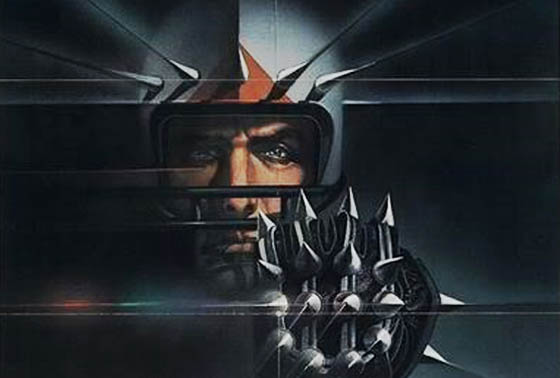
One of the advantages of age is added hues of golden 20/20 hindsight when discussing retro-futurism in movies and for me age doesn't factor into any retrofuturist film more than ROLLERBALL (1975). Today I finally actually watched the whole damned thing (it came on TCM), and understood it, and was thrilled by it in that low-key adultly 70s thrilled way. Why did it take me so long? There are reasons. Roll with me...


ROLLERBALL was a film that seemed to come across the TV quite a lot when I was a child but frankly it seemed far too adult for me to understand and I didn't need a film to tell me football was a violent, icky business. Why bother criticizing our penchant for media violence with more violence? To know the answer you must understand the 70s, the last decade before cable TV and the VCR changed the fabric of American life. Prior to then there were only three major networks, plus PBS and a few local stations on the UHF antenna, and most of them signed off around four AM with the Star Spangled Banner. Football would dominate the ratings any night it was on. Everyone in the family almost had no other choice but to watch it--especially if the principal breadwinner (the dad) called the TV shots-- and because it was so universal it developed a dirty kind of bourgeois cache it doesn't have anymore. It became shared culture across all classes, ages, temperaments. Once families had two TVs, VHS and cable, only the dads stuck around. The intelligentsia moved upstairs to the other TV. Suddenly ROLLERBALL had no choir left to preach to.

And anyway, it was hard to understand the appeal of both football and ROLLERBALL on analog (square) TV, no matter how big the tube. Unless the TV was huge and your eyes 20/20 you had to take their word for it there was even a ball down there. Now they put a digital yellow line to mark first down and with the big HD widescreen even I can finally enjoy it. But back in the day, sports movies and sports action was hard to keep track of, just a lot of 'half images,' and the 'editing for television' endured by the raucous (R-rated) sports movies further abstracted the story into oblivion.

In short, TV was no place for ROLLERBALL. If you wanted the real flavor of caustic satire about the NFL and glorification of macho violence, you needed to get a babysitter and go out to the cinema, the R-rated adult-aimed 'mature' cinema. Little kids like me would have to hear what it was all about second hand, by kids who'd overheard their parents talking to other parents about it.

But today I salute the sports movies of the 70s. They were wild, woolly, untamed, sexual, manic, a bit thuggish but also warm-hearted, loyal, shaggy, and drunk off their asses. Nowadays guys get kicked off the team for so much as a single toke of weed. What the fuck is the point? In the 70s, they would have pissed on your shoes before they pissed in your cup.

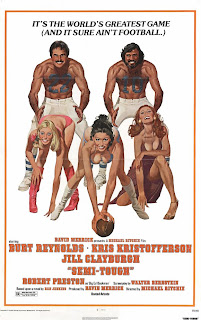
Perhaps the ball got rolling thanks to one of the big novels of the era: a savage insider tale of drugs, sex, and violence in the NFL called NORTH DALLAS FORTY, which in 1979 was made into a very popular movie with Nick Nolte-- then a young hunk who'd rose to fame via an early mini-series called RICH MAN POOR MAN (1976 - above right). Nolte wore a big 'stache in NORTH DALLS FORTY like Burt Reynolds, then the #1 box office star in the country thanks to the huge popularity of SMOKEY AND THE BANDIT (also 1976), which singlehandedly launched a craze for all things trucker-related: CB radios, diners, cowboy boots, biker bar brawls, convoys, sexy hitchhikers, jugs and speed.

smoking! today that would be a thousand dollar fine
Now I can re-examine these films from time's sweet retro distance and what I especially find healthy about NORTH DALLAS FORTY-driven sports satire popularity is the irreverent amount of sex and drugs involved vs. the sanctimonious, sober, overcoming-all-odds feel-good sober tedium in today's editions. Burt Reynolds' roster of characters may have been smarmy shitkickers at times but they were goddamned men. Even the kids got a version of this 'fuck you to niceness' in our own sports satire, BAD NEWS BEARS (also 1976).

Semi-Tough
While these kind of off-the-cuff sports films weren't necessarily critically acclaimed, they were beloved by many parents I knew (parents were younger then): they had broad, causal performances, tough locker room bonding, drug-induced hotel smashing, and Jack Warden as a weary coach going up against shadowy team owners who would do anything necessary to pack the stadiums, including pumping so much cocaine into their star quarterback he could keep playing even on a broken leg.

But for ROLLERBALL, director Norman Jewison is clearly aiming for something loftier. Jeff Kuykendall theorizes Jewison was trying to ape Stanley Kubrick and turn the film into a kind of Clockwork Football:
The problem here is that one could simply summarize the premise of the film, and the message would be inherent: society craves violence and leans toward corruption. The result is a film which is frequently pretentious: grasping at profundity and failing to glance it. Death Race 2000, directed by Paul Bartel and released the same year, ironically succeeds where Rollerball fails, tackling almost the exact same story but delivering it with such over-the-top violence and comedy that the whole achieves the sublime (and on a Roger Corman budget). Perhaps Jewison should have let go of the Kubrick approach; though it’s fascinating to see what happened when John Boorman took the exact same tack for the even-more-ridiculous Zardoz. - Jeff Kuykendall - Midnight Only


So sports movies were the rage along with car chase movies and truckers, in the mid-70s: aside from SEMI-TOUGH and NORTH DALLAS FORTY there was the tangentially-related BLACK SUNDAY (1977 - terrorist blimp attack at the Super Bowl); TWO-MINUTE WARNING (1976- assassin at the super bowl); SLAP-SHOT (1977 - brawling bespectacled brothers in hockey, below); BAD NEWS BEARS (1976 -smoking, beer-drinking, cursing in little league); THE LONGEST YARD (1974- prison football team); hell, even M*A*S*H (1969, but popular in the 70s) had a football game to satirize America's love of bloodsport.


And you can see the fundamental difference between today's and yesterday's sports movies with the remakes: The remake of BEARS loses the bulk of the profanity, smoking and drinking (so I hear), which mind you in the original was done by the kids; boy-man Adam Sandler replaces macho man Burt Reynolds in the remake of YARD; the remake of ROLELRBALL is a co-ed affair set more or less in the modern era on a sleazy Eastern European underground circuit, because America is so PC it's out of touch with good old bloodsport so they have to go where life is still cheap. The nanny state mentality makes it far less likely the heroes will bed numerous hotties and snort coke and shoot up steroids and more likely to cry at the bedsides of little dying kids, or scrape themselves up from poor neighborhoods, watched over by magical sober godparents. You know, like they did in the 40s, with the Catholic Legion of Decency breathing down their necks. What's our excuse?

In the 70s, you had games like this:


ROLLERBALL came out before both BAD NEWS BEARS and SEMI-TOUGH, but then again it's 'futuristic' and so is both ahead of the times as well as, now, behind them. Set in 2018, a lot of 'BALL's tropes have come true -- Caan pops in something between a DVD and an old mini-disc to watch home movies.... right there on the TV! In 1975! How did they know? And there's something like a TIVO and at one point Ralph Richardson kicks a big console computer intelligence that talks like a male version of Siri. And all the books ever written have been loaded into the computer-- though instead of being released as Kindle files they're summarized, i.e. stripped of any offending content or ideas that might run counter to the edicts of the shadowy ruling corporation and everyone knows that, um, today shadowy corporations don't control um... us.

But Jewison's 2018 is still a land without cellular technology and digital circuits so it's not that ahead of itself. They're still using punch cards and reel-to-reels and everything's huge and clunky. In the real future we get rid of all that heavy stuff, but keep the Ultimate Fighting Championship.  Roll, baby!


In between the violent sports games, John Houseman lurks and makes grim decisions on behalf of his shadowy corporation not unlike our own Dick Cheney. There's a decadent party where jet set kids blow up the last few surviving trees for sport. And everyone pops these things that come in little Sucrets-style boxes that makes people totally wasted. And like in SOYLENT GREEN, women have been reduced to chattel. James Caan is first given Maud Adams as a wife but then some high ladder salaryman whisks her away and Caan's pretty bent out of shape over it so won't retire when Houseman leans on him. Seems Caan's lone warrior rep is conflicting with the corporation's idea of the game as showing the importance of a group effort (i.e. a North Korean-style halftime show). They keep upping the violence quotient of the game namely to get him killed so his impudence doesn't go unpunished.


As tough a warrior as he is, you can tell Caan's not very bright; he's like the kid who'd rather kill all his friends than let them play while he has to go into dinner. He mopes around at libraries and computer desks trying to get some books about the corporations but none are forthcoming. He really can't understand the motives of the corporation! He's too OLD! Dude, why can't they just say it to his face. Caan's kind of grandiose behavior wouldn't fly in Hollywood no matter how many millions he was worth.

And then Rebecca Romjin (left) in sexy pads in the remake lets us know that now the future is much less macho; it's also tied in with the Twitter generation so that the bad guys can watch their stocks in the franchise rise in value with every kill that happens live on TV. Yeesh!

So what does it all mean. Yes, the original film is still pretty boring so I'm proud I managed to get through it yesterday, partly due to nostalgia and the new widescreen HD TV I got making it easy to keep my eyes on the ball. In honor of my violist dad I also constantly mentioned aloud the names of all the classical music dirges being played by Andre Previn's orchestra on the soundtrack. Also, my subsequent drug experience allowed me to understand the goofy chilled-out attitudes of the partiers. No decade did decadent, spread-out party scenes like the 70s.

But most of all I liked the final ending, where we see Jonathan slowly skating around the corpse-strewn arena in a series of twisted freeze-frame close-ups, his face unrecognizably distorted, as if all the violence and death around him was something he'd been waiting for all this time, so he could devolve into a rabid subhuman pixelated blur. This is a man who will always be the last one standing, a veritable reverse Horatio, holding the Hamlet head of dystopia in his hands as it dies, but then morphing into Roy Batty crushing the skull of his maker.

Trouble is, nothing's ventured or gained in ROLLERBALL, just the struggles of an innocent corporation's TV ratings as an ancient prima donna tries to keep playing a young man's game. Based on the level of drug-free helicopter hovering over today's athletes, the corporate masters in ROLLERBALL seem now to be the good guys. As Houseman's shadowy corporate ruler notes of Caan's mustached sidekick after the opening game, "You rolled, you really rolled." He sure did. Houseman may be the ostensible villain, but hey - he likes a good show. Anyone try to roll like that now, boom! Tested positive for MDMA and out of the game! I say a corporation that doles out drugs and applauds all the things they profess to loathe is A-OK with me. So roll on, Big Daddy, roll on! You may have been druggy and sinister but you were part of that last gasp of the era wherein parents were allowed to be raunchy, excessive and mature at the same time. Now we don't even know how to spell half those words.

Related Posts Plugin for WordPress, Blogger...