Showing posts with label Cannibalism. Show all posts

Sunday, November 30, 2014

The Ancient She-Shaman and her Shrooming Exhumer: SZAMANKA


The American holiday trifecta has already passed its first hurtle, Thanksgiving. Now the sluggish traffic and unruly Wal-Mart tazing begins in earnest and a skittish mummified shamanic Pisces like me turns naturally inward, for movies are the best way to avoid holiday shopping lines. All those commercials that try so hard to become a patronizing life coach for Americans, using the "we" not to mean their company but you the viewer + them, united: "we don't settle for anything less," and "we're always pushing just a little further" like they already know you, like David Manners telling Mina "we're going to forget all about these dreams, and think of something cheerful, aren't we?" in DRACULA (1931), or a narc would if he suddenly appeared at the edge of your druggy circle trying to imply he's always been part of your inside clique. But "we're" going stay inside, like an urban hermit, and savor the poison path, the peaceful darkness of the amniotic sac couch bog. One century soon, some decadent Warsaw university students will dig us up and put us in a nice preservative solution isolation tank. Rummaging through our fanny pack he'll find our secret stash of mushrooms both psilocybe and 'flybane' (i.e. fly agaric or Amanita Muscaria) and then eat them, so he can bond with us, and we'll warn him about the crazy woman fixing to devour his soul, SZAMANKA (or She-Shaman) is her name... and like so many hot girls in cold climates, she's fucking crazy. She's the one who killed us!

 (PS - All the collages in this post are made by me - so don't expect to see them in the actual film, I was just trying to help clarify the madness a little bit, on Zulawski's behalf, by throwing in some druggy Polish film stills with Bosch 'n shrooms hallucinations)

Speaking of shrooms: amanita muscaria are currently legal, and it's easy to see why if you ever tried them --they're gross. Too many can make you feel poisoned, not enough can make you feel like you're not getting off - and just the right amount gets the colors enhanced and the sweaty glow feeling of being connected to the world, but they also make that world smell like urine. You're supposed to drink your urine once they 'pass' through you, and then you get really high - but no thanks, bro. I have yet to do that, so can't comment. Maybe they were better in Poland or Siberia, 2,500 years ago, when the locals noticed the reindeer rummaging through the snow for them, wolfing them down and getting drunken crazy on them (apparently they used to drink the reindeer urine, which---I guess makes it all right? (Who was the first laplander who figured that out? "Dude, I was drinking reindeer urine, you know, like always, and I suddenly noticed...").

Either way, age has not diminished their power: a few thousand years in the bog and the anthropologist, played by Boguslaw Linda in SZAMANKA still gets off on them (literally and figuratively). But he learns the hard way: once you've submitted to the full stripping away of persona layers, divested yourself of all attachment, unmade the trappings of self, remembered your own birth, bathed in the white light of pure love, and forgiven everyone everywhere, then what? Life goes on without you. No one gets where you're coming from, or quite buys your mystic conversion. Your fiancee thinks you're nuts, and the people who do get your message, who feel the same cosmic light, are gross. They wear sandals and patchouli and eat too much garlic and look anemic from not eating meat. "We" sure don't want to hang out with them, too often.

So we turn to the nest of sweet isolation, a few cool cats to cuddle with, and an endless supply of DVDs. There's so much great trippy shit out there. No matter how 'gone' we get, Chile's Alejandro Jodorowsky, America's David Lynch, and Poland's Andrzej Zulawski can always guide us in a holding pattern 'til the rest of the world slowly catches up and we sink down into the post-Thanksgiving depths of Mordor Xmas. To that end, we save SZAMANKA for when we're delirious or have been in the cave so long we've forgotten there's even an outdoors. Zulawski doesn't even need to show us anyone actually taking the drugs. The shit's in the celluloid.


I first discussed Zulawski's SZAMANKA in conjunction with Carrie Matheson and Claire Forlan's awesome Dewar's ad while back in November of 2012, during that previously discussed enlightenment breakthrough awareness state I wrote "from boxes heart-shaped shapelessness, bags tossed as rubbish into the Warsaw mud, flown, Angus, darlin' - rather, a punk-en down Dalle Betty Blue-blackened bird spazzing through anthropology classes as her lover pilfers thousand year-old psilocybe and Amanita Muscaria mushrooms from a mummified shaman's pockets. Each wodka shot or peanut butter-covered stem tracking each punch and drunken stumble dream pie like meth and coveralls to grinding mechanical factory sex atop crumbling swamp corpse; grinding academics in their dancing and beer spillage and moving far away from the needle tip distance twixt the ancient fungal shaman's last expression train down through more more the turn style jumps, coiffed, jumps back through and gay references hurtled like Jack Benny's Polish theater troupe, bombed and built anew under which in the shelter Zulawski slept as a child. (more)


I don't remember writing that and I'm miles away from that galactic alignment euphoria, but I dig my crazy jive poetry as if it's from a long lost twin. I'm finding references to everything from T.S. Eliot to SULLIVAN'S TRAVELS to the obscure Lou Reed song, "Billy." But I wouldn't write like that again if I could. I'm too jaded. I was on a holy fool pre-apocalyptic role back this time in 2012, as seen in The Scrooge Satori, all without a single mushroom, And I would never have made the TO BE OR NOT TO BE connection in my current cave-bound form. Yet when else is a Polish theater troupe the main character of a comedy film set and shot in 1942 Hollywood?

Before you answer, quick imagine Roman Polanski urchins skittering through the Warsaw sewers while Germans shell the city above and Russians wait on the outskirts, until the Resistance is wiped out, so they can step in an Iron Curtain the place. What a bum deal. Poland gets screwed double, so who can blame them for being depressed? A little urine.... clears them of this deed.


Am I going somewhere with this, as some ancient astronaut theorists believe? Shamans are waiting for you to exhume their ancient stashes! Did you hear in the news that a 747 recently crashed in a cemetery in Poland? The Polish officials have so far retrieved 2,000 bodies! (1)

SZAMANKA (1994), aka SHE-SHAMAN, is one of them. Great judicious synthesizers underwrite Andrzej Zulawski's uber-bizarre panic movement-ish meditation on the nature of primitivism, Neanderthal train sex momentum, insanity, eating brains to gain that person's knowledge, and the lack of mores or coherence in 90s Warsaw. And the script was written by a woman! Manuela Gretowska co-founded the Polish Women's Party and ran for office... So best believe it's way darker sexually than even Zulawski would normally go. But thanks to his own 'maturer' madness, he makes a pretty good movie around it, way better than that punk Jean-Pierre Leaud was making in LAST TANGO IN PARIS (below, overlaid by me with a Bosch detail for easy decoding).


I mention this because Zulawski and Gretowska clearly know SZAMANKA is a lot like LAST TANGO IN PARIS, and that star Iwona Petry looks and foams at the mouth like Beatrice Dalle in BETTY BLUE which lest we forget ends with Dalle going totally crazy, getting electroshock, and winding up smothered with a pillow by the man who loves her ala saucy Jack in CUCKOO'S NEST. As with Bertolucci's film, Zulawski's crazy roving camera chases sexy nutcase Petry, running everywhere--onto trains, off of trains--upstairs and down--and at times there's obscene perverse men leering from every corner and it begins to almost seem like some perverse sexual nightmare. Fat bugs, these men are ready for the maw of a Kali mantis like Beatrice Dalle's in her holy trifecta - BETTY BLUE, TROUBLE EVERY DAY, and INSIDE.   One of her anthropologist lover's pals notes of her weird behavior that some people are "God's fools, with souls so big there's no room for brains," Iwona Petry's character is known as "the Italian" but is at least smart enough to realize they're talking about her, and to knock over their table accordingly. So while Boguslaw Linda goes on his lecture, she's illustrating his tales of Neanderthal shamanism by mouthing a display case and "careening through the streets of Warszawa like a culturally inept marathon runner who's afraid of clowns" (2). While he pursues a doctorate in medicine, she's studying engineering at the same school, so it's a metaphor to the division of labor and culture in Poland, and of woman's sexuality as something so archaically Precambrian as to devour the entirety of Apollonian civilization in a single sparagmosticated brain bite.

Her hotness making her a one-woman cliff for Warszawa's lemming males, it's as if she's constantly trying to keep them at bay by behaving in a way that turns even the staunchest stomach: she foams at the mouth, eats cat food out of her landlady's cat dish, and in short behaves like a proper panic movement-era primal screen actress, which means undergoing convulsions like one does on, say, too way way way WAY WAYyyy way too much acid. Four times what you usually take, I guess, is enough to get you to that level of walking down the middle of the street with no pants on, screaming at the top of your lungs, each root of hair in your scalp tingling like fiberoptic tendrils pummeling signals from every web string of time and space, sensory impression magnified to the point of distortion, contradicting the other impressions, coming into your brain past your normal blinders and defenses, so that you literally hear your own thoughts talk to you in the roar of a passing truck or the bark of a dog. In case you can't tell, I've been there: everyone you see looks like melting Cubist seventh dimensional sculptures, all laden with pulsing blood just millimeters from the surface. And it goes on like that for upwards of six hours (or if on DOM or STP, up to 36 hours). The only salvation is benzos, or whiskey... lots and lots, like a bull rhinoceros popping Ketamine in a vain attempt to put yourself under while being slowly fed through a paper shredder. Sometimes open mouth kissing display cases, salting your clothes, peppering your hair and spraying perfume on your lettuce, will at least help you break free from the normal behaviors of your social and cultural position, behaviors now revealed to be little more than straitjackets pulled past suffocation tightness.

this is your brain on drugs


Zulawski's been there, too. Petry and Linda know all the tricks, and maybe so has Gretowska, I'd imagine, because in SZAMANKA even engineering lectures weld sexual-reproductive organs on to the curriculum in ways that would probably blow Cronenberg's mind.
"Zulawski said the animus inspired by his film was mainly directed at his uninhibited actress. The press “hated her and destroyed her, and she disappeared.” He has not made another movie in Poland since: “This country is still in the Middle Ages.” - J. Hoberman NY Times March 2nd, 2012 (my birthday!)
Still in the Middle Ages. I agree, half of America is right there with them, and as Petry's performance is clearly meant to have a certain 'the whole Cro-Magnon Thing passed my evolution by" -style idiot savant savage ambivalence, she's a living contradiction to everything the Texas Board of Education--and by weird extension the International Film Critics Circle-- holds dear, he said, reading aloud from his notebook while running it under water in the sink, then dripping the blue inky runoff all over her naked body. Clearly, he (Boguslaw Linda) is tripping balls. But it's for science! And he doesn't need a frickin' medical research hothead like Charles Haid (in ALTERED STATES) or a creep like Bruce Dern (in THE TRIP) as a 'guide,' in fact Zulawski doesn't even feel the movie needs a shot of him actually taking the mushrooms. He's just suddenly on them, and we're left to guess how many he took or how long ago or which kind. He doesn't even need to mention reasons at first that his doctoral thesis is going to be an attempt to locate the ancient shamanic spirit within modern paranoid schizophrenics, realizing that "drugs, hunger, danger, darkness" -the constants of life in the dark ages--kept these primitive humans in a paranoid schizophrenic state 24/7. In other words, they were all the time, like most of us only are when tripping. To prove this point, Boguslaw starts slowly devolving along the same lines, craving that mystical union via any ceremonial sex magic or 2,500 year old mushrooms he can find. 


In that sense, no one does it quite as shamanistically correct as old Andrzej Zulawski. Jodorowsky is , by contrast, too bawdy-vulgar, Emir Kusturica too eccentric-whimsical, Lynch too straight, and Gilliam too bent. None are the types to take "fucking flybanes" at their science lab and pitch a doctoral thesis to their advisor and future father-in law while rolling around on the floor in the hospital chapel, to offer a unique fusion of the dramatic, forward-thinking, mystical, druggy, and socio-political all without whimsy, vulgarity, weird-for-weird's sake-ism, or any semblance of humor... or drama...

Maybe Poles, stuck in those Middle Ages, just don't give a fuck. They sidestep altogether the things that trip up America--for all its talk of freedom--in unhackable tendrils of churchy censorship and the compulsive need to to exposit onto the rubes. These students don't need to worry about narcs or rubes -- due to the joys of free socialist education, all are educated, and all hate the government. If they find some shrooms in the ancient pocket of the exhumed shaman, they're going to do them. And wait for the shaman in the dish to make the first move. And they're going to hide that they did them from even us, so you have to know what the signs are. And the signs are, apparently, indistinguishable from 'everyday' Warsaw life in the 1990s.

Dude, I've been on all sides of that equation, everyone except the mummified shaman. And that, according to my spirit guide, is what's waiting in fall 2015. Because let me tell you, without our space mushroom brothers as co-workers, we'll never get off this rock in any conveyance other than space ships. What's it gonna be, Hollywood? More big dollar-intensive conveyances just to wind up back with Jessica Chastain in the Pre-Raphaelite TREE OF LIFE shirt reflection, where we could have been all this time through some simple deep breathing meditation and/or a handful of nonlocal mushrooms?

these are Amanitas not psilocybe cubenses, but they're prettier


By the power of Terence McKenna, I hereby confirm that psychedelic mushrooms are standing by, ready to work hand-in-stamen with the next generation of psychonauts. The future's alien skies are limitless. Let the shrooms be your NASA and orbit is instantly transcended. Just first make it past the screaming terror breakwaters of your Scrooge tomb slab; breathe and pray your way past the hottie primitive from the Middle Ages eating your brain on drugs as it sizzles apart in the heated pan of pure consciousness; and the cancerous cops inside the marrow of your bones will melt away like dew in the desert.

On the other hand, maybe the dollar-intensive conveyances would be better, frozen forever 'til some far gone destination is arrived at, comfy in the couch-like peat bog of the 'old freezarino' in deep empty space, til the Boguslaw archeologist computer rifles our pockets and bids our mummy husks defrost. Alas, not even INTERSTELLAR sleep lasts forever. No matter how long they drag it out, the exhuming from the bog of cine-dream will inevitably occur, and one will wake up to house lights and the terror of an empty screen, once more reflecting like a DOS prompt on your empty helmet. Fucking flyboys...


NOTES.
1. Old Polish JokeS
2. The great Yum-Yum, House of Self Indulgence (5/30/13)
3. i.e. the Warsaw-set WW2 comedy thriller To Be or Not to Be

Wednesday, November 16, 2011

Pre-Code Capsules 9: BEHIND THE MASK, DR. X, TROUBLE IN PARADISE, BLESSED EVENT, THE BLUE ANGEL

BEHIND THE MASK
(1932) Dir. Francis Dillon
***
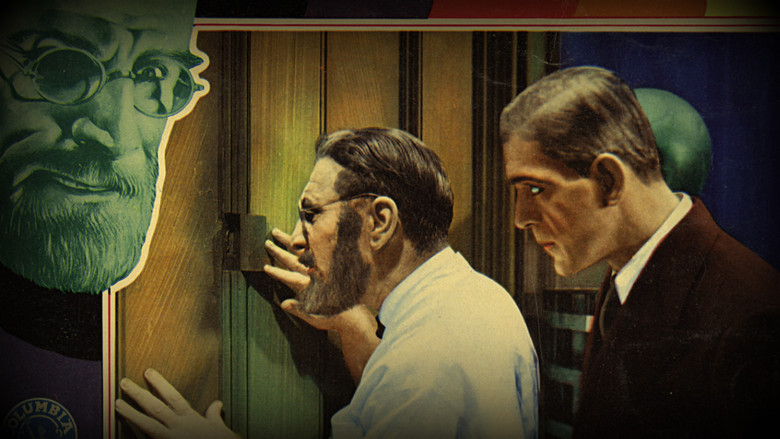
The great forgotten Jack Holt (Tim's dad) plays a terrible federal agent in this pulpy thriller. Endangering his witnesses and letting himself be snowed over by any old disguise or pretense, Jack's saving trait is a masochistic yen for deep undercover work, enduring a stint in jail and posing as a convict just so he can win the trust of nervous flunky Boris Karloff and thus can score a job in a racket that hides dope in caskets and is masterminded by a shadowy doctor. Edward Everett-Sloan factors in somewhere and there's a vast spy network full of dark-eyed bit players. Constance Cummings tries to save her dad, a doctor in 'a lot of trouble' and she's capable with a .45, which is a switch for these things.

It all climaxes in a scene where the masked evil doctor makes a great show of refusing to give the tied-down Holt anesthetic for a planned vivisection, because he wants him to experience the magic moment when excruciating pain becomes ecstasy. Batailles-esque philosophy and dimestore pulp come together within the casting confines of the Universal horror stock company! But it's not until the last five minutes that it approaches the cock-eyed madness of any five minutes of DR. X (1933). Before then, well, coincidence and imbecility, the foundations of any hack job adventure tale, reign supreme. Lots of cool atmosphere though, via NOTORIOUS cinematographer Ted Tezlaff.

BLESSED EVENT
1932 - Dir Roy Del Ruth
***1/2

If you've been always a bit cold on Lee Tracy (as I have been for many years) this is the film that will make you warm up. As the quintessential fast-talking brutally candid gossip columnist, he's like Jimmy Cagney crossed with an adenoidal scarecrow, singlehandedly ushering in a new low in journalism via the ratting out of 'blessed events' - i.e. children born less than nine months after the couple's been married, or outside of wedlock, or etc. Remember when that was a scandal? Me neither. But Tracy sure does wreck a number of lives. In a staggeringly well-played monologue he scares off Allen Jenkins' mob hitman by telling him about an electric chair execution he witnessed; he's so good he brings Barrymore in TWENTIETH CENTURY to mind, his imitation of the wobbly walk to the chamber, voice cracking with hysteria, body spazzing sharp and speed freak-jerky as he describes the anguish of waiting in hopes of  a reprieve, the shaky steps of the last mile, puking up the last meal, the rigor mortis and hair burning. It's the sort of thing that only the pre-codes could delve into, and this delves so deep you're quaking along with Jenkins by the end, and all traces of your dislike of Tracy have been obliterated.

Roy Del Ruth directed and the rapid patter pace is awesome except when Dick Powell's lame songs slow things down. Edwin Maxwell, Ned Sparks, Frank McHugh, Allen Jenkins, Ruth Donnelly, Jack La Rue, and Rita Cunningham all bring plenty of moxy too as either Tracy's cronies or victims. There are references to Jews, ("Do you know many Jews there are in New York?" - "Oh, dozens!"), Amos and Andy, and a wild-eyed girl 'in trouble' begging for a reprieve from Tracy's damning pen. Played with deranged ferocity and desperation by a ragged-looking creature named Isabell Jewell (left), she's pretty unforgettable. It all coheres into a whipsmack pre-code that makes your scalp stand on end. PS - You will also come out of this film learning what 'nadir' means, and may have a hard time readjusting to the dumb hack substitute for 'wit' passing as dialogue elsewhere in the world.

TROUBLE IN PARADISE
1932 - Dir Ernst Lubitsch
****

It took awhile for this pre-code Paramount to resonate with me, but now I dig that it doesn't 'Americanize' the dialogue like so many lazier Hollywood films, instead playing up the linguistic difficulties where everyone in Europe is constantly searching for the one language each of them knows just a little bit of, as in the excited way the Italian hotelier translates E.E. Horton's story of how he got robbed in his room and how this Babel effect makes a suave all surface crook get away with tons of goods.

Many viewings later I love the elaborate conveyance of gossip, so that Miriam Hopkins is getting verification requests from duchesses mere minutes after being spotted in the lobby of her lover by a nosy count. (and it's all rot, of course). While Herbert Marshall isn't Cary Grant, or Melvyn Douglas, or even Ronald Coleman, he swoons well and convinces you through two layers of subterfuge that he's genuinely confident in his sexuality, and genuinely in love with the moon (he wants to see it reflected in champagne) and the women around him are each more beautiful than that moon.

And who wouldn't be in love with both Hopkins and rich perfumier Kay Francis? Hopkins displays her wide, loose midsection proudly in some tight-clinging dresses--she "moves from the center of her cunt," as old Jill Parsons used to say--and I love the way their first kiss on the couch seems to make them slowly dissolve until the couch is empty; and Francis is at her most glamorous and poised, even while maintaining some of the concave androgyne aura she had in earlier films like THE COCOANUTS (1929). As always, Edward Everett Horton and Charlie Ruggles are effete, bitchy suitors; Gustav Von Seffeyritz  humbugs as the chairman of the board who suspects Marshall is a crook. But who would be able to resist robbing Kay Francis?

THE BLUE ANGEL
1930 - Dir Josef von Sternberg
***

BLUE ANGEL might best be understood as the chrysalis between the caterpillar of the silent era's 'deformed circus freak loves pretty trapeze artist' Lon Chaney Sr. plot boilerplate (which Acidemic contributor Budd Wilkins has termed the "masochistic melodrama" genre. See his fine Chaney reviews here) and the sound era pre-code butterfly of the Hollywood Sternberg-Dietrich collaborations. As such it's neither here nor there, like watching Wallace Beery get stuck in the doghouse door trying to sneak out of the cast of MGM's FREAKS to defect to Paramount (though in truth, he went the reverse direction).

Either way, Emil Jannings is a damn unsightly kind of creepy crawler, way uglier and uncharismatic than Beery ever was, and it's clear Sternberg can't stand him, so rather than stir our sympathy, Jannings' out-maneuvered Herr Professor inspires nothing but disdain. His smug judgment of Lola and her postcards (which he finds in his student's schoolbooks) makes his downward spiral far less interesting; his slow motion expressionist pantomime reaches for grand tragedy in a way that makes you think Chaney is down to his last few faces. With his bug-eyed outraged head facing the camera from the same angle over and over, his round glasses and Satanic facial hair swirling, Jannings works very hard at keeping his head always in the center of the frame while his body twists and turns like a big old bug caught in a spider web. But to what effect? Nevah vanted doo.


Shot in Weimar Germany just before her Paramount-ordered nose job, molar removal, and strict diet, the Dietrich we see here could be her own sister, the one who stayed in Berlin mit die schwarzwaldkuchen und bier. And partied with (eventually) real-life Nazi Jannings. But Von Sternberg is in fine form; he lights the Blue Angel club like a crazy expressionist side show and if you focus in on the lighting and shadows as opposed to Jannings mug, it definitely does become the masterpiece so many claim.

Still, more than in any subsequent films, Sternberg's masochism in DER BLAU ENGEL is a downer. Always portraying the suitors of his lovely star Dietrich as buffoons, bug-eyed blowhards, shameless masochists, or authoritarian bullies (or else they rarely speak at all and operate as sex objects themselves, like Gary Cooper in MOROCCO), Von Sternberg's obsessions can sometimes make his films feel like a jealous, angry lover is behind the camera, defacing effigies of his rivals even as his studio bosses insist he cast them (Cooper was one of Dietrich's many lovers). One would normally say of a Paramount pre-code that it's fun and a little sleazy but is it art? But in DER BLAU ENGEL we know it's art, and it's sleazy, but is it fun?  Nein!

Doctor X
1933 -Dir Michael Curtiz
***1/2

Time and digital re-colorization has been kind to the early Technicolor hues of DR. X. What used to look blurry and muddy and depressing now glitters with glowing emeralds, murky pinks and streaks of deep, bloody red that make it like a candy fountain of shadowy death. Fay Wray plays the daughter of Lionel Atwill, hamming fit to storm a barn as the titular Dr. Xavier, out to trap the "full moon killer" amongst his atmospherically-lighted collection of scientific colleagues, each of whom grows more indignant and suspicious the longer we hang out in their labs: Dr. Welles has made a 'study' of cannibalism and keeps a heart alive in an 'electrolysis solution' but his missing arm preempts further suspicion; Dr. Haines was shipwrecked for years on a desert island and his tasty, plump colleague was "never found"; Dr. Rowen studies lunar rays' effects on criminal minds but notes that "the lunar rays will never effect you and me, sir, because we are 'normal' people." Mmm...hm.


And dig the post-modern self-reflexivity of the the climax, with the doctors all chained to their chairs, their pulses linked to vials of blood that overflow like a buzzer at the top of a Coney Island strength tester when they're aroused by the murder tableaux staged before them, just like you in the audience! Scream ladies and gentlemen! The Tingler is in this theater!  The duality inherent in language gets a lot of subliminal attention too: Xavier's outrage over each of the new accusations of his colleagues belies its antithesis: "Dr. Rowen could never never be the guilty one," means the opposite, while Lee Tracy regularly promises not to do something as he bribes morgue attendants and security guards to look the other way. On the other hand, Xavier's grave pronouncements of things like "There can be no doubt about it, gentlemen - this is cannibalism!" are allowed no argument since they carry his medical weight. And now that you're not annoyed by Lee Tracy anymore (see BLESSED EVENT) maybe you wont want to tear his picture apart with your bare hands when you learn he gets Fay Wray in the end. Chained for your own amusement, indeed.

Monday, March 14, 2011

Hey Betty Blue, Come Blow Your Mind!


Beatrice Dalle: few other women have created such affectionately crazy characters. And I don't mean affectionately crazy like rom-com Sandra Bullock tangled up in wedding dress crazy, I mean batshit tear your jugular vein out with her teeth while on top of you in bed crazy. That she can make such terrifying characters affectionate attests to her charisma and fearlessness; she's like Asia Argento's SCARLET DIVA with a mild case of rabies. She is, all the time, what Courtney Love used to be, at key drunken moments (not a dig, I love Love), and Angelina Jolie before she got Sean Penn philanthropic  by which I mean, that precious moment when you're neither boring/shy nor boorish/belligerent, when you're awash in the mystic formula of fierceness. Dalle stayed fierce. She found the fountain from whence that fierce formula flows. She's the hot female version of Robert Mitchum in CAPE FEAR or Brando in STREETCAR. She's berserk so you don't have to be. It's okay to be turned on even as you're running for your life. And you better run. 

She's played in many films, in many different but distinctly Dalle roles, but there are three unforgettable movies that, taken together, circumscribe a 20 year devolution of her screen persona:  BETTY BLUE (1986), TROUBLE EVERY DAY (2001) and INSIDE (2007). Taken together they form a loose, unofficial 21 year trilogy of taboo-busting French cinema wherein our heroine evolves from bi-polar sexually ravenous waif (BETTY) to batshit cannibal nymphomaniac (TROUBLE) to full-on female Michael Meyers / Jason unstoppable Kali womb ripper (INSIDE). Let's slow down and delve!

Blue kind of retro-actively launched the whole 'quirky comi-tragedy with casual nudity and sometimes random violence" French post-Rohmer subgenre; Trouble took the always popular vampire myth to its bloody extreme end, Gallic-style; and Inside fit the torture-porn mold of the late 00s if transposed to do-or-die agonies of childbirth and child envy. What's interesting is the way the movies are separate -- different directors, scripts, etc.--but Dalle plays the three in a way that can be read as a cohesive arc: character threads left unresolved in Betty continue through to complete homicidal psychopathology in Inside, the way RED kind of wound up the threads of WHITE and BLUE in Krzysztof Kieslowski's Three Colors trilogy.

And what a hell of a journey because, you see, this actress needs no makeup our double to be terrifying: she's got those teeth!


One thing our own Hollywood heroines never seem to have is scary teeth. This sad truth compromised the rawness of Rob Zombie's DEVIL'S REJECTS (2007) for example, with its scuzzy Manson family cannibals flashing top notch orthodontics, and--for a couple of them--voices lacking the deepening effect of decades of cigarette and meth smoke, i.e. thin and tinny (Sid Haig being of course the golden exception). See, in America our teeth are either perfect or godawful based on our parent's health plans or lack thereof; there is little in-between the have-braces and have-nots; the rich get even their minor imperfections sealed over and whitened; the poor can only watch in the mirror as their incisors and bicuspids overlap and twist sideways. With socialized medicine however, the very-crooked get fixed to merely crooked; the merely slightly crooked is good enough for the state, so deal. Dalle's lupine chompers are definitely in this unique, disturbing but not unsexy median; she is a truly brave actress and sexpot for not wanting to hide them. Their dark crooked contours especially shine in all their H.R. Giger glory in TROUBLE: hers are the castrating incisors that squeamish last-minute castration cop-out films like TEETH and HARD CANDY boast of, but are scared to deliver even on rapists (both films resort to a JK-sew it back on-kinda cop-out at the last minute). 

Dalle doesn't need a reason to kill or castrate, it just comes naturally. Thus her crazy sexual frenzy in TROUBLE EVERY DAY is truly terrifying and sexy at the same time, putting the softcore sleaze of BASIC INSTINCT's ice pick murders to shame. The guy she eviscerates in TROUBLE isn't even that bad of a guy, just broke into the wrong house and didn't run when he had the chance, not unlike the poor string of sods falling victim to doe-eyed Marilyn Chambers in RABID. 

I came the long way around to BETTY BLUE in early 1991. I rented it on the advice of a hot chick I was after, thinking me talking about it would win her heart. It was my first time actually renting a movie with subtitles that I didn't have to for a class. Now of course it's no problem, but you may remember that back then they were hard to read on VHS (sometimes they were just cut halfway off by the bottom or where faded white-on-white lettering?) But - a strong gin and tonic and 20 minutes past the credits, I fell 'in love' with BETTY. After hitting my third or fourth drink of the morning--felt like I understood the French! By the halfway point, I was ready to fight to defend this crazy sexy movie. I wanted someone to come along and denigrate it so I could rush to its defense. I swooned for Beatrice, I even had a mancrush on Jean-Hughes Anglade! I balled my fists, drunkenly enamored of them both, and the two friends they make and drink tequila rapidos with, crying over their absence, and the melancholy perfection of their piano duet. It was like I had fallen in love with a movie as a collective person, a person who couldn't walk straight or uncross her eyes, maybe, but if anyone made a wise crack I'd belt them one. Roger Ebert, for example, missed the point and thus decided everyone else missed the point, not him! Here's what he wrote about the film on Christmas Day in 1986:

 Oh Roger, with that snide sexist comment your back-end misogyny is laid bare (even his word choice gives him away). Imagine if I dismissed VERTIGO so snidely: "people say VERTIGO is about obsession, madness, and castration anxiety, but it's really just a San Francisco travelogue, coupled to occasional shots of handbags." Imagine how mad Roger would get!! Yet it's far truer than what he says about BETTY.

See? I'm still fighting to defend that film, and YET, though I bought the DVD some time ago I've never even watched it. Maybe it's because it's such a drunk binge movie to me. I sobbed over it while drinking so much it's almost like an ex-girlfriend whose photos I no longer want to look at. Having since moved from booze to SSRI meds, maudlin Vertigo-style moping, adieu! Even when I watched it all the time I'd quit after around the 2/3 way in, and start again, rather than watching it all fall apart. Too damn painful. 

Looking back, it was, I realized, the first subtitled foreign language film I really 'loved.' PERSONA and LA DOLCE VITA were both close seconds, but my love for them was like an undergrad English student's love for Shakespeare: trepidatious, intimidated, afield of my comfort zone, but armed by the knowledge if I could talk about them in the right company, I'd seem intellectual. If they were girlfriends, PERSONA would be that aloof beauty you end up heartbroken alone in your room over as she wanders off into the rainy dark to kill herself and wont let you follow. DOLCE is that party girl who stays up all the time doing coke and is ultimately shallow and cowed by Catholic guilt. BETTY on the other hand is the sexy girl you meet at a party and bring home and a week goes by before you realize she hasn't left, even to get her things--if she has any. And by the time you notice she hasn't even left, and try to stop fooling around long enough to think of an excuse why she needs to leave, she's clinging to you like a python and you're too hooked on her hotness to even resist when she crushes your rib cage or froths at the mouth from jealousy after opening your mail. 


As her patient lover, the maintenance man, aspiring writer and part-time house painter Zorg, Jean-Hugues Anglade in the film can't go unmentioned. He's no mere 'beard' the way he would later become when strugglin' with English as a French cop in films like MAXIMUM RISK (1996) or as the default boyfriend for LA FEMME NIKITA (1990). Perfect as a drunken writer who loves his manic muse to the point he can only shrug every time she starts smashing the furniture, frothing at the mouth, and torching buildings, giving us that classic "what can I do?" Parisian shrug may make us mad when we're ugly American tourists trying to get directions to the Louvre, but in the context of dealing with psycho girlfriends, well, it's genius. He's aware on some level it's only a movie, so the damage is just imagery - her hotness is the only real thing. 

I mention him because it's the lack of an Anglade in the later Dalle films that would signify the madness: Zorg would know when to walk away, know when to run, know when to commit to a sanitarium. Without him, Dalle runs amok and the dead bodies accrue. 

Like SPECIES later, BETTY BLUE was one of the films I would watch over and over during drunken week-long benders, and yet never see all the way to the end, either stopping or passing out beforehand, over and over - just as well. The only time I ever got to the end was when I was too drunk or half-asleep to change the channel. There's a reason for skipping both - SPECIES ends with a tour-de-force of crappy video game graphics; BLUE winds up aping the pillow snuffing end of CUCKOO'S NEST. As Larry Fishburne says to Chris Walken in King of New York, who wants to see you in a cage, man?

Better to black out before then, so you can wake up and re-binge to the giddy joy of the first half, when the pair hook up with a similar nutsy, drunk couple, Lisa (Consuelo De Haviland) and Eddy (Gerard Darmon) and spend many a fun night drinking, singing, joking about Alpha Romeos, and dancing around the apartment together in silk kimonos (below, opening them).


This kind of 'letting go' between two in-love couples is something that seems uniquely French. Americans never seem to get this loose unless there's a skeevy orgy vibe, or a sleazy 'mixed party' stereotype like the scene with Jane and her friend bringing those boors back from the bar in COMING HOME. Here the vibe isn't lewd like an American salesman out of town or sad like some Antonioni orgy; this quartet have already had sex, a lot of it, and it's not sleazy at all. They're just happy to have another couple to celebrate their post-orgasm glow with. Their sex is lived in, free of American-style moral hypocrisy: it's widened all four of their perspectives and their collective giddy gratitude is contagious. Dalle's 'behind' is sexy albeit deglamourized by a pair of ugly loose silk women's underwear; Anglade, nakedly trying to hammer apart a couch with a lit cigarette; their nudity is neither the airbrushed slickness of late night softcore or fuzzy banal Emmanuelle eurotrash, but a beautiful offhand slacker sexual deadpan freedom. Zorg and Betty are a couple that would never sit still for the slow seductions of Rohmer, but rather plunge through the world like crazy screaming brakes-off banshees - and yet not like the abstraction of Godard aping Gun Crazy or the noir fatalism of Truffaut or the airless youth worship of Araki or post-modern extremism of Oliver Stone's Natural Born Killers.  It's the camaraderie of Howard Hawks or Nicholas Ray, transposed to the joyously (but not tackily) sexual. You only realize what a rarity it is when you try to find it in other films. Or life.


Alas, it's sad it can't last even in the movies that convey it, those that divide the rush of joy at 'finding your tribe at long last' acceptance first half with a long downward spiral of overdosing, paranoia and cheap meth. We saw this a slew of late 90's and early 00's movies like BOOGIE NIGHTS (1997), TRAINSPOTTING (1996), MONSTER (2003), IT'S ALL GONE, PETE TONG (2004); and REQUIEM FOR A DREAM (2000) -- all very open about the highs and lows of drug use and the family bonding of a shared high --that fast white light upward blast of the first Friday night MDMA-twinkle and ending with the long slow downward death spiral that ends with crying in the office bathroom on Tuesday morning when the last few molecules of molly leave the brain and takes all your dopamine with it.  

If you were drinking the way I was, or just maudlin and 23 in a time before Prozac rose to prominence, it was the ultimate sorrow: 1990-1992 - the nights of fun with Eddy and Lisa were gone. My band broke up and college was over and there were no jobs and no weed (thanks, CAMP). The feeling was like you just got accepted by the cool kids and then the kids stopped being cool. It was rough. But thank god, the movies were there; Dalle howled a song to that roughness in its own language, like a Navajo code talker 


It's that sweet remembrance of things past that suffuses the rest of BETTY BLUE, and dies totally in Claire Denis' TROUBLE EVERY DAY. A glacial, mostly nonverbal film, offering no sense of joy or belonging, only the terror of imagining your own human carnal lust leading you to a grisly agonizing doom. Thematically (STD metaphor!) like Cronenberg's RABID and SHIVERS, you know Denis is going way farther into the nitty-gritty, to sordid, evil places that, for all his weird appendages and 'new flesh', a Canadian could never go) Being torn apart by a maniacal lover in a maenad ripping sexual frenzy, is something we don't usually see (outside of our imaginations watching SUDDENLY LAST SUMMER) Such a grisly union of eros and thanatos forces us as viewers into weird moral positions, like a game of Twister devised by a coked-up pope, as the slow and relentless tug of sexual desire drags lonely people to their deaths via a very long, snaking chain tied to an anchor above the Mariana Trench. We risk our lives every time we climb into bed with a stranger - but in some areas, the drive to procreate trumps even survival, not to mention our family and careers: midlife crises, film noir, and Beatrice Dalle.

A good parallel to TROUBLE is Paul Schrader's CAT PEOPLE remake, which--like TROUBLE--posits a disease or gene that makes people become animals after or during sex. However, with Schrader. these killings are kind of tepid; the sex is over before the transformation starts, so it comes off a bit tame (the panther strikes while the victim is lolling around in a post-coitus haze). None of that waiting around for Denis! The way Dalle continues to obliviously whisper and coo into her torn-to-shreds dead lovers' ears for example, links to her a real cat lady, the type tries to keep toying and torturing their lifeless prey long after its dead.

Such scenes are few and far between in horror films. They make producers uncomfortable because--to put it a meta way--they threaten the safety of their model of the cinemagoer as one already dead and presumed therefore impervious to attack. It's as if the image and the eye are tectonic plates and the idea of cinema is to promise contact--a rumbling and shaking--yet prevent any actual rupture of the concrete, no buckling or triggering of a massive modernist earthquake. In true post-cinematic Asia Argento / Samara fashion, Dalle's sexuality causes the simulacratic rupture of the screen, wherein the covetous eye of the viewer is torn out in a fit of enjoyment that transcends all textual boundaries. She's like a knife that springs out of the screen as soon as her image lures you close enough to draw blood.


Variously dismissed, panned or gushed over by the few who've seen it, TROUBLE never really explains itself, presuming we're familiar with the pantheon of vampire and werewolf movies of ye olden times. For example, we can deduce that Vince Gallo is a chemist of the WEREWOLF OF LONDON / Henry Hull variety, tracking down a rare plant extract cure for his lycanthropic/vampiric malady. Gallo's malady is unnamed, but clearly causes an increasingly unbearable urge to devour and rend, especially during and approaching orgasm. Denis cuts back and forth between Dalle's LET THE RIGHT ONE IN-style handler (as he foolishly leaves her alone long enough for her to lure a pair of boys into the house) and Gallo on his honeymoon in a Paris hotel, where his stalker-killer lust is transferred from the wife to the cute hotel maid who comes in every day to make the bed. Dalle has devolved farther along in the disease, to where she can barely talk and spends each night breaking out of the prison her handler keeps her in, each night heading to the same lonesome stretch of road where truckers apparently pull over for sex, and are soon pulled to pieces. We can't really blame her. It's just a natural impulse. 

Gallo and Dalle-- it's gradually revealed through incidental conversations--once had kind of a thing for each other while doing research together in Africa (where they presumably found the plant that afflicted them, thus linking this film to GANJA AND HESS!) and, as their paths look like they will intersect again, we brace ourselves for what the Netflix liner notes erroneously refer to as a joint killing-spree. It never comes. Denis lives to thwart narrative expectations. Sublime moments compensate: Gallo and his bride hanging out atop Notre Dame, whose spires covered in gargoyles bear a passing resemblance to both Gallo (his weird eyes) and Dalle (her demonic teeth) - in parallel abstract ways I'm sure were at least mildly intentional. I'm not going to start getting into the whole reptilian conspiracy thing (read up on it here!) but Denis' thoughtful inclusion of these images brings a kind of Antonioni-esque post-modern amnesia to the events. We don't need plot exposition because we know the story and all its variations, from books, movies, and myth, and maybe on some antediluvian level, direct experience. In not laying out lots of expository dialogue, Denis allows the associations and timeless miasma to form out of a thousand minor details. In other words, post-modernism!


I wont spoil the particulars, but the key moment, the grisly highlight, is the sex/devouring scene of Dalle's with a horny neighbor kid who breaks into her locked room, and of course gets far more than he bargained for. Shots of the kids' accomplice downstairs waiting nervously for him to finish, hearing the muffled screams of agony and his ambiguous reaction (presuming maybe moans of pleasure), reminded me a lot of a key scene, quite similar, in the original I SPIT ON YOUR GRAVE. And hey, that's a good thing (if you know what scene I mean) TROUBLE EVERY DAY has got a bad rap as being disgusting and dull, but I think, again ale Ebert, its this squeamishness critics have with seeing hot girls castrate their prey and not just talk about it or cop out at the last minute. I get grossed out by a lot of things, but for some reason I find female-on-male sexual mutilation to be quite positive, maybe as there's so much violence done in the other direction, I'm a big one for balance... and anyway, it's the fuckin' movies! 

Inside (2007)
Last in the trilogy is one of those 'one night timespan' films which I love, especially if they end at dawn.  INSIDE tells the story of a pregnant woman (Alysson Paradis) living in a ROSEMARY'S BABY-style bubble that gets busted open, literally figuratively and metatextually, by Beatrice Dalle's covetous vengeance-seeker. 

And it's hard not to root for her as some kind of angel of feminine power. The patronizing treatment Paradis' expectant mother receives from her mom, the hospital, and her distracted boss sets the bar of pro-life patriarchal oppression at high right from the start, against which Dalle offers, at the very least, pre-biblical matriarchal alternative. There's a refreshing lack of "sanctity of motherhood" posing, an element so ingrained in the contemporary post-Spielberg/Ford American cinema that we only notice it by its sudden absence. With this disillusioning, we are made to realize that for all the babying, birth via C-section is a cruel and nasty business which no amount of drugs, sanitary surfaces and hospital hooplah can deny.  INSIDE gets to the meat of the matter, with humor and a fine sense of real time pacing.
Here Dalle's beauty has 'faded' drastically, even from even five years earlier, when she shot TROUBLE. She seems to have aged a great deal more in those five years than in she did in the 15 between TROUBLE and BETTY. She's no Isabelle Huppert or Isabelle Adjani--two actresses who will probably stay hot into their 80s, but so what? While both Adjani and Huppert can play super fierce and fucked-up women when the role demands, our Beatrice Dalle is something else entirely-- she is that fucked-up fierce woman, and if art imitates life you could take these three films as something like a portrait of supersexy evil genius insanity through the ages. Hers is the evolution from a bi-polar nympho-brawler losing her shit over not being able to have a baby (BLUE); to sympathetic cannibal (TROUBLE), to a completely unsympathetic monster ready to grab a a baby right out of another woman's womb. But is it a tragedy, or a triumph? Doesn't being the monster mean you--and you alone--get to not be afraid of the dark?

Now, the ideas on display in INSIDE were, I thought at the time, just a crazy French sensationalists' morbid imagination. But, as the Investigative Discovery TV show Deadly Women has taught me, it's happened quite a few times in real life! In fact it happened in 2007, the same year as INSIDE came out! Sacre bleu!! Crimes like these prove that, when push comes to shove, women can be just as crazy sick as men anytime, even sicker. Of course here at Acidemic we call that a victory. Why? Because, again, at least in the context of our discussion, it's movies! No one is really getting killed by Dalle, and after all, by the end of the trilogy, Betty Blue gets what she wanted, a child, now she just has to not kill it.


CONCLUSION:

By turns tragic, comic, sexy, horrifying and terribly sad, this loose trilogy of BETTY BLUE, TROUBLE EVERY DAY, and INSIDE form a grand and very French salute to our great big beautiful Dalle, a woman not even slightly winded by patriarchy's desperate chokeholds. Even if she's burned alive, electroshocked, stabbed, strangled, or smothered, she still wins, one way or the other. She appeals to the cultured European melancholic degenerate in us all, the one who sees not clearly but too far, and who knows that--once you clear away the social more haze--sex and death are so close to one another along the fault lines of existence as to be inseparable. Step too close to the crack and you find yourself caught in the thin slice of ground between their gaping fissures and nowhere to go but down into the crevasse. How, after all, can you get back up and keep a safe distance now? If you are Dalle, you straddle that fissure, one foot on each side, like a ravenous goddess! See these three films and realize: to desire sex but fear death, or vice versa is to live an anxious lie, what Buddhists call samsara. Dalle is way past your samsara. She dwells in the harrowing truth. She's the bubble gum card fluttering in the wheel of life's spokes. Her terrible teeth rend the mundane irrelevance of man like a celluloid Kali.

Friday, September 11, 2009

Sparagmos a-Go-Go: SUDDENLY LAST SUMMER (1959)


Them that think their Salvia trip was like being slowly rendered apart by wild animals or ravenous cannibal percussionists clearly never saw the face of God on the Encantadas during the sea turtle hatchings when the sky is black with carnivorous birds. Sure, the bad trip equivalent, when your whole soul becomes the beach and the world rips you to shreds with its transient blood bag banality, may be close, and may take just as long, but it's not the same. You only feel it until you can drink enough whiskey to dull the world's blades back to velvet cudgels. 

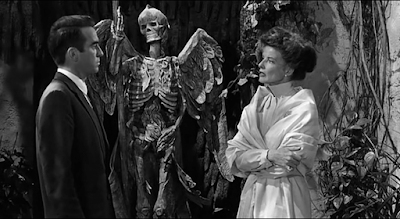
"Say something funny" says Katherine Hepburn, playing Violet Venable, one of the most coolly dangerous of all Tennessee Williams' predatory mothers. "Make me stop wanting to cry."

She's talking with a young psychiatric surgeon, Dr. Cukrowicz (Montgomery Clift) mourning the death of her (gay aesthete poet) son Sebastian in SUDDENLY LAST SUMMER (1958). Drinking her dailly daiquiri to undo the cringe of seeing her poor relations (Mercedes McCambridge and Gary Raymond)
pick through her late aesthete son's clothes like late-to-the-party no-neck seagulls, honking shrilly while nosing through his empty turtle shell for remaining scraps. God already took his soul, the beggar boys took his flesh and now Violet wants Cukrowicz to scrape the memory of his last moments from the brain of the scene's one witness, voluptuous Catherine Holly (Liz Taylor). Now the poor relations are her to grab the remaining cuff links and shirts. 

Though we never see a photo or painting of him (how can we picture anyone but Hurd Hatfield from The Picture of Dorian Gray (1945) or Helmut Berger circa 1969's The Damned?), Sebastian's spirit, his memory, hangs over the film like the angel of sexy death (that poses behind Katherine in that memorable final shot of Dr. Cukrowicz's first visit to Sebastian's weird prehistoric garden). Violet wants his poetry preserved but his homosexual promiscuity excised from the mind of its main witness, Katherine. Hence, she's locked up in a convent until the doctor can lobotomize the 'truth' out of her. 

For you see, Violet knows the kind of existential horror her son was into. The highlight of the film is Hepburn's monologue detailing her unforgettable summer with Sebastian the previous year, at Encantada island in the Galapagos, wherein we learn Sebastian saw the face of God in a beach full of baby turtle-devouring birds --an all too real annual event that traumatized many of us who first saw it as kids on Mutual of Omaha's Wild Kingdom back in the 70s and--like me--never forgot, trembling in the sudden unveiling of some evil undercurrent, some sadistic devouring other, aspect of existence.At least Violet Venable, Sebastian's mom and the caretaker of his poems, his life story--for his life was his poems and his poems were his life, doctor--is hip to that cosmic Lovecraftian truth, as evinced by the prehistoric garden they walk through, replete with an Angel of Death statue. - One of my favorite scenes in all movies. 

She's not well, or she'd know how creepy it must be to others to hear her boasting about her tight nigh-incestuous relationship with her late son. Yet determined to hide his gayness. 

Of course, PSYCHO was still two years away --there wasn't a template for recognizing when a mom's apron strings are choking her child in his 22 year-old cradle--at least one wasn't allowed to be visible in film unless based on esteemed literature (the big loophole to censorship was the bourgeois reverence for classic novels). With Sebastian gone, her need to dominate and invade moves over to Katherine, her screaming hysterical niece, she must be drilled dumb, so the fantasy poet can remain intact.

Despite all that, I love her. Violet may be monstrous, but she knows the queasy dread that draws sensitive poets to the rocks, that push me-pull you lure of the abyss. She draws short of sparagmos cannibalism, but otherwise is down to stare into the void. In that way she and her niece become poets, perhaps made so by osmosis, by connection to Sebastian. These two women provide nearly every monologue in the movie; they even sound similar--the syntax, the rhythm. We can only presume--having never heard him speak--that they are somehow imitating Sebastian's style, the way the absence of someone we love or admire causes us to adapt some of their traits, our unconscious attempt to fill the void they left. 

Through Sebastian, these two ladies have felt the caustic touch of god, the endless ever-amplifying agonies of drug (or sex addiction) withdrawal, the sense of disaster ever-looming, only a lack of funds or availability away. The horrible pain of being ripped apart by wild animals stretched infinitely. Withdrawal is the check for the meal so large and expensive we don't dare finish it. We linger at the bar, the needle, the bathhouse, hoping that blank page will somehow write itself.

But sooner or later we run out of salve for our cigarette-burnt hand and we've no choice left but to twist and hyperventilate in our bed (or on the street or park bench) for hours on end. Every minute of consciousness stretches out like a long strip of beach slowly being rent to shreds, every last twisting living reptile cell devoured and clawed; our whole being just a sacrifice to some pagan bloodthirsty god.

Tennessee Williams knows the feeling. You can tell in the way he blurs that sadomasochistic line between fear and desire, between the psyche and its surroundings. Williams' demons precede the debauched white-faced, black leather-clad monsters of HELLRAISER by thirty years. The rape in STREETCAR NAMED DESIRE, the shattering final shot of ROMAN SPRING OF MRS. STONE, the (if the censors hadn't changed it to a broken nose in the film version) castration of Paul Newman at the end of SWEET BIRD OF YOUTH, the sexy price of another drink at the end of CAT ON A HOT TIN ROOF (changed in the film version for a happy ending with Brick finally straightening out and loving Liz Taylor the movie), they're all concessions to the realistic level that come with an intense price tag.

 Sometimes they constitute crimes but in Williams' world there's no such thing as a bad sensation Sebastian wasn't the type to complain to the management, as Katherine explains during the climactic, drugged, hypnotized recollection of his final hours. With peaks of crucifixion-level agony at the climactic end of the spectrum and drunken 'snap!' stillness on the other--what else is true heaven but hell escaped from at a suitable velocity, like a rocket that needs pillars of fire scorching the ground to rise past the clouds? The only truly bad sensation in Williams' work is the despair that comes from the numbness of isolation and drifting; the fear of winding down to the speed of a boat becalmed, when not even the gulls want to peck at you. It's that despair Williams truly fears, a fear that makes the violent attentions of cannibal rent boys a luxury by contrast.

And even then, there's one thing worse even than isolation: being locked in with the no-neck monsters, trapped in 'the Drum' and its insane gibberers, or the smug naysaying nuns who refuse to let their patients so much as scream in despair or finish one cigarette. They're all of a piece with the banalities and shrill over-acting of Katherine's white trash mom and her dumb-as-shit cufflink-scavenging goober of a brother, George. How Sebastian ever put up with any of them long enough to pull Katherine from their grubby mitts into his rarefied realm is anyone's guess. "Aren't they awful?!" Violet comments to Cukrowicz  after they finally leave Sebastian's studio (where we see a male black nude and are left to draw our own conclusions).

Directed by Joseph Mankiewicz from Williams' original one-act play, brilliantly adapted with Gore Vidal, Suddenly Last Summer is the kind of thing that would freak people out even today, unless it was shot by George Romero or Dario Argento and all the cannibalism was actually shown, hence giving it a drive-in / grindhouse context. Then, somehow, it would be okay. The bourgeois snobs would know to stay away and it would all be laughable or cathartic.  As it is, the film's artsy pedigree ensures that even the most squeamish of bourgeoisie have to see--or rather hear-- it all the way through, forced--almost like Katharine Hepburn's insane matriarch--to accept the vicious incestuous, homosexual, Dionysian cannibal truth. They must hear that which cannot be shown. A mix of metonym and metaphor (hands, legs, instruments, birds), Katherine's recollection plays like a Hitchcock or Bergman dream sequence during a long therapy session more than a traumatic reality or more to the point, it shows there is no difference.

The terrible fate of Sebastian mirrors several mythic archetypal sacrificial moments from classic Greek literature (namely Euripides' Bacchae) involving crows, youths, blood sacrifice, implied homosexuality, and ritualistic initiation and of course, maenad rending - the 'ultimate' sensation (as Frank notes right before the Cenobites spring the hooks). Violet tries to make the "real" event in Williams' story seem a dead myth, a torture-porn fiction invented by a hysterical nymphomaniac suffering from "dementia precox" (which Dr. Cukrowicz assures her is a meaningless phrase) rather than a living truth. Just because it hides so damned archaically deep in the collective subconscious--doesn't mean it didn't happen. In a way it's the blueprint for paranoid conspiracy theories to come - are the dark secrets of aliens and secret societies so horrible we can't admit they're real, so make up paranoia--a meaningless phrase by which we deny dark truths? Why are alien abductions almost exactly like sleep paralysis? Which one is the illusion, or are both real, or some deeper truth than either/or?) 

We know the truth here because we know someone has read the coroner's report, but that doesn't change the poetic abstraction - as if shocking violence opens up a direct mainline between modern life and Greek myth. In flashbacks of hypnotized washed-out poetry, our senses are blasted open by Liz Taylor gradually releasing her gorgeous black hair out from under a tacky bathing cap, her voluptuous body squirming in the surf in a revealing white one piece bathing suit and inciting us into a horny cannibal frenzy (that image below was the selling point of the film).


What a flashback! The young bucks of the town that clamor against the private beach fence as they ogle her --creating a freakish, unnatural class divide / mirror / screen dichotomy - as if these boys could be the audience around us in the theater, or rather we become them, joining the slavering nameless throng climbing over each other to get a better view. And what a view! Me --YOW!  A thousand horny hands rip the screen to shreds and devour it, hoping to capture some of the hot light upon it. But the image still just hangs there, now on the wall behind the screen, and in the haze of sweat and blood rising up from the front of the trashed cinema. Pan! Pan! Not just bread but the god of satyriasis (a condition Williams self-diagnosed). 

But this is a talking cure movie and, as I say, the main horrors are spoken of--not seen, nor is the above image, we never see her hair flowing so freely (she has her neutering bathing cap on in the movie)  First, Violet describes the spectacle of turtle hatching day to Monty Clift's venerable shrink in the prehistoric garden. She's already a goddess (descending from her elevator chariot), made so by erudite wit and money so is--in a sense--under permanent hypnosis. If she had a hidden unconscious she'd perhaps be less eager to point out the totality of her incestuous bond with her son. Second, under hypnosis, Liz Taylor describes Sebastian's last hours to Clift at the film's climax. This Violet would rather not hear; it's as if her remove from the beach at the Encantadas, the safety of the ship, the fact it was turtles and not her own young, made it just an enthralling and weird story. But when it's your own flesh and blood being rended and gobbled up, she cannot--in a sense--look away from it OR see it. 

Monty's job as analyst then becomes acting as witness to these two women discussing the horrors of the unvarnished extreme end of the real, the obscene existential mouth which devours itself via a tongue of a million frenzied lashing conqueror worms; a churning, massive, oceanic ouroboros at the base pit of existence. Both Catherine and Violet wind up lambs in a kind of dual sacrificial ceremony, performing the horror of watching and relating a sacrifice for a (presumably 'civilized') audience. The band-aid is off and the audience forced to look, not at the scenes of carnage too grisly to show in 1959, but into the horrified eyes of someone who has looked (which is profound without being sickening). The natural reaction is horror of the type one may have when turning over a large rock and finding a whole ecosystem of squirming worms, centipedes, and snakes living below it, but then Clift doesn't let us recoil before taking each insect out in turn, and naming it, putting it to sleep under ether; and freeing us of our disgust. It's real Freudian return of the repressed abject menstruation shit. He's paying the tab, redressing the sins of our hear-no-feminine-napkin-application-procedure evil forefathers. The patriarchal rep of a new kind of medicine (Clift) hears the truth (sparagmos) of the hysterical symptom (Violet's denial / impending lobotomy) and thus the scene itself--sex--is cured as well as Katherine, as well as the nation under Kinsey. No wonder 1950s America loved Freud! He gave both genders an out: he mediated the mounting bedroom cold war by just keeping everybody talking. A war can't be waged if both sides admit they're afraid to fight. Their must be something more productive they can do with their excess energy.


Williams' own real life sexual interests followed the Greek ideal, aiding no doubt in his profound grasp of Greek tragedy and its ability to explain the cosmos in terms of Apollonian beach boys. Sebastian's unseen ghost hovers over the action like Poe's Lenore or the dominating spirit of REBECCA. Never seen, he's outside of space and time, at once something of a past and future century. He's anywhere but here. Even the title carries a time-travel vibe, like Phillip K. Dick's sci fi book NOW WAIT TIL LAST YEAR and indicates the exact kind of transcendence of space and time.

The whole structure of "Big Chill" kind of dramas, where the action centers around someone recently or long-since dead and therefore unseen is a big thing with Williams: Blanche natters incessantly about her long-dead lover who couldn't get it up cuz he was queer and thus shot himself in STREETCAR; Anna Magnani worships the memory of her late stud husband in THE ROSE TATTOO; Fred's dead at the start of NIGHT OF THE IGUANA, and who could forget old Skipper in CAT ON A HOT TIN ROOF? But none of them can hold a candle to the evil and eloquently damned Sebastian, who for total dominance over the living is as spectral as a Poe heroine, or Rebecca de Winter or the first half of LAURA.

Suddenly REPULSION

His mother, Violet, then is both Sebastian's symbolic killer and the force that kept him from harm on all the other vacations, and the force that keeps his name on everyone's lips... even in death. She's like a vampire protecting her prey from other hustlers. When Sebastian dies because it's because Violet's not around to save him and he forgot all the things he never learned while being under her wing when other boys were negotiating narrow streets on foot, and otherwise avoiding the painful fate of the cannibal crockpot.

Perhaps because of their own outsider statuses via homosexuality and alcoholism, Tennessee Williams and Gore Vidal could both really stare wide-eyed into the hellish morass that represents the ultimate end-game of rich jet set debauchery, the "okay let's take off the kid gloves" kind of thing involved in the real rough leather trade and all the other stuff Camille Paglia writes about. Here's an excerpt of Paglia talking about the greatness of Tennessee Williams in that regard:
If we are ever to see a revival of artistry, young film-makers must study and absorb the great movie past. To build on the small, weak, one-dimensional films of the 1980s and '90s is a dead end. The same thing with writing: if young people simply draw on the shallow, cynical, jargon-clotted postmodernism of the 1980s and '90s, they'll produce nothing that will last.

This is why I exalt Tennessee Williams as a supreme role model: he was openly gay (daring at the time) but never ghettoized himself. He lived in the real world and thought and felt in passionate, universal terms — which is why he created titanic characters who have had worldwide impact and who are still stunningly alive.
(Bright Lights Film Journal, #54, 2006)

Liz Taylor--a titanic, stunningly alive character with worldwide impact herself--seems to have been a kind of protean cine-muse to Williams, and one much more magnetic than Magnani, and much more opinionated and loud about it than most of the screen goddesses in her league. Totally unafraid to get in there and shake it in all senses of the word, from root to crown chakra (with a long pause at the hips), Liz's characters clash with patriarchy and then withdraw to fight again, like Sung Tzu says to do in ART OF WAR! Take GIANT, for example, where she maneuvers around the end zones at her newfound homeland Texas' narrow-minded patriarchal ways, and everyone of the old guard just has to put up with it. None of their usual patronizing crap works, even when she's way out of line they can't rope her in. She lets them win a hand or two, but never stops wearing them down, until they surrender like aggressive dogs to Cesar Milan in the Dog Whisperer. Like said dogs, these Texans realize they love her for her ability to be assertive without being aggressive, and she becomes the social mother conscience for all of Rich Oil Texas. She creates a new respect and admiration for the voice of dissent. It's okay to walk away having lost a fight with Liz Taylor. She'll let you win the next one.

SUMMER's Catherine isn't allowed to know this kind of power. When she parades around in negligees or bathing suits, it's both a mythic Venus on the half-shell moment and a scream for help; she wants you to see how desperately out of place she feels, but you can only notice how perfectly in place every part of her actually is. She needs a Rock Hudson around who she can bounce off of and claw at and know he'll stick around regardless. She needs a man to see the limitless compassion and love behind all the compulsive attention-seeking. Monty Clift fits this role beautifully, paralyzed face or no. One of my favorite moments is when she kisses him impulsively during their therapy and he neither rejects nor accepts to go any further, or back for that matter, saying "why not? It was a friendly kiss." He lets it affect him only mildly, but later when she grabs him and they kiss we never quite see how he responds. So many similar scenes in films blow this opportunity to dissolve phony social dualities between authority figure and lover, social order/propriety and chthonic carnal desire, the desire of the higher self and the desire of the man, as if any response other than rejection is considered amoral. Catherine's 'nymphomania' could be unknowingly encouraged to devolve into degeneracy by the nuns strictly-enforced codes of shame and negative reinforcement coupled to fast profits ala BUTTERFIELD 8, so when Monty responds in this way the chain is short-circuited and she's free. Who wouldn't go crazy if they took away your smoking privileges?

Any subliminal resemblance between Violet's hat and a Venus flytrap upper palate is purely intentional
Yes, this film makes you proud to be a smoker. It's cigarettes ultimately that bond Catherine with Monty's doctor and drive the mean nun from the room. And like cigarettes, it only gets better with repeat viewings, wherein you smoke along with the action, addicted and decaying... until all the cigarettes are taken out digitally and replaced with delicious chocolate candies!

A unique film, SUMMER's only competition in whatever genre it invented is Bergman's PERSONA (1966), which similarly deconstructs the nature of truth vs. recollection, image vs. verbal description, and the way image becomes truth via personally recounted testimonies of unfettered lust under blazing afternoon suns. Stories told verbally (but not seen) of unchained desire prove more arousing and dangerous than mere soft core footage shot through gauze, as it turns out, unless you're on acid maybe, but even on acid you just like it for the rhythmic breathing and colors; the image is inherently obscene to you by then anyway, it seems always about to overflow, eventually ripping open the screen. But whereas PERSONA delves into abstract meditation and whereas something like the DEAD trilogy shows the horror of the animal and vegetable decay but skips the post-modern ripped screen artsiness, SUMMER trumps all by showing the rip AND the screen and then showing Liz Taylor describe it under a heat lamp.

The result is as devastating and cathartic as a dozen art and/or horror films combined. A new image every viewing comes to mind, with echoes of Matt Shepherd and all the horrifying gay hate crimes on the one hand, and the meta refraction of Liz's real life bosom friendship with the homosexual Clift and his crippling car accident during the shooting of RAINTREE COUNTY, the year before, one that took this beautiful god of a man and left him looking far older, partially paralyzed, with Liz right there every step of the way, procuring and protecting. SUDDENLY finds the connecting ground between the horrors of old Greco-Roman myth and the reality around them, the more outre it gets the more real, the more specific the more meta, the more universal, its clear-eyed unflinching grasp for the truth is so pure-- even if it takes a little demerol to get there--it goes beyond truth, or myth, or even art, to become a reflection of all the loving joy to be found once the horrors of God's cruelty are finally grasped in full, and accepted. Color then is thine.


Related Posts Plugin for WordPress, Blogger...