Showing posts with label stephen king. Show all posts

Monday, February 23, 2015

10 Reasons DREAMCATCHER


Whenever it gets super snowy and chilly as it has recently I think of DREAMCATCHER (2003), the unreasonably maligned gonzo sci-fi disasterpiece from the collected pens of Stephen King, William 'Adventures in the Screen Trade' Goldman and Lawrence 'BIG CHILL' Kasdan. Sure it's not great, maybe it's not even very good, but it's got a lunatic recklessness that transcends so many traditional horror and science fiction cliches I can forgive it near about anything, and that's what the 10 REASONS series is all about. It may miss the ball a few times, its CGI may at time touch 80s video game pixelation, but at least its swinging for the parking lot instead of just trying to bunt its way out of the dugout.

For an example of contrast, right now for example I'm half-watching THE GIVER (2014), a movie so hungry for a piece of the current teen dystopia market it may as well have been written by a computer that was fed every sci-fi teen-targeted movie and book of the last 20 years. I wanted to see it to continue my teen dystopia thread from a few months ago and see what kind of magic Jeff Bridges could whip up out of such hack ingredients, but it's so glaringly simplistic I feel cheap just for having it on in the background. And so I exhumed this piece from my drafts folder instead, for there's no doubt that DREAMCATCHER is written by humans.... who freely aim not for the teens, or the adults, but middle-aged stoners in the middle of their fourth midlife crisis. How can I, fitting that bill, not salute such far-out willingness to ride the courage of its own batshit crazy convictions?


1. ESP altruism in children - The boys get their talents by first rescuing a bullied 'special needs' human named Duddy who shares his unique ESP power with them, and together they use their powers to locate a missing girl. The dreamcatcher isn't a Kruger-style truant officer or some tacky South Dakota souvenir but a visualization of the web that connects them. Each of the boys develop a psychic special power and remain connected by the threads of their psychic energy, which gives them a collective courage as well as abilities to find lost girls. I felt my heart soar when the littlest kid in the bunch picks up a rock and says hell yeah I want to fight, even if the bullies are way bigger. It doesn't matter - seeing their leader torturing poor Duddy behind the woodshed makes the little kid furious. He picks up two rocks and is ready to go down swinging because he's sickened by their sadism. This group of good kids are so badass they promise to run home and tell one of their gossipy moms if the boys don't stop. No hesitation about ratting the bullies out, never considering making it a playground thing rather than a genuine offense. I subscribe to the adage in Over the Edge that a kid who tells on another a kid is a dead kid, but assault perpetrated by a bunch of big kids on a small special-needs kid is a different than ratting out your dealer to get off on possession charge. 

Most these sorts of films, Stand by Me and so forth, are about growing up as "normal" outcast kids, i.e. types--the one fat dork, the thin little nerd, the older hunk with a drunk single dad, the token black kid with no real personality other than being black, etc.--all harassed by bigger evil sadistic bullies (King must have been bullied as a kid as there's bullies in nearly every book her writes. But the four dudes we see in Dreamcatcher flashbacks to their formative elementary collective ESP Dead Zone moments, are genuine badasses, not normal 'types' at all, and so don't have to put on familiar outcast cliche masks. We see through them how sticking up for someone weaker can give you lion's courage, the sort unavailable for ordinary self-defense, and the result is world's away from most of the rote bullying we see in other King adaptations). I don't mind if the film is exploring very familiar Stephen King territory (the ESP or psychokinesis of The Shining, Carrie, FirestarterThe Dead Zone etc.), cuz it's also Hawksian!


2. Donnie Wahlberg as the magical mentally challenged / psychically savant Duddy - Unlike so many other magic mentally-challenged kids, Duddy is never depicted as 'backwards' so much as 'sidewards,' i.e. once you 'speak' his language you realize he's a genius. And I know how firsthand how such kids can trigger psychic awakenings, because one happened to me with this kid, Victor. Cuz I was high on acid at the time I met him, I got what he was trying to say and he got all excited because most strangers couldn't understand his garbled syntaxes, but I could --in my LSD-opened state. He'd be in paroxysms of happiness that someone understood him, and in return he cast some weird mystic spell on me - where I knew as long as I avoided negative thoughts and my first thought each morning was positive I would exist in this state of transcendent bliss. (One morning I woke up with a cold and my first though was "I feel sick," and thus the streak--which had lasted three weeks!--was over). 

Donnie W.  really disappears into the role giving Duddy a comprehensiveness as a character that's worlds away from "Gotta watch Wopner" or "Life's a box of chocolates." idiot savants of other, better-reviewed movies. Figures he wouldn't be recognized for it - such unshowy genius seldom is.


3. Goofball Resolve - the whole thing with Lewis inside his inner filing room shouting out the window as the alien who possessed him sets about eating people isn't going to please anyone. Some people might call that a way too literal reading, but I say hey, this film is going for distance (1), and it doesn't care if you think it's dumb. A lot of horror movies work better in an audience, but I can imagine seeing Dreamcatcher with the BAM crowd being a pretty miserable experience as all the exasperated sighs and confusion take hold. But without snarky critics in the room, and no drive time outlay, its weirdness can stretch its legs, unperturbed by things like second thoughts. Commercial breaks probably help, too. 

4. The film starts in the middle of a covert alien war, sparing us all the doubt on the part of the military's willingness to accept what's going on. And I dig the alien invasion in the snow motif, which recalls Hitler's big Battle of the Bulge campaign, i.e. wait until it gets super snowy to make your move, thus catching them all unawares.


5. It's like reading a real Stephen King novel:  

With twists and turns and each character doing their thing, and encountering a military presence in the midst of another skirmish, lots of snow and New England charm, all very Kingly. And rather than constant crosscutting it plays little mini-chapters between characters. It takes it's time and spreads itself over two hours and fifteen minutes, which since it's on streaming is just fine as it can be watched like a Stephen King novel... in chunks where you occasionally put it down, but it keeps you reading because you have no idea where it's going next except deep into the blood-strewn snow of King's New England. Like most of his fiction it might be a little overwrought at times, and it may not have a strong ending, but more than any of his other filmed works, DREAMCATCHER really captures the internal monologue conversations, pop culture references, prosaic four letter New England cut-the-crap-itude, and the pressure cooker fear generation so intrinsic to his enduring popularity.


6. The aliens can do just about anything. They look like Audrey from Little Shop of Horrors on crystal meth when they're not in The Thing x Invasion of the Body Snatchers disguise. Plus, they are not without a self-aware sense of mordant humor, talking in a clipped posh accent, like they're the bad guy in a James Bond film. What an odd choice! And they can come right up your ass or down your throat like a combination tape worm / moray eel / ALIEN face hugger, and plant not just one little monster egg, but a writhing legion, inside you.

7. Lawrence Kasdan bringing wily, witty profane 'Big Chill'-ish dialogue and black humor to a zippy script. 

8. Duddy's mom: 

Rosemary Dunsmore creates a nice aura of loving gravity and courage around her son in her one big scene. She knows her son is dying and that he might be dead by the end of the weekend, but she's aware that he's called upon in service of something higher, even if she can't quite understand what that is."Okay, go save the world," she says as they mount their stolen military black Humvee. How rare is it that a mom can be so chill about sending her critically ill, special-needs son off into the freezing cold to battle some abstract alien menace on what will certainly be a one way trip? Kasdan and King are fans of horror and know just when to have characters step up to the Hawksian heroics plate even if it flies in the face of Hollywood's treasured 'logic of the heart' and all its tedious inside-the-box sanctity. Mrs. Duddy knows this is a boy's movie, so don't bother trying for BSAO, just stand the fuck back and let the kids play through. It's the most heroic gesture in a movie full of them and it gets me crying every time, cuz it's fucking true - every moment of it, every foot of their house, down to the dusty board games in the closet.

9. The great cast also includes: Jason MALLRATS Lee; Timothy THE CRAZIES Olyphant; Thomas THE MIST Jane; Donnie SIXTH SENSE Wahlberg; Damian HOMELAND Lewis; Tom THE RELIC Sizemore (his grudging acceptance of Jane's psychic outlandish mission is the most incredulous part in the film and Sizemore pulls it off) and frickin....

10. the Zu Warrior eyebrows of Morgan "Passin' Water" FreemanThere's usually a sense that either the military is good or bad depending on the political orientation of a film, but here they are both good and bad (ala THE CRAZIES) and the natural likable gravitas of Morgan Freeman is cast against type as a man who's been dealing with these aliens for the last 25 years and is thinking globally to the detriment of the infected locals, all of whom he wants to kill off to be sure the disease doesn't spread (not an injudicious thing to do, as Caspar Gutman would say).  His less draconian superior is called in and so there's two military factions --one good and maybe wrong --and one bad but maybe right. There's a great moment when the aliens are acting all childlike and innocent with their hands raised psychically talking to the soldiers in childlike voices and Freeman's like doooon't trust them. He might be wrong but he's so very right, just like DREAMCATCHER itself!
---

Last but not least is the groovy snow blanket over the whole film. creating just the right mood of preternatural stillness. Add it all together and you have a flawed gonzo classic I enjoy a lot more than the critically acclaimed 'kids together experiencing weird small town events' King adaptations like STAND BY ME. Capturing the loopy flashback-laden, middle-of-the-action, slow boat-to-nowhere structure of one of King's novels, there's a weird and wondrous cast and a plot that, like other 'Ten Reason' entries THE THING (2011), GHOSTS OF MARS (2000), and DOOMSDAY (2008) ping-pongs past so many genre cliche bumpers it becomes a whole new kind of lunatic pastiche perfection... so 'catch' it!


NOTES: 
1. "Going for Distance":  a common drunken Syracuse treehouse expression from 1987-91, i.e. to puke as far away from oneself as possible, while standing, head held high, rather than bent over a toilet like some common scrubwoman - but then also extending to mean not holding back in general, burning up all your stashes and telling your old lady to go home and go to bed because you're staying up all night, all the next day, and forever, until -'poof' magically you wake up on some floor or couch somewhere. An example of going for distance might be Lennon and Nilsson's "Lost Weekend" 

Sunday, September 02, 2012

Dubious Comforts: PET SEMATARY, SURVIVAL OF THE DEAD and the RNC


"The person you put there isn't the person who comes back" 
- Jud Crandall (Pet Sematary)

Aunt Cecily: "Do you believe...the dead can come back to life?
Bob Hope: "You mean like the Republicans?"
- The Cat and the Canary (1939)

Like a bad dream of Republican 'small government,' Pet Sematary (1989) depicts the return to a simpler, more 'Christian' lifestyle, marred by slight problems like the non-regulation of big business, i.e. Paul Ryan's ideas of 'limited government' is behind, no doubt, the unregulated road in front of the family house, whereon trucks go speeding past sidewalkless residential streets without speed limit signs, cops, or punishment. The heavy toll in run-over pets and children is a small price to pay when the alternative is welfare socialism! Limits mean sacrifice: once you're run over, mutilated in war, deformed from disease, or otherwise unassimilable into the Norman Rockwell ideal it's only natural that you become abject and ostracized, shoveled under the loamy carpet or kept hidden in a back room and spoon-fed oatmeal by the terrified child who will grow up to be the mom in Pet Sematary. This is the deal of small government, warts and all means, inevitably, all warts.

Boys do love trucks...
Like the bankrupting of Medicare and Social Security via ever-longer life spans, Pet Sematary shows how the idealization of a 'real' America is continually undone through denial of death. King's motifs come tumbling out of America's chock full-o-skeletons closet in this film way more so than in most all other adaptations of his novels: population control (here in the form of animal spaying issues --the run-over cat is unable to get to heaven as he's 'incomplete'); child mortality (the run-over infant comes back to gleefully kill off the cast, all because dad can't handle the pain of losing him again); assisted suicide (that old invalid aunt twisted up on spinal meningitis, praying for a death which the doctors prevent); lynchings (neighbors once torched the house of a zombie and its dad); Native Americans (burial site desecration), and so on. The graveyard bringing whatever you bury there back to life, but with a demonic streak of voracious homicidal ill will, makes a nice right wing nutjob analogy to sending your good Christian-raised kid off to college and having him come back an angry vegetarian pothead feminist.


All this deep red state subtext doesn't mean (the film) Pet Sematary is somehow not bad. It is truly bad. But its badness is perhaps why it's able to deal with these skeletons straight on. If the film were any better it would have to deep-six the abject subtexts, simply because too many guys in suits would be watching, ensuring nothing controversial came back to bite them. Instead it seems like even the director wasn't paying much attention, so all the gooey truth stays intact, a bit like one of my favorite awful films Godsend, which is also about the horrid deals grieving parents might be willing to make in order to allay their grief. When there's nothing you can possibly to do to bring your dead son back, you can relax and know that--funeral expenses aside--no one's going to drain your bank account in for monkey's paw resurrection service. Since it's impossible to raise the dead, we can surrender to grief's kiln-like heat and be suddenly made pliable. If we have any other alternative we have to take it, and thus the medical community and its ancient burial ground kin make wheel-of-life spoke-jammers of us all.


As in Godsend, Sematary's small cast, low budget, bad acting, poor spelling, flat lighting, unimaginative camera movements, and clunky dialogue swirl combine to help the movie achieve "the sort of shallowness that brings depth" (1). And while in Godsend it was the shrill over-and-underacting of Robert De Niro and Greg Kinnear that made it all so unintentionally Ed Woodsian, in Pet it's the culminating glory of seeing a zombie demon kid attacking an old man like a rabid Baby New Year at the stroke of midnight (above). Any horror is leavened as the kid is clearly just having fun making mean faces. Grrr. 

"President Obama's promise is to begin to slow the rise of the oceans (pause for laughter) and to heal the planet (more laughter). My promise is to help you and your family."  --Mitt Romney (RNC 2012 acceptance speech)
The bodies must be burned immediately. People will have to forego the dubious comforts a funeral service will give." - Newscaster, Night of the Living Dead (1968)
When I heard the above unabashedly anti-environmental attitude from presidential candidate Mitt Romney, I instantly thought of it as the inverse of the announcer in the original Night of the Living Dead, telling viewers to "forego the dubious comforts a funeral will give." Romney would be announcing the reverse: "The health office insists we forego the comforts of funerals in order to halt the spread of this epidemic, but I say your deceased family comes first!" It matters not if Mother Earth dies while we're eating her, as long as we get a big enough piece before its all gone, because we have to share that piece with our family. Unwashed hordes of illegal Mexican zombies are already gnawing upwards from Mother's toes! Arabs are pulling out her entrails! The Asian markets are scooping up her brains. If we don't drag the carcass away from them fast we'll end up not just hungry but looking weak to our enemies, which is far worse. Don't they know we're tough? Grrrr!

For all our strength we're still a very, very young country
Not to say that's what the Republican ticket and Paul Ryan's Ayn Randiness necessarily represent. One must make allowances for bloc baiting, but it's interesting because we have to go back to the Monkey's Paw's 'careful what you say' word choice of our wishes, and avoid 'getting everything we want' which would mean either (for them) a return to a Handmaid's Tale kind of fundamentalist American patriarchal religious oppression or (for us), an overly permissive socialist Welfare State. Neither side really wants either of those options and so we must preserve our state of conflict at all costs. The trick is to realize this and move into a state of conscious awareness, like the Buddha of professional wrestling - it's just a fight. We need to remember that the fight is just for show, that we need the fight, need the show, for balance. A total victory would mean the end of the match, and riots in the crowded streets, so drag on, lads, drag on...


Both sides have forgotten that the real enemy is the media, whose obsession with repetition and bottom lines and computer game tie-ins has led to the idea that zombie movies are just heads blowing up and armies shambling through stairwells ala RESIDENT EVIL. Romero's films, and King's, on the other hand, understand that without the issue of family and the 'right to undie' or the 'right to unlife' there's no 'meat' to the story, which is why RES EVIL is--for all its mega budget and gloss and nonstop action--so uninvolving, and PET SEM is--for all its low budget badness--so trenchant. We have the mom letting her daughter gut her with a trowel in Romero's first film; the girl in the ghetto protecting her zombie husband from 'the man' and getting bit for her trouble in DAWN; and in Romero's most recent installment SURVIVAL OF THE DEAD, an old patriarch fighting for the idea that life is sacred even in death, that every dead baby has the right to crawl out of the earth and hunt its parents. These aspects are what matter, what lingers after the endless shots of exploding heads have faded from our minds, and which is why 99% of non-Romero zombie films suck so bad. 


Shot in 2009, SURVIVAL OF THE DEAD is less a sequel than a 'concurrent' story to the first two films: it takes place several weeks into the original zombie epidemic, and society is still in the midst of its collapse. Two crotchety Irish-American landowners occupy a small farm-based island off the New England coast, wrestling over the abortion-encoded issue of whether to shoot the undead or to just chain and train them to deliver mail or rake leaves. The poster girl for it all (above) is Kathleen Munroe, a hot Irish brogue-sporting lass in sexy black riding coat with sexy black riding gloves, long flowing hair and blazing blue eyes staggering around a lush green corral with a beautiful black steed she's supposed to eat instead of peoples --and both sides of the argument watching her, hoping she'll take a bite out of this gorgeous black creature. It's a great, twisted National Velvet of the Living Dead moment. The zombie movie has evolved here into something a bit more aesthetically pleasing than we expected, at least in this one image, until the bites start.


Another key in SURVIVAL and PET SEMATARY is the use of intertextual imagery - namely portraits and paintings which 'come to 'life' like the once-buried loved ones now unburied. Portraits are, as we learn from John Berger's "Way of Seeing," the proprietary gaze writ large, the establishment of a permanent record of one's existence and property, meant to last beyond death and age, the way stars in films of the 1930s still look vibrant and young even after their corporeal forms have long since turned to ash or moldering bones. There's a fine line between wanting to return to past glory and mere fear of death, and zombie movies are that fine line's ultimate erasure, the frozen preservation of impermanent flux. Cinematic mortality's dawning self-awareness is the ultimate compromise between the 'undead' photograph of a loved one coming to get you (Barbara) across the graveyard of memory and the real of our cursed plane with its spatial existence ever-threatened both from interior growth-decay and exterior dangers. To live you need to kill and eat smaller creatures and avoid being killed and eaten by bigger ones. But, in the movies, all death goes up onscreen, and so we, floating in the cheap seats, can live, even if for just this 90 minutes, in perfect freedom from bodily concern, bathroom breaks aside.


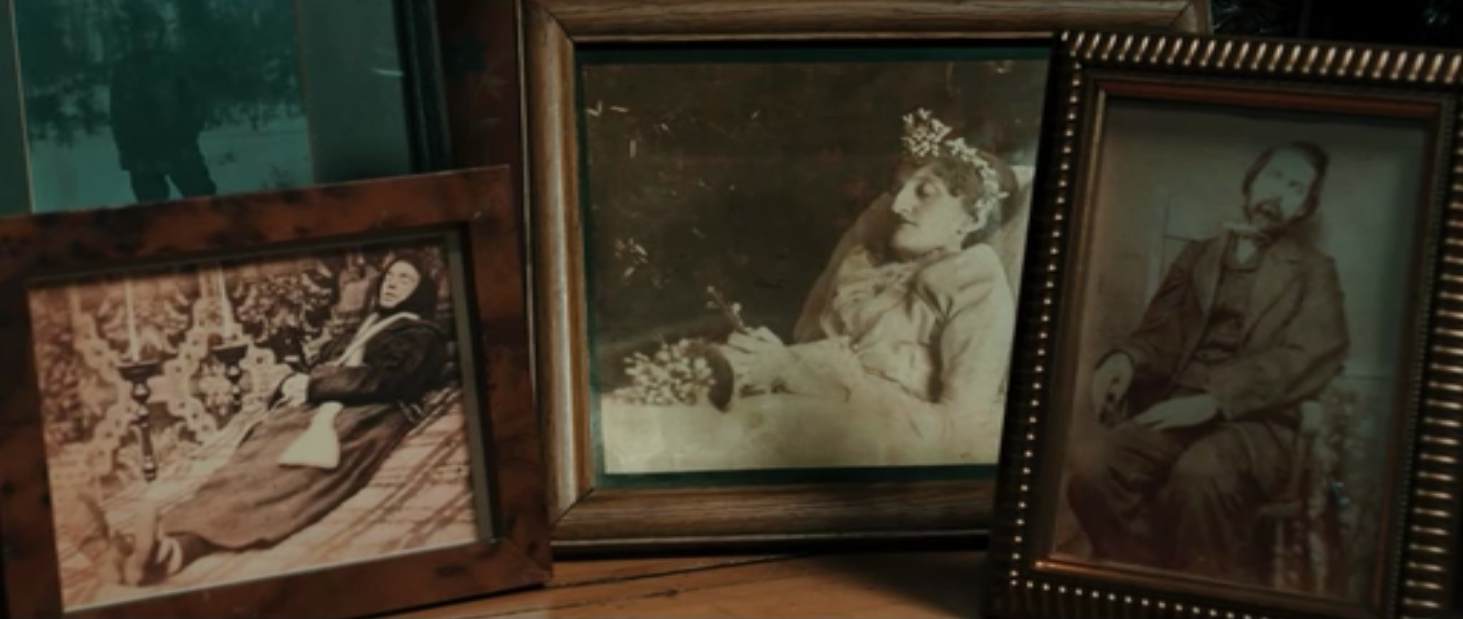
A key scene marking Romero's film as a critique of the conservative mindset involves the 'mixed race lesbian' from the National Guard who winds up abducted and forced to have dinner (prepared by a zombie wife [below left] literally chained barefoot to the kitchen stove) with the pro-(undead) life patriarch, who poses next to his John Wayne-ish portrait and end table filled with old photos of dead relatives (the old school tradition of 'post-mortem photography') and tries to woo her and her niche demographic over to his side, so maybe she'll extend an ankle for a shackle all her own one day. The dead people in the photos are great metaphors for the conservative slavishness to past cultural mores, the PET SEMATARY-ish longing to return to the land of rose-tinted exhumation. The patriarch here has almost no room in his heart for any living person at all. In death they are infinitely more receptive to the message of reverse-progress. Necrophilia is, in the end, all about control. An alive girl is nice and all that but...

"Sometimes death is better."

And yet, if once it all goes black you can go back, what returns? Babies, zombies, remakes, sequels --is that all there is? "Corporations are people, my friend," and corporations ruthlessly pursue self-interest, therefore successful films must be remade, and man must kill again and again just to eat the same meal he enjoyed last week. That's understandable. What's not is the assumption that grabbing it all for yourself is somehow a good thing for America. Demanding to be adored by the masses for your greedy self interest only seems ironic if you're not a rich insecure scion who's mad because he still lacks the nerve to tell the ghost of his dead father how much he hated him. That may be the ultimate irony of bipartisanship, that both sides are really angry at someone else, who's gone, and only their damned vampire photograph remains, and it can't bite back.

NOTES:
1. a compliment Godard once paid to 40s poverty row films from Monogram and PRC, which this film resembles -- See my piece on Monogram's Voodoo Man (1944)

Tuesday, October 11, 2011

SHINING Examples: Pupils in the Bathroom Mirror


Caught THE SHINING (1980) for the 18th or 10th or 100th time Tuesday (!) and noticed new things (!) as always--the vast disconnect between the members of the Torrance family; how badly each is trapped in their own unconscious minds' grips; how the Overlook's trans-dimensional gravity widens the space between them into uncrossable gulfs. I also realized how a post-structuralist malaise hangs over the Overlook, making even normal job interview blather cryptic and enriched with mantra-like repetitions which I have to assume are a meant as vain buffer against the madness of irrational experience. Of the entire cast, only Shelly Duvall's perky mom uses words in a direct, emotional manner, and everyone but Danny thinks she's a rube because of it. I also gleaned new insight into cabin fever and the archetypal meaning of the bathroom. So come with me, neighbor, I don't want to be alone. Trying to retrace steps is as dangerous as going forward.

Cabin Fever is something we know very little about since scientific inquiries into its nature are difficult. The presence of the scientific observer alone is enough to stop it from manifesting. Checking on an isolated subject's door with a questionaire in hand can either snap the subject out of it, or put the knocker at serious risk. This is because the condition infers a complete collapse of the social sphere. Without anyone to bring the subject back to a consensual reality, the sufferer can't tell the real from his imagination. The visitor can be misinterpreted as any kind of demons our unconscious can dredge up. Because the space of the hotel is so vast the Torrance family each falls into a separate madness. With no direct link to the social order present to keep them anchored--whether to each other, the social order or linear time/space--they dissolve into the archetypal time warp created by their own unconscious minds; like an iPod that must erase its current contents to connect with a new hard drive (they're not called 'torrents' for nothing!) Danny is erased from his body altogether, to be replaced by his talking finger, Tony. Jack--in his writerly determination to not be 'a dull boy'--is compelled to literally sever his family ties so he can escape into the past. Shelly's inability to get a 'normal' response from either of the Torrance males drives her into hysterics, and when even her ability to check in with the Rangers station for a dose of consensual social reality sanity is cut off, there's no new hard drive waiting to fill her memory. For whatever reason, her social connection won't erase, leaving her alone to witness the full horror of the Overlook.

Consider their example in light of the quintessential cabin fever victims: the Donner party (mentioned by Jack during the family's car ride) who spent months starving and shivering in clumsy brush sheds, buried under mountains of snow, weakened by frostbite and starvation, with only some human remains for food. Several of them lost any semblance of 'sanity' simply because the situation itself was without any 'anchor' of space/time and social strata. In such a situation, sanity becomes a burden, an anachronism. We can read the accounts of the survivors, but it was not a time wherein people waxed on about their mental states, unless they were novelists or well educated. 

In a way the relationship between Bowman and HAL in 2001 is reflected in THE SHINING, with its random markers "Tuesday" and "8:00 AM" indicating the complete breakdown and meaninglessness of time. There are no weekends in space, or at the Overlook, no intruding signifiers of social order for your madness to wriggle against. No alarm clocks. No recourse, except to kill any person whose reality might contradict your own.

Post-Structuralism - The second thing that stuck out this -nth viewing of THE SHINING was the constant repetition of 'tour guide' language: Jack and hotel staff (and later rangers via short wave radio) hide behind repetitive phrases ("sure looks like a lot of snow, over") and Jack especially clings to this repetition in his avoidance of any real commitment to his writing - his mantra of All Work and No Play make jack a dull boy functions as the endgame of a long string of repetitions heard throughout the film. Avoiding any genuine emotional connection to his family, Jack 'hides' in language, depending on his post-structuralist 'wit' for melting away the terror of any unsignified remainder that may come his way. But eventually, these mantras all fall by the wayside; they are feeble tools compared to the vast arsenal of symbolic language employed by the unconscious.


Note that the ghost bartender Lloyd (right) appears at Jack's big moment of crisis - when Shelly Duvall accuses him of hurting his son and Jack goes a little mad in outrage. Here he's wasted five months not having a single drink, out of some dorky fatherly guilt, and all for nothing as he's accused of hurting Danny anyway. His language finally breaks up a bit from the mantras and he mutters he'd sell his soul for a drink. There Lloyd is, without a word. Salvation and destruction all tied up in a single bargain. His statement "I would sell my soul for a drink," is perhaps the only 'true' thing he says, and as such constitutes a deal-done in the saying; the devil springs right up with full bottle service. Jack's eyes widen and bug out as he talks with Lloyd and the other ghosts, but he never dares ask anything like "are you real?" for that would risk sounding as square as his wife.

The Bathroom - Ground zero when it comes to realizing the drugs are kicking in. Check your dilated pupils in the mirror; freak out when you close the medicine cabinet and see a figure standing behind you, or a different background than the one you came in with; the toilet looms alien with its gaping porcelain maw of porcelain and swirling reflective light-off-the-small-square-tiles serpent scale vortices. This is the place of hair combing and judgment and bereavement, vows made to never drink tequila after wine, and last looks before you return to the merciless world of co-ed living. It is the place where coke moves from the tip of someone's car key into your nose, or you sneak cigarettes, or find the gun taped to the back of the old-fashioned toilet. We all surely know the 'boost' we may get when we break from our navigation of precarious social situations and retreat to the mirror of the bathroom to check our hair and psych ourselves for, and recover from, the million and one pressures, anxieties, and rewards, of social interaction. Here we are able to reconstitute our ego, a little mini-resurrection. The bathroom is where we go to delude and denude. We are allowed 'privacy' there, so can be naked without shame. And, as the hotel Overlook is so immensely private, the bathrooms in the film (there are two) are therefore double private, the haunted bath nook in room 237 is even a room within a room within a room, so triple private--so private that there is no difference between its reality and the realm of pure unconscious, and the tub is in a nook at the infinite point, for yet another layer--the mirror in the mirror room at the end of time in 2001. Time and language drift away in the solace of the gleaming fixtures and tiles, which correspond perfectly with our visualizations of the the drainage portal that lurks at the bottom of our souls, between our own unconscious and that of the universal collective, which is always waiting to back up the pipes and flood the room.

From top: Psycho2001, The Holy MountainTwin Peaks: Fire Walk With Me
Which came first, after all, the way bathroom tiles glisten in the light when you're tripping at 3:30 AM, or the reflection of your mind's eye temple and its sparking lights, each as large as the eye can wish to make out through the constantly rearranging serpentine points of definition? Small wonder that the bathroom is where all the scary business goes down in THE SHINING. For most Kubrick films, it is always, as it were, the same bathroom; the bathroom behind your eyes, or its eyes.  The black of your pupils in the mirror is the black of the 2001 obelisk and the blackness of the sink's drain, or Janet Leigh's dead eyes. It is the bathroom at the end of 2001 where Bowman hides from his older self; it's where Pyle shoots the sarge and himself in FULL METAL JACKET; it's where we see Nicole Kidman on the toilet while Tom adores his reflection in EYES WIDE SHUT. The colors in the Kubrick bathroom are always melting, the tiles always glistening like the skin of a giant slumbering serpent from the warped perspective of a fish-eye lens.


I've always felt if therapy wants to be truly effective it should take place in the bathroom. The room wherein the dancing dwarf speaks backwards in David Lynch's Twin Peaks is 'kind' of like this bathroom, a little less functional--like the outer lounge antechamber in swanky hotel ballroom bathrooms where you adjust your bow-tie at weddings and the dancing dwarf brushes your shoes and has a basket for tips and speaks in some indecipherable language. The beginning of Jodorowsky's THE HOLY MOUNTAIN takes place in a similar kind of bathroom/ tiled space, as the shaman shaves the heads of two women acolytes. This latter example evinces a superb understanding of the fantasmatic - with the hair shaving representing a complete identity melt (see also Kubrick's opening haircut sequence in FULL METAL JACKET) as an essential rite of passage when undertaking the trek to total self actualization and surrender.

In a Jungian analysis Jack's room 237 bathroom scene is something straight out of Hansel and Gretel - with the bathroom as the gingerbread house. Jack is a nervous but horny Hansel, the initial stern leggy sexiness of the female apparition is his candy. The breadcrumb trail in this case is the maze-like paths of the carpet and hallways that seem to pull him, like a magnet in slow dream time motion, towards the the woman, who is old witch and leggy candy rolled into a one-two switch. In Jung's lexicon, this old witch is the undernourished and most cranky shadow/anima, the 'wrathful deity' in the first bardo, the flip side of the peaceful deity / sexy young woman. Jack should have read the Tibetan Book of the Dead.

To get back to cabin fever, anyone who's been to the psychedelic mountain will surely have some chills of recognition in 237, for the room itself has cabin fever-- everything is slowed like clockwork and, without a 'majority' rule of perception to block the infinite with their tunnel vision reality, it's as if the Overlook is a galaxy and 237 bathroom is a black hole, through which one is drained into the pipes of Aboriginal 'dream-time.' One moves through the pipe and comes out of Marian Crane's open dilated pupil in PSYCHO, or out of the pistol barrel fired into the camera of Mick Jagger's brain at the end of PERFORMANCE. This small black hole slows down the world around it in an inescapable clockwork pentameter; hypnotic in its steady unwavering mechanical rhythm; it is the earth, the sun, and the wheels within wheels revolving in 2001's spaceships or Ezekiel's wheels in the sky. The drones on the soundtrack work to achieve this revolving sense of hypnosis, as does the slow, dreamlike movement of the camera and actors, the repetition of certain words over and over as a tool of hypnosis - "gimme the bat!" for example, becomes a mantra, as does 'redrum' and 'my responsibilities' and "Danny! Danny boy!"


Post-Post Structuralism - In my past viewings I've found her unbearable, but I came to respect and like Shelly Duvall's character this time around. After all, she does knock her husband out with a bat and then lock him in the pantry. She defends herself with a knife and eventually triumphs over him in every respect. She fucking kicks his ass! Her kid may be a nutcase and her husband a smartass but Shelly manages to keep some kind of grip on things even as she herself begins to see the apparitions. I was particularly aware of the wincing of the men over her gushing naivete during their initial tour, and it's that which clued me into the post-structuralist aspect: "This may be the biggest, most beautiful place I've ever been in!" she beams. The men wince at her guilelessness.  Jack would never admit the Overlook was the biggest place he'd ever seen, lest he look like a rube whose never left Denver--and in part that's why he got the job. But its Shelly's kind of uncomplicated normality that survives cabin fever, not Jack's cynical melting clock-style evasiveness.


You see, you see Jack plays the game wherein all language is double filtered, repeated and used as a distancing tool, a way of negotiating one's way through matters too vast and complex to adequately sum up. For those who operate in this 'adult code' any gushing or exclamatory phrase pollutes the bond that acknowledges the power of the unspoken and is therefore evidence of immaturity --the domain of the squares, i.e. the wives who don't get invited out to drinks or the kid who knows you're tripping at the art opening and has to tell everyone so you can't 'pass' for sane as you would like. "You know he's tripping, right?" - "Shut up Max, I don't want them to know," -- "why, are you ashamed?" But tripping you can't even process the word ashamed, it's only that your enhanced depth perception has now been pinned down to a mere drug signifier to which most people have only one response, to rapidly move their hands back and forth on either side of your head and say "you're going down a tunnel whoosh whooosh!"

For speech to be 'successful' as indicative of one's adult insider status -- too cool to care, as it were-- said speech must circumvent and sidestep and 'double-time' its actual meaning, and protect the sublime in fields of repetition and banality. (Max should have said "Did you know he's not tripping? Isn't that wild!") The words Ullman speaks to Jack during the interview, for example, he's clearly spoken before, but he trots them out like a favorite old horse around a familiar well-worn track. The past murders are mentioned with the 'customary' tact and Jack reacts in just the way one would ideally react, without real thought or emotional surplus. Compare his reactions to someone who attempts to be 'earnest' when faced with a similar situation, and you know I'm thinking here of the meetings between Barton Fink and Lipnick (read my thing on that thing here)


This strategy is also what enables Jack later to talk with Lloyd and later the bathroom attendant, Grady. Jack confronts these speechful specters with, if anything, a greater connection and directness than he has with his own family but basically the connection is the same in that it is deliberately clouded by 'hip' language. Ghost bartenders are much more sympathetic than hysterical wives or disturbed sons, at least in Jack's eyes. Effortlessly moving into a racist, classicist mode of thinking, Jack becomes the gentleman who is served, i.e. the upper class, of which until now he--like us--has obviously regarded with anxiety, since (unless we're part of this 'old money' class) most of us never 'see' this reality in our normal life, yet feel we deserve to live in it. When we're suddenly presented with the opportunity we balk. We want to go home and change, to buy a new dress, we start to panic. But in his delusional state Jack feels more than ready and clearly views his wife and son as the disposable dregs of his present, like Shelly Winters in A PLACE IN THE SUN, the sort of albatross of a broad who can't let a minute go by at Disneyland without having to say "isn't this fun, honey?" or "are you having a good time?," laboring under the idea that language will somehow encompass and exceed the event, will adequately mirror the vastness of direct experience. But Jack knows that by saying it she in effect robs it of the qualities she ascribes to it. Moms do this all the time, don't they? Honey? Don't they? Honey?


The only way saying something is great without making it less great is if the great thing has moved safely into the past - which is part of why the bourgeoisie prefers their artists long dead before they honor them. The artist was great but can never be great in that moment. (Jack is finally happy when he is 'already dead' and appears bottom center in the 1921 photo (above) his arms contorted like a Satanic puppet.

Jack triumphs because he never weakens in his mastery of repetition in language, he's like a horror icon version of Warhol. In repetition only does language prove an equal to direct experience, and only repetition can actually 'enhance' direct experience by hypnotizing the conscious mind into a state of strictly observational stasis. Approached via mantra, by removing one's focus from the realm of the symbolic, by repeating a single word over and over until it loses all meaning, the obscene dimensions of the real are suddenly exposed. Say it enough times in a row and even the word 'beauty' becomes a hideous, trumpet-like mass of snouts and tentacles. Better just wait in the bathroom until these tentacled noises have passed into rusty memory and silence removes your last few senses like barnacles and all tomorrow's parties are safely receded in the tide.

Thursday, July 24, 2008

More Tentacles from the 5th Dimensional Rift

Last night I finally saw THE MIST (2007), which is based on an old Stephen King novella I read in high school. I can't remember if the biblical elements are all in the King version, but one thing I do remember, for what it's worth, is that there was a hell of a lot more drinking! The lead character in the book drinks beer nonstop all through the story. What the hell happened? The only beer drinkers in the movie are condemned as "not taking the issue seriously." Jesus Christ, people!

I don't want to spoil things, but the presence of tentacles and the concept of the military opening a hole into another dimension, and having tentacles and mantis-like monsters escape to destroy civilization has become so common - from Lovecraft, to Buffy the Vampire Slayer, to Futurama (see below), to The Mist, and god knows how many Amazing short stories... not to mention the reports from those brave space cowboys who voyage into third eye realms with the aid of shamanic ritual, DMT, psilocybin, Salvia Divinorum, etc. And then there's "Revelations" in what you earthlings call the bible, and the eerie resemblance of "the Spaghetti Monster" to the transdimensional space octopus the Hebrews called "Yaweh." Call me paranoid, but it all fits together like a giant mantis claw pointed at the calendar to 12/21/2012, or what James Cameron would call "Judgment Day."

As I've said in the past, my own mystic visions have corroborated these fictional testimonies, and the recurring presence of a) dimensional rifts as signals of the apocalypse and c) tentacles and mantis-like beings issuing forth and devouring human souls and feeding off psychic energy (most commonly pain) in both fiction, visions/hallucinations, biblical prophecy, comedy, and paranoid crackpot UFO witness sightings/testimony, all seem to indicate the same horrible truth; a truth perhaps too horrible to look at straight on, (which also corroborates my vision of this devouring god as a sort of rotating space Medusa. To look at it head on is to die or turn to stone, so we can only glimpse it through the warped funhouse mirror of fiction, dream and astral projection).


Why am I risking condemnation, judgment, and perhaps mantisassination by telling you this? Because knowledge is power and actually every time I visit the space octopus/Medusa, She always first wants to know if I've preached Her word... i.e. to bring forth the glory that is the return of Medusa/space octopus onto the world! For the embrace of the space octopus is what shall save us from being devoured (your soul has to be nice and light first - for no mantis can eat the sun).

Other interesting paranoid parallels: the resemblance of the many-armed Hindu deities to the "vision" of flowing tentacles, and our own ability to feel and manipulate auric tentacles.


My Nostradamus-esque prophecy is that we will be seeing more and more images and renderings of trans-dimensional rifts, human-devouring mantis-beings, and tentacled heads rotating through space as we approach the fated date of 2012, all this as cosmic preparation for our collective journey into the fifth dimension, past the illusion of time and space. Are you ready to open your third eye and start waving hello to your new overlords with your newfound auric tentacles? You've got four years to start, my tasty human friends! And check out this crazy T-shirt!
Related Posts Plugin for WordPress, Blogger...