

Summer means barbecues and blah blah but also giant outdoor screens with buggy picnics; and for the indoor kids: lots of intense air-conditioned journeys into beloved classics via the miracle that saved us all: HD widescreen TV + Blu-ray remastering, and in each case the ultimate choice for repeat big screen pristineria: the 70mm negatives of classic Hitchcock and Kubrick.
But what about the movies themselves? You've seen 'em all before, a thousand times, does all that popping color and definition make a difference worthy of double, triple, quadruple dipping?
Oh, Johnny-Oh. Of course it does.
 |
| Vertigo |
 NORTH BY NORTHWEST, REAR WINDOW, and VERTIGO always held up even on full-screen (though I always had my doubts about the latter), but now with the full brilliant intensity of VistaVision (which was 'taller' 70mm) captured on Blu-ray, the precarious angles and dangling off roofs, the plunging hills of San Francisco, the detail in all the little apartment backyard windows, and the presidential noses all make sense in a whole new way. On a big HD screen we can imagine the plummet straight down through Midge's window in VERTIGO, how it would look (above) on I-Max 3D; we feel the bottom drop out in our spines when looking down at the street or the rocks below Mount Rushmore in NORTH. IF w imagine the original audiences going "whoa" and closing their eyes when beholding these staggering drop offs on a three story 70mm VistaVision screen (but not getting motion sick from too much quick camera movement and rapid cut. The big screen explains the slow glacial lack of edits and close-ups.)
 |
| North by Northwest (walls as censor-and-gravity-defying beds.) |
 |
| North by Northwest (tire = sudden rupture of screen/distance) |
The planes dissolve-
(small razor --- big face)
the dwindling safe spaces and the large open field
(no shields or stairs to the sewers).
The immediate kiss-off.
Roger transforms again into regular suited CK Dexter Haven,
shaving with her tiny razor
She makes the call, and it's all arranged, the desolate fields.
Flatness reins - the geometry of the image reduced to a child's conception of the horizon line (sky a blue band at top, ground a brown band at bottom.)
Without corners to hide in, mice feel terribly exposed.
 |
| "Big face, small razor" North by Northwest |
The plane and Cary now mirror again the plunge to the earth;
the plane comes down in triangles. The more triangles are created in this landscape, the more chances to hide. Eventually Cary all but draws his way out with angles, and Hitch makes sure math is obeyed, if not gravity. The plane eventually has no choice but to collide into a truck. What a plane can do by buzzing down on a guy in a field no one knows, it's a dumb way to do it (when a simple drive-by would have been easier), marking the decline of Mason's villainous upper hand. Only once or twice do we even get a machine gun noise, and then, it's after the fact, as if he just takes some parting shots as he leaves, nothing like the inescapable damage done by an actual strafing WWI biplane.
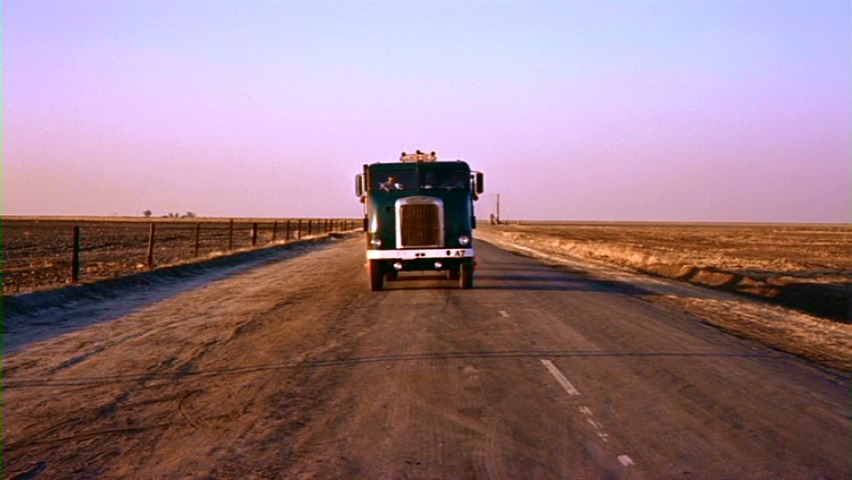 |
| North by Northwest (directional lines invaded) |
But the plane explosion marks the turning point - R.O.T (the "O" stands for "nothing") will play the peevish lover. And then he'll even play dead (his very next role) from then on, be free of roles (except as 'himself,' since he's agreed to keep up the disguise of the undercover agent. In other words, once he assumes the mistaken identity, he validates the villain's previously wrong presumption). Just as Cary, if he'd been really that drunk and pointed downhill in his car headed towards a cliff SHOULD have gone over the side, and he should have been killed on the road. He's beginning to reverse the polarity. From now on - with the explosion of the plane - he's baptized in disillusionment - he's on the offensive.
 |
| North by Northwest (Grant loses equilibrium) |
 |
| Big faces... |
 |
| By now our Thornhill is a master of corners, and screen traversement (North by Northwest) |
But then - seeing To Catch a Thief for the first time on Blu-ray, via my big HD 'deep black' home screen via a quality HD TV of decent size, digitally restored from a vivid VistaVision 70mm negative, was literally a revelation, as in a transformative religious experience. It was hardly the same film at all

 |
| To Catch a Thief - stills via DVDBeaver and 1000 Frames of Hitchcock |
The ending with all the stuffy period costumes and the dissolves through the long, endless dancing, gets a bit draggy even so. Endless lords and ladies all gussied up like you keep hoping for Cary's old gang to stop catering and dress like revolting peasants and guillotine the lot. But the slow leisurely pace is far less grating on a big beautiful Blu-ray where the colors of every flower pops and makes a personal connection so deep you can smell the roses, and taste Grace Kelly's expensive lipstick. All in all, it really gives you the symptoms of what it's like to cater an event like that, or play in the band, or DJ: the endless standing around, waiting to go home, the fantasy of being able to take your shoes off, prop 'em up on the coffee table, and watch old Universal horror movies while drinking til dawn. That fantasy of inevitable delight is here well-visualized by Cary's hair-raising rooftop chase, bathed in intoxicating greens, making full use of VistaVision's harrowing downward plunges.
 |
| To Catch a Thief |
 I would watch this film frequently for I had it on the same tape that had Never Give a Sucker an Even Break (1941), Naturally, I'd compare them, and imagine what Bill Fields--who was willing to marry the loaded Mrs. Hemoglobin (the ever-imperious Margaret Dumont) in order to put a nest under his little niece Gloria Jean--would think of Jimmy's reticence. Sir, you impugn this lady's austere character!
But time makes fools of us all, and I ended up feeling semi-trapped too in a similar relationship, from 2003-07--she an uptown successful professional girl who loved make-up and Diana Von Furstenburg dresses and all the finer things, etc. So I 'grew' into understanding LB's reticence and now, on the big screen, or via high quality Blu-ray Sony Bravia or whatever, I can get the effect of uncanny sexual fear generated by Grace's heedless adoration and that it's totally intentional. On the small screen she was beguiling - but on VistaVision, looming over sleepy LB Jeffries, 30 feet tall, looming above the audience she's like a combination Vogue cover and the Angel of Death about to sweep over a battlefield.
 |
| any similarity to Raymond Burr is purely subliminal (Rear Window) |
 |
| The Gigantic space-invading Mother Moab (Rear Window) |
The best he can do to dissuade her is to rant about elephants and dusty African safaris, as if every wife had to accompany every travel photographer on every sojourn, when in reality, it's clearly the reverse. She's ready for the jungle - it is he who dreads her world. He dreads being trotted out to the opera and being bored at glib advertising parties, charity balls, and who can blame him?)
The other main benefit of the big screen Blu-ray 70mm enhancement of course is the clarity of the window boxes, the other apartments across the courtyard. On the small TV they were visible but unimpressive. But... Imagine you're seeing them on the big VistaVision screen: the figures in the small boxed windows approximately the size of you, in the audience looking up, as if you're snooping on real apartments across from the screen, like if you vaulted out of your chair you could land right in that hottie's window. In the reverse direction, there's Grace Kelly moving out of her moab-size 'immediacy' in LB's apartment, climbing up into the apartment of the suspect, a parallel to your own 'entering' the 3D massiveness of the screen -- like she crept out of the film and into the audience, or the reverse. Suddenly there's no difference, and it's spooky.

With this enhanced added effect, the dramas in the windows have a new added sense of lost beauty that is is, when the rain falls or the night is late, clearly indebted to the paintings of Edward Hopper. The above scene of "Miss Lonelyhearts" eating alone, for example, is so sad because she's unaware of our empathy (and is too dumb to just take off her fancy clothes, put her feet up, crack open a bottle of wine and some ice cream, and watch TV all night, like a real American). We can't reach her but she's there, framed expertly in the golden Hopper light against the ominous darkness. In earlier versions, even the older DVD, she was still far away - like a tiny newspaper illustration, with Jeff the life size character.. But now, in glorious deep black HD, we can step into these far away windows as well as Jeff's apartment. We don't see Jeffery as much as see through him - we're as trapped as he is (him by his own leg in a cast; us by the legs of those closer to the aisle in our row) and his gaze is ever shrinking into these far away windows. The more you look at these people in these little dioramas, the more your vision shrinks to tunnel focus, like cell phone addiction - so the larger real world becomes terrifyingly large.


This super clear, nearly-3D effect of the super 70mm clarity has other benefits, long forgotten after decades and decades of cropping, consider the wraparound giant screen of "Cinerama" and Kubrick's 2001: A SPACE ODYSSEY (1968). With its clarity enhanced, the colors restored via 70mm (or in this case 65) negative, at least Kubrick's stately stereo side framing strategies begin to make more sense, especially as we compare his angles and stillness or slow glacial movement with, say, How the West Was Won and other films shot for 'Cinerama,' and roadshow wrap-around screens, where, as I said, sudden cuts and big close-ups don't work well, just as the long static medium shots never worked well on cropped home screens.


Consider the way the astronauts flank the porthole of the escape pod during HAL's lip-reading scene.) The 'pure' Cinerama of say This is Cinerama (below) isn't quite the same but as you can see, the 'fisheye' wraparound effect is largely the same in Kubrick's framing (HAL's fisheye lens vision being the perfect analogy to the wraparound effect). As the sides of the wraparound frame are invariably closer to the audience, and--ideally--nearly vanishing into their peripheral vision, it makes sense that they are invariably closer to the camera, larger, and the center of the action always in a kind of middle shot being slowly advanced towards. If you reverse it, and put a close-up in center frame and then distant background on either side, the fishbowl effect gets more pronounced, not unlike the reflections in the space helmet visors.
We see the Cinerama logo in 2001's end credits over and over, but never could have expected we'd benefit decades later. Could they have known back then we'd be reaping the benefits of that clarity in the 21st century from the comforts of our hovels? I bet Kubrick had an inkling. Certainly he fills the 2001: A SPACE ODYSSEY frame with reflections of wide home theater screens (above).
It explains so much about the boredom factor involved with 2001, as well as the travelogue nature of Vertigo and To Catch a Thief as discussed above. Quick edits and jarring close-ups in such gigantic formats would leave audiences dizzy and probably vomiting. Thus, in Kubrick's elegant compositions, we have images of stately wide shots with the focus of the action usually medium center and larger (close-up) images framing the sides and in the lower foreground that our eye can use somewhat like the edges of our peripheral vision. This gives viewers the immersive effect of being about halfway inside the screen, moving ever forward towards whatever is in the background center (the entirety of the film follows outward/upward movement - man's evolution as a steady outward stream of awareness, an ever-forward glacial gliding).
The subtitle of the film "A Space Odyssey" makes more sense when considering this original wraparound 'event' presentation format. For 2001 is both more (way more) and somewhat less than the average 'thinking man's' sci-fi movie from the 60s (this being the age of Heston, and the Social Message). It's also evocative of one of those forty minute IMAX films shown in museums for a small additional ticket cost, about the history of balloon flight or African geese migration (the 2001 version being at a very forward-thinking planetarium). In other words, it is both a trippy narrative and covertly NASA-driven Cinerama spectacle. Years of seeing it in full frame have left it seeming merely glacial and Surely Important. But now, even if we're not seeing it in Cinerama, just knowing that it was meant to be seen that way helps contextualize the structuring of the frame and the slow, deliberate pacing.
We're not just watching a movie, man, we're on a goddamned ride.


NOTES:
1. one of the few dislikable 'kid sister' characters in Hitch's ouevre - see Diane Baker in MARNIE
2. if you noticed it already, on, say, a VHS tape or on normal analog TV, hats off! You're sharp.
--
Suggested Cont. Acidemic Related Readings:
SHINING Examples: Pupils in the Bathroom Mirror (from 10/11)

 |
| Climb on up and rescue the red-headed damsel (even in the 1950s, uptown NYC spinster/divorcees preferred short red hair.) |
 |
| Thorwald exits the frames; enters theater / Stewart's domain (Rear Window) like the truck in North by Northwest |
So when the threat--the imposingly Nordic-named Lars Thorwald (Burr)--finally seeks him out and enters Jeff's apartment it's like he's a towering giant, an ogre. He's come out of the frame from the back, and worked his way around behind us in the theater, and he is gigantic. Jeff is like a frightened child menaced by a giant evil thug. He has in a sense now shrunk down to the size of one of his windows. He's become that which he spies on. (He can only pray someone across the way looks through his window). By now Jeff has become the total cinematic viewer stand-in, the type who hides in the dark and prefers to deal with reality through a small window rather than face the giant unruly beings like his girlfriend and this monstrous yet sympathetic figure. As a viewer it's unnerving because we can imagine being Thorwald as well as Jeff. We all hope we aren't being spied on from across the way; Jeff's only saved from being branded a stalker by his relative lack of focus, he's a restless channel flipper, whomever has their curtains open and is home is fair game. He's interested in Miss Torso (an intentionally grisly bit metonym) but not enough to get his blood up to a level that reassures Thelma Ritter.
 |
| another steep drop (Vertigo) and one of the first and only shots completely outside the apt |
The sudden drop off from inside Jeff's apartment looking out to outside looking in is the next big moment after the sudden lack of window separation when Thorwald finally enters. In trying to throw him out the window, he's outed, literally, regarded by all the neighbors he spied on, rupturing the screen/audience barrier (and another steep drop - not as high but scary due to precarious leg healing (back to the bone mend drawing board and all that motionless for nothing - and again, the honeymoon must wait - isn't that in the end what Jeff was afraid of. Nothing like two broken legs as an excuse to not get bounced around),
Moving ahead --- to 2001 via 1968

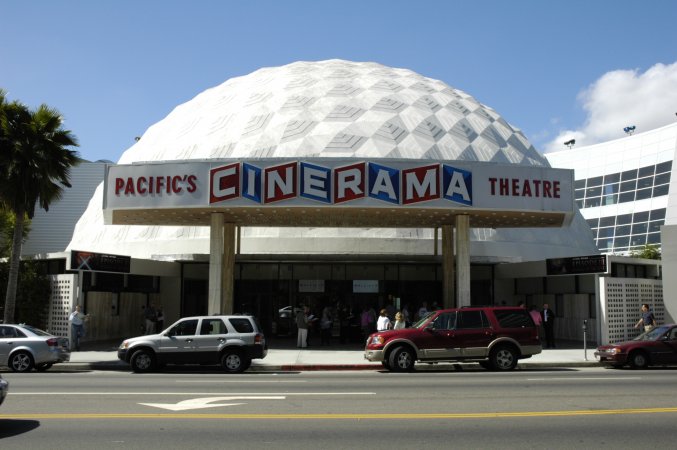
This super clear, nearly-3D effect of the super 70mm clarity has other benefits, long forgotten after decades and decades of cropping, consider the wraparound giant screen of "Cinerama" and Kubrick's 2001: A SPACE ODYSSEY (1968). With its clarity enhanced, the colors restored via 70mm (or in this case 65) negative, at least Kubrick's stately stereo side framing strategies begin to make more sense, especially as we compare his angles and stillness or slow glacial movement with, say, How the West Was Won and other films shot for 'Cinerama,' and roadshow wrap-around screens, where, as I said, sudden cuts and big close-ups don't work well, just as the long static medium shots never worked well on cropped home screens.


 |
| (from top: How the West was Won (x2), 2001 (x3), This is Cinerama) |
2001 was shot in Super Panavision 70, a process which involved principal photography on a 65mm wide, 5 sprocket hole high film frame (standard photography is on 35mm wide 4 sprocket hole high frame). This was projected back from a 70mm print, the extra 5mm being two 2.5 mm magnetic soundtrack strips "outboard" of the sprocket holes... In the original Cinerama installations, the film was projected on a deeply curved "louvered" screen which wrapped the image around the audience, sweeping them into the image. The Super Panavision version of Cinerama had an aspect ratio of 2.21:1 (the three-film and "rectified" Ultra Panavision versions of Cinerama were noticeably wider with an aspect ratio of 2.59:1). - Thomas E. Brown
 |
| Cinerama screen as background wall for moon shuttle - 2001 |
 |
| The early "Dawn of Man" scenes carry an--I'm sure intentional--Natural History Museum diorama vibe. Shot mostly on sets with the rocky ground ever on the bottom of the screen - 2001 |
The subtitle of the film "A Space Odyssey" makes more sense when considering this original wraparound 'event' presentation format. For 2001 is both more (way more) and somewhat less than the average 'thinking man's' sci-fi movie from the 60s (this being the age of Heston, and the Social Message). It's also evocative of one of those forty minute IMAX films shown in museums for a small additional ticket cost, about the history of balloon flight or African geese migration (the 2001 version being at a very forward-thinking planetarium). In other words, it is both a trippy narrative and covertly NASA-driven Cinerama spectacle. Years of seeing it in full frame have left it seeming merely glacial and Surely Important. But now, even if we're not seeing it in Cinerama, just knowing that it was meant to be seen that way helps contextualize the structuring of the frame and the slow, deliberate pacing.
We're not just watching a movie, man, we're on a goddamned ride.


NOTES:
1. one of the few dislikable 'kid sister' characters in Hitch's ouevre - see Diane Baker in MARNIE
2. if you noticed it already, on, say, a VHS tape or on normal analog TV, hats off! You're sharp.
--
Suggested Cont. Acidemic Related Readings:
SHINING Examples: Pupils in the Bathroom Mirror (from 10/11)


