
An adaptation of Christopher Marlowe's Elizabethan play, made by Burton to raise funds for his alma mater, the Oxford Dramatic Societ. And man, it can drag a bit, until you can barely wait for hell to roar up and get its claws and fangs sunk into our ranting antihero, so class can end and you can race out into the quad and smoke grass or drop acid.
But, dig man, see it again the next night, brain and pupils still expanded, and you may find there's a sensationalist, existential, trippy drug fantasia in its margins. It's there, I swear! So drop a micro-dose an hour before class starts, then mosey in and see where things land.
Oh but the trepidation of taking one's first trip, one's first big lysergic step. There's no going back. I remember the hysteria and hype in the 80s that kept me from doing it for the longest time: you could go insane permanently! Chromosomes damaged! In other words, damned, so the newbie's trepidation is mirrored in Faustus' second thought, needing to egged on by his cronies.
Oh but the trepidation of taking one's first trip, one's first big lysergic step. There's no going back. I remember the hysteria and hype in the 80s that kept me from doing it for the longest time: you could go insane permanently! Chromosomes damaged! In other words, damned, so the newbie's trepidation is mirrored in Faustus' second thought, needing to egged on by his cronies.
And so it is, whether intentionally or not, Burton susses out the commonality between Faust's devil bargain, Marlowe's sub-Shakesepearean prose, and the "lay down all thought / surrender to the void" philosophy of the flower people singing in the street. Both are in the sway of the beyond (sunflower petals glowing like flames in the dilated pupils of the dosed), and between all the psychedelics in the wind and Burton's own alcoholism and habit of disappearing into a fog with Liz (those drunken bender weekends), it's as if any kind of normal baseline by which to measure the bizarre in a British/Italian vanity production has been permanently eroded.
Like Roger Corman in the US that same sunshiny year, Burton was quick to make use of already-available props and sets from Italy's early-60s glut of Gothic horror films. All the macabre symbols and colors and imagery carry over from schlock to art, serving as hallucinational markers through the Jungian birth/rebirth Hell-initiation / the 'it is not dying / it is knowing' nirvana being over one side (the good trip) and the thousand rending talons of self-centered fear that shred your resistant ego to ribbons (the bad). In the end, while it's better to experience the former, the latter is much more cinematic.

Filmed in Italy and England, there's a lot of painterly craftsmanship at work in Faustus that few critics are in the mood to mention. The lighting evokes Bava's Black Sabbath (the gold standard) in its stunning use of colored gel spots. turning cobwebs and walls all sorts of ghoulish, unnatural, but strangely cozy colors. The subject -- a seeker who finds and realizes he was better off not knowing -- evokes Roger Corman's very California The Trip (from the same year, 1967 - above) and Corman's earlier, yet still highly-psychedelic horror films Masque of the Red Death (1964) and X-The Man with X-Ray Eyes (1963), even 1966's Wild Angels in a way. These Corman films ten towards sidpa bardo-aping hallucinations that subsume our seeker in 'careful what you look for' ironic comeuppance: kaleidoscopic images of painted women writhing in delight that change to withered crones the closer you get to them, monstrous orgies smeared on all sides by vaseline for trippy distortions, time lapse dissolves; the descent to madness kickstarted via dungeons, caves, cobwebbed skulls under cozy purple gel spots, sudden strange juxtapositional overlaps, and copious occult symbolism.
That the story's parallels to drug use are never overtly emphasized by Burton doesn't matter. He can't escape the tenor of the times, and drunks like he and Liz fit right in with acidheads, for both--sooner or later--get the honor of taking a Dante-style tour through the depths of hell. Both the high art of Burton and Marlowe and the drive-in sensationalism of Corman are centered around this savvy of the well of woe waiting right outside the blinders of our world. We would know more, like Faust, like Peter Fonda in The Trip or Prospero in Masque or Xavier in X-The Man with X-Ray Eyes. We seek to attain enlightenment, not through aeons of meditation and work with a guru, but the fast way... via a little tab on the tongue.
And should you disregard the warning label on Medusa's chintzy veil, don't whine when you're too stoned to write anything down, even though you dropped all that acid to improve your poetry. How ironic! That's the devil's bargain - he gives you endless inspiration but then--oops--no ink for your pen. The stores are closed; your car doesn't work and you shouldn't drive anyway. Everyone else is asleep, and there's no way to write down your flights of genius. How the devil doth laugh and laugh! Even if you had a pen it would take you years just to stop staring at it in quiet awe.


The books and drug pamphlets and 12-step meetings, and theaters, are all full of tales of those fools who'd ignore the 'caution' signs to "sound the depth of that they would profess" (as Faustus puts it), who live it up and order everything on the menu, still they aren't full nor satisfied; comes the devil's check they try to stave it off by ordering more and more. But finally they may order no more. the check must be paid. And so it is, by screaming, psych wards, rehabs, withdrawal, and suicide. These days psychedelics are being de-demonized but in 1967 they were still being blamed for anti-Vietnam protests so made illegal by a spooked Nixon. Thus even in The Trip there is the disclaimer in the beginning and 'cracked glass' ending, both forced on the film by the nervous producers who wanted to make sure the psychedelic experience was portrayed, ultimately, as causing calamitous long-term brain damage. More than governmental censure, I'm wagering James Nicholson was worried about lawsuits, suing AIP for endorsing a drug that convinced cousin Timmy he could fly out a sixth-story window.
In Faustus, however it's even more bleak and final than a cracked head or a splat on the concrete: the voyage to Hell being paved with eternal DTs is represented by an evil Liz Taylor in green body paint, her hair a bed of snakes, laughing evilly.
Dude, I've been there. The ghost demon girls all laughing at me after luring me into a no-exit trap. It's like you wake up with a hangover so screaming you know it's going to turn into DTs in a few hours if you can't find your last Librium, or secret whiskey stash. You can't because you can't even get of the couch without shaking, dry-heaving. and hyperventilating. the visions and shakes consume you so bad all you can do is scream, a scream without end... Close your eyes / Close your Eyes / Relax, think of nothing / tonight" - as Mary sings in Jesus Christ Superstar. But that does nothing to dispel the visions, and time slows to a crawl. Your hangover shakes don't get better as the hour click by, the way they would for a non-alcoholic (i.e. someone who hasn't signed that infernal contract). The longer you wait before getting high or drunk again, the worse the shakes get, exponentially, lower and lower, until perdtion's flame licks your culo.
And should you disregard the warning label on Medusa's chintzy veil, don't whine when you're too stoned to write anything down, even though you dropped all that acid to improve your poetry. How ironic! That's the devil's bargain - he gives you endless inspiration but then--oops--no ink for your pen. The stores are closed; your car doesn't work and you shouldn't drive anyway. Everyone else is asleep, and there's no way to write down your flights of genius. How the devil doth laugh and laugh! Even if you had a pen it would take you years just to stop staring at it in quiet awe.


 |
| The Trip |
In Faustus, however it's even more bleak and final than a cracked head or a splat on the concrete: the voyage to Hell being paved with eternal DTs is represented by an evil Liz Taylor in green body paint, her hair a bed of snakes, laughing evilly.
Dude, I've been there. The ghost demon girls all laughing at me after luring me into a no-exit trap. It's like you wake up with a hangover so screaming you know it's going to turn into DTs in a few hours if you can't find your last Librium, or secret whiskey stash. You can't because you can't even get of the couch without shaking, dry-heaving. and hyperventilating. the visions and shakes consume you so bad all you can do is scream, a scream without end... Close your eyes / Close your Eyes / Relax, think of nothing / tonight" - as Mary sings in Jesus Christ Superstar. But that does nothing to dispel the visions, and time slows to a crawl. Your hangover shakes don't get better as the hour click by, the way they would for a non-alcoholic (i.e. someone who hasn't signed that infernal contract). The longer you wait before getting high or drunk again, the worse the shakes get, exponentially, lower and lower, until perdtion's flame licks your culo.
 |
| "Heyyy, Swamp! Hey Swampyyy!") |
It's ironic then that Burton and Taylor--then married and still tabloid gold--are the weakest parts of the film. Like many towering drunk titans of the stage and screen, each could rely on a bag of tricks to mask their various hangover and bloated periods for only so long. Burton, especially, as he'd later prove in nearly every role he took, uses tortured booming depth of voice and harrowed stare of beady eye to mask his doleful hangover; ever gazing past the camera, he's presumably looking at cue cards, or the clock, waiting..... waiting.... for cocktail hour (1).
 That's not to say great genius couldn't be wrung from such sad states! Burton and Taylor had just made their two--by far--best films--Who's Afraid of Virginia Woolf? and Taming of the Shrew--right before doing Faustus. They were on their career-defining roll, making up for their inert chemistry in Cleopatra with a vengeance.
But it's all gone for Faust -- and it's clear right away what the problem is: Burton needs a playmate of equal stature, someone to provoke and challenge him, or he loses his energetic madness X-factor. He needs to plays off Liz's energy, making full use of their Pisces-Scorpio dynamic. BUT her character in Doctor Faustus never speaks, or appears as anything but a Ligeia/Rebecca-style anima (with an initially haunting but eventually tiresome Yma Sumac-ish leitmotif following her around like a ghostly herald). In short, she is simply miscast. She overflows the boundaries of a mute object role/phantom role. It's like casting Bette Davis as Jessica in I Walked with a Zombie or Anna Magnani as Lolita. To put it bluntly, she is simply way too old, too regal, too grand, too tremendous, to play a cipher role like this. Clearly these interludes where she sashays through the scene were not in Marlowe's play. They're written for her, so they can put her name on. the marquee while at the same time freeing her from having to memorize any of the fancy-pants Elizabethan dialogue. In one groan-worthy scne Faustus beholds her beauty and asks "is this the face that launched a thousand ships?" you feel like raising your hand to give the obvious answer. If you loved the brawling Liz in Shrew and Woolf, and were hoping for more of the same, you too might be inevitably weirded-out to see that same sexy-buy-clearly-aging force of nature posited as the ultimate silent objet-d'art of youthful ephemera, especially when she's competing with an array of young, sexy British models, all bravely clad in nothing but the glow from the OS hellfire.

Every straight male in the world knows this scene (above) from their fantasies and nightmares, the odalisques lounging in the flames of the fever / bad trip / vision of fear/desire/hell/heaven rolled together. They're always there, deep in our straight male DNA, judging all we see and do with scathing insolence. Their silence speaks volumes to our frenzied bloodstream. Liz's silence in Faustus speaks only to the gay sensibility's love of high camp, a kind of pre-Madonna plays Mona Lisa on a Tracy Lord pedestal. (2) She's neither terrifying or beguiling, while the above scene is both. These girls above are the maenads from the sidpa bardo. One wrong move, one flinch of fear, and they change from seducing you to rending you to pieces and devouring the remains. They are the demon reflections of our anima. To put it in Jungian archetypal terms, Taylor is simply not a blank enough canvas for our inner woman to project on. She's already fully filled in.
Another particular flaw with the film is the mythic-reference-choked language of the text, recited by Burton with great oratory declarations unto heaven but without much fire or oomph. I'm sure Marlowe is a genius but he's no Shakespeare. His fancy words resonate far less cosmically than the smaller more personal oratory we find in Franco Zeffirelli's Shrew and Mike Nichol's Woof, where the mythic resonance cracked through even the most banal of situations. Wth Marlowe it's the reverse: even the most mythically resonant scenes have a king of core banality dampening the mantle.

But it's all gone for Faust -- and it's clear right away what the problem is: Burton needs a playmate of equal stature, someone to provoke and challenge him, or he loses his energetic madness X-factor. He needs to plays off Liz's energy, making full use of their Pisces-Scorpio dynamic. BUT her character in Doctor Faustus never speaks, or appears as anything but a Ligeia/Rebecca-style anima (with an initially haunting but eventually tiresome Yma Sumac-ish leitmotif following her around like a ghostly herald). In short, she is simply miscast. She overflows the boundaries of a mute object role/phantom role. It's like casting Bette Davis as Jessica in I Walked with a Zombie or Anna Magnani as Lolita. To put it bluntly, she is simply way too old, too regal, too grand, too tremendous, to play a cipher role like this. Clearly these interludes where she sashays through the scene were not in Marlowe's play. They're written for her, so they can put her name on. the marquee while at the same time freeing her from having to memorize any of the fancy-pants Elizabethan dialogue. In one groan-worthy scne Faustus beholds her beauty and asks "is this the face that launched a thousand ships?" you feel like raising your hand to give the obvious answer. If you loved the brawling Liz in Shrew and Woolf, and were hoping for more of the same, you too might be inevitably weirded-out to see that same sexy-buy-clearly-aging force of nature posited as the ultimate silent objet-d'art of youthful ephemera, especially when she's competing with an array of young, sexy British models, all bravely clad in nothing but the glow from the OS hellfire.

Every straight male in the world knows this scene (above) from their fantasies and nightmares, the odalisques lounging in the flames of the fever / bad trip / vision of fear/desire/hell/heaven rolled together. They're always there, deep in our straight male DNA, judging all we see and do with scathing insolence. Their silence speaks volumes to our frenzied bloodstream. Liz's silence in Faustus speaks only to the gay sensibility's love of high camp, a kind of pre-Madonna plays Mona Lisa on a Tracy Lord pedestal. (2) She's neither terrifying or beguiling, while the above scene is both. These girls above are the maenads from the sidpa bardo. One wrong move, one flinch of fear, and they change from seducing you to rending you to pieces and devouring the remains. They are the demon reflections of our anima. To put it in Jungian archetypal terms, Taylor is simply not a blank enough canvas for our inner woman to project on. She's already fully filled in.
Maybe that has to do with Burton's lack of directorial experience? Nichols and Zeffirelli both know that true mythic grandeur comes from sharply observed small moments, not big declarations. Awareness of this paradox (specifics are universal; generalities are alienating) separates windbags from geniuses. Thus, when Burton is playing a middle-aged history professor shouting at his wife, he's as vivid and mythic as the cosmos; when he's a mythic figure shouting at the cosmos, he's as dull as a middle-aged history professor. When he kisses Liz as Helen and talks about her kiss sending his soul flying around the room, it's hard not to roll your eyes and think of that old adage of acting class, "you're telling us not showing us, and we don't believe it."
He should have pretended he was saying that to a dry triple martini. We'd be able to feel that passion in our toe tips! Burton comes alive!
Consider how how both Welles in his self-directed Macbeth and Olivier in his self-directed Hamlet (both 1948) give you the impression they love every minute of their character's tortured guilt and suffering. No matter what dour calamity their characters wallow in, they--- the director/actors-- revel in the poetry and mythic undertones, capturing the essence of art in small perfect little gestures. Director/star Burton on the other hand, can't even revel during Faustus' moments of revelry, let alone in his dour calamities. One must wonder if the demands of directing, the essence-draining demands of marriage, the endless intrusion of paparazzi, and staying sober long enough each day to stay on schedule-- tanked his energy.
He should have pretended he was saying that to a dry triple martini. We'd be able to feel that passion in our toe tips! Burton comes alive!
 |
| "the fruits of lunacy" |
Maybe he let his brown-nosing reverence for 'the classics' undo his natural crazy Wagnerian oomph? Unlike Olivier and Welles, both of whom swim in Shakespeare like it's the literary equivalent of 100 proof whiskey (which it is), there's a 'mustn't spook the dean of letters' kind of respectfulness with Burton's performance. Sure Burton was a vibrant earthy Petruchio in Shrew, but that was under Zeffirelli's direction, far from any dean of letters' stern looks. Like Welles and Olivier, Zeffirell is a director who swims in the poetry of Shakespeare (see his definitive Romeo and Juliet, and the shamefully underrated Mel Gibson Hamlet -see my review here) amongst others. Though Shakespeare is considered bourgeois, something only the educated snobs would attend, Welles understood Shakespeare was writing for the cheap seats as well as the queen, so would give himself permission to heedlessly go for a more reckless 'give the dean a heart attack' approach that, paradoxically, would be more faithful to the material at hand.
In short: If you film a respectful, staid depiction of a prankster thumbing his nose at staid authority figures, then you become the very thing you're rebelling against, and that kind of feedback squall is so exhausting it may takes years of painless deconstructive art history to recover any semblance of wit therefrom. End of rant.
As a result, the play's dense intertextually-lined language unpacks rather flatly, especially since there is --essentially-- so little at stake. This is, after all, the tale of an aged recent (he must have been on the 30 year plan) college graduate who fritters his time away doing tons of drugs and wine up in his apartment, alone but getting periodic visits from his drug dealer, fellow academes hoping he'll get them high. The rest of the time he's either lost in a whirl of phantom anima dream imagery (i.e.when he takes too much) or suffering insane hallucinatory tortures (when he takes too little). If he's in the Goldilocks zone where he's taken just the right amount, why, he can patter around his garret, whipping up alchemical formulas and writing or painting or reading as his whims dictate.
 |
| Any similarity to packing a massive gravity bong is presumably unintentional |
Still, there's nothing in the play for film to help us understand why he's so keen to worship Lucifer and denounce god, to sign away his soul, rather than just doing drugs and writing poetry all day while ostensibly teaching at some cushy university (hmmmm). Nor is there any indication of why we should sympathize with his latter bratty copping out (he's like a Satanic narc) and second-guess antipathy. What a welsher. our once so faux-brave Faustus.
If you've 'been there' (it's called college), you can relate when his occasional visitors find him lying on the floor, staring at some unseen phantom, or writhing in the grip of a fine, frothy madness, his clothes and brain in a state of disarray, unable to distinguish his corporeal guests from the phantoms. But as Bill Lee says to his visiting buddies who visit him in similar circumstances in Naked Lunch, "the Zone takes care of its own."
If you've 'been there' (it's called college), you can relate when his occasional visitors find him lying on the floor, staring at some unseen phantom, or writhing in the grip of a fine, frothy madness, his clothes and brain in a state of disarray, unable to distinguish his corporeal guests from the phantoms. But as Bill Lee says to his visiting buddies who visit him in similar circumstances in Naked Lunch, "the Zone takes care of its own."
None of that is any excuse to sign away your soul, though, idiot. That's just overkill, like getting a huge Led Zeppelin tattoo just because you saw Song Remains the Same for the first time, while on acid, last night, and ended up at the Zep-bedecked dorm room of some hot Pittsburgh brunette. Dude, you haven't even read Hammer of the Gods yet, don't be hasty. She loaned it to you on your way out, like a Christian giving a native a bible. A great night and Zeppelin is now your god. But a tattoo is a big commitment, bro. So make sure you listen to both sides of Presence and Coda before the needle hits the skin. No one is perfect. Jimi Page even wears chinos in one of their latter concert videos. Chinos! .
 Now, all those negatives aside, there is much to love about old Faustus. Even if Burton the lead actor seems to be suffering from boozy stress, Burton the director is able to use that same boozy stress as a subtext for a richly familiar and welcome streak of Gothic horror and illuminati in-jokes, showing he learned some important things from his drinking buddies John Huston and Tennessee Williams about using alcoholic highs and lows as mythic narrative touch points. And showing too that despite his lofty airs, Burton harbors a secret love of horror. You can tell he's seen Black Sabbath and Masque of the Red Death and he wants to use some of their aesthetic tricks. The popping rich spectrum of dusky deep ochres, blues, purples, and cherry reds, glow as if Mario Bava himself were doing the gel lighting, giving many scenes (restored to glowing HD for Amazon streaming) a highly evocative atmospheric surreal glow that, for me, as a 70s monster kid, reminded me of old Key comic book covers--the kind my mom would buy you in packs of three at the department store to keep me occupied while she shopped for clothes.

Walks through anachronistic/period sets and surrealistic historical tableaux (the Garden of Earthly Delights, the Vatican, a king's reception hall, a crypt) bring not just mythic resonance but call back to the various movies and genres those props were purloined from. Largely filmed in Italy, these sets were no doubt used in everything from peplums to westerns to Gothic horror (the way Masque used still-standing Beckett sets) creating a sense of stripping away of time's linearity, allowing a stage-like but very psychedelic rapid scene-changing (there's similar bits of Gothic horror call-back in Head, and Psych-Out as well as The Trip, keeping the old Gothic props and sets close at hand for quick inexpensive visits to the archaic subconscious). Copious tripped-out occult magic (nice use of made of a haunted mirror), cobwebs, skeletons, candles, alchemical test tubes and conjuring crucibles, volumes of forgotten lore, and astral charts-bedeck the torture chamber-cum-Illuminati arcane alchemist sanctuary that will be home base for Faustus' solitary drug experiments. Boldly treads our Faustus! Going where one might hallucinate yearning naked women inside the flames of a candle or the eye of a skull, or float through a veil of kaleidoscope effects and blurred edges, time lapse flowers and occult symbolism, to see the effects of time and age upon desire's ripe fruit. The laughing of the flower children switches to screaming with an imperceptible twist of the pitch shifter.
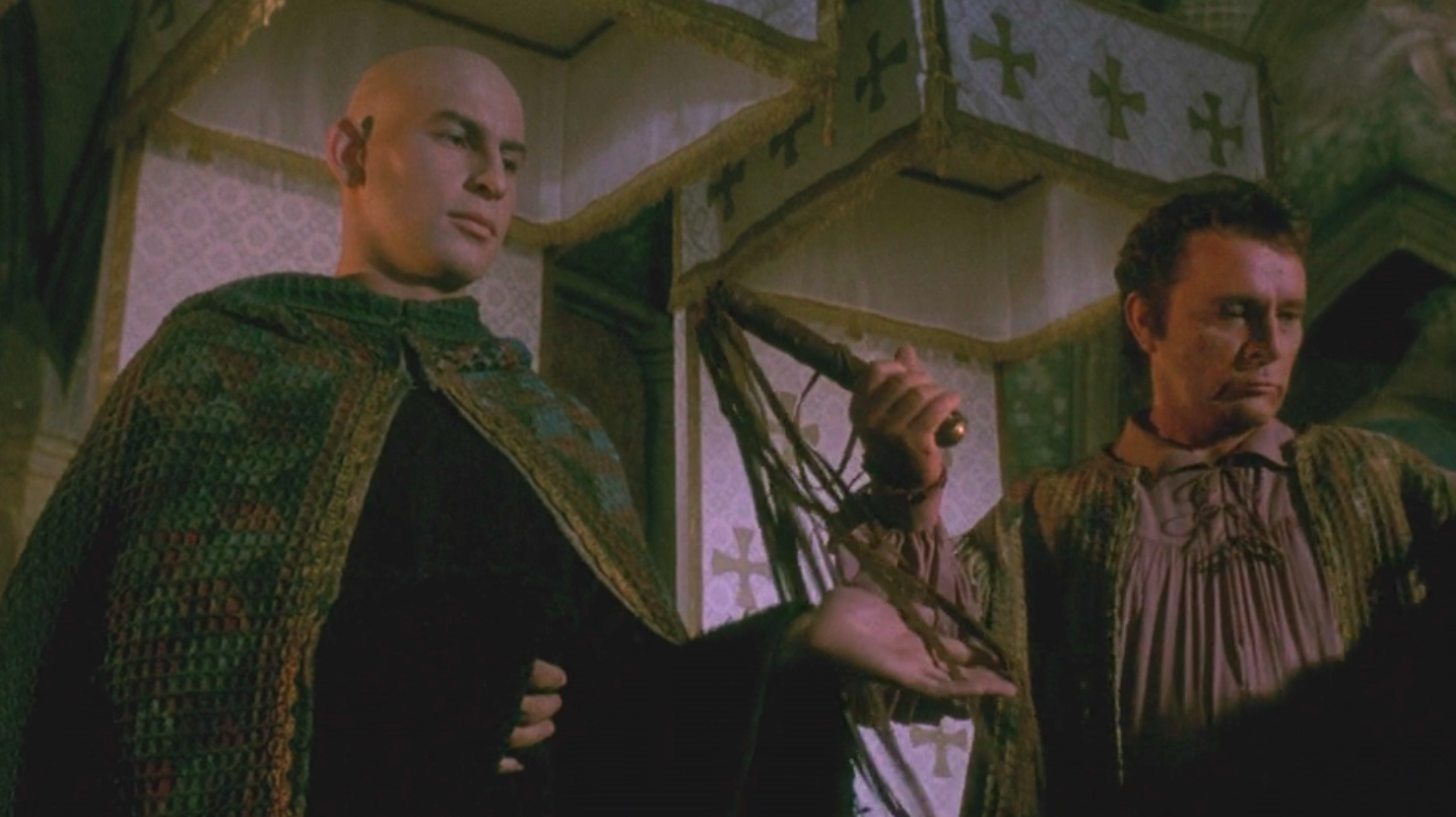
Like its contemporaries in the Elizabethan dream theater era, Faustus gambols freely amidst the arcane iconography of spirits and demons that would previously (or then-currently, if performed in Spain) be charge enough for heresy. As it is, thanks to the rise of sane Protestantism, even making fun of the pope is not frowned upon, so long as the knave who dares winds up trapped in the arms of burning hellfire by drama's close (we mustn't get the Spanish ambassador too mad, after all). Thus Burton's Faustus (under an invisibility spell) makes fart noises behind the rows of bishops, pelts the pope with a fancy cake, and flogs a bunch of empty robes in a moment that seems straight out of Jodorowsky. Then the psychedelic college kid experimentation aspect continues with the slow downward slide from seeking truths to questions that lie far past the known parameters of life and death to just getting massively hammered. There is no joy of evil in Burton's performance of these things, only a kind of peevish aggression, like a sulky ten year-old kicking his little brother's lego fort.
The ultimate in devil's bargains is, as I can tell you from direct experience, the alcoholic's. Only by staying drunk can he forget the horrible shakes, DTs and misery that compounds with interest for every day he doesn't suffer them. On and on he goes, on a massive bender, until eventually one morning he comes to and there's not a drop left in the house, and he's physically unable to move without it, so unless someone comes by with a bottle to save him, the voyage to agonizing hell begins. His is the terror of the cold turkey addict tied to a bed table in a hospital, screaming his guts out, like Bela Lugosi in Ed Wood.


 |
| From top: Hopper schools in TRIP; FAUSTUS |
In the beginning of Faustus we find Burton as an aging scholar in round owlish glasses and long gray hair -freshly graduated, advised by one of his druggie friends to "sound the depths of that they would profess."- In other words: don't just say no to drugs, try them first! Condemnation prior to experimentation is not wisdom, but its own sort of vice, twice as vile for its hypocrisy in one so allegedly open-minded and well-researched.
 |
| Faustus and Valdez Cornelius mixing a full decanter of the good shit - shhhh - don't let the RA hear |
Later, alone in his study, not quite sure which field in which to further broaden his academic acumen, which tome to grace with owlish eye, Faustus is buffeted by a sudden surge of boyish ego and curiosity. He feels the wave knock his soul up against the sand break of the known, made all the more pathetic and indulgent by his speaking aloud at us, as though his imaginary class: "To live and die in Aristotle," seems wise and--to him--oddly sexy, or to study medicine BUT--as as he notes, "the end of physic: our body's health." So from what new field shall his alchemist's brain next turn? Why not to the occult!
In other words, Faustus is bored, antsy, and doesn't feel like studying. His idle hands, the devil's workshop
Drinking buddies Valdez (Ram Chopra) and Cornelius (Robert Carawadine)--as sketchy a pair of Satanic drug dealers as one is likely to find in all of London-- drop by to regale him with tales of the fame and wealth that comes from conjuring demons. Soon trundles the trio graveyard-ways to raise hanged sinners and summon devils! It's all a little too convenient... Faustus gives in way too easy.
You expect the heavens to shout, or at least whisper--to explore the black arts is blasphemy, Faustus! Turn to the church and repent. This sort of disclaimer seems only fair -- due diligence to ward off those who are better off not venturing beyond the No Trespassing sign. And it's no idle threat, either. In all the tales of those who'd ignore caution to sound the depth of that they would profess, the price of enlightenment is dear. And as anyone 'called' to try these things will tell you, even your hardcore hippy friends may warn you off. People you thought were cool declare 'you'll damage your chromosomes, Faustus!"
In Faustus, however it's more bleak and final, the damage permanent. Hell is only a feeling for one having a bad trip. Eventually --after timeless aeons of distress-- everything will wear off. On some level, as many a scholar has noted, the only difference between a schizophrenic and an LSD user is that the latter knows he's just 'visiting' where the schizophrenic lives.' The opposite of the Sunday tripper, the schizophrenic knows he is just 'visiting' reality via medication and is actually living in the void, like a phantom signal forever caught between neighboring TV channels.
In other words, Faustus is bored, antsy, and doesn't feel like studying. His idle hands, the devil's workshop
Drinking buddies Valdez (Ram Chopra) and Cornelius (Robert Carawadine)--as sketchy a pair of Satanic drug dealers as one is likely to find in all of London-- drop by to regale him with tales of the fame and wealth that comes from conjuring demons. Soon trundles the trio graveyard-ways to raise hanged sinners and summon devils! It's all a little too convenient... Faustus gives in way too easy.
You expect the heavens to shout, or at least whisper--to explore the black arts is blasphemy, Faustus! Turn to the church and repent. This sort of disclaimer seems only fair -- due diligence to ward off those who are better off not venturing beyond the No Trespassing sign. And it's no idle threat, either. In all the tales of those who'd ignore caution to sound the depth of that they would profess, the price of enlightenment is dear. And as anyone 'called' to try these things will tell you, even your hardcore hippy friends may warn you off. People you thought were cool declare 'you'll damage your chromosomes, Faustus!"
In Faustus, however it's more bleak and final, the damage permanent. Hell is only a feeling for one having a bad trip. Eventually --after timeless aeons of distress-- everything will wear off. On some level, as many a scholar has noted, the only difference between a schizophrenic and an LSD user is that the latter knows he's just 'visiting' where the schizophrenic lives.' The opposite of the Sunday tripper, the schizophrenic knows he is just 'visiting' reality via medication and is actually living in the void, like a phantom signal forever caught between neighboring TV channels.
But whither Faustus? Which reality will be his final resting place?

But it all starts innocent, if sin can be so called. The three head to the graveyard like a trio of errant hippie sophomore knaves shrooming behind Sadler in Syracuse University, circa 1986, finding all sorts of universal truths and froth-at-the-mouth delights there (big rolling graveyards being the perfect place in which to trip, both emblematic of the experience you're on as far as death/rebirth awareness, and the way egoic fear keeps the lightweights away). These pleasures are the first reward of daring, to buffet manly against the current and enjoy the rarefied air above the superstitious public's boorish din.
In hindsight, it would be great if Valdez and Cornelius return, for Burton came to life in their presence; he plays well against their relish in demonic control. Like the bulk of the cast, they're students and teachers from Oxford's Dramatic Society and Burton often flickers to life in their company, only to turn dour again when sidelined through lengthy solo dark rants that we know in but a second he will deny having said. He chides Mephistpholis' sadness over his failing soul, urging him to take a lesson from his resolute bravery and "scorn those joys thou never shalt possess." Aa dissolve later and he's letting a statue of St. Sebastian urge him turn to God, then to let a skull on the desk encourage him back to Lucifer. All he needs is a hard push one way or the other and he not just hesitates but thoroughly changes his mind. He's wishy-washy! Take another little drink, Faustus!

It's hard to get involved in the plight of a man so unmotivated in his flight to Lucifer that its very reason defies credibility. He's a dude burning out his brain for pure onanistic thrill-seeking"magic" and only realizing it's not some dumb heavy metal pastime when it's too late to weasel out. He assures Valdez and Cornelius he'll stick the course. He says "magic enravishes me!" but we're never really sure what his end game is beyond pleasure and sport, to revel in the folly of others. The presence of these two enablers might have made it clearer (peer pressure) but without them, it's hard to fathom why he sticks to it. Whatever he once sought to know, being known, he'd rather forget fast, so turns to drink - which makes days flow faster especially with a devilish enabler servant at your side to make sure you never wake up without a stiff drink at your bedside.
 |
| "Glad tidings from great Lucifer" |
Reveling by proxy too proves a challenge. Whether flatly chanting along with the bell, book-and-candle monks who try to exorcise his spirit or belligerently chanting "he wants his money!" to an aggrieved bartender, we're not amused or thrilled (like we were in Woolf or Shrew) but rather embarrassed by this base schadenfreude and tone deaf infantile prankishness. Here is a man who freely takes more than would befit a man, then tries to weasel out of paying - drinking vainly against the passing of time (his ever-present hourglass) ticking down to his Hell journey. All the wealth in the world is his for the asking but he'd rather stiff the bartender.
He's a 'bad' drunk!
In his groovy man cave, doth Faustus have the alchemical tools to astral travel the world over and have his heart's desire granted time and again, the only caveat being it brings him no real joy, since there's no strife or earning of the goal, there's none but the pale shadow of gratification. And as anyone who suffers from depression knows, getting all you want in life might make you more miserable than just wanting, which at least gives you the hope you will be happy once said desire is attained. To attain it and still be unhappy is to be faced with the reality of a no-escape misery, a room without an exit. The gorgeous women you coveted as a geek in high school clamor all over you now that you're in a band, but their sudden, almost aggressive affection creeps you out; the terror of actually merging your naked body with someone who you barely know supplants your lustful reveries and turns desire's promise into the stuff of future shame and regret. For Faustus, his wish for 'a wife' is ridiculed by the devil with an open flower of beautiful women who turn into men or aged crones on contact. This is the Sidpa bardo in Buddhism at play. Women never stay lovely, and so outside of space/time, beyond the illusion of permanence; sexual allure beckons like a sticky web of flame that evaporates on contact but leaves you stuck, devoured by withered crones where once were massive babes. (i.e. the woman in room 237)

It's in this aspect, the terrors of the DTs, where Burton brings his alcoholic and priapic issues into the subtext: the realization that--when given a chance to be endlessly indulged--angelic vice soon turns to a tar pit

Movies are to the ego what the ego is to the soul, distraction from the terror of eternity. When tripping the distractions collapse into the real, especially on a so called bad (or 'bum') trip. For example, on one bad tip I forgot how to breath. I became aware of lungs, understanding at last their slavery to the body, the awful duty they have, their constant inflating and deflating, year after ear. I could feel them almost collapse from the weary shock of recognizing their eternal bondage. Of course the deliverance from this realization is that you only have to deliver one breath at a time. That's the AA secret. The "I'm just not drinking today" adage, the "one day at a time" is the 'good news' that helps many a drunk, myself included,. No one wants to imagine never drinking again. It's too awful to contemplate, but just not drinking today? Sure, it's a trick to make the abstinence endurable, but is booze's trick any less devious? Both use our ego's need to escape living in the moment (for the ego has less control when we are fully aware of living in the 'now') against itself. Like tricking you into self reflection by putting a top hat on the mirror and telling you it's Fred Astaire.
Supposedly immortal, the soul is paradoxically comforted by the ephemeral nature of all things, which is the direct opposite of the ego's anxiety. The space-time continuum allows us the comfort of the ephemeral, allows us to dwell under the protective illusion of impermanence. That all things die, that life is rounded with a sleep, wounds heal, flowers wither, traumas are buried in the repressed unconscious, seasons change, nights and days alternate ---these are comforts that deliver us from the terror of continuity. Hell, then, as realized by Marlowe's Faustus, is the waking up from this illusion of impermanence so that the terrifying eternity of existence is revealed and is inescapable. This is the trial of the cave crypt hallucination in The Trip, ("I don't want to die, man"). This is the 'bad trip' every psychonaut sooner or later must endure, the wave that sucks us under for an eternal night, the giant eye at the center of the universe gazing pitilessly through our X-Ray Eyes. This is Hell as inescapable awareness of, as Mephistophilis puts it, "all that isn't heaven", the great flaming void that is left "when all else dissolves."
 |
| "The depths of all that thy would profess" i.e. all therein that may be explored |
Hell, then, is the terror of eternity that makes us long for the illusion of impermanence. When faced with extinction, life at last becomes unbearably precious -- so that each miserable second is clung to like one clutches a piece of floating bed frame in the midst of a tidal flood current.
Yet, as he clings, Faust has no love of the life he's led, only fear for what is to come. Not knowing that his fear of eternity is itself already hell, he indulges full force. These are the types of lightweights you need to avoid when culling a 'set and setting' for your 'voyages' - as they're invariably the dudes who can't shake their ego's sticky grip, and foolishly believe all the fear mongering their ego incites to keep itself in power. Knowing how to ignore ego's panicky horse-in-the-stall bucking is one of they key skills for successful inter-astral navigation. When God is your co-pilot, you don't even need to go in the plane. With their ego as their co-pilot, these lightweights inevitably panic, and demand to be taken to the ER because they are sure they're dying. Ugh what a drag.

Early in their meeting, Faustus asks Mephistophilis where Hell is and why he's not there. "Why, this is Hell," notes Mephistophilis. "Think'st thou that I who saw the face of God and tasted the eternal joys of heaven am not tormented with ten thousand Hells in being deprived of everlasting bliss?"
Such a junky thing to say, bro. If you're living as--or have ever lived--as a drug addict or alcoholic, or known the bliss of a 'perfect' peak ecstasy experience, you may have tried unsuccessfully to recapture that high for years, eventually realizing you can never return to it. That is its own kind of Hell. The only thing that saved me from it back in the 90s was Lacan, and then SSRI meds in 2003. Since my relapse last Feb, I now get that same magnetic tug from the sight of all the IPA beers, the various small batch brews in the grocery store, none of which existed in 1998, when I initially stopped drinking. It was worth it to relapse just to sample those delicious brands. Except now when I pass them on display my heart breaks, my mouth waters, and the yearning increases exponentially the longer I linger. Is that in its way, not Hell, but it's okay since it's always there, the way depressives sometimes keep nooses or guns hidden in their closet, as a kind of assurance. The Hell in Faust's world is the hell of knowing you can never get back to that closet or the beer aisle. You're 86-ed for life... and beyond/
If any of that sounds familiar, maybe you too might find a special love for Burton's Faustus or if not love, at least unnerved understanding. For to be in the throes of a serious addiction is to know the joys of hell and heaven are as a coin ever flipping, and one may become the other just through the other's absence, and so sooner or later heaven always flips back to hell. Hell is the constant. It's a question of numbers, of days, of time. For every day the horrible shakes/convulsions/DTs of detox are staved off, the worse they will be when that key moment arrives: waking up completely out of alcohol, and unable to get to the store or bar to get some more due to intense shaking and hyperventilating. But until then, there's that moment in the morning (if you don't have to go to work) where you decide to try and wait until 4 PM cocktail hour, and after about a half hour your hands are shaking and your vision is getting weak and your heart feels as if will explode. Hell gradually comes into focus. You relent and crack open that first delicious IPA, and within seconds Heaven appears instead.
The only place, it seems, you can't exist, is anywhere between those two extremes. Mephisto's version of hell ("everywhere that isn't heaven") is almost identical with the advanced stage alcoholic or addict, whose heaven is mere absence of Hell (withdrawal), i.e. just not being in the agony of hell is heaven.

By contrast what delight then, to up the ante still further, for heaven may yet become euphoric than just not-hell, with the one caveat that any new plateau of ecstasy may become the new baseline, so that anything less than that same euphoria becomes the next Hell. Eventually Hell is anywhere that isn't euphoria and euphoria is just hell's momentary absence.
The irony of Faustus's deal with the devil--which holds true to for any addict's postponement of withdrawal--is that the decades of decadence he gets (24 years, as in hours of the day) are all elapsed by the end of the film-- they flit by. If there is any enjoying to be had, we don't really get the impression Burton's Faustus has done so, for his ecstasies are wasted worrying about Hell. That's the terrible bargain, the sacrifice of memory: most of a drunk's happy time is either not remembered due to black-outs or slept through. A drunk can tell if he had fun the night before only by how messed up his apartment is the next time he wakes up. Sandwiched between black-outs, benders, waking up in strange positions on strange floors, and suffering all the tortures of being departed from on-highness, it could take hours for him to figure out how long he's been asleep, what day it is, or what AM or PM on the clock means.
For a would-be escapee into booze's warm clutches, how unappealing Faustus' tavern-carousing, ugly life suddenly looks. Burton, an actual drunk, seems just mean and juvenile rather than the monstrous wit he was in Woolf. Burton the director spares us nothing of the scene's wild guffawing Breugel-esque peasant squalor --yet it's strangely beautiful too, as in the way the walls are painted to resemble both cracks, dirt and trees. Isn't that what it's all about, man, finding the trees in the bar wall filth rather than the other way around?

"Sweet pleasure conquers deep despair," counsels the demonic voices that guide Faustus towards his decades-long spree. Ah but the fine print, Faustus: the longer thy deserved measure of despair stays conquered by sweet pleasure, the higher the compounding interest on the loan against future joy, and the weaker the sweetness. Finally, the sweetness has grown too stale to conquer anything. The despair is now so deep that water line has risen to the ceiling. Thou art thus asphyxiated by woe, Faustus, swallowed up into Hell eternal, all for postponing your deep despair, whose fair judgement and scathing portion - felt in full at the time of payment, might have done more for your artistic vision than all the demonic libations in all of 1967 Berkley.
Sooner or later if we keep drinking, we die; sooner or later if we keep writing we live forever. The caveat: we're not there to enjoy whatever benefits that immortality may bring. We make a deal with the fates -we get to keep our souls by agreeing to labor in obscurity now, for the promise that 20 years after our death we'll be revered as geniuses. We won't feel the lionizing because we'll be dead, but the idea it's coming is enough to keep us working. Lost in the process of creation, our whole life flits by in a paintless brush.
Drinking on the other hand, brings us the adulation of the future masses in advance - hence it's a kind of reverse direction time line of reward, tapping into an ego gratification time machine. Whatever Akashic record crystal teraflop transfiguring time/space device they're accessing to read your work in the future and send payment of their love back through the past, it's as tactile and sweet in our third eye's ear as god's own indulgent applause.
One thinks too of this time travel authorship with writer Jack Torrance saying "I'd sell my soul for a drink," and thus summoning Lloyd the bartender, and eventually a whole room of hoi poloi. And while he lives forever via his life's work, it's not that repetitive work about being a dull boy, but the real life murder of a black cook and an epic fail of the mission to kill his wife and child - so there you go.

And beyond all that is the feeling of control that only surrendering control can bring. To have the ability to postpone the anguish of hell and prolong the joy of heaven available to you is surely worth any price even if that price is that, sooner or later, you use up your heaven and can no longer avoid hell's ever-increasing tab. It is due.

"Hell hath no limits"
A special high point is saved for that final act: Faustus's being swallowed up by Hell is effectively done with just a trap door in the floor opening and hands pulling him below, to the depths, at which point the whole production--set backdrops, actors, all--wheels backwards and outwards, as if Hell the Ghastly Furnace was there the whole time, its flames flickering at the other side of the clapboard walls confining Faustus's pained charade. Now, the set is pulled back, the furnace erupts from reality's cracks the way it does on intense DMT or salvia. Burton's Faustus--surrounded by red/orange glowing embers and a fully green demonic Taylor--is sort of twirled in a bad ballet slow-motion spin deep inside a kinky Rube Goldberg-meets-Brueghel haunted house tour Hell. Overlapping layers of Faustus, yelling and pleading; demonic figures writhing; reds and orange layers contrasting with Liz/Meduas's greed and demonic body paint--her mouth frozen in a Norma Desmond grimace. At last her stoic silent treatment and the obedient kissing and many guises she assumed to please him all make sense. She finally roars to life with a macabre flaring of the eyes that's thrilling all the more being so late to arrive (like Tura Satana erupting from a mannequin) Here is the green absinthe fairy showing her true size, shape and spirit.
She is, in every way, tremendous!
Her laugh is in the same beguiling voice that--for example, lured me last year around this time into buying a 15 pack of 'All Day IPA' at the grocery store (how it would whisper to me on my walk home from work, "what a great thing it would be to have that around, have one or two once in awhile") and the way that same voice laughed and sneered a month later when I was shaking and convulsing on the floor from alcohol withdrawal. That was the same laugh!

In her fathomless patience and malevolence, that demonic anima gets us all, sooner or later. And Taylor--who seemed so frozen in this burlesque of statuesque refinement in her earlier Helenic incarnations--now, as Medusa, finally lets loose. Look at her eyes (above)! Now that's a she-demon! In her eyes I see shades of Madeline Usher, Ligeia, Morella, and all those other ghostly/mad women in Corman's Poe films, the ones who come back from the dead, laughing and throttling an ever-terrified Price while flames consume them both, utterly.
 But through it all Burton the director sucks the wind out of Burton the actor, leaving him too deflated to project any Woolf-level gusto into his hamming. I can't help but wonder how much more energetic this would all be with a less wearily portentous Faustus, someone who could inject some camp vitality, like Vincent Price, with Burton as Mephistopheles instead, a role better in league with his direction. He shows a welcomely macabre flair,
an admirable sense of pacing and the sort of keen eye for psychedelic vistas that only acidheads, schizophrenics, or alcoholics who've experienced the DTs can really know. He taps into the core iconography of the then-burgeoning psychedelic drug 1967 culture via the same graveyard root Corman used for The Trip and X-the Man with X-ray Eye. Emphasizing the commonality between camp Gothic horror and countercultural psychedelia. If his acting isn't all there this time around, we'll always have Liz and Dick in Padua and "New Carthage" and sometimes we'll even watch them in Big Sur and Heathrow - and if we're also the same persons who love Bava's Black Sabbath and Kill Baby Kill then anything that six-degrees them all together, be it problematic and stilted or not, is going to get us right in the Jeffrey Cordovas.
Have I gone off the deep end with my alcoholism metaphor and Trip comparisons again? Sure I have. But so what? I'm no more repetitive, belligerent and self-indulgent in my fancy (did you get the Band Wagon reference in that last paragraph, didja?) than Marlowe and I relate to Burton's pained hangover more than most; I appreciate that he so gallantly tried to alchemically transubstantiate his weariness into the context of the Faust myth. If he failed, well, who hasn't? His low energy level as Faustus--the tired, sad, 'too many hats broke the camel's neck' distracted nature of his performance--is hardly new, but I'm probably projecting, for I too have tried to direct and act, while hungover/drunk, at the same time - and the results were even more tepid (we can't all be Orson Welles, or Mel Gibson). Burton's eyes may betray insoluble weariness, but his heart was in the right place and today we can still savor many aspects: that beguiling mellifluent booming voice, the way Marlowe's velvet language rolls trippingly off his tongue as if to its fleshy whiskey-soaked manor borne; the eerie Bava-esque gel lighting and horror movie accoutrements; and the druggy college sophomore connotations. I find comfort in the idea that, once upon a time, even professors could continue experimenting with drugs and sorcery up in their attic apartments without losing status. I may not feel much pity for Faustus's 'last-second desperation' as Hell's gorgon arms drag him down into the flames, but I understand how he got there. It's like hearing the 'before' of an AA qualification. And I've found out a lot of things from my own experience of hell's thirsty flames: eternity is only as long as you think, Faustus! Let go of regret for Heaven's memory, for what else is Heaven but Hell, once its fully accepted?
The great rule of eternity is that only nothing is forever... except thirst.
So.. Drinks, now... let each vicious circle be a signature on our natural habitat's cocktail napkin contract.
Whatever the cost, it's already worth it.

NOTES:
1. That last part seems quite sexist today, presuming a kind of condoned satyriasis is packed kit and caboodle over the hump of spiritual awakening - not no more!
2. That's a reference to Philadelphia Story, cuz this blog is high-class.
1. I'm guessing, based on my own experience doing the same thing - I may be projecting but, on the other hand, as they say in AA, you can't shit a shitter - not one of AA's best phrases, I'll grant you.
5. Technically the Hell might not 'be' eternal in the space-time sense, but in Hell, space/time ceases to exist. One comes out the other side of a cold turkey detox--which may seem to have taken less than a weekend to those around you and to the calendar--as if one had been away for centuries of endless torment. Yet you barely remember it, for the brain which records such things was so badly burned. All you remember is that it was an eternity, and eternity is over.


