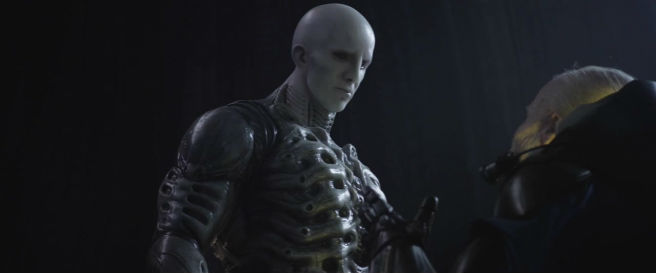
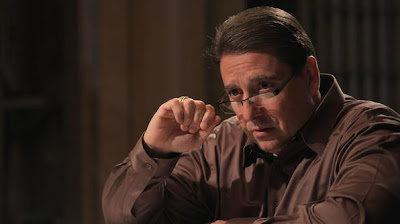
One of the weirdest, most psychedelically spooky and Halloween-triguing shows on TV right now is the Travel Channel's THE DEAD FILES: psychic Amy Allan and retired NYC homicide detective Steve De Schavi investigate haunted houses with a twin pincer approach: he dredges up the the building's history and talks to witnesses; she sees dead people. She
speaks to dead people, and they speak to her. But there's only
one way to know if her findings are real... and that's Steve's corroborating unearthed facts. She uses a sketch artist to capture the image of the main dead person she encounters on her "walk" through the house in the dead of night. She and Steve then compare notes, and in the big reveal we match her sketch with Steve's recovered photo of the historical troublemaker. They usually match, which is awesome, slightly scary if true. I get a kind of weird shiver when, in the 'Reveal,' Steve's tough but compassionate cop eyes widen, his head involuntarily shakes back and forth in stunned disbelief as the sketches match; we realize with queasy delight that we're watching a very grounded man's horizons expand, one think sketch at a time. Myth and reality, the unconscious psyche of the collective oversoul and the body--so long ago separated by church, science, and state--re-merge.
Ridley Scott's PROMETHEUS (recently released on DVD) provides an eerie ancestry with Steve and Amy's investigations. A retro-futuristic pre-emptive
Ancient Aliens gravestone for a still living humanity, it's Ridley Scott's big sci-fi comeback film, a belated prequel to his 1979 franchise-launcher ALIEN. Is it any coincidence its release date is 2012, a year that's marked the death of his brother Tony (see "
I'm not Afraid to Die") and the end of the Mayan calendar--which is relevant to the ancient aliens hypothesis of the film? A muddled but fascinating career capstone, PROMETHEUS serves as a summation of all Scott's pet themes--dehumanization, mankind as the missing link between apes/aliens; machines/replicant theory (we're all some ancient race's robots) vs. practice; the whole system on trial; technology merging with humanity; the cosmic spark, etc. Too bad once again Scott winds up overanalyzing and falling into his old habit of second-and-triple guess self-negating budget bloating. Detailed 'lived-in' characters of his earlier film have melted down to a snippy crew of petty stock types, so constricted by their narrowly-defined quirks and hang-ups they dare not breathe without sneering nor speak without re-underlining their assigned tics. Their dialogue evokes, not the cool replicants of BLADEUNNER (I want more life,
fucker father), but M. Emmett Walsh's chief copper ("Here's mud in your eye, pal"); not the professional exchanges about 'struts retracting' and 'access overloads' in the deadpan natural conversational tone professional chatter of ALIEN but the 'I want to open my presents!' brattiness of Logan Marshall-Green's supposed doctor of archeology. With his natty scarf and layered sweatshirts, he never even gives the impression he cracked a book, too busy gazing into his mirror.
 |
Nice scarf, Poindexter!
|
As usual, a crew of humans and one robot travel several years in a cryogenic sleep in a huge ship headed for, they hope, a kind of crashing the parent's door for a glimpse at humanity's 'primal scene.' Instead of finding our creators and seeing how proud they are of our bratty self-entitlement, we learn we're the result of an
X-FILES-esque black oil DNA germ warfare contaminant leakage. We were 'sparked' by one of the big-schnozzed bald albinos, left behind on Earth during a routine visit, determined to kickstart Earth's evolution (it's never very clear whether the oil is panspermia of the reverse). He drinks some of the gross black oil, dissolving himself into the waters, and--over billions of years--gradually becoming all of humanity. The elders who left without him will no doubt recognize us as his spawn, come for familial payback, some money for college, an inheritance. But the surviving bald guy's look of stunned irritation reminds me of a lot of my own irritated German grandfather on Xmas. We are offensive to their eye for the crime of being seen. We
are the next generation of gods (the DNA match is the same) but they don't want to recognize us as their children; they killed their own parents, and now of course they're paranoid about us. Maybe that's how you prove you're grown up in their fucked-up world. If we want their respect, we'll need to burst out of their stomachs.
If only that idea didn't have such a dead-end more-of-the-same finality. The aliens are a big disappointment here. Turns out, humans are still the only intelligent life form, we just found an older, bigger balder version. All that weird shit we saw in the first film? We loved it, it was so new, and it was all H.R. Giger's genius as well as Ridley's. The alien's acid blood and myriad strange stages of development, from egg to second stage parasite, to second egg, to 'hatch' to quick-growth ionizing, was startling and ahead of its time. None of the sequels have ever extended or thought beyond that genius concept. The alien form is now fixed instead of an ever-evolving creature. Now we have the 'Engineers' - CGI doing little more than removing eyelashes from big bald heads (no women aliens, either --that would apparently be stretching imagination too far). The first film depicted an alien of many different stages, one beyond all gender binaries, moving from egg to face hugger to parasite to infant, etc - it was a
truly alien life cycle -- nothing remotely like it before in film (or since). That level of weird science, i.e. biology and physics folded into the fiction, is long gone by
Prometheus, perhaps mirrored the uptight tattooed geologist (Sean Harris) spittle-flecking ever syllable about about how everyone but him doesn't give a shit about rocks; at the same time he utters nary a single line of dialogue that would convey he knows a thing about rocks himself, other than being able to read a screen to determine what's hollow or solid.
At the same time, this level of 'keeping it stupid' dialogue (where characters display skills only in expository self-promotion), reflects the way science doesn't want to recognize the power of mediums like
Dead Files' Amy Allan. Science wants to live completely and deludedly in the realm of materialism, which hates when
anything is believed without prior scientific confirmation. In the 70s, when
Alien was made, astrologers, psychics, alien abductees, and exorcists carried deep magic you could feel in your lower chakras. Now they are all fakers or delusional in the scientific eye, regardless of the mounting 'strange attractor' particle quantum theory evidence that everything is always in motion and interconnected in ways that transcend the narrow spectrum of our perceptions. There is a slowly growing realization amongst the cutting-edge quantum mechanics and string theorists that the movement of planets--even far away ones--in our own galaxy, effect every last emotion or event here on earth via quantum entanglement, the
zero point field, and an ever-dissolving and cohering latticework of strange attractors. But try telling all that to your science teacher, am I right? He'd rather fail us as charlatans because we're inferring the possibility of truth behind phenomena science has already labeled superstition, perhaps too hastily. It's the inverse of burning Galileo at the stake; it's almost like the middle segment of an ouroboros swearing it's on a diet even as it's eating / being eaten.
Prometheus is sci-fi for
those kind of thinkers, the types who call UFO abductees lunatics and psychics frauds without ever looking into the evidence, the implants removed from bodies, the marks, or
The Dead Files.
Part of earning a doctorate is believing and ascribing to their panel of thesis advisors' notions of reality. They can't handle the truth of their model's limitations, like they don't want to acknowledge an ugly son. It's not just a problem the 'engineers' (lead scientist Elizabeth Shaw's term for the big alien creators) have with us, it's a problem maintream science has with fringe science, and which Ridley Scott has with his own material. Or that hack other writer he got from god knows where, Joe Spaihts. Science must have
loved him. He's the Carl Sagan of sci-fi theorists, ignoring all the copious research and ideas to parrot thinking that will be outmoded in 20 years, like putting feathers on airplane wings.
Like more than a few prequels shot decades after the original, PROMETHEUS indicates just what exactly blew minds in the original's heyday through failure to recapture it. With the help of reality-bending CGI and a massive budget, Scott's film loses sight of itself. Too big to fail, or succeed, it lurches into the dark void in search of a light switch so that it might clear yet another shadowed room and illuminate yet another darkened forest with parking lot floods. The
Alien
series is now caught in a Moebius strip where the future is
farther in the past than the present, and ten times the budget means ten times slower momentum. CGI lets nerdy crippled-by-second-guessing directors like Ridley over-tinker until a film is all FX details and the actors just gray blotches embarrassing the technical perfection around them with their unforgivable human-animal irregularity. In short, like George Lucas.

A great aspect of the 1979 original, never recovered in any sequel, was
the naturalistic dialogue, the abundant adult professionalspeak (overlapping radio transmissions of technical jargon like background). Remember the breakfast scene, after everyone
wakes up on the Nostromo and starts smoking and grumbling and socializing in an overlapping naturalistic Altmanesque rhythm? These were people in the same room, at the same
time, adults talking in their low, natural voices. It was great, and no sequel deigned to try and capture that vibe. Or all the radio coms and beeping noises during the decent onto the planet? Call me crazy but cigarettes had a lot to do with that low key intelligence. Has the recently-installed zero tolerance for indoor smoking had the unforeseen side effect of dissolving our sense of 'adult' group dynamics? The chest-bursting scene was so shocking in the original because everyone was talking and joking and eating at the table in a believable manner, happy to see John Hurt's face again and to be heading back to bed ("back to the old freezarinos!"). This was a reality we understood, that was warm and believable, disrupted by this traumatic other of the chest bursting - it was a WTF moment right up there with the
Psycho shower scene.
But those moments can never be repeated. Today we're always waiting for that chest-burster, we get bummed if it
doesn't come. There is no more traumatic other, no adulthood to deviate from, no difference between adults doing a job and children impatiently bickering and dying to "open their presents" and then getting sulky when they don't get the ancient alien equivalent of an X-box. Screenwriting 101 blather extends to the hooligan geologist dismissing alien life as a load of bollocks (so why come? no one asks); the smarmy hipster biologist snickers like a mumblecore rom-com skeeve; the
disillusioned hunk drinks and mopes because the engineers aren't alive; leader Charlize is of course a cold
bitch who needs sexual healing from a black guy who sings "love the one you're with" and plays a concertina etc. You know, he loves life, in shorthand.
The video projection of Guy Pearce as the underwriter of the mission (in terrible old age make-up) introduces replicant David as "The closest thing I have to a son," a kind of cold insult to his butch daughter. "But he will never grow
old and never die." Oh thanks for underlining that, gramps. If he were an astronaut in Kubrick's 2001 he'd have probably had to say that "Hal was the most human of us all. But he was a computer... and he had problems."
Even more hackneyed is the way they continually associate their voyage with
an imagineered Disney ride, the blueprints for which are probably in a safe, waiting for box office returns to affirm its marketability. What we end up with is a somewhat sickening, unconscious consumerist 'ugly tourist' irritability we might feel in coach, towards the back, on an airplane, watching as the stewardess's beverage cart comes slowly down the aisle toward our row, while we die of thirst. PROMETHEUS has the ALIEN legacy and the rich field of crypto-anthropology to explore, to go a little gonzo with, but it never so deigns since there's all this stuff to do that's been stale since the 90s.
 |
| Would have loved to see her smile like this just once, in the movie |
The worst of the cast for me is Noomi Rapace, who joylessly cries and screams and yells and and rappels up
to the moral high ground like otherwise no one would take her pint-sized powerhouse trip seriously. Even when Ripley was racing around trying to
rescue that damned cat, she knew there was no
point in making the pain and anguish she was going through unbearable to us as well. She tried to keep it together. Truth be toldm this was my problem with Noomi in GIRL WITH THE DRAGON TATTOO, too. There's a certain line no actor should cross when expressing agony. When they cross it, the film ceases to be entertaining and becomes merely traumatic.
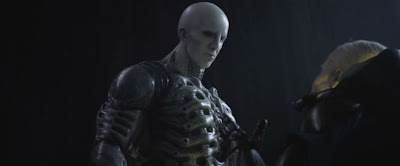
Another one of the aspects of the original ALIEN that made it so mind-blowing was that the giant alien 'space jockey' and the ship Nostromo investigates in the beginning is so uniquely other (thanks to H.R. Giger) with its vaginal entrances and fallopian shape, and the 'space jockey' was so big and odd, and most of all very old, apparently calcified or petrified by the leaked-in non-oxygen atmosphere For PROMETHEUS that mystery, that complete 'other' aspect, is lifted up to daylight: the fallopian / vaginal aspect is sublimated; the jockey's memorably weird trunk turns out to be an air hose to a helmet that opens to reveal a big, hairless (literally) CGI white guy with a weird Roman nose. It's like the Loch Ness monster being heaved up on dry land and someone explaining it's just a big catfish. Awww. Give us our mysteries back, Mr. Ichthyologist! Your 'engineers' are just a bunch of pre-op Pinheads fixing to slug a Dr. Carrington in old age make-up (if you compare the bottom two image, clearly this was intentional, right down the collar on the human and camera angle, which isn't a detriment, but still...)

 |
| from top: Hellraiser 4, Prometheus, The Thing (from Another World) |
There's a reason of course that we (or I, at any rate) recoil from this figurative interpretation of our makers. We don't like ourselves, so why should our 'engineers' have worse taste? We want to see an 'other' in science fiction, something we haven't seen before, something
truly new, so we
don't have to see ourselves reflected, yet again. If they should be the familiar human form, let their familiarity match Freud's definition of "uncanny," the way Giger's designs were truly uncanny in 1979, seeming to be some kind LSD version of X-rayed dinosaur animal alien bodies turned mechanical, as if-- in its rapid evolution-- it was absorbing the visual impression of the spaceship walls, becoming the same color and size as the pipes, as camouflage.
Alas, such radical beauty would be too 'alien' for a movie with this size budget --they can't take the chance, just like mainstream science can't risk supporting alternate theories of human evolution. A real-life astronomer who's used his cinematic wealth to spearhead innovations in telescopes and SETI-style radio receivers, Scott's almost afraid to let his imagination run too far afield. As if eager to impress his mainstream science friends, he suppresses the intuitive, shamanic, and daemonic through a kind of bulldozer mentality. The deadening effect science has on our souls, or PROMETHEUS has on our love of the original ALIEN, is a mythic counterpart in Heracles
bum-rushing the Underworld, hacking at shadows. A good book on this is by Patrick Harpur, who writes:
"Having severed all connection with the
gods and daimons, we reckon we are getting away with it. But we aren't.
The victory over the daimons is hollow; we simply make a hell of our
world. And, as we drive the daimons out before us, they simply creep
back in from behind, from within. We compel them to seize and possess
and madden us. If we want to know our fate we would do well to look at
Heracles. He neglected his wife, his soul, who, in order to rekindle his
attention, sent him a shirt soaked in what she was told was a love
potion. But the potion was a poison that poured over his body, corroding
his too-solid flesh. The more he tore at the shirt the more he tore
himself to pieces..." (1)
The
problems with PROMETHEUS stem from this same too-literalness. Instead of a
daimonic soul force not
bound by physical laws as we understand them, instead of the "Beyond Jupiter and the
Infinite" portion of 2001, or of gods whose thoughts are crystallized into the 3-D space time, like the Krell, or who who breathe life into man, like Zeus, or even use our own fears and memories against us, like EVENT HORIZON or GALAXY OF TERROR, the engineers are just a bunch of all-physical, no soul-having jacked-up leatherboy baldheads, carrying ink
black tubes of super soil/poison around the 3-D linear space-time universe, 'seeding' and/or 'poisoning' (it's never clear if there's a difference), the worlds they find like temperamental charcoal artists who regularly destroy most of their own work in a temper tantrum.
We have to take David's word for it that
they're bound to come destroy the Earth, that they are seeing us the way we see the squid monsters, with abject horror, like the father beholding the creature that returns from college with
long hair and a pierced septum babbling about communism. It's fitting that our engineers
turn out to be so Heraclean, so anti-spirit, even still using screens and projections instead of telepathy and astral projection (as the
real aliens do, and are doing right now, telling you not to believe me).
With all this uncanny familiarity breeding so much revulsive contempt, the fantastic H.R. Geiger production designs of the original become in fact anachronistic to the spirit of Scott's 'new' vision. The original marriage of
alien and Nostromo was about a clash of surfaces -- the alien was the
return of the gothic architecture, of biology and machine fused together
in spinal column-style fractal patterning vs. the maternal warmth of the living quarters portion of the ship and its dragonfly-like arrangements (above). We realize the original shape of the alien came from his previous surroundings, that he's continually shedding skins, for camouflage purposes if nothing else, so we realize the alien's been to some pretty crazy places, like Geiger's native Holland.
By 2012, the freshness of Giger's work long gone to cliche, Scott gives up on any notion of either gothic rapid-evolution 'other' or psychic 'inner voyaging' in favor of a bland universal language which is then made inscrutable. Like how grandparents and grandchildren sometimes share a special bond that leaves parents out of the loop, David the robot understands the big black engineers so we don't have to. And vice versa.
 |
Lawrence greets Prometheus
|
Quoting from his
favorite film LAWRENCE OF ARABIA, and wearing his hair like Peter
O'Toole, David's the only character we can safely identify with, the only character
who at least has the wherewithal to subtly conceal his agenda rather
than trumpet it like the denouement of an amateur stage production. Awash in Michael Fassbender's icy calm, David
seems to be acting only for himself, for a kind of twisted
self-satisfied prank-pulling, imagining himself as Lawrence, and the crew he serves no more admirable than the treacherous British military he 'works' for, and the aliens as his true (Arab) tribe. He
even talks to the ship's computer as if a human (rather than interfacing through his internal modem) while all alone, like he's feigning the need for 'human' companionship (he could just jack-in to the mainframe instead if we wanted). The computer calls him "David" in a voice no-doubt intentionally similar to HAL's in 2001. And like that film was
associated with birthdays, PROMETHEUS references Xmas continually, and
the idea of ersatz immortality wrought through progeny, all of whom are disappointed by whatever they get under their tree, no matter how expensive or over-thought out, just as we are disappointed by who our own kids turn into, even while their failure forces us to realize where they got it from, and our own shock of recognition and awareness when we realize it, and we're suddenly compelled to look over at our own parents, visiting for X-mas, in shocked self-recognition and apology.
It's our nature to be underwhelmed by ourself reflected, and in that one area, paradoxically, PROMETHEUS doesn't disappoint.

And who can blame David for thinking ill of his fellow Prometheus crew members? Sometimes
the 'banter' of the crew even seems to careen towards a kind of faux-FIREFLY
jocularity, "a hundred credits?" wagers the Asian stereotype, "put it
towards a lap dance with Miss Vickers!" Really bro? PORKY's-like
sniggering and lap dances are going to survive into 2089? And 'credits'? That was old tripe back in the 50s. And those
overconfident orchestral moments in the score, with those minor key English horn parts like a John Williams military funeral? And the way neither
Ridley Scott nor Elizabeth seem to remember there's a difference between
being a leader and a whiny martyr? "I shall need more time here," she says, when its announced they need to split back to the ship to avoid a coming
storm, as if her lady martyr bossiness can hold back nature. She refuses to let the security officer bring weapons on their first visit (pompously noting "this is a scientific expedition - no weapons," presuming I guess any wildlife that they encounter will understand and not try to eat them.) And then later she demands that Idris Elba kill himself by ramming the Prometheus into the alien ship taking off, because she's realized they're headed to Earth. Which again makes no sense but gives her the chance to once again be a total demanding humorless self-righteous buzzkill. Even when dealing with her husband's bitter
disillusionment she spins it around to get
attention by reminding him she
cawn't have children forcing me to recall the words of Camille Paglia:
Feminism
. . . sees every hierarchy as repressive, a social fiction; every
negative about women is a male lie designed to keep her in her place.
Feminism has exceeded its proper mission . . . and has ended by
rejecting contingency, that is, human limitation by nature or fate" (2)
Thus
even her husband's bitterness about the engineers being all dead must be reinterpreted as a slight against her being infertile. Still
he's at least human... for now When he says 'here's mud in your eye, pal' to
David, shortly before drinking the magic droplet of black hole mud placed cheekily therein, he evokes Deckard, and Shaw eats with chopsticks and talks to computers, so there you go. Scott is an avowed fan of classic sci-fi so naturally he'd age
into a fan of his own work, and even its predecessor influences and subsequent imitations. He's edited and re-edited BLADE RUNNER so
many times that it's become
about its multiple edits (as I discuss so repetitively in my 2008 article for Bright Lights,
What's your Edition Number? The Replicanting of Bladerunner.) The
only thing that the over-eager team behind the digital refurbishings seem to leave alone is the faces of the "mortal human" actors: M. Emmet
Walsh and Edward James Olmos, and J. F. Sebastian and Tyrell all have terrible terrible skin, as if the air's been eating their cheeks away. To
see their blue veins and gray, pockmarked, sweaty skin in amidst all
that shiny CGI-enhanced finery is to feel our human weaknesses are letting the computers down, embarrassing them at the company picnic, so to speak. We want to apologize to AI for being so hard to
duplicate, not just vis-à-vis the "uncanny valley" but with our
decomposing faces, frozen in time on the image while all around them every last set detail is gussied up with HD retouching.
But they're working on it.
Thus Peter Weyland is played
by Guy Pearce in elderly make-up rather than a real old man who might
seem less streamlined and more genuinely crotchety (why not get the actual Peter O'Toole, that would add a whole meta-level to David's Lawrence obsession), and his hand closes like a polyp recoiling from
his scheming daughter Meredith Vickers (Charlize Theron), who--in classic Freudian form--has made herself as sleek and anime-replicant-like as possible in order
to compete with Weyland's favorite (artificial) son. But of
course the favorite child never appreciates it. "Doesn't everyone want
their parents dead?" David later asks. And while it's clear Charlize does
want her father dead, so she can take over Weyland Corp, she also desperately
wants his love, which is a huge turn-off to him and us. Her attempts to become more
like a replicant to win his attention are an apt echo of modern eating
disorders and surgery addictions as girls make themselves more and more
like anime robots every day, slicking their hair back (easier to animate than loose strands) and crossing the uncanny valley in reverse, in an unconscious drive to please Disney's NWO agenda. Theron's style, then, is perhaps the most interesting and worthy element of the film and--for all that--most sad.

Valley crosses, hair slick for the CGI's ease, from top left: Charlize (Prometheus); Kristanna Loken (Terminator 3);
Charlize (Aeon Flux); Milla Jovovich (Ultraviolet); the pre-CGI Sean Young (Blade Runner) -
Speaking of wanting to make yourself as inanimate as possible, let us return to THE DEAD FILES...
As a preface, for those skeptics in the audience, let me return to what I was ranting about before re: science vs. the supernatural. Microbes existed long before there were microscopes to see them, so if someone had vision so acute they could see microbes before the invention of microscopes, would they be hallucinating, or considered to be pulling a fast one, even if they could draw them so well that, once they could be seen via the microscope, mainstream science would be forced to acknowledge the similarity? Would you be committed to an asylum if your hearing was so acute you could pick up noises no one else could hear until the invention of the condenser microphone finally won your release? By then they'd have probably deafened you "for your own good" anyway.
'Genuine' skepticism keeps an open mind and neither believes nor disbelieves anything 100% and that's why the presence of Steve De Schavi is so reassuring. His heavy lidded eyes betray a long history of dealing with lying murderers, scared witnesses, concealed information, and soul-deadening tragedy. He's a genuine skeptic as any good detective must be, yet he is continually astounded by Amy's spot-on information. Compare him, then, to the smug skeptics aboard the Prometheus, who even though it's 2089 and they're deep in space, sneer at Shaw's decree about alien 'engineers' like they're sophomore year science majors trying to impress a tenured older out-of-touch professor. A good cop trusts his instincts, his information, the facts, observation and experience, not dogma. Science on the hand snickers at anything outside the parameter of the consensually agreed-on 'known.' They snicker... because they don't want to snickered at. It could cost them their chances at becoming the next dean or getting the next grant. To even hypothesize anything farther than a few inches outside the parameters of the 'proven' is to risk permanent exile.
But there
are such things as ghosts, whether its convenient to mainstream science's paradigm or not. What they
are -- recordings in water or granite crystals of intense traumatic moments picked up only by minds attuned to certain frequencies, hallucinations, or actual spirits exiting outside their being seen - is open to conjecture. But, though the evidence is never consistent, when they're real they're as real as any other illusion, and vice versa. Unlike scientists, good detectives
do turn to psychics when they have no leads, because they're not too proud to ask if it means saving a life or catching a killer, and because they're trained to rely on observed details, not emotional certainty. Psychics have helped solve enough crimes that only fools doubt their ability. The thing is, that ability is not infallible, consistent, reliable, or testable.
In PROMETHEUS there are ghosts that appear via some alien HD projector 3-D expression of the 'stone tape' theory, which is that certain crystal deposits under or in the walls of old castles can record moments of extreme trauma that replay infinitely and be seen by psychics, children, shamans, and schizophrenics under the right series of electromagnetic circumstances (such as during a thunderstorm). And just like the stone tapes within and without the world of film, certain emotions and moments in time endure... in the zero point field.
And what will make Scott's film endure, despite the cliches, is its very real look at the intergalactic origin of humanity as a genetic self-portrait bar napkin scrawl. Again, skeptics may scoff but there's plenty of evidence to make us question the doop-de-doo logic of Darwin, which explains very little about
why we're are so different than our ape brothers, why chimps haven't developed speech by now, and who made the tape splices and alien signatures and serial codes on our junk DNA ("ever buy snakes from the Egyptian, pally?")

Scientists trying to understand the paranormal through their systems and measurements is like a dog chewing on a math book to understand algebra. We first have to admit there might be other ways to perceive the information in the book other than through eating it or smelling the binding. If we could read our reality the way it was written, with all nine of our senses aligned to all nine levels of reality, if we could read that which was written deep in the rocks of ages and in our DNA, then we would know who wrote and breathed us into creation (then split). Whoever they were, they left us here like deadbeat parents leaving their kids at the mall, promising to return in a few thousand years, in time for Christmas, then not even calling on our birthday, or buying us a bushbaby. They just threw us away like a message in a bottle. And now, if we see them on the street, they just look the other way, ashamed they ever created us to begin with.
We should kill them.
The catch in PROMETHEUS is that our makers may have used us as a biological weapon to wipe out some other species. The 'sacrificial engineer' in the pre-credits sequence dissolves into broken ashes that slowly, presumably over billions of years, reconstitutes into ourselves, but why? Were we meant to color the canvas or gesso it back to blankness to be ready for another version? Are we the ark or the flood?
 |
| Planet of the Vampires (1967) |
Still, what a disappointing answer this is to the mysteries of our own existence and of the 'space jockey' in the first film, the idea for which was cribbed from Mario Bava's PLANET OF THE VAMPIRES (
above) and before that elsewhere (see
Alien Explorations illustrious trail of same) as if to say there really is
only one race in the galaxy, and the aliens who burst from our chests are really created by our own Miracle Gro-spiked internal parasitic microorganisms rather than a true 'other' - i.e what made the original ALIEN so compelling.
Coming up with answers doesn't always mean answering the same question. In this case the logic is quite reductive. Wherever we go in the sci-fi of mainstream scientists, all we ever find is ourselves. Why bother going anywhere, then? Science is still so hung up on the 'distance' between solar systems, it can't get past the idea of bending space to get anywhere in the universe instantly, even though gravitational wave engines, warp drives if you will, are in the works, and should arrive within a few decades, we scoff at the idea some other race might already have figured it out before us.
 |
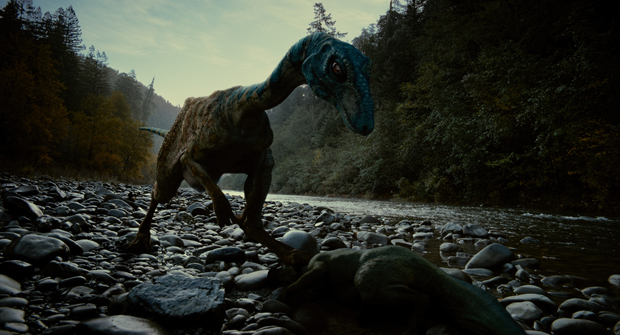
| From top: Parasaurolophus, Prometheus, The Tree of Life |
Reductive as it is, there's even some bizarre 'near-evidence' suggesting an
actual space jockey situation - a giant calcified ship on the dark side of the moon--with a Mayan mummy girl inside, keeping the ship alive through, presumably, an ancient system of brainwave power (see my post on Divinorum,
Prometheus and the Moon Maiden) which is fascinating to contemplate, if not quite believe.
Science will always admit it doesn't know everything and there are still countless uncatalogued life forms in the oceans, quantum physics-derived revelations about the elastic nature of time, space and
'true hallucinations' left to come. But we
will know it eventually--we seem to sense it. Until then it will always be the job of the artists and movie producers to figure out how to present this uncertainty to the public in intriguing ways that never quite becomes fact or fiction. That is the job of myth. Unless science can taste it in the math book, or figure out how to read it, these things can't actually exist in reality, and thus on these levels, science is a hindrance to progress. On the other hand, science protects us from falling back into magical thinking to the point we start burning corn maidens to ensure good harvests and giving all our money to magicians. We can stare at the cryptic markings in books we don't yet understand let our natural learning process slowly acclimate ourselves to the high strangeness. After a few more generations of 'heroic dose' shrooming, DMT-smoking, heavy-meditating ancient astronaut enthusiasts have come and gone, and their knowledge of alien theory seeped down into the collective 'given,' then alien engineering will organically become a scientific reality regardless of positivist insistence on being able to measure it first.
Or we can go on with the plan to panic and deny, belittle and destroy, mask our fear under the guise of a skeptic or mainstream scientist, deriding all we cannot explain and never getting the paradoxical irony when science in turn admits its own ignorance: "I don't know the answer either, therefore your hypothetical answer is not even worth investigating." If conventional archaeology thinks primitive people quarried and moved thousand ton carved blocks and lifted them into position in ancient Baalbek via ropes and pulleys, then they're the ones doing magical thinking.
Even as a kid, science's song and dance to cover up the big gaps in human evolution, our difference from other animals, our weird brains, smacked of desperation. Far more believable that someone else came by and made us, that we're apes with an injection of 'god' DNA, our Dr. Frankenstein blasting off to escape his mess of Karloffian monsters. God promised Noah he wouldn't wipe out humanity again with a second flood, so this time
he just left. Went out for a pack of smokes and we've been watching the sky, waiting for the sound of his car, ever since. Frankie, I don't think he's coming back.
FRANKENSTEIN was really the first time we learned that the gods don't want to see us at their doorstep. They wanted us to become lawyers instead of poets, clean-cut surgeons instead of hairbag rock stars. But we're artists, and depressed, so we in turn want a legitimate answer as to why our dad disturbed our timeless sleep and dragged us into the cold clinical light of day from out the cozy womb of stars.
Michael Fassbender's robot is, however, unlike us, no ugly genetic swamp of hang-ups and accidental girl drownings. He's an electronic Apollo, the gifted Adonis lawyer our god dad wanted us to be. He's the grandchild of these alien forefathers, so at least they should be proud of
him. David gets to skip it all... emerging full formed like a god from a slain Cronus thorax.
 |
| Into darkness: T-B: Dead Files, Prometheus, Planet of the Vampires |
In THE DEAD FILES it's De Schavi that mirrors the human astronauts, examining the records and remains of the ancient race that is somehow, in some form, still alive, and Amy is Michel Fassbender's robot, seeing that which still exists beyond mere 'living' --the things western civilization has tried to eradicate, to demonize, trivialize and ridicule --the layers beyond our notions of life, past the limited spectra of what we consider possible with our current common denominator senses. And the spooked hooligan geologist in PROMETHEUS is the ultimate example of mainstream science, going along for the ride if there's a tenure position involved but freaking out if his narrow parameter of the known is stretched even a hair, like going scuba diving and getting freaked out if he sees a fish. He's the Heracles forced to tear himself to pieces to get his shirt off. As the ugly link between the elder gods who made us and artificial intelligence's we've sired, he's the middle child, the "Jan." And collectively we're like the middle generation, shut out of the grandparent-grandchild bond. Both our alien creators and AI progeny want to kill us so badly we may have to beat them to it, just to prove we deserved to be here.

NOTES:
1. Patrick Harpur,
Daimonic Reality (p. 261) Prime Winds, 2003
2. Camille Paglia,
Sexual Personae, (p. 13) Vintage Books, 1991

 If I ventured into the 'flix stream, between the viaducts of Dr. Benway prescribed drug-enhanced science fiction hallucination dream, would you find me? Or would there no longer be a 'me' to find, and no difference between you, these words, the future, the past and all constructs of self I may adopt and discard over lifetimes? Yeah, it's the second option, because good films dissolve all difference. The screen is just the first in an endless banana peel of self (and vice versa).