Showing posts with label Chloe Grace Moretz. Show all posts

Wednesday, May 07, 2014

Not with a Wimp but a Banger: KICK-ASS 2, HUNGER GAMES: CATCHING FIRE, ENDER'S GAME


Look deep into the screen, my children. Any screen, all screens --this is your new reality: screens in the classroom -- a big one instead of a blackboard, linked to the laptop on your desk; the phone on which you secretly watch movies with a well-concealed earbud instead of watching the screen your teacher is pointing at; screens on the way home on the bus (your phone again) or car (DVD player above the dash + phone); screens at home (which you watch with one eye on the phone screen), the big flatscreen in the living room, the small one in your room, your laptop and phone still flickering as well... wake, and repeat. How many more minutes of life can the screen co-opt? There aren't any left. There's not even room for any more overlaps. You'll need ADD just to keep up with the future generations able to watch four movies at the same time without losing focus on a single one (while watching just one will drive them insane with restless leg syndrome and cell phone finger twitching). 

With their action figure and video game readiness, teenager-based dystopia sci-fi is all the rage -- and three recently-released big budget Blu-rays (I watched them all in the same weekend --consecutively) speak to this proliferation of screens, proving themselves to be great examples of what Guy Debord called recuperation. These big budget, mass-marketed teen demo-skewed tales of 'being an individual'  use the trappings of rebel youth subversion in service of the institutions they're allegedly subverting (i.e. the Che Guevara emblem used on a Bud Lite bottle: "Viva l'revolution... responsibly."), tapping deep into the product placement pulse of teen fantasy nerd America, and bringing forth all the synergy and branding money that it implies--! Piggyback on, Jackie! Wonder Twin Towers Activate! Form of Coors Lite... Ice! 
---------

KICK-ASS 2 (2013) nearly drowns here and there in coming-of-age platitudes about being yourself and collecting 'wherever outlaws rule the west' merit badges come sailing down the Donkey Kong ladders of your life along the way. If that justifies dressing up in goofy costumes and sticking your pretty face harm's way, all in the name of a safe America, then Yog Soggoth blessings on you, but you're loco. On the other hand, if, like me, you loathe the hypocrisy behind the bloodless PG endless ammo expenditure and zero body count of the old A-TEAM show (or T2's "Casualties Zero" Arnold eye screen scrawl), then its use of plenty of blood and realistic damage done to property, life, teeth, and limb makes KICK-ASS 2 a priceless precious thing, as gleeful in its sociopathy as Wendy Kroy, Alex and his Droogies, or Mr. Blonde.

Christopher "McLovin" Mintz-Plasse is the supervillain again, hiring cop-killing badasses from the dregs of his late father's mob business to pummel, strangle, gut and maul Kick-Ass and all his friends and family. Meanwhile witless cop Morris Chestnut doesn't want his orphaned ward Hit Girl (the still-glorious Chloe Grace Moretz) doing any more killing. He wants her to experience the 'beauty' of a normal childhood (where the hell did he grow up?) I kept praying Chestnut was one of the first cops to be killed during the massive slaughter inflicted by 'Mother Russia' - a gigantic female ex-KGB assassin-just so Hit Girl could get out from under his buzzkill sanctimony. But noooo.


That's the real lesson here: just because you promise something to an adult doesn't mean you have to deliver on it. And don't hide anything in your room. Searching your kid's drawers for drugs seems to be the 'in' thing these days. Kids acting weird? Search their drawers. The moral? Kids, hide your drugs outside your window, on a string, like Don Birnim's bottle in THE LOST WEEKEND!

Complain all you want, and some have --even co-star Jim Carey (I think he took his kids to the premiere, and was shocked at all the beheading)--but to me the film's absurdist brutality-- its gleefully 'real' cartoon violence-- is a long sigh of relief after an eternity of teen-friendly action movie bullshit. That said, the romantic / sexual elements are sexist and cliche'd. Night Bitch (Lindy Booth) has a great midriff but she's subjected to a strange rape gag which I did not care for. I also don't like that Carey's character would be so stupid as to crate his attack dog upon realizing he's under attack. Someone breaks in your house you don't lock up your attack dog! Schwontz, indeed! It makes no sense, like an NRA member hearing burglars downstairs so quick locking up his bedside gun.


But the rest of it is sublimely subversive, whether in a deliberate STARSHIP TROOPERS crypto-fascist qua-intentional way, or just unconsciously ultra-violent, it doesn't matter. With Hit Girl + her awesome vampire in LET ME IN and as Jack's nemesis Callie Hooper in the much-missed 30 ROCK, Chloe Grace Moretz is the promise of Angelina Jolie's Lisa in GIRL INTERRUPTED fulfilled. Unlike Jolie, whe's not squeamish about ripping someone's throat out with her teeth. Viva la revolution... irresponsibly, as Thanatos intends!


Speaking of revolution, HUNGER GAMES: CATCHING FIRE (2013) isn't fun or romantic or at all pleasant, but after a grueling angry week of work (or school) it's certainly cathartic. Snide observers might dismiss Katniss' (Jennifer Lawrence) as just another morose girl who likes hunky boys to fight over her, and who prefers the company of a guy shorter than her ("so he can look up to me, so I can be his ideal") but really loves a hunky taller dude. This time we barely explore that by-now dulled triangle (except as an oblique analogy to Hollywood's lavender marriages) instead Peeta (Josh Hutcherson) is depicted more like the uncooked egg schoolgirls carry around during reproductive health awareness week. While her rightful man (some Hemsworth or other) is off fighting the real war; Katniss coddles and protects Peeta with the zeal of a neurotic mother hen. He's near-grown, Katniss. Let lil' Peeda stand up by himself.

What works best is how well the film nails down the nerve-shredding implication that 24/7 media coverage not only destroys stars like Britney, Amy, and Lindsay, but our civilization as a whole, leading to a globally catastrophic intensity wherein celebrity hinges on survival and failure to smile with casual joie de vivre when cameras are present--or to be convincingly smitten by some designated short guy before a live studio audience--ensures your family is killed and your village fire-bombed.

The concept is ingenious, because HUNGER GAMES is a cottage industry at its own throat, equating its depicted future dystopia with an endless flow of diegetic paparazzi, make-up chairs, TV promo circuits, award shows, tedious applause, and all the red carpet press sound byte droppings that are a parallel to the grueling regimen of its meta/non-diegetic modern starlets.


Perhaps to metatextualize these implications, Jennifer Lawrence spends most of the movie caked in enough bronzer to weigh down three Cleopatras on a death march backwards through the uncanny valley. Her glum face beneath this load would be too much to bear without some of her old spark, and it ain't there, honey, so thank god Jena Malone shows up, a champion from one of the other districts, to pick up the badass bitch slack. Malone looks great in her black and silver uniform, or naked in an elevator, or spattered in blood, stealing ever scene she can while JL's Katniss mistakes glum moping for world weariness.

All the old cast is back as well, including Donald Sutherland as the evil emperor, a decadent fop whose refusal to grasp even the most basic tenets of social psychology makes his tenure as leader the most unrealistic thing about the film. Here's a man who genuinely believes he can quell a revolution by publicly executing and flogging anyone who makes a Girl Scout sign. For a man whose reign hinges on TV propaganda, you'd think he would know enough about mass media by now that all he'd have to do to quell rebellion is give out mockingjay symbols as keychains, T-shirts and bumper stickers, and have his Stanley Tucci greet the TV audience with it (in short, komrade, to employ recuperation), the way MTV has done to every underground music movement since its inception. Draconian brutality never works in quelling revolutionary symbolism, Donald! It all but ensures it. It's like dropping napalm on a peace symbol bumper sticker to end the hippie movement. You end the hippie movement by getting Nixon to say "sock it to me" on Laugh-In. 

The reason why Sutherland doesn't do that of course is inherent in the marketing for the film itself; as he lurches about on his pre-set dictatorial track, it's as if the Donald is trying to throw us off the scent of Lionsgate's own ingenious use of recuperation by showing his own obliviousness towards such a practice. As those 'mockingjay' pendants are on sale just a few stores down from the multiplex at Forever 21 or Mandees or wherever, it would be conflict of interest for the evil emperor to endorse them. They mustn't get wise, these kids. A happy consumer is an unconscious consumer, even if what's being consumed is the notion of waking the fuck up.


Other HUNGER signifiers are probably not going to be sold at the multiplex, regardless, such as the garish fashions worn by the hoi poloi. With their frills and pouffiness drawing groaningly obvious parallels to both the Reagan 80s and the French Revolution, the series offers enough hammering on the dividing wall between the champagne and canapés of the sophistos and the hunger of the peasants to make even D.W. Griffith's ORPHANS OF THE STORM seem Rohmer-esqely subtle. That said, there are moments when Elizabeth Banks as the agent-PR maven looks mad hot in her gold trim, and this go-round she gets a few scenes to act instead of just playing the shrill press agent mouthpiece for plot exposition. I still don't like those terrible fake color eyebrows...

Then there's a rare treat, lacking in the other films discussed here: a genuine drunk hip older dude, one of the few 'understandable' adult characters in this or any of the series currently marketing themselves to teens: Woody Harrelson. Advising Katniss how to blend in, make friends, and learn to think outside her box, and to have a damned drink once in awhile. He also eats when food is offered and gamely drinks this wretched dystopia out of focus, freeing himself for better things other than validating Katniss' useless sulking and refusing all offered goodies, as if eating a single hors d'oeuvre would make her 'part of the problem.'

The most original element is the central bizarro twist of having to imagine spending all your time with the dude you don't like, yet must pretend to love, and he's shorter than you, while your true tall love galavants into the firestorm. And the short guy's so sweet and staid, and supportive, he only makes it worse. That tweens are swooning for him out in the real world, only shows there's still hope for short, staid guys.... and hope is a dangerous thing. 


(check out this great paranoid rant about the Girl Scout / Katniss salute on the Dismantle the Beam Project!)


ENDER'S GAME (2013) is far removed from all that tweenage love nonsense, but there's a lot of care and time spent getting the glistening eyes of the space bugs exactly right. Luckily Asa Butterfield's Ender is allowed to be kind of fourteen year-old Hannibal Lecter instead of just a 'normal' kid like the kind only a Morris Chestnut would think really exists. Recruited by Harrison Ford via the old LAST STARFIGHTER tactics and put in charge of a drone armada to fight a bunch of STARSHIP TROOPER-esque space locusts, Asa's 'Ender; is legitimately scary and sociopathically over-calm. And its awesome.

I hated LAST STARFIGHTER and its bland 'every lad' gets recruited to save the world because he plays video games well. I didn't mind the hunky ciphers in STARSHIP TROOPERS because we were supposed to think of them as caricatures, not as 'normal suburban teens' as imagined by guys who haven't seen ever seen on. But Ender is different. He's a weedy ectomorph but can defend himself with devastating Lecter-like economy. Underneath his nervous morphology and liberal guilt lurks the heart of a carnivorous killer. His nebulous doubts about the rightness of his mission are played up but we never really get the full HEARTS AND MINDS story before the reverse of the climactic battle of BREAKING DAWN smashes through our screens and from there they start setting up the hoped-for sequels. The film's structure ingeniously keeps the space war stuff on the screens within the screens (knowing we've seen it all before) and secondary to the Starship Enterprise-ish minutiae of commanding a row of similarly young and gifted kids sitting at drone computer screens. And hey, it's what the military is doing right now with drone programs! THE LAST STARFIGHTER really is coming true!

Real life drone pilots at their consoles
The last thing any kid wants is to see an 'average' kid like themselves
in a sci-fi movie. We go to sci-fi to get AWAY from that shit, dumbass.

As in CATCHING FIRE, ENDER wants you to want the sequels, to get the DVD, see it again on the IMAX, in 3-D, commit to it, for it only earned, so far, a paltry sixty million, little more than half its budget. I wish my interest in seeing sequels to under-performers like JOHN CARTER and THE GOLDEN COMPASS could bring them forth through sheer will, but then again I don't have either on DVD. I know I should buy them, like an indirect post-production Kickstarter, but it's a lot of emotional baggage to deal with, a lot of responsibility befriending the nerd no one else likes. You can never shake them off once you do. Besides, how much difference will my ten bucks make against that vast deficit? I'd rather invest in a film that will feel my paltry offering, even if only as a ripple in the wind.

Not to ramble off topic, but I feel like I should defend JOHN CARTER in particular because I read all the original Warlord of Mars Edgar Rice Burroughs novels as a kid, as well as Burroughs' Tarzan and Carson of Venus books. Also Robert E. Howard's Conan, Moorcock's Elrik; and Fritz Lieber's Fafhr and the Gray Mouser. 

from 1946! I got it for cover price
at the Lansdale PA Book Swap,
around 1981!
The best part about all of them? No fucking kids! No 'average teen' hero for us to 'identify' with. No 'Boy' in the Tarzans ('Boy' ruined the later movies), no boys at all. In those books we were still allowed to identify with the badass adults, the ones who could kill without PC moral hand-wringing. We need those adult heroes back! Imagine STAR WARS if Han Solo never showed up, replaced instead by a 12 year-old boy with really normal hair and a nagging mom?! Horrible... yet there it is...

And so it is that we must fight Morris Chestnut's call to safety and fight with all our strengths against unimaginative dogmatic Hollywood's glorification of 'being a kid.' Already they have gone back and digitally removed all the cigarettes, replaced the FBI's guns with flashlights, removed the nudity and much of the cursing from our cinema heritage. Stop them! Stop them before they install their safety-first overhead florescent lights even into the darkest recesses of our most secret-sacred imaginations. I say roast Morris's chestnuts on the open fire of aimless youth rebellion! Richie in OVER THE EDGE, thou shalt not have died in vain, in vain!

Monday, March 12, 2012

Are You Lonesome, Automaton: Terminator and Halloween vs. HUGO / or Woman is the Father of Horror

I am a mechanical man
And I do the best I can
Because I have my Family
   -- Charles Manson ("Mechanical Man")

Was it chance I saw Hugo (2011) and The Terminator (1984) in the same day and Halloween (1978) the next? Three tales of automatons... one amok and one clockwork and one clockwork amok, all about going into the past, as it were, to either repair or destroy icons, be they girls or auteurs.

First the first two: with amazing actors glassening up their eyes and amazing photographers capturing the play of light therein, you don't have much of a chance to stay unmoved on an emotional Sunday afternoon watching Hugo, but the clockwork momentum and awe and everything coming synchroniciously true was much more machine-like than the pre-CGI Terminator; in other words the science fiction film seems ancient and primitive while the nostalgic look back to the silent film era is futuristic slick --the true 'tech noir'.

Like Scorsese, I know there's no getting past the space-time conundrum of my own memories, and like any film critic / theorist I love to dredge long lost celluloid from beneath the skittering heels of post-industrial society. The resurfaced and belatedly lauded (within Hugo) Méliès is just perhaps the latest/first example of a reflexive Cine-Lazarus resurrection in cinematic memory (his films were melted down to make shoe heels during ze war). Alas such resurrections are subject to an unspoken bourgeois law that says ahead-of-their-time 'underground' artists must lie buried for not less than one and ideally not more than seven decades before being exhumed and wept over by the wonderful wizard of film curation, who gives them something better than life: a retrospective! But Hugo's tin man's heart-shaped key can't compete with its own clockwork orange-hued enshrinement in the perma-pantheon as far as shiny tokens. Though the artist's work has not changed its essential form, the world has tick-tocked so many times around the orb that old is new, quaint is revolutionary; whimsical antiquation is post-modern; cheap drive-in fodder and newsprint comic books are hundred million dollar box office business; and night table films about film preservation are filled with enough clocks you'll never have to reach very far to smash the snooze button on the industrial age for another two hours of hand color-tinted dreams...


The problems in Hugo lie with the heart-shaped key (as Sarah's answering machine puts it, "machines need love too"), indication someone convinced old Marty that we need a catchy symbol to recognize a film, and the Méliès 'brand' of that rocket-in-the-moon's-eye must be recognized as iconic (ever try to watch Trip to the Moon in one sitting? Sure it's imaginative but it's also boring - all static long shots), and the douche-chilled bouts of bouncily orchestrated whimsy in the cutaways to the budding romance between old dude and the old lady who sits at the cafe, --oui, monsieur, but she has, 'ow you say, the bitey dog?-- So he gets a dog of opposite gender for to woo said old lady. This contrasts in cakey layers with the plucky orphan film lover's Dickensian bouts with the evil stationmaster (Borat); and in the station works a flower girl (Emily Mortimer) who lost a brother the way the stationmaster lost his leg, and Méliès lost his negatives... in zee Great War! Ze Jews made shoes mit dem. It all must be recognized and underlined and sugar-flecked for easy patenting. Sure, I cried. But I felt cheap for doing so. I felt like someone was trying to be Ron Howard, and that's a bad thing when that someone is already Martin Scorsese.


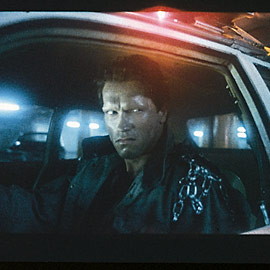
Then there's The Terminator, a film that makes me want to rescue from obscurity that old James Cameron, not the Titanic control freak, the Pirhana 2 protege.  I remember seeing the trailer for The Terminator at the Montgomeryville Drive-In (the main feature was C.H.U.D!) Shuffled in with about six other similar-looking indie sci fi-ish titles, The Terminator looked cheap, sleazy and we in the car, all Conan fans, loudly mourned how far Arnold had fallen since 1982. Focusing on the sad-eyed New Wave disco Tech Noir, with its tacky neon and Arnold dressed like  the kind of guy who usually has Rutger Hauer or a naked screaming woman reflecting in his Gucci sunglasses.

Of course that's not the way it panned out; the reviews glowed and the box office soared, and my jaw dropped in pleased amazement. I remember seeing Terminator by myself up in Woodbridge to get away from my family Thanksgiving day in 1984 and lord knows I felt pretty wowed. The trouble was that it became too popular. Overnight Cameron became an auteur, the most recognized newly minted wunderkind to emerge from the exploitation genre since John Carpenter in 1978 with Halloween. And if you meshed Hugo and Halloween together, wouldn't you have The Terminator? Look at the resemblance of the 'shape' and the mechanical man in the below shots, so many similarities to with the Sarah's roommate and her boyfriend and PJ Soles and hers, right down to the getting killed going for a post-sex snack, the annoying rock headphone-wearing, the presumption--as with so many modern cell phone users--that being myopically absorbed makes you invulnerable, etc.


1. Automaton!: The idea of the automaton goes back to the 1890s (see below right) and was forgotten by the 1920s, but the automaton killer thing began again with Halloween (or maybe the 1940s Mummy sequels). Of course I'm talking about the slow moving but unstoppable variety, the shambling shapes who can't be killed yet are not alive, and are already slowed yet won't be stopped. And like The Terminator, Halloween was a scrappy independent low budget ($6 million; Halloween was $320K) thriller that wound up being iconic and inspiring many much bigger-budgeted imitations, all of which corresponds to the figure of the forgotten auteur and his lost gem 'automaton.' The filmmaker's own alienation from the actual machinations of projection, of the mechanism of screening and seeing the film with an audience (aside from the premiere), anxiety about the cross-country marketing and promotion, and the obsessive need to tinker, to keep taking things in and out of the final cut until the last possible moment. What does it all deconstruct to?

"Draughtsman-Writer" by Henri Maillardet c. 1800

The surrealist concept of 'automatic writing' is probably at the farthest extreme of big budget Hollywood moviemaking: the first is unadulterated raw unconscious, the second has been tooled by a team to wring maximum suspense and greatness, with dozens of unionized voices pitching in and every creative decision having to eventually boil down to entries in a budget ledger. The whole mission becomes capturing the blazing brilliance of the automatic writing session inside the carefully constructed and staggeringly complicated mechanism of filmmaking. It's what occurred to me watching the mechanical man in Hugo start to draw... we don't know what the metal hand will write or create, but neither do we know what our own hand will write during automatic writing... it becomes the opposite end of the Hugo spectrum, the mechanical voice, SKYNET's distant cousin, reaching from beyond the well-guarded door to hopefully scribble something accessible and profound: "I'm sorry, Dave. I can't let you do that." or "we think of the key, each in his prison / thinking of the key, each confirms a prison."

2. Women are the fathers of Horror - And now, gender controversy comes into the mix, because creating mechanical people and automaton killers is a man thing, his approximation of the birth giving experience. The mad scientist is the classic Apollonian archetype, attempting to replace the chthonic madness of woman's birth canal with living tissue over titanium endoskeleton... or big fat cogs. The man rejects reality and creates his own, either a shape, a tower, an automaton, a poem, a science fiction or horror film...

So wouldn't it follow that women, then, are perhaps the 'fathers' of these creations, the automatons, and therefore of all the best science fiction and horror films? Look over the roster and you see women right behind the scenes, letting the man take the director credit, and instead working as producer and writer, script supervisor, and sometimes star


Consider yet another Halloween-Terminator similarity: in both films the target of the monster is a normal, good-hearted girl who locates her true heroic self in the course of events, and both films transcend cheap boy's club sexuality and feel more assured about gender than a genre picture had seemed capable of prior to. And a look at the credits reveals why: women were actively involved, as writers and/or producers, in both productions: Debra Hill in Halloween and Gale Ann Hurd in Terminator, and though their contributions tend to go unrecognized in the rush to canonize directors like Carpenter and Cameron, looking at the later works of each lady you see a lot of the same wit and charm that made both these early films so successful, a wit and charm lacking in the director's work without them. For example Hill also worked with Carpenter on The Fog and Escape from New York and Hurd worked on Cameron's Terminator 2, Aliens, and The Abyss. These films all have a spark and wit and self-effacing deadpan soul that is lacking in later work by the men (unfertilized eggs, if you will). The trick of course is to find and then honor the woman creative voice who understands the masculine psyche without being contemptuous of it (the genius of this being Katheryn Bigelow, below w/ Oscars).


Debra Hill, left
Within the context of Hugo we have the female character played by Chloe Grace-Moritz who, in the end, finds her own groove by deciding to write the book whose adaptation you have just seen. So in a way she's also a female 'producer' helping a male's automated vision make it to the screen, filtering the material through feminine perspective, watching from on high as a man expresses through art his own weird gender-fucked procreation. Like Hurd and Hill, Moritz is participating in the rearing of a film--through support and input the way a husband would in the rearing of the child. Just as a dad helped conceive the actual child, and may help raise it, he will never get the auteur credit for the child's existence, that credit belongs to the woman, no matter what part dad had in it. So it is that great sci-fi and horror films seem to depends on women like Hurd and Hill, who become, in a way, the fathers (Scorsese of course has genius editor Thelma Schoonmaker;  Argento had Nicolodi, even George Lucas had Marcia, the list goes on, and the dip in quality after their split is always noticeable. (Hitchcock stayed the course with wife Alma, so his work stayed good),

Blue Meanies: (from top) Terminator, Halloween, Hugo

3. The Gears: In the end, our 'submission' to the process of entering a film 'dream state' is an interface with a machine - our brains becoming clockwork, revolving with the turning reels of film, the gears and wattage of the projector.  The actual movie may have cost millions to make; it may have been made by talented craftsman tinkering for months, years or it may have cost just a few hundred thousand, shot and edited in a few weeks, but the final result is always the same (as is ticket price): it all boils down to a machine spitting encoded light and shadow out onto a white screen in some suburban multiplex. We enter collective hypnosis willingly - leaving our necks and heads exposed to the person in the row behind us who just might stick a knife through the base of our skull. Sex and sleep may leave you vulnerable to killers onscreen, but film watching is to actually invite them in. 

But it's okay, they're not human - just electromagnetic waves.  We've invited in the machine. Hopefully it's not, you know, become sentient. 

Man Ray - Rayograph

We repress or ignore this cinematic mechanism element when surrendering to a movie (unless it's out of focus, or too quiet, or the sound is out of sync, or the theater is too hot or cold) as easily as we forget that we--personally and finally-- could become raw meat in the blink of an eye on the highway, or that 80% of the voices we hear tend to be electronically reproduced, that we barely speak anymore except to order food... on the phone. The automaton then comes as an eruption of the mechanism even further into consciousness, a black hole opening up in the center of the film, fixing to turn us all into mecha-aberrations, like Chaplin threading through the machine in Modern Times, or Sarah Connor in the crushing metal compactor in the Terminator climax.

To avoid this we like to keep a respectful distance from the mechanism itself, we hide the wires behind the walls, but as we prepare for 2012 it becomes pretty terrifying to realize how hopelessly addicted we are to electricity. One magnetic pulse and we will be totally lost--everything digital wiped blank in the blink of an eye. The tactile will survive, like celluloid, there just wont be any way to project it. 

The Terminator and the mechanical man in Hugo are both examples of machines that don't use electricity, that would survive the pulse - one just needs to be wound up, the other is nuclear-powered. Neither needs an outlet. 

They, alone, are truly independent. Autonomous, far freer than ourselves.

blood and gears (from top: Hugo, Modern Times, Terminator)

4. False Nostalgia Syndrome - Like a suspicious number of films nominated for a 2011 Oscar, Hugo bathes in nostalgia for pre-WWI silent film whimsy, recalling Modern Times if it was remembered by the film scholar who managed to find its lost reel in a mislabeled can and won a prize, and Scorsese is certainly a major savior of film preservation, but is his nostalgia enough to warrant the 'greatness' label for Méliès? Is the subject even a worthy entry in the oeuvre of the man who made Raging Bull and Goodfellas? When dealing with the working class Italian neighborhood of Little Italy or Brooklyn, Scorsese gives us 'real' nostalgia, as in he 'really' witnessed it. For an escapist like myself, Hugo seems as suspiciously self-indulgent as Woody Allen's Midnight in Paris. These are the fantasias of pampered rich kids who have been able to spend their lives tinkering with sound and image and now wonder if maybe, if they could travel back in time, then even Earnest Hemingway would call them geniuses. They'd be able to recognize themselves in work by Ezra Pound and T.S. Eliot and get to drink 'real' absinthe. It works as their fantasy, but it can't work as ours because they've inhaled the fun out of it, and left us nothing but a shrine to their own desire, nothing but the act of showing us something that meant something to them when they were young and dumb like they think we are now. 

The Terminator on the other hand is my experienced moment of childhood whimsy (well, teenagerdom - right at the time I was changing from comic book nerd to punk rocker)--and revisiting the film today it seems, at least on the surface, refreshingly trashy. With its pouffy hair, pastel clothing, Italian rock synthesizers, rear screen-projected stop motion animation, copious neon, pet iguana, and casual sex roommate getting killed off slasher-style, this pre-digital futuristic film is the 'real' wake-up to nostalgia that Hugo can only catch from a fleeting Parisian postcard, that is, unless Scorsese actually remembers going to films at the turn of the century, pinning that rocket-in-the-moon's-eye image on his bedroom door to anger his mama. (Mama, it's just-a la luna.) Because without that genuine connection, only an egoist would think he could deliver any real meaning... unless he admitted Méliès films lacked narrative thrust, and that--depending on how long it's been since we saw our favorite childhood films--our expectations are seldom met. 

Paradoxically, it's in not meeting expectations the actual magic occurs. It's the very gritty low budget tangibility, the tactile vividness, of the 1984 Terminator that somehow makes it seem more alive today than a CGI-sandblasted 2011 film like Hugo. No one knew at the time of Terminator's making that "I'll be back" would become such a catch phrase, to the point there was no way avoid its embarrassing repetition in the sequels. They became a slave to a tossaway line, doomed to repeat and repeat every time someone puts in a nickel and turns the crank.

The original Terminator is a movie free of that kind of presumption and reptition; it presumes it won't be loved any more than most sci-fi down-and-dirty action pics, which is why it's so indelible. Hugo all but tells us we have to let its magic symbols -- the rocket-in-the-moon's-eye, the heart key--into our hall of future golden memories, to make this an Xmas staple to get gooey with grandma over. But for me, even though I well-knew of Méliès beforehand, and I had his Trip to the Moon on super 8mm and we'd project it over our drummer in our band's light show in 1986-9, what that moon makes me think of all these decades later is "Tonight" by Smashing Pumpkins, another recreation that doesn't even bother with the rocket in the moon's eye shot... to its credit. Instead, the Pumpkins take the look and feel of Méliès' pre-modernist world's fair whimsicality and then update it to rock, speeding up the imagery and adding deep emotional hooks.

Scorsese instead tries to slow us all down into Méliès' level, to put the film in a shrine or museum and destroy its last link to the real world. If Hugo were truly to be worthy of the Scorsese canon it might end, for example, with the audience slowly realizing that the static long shots and endless flurries of spastic activity make Méliès' films kind of boring (except maybe on a huge screen so the actors seem approx the size they would be as actors on the stage). Though undeniably creative and elaborate, they're hung up on the magic celluloid provides at the cost of resonance and narrative cohesion. Instead we see a lot of things disappear and reappear as if that never gets old. Today these films only capture attention when used in a new context, a collage or lightshow. Scorsese would have been wiser to try and capture the chaotic making of the films, jilting Hugo altogether. And hey, he fixes the hand-tinting and slyly tweaks out the dullness through just showing a long Academy-style montage of highlights from the found Méliès oeuvre at the very end. There's too many train station vignettes to cover to go much farther.

Hugo's unthinking reverence for the great Méliès reminds me of the ending of the 1958 film Teacher's Pet: Clark Gable plays a scrappy self-taught city reporter butting heads and other parts with Doris Day as an over-educated journalism teacher with no real experience, whose father won a Pulitzer for his smalltown paper editorials. Love happens against their will, with Gable preferring to pick fights with Day's platonic pal Gig Young than make love. It's not until Gable finally reads Day's dad's old editorial clipping that he can proclaim "they stink" and come into his own as the confident uneducated lover of an educated gal. Call it reverence prior to investigation, or just bourgeois idolatry, but it takes him the entire film to learn to value his own opinion enough to make this claim, and until he does he's stranded behind this slab of journalistic integrity that he's expected to measure up to even though he's long since surpassed it. I wouldn't even bring it up if it wasn't so relevant to Marty.... Marty, come back to the 'hood! Stop puttin' on those fancy airs. 


I'm not knocking Hugo; I cried and thought Asa Butterfield was eerily perfect, but while I normally love Moretz she seemed ungainly and confused... 

Spielberg's Super 8, which was released the same year as Hugo but not nominated for an Oscar, is nostalgic for the era that I too was a a young super 8mm filmmaker in (the Terminator era), but also proactive about actually making movies instead of revering the makers or cleaning the projector. Scorsese has never really gone self-reflexive that way, to the point its suspect. There's no real salute to the creative energy of the moment in Hugo; it's all about preservation and repairmanship; it has to run all the way around the massive sets five times just to make us think the right hand doesn't know the left from a hole in the wall, through which it hopes to add some Amelie Rear-Window-Psycho insightwithout drawing attention to its own absurdly over-qualified self-awareness.

Eyes of Laura Mars... or Supergirl?

 Super 8 on the other hand is just as top heavy but it fights from its gut; it kicks and scratches and its orphans are only half-orphans and the pain and the bonding between Elle Fanning and Joel Courtney devastated me a lot more in a lot less time, and seems a more logical film to champion for a ballsy academy. But they weren't awake enough to realize Super 8 isn't about the alien or the evil government but about kids carving their own sacred space out of the lumpen absence of parents too dumb to know either their own beastliness or their kids' frail genius. The alien in Super 8 suggest what might have happened to ET if he'd not been able to phone home, or if we abducted the greys at the end of Close Encounters. In other words, he's pissed! He's the perfect reflection of the suburban teen forever denied any form of dangerous self-expression ala Over the Edge or Rise of the Planet of the Apes. No wonder, then, the old timer Academy dismissed Super 8, probably with the glint of fear in their eyes.

Super 8

Final anecdote: I had my own Hugo moment in 1997 whilst out of my mind on acid up at a friend's big weekend party at her Swiss chalet in the Catskills. It was gorgeous night under the stars and everyone spread out under a massive blanket on the ground, facing the blank white side of the house. Behind them I set up my old super 8 projector on a picnic table bench and projected on the wall an old clip reel from 1931's Dracula, unintentionally at the wrong (slower) speed setting, and since I was tripping I had no way of knowing. An already slow movie became dripping with poetry as that slowness was doubled into a total dream state. Is there a more indelible image of death at 12 frames a second than black-and-white Helen Chandler as Mina, her voice now almost manlike in its druggy depths, slowly explaining her dream of the room becoming filled with mist? As I crouched hallucinating into the weird gears and mechanisms of the projector, threading the machine like some old Rumpelstilskin out of time, shut out by choice and inclination from the orgy of physical warmth going on in front of me with my friends, who lay in a row under a huge zipped together sleeping bag, I felt like an outsider, yet in command. They were watching the films of course, but also doing physical stuff under the covers of which I knew not -- e they would be the last people to notice how... sloow David Manners was talking. He finally sounded like a man.


So there I I was alone, in front, in the cool damp of the night, threading my machine to dazzle them with slow motion vampires from 1931, and while most nights my feeling of disconnectedness would shatter me more than any constant drip of bourbon could repair, that night, under the stars, I accepted my role as 'projectionist' and gave up my hunger for the golden hair and sleeping bag sense of belonging. It all came into focus for me in that moment, and though my friends were all making more money than I was via advertising and computer network maintenance, and were basking in their ability to create human warmth and self-confidence, not all of us can turn down our genius enough to lapse into the tactile bonding of more socialized, less alcoholic peoples. But they accepted me, loved me, I knew that, and meanwhile I had Bela Lugosi... and I was running the films, and here in this Alpine heaven I had proven, despite my lumpen clay demonic self-consciousness, the gravity dragging me back to my level of cinematic isolation, that I belonged. 


If that doesn't make me a Hugo, I don't know what does, or a Kyle Reese (Michael Biehn) in The Terminator, who is also in his way, an archivist, going back in time to preserve some imperiled damsel in mid-bloom. Don't we all hope some Hugo is going to dig up our little forgotten super 8mm films up from some garage sale attic one day? Or some collector of my old hand-drawn comic books look me up in hushed awe? And I'll find out there's a whole cult around me, and they thought I was dead, and --oh wait. maybe I am?

"A mistake is made."

This is what non-family man artists do instead of having real human children of our own and wondering if they'll ever call us once they move out: we make them out of clay and wire and words and weird alchemical machinations, hoping some version of ourselves in a future generation will come along and figure out what we were trying to say. The Mechanical Man's reproductive organ is a camera but women don't need to have one since they can have real babies... Like Manson in the top quote, they have 'a family.' The camera is there already - the man brought it, because he does what he can. 

When will intelligent women stop writing about man's obsession with giving life to the dead, as if it's she who should be jealous?! Honey, why do you think we're doing it. 

We build it to impress you.
We use it to escape you.
We escape from it,
too late.

Elsa Lanchester as Mary Shelley (Bride of Frankenstein)

Friday, August 20, 2010

The Return of the Great 70s Dad: Nicolas Cage in KICK-ASS


I thought the age of great 70s dads was done, but that was before I saw KICK-ASS (2010), in which a truly cool father (Cage) manages to slide past the doting widower daddy ("mommy's in heaven!") morons of Hollywood to finally do what Batman should have been doing all along: using firearms, gutting mobsters with exotic weaponry, and teaching his 11 year-old daughter to be a pint-sized killing machine.

This is the kind of film where you see something genuinely subversive -- kids as instruments of lethal vengeance-- and know instantly that a dividing line will form between film critics that are cool (i.e. they get intentional subversion of the treacly overprotective cinema status quo) and the dull self-appointed moral guardians (i.e. status quo dogma-eating suckaz) as easy to demarcate as a scroll down the rotten tomato meter. My old editor at Popmatters, Cynthia Fuch's discusses for example the one-note presence of Marcus, Nic Cage's old cop buddy who raised Hit Girl while Nic was in the slammer, framed for his wife's murder :
Marcus serves one purpose here, to deliver the film’s not-so-earnest injunction against Big Daddy’s monomaniacal exploitation of his daughter: “You owe that kid a childhood!” With that done, the movie can proceed apace, exploiting her in every way it can think of. Serving as Kick-Ass’ mentor, savior, and inspiration, she’s abused and abusive, horrified and horrific, tearfully vulnerable and ingeniously cruel. (4/16/10)

Hahah! Well, frankly, if there wasn't some uptight backlash against all this "exploitation" the character wouldn't have nearly enough subversive zing, so I'm glad at least some critics felt the need to jump on this, like they have to make sure we know it's wrong WRONG WRONG to train our daughters to be assassins. "You owe that kid a childhood?" Really? What's a better childhood than not having to go to school and spending all your time hanging out with your cool superhero gun nut father? What is she missing? Facebook chats? Sexual subjugation and elementary school belittlement? Tedium in front of the TV? Wasted hours playing with dolls and engaging in clique-y slumber party backstabbing?


Even more inflammatory is a review by someone named Prarie Miller:
... let's just say that it's reached the point in movies where pedophiles could conceivably launch a movement protesting that double standard filmmakers get away with all sorts of exploitative behavior with children in movies that would land predators in the real world in handcuffs. It would seem that we're talking a line here between reality and fantasy, with the emphasis on a different kind of graphic at work, and a line that has been seriously crossed (Newsblaze)
 Yeah, Prarie, let's just say that... wait, what? Are you seriously using the phrase "in movies" redundantly in a sentence? Do you even know where the line between reality and fantasy is? It's not in a comic book movie, anywhere! Ever!  Don't you see that this girl assassin is a direct and intentional affront to your hypocritical projecting? More than anything, we love Hit Girl for the very reason that we know she will get you all up in arms; we know that some serious standing-up to nervous industry suits must have gone on to prevent their meddling with the script and turning her bullets into, say, tranq darts. Hit Girl is a triumph for the very reason that she kills her victims without qualms! She's an emblem for child empowerment rather than for child victimization mentality, which the Praries of the world prefer, and misread as saintliness.

Of course, as I say, without the whack-job moral guardian fringe ringing their alarm bells, you wouldn't wake up to realize that finally something genuinely ballsy is happening in a superhero movie -- a gleeful finger in the eye of the still-lingering remnants of the Hollywood moral production code and the whole "Won't someone think of the children" hysteria of films like Cage's "worst dad" film, KNOWING. Actually, Hit Girl's the first 'free' kid I've seen since 1979 and OVER THE EDGE, or the other cool kids I wrote about last week in my slam against Michael Cera (since amended), like Tanner from THE BAD NEWS BEARS!

I'm also reminded of one of the story threads in D.W. Griffith's INTOLERANCE (1919), wherein a moral crusader matron is out to rescue the exploited children of the slums, so she can drag them away from their loving mothers and throw them into a giant orphanage where they can be safely ignored in long rows of cribs by uncaring city employees. I think any girl who had the choice to be raised by Nicolas Cage and trained full time in the art of killing vs. being forced to go to some dumb public school and then come to a distracted babysitter while a single righteous mom works double shifts would choose the former. Watch fucking BLUE CAR and see how bad it could be.

Hit Girl is lucky she gets to spend all her time with a cool, loving father and when you consider (as I've written about in SALT) the usual back story of female assassins--their cruel schooling and tough surrogate parents--Nic's kindly Tod Browning-ish scheme of vengeance is a breath of fresh cool air.  He even takes his daughter to get ice cream after shooting slugs into her bullet proof vest and gives her cool butterfly knives in a big swanky box. This was the first film I've seen since about a single father-daughter pair bond that didn't make me want to wretch, and even makes me want to be a father if I could ensure I had a daughter into knives and not a dorky son into superhero comics.

For an example of the latter, let's examine another case of superhero childhood with (in this case surrogate) dad and no mom, HELLBOY.

Now, I liked the first HELLBOY which involved the origin of an adopted demon child by a squad of rough and tough American GIs in WW2. The child demon grew up a cigar-smoking badass, as if he'd been raised by Sam Fuller. But then in the insipid sequel we get this treacly homespun flashback of Hellboy as a goofy nerd, watching Howdy Doody with his glasses and buckteeth and wearing his jammies and getting tucked in by a loving and responsible... zzzz, I turned it off right at that moment. What the hell happened, "Hell" boy? Prarie got to you, didn't she?

Then there's the drably hypocritical "clean" conscience of heroes like Batman--on whom Cage's Hit Man is cheekily based--who would never, say, shoot a real gun at the Joker or something, because "killing is wrong," -- no guns, Alfred! So he has to invent all these bizarre non-lethal weapons so he can wipe out whole blocks with collateral damage (chasing the Joker around Gotham, he totals dozens of cars and I'm sure incurs a lot of fatalities), but as I've written before, he's as "innocent" as our precision bombers over Baghdad - though to their credit at least the military's not squeamish about shooting a bad guy up close.

Anyway... as Hit Girl, Chloe Grace Moretz is a revelation. Fresh air finally becomes breathable once you see an 11-year old girl eviscerate a room full of thugs and do so with a convincing air of detached cool and scary intellect we haven't seen since Anna Paquin in THE PIANO. QT had to do it in anime with the Lucy Liu backstory in KILL BILL, but that was all dark to be begin with. The juxtaposition of the day-glo highschool coming of age shenanigins in the dorky comic book guy side of things and the colorful costumes make the bloody merciless killing of KICK-ASS's pint-sized avenger all the more striking. We're just not used to it, it's original! Hollywood has this unofficial policy that good girls don't shoot guys - that's why Jamie Lee Curtis has to drop her Uzi before it's allowed to shoot everyone in TRUE LIES.

It's so liberating. One wants to go back in time and rescue Patty McCormack from her mom in THE BAD SEED and teach her to fight crime-- an army of bloodthirsty children stalking the streets! Pedophiles dying right and left. If Nic Cage's Hit Man could become a role model for all the dads of tomorrow, what a blood-stained, crime-free world we would have.

Moretz is next scheduled to appear as the vampire kid in the remake of LET THE RIGHT ONE IN (above). I can't wait to read the uptight film critics' anxiety that seeing blood-sucking children onscreen sends the wrong message to parents everywhere: "Children are meant to be locked in their rooms with bibles and homework, not allowed to kill adults willy nilly!" Yeah, you wish, downpressa!

Related Posts Plugin for WordPress, Blogger...