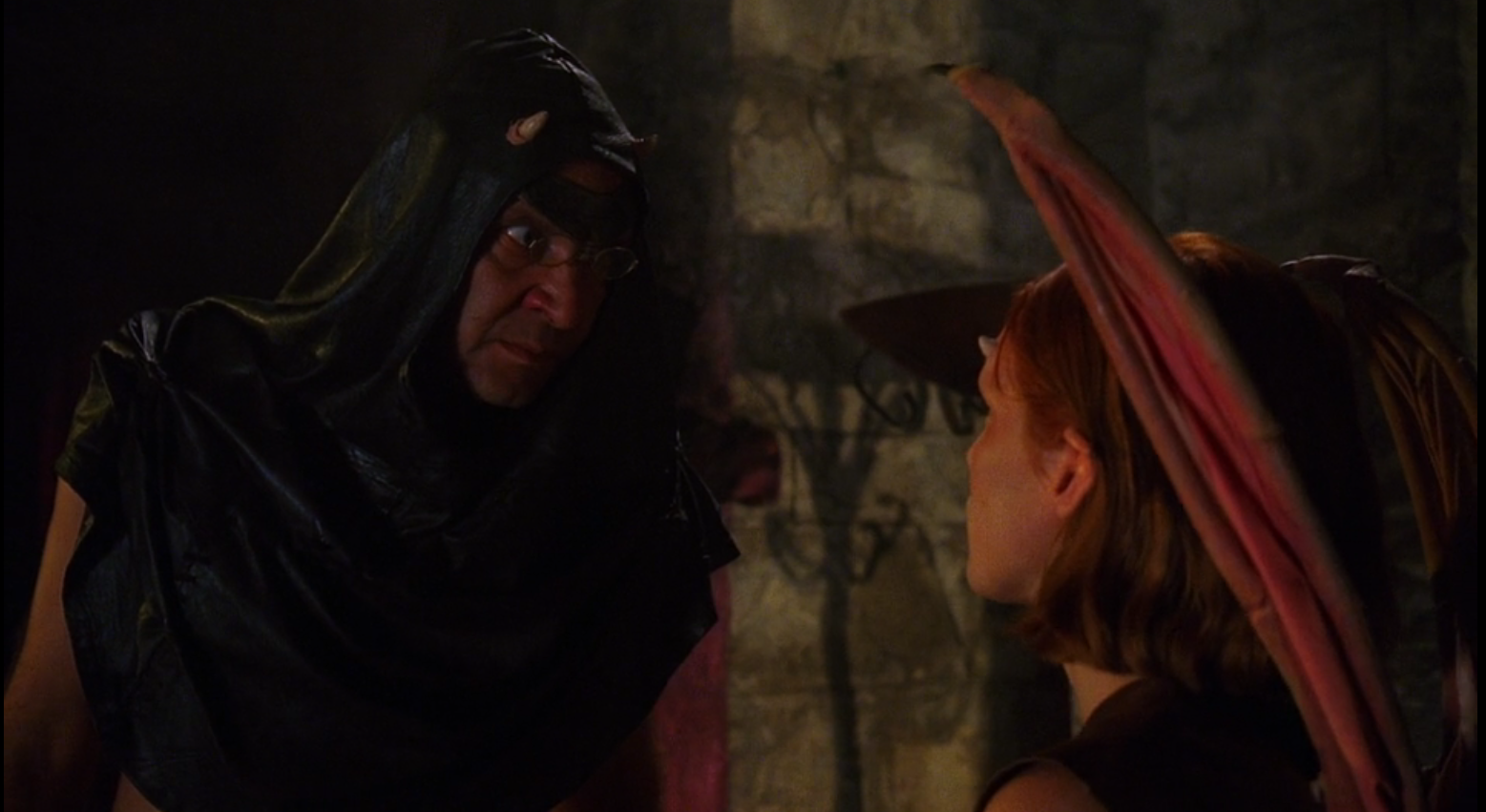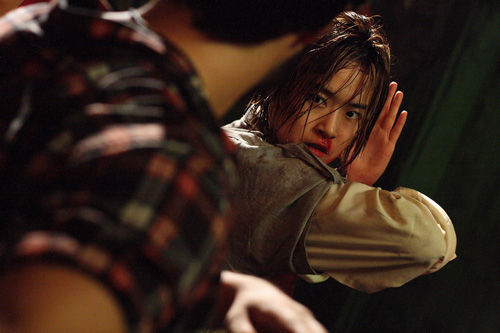

Low-investment pixel-bashing didn't exist in the 80s, at least not on the big screen (TRON aside). Effects were done with models, fake blood, exploding plaster heads. In the fast, from-the-hip world of Italian horror especially, things ain't perfect: stuntmen trip over carpets and miss their fake punches by a mile. But we're about as far from ULTRON's empty bot-bashing as it's possible to get.
So far away, in fact, you're practically all the way around again.

I didn't come here to pixel-bash, though, I came to make a ridiculous claim, that Scream Factory's new GHOSTHOUSE / WITCHERY Blu-ray double feature is better than ULTRON, By virtue of its analog tactile hurtiness, pre-CGI Italian 80s horror like these go far deeper than its pouffy hair and rotary phones might suggest, back to the innocent time when we were still too young to not be horrified at the sight of intestines being pulled out of a screaming Tom Savini. Every slow walk through a darkened hallway was once fraught with a gut-tingle anxiety. We needed to be able to sneer at the fakeness of the gore even as we needed to look away.

And though the budgets be low they were shot on 35mm, and they look good. They are serving drive-in dream logic distance and graphic violence. Shit like this was ideal for the post-midnight 'last' film on the drive-in bill after something like NIGHTMARE ON ELM STREET IV or WAXWORK before coming straight to video... then to complete obscurity... gone and unmissed, unwanted for over two decades, But now, restored on Blu-ray in a double set from Shout... GHOSTHOUSE and WITCHERY demand your agog disbelief!
Did anyone ever love them? Many have tried. All have failed.... so far.
Will you be the first, or wretch like the rest?

"La Casa III" (1988)
Dir Umberto Lenzi (As Humphrey Humbert)
Dir Umberto Lenzi (As Humphrey Humbert)
*1/2
"Oh Paul... I saw death..."
Kids will be ghosts with clown dolls killing kids in late-80s Italian films set in 70s America--instead of just adults with axes and chainsawed because Poltergeist, and Nightmare on Elm Street had cleared away the tired slasher tropes, and Europe is a lot slower to change once it finds a style it likes. When I was in Buenos Aires in 2000 they were still dressing and acting like it was the 70s, and I loved it. So I accept that Lenzi thinks that in 1988 American' kids still give a shit about ham radios, or even CB radios for that matter, and are such good sports that when they hear someone screaming for help on one of the bands, you just know they have to triangulate the signal and rush, a few days later, to the rescue. In case, you know, the killer is really... really slow."Oh Paul... I saw death..."
Turns out, that message came from a deserted house where long ago an evil kid and her singing clown doll killed her parents. Now her ghost is down in the basement, killing anyone who ventures therein, including a diverse roster of good-natured hippie-punk squatters. The ham band join them and they all hang around the house like a mix of SUBURBIA squat and Scooby gang abandoned mine. Not sure why they feel so compelled to linger (we presume they have homes to go to, since they also have a cushy trailer, but you know how kids will be: they just hang out waiting for their creative deaths to find them.
First up, naturally, is a fat black kid who is also a petty thief, and a freeloader: he hitches a ride, uses a skeleton hand for cheap shocks and pick-pocketing the kids who pick him up and basically shoves people out of the way to be the first to die. Maybe that's Ghosthouse's way of trying to "pass" as an American movie before that racist cliche became too glaring to ever use again. And hey, John Saxon shows up as the sheriff (see replies below for correction), vainly trying to make it better film. He tries to coax the kids to move on, albeit without success. Only Italians would think American suburban law enforcement would ever be nice enough to kids to actually ask them to stop trespassing on private property, then giving up with a chuckle and a sigh once the kids refuse. Even after they begin dying one by one, they feel compelled to linger, like the guests in Luis Bunel's EXTERMINATING ANGEL. It never occurs to them to even walk next door or drive away, or even drive down the block a bit, even though trespassing on private property is a crime (in America), and even they arrived in a still-working RV, and despite the cop's warnings that this isn't a legal, safe and community-oriented way to spend their weekend.
 With the English dub, everyone but Saxon (who dubs his own lines, thank god) sounds like a semi-illiterate seventh grader doing a cold read at a junior high school audition while his lacrosse buddies snicker in the hallway.
One quibble with either the sharpness of the transfer, the color grading or the way Italians overuse stage make-up of the time, the clarity of the HD Blu-ray image drains the lighting of nuanced skin color (if there was any) so we can see the thin color differentiation where the pancake make up line is around the base of their necks and the thin brush stroke marks of every foundation application, even on the men.. The result is the impression the entire cast has been living in a basement for the past decade, or England, or in their third year of clown college (or some Weimar cabaret). Is it just the restoration, or part of a gambit to make Italian actors look more Nordic (as in their general obsession with red hair, or if it's the color grading (1). Either way the cumulative effect is... demoralizing.


There are things I like about WITCHERY though, despite all that. I like the foreboding sense of isolation, with the eerie wind and dim lapping waves. I like that no one dares take a boat out from the mainland to rescue them, because the ocean is allegedly so choppy from a coming storm, like this is some kind of lost zone off I KNOW WHERE I'M GOING Scotland where everything seems tranquil but nothing is. Take their word for it. Even if you can see the shore from the island. I've had dreams like that. I get it.
First up, naturally, is a fat black kid who is also a petty thief, and a freeloader: he hitches a ride, uses a skeleton hand for cheap shocks and pick-pocketing the kids who pick him up and basically shoves people out of the way to be the first to die. Maybe that's Ghosthouse's way of trying to "pass" as an American movie before that racist cliche became too glaring to ever use again. And hey, John Saxon shows up as the sheriff (see replies below for correction), vainly trying to make it better film. He tries to coax the kids to move on, albeit without success. Only Italians would think American suburban law enforcement would ever be nice enough to kids to actually ask them to stop trespassing on private property, then giving up with a chuckle and a sigh once the kids refuse. Even after they begin dying one by one, they feel compelled to linger, like the guests in Luis Bunel's EXTERMINATING ANGEL. It never occurs to them to even walk next door or drive away, or even drive down the block a bit, even though trespassing on private property is a crime (in America), and even they arrived in a still-working RV, and despite the cop's warnings that this isn't a legal, safe and community-oriented way to spend their weekend.
With the English dub, everyone but Saxon (who dubs his own lines, thank god) sounds like a semi-illiterate seventh grader doing a cold read at a junior high school audition while his lacrosse buddies snicker in the hallway. One quibble with either the sharpness of the transfer, the color grading or the way Italians overuse stage make-up of the time, the clarity of the HD Blu-ray image drains the lighting of nuanced skin color (if there was any) so we can see the thin color differentiation where the pancake make up line is around the base of their necks and the thin brush stroke marks of every foundation application, even on the men.. The result is the impression the entire cast has been living in a basement for the past decade, or England, or in their third year of clown college (or some Weimar cabaret). Is it just the restoration, or part of a gambit to make Italian actors look more Nordic (as in their general obsession with red hair, or if it's the color grading (1). Either way the cumulative effect is... demoralizing.
But there's joy in GHOSTHOUSE's many little life-affirming accidental Brechtian details, like the shot of a hand swinging a hammer down into a guy's forehead. The swing downward is held just a few frames too long in the editing so we see the hammer slow to a stop an inch from the victim's forehead before the quick mismatched jump cut to said hammer buried in his suddenly thicker (padded) and darker-hued forehead (the painted-on latex skin color doesn't match). I love this kind of thing as Lenzi's effect crew use the the same camera and effects tricks my buddy Alan and I used in our old super 8mm epics, and I find comfort in knowing we did it better, or maybe since our image wasn't HD, it just looked cleaner. Certainly our editing was better. Anyone can make a decent cut between the axe swinging down and the effect of the axe in the head so that it looks real. Only someone with no idea what they're doing, or a Brechtian like Godard, would leave the frames where we see the axe stop right before it hits the actor's head. But I'm so glad it's there. Without it, the scene would just be another lame murder with bad latex effects instead of a little life-affirming incident (fake death keeps real death at bay).
Finally, as GHOSTHOUSE lumbers towards its required 90-95 minute mark, all the "best kills" come tumbling out. One kid drowns in a boiling lake of skull-sprinkled cream-of-wheat under the basement floor as a cheap great din of 80s SUSPIRIA-ism howls in the bones of the soundtrack. The little sister is cut in half at the waist; a kid is diced up by a fan blade; blood comes out of the sink. There's even ghost doberman like in THE OMEN (though I like to think it's from FACE OF MARBLE). The clown doll is too similar to the one in POLTERGEIST and the ghost girl too similar to the one in KILL BABY KILL. But the scenes of graveyards and old tombs recall all the touchstones of the Fulci and Argento canons. John Saxon is always playing sheriffs, but he always elevates. It's crap, but it's priceless... crap, And the Blu-ray comes with....

WITCHERY
"La Casa IV"
(1988) Dir Fabrizio Laurenti (as Martin Newlin)
*
(1988) Dir Fabrizio Laurenti (as Martin Newlin)
*

WITCHERY is both much worse than GHOSTHOUSE as far as unrealistic yet nauseating prolonged gore / torture scenes, but better as far as far as cast and writing, with several recognizable American movie faces and a theoretically understandable reason for hanging around an unoccupied murder house while everyone is being picked off (they're stranded on an island due to an alleged off-camera storm).
Linda Blair is a pregnant lady looking to buy or sell a very old abandoned seaside island hotel --its gray shingles flap in the ocean wind most atmospherically. Pouty Catherine Hickland plays a virgin grad student squatting there while writing her term paper on the 'witch light' that has regularly appeared out of the window throughout the building's early colonial American history and up to this very day! Hickland's then-real life husband David Hasselhoff is her sexually frustrated boyfriend/photographer, forever pressuring her to yield unto his desire, but her grimoire asserts "virginity can be a virtue and not the barrier that separates innocence from knowledge." Touche! He can't argue with that, though he knows it's really her all-consuming fear of penetration, and he can't argue with that either. She has this great slurred drowsy way with a line, like she spent the whole shoot on Valium, and who could blame her? Her imdb.com page notes that after her acting career she became a professional hypnotist, which makes perfect sense considering the pulse-slowing alpha wave-inducing speaking pattern.
Even so, we feel for the horny Hasselhoff. Why does he stay around? Dost he not know how Hoff he art!? There's other fish in the sea, and what a rod and bait box he surely packeth.

If only we stayed with this pair and their push me-pull you but stay respectful sexual thing, the film might not be such a drag. If it did that and cut the grotesque yet unconvincing torture scenes down to a manageable length, it might even be watchable. As it is, WITCHERY is brilliantly summarized in Leonard Maltin's Film Guide as "uncomfortable."
I don't mind a certain level of gross-outs, but the victims here get sucked into some kind of sub-basement Middle Age horse barn Hell, consisting of a row of horse stalls that have been converted into an alternate dimension Hell by doing... exactly... nothing to them. They don't even remove the straw. But who needs webs and chains and flames and damned soul when your stable has mocking old pilgrim-cum-carny geek lady and deranged Pagan-looking old man, straight out of a Bruegel painting (those tacky white hoods!), reaching out through the horse stall slots as victims try to pass by, laughing and gibbering like caffeinated mental patients at a Jaycees haunted house for charity? I do.
After enough suffering, we begin to learn that each victim stranded on the island is there because they are needed for a stern German witch's spell (the one with the witch light!) - each death is an invocation of one of the seven deadly sins in some vague way, so they suffer suitable stable-set punishments: for the pregnant Linda Blair, the Bruegel painting old lady and Satan (not even horns) fight over, and then eat, a premature (very fake-looking) newborn baby. In one prolonged, grotesque scene, the bossy Jewish mother real estate mogul gets her nails broken off, her lips sewn together--a terrible appliance job and we see almost the entire process of sewing all across the mouth, as if the producers were sure they'd have to edit it down (2). She's then is hung upside down in the chimney as the rest of the survivors unwittingly start a fire right under her hanging head and since her mouth is sewn shut they can't hear her screaming as her hair goes up in flames. Oh the humanity! Hickland the virgin is--in the most vile sequence--raped by a sickly youth with sewn-shut lips (what's with the lips thing, Fabrizio?) while the old lady and Satan hold her down -- Yeccch!! Thank 'god' then that Linda Blair's hair gets wild once she's inescapably possessed by the devil, and there's the old classic of when the nympho real estate girl starts seducing the Matthew Broderick-ish dweeb real estate guy in a room with a big mounted swordfish on the wall.... wait for it.....
 Maybe I ate too much of something or other while watching, but I came away from WITCHERY with little but a lingering nausea. I think the film may have been seeking the kind of kinky equilibrium of Clive Barker, whose HELLRAISER was a big horror hit the previous year. But Barker would be too outrageous and creative to let the nausea and ennui take hold. In the Barkerverse you understood the difference between both dimensions (the pinheads' S&M club and tawdry Britain) and felt they were both real, even if just dreams in each other's spaces (the pain/pleasure trip was more or less theoretical). But in WITCHERY, there is no difference, and both feel false. In Barker, the mutilated masochistic demons are trippy and funny. Here, they're 'uncomfortable.' And the latex effects are betrayed by the clarity of HD Blu-ray, making them less shocking and more like arts and crafts.
After enough suffering, we begin to learn that each victim stranded on the island is there because they are needed for a stern German witch's spell (the one with the witch light!) - each death is an invocation of one of the seven deadly sins in some vague way, so they suffer suitable stable-set punishments: for the pregnant Linda Blair, the Bruegel painting old lady and Satan (not even horns) fight over, and then eat, a premature (very fake-looking) newborn baby. In one prolonged, grotesque scene, the bossy Jewish mother real estate mogul gets her nails broken off, her lips sewn together--a terrible appliance job and we see almost the entire process of sewing all across the mouth, as if the producers were sure they'd have to edit it down (2). She's then is hung upside down in the chimney as the rest of the survivors unwittingly start a fire right under her hanging head and since her mouth is sewn shut they can't hear her screaming as her hair goes up in flames. Oh the humanity! Hickland the virgin is--in the most vile sequence--raped by a sickly youth with sewn-shut lips (what's with the lips thing, Fabrizio?) while the old lady and Satan hold her down -- Yeccch!! Thank 'god' then that Linda Blair's hair gets wild once she's inescapably possessed by the devil, and there's the old classic of when the nympho real estate girl starts seducing the Matthew Broderick-ish dweeb real estate guy in a room with a big mounted swordfish on the wall.... wait for it.....
 Maybe I ate too much of something or other while watching, but I came away from WITCHERY with little but a lingering nausea. I think the film may have been seeking the kind of kinky equilibrium of Clive Barker, whose HELLRAISER was a big horror hit the previous year. But Barker would be too outrageous and creative to let the nausea and ennui take hold. In the Barkerverse you understood the difference between both dimensions (the pinheads' S&M club and tawdry Britain) and felt they were both real, even if just dreams in each other's spaces (the pain/pleasure trip was more or less theoretical). But in WITCHERY, there is no difference, and both feel false. In Barker, the mutilated masochistic demons are trippy and funny. Here, they're 'uncomfortable.' And the latex effects are betrayed by the clarity of HD Blu-ray, making them less shocking and more like arts and crafts.
  |
| No amount of witchery can made that lipstick color and thick eyeliner work anything but woe on all who gaze herein |
As the seven hundred year-old witch lady mastermind of the murders, Hildegard Knef (left) is hit and mess. In general she reminds us there's a dispriting abrasive flipside to the unflinchingly carnal allure of Germanic lady icons, In specifics, her terrible make-up choices remind us of how some things are never meant for HD, such as old person skin when caked in too much bright oily white make-up, the smell of bad perfume over 'old person' mustiness that evokes slogging one's way through a tedious 'party' at your unfun grandma's. Torture all you want, but in truth it's Knef's black eyeliner and the garish horror of her orange lipstick that are the real horrors of WHITCHERY.
 |
| Knef in the 50s - nicely unadorned |
Maybe my reaction towards Knef (L'ATLANTIDE) reminds me of my stern and disapproving late German grandfather. Old Germans, man, are the worst - somehow more decadent than any French libertine yet so joyless about it you become a conservative almost instinctively. Their favorite thing is to torture their grandchildren with endless long lunches and dinners und schwarzwaldkuchen. Hours and hours with nothing to do but try to understand their wearingly adult conversation, as the only book or magazine they have in their Apple Canyon cottage is a Reader's Digest from 20 years ago, and the only game in the rec room closet some 1000 piece puzzle of a dull landscape. So one endures a full week of being bored near to death, minutes stretching like years, hushed constantly as children aren't heard, symbolic lips sewn-shut.. waiting as lunch turns to dinner and dinner turns to drinks (which you can't have - you're too young) Being crucified upside down, stabbed with a swordfish and set on fire is an indulgent luxury by comparison...
Long azzits annalog.

NOTES:

NOTES:
1. Italian fondness for red hair in cinema means lots terrible red-on-black hair dye or bad wigs on people who could never in a thousand years pass as Irish, the hot sun melting their brown bronzer intro rivulets of opaque desert sweat (as in the grotesque McBain family wiped out by Fonda in ONCE UPON A TIME IN THE WEST
2.so they do what so many directors do, add about 20 seconds more gore than they really want, so they can begrudgingly remove it at the censors behest, thus satisfying both of their power trips and ending up right where the director wanted it to begin with (but then if the censors don't say anything, viola- way too much to the point it loses its blunt force impact)