Showing posts with label French. Show all posts

Tuesday, July 21, 2015

The Metatextual Exorcist's Assistant: MAPS TO THE STARS, CLOUDS OF SILS MARIA


Film as a medium isn't old enough that it has a set response as to how to handle the 'problem' of aging A-list actresses. But two 2014 films both recently released on DVD have shown the 'old' way can be made 'new' again through post-modern tweaks. The sexy young bitches of the 80s-90s have found work playing middle-aged actresses fighting to stay young and relevant, the way hot bitches of the 20s-40s did in the 50s-70s, by playing faded stars who go insane from being cooped up in their cobwebbed minds and mansions while the pictures (and cars) in the world outside get smaller, junkier, younger. Going 'Norma Desmond' allows for a kind of ageist exorcism which then makes the aging actress playing the unbalanced aging actress seem balanced by contrast. So Billy Wilder makes Gloria Swanson seem cool and Robert Aldrich makes Bette Davis seem fearless--they boldly go into the depths of their own potential madness as Hyde versions of their own personae. Skulking around their eerie mansions as theremins goose their every mirror-ward hiss, the well-aging actress playing the semi-well-aging actress playing the unwell (delusional) aged actress is cathartically freed from her own gerascophobia, exorcised with the help of a Chanel-scented strait-jacket (starring Jessica Lang as Joan Crawford). (1)

Maps and Clouds stars in an important drama about Alzheimer's
Now that we're all feminists again, the kind of lurid madness that made Baby Jane and Norma Desmond so indelible is too objectifying, too freakshow, for squeamish PC Hollywood. Age and narcissism mustn't be reduced to just another carny attraction-- not that Hollywood wouldn't make it so if we demanded, but you can't put the genie back in the bottle. So the producers must instead paint a sensitive portrait of Alzheimer's or some real-life tragic figure's descent to madness. They must be educational, touching, and earnest instead of high-camp shock-value horrific. We associate aging with importance now, middle-aged actresses with serious drama. In this way, filmdom solemnly leads them out to pasture rather than letting them shred the walls of a cinematic padded cell. With all projects not good enough for a dame of their stature, they wither from underuse.

Sensing an opportunity to fill the gap, however, scrappy maverick independent filmmakers circle the wagons around the A-list divas with a little money saved up (or will work for scale to get their attached to a truly edgy and 'now' product) who want to sink their teeth into something bonkers for a change, to work with talents unafraid to plunge into new dark depths behind the camera, irregardless of the PC putsch that so paralyzes mainstream Hollywood when it comes to bitches over 40. Canadians like David Cronenberg and Frenchmen like Olivier Assayas, keep the luridly self-reflexive spirit of Billy Wilder and Robert Aldrich alive, for they know a secret denied the average Hollywood hack: the 50s-70s 'horror hag' spirit need only be taken one meta-level further to resonate in our new century's junk TV-addicted consciousness afresh and leave the stigma of exploitation behind in the process: Julianne Moore and Juliette Binoche shall play Gloria Swansons playing Norma Desmonds now, instead of just playing Norma Desmonds trying to play Salome. Brian Oblivion would be so proud! 

THE CLOUDS OF SILS MARIA
Dir Olivia Assayas (2014)
***

Olivier Assayas uses the post-modern lesbian corporate thriller the way Jean Pierre-Melville used the French New Wave gangster film, as a gateway between high art and low genre for anyone with a Gauloises and Steadicam to glide through behind him. In his Boarding Gate, for example, scenes of Asia Argento walking through a vast bustling Hong Kong mall-flea market--each booth/stall a vast tapestry of electronics, contrasting languages and music all whirling together one after the other--are perhaps the most ear-boggling use of post-modern affect in all cinema, but then... what is there to when from why? We're left feeling cheated, confused, even irked.Assayas' biggest weakness has always been his endings, since demonlover, even. His best works, like Irma Vep, end in pure abstraction. His worst endings feel like betrayals - like he led us on, like seducing us into bed then running away going "I forgot I'm married" and runs away last minute.

Before something like that happens, Clouds of Sils Maria covers several layers of a power trio of strong female leads ranging along the All about Eve axis, each playing versions of themselves and their personal assistants in screens-within-screens. The catsuit Les Vampyres S/M gone corporate bitch-in-the-boardroominess of his dEmonlover and Boarding Gate coalesce against Summer Hours pastorale realness as two women play characters studying to be themselves and each other; the same weird mix of back-stabbing and compassion with which younger executive assistants are shepherded by older female employers into the abyss of self-awareness and ambition, breaking them down and being broken in turn in some twisted--even if initially altruistic--identity merge/melt-down. They have youth; you have power. But they can get power, what can you get, except older?

From the ongoing discussion between Maria (Juliette Binoche) and her assistant Val (Kristen Stewart) about Maria's character in the play that made her famous (she's now shifting from the ingenue to the older lesbian mentor, and she ain't happy about it). Maria's nihilistic interpretation of the character during rehearsals and discussions jibes with Val's hip youthful (American) interpretation of Maria's interpretation, which Val sees as solipsistic, as glorifying youth based on one's rose-tinted memories and attacking her own aging dignity. And Val isn't backing down even against Maria's contemptuous laughter which might have worked on her when she was Val's age, but Val is somehow more grown up than that.

It makes sense then that Kristen Stewart steals the show as Val, handling her personal assistant duties with startling cool, knowing just how to rile, soothe or otherwise push Maria's buttons while juggling deals and cars and hotel rooms and interviews and meetings with photographers, all without ever seeming to break her detached stride or smash her incessantly ringing cell phone. Chloë Grace Moretz plays the rising star playing the younger part in the play (the superhero masochist in the comic book film they see) who Val and Maria meet with later for drinks, along with the young dumb boyfriend, a writer whose wife tries to commit suicide and...hmmm.

If that's confusing, it's my fault. Let's just say it's Bette Davis' The Star meets Petra Von Kant rehearsing a lesbian corporate boardroom version of The Blue Angel in the isolation of Faro (where Bergman filmed Persona) so hey, that's a lot a layers of reference. What makes it work even if you don't know those films is the way the pair of actresses connect with such quiet force (we understand immediately why Stewart won the César) and the dialogue of the play they're working on resembles their characters' own relationship--and perhaps Stewart's real-life relationship with PA Alicia Cargile (left)--so much it's (intentionally) impossible to tell where one (the lines they're running) ends and the other (their actual relationship) begins, except that the line-running they do feels real while their sudden lurches into directly discussing their own relationship--Val complaining as Maria laughs at her impressions of the play's subtext--seems sudden, hamfisted. It's as if direct confrontation would be too much, too theatrical, so they just endure all they can like it doesn't bother them until they just bail. It begs an interesting question: how does one deal with having acted all kinds of break-up scenes with someone when you're suddenly actually breaking up with them, without it feeling cliche? Atsa lotta layers, Olivier! Maybe ats too much...

Maybe yes, for then comes that terrible Assayas anticlimactic 'resolution.' As the Binoche-Stewart personae (see what I did there?) merges into itself like a sssnake. along with the two characters they're rehearsing (via the actress and personal assistant they're playing), there's a sudden mystical shift that... well.. it doesn't work. Oh Olivier, you just had to keep adding layers until the whole thing deflated like an overdone soufflé... again. 


Maybe I'm wrong or nitpicking --it's just that jibing to Stewart and Binoche's chemistry through most of the film as I was, I felt genuinely saddened by the sudden flight into Peter Weir-ish fourth act mysticism. The big comparisons critics have been making of course are to the endings of Bergman's Persona and Antonioni's L'Aventura, but the former was abstract from the get go, there the weird ending made sense and in the latter they at least talked about the disappearance --it even obsessed them for awhile, until they forgot about it, and we didn't much miss the missing girl anyway, since it was Monica Vitti we were collectively falling in love with even at the start. Here in Sils that love equation is reversed, like L'Aventura if Vitti just left without a note toward the end and we spent the rest of the damn movie with the smarmy Sandro (Gabriele Farzetti). Some critics hypothesize Val kind of morphs into Chloë Grace Moretz, playing the tabloid-branded scarlet letter marriage-wrecker of years ago (see: Kristen Stewart in the Snow with Poison), but to me they're making excuses on Assayas' behalf. Mention art cinema 'modernity' vs. vérité realism if you want --it just plum doesn't work... for me at least. In interviews Assayas says he wanted to give the audience something to think about, but it feels to me like all he did was take something we were thinking about away. 

The scenery is staggering. I love this mountainous zone where German loftiness, Nordic depression, and French intellectual aesthetics sizzle together and align like a constellation. I was imagining what if Bergman were directing, that he might go full-on post-modern and we'd maybe get an interview with Alice Cargile in between takes of the film within the play about a pair of women in a play. That might have worked, but whatever - the Melville of post-affect cinema transcends such things as satisfying destinations. As with Irma Vep, Boarding Gate, Carlos and demonlover, the trip is where he works his magic. Once arrived, he's all out of rabbits.


MAPS TO THE STARS
(2014) Dir. David Cronenberg
***1/2

One can't imagine either Hollywood or the Sils Maria European bourgeois "artist" community making a film like Maps to the Stars. A lurid, slow-burn haunted-Hollywood saga of pyromaniac schizophrenics, hot young ghosts, egomaniacal stars, and abusive life coaches, it could only come from a Canadian indie auteur who doesn't need pretentious vanishings to craft a Brechtian dissertations on aging actresses being intimidated by the endless incoming waves of amber ingenues. As in Sils, the idea of female 'performance' leads to meta-split mirroring, passive-aggressive sabotage by the older insecure actress against her younger personal assistant, the Twilight connection (Stewart in Sils, Pattinson Maps), Stewart co-starring with Maps star Julianne Moore in Still Alice the same year (top), like an eerie reflection across continents, genres, and post-modern layers. 

Thing is, of the two films, only one is genuinely subversive and ballsy. Only one goes to places the jugular didn't even know it led to.


In both Sils and Maps there's the idea of being subsumed by another's ego, of being a young female assistant, trying to have her own life while working for a solipsistic middle-aged actress who's going insane from dealing with the dwindling roles / loss of youth, and so bullying their younger incarnation in an attempt to exorcise their own inferiority complex. In Sils the assistant takes revenge in the must cowardly way possible, by merely vanishing without even two-weeks notice; in Maps, well.. I can't spoil it, but it's far more satisfying. There's a sense of unyielding magnetism in Cronenberg's film that Assayas' was too high in the Alps to feel: the inexorable magnetized streak of insanity running deep in the fault line crust of Los Angeles, and the most expedient, direct way to drill down into it.

Sordid show biz underbelly chronicler (and Castaneda mystic) Bruce Wagner (Scenes from the Class Struggle in Beverly Hills) knows every inch of what his script is chronicling, and he can match the darkness, stab-for-stab. Agatha Weiss (Mia Wasikowska) arrives on Hollywood Boulevard by bus after being released from some juvenile mental hospital, and--like Melanie Daniels at Bodega Bay--her mere presence triggers the vengeful furies, here a series of ghosts: Her new employer, fading star Havana Segrand (Julianne Moore), is haunted by her crazy star mom Clarice, who set their house on fire when Havana was only a child; Agatha's estranged brother Benji (Evan Bird), a bratty child star, finds himself haunted by a girl who died before he could grant her Make-a-Wish Foundation request. Meanwhile, a new biopic is being made on Clarice's storied life and daughter Havana is  fighting to play her, even while claiming she was molested and abused. Ingeniously, the ghost of Clarice is played by luminous hottie Sara Gordon (above, in the bath),  and of course, it makes sense--why wouldn't a vain ghost want to appear younger than her own grown alive children? It's just the right kind of weird twist that shows a real subversive instinct that Maps has in abundance, the kind Assayas ultimately lacks even as it covers the same ground.

It's all in the genes.


With the kind of naive prepossession that does well in Hollywood, Agatha-- on meds and working the steps, tries make amends with her family, but that doesn't go over well with her bitter father (John Cusack) who still hates her for setting fire to their house as a child and feeding Benji a near-fatal overdose of pills. Since that ordeal, Cusack has risen to make a fortune as a platitude-spouting gestalt masseur (with clients including Havana whom he clearly hasn't told about Agatha or vice versa). He has demons of his own, clearly, exhibiting the typical violent denial self-help gurus often display towards their own hang-ups. 


Ultimately these two interlocked pyromaniac-and-narcissist-choked LA families crash into one another in a shocker climax so effective and satisfying it becomes the polar opposite to Assayas' Sils's (we saw them as a double feature this past Friday night - I'd recommend you do the same, in the order presented). We just don't expect such a shock because for awhile there Cronenberg made us forget we were watching a Cronenberg film and not some piece of Hollywood self-regard and near-whimsy about how all we need is a bus ticket and a dream. That's the Cronenberg touch at work, to be good enough at the one thing you forget it's the other. Stars has courage to go deep into the abyss from off a steep, high diving board, while Sils only splashes around a bit then crooks a finger towards Lars Von Trier's receding light. Even Maps' ghost appearances aren't trite or cliche. Although they're presumed to be just psychic projection, it's a movie first, so we understand that being actors anyway the haunted A-listers are conditioned to let their imagination get the better of them, to confuse their script with their life in ways only we were confused by in Sils Maria. In other words, even as actors playing characters who are actors, characters will mess themselves up in the name of a good performance, with the understanding that--above all--they're still in an "actual" film as well as a film about film, even when they know within the context of the (outer) film that the (inner) film is just their reality and not even a film-within-the-main film!

If that's confusing, consider the contrast: in Sils, Binoche is playing an aging Marlene Dietrich remaking The Blue Angel as a butch Emil Jannings, heading back to her classroom to sulk after her younger wife hooks up with the strongman. In Maps, the better option is finally presented: kill them both and burn the whole fucking cabaret to the ground! Clarice and Agatha, I tell they, by the power of Chuck D, Hollywood sur le feu!

NOTES:
1. PS - when I wrote this that AMC show FEUD hadn't even been announced! Was it ushered into existence because of this post? I like to think so (5-16-17). 

Tuesday, January 21, 2014

Let the Darionioni Nuovo entrain your Dissonance: AMER (2009)


Stendahl syndrome is a real thing and now I know because it happened to me with this experimental-narrative post-modernist hybrid fairy tale-erotic awakening giallo bit of mind-melting genius, Amer (2009). I didn't pass out but I did get a full bore panic attack mind shatter moment of pure Vulcan mind meld between image and reality. I have fallen into this film like Alice into that K-rabbit hole down through the 'David Lynch-as-a-girl twisted up with a giallo fan version of Maya Deren' Wonderland. Amer isn't just a film, it's a disintegration engine, sucking up the distance between the viewer's mind and the screen like lovers on either end of a Twizzler, swallowing towards the middle and into the blackness.

What sets Amer apart from almost all other films, and it's clear from every frame, is that it's written and directed by a male-female team, Hélène Cattet and Bruno Forzani. They come together like the reunification of the conscious mind and the unconscious. "It’s because we are a couple that we can work together," they noted in a 2010 desktop interview. "It would have been impossible to make the film with someone else. We trust in each other and we can speak honestly about intimate things. That’s why we can collaborate." That they sure as fuck can. Their names evoke their respective Italian male and French femaleness, which makes sense because there are certainly strains of Catherine Breillat as well as Argento, Antonioni as well as Claire Denis, but then again, they're Belgian... and beautiful. So that does happen.

If it helps the process, maybe have seen enough experimental cinema to check the references in advance: Antonioni-ish ur-ambiguous 'intentionally signification resistant' art, and Argento-ish European erotic fairy tale horror films from the 60s-70s, so the analytical signifiers and references can cascade upon you, the way Un Chien Andalou cascaded instantly recognizable political horror upon rioting Parisian art critics in 1929, or the Basilica of Santa Croce cascaded upon poor Stendahl. Thanks to these two kids who made this wild film, Stendahl syndrome's not just for Florentine tourists, or Asia Argento, anymore. This time it's poison L. This time they came for me.

Until mon Amer there's always been a weird dissonance, a grinding disagreement, between the iconography of experimental film and narrative film, even in Europe, where art doesn't have to be framed and velvet roped the way it does here. A mirror to this twin dissonance might be found between the Jungian anima and the Mulveyan male gaze, between Jess Franco's 1967 Succubus and Lucretia Martel's The Headless Woman. But Amer brings to this twin dissonance (experimental vs. narrative / male fantasies about what girls dream vs. female artist's impressions of girls dreaming about men) a twin serpent DNA lover's frequency that harmonizes all those dissonant tones, and the resulting unified field harmony expands wider and wider until it envelops and entrains other dissonances, widening its wave until even the most ideal sympathetic response to the film is swamped and carried off ever outward into space until the floor rises up to meet you like a wall

and then forward into panic
the image of self within your mind shatters
like Ellison's glass goblin
ancient crumbling nitrate like Edison's ghost dance.
Your crystal skull's shambling pedestal falls
to the marble Florence floor
Its eye sockets, twin gondolas, stay afloat.
Your back's hard against the couch still
watching the shards of your coil's shard's scatter,
the cards shatter off the diving board
couch in a 52 pick-up of fluttering
raven-hoofed watery wings,
and you swim

deep

deep down, Diabolik-ish.
The floor sinks towards you like a mouth,
Betty Blue Boy blows candy canings,
the outcast cowboy burning constantly at stake

But what mouth?
Don't do drugs,
but let them do you if they wish-
it would do you honor.

And what is the difference between faking not having amnesia and not having it but secretly pretending to hide that you have it (as in pretending you know what's going on when you don't but not really, i.e. faking it even to yourself?) This is what we black-out drinkers are familiar with --easing our way into our lives each morning like we know all that happened the night before but we don't - it's an art, a bit of sly detective work as you suss out the night's events and all witnesses' remembrances of your actions without letting on you don't remember. With a level of remorse that would crush a sober man, we eye our girlfriend on the couch for signs of her displeasure, trying to fathom what we may have done to embarrass her... pretending we already know and are sorry, as we quietly (when she's in the bathroom),
and with practiced legerdemain,
spike our orange juice.


Many have tried and a few have come close to harnessing the kind of alternating current a romantic male-female directing-writing team couple can generate: Debra Hill and John Carpenter came as close as anyone with Halloween (1978) but every film has to get up from the table and go pick a bathroom sooner or later, and Halloween eventually chooses the Men's, which means John Carpenter in the limelight, Hill to the side. No film has made it all the way past the border of gender and to the boundary of the split subject, avoiding picking the man as the director, woman as producer, or writer, or vice versa --no film makes it past nationality, temper and even age, smashing through the wall between the bathroom doors and finding its own special hidden alcove. Amer isn't the male gaze or the female gaze but both gazes sliced up in long celluloid pupil Laura Mars strips and arranged in Sergio Leone eye close-up layers to form something as new as neither, something genuinely transgressive without relying on anything so paltry as meaning, story, narrative, coherence or logic... or even cheap shocks. Would your dreams ever deign to use them? Why should Amer? Instead it resists even the fundamental hazard at a guess of meaning critics might find in something similarly post-structuralist like Antonioni's Red Desert or Maya Deren's Meshes of the Afternoon. It's something as slick and enjoyable as any modern movie but deeply entrenched in the experimental and certain to confuse or irritate anyone expecting signifiers of the real to properly adhere.

The male-female creative interaction of Hélène Cattet and Bruno Forzani seems mirrored in the zig-zag rhythm of the shots - one step into giallo narrative, one step back along fractured dream surrealism, each refracting and reflecting the predecessor - move, countermove, and so nothing is ever clear or unclear. Everything resists a concrete interpretation but continually beguiles us into wanting one, uses that want for its own purposes, maybe even better than Antonioni did: it doesn't charge ahead like a boy with an Uzi and climax or dissolve into curios like a girl with a flower, yet if you don't run away in disgust, or boredom and if you don't dismiss it all as girly stuff or misogynist or think you don't know what's going on, and if instead you just ride with it, but remain alert and enthralled and ideally high on lack of sleep and Jung and art and Robitussin, then there it is, in its sublime perfection, the mind--both halves--inner and outer, conscious ego and unconscious animus locking into place while busting open at the same time, the unconscious's language signifiers becoming reshuffled, the normal narrative progression cracked open like a nut, the inside goodness free falling in slow motion and for a moment you and the unconscious and the images onscreen are all one - the barrier of screen and speaker between you has evaporated.

When dealing with the giallo genre in the scope of female fairy tale iconography it's important to stress that the collective as well as personal unconscious does not recognize the border between life and death, between the alive and dead version of you, the ego/soul/body/consciousness. Your dreams are the same whether or not you die outside of them - death in your bed doesn't wake you from the nightmare. The razor in the hand of the man chasing you is never just a phallus, penetration anxiety or even fear of death. It's a fear of dissolving, a loss of self, the split - you are afraid to turn around and face the demon chasing you in your nightmare for a very good reason - once you turn around and face it the demon will merge with the 'you' who stopped running, both will cease to exist and a new life will begin. Only through fear of change, or merging, of opening the self's border, does one hold onto the virginity of a tangible unchanging self. All else is transition. All of Amer is this transition - it is a coming attractions highlight reel of infinite length, the narrative arc of the 90 minute film split three ways, and from there three more.

The first such split occurs during childhood - the Freudian key that unlocks Bluebeard's secret dead bride storage: Bava's Black Sabbath, Suspiria, Alice in Wonderland, Wizard of Oz, Brothers Grimm, and Valerie and her Week of Wonders. The second turns sunny and erotic with the girl on the cusp of sexual maturity: Rohmer, Betty Blue, Emmanuelle, Fellini, Blow-Up and Chabrol, and even maybe Cocteau. The third and final turns to the dark again: Argento, later Bava plus Blood and Black Lace, Soavi, Fulci... but with the jittery bipolar modern 'twang' of Antonioni's Red Desert. The eternal dance of metatexual refraction never ends even at the end. The movie becomes a male-female duel in exquisite corpse fashion, each image reinterpreting the one that came before, ever circling dark truths but resisting meaning and remaining the pinnacle of cinematic 'dream logic.'


The only way to describe what's going on is to give these kids a name that can link them with certain of their peers, so I'm calling them the Darionioni Nuovo, a group of filmmakers who have melded the experimental and deeply psychoanalytical styles and substances of Argento and Antonioni into a modern new vision for cinema, one geared towards not just the moviegoer's eyeball but their pupil, not just their ear but their ossicles, a group who refuse to label Antonioni and Godard as art and Fulci and Franco as trash, but to see each as half and half. This is a zone that we usually don't trust 'new' filmmakers with, especially not in America where everything has to be laid out with big yellow lines and breasts and 2.3 children and token minorities and police and moral lessons and zeitgeist-dictated products placed according to rating and market. But in Europe and South America and places where socialized education and less hysterical reactions towards sex and cigarettes lets the youth get super intellectual for free, there is thrives. Maybe it's their less repressive attitude towards sex that frees them from infantile obsession, helping them to make deeper movies: Berberian Sound Studio, Only God Forgives, Magic Magic, Boarding Gate, Beyond the Black Rainbow, A Field in England... but mainly or totally in this instance, Amer. Maybe they can't be appreciated, or even endured, without familiarity with the 60s-70s European horror film canon, but if you haven't experienced any of it, then what are you, un poulet? dive in to the grinder! If it don't make sense, congrats. Take some acid and try it now. If it makes sense at last then bro, you missed it.


Now when a guy, a bro, a dude tries to make a female coming of age story, no matter artsy or 'feminist' it's still a male fantasy, in the end, am I right guys? And that's a shame, because on the one hand we're not allowed to get turned on by the Blue is the Warmest Color because it's still the leering male gaze (a middle-aged man filmed it), and on the other we can't enjoy Chris Lilley's HBO show Private School Girl because our anima gets jealous (if anyone should pass as a school girl, it should be us). And when a woman makes a coming-of-age film she either lets her animus, "her master's voice" lure her into a phallus-sacrificial circle in the forest, ala Thirteen, or she projects said voice clear out of the room with the flat-age swack of a musketeer's sword (Breillat's Bluebeard). Instead of either, Amer rolls elegantly along the sharpened edge of the blade and into the 'win a free game' hole at the end. When it emerges it is, como si dice?, ready for the Lynchian eraser factory.

Counter, Paul!

And what then? The lights come in corners of this massive mausoleum of industrial space that have been dark for years. You forgot those lights were even there; you forgot the corners were even there; you forgot the machines were even there. The machines that now start whirring but you forgot what they do or what you're supposed to do to them to make them run. But people are applauding you, Nina! You didn't even know you were onstage! You've moved from being just another American whining for his phallic climax to a European calmly engaging the bivalve sensual. Now, Nina, Now! Now you really are the Black Swan. And as some trick velvet light trap choker snaps shut behind you, the concrete Basilica floor tilts up to greet you like the concrete smack of a grounding lover. And on the count of three you are back to one / true unified / split. Two/ Snap, dragon. Truth or illusion, George, at last, and for all time, there is no difference. 3

Sunday, September 01, 2013

Post-Structuralism of the Living Dead: PONTYPOOL (2008)


"Only the medium can make an event" - Baudrillard

In PONTYPOOL  the world ends not with a bang but with the words "in Pontypool the world ends not with a bang but with the words 'in Pontypool the world ends in Pontypool'..."- an ever-tightening stutter-stop loop that causes cannibalism as people try to unsay the source of the said words. It's no time to be running an early morning English speaking radio talk show, in a town so blizzarded out all winter that you have to take the world's word of it that it's still out there, past the white/gray curtain. This one early morning a slow escalating series of incoming calls, emergency broadcasts (or pirate interceptions, in French) and mass confusion envelop early morning DJ Grant Mazzy (Stephen McHattie), a self-styled outlaw with a yen for conspiracy theory; his harried but maternal line producer, Sydney Briar (Lisa Houle); and intern Laurel-Ann (Georgina Reilly). For a long stretch of film we meet only them, and a lot of voices calling in to deliver astonishing reports that go blank in big flurries of horrible chaos as people chant meaningless phrases over and over then bite each other.


Of course if you've never done angel dust then the stories sound like the ravings of the town's many drunkard local fishermen. Grant can't quite believe it, and his paranoia begins to overwhelm him -is the whole town in on some bizarre prank? It's not until BBCI phones that Mazzy realizes what was mere minutes ago a punishment assignment (Pontypool the Canadian equivalent of Siberia due to his cantankerous airwave anarchy) has led to this one Wolf Blitzer Gulf War-style moment.

He blows it, though. Too freaked out.

The sense of cozy insulation works a soothing spell for quite awhile (especially if you listen on big cushy headphones  while watching in the dead of night/early morning, as I usually do). Grant, Sidney and Laurel-Anne's studio is set up in a church basement (looks like an AA meeting is about to start) and they haven't seen any of the things described. This is a snowbound town where nothing ever happens or has happened. All Mazzy and Sydney and Laurel-Ann have are the callers, whose voices gradually devolve into repetitive cannibal madness and all other lines--police radio, AP wire, 911--are dead, or dying, just static and then the alien-like buzzing we belatedly recognize as the emergency broadcast signal. It's like the whole world has shrunk around their little studio - an island in an already island-like town. Pontypool, where they know most of the residents by name, winter nights stretch long into the following evening, leaving the town forever shrouded in a haze of booze, depression, and shuffling from heated car to radio station basement to car to home to bed to car, with no sun to indicate if you're coming or going, with windows just reflecting an opaque walls of darkness and snow. It would make sense that, of all places, here is where language and listening has such power - where everyone is snow blind so their other senses are enhanced.


What really makes it work is the power of imagination coupled to the frustration of never getting the complete story --we strain at the bits of the movie's limited knowledge, and we recall the way breaking news drips slowly with newly emerging facts buried in an avalanche of idle speculation to fill in the minutes on CNN and their ilk. It recalls back when the radio was the news delivery system, where vivid descriptions conjured mental images of disturbing power, a time when 'showing' mass cannibal carnage in all its Tom Savini-ish Fangoria glory was a subversive act, something to look away from in blanched shock. Now it's the opposite --showing us almost nothing becomes a new form of subversion, back to the fire and oral history and imagination. There are now countless zombie / mass plague insanity knock-offs and for a few seconds the 'found video footage' trick was novel but that was 10 years ago and they're still endless (and cheap). Of them all, only Pontypool (2008) finds an original tack, sailing towards the source of the original Romero film's hidden candy shell power--the news broadcasts--the way the professional newscasters with their cigarettes and thick glasses and bustling assistants behind them all both offer reassurance and terror, their steady authoritative and comforting deep news anchor voices only serving to make the pronouncements about 'packs of ghouls' more terrifying (Night never use the word zombie in that movie, or even--as I recall--the second).  Pontypool rocks that same tack. It's almost too post-structuralist for its own good at times, too lit workshop precocious, but makes terrific use of uncertainty, the unreliable aspect of oral history and delves deep into the way imperiled people instinctively turn to the media to provide a narrative structure for the chaos around them, and how the media finds itself compelled to provide one, to make it up on the spot if need be. Without clear visuals, long shots of the calamity, official press conferences, the calm but thrilled voice of a reporter standing in the snow near a firetruck, we have only our own imaginations with which to structure things. At such times radio can reach the deepest vaults of our mind, forming deep cerebral cortex responses not normally our own. The morning 9-11 went down, for example, I was at work, in the office: no TVs, AOL still relatively young, so we listened to it on the radio. Hearing Peter Jennings describe the towers falling and planes crashing into Washington, I imagined the world consumed in fire, civilization ending all around us, a happening so apocalyptic it was hard to fathom it was even real, more like Orson Welles' War of the Worlds. When I finally saw the footage, horrifying as it was, it was almost a relief (the building fell straight down rather than to the side creating a domino effect stretching the length of Manhattan- which was what I had pictured). That's kind of maybe part of the reason why I love this film so damn much. It's the only thing that's yet come close to recreating that surreal almost merry apocalyptic feeling. I was, in fact, giddy. It was only a few days later when I noticed half the "blue collar Buddha" (as we called them, mostly firemen) population of my uptown AA meeting was gone, and the few that remained, devastated with grief and survivor guilt, that the full brunt of it all sank in.


But that's it - we can't always be near a TV with CNN, but even if the power goes out we can find and old battery-operated radio. We all secretly love calamities (as long as they don't happen to us or we don't know whether anyone we know was hurt or killed) because suddenly, for once, something is happening and the mood amongst the reporters is always jubilant. They try to restrain themselves, but this shit is why they got into this. Careers are made in such moments. It's one of those rare times when absolutely no one can predict what will happen, when no one knows the whole story, and it's the newsman's turn to create a proxy, out of thin air if need be, until the real one finally coheres. The whole world seems to wake up in such moments, to be unified in their collective shock and awe, secretly loving the thrill of orbiting closer and closer to a possible armageddon, to the mad chaos of complete social chaos.


Why  I've already seen Pontypool four times is the comfortable sense of being in a warm radio booth on a frozen Ontario small town morning it provides, and the early stretches of incoming news as DJ Mazzy in the morning starts out with the usual bickering with his producer over when to read school closings and the slow mounting panic/paranoia when he begins to think people are all fucking with him, all so organic it all unfolds in more or less real time for long stretches without the viewer (me at least) noticing; as the influx of news and shaky narration causes a breakdown in our perception of reality, we trust his deep perfect radio voice (it wouldn't have worked with a high-voiced wuss actor like Edward Norton). In other words, while not being specifically scary, and always kind of funny-ominous, there's a sense that something meta is always at stake, something that might leak out and effect even your blogging about it, for more than any horror film I've seen, it gets that whole post-structuralist Burroughsian language as a virus concept.


The secret, as media studies grads know, is the news media's secret agenda has always been to cast anxieties about the prevailing social structure's solidity off on handy targets: crooks, shady pols, terrorists--which then makes the news a comfort. You see which way the finger of blame points, and you make sure you're standing behind instead of in front of it. And when you're behind it, you're strong; furthermore, you know which way to look for oncoming danger. So when the TV station reports on a mass insanity uprising, it becomes 'real' in a way it couldn't be otherwise even if you witnessed it yourself. This process strengthens you by strengthening the illusion of law and order's ultimate omnipotence within you. As Jack Torrance would say, cannibalism is okay to talk about in front of their son, because he "saw it on television." It's the same for us. In fact cannibalism's power in Pontypool lies in its invisibility. Thus one Romero news broadcast is worth three dozen CGI zombie army ant hill urban killing floors, all those tedious Matrix-rip bending over backwards, both barrels blazing slowmo shots are just video games played by some kid you pass on your way to pick up your laundry. The end of the world can't be accepted as a legitimate event until it is authenticated through the TV. Unless the revolution is televised it cannot exist. This is what Baudrillard and McLuhan can teach Gil Scott Heron. It's why so many disaster movies now get real news anchors to come on with their fake news.


In Dawn of the Dead (above) Romero yanks even that little buoy of illusory 'objective reality' away right from the start; the TV station itself starts to collapse from nervous exhaustion at the start of the film, the crew devolving into petty arguments and agendas. Those who haven't had a chance to experience the dead rising directly commandeer the zombie outbreak to suit their agenda, the black intellectual in the in progress talk show labeling it as a cover-up for cop violence in the ghetto. When the four people we follow find a TV later, there's just one continuous talk show left, with two pundits yammering in a progressively more hostile, childish manner. Reality, civilization, has in effect become totally subjective. Even bona fide facts are debated. It was always like that once, maybe, before cross country railroads and telegraphs. But each man was connected to some tribe, some family in those days. Now our tribe is purely virtual, friends from everywhere except our own neighborhoods. Without the news to structure our reality, we're all insane from cabin fever inside a week, even while inside a crowded survivor camp.


Pontypool zeroes in on this issue by presenting the entire 'event' from within a radio station on a single day. It is only Mazzy and his producer who can determine to what an extent they should continue to connect their listeners to their callers. In this town we learn the 'eye in the sky' for local morning traffic is an old dude with binoculars on the hill, playing chopper sound effects so we get the impression he is in a helicopter, which for some reason makes us feel warm, loved, guided into work by a heavenly hand. A weird musical family shows up dressed as Arabs to sing bizarre but hopelessly square 'Arabian' songs, the dad firing a plastic Uzi for accent (I had the exact same one as a kid). This isn't given much commentary in the film but it's a good metatextual meltdown signpost. We learn that the Pontypool crisis involves the repetition of phrases until they become meaningless, a weird infection of thinking transmitted through language, an idea that rewards deep contemplation if you approach it with enough McLuhan, whose concept of language as "a form of organized stutter" underwrites the film's post-structuralist collapse, where meaning and syntax become derailed, causing human brains to go crashing into the morass of subjective looping, where each new repetition increases in violence until they rend one another limb from limb. Is this something to do with Quebec separatist intellectual terrorists? The French language seems suspiciously immune.


While the chants of the crazies may seem meaningless, what we glean from Pontypool is that everything has meaning, and the power of chant is no fluke. Anyone can use repetition to either make themselves calm (the rosary, chanting) or  drive themselves crazy (All work and no play make Jack a dull boy; sections of Mingus' Black Saint and the Sinner Lady) or both (dervishes, maenads). What makes Mazzy interesting as a character is that he is aware of this and does not take his DJ power lightly; even his school cancelation snow day news carries poetic, grim observations, and he predicts the coming crisis all based on one odd morning encounter, even knowing he may be starting the very fire he's railing against by railing against it. And he gives both women cute innocuous valentine's day cards, indicating that beneath his gruff exterior and contrarian shock jock tactics (mild compared to America's) beats the heart of a regular sentimental guy, a rotgut and cigarettes innocent. In other words, this is not an American film. There's no in-fighting, cursing tantrums, misogyny, lectures, or grandstanding. Sydney's anxiety over what her DJ's going to say is moderated and modulated moment to moment as he pushes the envelope but then eases back; her riding him to be less incendiary but tempered by an almost motherly need to keep him grounded, trying to encourage Laurel-Ann to feed him the news slowly and get confirmation first so he doesn't start a panic.


This is perhaps the film's one dubious theme, the conception of language as a virus, that it's not the news driving us crazy but the saying that the news is driving us crazy which is driving us crazy. Since these media-virus concepts show up in Cronenberg a well one wonders if this interest has anything to do Canada itself, its weird placement between the USA's ever loudening media barrage and the BBC's staid tosh clarity. The movie seen on streaming (on Netflix) is itself a virus, infecting anyone who plays it. The media breakdown can extend to your life -- is there a virus within Pontypool itself, that scrambles the very particles of code within its signal, ala The Ring? Or was my girlfriend, in the throes of a phone interview with some comedian in the other room, tripping on the extension cord for the WiFi, causing the Netflix stream, as well as internet, to go out in a single flash right at a key moment in the film? It was so perfectly timed I became as unnerved as old Mazzy. Let's pause and ruminate on what version of the new 3-D that will be, when the film makes your TV explode at a key plot juncture.


Sure that's a sick idea, but that's the thing -- when the news envelops you then you don't really know what the hell is going on the more you think you do; you don't know what is real because your imagination can't stop filling in details, and neither can the newscasters. Pontypool's climactic moment of interdimensional communication is when emergency broadcast interruption comes roaring through the station, cutting out the broadcast to announce those listening should refrain from speaking, using terms of endearment or embracing loved ones, or using the English language, ending with "don't translate these words" which Mazzy reads, translated, over the air waves- Is this, then, a structuralist terrorist attack. Oh yes Quebec resistance, how very French of you!

Top: Lisa Houle - Pontypool / Bottom: Anna Karina - Alphaville
But the French, as Godard's Alphaville (1965) computer knows, are too stubborn and contrary to be as ingenious and post-modern as the unseen linguicidal agents of Pontypool, which does for the 1939 Martian broadcast what the Blair Witch Project did for found nature films, i.e the very lack of reliable 'authorized' source information gradually reduces the one on the microphone to the sole remaining authority. John Connor at the end of Terminator 3 achieved this but with nuclear certainty, while Grant Mazzy ingeniously understands that, unless the revolution is televised, it does not exist, so as long as it is only chaos, a mere riot, he can talk it out of existence; if it is more, he must know what that more is, or cease to exist. Without a pundit chattering out in the cold and another one warm and looking at them from beyond a glass or plastic screen, and us looking at them, then there's no certainty about anything. Let go of language and everything is revealed. Not even the credits can end your transmission. So stick around past the end credits... to the grave! In the words of Sir Alfred McLennan, we must take this secret to our graves.... and even beyond!


jlll;;p[koom


p;l


kgu

Thursday, July 07, 2011

Capsules of Crank: THE HORDE, RAGING PHOENIX, PIG HUNT, DARK ANGEL: THE ASCENT


DARK ANGEL: THE ASCENT
(1994) ****

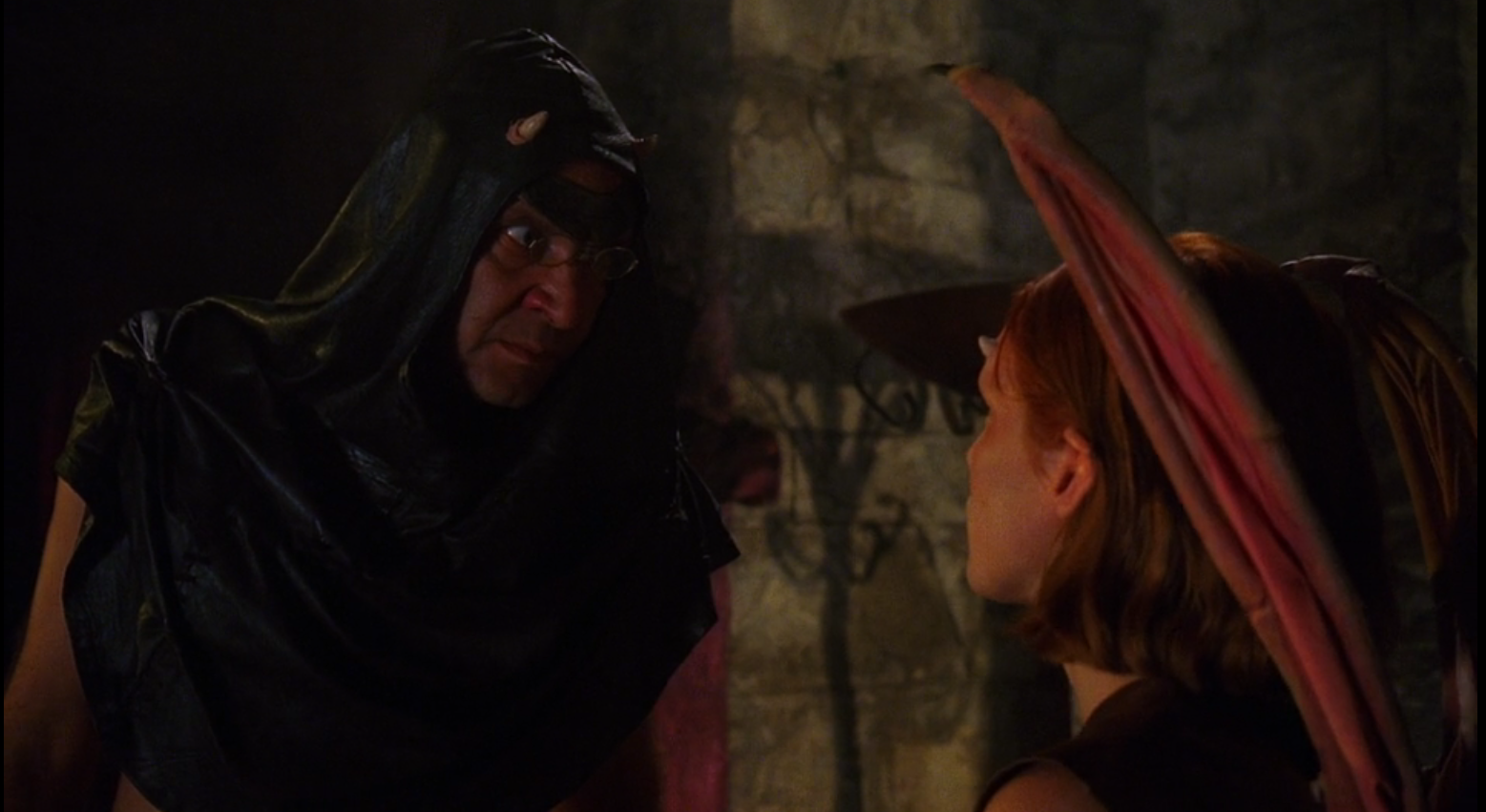
Directed by a woman (Linda Hassani) who is seemingly from another planet, DARK ANGEL (no relation to the TV series starring Jessica Alba) has a bit of a space cadet glow, kind of like MY SO-CALLED LIFE if Angela Chase was a demoness looking to find herself in the world above her Hell home, etc. Charles Band's Full Moon company utilized beautiful Romanian architecture and painterly craftsman lighting to overcome the relative lack of CGI or budget, towards turning this into a sweet 'so wrong it's right' dusty-dream theater fairy tale ala LEMORA: A CHILD'S TALE OF THE SUPERNATURAL or VALERIE AND HER WEEK OF WONDERS. Veronica (Angela Featherstone) feels called to the surface, strictly forbidden the demon set by their Angel employers. Dad's so upset he's motivated to shout in her face in spittle-flecked hysteria of the sort only Nicolas Worth (so chilling as the psycho in DON'T ANSWER THE PHONE) can provide, flogging and striking her, and generally driving her from his door. She escapes with her dog Hellraiser and together they wind up cleaning up an surface city. Romancing a young handsome doctor and wandering around the crime-ridden park at night, ripping spinal columns out of rapists and racist cops and feeding their impure hearts to her dog, Hellraiser. Soon she hooks up with an ER doctor whose karmic balance is strong clearly due to all his selfless healing work, and who's hot and has a nice studio loft apartment for her to move right in.

"To turn away from evil is to be an accomplice to evil"
Through Veronica's actions we learn that demons aren't evil so much as determined to cause suffering and death to those who do evil, and that when acting is really really bad it becomes almost like innocence. Angela Featherstone's zombie acting style gives her crazy lines--part alien free of all humanity's typical shame and fear as she seeks to get the whole picture of life above--and part biblical vengeance--a deadpan flatline sincerity a better actor couldn't hope to match. Her bravely imperious tone when being questioned by suspicious cops is out-of-step even for 90% of other Satanic representatives in film. The way she delivers lines like "I don't require the blessings of the church to engage in unsanctioned sexual relations, Max" is so good I wish I had it as a ringtone. Even the sex scene is tasteful, and I love when she unfolds her true form--wings, horn, tail--after orgasm, in bed, and he's surprised but doesn't freak out, he's just like "hey, it's all right," in a normal late night bedroom voice. He's cool with it! It's all played dead straight, which is why it works so damn well, like Jacques Tourneur making films for a a Satanic Sunday school.


It might not be for all tastes, but in addition to Featherstone's wondrously low-key performance, I love the dreamlike grungy fairytale threadbare Guy Maddin meets Silk Stalkings ambiance (Hassani's directed a few episodes of the latter). It's the perfect film to pass out to by the tenth whiskey of the night. And if you're one of those sober Bickle-ish horror fans who has to really search his collection to find a suitable date movie, here it is. Once you see Veronica offer the would-be rapists spinal column to his intended victim as a trophy, you know there really is a God... and God is good.
--
Though if he really loved us, there would have been eight sequels, or even one.
PS  6/16 - see my updated close-up on this swell film here

 RAGING PHOENIX
(2009) ***1/2

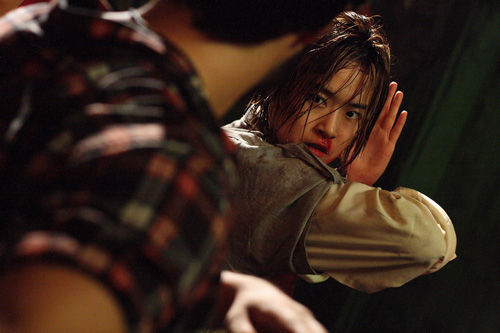
Jija Yanin (CHOCOLATE) is a miracle, a wiry, scrappy little kicking so much ass she should charge by the truckload miracle, especially when she learns a hilarious mix of drunken monkey-style and break dancing. She's an avenging angel against kidnapper gangs, but rather than dipping into the usual sleaze and dispiriting inhumanity at the core of the Thai white slave trade, RAGING PHOENIX involves kidnapping women for their precious pheromones, which are mined via their precious tears in a bizarre underground nightmare lab/dungeon, eerily reminiscent of the tunnels talked about in reptilian conspiracy circles, replete with humans being hypnotized and farmed for emotional response-generated fluids --though melancholy reverie here rather than pain and fear; it's all masterminded by a transgendered martial arts master in a red kimono who does not go down easy.


Unlike the basic stuff from Hong Kong, these Thai guys never use guns, or weapons of any kind... just martial arts, not even bo staves, shuriken, or nunchaku. What kind of gang is that? How can you ever expect to compete with the Yakuza, the Tong, or the Golden Hand? I would have liked to see the booze show up at the last minute like Popeye's spinach, to go with the drunken monkey style, but instead there's some last minute emoting, as the guy our Phoenix loves, well blah blah - you know how those Asian countries are when it comes to sweeping soapy doomed young love, but they do some great couple martial arts in between all, he throwing her all over the place an a big elaborate set piece on a stacked series of rope bridge crossings over a vast deep pit is pretty wild, with more of that swanky high-def deep black-saturated color whiplash camera (so freely used in THE HORDE, our next film)  circling and sliding and whirling around our various heroes. And the martial arts--from choreography to camera to high-kicks--are wondrous.In the end, though, where are you, whiskey? I went to do the dishes afterwards and smashed a plate I was so pissed off they forgot about booze, their secret weapon - you can't have drunk monkey style without it, I don't care what your sen-sen says. ! As the subtitles say: "I want Vengence!" (sic)


 THE HORDE
(2009) **1/2

Borrowing liberally across a long line of John Carpenter, George Romero and 28 DAYS, this French allegory is shot in that whiplash urban chic way that's become synonymous with modern horror films. Dudes, are running zombies all the rage now? In the original DAWN OF THE DEAD for example, the slow comical zombie moments allowed the human survivors time to reflect, reload and recognize themselves in the zombie's eyes, and it was more like our actual nightmares, wherein we're always running in mud or trapped as something shambles or crawls inexorably towards us. Then there's the whole RESIDENT EVIL virus that's infected so many zombie movies with 'money shot' climactic moments of one lone human discharging his/her armaments in full slow mo Matrix camera abandon and the shells come popping out of each machine pistol as they flash at acres of zombies pressing forward like literally rabid fans at a rock concert (see my Hell's Angels Vs. The Flower Child Dead).

But as for humans, you can do worse than the old Carpenter's saw of cops and robbers teaming up to fight the common foe. Eric Ebouaney is awesome (he's the guy slapping Rebecca Romjin in FEMME FATALE), playing a crazy Nigerian ex-child soldier turned drug dealer, with--exactly like Ice Cube's situation in the eerily similar GHOSTS OF MARS--a hothead brother who doesn't trust their new white cop allies. I like that they all get jacked up on cocaine--cop and crook alike-- before rushing out to battle, and a female zombie pinned to the floor provides weird cokehead gang rape frisson without having to get icky and dehumanizing and depressing like DEADGIRL (here just implication is enough), and when an old neighbor 'Indochine' veteran gets involved, and thinks the zombies are a "chink" counter-attack, you have the deadpan allegory of Romero, if not the shambling.

PIG HUNT
(2008) **1/4

There's just a few problems here, one is making the sanctimonious pretty boy murph dillweed good guy the hero -John (Travis Aaron Wade) --and having his self-important dillweed girlfriend (Tina Huang) invite herself along on an all-guys Northern California camping trip / boar hunt just so she can make wise-ass cracks about their phallic gunsmanship --just what every boys' night out needs, a girl inviting herself along to heckle and emasculate them. Why even bother? If  a guy can't kick his girlfriend out of the car he doesn't deserve to come!.

 Ben (Howard Johnson Jr), Quincy(Trevor Bullock), and Wayne(Rajiv Shah) are the other friends, killed more or less in accordance with their stereotypes (Asian guy first, fat guy second, etc.). But hey, this film isn't about breaking new ground, its about giant man eating pigs protecting pot fields.


There's odd inconsistencies I shan't spoil, but there's also moments of genuine schlock anarchy: a coven of dope-growing hippie girls who preach back-to-nature while sporting silicone breast enhancements; in-joke homage and quotations (as in the fat guy quoting APOCALYPSE NOW); some good looking buds on the fields (John wants to call the police about the crop, which made me see red... hairs that is - a fucking narc tattletale like that deserves death); a rocking theme song from the reliably deranged Les Claypool (he shows up onscreen as a preacher who dies in a ROAD WARRIOR-homage) and a great antihero duo in the form of DELIVARENTS-ish local boys played supremely well by Jason Foster and Nick Tagas. Spiking their coffee, and ripping crank off their hunting knives, they show the right way to psych yourself up for killin'! I was rooting for them the whole time! Root, Hogs! Gut yourself some narc!

When the situation gets explosive and the DELIVERANCE boys rally the locals against these clean-shaven intruders, there's some riveting driving around and waving guns, and the emotional anguish and subsequent carnage is awesomely bodacious. However the monster finale is disappointing. For one thing, it seems oddly blocked, with a set-up that we don't know where anyone is in relation to each other half the time when they're all in the same outdoor pit. Why is everyone standing around watching this pig, with special fx snot hanging out of its nose, rooting around for victims? Wouldn't they want to hide... or something? It's kind of a let-down. But hey, four beers in, you won't give a sheeeeeeeeeeeeeeeeeeeeYIT

Monday, May 16, 2011

The Girl who Fingered the Frenchman


Ah  France, the big scandal erupting with Dominique Strauss-Kahn is a reminder that where there's liberty et fraternite' there are also sleazebag rapists in high places. The attack (ED NOTE: It's since been downgraded to prostitute-blackmail scam) happened in a New York hotel, and maybe its my city pride that makes this story resonate as a great David and Goliath style upset, something the Millennium Trilogy could be proud of, and might even be a little bit indirectly responsible for: the word of a rattled immigrant hotel maid was enough for our cops to pull this high roller Frenchman off a first class plane and throw him in the clink. Word is finally out: clergymen and politicians are the sex maniacs of our age - believing the word of the victim is the new black!


To see more? Cinema, naturalmente. The above attack sounds very plausible, in fact I've seen it in at least two films, and recently: Asia Argento's self-directed SCARLET DIVA (with a crazy producer played by artist Joe Coleman chasing Asia down the hotel hallway in Paris, naked but for cowboy boots, ah, Cannes! - my in-depth discussion here) and Vince Gallo attacking a Paris hotel maid in TROUBLE EVERY DAY (above, here). The evil rapin' madmen of power in GIRL WITH A DRAGON TATTOO and the Millennium Trilogy are apparently in France now that said girl made it too hot for them in Sweden (see my piece on Bright Lights, 'The New Lurid: Cinema's Rape Disavowal Fantasy').

But what of other locales in France, outside Paris, ala the French countryside? This seems to be a pretty terrible place. Vast stretches of emptiness given privacy by giant tank-hidin' hedgerows allow slavering mutant sexuality to flourish. A group of normally upstanding males commit a horrific gang rape when they realize a woman is living alone in a stone house by a remote stretch of French country road in ONE DEADLY SUMMER (1983), with the victim's daughter (Isabelle Adjani) enacting an elaborate revenge before realizing maybe it didn't happen or whatever (I had to stop watching after that). Indeed, in this array of films, the French countryside is a place where no one can hear you scream, and no law can come to your rescue with any quickness, the law may even be the source of evil groping. Men must stand on their own good conscience, and many do not. Remote areas are a creep's power source as much as above-the-law titles like politician and priest, but the ambiguity and self-reliance goes both ways. All is not always what it seems.

Take the 1970 British film about two birds cycling on holiday through rural France, AND SOON THE DARKNESS. Over at Britmovie, Drew Shimon cogently discusses the film's ability to create suspense without much overt violence or even actual dark:
Ironic, really, for a film bearing the title And Soon The Darkness, that practically no darkness is actually seen throughout, but such things are part of the strange fascination of British horror: in Die Screaming, Marianne for instance, Marianne neither dies nor screams, and in Whoever Slew Auntie Roo, the identity of the slayers is in no way a mystery to the audience. What it doesn’t deliver in honour of its title, though, it makes up for by exceeding every other possible expectation.
I was led to expect this film would be really disturbing, ala THE VANISHING, which is why I steered clear for so long, but it's actually just suspenseful, sexy and awesome. Also, if you know any French at all, you get an inkling of the identity of the rapist-killer early on, and the savagery of rape as depicted in GIRL or something like I SPIT ON YOUR GRAVE (see my 'Towards a New Cinema of Castration') is absent, replaced by the gross caricatures of lust you get in Japanese pinku films: the eyes of the rapist bugging, lips snarling in deformed adolescent exaggeration, tongue wagging obscenely... truly possessed, insane by an inability to repress basic lustful instincts. I find these depictions much less traumatic, they're more symbolic renderings, the men demeaning themselves with twisting grimaces; you never get the sense these guys getting very far, mostly humping air like a dog--it leaves one confused. If it's not meant to be harsh and repulsive ala SPIT or GIRL than what? A chance for a woodsman to ride to the rescue? A moment of kinky objectification? Or a moment to have the ugliness of base id-lust rubbed in our face as a cautionary tale? I muse on this at length in my cogent 2010 celebration of FEMALE CONVICT SCORPION: JAILHOUSE 41, Stung by the Belle. 

DARKNESS gets a lot of mileage out of short skirts and dried patches of grass, a spooky bunch of wooded patches separating vast empty fields, the gradual setting of the sun (it all occurs over the matter of a few hours), the onset of clouds and rain, and the vast language barrier between a holidaying Brit girl and old French gas station workers. In such a tranquil setting, the sexual violence seems almost quaint, a mere flaring up of an old forgotten splotch of vile repressed desires left too long untended in the fields. Because the film works, as Shimon says, without the darkness promised (and soon, like CCR's someday, never comes), it escapes our condemnation, but there's an aftertaste of sleaze that lingers on. But hey, it's on Netflix streaming! So is the remake! Avoid the latter!

Also on Netflix streaming, all of a sudden!-- is a bunch of Jean Rollin films, including REQUIEM FOR A VAMPIRE (1973) Read Ethan Spigland's essay on the film in Acidemic #6, here to get the lowdown on the film's use of Freud's uncanny and the sexual doubling of Georges Bataille. Using what looks a lot like the same road from DARKNESS, this film follows to young naifs in clown costumes who wind up lost in the wilderness, eventually abducted by a castle full of old debauched vampires and their slavering rapist underlings. The girls are sexually attacked, and then forced to watch, hypnotized, as various girls chained in the dungeon are raped in the usual slavering, grotesque but bloodless, bruiseless, Sadean, confusing, tedious, all very abstract and philosophically cogent.

The roots behind intellectual S/M still boils down to the most sleazy of crimes against empathy, and if anti-pornography advocates are right--and apparently they are--there's nowhere else left to go but to that wretched basement. Once the consumer of the image has let himself become dehumanized via the suffocating access to so many images, the image suffocates as much as the proximity of the other. Rape fantasies are actually common in both sexes, but as I noted in my BL piece defending the Twilight films from anti-feminism charges, Someone to Fight Over Me: Rape is not called rape when it's in romantic fiction; it's "ravishment" / the erotic charge of setting a romance in a past era lies with the straitjacket moral code: the only way a woman can keep her honor is by resisting both the man and her own desire. She indirectly invites the overpowering on herself as a means of sidestepping issues of her feminine resolve and honor, and the uncertainty of responsibility over one's actions. This is not weakness on her part, but an intrinsic understanding of what's truly erotic about societal loopholes. She has the strength it takes to surrender... (more)

Another interesting French film dealing with slavering maniac males in the countryside is DON'T DELIVER US FROM EVIL (1971), loosely based around the same real life case as HEAVENLY CREATURES, but with a lot more teasing of leering male strangers. It starts in a banal schoolgirl reverie: two lead girls are having a holiday over the summer in the country after a long stretch in a Catholic boarding school. The pair delight in flirting with and teasing passing male travelers, but the men they lure into the brush or home to their hideout have only two speeds: grotesque tongue-wagging sexual assault and motionless confused indulgence. The men never try to tease back or engage in the girls' weird head games. Instead they let themselves be teased to a certain point and then snap, becoming insane slavering rapists in a flash, precipitating their own deaths. As Kim Morgan notes on her Sunset Gun:
Thank goodness they lived in the early 1970s. No manic panic hair, no PVC mini-skirts, no cheap fetish boots and tired, sullen expressions for these best friends. These girls are enjoying their evil. So much that they put together a crafty, dainty black mass in an abandoned chapel (you can feel fellow bad girl Martha Stewart heartily nodding her head in approval). With the dim groundskeeper serving as "Priest," they seal their Satanic deal and drive the man nuts while sitting in the rowboat in the thick of night -- he can see through their cotton Communion gear. (more) 
So can we, man. I still think of that scene at certain times...


The key thread I'm fumbling for through all this is the ultimate emptiness of sexual gratification as the be all and end all of power. All that smoke and perfume and grinding strip show razzle dazzle leads to nothing more than an expensive feeling of emptiness behind the wizard's peepshow curtain. It's culture's job to make you forget that post-orgasmic depression, but just as rich women like Winona Ryder may shoplift for a weird thrill, trying to recapture a time when acquiring possessions brought them joy, so the oversexed rich French politician may accost a hotel maid because all else has failed him, and he figures himself above the law, and maybe still thinks he's in some role-play brothel from the night before. Who knows? His world is akin to the one Kim Morgan describes, of "tired, sullen expressions, cheap fetish boots and PVC mini-skirts." But rather than be hypnotized into the world of surfaces and possessions like the men who want them, the girls in the equation are coming from a different place, trying to harness real power--to master their own chthonic sexuality-- to surf rather than dutifully drown, to dare live beyond social roles, mores and the tedious commodified grinding that passes for modern rebellion. Rather than settle for the $900 call service fee, they want to try for curtain number trois.

For these sleazy rural Frenchmen, however, all the curtains have long since been open, and they have no more control over their desires than a near-unconscious diabetic smashing his fist through a candy shop window.  It's fascinating to contemplate how a man with so much to lose as Strauss-Kahn could be so careless and crazed. Of course it could be a set-up, created to depose him by his enemies. On the other hand, even if it's true, isn't it still a set up, a trick of desire, of the devil, who rewards the debauched with all the riches of the world at the cost of their ability to enjoy them? Aren't those creepy noblemen in Sade, Huysmans, and Bataille really just depressed from having to constantly up the sadomasochistic sensation ante just to feel anything but benumbed ennui? Pity them...  certainly jail them and denounce them in the press and even castrate them but pity them, for they are dumb enough to believe the lies of their own merciless hard-ons. They have become dupes of the genetic con and are destined for incarcération... ou paternité. 

And for what? The sociopath, the narcissist, the sexaholic, even just the pervy father hanging around his daughter's room at her sleepover... who made them what they are? The answer is just the soft sound of French countryside crickets... and the flutter of pages from an old, discarded Maxim. 
Related Posts Plugin for WordPress, Blogger...