Showing posts with label Kim Morgan. Show all posts

Wednesday, September 07, 2011

The War Against Normal: A STRAW DOGS remake and LEAVE HER TO HEAVEN


I just saw there's a remake of Sam Peckinpah's great misunderstood masterpiece STRAW DOGS. Take a look at this poster:
First of all, what is up with that reflection of a face when we can see clearly that the chunk of glasses where said reflection would be has broken off? Did this guy get a tattoo of a dude's face on his eye? Did only his reverse clip-on shades get broken? See the original poster below and wonder to yourself what kind of poster artist would think lenses that have broken off still reflect?

And of course, no crap remake poster would be the same without a meaningless tag line. Are they asking us or telling us about this breaking point? Have they tested every man for one? What about women?  Sexist bastards.... Deconstructed, the tag intends to align the viewer with 'everyone' - indicating the sneering contempt the copywriter feels for their target demographic: "Don't worry, the hero of this movie isn't going to get pushed around for long!" Chances are the author of that tag didn't even see it, or the original, or any movie made before 1993, the year punk broke! 


The original poster was terrifying since if you look at Dustin's expression it's calm, even smiling, and compacted down to resemble Roman Polanski after a night of some energy expenditure. His eye behind the broken glass is dead like a shark's, or as if its been gouged out at the pre-photoshop art department then pasted back in by a nervous intern hoping the boss wouldn't notice. Yet he's smiling.


The weird thing is most people don't realize that Peckinpah considered Dustin's STRAW DOG math professor 'everyman' (who breaks the point and kills a bunch of locals to protect a child murderer), to be the bad guy, a self-satisfied liberal who considers himself six cuts above the riff-raff of the icky rural England locale that he settles in with his hot young wife (Susan George). See, she's easily the cutest bird inside a 60 mile radius of this Cornwall dump. She was born there so everyone knows her; she even left behind several strapping ex-boyfriends when she escaped. Now she's back. Some call this a rape-revenge film, but Hoffman never finds out about her being raped (by her ex-boyfriend and his sadistic pal after they trick Dustin into going quail hunting with them and leave him stranded way out in the middle of nowhere, then double back to the alone and kinda terrified George) and his refusal to turn the caught-red-handed pederast (David Warner) over to the mob for a right proper lynching is what sets the bloodbath in motion. Mostly, I'm betting Hoffman goes ballistic because of the dead cat (discovered hanging in the closet) - that would surely get me fired up too. If someone killed my cat I'd probably raze the whole town.

Long lumped by the literally-minded critics (how small town riff-raffish of them!) in the category of vengeful ass-kickers like Buford Pusser in WALKING TALL, and Cameron Mitchell in any AIP biker film, one can only assume the complex shadings of self-righteous lefty nerd narcissism in Hoffman's smug everyman will be weeded out in the remake until he's American Average like "everyone" with their "breaking points."

I've been reading the new Pauline Kael collection, so forgive me if I sound astringent, but apparently the idea that the one educated man who stands alone against the many armed yokels might actually be the bad guy (or at least not a cut-and-dry hero) in a film is beyond the average (petit-bourgeois) movie critic unless it's spelled out with ominous music cues and sudden outbursts of misogynistic violence. It hasn't been done to death so they don't believe it even exists. The fools! The bombastic ignoramuses!

And then there's the reverse: sometimes the villain everyone presumes is evil is actually the only sane, sympathetic person around!

Kim Morgan and the Self-Styled Siren discuss one such film, LEAVE HER TO HEAVEN (1945) across both Kim Morgan's site, Sunset Gun, and Siren's classic self-titled blog, and the realization that Gene Tierney's murderous bride is actually the complex heroine of the film, which is a kind of horror story about a beautiful bi-polar artist who gets trapped in a stiflingly normal marriage with a husband who hides behind Norman Rockwell facades and close extended family sing-a-longs to avoid being intimate (hinting he might not even know he's really gay). Here's a sample from Morgan's side: 
Gene/Ellen is a modern type of woman, a poetic, ingenious woman, and I always get the sense that her inner struggle to express whatever power or talent she has, well beyond her beauty, is pure torture. Many may look in her eyes and see cold orbs of hate, but I see… Wagner's entire Ring Cycle, and beautiful, damnable Richard W. seems especially appropriate since, for some crazy reason, he also managed to write, in 'Lohengrin,' 'Here Comes the Bride' amidst his Götterdämmerung. 
Is this an excuse for her dastardly acts? No, but she does serve to symbolize every trapped, powerful woman flapping around her white picket fenced-in bird cage. That war raging inside her twists into a a full-scale blitzkrieg on the… normal people. Her revenge is her final work of art! Her masterpiece! (more here - Siren)
 And from la Siren:
I always wait for that staircase, for Gene hurling herself down it after carefully leaving one slipper on the top step, like a psychopathic Cinderella. It's a wicked act, but she tells Ruth just before she does it, "sometimes the truth IS wicked." Along with Mildred Pierce, Leave Her to Heaven dares to go down some dark maternal byways, into things some may feel, but no one wants to admit--in this case, pregnancy as a cage, one that's about to slam shut for oh, about 21 years. Ellen's on bedrest, its own kind of "Yellow Wallpaper" hell. (Those insipid posies on Ellen's dressing-room wallpaper could drive a lot of women to the brink.) Look at what she's doing beforehand. She's talking to her own sister about the stroll the girl just took with her husband. Couldn't Richard be upstairs talking to his wife? Making sure she isn't bored and terrified, instead of taking it for granted for that she's rubbing her belly and practicing lullabies? So she grabs her most beautiful robe, and re-applies her lipstick, and she even puts on perfume--because she's about to go back to Ellen, the beauty, and leave behind Ellen, the terrarium. (More here / Sunset Gun)
"Psychopath Cinderella" - awesome. And here's something I wrote (link here) on the same subject for Bright Lights in March of 2010 when Film Forum screened LEAVE HER TO HEAVEN for a special week-long revival screening:
Wilde's straight-edge kid brother gets killed first after he decides to hang around the lodge like a third wheel albatross on Ellen’s neck. The way Stahl frames this event, in the peace and quiet of the lake,  makes a great ironic comment on the production code-approved craze for “discovering the great national parks” that was going on all over cinema in the late 1940s, early 1950s. I always root for Tierney in these scenes. I too know the frustration of having to run a cock-blocking gauntlet of resentfully undersexed friends and relatives every time you want to get your lover up to bed, or having to drag your urbane self out to buggy campsites to pacify your spouse’s yen for convention.

The drowning of the brother is nothing compared to the glorious moment when Gene throws herself down the stairs to induce a miscarriage (Wilde must have waited until she was ovulating to slip her one). That's incredibly hard to do, and I think it's heroic, in its own twisted way, symbolic of her yen for flight and mastery over her own self-preservation instincts (I tried to throw myself down the stairs every week as a kid, to avoid soccer practice, and just physically couldn't--my body wouldn't let me).  Meanwhile if Wilde had bothered to pay attention to her in bed and maybe even give her an orgasm, none of this mayhem may have been necessary.

If we, living as relatively relative free as we do today, were suddenly stuck in a post-code extended family Americana hell hole like Gene's in HEAVEN, would we act any different? Or would we just quietly disappear–like Lea Massari in L’AVENTURA (1960)– before the bores could catch us and smother us back into Stepfordville? Maybe I’m just unusually squirrelly when it comes to the sorts of color schemes at work in the film; as Village Voice scribe Melissa Anderson notes, the color scheme “redefines mauve.” I hate mauve. It's telling that  Gene, whom Anderson calls “one of cinema’s most chilling psychopaths,” grew up with an intellectual, adventurous father who raised her far outside the claustrophobically chipmunk cheeked tedium of “sanitized” American small town life,  No wonder she can't adapt! Like those poor once-professionally employed heroines who had to give up their jobs, get married, and dutifully cook, clean, and obey their husbands, once the code took effect in 1934.
Where I’m going with all this is to analyze the ultimately corrupting nature of post-1934 cinema’s phony morals; the “as long as you feel bad about it, it’s okay to kill” sort of compromise with the censors. You can see this in two roles played by Winona Ryder: HEATHERS, with Winona's refusal to 'enjoy' the killing of the evil jocks and janes nonetheless orchestrated by herself and Slater; and SEX AND DEATH 101 (which I decried in "Why Can't We All Just Morally Compromise - Bright Lights 4/10/08), where she only drugs her sleazy would-be lovers into a restful coma from which they awake at the happy ending. We need more LEAVE HER TO HEAVEN-style sociopaths, by which I man girls with cajones enough kill those who would hobble and baby them with prefab beige rusticity, and critics with the cajones to applaud them, to see purveyors of mauve domesticity as just as deserving of death as cannibal rapists. We had THELMA AND LOUISE to inspire us in this way for awhile in the early 90s, but somehow the drippy third wave feminism of Sex and the City gourmet shopping swept over that fire like a flood of designer bottled water and soggy Stepford ash is all that remains. 
Figures like Gene are essential because they blur the line of good and evil, and help us extoll revenge using art. A murder in the movies is not the same as real life, so let it be cathartic and wild. In this sense Ellen is just such a wild  artist, a frustrated panther goddess trapped in the hell of some L.L. Bean adman’s pre-presentation nightmare and busting out of the net through any means necessary. It’s just too bad she couldn’t take a few more of those little bastards out before the inevitable mauve ocean swallowed her in its tranq dart credits. 

*****
That may sound hardcore, but I embrace the Camille Paglia/ Nietzschean vantage point --beyond good and evil, baby. So how about a LEAVE HER TO HEAVEN remake, directed by Darren Aronofsky, starring Vera Farmiga as Ellen/Gene Berent? And thank God that there are still women out there like Kim and la Siren who aren't scared to call a spade a spade, and then bury you with it.  Sometimes when life gives you lemons it's far more noble--well, not noble, but certainly more exciting and cinematic--to put them in a pillowcase and beat someone up with them than to make lemonade... especially if you're all out of sugar. Ellen is all out of sugar, America,  so take your lumps!

Thursday, September 01, 2011

Acidemic Journal of Film and Media #7: The Nordics ONLINE Now!

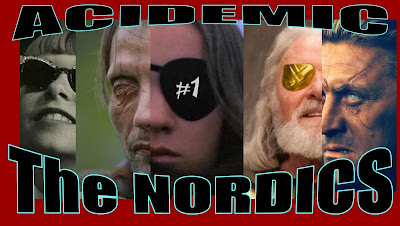
The Fall 2011 issue of Acidemic Journal of Film and Media is now active, on-line, and considered harmed and dangerous.We've got awesome work from an array of deep talent and warped visionaries. post-theorist Steven Shaviro (The Cinematic Body, Connected); Sweden's Daniel Ekeroth (Swedish Death Metal, Swedish Sensationsfilms); revered L.A. film and rock critic Kim Morgan (Sunset Gun, MSN); beloved film historian David Del Valle; sharp-eyed Budd Wilkins (That Obscure Object of Desire); the haunted Steve Tweed; the celestial Lucy Blodgett; sharp newcomer Molly Marie Wright; rising painter Audra Graziano, and topics ranging from the sleazy sex-snuff apocalypse of the Balkans and Swedish cinema's trailblazing sexual openness to the 'kicker' phone booth vandalism of mid 1980s Stockholm; 21st wave 70s feminism via German DEFA science fiction and the 1976 TV show, Star Maidens; Bob Hope meets Thriller: They Call Her One-Eye;  Let the Right One In vs. Twilight; Thor in the Gardens of Sebastian Venable, and of course some Nordic alien theory! Come and See, and behold a pale blonde horse and the name that rode on it was Acidemic Journal of Film and Media #7: The Nordics...

And also check out the August issue of Bright Lights Film Journal #73 also online, Acidemic's two-fisted older brother! 

Thursday, November 04, 2010

Drowned Phoenician Sailor and his Mermaid Muse: HE RAN ALL THE WAY (1951)

Full fathom five thy father lies;
Of his bones are coral made;
Those are pearls that were his eyes:
Nothing of him that doth fade
But doth suffer a sea-change
Into something rich and strange.
Sea-nymphs hourly ring his knell
Harke now I heare them, ding-dong, bell.
Sometimes a movie would slip right by you if not for the recommendation of some critic willing to stand up for it and urge you to look deeper, to look--as Godard once did--for Shakespeare in Monogram westerns. You may get disillusioned if you look for Shakespeare in all Monogram westerns, so you need a Cahiers du Cinema writer to give you a name, like Edgar G. Ulmer.  Hearing someone express unabashed love for certain actors, movies, or directors is very gratifying in an age when clueless managing editors stifle the path forward for many critics, like a herd of cattle being driven into the same narrow gate.  Good journalists and critics don't need fences - they know the terrain. Such a glorious confessor and herald and thrower downer is Sunset Gun's own Kim Morgan. Naturally I was thrilled to see her featured on TCM's Critic's Choice this month, curating two films, SOMETHING WILD (1961, starring Carroll Baker) and 1951's HE RAN ALL THE WAY, starring John Garflield. She writes on the latter:
Mr. Garfield. In my mind, one of the first method actors (he trained in the famed Group Theater and worked with Clifford Odets), he was also victim to one of cinema's darkest, most shameful moments when the left-wing, progressive actor (and patriotic actor, he helped created The Hollywood Canteen for heaven's sake) testified at the scabrous House Un-American Activities Committee, who suspected him and certain colleagues, Communist. Unlike many other actors, writers and directors (including one of his former directors, Elia Kazan), Garfield refused to name names. As both a once young street tough and a man of principle, Garfield would not rat. Not surprisingly, work was then harder to come by and at the young age of 39, Garfield died of coronary thrombosis. Many speculate an already present heart condition was worsened by the stress caused by the House's inquisition. I think this assumption is correct. His mislabeling and death is so tragic that it angers me to this day.

I needed Kim's guidance, because Garfield has always annoyed me or barely registered as a short streetwise blowhard, a kind of grown-up Bowery Boy, reminding me of guys I didn't like in High School, which I freely admit is not his fault, and frankly, as a child especially, method acting just seemed dull and self-important. Again, that's where good critics come in, steering through their yes towards a richer appreciation. Would I have ever noticed Montgomery Clift or James Dean if film history hadn't lionized them to the extreme? Would any of Clift's traits resonate in today's cinematic market, where sensitivity and subtlety and deeply-felt emotion are jettisoned in place of insincere tough guy detachment, whiny self-indulgence, ordinary hunk blandness, homophobic buddy comedy confessions of manly love, and larger-than-life hamminess?

Thanks to tons of books and documentaries, we know what to look for in a Dean or Clift performance. We know to look deeper into a Clift's sensitive eyes than we might for a normal actor, because we know it's going to be worth it,  like slowing down to appreciate a bottle of really good vintage wine rather than just gulping it down like you do with your usual Saturday night box of zinfandel. If you didn't slow down, it wouldn't taste much different.

Garfield's last film-- and one written by Dalton Trumbo (a fellow blacklist victim), HE RAN ALL THE WAY operates from a standard 'hoodlum on the lam takes family hostage' plot that's a solid front for a sorrowful blacklist subtext. Within the first few minutes we've already learned that Garfield's character has a bossy, self-centered mother and one very bad-influence friend who drags him along as muscle on petty theft jobs. A payroll robbery at a garage goes sour, Garfield ends up shooting a cop, and his 'run' is on. Hiding out at the community pool, he runs all the way into the perfect cover, a dowdy blue collar broad (Shelly Winters) trying to learn how to swim, and eager to fall into the arms of a well muscled 'teacher.'


All gangster romances generally seem to involve a polarized split feminine, the glamorous femme fatale and the  virtuous, allegedly homely girl who wants to reform the antihero and is so pretty that even their plain makeup and ugly hair can't disguise her. But it's not often that we see the reverse of the typical noir equation, the homme fatale putting the moves on a genuinely homely girl, one who in this case is not even rich, merely needy and convenient. It's a precious rarity to see these situations in any film --you can count them off in one hand: A PLACE IN THE SUN, LOLITA, SUSPICION, WITNESS FOR THE PROSECUTION, THE HEIRESS, and maybe recently IN THE COMPANY OF MEN. Any guy who's ever dated someone they liked well enough but never wanted to be seen in public with, never wanted their guy friends to know about, has an investment in a film like this. After all, these situations happen a lot, especially around four AM in bars, or on the slicker internet dating sites like Nerve.com. Lord knows we need more movies like this. For the playas.


Of the less attractive stars in old Hollywood, Winters had it hardest but worked longest. She could never just blind you with DARK VICTORY wit and class like the similarly snaggle-toothed Bette Davis, or scare you into submission like the similarly coarse Joan Crawford, and Olivia de Havilland could only ever meet plainness about halfway, despite her lavender drubbings by the Oliviers and Clifts. So, almost by default, Winters landed all the 'easy' lay/dumb braying broad roles. Her characters knew they weren't beauty queens--or very bright, or graceful, or stylish--and though they had a bad case of the ugly tunnel vision that can result from being ignored by all the boys at every dance, Winters infused them with a warm vulnerability that made you as a man kind of imagine-- well,  maybe not sleeping with her or flirting with her, but having already slept with her and now desperately trying to get back to the keg before you sober up any further, and yet wanting, despite your best judgments, to keep the bridge only half-burned.

Note the open eyes right on water level as Garfield clocks the cops. That's fucking acting!
A simple analysis of HE RAN could see it as the gangster version of getting to know your in-laws, an Italian or Jewish neighborhood kid moving in on a working class Irish-American family of limited but comparatively affluent means. The central family in HE RAN acts happy, but a Nicholas Ray-level streak of poison runs through them. This is a family that has to announce how happy they are, but they're also perfectly willing to leave their daughter alone in the apartment with a stranger while they go off to the movies, indicating this is the first man she's ever brought home so they don't know protocol. But more than 'happy' they're just Irish martyrs --eventually miserable, and unaccommodating to their doomed house guest, more out of fear and Catholic guilt rather than it being the 'right' thing to do. Their dour refusal to eat the chicken Garfield provides makes it seem less a matter of deep family pride and more that an angry censor is standing on the other side of the room, his clipboard and pen more threatening than Garfield's gun, demanding the family display their disgust at their guests' recent criminal past at least three times for every moment Shelly buckles under his heavy charisma. And even as all through the film Garfield tries his best to ingratiate himself, to be accepted, they still refuse him even basic courtesy. Haven't they ever heard of Stockholm syndrome? He's not a tenth as needy as Shelly. I'd be helping disguise him as a Hasidic rabbi within a few minutes of that tasty chicken dinner! Hmmm mmm!


So even though after the incredibly suspenseful first 1/4,  HE RAN ALL THE WAY wanders away from its noir connections and into the sparsely furnished blue-collar method-acting Chayefsky-Kazan-Schulberg-Fink chamber drama, Garfield's eye view reigns over. He's complex! We're allowed to see him through Shelly's eyes: one minute we want to fix this wild bird's broken wing, then he snaps at us and we know he's still far from house-trained.  He's sensitive yet cold-blooded; a terrified kid trying to joke and make friends on his first day of school, and getting the airs and high hat for his trouble, so then Columbining them all the next day.

Maybe that's all just my reading too deep into it, due to the fact that I never much cottoned to Wallace Ford (he plays the dad) especially in corned beef cliche's like his snarky reporters and his John Fordian Irish-American working stiffs. It's like he's the poor man's Jimmy Cagney, and he mistook Cagney's punchy energy for rote 'snappiness' and know-it-all smarm. Nothing personal against Ford, but I wanted Garfield to shoot him.At the same time, Wallace does very well here, acting-wise. Every heroic decision he makes is second-guessed by the women in the family, and he's so roped in by 'the right thing to do' and 'family above all' that he practically chokes to death, like the gangster from THE COOK, THIEF WIFE AND THE LOVER was force feeding him all 24 pages of the production code.

Would this family's cold shoulder be warmed-up if Garfield was Irish and his mother went to their same church? I doubt it. Any sensible middle class New York family would just charge Garfield a 1/3 of his stolen money, in exchange for food and shelter, ala THIEVES LIKE US. I say screw them and their banal 'common folk' decency (1). I'd like to get that Ford enrolled in a Cultural Studies course with Noam Chomsky or Howard Zinn and let him get wise to how all that 'good honest folks' prattle was invented by rich fat cats to keep him and his blue collar Irish brethren docile and productive! And you know that commie intellectual Trumbo had just such an education in mind!


So though all the ingredients are in place for a confirmation of 'American family values,' count on Trumbo to take the censor-approved ingredients of a nutritious but tasteless leftover stew and deliver instead a chicken dinner with a cookie full of arsenic for desert. Even though  the 'old-time' extended Norman Rockwell style family (dad wearing suspenders and reading the paper, mom in the kitchen, junior with freckles)--once mocked by wits like Ben Hecht, Charles Brackett, and Charles Lederer--is in the end made to win, Trumbo makes sure we're allowed to at least come away still rooting for our disillusioned wild pterodactyl of an anti-hero, John Garfield.

Garfield's performance here is so good that it accumulates in power as the movie progresses: Garfield doesn't just push Shelly and her dad around in the haphazard way Warner Brothers used to have with gangster violence (2), he grapples with them like a man trying to claw his way out of a prison of soft Irish working class flesh. Imagine James Dean's anguish mixed with Jimmy Cagney's boxer grace and Brando's stray bullet ricochet savagery (ala his table clearing or radio tossing scenes in STREETCAR), and then use all that to reverse the stairway trajectory of Jimmy Stewart pushing around Kim Novak for the final VERTIGO freakout... right? That's fucking awesome? Genius!! You don't even worry for Shelly's safety, for she is not frail.

I think its not unnatural to compare Wallace Ford's righteous Irish father with Joseph McCarthy, and read the whole thing as a stealth razzing of an uncaring, terrified 1950s conformist landscape. So damn you, Joe McCarthy. It's you who should have been shot down like a rabid foaming dog in the gutter, not this angel of poetic realism and punchy gravitas named John Garfield.


I recently moved to Park Slope, Brooklyn, and my new address happens to be 203 Garfield Place! No one can tell me it's not named after you, Johnny! Johnny, they shot you down in the street because you wouldn't rat on your friends. But thanks to Kim Morgan, and TCM, you do yet live! Now we can savor scenes like the one above, where Garfield thinks his stolen money's been re-stolen from his locker and he spasms out in a panic attack so wrenching its like he wraps all the panic of THE BICYCLE THIEF up in five seconds.

The way Garfield hides in that pool, and tries to wrestle with his lack of worldly smarts as the clock ticks out made me think of those lines from Shakespeare's Tempest, that Eliot used in The Wasteland which I reprinted up top of this post.

Translated - Kim Morgan is the sea nymph, and the sea-change suffered is not into coral and pearls, but the pearly stuff of celluloid. The something rich and strange is the new perspective over time that film history can provide us with. Uniquely modern, world-class and ahead of his time, Garfield's art is so pure it can seem to rest full fathom five, can be hard to see without sea nymphs and fairies to point out where it lies. But like that coral, Garfield's films aren't going anywhere, and if anyone's soul can be said to endure eternally anew in the briny nitrate depths of Hollywood film, it's his.


NOTES: 
(1) The production code had strict views about glorifying gangsters, or inferring anyone could ever shelter them and be anything but a louse, unless of course they sulked like little bitches, and gangsters were all but required to die in the gutter or in a fireball explosion by the end.
(2) Bogart, for example, God love him, never really threw a convincing blow (i.e. that kick he gives Geiger's shadow in THE BIG SLEEP), or even tried, to, not that it mattered, because he was such a good actor you still shuddered in fear every time he moved, his energy and malevolence before and after a punch were so intense the punch itself barely needed to happen, i.e. as the  abusive screenwriter IN A LONELY PLACE.,

Tuesday, August 10, 2010

LL/LL: Through the Peeping Glass


Mining a bit of the sleazy tabloid feel of STAR 80 and WONDERLAND with the lost Lenore/Laura Palmer surrealism of FIRE WALK WITH ME, the images from the "last of Lindsay" photo shoot (see below video) for the in-development INFERNO are disturbing in their implications of an as-yet innocent Linda Lovelace being roped into a hotel g-bang by her rough trade husband, Chuck Traynor. When you consider that poor Lindsay was on her way to jail when this photo shoot occurred, prior to any actual filming of the story, and that scraps of the sexually turgid script are apparently all over the internet, I get uneasy, doomed, wretched feeling we're all going to hell, just from a video about a photo shoot! In its own way, this little video teaser is already a perfect slice of Hollywood at its most self-reflexively turned-on and remorseful about it at the same time.

Considering he's done only one other film, 2008's YOUR NAME HERE, its perhaps unintentionally revealing that the first thing on the poster you read is "Mathew Wilder's Inferno," as if implying he's the impresario-exploiter of the piece, the Chuck Traynor to Lindsay's Linda. And what does that entail? Maybe he's just distinguishing the film from Dario Argento's INFERNO; I hear the script's good, but does that earn Wilder his headliner marquee status?

The big star of the video of course is Lindsay; her expressions in the photos betray a staggering talent and a wounded soul: regret, excitement, ambivalence, and even disinterest in her own welfare. Anyone who's ever been in love with beautiful, young, tragically self-destructive woman will inevitably have that familiar feeling of their heart dropping to the floor and breaking into a million shards. It's almost enough to make you go and sin no more.

Life imitates and heals art as, right in the middle of a photo shoot re-creating this ground zero of lost innocence, two smart, talented ladies sit and talk, capable lionesses in a den of wannabe poachers and hyenas, the sidelines a blur of slavering and snapping paparazzi. Supplying the light to the shadow, the always amazing Kim Morgan does the interviewing as Lindsay--her voice raspy and thoughtful-- explains how she reads the character of porn star Linda Lovelace. On her own blog, Sunset Gun, Morgan notes of the experience:
Thoughtful, funny and good, Lohan depicted her shoot, which were essentially, stills from the movie (written and to be directed by Matthew Wilder), with impressive, shifting emotions, gritty strength and intense poignancy. As photographer Tyler Shields snapped the dramatic pictures, based on an especially sad moment in  Lovelace's life, it was fascinating to watch her go in and out of character.
When it was all done, Lindsay sat on the bed with me while I asked questions (and here, simply listened, like a therapist), and she talked quite easily about the sadomasochist relationship of Lovelace and Chuck Traynor, at one point saying the script reminded her of her parents. Yes. She has been through some things. (Read full piece here)


Like myself, Kim Morgan is a staunch defender of Lohan's right to be wild, pointing out that the same bad behavior in men (like Colin Farrell, for example) only gets a winky smirk from the press, while a girl like Lindsay is crucified and condemned as if by a nation of tut-tutting moral committee matrons:
I don't care what so-and-so movie writer from whatever newspaper or Web site feels about Lindsay's partying or sexy lifestyle (there's a strong strain of misogyny in this kind of critique), the real question is, can she act? If critics assessed Jack Nicholson for his off-screen behavior, he might not have the Oscars he so richly deserves. (KM)
That's a good point, and the answer is yes, she can act up a storm. The misogyny thing is tragically true. In her own way Lindsay is the Richard Burton of her hour, but girls aren't allowed to be bedrunken titans, only coy and pretty and if they want Oscars they have to wear false teeth and shoot skeevy Florida johns; they have to bow and suffer before the pervy desires of evil men rather than looming tall and true and as fucked up as they wanna be. All phoenixes must first be ashes and these days they use special phoenix-retardant urns to keep the vengeance from spuming forth.

Thus INFERNO could be Lindsay's THE WRESTLER, or it could be her I KNOW WHO KILLED ME PART TWO, and maybe a lot of that will depend on sexist preemptive judgment and maybe not. Either way, Lindsay's due some respect from the sneering hordes, whatever the role. And who will play Lindsay playing Linda and re-enact this photo shoot in 40 years? Will the self-reflexive merry-go-round of glamorously tawdry recreations of scuzzy moments in adult film history ever come to its crashing halt or will it just get more dizzying? Your honor, I was not even her first lover.

Thursday, May 27, 2010

For Sizzle: AMERICAN GRINDHOUSE (2010)


I considered myself a sleaze merchant know-it-all prior to entering AMERICAN GRINDHOUSE, but still had to see it if only for my idol, Kim Morgan's presence (below) as a talking head. Turns out it's pretty cool and I learned new stuff. In addition to the "sinsational" Ms. Morgan there's: "Czar of Noir" Eddie Muller, John "In-Joke" Landis, drive-in guru Jack Hill, and Joe PIRHANA-Dante, not to mention people I was sure I'd be annoyed by but turned out to love, like Herschell Gordon Lewis, of whom Landis says, "I don't particularly like his films, but I love his posters!" Hey, that's a compliment in exploitation land, and you can tell Landis means every word of it. Despite the crushing despair I experienced covering the SW double feature of Lewis' JUST FOR THE HELL OF IT/BLAST-OFF GIRLS (for the now defunct DVD Angle), I must admit Lewis seems like a helluva nice, smart, relaxed guy - and even a squeamish feminist like myself has to doff his hat to the man who made 2,000 MANIACS - in the words of Michael Weldon: "YEE-HAW!".


Producer/director/editor Elijah Drenner keeps it all humming along at a nice clip through the decades, starting around the dawn of cinema and ending with recent tributes like Tarantino and Rodriguez's GRINDHOUSE. There's elements I would have put in (the rise of the VCR and subsequent Disneyfication of Times Square) and others I would have left out (THE TWO-HEADED TRANSPLANT, though it does make a great metaphor for America's geopolitic) but you'll never squeeze the whole history into a single film, and Drenner keeps it all from being too flashy or too slow, too normal or too head-spinningly weird --and does not spare the adult content: bare breasts, sexual assault and horrific gore are all here, with many of the most disturbing clips from the most disturbing films: ILSA: SHE-WOLF OF THE SS and the works of HG Lewis (pictured below), such as BLOOD FEAST, for example. And the clips all look really, really good. It's very strange that this stuff was once so shocking you could only see it as a legal adult in a sleazy theater at the stroke of midnight, and now it's nostalgia, and yet - the times are if anything more conservative and morally regressive than ever. I've even argued the two are linked - we're conservative because we're jaded.

HGL and some of his 2,000 Maniacs
The best praise I could give for something like this is that it reminded me of when I was a kid in the 70s and actually scared of the TV commercials and newspaper ads for a lot of these movies. I could also see a portion of a drive-in screen, far in the distance, from my bedroom window, if I used my kid telescope - I watched pieces of THE MANITOU that way! At least I think it was. I still haven't seen LAST HOUSE ON THE LEFT (from fear of post-trauma more than anything else) but if I could be assured the actual DVD transfers of these films looked as good as they cleaned-up clips here, I'd be all over it. Plus, Drenner leavens unease by showing lots of outtakes: LAST HOUSE seems less foreboding now that I've seen David Hess shooting the breeze with his onscreen victims between shots.

It must have been a difficult choice to leave out the European imports that had a huge effect on grindhouse distribution patterns (I asked Drenner about that: "We had to make a clear line down the middle and decide what to cover and what to leave out.") On the other hand, who needs a complete picture? That's what Michael Weldon's Psychotronic Cinema Guide The Psychotronic Video Guide To Film is for! What we have here in AMERICAN GRINDHOUSE is a nice little summary of 100% American output, a carny's insider view of Yankee hooplah and pitchman ballyhoo, with art and culture pushed way to the side until it's off the table -- and lands with a lowbrow splat.

There's stuff here I didn't know about, which shocked me. I had no idea the film THE CORPSE GRINDERS was a huge hit for Ted V. Mikels. The grinding of corpses carries no appeal for me, personally, but I always kind of subconsciously associated it with the term grindhouse (or the shredding of old film in a cheap projector, grinding the sprockets). When I learned the name's taken from "Bump and grind" as a mark of when the country's once plentiful burlesque houses were turned into theaters to show films of girls stripping (cheaper that way), you coulda knocked me over with a feather from a rhinestone pastie. Imagine if it was called 'bumphouse' instead? Why just grind, man? 

The whole stripper genre was a bit of a blind spot in my sleaze-education prior to this film but apparently there were an awful (in both senses) lot of them. Ed Wood fans still recovering from trying to stay awake through ORGY OF THE DEAD might be glad to know it's not anyone's fault that they failed. LSD fans who tried and failed to watch more than ten minutes of MANTIS IN LACE can also relax for the same reason. Apparently there was a time when looooong dull stationary camera striptease scenes (as with burlesque queen, Blaze Starr, atop with drum) were considered the height of decadence. Fascinating, yet tame and tedious in our age of readily ubiquitous nudity and XXX-rated websites.
 
I've got minor quibbles with AMERICAN GRINDHOUSE as a whole, of course: we'd be so much better off with more of the witty Kim Morgan, though when she's put on the spot for saying women like to see other women naked ("They do!" she exclaims in reaction to Drenner's apparent offscreen incredulity) it seems a bit of a weird inclusion; if you're going to leave it in the film, don't doubt the woman! She's trying to help Travis Bickle get Cybil Shepherd to go with him to see SOMETIMES SWEET SUSAN (see way below).  I always thought Travis was being rather passive aggressive, the pressure to be charming and get Cybil into bed leading him to this massive act of self-sabotage. But Kim says different. I believe her.

On that note, no review of a movie on a topic like this would be complete without the word misogyny, so there it is. Surprisingly, the most feminist-friendly guy on the show seems to be HG Lewis! There's ample time devoted to his feminist-fave, SHE-DEVILS ON WHEELS, but where's Russ Meyer's FASTER PUSSYCAT, Abel Ferrara's MS. 45, that Hemingway sister joint, LIPSTICK, and the whole rape-revenge cycle? For that matter, where's the Satanic possession and the EXORCIST / ROSEMARY'S BABY knockoffs? Where's TEXAS CHAINSAW MASSACRE? ERASERHEAD? Bette Davis' BABY JANE microgenre, and 70s telekinesis? BLACULA? And ballyhoo meister David Friedman's classic quote about how his movies were "all sizzle and no steak," and pornography gave people the steak, so the sizzle was out, and that's how grindhouse essentially died and became pornography?


Not to kvetch of course, just to flaunt my own expansive knowledge and hide my terror. Because not only am I afraid to see LAST HOUSE, I'm afraid to see PASSION OF THE CHRIST (above), which Landis astutely points out is "the last real grindhouse film!"

Speaking of passion, I've got a soft spot for New York accents, so I got a real kick out of sleaze director Don Edmonds alternately justifying, apologizing for, and boasting of, the excesses of his ILSA: SHE-WOLF OF THE SS, a film I rented back in 1990 in Seattle (from Scarecrow Video!) and which made me see red, literally, when I closed my eyes during sex for the next three years!  But one must admire the relative care that went into ILSA, vs., say, most other Nazisploitation (called "Nazi Exploitation" here, for some reason) with their use of Lewis' patented nail-the-camera-to-the floor, yell-action-and-sneak-off-for-a-nap style framing. But what about the other period sleaze auteurs that aren't mentioned (unless they were mentioned whilst I was in the bathroom, or mixing drinks, or smoking crack, or rolling johns in the men's room), shouldn't there be a sequel? Eurosleazeonomicon, or something cool like that?


AMERICAN GRINDHOUSE never reaches much of a conclusion beyond confirming that Americans will always make films with both eyes on the ticket window and just a toe brushing up against the edge of art, and thus our baser instincts will always be catered to. It's a comforting but disturbing thought about the value of prurience and the way always getting exactly what you want to see can make you a perverse mess just like the anti-porn crusaders have always harangued it would. But at a brisk under-90 minute running time (it would be a perfect part of any exploitation double feature), AMERICAN GRINDHOUSE moves fast enough there's nary a dull moment. For casual fans you can really get an idea of what avenues you may want to explore. Just be prepared to be shocked, amazed, and... most of all, flabbergasted! Grind yourself deep into your seat as you enjoy a splice-ridden slice of film history, one bedecked with sound, fury, and sizzle. In the words of Pam Grier in COFFY (below) when her cop boyfriend tells her she can't just go around just killing everyone: "Why not?"

Wednesday, April 29, 2009

Favorite Film Critics Series #1: Kim Morgan

For me, nothing is more exciting--and occasionally upsetting--than discovering another writer who not only thinks as I do and writes similar to my style, but does it better, and started doing it earlier. The writers who inspired me in high school caught my eye because they could convey their love for movies in an infectious manner: Robin Wood writing about Howard Hawks or Stephen King on horror films; Pauline Kael on Taxi Driver and Last Tango in Paris; Michael Weldon's Psychotronic Encyclopedia. The love these writers felt was conveyed with far more punk rock energy, film history savvy, and intelligence than any of the tired reviews I read in my dad's newspapers and old Times. By comparison, the self-satisfied wit of the bourgeoisie mainstream critics seemed stuffy, stale and far less intelligent than it thought. Manny Farber and James Agee were next for me, as manly men writers of the American abstract 1950s style, showing how criticism could sing with a poetry and zing that was almost macho. But they weren't around in book form yet, that I knew. It took a long long while... and then Kim Morgan.

She is the best and most fearless of them all... and my favorite. It's especially vexing (in a good way) that she's, by all accounts and photographs, a smokin' hot blonde babe in the grand noir tradition who drives a Gran Turino, but she'll turn around and champion a film like IRREVERSIBLE or stick up for a media whipping boy like Nic Cage, and do so with a trenchant alacrity and snappy journalistic rhythm (explained perhaps by her origins as a film critic at The Oregonian in Portland). Compared to Kim, most film writers--and certainly editors--are completely unconscious of their own subtextual motivations, dutifully doling out what they think writing "should" be about and not daring to say what they really feel, down in their dark heart of hearts. Kim's heart of darkness is wide open... just follow her breadcrumb trail yellow highway dash words straight through it.

There's some unwritten expectation that once a woman breaks "free" -- ala Thelma and Louise and Camille Paglia--she can't survive and thrive in our sleepy mall society. She has to crack up, overdose, become, as they derogatorily put it, a Suicide Girl (tm) or Grrl worse, a Stepford mom. Any female not safely contained in labels and square holes is a genuine threat to the ensconced bourgeois patriarchal journalist status quo. They want their female writers to dye their hair black and wear glasses --how else can we know they're intelligent? To use VERTIGO as a template, the Jimmies of the world want Midge in one corner and Madeline far away in another, quiet and remote. Give them the beauty and style of Madeline matched to Midge's sharp two-fisted intellect and they start getting defensive.

I love that Kim loves Camille Paglia and isn't afraid to talk about the appeal of primal rape fantasies in film. I'm the kind of guy who will never see IRREVERSIBLE, for example, but I'm thrilled that Kim Morgan sticks up for it, that she gets Gasper Noe, that she doesn't let Laura Mulvey's male gaze hysterics ruin her appreciation, that she's tapped into the primal masochism of the original pre-code female movie viewer, the Great Depression-era sweethearts who wanted their women suffering and bleeding from their stigmata one minute and wearing dynamite fur wraps and seducing Clark Gable the next. It's the sort of evolved, Batailles-style sex and violence okayness that sends half of liberal arts academia running for the torches and pitchforks and the other half mistaking it for a come-on and then getting pissy when you turn them down. Kim can swoon over Burt Reynolds or Clint Eastwood like a rabid fan yet stay a damn good woman writer and ass-kicking chthonic feminist and bring both things infectiously together with far less words than I would use, to mean twice as much. Through her journalistic concision, intellectual cajones, and rock and roll daring, cinematic lust is alchemically transformed into prosaic gold, enabling her to venture deep into the void without dimming her wattage. Take her sympathy for the twisted car fetishists in Cronenberg's CRASH:
Though the novel's relentless descriptions of bodily fluids and organs coalescing with twisted steel ("his semen emptying across the luminescent dials that registered forever the last temperature and fuel levels of the engine") are rendered less graphic by Cronenberg, J.G. Ballard's vision of the "liberation of human and machine libido" remains potently intact. In both novel and film form, Crash takes a non-moral and non-celebratory approach to its subject matter, creating an alternative perception of the physical world that is as beautiful as its is horrific.
Not unlike the characters in CRASH, Kim Morgan creates a strange beauty out of the sometimes repulsive cinema she discusses. Being a woman is inherent in her style and we realize in reading her site Sunset Gun that we don't really know too many women who tell it like it is in such a no hold barred but colossal way. For most feminist academes, for example, REPULSION (pictured below) is perhaps a disturbing study of patriarchy's damaging effect on a mentally ill vixen. But Kim isn't going to be hung up on dogma; her eye can find poetry in places most of us are terrified to even look:
Deneuve's loveliness makes Carol's madness more palatable (her unfortunate suitor thinks she is odd, but he can't help but "love" this gorgeous woman), but eventually it becomes horrifying. Carol is not simply a Hitchcockian aberration of what lies beneath the "perfect woman," she is the reflection of what lies beneath repressed desire -- in men and women.

What poor Deneuve in REPULSION really needed, of course, was her own blog and something that she was passionate about, a place to vent and express the twisting serpents of her mind (perhaps Polanski is expressing what the nightmare of life without movies would be). Because Kim trusts her own equilibrium, rather than leaning on feminist dogma's ropes, we finally begin to understand the Svengali-like powers of artists like Roman Polanski and Roger Vadim, as in her praise of IF DON JUAN WERE A WOMAN:

(Bardot) let herself age without surgery. And now everyone thinks she's nutty. And some even recoil at her face, even though it was that very lifestyle men so desired -- bikini on the beach, ciggies, wine, sex and song, that lined it so. Again, this is a feminist -- not whiny Naomi Wolf and her boring "Beauty Myth," or all those sensitive men who lust on and on about Helen Mirren (who is hot, don’t get me wrong) but to the point where they simply want women to pat them on the back for digging an older gal. Mirren’s easy. Tell me you want some Judi Dench action and I’ll give you credit. And like Ms. Dench (though never a raving beauty and one whose career flourishes) in that bathtub scene during her genius performance in Notes on a Scandal, BB says, fuck you, this is me.

In a single paragraph she takes feminism past the tired materialism of the third wave and out into the desert on a vision quest; she swoops down like an angel to pluck Thelma and Louise from their falling cadillac. She's the redeemer of rock and roll noir, the return of all the great stuff we lost when the 1970s ended. She's freedom, love, and speed, deliverance from bourgeois dogma and PC sexism. She's the Amelia Earhart of the desert roadside attraction. Visit Sunset Gun, and dig the cool crazy glamor, exhaustive film knowledge and high octane wit that is my beloved Kim Morgan.

Friday, September 05, 2008

The Art of the Snivel

The powers that be have been unusually miserly with their classic film DVD releases in the last five or so months, but this week we at least get some really good, weird film noirs, MOONTIDE and the incomparable ROAD HOUSE. A fine showcase for Ida Lupino (she gets to croak out a bunch of numbers in her frail, smoke ravaged voice, and you understand why she packs the house and everyone stays quiet, almost nervous lest they break the spell of her world-weary reverie), ROAD HOUSE is slam bang quality "rustic noir" - the hybrid of guns and fatalistic romance with the big outdoorsy cabins and lakes that American audiences seemed obsessed with in the late 1940s and early 1950s. The big show stopping performance here isn't from Lupino, though, it's Widmark--who slowly burns his way from lovable swine to full-on homicidal lunatic, sneering and cackling like his KISS OF DEATH killer cranked to 11. Never before has craven sniveling been made so damned sexy.

I'd never seen ROAD HOUSE--not even the Patrick Swayze remake--until last night and I'm fairly blown away. It's rich in atmospheric detail, with the titular house--a bowling alley/tavern deep in the Northern moose country along the Canadian border--brought to detailed, thriving life. Twenty minutes into the film and we feel like we've been working there; we know the playboy boss, Jefty (Richard Widmark), his Rock Hudson-ish fall guy (Cornell Wilde), the bartender, the waitress (Celeste Holm), the newly arrived torch singer (Ida Lupino), their good and bad sides, the way you can only know someone by working with them. The road house itself feels lived in, cozy. The plot runs along the same lines as Douglas Sirk's WRITTEN ON THE WIND, with Wilde's poor but virile right hand man (a very good bowler) falling in love with the torch singer, whom Widmark has imported for himself. Widmark doesn't take well to the news, and begins a rapid descent into giggling homicidal rage, in the Widmark tradition! 

Adding DVD lustre is a great commentary track from noir czar Eddie Mueller and my favorite, Kim Morgan. Morgan sounds great, keeping the energy raised with her patented quick talking brilliance. More than once I was stunned by her ability to convey elaborate, detailed insights concisely and eloquently--such as the myriad meanings of Widmark's crooked smile--at the speed of normal urban conversation. Mueller is also good; slower to get his points across, as befits, perhaps, his czar status, but a veritable fountain of pertinent information. Together they're an ideal commentary team and one hopes to hear them share more tracks such as this.

The picture quality throughout is very good, though a disclaimer at the beginning assures us humbly it was made "with the best materials available." I didn't notice any flaws, but then again I was too riveted by the intensity of Widmark's performance as Jefty. As I lay in bed trying to sleep I was overcome by Jeftiness, his slimy relish for the hatred he's generating. Widmark here gives us the same lived-in sense of egotistic entitlement and sociopath wit that we find in the best of our complex movie bad men - Brando's Stanley Kowalski for example. He wears the evil of Jefty like a lived-in favorite set of pajamas. Waving a gun around in a drunken display of marksmanship, he's magnetic and believable - you know you should think of an excuse to get away from him before you get hurt, but you just can't; you risk your life just to watch what he does next.

By comparison, we might look at Robert Stack in WRITTEN ON THE WIND. Stack's genius as the rich kid there was in showing us the squirming worm of infant neediness underneath the rock of male bravado; you pitied him but still wanted to step on him, squish him back down to your Freudian root cellar. Widmark's Jefty on the other hand, keeps the bravado rock unlifted. He's a hunter, a dead shot even when dead drunk, and he laughs uproariously at his own absurdity; when he tries to show a needy side it's too foreign, too out of character, even to himself, and he quickly covers it back up. But that's part of why we like him. Instead of showing us the void of his naked soul, he shows us the way out of our own, he makes sadistic glee contagious; we come away not just glad the lovers are united and the sun is coming up, but still infected by Widmark's charismatic violence. He gets under our skin and when the movie's over he's still there, driving the Widmark hook deeper and deeper into our voyeur muscle.

Related Posts Plugin for WordPress, Blogger...