Showing posts with label Exploitation. Show all posts

Friday, August 03, 2018

Angels of Death Special Edition VII: FASTER PUSSYCAT! KILL! KILL!


"Welcome to violence, a deep raspy voice grabs us right from the get-go, the soundwaves of his voice on the tape measured out for us in some macabre dance of manly depth, "wrapped up in the flesh of woman,". At the mention of the threat posed "even by dancers in a go-go club!" the music explodes as we cut to three uninhibited (clothed) dancers in the midst of enflaming male lust. The audience is puffy with ugly masculine energy, middle aged clods hopped up on drink and desire. The audience is the kind of mugs not even a mother could love, frenzied with cigars and darkness, shouting: 'Go baby go! Go! Go!" The girls wail and rock in their bikini ensembles; the music builds; the shouts intensify; it all explodes into sunshine with a maniacal laugh and the title credits come rolling up as the dance continues into a sunny race down and sports cars zipping along the open American desert highway, the bright morning sun blinds us after being in the dark dankness of the club. Now the girls are out of that darkened cesspool, speeding forward into the wasteland (the open roadster-ready planes of the the Mojave Desert, where you can see a cop--or anyone else-- coming from ten miles away); each woman is in her own little souped-up roadster, leap-frogging each other and blasting their way freer and freer. The theme by some garage outfit called the Bostweeds roars under them like a souped up engine: "Pussycat is living reckless / pussycat is riding high / if you think you can tame her / well, just you try!"

Already we're in love with these maniacal girls and their movie. We'd never dream of trying to tame any of them, or this film, all we can do is hang on the way we do on roller coasters or when the woman driving us home from the bar is going way too fast but we're scared of blowing it if we say anything so we just discreetly grab onto our seats. It's Faster Pussycat, Kill! Kill!, a 1965 drive-in massacre helmed by Russ Meyer, the brilliant chronicler of big-breasted, sexually voracious, tough-talking women burning through men with uninhibited carnality.

Before this big breakthrough, Meyer, 'nudie cuties' ruled the former burlesque clubs-turned-art houses. These were the kind of things made in pursuit of the long green by daring the censor with anything they could get away with in the early-60s, which wasn't much.  The film Poor White Trash that had been playing the tail end of drive-ins for decades, and Meyer took notice, delivering things like Mudhoney and Lorna, and then 1965's Motor Psycho (a kind of The Searchers, but with bikers instead of Apaches and sexy Haji instead of Jeffrey Hunter). Pussycat was something else altogether-- there was no precedent for it, no antecedent. Cinema had never seen women like the three wild go-go dancing, off-road dragging thrill-seeking maniacs, nor would it, sadly, ever again --a few random female characters roaring through not withstanding.

The threesome of Pussycat are now the stuff of grindhouse legend: Varla (the terrifying Tura Satana), the tough butch sadistic leader, in the black Porsche, who shouts her lines in a haughty monotone; Rosie (Haji), her right hand underling/lover, who speaks in a low-key Chico Marx accent ("now I'm a-gonna spin-a dry you!") and Billie (Lori Williams), the curvy fun-loving sexually carnivorous blonde who tags along with this duo for the wild kicks they provide.  Wild stuff happens wherever they go, turning on Billie to a point, and it's implied that if her wild antics get her into trouble with--say--go-go patrons stalking her after house, she can rely on Varla to beat the shit out of them.

In a sharp turn from the slew of 1950s girl gang delinquent movies, there is never any mention of these three being in any organized gang. They have no matching jackets or tattoos, not even weapons, aside from Varla's switchblade (Rosa carries it for her). There is no posing or growling or trying to act tougher than they are. These three girls - they're the real deal. We learn this pretty early on after--and some might say he deserved it for hitting her when she was already letting him walk away--Varla breaks a young all-American boy Tommy's (Ray Barlow) entitled little SWM neck.  For thrilled first time viewers we're suddenly in brand new territory. We have no idea what's going to happen; there's no cliche or roadmap here. Not anymore. All we know is, any man who crosses Varla better watch out. And it's pretty easy to hide a body even in the dead of the blazing California afternoon... in a big empty like the Mojave.

Susan Bernard worries she might be hogging all the oxygen. 
THE DANGER IN EMPTINESS

Replete with tire markers for boundaries used for racing and timing trials, the Mojave is the kind of place that is usually deserted for miles and miles in all directions and, well, if you've never been way out alone in the middle of a desert before, then you know how eerie and ominous it gets, how long you can go without seeing another living soul, and yet how far you can see in all directions. It's an eerie feeling, how quickly the law and order of the country can be left far behind, and horrible crimes could occur right there in the open, for hours and hours, and no one would know, and even if you tried to escape, there's nowhere to hide. Even if you manage to get in your car and drive away, your pursuers have miles and miles in which to catch up and run you down. This sense of lawlessness brought on by isolation is something understood by Peckinpah (Bring me the Head of Alfredo Garcia), Sergio Leone (Once Upon a Time in the West), George Miller (Mad Max, the Road Warrior), and Wes Craven (The Hills Have Eyes), among others (Wolf Creek), but not everyone - you have to experience it to know about it. You have to feel the danger in the air to know that you can't cart your civilized obliviousness into the wilderness. Even if it's just to run some timing trials (or score drugs), you have to be ready to defend yourself, and you should never be dumb enough to let yourself be led too far away from your trailer or homestead, leaving your children and/or hot wife unprotected so a bunch of guys on bikes (or horses) can just ride up and run riot while you're off chasing a decoy. Unless you're going to track them all down later and kill them yourself, there's not a damned thing you can do about it all, except run feebly back towards your trashed house.

"you don't have to believe it --just act it."
Into this wasteland came the hot rods. Teenagers were souping up dad's hand-me down Studebakers and drag racing out there, nice flat land all free of traffic lights and store windows. It's a distinctly Californian, distinctly mid-60s, pre-summer of love / post-big studio system phenomenon, when southern California car culture was all the rage (ala American Graffiti) and drive-ins the perfect place to see violence, sex, and speed and submarine races while getting it on in the back seat. Don't forget too that the mid-60s marked the time when the bikini--long a staple of French beaches--finally gained acceptance in the States. It was new-ish, so just having the word 'bikini' in your title, could guarantee box office interest. Bikinis and cars were coupling up, as seen in AIP pics from the same era, like Velvet Vampire with its flashy yellow dune buggy, or climactic car chase scenes in Dr. GoldfootBikini Beach, Eegah!, etc. It was also the dawn of the transistor radio, so not only would we now see the voluptuous young bodies in all their splendor on the beaches, but they could bring their garage band radio stations and dance the frug or whatever and hula hoop out there until the sun went down and then go cruising home with the top down. Old duffers like Buster Keaton scrambled for fishing-related excuses to get out there and discreetly ogle.

Beach Blanket Bingo (1965) - Bonehead dates a Mermaid

But over away from the relative safety of AIP's beach movies and stuff like Beach Girls and the Monster, and The Horror of Party Beach, were the adults-only "third and last film on the marquee' drive-in pics. 
Thus to Pussycat, wherein in A nice-looking All-American boy, a "safety-first Clyde" and his groovy obedient chick come roaring up to where our three amazons are hanging out: 'the best measured strip of land around' for timing trials' ("It felt fast.... real fast!"). We're headed for trouble from the moment Tommy gets out and stretches a little too patriarchally before them, as if to say, I'm the only man here so naturally I'll be in charge. His girlfriend Linda (Susan Bernard) comes out when Varla notes of his car: "you could time that heap with an hourglass" ("did someone mention my figure," she says all cute. Then adds "shall I set up shop here, Tommy?" and already you can't wait to see him get roughed up). But soon squabbling and chicken runs will give way to something much darker.

With each trip to the well, my cup to fill, I come away with no admiration for what may well be the Big Sleep of 60s drive-in exploitation - a favorite that makes me feel just a little cooler every time I watch it. Luminaries of the trash arts like John Waters (who first turned me onto it through his book Shock Value), and feminist film critics like B. Ruby Rich recognize the film's genius and can convey it more cogently perhaps than I, who sometimes have trouble writing about my favorite films, as if afraid I'll somehow spoil them for myself by too much self-editing. I can only agree from my dozens of viewings that, as Waters says, "it ages like fine wine." 

Even now, new elements are still coming out in its bouquet. From the sound mixing to the framing, the gutsy brawling saxophone of club jazz combo score -- always somewhere between a tough TV cop show and a strip club --and no-prisoners editing, everything is surprisingly professional and opened up. No canned audio dubs, nothing primitive in its execution. It's flawless. Sure, they shout all their lines when outdoors, to make sure they're heard - but they never sound muffled and sloppy, like they would in, say, an Al Adamson movie, or all canned and overdubbed, like in a Doris Wishman and -oh! oh! What delicious lines! Jackie Moran's gonzo script roars by like a half-beatnik version of Ben Hecht and punch-drunk George Axelrod. You can feel and hear the air between the actors and the cars, the voices, that blowsy wailing saxophone giving everything a groovy edge. The acting may be flat, mostly (only Haji and Stuart Lancaster seem born for this weird style of dialogue, almost like Samuel Jackson was born for Tarantino's), but the dialogue is on point, it works perfectly anyway.

Speaking of Haji- I never really paid much attention to her until around the 12th viewing, being too enthralled by the statuesque curves of Lori Williams, and the evil of Tura Satana. But then, Marx Brothers fans like myself don't really appreciate Chico Marx, either --he's not as anarchic as Harpo or as intellectual as Groucho. But without him, the schtick falls apart. His presence makes them 'the brothers', the way Haji makes it a girl gang even with just three people. Her Rosie defines what they are and aren't. She never seems to be hamming even with that weird accent. She sticks with Varla, but she's also very aware of the danger they're in, or that her lover/leader may have gone too far. She's not as freaked out as Billie, but she's also clearly got some kind of moral conscience. And she makes the best use of any line she's thrown. While Tura and Lori both shout their lines like they're yelling over a lawn mower, Haji purrs, low, almost halfway to herself, comments like "His car's okay.... only the color needs changing... like maybe yellow?" and my favorite line of all, when Linda offers them a soft drink. "Soft drink, she asks? We don't a-like nothing soft --Everything a-we touch is hard."


But while Rosie is to be fathomed for her middle child subtlety, Varla is one of the most amazing and badass characters in all of exploitation cinema. Tura Satana's a giant, beautiful in a weird almost alien way - half-Japanese, tall, pale skin dark hair fierce heavily black-lined eyes, flattish face that showcases her teeth like some alien carnivore, and a sneer that seems to melt into the fourth dimension. We wouldn't see a smile that scary again until the alien smiles for Harry Dean Stanton in the Nostromo docking bay. Yet Tura is never not all woman, even belting out hammy jujitsu moves or swinging her head around in a crazy kamikaze driving style, she's mad feminine. We never learn why she's such a crazy bitch, but who cares? She doesn't seem to have got that way by suffering past male abuse, but just by being a true Woman, stripped of all phony pretense of decency.

Then there's Lori Williams' Rosie, who gets all the best lines and looks the sexiest in her white go-go boots and hip-hugging white shorts. Her lust after 'the Vegetable' the brain damaged body builder who the old man (Stuart Lancaster) uses like, as he puts it, "a piece of mutton", is truly hilarious ("I don't know what you're training for, but as far as I'm concerned, you're ready.") What Williams lacks in subtlety she more than makes up for in giddy oomph. When she's getting drunk at lunch with Stuart Lancaster (as 'the Old Man') she sounds like she really is drinking (there ain't iced tea in that Cutty Sark bottle), noting it's "it's been known to be passin' out time." With Varla out back seducing Kirk to get the loot location and Varla jealously spying, and the Vegetable taking Stuart up to his room for a nap, it's time for Linda to make a dash for it, but this is still the desert, and walking anywhere on foot without a day-long head start, you just wont outrun an All-American jeep.

For those who aren't familiar with it (and it can become hard to track down since the Meyer estate keeps the rights notoriously close to the vest) Pussycat is slightly easier to find than the rest of his films (aside from the studio-made Beyond the Valley of the Dolls) though they're sold on the Russ Meyer website, the DVDs aren't the best - they look like merely remastered from old tapes rather than source prints. So why someone like Arrow doesn't do a deal with them is a lingering mystery. I hear there's been a Blu-ray thing in the works for years now, but who knows why it's taking forever? (Editor's Note: according to his son, Meyer threw away the negatives when he struck the video master, figuring they'd never be screened again. So alas, the video masters are all that are left, which is too horrible to contemplate).


The film's been compared to Texas Chainsaw Massacre, and indeed there's a kind of bent similarity but Texas' qua-feminist throttle isn't all the way open the way it is with Faster. The buzzing you hear isn't Leatherface's chainsaw threatening Marilyn Burns but Varla's wheels crushing 'the Vegetable'. They'll have to send him away "from a lot of things" and we imagine suddenly that Carmen Sternwood would be a great candidate for this gang, to take Billie's place after she dies, as would Claudia Jennings from Truck Stop Women (1974). Well, we can't have everything, unless we want to make a movie ourselves. 

Hmmm I'm not trying to put any ideas into anyone's heads, but it seems to me a badass girl gang crashing a lot of different genres would be just the thing. A lot of folks have tried and they end up being the usual overwrought nonsense with one too many well-scrubbed thugs locking overly siliconed strippers in trunks, in between lugging bags of cash in and out of hotel lobbies, shots of sunglassed douchebags smirking into rearview mirrors, abusive backstory, flashy meaningless over-editing (you know the ones I'm talking about - no names) and female violence done with "this hurts me more than it does you" anguish in their eyes rather than sadistic relish. In other words, these mostly male directors miss the whole point. The only film of late I can see even coming close is the 2010 low budget Aussie pic, El Monstro Del Marwhich is kind of like the Faster Pussycats vs. the Sea Monster and, of course, the fantabulous 68 Kill (which is awesome and recommended - don't let the dumb title and excruciatingly tacky poster art dissuade you).


BEFORE AND AFTER (THE MEYER CANON):

Faster is so good it's natural to want to explore more Meyer films. Alas, while the quality of the filmmaking is always superb, the films aren't restored, leading to blurry colors (which is why hiw black-and-white films hold up better). But even taking that into account there's no film quite as perfect as Pussycat in the Meyer canon. After this, he moves to color and off-road mayhem gradually mixes down to roaring soapy bedroom farce. His earlier backwoods lustful "Erskine on the Half-shell" insanity becomes tempered down into historical epics (Blacksnake), banal softcore (Fanny Hill), and cartoonish rutting (Up!, Beneath the Valley of the UltraVixens)

These days I have a whole new appreciation for Haji's Rosie, The co-star of Motor Psycho, her gorgeous breasts ever hanging out of a torn blouse as she bounces around in Rocco's truck through the desert on their quest for vengeance. 


Even his vehicular homicide film from the same year (1965) wasn't in the same league as Faster, not by a longshot. By keeping the bad guys all men, it becomes a 'roughie,' part the short rape/revenge trend in mid-60s exploitation. Now it's notable mainly for a chance to see Haji in a more prominent role, as a compatriot in bereaved vengeance to Alex Rocco (!). After the gang harass and/or kill Rocco's wife and her family, Haji and veterinarian and Alex Rocco drive off to take revenge.  The Mulveyan male sadistic gaze meanwhile must watch in horror as the bikers act on our eye's desires (the girls are very shapely), almost like they're our own monster of the Id (from Forbidden Planet). Very Clockwork Orange in that respect - as all our libidinal leering comes back to haunt us. We'd never get quite that uncomfortable in that way today, when Hollywood films sexual assaults in such a way as to leave us feeling personally violated, traumatized, but never uncomfortably complicit through our own ogling desires. Either way, it's the polar opposite effect of Pussycat. Sigh, I wish there was a whole Pussycat series.

we do not approve of their methods- Motor Psycho

But no.. Drive-ins no longer wanted black-and-white, so- Meyer moved into color (now faded and soft_ and relaxing censorship let him drift ever closer into hardcore. One of his other films of his I do like, SuperVixens (1975) has scenes like the one with mail order bride Uschi Digard running around the farm, naked but for feathers in her hair and waving ears of Indian corn outstretched as if auditioning for some X-rated margarine box, while Stuart Lancaster, naked but for a chicken over his groin, runs in an intersecting direction, breaking up a montage of them screwing in all sorts of farm locations. It's funny and strange but shows Meyer's confusion with loosening censorship via both sex and violence. How far does he really want to go? Everywhere our hapless hero goes 'Super'-sized glamazons (with names like "Super Cherry") throw themselves at him and he seldom wants to reciprocate, either trying to fight them off and arousing the ire of their kinky boyfriends (who like to watch, like John LaZar) or angering the farmer or hotelier he'd be cuckolding into chasing him with a shotgun. Violence explodes from the wild cartoon fury of nymphomaniacal Super Lorna (who takes an axe to his car in a jealous rage and then is later killed in the bathtub by Charles Napier after she taunts him for not getting it up, a scene both hilarious and deeply disturbing. 

Indeed, that uneasy mins becomes the norm for Meyer: the killing and abuse of women is repeatedly made an extension of sexual frenzy wherein everyone loses. Even in Meyer's big budget Beneath the Valley of the Dolls two women get a pistol shoved in their mouths for being lesbians. "Theirs was not an evil love, but evil came because of it." Really, Ebert? Yet you shit all over I Spit on Your Grave?

Uschi Digard in SUPER VIXENS - the Mail order Milk Maid Fantasy cranked to cartoonish extremes
enough to make Jayne Mansfield blush; (but in this pic too we see the problem with color film vs.
black white as far as preservation - it's all muddy, especially without the negatives to strike a restored
print from for  a good DVD or Blu-ray. Gosh darn it Russ, why did you throw the negatives away!?

Our hero is very rude not to indulge the weird come-ons of Super Cherry while her boyfriend
(John Lazar) watches excitedly from the driver's seat.

In short, outside of Faster we get violence but the wrong kind, not the badass liberated gangland karate of Varla, but a kind of extension of pent-up, summer heat-fueled sexual madness. We don't 'feel' the violence in Pussycat or share Linda's frustrated terror at the macabre luncheon ("she's a sick girl, pops"), or wince at Tommy's humiliation after the race around the track. We're meant to view this pair of clean-cut normies with a kind of savage's eye, the way we do the white kid virgins snatched by Rosie Perez and Javier Bardem in Perdita Durango (aka Dance with the Devil). Before they maybe die, their small world has been enlarged, their sense of middle class entitlement blown apart forever by this experience.


TOO FAST FOR SEX

One of the unusual aspects too of  Faster -- there isn't any sex in it whatsoever, making it unique in the Meyer annals. There's implied lesbian pair bonding and -- in the house of the three men, some implied (but never seen) rape/murders done in the past by the Vegetable with the Old Man as instigator/spectator (revenge for a past slight done - when he crippled himself rescuing a girl off the tracks, who didn't even stop to see if he was all right). According to interviews, Haji didn't even know she was playing a lesbian until the shoot was almost over, but that's okay- this is 1965, after all, that they don't wear it on their sleeve is quite realistic for its time. We wouldn't really notice if not for Billie teasing Rosie that "you only got one channel, and your channel is busy tuning in outside. You really should be AM and FM..."  Earlier, when Varla tells Billie, "Rosie and I are going to take a walk..." we imagine there might have been a softcore lesbian moment if this was 1969 instead of 65, or if Meyer had time, and the girls were down. But who cares, in the end? There's no time for such stillness in this fast-moving film. The few times (straight) sex is tried it's interrupted either by either a train (which throws the Vegetable off his rhythm) or a scream from Linda (which interrupts Varla and Kirk), and at the end, a rape the Vegetable is too upset to perform despite his lecherous old man's shouts. No time! Cue the Bostweeds!


This lack of sex marks a key turning point for the Meyer canon. From henceforth, sex will become Meyer's obsession. Feminism and amok 'super'-sizing will all be in service of sexual fulfillment which never seems to come.  The cars will still zip by, but our heroes will be settled in cabins ant tract homes, at least until their horny broads almost destabilize the scene in a fit of horny pique, or he comes home to find her making it with the milkman, unless that sort of thing turns him on.

"You girls nudists, or just short of clothes?"

As for the rapey duo of Vegetable and old ma, we never really get the details of one ominous pronouncement that they have "all the land to hide those pretty ribbons in when we're done with 'em" but we wonder how the good brother, who doesn't seem to have any kind of a job except nursemaid to the pair of them, can stand back and let these kind of atrocities go on. It's fine that the script doesn't bother explaining that: it's too busy tossing out one great line after the other.

It's also perfect to drink to, as there's copious opportunities and justifications, such as when the old man grabs the Scotch bottle out of the grocery box Kirk is bringing in from the store. "It's a little early for that, old man!" notes Kirk. "The train is late!," Stu snaps. "Nothing's on schedule today!" When I watched this over and over in a drunken euphoric bender haze on a 6-hour tape with Mesa of the Lost Women, Cat People of the Moon, and Spider Baby. I never shut up about that tape on this site, and I'm sorry. 

In the end it doesn't matter what the old man instigated or not SPOILER ALRT -- he will be dead before nightfall, his wheelchair overturned, his long greenbacks fluttering in the wind. Something else is gone forever, too. Movies will never feature this much crazy thrills packed into Hawksian 'enhanced' real time again. There'll never be a character as unhinged and gleefully butch mercenary as Varla, not in the Meyer canon, not anywhere.  This is the steep price of civilization. Nowadays producers would be too worried about arousing feminist / lesbian film scholar ire, actresses too worried about their image. When there are badass females, they 'got that way' because of child abuse or a rape. They're not just wild... untamed... violence in the form of woman.


As in Chainsaw, Linda realizes her 'rescuer' is taking
her back to where she just escaped fro
"Welcome to violence, the word and the deed," that narrator said back at the start (and is never heard again). But the stay is short, like a delicious lap dance to a short song, the film ends much too quickly, leaving us with the only two 'other' boring characters in the film: Linda and the 'good' brother (Paul Trinka), who buys lots of big hardcover books over mail order -"and they're ain't a picture in one of them." The others are all dead now (or 'destroyed' in the biceps) and it's not even dark yet. The film is over so fast we need, want to keep the electric thrill of it going with another film. But what comes close, if, as I said above, the Meyer films tend to drift off into rape and bedroom farce rather than badass bitches tearing up the swinging' miles?

That's the saddest part of Faster, the realization there's almost nothing else like it, anywhere. And there should be. It's a damned conspiracy. Women are becoming more equal and men are afraid ironically of getting flak from feminists by showing women as too powerful. Women are now forced to be merely equal, but for my money that's missing the point. Equal to what? 

The point is of no return, we're reaching it. Can we turn it around?

---


FURTHER EXPLORING

Actually -For some Pussycat-eaque thrills, make sure to get the DVD set of Honey West starring Ann Francis. Lori Williams has a poolside cameo in the first episode (left)! Francis plays detective Honey as a capable swinger, both Emma Peele and John Steed rolled into one -- her handsome boy Friday may do the heavy lifting, but she's the lead and never lets him forget it (and there's no romance of male dominance - she calls all the shots). Each episode is only a half hour, so no time for the filler that sometimes eats up the first half hour of Charlie's Angels episodes. 
  

And of COURSE SEE ALSO:

Thursday, February 08, 2018

Square in the Maenads: 68 KILL


Trent Haaga's darker-than-black noir comedy posits, early on, that even within the cartoonish, exaggerated post-grindhouse-fueled Alamo Drafthouse-bound renegade spirit popularized in the mid-90s by Tarantino--there are rules of engagement yet to be broken. Even for characters who--like the assassins of Banquo---are so incensed by the vile blows and buffets of the world they are reckless what they do, there are hot babe messes more reckless still. For hard-working squaresville lovestruck septic man Chip (Matthew Gray Gubler), roped by crazy hottie stripper girlfriend Liza (AnnaLynne McCord) into robbing one of her johns (of $68,000 - hence the title), that line of relative decorum is obliterated fairly early on, but... 

I can't say more, for to spoil even one twist or turn on this wild ride is to lessen its blunt force impact. Suffice it to say, for we fans of strong assertive women (those who score along the Hawks-Meyer GF spectrum rather than the 'strong-willed mother-type' Ford-Spielberg curve), this bonanza of badassery is--especially in the time of plunging markets and collapsing governments--something we desperately need. Why wait for a normal woman to be brutalized before turning savage? That, to me, is sexist, inferring a woman needs a man's cruelty to light her inner bomb's fuse. 

From hence forth let mentally remembering the numerical combination of your client's safe suffice as a sufficient excuse for unleashing your inner shredding and devouring maenad upon him. McCord is so turned on by his death throes it looks almost like she's inhaling his departing soul like a hit off the crack pipe.

Liza with her weird brother Dwayne (Sam Eidson)

90s ANTI-MORALITY RETURNS:

When I was around five years-old, I was--for a brief and intense few weeks--obsessed with the dubbed Japanese anime cartoon SPEED RACER. It wasn't because I loved it but because it was the only thing on, every day after school like clockwork. I watched it, but I hated the good guy, 'Speed', and hated his stupid monkey and mustachioed sidekick and their ridiculous Pizza guy striped caps. I found it unfair that the way-cooler bad guys (always in  black shades) never won a single goddamned race. I was too young to know the game was fixed. I kept sticking around because I figured just once the cool guys in black just had to get lucky.

Every day I'd await it on afternoon TV, sure that this one time the guys in black would win. My fury mounted as the weeks passed. 

Finally my mom, sensing my mounting frustration, explained the terrible truth - the good guy always won. The game was rigged. I felt sick to my stomach and never watched SPEED RACER again. 

I mention that memory to explain the euphoria that overtook me--and audiences around the world--25 or so years later, when the murderous outlaws of True Romance, Bound, The Last Seduction, Natural Born Killers, and Pulp Fiction started winning. Surviving past the credits used to be all but impossible for gangsters and murderers --it was a given they'd be shot to pieces or hauled off in chains. Beloved 80s-early 90s crime characters like Scarface, Baldwin in Miami Blues, Thelma and Louise, and Walken's King of New York had all had to die at the end - even though it was clear the cool directors hated this pre-ordained (by ancient censorial codes) necessity. In the early 90s, old ideas of moral code collapsed at the feet of Tarantino, Rodriguez, Stone, Dahl, Armitage, and Tony Scott. It was a victory not only for crime but for the haters of cliche. That killers always pay for their crimes was a rule made by preachy moralists who think audiences are too stupid to get that this is all just a movie, that 'rooting' for bad guys will make us go out and commit crimes - monkey see, monkey do. Showing cool gangsters living past the credits, reaping the rewards of their crimes, implied good faith in audience reactions. It's that same faith hat's paradoxically inherent in the low bar sense of morality we find in 68 Kill.

We don't get that vibe so much anymore, the feeling of cinematic killing as a kind of liberation from moral conscription --we're too crushed up in PC remorse. All our big screen killers tend to be pedophile shadow people now. Cinematic criminal sexuality is no longer 'fun' --it's a two-way prison, where a victim of childhood abuse grows up to abuse children. Crime has lost its sexy bubble gun snap. Sinematic violence is now 'felt' with a sickening bone-break chill rather than as a pop culture splash page. We had Spring Breakers a few years back, and occasionally a Tarantino film, but where can badass alpha bitch psycho monster hotties go to unfurl their random violent urge flags these days, I mean really unfurl them, not in some half-assed tough day at the office meltdown but genuine homicidal merriment? 

There was a villainess in Wonder Woman --all scarred up and ready to go--but then comes the cop-out: she turns out to be just a love-starved, disfigured chemist gone awry. Where are the Kali archetypes? Where is the Red Queen? Where is the Catwoman who revels in her diabolism the way Julie Newmar used to, rather than Anne Hathaway versions. the types that set about morosely stealing just to help her sister, or exonerate her record, or help some blind nephew go to Juilliard? Where are the Bridget Gregorys, the Tura Satanas? The Angels of Death?

Don't sweat it, man -- they're here.


Played by AnnaLynne McCord, main psycho stripper/killer Liza is a super confident, cash-hungry predator with a wild lion's mane of hair and a live-for-today attitude that's all the better for being underplayed rather than hammed up. She savors the death rattles of her victims rather innocently but seems to actually care about Chip, to forgive him his trespasses, to look forward to taking him out for a wild flight from Dodge with a stolen bankroll and maybe finally use the "L" word back at him. In her uninhibitedly sexual and violent way she could be who either Vanessa Hudgens or Ashley Benson from Spring Breakers grow into if they drop out of college and move inland to continue their life of sex and violent crime, becoming more and more nympho-homicidal, each taking in a cute lost puppy boyfriends who idealize them as perfect angels. Evoking the composed beauty of the femme fatales in The Last Seduction, GirlyGun Crazy (or more recently, Amber Heard in All the Boys Love Mandy Lane and Machete Kills), with the stripper-gone-legitimately-wild carnality of one of the go-go dancing drag stripper threesome in Faster Pussycat, Kill! Kill!, Liza is a keeper you'll want to bring home to terrorize mom with, or at least savor her every line of dialogue over multiple viewings.


And she's only one of a whole parade of amok, strong female alpha bitches to come: freed hostage Violet (Alisha Boe) lures Chip into a playful team sing-a-long to "Pop Pop / Pop Music", and later Sheila Vand (the lead in A Girl Walks Home Alone at Night) takes over as the psychotic emo chick Monica, the cooler-than-thou deadpan gravel-voiced punk alpha bitch ringleader of a small meth and prostitution and whatever else pays the dealer and landlord gang of trailer-dwelling nutcases, including great turns by Hallie Grace Bradley, who dryly impels Chip to go down on her in back of the convenience store in exchange for information on his missing car, and Lucy Faust as an expertly cackling young tweaker called Skinny. 

Vand's Monica is so good with that low register druggy southern drawl it's like she talks and moves via an inner green slime-soaked slinky tied to a high voltage electric hum. She alone would make the film a must. And like every other girl in the film, she can't resist messing with Chip's squaresville puppydog mind. 


We may roll our eyes at Chip's idealizing cluelessness, may wonder how he can take so many golf club swings to the head but still keep most of his teeth and all his eye socket structural integrity, but--and this is a hard thing to pull off--we still like old Chip because we see through his beaming eyes how golden and irresistible Liza's skin glows in in the morning light as she sleeps; how the sun filters through the colors of their head shop tapestry curtain blanket and brightens every hidden purple in her hair and kimono; how even her teeth and gleaming are her teeth (1). We feel his rage and confusion, too, because we know what it's like to be so suggestible (or I do, at any rate), but--unlike other fall guys Chip's been compared to, like whiny Jeff Daniels in Jonathan Demme's Something Wild or smarmy Griffin Dunne in Scorseses's After Hours or Peter Berg's hick with a too-good-for-this-town pretensions in Last Seduction--we don't consider his squeamishness to be cowardice or a lack of adventuresome spirit but the work of a crisis within his sweet nature--conscience grinding gears with his smitten rapture. He means well, but every new tattooed girl casting him a come-hither look is just another ounce of sweet kryptonite. Lovestruck by nearly every set of female eyes he sees, the only thing saving him from the latest femme fatale is the next, even deadlier one, waiting around the next bend.

That's why it's so important that 68 Kill (terrible name, great movie) came out the same year as Wonder Woman, The Beguiled, Lady Bird, and The Love Witch. It's like 1994 all over again but with the focus square on the women. Now the women don't have to even be sociopaths to conquer the terrain. Now they do it so surefootedly it's like all of feminism up to now have been as little effeminate 'eh-heh' cough.

Those films are all made by women though, whereas --like Rob Zombie before him--Kill's writer-director Haaga grew up in a trashy trailer park, and it shows, not in a bad way, but in a way that captures the scuzzy low-fi vividness of the scene, only unlike Zombie, he does it without our eyes ever feeling soiled by grim misogyny and torture porn. Haaga got his start writing stuff (and I use the word loosely) like Citizen Toxie, so you know he knows how to deliver thrills far outside the morality-taste spectrum that so blandifies his fellows (Zombie included - where the murdering white trash have thin little nonsmoker suburban voices and perfect dental work and the violence scans as mean-spirited misanthropy rather than breezy black comic fun).  68 Kill might be violent and trashy but it has a summery feel that says 'oh, lighten up Scott Tobias! (2) 

We're not in "reality' while watching movies. We're through the grindhouse mirror spectrum, where the colors are a little more vibrant (it looks like it was shot on actual 35mm film with popping colors and super rich flesh tones).  The score, by Frank Ilfman and James Griffiths, uses all sorts of twangy guitars and rumbling synths it evokes all the right past motifs: some dashes of guitar echo swamp haze, and a sense of love and joyful innocence continually revived and re-drowned in the saw mill molasses sea.

Either way,  if a trailer park in every neighborhood in the coming disaster-stricken country of ours means more crime movies like 68 Kill. I can only trust the fourth wave will recognize the strength behind its crudity rather than get so pious it drowns the neighborhood with the bathwater. To paraphrase Nigel Tuffnel, when a man sexually abuses a woman, that's sexist, when a woman does it to a man - that's social justice. Maybe that's not being honest about real female personae, but this is the movies, man. It's just drag. If we can't let our hair down here, we're going to go bald from stress. We used to be adults...we can be both NPR listeners and as aggressive and combative as the red state chimera. Sometimes, well, sometimes, if you're a real American, and maybe a liberal but not a total beta cuck, you got to look at your right wing Arizona-dwelling kid brother's gun collection over Xmas and, instead of rolling your eyes and waving pictures of dead schoolchildren, feel the heat of the cool, the thrill of the target range recoil. You gotta look at your bro and say, damn right, brother, damn right. After all, a lot of shit's gone down but we're still here. If America's gonna get it together we gotta learn how to enjoy each others' outlets. A little PCP-laced oregano, an AR-14, and thou. 

Whatever testy little snipes you may have about the right wing lunatic fringe, at least they know who they really are --they're killers. We in the blue states close our eyes to the abbattoir even as we grab the grass-fed fillet mignon. To quote German freelance terrorist Wulfgar Reinhardt (Rutger Hauer - 1981's Nighthawks), "we're not heroes, we're victims! " The white heterosexual man will not share his toys, he'd rather break 'em. So let's break him first, for he is the hypnotized toy of any Fox wily enough to shake a tail feather-covered snake rattle.

Further Reading:
Catty-Cool Susan Cabot

NOTES:
1.as with Rob Zombie's similarly comic-grotesque Devil's Rejects, the big give-away that these are actors, not real trailer trash, is their perfect teeth; but I think I speak for everyone when I say, thank heaven Rob let that detail go unfixed
2. If you check out RT or wheveer, a blurb from him pops up calling it nearly a de facto remake of After Hours [that] keeps the hostility and loses the self-deprecation, which turns it into an example of misogyny rather than an examination of it.  But Scott, your implying Scorsese's film isn't misogynist, which is absurd. Go look amongst thy Scorsese discs for a real live alpha bitch and see how far ya get. PS- Sharon Stone in Casino don't count (loud does not equal strong). But the ladies of Hagga-ville? I'm more worried about the fate of their drugs. Those poor suckers never had a chance.

Tuesday, June 27, 2017

Jills of Jack Hill Part 2: BIG DOLL HOUSE, COFFY, SWINGING CHEERLEADERS, SORCERESS, BIG BIRD CAGE, FOXY BROWN


At last, the color portion of my promised Hill oeuvre, celebrating the mountain of Hills now available on Blu-ray, framing the golden question of whether Hill "gets" women or just loves them - whatever the difference is, and if a single filmography can answer it. Thanks to great work of the mighty Arrow video, and Scorpion releasing; most everything Hill did is on Blu-ray or at least DVD (see part one of this series, the Hill black and white era). Next to the great JC, he's the premiere Hawksian of the drive-in era. Cherish him.

The following have always been in print and written about quite a bit, largely due (I think) to Quentin Tarantino and Pam Grier, so just a quick pass through of their (both literal and figurative) pros and cons.

PART II: THE GRIER YEARS

THE BIG DOLL HOUSE
(1971) Dir. Jack Hill
*** / Amazon Image - A_

Made during New World's stint filming everything down in the Philippines with a brigade of rising talent, this quintessential Women in Prison movie has aged far better than most, with Jack Hill's love of strong beautiful women in full effect. The leggy cellmates (Hill is a master of keeping them all in-frame, splayed on their bunks) include: Pam Grier as the dyke alpha; Brooke Mills as her strong-out junkie squeeze; Judy Brown as the newbie; Pat Woodell as the guerrilla/activist; and Roberta Collins as the tough blonde who's only looking out for herself (and advises the newbie to do the same). 

This was Grier's first film--she'd been Corman's secretary when Hill 'discovered' her--and you can see why she was an instant smash. She would go on with Hill to make history with two iconic films as we shall see soon. But here her iconic force and breakthrough sexual heft (always with innocent sweetness she can't squash in herself no matter how hard she tries) is kept in chains, more or less. She's just part of an ensemble who spend their days racing cockroaches, fighting in the mud, showering, and getting it on while the sadistic head guard (Kathryn Loder, left) conducts nightly torture sessions for the pleasure of the mysterious Colonel Mendoza (the kind of character who watches from behind screens --only his cigarette holder and riding crop discernible in silhouette). 

What's great is that for the most part these girls are damned tough, they suffer but they don't plead and moan. They're tough, like Cagney might be if given the same treatment, rather than moaning in surrender and pain to appease the kinky raincoats. Naturally Mills doesn't quite live up to that tough girl standard when it comes to the real torture of heroin withdrawal (turns out the head guard is supplying but holding out now that her snitch isn't snitching enough). But freedom in one way or another will soon be theirs, guns blazing! 


Grier's dynamite song "99 Years" tops a great knowing soundtrack, and highlights include Collins raping a delivery guy at knifepoint after she notices him spying on her in the shower (Hill lingers on her lusty gaze and she really sells it). Kathryn Loder is genuinely chilling as the sadistic guards, with just enough Nurse Ratchet surface warmth and justification of her behavior to chill the blood all the more after she gets the disobedient inmates all strapped down. Sadly, Hill mainstay Sid Haig delivers one of his worst ever southern accents as a skeevy fruit vendor. I'm not a fan of this genre in general, but there's no denying this is one solid piece of quintessentially New World drive-in exploitation. Sexy and sordid without ever being depressing or cheap, it's easily the best WIP movie as far as I'm concerned, thanks especially to the new HD restoration/remaster. The photography is dusky and vivid without any of the waxy tropical sweat that seemed to cover every surface in past versions, i.e. when the air is so humid it can't evaporate any more liquid, so every surface seems slimy --the main reason I always used to avoid movies shot in the Philippines. Not sure where it went, but I'm sure glad it's less pronounced, as if the HD remaster came with a big blowing AC.

THE BIG BIRD CAGE
(1972) **1/2

The Doll House was such a hit that Hill and Grier had to go back to the Philippines and crank out another; this time there's more comedy, more rebels, and a bigger budget (a whole summer camp-style compound is blown up, searing even the celluloid). Now the showers and catfights are outdoors on muddy sloping hills, which is slightly less depressing, and there's even more of a revolutionary angle as Grier's boyfriend is rebel leader Sid Haig, and the plan is to get his lonely rebel troops some girlfriends by liberating the women's work camp. That's all fine, but the real selling point is the the amazingly slender-hipped huge-haired mega-babe Anitra Ford as a free-spirited nymphomaniac named Tory, whose bedding of important political figures has landed her 'on ice.' She becomes Grier's sparring/bonding partner and helps blast their way to freedom.  I dug this the first time I saw it with my socialist rebel Argentine espousa (when I was working as a film critic covering the New World canon for the Muse); I didn't like it the second, alone and disheveled.


Pros: Grier and Ford are both dynamite with their bad attitudes and skimpy prison attire (Ford may have the best mid-riff in the history of the genre - though she's not in the above pic) and this go-round Hill is much more about escape, sisterhood, and machine gunning your way to freedom, than he is about seeing women tortured (though there's plenty of that too - alas). Grier and Ford are a great team, and--even though he's rocking a misplaced accent--Haig's the man.

Cons: It's a personal thing, but I find the sweaty Filipino foliage claustrophobic in its visible sweaty humidity. The gay mincing guards (the film's most dated element) are much too flouncy, and there's a wearying amount of suffering and abuse prior to the revolt. Me, I like ten pounds of vengeance to an ounce of provocation, not vice versa. As with the next two films, Hill seems to get meaner the second time he covers the same ground (venting subconscious anger at Corman for trying to pigeonhole him?)

COFFY
(1973) - ***1/2

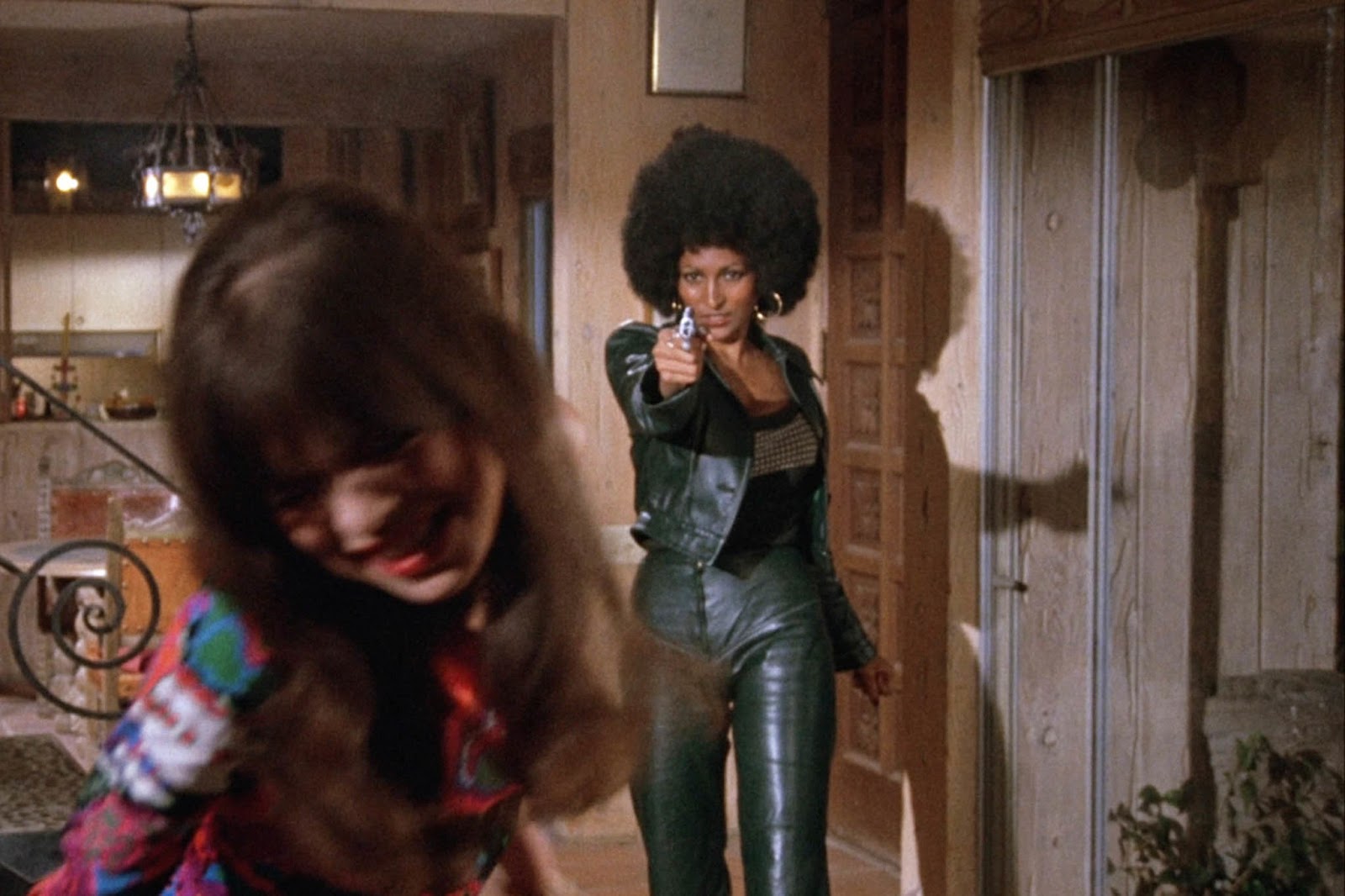
Grier rocketed to stardom as the queen of blaxploitation films with this big cult hit-- capably stepping out from her ensemble work in New World's Philippine prisons and into starring roles at the now blaxploitation-focused AIP. She's a hardworking nurse out to avenge her smack-addicted 11-year-old sister by waging a one-woman war on Los Angeles' drug/prostitution racket after her kid sister is made into a junky ("her life is over!"), and cop friend Carter (William Elliott) is beaten up for not being crooked. She blows (the head off) a pusher, forces another to give himself a hot shot; threatens to carve up a prostitute's face unless she gives up her pimp's secret stash, and goes undercover as a high-class Jamaican prostitute to move herself into the stable of the marvelous King George (Robert Doqui), a super mack-daddy pimp with big-time heroin connections and his own funk leitmotif by legendary Roy Ayers (the whisper of "King George..." over and over as he struts around helps make this high-end pimp quite endeqaring). Pam's Jamaican accent is limited, but her white bathing suit is divine, her body bedazzling, her cape delicious (she also has a cool cape with her nurse's uniform. Capes!) Her hair huge and (it turns out) spiked with razor blades. 

She's soon getting in over her head, escaping narrowly, pinning her own theft of the stash on King George and flowing back up the chain of smack empire command like an IV of death. Sid Haig delivers a truly chilling extended laugh while dragging King George behind his car (courtesy Chevrolet!). Diane Arbus's husband, Allan, shows up as a sleazy sheik (MASH fans are bound to be pleasantly unnerved by the sight of visiting shrink Sidney demanding Coffy crawl to him on the bed). Booker Bradshaw is Coffy's tall, dark, and handsome politician boyfriend, whose slick-ass roadster is so low he has to step down to get into it. Through it all, Grier keeps her character tough and glamorous and always holding onto her sensitive center, even when wielding a sawed-off shotgun. Hill stretches the movie to accommodate her three dimensions, her towering strength always coming with back-end working girl weariness, the kind that needs no man's aid, just maybe a cup of coffee or a Sunday drive. (It's clear Tarantino was trying to capture that mellow openness, the weary but kittenish honesty, during her early scenes with Robert Forster). 

It's temporarily good to be the 'King'
Cons: The Olive Blu-ray is barebones and in its widescreen HD reveals something not as immediately apparent on VHS, just how cheap the sets on this movie are, something the full screen VHS I used to have successfully obscured. Here we can see the far edges of the cheap plywood phony walls in mid-warp/decay from the swampy heat of the soundstage lights; every surface has that sad "under construction" look. The bars and apartments have an airless, sweaty claustrophobia. As for the actors --their wigs appear crooked and misshapen, their make-up runny; it's like a giant basement of Arbusian freaks (or was I just really strung out on cough medicine last time I watched it?); even the outdoor scenes have an existentially oppressed vibe. And just because he's a pimp doesn't really mean King George (above) deserves to be betrayed and dragged around behind a car like Angelo in Wild Bunch, or the fellow stable whores deserve to be all cut up or otherwise abused just so Coffy can use them as stepping stones to her ultimate vengeance. She's just slumming but this is how they make their damned living!

Pros: In the end, though, none of that shit matters, because that score by Roy Ayers is so damned funky, so tight, so on point, and sounds so full and badass in the Blu-ray digital that if you watch this with the stereo connected, you'll be blown well clear of any lingering urban blight. And despite the bad wig factor, the actors are first-rate. Grier, especially, is in a class by herself. And, more tellingly, the tawdry atmosphere works to make all the heroin addiction--that longing for release--perfectly understandable. Hill can't convey the way an armful of opiates can make a heaven of ghetto hell, but he sure has a handle on the look and feel of withdrawal. The whole COFFY mise-en-scene seems as if its an aesthetic reflection of what the Hold Steady's Craig Finn calls the 'crucifixion cruise', i.e. the endless slog through the pain and despair that is withdrawal, pain and despair that makes you so desperate for release, you'll sell your soul to the first buyer.

(PS 1/19- Seeing this again on the Amazon Prime HD streaming print, I'd scratch all that urban blight stuff- everything looks gorgeous and glamorous, even the dingy green light of the hospital where she works highlights Pam's luminous skin, and Booker's pad and topless bar hangout scintillate with moody fireplaces.)

courtesy Art of the Title


FOXY BROWN
(1974) - **

Paid homage to by directors from Spike Lee to Quentin Tarantino, this is the title Pam Grier is known for/by even though it's COFFY they're thinking of. Originally set to be a sequel, this incarnation of Grier is a tougher, more cartoon-like version of her same vigilante character. A  'take back the street' grassroots anti-pusher coalition jostles in her loyalty with her scuzzy small time junky brother (Antonio "Huggy Bear" Fargas). Drugs and gang violence have so destroyed her neighborhood that when her undercover cop boyfriend (Terry Cotter) is gunned down in the middle of the afternoon, no one comes forward as a witness. Her brother might know who did it, though and so--uniting with that local "neighborhood action" group--Foxy goes undercover herself as ---what else?-- a high-end prostitute. 

I dig the opening sequence at a late-night coffee stand with Fargas nervously hanging out while two Italian legbreakers wait for a pair of cops to finish their coffee and go so they can beat him up. His call to wake up sister Foxy, and her last minute cavalry rescue are all pretty good, but then we start cutting over to the the bruised thugs and their leader, a dour white girl (a doughy Kathryn Loder) and it all starts to twist downhill to an wildly uneven mix of broad camp, shrill sadistic (ugly and prolonged) brutality and glum inner-city realism.

Lacking a lot of the sadistic flair she brought to The Big Doll House, Loder spends way too much time dressing down her underlings, threatening the girls who 'work' for her, and nuzzling her right-hand boy toy, Stevie (TV actor Peter Brown). I think she and Stevie even end up sharing a slow, menacing maniacal laugh at one point. As for Foxy, she travels as far as the poppy fields of the Philippines (where else?) in her quest to bring down the operation. We keep expecting her to be smart and manipulative. but she winds up captured, raped, given forced heroin injections (which is always--it seems--how the bad guys get the girls submissive, uninhibited and completely dependent) and her eventual payback is never enough to right the catalogue of wrongs. For example, Foxy's sexual belittling of an old white judge is pretty hilarious, but even that goes sour when the call girl she encourages to participate (Sally-Ann Stroud) winds up tortured and murdered after Foxy leaves. (How emblematic of America's involvement in third world power struggles)!

Pros: The crazily colored opening credits feature Grier boogying down in all sorts of super-sexy outfits to that iconic Willie Hutch theme song. As with Roy Ayers score on COFFY, that Hutch soundtrack worth the price of admission all by itself, play it loud, neighbors be damned. Unless they complain, of course. Then put on your most expensive headphones. 

Cons: Way too much screen time is spent watching Loder sadistically abuse her girls and dote on her  gigolo and not nearly enough watching Grier kick the shit out of people. Even more so than COFFY there's way too much urban blight, sexual abuse, and general social degradation. Foxy seems to think turning tricks, getting shot up, raped, harassed, shot at, and leaving the people who help her to be tortured or killed, is small price to pay for --what? Does she get anything for her troubles? SPOILER ALERT: She doesn't even kill the evil Loder at the end, as if to pay back Loder's endless ugly egotistical sadism--which by then has grown as soul-crushingly wearisome as that of Alan Ormsby in CHILDREN SHOULDN'T PLAY WITH DEAD THINGs or Michael Gambon's Peter Grant-ish thug in THE COOK, THE THIEF, THE WIFE AND HER LOVER--with merely death wouldn't be enough to avenge how soiled we feel. Still, it would be a damn sight more satisfying than what happens.


PART 3: The Centaur and the SORCERESS

Hill would break out from Corman's wing a bit for his next film, to form Centaur Releasing with John Prizer, for which he'd bang out two quick punchy films in the female ensemble vein: one would rake in a small fortune; the next would lose it. After a lengthy hiatus he went back to Corman for one more film, would fight a bit with him one time too many and then that would be it. Career over. To all our regret. Well, how else do you graduate from the Corman school unless it's to fight with him about some creative issue and off you trundle, into either the abyss or the big time? Sadly, Hill's disinclination to work in direct-to-video or TV led to him doing just zero more films after that. 

He's still around though! Never say never...

THE SWINGING CHEERLEADERS 
(1974) - ***

Following New World's tried-true three girls at work-and-play ensemble "nurses" formula, this brings Hill's cunning mix of sexy feminism, cathartic violence, deadpan wit, and covert liberal politics to bear in a sexy comedy-drama form. Radical journalism major Kate (Jo Johnston) goes undercover to expose outdated mores and institutionalized sexism within the college's football cheerleading team, but instead she finds she these girls are cool, while her wild-eyed radical underground newspaper editor boyfriend Ross (Ric Carrott) is a rapey dick. Besides, the handsome quarterback Buck is played by Ron Hajek, his teeth white and straight enough he's worth stealing from the bitchy, manipulative cheerleader squad captain Mary Ann (Colleen Camp). Sulky Ross, meanwhile, takes out his anger by publishing Kate's expose (after she tried to scrap it) and then, later, inviting his sicko friends over to "break in" the virgin cheerleader (the doe-eyed Rainbeaux Smith). Mary Ann's dad, the dean of the school, is meanwhile embroiled in a plot to "fix" the big game, along with the coach, and a black professor (Jason Sommers) who is having an affair with the black cheerleader (Rosanne Keaton, one of Playboy's first black centerfolds).

Pros: Hill keeps the action flowing in surprising ways. I'll confess I have a low skeeve threshold when rapey idiots start snickering and egging each other on like so many dickweeds needing their graves spit on (like in the odious misogyny benchmark PORKY'S). So I like that here the jocks are sensitive and serious and the radical underground journalist is the swine. (Hill reports that a Texas audience one burst out of the seats applauding when the jock beats up Ross- so did I!)

Cons: I liked it the first time I saw it, and kind of fell for Johnston in those shorts. Now, a decade or so later, she just terrifies me--those eyes seem wild and unhinged, the mouth grinding as if from a line of badly-cut coke snorted fifteen years ago but still lodged behind her eyeballs. (Am I just talking about myself? I guess that's what they call 'maturity.')

I know it goes without mentioning in a more enlightened era, but what sticks out now isn't that there's a black main character --there were more than a few at the time (as in 1970s' BEYOND THE VALLEY OF THE DOLLS and all the New World nurse movies) but that it's a reminder of the miscegenation taboo that no black woman and white man (or vice versa) can ever be attracted to each other in these movies, so if you're black woman at a predominately white school, there will be one or two black men showing up, and you'll be bound to have an affair with one or both. As a kid in the 70s I wondered if that was just some instinctual thing - like black people don't find whites attractive, genetically, and vice-versa. Now of course I know the truth (racist southern distributors would never show the film otherwise) but in today's enlightened time, it actually seems conspicuous.

Pros: The black professor has a ferocious tough-as-shit black wife (Mae Mercer), who drops in on our terrified cheerleader in the film's most surprising powerful scene. Even if you've never been verbally threatened by your lovers' spouse--either by knife-point or just over the phone--you will get a queasy pit of your stomach thrill from her intensity . I've been on all sides of that equation and let me tell you, Hill gets it right and Mercer is a powerhouse. Never losing our sympathy even as we're terrified to the point of shitting our finest cheerleader slacks, she makes an impression so deep the picture still shakes after she's gone. As for the 'sweet one,' Rainbeaux Smith glows with a mix of doll innocence and angel sublime grace (hard to believe she was pregnant at the time --as we learn in the Arrow Blu-ray's generous extras). I like too how Hill doesn't even bother with the big climactic game at the end, nor even deign to mask the terrible emulsion damage and faded color on his stock footage of the game (do we ever even see a football?)

Cons: The main thing I can't stand about it all though, is the Scott Joplin rag underscoring the big climactic brawl at the warehouse. That kind of corny silent film (i.e. royalty-free) ragtime jazz nonsense hangs anachronistically around all through New World nurse and AIP's beach party catalogues, even in The Trip! I'm sorry Hill had to lug it with him to the Centaur's kingdom.

Blu-ray: The Arrow restoration is surprisingly only so-so as far as some colors being restored (lots of glowing greens) but it still seems very bleached out. I'm sure they did the best they could, but expectations are so high after the beauty of Spider Baby and Pit-Stop. 


SWITCHBLADE SISTERS
(1975) Dir. Jack Hill
****

SPIDER BABY's my favorite Hill but this is the second, a complex but highly re-watchable tale of feminism, street violence, and short-shorts. Doll-faced, sweet voiced, crazy-eyed Robbie Lee stars as Lace, leader of the gang, the 'Dagger Debs.' New girl in town Maggie (Joanne Nail) is the newcomer, and not averse to using her belt as a chain and/or grabbing a switchblade to defend herself at the burger place. Lace's one-eyed Iago, Patch (Monica Gale), sees the writing on the wall re: her beta status. Lace just thinks Patch is jealous of Maggie's cool gutsy charm, but ole Patch is right. Not only that, there are the sparks between Lace's boyfriend, the Daggers' leader, Dom (Ashner Brauner, doing a great Ralph Meeker impression), and Maggie. Even his breaking into her room to rape her can't change that, nor Lace getting pregnant and getting all gooey about raising the baby, to which he snorts and tosses her cash for an abortion.

Pros: a big roller rink massacre; an attack coordinated with a feminist black militant coalition, with machine guns and a badass armored Cadillac; the heavenly blonde Daryl Hannah jawline of Janice Karman as Bunny; the badass 70s funk score; some great hair and dialogue; and a lightning pace. See it when you're super furious at the world or just strung out with the shakes because your dealer never showed, and bask in the cathartic anger, the fabulous legs of Joanne Nail, and the way Robbie Lee's eyes widen and dilate, then contract into a glowing glaze when she talks. Savor too Nail's final rant to the fat cop, her face streaked with blood, eyes wide and maniacal, a shocking Cagney-by-way-of Lorre raving moment (maybe my favorite ending in all schlock cinema).

Joanne Nail would be back all right... in the fascinating 70s all-purpose drive-in capstone, THE VISITOR! (1979) Not much else, alas. Oh how I wish that Switchblade Sisters had a bunch sequels, like it would have in Japan. (Fuller review here).


SORCERESS
(1982) Dir. Jack Hill
***

Wild-eyed sorcerer Traigon (Roberto "the Mexican Martin Holden Wiener" Ballesteros - who really knows how to swirl his blazing red cape) needs to sacrifice his firstborn child to his crazy Reptile goddess to keep his magic strong, but his hot young wife (Silvia Manríquez) has twin girls and won't tell him which one came first (if he gets the order wrong, he's screwed). A wild-haired noble wizard strides forth to zap Traigon into a 20 year-long period of oblivion, but too late to save the mom from Traigon's swordy pique. Naturally, the wizard brings the orphaned twin girls to a farmer off in the wild to raise in secret (disguised as boys), imbues them with latent magical abilities and drops back in, Merlin-style, twenty years later, to tell them about it. By then the girls have grown into beautiful Playboy playmate twins, Lynette and Leigh Harris, who don't even know how hot they are or that they're girls and that they live in a world where there is no word for 'twins' so they have to be called "the two who are one" all the time. Traigon comes back too and resumes the hunt for the first born. His guards assault and murder the farmer family while the twins are out nude swimming. A vow of vengeance is sworn! The hearty viking, Baldar (Bruno 'the Mexican shorter John Goodman' Rey), and a horny satyr (who baas like a sheep) sign on for the ride. During a remarkably large scale market town square scene (viva la Mexico) they meet up with Erlick (Roberto Nelson), and launch a market-wide donnybrook. The twins do a pretty good job as a kind of tag team bo staff whirligig and the size and detail of the village is impressive. Ensuing are 'surprises in store' for the two who are one', not just birds-bees discoveries, but hair-raising escapes, magical spells, fights, god-wars, apes with druggy fruits (if you'll forgive the expression), remote orgasms (the girls are linked psychically), and undead warriors culled from their crypts. Erlick has his own problems too, including a near-impalement the original style of the word (slowly sliding down a greased pole towards a sharpened stick aimed up your arse and bound to pop out the top of your head --if you're lucky).


Long unavailable in any format, SORCERESS is now with me forever! I love it! It has just enough of Hill's dry Hawksian wit to stand apart from other sword and sorcery "epics" of the 'shot in Mexico or Argentina' New World post-CONAN era. With its score lifted bravely from BATTLE BEYOND THE STARS, and a cast of strong women (though for me the most exciting and charismatic is
Manríquez as their mother--who dies the prologue), hilarious monsters, very little torture and injury, and humor always well inside the boundary that separates dry deadpan wit (ala Big Trouble in Little China) from self-aware camp, and superb lighting of the night and underground scenes )it looks especially great on this Blu-ray - all burnished golds and charismatic highlights), it's a blast. And, of course, under 90 minutes long.

Pros: One of the lead guards has a crazy helmet that seems lifted from the 1936 FLASH GORDON. There's also a genuinely spooky crypt scene where the vertical dead in rows of alcoves slowly shamble to life out of the darkness. Baldar's a great wingman. The twins are real (in all senses); the little ape monster masks have facial movements; the satyr leads a charge of real sheep at the climax; and the effects are all of the charming 'painted on the celluloid' variety (CGI was still ten years away). The tactile earthy effort of it all--its solid mythic arc and florid array of weridness--floats it past its limits. Didn't all the best Hills? 

Cons: It's sad to learn this was Hill's last movie, mainly because he got in an "enough is enough" spat with Corman over the editing (i.e. length). Why couldn't Hill have just let Corman cut the movie up? Corman's judgement has always been--to my mind--pretty solid. Why did Hill have to raise a ruckus which caused a falling out? Hill's needing to look elsewhere to make his movies led to... no more movies? To all out detriment and loss.

But then again, home video was changing the landscape and who knows if he'd been as good on direct-to-video? I ain't as good a writer as I used to be either). Age and experience brings wisdom at the expense of exuberance. And Spielberg was coming along to make decadent deadpan larks like this -- too dirty and weird for the young kids and too cheap for the adults-- left to lurch along solely with the 16-20 year-old males at the video rental store looking for a post-Conan fix.

 Still, there were many more films in this style for New World to come, and a good number of them are pretty decent, as far as bad movies g, full of the wondrously paradoxical Corman mix of feminist empowerment and bared breasts, dry wit, and deadpan in-jokes we crave when relaxing in a late Saturday afternoon or five AM Sunday morning stupor. Sorceress's release year (1982) was a high point for A-list sci-fi and horror/adventure, and amidst that year's B-list, Hill could have rocked out for at least a few more classics. Damn you, Traigon! 

At any rate, long unseen in any format, SORCERESS is-- finally, thanks to Scorpion's gorgeous Blu-ray (replete with detailed extras)--made eternal. We are blessed twicefold, for the reds (of Traigon's cape especially) glow gorgeous and the black lunge deep - and when those corpses emerge from the thick cobwebs of the crypt into the torchlight,.


CONCLUSION

So in short, to answer my question from part 1, does Jack Hill 'get' women, the answer is clear: fuck you for asking!

Sorry, all that violence has me snappy and so does the state of the nation, and the liberals' bad habit of the back part of a movement lynching its own vanguard in its zeal. Hill's women are from the second wave of feminism, when it was called 'women's lib' and involved a certain amount of sexy strutting and sensual freedom that would now be considered a male-imposed fantasy. But from where I stand as a SWM, 'now' is a mighty buzzkill place. The third wave's dour sense of sulky humorless privilege still hasn't found a cinematic representation other than preachy documentaries and the kind of amateurish avant-garde downers seen mainly at museum and university lectures. The difference between Hill's strong babes and their un-charismatic 'representational' figures is like hanging out in an air-conditioned bar full of drunken undergrads vs. a sweltering administrative office full of self-righteous grad students who consider deodorant and air conditioning to be toxic.  Maybe they are right, man, but that don't make it fun to be around them. And maybe that's why no one is, unless they need to be, i.e. for a grade or a tenure recommendation.


Oh shit I'm becoming the very critic I was just critiquing, I've been beaten into a coma by my own copy of Sexual Personae. Actually, I never did read anything bad about the Hill oeuvre. Unless I wrote it about Foxy Brown. Still, I haven't watched Foxy since that bad experience in '99. Why would I? I'll just watch Switchblade Sisters for the dozenth time, or Corman and Angie's Big-Bad Mama, or The Lady in Red, by Lewis Teague and John Sayles, all celebrations of badass women who 'tag ya back' in ways unthinkable in today's noxious clime. We can either glumly point out they were made by men or we can act like the women in them and take out the trash, figuratively, and throw it all over the floor and tell the men to clean it up literally! Up (with) the Hill!

Let the games of spider begin, and let Robbie Lee, Jill Banner, Beveryly Washburn, Adele Rein, Joanne Nail, Lynette and Leigh Harris, Mae Mercer, and ---oh yeah, PAM GRIER...and all the rest, run into the blazing light of eternal replay.
---
PS, Beware a movie with Linda Blair directed by the semi-odious Jim Wynorski--also called Sorceressfrom 1987-- it sounds awful, though I do love that he just reused a title on which he already had credit (the 'original' story of Sorcreress). Had he forgotten? Does he just love that word? Jim, if you're listening, you're a dog, sir. A dog! PS - Loved Deathstalker 2!

Related Posts Plugin for WordPress, Blogger...