"Welcome to violence, a deep raspy voice grabs us right from the get-go, the soundwaves of his voice on the tape measured out for us in some macabre dance of manly depth, "wrapped up in the flesh of woman,". At the mention of the threat posed "even by dancers in a
go-go club!" the music explodes as we cut to three uninhibited (clothed) dancers in the midst of enflaming male lust. The audience is puffy with ugly masculine energy, middle aged clods hopped up on drink and desire. The audience is the kind of mugs not even a mother could love, frenzied with cigars and darkness, shouting: 'Go baby go! Go! Go!" The girls wail and rock in their bikini ensembles; the music builds; the shouts intensify; it all explodes into sunshine with a maniacal laugh and the title credits come rolling up as the dance continues into a sunny race down and sports cars zipping along the open American desert highway, the bright morning sun blinds us after being in the dark dankness of the club. Now the girls are out of that darkened cesspool, speeding forward into the wasteland (the open roadster-ready planes of the the Mojave Desert, where you can see a cop--or anyone else-- coming from ten miles away); each woman is in her own little souped-up roadster, leap-frogging each other and blasting their way freer and freer. The theme by some garage outfit called the Bostweeds roars under them like a souped up engine: "Pussycat is living reckless / pussycat is riding high / if you think you can tame her / well, just you
try!"
Already we're in love with these maniacal girls and their movie. We'd never dream of trying to tame any of them, or this film, all we can do is hang on the way we do on roller coasters or when the woman driving us home from the bar is going way too fast but we're scared of blowing it if we say anything so we just discreetly grab onto our seats. It's
Faster Pussycat, Kill! Kill!, a 1965 drive-in massacre helmed by Russ Meyer, the brilliant chronicler of big-breasted, sexually voracious, tough-talking women burning through men with uninhibited carnality.
Before this big breakthrough, Meyer, 'nudie cuties' ruled the former burlesque clubs-turned-art houses. These were the kind of things made in pursuit of the long green by daring the censor with anything they could get away with in the early-60s, which wasn't much. The film
Poor White Trash that had been playing the tail end of drive-ins for decades, and Meyer took notice, delivering things like
Mudhoney and
Lorna, and then 1965's
Motor Psycho (a kind of
The Searchers, but with bikers instead of Apaches and sexy Haji instead of Jeffrey Hunter).
Pussycat was something else altogether-- there was no precedent for it, no antecedent. Cinema had never seen women like the three wild go-go dancing, off-road dragging thrill-seeking maniacs, nor would it, sadly, ever again --a few random female characters roaring through not withstanding.

The threesome of
Pussycat are now the stuff of grindhouse legend: Varla (the terrifying Tura Satana), the tough butch sadistic leader, in the black Porsche, who shouts her lines in a haughty monotone; Rosie (Haji), her right hand underling/lover, who speaks in a low-key Chico Marx accent ("now I'm a-gonna spin-a dry you!") and Billie (Lori Williams), the curvy fun-loving sexually carnivorous blonde who tags along with this duo for the wild kicks they provide. Wild stuff happens wherever they go, turning on Billie to a point, and it's implied that if her wild antics get her into trouble with--say--go-go patrons stalking her after house, she can rely on Varla to beat the shit out of them.
In a sharp turn from the slew of 1950s girl gang delinquent movies, there is never any mention of these three being in any organized gang. They have no matching jackets or tattoos, not even weapons, aside from Varla's switchblade (Rosa carries it for her). There is no posing or growling or trying to act tougher than they are. These three girls - they're the real deal. We learn this pretty early on after--and some might say he deserved it for hitting her when she was already letting him walk away--Varla breaks a young all-American boy Tommy's (Ray Barlow) entitled little SWM neck. For thrilled first time viewers we're suddenly in brand new territory. We have no idea what's going to happen; there's no cliche or roadmap here. Not anymore. All we know is, any man who crosses Varla better watch out. And it's pretty easy to hide a body even in the dead of the blazing California afternoon... in a big empty like the Mojave.
 |
| Susan Bernard worries she might be hogging all the oxygen. |
THE DANGER IN EMPTINESS
Replete with tire markers for boundaries used for racing and timing trials, the Mojave is the kind of place that is usually deserted for miles and miles in all directions and, well, if you've never been way out alone in the middle of a desert before, then you know how eerie and ominous it gets, how long you can go without seeing another living soul, and yet how
far you can see in all directions. It's an eerie feeling, how quickly the law and order of the country can be left far behind, and horrible crimes could occur right there in the open, for hours and hours, and no one would know, and even if you tried to escape, there's nowhere to hide. Even if you manage to get in your car and drive away, your pursuers have miles and miles in which to catch up and run you down. This sense of lawlessness brought on by isolation is something understood by Peckinpah (
Bring me the Head of Alfredo Garcia), Sergio Leone (
Once Upon a Time in the West), George Miller (
Mad Max, the Road Warrior), and Wes Craven (
The Hills Have Eyes), among others (
Wolf Creek), but not everyone - you have to experience it to know about it. You have to feel the danger in the air to know that you can't cart your civilized obliviousness into the wilderness. Even if it's just to run some timing trials (or score drugs), you have to be ready to defend yourself, and you should never be dumb enough to let yourself be led too far away from your trailer or homestead, leaving your children and/or hot wife unprotected so a bunch of guys on bikes (or horses) can just ride up and run riot while you're off chasing a decoy. Unless you're going to track them all down later and kill them yourself, there's not a damned thing you can do about it all, except run feebly back towards your trashed house.
 |
| "you don't have to believe it --just act it." |
Into this wasteland came the hot rods. Teenagers were souping up dad's hand-me down Studebakers and drag racing out there, nice flat land all free of traffic lights and store windows. It's a distinctly Californian, distinctly mid-60s, pre-summer of love / post-big studio system phenomenon, when southern California car culture was all the rage (ala
American Graffiti) and drive-ins the perfect place to see violence, sex, and speed and submarine races while getting it on in the back seat. Don't forget too that the mid-60s marked the time when the bikini--long a staple of French beaches--finally gained acceptance in the States. It was new-ish, so just having the word 'bikini' in your title, could guarantee box office interest. Bikinis and cars were coupling up, as seen in AIP pics from the same era, like
Velvet Vampire with its flashy yellow dune buggy, or climactic car chase scenes in
Dr. Goldfoot,
Bikini Beach, Eegah!, etc. It was also the dawn of the transistor radio, so not only would we now see the voluptuous young bodies in all their splendor on the beaches, but they could bring their garage band radio stations and dance the frug or whatever and hula hoop out there until the sun went down and then go cruising home with the top down. Old duffers like Buster Keaton scrambled for fishing-related excuses to get out there and discreetly ogle.
 |
| Beach Blanket Bingo (1965) - Bonehead dates a Mermaid |
But over away from the relative safety of AIP's beach movies and stuff like Beach Girls and the Monster, and The Horror of Party Beach, were the adults-only "third and last film on the marquee' drive-in pics.
Thus to Pussycat, wherein in A nice-looking All-American boy, a "safety-first Clyde" and his groovy obedient chick come roaring up to where our three amazons are hanging out: 'the best measured strip of land around' for timing trials' ("It felt fast.... real fast!"). We're headed for trouble from the moment Tommy gets out and stretches a little too patriarchally before them, as if to say, I'm the only man here so naturally I'll be in charge. His girlfriend Linda (Susan Bernard) comes out when Varla notes of his car: "you could time that heap with an hourglass" ("did someone mention my figure," she says all cute. Then adds "shall I set up shop here, Tommy?" and already you can't wait to see him get roughed up). But soon squabbling and chicken runs will give way to something much darker.

With each trip to the well, my cup to fill, I come away with no admiration for what may well be the
Big Sleep of 60s drive-in exploitation - a favorite that makes me feel just a little cooler every time I watch it. Luminaries of the trash arts like John Waters (who first turned me onto it through his book
Shock Value), and feminist film critics like B. Ruby Rich recognize the film's genius and can convey it more cogently perhaps than I, who sometimes have trouble writing about my favorite films, as if afraid I'll somehow spoil them for myself by too much self-editing. I can only agree from my dozens of viewings that, as Waters says, "it ages like fine wine."
Even now, new elements are still coming out in its bouquet. From the sound mixing to the framing, the gutsy brawling saxophone of club jazz combo score -- always somewhere between a tough TV cop show and a strip club --and no-prisoners editing, everything is surprisingly professional and opened up. No canned audio dubs, nothing primitive in its execution. It's flawless. Sure, they shout all their lines when outdoors, to make sure they're heard - but they never sound muffled and sloppy, like they would in, say, an Al Adamson movie, or all canned and overdubbed, like in a Doris Wishman and -oh! oh! What delicious lines! Jackie Moran's gonzo script roars by like a half-beatnik version of Ben Hecht
and punch-drunk George Axelrod. You can feel and hear the air between the actors and the cars, the voices, that blowsy wailing saxophone giving everything a groovy edge. The acting may be flat, mostly (only Haji and Stuart Lancaster seem born for this weird style of dialogue, almost like Samuel Jackson was born for Tarantino's), but the dialogue is on point, it works perfectly anyway.
Speaking of Haji- I never really paid much attention to her until around the 12th viewing, being too enthralled by the statuesque curves of Lori Williams, and the evil of Tura Satana. But then, Marx Brothers fans like myself don't really appreciate Chico Marx, either --he's not as anarchic as Harpo or as intellectual as Groucho. But without him, the schtick falls apart. His presence makes them 'the brothers', the way Haji makes it a girl gang even with just three people. Her Rosie defines what they are and aren't. She never seems to be hamming even with that weird accent. She sticks with Varla, but she's also very aware of the danger they're in, or that her lover/leader may have gone too far. She's not as freaked out as Billie, but she's also clearly got some kind of moral conscience. And she makes the best use of any line she's thrown. While Tura and Lori both shout their lines like they're yelling over a lawn mower, Haji purrs, low, almost halfway to herself, comments like "His car's okay.... only the color needs changing... like maybe
yellow?" and my favorite line of all, when Linda offers them a soft drink. "Soft drink, she asks? We don't a-like nothing soft --Everything a-we touch is
hard."
But while Rosie is to be fathomed for her middle child subtlety, Varla is one of the most amazing and badass characters in all of exploitation cinema. Tura Satana's a giant, beautiful in a weird almost alien way - half-Japanese, tall, pale skin dark hair fierce heavily black-lined eyes, flattish face that showcases her teeth like some alien carnivore, and a sneer that seems to melt into the fourth dimension. We wouldn't see a smile that scary again until the alien smiles for Harry Dean Stanton in the Nostromo docking bay. Yet Tura is never not
all woman, even belting out hammy jujitsu moves or swinging her head around in a crazy kamikaze driving style, she's mad feminine. We never learn why she's such a crazy bitch, but who cares? She doesn't seem to have got that way by suffering past male abuse, but just by being a true Woman, stripped of all phony pretense of decency.

Then there's Lori Williams' Rosie, who gets all the best lines and looks the sexiest in her white go-go boots and hip-hugging white shorts. Her lust after 'the Vegetable' the brain damaged body builder who the old man (Stuart Lancaster) uses like, as he puts it, "a piece of mutton", is truly hilarious ("I don't know what you're training for, but as far as I'm concerned, you're ready.") What Williams lacks in subtlety she more than makes up for in giddy oomph. When she's getting drunk at lunch with Stuart Lancaster (as 'the Old Man') she sounds like she really is drinking (there ain't iced tea in that Cutty Sark bottle), noting it's "it's been known to be passin' out time." With Varla out back seducing Kirk to get the loot location and Varla jealously spying, and the Vegetable taking Stuart up to his room for a nap, it's time for Linda to make a dash for it, but this is still the desert, and walking anywhere on foot without a day-long head start, you just wont outrun an All-American jeep.
For those who aren't familiar with it (and it can become hard to track down since the Meyer estate keeps the rights notoriously close to the vest)
Pussycat is slightly easier to find than the rest of his films (aside from the studio-made
Beyond the Valley of the Dolls) though they're sold on the Russ Meyer website, the DVDs aren't the best - they look like merely remastered from old tapes rather than source prints. So why someone like Arrow doesn't do a deal with them is a lingering mystery. I hear there's been a Blu-ray thing in the works for years now, but who knows why it's taking forever? (Editor's Note: according to his son, Meyer threw away the negatives when he struck the video master, figuring they'd never be screened again. So alas, the video masters are all that are left, which is too horrible to contemplate).
The film's been compared to
Texas Chainsaw Massacre, and indeed there's a kind of bent similarity but Texas' qua-feminist throttle isn't all the way open the way it is with
Faster. The buzzing you hear isn't Leatherface's chainsaw threatening Marilyn Burns but Varla's wheels crushing 'the Vegetable'. They'll have to send him away "from a lot of things" and we imagine suddenly that Carmen Sternwood would be a great candidate for this gang, to take Billie's place after she dies, as would Claudia Jennings from
Truck Stop Women (1974). Well, we can't have everything, unless we want to make a movie ourselves.
Hmmm I'm not trying to put any ideas into anyone's heads, but it seems to me a badass girl gang crashing a lot of different genres would be just the thing. A lot of folks have tried and they end up being the usual overwrought nonsense with one too many well-scrubbed thugs locking overly siliconed strippers in trunks, in between lugging bags of cash in and out of hotel lobbies, shots of sunglassed douchebags smirking into rearview mirrors, abusive backstory, flashy meaningless over-editing (you know the ones I'm talking about - no names) and female violence done with "this hurts me more than it does you" anguish in their eyes rather than sadistic relish. In other words, these mostly male directors miss the whole point. The only film of late I can see even coming close is the 2010 low budget Aussie pic,
El Monstro Del Mar, which is kind of like the
Faster Pussycats vs. the Sea Monster and, of course, the fantabulous
68 Kill (which is awesome and recommended - don't let the dumb title and excruciatingly tacky poster art dissuade you).
BEFORE AND AFTER (THE MEYER CANON):
Faster is so good it's natural to want to explore more Meyer films. Alas, while the quality of the filmmaking is always superb, the films aren't restored, leading to blurry colors (which is why hiw black-and-white films hold up better). But even taking that into account there's no film quite as perfect as
Pussycat in the Meyer canon. After this, he moves to color and off-road mayhem gradually mixes down to roaring soapy bedroom farce. His earlier backwoods lustful "Erskine on the Half-shell" insanity becomes tempered down into historical epics (
Blacksnake), banal softcore (
Fanny Hill), and cartoonish rutting (
Up!, Beneath the Valley of the UltraVixens)
 |
These days I have a whole new appreciation for Haji's Rosie, The co-star of Motor Psycho, her gorgeous breasts ever hanging out of a torn blouse as she bounces around in Rocco's truck through the desert on their quest for vengeance.
|
Even his vehicular homicide film from the same year (1965) wasn't in the same league as
Faster, not by a longshot. By keeping the bad guys all men, it becomes a 'roughie,' part the short rape/revenge trend in mid-60s exploitation. Now it's notable mainly for a chance to see Haji in a more prominent role, as a compatriot in bereaved vengeance to Alex Rocco (!). After the gang harass and/or kill Rocco's wife and her family, Haji and veterinarian and Alex Rocco drive off to take revenge. The Mulveyan male sadistic gaze meanwhile must watch in horror as the bikers act on our eye's desires (the girls are very shapely), almost like they're our own monster of the Id (from
Forbidden Planet). Very
Clockwork Orange in that respect - as all our libidinal leering comes back to haunt us. We'd never get quite that uncomfortable in that way today, when Hollywood films sexual assaults in such a way as to leave us feeling personally violated, traumatized, but never uncomfortably complicit through our own ogling desires. Either way, it's the polar opposite effect of
Pussycat. Sigh, I wish there was a whole Pussycat series.
 |
| we do not approve of their methods- Motor Psycho |
But no.. Drive-ins no longer wanted black-and-white, so- Meyer moved into color (now faded and soft_ and relaxing censorship let him drift ever closer into hardcore. One of his other films of his I do like,
SuperVixens (1975) has scenes like the one with mail order bride Uschi Digard running around the farm, naked but for feathers in her hair and waving ears of Indian corn outstretched as if auditioning for some X-rated margarine box, while Stuart Lancaster, naked but for a chicken over his groin, runs in an intersecting direction, breaking up a montage of them screwing in all sorts of farm locations. It's funny and strange but shows Meyer's confusion with loosening censorship via both sex and violence. How far does he really want to go? Everywhere our hapless hero goes 'Super'-sized glamazons (with names like "Super Cherry") throw themselves at him and he seldom wants to reciprocate, either trying to fight them off and arousing the ire of their kinky boyfriends (who like to watch, like John LaZar) or angering the farmer or hotelier he'd be cuckolding into chasing him with a shotgun. Violence explodes from the wild cartoon fury of nymphomaniacal Super Lorna (who takes an axe to his car in a jealous rage and then is later killed in the bathtub by Charles Napier after she taunts him for not getting it up, a scene both hilarious and deeply disturbing.
Indeed, that uneasy mins becomes the norm for Meyer: the killing and abuse of women is repeatedly made an extension of sexual frenzy wherein everyone loses. Even in Meyer's big budget
Beneath the Valley of the Dolls two women get a pistol shoved in their mouths for being lesbians. "Theirs was not an evil love, but evil came because of it." Really, Ebert? Yet you shit all over
I Spit on Your Grave?
 |
Uschi Digard in SUPER VIXENS - the Mail order Milk Maid Fantasy cranked to cartoonish extremes
enough to make Jayne Mansfield blush; (but in this pic too we see the problem with color film vs. black white as far as preservation - it's all muddy, especially without the negatives to strike a restored print from for a good DVD or Blu-ray. Gosh darn it Russ, why did you throw the negatives away!?
|
 |
Our hero is very rude not to indulge the weird come-ons of Super Cherry while her boyfriend (John Lazar) watches excitedly from the driver's seat.
|
In short, outside of
Faster we get violence but the wrong kind, not the badass liberated gangland karate of Varla, but a kind of extension of pent-up, summer heat-fueled sexual madness. We don't 'feel' the violence in
Pussycat or share Linda's frustrated terror at the macabre luncheon ("she's a sick girl, pops"), or wince at Tommy's humiliation after the race around the track. We're meant to view this pair of clean-cut normies with a kind of savage's eye, the way we do the white kid virgins snatched by Rosie Perez and Javier Bardem in
Perdita Durango (aka
Dance with the Devil). Before they maybe die, their small world has been enlarged, their sense of middle class entitlement blown apart forever by this experience.
 TOO FAST FOR SEX
One of the unusual aspects too of
Faster -- there isn't
any sex in it whatsoever, making it unique in the Meyer annals. There's implied lesbian pair bonding and -- in the house of the three men, some implied (but never seen) rape/murders done in the past by the Vegetable with the Old Man as instigator/spectator (revenge for a past slight done - when he crippled himself rescuing a girl off the tracks, who didn't even stop to see if he was all right). According to interviews, Haji didn't even know she was playing a lesbian until the shoot was almost over, but that's okay- this is 1965, after all, that they don't wear it on their sleeve is quite realistic for its time. We wouldn't really notice if not for Billie teasing Rosie that "you only got one channel, and your channel is busy tuning in outside. You really should be AM and FM..
." Earlier, when Varla tells Billie, "Rosie and I are going to take a walk..." we imagine there might have been a softcore lesbian moment if this was 1969 instead of 65, or if Meyer had time, and the girls were down. But who cares, in the end? There's no time for such stillness in this fast-moving film. The few times (straight) sex is tried it's interrupted either by either a train (which throws the Vegetable off his rhythm) or a scream from Linda (which interrupts Varla and Kirk), and at the end, a rape the Vegetable is too upset to perform despite his lecherous old man's shouts. No time! Cue the Bostweeds!
This lack of sex marks a key turning point for the Meyer canon. From henceforth, sex will become Meyer's obsession. Feminism and amok 'super'-sizing will all be in service of sexual fulfillment which never seems to come. The cars will still zip by, but our heroes will be settled in cabins ant tract homes, at least until their horny broads almost destabilize the scene in a fit of horny pique, or he comes home to find her making it with the milkman, unless that sort of thing turns him on.
 |
| "You girls nudists, or just short of clothes?" |
As for the rapey duo of Vegetable and old ma, we never really get the details of one ominous pronouncement that they have "all the land to hide those pretty ribbons in when we're done with 'em" but we wonder how the good brother, who doesn't seem to have any kind of a job except nursemaid to the pair of them, can stand back and let these kind of atrocities go on. It's fine that the script doesn't bother explaining that: it's too busy tossing out one great line after the other.

It's also perfect to drink to, as there's copious opportunities and justifications, such as when the old man grabs the Scotch bottle out of the grocery box Kirk is bringing in from the store. "It's a little early for that, old man!" notes Kirk. "The train is late!," Stu snaps. "Nothing's on schedule today!" When I watched this over and over in a drunken euphoric bender haze on a 6-hour tape with
Mesa of the Lost Women, Cat People of the Moon, and
Spider Baby. I never shut up about that tape on this site, and I'm sorry.
In the end it doesn't matter what the old man instigated or not SPOILER ALRT -- he will be dead before nightfall, his wheelchair overturned, his long greenbacks fluttering in the wind. Something else is gone forever, too. Movies will never feature this much crazy thrills packed into Hawksian 'enhanced' real time again. There'll never be a character as unhinged and gleefully butch mercenary as Varla, not in the Meyer canon, not anywhere. This is the steep price of civilization. Nowadays producers would be too worried about arousing feminist / lesbian film scholar ire, actresses too worried about their image. When there are badass females, they 'got that way' because of child abuse or a rape. They're not just wild... untamed... violence in the form of woman.
 |
As in Chainsaw, Linda realizes her 'rescuer' is taking
her back to where she just escaped fro |
"Welcome to violence, the word and the deed," that narrator said back at the start (and is never heard again). But the stay is short, like a delicious lap dance to a short song, the film ends much too quickly, leaving us with the only two 'other' boring characters in the film: Linda and the 'good' brother (Paul Trinka), who buys lots of big hardcover books over mail order -"and they're ain't a picture in one of them." The others are all dead now (or 'destroyed' in the biceps) and it's not even dark yet. The film is over so fast we need,
want to keep the electric thrill of it going with another film. But what comes close, if, as I said above, the Meyer films tend to drift off into rape and bedroom farce rather than badass bitches tearing up the swinging' miles?
That's the saddest part of
Faster, the realization there's almost nothing else like it, anywhere. And there should be. It's a damned conspiracy. Women are becoming more equal and men are afraid ironically of getting flak from feminists by showing women as too powerful. Women are now forced to be merely equal, but for my money that's missing the point. Equal to what?
The point is of no return, we're reaching it. Can we turn it around?
---
 FURTHER EXPLORING
Actually -For some
Pussycat-eaque thrills, make sure to get the DVD set of
Honey West starring Ann Francis. Lori Williams has a poolside cameo in the first episode (left)! Francis plays detective Honey as a capable swinger, both Emma Peele and John Steed rolled into one -- her handsome boy Friday may do the heavy lifting, but she's the lead and never lets him forget it (and there's no romance of male dominance - she calls all the shots). Each episode is only a half hour, so no time for the filler that sometimes eats up the first half hour of
Charlie's Angels episodes.
And of COURSE SEE ALSO:



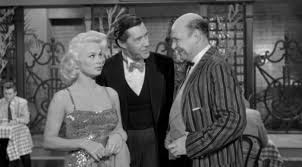 Luckily, there's a kind of masochistic 'turn the audience into feminists' critique going on here, as in Blonde Venus we may not like that he wins in the end, but we're clearly meant to root against the squirmy male who uses the conservative values of the reigning social order to help put a woman in her place for the crime of outshining him in every department. If we come away pissed off, at least we can credit the film for stealthily agreeing with us. We can't help but cheer when she dumps a conga on his head then pours a pitcher of water through it onto his head. Even if she apologizes later, and asks "do you find me... desirable?" so that we roll our eyes and snort derisively, Zugsmith gave us our moment. And we'll never forget it.
  And over all, it's one of those "What, me worry?" fantasies where all the women are stacked and leggy, but smart and aggressive, and the men more or less idiots. But when you have Coogan and Carradine dancing at a bar, how bad can things get, no matter how much Milner dashes around like some kind of universal chaperone (telling Jayne "You are a bit much for a growing boy to face at nine-AM in the morning.") or the flash-frozen "Woo Woo" mopes and Moranis-izes? Sure, the ending is total chaos as all the disparate parts come together in a big science lab/classroom climax (with the gangsters and Thinko finally squaring off) but at least half the gags hit home and if you don't really laugh, well, one of the beautiful gals is usually onscreen to rest your eyes on while you wait for the next zany character to come tumbling into the scene. For all its faults, I think I like it better, as a whole, than either Beyond the Valley of the Dolls (which has an icky homophobic subtext) or The Girl Can't Help It (which has an icky Tom Ewell smarm). Sure it's not as good as Lord, Love a Duck but what is? Even that's not perfect, though it sure is Milner-less.