Showing posts with label Universal. Show all posts

Tuesday, June 25, 2013

Death's Lost Stinger - NEVER GIVE A SUCKER AN EVEN BREAK

"last time it was pink elephants..."
What makes booze, the scourge of human civilization--Homer's "cause of, and cure for, all life's problems"--so irresistibly funny even when unrepentantly horrible? Find out by examining the last film of W.C. Fields', the ground-patchingly surreal, meta-bizarro masterpiece Never Give a Sucker an Even Break (1941). As Fields says in Poppy, "Without purple bark sarsaparilla this mundane sphere of ours would be barren, bleak, and dank." And yet who made it so, Bill? Drunks, 'at's who

"Oh, Uncle Bill... but I still love him."
When I was getting sober I vowed never to lose my affinity for Fields and never to judge those who could still get plastered. Fields too tried sobriety, especially during a drying out period in the late 30s that saw the end of his Paramount days and the beginning of his Universal period. The new studio gave him free reign, he needed to tangle only with the censor, and thanks to appearances on the Charlie McCarthy Show where he traded wood alcohol-based jokes with Charlie ("go away or I'll sic a beaver onto ya") until his boozing had become a cornerstone of his schtick, which made it all the easier to cloak a relapse. Hard drinking only figured in a handful of his earlier Paramount films. He barely got to drink at all in fan favorite It's a Gift. Some flask sneaking around a fire, another swig or three during the big final deal. Drank nothing at all in The Old Fashioned Way or Poppy (in both of which he wore a ridiculous, Ziegfeld-style clown costume), nothing in Tillie and Gus, and only had a few evening apple jack nightcaps in Man on the Flying Trapeze. Just being mean to children, slickering rubes and never paying his boarding house tabs was enough to be a rogue in those days, apparently. But starting with Universal's You Can't Cheat an Honest Man Fields had full script control, the kid gloves were off and the madness begun, and it warsth chasherlesh.

Over the years I've grown comfortable with the idea of never being able to drink again (it's been 15 misera--I mean beautiful years). The sorrows of life are the joys of art, in the words of immortal drinker Ben Hecht. If you're an artist or writer then you know there is no better sorrow than strong spirits, the beautiful, wild demoness of drink. My body was just too weak in the end to keep up with her demands. I had to let her go. I still see her, sometimes, in liquor store windows, and if the song in my iPod is sad enough, (last time it was Sarah McLachlan), I stop and trace the outline of her bottle against my heart. I will remember you / will you remember me?

Fields, slowly dying of alcoholism by the time of NEVER GIVE A SUCKER AN EVEN BREAK (1941), could never shake her from his system the way I did (knock on wood). He tried. But trying isn't comedy and the eternal thirst becomes funny even at its most tragic level, the ultimate in heartbreak, through Fields' blearily-focused lens. I've used the metaphor for a life spent focused on one's marriage, work, responsibility, chores, mortgages, sobriety as climbing up a rocky, snowy mountain--too focused and tired to wonder if you're happy--and then, when you're 3/4 of the way up the snowy mountain suddenly a beautiful young free spirit, the type you were dreaming of all through your teenage years and early twenties but never met--comes sledding past, racing down the slope in the direction you just came, shouting "jump on!" You have only a split second to decide, if you had more you might have chickened out. But maybe you've had enough bickering and enduring backseat screaming matches and even though a part of you has vowed to never cheat or jeopardize your home, you just jump onto the back of her toboggan, clamp your hands around her waist and hold on.

Down you plunge! You hear your wife's angry cries fading into the background winds, replaced your wild--if strained--laughter. She's such a reckless driver, this girl, and there are so many rocks and trees around, you might easily end up with a broken neck.

Then you get to the bottom of the mountain. You wipe out and when you finally stand up, you find her boyfriend is waiting to punch you in the nose. The girl laughs, grabs her toboggan and takes the next chairlift, boyfriend at her side, while you lie there, your blood spilling all over the snow.

What do you shout to yourself, if you're me or Fields? Again! Set 'em up again.


Again... no quarter given to thy foe, thyself, that barren, bleak dank sarsaparilla -less sphere, that mountain of barren rock you were scaling called marriage, family, work, gutter and lawn maintenance. Fields' love for booze reflects a very clear need to escape all this 'obligation,' to vamoose, to disappear into the mist, down the mountain on booze's reckless sled, and thus to let the vicious roundelay of sleeping, waking, eating, shitting, working, dying, recede like the fading cries of "Harrrr--Rold!" from an outraged shrew wife.  Even if the disappearance is only temporary, just time eased from its wearying consistency for half a tick, it's worth any price, any toll on health, wealth, or sanity. As Eliot wrote "the awful daring of a moment's surrender / for this and this alone have we existed."

Civilization has, in it's way, never been able to shake this wild demoness. Prohibition just drove the price up, and heightened the camaraderie, the shared joke, with the speakeasy passwords. Part of the charm of setting a film like International House in China was the lack of prohibition; Americans came out there to get away from the madness of sanity. Once prohibition was repealed, things went back to normal, like it does today a few months after you turn 21 and the thrill of unlimited access without need of a fake license wears off. So being sober means understanding the reality of booze, which is that it never measures up to the warm glow anticipation. The buzz is like music, ephemeral, but in trying to maintain that buzz through continued consumption one invites the fallout of hangover, sloppiness, missed deadlines, illness, depression, anxiety, amnesia, and... eventually... the 'missed launch' wherein you're so drunk you can't stand up and yet remain horribly sober, miserably conscious of how un-enraptured you are,  no matter how drunk you get. (For a great description of this horror, read the last chunk of Kerouac's Big Sur).

To down in a vat of whiskey... death where is thy sting?
Now there are people who aren't alcoholics, so they don't know the true joy of the terror of addiction, the horror of convulsions and D.T.s or the giddy ecstasy of waking up feeling like death, pouring a 50/50 gin and grapefruit juice highball, pounding it down in a single gulp, pouring another one, and sitting down to watch your favorite bender movie, SPECIES or APOCALYPSE NOW, and realizing it's only six AM on a Sunday, not six PM, like you feared when you first opened your eye. You have the whole day, hours left to try and taper off! The agony and ache of your morning hangover vanishes and is replaced by ecstasy in a matter of minutes.

Next thing it's six AM on a Monday, and you're thinking of reasons you can't come into work, putting that scratch in your voice for when you call your boss.  Godfrey Daniel!

The best way I've learned to explain it is on a scale to measure one's mood / feeling of well being / joy and contentment. Let's say a 1-10 scale: ten = ecstasy; one = being grimly depressed/ suicidal; five = the average mood of the average human on an average day.

So the average person stays in the middle, bouncing around between 4-6
Getting drunk brings them to a 7-8, then back down to a 4 for the next morning, then up to 5 again.

But alcoholics like W.C. Fields and me have an average of 2-3. And when we drink we catapult to a perfect 10, hit the bell and go sailing downwards, arriving at 1-2, one way or the other, eventually.

If we keep a steady buzz throughout the day, we can manage an extended wobble between 7-9, but the longer we keep that up the more harrowing, miserable, and lengthy our stay down at 1-2, over that toilet, beholding our skull reflection in the water, too sick to choke down the booze needed to stop being too sick to drink.

My friends, when that happens, take a break from your six hour stint hyperventilating over the toilet and lean back on the cold tiles and think, "Erich and Fields were here!" And bask in the comfort that there's literally nowhere else to go but up -- or down to zero. And zero means you're off the scale - unconscious, dead, or having a massive orgasm --neither way, salut!


Fields made it to zero, as we all must, and hasn't worked a day since, but everyone of us still bouncing up this scale and back down longs to escape it, not just to return to the dubious joy of sobriety or alcohol but to transcend the scale altogether, to die, to be really drowned in a vat of whiskey.... that must be... glorious. But since it's too hard to kill yourself, or become a vampire, drink's a fine second, a temporary respite from the abyss of addiction, which it itself engenders (to paraphrase Nicholas St. John).

"I was in love with a beautiful blonde once dear, she drove me to drink. That's the one thing I'm indebted to her for," says Fields. It's one of Sucker's more indelible lines, and probably true and it's packed with Lacanian paradox: in ruining his life, this blonde set him free. She was coming by on that sled. She brought him down to the 1 or the 2, allowing for more velocity on the bounce back up to 10 again. And that's what we alcoholics really love, the velocity. To push up from the bottom, to shoot from a 1 to a 10 is way more awesome than going from 5-9. In fact you don't even really make 10 unless you get a good velocity going. To savor the rush of the climb you need the bungee-style chance to press your face against the mortal coil Boiinnng, even sneer at it as it almost grabs you in its skeletal claws, and then suddenly you're bouncing back up again, the skeletal hands close below you, the skull grumbles in defeat, and all one's minor problems--debt, bad marriages, legal troubles, unemployment, bad reviews--recede-- DING! A winna!


In that moment, just being alive and relatively uninjured is the cherry on a grand cake; all real life problems are as minor little mosquito bites on a man running for his life from wild boars.

I loved Never Give a Sucker an Even Break even before I had my first drink. It aired at four AM on a local TV station one early Saturday morning in 1983, when I was 16, the morning before I had to go to my very first-ever day of work. I was tired, of course, having gotten up so early on a Saturday (our VCR timer was unreliable, so I'd get up early and sneak downstairs while my parents still slept, to edit out commercials and musical numbers, purist that I was). All that day I had to operate a creaky, noxious-fume spewing (pre-Xerox) copier... nonstop for six hours, my chain-smoking boss lady stapling next to me, leaping down my throat at the first pause in the clanking of that old machine. I was way too shy to ever ask for my breaks, presuming she would just tell me to go on them at the appropriate time. She didn't. Just kept stapling and smoking and I got hungrier, dizzier, and wearier, though the coffee was always free.

But Fields had prepared me for just such a baptism of misery. All through the day his magic song echoed through my mind...

Chickens have pretty legs in Kans-assss.

I started smoking that very day.

When you're falling, dive.


Thinking about the cozy airplane in SUCKER and Fields' comforting song through that noxious Sunday afternoon created a soft warm feeling that resisted the crushing dehumanization of the copier. It was my happy place, that open air rear observation compartment. Looking back, that whole sequence and its frame-within-a framework meta groundedness couches that airplane in layers of comforting safety. Let's examine the layers:

"couldn't stand the noise..."
 LEVEL ONE: 
The Magic Drunk (oblivion) - altitude of cozy ecstasy

It's no coincidence that my two favorite films of Fields involve copious drinking and air travel of a uniquely Fieldsian character: the autogyro (in International House) and a giant airliner with an open air rear observation compartment and berths like a sleeper car in Sucker. For being 'up in the air' offers its own unique freedom - high in the clouds, free of all responsibility (the same with being deep deep down, as in a secret underground lair- another happy place of mine). One is essentially in heaven, that '10' bell I spoke of, Eden, free to drink into oblivion while surrounded by clouds which "look just as fleecy as... clouds" and being waited on by beautiful adoring women, a kind of second infancy.

Chickens have pretty legs in Kansas.... (2x)

Chickens lay eggs
big as nutmegs

Oh chickens they lay eggs in Kansas

Fields sings this awesome song while still in his berth after being woken by the stewardess, a vision of wartime loveliness if ever there was one. We see his niece, Gloria Jean, and a random blonde in earshot in another berth, smiling wistfully at his song, as though he's Frank Sinatra, with the rush of the airplane in the background it becomes a scene of prenatal bliss, a mirror to the earlier scene of Gloria Jean's gypsy folk song with reaction shots of adoring lambs and donkeys.

 LEVEL 2: 
The Plummet (after a bottle of golden nectar)

This thirst for freedom, the ferocity of chasing your dreams, even if the dream is destruction, even if it pulls you from the forward movement of time into a vertical plunge, this is the definition of America being pulled out of its isolationist stance into the war in Europe. Here, Fields jumps out the window and is taking a chance, that's the point, as he tells Og Oggilby in his previous film, The Bank Dick (1940): "My uncle, a balloon ascensionist, Effingham Hoofnagle, took a chance. He was three miles and a half up in the air. He jumped out of the basket of the balloon and took a chance of landing on a load of hay."

"Golly! Did he make it?" Oggilby asks.

"Ah, no... no he didn't, Og. Had he been a younger man he probably would have made it. That's the point. Don't wait too long in life."

 LEVEL THREE: 
The Aerie - The Buzzard's Nest

The nest is the ideal halfway point between the uninhibited surrealism of International House and the average family man yarns of Fields' earlier Paramount days - Margaret Dumont is much cooler and more fun as a foil than either Jan Duggan (whose nonetheless pretty great) and Kathleen Howard, whose one-note shrillness can turn off potential fans of Man on the Flying Trapeze and It's a Gift. Dumont connects it to the Marx Brothers and has her own weird sense of gravitas. As Molly Haskell says "the poise and unruffled splendor with which (Dumont) graces (the Marx) films is ample testimony to her place in their hearts and in film history." (67) After Ouilatta looks over his shoulder smiling innocently, "why, mother!" Fields beholds a giant, fanged Great Dane, implying that her mother is in fact the dog --like in The Omen!! "Romulus and Remus!" 


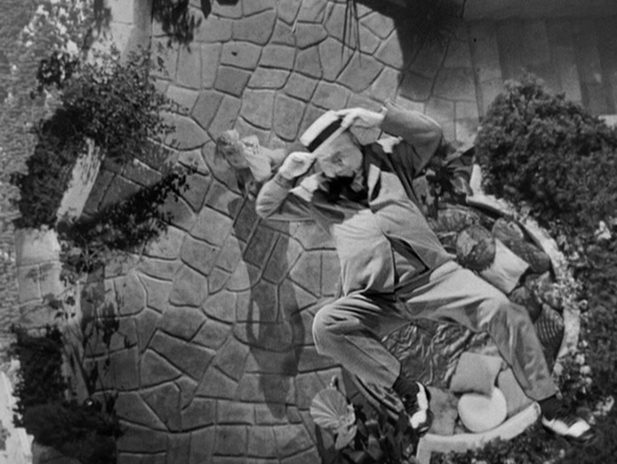
The normal act of the 'old reprobate' is to make moves on the young daughter while making a feint at wooing her mother (The Graduate in reverse) and here in this surreal 'nest' there's nowhere else to go on the mesa but down so it's not like mom goes to the salon or church all that often. There's no time to be free of Mrs. Hemoglobin and her fanged great dane. The mesa top is small and we can see the whole thing in detail (above), the round bed on which Ouilatta Hemoglobin (Susan Miller) reclines, looking up in calm astonishment. But just as there's no man around, there's no escape from her mother, "a buzzard if ever there was one," as he later explains to visiting engineers Charles Lang and Emmett Vogan (below). So down again he plunges.

On a subtextual level, the daughter and mother (and dog) are inescapably joined. Just as Sue Lyon in Lolita inevitably turns into Shelly Winters (see Lyon in Winters) there's no freezing Ouilatta in time. She will become a great dane-Hemoglobin hybrid. His best bet is celibacy, to avoid the Humbert Humbert trap and stay in the 'good uncle' role with Gloria Jean. It's his one redeeming trait.

LEVEL FOUR:
The Russian Village 

Director Cline and Fields incorporate one of Gloria Jean's Russian peasant songs via a miraculous scene in the Russian village bar. Fields is told that the buzzard who lives on the mountain top is rich, causing him to immediately have a moment of clarity about his undying love for her. As the music swells slow and mysterieux in the background, he notes, eyes a-twinkle, "she seems to have a good heart, too... in fact she seems like an awfully nice woman to me.... now that I come to think of it." The romantic music of the gypsy chorale underwrites his change of approach, and next we see Gloria Jean joining in the peasant song as her wagon rides up to the gypsy camp ("How do I get to the Russian village?" - as if there's only one, like going to someone in New York and saying how to I get to the American town?). Gypsies walk alongside her wagon, keeping up the unearthly but achingly gorgeous vibe of their song, Gloria Jean now wailing over the top in long sustained filling-rattling notes like a theremin, or a Duke Ellington lead cornet.


LEVEL FIVE:
Esoteric Studios - Mr. Pangborn's Office (Reality)

It's always a bit of a wrankler when Pangborn slams the script down because we never get to learn what happens next (after Fields and Gloria Jean go  up to the aerie and she kaboshes the idea of marriage - "but she'll be with us!" indicating Ms. Hemoglobin; it continues the fantasy result of Fields self-induced chastity, as he doesn't need to be possessive of Gloria Jean, as she is of him, wanting it to be just the two of them, forever, singing to and hiding drinks from, one another. Even her mother, a stunt double, seems just an extra in their lives. So Pangborn's slapping down of the script is an affront to her as well as him (she kicks him in the shin after he disparages Fields in her presence). 

Certainly the binding clauses of Hollywood and censorship seem to plague Fields in this earthly realm, to the point he's expected to hide his drinking from the camera as well as the neice: "This scene was supposed to be in a saloon but the censor cut it out" he says while popping into an ice cream shop for a drink. It is allegedly true, but the only real gag in the whole thing is basically just Fields trying to get a scoop of ice cream into his mouth while his straw keeps wilting at the last possible second and the ice cream vendor guy tries to swat a fly. "It's killers like you that give the west a bad name." One wonders what the original gag was like. Was Fields playing with an olive, or trying to get a drink to his lips but his hands were shaking so bad he kept spilling the shot? Man, that would have been hilarious. I've had to lower my lips down around a Martini glass, sipping off the top until my shakes wore off, but oh what a glorious feeling when they did (that rocket up to 10).  


Part of the earthly realm is Carlotta Monti (above) as Pangborn's receptionist (and Fields' real-life long time paramour --author of WC Fields and Me) who's speaking to presumably her boyfriend on the telephone when she says "You big hotty-doddy... you smoke vile cigars all day and drink whiskey half the night," which Fields presumes is about him--and metatextually really is (since he is her boyfriend, more or less). We know he does do the things she surely griped about in real life. Typical then, that Fields would include copious post-modern witticism understood perhaps only by himself and people who know him, something I try to do in this blog! She's semi-cute with little Norma Shearer arms, but it's sad that she wound up an eternal mistress helper to the man and all she got was this part, which only enabled her to complain through the wire-bars of a metatextual prism. I've not read her book or seen the movie with Rod Steiger as Fields as I'm afraid of losing even a gram of my love for the man. As you know from my 'first day ever of work' story, I need him.

And I still love him.


CODA:
HIS LITTLE NIECE, GLORIA JEAN 

In the end, despite being all about the pursuit and abandonment of illusion, Never Give a Sucker an Even Break remains extraordinarily clear-eyed about the moment-by-moment inevitability of mortality. There's no delusion of a happy ending, except that Fields and his niece are going down south for awhile (maybe to Brazil like Orson Welles, on a 'good will' tour). The whole film occurs basically over a day at the studio, from the mom and niece separating for the day's work and talking about Uncle Bill. "Your uncle Bill is too good," the mom says and ending in a car wreck in front of the emergency room, dropping off a woman he's mistakenly assumed is pregnant.


Of course Bill's had cute girl daughters and charges before: Poppy, Sally of the Sawdust, It's a Gift, You're Telling Me,  Man on the Flying Trapeze and You Can't Cheat an Honest Man, a less loyal one in The Bank Dick. But this is the first time they haven't been of marriageable age. Mostly (Una Merkel in Bank Dick aside) they've always been 'good' to him, whereas very young girls and boys, such as Buddy and Butch, Gloria Jean's stand-up bass and accordion accompanists, are little shits.


But she's also there to add something no comedy could escape in the 40s: songs. What idiot decided comedy needed long musical breaks? Whomever he was, Fields thought he was an idiot too. That said, Cline and Fields refuse to just waste comedic or metatextual opportunities during the numbers. One of the songs, presented as a lengthy rehearsal on a busy under-construction set, is targeted by everyone but Pangborn for being insufferably bourgeois, even within the film itself, as all concerned groan about the corniness of the lengthy, tediousness of the song. Hollywood's desire for respectability is here in full flower, what Shaw calls the Englishman's "mistaking virtue for being merely uncomfortable," going to see classical music concerts because they like the idea of themselves liking classical music. That kind of stuffed shirt petit-bourgeois squareness was usually the purview of MGM but Universal wanted to at least go through the motions. Nuts to that. Fields and Cline are way too hip for any such airs, reflected in shots of Gloria Jean's, the pianist's, and Buddy and Butch's boredom, and their revenge via spat out cherry pits in Pangborn's general direction as he conducts, after squashing the boogie woogie song "Uncle Bill wanted me to sing." In other words, Fields may not be able to get the songs he wants for Gloria Jean, or be allowed to go singer-less, but he can damn sure express his contempt for Universal's bourgeois aspirations. And he invites all concerned in on the conspiracy against the Pangborn effigy, even the singer herself joins against the song.


But there's some genuine human affection there, too: Fields may resent her studio-enforced presence but nonetheless loves Gloria Jean anyway, or certainly doesn't hold her accountable, and loves Carlotta Monti, and even, still, the beautiful blonde who drove him to drink, and doesn't even bear ill will to them or even to Pangborn's uptight head of Esoteric Pictures. In fact, he hasn't an enemy in the world (in his eyes at least) and at least none that cause him undue concern no matter how hostile, ugly, annoying, and sickeningly faux-homespun they are ("there's something awfully big about you, too"). Life's too short.

But he's still going down fast, like a plummeting anchor, to that final and eternal level, to the base of the mountain with the waiting boyfriend's fist, the kitten stocking, where 10 and 1 are just as fleecy as... clouds, to where there is no longer a difference between sky, buzzard nest, mountain, village, movie reality or reality-reality. It all roils down to the noxious huff of copier fumes and second hand-smoke, as a 16 year-old kid begins his first day of work, dreaming of some future vat of whiskey drowning, a paycheck oblivion depth bomb fit for a king, a scoundrel, or a punk poseur muddling through a Sunday at H&R Block in Somerville, NJ, 1983, dreaming of getting back home to watch that movie one more time, take his shoes off, sit down, and guzzle sugary soda and pretzels, candy (or whatever else I relaxed with in the two years between my first cigarette/day of work, and first drink). I'd soon learn that the sorrows of life are the joys of art, and that the misery of work fuels the giddy roadster of happy hour inebriation. Pleasure and misery are always balanced in the end. Alcohol may would almost killed me a dozen times over...

But I still love it.

Wednesday, October 24, 2012

Old Dark Capsules 2: Phantom of Crestwood, The Black Cat (1941), Horror Island, The Rogue's Tavern, One Frightened Night

THE BLACK CAT
1941 - Universal **1/2

 It's confusingly titled since the Ulmer 1934 is the Black Cat as far as every horror fan in the world is concerned, but this name-only version has charms of its own, hampered (unless you've a benign tolerance for idiots) by insurance salesman Broderick Crawford's spazz and bluster and the endless tut-tutting of Hugh Herbert. The climax exemplifies Griffith's dictum re: you don't crosscut from the heroine about to be grilled in a cat crematorium, Perils of Pauline-style, to old Hugh Herbert fiddling around with old lamps and screwdrivers laughing to himself like a simpleton, since it creates a feeling of rage rather than suspense in the viewer (his exact words, I swear!) Another rule: never turn your back on someone after you've accused them of murder, especially when you're alone with them inside a secret, soundproof chamber. Luckily there's the triple threat treat of Basil Rathbone (as a greedy heir), Bela Lugosi (as an enigmatic groundskeeper), and Gayle Sondergaard (as a suspicious housekeeper); and dialogue so rattattat one gets the whiff of amphetamines in the air. However, unlike Howard Hawk's ingenious use of overlapping dialogue, here they wait for the other person to finish their lines (if you'll forgive the expression) so there's a weird disconnect, as it takes longer to go a shorter distance even while moving  twice as fast. As a result, more stuff happens in the first half hour of this film than in six ordinary old dark house films, yet it never really goes... anywhere... at all...  'til the fiery furnace finish.


In addition to Basil Rathbone ("who does he think he is," quips the Brod, Sherlock Holmes?") there's a young, surly Alan Ladd in his film debut (would that Veronica Lake was around to chill him). And while Brod's schtick grows wearisome fast, there's some satisfaction to be had when he jumps off a second floor balcony and lands face down in the mud in a single wacky take. After flying through the air and tackling an empty suit of armor or the wrong guy over and over though, you'd think he might hesitate the smallest bit with his wild accusations the next time a single whiff of red herring catches his dopey blue-collar nose. Nope. Still, like that Ritz Brothers' Gorilla movie, if your mood is undiscriminating enough, there are worse variations on the theme, and it certainly ladles on the atmosphere. This Cat has even more secret passages and panels than most; the cat sculpture and its surrounding marble mausoleum are gorgeous; and there's two deaths by hanging (they weave around the censors by showing dangling legs reflected in the mirror).


Gale Sondergaard is good as always as the sinister catkeeper (the old rich dead lady wants to keep her house a cat sanctuary after she dies) but poor Bela--though featured prominently in the credits--is literally stuck out in the cold as the shaggy groundskeeper. Clearly they wanted his name on the marquee but didn't want to deal with him at all, except maybe through a second unit. Was the morphine or just his infamous Hungarian temperament that reduced him to these wasted household servant parts at Universal all through the 40s? While we're on the subject, I would like to see one movie, just one, where Bela has a girlfriend. Why couldn't he be married to Sondergaard or something? Actually there is one film where a girl likes Bela, Monogram's BLACK DRAGONS. (Rattle metal thunder sheet and flicker the lights)

HORROR ISLAND
1941 - Universal - *1/2

There are a lot of things wrong from the start with Horror Island but none more so than the three lead males: squeaky clean Dick Foran in a Popeye-style sailor man suit as a dope struggling to pay off his boat; Fuzzy Knight, making Andy Devine seem like like Errol Flynn as his cornpone first mate; and Leo Carrillo, shameless hamming it up as a Spanish pirate, replete with earring. They're seeking some buried pirate gold on a remote island, but need money for the expedition so they market it as an adventure expedition. Signing up is wiseacre heiress Peggy Moran, her drowsy playboy companion, Thurston Coldwater (Lewis Howard), and some other tourists. After some on-deck skullduggery they land on a rocky coasted island and an old mansion and then commences the ghostly howls, and the dusty suits of armor that m-m-m-move by themselves. Simmer for 30 more minutes of tepid candle-lit corridor creeping and you got yourself a bland comedy-mystery cliche stew. Worse even, a lot of the spook happenings turn out to be fake. A sinister shadow in a slouch hat tries to add to the studio enforced and censor-scrubbed 'fun' but whether he succeeds probably depends on what age you were when you first saw this. 


People who caught on TV in their youth do love it. It even has a chapter in the Guilty Pleasures (Vol. 1 - Midnight Marquee) which I think is out of print so you'll have to take my word for it (I can't find my copy or I'd quote it. For you, it should be enough to know that it's there, in the book, and that some writer likes it. I will say this: if you just relax into the film and take it as a bunch of vaguely connected shots of young men and women in dreary wartime fashions and pasteurized pirate costumes skeedaddling in and out of secret panels and conking each other on the back of the head, maybe you can muddle through.

There is one bright spot: Moran's effete rich pal, Thurston, played with great ennui by Howard, who lounges around and makes droll wry comments like an anesthetized Waldo Lydecker. He can do wonders with a line like "Listen, my impetuous young friend," and he even has the last joke. Why didn't he star?!?!

PHANTOM OF CRESTWOOD
1932 - RKO  ****

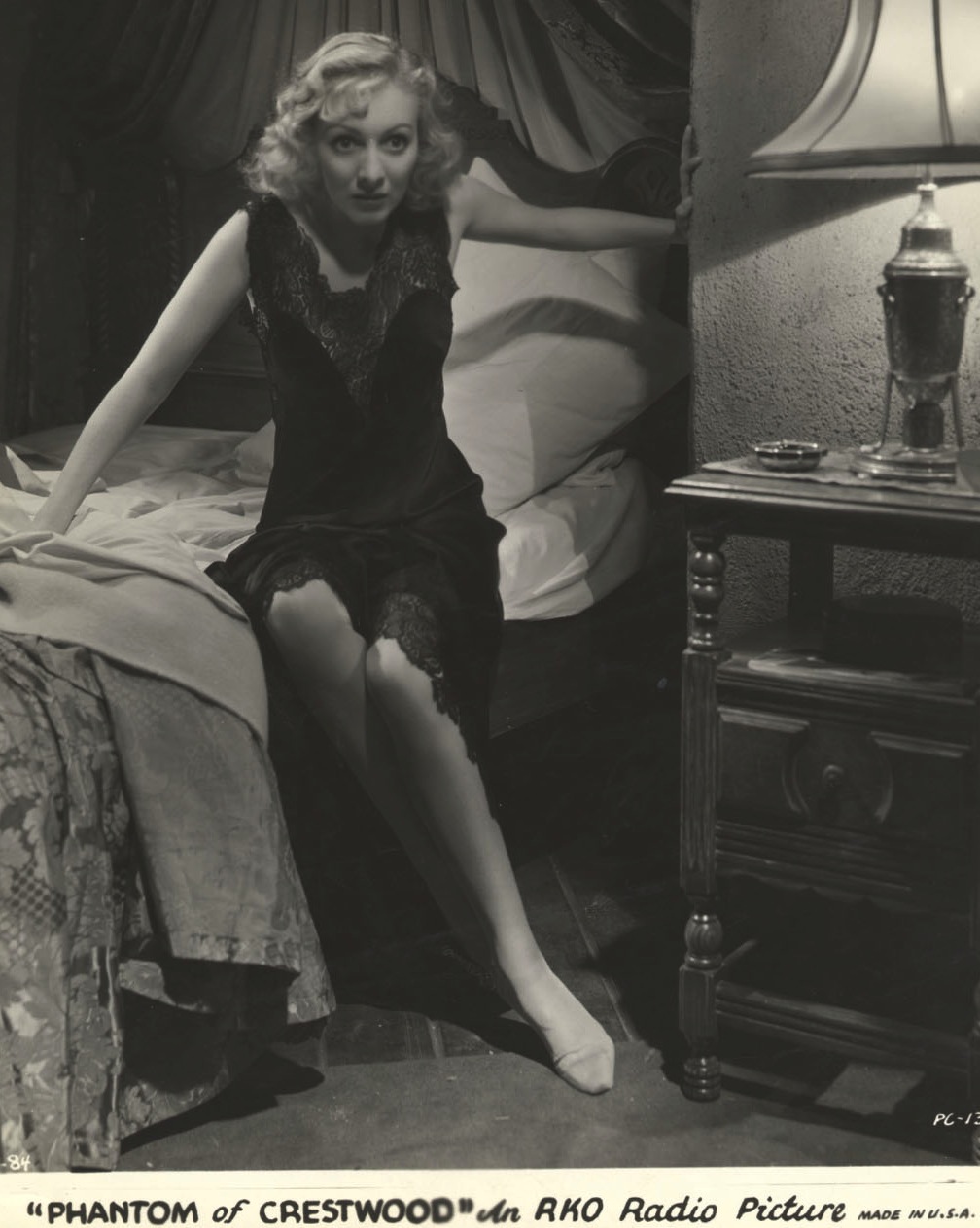
It's got everything I love: it occurs over one afternoon and night, ends at dawn, it's got fog, a washed-out road, a wind-blown house, murder suspects, death masks, and two of my favorite actresses: Anita Louise (Titania in the 1935 Reinhardt Midsummer Night's Dream) and Karen Morley (Poppy in Scarface). The latter delivers a scene-swipingly slithery performance as wry gold digger 'party girl' Jenny Wren, who's decided to retire and intends blackmailing all her rich ex-lovers in one fell swoop, gathering them for a party at a remote Southern California mansion at midnight, along with their wives, if any. The scandal! If this got out I'd be ruined (x3). Jenny's retirement is prompted--we learn via then-groundbreaking whirlwind flashbacks--bysome naive rich baby-faced college boy's leaping off cliff to his death after she dumps him (papa cut him off because he wants to marry her). Then his ghostly face appears on the balcony, and then she's dead, too, from a thrown dart (?). Ricardo Cortez and his group of gangsters arrive, initially to steal some of Jenny's incriminating love letters, but when they see the corpse, decide to hold the whole party hostage, and need quick solve the murder before the landslide is cleared and cops arrive. 


Yet another great instance of pre-code casting genius: Hilda Vaughn is Morely's awesome deadpan maid, a kind almost a Leporello-level co-conspirator and/or sewing circle "companion: rather than a mere servant. And if the lesbian currents don't run deep enough for you, there's the butch old aunt played by Pauline Frederick who--like Mercedes McCambridge in Giant--is fond of using horse breeding terminology when scrutinizing potential in-laws (i.e. Anita's innocent sister home from college). They're all great but it's really Morley's show - though she's in the role of the rotten blackmailer everyone wants to kill, she's so honest about her machinations, so amused at the way her suckers fear scandal, yet so winning in her "chalk it up to experience, youngster" worldliness, we want to write her incriminating love letters ourselves.

 The ending, on a foggy cliff with a single engine police plane coming in overhead and the two guys walking off into the fog, foreshadows Casablanca!!  The only difference, the plane is going the opposite direction! The End! The photography is shadowy and intoxicating almost to Von Sternbergian levels, but with all its (in this case, Spanish-style) old dark house accoutrements -- secret passages, clues, washed-out bridge keeping the cops away, complex motives and sophisticated pre-code banter, it doesn't even need to look good to be great.

THE ROGUE'S TAVERN
(1936) Dir. Bob Hill / Puritan Pictures - **

Detective Wallace Ford wants to marry Babara Pepper (a former department store detective)--and quickly-- so they head to a remote lodge the next state over (where its presumably easier to wed impulsively), there to meet a preacher at a tavern for a quickie service. But man, did Ford ever pick the wrong place! They haven't any vacancies. And the justice hasn't shown up. A gaggle of suspicious types mill in the lobby,  the wind howls softly outside in the night, and then a dog (Silver Wolf) bares his fangs on cue at certain windows and soon, sans preacher, they're all locked in by a mysterious killer. Suspects include a cabal of diamond smugglers, an old coot in a wheelchair and a sexy, strange fortune teller lady (the colossal Joan Woodbury) with a habit of staring straight into the camera during moody close-ups! And Silver Wolf! I've seen this movie a dozen times and fallen asleep every time, but there are worse films to doze off to than this one--the photography, framing, performances, and foggy, dog-howl atmosphere (we hear people scream alongside growls in another room and people run in just in time to see Silver Wolf jump through a broken window and the victim fall down dead) lifts it two steps above the average comparable Monogram picture--and long as you wake up in time to marvel at the sustained crazy killer monologue finale. Seriously, you'll love who the killer turns out to be - it becomes almost a giallo. 


Please note also the big fireplace in the lobby / lounge / tavern, which apparently was a mainstay of RKO-Pathe soundstage, chosen 2-1 by fly-by-nite indie outfits like our 'Mercury Pictures.' When at RKO-Pathe, make sure to build your set around the big fireplace, if it's available (too big to move off the soundstage). You won't regret it. "Have you got a fireplace?" asks Wallace Ford. "Have we got a fireplace!" 


Unfortunately, when the fireplace is the film's best artistic asset, it's gonna be a long night. Splotchy sound (sometimes there's none at all, when something like music, or wind noise, or even footsteps, would be nice; other spots people are talking but there ain't no sound to that either). Pepper's character has that post-code nag problem where instead of just telling Ford what she's seen out the window, i.e. fangs, murders, she hems and haws and stammers like Lou Costello while Ford (a detective in his day job) is busy cross-examining the rogues, and he's reluctant to listen to her, thinking she's just making some excuse to monopolize his time or make some dumb faux-Ann Sheridan wisecrack. One longs for the relative tactlessness of Jimmy Chan! Luckily the jewel thieves get some good knowing lines ("the preacher must be busy with something awfully important," notes one of them), the mystery keeps moving forward, and all three of the women in the cast are all fully-formed characters (for all my grousing, Pepper is a pretty on-key sleuth, silently trailing after suspects, searching everyone's room, etc.) The DVD version on Alpha and is pretty blurred (the Prime print is better). But I don't think clarity would help. The fog of booze, on the other hand, just might. 


ONE FRIGHTENED NIGHT
1935 - Mascot Pictures - **1/2

A dark and stormy night, a crotchety old man (Charley Grapewin) gathers his greedy heirs and promises them each a million dollars, but then some blonde shows up claiming to be his long lost granddaughter, so he changes his mind and leaves it all to her. If you want your granddaughter to survive the night!! Secret panels, passages. grisly masks, and a house full of strange blow guns and other indigenous tribal weaponry... you get the picture. 

ONE DARK NIGHT is a little more lively and ape-free than most old dark house pics, but finds itse;f  saddled with the inescapable Wallace Ford. He plays a Vaudeville magician named 'the Great Lavalle,' whose car conveniently breaks down near the old mansion during the storm. His assistant (Mary Carlisle) just so happens to be the real granddaughter heiress. The old man believes her because she refuses to have anything to do with him or his filthy money. Meanwhile there are poison darts, Hindi sculptures, and a line-up of suspects who all must sooner or later tangle with the usual carload of clueless, gun-jumping cops. Rafaela Ottiano (the human trafficker in SHE DONE HIM WRONG) is the maid; Arthur Hohl and Hedda Hopper (you heard me) are suspects. Ford has no interest in Carlisle except as a pal and assistant, which is unusual, so she upgrades to Regis Toomey, despite the fact he may be the killer.

FRIGHTENED has been a fall-asleep C-level favorite of mine for years in a more truncated version than the somewhat blurry Alpha DVD (I had taped it in the early 80s off the old PBS show Matinee at the Bijou).  I even used footage from it in my cynically unclaimed 2009 smashed hit, CURSE OF THE MALE GAZE. What better way, perhaps, to close this capsule collection than to present it now? 


See Old Dark Capsules 1 here (with OLD DARK HOUSE, CAT AND THE CANARY, THE GHOUL, THE MONSTER WALKS, THE GHOUL)

Friday, October 28, 2011

Old Dark Capsules: THE GHOUL, CAT AND THE CANARY, THE MONSTER WALKS, THE OLD DARK HOUSE, THE BLACK RAVEN


Secret panels, stormy nights, dying heirs, hairy hands, Karloff, candles, lawyers; priceless mcguffins stolen from a dead man's watch pocket; maybe a coroner, woken up at this ungodly hour of the night; guys in ape suits for the medium shots, stock footage of a monkey for the close-ups; Bela Lugosi stuck playing a butler with barely any lines because the producers are worried about his morphine addiction; shrieking maids; bats; black cats; skulls on desks; conniving trophy wives everyone wants dead. What could be more Halloween-ish? It's the Old Dark House genre, basically forgotten today because there are no more old dark houses. Now they're either 'haunted' or long-since converted to apartments.

But if you've ever spent a weekend at a rich friend's mansion then you know how weird it can get: a late night trip to the bathroom after everyone else has gone to bed can be a terrifying, surreal nocturnal journey ala THE NIGHT OF THE HUNTER river trip. The walls are so thick that if someone were screaming for help downstairs in the study you'd never even hear them, or be able to find them.

And no longer can eccentric millionaire uncles just caper down to Egypt and help themselves to whatever cursed, ancient artifacts they care to dig for. The colonialist yard sale is closed! But the films, thank Ra, remain open! Here's five I know like the back of m'hand, and the catacombs of m'mind: 


 THE GHOUL
(1933) Dir. T. Hayes Hunter
***

British studio Gaumont's attempt to make a 1930s Universal horror reveals just how great Universal horrors were by contrast, especially when made with Karl Freund and James Whale nearby. At any rate, GHOUL used to exist only in fuzzy dupes (in this country at least) so it's nice there are finally coherent transfers/prints around, for the film is lovely and foggy and cozy as a cup of Earl Grey at a midnight foggy moor picnic which, as a few of the other entries here make clear, is not as easy to pull off as it seems. The all-star cast includes Ralph Richardson as a noisy parson (there must be a running joke in English dog-and-pony circles about nosy local vicars cycling from house to house to mooch drinks). Karloff stars and gets almost no lines as an eccentric, dying Egyptologist who spends 75,000 pounds on an emerald he thinks will bring him back from the dead. He's soon entombed to the strains of Wagner's immortal "Sigfried's Funeral March" but naturally the gem winds up bounced around the rest of the skulking cast, starting with Ernest Thesiger (Dr. Pretorious!) as a worried Christian butler, and Cedrick Hardwicke as a grumpy Dickensian lawyer who employs rather elaborate strings of words like "I intend to grant myself the pleasure of calling on her this evening." They're all either looking for the emerald, stealing it from someone else, writing notes, stealing said notes in the fog, making peace with angry cousins, being strangled by Karloff (back from the dead and in search of his expensive emerald) or having sadomasochistic fantasies (how very British!)


The grand guignol moment is when Boris carves a bloody ankh symbol on his bony chest, cut from many prints, and skulks around nearly harming the ladies (he's really just after the gem and immortality) and the comic relief comes in the form of Katherine Harrison as the daft best friend of plucky heroine (Dorothy Hyson). Believe it or not, Anthony Bushell and Harold Huth steal the show as a bemused Arab and a square-jawed nephew, respectively, THE GHOUL would make a fine, weird double bill with the original MUMMY (1932), and possibly even stole its props. Alas, like so many British-Egyptian Museum horrors of the era all the supernatural elements must be conveniently explained away by film's end. One mustn't leave the queen's subjects thinking such things are true, you know... a gullible lot they are, I'm afraid, sir. That's not to say this jewel still isn't a little loose in its setting, sir! Pure 30s horror mood it is, with enough Worcester fog to carry it through if you lose track of who has the jewel, or where it's hid, or where everyone else is relative to everyone else on the grounds.

THE CAT AND THE CANARY
(1939) Dir. Elliot Nugent
 ****

My favorite Bob Hope movie! I've seen it 1,000 times! Dragging my canoe behind me! I taped it off 'Spotlight' in 1980 and, in some ways, I'm still watching it. It only came onto DVD recently, was never on VHS and hasn't been on TV ever, so if you don't remember it, there's a reason. The silent version is in public domain but who needs it when this one has Bob Hope in the perfect mix of romantic hero and scared goofball quipper as Wally Campbell. It was his first big role and his comedic timing is so sharp he actually heightens the suspense with his whistling in the dark style asides, double takes, and feints back and forth between courageous pose and truthful reveal of (understandable) fear; he puts all the other variations of this character to shame (and I mean you, Wallace Ford). He's also drawn a great leading lady in Paulette Godard, though it's clear that in the original she's a bit more frail and old-school kindness-of-strangers-dependent. Goddard seems way too modern to faint or drop a gun, and way too sane to believably be even remotely as out of her mind as her greedy relatives would like to believe. That's because the she's the sole heiress to her eccentric Uncle Cyrus Norman's bayou mansion, where an escaped maniac who calls himself 'The Cat' is prowling for victims, and where the disparate relatives are gathered for the midnight will reading, a cliche which really got its start with the play version of this, which underwrites not just this film but the entirety of the genre.


So much that could go so very wrong goes just as right instead in the hands of director Elliot Nugent. He keeps the shadows alive and makes sure a creepy wind sound accompanies the fine Enrst Toch score (which never gets cutesy, just creepy). The outdoors around the house is a big swampy fog-bound soundstage rather than drab outdoor footage, which earns it a high mark; the secret panel-to-the-small-garden-hut climax conjures the expressionist shadows of Cabinet of Caligari, replete with the maniac's dramatic posturing - very high mark. What a cast! George Zucco reads the will and is the first to get murdered; Gale Sondergaard is the Creole housekeeper in tune with the mysterious chimes and 'murmurs' of the old house; and nobody sings or titters like an imbecile, not even cousin Cecily and she has to hold her finger under her nose to keep from screaming. Top marks. It was such a perfect lightning bolt synergy of style, substance, and cast chemistry that Hope reunited with Sondergaard and Zucco when they played his Nazi pursuers three years later in My Favorite Blonde and he reunited one year later with Goddard in The Ghost Breakers which has more supernatural elements than Cat and is generally considered the better film, but man, I'll take them both. It's still early in his career enough that Hope doesn't know yet just how great he is, but Nugent does, and the atmosphere is electric. Dragging my canoe behind me!

THE MONSTER WALKS
(1932) Dir. Frank Strayer
 **

This creaky Frank Strayer riff seems recorded on the kind of early sound equipment that was outmoded by 1930. The air is thick with burbling hiss like everyone is underwater (which I like). It's got most of the boxes filled:  big old dark house with a rich dead patriarch? Check.  The will read and an absentee girl heir (the compact Vera Reynolds) breezes in to collect the millions? Check. Ape in a cage in the basement? Check. Willie Best as a frightened chauffeur? Check. But we also get Mischa Auer as the illegitimate son of the old creep in the wheelchair and the maid, angry he's denied any of the family fortune after all the hours he's slaved for that old man. Not even hairy hands coming out of the wall can remedy the social injustice and animal cruelty (the ape, named Yogi, is a real ape instead of a guy in gorilla suit) that lingers in the air while the typical Cat and Canary will-reading resentment simmers and the camera keeps its static distance.

I know the Leonard Maltin review by heart: "Willie bests Mischa for laughs, but it's a close race." Lenny, you're my wheelchair-bound true father who taught me to write like a subliminal weisenheimer. Despite the unpleasant angles, the unconvincing stormy night-rattling-sheet metal makes it nice to fall asleep to as the sun comes up on another frosty November 1st, your blood levels of alcohol, ecstasy, nicotine, and sugar now dwindled to an early morning frost on the window shudder no amount of hot coffee can allay. Take it from me. "I have a premonition something's going to happen! Something horrible!" Vera says while the painting behind her slowly turns crooked so someone can spy on her. Her dumb boyfriend doctor (Rex Lease) tells her she needs something for her nerves, but then just kisses her. Dude! You should have got the tranquilizer! Then the old creep in the wheelchair tells her she should take one, too. And then the doctor goes to get her one after the ape hand incident and she still won't take it ("perhaps I won't need it"). Ugh.

Still in a movie this slow and strange it's the little things. "Nobody's going to steal their money," snarls bitter Mischa after his mom tells him to bolt the doors and windows. "It's not here." Best gets the last laugh: when he's on the floor panicking because the mouth on the polar bear rug has caught his slipper (he thinks it's "Mr. Yogurt") he seems about as afraid and engaged as if he's reading the script to himself while falling asleep. Vera is such an idiot she won't believe who the killer is, even when he's openly trying to kill her.

THE OLD DARK HOUSE
(1932) Dir. James Whale
****

The great 'lost' Universal horror of 1932. I longed to see it ever since I was a kid reading about it in my Creature Features guide, but it was all but lost thanks to the habit of destroying older versions when remakes came out (not that the remake resembled the original in anything but name/s). Then Kino came to the rescue via a restored, lone surviving print (discovered through the perseverance of Curtis Harrington), and co-star Gloria Stuart even did an audio commentary for the laserdisc.

I never had a laserdisc player, but James Cameron did, loved the commentary, and that's how she came to narrate Titanic! True story!

Not an old dark house movie, Old Dark House is not even really a horror movie or a comedy, but a James Whale movie. As such, it's a combination of many atmospheric, very British elements that don't come together until numerous viewings over decades help the various medicines buried in its flavor tapestry kick in. Getting older, we come to understand the 'that's fine stuff' rant by Rebecca Femm (Eva Moore) to Gloria Stuart, and how it leads to her reflection like that of a skull in the mirror; or the resemblance Rebecca has to a photo of Queen Victoria by her mirror; the general nicety and British crust of Horace Femm (Ernest Thesiger) who "likes gin" (and would still be drinking it a few years later in Whale's Bride of Frankenstein), the way the alcohol passed around by the roaring hearth gives you a feel of being there and feeling the warmth of the cinematic image like that same fire; the honest romance between lost generation lad Melvyn Dougas and Bill's (Charles Laughton) traveling companion Perkins (Lillian Bond); their arrival like a daft breath of fresh working class air in the middle of a stiff dinner, lightening the rich yobbo dryness against which the merry Melvyn Douglas hurls himself like a kid fighting waves on the beach. Karloff as the mute butler portrays the end point of madness and the beginning point of savagery; Laughton becomes the backbone of Britain; the late inning introduction of Roderick Femm--played by the elderly real life old lady of the stage Elspeth Dudgeon --provides a welcome bit of contextualization, change of scene and foreshadowing. And then, in a rage Morgan releases Saul (Brember Willis- the hermit from Bride) who is hopelessly, violently insane... See it 30 times, 300, it's still not enough... my friend.

 THE BLACK RAVEN 
(1943) Dir. Sam Newfield
****

When I'm having a travel-induced panic attack, THE BLACK RAVEN is my go-to source of solace. I really respond to the cozy fireplaces, howling wind, torrential rain, muffled dialogue, and the sense of conspiratorial cool amongst the more criminal guests (they all sign the register as 'John Smith'). It all takes place--like the best old dark house films--over one 'dark and stormy' night, beginning as guests learn the bridge is washed out in their rain slashed cars and ending when the rain stops at dawn. Padding around the waterlogged cardboard sets in his robe and slippers, Zucco's great as the enigmatic retired criminal who now runs a small inn (named the Black Raven) just this side of the Canadian border. No actual ravens or border-crossings appear in this film--too rainy--but Glenn Strange is the idiot manservant and the wondrously dour Charles "Ming" Middleton is the clueless sheriff. A suitcase of embezzled cash results in murder; a corrupt politico tries to break up his daughter's newlywed marriage; and an escaped crook is out to settle an old score with Zucco. An eloping young couple try and stay out of the way. Make sure to get the best available edition as there's lots of crappy public domain editions wherein everything is too dark and muffled. (Roan Group's 'Black and Blue' set that includes Ulmer's Bluebeard and Bela's great, incoherent Black Dragons is the best so far, and highly recommended). Your mileage may vary, but for my dark and stormy night PRC 40s money, it's Black Raven all the way.

Special shout-out to Verdoux! - it seems to contain the same eerie alchemical magick as celluloid itself!
Related Posts Plugin for WordPress, Blogger...