
Showing posts with label Comedy horror. Show all posts

Saturday, November 16, 2013

Wronger than the Storm: SHARKNADO, THE REEF

If November persists, talk to do your doctor.

If the 12 month cycle was Dr. Moreau's island, November would be the House of Pain: "there's no twilight in the tropics," Moreau says, "darkness falls like a curtain." So does night in November. The hushed chill of dying leaves rustle around in the corners of streets like packs of shuffling Bed-Stuy crackheads during the walk home from work at five PM! You absorb their shoulder-ache withdrawal and the cold of their torn feet from the corner of your glazed thousand yard stare as you sweep past, muttering incessant vile oaths (you, not them). November: the New York marathon ends on a cold Sunday evening after Halloween is over --and thus all that is good in fall. You obligingly weave your way to the finish line to meet them, your wobbly friends in their reflecting mylar disposable ponchos shining against the foggy grey afternoon; your pride in them is a little flicker of warmth in your freezing jitters. Going out to a bar to celebrate, sitting at a long table of celebrants with pitchers of beer and drams of Wild Turkey, none of which you can have as you're on the wagon, but you know that one shot--one single gulp-- and all that ache and misery would melt into an amber glow, all the pain converted to heaven in the time it take your leviathan blood to swim an arterial league. But No... No No November. Daylight savings begins like a long slow wet dog shudder; now it gets dark before you have a chance to emotionally prepare, the curtain that falls in Moreau's tropics. Suddenly the couch is extra cozy and every fibre of your being says "Let's not go out tonight. Or this weekend. Or ever." The sight of those shivery runners, high with endorphins (and later whiskey) they're the last you see of your crew. But with each missed party, another nail in the social coffin. But are you trembling? No. Why?

SHARKNADO.

Apparently it was all the rage in "Twitterverse" but I saw it later, or 'just now' on Netflix. After work. Alone. I'm not going to pretend I was in on its "trending." But I will confess I needed it. Didn't want no boring bits or glum nonsense the night I first saw it, just now, under lots of Brooklyn stress and soggy socked sinking from the weight of atmospheric conditions. There was none, and soon I was feeling warm and dry while watching Los Angeles get flooded with CGI sharks, in what plays out like almost like real time, snapping-up spoiled Beverly Hills brats and swimming along the freeway or raining from the sky with a rare-for-Syfy propulsive inland-rushing tidal energy. Rather than blithe news cutaways there's long car rides with fellow drunks, looking out from behind rainy windows as confused news reports crackle on the FM radio. Life goes on; even as LA falls apart under the rain of sharks, assholes still bicker and hardcore surfer exes overreact and have to save every endangered chum.


November. The bitterest, crushingest month demands a city (not mine) fall in totem if its to spare us its crushing measure. We watch LA drown in sharks the way barleycorn huskers watch their effigies burn, before family obligations rise like a prematurely buried Usher to wrest even the highest of kites back down to the beige carpets of a vacuumed earth, at least that kite will fly, and the husk will burn. The darkness will creep up towards the end of lunch and by the walk home we'll be snared in the trawling net of cold autumnal night. Relationships will crumble, jobs melt away, the windows shutter, the air conditioner will be taken hurriedly from the window... like a reverse burglar. But first, the fire.

The point is, SHARKNADO comes along, and a Ferris wheel rolls into the side of a four story international style apartment building like it's no big deal. Charlton Heston might drag that Ferris wheel roll out to three hours, but this film rushes along past it. Sharks in the bar, sharks in the traffic jam; "It's like old faithful!" as water shoots up from the sewers. "We're gonna need faith to get through that" over a flooded dip under an overpass. A douchebag boyfriend of the sulky daughter says: "Even if it is the storm of the century, Beverly Hill's rescue services are second to none!" And then he looks out the window, sees a shark in the swimming pool and before he can react a wave crashes through into the living room and his head gets bit off. And there was much rejoicing. If you ever played the game as kids where you had to be halfway up the stairs or on a chair or couch to avoid getting eaten by a carpet shark then yes you are in bad movie heaven. If the leader of the survivors, Finn, is a typical bleeding heart idiot who has to stop to help everyone, even school buses that look empty. "This is your problem, Finn!" bemoans the weary ex-wife (Tara Reid) - and we kind of agree, but then Boom! Turns out --there's scared kids in there, and a TJ Miller-ish bus driver way out of his depth! You saved another busload from the shahks, Finn!

What a man that Finn, what a tool. The real rooting interest is in his barmaid Nova (Cassie Scerbo) who wants to be more than a maid to Finn, but he's not into it (What a mensch Finn is! He has to stay loyal to an ex-wife who's already got a mule of a boyfriend literally kicking in his stall). As the loyal hardscrabble Nova, Scerbo proves the most interesting and non-cliche'd character. And she's also the source of larger-than-life wit and humor; a combination Brody, Quint and Indiana Jones, in the Goldilocks Zone of mild hotness (i.e. down to earth and accessible), toting a shotgun, and actually pulling off the kind of lame in-joke lines ("Sharks.... why did it have to be sharks?") that would make lesser actors crumple up in defeat. Later she even has her own 'Quint on the USS Indianapolis' style monologue as to how she got that sexy thigh scar. There's also John Heard as a dissolute bar regular, using his stool as a shark bashing device, and others that come and go and are gone in a flash of dark CGI blood spatter.

Effects are serviceable without worrying too much about perfection. Sharks fly in the wind but there are no other fish nor even a shred of seaweed in the wind, not even a wood splinter, and best of all, this apocalypse of sharkiness seems to follow Fin and friends alone -- other cars continue to drive by, unaware of any problems, even ignorant that the Hollywood sign is down to " Hol  o d". And even the biggest disaster of all: cell phone reception is gone is handled. Would it be half as funny anywhere else than LA? Car rental agencies are still in business, cops are cordoning off areas of downtown for no particular reason. There's no cause to panic unless you've been attacked, but meanwhile half a block down they're still waiting in line at the liquor store. Priorities.


There's been a ton of similar junky films from the SyFy-Asylum complex: Corman Y-generation ripoffs of Italian ripoffs of JAWS' rip-offs, which in turn reach back through cocktopus tentacles into the era of the 50s bug movie (ripping off Corman's originals). Most of them are pretty weak, effects wise, acting wise, script wise. But this one, it's different. It's like it overheard every excited kid hanging out on the beach in 1974-78, every kid wistfully imagining sharks flying out of the sky. 'NADO took notes like these kids were holy prophets. And let Tara Reid stand as a lesson against growing up under too much sun and peroxide. Yea.

In the end, it's Scerbo's Nova who really stands out, who makes it work as more than a high concept stunt. With her Jersey girl hair and raspy voice, way with a gun, and foolish crush on the one guy too self-righteous to get with her, she's a unique new creature in these sorts of movies, and may SyFy remember to keep her in the sequels; and remember too the uniquely comforting sound of a car radio giving out updates low amidst the conversation about what LA shortcut to take and who to rescue first. And remember too that--unlike the Dads of Great Adventure movies--this one is more wryly critical of unwelcome meddler Finn's bad habit of problem of having rescue everyone he meets, all the time, whether they want his help or not. The critique, Nova, and the gentle flap of wipers, sound of rain and the roof, and shotguns being reloaded --these are what makes this film so good. I worry those very things won't survive in the sequels to come, in favor of crazy cameos, wacky synergized marketing tie-ins, product placement, stoner dumbness, has-beens the producer owes a favor to crowding onto the Fin-boat, and all the other stuff sequels accrue like barnacles when something this low on the totem pole hits viral on Twitter. And there will be sequels. They already have the sharks in the disc drive, after all, just waiting to be used again.

Unlike real monsters--or people, or seasons--they don't go bad.

It's not just that these barometric eating machine projections have hit such a comforting firelight-style chord, it's that all these decades later and we're still happy to be reminded we were once afraid of the water. We can project our darkest unconscious fears right into the murky dark, right there as we lounge around under the beach sun. We all know the hard truth, even kids: the ocean takes it all. Soaks it all up it does, like a combination stress pillow and life jacket around your albatross neck, to make room for all the misery November has to offer.


Netlfix told me to watch THE REEF next, so I did, anxious to stay in the zone. Well, of course it's not as fun. Maybe it's something in their accents and cheery disposition but it's hard to distance oneself from a single Aussie in distress as easily the entire city of Los Angeles. The clear blue water under blazing sun is divine, but the money shots in THE REEF all occur under the surface. The story of a jaunty weekend boating expedition to some reasonably far away Aussie island in the a clear blue inlet (?) that ends up sinking and leaving the boaters dog-paddling around trying to make it to the island in one piece, it's not even the attacks themselves that rivet or make the gut sink, but the sight of great whites slowly materializing out of the crystal blue blankness around our frightened water-treading castaways. Like a distant rider in LAWRENCE OF ARABIA, they circle and you can't tell if they see you or not, their dead eyes betray no sudden interest. They just orbit lazily, then Bam!

But there's only so many times you can do that and have the same groovy effect. After awhile all you have is a lot of anxiety and monotony commingle even if you're glad to be relatively dry. There's so much damned blue between the sky and the sea, you pray for red just to liven up the palette.

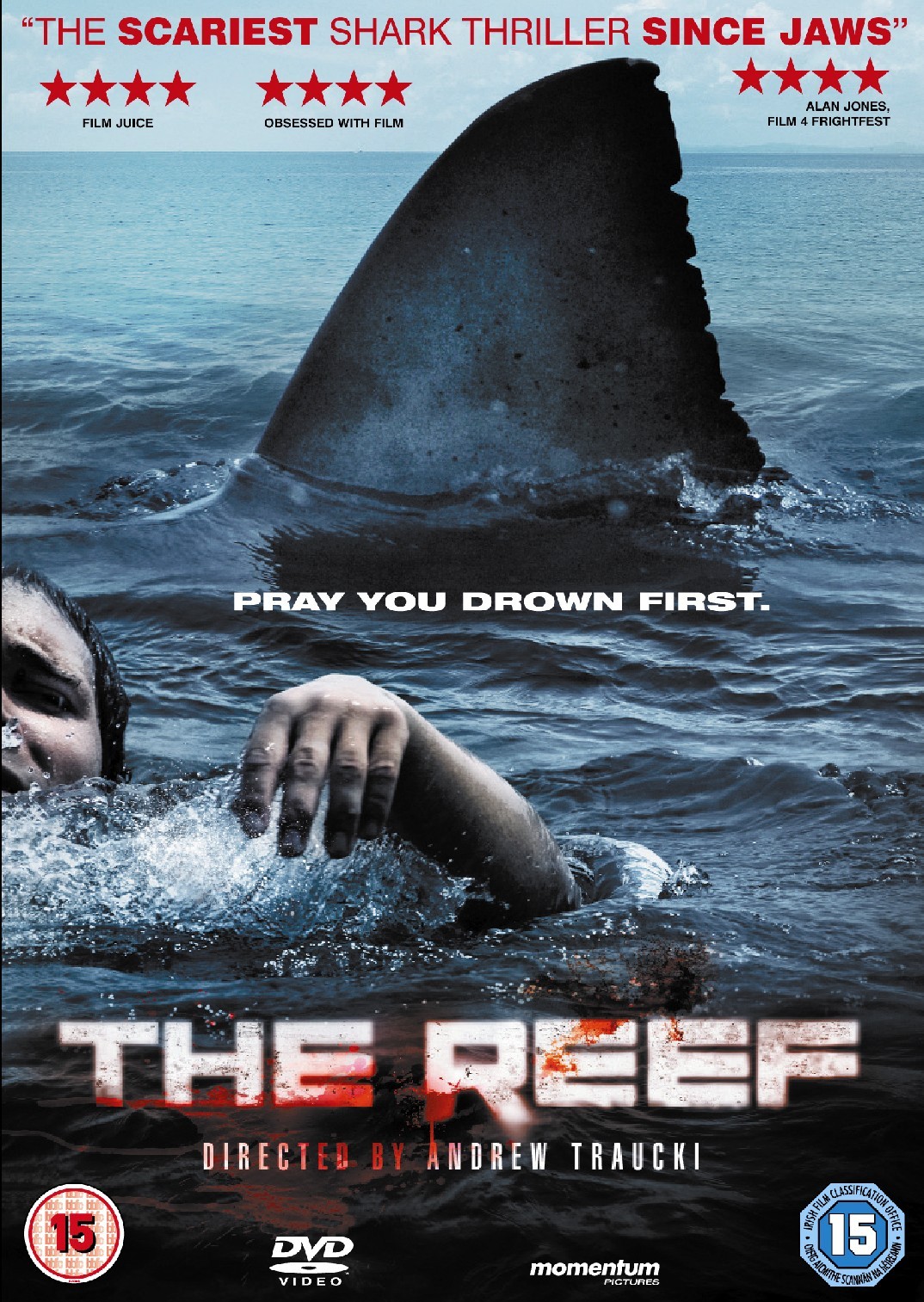
The other problem is the sheer stupidity of the outdoorsman captain. Why, if you're sailing in a really remote area with a bunch of people, wouldn't you have some kind of radio or distress signal? Or goddamned lifejackets! A goddamned flare gun. Anything!! Australia is crawling with sharks, so wouldn't you have something? Maybe shark repellent? Magnets? Life vests??!! Why if you are all in the water and completely vulnerable would you swim towards the friend of yours being eaten? What are you going to do to help, gather his falling limbs? You're just going to spread more blood in the water.

I doubt even SHARKNADO would argue that THE REEF (2010) is a better film, quality-wise. But aside from the stark blue scenery, it's a wee bit of a bummer, with wayyyyy too much acting. Do we see shark movies to get bummed out? No, we don't. (Though for me, I haven't even seen BLUE WATER for the same reason). SHARKNADO understands this. Actors need to be either confident enough to understand that too much screaming and hyperventilating in irrational panic can bum us out rather than make us scared, or be incompetent enough that it becomes fun to see them try to do either one. Here it's that they're good but not good enough to be bad enough that it's enjoyable.

The Aussies have a great advantage when it comes to monster movies: their country is lousy with great white sharks and giant crocodiles, and god knows what nameless evils lurk in the Outback, including all manner of Dundee-esque outdoorsy-worsy walla big knifed WOLF CREEK-ies, but they should never forget what we want out of a monster movie, laffs, mate! There's a baller Aussie croc film called ROGUE (2007) with the new queen of B-movie monsterdom, Rhada Mitchell, for example, that works a similar territory to REEF and is better for being so much hipper to our needs. And it's based on a true story, too. Take a note, November Netflix: THE REEF is just blue water and screaming, but SHARKNADO is deliverance from the cold dark depths and up into the sweet, sweet shallows. We can finally stand.

Friday, October 28, 2011

Old Dark Capsules: THE GHOUL, CAT AND THE CANARY, THE MONSTER WALKS, THE OLD DARK HOUSE, THE BLACK RAVEN


Secret panels, stormy nights, dying heirs, hairy hands, Karloff, candles, lawyers; priceless mcguffins stolen from a dead man's watch pocket; maybe a coroner, woken up at this ungodly hour of the night; guys in ape suits for the medium shots, stock footage of a monkey for the close-ups; Bela Lugosi stuck playing a butler with barely any lines because the producers are worried about his morphine addiction; shrieking maids; bats; black cats; skulls on desks; conniving trophy wives everyone wants dead. What could be more Halloween-ish? It's the Old Dark House genre, basically forgotten today because there are no more old dark houses. Now they're either 'haunted' or long-since converted to apartments.

But if you've ever spent a weekend at a rich friend's mansion then you know how weird it can get: a late night trip to the bathroom after everyone else has gone to bed can be a terrifying, surreal nocturnal journey ala THE NIGHT OF THE HUNTER river trip. The walls are so thick that if someone were screaming for help downstairs in the study you'd never even hear them, or be able to find them.

And no longer can eccentric millionaire uncles just caper down to Egypt and help themselves to whatever cursed, ancient artifacts they care to dig for. The colonialist yard sale is closed! But the films, thank Ra, remain open! Here's five I know like the back of m'hand, and the catacombs of m'mind: 


 THE GHOUL
(1933) Dir. T. Hayes Hunter
***

British studio Gaumont's attempt to make a 1930s Universal horror reveals just how great Universal horrors were by contrast, especially when made with Karl Freund and James Whale nearby. At any rate, GHOUL used to exist only in fuzzy dupes (in this country at least) so it's nice there are finally coherent transfers/prints around, for the film is lovely and foggy and cozy as a cup of Earl Grey at a midnight foggy moor picnic which, as a few of the other entries here make clear, is not as easy to pull off as it seems. The all-star cast includes Ralph Richardson as a noisy parson (there must be a running joke in English dog-and-pony circles about nosy local vicars cycling from house to house to mooch drinks). Karloff stars and gets almost no lines as an eccentric, dying Egyptologist who spends 75,000 pounds on an emerald he thinks will bring him back from the dead. He's soon entombed to the strains of Wagner's immortal "Sigfried's Funeral March" but naturally the gem winds up bounced around the rest of the skulking cast, starting with Ernest Thesiger (Dr. Pretorious!) as a worried Christian butler, and Cedrick Hardwicke as a grumpy Dickensian lawyer who employs rather elaborate strings of words like "I intend to grant myself the pleasure of calling on her this evening." They're all either looking for the emerald, stealing it from someone else, writing notes, stealing said notes in the fog, making peace with angry cousins, being strangled by Karloff (back from the dead and in search of his expensive emerald) or having sadomasochistic fantasies (how very British!)


The grand guignol moment is when Boris carves a bloody ankh symbol on his bony chest, cut from many prints, and skulks around nearly harming the ladies (he's really just after the gem and immortality) and the comic relief comes in the form of Katherine Harrison as the daft best friend of plucky heroine (Dorothy Hyson). Believe it or not, Anthony Bushell and Harold Huth steal the show as a bemused Arab and a square-jawed nephew, respectively, THE GHOUL would make a fine, weird double bill with the original MUMMY (1932), and possibly even stole its props. Alas, like so many British-Egyptian Museum horrors of the era all the supernatural elements must be conveniently explained away by film's end. One mustn't leave the queen's subjects thinking such things are true, you know... a gullible lot they are, I'm afraid, sir. That's not to say this jewel still isn't a little loose in its setting, sir! Pure 30s horror mood it is, with enough Worcester fog to carry it through if you lose track of who has the jewel, or where it's hid, or where everyone else is relative to everyone else on the grounds.

THE CAT AND THE CANARY
(1939) Dir. Elliot Nugent
 ****

My favorite Bob Hope movie! I've seen it 1,000 times! Dragging my canoe behind me! I taped it off 'Spotlight' in 1980 and, in some ways, I'm still watching it. It only came onto DVD recently, was never on VHS and hasn't been on TV ever, so if you don't remember it, there's a reason. The silent version is in public domain but who needs it when this one has Bob Hope in the perfect mix of romantic hero and scared goofball quipper as Wally Campbell. It was his first big role and his comedic timing is so sharp he actually heightens the suspense with his whistling in the dark style asides, double takes, and feints back and forth between courageous pose and truthful reveal of (understandable) fear; he puts all the other variations of this character to shame (and I mean you, Wallace Ford). He's also drawn a great leading lady in Paulette Godard, though it's clear that in the original she's a bit more frail and old-school kindness-of-strangers-dependent. Goddard seems way too modern to faint or drop a gun, and way too sane to believably be even remotely as out of her mind as her greedy relatives would like to believe. That's because the she's the sole heiress to her eccentric Uncle Cyrus Norman's bayou mansion, where an escaped maniac who calls himself 'The Cat' is prowling for victims, and where the disparate relatives are gathered for the midnight will reading, a cliche which really got its start with the play version of this, which underwrites not just this film but the entirety of the genre.


So much that could go so very wrong goes just as right instead in the hands of director Elliot Nugent. He keeps the shadows alive and makes sure a creepy wind sound accompanies the fine Enrst Toch score (which never gets cutesy, just creepy). The outdoors around the house is a big swampy fog-bound soundstage rather than drab outdoor footage, which earns it a high mark; the secret panel-to-the-small-garden-hut climax conjures the expressionist shadows of Cabinet of Caligari, replete with the maniac's dramatic posturing - very high mark. What a cast! George Zucco reads the will and is the first to get murdered; Gale Sondergaard is the Creole housekeeper in tune with the mysterious chimes and 'murmurs' of the old house; and nobody sings or titters like an imbecile, not even cousin Cecily and she has to hold her finger under her nose to keep from screaming. Top marks. It was such a perfect lightning bolt synergy of style, substance, and cast chemistry that Hope reunited with Sondergaard and Zucco when they played his Nazi pursuers three years later in My Favorite Blonde and he reunited one year later with Goddard in The Ghost Breakers which has more supernatural elements than Cat and is generally considered the better film, but man, I'll take them both. It's still early in his career enough that Hope doesn't know yet just how great he is, but Nugent does, and the atmosphere is electric. Dragging my canoe behind me!

THE MONSTER WALKS
(1932) Dir. Frank Strayer
 **

This creaky Frank Strayer riff seems recorded on the kind of early sound equipment that was outmoded by 1930. The air is thick with burbling hiss like everyone is underwater (which I like). It's got most of the boxes filled:  big old dark house with a rich dead patriarch? Check.  The will read and an absentee girl heir (the compact Vera Reynolds) breezes in to collect the millions? Check. Ape in a cage in the basement? Check. Willie Best as a frightened chauffeur? Check. But we also get Mischa Auer as the illegitimate son of the old creep in the wheelchair and the maid, angry he's denied any of the family fortune after all the hours he's slaved for that old man. Not even hairy hands coming out of the wall can remedy the social injustice and animal cruelty (the ape, named Yogi, is a real ape instead of a guy in gorilla suit) that lingers in the air while the typical Cat and Canary will-reading resentment simmers and the camera keeps its static distance.

I know the Leonard Maltin review by heart: "Willie bests Mischa for laughs, but it's a close race." Lenny, you're my wheelchair-bound true father who taught me to write like a subliminal weisenheimer. Despite the unpleasant angles, the unconvincing stormy night-rattling-sheet metal makes it nice to fall asleep to as the sun comes up on another frosty November 1st, your blood levels of alcohol, ecstasy, nicotine, and sugar now dwindled to an early morning frost on the window shudder no amount of hot coffee can allay. Take it from me. "I have a premonition something's going to happen! Something horrible!" Vera says while the painting behind her slowly turns crooked so someone can spy on her. Her dumb boyfriend doctor (Rex Lease) tells her she needs something for her nerves, but then just kisses her. Dude! You should have got the tranquilizer! Then the old creep in the wheelchair tells her she should take one, too. And then the doctor goes to get her one after the ape hand incident and she still won't take it ("perhaps I won't need it"). Ugh.

Still in a movie this slow and strange it's the little things. "Nobody's going to steal their money," snarls bitter Mischa after his mom tells him to bolt the doors and windows. "It's not here." Best gets the last laugh: when he's on the floor panicking because the mouth on the polar bear rug has caught his slipper (he thinks it's "Mr. Yogurt") he seems about as afraid and engaged as if he's reading the script to himself while falling asleep. Vera is such an idiot she won't believe who the killer is, even when he's openly trying to kill her.

THE OLD DARK HOUSE
(1932) Dir. James Whale
****

The great 'lost' Universal horror of 1932. I longed to see it ever since I was a kid reading about it in my Creature Features guide, but it was all but lost thanks to the habit of destroying older versions when remakes came out (not that the remake resembled the original in anything but name/s). Then Kino came to the rescue via a restored, lone surviving print (discovered through the perseverance of Curtis Harrington), and co-star Gloria Stuart even did an audio commentary for the laserdisc.

I never had a laserdisc player, but James Cameron did, loved the commentary, and that's how she came to narrate Titanic! True story!

Not an old dark house movie, Old Dark House is not even really a horror movie or a comedy, but a James Whale movie. As such, it's a combination of many atmospheric, very British elements that don't come together until numerous viewings over decades help the various medicines buried in its flavor tapestry kick in. Getting older, we come to understand the 'that's fine stuff' rant by Rebecca Femm (Eva Moore) to Gloria Stuart, and how it leads to her reflection like that of a skull in the mirror; or the resemblance Rebecca has to a photo of Queen Victoria by her mirror; the general nicety and British crust of Horace Femm (Ernest Thesiger) who "likes gin" (and would still be drinking it a few years later in Whale's Bride of Frankenstein), the way the alcohol passed around by the roaring hearth gives you a feel of being there and feeling the warmth of the cinematic image like that same fire; the honest romance between lost generation lad Melvyn Dougas and Bill's (Charles Laughton) traveling companion Perkins (Lillian Bond); their arrival like a daft breath of fresh working class air in the middle of a stiff dinner, lightening the rich yobbo dryness against which the merry Melvyn Douglas hurls himself like a kid fighting waves on the beach. Karloff as the mute butler portrays the end point of madness and the beginning point of savagery; Laughton becomes the backbone of Britain; the late inning introduction of Roderick Femm--played by the elderly real life old lady of the stage Elspeth Dudgeon --provides a welcome bit of contextualization, change of scene and foreshadowing. And then, in a rage Morgan releases Saul (Brember Willis- the hermit from Bride) who is hopelessly, violently insane... See it 30 times, 300, it's still not enough... my friend.

 THE BLACK RAVEN 
(1943) Dir. Sam Newfield
****

When I'm having a travel-induced panic attack, THE BLACK RAVEN is my go-to source of solace. I really respond to the cozy fireplaces, howling wind, torrential rain, muffled dialogue, and the sense of conspiratorial cool amongst the more criminal guests (they all sign the register as 'John Smith'). It all takes place--like the best old dark house films--over one 'dark and stormy' night, beginning as guests learn the bridge is washed out in their rain slashed cars and ending when the rain stops at dawn. Padding around the waterlogged cardboard sets in his robe and slippers, Zucco's great as the enigmatic retired criminal who now runs a small inn (named the Black Raven) just this side of the Canadian border. No actual ravens or border-crossings appear in this film--too rainy--but Glenn Strange is the idiot manservant and the wondrously dour Charles "Ming" Middleton is the clueless sheriff. A suitcase of embezzled cash results in murder; a corrupt politico tries to break up his daughter's newlywed marriage; and an escaped crook is out to settle an old score with Zucco. An eloping young couple try and stay out of the way. Make sure to get the best available edition as there's lots of crappy public domain editions wherein everything is too dark and muffled. (Roan Group's 'Black and Blue' set that includes Ulmer's Bluebeard and Bela's great, incoherent Black Dragons is the best so far, and highly recommended). Your mileage may vary, but for my dark and stormy night PRC 40s money, it's Black Raven all the way.

Special shout-out to Verdoux! - it seems to contain the same eerie alchemical magick as celluloid itself!

Tuesday, October 25, 2011

White as a Sheet: BLACK MOON (1934) and PARANORMAL ACTIVITY 2 (2010)


Voodoo and witchcraft-related horror films often simmer with a whole gris-gris bag of subtext: gender, race, and psychology all percolating under a boilerplate plot and how much of it we detect depending on our own cultural and educational situation. As our nation/world gets collectively more sensitized, not noticing the drip over spilling out of that pot seems hard. We can't not roll our eyes as yet again a white man lands on a voodoo island for gold or research or to investigate shipwreck and a cute young half-caste (or white, but made up in bronzer to look dimly ethnic) woman from the village betrays the gods to be with him; they escape in a boat as the island erupts in flames and all the black monsters die except the grinning ferryman who is innocent in his naivete, who spirits them away where they can breed and uphold the status quo and in later years, the now retired white dude can go "Voodoo? Harumph!" when the kids ask him about it.

As for the woman, it's tricky but with a recipe set in Hollywood stone: if she's actually white (usually her parents were missionaries or crashed in a plane) they're happy ever after (though maybe she still uses some voodoo in the kitchen, ala Burn Witch Burn). If she's not 100% white, she must die to save him, and thus appease the gods/censors). If she does live, you must imagine Carl Denham lecturing at a feminist studies group: "She was a queen in her jungle world, but she threw it all away to follow a handsome stranger home to to his own lands, and here she is, barefoot and pregnant, for your own amusement!"

In a very few films however, someone clearly takes a stand against these tired/true rules, such as in the consciously progressive, often forgotten voodoo film from Columbia, BLACK MOON (1934). With its mix of horror-action and white man's burden-coded proto-feminism it just may be the least racist and sexist of all 1930s racist-sexist zombie movies --a kind of pre-Lewton Lewton where women understand the supernatural realms instinctively while the half asleep men try to keep it all buried via tactics like condescension, humiliation, beatings, and threats --none of which work a damn-- until the status quo boundaries have shrunk to noose size.


Keeping with the subjugation motif, Fay Wray gets second billing in MOON but is the most recognized name, having tangled with Kong on Skull Island the year before. However, on this particular forgotten island the white power over the ebony denizens is long established, thanks to a racist French sugar cane plantation owner (Arnold Korff). His young niece (Dorothy Burgess) left the island years ago for New York City and now wants to come visit. He doesn't want her to, lest it excite the natives. Living there as a kid, she apparently did some serious mystic bonding with the locals and now the drums are calling her to return, return, with her own young daughter in tow.

The voodoo scenes turn out to be surprisingly respectful of the tradition - and the drumming and singing is awesome, with day-for-night shots of glistening black bodies drumming and dancing, old wizened faces staring off into the distance, and lots of white plantation garb that may be more true to the mileu but lacks the exoticism wer'e hoping for. There's no 'real' night in these scenes, no Anton Grot or William Menzies-type set design to bring it all into a rarefied realm. And it's slow going in spots, and very odd. It never seems sure where it wants to go, only where it doesn't. They even bring in the under-sung Clarence Muse (see my ode to him here) as the charter boat captain who takes old Jack Holt to the island (he wants to make sure his girl is all right). Muse is worried about his own girl, a local who's become much too mixed up with the voodoo scene. The form a kind of interesting bond of equals, not unlike Paul Newman and Sidney Poitier in Paris Blues, just two normal American guys wondering what's got into their women. There's no nonsense like there would be if their characters were played by Willie Best and Bob Hope, for example, though they werent' too bad in and of itself compared to other teams.


But while it's applaudable on these levels, and it is spooky right from the opening with servants in the voodoo lady's New York City apartment, shuddering at the sound of Dorothy Burgess teaching her infant daughter to play voodoo drums, it never lasts: a strange man who works for the colonialist uncle shows up with the message he doesn't want Burgess to go to the island--the natives are too agitated. She says buzz off, and then he's killed on his way to see the husband to try and get him to nail her fins to de floor, so to speak. What's cool is we want her to go to the island, so the native skulkers are killing the messenger for our benefit. Thus, the natives are clearly the good guys up to a point, as we bristle at the idea these scowling white dudes are going to decide where Dorothy Burgess can and can't go.

But in the end of course they are right.

Aren't they always?


Lacking any kind of central figure to care about, aside from Wray and Muse (both minor figures in the film) makes the film a little too reliant on atmosphere and expectation. The ominousness builds up for the big ceremony but it's so 'respectful' when it comes it's a bit of an anticlimax. The kid's maid is killed early on when she keeps objecting to the child being given things like knives and voodoo dolls to play with, but we don't see the murder or even the body. Why? This is a horror movie, after all. Wray wires for Holt to come and take them home but the wire operator is killed before he can send it. At least we get to see the explosion.

Even so, we side with the voodoo crowd because we're waiting for something genuinely 'bad' to happen. They keep talking it up, until it can't possibly match our expectation. But we do like Holt's relationship with his little daughter. They have a genuine bond and he's not a simpering sort like dads in films today, but a rough and ready 70s dad type and she loves him for it.


PARANORMAL ACTIVITY 2 shares a lot of BLACK MOON's deep subtextual feminism. Here the dad is a self-satisfied liberal authoritarian pretending to be fun, hip, gentle family man but he scoffs at the supernatural while his wife and maid know better, which only makes him resentful and furious, forbidding any mention of supernatural goings-on in his presence, even firing the maid for daring to light incense in the house. What a dick!


Like its forerunner, PA2 was a huge hit in theaters, and like BLACK MOON has a great, prolonged set-up with only mild yield: the initial ghost attack looks enough like an ordinary break-in that it compels dad to install security cameras and as our subjects sleep through the night these security cam images--a ghostly lit pool with the cleaner snake slithering around the surface; the crib room with the German shepherd guardian (the dog's not much for supernatural detection, surprisingly; the big petit bourgeois living room--take on a creepy life of their own as our eyes nervously scour the banality in search of some uncanny element or movement. Andre Bazin would surely approve!
 

One reason the PARANORMAL ACTIVITY films work as instant pop culture artifacts is their William Castle-ish utilitarianism - they are here to provide bonding moments of shock in the cinema on Saturday night, or to creep out couples on their couches, couples similar to the couples depicted. And that is all - they are obviously super cheap to make, and make far more than their more expensive competitors. But what they show is something new--the modern American family to itself as it really is, revealing the awful difference between how 'scary' we look on video vs. the pretty people we see in the mirror. The dad thinks he's a hilarious righteous sex machine but we see he's an asshole, etc. and then, watching himself on screen, so does he. These people are the American family that the sitcoms and TV want to portray, but don't have enough time. All the corpses the screenwriters can dredge up in the family garden pale in comparison to the unstoppable demonic ghost possession in the real time found footage usually edited out of TV shows. For eight hours or so every night most of us are in a sate of total unconsciousness. Who knows what's going on while we're asleep? It's creepy. That's what got us hooked in the first place with the first PA - a possessed sleeping girl standing motionless over her sleeping husband... hour after hour.

It's important in each example here that the endangered family be upper-middle class as success makes the dad 'dependent' on the prevailing reality and culture. He's got something to lose. He knows hungry young bucks are eyeing his spot. A white trash redneck sleeping in his pick-up truck has nothing to lose by embracing new paradigms and is thus way more likely to be down with the supernatural. But in the American upper middle class' unconscious, the uncanny is ghettoized so deep that when dad finally sees the tape and learns the truth he becomes a fractured, incoherent mess, worse than useless and ripe for possession. If such a possession was offered he'd snap at it, a chance to switch sides and affix his star to whatever's currently in charge, whatever overpowering force wants to supply the new paradigm, no matter, as long as he can still feel smug.

Just as BLACK MOON is not just about race oppression but gender oppression, each one a metaphor for the other, so too the PARANORMAL films are about superstition and rational thinking kicking each other into oblivion. When the rational left-brained know-it-all douche bag dad types are forced to confront the truth, forced to realize via the very rationalist tools of the skeptic-- security cameras-- that they can never completely protect their children, even in their own house--that their kids will always be exposed to danger, then not even the TV set can provide a respite, then dad is drained of all his false entitlement. And if he denies he ever even had any, his double negative shoots him in his own foot through his mouth.

Such a realization of complete powerlessness is the apocalypse of the American family and its one salvation. One thinks back to the "they're here" moment in POLTERGEIST, and if you compare the downward spiral from level-headedness to powerless tired mess of Craig T. Nelson as the dad in that film vs. the gone-to-pieces dad in PA2, all you can do is weep for the incredible dissolving father. The ghosts came through the TV static in that 1980 pre-cable film (when white noise static and station sign-offs still existed), but the PA films are made on and with digital --there is no more four AM shot of an American flag to signal the end of another broadcast day, no chance for static to sneak through and speak to us in its crackly 'popcorn' white noise languge. We have 900 channels of cable and it never, ever sleeps. It's not just ghosts we shut out, it's everything. All hail Shark Vacuum

Tuesday, October 18, 2011

Halloween Essential: THE BOOGIE MAN WILL GET YOU (1942)


Straight horror was considered ill-timed during the war, but horror comedy was OK - get 'em laughing at the boogie man and the eggshells don't crunch quite so loud underfoot on the way home. If only an attempt by Columbia to mimic Arsenic and Old Lace, then a Broadway hit, THE BOOGIE MAN WILL GET YOU would be pedestrian fluff--and most critics dismiss it as just that---if the script didn't rock in a way so deadpan it take many viewings to truly savor. That means that you must come to terms with the shrill hamming of Larry Parks and "Miss Jeff" Donnell in the Brad and Janet roles. It's worth any effort to get both Boris Karloff and Peter Lorre, bouncing off each other with perfect comedic timing. Clearly, we're meant to share their bemused disdain for Bill, the high-strung little pisher of a romantic lead (Parks). He's shipping out to war but first has to square up with flighty ex-wife, Winnie (Donnell) who just bought the crumbling old inn where mortgage-strapped Karloff is brewing atomic supermen in the basement and two old character actors round things out as the resident 'cook' and 'pigkeeper.'

Ever-angered at his own co-dependent need to save her (he thinks she's gullible), Parks' is like a high strung little wire--one of those shrimpy 4F guys Hollywood had to use to patch the holes left by all the A-1 recruits and draftees. It's clear Winnie does need saving (heavy clocks and sideboards nearly fall on her quite often) but she doesn't think so and regards Bill as a tiresome nuisance, though he eventually proves his worth. Visitors to the inn include two doubtful state troopers, a crazy 'human bomb' escaped Italian POW, and the always delightful Max Rosenblum as a powder puff salesman ("like what ya dab on ya kissa"). Lorre is the town magistrate, sheriff, and the notary public who arranges the deed to be signed over and eventually joins Karloff in his superman brewing (the failures are stored in a cold morgue room off to the side. Parks and Winnie set about the renovations, and hunting for possible shadiness and it's all so good, so right, you get the vibe you might remember from when dad's away for the weekend on business and mom lets you stay up extra late and makes popcorn.


If you've seen ARSENIC, the film version made two years after BOOGIE MAN, you know that Parks' equivalent would Cary Grant's Mortimer Brewster. Grant uses the same high voiced morality and exasperated protectiveness as an excuse for avoiding sex. Recall how Grant keeps his bride waiting at the cab while he tries to quickly send his homicidal aunts off to "Happydale," like they are the ones who need it. Parks at least seems to want to have sex at some point, and is willing to do the Bed, Bath, and Beyond route if that's what it takes to get there. Winnie has his number ("Bill," she asks romantically, "don't you ever get tired of yourself?") and it's all understandable because men were hard to find on the home front back in 1942. They better look 4F if not in uniform, and not get too lucky with all the single girls drifting around in zombie fugue states between the sexy bookstore girl in The Big Sleep and the tranced-out Monogram brides of Bela Lugosi in The Corpse Vanishes and Voodoo Man. 

The catch is that, just like we root for Grant's crazy aunts in Old Lace, we root for Karloff and Lorre here way more than Parks. First the "gruesome twosome" spar with each other, old neighborhood enemies (Lorre owns the mortgage) but they then form a bond with Lorre helping Karloff turn passing salesmen into electro-powered supermen: "He will destroy Berlin! He will throttle Tokyo!" Meanwhile, the ghost of Unkus ("The last of the Mohicans!") keeps emitting unearthly yowls in the day-for-night exteriors, and a portly 'balletmaster' snoops around the grounds and deflecting knife attacks from the crazy old lady housekeeper with his whalebone corset.

The dialogue is deliciously archaic throughout, as if a drunken Vincent Price was mocking passages in some old Victorian novel. Someone had a good time writing this, and the actors ride that spirit. Lorre gets a great glint of mischief in his eyes and Karloff riffs on all his past and future mad scientist-cum-daffy but lovable old duffer roles.


There's lots of great little bits I love and can quote by heart: Lorre's kitten, which he carries in his coat ("she has an amazing affinity for crime and corruption!") and his easygoing way with handling all the magistrate duties required in this strange 'historic' town is consistent with the Norman Rockwell divided by Chas Adams political allegory of the moment, reflecting the way social order and governmental fixedness dissolve on the home front when the bulk of the brains and brawn are occupied elsewhere. Authority and energy streamline themselves, for survival's sake; capitalist money-grubbing is put on hold in favor of a kind of can-do socialism America shuns both before and after emergencies. At such times as war, petty tyrants can grab the throne and force true noblemen to turn outlaw and rob the rich and give to the poor in Sherwood. Or in this case, to help the war effort by taking 4F door-to-door salesmen and turning them into super soldiers!

Karloff and Lorre bring out the best in each other. One of the big tragedies of cinema is that Karloff wasn't released from his Broadway contract to do Capra's film version, though the rest of the cast all got to (west, that is). Karloff instead made this film, almost as consolation, once the show was over, and Raymond Massey stepped already into his shoes on ARSENIC, making all the jokes about "he he looks just like Karloff!" completely confusing -not that he did that bad a job, it's just that Karloff would have nailed it and no one would ever accuse anyone of looking 'just like Massey.' Not just for that reason but I prefer BOOGIE to the film version of ARSENIC. There's a lot less repetition and whinnying sexual anxiety and a lot more Lorre and Karloff. That means, in other words, more Halloween perfection, despite its relative sunniness (Capra got to use real night, and you can feel the difference). Put it on a double bill with Roger Corman's THE RAVEN and your Halloween shall be neither Karloff and Lorre-less no mit aus heiterkeit!
Related Posts Plugin for WordPress, Blogger...