Showing posts with label World War Two. Show all posts

Friday, March 10, 2017

Shhhh! At long last, lost Lewtons: ZOMBIES ON BROADWAY, THE FALCON AND THE COEDS


Shhhh! Let us speak of Val Lewton, but quietly. A man whose oeuvre of poetic B-movie horrors we knew of, even in the 80s of Central Jersey suburbia (where we taped them off local TV creature double features, like a fisherman dipping his claw into the soft stream), Lewton made subtle and shadowy noir-horrors that are still ephemeral, mere wisps of smoke through the threader. Yet how come even my Journey-crankin' gearhead brother also liked Cat People and I Walked with a Zombie after I taped them back-to-back when they came on WORs Creature Double Feature and we watched them nearly every night one long ago summer, the fan on next to the window drowning out the crickets,  and the harp and frond shadows whistling all around the dark verandas? We dug the growls in eerie WMCA basement pools, and the rustle of the cane fields. They didn't shout and telegraph their emotions --they talked in low, conspiratorial voices and operated on a level of subtlety that drew us in (we had to lean into them), leaving us transported, and... then... suddenly realizing, as does the lovelorn birthday girl in Leopard Man, that it's gotten dark and we're locked in with some strange deadly force we can never see clearly. Where most horror was like a crazy derelict shouting at us over shrill orchestration, Lewton's movies lured us close with seductive calming whispers.

Maybe that was part of their appeal --the low, quiet talking was part of the wartime experience. Loose lips sink ships! The guy on the park bench reading the paper might be a Nazi spy! We could watch these films all night and never wake the parents (and they were good for hangovers, too).


It being the war, the thinking at the big studios was that if one must make horror films, make some of them hilarious, so that America might laugh at its Euro-thrashing boogeyman fears. Boris Karloff was on Broadway with Arsenic and Old Lace, and 1942's underrated Boogeyman will Get You was at Columbia; Lugosi was chasing the Dead End Kids around moldy Monogram passageways. And at RKO--on the B-lot with Lewton and Tourneur--a new way to exorcise the horror of war was manifesting, a style the both looked forward to film noir and backwards to classic literature and ancient myth, and with a minimalist leave-it-to-your-imagination approach to monsters.

The latter was something that we young Famous Monsters of Filmland devotees were initially turned off by, but then later-- when confronted with too many bad monster suits--we finally realized how seeing is never the same as believing; a really dark black shadow is itself scarier than any illuminated monster hiding within it.

That shadowy minimalism, in combination with the quiet whispering and the mostly-indoors filming, and the supernatural--unconscious--power-of-suggestion-genuine supernatural transformation aspects, makes Lewtons seem very personal. Everyone in the world could be wearing I walked with a Zombie T-shirts and we'd still think we were the only one who resonated with its weird dream poetry. It was just some small precious thing that spoke only to us in a 'psssst' sort of conspiratorial whisper, like some girl you meet at four AM outside on a stoop and have an hour-long conversation with in low voice to not wake the neighbor while you share a cigarette (and then you realize she was never even there - just a dream, your anima projected onto the smoke). I'm always amazed when I hear other people say they love these films, for I presume they're my discovery alone, and so perhaps do they.

That's why we fans--especially those who love both film noir and art films as well as horror pics, feel protective of them. I don't like all Lewton's later movies as well as the first four; I think it was a mistake to separate him and Tourneur after the third film, a mistake to start casting children (as in Curse of the Cat People and The Body Snatcher) and setting things in period costumes, and a mistake to lose narrative steam by getting hung up on polemics on 'authority in tight spaces evoking madness '(Ghost Ship, Isle of the Dead). All the tri-corner hats and clattering hooves and smiling coachmen (Bedlam, Body Snatcher), make me feel like I'm being dragged through Colonial Williamsburg as a bored, thirsty kid with aching feet (an experience which left me with a lifetime aversion to period pieces and the smell of horses).

The later Lewton would have no doubt done an actual Jane Eyre instead of I Walked with a Zombie, for example. If only the executives in their infinite wisdom didn't give him such easy literary titles as Body Snatcher and Bedlam! Better they got weirder and more prosaic like The Thorned Glove of the Time Traveler or I was a Voodoo Vampire. 

All of which is a tortuously long preface to the discovery of two 'sort of' Lewton films made by RKO's other B-units but using many of the same people, same actors, crew, writers, sets, props, ghostly mythopoetic flavors and signifiers from the first four films (all from 1942-1943) in the Lewton RKO series. When I've run the Lewton circuit and I got to have more, and am eyeing the Bedlam, Body Snatcher last gasp with grim countenance, maybe I'll turn to these instead. 

So here are two I have found and folded into my Lewton box, if you get my meaning. None of this will mean much to people not in love with the breezy interiority of I Walked with a Zombie. But then again, who wouldn't be, if they surrendered to it?

THE FALCON AND THE CO-EDS 
(1943) Dir William Clemens
***

From its crashing waves close-ups and swirling romantic piano music score, right down to the title font, the resemblance of Falcon and the Co-Eds to the opening of I Walked with a Zombie is uncanny; I only noticed it though as I recently saw them both--quite by accident-- back-to-back (1).
In addition to cast, font and mood, the figure of a gloomy fragile-doomed poet hangs over both this film and Lewton's fourth, The Seventh Victim. All three of them are from 1943, and two were written by Ardel Wray, a mysterious poetic figure who seems clearly to have modeled these fragile doomed poets on himself, possibly exorcising some inner doomed poet, forever at odds with the RKO B-movie system, looking for one muse to lift him from suicidal despair.

In both instances, a poet is hanging around and wafting in his (spacious) bungalow, clearly nursing a fabulous dreamy crush on some girl who's really a shimmering reflection of his own dream anima. A teacher at the all-girls school, the dead poet/English professor has fans who are sure it wasn't an accident or suicide and that the dean just wants to avoid scandal. Hence a saucy student heads down to the city to steal the Falcon's car so he'll need to go up there to get it. Once he's up there, reading the dead poet's manuscript as a crushing girl is swallowed in billowing curtains from an ocean view window, we think instantly of Seventh Victim's Jason (Erford Gage) and his original draft of poetry that Dr. Judd accepts from him on their way to the Satanic mass, or thereabouts. Reconstructing the personality from mute evidence, the Falcon declares this dead poet "a man who perhaps demanded too much from people and had to live in books to get it, who spent most of his time alone,.... who took refuge in his new imagination (...) how easily a man like that could be dominated by others." and "He lived such a narrow empty life that it finally suffocated him." Damn dude, been reading my seventh fLstep? Nimbly prowling around the grounds, Tom romances or confounds the endless string of suspects, manages to maintain the student body's collective crush without either dampening or indulging it, and employs three singing moppets to shadow suspects, the very cool 'Ug Sisters.'

Haunting Co-Eds with otherworldly presence is a dreamy psychic student named Margueritte (the alluring Rita Corday), with a dead composer father--supposedly similar in temperament to the dead poet (but more famous)--who keeps having premonitions of death ---voices whisper to her in the wind to kill herself. We hear what she hears in the sound mix, and it's pretty creepy as the whispers blend with the wind until we almost feel like we're going crazy. And for a supposedly grounded mystery, the film keeps a tactful and open-minded opinion on the supernatural, mirroring that of Lewton's films, wherein the real and the vividly imagined merge into a poetic realism (i.e. Irina is a cat and/or a frigid hysteric in Cat People; Jessica is a zombie and/or a casualty of tropical fever in I Walked with a Zombie - the supernatural as a dweller on the threshold of existence).


Tom Conway seems to have been quite busy amidst the RKO B-lots, for in 1943 alone he was in three Falcons and two Val Lewton pictures (Seventh Victim and I Walked with a Zombie). Like Lewton, Conway was born in Russia (St. Petersburg) to a wealthy family that fled the Bolsheviks, bringing with them with barely any of their vast fortune). Looking at Cat People now I realize that it is not really my favorite Lewton film anymore - it lost some esteem when I lost my own virginity (and stayed human). But whether the curse is real or not, I'm a huge fan of Conway's lascivious Dr. Judd. I'll grant you he doesn't really buy into her story and he should, because he's already losing his chance to get her on the rebound, but then it's too late; one certainly can't hold it against him if he turns up the following year after supposedly being torn up, to go around pimping Jean Parker and pissing off more poets in The Seventh Victim. 


Here are some more similarities -
WOMEN

The women angle too is interesting, as Lewton films are stocked with so many strong females. With women doing so many of the jobs usually taken by men during the years 1941-45, it's imperative to remember that, while women suffer at the hands of soldiers and blah blah, its a great time for feminist advances in the workplace and an even better time for attractive men still at the home front, that is if they want to experience a world where the women compete for the men, for a change. That's part of the noir fantasia we so love in The Big Sleep for example, all the hot available lady cab drivers, librarians, book store managers, etc. We think 'oh how novel!" now, but these films reflect a very real facet of life at home during the height of the war, and not only are there many women, but war widows, and in the morality of the time, a widow was basically allowed to sleep with anyone she wanted. She had given her maidenhood to the cause, and now the rest of her sex life was her own.

The girls' school, seen in both Co-Eds and 7th Victim is a prime example of this Edenic safe space in the time of war (ala the woman's dorm in A Matter of Life and Death). This is a kind paradise a man overseas can imagine without feeling either sexual desire or paternal affection but something in between and yet neither, beyond any one final thing, reflecting the feminine eternal flame that cores the death drive like an apple.

THE AMBERSON STEPS


Astute viewers will also notice the school's main stairwell (built for Welles' Ambersons and used regularly by the B-unit) used for the interior of the all-girls' schools in both Co-Eds and Seventh Victim - leaving us to wonder - is it the same school?

Alas, Jean Brooks

I am not a fan of Brooks, and though she wears a few nicely trimmed dresses here and is a decent actress am shocked by her callous behavior towards the "students" (many of whom seem no older than her) and that we're supposed to not think she's the dragon lady. Kind of the missing link between Joan Bennett and Shelly Winters, she has gravitas and a no BS sense of acting and purpose that creates a kind of hangover contagion rather than the allure we'd hope for. Not sure if it's me but I can't abide her character being mean to Marguerite or letting a panther loose, or turning down a poison drink for weeks only to pick a noose instead. Nothing makes sense when it comes to our Ms. Brooks. 

ZOMBIES ON BROADWAY
(1945) **

Deconstructing the horror / war mindset is tricky. We can understand the psychology behind the horror ban as a classic example of Hollywood misdiagnosing the contradictions that abound in viewer psychology. The feeling was that audiences didn't 'need' more horror (the war provided plenty). Lewton's B-unit and Universal's THE WOLF MAN and SON OF FRANKENSTEIN proved audiences needed the old horrors more than ever, but they also needed to be able to laugh at their fears. Thus, horror comedy became a huge parallel program, stretching from Bob Hope in CAT AND THE CANARY (1939) and GHOST BREAKERS (1940) through to BOOGIE MAN WILL GET YOU (1942 and the stunning success of ARSENIC AND OLD LACE on Broadway, which kept Karloff out of films for almost a year.

RKO finally loaded itself into the horror-comedy canon for ZOMBIES ON BROADWAY in 1945, a clunky if well-crafted little blend of scares, laughs and island intrigue. The comedy comes from a pair of shifty talent agents who try to appease gangster Sheldon Leonard's yen for nightclub entertainment by procuring a real 'live' zombie for his voodoo-themed lounge. What makes it, like Co-Eds, a long lost Lewton is that the boys go to San Sebastian, the same island setting as 1943's I WALKED WITH A ZOMBIE, and there they meet several actor/characters from that film, including the tall scrawny bug-eyed zombie, Darby Jones (above- the skeletal tall black man who plays the scariest of the zombies in Lewton's film, Carrafour) and the strolling calypso singer, Sir Galahad.

Though not part of the Lewton crew (he'd only appeared in a small role in the same year's Body Snatcher), Bela Lugosi has a florid, full-tilt villain role as the zombie maker who ensnares our bumbling pair of Abbot-and-Costello-esque comics (2), tying them up and then letting them run amok through his trap doors and passages, chased by himself and Jones.


As with Lewton's Zombie, a real chilling highlight is a song from Galahad, this one played as the boys disembark on the San Sebastian dock. First Galahad sings happily about how San Sebastian is a tropical paradise but when the boys walk past him and he's behind them, and all the other passengers have gone from the dock, the song gradually darkens in melody and lyric, to become a tale of menace, paranoia and woe.

Sir Galahad's songs are always direct addresses to the people he's singing about, which is what makes him uncanny - as in his slow ghostly walk across the empty veranda towards Frances Dee after brother David has passed out in I Walked with a Zombie. But of course the boys are imbeciles, and don't think Galahad's eerie tourist trap warning could apply to them.

Though played for comedy, these little termite moments gives Broadway the Lewton vibe. Also, it's entirely (RKO) studio-bound, with atmospheric lighting especially in the night/dungeon scenes The front of the NYC club could be the same set as in Leopard Man, the NYC exteriors the same as in Seventh Victim.e


As for the boys, they're fairly forgettable. The stooge screams like a hysterical baby the moment anything goes wrong, even while sneaking up on a voodoo ceremony, making the panic of Mantan Moreland in KING OF THE ZOMBIES (1941) seem like square-jawed heroism. I'm also not a huge fan of Darby Jones' doofus ping-pong ball eyes this go-round. It's not a good look. His eyes were plenty buggy in Lewton's film, so what's the rumpus? Luckily we wouldn't see ping pong ball eyes in style again for zombies until 1972's SUGAR HILL where they rawk. At any rate, Bela makes up the difference. He seems to be having a grand time here, stretching his muscles in real sets after loping around Monogram's waterlogged cutaways for so long, Best of all, there's no Jean Brooks!

So enjoy what ye can while ye can, for the war can't last forever and once Johnny comes marching home, all that dizzy poetry will have to be stopped. Played by Alan Ladd or Robert Mitchum, our returning vets will be brooking no umbrage from fey 4F poets who've had the pick of the dame pool for too damn long.

Until then... Shhhh!


NOTES:
1. I thought I was the first to make the Ardel Wray connection, only to find Time Out London's Film Guide had beaten me to it, them crafty Brits.
2. Strangely, aside from Hold that Ghost in 1941, Abbot and Costello stayed away from horror until well after the war (... meet Frankenstein came out 1948), preferring westerns, period pieces, and sports spoofs.
Special shout out to the indispensible DVDBeaver from whom I copped some of the above Co-Eds stills

Wednesday, March 18, 2015

Great 70s WarDads: Brad Pitt in FURY and WORLD WAR Z


I started writing this post a few months ago during the 2014 Golden Globes, prepared for the usual mawkish acceptance speeches and self-congratulatory montages, but I was shocked instead by how much blubbering was occurring over, of all things, kids. On and on these winners went about how they love their kids, how their kids are shining stars that transport them safely across the deserts of artistic blocks and emotional meltdowns and give their lives' meaning.

It was appalling.

Sure, I'm being a curmudgeon, but I have nothing against the kids themselves. I feel for them. Imagine being one of the children of those Globe winners, staying over at a slumber party and everyone's watching of course on TV and noticing your dad is a wussy crybaby who's totally bound to you hand and foot. Christ, I would have packed my sleeping bag and bailed on the spot. Kids have honor, a code! In order to grow into decent human beings these kids need to know dad isn't going to fall apart on them, crying and clinging and making them fight for every second of privacy. They want to know that they can move out one day and while mom might cry, dad will sigh in relief.

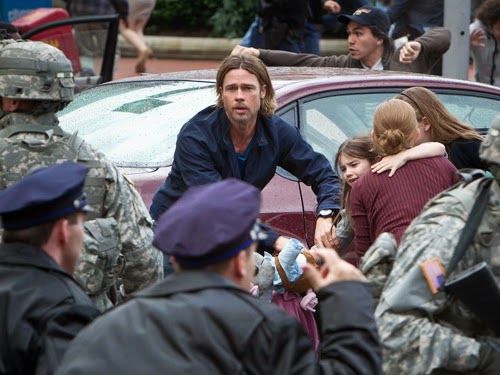
Maybe instead of their kids, these dads should thank Brad Pitt, for showing the way a great 70s dad behaves, during World War Z (2013). Maybe the first film to actively redress the Dads of Great Adventure complex that's befouled our decade's disaster movies (you know the type: the widowed, divorced or absentee workaholic/slacker dads who wind up with custody of the kids during the apocalypse because it strikes on the weekend--and his biggest fear is they'll die on his watch, and he'll look like a bad parent), Pitt's dad is competent and responsible for the world outside his immediate family as well as for said family, without showing any strain. All under his watch are taken care of, all without his sanctimonious belittling, clinging, or simpering (or on the other side, ignoring, spacing, procrastinating, stalling).

Pitt's professional compassion exonerates his apocalypse dad from the usual sense of proximal guilt that trips up rubes like Cage in Knowing, Viggo in The Road, Cruise in War of the Worlds and Cusak in 2012. More than all of them, World War Z makes a genuine manly effort to show male viewers a kind of post-Fight Club code they can live by without feeling like second class citizens in their own home. UN troubleshooter Gerry Lane and family (including urchin collected en route) are choppered off to an aircraft carrier packed with refugees so he can jet off to locate Patient Zero somewhere on the other side of the world. His global nation-hopping journey takes him from South Korea to Israel to a remote medical testing facility in Wales, and finally to a refugee camp in the one place savvy doomsday preppers have eyeballed since 1999, Nova Scotia!


The real-life world-savin' pair of Jolie and Pitt got started on their global betterment tour when Jolie starred in Beyond Borders. She really brought her work home with her. As if continuing that film's message, Brad's UN agent has already survived in some of the most harrowing third world hotspots. so the disasters of this zombie plague don't stress him out the way they do other dads. He has a strong, supportive wife, two glowing children, and great fun family rapport. Over the course of the movie these kids and wife are never really in danger, or at any rate, they don't panic because they trust in their heavenly-faced father. We sense that-- even when the zombie spittle is flying fast and furious--no harm will come to any of them. In fact those who stay super close to Pitt miraculously survive even as everyone else around them are infected and/or dead. The concern is solely as to where and how Pitt's UN unfazable superdad will solve the zombie problem, not if.


One of the tricks Pitt's Lane knows is something that the earlier dads of great adventure never mastered: triage. Even if he should make eye contact with people being bitten and devoured, he refrains from stopping to help them if it means risking his life or the lives of those he's with. You can imagine a lesser dad shouting 'somebody do something!' every time he sees a lost kid in a corner, but not Brad. He knows when to cut and run. There's something reassuring about how Lane's status with the UN gets him driven all around the world without need for check-in or bag search. His ability to think globally and survive locally rather than thinking locally like the dads of great adventure is what earns him this first class status.

On the other hand, telling moments in Z reveal a savvy about the proximal responsibility issue: the grateful singing of the Palestinians being let into Israel to avoid the plague excites the zombies and drives them over the impregnable wall; the one moment of true Brad danger comes when his wife's phone call rings as he's trying to sneak around sleeping zombies. This is a movie that knows how any glimmer of empathy, proximal responsibility, etc. can set off a chain reaction. Only Brad's compassionate but survival-based mojo manages to know when to run in true triage fashion.


Fury (2014) finds "Wardaddy" (Pitt) not saving the world per se, but blasting the hell out of the German homeland defenses with a tank crew of uncouth but loyal brigands. A clean-shaven newbie from the typing pool is 'daddy's' latest adopted son (Logan Lerman): he quivers and quakes and resents papa Pitt forces him to shoot an unarmed German prisoner (to toughen him up) and--as in Saving Private Ryan--there's some of that distasteful anachronism where he's the nerdy typist character (played by squirmy Jeremy Davies in Ryan) is too wussy for 1945, hell, even for 1975, but wussy like they only started to make 'em in the post-PC 'declawing' of masculinity, beginning around the early 80s. Wardaddy does the right thing in forcing him to kill an unarmed soldier --it's a matter of Pitt and crew's on personal survival that the kid be forced to surrender his squeamish morality. This suggests all sensitive typists (like myself) could use a few months on the front lines of a war with a guy like Wardaddy to toughen us up to the point we can turn compassion into an asset rather than a liability, so that we don't hesitate on the trigger when its time to kill or be killed, and that we know when to run past someone in danger, even if they make soulful eye contact with us, if it means certain death.


Pitt had proved he could be wild and liberated even whilst a young scrap of a fella, back in Thelma and Louise, so that's never been in doubt, but even so, here we got some extra layers of toughness as borne out by his scarred and diesel oil-stained face. We see him get kind of cleaned up when a nice little breakfast served up by a couple of frauleins in a little second floor apartment that's gone un-bombed, but when it's invaded by the rest of his motley tank corp, we see Pitt forced into a weird no-win zone between solidarity with his rapey crew and an innate gentlemanly spirit. It's the most tiresome scene in the film, it stretches on and on, and I'll confess I FF-ed part of the way, but it's almost worth it for the brutal pay-off, which finally brings things to bear for our milquetoast. Eventually the lad even learns when to let a kraut fry to death and when to chop him in half.  Hell yeah, Sgt. Rock loves this movie, wherever he is.


And if the whole last stand thing means that yet again the Saving Private similarities come too close to call, what is so important about Fury is what's not there: no balderdash bullshit about needing to ask a goddamned woman whether or not you 'earned it' and all that trying to find some greatest generation noble cause lollipop at the center of the severed head tootsie roll. It's finding your manliness in the company of men and smoke grenades --that's what it's for, war. David Ayers supposedly had a fight club thing going on each morning with the cast: each man fighting the other. It's true, as many of us know (but moms, wives, and soft-handed typists never have): the fastest way for men to become friends is to fight each other.

We all knew Pitt could bring the nihilistic badassitude, as could Michael Pena (Observe and Report), the real surprises in the crew are Jon Bernthal as the unkempt creep whose Iron John energy finally connects with Lerman after the fraulein incident and--most amazingly--Shia LaBeouf, whom I've always regarded with some level of contempt, but his work here completely changed my mind. When it comes down to the nitty gritty, of sharing last cigarettes and drinks before almost certain doom, it's Shia who really brought it home for me. I felt his clear-eyed look at mortality deep in my socks. I felt in his suppressed quiver of finality the feeling of being fully cognizant of imminent extinction, how one's death is pressed right up on the glass and always just a tap away --and of standing firm, fully in thrall of the only thing that can transcend the overwhelming instinct towards self-preservation: devotion to one's team. The crew, the captain, and the Pitt, the Wardaddy, the king. It's something that, for all its greatness, the entirety of Band of Brothers was never able to achieve as it lacked an actor of Pitt's unique combination of toughness and charisma, the combination of the great 70s dad. We feel the love for that combination in Shia, who gets his voice down a full octave and takes swigs of booze so believably we're made intolerant of all the lesser actors who betray their lack of experience as boozers by drinking straight whiskey like it was iced tea). With this crew's clear wincing we feel we're really in there with them, in that tank. We can smell the diesel fumes, mixed with the tang of explosives, dried blood, sweat, burnt oil, and cigarettes. It's the tang of the great 70s dad.


There's no voiceover in Fury, either, which also sets it above so many of its 'mother, am I a good man?' counterparts. And the ending credits are some of the coolest I've seen, with Steven Price's great A Silver Mt. Zion-esque soundtrack blasting over high contrast color-res images of the rest of the war. Any idea that  the war was already won by the time we crossed the Rhine is put to rest. A whole lot of pointless killing and destruction is left undone. The soldiers that were just kids and old men still are dangerous if they have ein panzerfaust (and most of them did). Yet, knowing the war is lost, all the fighting becomes somehow robbed of the honor it had when the outcome wasn't certain. Now it's not a matte of survival against evil but a delaying action waste of property, architecture, and lives rather than a noble cause. All that's left, then, is loyalty and brotherhood.

Ask the guys in Afghanistan and Iraq what they're fighting for and the answer's always the same: the guy next to them in the foxhole, their buddy, their brother by fire, they fight to keep each other alive. That's the kind of thing that would sound trite in a voiceover but if a movie like Fury can show that rather than tell (or ask for meaning from teary wives), then maybe the senselessness itself can make sense. War is hell right up to the end but so is life when the unimportant stuff's stripped away. More so in Fury than most war films (since maybe the 1930s) if you're going to survive, you need to become Hell's chosen badass. So here we finally learn what Spielberg only hinted at in his clutching for decency: that every milquetoast has it in him to face death with both barrels blazing if it comes to that, to let go of burdensome humanity and at the same time find a whole new Nietzsche paradigm.

Patton knew it. Kubrick knew it. Pitt's Tyler Durden knows it. Sgt. Aldo Raine knows it. "Wardaddy" knows it, and director David Ayers knows it. In filmmaking, as in war, the comfort of phony personae is the first thing that must go. The fastest way to shuck it is in a bare knuckle brawl with someone you're not even mad at. Even since the 90s, the Pitt persona has never wavered from that punchy code. He is our tousled lord, our approximate Arthur, our Kalifornia king.

He's all that's still standing between us and the terrible apron string hydra we choose to call mother.


Friday, October 03, 2014

Dystopian Parables for the Masses: DIVERGENT, CAPTAIN AMERICA: THE WINTER SOLDIER


Jump, baby, Jump! Jump into the Uncanny Valley, where chicks and hunks in black and silver body suit--kissers slicked over with CGI-bearing golden-brownish glow airbrush make-up--pretend to fight an onrush of enforced digital sameness, until the snake eats itself, the Uncanny Valley fills with ones and zeros and is so level the need for actors disappears altogether. They just float on the surface, newly born. And then mom starts singing "Clash City Rockers" (1) because it turns up on a car commercial, "nothing rocks the town like the Clash City Rockers... except the new Toyota Camry." 

Then, and only then, I'll know it's too late... even for me.

I'm old enough, even too old, to accept the brutal truth, which is that the kids today don't know there's even a brutal truth left to accept, which means there's no longer a truth at all, just the brutal. "Clash City Rockers" isn't cool anymore it's 'grampa's music' and hence undesirable, unless kids today are cool enough to realize their generation's music is the kind of squaresville Glen Miller nonsense that rock was invented to counteract. now grown to anthem size, filling stadiums rather than ballrooms. In the70s-80s, we punks and poseurs didn't have to decide if we were goth or emo or strait-edge or hardcore or Edward or Jacob or Erudite or Dauntless. or closeted or 'out' or bisexual: we were all just punks or (more likely) poseurs, smoking ourselves dizzy at City Gardens waiting for The Ramones or Replacements' All-Ages show to start. But today you need to pick your clique and must abide by its rules and brush off the rest, and if you jump bandwagons no one will talk to you and your reward for being a stunted in all other ways but artistic is the agony of another Saturday night spent alone in your room reading manga, until you turn to the make-up table and tart yourself up for Nerdtown.

This here's real

In both the recently released to DVD 2014 films, DIVERGENT and CAPTAIN AMERICA: THE WINTER SOLDIER, there's a dude who's been brainwashed by the fascist dystopia and ordered to kill the one he loves. And in each, the one he loves doesn't give up on him, even risking their rebel coterie's lives while trying to break through to him because, damn it, you don't give up on your old army buddy or a cute guy who respects your virgin boundaries. Each brainwashed buddy is programmed to kill all those who pose a threat to a deranged Kate Winslet or brilliantly-against-type Robert Redford. But by now you've guessed that even buddy love is stronger than military-grade brainwashing. Love is able to survive even lame 'sensitive' male Subaru voiceovers, it's deeper even than behavioral programming or the ping pong balls of motion capture technology. Even Redford--the goddamned Sundance Kid!--can't change it. 
Taken together these two films paint a nice portrait of where we are today as an eternally teenage wasteland nation, and how it's our obsession with health that makes us sick, how it's our longing for security blankets that leaves us most exposed. Our presumption is that kids today already know who Neville Chamberlain is because they've been to high school or read a book. But we presume in vain. Kids today have no idea who he is, and so never glean the importance of the lesson his liberal utopian pipe dream folly teaches us.

Chamberlin, a pacifist dumbass
For old Neville Chamberlin is history's most glaring example of what not to do when every fibre of your national being wants to make peace at all costs, to live safe today and let tomorrow fed for itself, to waste valuable ammo-gathering time trying to get extra comfortable in your peacetime bubble.

Neville Chamberlain (in case you're one of those kids) was the British prime minister who let Hitler sweet-talk him out of sticking up for Czechoslovakia in exchange for Hitler's solemn promise to not invade any more countries. He came back to England waving a piece of paper guaranteeing "peace in our time."

This was supposedly because Britain was still recovering from the previous world war, but really it's because Hitler wouldn't let Chamberlin smoke in the Reichstag (according to INGLOURIOUS BASTERDS). If he just sparked up anyway, man, right there, he maybe would found the chutzpah to stand up for the Czechs. Well, I saw a picture the other day of a bunch of members of the 101st Airborne at a dance with some dames in the mid-40s, and every single one of them had a cigarette. They're the ones kicked Hitler's ass. Do you think ISIS would even exist if Obama was allowed to smoke in the Oval Office? Instead he's a Bluto-battered Popeye stripped of his contraband spinach at the door. Gotta be healthy, man. No spinach. Popeye's spinach-guzzling youth has left him with a bad case of chronic iron poisoning. 

So now you know about Chamberlin, and how our collective all-consuming horror of illness, death, and decay extinguishes the flame (and smooth filtered taste) of our own shortened life span and conversely poisons the Earth with overpopulation. Resources and living space get scarce and lack of security blanket options gives angry idiots the balls to not mind getting killed toute de suite by our noncommittal drones in the name of some fuzzy cause.

Luckily there's always movies and movies about teenagers fighting back against the hypocrisy of dystopia overreach are big bucks, and that, my friend, is what irony sufficiency is made of.

Nurse, all that glowing stuff is going to have to be removed

But if grooving to a nine figure-budgeted movie spinning in your hardware can make you feel that you're part of a vox populi juggernaut revolution, a Churchill not a Chamberlain, even if only for two hours and ten minutes, facing danger on the screen, dissolving into the breathless pace and riveting action like a true hero... then just remember that while you were so motionless on the couch, six more species died in the rain forest.... and you could have prevented it, for just fifty cents a day. That's less than the price of a cup of coffee.

Keep your logos round and burning

Conversely, here's a little-advertised truth about addiction I've learned the 'hard' way: drug and alcohol withdrawal is brutally painful, terrifying, even soul-crushing, BUT it can bring sexual pleasure as exponentially intense as the pain, exhilaration as intense as the terror. But few know this because a) so often this withdrawal is done in a hospital, where opportunities are scarce; b) first you must truly suffer, convulsing, screaming, vomiting and rolling around on the cool tiles, riding an endless terrifying roller coaster that's all vertical drops and torturous climbs, for like three long days in one endless loop. In a similar way, perhaps, enduring the intensity of withdrawal from the media's cozy hypnosis brings true liberation, but who would be fool enough to know it unless forced to? Stretching your limits is just a nice way to say being stretched on the rack. 

And no one suffers like a teenager, whose stretching is involuntary, a werewolf transformation that takes agonizing years instead of a night or two under a full moon. The one part missing from the TWILIGHT movies that the (last) book went into detail about: the great flaming agony stretching on for timeless weeks that Bela endures in her transition from dying anorexic pregnant teen to hip, naturally-toned rich mom vampire. When you don't endure the trauma, the basic training breakdown, the post-marathon soreness, or the primordial terror of the final few bardos of death or deep meditation, then your transformation, your evolution, is not permanent.  Teenagers trapped in the torturous cocoon of braces, acne, dandruff, virgin angst, and clumsy self-loathing, can't imagine how the much their future self-confidence, straight teeth, clear skin, will depend on it, and how quickly the pain will disappear once theb benefits are known. This counter-intuitive need for trauma, coupled to our fear of it (inseparable from the fear of pain and dying), makes a good dystopian parable for the masses, and why teenagers resonate with them so strongly. Old men need no more dystopian parables, only escape from their oldness in the chimera of myth and chimera of youth. And it is the same resonating myth and escape into (and from) youth that brings old and young together.  No one wants a teenager in their living room, but onscreen everyone can be teenager just for two hours, or--if already a teenager--a hero whose diamond anguish is at last given the properly operatic golden setting.


It is the duty of any nonconformist or outcast in a conformist society to subvert that society, the force of the social repression on the nonconformist forming the response and creating the spatial form of the future: Jesus on the cross, Mandela in the jail, and Gandhi on the hunger strike; but if you want to avoid that pain, you can stay addicted to to the virtual pleasure of the simulacrum and just write a Young Adult dystopia novel or superhero comic or screenplay wherein your protagonist subverts an even more conformist future or alternate reality. And if it sells, and catches on with the teens everywhere, and is adapted into a big budget movie, conformity expands to envelop it, then shrinks back as it digests, and then the trappings from that parable are spit out a decade later in a lame car insurance commercial, as drained of its original meaning as a Times Square New Year in the post-Giuliani era.

On the plus side, by entering the collective fabric it will serve to caution the power elite about going too far in trying to repress and restrict the freedom of the masses. Certainly the power elite fear from these tales the fallout that would come with restricting freedom of speech, for any speech---no matter how anti-authority--can be subverted to power ("Clash City Rockers ride the streets in the new Ford Freedom") Truly it is written in Situationist theory books forced on liberal arts undergrads the world over: a reigning social power can find no surer way of survival than incorporating critiques of itself, ushering in an era wherein compliance as the 'reality' is never even noticed behind the simulacrum screen. In HUNGER GAMES, Donald Sutherland's nervous military dictator thinks suppressing the symbols of rebellion will suppress the rebellion itself, but a media savvy ruler doesn't outlaw symbols, he mass markets them. He flashes the Girl Scout / Revolution gang sign at press conferences. Anything--even Sid Vicious snarling "My Way"--can be digested, incorporated, and eventually spat out into a car commercial. No revolution can win against a government that burns itself in effigy every night on the evening news. What are you going to do to protest, put out the fire?


In order to be free from our addiction to the cathartic thrill of battling Hollywood-conjured dystopia, we must learn to love the pain deprivation brings, which goes against everything capitalism stands for. No expensive wine ever tasted half so sweet as warm canteen water to a dehydrated ocean castaway. Is this not the the core truth of meditation, or stereograms, or the rapturous freedom of the starving, tortured artist hallucinating sausages and flagons in his swirling oils? And nothing's more disillusioning than realizing the spiritual crisis that cost you years of suffering and depression but resulted in artsy growth could have been solved with Effexor, and just as quickly turned into a raving maniacal sociopathy by adding Abilify. By extension, anyone with the right technology, drugs, or patience could turn you into their automaton. With the flick of an artificially-implanted cerebellum switch you could feel your friends are your enemies, and vice versa. Raymond, why don't you play some solitaire?

Thus the brainwashed super-conductive Winter Soldier (above) doesn't flinch or protest when his keepers want to give him an electric shock memory wipe. He just leans back into the chair and opens to receive his rubber mouthguard like an angry boxer thinking only of the kill. The captain meanwhile is thrown into a dilemma when he doesn't quite know who to trust within the NSA-Homeland Security-ish conspiracy web known as S.H.I.E.L.D. He himself is doomed to be incorruptible, no matter how many perish as a result of his principles. I simply cannot give more away, but it's this 'question authority' theme that gives the film its emotional resonance. Fifth columnist academes can say what they want, in Captain America's heyday (he was frozen in 1945 so he could miss becoming Reb Brown -left) we had a genuine uniform-wearing enemy to fight, and that we might actually lose was a real fear that brought Americans together and cured its Great Depression quicker than an Effexor / Neurontin / Wellbutrin cocktail.


And in DIVERGENT, the brainwash comes via a remotely activated chip air-injected into each 'Dauntless' member's neck as part of an alleged location tracking program, a process woven so seamlessly into all the other initiatory processes that no one can hardly complain--any more than an army recruit can complain if forced to do push-ups. The big fear for our plucky DIVERGENT heroine, Tris (Shairlene Woodley) isn't being brainwashed, it's that her friends will find out she's not one of the approved types of persona which act as fascist-brand masonic brotherhoods that all young citizens of this society must join, being allowed to pick for themselves at a big ceremony, because not doing so, not fitting a socially prescribed 'type' means being 'divergent' - i.e. a natural-born nonconformist, the type who must subvert the dystopia, write a book about subverting a worse dystopia, or die a death by slow closeting. Perhaps it's natural to have subversive artists in any society that gets larger than a few thousand people. Native Americans treated their gay tribal members with reverence, for they were signs the tribe was flourishing and needed to slow its population growth. A dystopia would of course not go for that display of difference, and with subversive artist types it's perhaps the same... no room for 'decadent' art in a dystopia. At any rate, Tris fears becoming cliqueless and alone by daring to say no to peer pressure, but can't help being chip (brainwash) resistant and so forced into the capacity of heroine. She's the type of person who, like myself can't connect for some reason to the giddy rush of 'mob mentality' (2). In the big picking ceremony she goes for the daredevil mesomorph soldier brigade (i.e. the jocks or the Wermacht) the 'Dauntless' group, but she's way too independent and peaceful. She's also too athletic and dopey to be an Erudite (the fretful nerd group, or Gestapo); too Erudite to be Abnegation (the Red Cross), etc. But this is a dystopia where your friends literally jump off a roof and if you don't follow them then you're not cool anymore. And you have to succumb to paranoia to not be suspect (if you're Erudite). And you have to let yourself get exploited and scapegoated if you're Abnegation (see also VIRIDIANA).


Sure it's a little trite, but I like DIVERGENT mainly because the twisty high school clique-as-metaphor-for-fascism stuff displays a keen savvy to the way initiation rites are incorporated into the lure of the popular clique. Here institutionalized initiation is conformist just enough that both the personal and political seamlessly interweave, like joining the Riffs, the SEALS, the Heathers, getting your ears pierced, your first tattoo, drinking your first beer and smoking your first cigarette all on the same day. Feeling like you finally belong somewhere is an intoxicating high, especially if you've never felt it before. The dissolution of apartness, of singular lonely ego subsumed into an inclusive group whole, is exhilarating in exponential ration to the amount of lonely bedroom angst you've suffered.

But that high has a price and you're suddenly being shipped off to Vietnam, like Treat Williams at the end of HAIR.


The thing DIVERGENT doesn't get is that having a weak central girl throws off the curve- Kristen Stewart is Antigone-stubborn in TWILIGHT; Jennifer Lawrence genuinely mythic in HUNGER GAMES; the kid in ENDER'S GAME spookily self-confident, but this chick Tris is perhaps--to her detriment--the most 'normal' teenager-like of the bunch. Rocking a terrible poker-face, she lacks the inner fascist to succeed as a Dauntless. She doesn't have a grasp of 'war footing.' She's not Artemis-esque or Antigone-determined or a math prodigy; her puffy face dilates and registers every emotion, which is not good if you're gay, I mean "divergent" in a world hostile to any sort of difference. If you show your true face they will get you. The same ones who urge you to be yourself are the ones who will attack you if your actually doThe core of every teenage fear lies in this idea, that the joy found in belonging to a cool group will soon give way to the terror of being abandoned by them once they see your face register the joy you feel at being accepted at last. This is part and parcel of the feeling teenagers never get over into adulthood: that the parent or god that watches over you is just a trickster demon awaiting the right time to remove its saintly mask to expose that which your whole life was a shield against seeing--his hideous giant demon face coming forward to consume you like one of Kafka's devouring industrial vaters--all the while encouraging you to take off your own mask, to be yourself, at last, to finally show your soul just in time to see it ripped to shreds... 


 In WINTER and DIVERGENT, the moment of exposing the demon face behind the mask is when what was once just rumor and conspiracy theory starts to lock shut (SEMI-SPOILERS AHEAD) around you, too late to resist it, no time to plan a defense, no access to yourself, no chance to catch your breath. What you didn't see coming suddenly comes, not on the horizon ahead but behind, next to, within, and in all directions, making its move only when its sure all resistance has been pre-demonized as terrorism, disarmed, isolated, and confused. Then the NSA takes off its mask and the Sixth Reich Paperclip draconian totalitarian future-present is right there, and has been, in disguise all this time, and the Homeland Security emblem turns out to be a scrambled up swastika, and it's too late to do anything about it because we've signed all our freedoms away in the name of order, because we got all scared when the news waved some Muslims at us. God help us, we activated SKYNET just to deal with a couple of dudes with AK-47s and cell phones. General Ripper was right! They've infiltrated our precious bodily fluids! Little tiny Stalins swim in our blood. They're even in the money...


Masks on / masks off 
Now I don't really believe in a massive global conspiracy per se --I imagine the world to be far too chaotic for that--but I don't rule it out. What I do know, though, is that-when it comes to running Hollywood--the industry guys can tramp around their fancy desks high on all the megalomania-infusing coke they want, but deep inside their drawers they know who the real boss is, the capricious Middle American teenager. Their ample expandable income, their drivers' license, their need to get away from parental eyes even for a few hours, the crushing relentless sameness of suburban boredom, all bring them time and again to the multiplex. Why not tie high school subjects like social science and literature to cafeteria mores and social hierarchy to teenage hormonal angst and deep mythic dystopian allegories, so that the films they see double as Cliff notes to the classics in class and of their lives? Maybe the kids are reading Plato in fifth period or leaning about World War Two for the first time, so hey, if you commingle these big historical and cultural currents in with the high school threat of cyber bullies, peer pressure, and the rush of the first law break or sense of belonging to a clique, then you have hooked onto an iconography of coming-of-age mythic suburban metaphors, each multi-layered signifier keyed into a hormonally pained demographic. 


That's myth. At it's purest. In myth there's a way to apply what's taught in school to real life, to do it in a way where the result is fantasy on a larger more 'real' level than mere reality. 

Thus these teen dystopia parables become more and more urgent as the real and public sphere shrinks. Science tells these kids that their future is all used up but as long as their present is spent texting and downloading violet ray dystopian fantasies, they can live without anything so banal and limited in scope as science's concept of time line futures. These kids know that watching someone else fight the power isn't the same as fighting it themselves. But how do you fight a phantom who monitors your every move before you make it? Just trying to get a gun into high school or threatening Congress via your Tumblr will get you all sorts of expelled. But watching someone else fight a raging battle against a CGI windmill version of all the old American evils? That's doodle dandy do or die. 


I know it's cliche to say but, for my generation, things were different. The dystopian-spurred life-or-death need to assert your individuality and face the dreaded finality of conservatism was totally lacking in the John Hughes (and Arnold Schwarzenegger) 80s. There were no cell phones or internet by which to stay constantly connected. As a result, that connection never felt threatened, that was our burden and our blessing. We had no faith to lose, and we knew it. Not no more. If you win a teenager's heart today by expressing their queasy post-digital angst, they'll come back for the sequels, then they'll buy the DVD (even after they downloaded it illegally (you hope), and in 20 years they'll buy it again in a deluxe commemorative edition, and it can run in perpetuity across a spectrum of cable channels... until that car commercial tie-in wrings the last dollar out.


Starship Troopers (1997)
And of course, there are the girls, the ladies, all locked into the golden gloss that makes all them all now look like they're CGI avatars slick with softener, every frame of their face Maximed to abstraction, all the better inject them into the video game vein. But hey, the good news: boys have picked up some slack to become objects, which is like, so like, finally, you know? It's the baby steps, man. Before women can be free of objectification they must first choose a replacement way for us to look at them, and there's but one traditional gender left to objectify. There is a reason, burn, turn, worm, but don't say I didn't warn you about that Uncanny Valley crossing, ladies. This is John Connor coming to you from inside Crystal Peak: let the revolution commence broadcasting on UHF, on the Emergency Broadcast System, on the HAM radio, anywhere it can be safe from the digital detection. Analog only, No digital, man. Analog got the warmth and the resonance, 'cuz nothing stands the pressure of the Clash City Rockazz!


NOTES:
1. The Clash, in case anyone doesn't know, were a prime example of politically left-wing, anti-Thatcher English punk rock, hence their use in car commercials is the kind of thing that runs counter to their message.
2.  I've been there at the start of three riots in my life -- and each time I walked away before the violence began, horrified by the way all my friends seemed to transform into bloodthirsty animals, and feeling strangely abandoned, as if they all disappeared right in front of me, just as would happen later when cocaine came back in vogue in the '98. I simply could not catch the mob or coke mentality anymore than I could 'get' the Grateful Dead. I guess that makes me... Divergent!

Wednesday, June 25, 2014

America of Ghosts: Why Lana Del Rey is the New Val Lewton


The new Lana Del Rey album is out this week, like the Stygian tide, and with it "controversy" so perfectly-pitched that she and her salivate-on-cue detractors must be in on some cosmic PR joke. Take it from an old punk rocker-turned hippy-turned-hipster-turned post-Peaks-ian, who missed all his grabs at the big brass ring: it is good to die young, whatever Frances Bean may say. The only freedom an artist has from eventual irrelevance lies embedded in the obsidian wind that whistles through gratings of that other sewer's shore, or the cane in the fields at night on San Sebastian. In death, alone, can artists safely say they made it. Once past life you're way past worrying about the critics and audience indifference, hit counts and box office. The same way you used to forget your troubles at the movies--safely darkened to the point of anonymity in that eternal shrine to our shared past--you forget your irrelevance in the field of 'breaking new artists' via a before-your-prime death.

There's no difference between living through the movies and living through death. Either way you coast into immortality like second base on a field of feathers. If you're writing or painting or singing only for the edification of the future rather than the adulation of the pearl-twirling swine of today, then rest, in peace and assured, no matter how maligned or ignore you are today, some distant unborn generation will pretend to have read or heard or seen your work. First, though, they need to know you died, to prove you're serious - and so they aren't afraid of running into you at the part while they're reading your book and then you start trying to autograph them or worse. Immolation purifies art from compromise by cumbersome human mortality. Lana Del Rey knows. I'd say she knows it so well she doesn't have to prove it. I'd say she's free from the iffy benefits of validation, and has achieved this purely through facing her own mortality, via the bi-polar abyss.

As we learn only after much resistance in AA or therapy, in surrender lies the only true victory. The only true heaven is hell, accepted.


And, from Lana Del Rey's perfectly framed early 60s car crashes and second shooter denim paranoia, we stagger down an off-road shortcut through the slashed tire car wreck James Dean 50s, and all the way back to the 40s wartime graveyard of Val Lewton. It's no accident that all the Del Rey backlash ballyhoo started up again yesterday-ish while simultaneously TCM played Lewton's acclaimed low-key masterwork THE SEVENTH VICTIM (1943). Like all Val Lewton's best work, Victim is suffused with his deep wartime homefront guilt and paranoia, conjured to scare and yet comfort the Rosie Riveters on their lonely dinner breaks. Their man was gone but death was right there. All Lewton had to do was dredge the cables up from the ocean bottom like collective unconscious tentacles. His best work is like a modern art exhibit after the public has long drifted home and the lights are off; the crumpled invites and plastic champagne flutes loll ominously in the breeze of an open window. And then there's Lewton, creeping in with his art, the art of the nervous insomniac who remembers as a child seeing Death watching over his cradle, making sure the orphanage of mortal light was taking good care of him, ready to yank him back at the first sign of carelessness on the part of the living staff.

Icons from top: "Summertime Sadness," I Walked with a Zombie"Tropico"
Lana Del Rey and Val Lewton both create a vibe where the ebb tide of childhood abandonment anxiety is stronger than any fear of death. When this abandonment tide washes through the psychic land, once the terror subsides, the crap is washed away and all that remains are the immovable immortal icons, the stone memorials built to last, in whom we first found a source of protection that wouldn't abandon us. Thus Elvis, John Wayne, Marilyn, and of course Jesus all loom on Lana's heavenly plane like death coaches. On Val Lewton's post-tidal surge shore are immortal archetype statues from Greek and Egyptian myth: Cerberus, Set, and later on San Sebastian (above). Waiting in crevices of the stone stairways and rustling cane fields and wine goblets and calypso songs, Letwon's idols are literally etched from rock. All-seeing blank eyed demons that are only vaguely visible in the shadows, animated black-on-black splotches that resist all but the final Rorschach meaning.


So while some are threatened or indignant (same thing) over this death drive fancy of Del Rey's, I say hey, man, be grateful: her death drive is visible, in our sights to share, because all she has to do is pout, turn slowly away, and take a backwards slow mo Peg Entwistle dive off the Hollywood sign and down through Diane Selwyn's pale blue skylight and it's YOU who die, not her. Keep her in view at all times. Once you can't see her you'll know she's behind you, with a gun or sharp sword. You can follow her around like Boris Karloff follows the hottie Greek wurdulak in Lewton's ISLE OF THE DEAD (1945); you can be a whole internet worth of Karloffs reigning down torrents of ancient superstitions and gossip on anyone who'll click your link; you can drip a whole nation of self-appointed sanity over her sun roof... it does not slow her rush home to your death one hourglass grain.


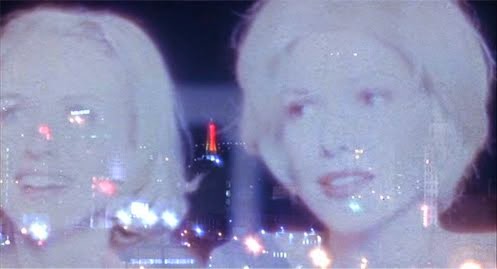
Lana Del Rey knows memories and movies are the same thing and that every home movie of happier times must speed up as you approach the black hole realizations that the people you're watching onscreen are long dead. She even casts herself as the bad guy most of the time, as in "Summertime Sadness" --driving her lesbian ex-lover to jump off a bridge ("kiss me once before you go") while she pouts in fog machine student films and home movies that repeat faster around certain points as the weeping lover falls, the drama finally so impressing Lana she jumps/falls too, the doubling inherent in an L.A. lesbian affair fully embraced- - drowning in each other's reflections in each other's eyes, downing cliffs and Hollywood sign letters, their eyes stare straight ahead, batting lashes until they morph into a thousand penitent film strips striping down Hollywood's naked back. They come already refracted like an ever-opening lotus mirror reflection of cinema: hence Rita/Betty=Diane in Lynch's quintessentially L.A. masterpiece MULHOLLAND DR. (below); hence the shifting dynamics of the nurse and her glamorous willowy zombie in Val Lewton's I WALKED WITH A ZOMBIE (1942); Klo-Klo/KiKi's continual mirroring/sacrifice deferral in LEOPARD MAN (1943) and Irina's attempted devouring of Alice in CAT PEOPLE (1942).

Sister, she called me her sister.


It's fate, baby. Watching CAT PEOPLE today on DVD it's possible to see just what's in the deep dark shadows around the swimming pool: there's a black hole cartoon animation in there, a shape that mutates from vertical to horizontal, ever so briefly. When Irina turns back human she moves from paw prints to high heels prints (not bare feet - Lewton never tries to literalize), she wears a fur coat that when she changes tightens in around her and, if you look close at her body lying on the ground outside the panther cage, she looks like a bearskin rug with a teddy bear's head sewn to one arm, but we only see it from far off, up on the street lamp. In ISLE OF THE DEAD we can see, if we look very close, the way the undead Mrs. Aubyn seems to materialize out of the moonlit reflections on a stone wall, like she's only semi-corporeal but never in that common special effects way that would make it obvious. DVD's clarity alone makes these things at last visible; they were never meant to even register consciously. There was no way to pause and rewind before video tape... No one ever knew for sure just what they saw, if anything, so they remembered all sorts of darkness.


Lewton's subtlety reveals a Russian's love of great literature that extends deeper down than the average bourgeois tenure track, deeper even than the blood (his real name is Vladimir Ivanovich Leventon), deeper than the cauldron from which are dredged all our hopes and fears, and our tomorrows are like a thousand yesterdays. And great literature is always about death, that's how you know. It's where we go to prepare, to remember that a vast elevator full of blood is only a thin, easily-punctured epidermal layer away, and the only freedom comes in whether to ignore this dread out of fear, or embrace it out of courage, love, and rock and roll who-gives-a-fuck-it. This is where Lana Del Rey's coming from with her comments about being a feminist and thinking it's cool to die young. Would you get mad at David Foster Wallace, or Hunter S. Thompson, or Hemingway for saying those things? No. And they're all dead, at the hands of the same assailant, the only one that truly makes it. Performance.

Now, if my dad killed himself because of Lana Del Rey I'd be pissed. But my dad was killed by doctors (he died, after all, in the hospital) and it's hard to be pissed at them, as a whole. At home with an ocean of bourbon and ginger ale he was immortal. He kept death close so it couldn't sneak up on him. But that hospice-strength IV cocktail's got no spirits. Without his whiskey and gin, the door opened right up and waved him in like a pit crew waving in a race car. Maybe when we try so hard to keep the body alive we kill the soul. Who wants to die sober? Only those for whom sleep is the cure-all; for some of us, the fucked up artists and writers who do what we do because we'd go even crazier if we didn't, the only cure-all is music, literature and films. We can die because we've already left our immortal imprint on the living world. Lana Del Rey is both the cure and the cause for the cancer of Hollywood because she embraces the theatrical aspects of emotional anguish, with herself as both the sufferer and the object of longing; her faux-period home movies, painstaking in their iconic recreations, are like the restaged car accidents in Cronenberg's CRASH, only transcending sex in the service of art, music, and obsession.

From top: CRASH, LEOPARD MAN
I love Lana Del Rey because of her pro-death chanteuse-rock fuckithood, not despite it, and I have no problem with it all being a persona put on by a failed pop star named Lizzy Grant. If her schtick didn't resonate we wouldn't be talking about her, wouldn't feel strongly one way or the other, and if her story is really a confession, then so is mine, though not, apparently, Rolling Stone's and Jezebel's -- though both were once edgy in their ways, I hear. Now they're both 'institutions' successful enough to feel they have something to lose, something they'd kill to protect (see CinemArchetype 5: The Human Sacrifice) but never endorse dying for. Lana Del Rey is a persona that has nothing whatsoever to protect, so can engage in a kind of high wire free-form self-immolation theater. Animas with respectable DSM-IV counts are plentiful but then they have kids one day and Whammo! The persona is replaced, even grown out of, but is it really a growing out of it or just doubling and diluting? How many great sexy young actresses have we lost to their children? Even when these starlets come back to us, babies delivered, they're not the same: their dangerous heart--that thrilling gleam in their eye--now exists off camera, transferred to vessels still mewling and puking in nurse's arms.

It should have been me, puking, like the princely changeling in Midsummer Night's Dream. I had to quit her, my whiskey... sweet whiskey, and ride off with AA Oberon. My sober life --that's my cross to bear, my LSD Albert Hoffman problem child, the thing that robbed me of the gleam, my lost Lenore. But I'm not a star. No one even notices. Not even the guys at Liquor Warehouse on Broadway, still the best prices in New York City.

But I still haven't forgiven Angelina Jolie, or Liz Phair. Ladies, you broke my heart!

Never stop smoking or drinking - even knowing both are poisons,
for you've already spilled more than secrets (bottom: SEVENTH VICTIM)
Now you love your children the way you used to love the fans.
Now your love is funneled to some off-camera cradle.
Those who love you from speakers and screens are left orphans.

We can't see through your kids' eyes,
for we are not John Cusak trapped in John Malkovich's child.
But either way you will soon age, past this singular moment.
And you will know the sting of this abandonment
once we both eventually move on.

There's no way to stop the ravaging.

You'd have to leap off the edge
like Lana Del Rey.
But she does it in advance of our gaze, and so
we will never move on
from her.
She's already
gone, and you - mom,
you've fucked it all up.
The apron string hydra, newly hatched,
whines you away.

-----
In a semi-deserted Bijou in 1943
a nervous young assembly line worker calls in her sick day,
watches SEVENTH VICTIM or THE LEOPARD MAN at the half-empty Bijou.
The dark shadows of the empty seats surround her,
where a boyfriend or husband would be.

Then, onscreen in the shadows she sees him, beckoning...
She knows in her heart he's just been shot down over Europe.
Doesn't even need to read the evening telegram.

Lana Del Rey is the eyes that discern changing shapes in that darkness, and Lana Del Rey's eyes are that darkness. On digital, nothing escapes notice... even the void hidden within the void.

This is the girl
That's why Val Letwon's morbid preoccupation with death is so relevant. Using deep black shadows he reveals that the thing wartime America most fears isn't death but loneliness, abandonment, being entombed --all of which is brilliantly realized by the cheap B-movie sets where even the sky seems indoors (and is)--of being left alone too long in a dark empty country with only the ghost radio signal one clings to for company, for news of the vast armadas of sweethearts and sons vanished into the bookending oceans.

And then... Frank Sinatra's voice like a phantom mellow echo; his mastery of mic technique giving his songs an almost unworldly amniotic sound markedly different from the rest, welcoming you to join him in the pulsing warm fog between two shores: "if our romance should break up / I hope I never wake up /if you are but a dream." You are. Hardly even born yet. There in the unrealized amniotic slumber of the Stygian crossing, as Sinatra's songs coast overhead in ceaseless tachyons towards the past, you can hear your father's conception becoming re-buried in the sunken space between the words. 


Lana keeps her expression blank --she does it for our haunted projector, so too Val Lewton's deep black shapes --they accept our projection just as American small towns became a ghost towns for the wartime duration: the younger healthier men all drained away by old Europe's vampires, even in Hollywood, until all that's left in Hollywood are German and Russian Jewish intellectual exiles (and gay Weimar actors whose only roles are as the very same Nazis that drove them out). The young male stars of the B's are now tenderfoots, the old men, the crippled, the meek, the short and reedy. And everywhere, in the air wafting from Europe, the smell of death --the inevitability of it--in ways we can't imagine with our current wars and their paltry kill levels (we might lose a few dozen thousand but nothing close to Europe and Asia's combined sixty million in World War Two). Only a full scale nuclear war would even put a dent in us now. We need hundred of million dead, and it would still be the same % as we lost in WW2--a spit in the bucket. Half of us could die and we'd only be where we were in the 1970s, when we first started to worry about overpopulation via films like Soylent Green (1973). It's not death that dooms our planet, but life. Our blind clinging to health like panicked survivors swamping the lifeboat. If we could all just die like gentlemen, like the great Solomon Guggenheim on the Titanic--if Lana Del Rey can lead us by power of bad example, and if we leave right now--we just might make it.

We won't.

Echo of my undead soldier (from top) Del Rey, DEATHDREAM
Lana Del Rey and Val Lewton know we're not going to make it, and they see and hear and reproduce the ghost of America's past in the deep shadows of the cinema. Their work is already self-aware, feeling its way backwards, seeing their audience for what they are, already dead, or soon dead, relative to the immortality of movies and recorded music. Del Rey makes music for America's ghost future/past to haunt the wasteland with, but for now she's all alone, like any still-living phantom. As Pitchfork notes she's "an utterly distinctive figure in popular music, not part of a scene, with no serious imitators—and befitting someone completely off on her own, she’s lonely." There are a few artists over the years who have explored similar ghost transmissions: Miles Davis' trumpet echoing through the primordial pre-ears-to-hear-it howling of an uncooled Earth in Agharta; Kubrick's use of "Midnight, the Stars and You"; Lynch's use of Roy Orbison and Julee Cruise... but none live and breathe within that ghost transmission - none play on the idea that--even if you weren't alive to hear them sing--the sound is encoded in the crystal receivers at the core of your DNA.  


Lana Del Rey--her "self" as persona, her videos, her willingness to invite nanny state feminist shock and outrage--returns Freud's 'death drive' to its preferred verb status, floored and drunk down Route 66. Her music is ideal for drug overdoses, lover's suicide pacts, long drives with tearful anorexic self-cutters, and self-immolation at the graveside of James Dean. Without Morissey-moping but rather with hair done up and radio playing Elvis with JFK convertible top down, smoking, hovering over Marilyn's lifeless body like a wraith, hiring an actor to dress like Elvis and sneer while rubbing up against the old time microphone stand in front of the John Wayne's rawhide coffin, to paraphrase the Donne-quoting devil-worshippers in Lewton's Seventh Victim, death falls to meets you as fast, halfway. And death x death = life.


"National Anthem" - note vivid attention to period detail and home movie posing 
while at the same time revising JFK into a contemporary-ish sexy, rich, cultured rapper, and 
gaggle of cute biracial children. Like so many of her best work, the music and imagery are linked and
build to a  final 'bells' montage i.e. the final moments of DON'T LOOK NOW, or the last seconds of 
THE BLACK SWAN.
Del Rey embraces the sacrificial phoenix icon of the damaged hottie in ways Lindsay Lohan never understood well enough to make part of her art, to use it rather than be used by it (painting a fictionalized self-portrait vs. being someone else's paint). When it comes right down to it, Lohan is sharp, talented, and ballsy but LA has robbed her of self-perspective. She's mystified why she always lands in jail and loses her film funding. Lana Del Rey skips all that and just films in the jail. She avoids the trap of co-dependence or prison or rehab by becoming the 'act' of the drunk, the Baby New Year of the Mulholland Death Drive. Where Lohan avoids the stake and the torch of the frightened villagers by promising to get help, Del Rey climbs right up and starts the fire and directs the camera angles, but it's an act, man - the villagers never gather for real because they're already there in effigy. Del Rey acts it so she doesn't have to be it, whereas Lindsay is it but tries to act "normal." If you get angry at Del Rey because she's fake (shouting "hey Lana, why a-you change your nice-a Jewish name?" from across the street) or are worried because she's real, well - all your rants and raves will do is boost her hit count --like the boost in album sales she got after her hostilely-received 2012 performance on SNL (see "Kiss Me Del Rey"). 


The Leopard Man
Val Lewton's poetic dread of death similarly produces films that hang inches from the darkened grave, performing/exorcising the collective demons of wartime, so he doesn't have to go fight and die for real. He has to prove himself somehow, feeling the terrible guilt reported by so many stay-at-home men during World War Two. The best you can do if you're an artist on the home front is try to capture death's lightning spirit in a statue of Hermes or San Sebastian watching over the scared endangered souls, understanding in this the entire primal purpose behind art as totemic sacrifice, a giant burning man made of straw, a sand mandala patiently perfected then dusted away. The true artist never hides the skull in the ice cubes because, when the death wish is externalized for posterity, one achieves immortality. Death is pleased that you've honored him and so spares you for another year, the living ghost retina burn outline of his long ago flown-free firebird cohering from the flames.


"Summertime Sadness" 

Del Rey trusts we're not going to kill ourselves just because she says it would a sweet gesture, would show her we really care. That's her whole secret, believing in our intelligence as much as we believe in hers. How many films other than Lewton's or music videos other than Lana's with this level of trust? I sympathize with Kurt's daughter but really, Rolling Stone, it's you should be ashamed for soliciting angry responses from a girl who never got to know her father any better than we did. That doesn't reflect badly on LDR's statement, or FBC's retort, only on your journalistic 'ethics,' RS. You who were a once mighty countercultural institution (even smart enough to be aware of the paradox in that phrase) are now reduced to passing gossip, angling to be ground zero of a viral thread, leaping down the throat of anyone speaking out against the principles of bland nanny state life-for-life's-sake-PG-tedium (rock out, safely!) and embedded advertising-ready rebellion. Maybe you should go run another cover piece about Bob Dylan and Tom Petty together again, or Neil Young and his guitar! Like all the other fallen giants, you've let 'trending' become the new version of stock market panics, all real guts and glory trampled underfoot in the stampeded to avoid being trampled by your own clod readers. 

"National Anthem," ISLE OF THE DEAD
Most filmmakers and artists and musicians only think of themselves, of their hunger for fortune and fame, or their ennui after achieving all their goals and realizing the hunger still remains. But some of us know well that every film, post, or album we make will survive our own death --and it haunts us. We know black magic's promise of eternal youth, of the ghost in the machine, the threading spools running emulsion past the projector beam light measuring images and spinning shutter rotary out in 1/24 second still images that give the actor on the wall the only immortality there is. The Bing Crosby songs from the 30s radio shows are still flying out into space, signals coasting farther and farther away, just waiting for the right crystal skull receiver. These signals will, in a century or so, be still traveling, more alive than our own cracked and disintegrating skulls. Compared to this eventual alien Akashic record-style idea of future reception, any reward of fame in this lifetime is paltry. Some of us know we're long dead already, but we have our living image, our words and voice, out there, up there, in the ether, the WiFi signals drifting out in waves recorded by time, or down in the teraflop stone tapes. Even if no one reads us or sees our art in our lifetime, we can die easy. 

Some, like Val Lewton and Lana Del Rey, take this weird solace one step further, enacting rituals of death and transfiguration for posterity and mimetic power in much the way the Gunfight at the OK Corral is recreated on the streets of Tombstone by scholars with big gun collections. Thus the JFK Zapruder footage will endure any memory of the actual presidency of JFK, and in doing a macabre, melancholy homage to this ritualized repetition-compulsion, Del Rey cracks the door handle to the beyond. You can feel it in her sad puppy eyes, the fusion of sex, sadness, lost, lust and American-style freedom, the sort of sad-eyed lady of the lowlands that always needs to be courting death to feel alive, that lives in the crevasses of national tragedies like a sexy afterthought. It's there in the films of Val Lewton too. Watch the first four of Lewton's RKO horrors interspersed with a few Lana Del Rey videos all in the same night (the older ones--"National Anthem," "Video Games," "Born to Die," and "Summertime Sadness") and before you die you shall see their America of ghosts. 

Related Posts Plugin for WordPress, Blogger...