Showing posts with label jennifer connelly. Show all posts

Saturday, October 31, 2015

Halloween Special Edition: 10 Quintessential List + 13 More on Bright Lights


As a lifelong classic horror fan it gets my arse all in a tether when channels like IFC figure what we need are marathons of crappy HALLOWEEN sequels, or that horror means only three names: Freddy, Jason, Michael or god forbid, Jigsaw. To me that's like bringing a keg of green dyed Bud Lite to a highbrow Dublin wake. It's gouache (the watery paint, not the adjective). It's the one time of the year the punters might learn something about our rich horror heritage but instead they're allowed to indulge in feeling that 'classic' doesn't extend back farther than the mid-90s.

Well, rejoice brothers and one sister. I've made a grand list of 13 horrors fit for even Hiram Walker himself, found only on Acidemic's more coherent and lauded (laudanum-laminated) cousin, Bright Lights Film Journal:

Sh! The Horror! 
13 Suggestions for an Uncommon Halloween 
Viewing Experience

Also, make sure to visit my Netflix horror recommendations on:

Post-Giallo Nightmare Logic ala Netflix
and Netflix Deadpan Comic Horror Inititative
and Last year's 13 Obscure Horror Gems (via Slant)


Many lists... many masters. But this next list cuts through them all, for they are the lesser-known but relentlessly magnificent gems I watch every year around this time, as far back as whenever I first taped, bought, or saw them. Each is so laden with atmosphere you can smell the bonfires and first chill of night, feel the centuries of huddling around the harvest hearth in your collective ancestral ganglia. Rather than finish all these half-assed reviews I've been struggling with, here now, some short mentions of all the favorites I revisit every year.

CITY OF THE DEAD 
(AKA Horror Hotel)
(1960) Dir. John Moxey

There's so many strange similarities between this Amicus debut feature and Psycho that, were they not made in the exact same year on opposite sides of the Atlantic, you'd swear they were emulating each other. Both feature naive but courageous and very pretty blondes who wear their hair moddishly short and leave their comfort zones on big adventures, alone, against other people's advice or good common sense, and wind up staying at decrepit inns where they are killed, by a knife, in the middle of the night, and the middle of the picture. Then follows the boyfriend to investigate and eliminate the threat, but the damage has been done; our locus of identification is forever shattered. Welcome to the 60s. (from: CinemArchetype #5: The Human Sacrifice)

Even her name, Nan Barlow, evokes her sacrificial position (similarity to John Barleycorn) and her beauty and low-key acting style evoke Veronica Lake--who played a witch herself years earlier. But what's most important is the swirling black and white fog, sinister shadows, minimalist sets, and the feeling of pre-ordained noir-ish dread, Nan reading a history book about the burning death of Elisabeth Selwyn to (unwittingly) Selwyn herself in her ghostly materialization alias as the hotelkeeper, also reading about the human sacrifice, guileless about how the things she's reading about--the Candlemass sacrifice to Lucifer at the hour of 13--will be happening to her in a few hours -- just a sweet innocent college student unaware of the dangers around her, with no smirking boyfriend to protect her (he tried to talk her out of it but didn't come along). There are no outdoor shots: the town is just a fog-bound ever-dark soundstage, and all the better for it, especially in the moments of warmth like Nan's refuge in the cozy bookstore. Add Christopher Lee, Brit actors rocking "American" accents, a very-deep voiced ghost Satanist (Valentine Dyall), and a bunch of comeuppance heaped upon that smug boyfriend when he finally shows up (he sounds like he's doing a Ralph Meeker impression)--and you get a favorite of mine that makes a great triple bill with BURN WITCH BURN (an actual line in the film) and VOODOO MAN. In each our loyalty and sympathy is always in flux, the hatred for intolerance and denial and its long-term damage on the world vs. the actual bottomless malevolence and pagan human sacrifice at the core of pre-Christian religion, making Christianity seem, if you'll forgive the expression, the lesser of two evils. After all, we come to like cute little Nan - the unlucky Alice drawn to her Barlow-corn wicker girl wonderland waterloo and her death is genuinely upsetting --maybe even more so than Marion Crane's, because Nan has time to see it coming - to know what's in store having just read about it, and we feel her bottomless dread as she looks into the merciless eyes of her killers as they coldly chant the hour. It helps make the admittedly silly climax cathartic, and then there's one final PSYCHO-echo, a slow turn of a chair into the light to see the corpse of the presiding female spirit. 

MESSIAH OF EVIL
(1976) Dir. Willard Huyck 

This impressive debut feature from future Lucasfilm writers Willard Huyck and Gloria Katz stars Mariana Hill as Arletty, the emotionally vacant daughter of a disappeared artist (Royal Dano). There's a hushed quality to Messiah of Evil, all the better to hear the waves crashing in the distance. Nobody shouts until they're about to die, usually at the hands of cannibal mobs. A super-chill dandy, Thom (Michael Greer), and his two girlfriends, Laura (Anitra Ford) and Toni (Joy Bang), join Arletty in an attempt to unravel the mysteries afoot in this secluded, unfriendly location, and as Thom busts a move on Arletty, the girlfriends get bored and disappear into the ominous blackness. Among the film's more haunting elements: photorealist faces peering through windows and a wall weirdly painted with a full-size escalator. At any moment, this empty house seems as if it could warp into a nightmarish shopping mall—one of many bizarre evocations of a film that cannily mixes Lovecraftian dread with Antonioni-esque alienation. (Slant 10/30/14)


KILL BABY KILL
(1966) Dir. Mario Bava

It take a few viewings to really appreciate KILL BABY; it's not as highly regarded as some of Bava's other work, which is probably due to a history of bad prints and title changes. A Victorian Gothic Italian rural villa ghost story, KILL, BABY, KILL's Italian title was OPERAZIONE PAURA! (Operation: Terror!). We don't blame them for changing it, but why make it sound like a giallo spy thriller? The similar sounding film FASTER PUSSYCAT, KILL! KILL came out the previous year, and was a film that set the bar for outre grooviness, but grooviness hadn't even been invented in the BABY's Victorian Age setting. Instead there are beautiful 'old master lighted' bowls of fruit, great wind effects, sedatives ("give her 20 drops") and an array of strange and wonderful women, including a beautiful brunette bruja (Fabienne Dali), a terrified innkeeper's daughter (Micaela Esdra), a stylish and terrified med student named Monica (Erika Blanc), and Melissa Graps, a ghost girl with blonde hair (to tie the film even deeper into RIGHT ONE, she's played by a very spooky boy, Velerio Valeri). She's like Italy's Victorian era version of THE BAD SEED times the SHINING's murdered twins divided by Norman Bates in "wouldn't hurt a fly" drag. In fact, I've seen this movie ten times now and it gets better every time, even if it does occasionally put me to sleep.  Since BABY tells only one story, it's not as relentlessly scary and blackly comic as Bava's 1963 trilogy BLACK SABBATH, and can seem padded here and there with repeated shots of bells tolling and gloomy ghost-eye exteriors. Cool scenes of victims returned as undead servants of the evil spirit, foreshadowed all through the first 2/3 of the film never materialize. Did Bava run out of undead make-up? Is that the reason the film is so slow, and yet over so fast? Who cares, it's Halloween down to its core  (more)


THE UNDEAD
(1957) Dir. Roger Corman

I saw UNDEAD when very young on TV and the scene were Duncan seeks shelter at the witch's house is to me the eternally definitive Halloween moment, Dorothy Neumann the definitive good witch. Her crooked nose, clearly made by cheap putty that seems always about to dry and fall off (you can see the line between Neumann's real nose and the false one), bubbling cauldron, and other trappings, puts to rest the libelous claim of Glenda in OZ that "only bad witches are ugly" (the bad witch is sexy Alison Hayes) and I love the casual way she asks the stranger at her door "Are you from this era or from a time yet to be?" as if hypnotists from the future were not uncommon.

Lastly, the insidiously merry laugh of Satan himself, played brilliantly by Richard Devon, incorporating modern wit and ancient evil as a good-humored beatnik trickster who transcends time itself and recognizes the time-traveling hypnotist right away, by name! Awesome. Once the rubes leave, the site of the black mass becomes a point of contact between the by-now-insane hypnotist, Duncan, the devil, and both witches as they all argue for and against Duncan going back to the executioner in the morning. Ingeniously, Corman finaly moves his camera outside, making the sun and sky seem suddenly more unreal and dreamlike than the black fog supermarket-bound night that came before.


THE DEVIL RIDES OUT
1968 Dir. Terence Fisher

Here in Hammer's tight little adaptation of Dennis Wheatley's novel we have everything that makes British devil films great: Christopher Lee, some intelligent older women, Charles Gray as a sophisticated, witty villain, and upper crust Jet setters cult worshipping Satan through black magic, peppered with a few older eccentrics who look like any minute they're flying to Manhattan for Rosemary's baby shower. (CinemArchetype 17: THE DEVIL)

1968 Dir. Jack Hill

As with GIRLY, described in my last post, SPIDER BABY seems to merge with my psyche as if it had been made just for me... zeroed in but not in a sort of overkill give the people what they want kind of way but a perfectly-realized, just gory and strange enough but never to the point of post-modern narrative disruption way. It lies on the historical time line between my love for those old Bela Lugosi Monogram and PRC poverty row horrors and the art film Corman-school mix of post-beat wit and Corman trained mastery of on-the-fly shock, schlock, and drive-in pacing. Nowhere are there the tedious elements that usually mar old dark house and murderous family films: no snarky reporters, imbecilic cops, doting old ladies or suspicious tire salesmen and yet there are all sorts of groovy meta links to the gonzo films of the past in the casting: Monogram mainstay Mantan Moreland opens the film as an unlucky telegram Sam; Carol Ohmart, the archetypal broad in Castle's House on Haunted Hill (1957) and Corman's The Creature from the Haunted Sea, is great at making greed and contempt super sexy; Sid Haig, the Jack Hill and later Rob Zombie perennial, brings weird savage naive pathos. Why, the whole thing just stinks with atmosphere! (that's a quote from the sun-dappled but roughly similar and underrated Boogeyman Will Get You (1943). (more)


PLAN NINE FROM OUTER SPACE
(1959) Dir. Ed Wood

"...if you’re old enough to remember UHF TV then you remember seeing PLAN NINE or BRIDE OF THE MONSTER and having your mind blown. Wood understood children’s need for disruption of narrative and that need is the same as Godard’s. Nothing bores children like heavy plot-driven adult conversations and mature coded historically accurate subtlety. When green slime drops from a CARRIE bucket onto Kid’s Choice Awards presenters, how different is the laugh derived than the laugh when Tor Johnson bumps into the doorways and shakes the walls in BRIDE?"(see my MUBI List: Accidental Brecht)


THE RAVEN
(1963) Dir. Roger Corman

A personal favorite Halloween perennial, this loose comedic 'adaptation' of Poe has reluctant sorceress Vincent Price longing for his Lenore and Peter Lorre (old and bloated but still hilarious) as the raven, turned that way by Dr. Scarabus (Boris Karloff), who it just so happens killed Price's father and has, as it turns out, stolen Lenore (Hazel Court) - who's still alive (a bit like he stole Lugosi's wife in the 1934Black Cat, another Poe "adaptation"). Soon they're all packed away in a carriage, along with a super young Jack Nicholson as Lorre's son Rexford. It all culminates in a memorable sorcerer duel that's fun for all ages.

The Blu-ray remastering is jaw dropping --as different as beautiful soothing night from shitty gray-ass day; its vast and impressive sets (Corman kept all the sets from past Poe films and by the time of The Raven he'd assembled them all into a vast sprawling Gothic maze) always looked kind of brownish and washed out but now every flicker of the big fire pit is a poem; once the gang enter Scarabus's castle the HD transfer begins to shimmer and glow in a new hauntingly lovely greenish gold reflective light and inward depth. The Les Baxter score at times errs on the side of the smugness and helicopter overbearance; but this is pure uncut Halloween delight, so might as well bring the kids by which I mean depressed lovelorn sophomores reeling from too much bad acid too soon in life, catching this at the Student Union, aching in their tired raging bones for the velvet-lined purr of Price. (Mephisto from Missourri - 10/14)


HORROR EXPRESS
(1972)

This Spanish-British horror union of Horror Express (1972) was long a favorite of my father's back in the day, with a bad guy as an alien that passes from body to body that's been thawed out from inside the frozen ape man brought onto the Orient Express by Himalayan explorer Christopher Lee. The thing inside --which drinks your brain through your eyes rendering your brain creaseless--crashed here before life began; its glowing red eyes carry imprints of things it has seen such as the Earth from far away, and dinosaurs. They look like drawings from a book but that's not the reason superstitious Rasputin-style monk (giallo regular Alberto De Mendoza ["thy will be done as it is in Hell!"]) steals it off the tray. There's also Silvia Tortosa as a foxy countess, Alice Reinheart as a foxy spy and Telly Savalas as a Cossack who comes barging onto the train at the worst possible time rocking his usual awesome ridiculous hamminess ("Who are da killas!? WHO!??" he shouts to the assembled first class dining car. "Who are da trubblemakers!"). Christopher Lee Peter Cushing make an engaging Holmes-and-other-Holmes style duo (aided well by Totosa) and the Orient Express makes a perfect backdrop for a tale of existential steam-powered escape, where through the ever-increasing momentum of man's scientific reasoning --the lone guiding red lights hurtling through the Ice Age Siberian tundra; the train whistle Morricone-ish score, the alien red eyes sucking up information the way we wish we could with books and professors and maybe will be able to one day with brain boosting chip memory implants, we get a tragic and profound sense of science still having a long way to go before we can escape the gravity of these archaic bone machines with any kind of permanent return to our true friends and family... out there, in a way that's infinitely more profound than The Man who Fell to Earth. 

(see also: The Creeping Flesh - 1973)


(1985) Dir. Dario Argento

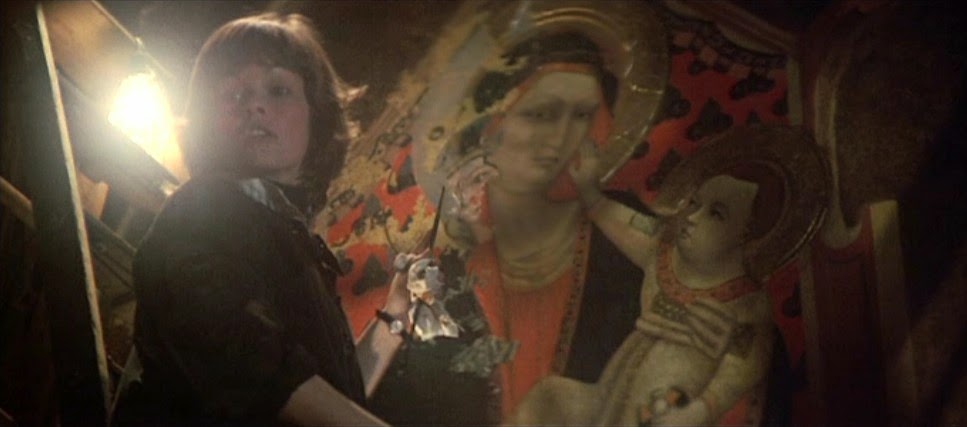
I've seen fire and I've seen rain, and I've seen SUSPIRIA enough times to not even mention it here - but PHENOMENA is a perennial because it's got Jennifer Connelly in the dark mirror twin role to her LABYRINTH wanderer (made the following year). With her raven-black hair blowing in the wind roaring down from the Alps, as the echo and flanger-pedal-drenched electric guitar and throbbing synth moments of ex-Goblin Claudio Simmonetti's evokes some echoing electric alpenhorn trying to signal anyone who can hear it to an unseen spectral menace. If you can move into the frame of mind of being at a near-deserted drive in in the middle of nowhere or even if you can't, you will dig the spook show surrealism and great wind noises.

It takes all the hot topics of the early 1980s/late 1970s and mashes em up with Argento's bizaarro touches: there's a chimp named Tanga (played by a very cool chimp named Inga) avenging his slain master ; SWARM-style bug attacks; CARRIE-esque telekinetic revenge against bratty schoolmates (replete with wind blowing the hair back ala FIRESTARTER); a deformed Jason-like child, flaming lakes, a razor left in a trash can, beheadings, maggots, POV killers shots with a knife on a pole ala PEEPING TOM, and all of it scenically filmed around the base of the Alps, where it's nice and stark and windy, in what wheelchair-bound Donald Pleasance dryly refers to as "the Transylvania of Switzerland."

People have written bad things about Connelly's acting here, i.e. her blank expressions when she should be scared, but hey--I think she's letter-perfect. She's a sleepwalker! And good lord did she have to suffer bouncing around in that decomposing offal pit, so give her a break. PHENOMENA works best, as its fans note, as a fairy tale, with Connelly's power to attract bugs perhaps the key to her fearlessness. She's like a superhero, hence the killer's question, my favorite line in the film, "Well? Why don't you call your insects!?"(more)

THE HOWLING 
(1981) Dir: Joe Dante

For my money this is the best lycanthrope study since WEREWOLF OF LONDON (1934), the one with Henry Hull and Warner Oland fighting over a Tibetan flower, not the one with David Naughton arguing with a decomposing Griffin Dunne in a Piccadilly cinema. Maybe I just don't care much for werewolves that get hung up on the letter of the law, like Landis' AMERICAN WEREWOLF IN LONDON, which came out the same year as HOWLING and there was much to-do in the press at the time about which make-up artist did the better transformation. Rick Baker won, and he's a genius, sure, but he and Landis makes Naughton's transformation unbearably agonizing, the moon inescapable, the beast itself a real wolf puppet on all fours. He takes it all way too literally. Joe Dante and Rob Bottin, on the other hand, know it's a goddamn metaphor, so they don't get hung up on the 'real' parameters. Thanks to witty script by John Sayles and Terry Winkless, their werewolves move way beyond such hang ups as urban realism, looming tall, standing upright like monster gargoyles, they're effective reactions to a world gone wrong. There might be too many indulgent close-ups of air bladders but so what!? It still rules. Following in the shoes of Dante patron, Roger Corman, HOWLING taps into the lupine side of 1970s sexual swinger and EST-ish encounter groups and woodland retreats. It's funny and scary and trashy and witty all at once, full of strong liberated professional female characters, De Palma meta-refraction, audio mimesis procedural delirium, Carpenter ominousness, Cronenbergian clinical immediacy, and a plethora of great bit roles by folks like Dick Miller, John Sayles, Kenneth Tobey, Slim Pickens, Kevin McCarthy, Forry Ackerman, and Corman himself..
--
Even FURTHER LISTS:
Great Women of Horror - Acidemic Top Ten. 

Netflix 24-hour Horror Marathon 
(though only about half the films listed are still streaming over there. Netflix what happened to you, man?)

CinemArchetype 17: THE DEVIL

Wednesday, July 09, 2014

Two hearts stab as one: Brian De Palma + Dario Argento = split/subject psychic twins of the reptile dysfunction


The critics say they're indebted to Hitchcock for their tropes, obsessions and subjects, but what I really see in Italian horror director Dario Argento and Italian-American suspense director Brian De Palma is a bizarre split-subject psychic twin connection, a shared reptile dysfunction that springs from Catholicism, ancient Rome, and scopophilia-driven sexual obsession mingled into a love story linking across the oceans and continents from Rome to the USA, a round trippy immigrant passage between the old and new world / mammalian higher brain's compassion and the reptilian cortex of unsocialized pre-empathic killer. De Palma has made a few films exploring this sort of split-subject psychic twin connection (SISTERS, THE FURY, RAISING CAIN) while Argento oomphs his dark fairy tale sensationalism with it. Argento even wanted Jessica Harper for SUSPIRIA after seeing her in De Palma's PHANTOM OF THE PARADISE. He said so!


And I didn't even know this when I started this post, but they were born the same month (September) of the same world war-ridden year (1940), six days apart. They are both Virgo, sign of the virgin, sign of obsession, poring over film strips and sound boards with the repressed energy of a thousand unreached orgasms (Catholic guilt, mama's bathroom monitoring, and god knows what else making masturbation a hairy palm-fearing no-no).

from top: Jessica Harper w/mic in PHANTOM OF THE PARADISE
(De Palma); w/knife in SUSPIRIA (Argento)
Both have been accused of objectification and misogyny due to their detailed gruesome violence against the female body. I used to agree with that diagnosis, but now I blame their reptile sadistic killer instincts on intense Italian mother-love and Catholic guilt (Hitchcock, too, was Catholic). The Devouring Mom's giant hydra apron strings cling to their minds no matter how much their onscreen avatars hack at them, each new woman's body a tendril-tentacle. I've come to feel my own feminist ire is founded in that same struggle, coupled to the unbearable level of anxious dread and soggy liberal arts (Protestant-atheist/Nordic) guilt--the compulsory mammalian instinct to protect the women (civilization, sterile) vs. the cold reptile desire to savage them (primal, fecund). When a camera doesn't look away from the horror wrought by our helpless positions as observers on the opposite side of the screen, caught like a masochistic spider in a sadistic web, then real horror can begin - on both levels at once. Feminists like myself blame the camera, the director, for our intense discomfort. Better we should have our eyes gouged out than see such traumatic butchery! Rather than examine this response and our own culpability in it (deep deep down, we feel the savage id stir), we lash out, labeling the directors misogynist in a vain attempt to scrub the horror from our eyes, not even realizing we're now part of the problem by associative vehemence.

Clara Calamai, Jacopo Mariani - DEEP RED
But Argento and De Palma will not let us look away. Even if we gouged our eyes out they'd find a way to reach us with these images.

Blood and black, from top: SCARFACE, SUSPIRIA (see Mater Testiculorum)
Argento and De Palma also use similar post-modern effects, deconstructing their own misogyny and their audience's demands for blood; each goes deep into the human eye, ever searching for what lies past the inscrutable inky black roundness of the pupil. Cameras, mirrors, photographs, film sets, stage sets, plays, taxidermy, and elements of performance-within-performance, masks behind masks, abound. I generally don't like dream sequences, they're like vents in which to dump cheap manipulations and sudden shocks without the burden of context, but De Palma melds and mirrors the dreams and reality together so completely that this harsh judgment doesn't apply; Argento does away with waking life altogether. Occasionally an Argento character wakes up in some exterior, drops by an outside a parapsychology conference for some exposition (as if a glass of water, or a quick trip to the bathroom), then it's back down into bed, the pillows, the mattress below it, the floor below that, the floor, the floor below... the floor... and then they're back and unsafe in the Freudian nightmare murk. 

from top: De Palma - CARRIE, Argento - INFERNO, De Palma -
DRESSED TO KILL, Argento - 4 FLIES ON GREY VELVET
Interesting too is that Argento's work has by critical consensus really sucked since 2001's SLEEPLESS, while at the same time De Palma's been pulling himself out of a sucky period (with 2002's FEMME FATALE). It's as if these aging auteurs are sharing a pair of traveling genius pants. De Palma's been returning to his old haunts, where cheap raincoats, razors, masks, split screens, double cross media-blackmail-stalk-and-snap PEEPING TOM post-modern media theory coupled to a PSYCHO-style cross examination, circular staircase POVs, and a psychiatrist's explanatory monologue wrapping the catalog of kinks back up in its brown wrapper before a final gotcha which often ends up being a dream within a dream, or was it (as in his recent PASSION)?

Without those traveling pants, Argento is floundering; he's become just another late night Cinemax director paying more attention to disturbing gore, gaudy sex and no art-as-violence fairy tale tricks for which we love him. Maybe it's because De Palma is making smaller movies that suit his fancies, while Argento seems laboring under the pressure of his name (and his refusal for example in MOTHER OF TEARS to go with his ex-wife's fairy tale script which might have rocked, and instead some nobody American guy's, one can only imagine it was because his had less art and more gore which is all he cares about these days, don't get me started).

Either way, and as an aside, this does not betray my grand theory that they are twins linked by some strange telepathy, like Jennifer Connelly with her flies in PHENOMENA (1984), or Amy Irving with Andrew Stevens in THE FURY (1977). 


None of this is to accuse either Argento or De Palma of being a mama's boy, a misogynist, a copycat, or a potential murderer. For better or worse (mostly better), the critical backlash against their movies has helped usher in the PC-era. With feminist ire building in nearly everyone, the blatantly phallic drill, endless softcore strutting and groping in De Palma's BODY DOUBLE (1984) was like an affront even to his defenders and defenders of the 80s in general. In Argento's similar films, sexual fetishizing is never an issue, except as far as elaborating on the madness of the mother or father fixation which then (usually) triggers a schizophrenic break with reality.

Now that I'm older though, I see the misogynistic violence of De Palma and Argento through this same schizophrenic prism, and realize only by expressing these wormy fantasies can we temporarily-cathartically expel them, or at least depressurize them so they don't explode and cause real-life damage. How many hydra apron strings were severed or unstuck in American families thanks to PSYCHO (1960)? It made such a splash on its initial release that the ripples haven't ceased in fifty years. It changed the way America went to the movies and gave armchair psychologists a gold standard for the dangers of maternal suffocation. Who knows how many closeted or overprotected men would still be living at home and doing their mothers' toenails on a Saturday night if not for PSYCHO as a warning? "You better move out before you end up like Norman Bates." Who knows where De Palma or Argento would be without it? PSYCHO snapped the 60s off at the shower curtain 50s root, and tossed it into the inky black pupil drain, where emaciated 20 year-olds like De Palma and Argento were waiting with their celluloid nets. 

Color-coded patterns from top (alternating De Palma/Argento):
 FURY, SUSPIRIA, RAISING CAIN, INFERNO,
UNTOUCHABLES, SUSPIRIA, PASSION, DEEP RED, FURY, 4 FLIES
MUSIC:

Naturally these psychic twins are not identical: Argento's psychoanalysis is perhaps deeper while De Palma is more into politics (Italy wasn't as mired in Vietnam). Argento's connection to music is more wryly contrapuntal than De Palma's, making innovative use of children's songs, whispering, percussion and even electric bass-driven funk from Goblin and Ennio Morricone. In DEEP RED, particularly a real break with convention is begun: swooning pop balladry as heads get slow motion sliced by shattered windshields--the glass a pop art snowstorm--and rattling nerve-grating, plastic cup echo-drenched percussion that stops when David Hemmings steps on a bottle, then resuming just as abruptly when a shade falls. This approach is the total opposite of the usual emotional-telegraphing of Hollywood, of which De Palma is part, preferring the usual overwrought orchestras. De Palma had Bernard Hermann scoring (De Palma's first films, and Hermann's last) which cemented the Hitchcock connection, but the genius of creating undulating nervous tension with an orchestra died when he did. Even geniuses like Hermann don't get how mellow pop songs should accompany murders and suspense music play over romantic parts. I've never been too crazy about the score of TAXI DRIVER for that reason, it's like Hermann doesn't get the ambivalence and Herzogian inscrutable stone face of the natural gods thing the way, say, Tangerine Dream got it for SORCERER. It takes true madness and the ability to convey the full breadth of that madness so those listening don't have time to recognize and escape it. It's only when De Palma got an Italian to score, Ennio or Nino Rota, that it really gels.

From top: NORTH BY NORTHWEST, DR. NO, the full ambiguity of
casual sex at its most chilling, and therefore truest.
ROMANCE:

Argento and De Palma use romance in a subversive manner, riffing on the lovers-on-the-run style of Hitchcock's NORTH BY NORTHWEST (1959) by having romantic comedy tropes tossed nervously in with the suspense, sifting through the queasy mix of dread and attraction that occur during a casual hook-up, i.e. when the other person's hot but it's all happening a bit too fast to not seem suspicious (where only Connery era-Bond or Cary Grant can safely tread). Is that what happens when a charming sociopath puts their moves on you? The winding up in bed with them is carefully crafted to make you think it's chance and fate, the night itself conspiring to bring you together, but already they're spiriting you away from your old life with surgical expertise. Even if they don't end up boiling your rabbit, or bringing you someone's head in a box, it can still be dangerous to bring them home or go home with them. Every hook-up is a risk. It's like a romantic comedy is coming true and you think somehow you deserve it, because your hormones scream oui oui. But something's not right. A grown man shouldn't exclaim aloud, "I forgot to phone mother!" while sitting down to martinis with executives at the 21 Club, expecting all these peers of yours to understand.

from top: De Palma (DRESSED), Argento (BIRD), De Palma, Argento - etc.
BIRD, DRESSED

They see you (from top: DRESSED, DEEP RED)
MISOGYNY of the GAZE

Lest we forget, BODY DOUBLE made co-star Melanie Griffiths (Tippi Hedren's daughter), an overnight star for her bubbly voice and her so 80s window striptease VERTIGO honey trap; Nancy Allen in DRESSED TO KILL uses her sexy body as a weapon to overwhelm the killer's gaze. It's this idea of feeling suddenly exposed as the viewer in the audience that activates the killer hiding in plain sight within the viewer's "normal" psyche-- such as when the psychic 'sees' the murderer while on stage at the psychic conference in Argento's DEEP RED. Dude, she's seeing us.

Part of the feminist arousal of ire perhaps stems from the anger at being forced to feel what the murders are depicting, not just from the stabbed side but the stabber, the horror and savagery of the murders leave their mark our murkiest reptilian recesses. But they are meant to be disturbing, to heighten our senses through fear and make us paralyzed in our seats. That is the correct reaction to these violent depictions and to presume it's not, that it's sadistic and somebody's getting off on it, is to presume a vast nation of rain-coated social sadists who get off on seeing sexy women terrorized. The response of feminist outrage is connected to the same repressive mechanisms that motivate the killers in De Palma's DRESSED TO KILL and Argento's DEEP RED. Seeing themselves being seen, they freak out. It's as if Argento and De Palma are doctors who touch these critical viewers in places within themselves they don't want to admit exist, so the urge is to sue for sexual harassment. But maybe he was checking for a tumor! Maybe she's reading too much into it based on her own hang-ups?

The stuff that really traumatizes me now is not the gore of De Palma and Argento but the unconscious, casual cruelty of other films (like VACANCY or WOLF CREEK), that aren't necessarily good or scary but leave me damaged for days, just imagining anyone would ever want to see or get off on that kind of torture porn brutality. Argento and De Palma are more compassionate; the very idea of film violence obsesses them to the point that they can target and exorcise it through a double blind mirror-to-the-audience gaze reflector, such as the movie screen-shaped white art gallery entrance in THE BIRD WITH CRYSTAL PLUMAGE (below), or the (wider) screened window of De Palma's BODY DOUBLE (below that).

In these shots/scenes we're given a profound metatextual illustration of the perverse appeal of violence on the big screen, and the reason for our sometimes violent offense seeing it -- our urge to rush the screen and pull it down before the unthinkable happens, and if we fail, to find the director and pour our drink on his head and kick him in the nuts. When I was young in the 70s-early 80s, seeing an R-rated murder like in SUSPIRIA or HALLOWEEN was the equivalent of a scary roller coaster, a rite of passage, something you needed friends to go to with (at the drive-in or dangerous downtown theater). But if the audience laughs and cheers the murder (as they would going down a roller coaster hill) and someone is there alone and sulky to review the film for the Times, would they not worry, hearing the cheers and giggles, that these films are mere pornography for vicious misogynist freaks? I know that's what I would have felt. I read those reviews and developed a whole irate feminist vulnerability complex because of them, or imagining the audience cheering slaughter of sexually aware females, as if the theater reverted to some biblical age-style adulteress stoning.

But I now think these murders are meant to tap into our mammalian protective instincts far more than reptilian cortex sadism. More than cheering brutal murders, we scream at characters onscreen in helpless frustration not to go back in the house, or basement (hence all those 70s horror titles DON"T ANSWER THE PHONE, DON'T LOOK IN THE BASE etc.). But our anger over their counterintuitive behavior might be our attempt to shirk our responsibility. We want desperately to feel like the endangered woman brought it on herself for making so many counterintuitive decisions, that believing she deserved it will absolve us of the guilt that we couldn't be there to save her, that her death onscreen is the result of our real-life absence from our own lives, but it's not our fault!! Damn you for even tricking us into thinking so.

untraversable screens - from top: Argento, De Palma, Hitchcock (viewer helpless to help, or look away)
METATEXTUALITY

But it's really the powerlessness of being tied (more or less) to our chair and unable to be heard through the screen (often represented in De Palma like a shower stall or rainy window), and guilty at our own bloodlust, the deep dark reptilian-dysfunctional part of our viewing brains (the type that eats their young and has no empathy), that we're reacting to. It's simplistic to call that misogynist, because if we didn't feel that way, if we relished her weakness and bad choices as chances to strike, then we reduce ourselves to the lonesome status of the reptile, or cokehead, a sociopath rather than a compassionate mammal-reptile hybrid. As so often in Argento films, we shudder enough watching the stalkings and killings that we need our own avatar for that shuddering, someone similarly trapped outside the screen - unable to save and unable to look away - the reptile mind holding our terrified mammalian eyes on the blood with the same insistence as the administrator of the Ludovico Technique.

from top: CLOCKWORK ORANGE, OPERA

It's also true that when other artists tries to mix media theory and sex and violence, giallo tropes can't help but appear--as in the John Carpenter-scripted EYES OF LAURA MARS (1978), which somehow manages to be very Italian just by being into fashion and photography (via Helmet Newton) and set in New York at the height of its crime-ridden grittiness. To incorporate cameramen within films and musicians and sound engineers hearing something they shouldn't or seeing something they can't quite remember, is to enter a realm where even we as the viewer are not safe. It began with REAR WINDOW (1954), became entwined with the counterculture in BLOW-UP (1966) and its imitators, and continues with Argento's and De Palma's descendents, like Strickland's BERBERIAN SOUND STUDIO (2012), and  Michel Soavi's 1987 STAGE FRIGHT. The key in each is the meta-framing of the performance of horror as a rite, an ancient re-enactment of pagan sacrifice older than modern civilization, ever present in our DNA just waiting to come out, powerful even if the victim is just a barleycorn effigy.

children of meta giallo: BERBERIAN SOUND STUDIO, STAGEFRIGHT:
AQUARIUS, EYES OF LAURA MARS
SHARED MOTIFS:

AVENGING ANGELS and DEMONESSES


from top: De Palma (x2), Argento, De Palma. Argento
ART: 
Art galleries and artist studios legitimize scopophilic behavior, allowing for more a broader palette of associative symbolism. Stretching the sexual gamut, via headless statues and statue-less heads, Bosch and Bruegel, Escher and surrealists lead the way to where De Palma and Argento follow.  Through art, Laura Mulvey's concept of the male gaze is equalized, or at least - broadened. In subversive horror films, the male gaze is declawed, rendered impotent, because the desired woman onscreen looks back at us. She sees our evil toad thoughts and doesn't flinch or bow submissively, freezing us in our motionless tracks. Hence my term Mecha-Medusa (wherein the desored object looks back, freezing us with the uncanny, skeevy horror of our own initially lewd stare). See also: subliminal screens, metaphors for the immersive film viewing-experience, the mass hypnosis of the theater where we merge into a group mind caught under the sway of a dangerous crazy person.

 frpm top: STENDAHL SYNDROM, DRESSED TO KILL
Associative and literal misogynistic devouring / dismemberment / triggers

De Palma, Argento (etc.)
-----
BLINDNESS

from top: Argento, Argento, De Palma.

Blindness allows for heightened variations on the HVR or Heightened Victim, or Helpless Viewer, Response (we can't help them across the street, being blocked by the traffic of the screen); fetish objects for objectifying (they can't look back); they cannot be threatened by what they see, hence are not a threat (as in the men blinded for seeing by matriarchal coven-ruled social order in the 1978 TVM, THE DARK SECRET OF HARVEST HOME --blindness as symbolic castration). At the same time, some--like Malden in CAT O'NINE  TAILS above--use their other heightened senses to advantage (linking their hearing to the sharper hearing of animals, or Travolta's field microphones).

Argento x 2, De Palma x2
MIRRORS / DOUBLES

They fog, and when something or someone looks in them and freezes stock still, they become their own objects. Doubling is related to that --evil twins, and the inherent split of actors and characters -as in the split between the woman playing a terrified woman in a horror film, or literally split in the case of the body doubles in De Palma's BLOW OUT and BODY DOUBLE. There are the separated twins of SISTERS or RAISING CAIN and the eerie similarity romances (someone looks just like someone else the protagonist was in love with and saw die-- stemming from VERTIGO) - -Geneveive Bujold in OBSESSION, Melanie Griffith in BODY DOUBLE, Margot Kidder in SISTERS, the two raincoats in DRESSED TO KILL, and so forth. In Argento, there's the impersonation of the killer as PTSD obsession in THE STENDAHL SYNDROME or TENEBRE, the fraternal twins of INFERNO, the impersonation doubling in PlUMAGE --actually, I guess it's more of a De Palma thing come to think of it, as he's way more into VERTIGO than Argento is. 


PRIMARY COLOR SYMBOLISM: 
Deep Red is the color of menstruation, child birth, the link to sex and excitement, flushed cheeks, heat / dark blue the color of swollen wounds, the chill of the deep, dark death, etc.

DREAMS / DREAMLIKE FLASHBACKS
De Palma relies on them but drags them really slow and methodical, without any dialogue and often backwards so that they're as relevant as 'reality' within the film; Argento flashes to them now and then, more out of stories told or childhood memories of the asylum or before or after (where everyone acts like automatons). De Palma links dreams with horror movies worked on by characters of his movie (John Travolta in BLOW-OUT), or wordless operas, or the clockworkiness of Bergman's WILD STRAWBERRIES or Dali's dream clocks in SPELLBOUND and MOONTIDE.


CIRCULAR STAIRWAYS
Great for chase sequences and as symbolic of the 'descent' into the unknowable squirmy recesses of the subconscious.

frop top: Godard, Coppola, Argento, Argemto,  De Palma, De Palma
SOUND RECORDING

The visual screen is just part of it, of course. Coppola's THE CONVERSATION was hugely influential on both De Palma and Argento (the scopophilia kink extends to eavesdropping). They both similarly took notice of Godard and Truffaut (as in the DON'T SHOOT THE PIANO PLAYER-style arc of BLOW OUT) whose incorporation of the recording studios and screening rooms they were using into the films themselves indicated an unhesitating post-modern bent.

From top: PEEPING TOM, REAR WINDOW, BLOW-UP, TAXI DRIVER
PHOTOGRAPHY

Antonioni's BLOW UP, Hitchcock's REAR WINDOW and Powell's PEEPING TOM are huge (obviously) influences to both directors. To a lesser extent, TAXI DRIVER (if Travis had a 16mm movie camera to point at the mirror and the pimps, imagine the movie he would make!)


SCREEN METAPHORES: De Palma is more obsessed with the hot female body threatened by the gaze (and threatening to it as well, quid pro quo) while Argento is obsessed with childhood dreams and traumatic repressed childhood memories drawn on the wall and then painted over, fairy tales elaborated into operatic tableaux (the automaton movements of the child in the DEEP RED flashbacks, etc.) Argento is more centered directly on metaphors for passive viewing (trapped and forced to watch), while De Palma focuses more on the cinematic apparatus (projectors as well as screens). Note the way the shadows in the picture above makes the childhood drawing look like its projected on the wall; below that is the image from INFERNO, the screen as opaque window about tot be slammed down on a neck, or slowly torn through by a dying woman. Unlike the earlier example (in BODY DOUBLE or OPERA), these screens aren't there to mock our powerlessness to save a woman (or alert to the danger behind her--the common thing in the crowded cinema of audience members shouting at the woman onscreen to turn around), but to threaten our sanity by either coming through the screen (like a broken head through a window) as in Lamberto Bava's DEMONS or beckoning us through it (as in DEEP RED)

From top: Patton, Blow-Out

For De Palma it's not the art house he recreates with his traversable screen, but the drive-in, the NASHVILLE or TARGETS or PATTON-style backdrop, such as the flag behind the climax of BLOW OUT or the blue behind Carrie at THE PROM (just as in SCREAM or THE RING it's not the theater or drive-in but the TV), like a kind of multi-media breakdown.

Find the skull gazing back!
(from top: Hithcock's NOTORIOUS, DRESSED TO KILL)

THE GONE-DEAD GAZE: De Palma's films are never, to my mind, as focused on art, instead dwelling more on politics and on the curvy flesh of hot girls and the terror of that objectifying gaze being reversed, of the 'object' returning the gaze, provoking a response which is always in direct relation to the viewer's fear of being viewed, of being judged. Feminist critics attach too much power to the male gaze, seeing it as ownership, which is like thinking you can get fat from looking at pictures of cake. Like dogs brave and combative on the leash but cowardly off it, we love to imagine what studs we'd be in the sack with some hottie we pass on the street; as long as she doesn't turn around and invite us upstairs for a tryst, we're safe in our fantasy. But if she drops the pretense of not seeing us and offers or asks for sex, even the most courageous of studs will usually rear back like a startled mare --it's too sudden, too soon. We perceive it almost as a violent slap, we're like Medusa flashed by a mirror raincoat.

from top: 4 FLIES IN GREY VELVET, PSYCHO

And so it is that the ideal object that arouses or fascinates the killer is one that never looks back (figures in magazines with the eyes crossed out, blind people, etc.), allowing unchallenged staring. When the figure in portrait of Otto Preminger's LAURA (1944) suddenly appears, in a raincoat and bad mood, the detective's enchantment is instantly dispelled. The murderer's fantasy is to keep his prey from being able to return the gaze, to rip off our mask. Unless the cops scan the last image her eyeball and project it onto film (as in 4 FLIES ON GREY VELVET), or she comes back from the grave, she'll never be able to identify the killer.


Lastly, don't forget AMER (2009): perhaps so meta as to transcend narrative altogether, it presumes a certain familiarity with Argento and De Palma's oeuvre and their shared psycho-sexual roots as well as the distinctly Antonioni-esque experimental ambiguity where Jungian fairy tale subtexts go so deep down they come out the top like digging to China. One of the rare feature length films credited as being directed by a couple (she's French, he's Italian), the film is truly split, not just into three chapters but into experimental and narrative; not scene-by-scene but shot-by-shot.  At last he twins of fairy tale sexual psyche are united, the children of the giallo are born again, and the unification of male and female halves make a unique whole. AMER is the fulfillment of the promise in Argento and De Palma's most dreamlike works, distilled with all the plots and narrative weeded out but still riveting. It's glorious.
Related Posts Plugin for WordPress, Blogger...