


Dream or Nightmare logic: a lazy way for European directors to run amok with free association non sequiturs and not have to worry about coherence, or a daring approach to the post-60s crashed jet set void de la Freud delving, based on the symbolist and surrealist movements of the early 20th century?
A: Yes
B: Magenta.
C: Hollyhocks
D. Mrs. Claypool
E. (......windshield wiper sounds)
F. Two of the above
2. European art cinema can be very boring and opaque if you're careful. But if you're not--if you're, say, dosed or delirious or bored into falling into a trance--its abstraction makes perfect 'sense.' Falling half-asleep while watching Rollin or Jess Franco's earlier work, for example, is a truly psychedelic experience, and in most cases almost inevitable. Would you agree?
A. No
B. Sax player shredding a picture of Lina Romay and dropping pieces in a ditch by the Autobahn.
C. Sax player shredding a picture of Maria Rohm and throwing pieces into the Bosphorus.
D. Trumpet player taping a picture of Soledad Miranda back together again, in vain.
3. There are five easy ways to understand Italian drive-in dream logic, all based on the Carnival of Souls principle:
a.) DEATH: The protagonist is already dead and/or stuck in an endless reincarnation loop stuck in the amber of hell/heaven time.
b.) AMNESIA: The protagonist/s have amnesia but don't even know it - they try to hide it, the way you don't want to admit you don't remember someone who comes up and knows your name. The result of lots of drinking in the swinging European 60s-70s.
c.) DREAM: Dreaming while awake, caught in a web of true myth, where waking consciousness and unconsciousness have lined up perfectly, like two overhead transparencies.
d.) LSD: They're tripping or recovering and can't remember which is which (lots of acid in 60s-70s Europe)
e.) INSANITY - They're remembering or recounting narrative from a psych ward.
f.) All of the above, for in a way they are all the same, non?
Remember that in Europe the language barriers are more immediate and the past older than in America. In Europe, a 70s B-movie can take place in a real castle, or a condemned art nouveau mansion cheaper than building a single Hollywood set, so a modern French model in a turn-of-the-century vampire gown running loose amidst the Gothic spires is not only cheap to film, it has so much post-modern frisson it creates a truly 'all times all the time' dream logic loop all into itself.
 |
| Beyond the Black Rainbow (top: The Strange Color of your Body's Tears; Berberian Sound Studio) |
For this festival, we're talking of a return to the art of those pre-slasher death-poetic times, a time before the derelict fringe theaters at the edge of America closed. And before kids could just go to their rooms and watch tapes of Texas Chainsaw Massacre and Dawn of the Dead until they were numb, and pornography when they weren't. Compared to that madness, the razor slash black glove murders and surreal heavy breathing dream-rotica of what Mondo Macabro calls Eurosleaze seem almost quaint.
 |
| You and the Night |
And so, full circle. New filmmakers falling in love with the old ways --trying to escape the numb overkill 'traumatize even a pre-Ludovico Alex' ultra-violence-- come to this old genre as if a wellspring. And the wellspring has never been clearer, cleaner, more beguiling: Many of these old films, available only as pan/scanned blurs on VHS if at all, bare now restored by to HD by loving homegrown labels. And so new films spring up paying homage to the post-modern psychedelic wellspring of experimentalism.
 |
| The Strange Color of Your Body's Tears |
And atop the crest of the post-modern alienation resurgence lurks 'the Darionioni Nuovo' the New post-Dario Argento-Antonioni wave-- Peter Strickland, Helen Cattet and Bruno Forlanzi, Sebastian Silva, Nicolas Winding Refn, Panos Cosmatos, and the post-Carpenter/Morricone music of Sinoa Caves, M83, Tom Raybould, Cliff Martinez, and Rich Vreeland. It's a new setting sun; the alienation-cum-Freud dissociation style used together to explore red desert crimson rivers of pain and ecstasy, hills of post-modern disaffect that uses our need for a coherent linear narrative mapping, our presumed familiarity with exploitation and art film history, with fairy tales, David Lynch, and modern art, as a kind of metaphysical third heat paint brush. The result is what art cinema should always be striving for: an erasure of the line where narrative classical cinema ends and avant-garde experimentalism begins. Madness coheres like a boil atop modern alienation's callouses; our own vivid imagination becomes a finger pointing at how innate and irremovable is our compulsion to craft a frame, an order, a meaning, a reason, a psychosocial iconography, onto even the most elusive and elliptical of texts.
But it's only when the symbols are there but we can't connect a single one that we're finally free --pure Joycean aesthetic arrest mingling with the erotic Batailles death drive at the same time. So line these up in your list, see them all in order, all at once--obey.... obey... and let go of that tightening noose around your mind called language.
See also:
STAGEFRIGHT: AQUARIUS
Bad Acid 80: Italian Horror Drive-In Dream Logic

1. PASSION
(2012) Dir Brian De Palma
***
De Palma's Italian modernizing of the Hitchcock homage, an obsession he abandoned for a slew of blockbusters in the 80s-90s, has kicked back in for the 21st century, on more modest budgets, out in Europe where they still revere fading auteurs. He's been crafting old school returns to form like Femme Fatale and this loose remake of the French film Love Crimes, called Passion. Strangely, due to cast and content, it also functions as an unofficial sequel to Soderbergh's Side Effects (which as Alan Scherstuhl notes "ground that other girl with the dragon tattoo through something like the same pharmaceutical Hitchcockisms.") Even with all that intertextuality, Passion--not unlike Fatale, --met with critical hostility from a knee-jerk press too busy sneering at the unrealistic excess and recessive misogyny to notice the sexy genius at work, condemning it have having almost no reference to anything other than Hithcock and Chabrol films. But if Passion came out in 1973, those same critics would be worshipping it today, since Pauline Kael would be around like a protective lioness for her dirty kick cub. She's gone, but here on Netflix Passion finds a new chance for resonance, since it can become part of a post-giallo festival list like mine! Always the downtown American twin/paisan to Argento (see: Two Hearts Stab as One: De Palma's and Argento's Reptile Dysfunction), De Palma is nothing if not savvy about the obsessive alienation caused by the endless proliferation of image, of titles binged in meta mirroring, instant festival curations (like this one). His films work best when they're situated between the art and low horror films on the theater 'coming soon' wall. And onscreen, the boardroom lesbian betrayals and seductions, the split screen, the ballet, all add up to a curious and sometimes titillating exercise in pure bravura style for style's sake. Pretend it's a futuristic thriller coming out in 1978 and that it's not a movie at all but a lesbian fantasy Catherine Zeta Jones is having while in jail during a Side Effects coda. Frickin' McAdams is the hottest thing ever, man, and brings so much duplicitous brio to her role she's like her old Mean Girl self grown up for the long con. And the gorgeous-if-sterile corporate imagery, hot sex, cold stalking, and ominous Pino Donaggio score are as perfectly interconnected as a fine Swiss watch.

2. KISS OF THE DAMNED
(2014) Dir Xan Cassavetes
***
***
Bearded screenwriter Paolo (Milo Ventimiglio) meets alluring but stand-offish Djuna (Joséphine de La Baume) but they can only hook up if he becomes a vampire, cuz she gonna bite him. Love finds a way and five Twilight films are condensed to the opening act of a low budget but artsy and vivid retro-esque vamp tale from the daughter of John Cassavetes. Backed up with a sultry Steven Hufsteter score (with just enough vintage Morricone twang), the delicately low-key romantic chemistry of La Baume and Ventimiglio intoxicates so when Djuna's wild child sister Mimi (Roxane Mesquida) shows up, needing a place to crash after laying waste to her last party town residence, we recoil in frustration like we're Gene Tierney cockblocked by apple-cheeked cherubs in Leave Her to Heaven. Kiss of the Damned isn't set in the past or anything but Cassavetes is clearly paying some homage to the sexy vampire films of swinging 60s-70s Europe, and she hooks us into loving them anew by filling us with the giddy high that comes from being welcomed into the in-crowd, and being cool enough that of course you fit right in, and get to stay young and gorgeous forever...

3. BERBERIAN SOUND STUDIO
(2012) Dir Peter Strickland
***1/2
While we wait for his wildly acclaimed Duke of Burgundy to come to Blu-ray, the Argento stylistic anti-misogyny,Bergmanesque post-modern meltdowns and Lynchian "no hay banda"-ism of Strickland's memorable debut Berberian Sound Studio add up to a deeply unsettling visually (and most importantly aurally) seductive post-structuralist fantasia wherein a reserved Brit sound mixer (Toby Jones) works on a mysterious horror film in 70s Rome. We never actually see the film the's working on (just hear it), which just adds to the unsettling frisson of its imagery --no visual violence can really match our imagination, aptly mirrored in the sickening dead-inside feeling overtaking Jones as he rattles the chains, crunches heads of lettuce, and drenches it all in a dripping crypt echo (from the fractions of script and scenes the film seems one part Argento's Suspiria, one part Soavi's The Church, and one part Fulci's City of the Living Dead). Strickland trusts his expert blocking and cagey actors and actresses in and around the studio's tight places, and though the rudeness of some of the macho Italian filmmakers gets on one's nerves, it's supposed to, indicating the corrupt, decadent fucked-up misogyny of Italy runs thick as blood under the giallo genre's slick surface. A layered masterpiece of enigmatic self-reflexive horror, Berberian Sound Studio is like five different Italian horror and art film DVDs--the films and making of documentary extras--all swirled together into a fantasia that puts broader self-reflexive stuff like Shadow of the Vampire to shame, and instead approaches the meta greatness of Irma Vep, StageFright, Contempt and The Stunt Man.


4. STRANGE COLOR OF YOUR BODY'S TEARS
(2013) Dir. Helen Cattet y Bruno Forlanzi
***1/2
Hélène Cattet et Bruno Forlani, cinema's first and only mixed gender / race / nationality directing couple have been setting my head on fire ever since their 2009 feature debut AMER. I was so blown away by their unique mix of modernist experimental and post-modern 70s Italian horror narrative that I even coined a term to describe them the Darionini Nuovo. Argento may not have made a decent film since the mid 90s, but this pair has taken his blazing primary color iconography farther than brother Salvatore would have e'er allowed. (I'd also argue Argento really needs Asia's mom, Daria Nicoldi to help him write and get the feminine fairy tale point of view, because without her--as in his last decade's worth of films--he just seems perversely misanthropic.) Granted Forlani / Cattet's unique looping style will no doubt prove alienating after about twenty minutes to people who don't know Suspiria, Red Desert, L'Eclisse and Bird with Crystal Plumage like the black of their gloves, and who don't swoon at gorgeous ironwork maze of art nouveau architecture or thrill to Jungian psychosexual mythic color-coded resonance, all slashed out before them like a blood bouquet against obsidian skies. Then again, even those of us who do might need a break halfway through. Don't worry, the joy of streaming is you can just stop and pick up later where you left off. Or start over. There's no difference. Maybe try playing ten minutes of it in between all these other films, like a connecting story to a horror anthology. Either way, essential viewing.

5. BEYOND THE BLACK RAINBOW
2010 Dir. Panos Cosmatos
***1/2
Michael Rogers is a batshit crazy psychiatrist named Barry Nyle, who keeps the director's scanner-style acid-spawned only patient, Elena (Eva Bourne), under heavy sedation in a futuristic Rothko-cum-Kubrick orange or red or yellow room, and tries to analyze her through her a thick protective glass, while jotting down 'notes' and slow-as-molasses-style going even more insane. He also has special super tall robot-like guards called sentinauts and a weird white triangle device that can deliver sound vibrational (presumed) shockwaves to knock Elena to the ground and (presumably) jam her brainwaves if she tries to explode any heads or walk out the door. It's really a sight-sound spectacular, heightened by a great retro-futuristic synth score by Sinoia Caves which heats and throbs and pitch modulates around the bizarre retrofuturistic dome, going everywhere Barry goes, from the depressing nurse's break room, the office/drug den of the Buckminster Fuller-ish founder of their geodesic complex, his slick car. In a flashback to 1966 we see the Fuller-ish director as a younger man, taking Barry on his deep dish drug trip (LSD was legal then and being used by forward-thinking psychiatrists all around the world); his trip resembles the 'Beyond the Infinite' section of 2001 slowed to molasses and judging by the third eye drawn on his forehead and his patience with letting his face melt and dissolve, we figure he must be ready to transform... but into what? Then he's reborn in an oil slick, crawling out of a black circle like a reptile from its egg, and latching onto the woman, some woman... I don't know...his wife? Elena's mother? Does he kill her by ripping her throat out with his teeth, or is that an ejaculation? Is she coasting on an orgasm, or is the light going out of her eyes? Or is he remembering his birth? Does the director forgive him since he's legally insane due to his heavy trip? Dude, I've been beyond the black rainbow too and I didn't end up killing anyone, so what's this guy's deal? I do know how easy it seems at the time, but there's a difference.
We know Cosmatos's deal at any rate: he's made a glacial melding of Canadian retrofuturistic 70s horror (Scanners, Blue Sunshine) impossible to categorize masterpiece so far ahead of its time it's past hasn't even happened yet, and yet it's never left the 70s, why would it? The imagery and the music is the thing... is Cosmatos our new Kubrick? Time alone will tell, but it won't tell Barry.
We know Cosmatos's deal at any rate: he's made a glacial melding of Canadian retrofuturistic 70s horror (Scanners, Blue Sunshine) impossible to categorize masterpiece so far ahead of its time it's past hasn't even happened yet, and yet it's never left the 70s, why would it? The imagery and the music is the thing... is Cosmatos our new Kubrick? Time alone will tell, but it won't tell Barry.

6. ROOM 237
(2014) Dir Rodney Ascher
****
Now we come to the dividing line between present-past and passed-past and pissed-drunk, a sideways crab-like moving from post-modern giallo to paranoid theorizing to proto-giallo to TV movie giallo and bizarro refractability. With Ascher's fascinating documentary we understand the impossibility of a text ever meaning anything, regardless of the author's intention. So freed of all understanding, we enter the realm of madness and all is illuminated, and terrifying. First because paranoid psychosis is very contagious so as we hear these crazy theories about what every little detail means we begin to get scared by the original movie all over again. Now we realize the insanity that appears when we lose all contact with the outside world. Artists try to work with it, theorists riff on it, and the writer drowns in it. Forget about being reduced to a simple icon through repetitive mantra makes a dull boy, the SHINING is all about losing all connection to icons, all signifiers, until objective consensual 'meaning' vanishes into the fog of the purely subjective. Good riddance, or rid...dle dense! (more)

7. LISA AND THE DEVIL
(1974) Dir. Mario Bava (1)
***1/2
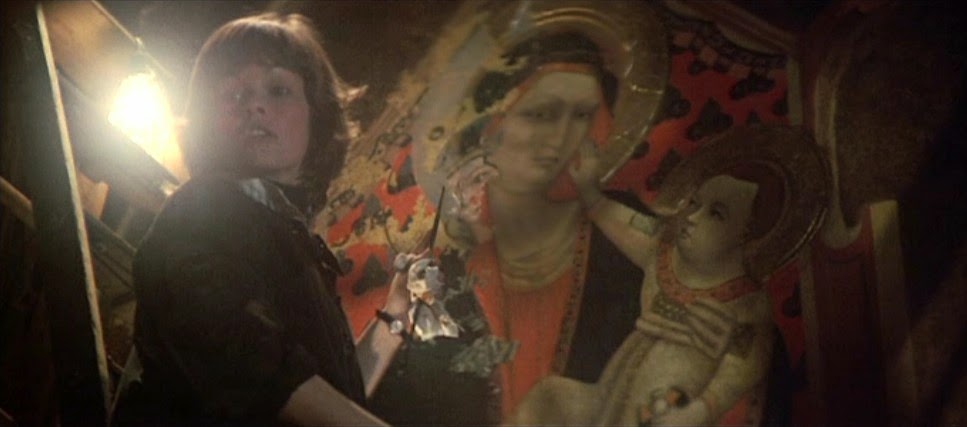
Lisa (Elke Sommer) is on holiday; her tour bus stops at a maze-like little Spanish town and and Lisa sees a jolly demon in a Middle Ages fresco - it sticks in her mind; then she sees a man who looks just like the demon buying a mannequin at an antique shop she wigs out. So do we, for he's a bald, lollipop-sucking cigarette-voiced hipster named Telly Savalas. It's all too much for poor Lisa and she's thrown into what Carlos Castaneda might call 'non-ordinary reality' and what Bava might call purgatorio but what we call 'surreal 70s Euro-cult heaven.' Obsessed by a little musical carousel of macabre figures chronicling the endless cycle of life after life, Lisa begins to wake into that special nightmare where you turn around and suddenly everyone you know is gone and you're all alone and lost in an empty narrow streeted maze in a foreign land; you catch a ride in old car from a rich couple (the younger wife having an affair with the hot young chauffeur, the older man too world-weary to give a fuck, etc.) The car breaks down near a a weird old villa where you all run up against a cockblocking Hitchcockian matriarch played by Alida Vialli (the malignant future director of the Freiburg Dance Academy) and her cat-eyed son (Alessio Orano), who she won't let beyond the villa walls and who has been so....so lonely. Corpses accrue, and as they do, mannequins appear which Telly arranges in the 'funeral rehearsal'.
Naturally, Lisa looks just like Alessio's dead wife and--when he later makes love to her comatose form her by his dead wife's sleeping skeleton--his lonesome kinkiness gets so creepy on so many levels you just have to laugh.
Mario, you make Poe seem balanced.
Naturally, Lisa looks just like Alessio's dead wife and--when he later makes love to her comatose form her by his dead wife's sleeping skeleton--his lonesome kinkiness gets so creepy on so many levels you just have to laugh.
Mario, you make Poe seem balanced.
 |
| Who pulls your strings, baby? |
Anyway, it's all cool as this is all just a tape we played long ago underneath the carousel of time Lisa wanted at the antique store, which turns up here, with a tape player providing the music; Savalas' mannequins come to life and play the parts of long dead lovers or whomever is needed, and the killer kills them back to mannequins again. Funeral marches are held on the spot, as the latest body is wheeled around on a serving cart through the vast semi-decayed mansion; one lavish room is devoted solely to family funerals, which Alessio later tries to change into a marriage chapel by kicking wreaths over. If the (painted on clapboard) decaying trimmings and gaudy silver of this old villa begins to weigh on the mind like one has spent too much time 'antiquing' on a sunny afternoon in the country with mother.... always with mother. But murders come too fast for boredom, and necrophilia follows hot on the heels - a dozen viewings later and you appreciate it like you just learned to savor very old wine instead of wolfing it down for a quick escapist buzz.

Depending on your affection for the giant pointed 70s collar out over smoking jacket lapel look, the size of Alessio's collar at left might be just too much. The sickening key lime green of Elke Sommer's raincoat and shoes makes me, personally, ill and really brings out the greasy flatness of her gaudy cheap 60s make-up (as Audrey Hepburn says in CHARADE, certain shades of limelight can wreck a girl's complexion). But, even if you're sick like me, if you get to the end you finally get why she was wearing it in the beginning; because every color must match, pre-destined like a dream, and her horrible make-up is all gaudy and doll-like purely so she looks like a mannequin in profile. The film is full of things like that, so never doubt the maestro, baby (PS - I recently saw the HD remastered verision of this on Shudder and take back everything I say, she looks ravishing - it was the old transfer that made everyone look so waxy). I would be thoroughly a fan if the score was Morricone twang instead of Carla Savaina swank, but there is an interesting giallo-esque sing-song motif playing for all the broken clock shots (lots of 'x' symbolism) and whether ironically working a lollipop colored the same lime green as Elke's coat, dropping double meaning Satanic inferences like "nothing escapes me, madame") or wryly talking to himself while packing mannequins into coffins as part of a "dress rehearsal for a funeral"--he's divine, baby. Divino. I also love him as the Cossack officer in Horror Express ("who are the perpeatratazs?!") and he's my favorite Blofeldt ("you love chiggens.")
Selected Shorts:

KOLCHAK: THE NIGHT STALKER
(1975) "The Trevi Collection" (ep.14)
(1975) "The Trevi Collection" (ep.14)
I never saw Kojack but Kolchak is different. Him I knew and loved. And it was even on early enough I could stay up to watch it. And in this episode we're reminded there's no cheaper yet creepier effect than casting and dressing humans to look like mannequins so you can interchange them with the actual mannequin in the background of shots for a very unnerving effect. Bava used this trick in Lisa and the Devil albeit more overtly. Like the 1979 Tourist Trap, Kolchak keeps the truth ambiguous. And this witchy episode is one of everyone's favorites from the era. Right up there with the lizard monster in the tunnels, the headless biker, and the ghostly Native American shaman. Dig man... canceled after one season... 'cuz he was getting too close to the truth!

"Danielle"Starring Jennifer Lawrence
Saturday Night Live - Season 38, Episode 11 Time: 43.52-47 - 47:08
The movies this four minute spot parodies are all-too familiar for anyone who remembers pay cable in the 80s. And the brains behind this (clearly Fred Armisen and Bill Hader) know their stuff and Lawrence is, as always game. Brilliantly capturing the flat but sonorous voice dubbing --clipping sentences together.... tofitthelips as they move... and the crushing banality of it all and sudden sharp laughter-- hahaha, look kids I'm a bufoon... It's priceless and worth taking the time to find, for it captures perfectly the icky sensation of watching Europeans try to act like Americans on vacation, and pretend orgy mongering is natural for all jet set lounge cadets outside the US. if you want to stick on this bent - check out Danger 5, the first season.

8. THE IRON ROSE
"La Rose de Fer" (1972) Dir Jean Rollin
***
The French love their poets the way Americans love rock stars. This is normal, not something for your girlfriend's parents to passively sneer at. In other words, unlike Americans, the French love writers as well as performers, and understand that the actors aren't just making this stuff up on the spot. Most of all, though, they love French poets like Brittany's own Tristan Corbière, one the crowning jewels of the Symbolist 'dead before 30' dozen. I'm not sure which part of Françoise Pascal's final monologue/ voiceover during her nude cross-bearing is from him, but I do value that it's hard to tell. I also value that, aside from an ominously black train parked in the weeds in the middle of nowhere and an opening working class wedding feast (at which both characters seem to clearly not belong --as if already ghosts), the film takes place over one late afternoon-into-dawn trip to the overcast graveyard. As their pleasant and banal Rohmer-esque date turns first into a slow nightmare (they can't find the exit), then paranoia over each other's motives, and then a surreal mournful cry for death, the whole film becomes a love song, a longing for the loving embrace of la mortalité, finalité et l'éternité.
 |
| And is there any image more quietly under-the-skin creepy than this image at right? Non. |
Every student filmmaker knows that old cemeteries are the best places to shoot films cheap (superstition keeps most people away; the stones add artsy death drive heft), and a cast of just two actors walking through it is even cheaper. You don't even need a script! You can just shoot your actors frolicking or running or freaking out and figure out what the reasons are later via voiceover. It would be lazy in most directors (even I've done it -see the Buenos Aires section of The Lacan Hour) but that's just part of Rollin's charm, that pretentious art film iconography. There's already a morbid air to his Euro-sex films anyway, so it's no stretch going this dark, and Pascal's deranged and demure performance, slowly going crazy amidst the plethora of human bones scattered in the open crypts, is perfect.

A purist might wonder how either this or the last film is truly post-giallo, but to that I shrug like a condescending French cabbie and note that it's short, so you might not even have time to wonder where the hell it's going before the ride is over. Just know the boy and girl are dressed in bold primary colors, so we can see them in the fading light. There's no glaring spotlights or day-for-night nonsense, making Jean-Jacques Renon's photography all the richer for being so dark without going murky. When the sun comes up and the the conqueror worm's snacktime looms you can feel your pupils contracting from the sudden light. It's glorious in its Corbière-sy darkness. Vive la morte!

9. YOU AND THE NIGHT
"Les rencontres d'après minuit" (2013) Dir Yann Gonzalez
***
You'll either like it or think it's too jejune, or--like me--both (in alternating currents of cringe and singe), but either way, if Radley Metzger and Jean Cocteau collaborated for some SoHo gallery after-hours 'happening' you'd get this. Mme Jannings notes on imdb: "This is a movie that cannot be seen with the eyes of evasion. It is a movie that needs to be watch it (sic) with the eyes of the soul as well as the physical eyes, without prejudgments, and without taboos." Oui, mademoiselle! It may have that pleased-with-itself, breastfed-until-21 sense of presumptive Euro-entitlement (something most Americans have bullied out of them well before middle school), but it has a warm heart underneath its posturing, and if you wish to understand Cocteau, which is to understand France, and to understand Radley, which is to appreciate sex as no more dangerous underneath its leather studs than a frightened dog once it gets to know you, then you'd do well to watch, appreciate and understand You and the Night.
I've written copy for a Paris music and movie review web site (now defunct), and maintained a 'cinq a sept' with a married Swiss-French businesswoman for three years, so I know what it is to love the French, biblically, aesthetically, tragically. This film will, if you are me, remind you of such things, of what Dietrich said about sex for Americans vs. Europeans. In fact it is better at what Greg Araki tries to do than Greg Araki (whose White Bird in a Blizzard almost made this list). It's also better--to my mind anyway--than anything by the sentiment-besotted Wong Kar Wai. Instead, its emotional lotus-like opening has something of that Apollonian Kenneth Anger-via-Max Reinhardt magic ritual-fairy dusting that amply compensates for its overall... ow you say, self-indulgent wankery?
As with Cocteau, the boys are astonishingly gorgeous, the girls ruggedly handsome. As in Argento, there are bold striking colors. There are elegant tableaux compositions, a great M83 score, and a nicely ravaged cameo by the ever-feral Beatrice Dalle as a whip-wielding commissar. If it all adds up to a nice bunch of parts rather than a movie, well, what of it? Love leaves a new hole for every old one it fills (that's mine, but you can use it.)

Even more importantly, thanks to this curated-by-Acidemic orgie de fête, it's a unique film that doesn't need to stand alone, not anymore, which is good since it's a film all about how the most oversexed are often the most alone, and for learning to stand together as a group may be the first time they experience real connection (i.e., like crying at a Sex Addicts Anonymous meeting if it was held at midnight in the rehearsal room of the Suspiria ballet school)
What we learn is: if you are young and gorgeous, sex is easy; it's bonding that is hard. It's every loner's dream, to find a readymade clique of like-minded outcasts. It's a love far rarer than the carnal or romantic; you have to drop everything and run with it, to the grave, and--especially if you're a debauched French poet--even beyond.
The film provides a chance for a lot of monologues set to flashback dream theater tableaux ('the Star's' obsessive sexual love for her beautiful son is a decadent meta-highlight), and it's all followed by a feeling of warm togetherness that we in the audience may or may not feel part of, depending on our mood, attention span, and the year on our AA chip.
Best of all it's not whiplash edited, morose, uncouth, violent, or abusive (Dalle's commissar aside). Like AA, it's a safe enough that flights of Cocteau-esque fancy can flourish without fear of ridicule or persecution (presuming you're watching it by yourself). It's the kind of film where--as an American--if you were in the room with someone else you'd have to roll your eyes and sigh. For all these people do, sexually, is talk -some orgy! Rather than doing lines off each other's bellies and swilling wine like a pack of HBO Scorsese rutters before going home alone to take a hot bath and cry their mascara down into the bubbles (as we have all so often done, we lost revelers of the night), each of the assembled sexual stereotypes confesses, and talks to each other and go on group astral travels to beaches and theaters. And thus, it ignites slow-to-start hearts, proves to a champagne fit to ressurrect jet set languors everywhere, to heal even those American middle school wounds.
There's always, as Countess Bathory in Daughters of Darkness might say, always another beautiful young person in need of money and a place to crash. We shall be young forever. Yeeesh, what a thought.

10. THE CALENDAR GIRL MURDERS
(1984) Dir William A. Graham (TVM)
**1/2
Here's a different kind of pre-pre-post-giallo: a prime time major network's watered-down version of the lurid 'hot girls endangered by the viewer's own twisted obsession' giallo. As Lt. Stoner (great name!), cop Tom Skerritt does his usual low-key thing on the hunt for a serial killer of 'calendar girls' (an approximation of Playboy playmates mixed up with the fashion world in ways that, like the 70s in general, refuse to become clear). Sharon Stone is one of the models, though she seems to have some other job in an office. All sort of remotely televised events involving swimsuits, fire, aerobics, and track meets (lest we forget about Personal Best) provide perfect opportunities for stake-outs, security lapses, car chases, and binoculars; the killer siezes every opportunity to make Stoner look like an idiot by killing the girls he's guarding right under his nose. There solidly familiar music score that at times passes Deep Red-era Goblin in the night. Robert Morse (Bert Cooper from Mad Men) is a deranged emcee in terrible blonde toupee, one of many red herring weirdos in the fringes.
 |
| Calendar Girl Murders |
 |
| Basic Instinct |
Of special note is the weird frisson of Stone answering the door with wet hair in a white terrycloth rob to talk to the cop who suspects her but is too turned on to care (above, left), almost the exact same scene occurs in Basic Instinct, right down the robe and wet hair. Basic Instinct was itself a post-modern giallo twister (i..e all the 'real' murders were in Stone's book as was her romance with that film's Stoner, Mike Douglas) so the two provide a nice infinite loop of reflections with the first movie in the schedule here, De Palma's Obsession which is a very loose remake of a French film Love Crime.

And here's a real twist, Skerritt's Stoner is married with kids, i.e. still married so not showing up late for joint custody hearings like every other cop on TV! But he's tempted, mightily by Stone. Who wouldn't be? Seduced by his son's pin-up crush? It's right on so many levels. And in true 70s form, cops and killers hug it out at the end and there's a great 'wrap-up' scene back at the station, where Michael C. Guinn as Stoner's chief magically lifts the entire film right out the path of an approaching Martin Balsam denouement and into a gritty-but-funny 70s cop show Barney Miller meets Fassbinder epilogue. It may be nothing new (or old) but The Calendar Girls still exists trapped in time, and Netflix reminds us of that every day... til it's gone.
 |
Fin
NOTES:
1. it's cinema history that Lisa bombed and producer Alfredo Leone tried to recoup his losses by jumping on the Exorcist bandwagon and asking Bava to shoot a few reels of Exorcist ripoff footage with Elke Sommer coming back to play possessed and a priest doubting his faith while they flash back to the events in the film. Re-released as House of Exorcism, Leone recouped his losses! Hurrah. And naysayers hate it, but I can't blame Leone for not wanting to go broke so Bava can make art that won't be appreciated for at least 30 years. And it is! They kept the original cut, thank God (if you'll forgive the expression) and even House of Exorcism has its points; there's some added footage not used in Bava's film that makes it an interesting addendum... I think. And since it is also on Netflix streaming here I'd recommend playing them both, maybe at the same time kind of like playing Wizard of Oz and Dark Side of the Moon together, if you get my drift. Here's what you do: put Exorcism on your laptop or phone with the volume low but audible and Lisa on the main screen. Set the laptop/phone down somewhere it's just obtrusive enough, like on the coffee table and let the overlap, duplications, and occasional switches to added footage of Elke being possessed make it all seem like a concurrent sixth dimensional reality. After all, Lisa and the Devil is like one long dream some young woman afraid of sex and mannequins might have after an Ugetsu -Wild Strawberries double feature, but stretched to a film length with no 'waking' in the normal sense. But with House on at the same time, Elke occasionally wakes up in an Exorcist 'second level' Inception style dream reality, and then the exorcist himself wakes up to being forced to walk in Father Karras's and I don't know how many others' shoes... back to that accursed villa, just like the end of Exorcist II. (NOTE: Right as I was finishing this post, House of Exorcism disappeared on Netflix.... coincidence?
|


.jpg)


.jpeg)


.jpg)


