Showing posts with label Peter Strickland. Show all posts

Wednesday, September 14, 2022

It's Called Scissoring: IN FABRIC


I heard about Flux Gourmet being totally weird. Well, a new Peter Strickland film is a time for nervous celebration! 'Celebration' because anything by old Strick-9 (his cool nickname, I just decided) guaranteed a totally original, multi-genre-exploding work of art; 'nervous' because original multi-genre-exploding works of art don't always 'land' --especially when stretched to feature length. You may gaze in awe at his always-beautiful imagery, thrill at being able to recognize all the embedded references, savor the alienation of Antonioni-esque post-structuralism, and yet when you pick a time to go to the bathroom, you don't feel the need to 'pause' or hurry back to your seat You can be pretty sure you're not going to miss any detail of plot or lose the narrative unction - as there is nothing to lose. 

The cost of experimental eccentricity, alas, is stasis, the pre-Raphaelite fairie bower. We gaze in rapt awe like Hylas at the beauty of our own reflection, wondering when the nymphs will drag us under into rapt cinematic hypnosis. In Strickland's pond, they never come!

But Strickland may yet find a way around this edging. With each film he gets closer to making a real normal movie. He came closest with his last film In Fabric (2018) and so to celebrate the serving of Flux Gourmet, let me dust off this unfinished gem of a review I started after watching it a few months or years ago. 

PS- Dig my prolonged urine metaphor opener. Shout out to the Yellow River Boys! 
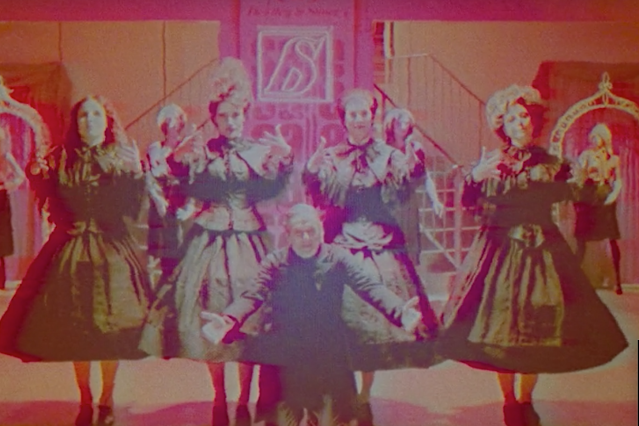
IN FABRIC 
(2018) Dir. Peter Strickland

Wise cine-urologists say: When a director aims the golden arc of his film in three directions at once, he better be on his toes, lest he be left with piss-sprayed shoes. 

Peter Strickland is just such a reckless streamer. His films are homages to the golden shower of 70s 'Eurosleaze,' splashing beautifully into a shiny, serpentine urinal of experimentalist meta-satire, dusky cinematography, and vivid collapsing, ever-shifting signifiers.. The signposts by which we recognize all the tics and tricks of the era's erotic 'dream/nightmare'-makers (Franco, Rollin, especially) are--in le universe Strickland--twisted around to leave us with that strange, alienated feeling where we kind of step out of the narrative, and it's as if we're waking from the dream of our own lives, the dream where time stops, the clocks melt, and the illusion that dreams and waking life are mutually exclusive evaporates in the cold heat of a blazing moon.

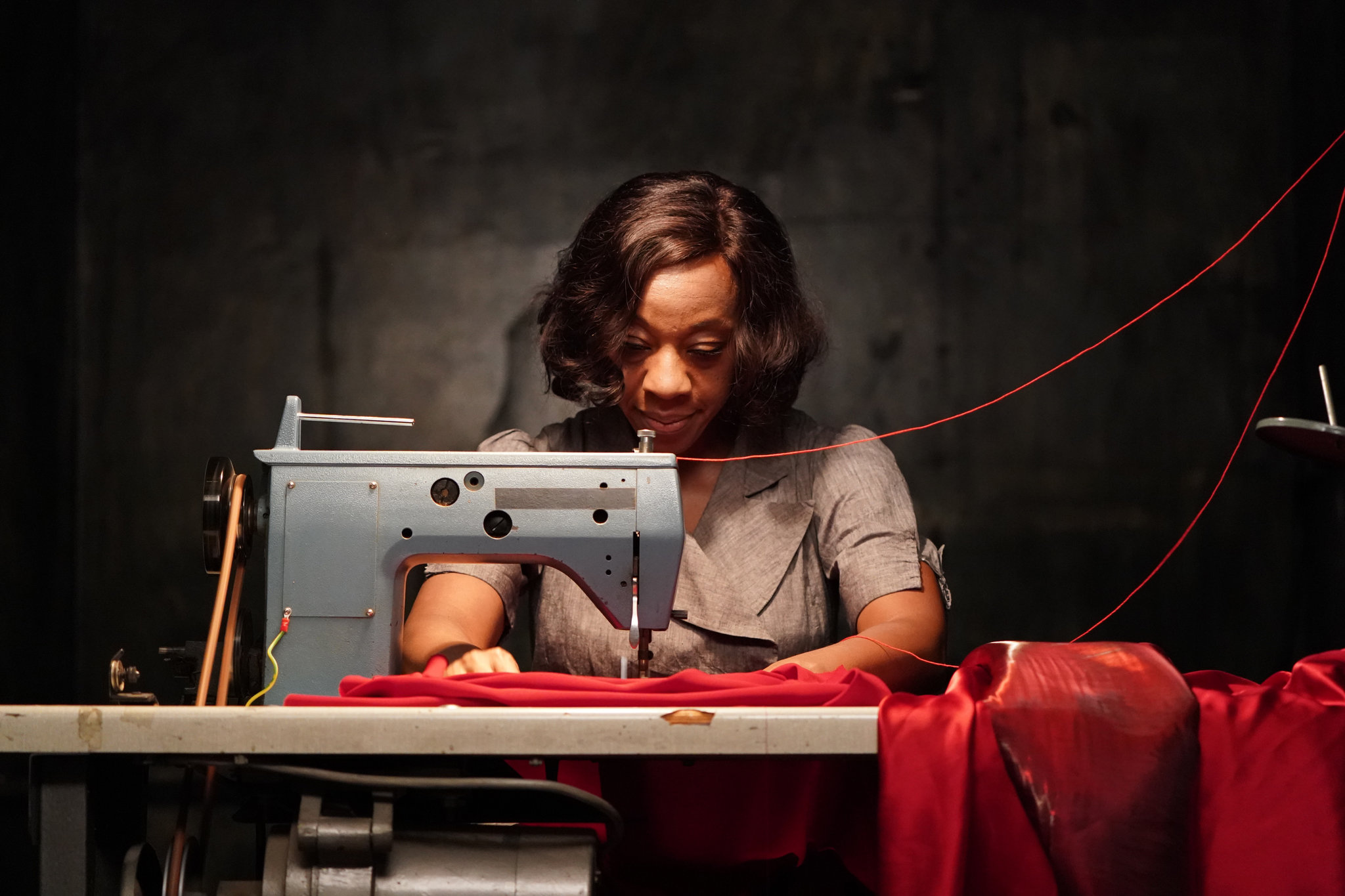
That's why it comes as no surprise that Strickland's In Fabric (2018), wiggles that stream of consciousness into three different streams, hoping one at least will hit the mark. We get: (a) a dark 70s-set period piece surrealist dystopian satire of England's Tony Richardson-style 'kitchen sink' (i.e. working class yabbo) character dramas; (b) a high-fashion updated or Tales of Manhattan-cum-decadent-capitalist horror satire equating fashion retail with kinky sex and black magic, and c) a work of détourned experimentalist fashion decollage, exploring the way the concept of "objectification" refuses to hold still and have its picture taken. In short, rather than leaning on Franco, Kümel, and Rollin, you can feel influences from Antonioni (modernist alienation), Bunuel (surreal deadpan satire), Argento (wild vivid colors and sudden violence you can feel in your nervous system like a cold shock), Fulci (gore as high art), Gilliam (dystopia!) and Kubrick (glacial gliding) all coalescing around a kind of Stan Brakhage / Tony Richardson collaboration for a Situationist detourned Sears catalogue from the mid-70s. Sure, technically it's about a red dress that kills its owners, sold by a Satanic department store, in an outskirt of 70s London. But that's like saying Psycho is about the difficulties of juggling a failing business with caregiving for an invalid parent.

What does it say about this film that the idea of the dress itself as a sentient, relentlessly destructive garment is perhaps the least interesting thing about it? The 'enigmatic uncanny object destroying everyday people' motif is soooo last season. We've already had Rubber (a tire), Christine (a car) or The Car (a different car), Maximum Overdrive (many cars) or Killdozer (take a guess)--or--probably the films Fabric most closely resembles as far as adhering to the 'possessed object killing a series of folk' narrative structure--Death Bed - the Bed that Eats and The Mangler (a laundry press).  As is often the case, there's no origin story to Fabric's monster dress - no flashback to a satanic dress designer whose soul moves into the dress as he's killed by an angry mob; no meteor crashing through a boutique window and infusing the dress with an unholy glow; no shamanic child laborer in Malaysia weaving curses into the fabric as an act of anti-capitalism vengeance, or anything like that, but that's ok. What matters is that Strickland never misses a chance to run the camera's scissor gaze up and down on the crushed velvet curtain of a scene.  The end spends lots of time showing us the blazing hypnosis of the devilish TV commercial, implying that if we ever die while watching TV, it's conceivable we would never even notice the program had changed. The image would just catch on fire and melt into our dispersing attention locus. 

Whether or not it's attempting to be some caustic lower berth satiric response to the gushy texture-and-privilege fabric worship of PTA's Phantom Thread (1), no one man may know. I don't think so, but Thread did come out the year before this. And it's all connected by a... But this ain't no portrait of an oh-so sensitive famous guy tortured by his own rich fame and a doting fan/wife/personal assistant with a streak of Munchausen by-proxy, this is about Dentley and Soper, a fashion oasis that really put the 'tore' in 'store.' The mannequins loom like aliens moving to a century-long circadian rhythm (we never see them move, but they do, like plants). The vampiric alien department store sales staff are all statuesque mannequin-like black-haired pale skinned women who speak in a kind of philosophical sales-pitchin' English, never addressing questions or people directly, speaking only in (masterfully-written) commerce-bent aphorisms. The store has an old time chute for the payments, where the money goes up and the change comes back along a ceiling tube (bringing another chill of 'bored child of the 70s' recognition from the check-cashing drive-through at the pre-ATM bank). And an old timey elevator runs through the middle of the place like a steampunk serpent. And if you think you know what floor it's getting off on, you're mistaken, it goes down, down, down, to where souls and skin and cloth stitch together in a 'Cronenberg meets Barker at the 70s fashion outlet'-style shock tableaux. 

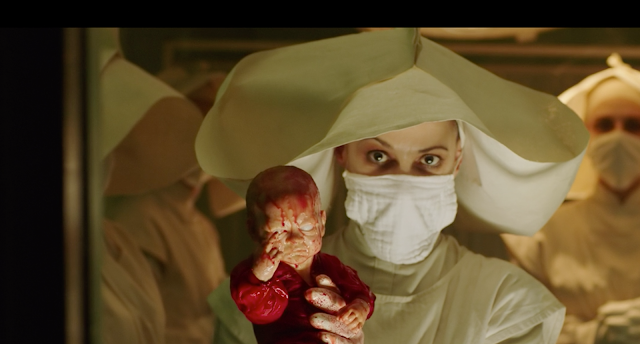
There can be no doubt, In Fabric succeeds at whatever it's trying to do. It's always lovely to look at, sumptuous in a way that makes one wonder "where's all this money coming from?" because "who is the audience for something this esoteric?" The wonder is that the level of cinematography and craftsmanship is so high, as films this weird are usually low-budget shoot-from-the-hip affairs. Not so In Fabric!  The dream sequences are special highlights. Witness the lovely color and surreal composition of the below, the demon newborn beckoning! I could watch this film forever... but would I have really ever seen it?

It doesn't pay to tell you too much about what's going on, so I'll just elaborate on random moments and the general framework which is a kind of Damien Thorn parable, with an evil red dress in place of a Satanic changeling, and a vampiric sales staff instead of shady nursemaids and big dogs. 

First, a divorced black middle-aged bank teller named Sheila (Marianne Jean-Baptiste) buys a dress for her blind date (i.e. to wow the eyes of her unseen suitors), and second, a geeky ectomorph trapped in a working class yobbo hell with a fiancee wife who spends most of her time on the phone with her family. To go into all the hows and whys would do much to ruin the WTF progression of the film. For watching a guy dance at a pub in a red dress with some guys twice his size all rapey or not as they get hammered is to wonder what the hell is going on and that wonderment is the best part of Strickland.

Since this is all set in the 70s-80s (Strickland's and my childhood era, tellingly), she's going on and pre-internet date, this being when you answered personal ads in the newspaper and they leave messages on your gigantic answering machine. And you don't even get to see a picture before meeting them. As I can assure you from my internet dating during the early wild west dial-up modem days, that's not a good idea. But she gets lucky, and maybe it's the magic of the becoming red dress she's bought from aver Satanic department store. The guy turns out to be a salt-and-pepper middle aged knight in shining sweater armor. A guy any middle=aged black bank teller would be glad to grab, and he's into her! Thanks, red dress.

And man she needs a break. Her artist/slacker son treats her like a servant, passive-aggressively lobbing his ever-present girlfriend's vagina in her face via his bizarre but very cool art.  At the bank, her grinning identical twin bosses give her a carefully HR-approved talking-to after she takes five extra minutes in the bathroom, and surreal Bunuelian/Brazilian digressions ensue. They also ask to hear and then analyze her dreams--which are then depicted and presented as key portents towards maximum work efficiency (these dream elements will recur and are are like a welcome tide that keeps drifting the film outside its kitchen sink harbor). 

But the dress may be just setting her up for a fall, for demons like to prop you up higher before knocking you down, like an angry kid building a tower out of blocks. During a walk through the park a pit bull attacks her sleeve and she gets blood all over the dress! The washing machine in the basement goes rogue when she throws it in, and tears itself out of the wall leaving a deep gash in her hand. Even in remote cornfields, mannequins seem to watch her every move. What does it mean and why her? Is it because she tries to take the dress back? 

Not only will the store not give a refund, they refuse to even take it back. The staff do not look kindly on this attempt at abandonment of decisive and initially admirable lifestyle upgrades. The saleswoman Ms. Luckmoore (Fatima Mohammed) did warn Sheila that the girl who modeled in the catalogue died in a "zebra crossing," on a catalogue shoot in Africa, but then she assures Sheila that the dress was washed "throughly" before putting it back on the rack. There's only one like it, one size fits all, and it has the habit of trying to strangle you or floating above your son's lover while she's having an orgasm and freaking everybody out.

So it finally finds it's way to a thrift store where it's grabbed almost sight unseen by a passing lorry driver who make washing machine repairman Reg Speaks (Tony Bill) wear it for his bachelor party, which consists mainly of getting roiling drunk and dancing and drinking to the point of puking with his fiancee's macho-charged brother and their yobbo co-workers. Their crazed boozy mania, howling in the streets and circling Red in the dress like a Ned Beatty in dem woods. At home his fiancee/wife, Babs (Haley Squires).  His boss is so tough that he expresses his hurt at not getting invited by a long angry stare. Meanwhile a bored housewife tries to seduce him when he comes over to fix her 'ahem' machine, and he diffuses the situation by giving a monotone recitation of all that might go wrong with a washing machine and how each issue would be repaired. Apparently this is like a hypnotic turn-on, even thrilling those banker twins, to whom Reg applies for a loan to open his own repair shop after he's fired for not writing up an invoice when repairing his own washing machine. The boss doesn't say a word, just eats Reg's time card while the crazy synths of Cavern of Anti-Matter's strange clangy score drones to a head. 

It's only when Babs drops by Dentley & Soper's for an exchange of the red dress (which she just throws on a rack after they refuse to accept it, oh Sheila why didn't you think of that?) that someone is able to fire back enough retail savvy to make an impression on the vampiric staff, out-aphorism-ing them at their own game and rattling their implacability. Too bad the dress has evil plans for her whether she effectively got 'rid' of it or not, which includes burning the store down during a riot over a place in line while she ends up hiding out in a changing room. Is the whole message of the film that one small altercation over who was before who in line can lead to looting and rioting to the point film itself may spring its thread in the sewing machine projector and wind up unspooling down around your projectionist/seamstresses' feet like an amok and endless serpent? 


P'raps. 

So what 'ave we then? Gorgeously photographed and stylized imagery that plays on childhood memories boys have of first arousals poring over Sears (or in this case, Harrod's?) catalogues; deep tissue social satire that sometimes tips over into the obvious (oopsy!); genuinely dark and unrelenting comedic horror about the imperfections and oily parts of the human body vs. the bald wild-eyed perfection of the department store mannequin? All this and body horror galore can be found IN the endlessly perverse and fascinating-- if a trifle obvious around the gills--FABRIC, a movie so weird the producers or whomever had to rename it, adding "Dressed to Kill" at the end in re-release (just so folks know it counts as a horror film as well as a Bunuel-ish surrealist satire). 

There can be no doubt, it succeeds at one or two of its chosen artsy arcs, but when there's no 'normal' to rush back to, no 'home base' from which to get our bearings (as we could, for example, in the knotty-legged sanity of Sellers' Group Captain Mandrake in Dr. Strangelove, or Margaret Dumont in Duck Soup), we can't find a 'whole cloth' from which to start all the ripping. We can only judge it as a collection of surrealist remnants, half-off at Harrod's, one-day-only; they don't add up to a cumulative effect, but taken as weird vignettes they look like a million bucks.

At this level, In Fabric is a sporadic triumph, a genuine 'going out of existence sale' wherein if one row of cast-off ideas and satiric notions doesn't grab you, keep shopping as every corner's bound to hold an object you just have to try on to lift your dull little life into some kind of dystopian delight. 

So what if the clothes don't fit? They're literally unlike anything you've seen before, with so many startlingly dark moments of satire that any random 20 minute chunk is the wildest feature I've seen all year. As a whole though - one wonders what Strickland wants out of us, other than to maybe 'wake up' to our programming? Are the Duntley & Soper commercials that are always on TV-- all strange color bleeds and cryptic 'come here' gestures from the frozen smile sales staff - meant to evoke hypnotic triggers for consumer society mind control? Are we being dared to find all this trenchant, or is Strickland taking the piss? 

It's one thing to insult us, but when you insult our first world consumer entitlement you better be armed with a sense of forgiving catharsis or warmth by the end. Otherwise, your movie smacks of sophomore film student self-righteous preachiness, like a trust-fund Marxist lecturing his dad on socialism over winter break. Don't expect applause if you depict your audience as clapping seals, especially if you don't throw them any fish. The fish may be plentiful, but they're too far away, and the lashing talons of social satiric harpies wait for any outstretched hand. Oh how you mock blind King Phineas with the sound of your dazzling stitchwork feasts! 
---------------
ORIGIN STORIES - or "Why Erich breaks out in an uncontrollable rage if a girl drags him into a fabric store"

I think I can explain the origins for In Fabric, as well as the whole homosexual or metrosexual or bisexual male's yen for fabric texture and fashion on film vs. the straight male's terror and loathing of it. Strickland cleary. has the same formative year memories as I do of being a child dragged around to fabric stores and fashion outlets in the 70s by mom (according to Wiki, it was mainly the now-closed Jackson's in Wiltshire) bored for what seemed like torturous hours in women's fashion stores, getting reprimanded by the sales staff for crawling up the mannequin's skirts or hiding under the racks. As a (straight) boy, my sole source of pleasure at these stores came from ogling under the mannequin skirts and staring qua-lustfully at the provocative pictures on the nylon labels. That only lasted a few minutes though, then you're back to being bored beyond endurance. If you're a boy dragged to such places, it's impossible to be neutral about them as adults. 

Kids today got cell phones so are never bored on that excruciating level. But we of Gen-X. We knew boredom. Stuck for hours in these stores we either snapped from the strain, resulting in a kind of Stockholm Syndrome / personality split leading to a career in fashion--or developed a vivid imagination to lose themselves in fantasy; and when they grow up they have a rich escapist streak plastering over a lifelong fear of being bored. That's me. I still get insanely claustrophobic if I'm in a fabric store or ladies' fashion outlet for more than fifteen seconds. Just be a girl I'm shopping with and tell me what you want to try something on, I'll either leave instantly or start a huge in-store fight. It's automatic. I can't control it. Mother!! Mother, why!?

I ended up saving my sanity by getting mom to buy me those three-in-a-bag $1.29 Gold Key horror comic book packs--I can still see the covers in my mind's eye now, especially Boris Karloff -Tales of Mystery--which the now-closed Wannamaker's had hanging on a child's eye rack by the cashier, as if sensing the need for my escape. Thank you whoever thought of that!  Today, I can't walk past a display for ladies pantyhose without imagining Karloff's dapper mustache (above left). Gold Key you are aptly named. To paraphrase TS Eliot, thinking of you confirms a prison!

Strickland meanwhile must have developed far differently than either from those experiences, with the result is that In Fabric blurs the line between the store and the comic's contents. His film is even structured like an issue of Karloff Tales of Mystery replete with multiple stories connected by a thread (literally in this case), harnessed to consumerist critique and clear reverence for the sexual allure of glossy red fabric when beautifully filmed against dark backgrounds in 35mm. With In Fabric, Strickland escapes to the 70s fabric store for his horror fix. I want to shout at him as the Gold Key lights the path through the darkness, Strickland, you're going the wrong way!"

I'll never quite feel it, but I understand it. 

Stuck in the zone of the gigantic maternal Other, looming over your small stature--and being neither the focus of her loving attention (she's looking at clothes, so just stay close by and don't break anything or annoy her) nor freed from her presence (i.e. allowed to escape to your den of toys, wherein YOU are the giant), you are stuck in a Spenserian fairy bower built for someone else, destined only to watch the process of slow materialist seduction from the outside. Your young imagination is so desperately bored and alienated you either have that split personality break--i.e. fall into the enchantment of another gender's fashion scene and become determined to make mom's clothes for her (thus restoring yourself to the center of her attention, i.e. her Lacanian phallus)--OR you become withdrawn into your own interiority, shutting out the maternal altogether, losing yourself in the all-male world of dragons, dinosaurs, and advancing German tanks (i.e. the realm of the absent father, taking the hero's journey of differentiation from the mother). 

In short, dragging your son to the fashion store too many times will either make him a dress designer, filmmaker or master escapist, using his Gold Key to open the door out of the dusty sales-tag maternal sphere. Follow Boris Karloff, he does not steer amiss. 

And one final question: when you die alone in front of the TV, does it really keep playing? Or does the commercial beckoning you forward melt away, like a mannequin in the flames of a black-out riot, the dripping plastic of the sales force entwined with malfunctioning cathode rays adhering to your wiggly soul and dragging it down into the abyss of paying the full price in a world of knock-offs?

Wednesday, September 23, 2015

Butterfly Moanin' (DUKE OF BURGUNDY and Faerie Bower Cinema)

DUKE OF BURGUNDY
(2014) Dir. Peter Strickland
"The sovereign being is burdened with a servitude that crushes him, and the condition of free men is deliberate servility." - Georges Batailles 
Emerging from its cocoon as a beautiful Shout Factory Blu-ray, Peter Strickland's Duke of Burgundy is a nod to the 60s erotic reveries of Jess Franco and Jean Rollin, only without the vampires and knife-wielding sadists. Snaking forward in a steady hypnotic rhythm, it instead examines the BDSM head games played by a pair of lesbian lepidopterists living in a dream world where it's always autumn, men don't exist, and the Gothic architecture is ever-fecund with overgrowth. The beautiful dusky purples and oranges of the butterflies and lush Victorian interiors match the women's clothes and skin textures as they come and go along their whispered cloistered flight paths, an endless repetition wherein love may be hidden somewhere, but everything else needs a safe word. 

As a throwback to the 'Eurosleaze' genre, only without the sleaze, Duke's dreamlike mood is at once boring and fascinating, eros and thanatos inextricably linked. Like Franco's and Rollin's films, it's best seen while falling half asleep (which its slow pace is guaranteed to help with). It's less a forward marching phallic arc (and its post-orgasmic snooze) and more a repeated lullaby, or the same storybook read over and over to a child in its crib by the giant mommy goddess; the feeling of giant arms and a beaming loving face the size of a large stone idol (relative to our infant height) couple to the terror of being put down, and the lights turned off--but that terror maybe preferable to the suffocating feeling of that giant mom never putting us down at all. Wanting more of mom's love than one gets is as important as having it.

Chanting and ritual create a sense of tranquility by, amongst other things, driving the ego from the microphone of the mind by boring it into surrender. Once it realizes nobody is listening to its alarmist cries, that he's getting nothing from the crowd, like a dying comedian, he finally gives up the mic and vanishing from the room, the way a cigarette snuffs itself out once dropped in an empty bottle. For the ego to deliberately court this annihilation is the secret, spiritual core of masochism, at least on an intellectual / spiritual level! That's why spiritual warriors always accept ask for the most debasing job at the ashram, the one no one else wants. Submersion into 'group' mind, the giddy rush of rioting or delirious dance floor orgies, leads to a kind of open-hearted faith in the power of us vs. them--the trick of all effective cults. The mom's giant arms restored! 

Scarlet Empress, The

That kind of repetition is found best in the films of Josef Von Sternberg with their fetishistic veils, mirrors, and inert momentum; or the ritual hypnotism of Kenneth Anger; or--especially as its so clearly referenced in Strickland's film--the 1963 Stan Brakhage experimental minute-long Mothlight.

I'm a confirmed proponent of the masochistic gaze theory posited by Gaylyn Studlar and Steven Shaviro, so I knew what to look for in Darionioni Nuovo tremolare Strickland's Duke. That's good, otherwise I wouldn't have known my boredom was a valid artistic response. I would have just rolled my eyes and said "this sucks" like my poor girlfriend watching with me said. According to his interview in the Blu-ray extra, Pete Tombs (of Mondo Macabro fame), commissioned the film, wanting a remake of Lorna the Exorcist (a very long awaited Jess Franco title, for those who've learned to wait). Me, I've learned the only way to enjoy Franco (for me at least) is while alone at dusk, falling asleep in my easy chair as the sun sets. In all other ways, certainly as narrative, or any kind of genuine erotica, his films are not very good. But in the right half-asleep or nonjudgmental state, the alpha wave receptivity of deep relaxation or illness, they're genius.

Time and again I've found a masterpiece in the same place I found an unwatchable softcore piece of crap only days before. That place - Jess Franco. 

Here's an example: I recently screened Franco's SUCCUBUS (1967) for a bunch of half-asleep kids at a European horror film class. I hadn't realized just how sex-drenched it was until they shifted uncomfortably at their desks. They hated it. So I explained my secret to enjoying it: amnesia. 

The jet-setting European sixties swinger well knew of it, that mix of language and cultural barriers and the memory-damaging effects of booze and too many parties with too many lovers. When someone comes up to you and says hello again, you don't think they're gaslighting you, you think you were probably drunk or stoned and just don't remember them. So you play it cool, take the social cues their behavior offers, don't let them know you don't remember them, that would reflect badly on you, and alienate them. So you roll with it, trying to suss out what anecdotal facts you can.  

This can even extend to a strange woman climbing into your bed in the dead of night. Maybe she's your lover and you just forgot? Can't kick her out now - it would be so rude. After all, it's the 60s.

from Jess Franco's Succubus (1967)

Maybe we're even married! Best to play it cool and act like I know who she is, and am just playing I don't - add some meta layers on it. 

This viewing strategy ties in with the post-war modernist frisson born of French-speaking critics watching liberated Hollywood films sans dubbing or subtitles in the years immediately following the 1945 liberation, in the gap between Hollywood once again releasing films with French, German, Dutch, Italian, and probably Norwegian subtitles. Starved for film of any kind, French intellectuals made a game of not understanding anything that was going on in the plot. It allowed the critics the freedom from language's structuring of the images and sounds, leading to original conception of the phrase mise-en-scène. What is going on in a film when we can't speak its language? How does it still 'talk' to us, using imagery and sound alone?


Anyway, my Succubus exercise worked. The students imagined the character/s had amnesia and now they loved it. They 'got' it this time, the modernist frisson. That's the kind of magic Franco's (and Antonioni's) best films provide. They're meant for an international audience who needs a freedom from conventional semiotics. And within that anecdote lies the paradox of how a boring film can get better with repeat viewings, especially when your ego is shut off due to repetition or sleepiness (or drugs), or not knowing the language being spoken. We can't 'turn off' into hypnotic narrative when we don't know what's going on. We're free of the burden of interpretation, and the judgments that implies. 

That's the key to Franco, and maybe Strickland too. It's cinema aimed at the unconscious mind, the place where plots and dialogue never add up, and no one speaks in their actual voice, they're dubbed in way too many languages to ever do an 'original' language track In the end that's perhaps why Fritz Lang 'got' it, as did Welles, when most critics sneered at or ignored Franco's work, unable to see past the tawdriness and terrible dubbing. Both are valid responses, and indeed, may criss cross.

This was Europe in the 1960s-70s, the time of commercial jet travel opening all borders to well-dressed imports and varying strength X-rated inserts. Western Europe became the Capital of Amnesia and Babalon Working, a time when a producer, actor, and director may easily have no language in common other than that they all found in Antonioni's Blow-Up, and drugs and alcohol were ubiquitous and there was only one rule: don't say no to psychedelics offered at a groovy party and don't ever demand to go the ER if things get too hairy. When you can't remember how you got somewhere, or the walls are bleeding, or you wake up with a stranger in a strange bed, you can't make a big deal about it. If you freak out and go all egoically clutching for the handrails, you might end up in the sanitarium or prison; worse, you might draw attention to yourself as a square, a tourist, a rube, a wally, and get everyone arrested.

That's the one rule: if things get weird you can't wimp out. There is no safe word in swinging 1967. Ride the snake. And as the mannequins assemble for the sacrifice, presume that your unbridled arrogance will convince them that you're not the designated victim.


And masochistic cinema is really about that very same modernist frisson, the enslavement to the Other that finds true fulfillment only in dreams.

Dreams that they know will end.

For fans of Franco, or Von Sternberg's Dietrich films, the repetition is what cements the film into a favorite. Seen the first time it may be well unsatisfying, dull, irritating. Seen thirty times, it's the voice of a cherished mommy goddess and her absence, the absence that makes the presence bearable. We can want to see it again because we've seen it already.

I know the drill like the back of my molar. Like the older lady in Strickland's film, I--though no sadist--have been called onto to play one in a romantic tryst, many times, and always, each time it was really the verbal descriptions of what I would do--dictated by my lover in very specific details and then repeated in slight variations each time thereafter--that got them off. Experienced that way one realizes that, for most kinks, it's about the show, the whispered declarations of power vs. humiliation rather than the practice, which seems a trite gaudy and ridiculous (maybe I'm a prude?) But I like the JVS/Dietrich films as thye ascribe to the Gaylyn Studlar masochistic filmgoer theory vs. the Laura Mulvey sadistic proprietary male gaze theory, as Z sums it up:
"Where Mulvey views the female as having no power, in a masochist reading, the woman is powerful due to possessing what the male lacks, so pleasure is not gained by “mastery of the female but submission to her” (1985:782). This is in direct contrast to Mulvey’s view, which centres on voyeurism and fetishistic scopophilia being a defense mechanism to castration anxiety." (Z- Mediated Musings)

Strickland understands these confusions of gaze; his film delves inwards to where the segmentation of a pupae abdomen circles into a set of winding fecund autumnal purple steps linking the look with the looked upon. Along with his post-giallo contemporaries, Strickland brings the modernist shiver of experimentalism into a head-on collision with the tenets of conventional narrative, letting their momentum derail each other and making something new from the train wreck, something that's neither formal/classical narrative nor avant garde/experimental, but a hybrid at once both invigorating and stultifying. In what could easily be the story of Mulvey and Studlar forever locked in a death/love staring contest, this wreck of a film shakes every pair bond to the core not through any particular eroticism but through the deconstruction of the kind of hermetic universe a loving couple creates within their shared space, a feeling of magic and second childhood, their honeymoon suite becoming an overgrown forest, a private world free of the constraints of time and outside responsibility. The stultifying comes once the outside has been ignored too long, the overgrowth chokes itself into mulch and dead leaves, leaving the stench of plant decay, what was once felt as protection and safety is now a prison, not through some shift of power, but through its own endless repetition.

In that and other senses of course it mirrors the fragmented masochistic obsessiveness of the films of Josef Von Sternberg (all those long slow meditative takes as Marlene walks around rooms, playing with this doll or that and shooting coy looks over her shoulder--as if stalling perpetually for time)--or even Bergman films like Persona (with the young boy in the experimental opening, trapped in the morgue as if reborn and tracing the blurry projection of Liv Ullman's jaw). And from there of course, The Ring and The Birds , i.e. Mecha-Medusa and the Otherless Child, i.e. the merging of the screen and the eye, the speakers and the ear, the dialogue between one's unconscious and conscious mind finally becoming audible; recognizing the monstrous absurdity of one's own masochistic sex fantasies once translated into action. (See Taming the Tittering Tourists).


Color coding, From Top: Lips of Blood (Rollin, 75); Girl Slaves of Morgana Le Fay (Gantillon, 71); Cries and Whispers (Bergman, 72)
In short, from my own perspective, I don't see a Mulveyan fear of castration in cine-masochism at all in these Eurorotica time capsules- but rather a longing for it, a longing which underwrites my own theory behind the (straight) male's fascination with an all female or matriarchal world (ala Persona, The Girl Slaves of Morgana Le Fay), one that doesn't 'include' the male figure or allow for even a projection of one's own gender based locus into the narrative. If a male figure somehow gets a toehold into this special universe, it's only as a eunuch servant, a blind man at the door who is not invited in, or an outmaneuvered future blood sacrifice ala Daughters of Darkness, the Blood-Spattered Bride, The Velvet Vampire, Girly and Vampyres.

This woman-centric film universe reflects the opposite of male-orgasm-based pornography, for the typical male sex fantasy doesn't last beyond the point of le petit mort. Men's sexuality, unless they are extraordinarily virile, dissipates immediately and drastically after orgasm; the fulfillment of the phallic hero's journey always ends in symbolic castration. This is why he begs and pleads but then, when there's no more barriers, hesitates; each orgasm is a sort of suicide, and the male knows it - once he's able to attain it, it comes too soon. The lesbian erotic scene, on the other hand, goes on and on, stopping time in its fairy tale tracks. There's no worry about premature ejaculations or flaccid impotence. The fairy bower's chthonic overgrowth ensnares and subdues narrative phallic linearity. It's something men just don't get to (or want to) see --we've already left the bed and headed for the kitchen to find a snack.

And so it is that these films show us a variation of sex we are, as single perspective organisms, forever denied in real life. We get to, in a sense, find out what our moms were like before we were born. It's something we'll just never know in real life, except through keyholes, screens (projections, paintings, pictures) dreams, and rebirth. In these films we finally understand, perhaps, why the patriarchy, the male gaze as per Mulvey, is so terrified of the female orgasm. I don't mean the little 'sneeze' or even the cherished involuntary vaginal contraction versions, but the one eternal female orgasm that comes later, and lasts forever, and increases and increases, feeding its own orgone energy flame until activating the alchemical awakening of the Kali destroyer / creator goddess. A withering force as devastating to the phallic tower as a great flood, is achieved; the male gaze is blinded in the flash, and not even Oedipus' stiff braille guide rope can help him find the door, let alone the keyhole.

Elsie Wright -w/ Cottingley Fairies

Rose Bower (Burne-Jones)

The lesbian fantasias of Franco and Rollin aren’t really meant for the chthonic dead end of fairy bower lesbian stasis, but they do draw on the same chthonic morass torpor, the way Antonioni draws on Monica Vitti’s beauty, or Fellini on circus pageantry or Welles on Welles – as a thing fulfilling in and of itself that precludes or prefigures egoic detachment from the mother. The sexuality of Fellini is--as in his best work-8 ½ and La Dolce Vita--exposed and recognized as infantile narcissism even while it's being indulged; Antonioni’s sexuality is like a dangerous ledge over the abyss and Welles’ balloon of titanic ego is inevitably punctured by the realization he can post-dub anyone in his films but a woman. Theirs are not the orgasm moments, the money shots, theirs are reminders that epiphanies, like male orgasms, are short and cheap and then life grinds on, oblivious. The trick with European reverie cinema is that this egoic puncturing never happens nor needs to. In a Rollin film, if a male character shows up who fancies himself the hunter-rescuer of the scene (as in one of Rollin’s endless string of jewel robbers) he’s peripheral --we’re invited to scorn him even as he tries to organize or tame the matriarchal nonlinear experimentalism of the hermetic female fairy bower. Like the forbidding father at the nursery he tries to shatter the fantasy of our total reunion with the mother, the memory of being an infant surrounded by gigantic adoring women, hearing their conversations as strange enigmatic words we do not understand, formatting the blank hard drive of self via the ebb and flow of mom’s attention. He tries to whip the women into linear order, but they of course devour him, like a phallic sandcastle in an incoming tide.

At this pre-egoic stage, we don’t identify ourselves as separate from mother and are therefore ‘female’ regardless of biological gender. The need to differentiate and establish oneself as male and separate from mom is a traumatizing initiation these films undo. Their drawback is their lack of dramatic arc, their inability to finish the initiation and begin journey. The butterfly motif in Duke is the ultimate irony - the caterpillar becomes a butterfly, flies off and dies (male linearity) but here, with these lesbian lepidopterists, the butterfly stays fixed in time, punned on the board, etherized on the fairy bower table– the life cycle interrupted at its peak moment...

My favorite game to play with babysitters in the 70s
Maybe I'm keen on this subject because as a child I was never very coordinated or confident on the kickball field (and hence always picked last for teams, a daily humiliation). I always just wanted to hang out with the girls; I was in love with girls in general, no real sexual desire had cohered along my polymorphic jouissance ley lines, but girls made me feel electric nonetheless. I despised boys on principle. I had one little brother and no sisters, which might explain some of it. When some girl's evil mom didn't approve of my attention, tried to force me outside into the mud with their wild obnoxious dirty foul-mouthed boys instead of upstairs with the girls it aggravated my delicate nerves. I hated those boys! The girls were pretty and sweet and I was enthralled. I also adored all my female babysitters, like they were giant idols; there were these three cool female cousins who coddled me all through my infancy, and then --boom, they weren't around anymore. Never having had a lot of physical affection from my (Swedish) mother after, say, five, I longed for three giant cute girls (relative to my size) and I didn't feel their protective young girl maternal energy again until stumbling on the Alice in Wonderland statue in Central Park (see my first film Erich Kuersten: A Poet's Journey)

Just the right size
As a child in the arms of a girl Alice size, I didn't need to exist, or get affection, or conquer any other phallic arc. I was, in other words, absorbed totally into the state of the passive masochist spectator. Of course this came back to haunt me later as I was often paralyzed when it came to busting the first move, afraid the girls I fancied would flutter away with some spiel about how 'I thought we were just friends.' And also the closer I got to said move the more my knees buckled and I felt I'd pass out. In short, sex and desire were too intense, I wanted to orbit the star, not crash into it - that was for the boys good at kickball.

Duke of Burgundy in a way operates on the same principle. The one hot sex scene is merely spoken, with the mistress struggling to keep her partner supplied with her custom-tailored erotic dom-sub fantasia. But again there's no ego formed, no linear thrust, which is why the film is so boring. But hey, that's part of the masochistic current, the Warholian love of boredom --the result of undoing the need for ego and therefore lacking a narrative arc to guide and hone in our focus the way a child's polymorphous perversity gradually 'settling' in a space beyond the narrative; the love of repetition and ritual (as in the repetitive alchemical rites in Anger's films). The oceanic experience, which the masochistic gaze in cinema mirrors, is the compromise against what the Studlar's theory of masochism admits from the beginning is hopelessly unattainable. To attain the male orgasm, or even to permit the male involvement, would break the spell.
The prince's kiss wakes us up from our dreamy slumber, the opiated medicines of the witch leading us to a sweet stasis which is broken by the kiss that whisks us back into space and time, for better and worse.

The ending is the same either way. Death is just the sign on the door through which the audience exits the theater into the lobby. The only way to avoid going in our out of that door is to become etherized, frozen and pinned to your seat. Either way, the cinema is the same; if you stay for the next show, prepare to be bored. The movie playing never changes. And its that element of inert sameness, the repetition, that works to make Duke of Burgundy both boring and artsy, maybe proves that calling something boring and artsy is redundant, and maybe it even proves that calling a film the realization of the insatiable appetite for repetition is to damn it with high praise, something only fellow post-giallo filmmakers like Helena and Bruno understand (as in the endless variations of the same scene in The Strange Color of your Body's Tears). But who likes it? Almost no one, for longer than 10 minutes at a crack. Still, in this inert symbolic re-death eroticism, Studlar's masochistic gaze is spot-welded to a Crash-style car and sent over a cliff into to the kind of Jungian ego annihilation, liberating the libidinal desires that formulate the structure of the differentiated self, which is really just a nice way of saying it's boring as fuck-all. Don't miss it. Oops you all ready did.

Tuesday, July 14, 2015

Summer of Streaming II: Post-Giallo Nightmare Logic la Netflix


Dream or Nightmare logic: a lazy way for European directors to run amok with free association non sequiturs and not have to worry about coherence, or a daring approach to the post-60s crashed jet set void de la Freud delving, based on the symbolist and surrealist movements of the early 20th century?

A: Yes
B: Magenta.
C: Hollyhocks
D. Mrs. Claypool
E. (......windshield wiper sounds)
F. Two of the above

2. European art cinema can be very boring and opaque if you're careful. But if you're not--if you're, say, dosed or delirious or bored into falling into a trance--its abstraction makes perfect 'sense.' Falling half-asleep while watching Rollin or Jess Franco's earlier work, for example, is a truly psychedelic experience, and in most cases almost inevitable. Would you agree?

A. No
B. Sax player shredding a picture of Lina Romay and dropping pieces in a ditch by the Autobahn.
C. Sax player shredding a picture of Maria Rohm and throwing pieces into the Bosphorus.
D. Trumpet player taping a picture of Soledad Miranda back together again, in vain.

3. There are five easy ways to understand Italian drive-in dream logic, all based on the Carnival of Souls principle:

a.) DEATH: The protagonist is already dead and/or stuck in an endless reincarnation loop stuck in the amber of hell/heaven time.
b.) AMNESIA: The protagonist/s have amnesia but don't even know it - they try to hide it, the way you don't want to admit you don't remember someone who comes up and knows your name. The result of lots of drinking in the swinging European 60s-70s.
c.)  DREAM: Dreaming while awake, caught in a web of true myth, where waking consciousness and unconsciousness have lined up perfectly, like two overhead transparencies.
d.) LSD: They're tripping or recovering and can't remember which is which (lots of acid in 60s-70s Europe)
e.) INSANITY - They're remembering or recounting narrative from a psych ward.
f.) All of the above, for in a way they are all the same, non?

Remember that in Europe the language barriers are more immediate and the past older than in America. In Europe, a 70s B-movie can take place in a real castle, or a condemned art nouveau mansion cheaper than building a single Hollywood set, so a modern French model in a turn-of-the-century vampire gown running loose amidst the Gothic spires is not only cheap to film, it has so much post-modern frisson it creates a truly 'all times all the time' dream logic loop all into itself. 

Beyond the Black Rainbow (top: The Strange Color of your Body's Tears; Berberian Sound Studio)

For this festival, we're talking of a return to the art of those pre-slasher death-poetic times, a time before the derelict fringe theaters at the edge of America closed. And before kids could just go to their rooms and watch tapes of Texas Chainsaw Massacre and Dawn of the Dead until they were numb, and pornography when they weren't. Compared to that madness, the razor slash black glove murders and surreal heavy breathing dream-rotica of what Mondo Macabro calls Eurosleaze seem almost quaint.

You and the Night

And so, full circle. New filmmakers falling in love with the old ways --trying to escape the numb overkill 'traumatize even a pre-Ludovico Alex' ultra-violence-- come to this old genre as if a wellspring. And the wellspring has never been clearer, cleaner, more beguiling: Many of these old films, available only as pan/scanned blurs on VHS if at all, bare now restored by to HD by loving homegrown labels. And so new films spring up paying homage to the post-modern psychedelic wellspring of experimentalism.

The Strange Color of Your Body's Tears

And atop the crest of the post-modern alienation resurgence lurks 'the Darionioni Nuovo' the New post-Dario Argento-Antonioni wave-- Peter Strickland, Helen Cattet and Bruno Forlanzi, Sebastian Silva, Nicolas Winding Refn, Panos Cosmatos, and the post-Carpenter/Morricone music of Sinoa Caves, M83, Tom Raybould, Cliff Martinez, and Rich Vreeland. It's a new setting sun; the alienation-cum-Freud dissociation style used together to explore red desert crimson rivers of pain and ecstasy, hills of post-modern disaffect that uses our need for a coherent linear narrative mapping, our presumed familiarity with exploitation and art film history, with fairy tales, David Lynch, and modern art, as a kind of metaphysical third heat paint brush. The result is what art cinema should always be striving for: an erasure of the line where narrative classical cinema ends and avant-garde experimentalism begins. Madness coheres like a boil atop modern alienation's callouses; our own vivid imagination becomes a finger pointing at how innate and irremovable is our compulsion to craft a frame, an order, a meaning, a reason, a psychosocial iconography, onto even the most elusive and elliptical of texts. 

But it's only when the symbols are there but we can't connect a single one that we're finally free --pure Joycean aesthetic arrest mingling with the erotic Batailles death drive at the same time. So line these up in your list, see them all in order, all at once--obey.... obey... and let go of that tightening noose around your mind called language. 

See also:
STAGEFRIGHT: AQUARIUS 
Bad Acid 80: Italian Horror Drive-In Dream Logic


1. PASSION
(2012) Dir Brian De Palma
***

De Palma's Italian modernizing of the Hitchcock homage, an obsession he abandoned for a slew of blockbusters in the 80s-90s, has kicked back in for the 21st century, on more modest budgets, out in Europe where they still revere fading auteurs. He's been crafting old school returns to form like Femme Fatale and this loose remake of the French film Love Crimes, called Passion. Strangely, due to cast and content, it also functions as an unofficial sequel to Soderbergh's Side Effects (which as Alan Scherstuhl notes "ground that other girl with the dragon tattoo through something like the same pharmaceutical Hitchcockisms.") Even  with all that intertextuality, Passion--not unlike Fatale, --met with critical hostility from a knee-jerk press too busy sneering at the unrealistic excess and recessive misogyny to notice the sexy genius at work, condemning it have having almost no reference to anything other than Hithcock and Chabrol films. But if Passion came out in 1973, those same critics would be worshipping it today, since Pauline Kael would be around like a protective lioness for her dirty kick cub. She's gone, but here on Netflix Passion finds a new chance for resonance, since it can become part of a post-giallo festival list like mine! Always the downtown American twin/paisan to Argento (see: Two Hearts Stab as One: De Palma's and Argento's Reptile Dysfunction), De Palma is nothing if not savvy about the obsessive alienation caused by the endless proliferation of image, of titles binged in meta mirroring, instant festival curations (like this one). His films work best when they're situated between the art and low horror films on the theater 'coming soon' wall. And onscreen, the boardroom lesbian betrayals and seductions, the split screen, the ballet, all add up to a curious and sometimes titillating exercise in pure bravura style for style's sake. Pretend it's a futuristic thriller coming out in 1978 and that it's not a movie at all but a lesbian fantasy Catherine Zeta Jones is having while in jail during a Side Effects coda. Frickin' McAdams is the hottest thing ever, man, and brings so much duplicitous brio to her role she's like her old Mean Girl self grown up for the long con. And the gorgeous-if-sterile corporate imagery, hot sex, cold stalking, and ominous Pino Donaggio score are as perfectly interconnected as a fine Swiss watch.


 2. KISS OF THE DAMNED
 (2014) Dir Xan Cassavetes
***

Bearded screenwriter Paolo (Milo Ventimiglio) meets alluring but stand-offish Djuna (Joséphine de La Baume) but they can only hook up if he becomes a vampire, cuz she gonna bite him. Love finds a way and five Twilight films are condensed to the opening act of a low budget but artsy and vivid retro-esque vamp tale from the daughter of John Cassavetes. Backed up with a sultry Steven Hufsteter score (with just enough vintage Morricone twang), the delicately low-key romantic chemistry of La Baume and Ventimiglio intoxicates so when Djuna's wild child sister Mimi (Roxane Mesquida) shows up, needing a place to crash after laying waste to her last party town residence, we recoil in frustration like we're Gene Tierney cockblocked by apple-cheeked cherubs in Leave Her to Heaven. Kiss of the Damned isn't set in the past or anything but Cassavetes is clearly paying some homage to the sexy vampire films of swinging 60s-70s Europe, and she hooks us into loving them anew by filling us with the giddy high that comes from being welcomed into the in-crowd, and being cool enough that of course you fit right in, and get to stay young and gorgeous forever... 


3. BERBERIAN SOUND STUDIO
(2012) Dir Peter Strickland 
***1/2

While we wait for his wildly acclaimed Duke of Burgundy to come to Blu-ray, the Argento stylistic anti-misogyny,Bergmanesque post-modern meltdowns and Lynchian "no hay banda"-ism of Strickland's memorable debut Berberian Sound Studio add up to a deeply unsettling visually (and most importantly aurally) seductive post-structuralist fantasia wherein a reserved Brit sound mixer (Toby Jones) works on a mysterious horror film in 70s Rome. We never actually see the film the's working on (just hear it), which just adds to the unsettling frisson of its imagery --no visual violence can really match our imagination, aptly mirrored in the sickening dead-inside feeling overtaking Jones as he rattles the chains, crunches heads of lettuce, and drenches it all in a dripping crypt echo (from the fractions of script and scenes the film seems one part Argento's Suspiria, one part Soavi's The Church, and one part Fulci's City of the Living Dead). Strickland trusts his expert blocking and cagey actors and actresses in and around the studio's tight places, and though the rudeness of some of the macho Italian filmmakers gets on one's nerves, it's supposed to, indicating the corrupt, decadent fucked-up misogyny of Italy runs thick as blood under the giallo genre's slick surface. A layered masterpiece of enigmatic self-reflexive horror, Berberian Sound Studio is like five different Italian horror and art film DVDs--the films and making of documentary  extras--all swirled together into a fantasia that puts broader self-reflexive stuff like Shadow of the Vampire to shame, and instead approaches the meta greatness of Irma Vep, StageFright, Contempt and The Stunt Man.

4. STRANGE COLOR OF YOUR BODY'S TEARS
(2013) Dir. Helen Cattet y Bruno Forlanzi
***1/2

Hélène Cattet et Bruno Forlani, cinema's first and only mixed gender / race / nationality directing couple have been setting my head on fire ever since their 2009 feature debut AMER. I was so blown away by their unique mix of modernist experimental and post-modern 70s Italian horror narrative that I even coined a term to describe them the Darionini Nuovo. Argento may not have made a decent film since the mid 90s, but this pair has taken his blazing primary color iconography farther than brother Salvatore would have e'er allowed. (I'd also argue Argento really needs Asia's mom, Daria Nicoldi to help him write and get the feminine fairy tale point of view, because without her--as in his last decade's worth of films--he just seems perversely misanthropic.) Granted Forlani / Cattet's unique looping style will no doubt prove alienating after about twenty minutes to people who don't know Suspiria, Red Desert, L'Eclisse and Bird with Crystal Plumage like the black of their gloves, and who don't swoon at gorgeous ironwork maze of art nouveau architecture or thrill to Jungian psychosexual mythic color-coded resonance, all slashed out before them like a blood bouquet against obsidian skies. Then again, even those of us who do might need a break halfway through. Don't worry, the joy of streaming is you can just stop and pick up later where you left off. Or start over. There's no difference. Maybe try playing ten minutes of it in between all these other films, like a connecting story to a horror anthology. Either way, essential viewing. 


5. BEYOND THE BLACK RAINBOW
2010 Dir. Panos Cosmatos
***1/2

Michael Rogers is a batshit crazy psychiatrist named Barry Nyle, who keeps the director's scanner-style acid-spawned only patient, Elena (Eva Bourne), under heavy sedation in a futuristic Rothko-cum-Kubrick orange or red or yellow room, and tries to analyze her through her a thick protective glass, while jotting down 'notes' and slow-as-molasses-style going even more insane. He also has special super tall robot-like guards called sentinauts and a weird white triangle device that can deliver sound vibrational (presumed) shockwaves to knock Elena to the ground and (presumably) jam her brainwaves if she tries to explode any heads or walk out the door. It's really a sight-sound spectacular, heightened by a great retro-futuristic synth score by Sinoia Caves which heats and throbs and pitch modulates around the bizarre retrofuturistic dome, going everywhere Barry goes, from the depressing nurse's break room, the office/drug den of the Buckminster Fuller-ish founder of their geodesic complex, his slick car. In a flashback to 1966 we see the Fuller-ish director as a younger man, taking Barry on his deep dish drug trip (LSD was legal then and being used by forward-thinking psychiatrists all around the world); his trip resembles the 'Beyond the Infinite' section of 2001 slowed to molasses and judging by the third eye drawn on his forehead and his patience with letting his face melt and dissolve, we figure he must be ready to transform... but into what? Then he's reborn in an oil slick, crawling out of a black circle like a reptile from its egg, and latching onto the woman, some woman... I don't know...his wife? Elena's mother? Does he kill her by ripping her throat out with his teeth, or is that an ejaculation? Is she coasting on an orgasm, or is the light going out of her eyes? Or is he remembering his birth? Does the director forgive him since he's legally insane due to his heavy trip? Dude, I've been beyond the black rainbow too and I didn't end up killing anyone, so what's this guy's deal? I do know how easy it seems at the time, but there's a difference.

We know Cosmatos's deal at any rate: he's made a glacial melding of Canadian retrofuturistic 70s horror (Scanners, Blue Sunshine) impossible to categorize masterpiece so far ahead of its time it's past hasn't even happened yet, and yet it's never left the 70s, why would it? The imagery and the music is the thing... is Cosmatos our new Kubrick? Time alone will tell, but it won't tell Barry. 

6. ROOM 237
(2014) Dir Rodney Ascher
****

Now we come to the dividing line between present-past and passed-past and pissed-drunk, a sideways crab-like moving from post-modern giallo to paranoid theorizing to proto-giallo to TV movie giallo and bizarro refractability. With Ascher's fascinating documentary we understand the impossibility of a text ever meaning anything, regardless of the author's intention. So freed of all understanding, we enter the realm of madness and all is illuminated, and terrifying. First because paranoid psychosis is very contagious so as we hear these crazy theories about what every little detail means we begin to get scared by the original movie all over again. Now we realize the insanity that appears when we lose all contact with the outside world. Artists try to work with it, theorists riff on it, and the writer drowns in it. Forget about being reduced to a simple icon through repetitive mantra makes a dull boy, the SHINING is all about losing all connection to icons, all signifiers, until objective consensual 'meaning' vanishes into the fog of the purely subjective. Good riddance, or rid...dle dense! (more)


7. LISA AND THE DEVIL
(1974) Dir. Mario Bava (1)
***1/2

Lisa (Elke Sommer) is on holiday; her tour bus stops at a maze-like little Spanish town and and Lisa sees a jolly demon in a Middle Ages fresco - it sticks in her mind; then she sees a man who looks just like the demon buying a mannequin at an antique shop she wigs out. So do we, for he's a bald, lollipop-sucking cigarette-voiced hipster named Telly Savalas. It's all too much for poor Lisa and she's thrown into what Carlos Castaneda might call 'non-ordinary reality' and what Bava might call purgatorio but what we call 'surreal 70s Euro-cult heaven.' Obsessed by a little musical carousel of macabre figures chronicling the endless cycle of life after life, Lisa begins to wake into that special nightmare where you turn around and suddenly everyone you know is gone and you're all alone and lost in an empty narrow streeted maze in a foreign land; you catch a ride in old car from a rich couple (the younger wife having an affair with the hot young chauffeur, the older man too world-weary to give a fuck, etc.) The car breaks down near a a weird old villa where you all run up against a cockblocking Hitchcockian matriarch played by Alida Vialli (the malignant future director of the Freiburg Dance Academy) and her cat-eyed son (Alessio Orano), who she won't let beyond the villa walls and who has been so....so lonely. Corpses accrue, and as they do, mannequins appear which Telly arranges in the 'funeral rehearsal'.

Naturally, Lisa looks just like Alessio's dead wife and--when he later makes love to her comatose form her by his dead wife's sleeping skeleton--his lonesome kinkiness gets so creepy on so many levels you just have to laugh.

Mario, you make Poe seem balanced.

Who pulls your strings, baby?

Anyway, it's all cool as this is all just a tape we played long ago underneath the carousel of time Lisa wanted at the antique store, which turns up here, with a tape player providing the music; Savalas' mannequins come to life and play the parts of long dead lovers or whomever is needed, and the killer kills them back to mannequins again. Funeral marches are held on the spot, as the latest body is wheeled around on a serving cart through the vast semi-decayed mansion; one lavish room is devoted solely to family funerals, which Alessio later tries to change into a marriage chapel by kicking wreaths over. If the (painted on clapboard) decaying trimmings and gaudy silver of this old villa begins to weigh on the mind like one has spent too much time 'antiquing' on a sunny afternoon in the country with mother.... always with mother. But murders come too fast for boredom, and necrophilia follows hot on the heels - a dozen viewings later and you appreciate it like you just learned to savor very old wine instead of wolfing it down for a quick escapist buzz.

Depending on your affection for the giant pointed 70s collar out over smoking jacket lapel look, the size of Alessio's collar at left might be just too much. The sickening key lime green of Elke Sommer's raincoat and shoes makes me, personally, ill and really brings out the greasy flatness of her gaudy cheap 60s make-up (as Audrey Hepburn says in CHARADE, certain shades of limelight can wreck a girl's complexion). But, even if you're sick like me, if you get to the end you finally get why she was wearing it in the beginning; because every color must match, pre-destined like a dream, and her horrible make-up is all gaudy and doll-like purely so she looks like a mannequin in profile. The film is full of things like that, so never doubt the maestro, baby (PS - I recently saw the HD remastered verision of this on Shudder and take back everything I say, she looks ravishing - it was the old transfer that made everyone look so waxy). I would be thoroughly a fan if the score was Morricone twang instead of Carla Savaina swank, but there is an interesting giallo-esque sing-song motif playing for all the broken clock shots (lots of 'x' symbolism) and whether ironically working a lollipop colored the same lime green as Elke's coat, dropping double meaning Satanic inferences like "nothing escapes me, madame") or wryly talking to himself while packing mannequins into coffins as part of a "dress rehearsal for a funeral"--he's divine, baby. Divino. I also love him as the Cossack officer in Horror Express ("who are the perpeatratazs?!") and he's my favorite Blofeldt ("you love chiggens.")

Selected Shorts:
KOLCHAK: THE NIGHT STALKER
(1975) "The Trevi Collection" (ep.14)

I never saw Kojack but Kolchak is different. Him I knew and loved. And it was even on early enough I could stay up to watch it. And in this episode we're reminded there's no cheaper yet creepier effect than casting and dressing humans to look like mannequins so you can interchange them with the actual mannequin in the background of shots for a very unnerving effect. Bava used this trick in Lisa and the Devil albeit more overtly. Like the 1979 Tourist Trap, Kolchak keeps the truth ambiguous. And this witchy episode is one of everyone's favorites from the era. Right up there with the lizard monster in the tunnels, the headless biker, and the ghostly Native American shaman. Dig man... canceled after one season... 'cuz he was getting too close to the truth!

"Danielle"Starring Jennifer Lawrence
Saturday Night Live - Season 38, Episode 11 Time: 43.52-47 - 47:08

The movies this four minute spot parodies are all-too familiar for anyone who remembers pay cable in the 80s. And the brains behind this (clearly Fred Armisen and Bill Hader) know their stuff and Lawrence is, as always game. Brilliantly capturing the flat but sonorous voice dubbing --clipping sentences together.... tofitthelips as they move... and the crushing banality of it all and sudden sharp laughter-- hahaha, look kids I'm a bufoon... It's priceless and worth taking the time to find, for it captures perfectly the icky sensation of watching Europeans try to act like Americans on vacation, and pretend orgy mongering is natural for all jet set lounge cadets outside the US. if you want to stick on this bent - check out Danger 5, the first season. 


8. THE IRON ROSE
"La Rose de Fer" (1972) Dir Jean Rollin
***
The French love their poets the way Americans love rock stars. This is normal, not something for your girlfriend's parents to passively sneer at. In other words, unlike Americans, the French love writers as well as performers, and understand that the actors aren't just making this stuff up on the spot. Most of all, though, they love French poets like Brittany's own Tristan Corbière, one the crowning jewels of the Symbolist 'dead before 30' dozen. I'm not sure which part of Françoise Pascal's final monologue/ voiceover during her nude cross-bearing is from him, but I do value that it's hard to tell. I also value that, aside from an ominously black train parked in the weeds in the middle of nowhere and an opening working class wedding feast (at which both characters seem to clearly not belong --as if already ghosts), the film takes place over one late afternoon-into-dawn trip to the overcast graveyard. As their pleasant and banal Rohmer-esque date turns first into a slow nightmare (they can't find the exit), then paranoia over each other's motives, and then a surreal mournful cry for death, the whole film becomes a love song, a longing for the loving embrace of la mortalité, finalité et l'éternité. 

And is there any image more quietly under-the-skin creepy than this image at right? Non.
Every student filmmaker knows that old cemeteries are the best places to shoot films cheap (superstition keeps most people away; the stones add artsy death drive heft), and a cast of just two actors walking through it is even cheaper. You don't even need a script! You can just shoot your actors frolicking or running or freaking out and figure out what the reasons are later via voiceover. It would be lazy in most directors (even I've done it -see the Buenos Aires section of The Lacan Hour) but that's just part of Rollin's charm, that pretentious art film iconography. There's already a morbid air to his Euro-sex films anyway, so it's no stretch going this dark, and Pascal's deranged and demure performance, slowly going crazy amidst the plethora of human bones scattered in the open crypts, is perfect.  

A purist might wonder how either this or the last film is truly post-giallo, but to that I shrug like a condescending French cabbie and note that it's short, so you might not even have time to wonder where the hell it's going before the ride is over. Just know the boy and girl are dressed in bold primary colors, so we can see them in the fading light. There's no glaring spotlights or day-for-night nonsense, making Jean-Jacques Renon's photography all the richer for being so dark without going murky. When the sun comes up and the the conqueror worm's snacktime looms you can feel your pupils contracting from the sudden light. It's glorious in its Corbière-sy darkness. Vive la morte!


9. YOU AND THE NIGHT
"Les rencontres d'après minuit" (2013) Dir Yann Gonzalez
***
You'll either like it or think it's too jejune, or--like me--both (in alternating currents of cringe and singe), but either way, if Radley Metzger and Jean Cocteau collaborated for some SoHo gallery after-hours 'happening' you'd get this.  Mme Jannings notes on imdb: "This is a movie that cannot be seen with the eyes of evasion. It is a movie that needs to be watch it (sic) with the eyes of the soul as well as the physical eyes, without prejudgments, and without taboos." Oui, mademoiselle! It may have that pleased-with-itself, breastfed-until-21 sense of presumptive Euro-entitlement (something most Americans have bullied out of them well before middle school), but it has a warm heart underneath its posturing, and if you wish to understand Cocteau, which is to understand France, and to understand Radley, which is to appreciate sex as no more dangerous underneath its leather studs than a frightened dog once it gets to know you, then you'd do well to watch, appreciate and understand You and the Night. 

I've written copy for a Paris music and movie review web site (now defunct), and maintained a 'cinq a sept' with a married Swiss-French businesswoman for three years, so I know what it is to love the French, biblically, aesthetically, tragically. This film will, if you are me, remind you of such things, of what Dietrich said about sex for Americans vs. Europeans. In fact it is better at what Greg Araki tries to do than Greg Araki (whose White Bird in a Blizzard almost made this list). It's also better--to my mind anyway--than anything by the sentiment-besotted Wong Kar Wai. Instead, its emotional lotus-like opening has something of that Apollonian Kenneth Anger-via-Max Reinhardt magic ritual-fairy dusting that amply compensates for its overall... ow you say, self-indulgent wankery? 

As with Cocteau, the boys are astonishingly gorgeous, the girls ruggedly handsome. As in Argento, there are bold striking colors. There are elegant tableaux compositions, a great M83 score, and a nicely ravaged cameo by the ever-feral Beatrice Dalle as a whip-wielding commissar. If it all adds up to a nice bunch of parts rather than a movie, well, what of it? Love leaves a new hole for every old one it fills (that's mine, but you can use it.)

Even more importantly, thanks to this curated-by-Acidemic orgie de fête, it's a unique film that doesn't need to stand alone, not anymore, which is good since it's a film all about how the most oversexed are often the most alone, and for learning to stand together as a group may be the first time they experience real connection (i.e., like crying at a Sex Addicts Anonymous meeting if it was held at midnight in the rehearsal room of the Suspiria ballet school) 

What we learn is: if you are young and gorgeous, sex is easy; it's bonding that is hard. It's every loner's dream, to find a readymade clique of like-minded outcasts. It's a love far rarer than the carnal or romantic; you have to drop everything and run with it, to the grave, and--especially if you're a debauched French poet--even beyond. 

The film provides a chance for a lot of monologues set to flashback dream theater tableaux ('the Star's' obsessive sexual love for her beautiful son is a decadent meta-highlight), and it's all followed by a feeling of warm togetherness that we in the audience may or may not feel part of, depending on our mood, attention span, and the year on our AA chip. 

Best of all it's not whiplash edited, morose, uncouth, violent, or abusive (Dalle's commissar aside). Like AA, it's a safe enough that flights of Cocteau-esque fancy can flourish without fear of ridicule or persecution (presuming you're watching it by yourself). It's the kind of film where--as an American--if you were in the room with someone else you'd have to roll your eyes and sigh. For all these people do, sexually, is talk -some orgy! Rather than doing lines off each other's bellies and swilling wine like a pack of HBO Scorsese rutters before going home alone to take a hot bath and cry their mascara down into the bubbles (as we have all so often done, we lost revelers of the night), each of the assembled sexual stereotypes confesses, and talks to each other and go on group astral travels to beaches and theaters. And thus, it ignites slow-to-start hearts, proves to a champagne fit to ressurrect jet set languors everywhere, to heal even those American middle school wounds. 

There's always, as Countess Bathory in Daughters of Darkness might say, always another beautiful young person in need of money and a place to crash. We shall be young forever. Yeeesh, what a thought. 

10. THE CALENDAR GIRL MURDERS
(1984) Dir William A. Graham (TVM)
**1/2

Here's a different kind of pre-pre-post-giallo: a prime time major network's watered-down version of the lurid 'hot girls endangered by the viewer's own twisted obsession' giallo. As Lt. Stoner (great name!), cop Tom Skerritt does his usual low-key thing on the hunt for a serial killer of 'calendar girls' (an approximation of Playboy playmates mixed up with the fashion world in ways that, like the 70s in general, refuse to become clear). Sharon Stone is one of the models, though she seems to have some other job in an office. All sort of remotely televised events involving swimsuits, fire, aerobics, and track meets (lest we forget about Personal Best) provide perfect opportunities for stake-outs, security lapses, car chases, and binoculars; the killer siezes every opportunity to make Stoner look like an idiot by killing the girls he's guarding right under his nose. There solidly familiar music score that at times passes Deep Red-era Goblin in the night. Robert Morse (Bert Cooper from Mad Men) is a deranged emcee in terrible blonde toupee, one of many red herring weirdos in the fringes. 

Calendar Girl Murders
It's '84, not '75, alas, so the fashion shoots are full of horrifying 80s spandex and tacky post-no wave punk-lite make-up, but things are still 'open' in that medallion over turtleneck Cali kind of way, so Tom Skerritt is still able to make us realize it was him, not Sigourney Weaver or Ridley Scott, who really made the interaction amongst the Nostromo crew so low-key and naturalistic in Alien, which explains why that kind of chill cigarette ambient naturalism is lacking in subsequent sequels. And Sharon Stone plays a kind of foreshadowing prelude to her suspicious author in Basic Instinct. The only way it could be better would be if they kept the VHS streaks. I'm a fan of any detective named "Dan Stoner" with Stone calling him Stoner all the time, "Hey, Stoner" especially hilarious. And Stone treats this major role like the creme de la creme.

Basic Instinct
Of course,  In prime TV movie style, Calendar delivers the 'jiggle factor' even as it critiques the morality of its delivery system; the clues are all discoverable via fashion photographs, and TV recordings, and Skerritt's cop regularly uses people as bait to flush out the killer but then he fucks up his monitoring strategy and so they're killed, one after the other. What a moron.

Of special note is the weird frisson of Stone answering the door with wet hair in a white terrycloth rob to talk to the cop who suspects her but is too turned on to care (above, left), almost the exact same scene occurs in Basic Instinct, right down the robe and wet hair. Basic Instinct was itself a post-modern giallo twister (i..e all the 'real' murders were in Stone's book as was her romance with that film's Stoner, Mike Douglas) so the two provide a nice infinite loop of reflections with the first movie in the schedule here, De Palma's Obsession which is a very loose remake of a French film Love Crime.

And here's a real twist, Skerritt's Stoner is married with kids, i.e. still married so not showing up late for joint custody hearings like every other cop on TV! But he's tempted, mightily by Stone. Who wouldn't be? Seduced by his son's pin-up crush? It's right on so many levels. And in true 70s form, cops and killers hug it out at the end and there's a great 'wrap-up' scene back at the station, where Michael C. Guinn as Stoner's chief magically lifts the entire film right out the path of an approaching Martin Balsam denouement and into a gritty-but-funny 70s cop show Barney Miller meets Fassbinder epilogue.  It may be nothing new (or old) but The Calendar Girls still exists trapped in time, and Netflix reminds us of that every day... til it's gone.


Fin

NOTES:
1. it's cinema history that Lisa bombed and producer Alfredo Leone tried to recoup his losses by jumping on the Exorcist bandwagon and asking Bava to shoot a few reels of Exorcist ripoff footage with Elke Sommer coming back to play possessed and a priest doubting his faith while they flash back to the events in the film. Re-released as House of Exorcism, Leone recouped his losses! Hurrah. And naysayers hate it, but I can't blame Leone for not wanting to go broke so Bava can make art that won't be appreciated for at least 30 years. And it is! They kept the original cut, thank God (if you'll forgive the expression) and even House of Exorcism has its points; there's some added footage not used in Bava's film that makes it an interesting addendum... I think. 

And since it is also on Netflix streaming here I'd recommend playing them both, maybe at the same time kind of like playing Wizard of Oz and Dark Side of the Moon together, if you get my drift. Here's what you do: put Exorcism on your laptop or phone with the volume low but audible and Lisa on the main screen. Set the laptop/phone down somewhere it's just obtrusive enough, like on the coffee table and let the overlap, duplications, and occasional switches to added footage of Elke being possessed make it all seem like a concurrent sixth dimensional reality. After all, Lisa and the Devil is like one long dream some young woman afraid of sex and mannequins might have after an Ugetsu -Wild Strawberries double feature, but stretched to a film length with no 'waking' in the normal sense. But with House on at the same time, Elke occasionally wakes up in an Exorcist 'second level' Inception style dream reality, and then the exorcist himself wakes up to being forced to walk in Father Karras's and I don't know how many others' shoes... back to that accursed villa, just like the end of Exorcist II. (NOTE: Right as I was finishing this post, House of Exorcism disappeared on Netflix.... coincidence? 
Related Posts Plugin for WordPress, Blogger...