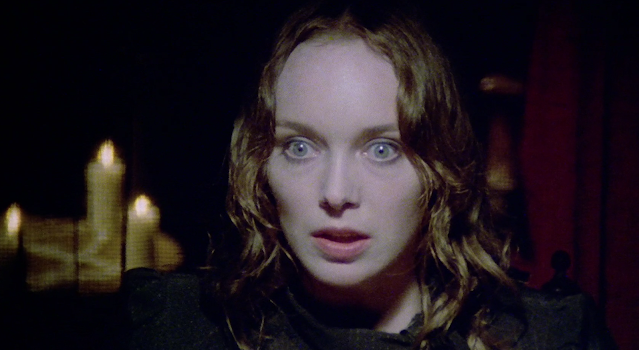
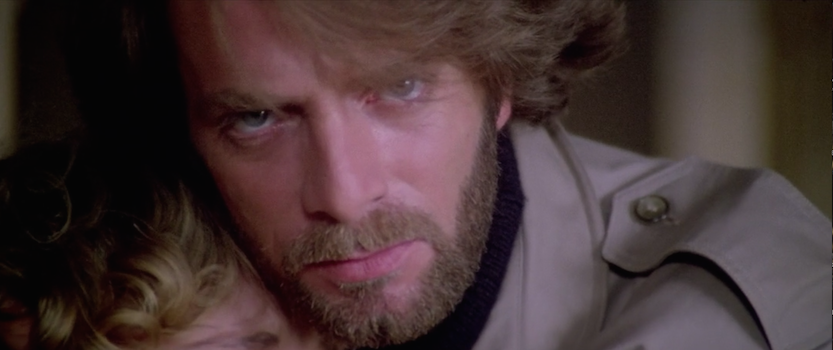
Showing posts with label Lucio Fulci. Show all posts

Thursday, October 24, 2019

Creature Double Feature Night 4: BAFFLED! (1972); CITY OF THE LIVING DEAD (1980)


Tonight, here's an oddball pairing of films (currently on Prime) about oddball couples investigating strange happenings together based on an eerie and unexpected premonition that strikes one of them out of the blue. In each film, one is a layman with the vision, the other is an investigator with a yen for a big story, eager to visit the place they saw in the vision. To balance things out, in one film its a NYC woman (Catriona MacColl) who has the premonition and the man is a cigar-chomping newspaper reporter (Christopher Plummer) sensing a scoop and maybe some chemistry (he rescues her from a coffin --and nearly splitting her head open with a pickaxe doing so, after she 'dies' in the midst of a seance) and the town is in New England. In the other, the seer is a race car driver (Leonard Nimoy!) who almost dies in a racing accident while having the vision, and the investigator is a spunky lady Brit rare occult book detective (Susan Hampshire) and the town is nestled in the remote English countryside. One is a gory nightmare of zombies and creepy violence; the other an early 70s TV movie/pilot. Can you ask for a more/less at the same time? A veritable yin/yang they are.

1. BAFFLED!
(1972) Dir. Phillip Leacock
*** / Amazon Image - B-

The weird surprise of this one-off bloodless supernatural comedy-thriller pilot is the odd duck chemistry between Leonard Nimoy and Susan Hampshire as a pair of pre-Minority Report solvers of crimes yet to happen. Nimoy plays a race car driver suddenly stricken with the ability to see future events, in this case it's a murder at some weird English mansion. Nimoy can't shake his alien aura long enough to convince as a regular Formula 500 joe, but he seems to be having a wry blast of a time running around the countryside with Hampshire and his Satanic alien head seems natural for a hip soothsayer. For her part, Susan Hampshire radiates a kind of can-do British cheek as occult bookseller Michelle. She sees him on TV after his big race, talking about a flash to a murder yet-to-happen and she's determined to help him find the mansion and prevent the crime. Rachel Roberts (Picnic at Hanging Rock's uptight headmistress) is in charge of the place (open to guests in summer); Vera Miles as the rich middle aged actress Kovak sees falling out of an attic window. She's with her daughter (Jewel Blanche) while her estranged ex-husband (Mike Murray -She-Devils in Chains), sporting the most cruelly Satanic haircut of the entire decade--hides in the greenhouse where he lures his daughter to dark side with the help of a mystic wolf amulet. See? BAFFLED! is Cool! 

Lots of turtlenecks and medallions and occult signifiers; fancy British cars tool around the grounds to make sure the car fanatic aspect of Kovac's character fits in (with some unconvincing but just dandy rear projection during the chase scenes). There are way too many daylight exteriors and extraneous herrings about but I like the weird non-sexual friendship chemistry of Nimoy and Hampshire's characters. They're into each other but not enough for it to get in the way with their strange bond, which means they're smart enough to leave it as a will they-or-won't they. Between her trenchant knowledge of arcane texts and his weird flash forwards to strange murders somehow tied in with an an occult group of weirdoes known as the House of the Wolf, they're kept too busy, aside from being stuck in an elevator shaft during most of the hair-raising climax, too get gooey (but Kovak's already seen the previews).  The cast of British BBC stock are all in their best chipper form. Hampshire is especially a delight: animated, assertive, fearless, funny and forthright, bouncing around in her 70s peasant frocks and groovy turtlenecks. A bewildered Nimoy can't help but laugh in admiration.


Richard Hill's score is over the top cop show pumping, never quite on the nose as far as being bouncy when it should be scary or scary when it should be bouncy, but that adds an almost mocking tenor that's most invigorating. The Prime image is pretty solid, albeit in that usual drab TV movie frame, luckily the colors are strong, as you can tell from the red of Michelle's turtleneck, above. There's a great final line after their awkward near-kiss goodbye: "Michelle… we’re leaving for Paris. Someone’s in trouble… I don’t know who, yet…”
---

CITY OF THE LIVING DEAD
(1980) Dir. Lucio Fulci
***1/2 / Amazon Image - A

Despite its excessive gore, sub-basement Freudian dialogue (everyone's hung up about porno flicks, incest, prostitutes, and witch burning), and endless parade gross-outs (including open mouths full of food, rotting carcasses covered with neon pink worms, muddy offal rubbed in faces, intestine-vomiting and maggot storms), City of the Living Dead is a strangely beautiful film. Thanks especially to a great HD transfer capturing every silken web glisten against the stygian blackness of Sergio Salvati's gorgeous cinematography. Its script makes no logical or linear sense but on a purely dream level, it's like an HP Lovecraft book read by lamplight in the dead of night in a quiet old country house. The ground is ever laden with billowing fog. The hair of the ladies is wondrously loose, auburn and backlit so it glows with an unerring luster. The hair is still 70s perfect. No 80s perms here, except on Gerry (Carlo De Mejo) the unprofessional shrink, and the NYC psychic lady who foretells the dead rising from their graves and only  the woman who had the vision and the journalist who nearly impaled her skull while rescuing her from being buried alive can drive out to New England to stop it. 

It's not perfect, the way say, Fulci's The Beyond or House by the Cemetery is. Some of the gross outs are a bit overdone, such as when sultry Daniela Doria literally hurls her literal guts out and cries blood after seeing a vision of a hung priest while trying to make out with Michele Soavi in a car. Those who consider 'nightmare logic' merely an excuse for narrative inconsistency and lazy writing won't like that the zombies can sometimes appear and disappear at will, or that someone might die early in the evening and then have an autopsy done before arriving in undertaker makeup (replete with tissue stuffed up her nose) later that same night lying dead on Janet Agren's kitchen floor; or that people tend not to defend themselves well when attacked, or run fast, or get out of the way, but anyone can make another "shoot 'em in the head" flick. Nightmare logic is way beyond that. If it does its job well--like it does here--we resonate with the paralyzing sense of total shock. If anything here it's the occasional feints towards daytime familiarity that seem out of place: the handful of cop cars, coroners leaving funeral homes, emergency news announcements on the bar radio, and wrongly accused suspects violently murdered by superstitious locals, etc. indicate Fulci hasn't yet totally severed the connection to his earlier giallos like Don't Torture a Duckling, but he sure soon would.

On the fourth or fifth viewing, the nonsense makes more sense even when marveling on the weird web of sexy relationships and inappropriateness going on in the lives of Dunwich's doomed residents. We find time to dial in and wonder whether Gerry is dating the much younger Emily (Antonella Interlenghi) and if she was once a patient (how unprofessional!) and if so, why she feels she has the right to casually barge in on his session with sultry Janet Agren (who self-deprecatingly dismisses her own dreams as just 'daddy issues") because she has to (for some unknown reason) break her date to go check on 'Bob,' (Giovanni Lombardo Radice) a deranged probably probably pedophile who lives in a hovel on the outskirts of town with his inflatable girlfriend. It makes no sense why Emily thinks she must barge in on a session of psychoanalysis just to break up a date in order to drop in unannounced at the derelict squat of a confirmed pedophile in the dead of night, just to pose seductively (and uninvitedly) on his rotted mattress. You could say it's all just haphazard the way 'story' is in a XXX movie (with scenes an excuse for linking gory tableaux) but that's like saying who cares what dreams mean since their sole intention is to keep you from realizing you're asleep, 

Nothing we imagine or expect ever does happen. Even the title is misleading: we leave NYC early on (very much alive) and spend the rest of the movie in the small town of Dunwich (hardly a city), so the images of grungy urban squalor full of dead commuters conjured by the title never materialize. But succumbing to its pleasures is like sliding upright down a slimy marble stairs in the dark with no handrail. You could step very carefully downward and get there safely but you'll have to wake up in a few minutes either way so why not go as deep as you can. What's important isn't that you don't break your skull open, it's that you feel that queasy vertigo twinge on the way down where you feel it almost happen, as Fabio Frizzi's mellotron-sampled male chorale-led synth anthem pronounces you triumphant over death itself. 


Third Feature Option:

(1998) Dir. Michael Almereyda
*** 1/2 / Amazon Image - A-

A kind of Lower East Side downtown hipster coffee and cigarettes experimental and cool, The Eternal is a boozy metatextual dissertation on memory, alcoholism, and the bonds of the moment transcending the bite of history and vice versa, it's also a loose, sexy update of a kind of combination of Hammer's 1972 Blood from the Mummy's Tomb (and its Stoker source novel) and the 1951 The Thing. The story has boozy rich couple Alison Elliot and Jared Harris leaving NYC for her ancestral Irish moor's estate, as if called home by some archaic homing signal (shades of 1934'a Black Moon, though I can't imagine Almereyda has seen it). As far as the previous two films, it's got that American out of water vibe as an ancestral estate is visited, strange visions, sudden corpses, and a sense of nonchalant cool highly unusual for the horror genre.

Christopher Walken has a couple of great scenes as a boozy call aesthete puttering around the mansion in his red robe, drinking Irish whiskey and, amongst other things, showing Alison the mummified corpse of a long dead druid priestess relative, found nestled in amidst old basement trunks. Amongst other curious things, the more Elliot starts to feel woozy and black out, the more alive and beautiful the mummy gets, until it looks almost identical to her, though gifted with immortal strength, a disregard for the life and death of those around her, and telekinesis. What's her deal? "It was the Iron Age," notes Walken. "You had to do a lot of nasty things, just to get by." Amen.
(see full article)

Wednesday, October 19, 2016

Nightmare Logic: Lucio Fulci's HOUSE BY THE CEMETERY (1981)

House by The Cemetery - Anna the Babysitter


October evenings in 2016--the usual chill of autumn warming the corpsey cockles of my hideous heart, but there ain't none. Has the Earth finally run dry of autumn leaf snap? It's the only reason I'm still here! Here where a Rosato Brothers' insulting C-note of an October day barely resonates before summer muggin' of Danny Aiello flattens the coffers. Speaking of Italians, man, maybe I've mellowed with age, but Lucio Fulci's 1981 Quella villa accanto al cimitero aka HOUSE BY THE CEMETERY has sure come along in my esteem. Maybe I'm finally mature enough to admit my prejudices against Italians (too many at my NJ high-school) and confront my childhood fear of a certain basement in our old Lansdale PA house in the 70s, with its cobwebbed corners and scarier crawlspace, beckoning me at halfway down the wooden steps to crawl in and see what was around the dark corners.

If you were ever afraid of your childhood basement yourself, back in the time when you were small and weak and each unaccompanied step was an endeavor, and when just going down there to get something for your mom while she was making dinner was so scary you'd race back up the stairs at the first tiny creak (even if you knew you made that creak), then travel with me back.. back..

Sure, there's a pretty fake bat involved, but we've all seen worse, and at least the wings flap and we wouldn't want Fulci to kill a real bat just for a movie. And if we did, believe me, he would.


Before diving in, a word of warning: even some Italian horror film fans I know aren't huge fans of this movie, due to its many confusing anti-ellipses and stubborn adherence to paranoid  nightmare logic. Me, I like it for the same reasons they don't and because he keeps the focus so narrow, so localized and nightmarish, confined to a single locale, tapping the same vein of cabin fever-induced time-bending paranoid 'always been the caretaker' interiority that make films like The Innocents, The Haunting, and The Shining (see Pupils in the Bathroom Mirror) so effective. Nothing evaporates the supernatural like the intrusion of the social order--cops, expository shrinks, fire arms, witnesses, panicky groups of holed-up survivors, reporters, etc.-- and nothing condenses it quite like communication failure between isolated, dysfunctional family members, like the Boyle's here in Fulci's House. Dad Norman is an academic researcher lugging wife and eight year-old son to New England for a six month stay to finish the 'project' started by Eric (his mentor in grad school). Played by gaunt, ever-bearded giallo mainstay Paolo Malco, Norman has a habit of staring conspiratorially at the camera as if its his Mr. Hyde wingman--especially when his emotionally drained and tantrum-prone wife Lucy (Catriona MacColl) is in his arms and can't see his face (which is Italian cinema shorthand for he's either having an affair or is a killer or is read herring); the Danny Torrance-style psychic son Bob (Giovanni Frezza--burdened by a bad dubbing job), is in communication with a young ghost girl named Mae Freudstein (Silvia Collatina) who warns him of the danger if he comes! But what parent ever heeded a tow-headed third grader's babbling (and why isn't he in school?). Mae gives him a large doll of herself and the fact that it's missing an arm and a leg and at least 50 or 60 years old is our first shattering clue). There's also the ever-enigmatic and smoldering-eyed Ania Pieroni (the music student young witch in Inferno) as Anna the babysitter. Cue paranoid vapors from Gaslight (all through enigmatic stares, ingenious destabilizing edits, and unspoken paranoid inference).

What makes Italian cinema of this era endure so well in general (and explains a lot of the rationale behind 'nightmare logic') is its ability to profit from Antonioni's 'signifier-meld' to get over language barriers. No one through line settles over the suspicion and enigmatic movements of the characters, leading to a deep sense of alienation in the viewer, which only seems profound if you realize that feeling is intentional. It also holds itself up well to repeat viewings. Everything is so.... cryptic... that new meanings and connections are constantly occurring. Like Argento, Fulci was coming to the horror genre from mysteries / giallo procedurals, where keeping audiences guessing who the killer was meant having everyone be slightly suspicious--everyone is hiding something--or so it seems. People keep mentioning the last time Norman was up there and he says they must be mistaken but he's that shifty-eyed Italian kind of giallo-brand ectomorph (thin enough that he can be mistaken for a woman if he wears a trench coat and hat) with eyes that make you suspect he's either having an affair with, or trying to kill, everyone he looks at, including the viewer, even as his actions and dubbed words are all regular scared family man. Meanwhile the mom tries to stay 'normal' in this sea of enigma, suffering the standard Monica Vitti meltdown. Emotionally unbalanced, refusing to take prescribed pills even as dad gaslights her ("I read somewhere those pills can cause hallucinations" - she says. Norman replies: "Are you sure?") She and Bob are the only ones psychic enough to recognize the danger before it's too late, but in prime nightmare logic style are unable to change the course they're on. Whether she's imagining or not, there's no arguing that the graves from the cemetery next door run right on under the house, and even inside the living room, with plaques all along the floors and hallways. Regardless of what Norman says, it is weird. "Lots of these old houses have tombs in them," he says, "because the winter's cold here and the ground is too hard for digging." 

Are you sure?

CHAPTER 4: ANTONIONUELCRAFT

Lurking on the threshold between the seventh-dimensional terror of Lovecraft and poker-faced absurdist surrealism of Bunuel, Cemetery requires the kind of reckless willingness to abandon familiar signifier-chains we find only in the post-Antonioni art house intellectuals and the LSD-experienced horror film lovers, whose eagerness to embrace the primal anxieties of nightmare logic enable them to abandon all expectations of narrative direction. A painterly schizophrenic kind of attention is paid to to things like a steak knife being used to turn a key in a rusty hinge, the camera pulling up close and the suspense rising with the intense chalkboard squeak of long-rusted, painted-over bolt slowly turning, while dad comes ever closer to slipping his grip on the knife and slashing open his wrist (or having the knife blade snap off and go ricocheting around the kitchen before lodging in someone's head). For every one time this happens, a dozen more examples pass by, by the skin of their teeth, from erupting into a serious accident. Then the door opens--Norman flashes the flashlight through the thick cobwebs and we wonder if Freudstein really does "live" down there or is some kind of a sporadically re-animating corpse. And then--before Norman can look around--a bat attack. It's quite a sequence - practically as it occurs all in real time from the moment Norman wakes Lucy up (the barbiturates lining up on her night table like little troupers) to the death throes of the bat; from waking up refreshed after a night of (presumably) Valium and sex, and winding up back to being the sobbing out-of-her-depth nervous breakdown, all in a single, prolonged sequence --there's no other horror director who comes close to that kind of micro-focus in a single consecutive event line.

TICK-TOCKALITY and MOLASSES LIGHTNING

And then, as the basement keeps opening, the bat's blood all over the floor, the hitherto weird mix of nightmare logic and deadpan humor shifts to straight nightmare. No other film of Fulci's is so rife with childhood nightmare and so void of cold adult coherency. Italy's other great horror maestro of the period, Dario Argento, still turned to logical cops and psychologists for eventual explanation (even in Suspirira) but in House, Fulci forgets about cops and rationale as the time window is just too short. By the time the progressively more deranged and horrified recordings left by Norman's mentor reach the part about Freudstein keeping himself alive in the basement via a steady stream of replacement organs and limbs shorn from new tenants, little Bob is already locked in the basement and Freudstein--one of the most genuinely unnerving Italian walking corpses--is shambling towards him, crying like a dozen children. As with Carpenter's Halloween (its sequel was in drive-ins the same year as this) this long scene crawls in melting clock tick-tock momentum. The rest of the film, a protracted climax, occurs in a slow cross-cutting wherein time moves slower than real life while never actually being in slow motion. As in Halloween, moving across a room to open a locked door (ala Leopard Man) can seem to take forever, the more you crosscut, as each parallel action is seen in full, so crosscutting between one person riding to the rescue and another facing danger, over, say, a three-minute period, would take six minutes, if adding a third element (Killer POV), nine minutes, and so on. It's an editing strategy that subverts our the narrative pacing expectations originally set up by DW Griffith. The feeling transcends ordinary excitement to create that nightmare pacing feeling of running through three feet of sucking mud while some demonic entity slowly advances towards you. Usually crosscutting liberates us from time's tedious aspects while enhancing our desire for the two separate threads to finally meet (the pursued or endangered heroine and the cavalry riding - riding to her rescue) which flatters our paranoia. We sense our desire will be met at the conclusion of the sequence, due to associative tendency created through signifier expectation: show me an apple near a pointed black witch hat and I'll think its poisoned with sleeping sickness; show me a racing squad of cop cars crosscut next to an isolated young woman slowly opening her attic door, and I'll think the killer is up there -- etc but she'll be saved in the nick of time. Few American auteurs dare screw with this formula the way Fulci (and Soavi) did until Demme with Silence of the Lambs when at the start of its own scary basement climax, it turns out the FBI SWAT team are rushing an empty house not Buffalo Bill's, who answers the door to find Clarice, alone. It's a betrayal of expectation that creates devastating suspense. The cavalry will not be coming this time, we realize, deep in our gut, from this effect, that Clarice is truly on her own.


A similar rupture event occurs earlier in the time-frame of Cemetery as well, between the two children who are in psychic communication--which we only realize at the very end (though we can surely guess) are on opposite sides of the life-death divide, separated by 60 or so 'living' years. Time is much more fluid in its ability to travel both directions, which we're not used to, but film has no problem duplicating. This angle of House confuses some people in its ambiguity but if you know Antonioni's Blow-Up (1967) and the birth of LSD symbolic melt-down post-structuralism and the 70s movement towards ESP, telekinesis, past-life regression, Satanism, post-Manson cults, deprogramming, near death experiences (NDEs), Nigel Kneale's The Stone Tape theoryand the way in which strange visions and dreams might well be some denizen of your house in the far future channeling your ghost (wherein you might be talking to your unborn great granddaughter and not even know it), then yes the ending makes perfect sense. If someone from the past can visit our present why not vice versa. Who knows? Even we might be from the future... right now.

Whether or not Fulci had seen The Leopard Man (1943), with little Maria's blood coming in under the door as her mama rushes to unlock it--is incidental. He takes that one pivotal moment -- a key scene in nightmare horror-- and drains it of all cultural, feminist Jungian-archetypal symbolism, and mixed emotions (our secret, shameful relish in knowing mom deserves to have this death on her conscience for not believing her daughter)--then distills it down into pure fear, turning the whole final act of the film into one prolonged, torturous crosscut scene of a child locked on one side of a door, parents frenzied on the other, father pounding like a crazy man. In doing this, Fulci distills a gallon of vodka down to a pint of 190 proof Everclear just so we can then take an hour and a half to sip it straight with no chaser. We may be dizzy, nauseous and trembling by the end but by god are we drunk.

Fulci's other films in his undead category, such as The Beyond (also 1981) lack that kind of intense focus; they are all over the place: flashbacks, hospitals, precincts, florists, precincts, barns, morguesm bookstores, and corpses with pink Jello-pop acid waves and tarantulas, seeing eye-dogs and half-headed zombie broads, etc. House alone in Fulci's canon belongs with those classics of horror that focus in on an isolated set of characters experiencing the structural collapses of the social order, patriarchal symbolic edifices toppled by intrusions of the unassimilated real (no cops to the rescue, no red herring "pervert" suspects, and the supernatural element is kept under wraps as long as possible). Once people are killed in House they don't get up and walk again, or wink in and out of existence (as they do in City of the Living Dead), they just get hung up on the basement laundry line for Freudstein's use in his home repair, and then their limbs and voices show up in Freudstein himself.


Thus while many critics will say House by the Cemetery doesn't make sense, that people take so long to walk from one room to another and no one thinks to call the cops or move out, I'd counter that this is intentional. Dream logic isn't an excuse for lazy coherency, to just toss whatever crap together you want and call it dream-like --though that has been done plenty of times. In 'reality,' the structural geography of the dream landscape is just as organized and cohesive as the social order: each element corresponds to an aspect of the psyche, with Freudstein as the Primal father devouring his young like Cronus. Whereas something like, say, American Werewolf in London, will rely on dream sequences to justify senseless but visually interesting 'trailer-ready' moments (such as a squad of werewolf Nazis bursting into the family living room and machine gunning everyone), these scenes are 'cheats' and betrays a faith in the permanence of conscious perception that pegs Landis as part of the provincial pop Spielberg-Lucas-Chris Columbus school of wide-eyed wonder, the type who takes these things literally, and so insists of gruesome latex transformation scenes, and issues like waking up from your rampage naked (your clothes having been shredded off), the kind of literal-mindedness comes from having not taken mind-altering drugs, or experienced drastic social upheaval (a war) or had mental illness issues (they're all the same thing, really).

Take as opposition to that literal-minded approach the more grey-shaded psychic breakdowns from highbrow European immigrants who came to America fleeing wars and revolutions on their home continent. For them it was the shadow of the wolf over Europe vs. the silver bullet promise of the New World. In The Wolfman (1941) and the original Cat People (1942 - below), the transformations don't 'hurt' or leave gory residue, they overtake the person like the physical manifestation of a dream state.  I recently made careful observation of the shadowy transformation scenes in Cat People and noticed (thanks to the clarity of DVD) that Irina's transformation to a cat person isn't rendered by effects but by black-on-black animation (if you look closely in the dark shadows in the corner of the pool room you can see--briefly--an animated black ink splotch). Most notably, her transformation back from cat to human is conveyed by wet paw prints gradually becoming--not bare feet--but high heeled shoes! The pad prints of the paws become the print of a heel and toe with just the most minor of adjustments. Val Lewton understood that a black panther cat doesn't become a naked woman but a woman in a fur coat with high-heels. The coat and heels are her skin and paws. The camera doesn't dwell on this detail, merely pans away, but the implication is a truly marvelous Camille Paglia-style fusion of the chthonic feminine and high fashion glamazon.


But Fulci, a dream logic master, doesn't need dream sequences or mystic auras to infuse a simple domestic setting with weird imagery. Like David Lynch or Bunuel, without ever straying too far from the banality of everyday detail he subverts the normal family and their dramas into figures and narratives of childhood nightmares. It's similar to the way we can use the archetypal models of Wizard of Oz and Alice in Wonderland to illuminate reality from the point of view of a paranoid schizophrenic. Imagine a real-life Dorothy who 'no place like home'-s her way back to black-and-white only to find she's murdered Mrs. Gulch by drowning her in the water trough while deep in a post-tornado fugue state. Or imagine a mentally ill Alice, chasing real white rabbits around the woods, killing them, and opening their stomachs to find the ticking watch she keeps hearing. Like The Innocents or The Shining, Cemetery is a study of the magical/archetypal and the real/social, and how easily one becomes the other, and how mental illness is the highest sanity.

For reality to bend this way, isolation is essential.  Cops and psychiatrists dispel the fantasmatic by their signifier presence alone. A cop's whole training, and the court system, and doctors in both social function and symbolic authority, is to clear away the cobwebs and separate fact from fiction. The very things that drive people into fits of cabin fever murderousness are ideally abated by the presence of 'the law.' Ghosts come out only when there's no one around to dispel them with the lamp of logic.

Therefore too comes the realization that a terrified kid locked in the basement, hammering at the door screaming and pleading, while his mom pounds on the other side, and the killer lurches slowly across the room--might run on and on, time melting down to stasis, the terror mounting like the swinging of a pendulum, or the slow ascent of a roller coaster. It doesn't matter in the end if the threat is actually real or imagined (if he's scared because of a creak he heard or his own scared kid imagination-embellishment) it can still function along this line - in fact, the two need each other --the isolated paranoid schizophrenic (or terrified child) and the supernatural Other like opposite polarities with a genuine demonic manifestation the lightning strike.

Critics who disagree that House by the Cemetery is art may instead label Fulci a sensationalist, especially in the spoiled mainstream USA where open endings like House's allow for lots of WTF unanswered questions to just hang there. But they wouldn't dare say that about Antonioni or Lucretia Martel, because there's no shambling corpses in The Headless Woman or Red Desert. Instead in both these similarly ambiguity-drenched films we find an ordinary upscale housewife reconfiguring ordinary random events around her so that they almost constitute amnesia or an affair.  We can never be sure what's going on in either film, but both capture the way a thrill of guilty fear might pass us when we hear a siren in the distance or the flush of shame when we hear someone laughing behind us. What else is art, anyway, if not that?


"Oh God! His voice... I hear it everywhere!"

One of the major quibbles/strengths for the dream logic effect is the sound of paranoia, the diegetic ambient sound effects of a film like House, which are attuned to incongruous dis/association. Using Eisensteinian associative editing style for subliminal sound-editing, ambient noise (birdsong, leaf rustling, children playing) might suddenly go silent, or a strange parrot noise morph into what might have been a child's scream. Was it? Heard but once within the ambient noises, our brain doesn't have time to consciously notice if it was or not, so that the birds never quite become a literal child screaming (they way it would be spelled out under John Landis or Spielberg), it may never even become conscious. In other words, if you hear a tree fall in the woods but didn't see it, and the sound of its creak-and-crash occurs the same time as a rusty door hinge is opened, and a dog barks in the distance, did you really hear it? I mean, maybe you heard the sound itself, but it was buried within all those other sounds, so you didn't think "hey, a tree fell,' and yet, subliminally, you might think, "hmm I wonder if any trees fell lately." Or would you wonder if you just hallucinated a third tone: you heard the dog plus a squeaky screen door hinge and the two, briefly, became the tree falling, like an overtone in Tibetan throat singing? If another tree fell right afterwards or you heard a chainsaw, then you'd realize you heard it. Otherwise.... no. So did we even hear it in the film, either? I could rewind and check but would rather leave it be, Schrodinger's Cat-style. That's Italian!

Freudstein's disruptive manifestation comes even into this field, for he's a master of audio mimesis, his voice like Satan's many waters, ranging from unholy Bluto-style laughs that sound like a narrator overdub recorded through a tin can and mixed with a lion at the zoo--to even crying in a child's voice (possibly Bob's own) when injured, a voice that sometimes doubles itself to sound like a chorus (the girl, too) --and, buried in the frying (which sounds very fake, perhaps appropriately), there's an occasional tiny laugh. Are these the voices the ghosts of murdered children or is Freudstein stealing their vocal cords as well as their limbs? Does he have some kind of ability to mimic his previous victims to lure new ones down, ala Attack of the Crab Monsters? or does he just cry if hurt, cuz he's a big baby, or trying to make the family think he is so they'll come closer?

If you need a 'correct' singular answer, then you also may need to state upfront to yourself that the hauntings in The Haunting and The Innocents are just the projections from the deranged mind of a repressed middle-aged virgin hysteric, not actual ghosts from within the cloistered walls of a remote empty mansion (or vice versa) rather than both. Again, Schrodinger's Cat, man. Once one or the other is confirmed, the film becomes either a medical drama (The Snake Pit) or goofy horror (The Snake Woman), but while it's in between, baby it's art. When the sound mixing also captures that 'both/neither' paranoia, the effect doubles into delirium.

Norman stares directly into the camera a lot - for the same reason most actors never do: it's uncanny 

In an international film center like Italy, since the language / dubbing is always so iffy from language to language, and there are so damn many, much of any international film's power rides (1) on the ambient noise / foley / sound effects and a style of antithetical music originated by Ennio Morricone. Italian auteurs like Fulci know the tone of a whole film can change with a bad dub job (as in the terrible adult voice doing little boy Bob) but no one can argue with the magnificent way an innocent child's sob of woe is folded into the sprocket-waves of a squeaky door hinge, or a woman's scream becomes a jazz horn. Thus the drive of these films is always based on sound, music, and enigmatic staring contests, rather than lengthy dialogue passages. And what dialogue there is, if meant to be enigmatic, thrives under flat renderings from voiceover dubbing artists, those familiar voices we hear over and over, from movie to movie, yet whose names we never learn. 

Walter Rezatti's score for House--rife with the kind of antitheticaly grandiose soapy themes mocked and indulged in equal measure by the post-Morricone composers of Italian cinema--surges between soapy melancholic grand piano and crescendoes of church organ-driven prog rock, taking enough long silent pauses here and there so we can hear the pin drop. It manages to capture also the weird way Fulci's 'melting thunder' time disruption editing mirrors across itself. Modern horror themes come rupturing out of its ground like oil gushers of the putrid dead in between cliffside romantic clinches so that sweeping concert piano virtuosity --which normally is my least favorite Italian soundtrack instrument--fits elegantly as counterpoint. That great semi-ironic Ennio-style antithesis brings depth and emotion in a way the more old-fashioned on-the-nose telegraph orchestration of Spielberg types like John Williams and Howard Shore cannot. As always with Fulci, this music is used sparingly, effectively, sometimes jarringly - roaring to life to cut off actors' last word or stepping on their first, with even what sounds like a 'play' button clicking in the mix. I've written too much in the past validating accidental Brechtianism to just presume Fulci 'missed a few spots' in the sound editing, especially with all those earlier marvelous musical flourishes.

Demerits for some terrible dubbing, especially by whomever did Bob, who sounds like he's always counseling a simpleton in a terrible 60s movie (which is why I can use that word) but that sense of wrongness again helps to give it all a nightmare fatalism. The dad's declaration after dragging the family away from comfy upscale NYC, proves a smug dismissal of their needs and concerns ("you're gonna love it, smell that country air")  is also strangely unconvincing --carrying no authority and raising suspicions he's woefully inadequate as a father. You could be coming to him bleeding and on fire and he'd wave it away as new school jitters. It can drive viewers insane but that's part of why it works as a nightmare logic parable -simple buildups from normal tiny incidents seeming slightly out of joint --the way no one in the family really hear what one another is saying - which is why Anna's ominous silence carries such a charge and says way more than all the generic small talk of the mother.


I AM LAZARUS, COME FROM THE DEAD 
(but as a kid, so no one listens)

Another example of Fucli's open-ended death/Lazarus metaphors (ala Mike Hammer --va-va-voom! Pow!): Bob, the child, racing in terror through a field, the camera running up behind him with the score roaring to life with crazy synth squiggles of twisted menace. He stumbles, falls atop a grave, the ghost (?) of its occupant's child, Mae Freudstein (redheaded child of horror Silvia Collatina) lifts him off the stone, grabbing him by his arm, which stays folded across his chest like he's in a coffin; Mae turns out to have been chasing him in a game of tag, not trying to kill him via ye old killer POV but now Bob has to run home for lunch. He promises -as we all did as childrem--to race back out to play as soon as he's done. Mae watches as he runs back towards the house before saying (with a robotic fatalism), as if he's right there next to her. "No Bob, don't go inside." but the score surges to life again and cuts off her last syllable.

By then we've already seen Mae in a flashback to her own period (Victorian, judging by the dress), earlier (and again later) saying the same thing, as if in a trance, and we've heard her say it to Bob while he's in a trance. Bob also hears her talking to him from the window of the old photo of the house before they move in, so one ghost friend in the early 1910s is having a conversation with a real boy in "present" time (1981). Fulci give us both sides of the divide, illuminating the flexible immortal quality of film narrative as a perfect medium for ghosts and 'shining.' The girls admonition in the graveyard --"you shouldn't have come, Bob" has a chilling unemotional frankness far beyond the capability of either of them to convey proper terror.

It's not like Bob really has a choice, after all, he is a child and in no position to refuse his parent's moving days. If a child tells his parent not to move somewhere because a girl in a photo told him not to go, they'd just laugh and roll their eyes, think he just doesn't want to leave his local friends or sexy babysitter. Yet even after moving in, when he sees his new babysitter's head bounce down the stairs, Bob is still unable to convey the gravity of the circumstance to his mother. She's the type of parent who-- if you came to her covered in bruises-- would chide you for scuffing up your new pants and send you to your room. Of course from that horror then comes the comedy of Bob shouting down into the basement: "Ann! Mommy says you're not dead!" And then his walking down the stairs to find her, knowing full well something killed her down there, is the stuff of pure shouting "Bob you idiot!!" a the screen.

This is just one of the ways Fulci builds terror in a viewer, the raw molasses slow illogic after all that high-toned paranoia reaches back to the fatalistic dread of kids who aren't heeded until it's too late. It's the big fear preyed on in all the best horror films, most recently in Let the Right One in and It Follows, of being a kid in danger and adults around either unwilling or unable to notice or give your fear the slightest heed. Not until the blood runs under the door will they believe you and even then will rather believe it's somehow a result of your own morbid imagination or your own fault.


NIGHTMARE LOGIC III:  Schrödinger's Cat People

House opens up with a mini masterpiece of generating suspense - we pan  up from the gloomy house and there's a gorgeous young women getting dressed by a table where clearly she's just been getting it on with some unseen boy mere moments ago. She's talking to him on the presumption he's off-camera (we never see him... alive). Because of the dusty remoteness of this house we glean the young couple's love is forbidden (probably both living with theur parents), passionate (you'd have to be ripe with sexual heat to get it on in such cobwebbed gloom), and doomed (no one knows they're there, of course, so won't be looking for them). This is not an uncommon way to begin a film, I'll grant you. But rather than the usual exchange, the whole scene is just her talking and slowly realizing he's not answering and must be in the basement, her fear level slowly generating from blithe babble to screaming. Fulci regular Daniela Doria is the girl,  counter-orbiting with the camera around the copulation table in ever wider arcs, introducing us to the house in the process --which is caked in dust now but presumably won't be after the credits. While many Italian filmmakers add weird touches and tricks from Hitchcock etc., Fulci's trick is to cut right to this terrifying scene, like paring away Argento's operatic style to establish a sense of powerless unease in the viewer using very little in the way of backstory, plot, or other stalling tactics. Good writing can convey more mood and information in a glance or line than three pages of lame exposition and that's the case here--all the details add up so that after barely a few minutes of elapsed screen time, the house itself seems doomed, and all who would enter into it are goners. The basement especially is cavernous and foreboding, the kind of place where it's better to just leave it be, and you're not sure why--but we feel it, too, in our bones along with the setting wintry New England desolation.

As a result, what might be just another dull opening murder of a naughty young girl and/or boy leaves dread in the air like a radio key.

Later: The real estate agent's corpse is dragged across the kitchen and down the stairs, leaving a wide streak of blood; the close-up of blood on the wooden floor is suddenly interrupted by a sponge coming into frame. We wonder for a half-second if Dr. Freudstein is actually cleaning up after himself, but then we see the floor's being cleaned by Anna, throwing down a big mop and bucket. But is she cleaning the real estate agent's blood or was the blood gone before she started cleaning? Is she in league with Dr. Freudstein or is Lucy just hallucinating and by now shrugging it all off (or is it the dead bat blood from earlier still uncleaned)? Lucy comes into the room in her robe, "What are you doing?" she asks. Anna gives her an enigmatic look that could mean either a) what does it look like, genius? You people leave blood everywhere (in other words, Anna think Lucy has been killing people and is now just being coy - maybe planning to blackmail her). and b) I'm going to fuck your husband. But instead, Anna finally says "I made coffee."

haunting stare from House by the Cemetery

Playing more or less the same enigmatic character in each film, she rarely speaks, but her eyes speak volumes. Just seeing her drive by or appear in the music class in tandem with the letter in INFERNO is to get an exciting chill that unfortunately the rest of the movie can never quite match.

In HOUSE BY THE CEMETERY (1981), Pieroni gets a substantially bigger but equally enigmatic role (though she does wind up killed), where she plays the nanny, Anna. Here her ominous silence contrasts with the incessant generic small talk of Lucy, the family's neurotic mother. Anna's eyes seem to say 'cut the crap' with every glare at her: "What a shame you didn't come with us to the restaurant last night" Lucy says, for example, as Anna is cleaning the floor. This gets a knowing, vaguely contemptuous and cuckolding reaction shot stare that could be read many ways, as its no doubt meant to. This ambiguity even continues with the implication Anna is bringing a tray of coffee to Norman at this desk (we see the tray eye view) -leading us to expect she's going to sit on his lap and ask him to read to her, like Lolita sat on Humbert, but instead, the surprise reverse shot reveals Lucy is actually behind the tray, as if she's trying to regularly reverse the usual red telephone course of events. Later Lucy comes out onto the street with a bag of groceries and we think we see Norman driving by in the car, but he doesn't see her or pull over to help her, and just drives on. Did Lucy drive the car and he stole it, leaving her to walk home with two bags of groceries through the woods? Did he say he was going to NYC but really is hanging around the library, listening to disturbing tapes of his predecessor's rantings (accompanied by POV shots of Freudstein's 'workshop' replete enough gore to repel most anyone --no matter how fake most of it looks)? Or did he ditch his wife in town so he can race home and have a quick tryst with Anna?

It would be unfair to make Fulci account for the lack of resolution in all this unspoken
'let's drive the wife insane' red herring anymore than in the 'almost affair' between Richard Harris and Monica Vitti In Antonioni's Red Desert. There's no trope or cliche that sits still and allows us to situate ourself into what kind of movie this is, which again maddens the materialists and paranoid neurotic hausfrau narrative film clingers. They can argue that since nothing comes of it, plot-wise, it's just a waste of time that goes nowhere, that it's just another Italian fooling around with the bag of enigmatic stare tricks so beloved of Italian auteurs and absinthe surrealists.

I would argue that it's because this approach generates a sense of paranoia and unease that it spooks off those materialists, because they don't get that it's the spooking off that was the whole intention, like saying horror movies aren't supposed to be scary, so you don't like Halloween. If you submit to the alienation ambiguity as intentional, it makes the later horror events seem further and further abstracted, so that when they finally cohere from the ambiguity, they come too close to home for easy laughing off. It's like the auteur convincing us the danger is coming towards us from far away, pointing it out in the distance, and then when it's about half-way, stabbing us in the neck and running away (do you get that reference?). 

Fulci's critics wouldn't dare say, for example, that Hitchcock wastes our time with the Melanie Daniels'-Mitch Brenner meet-cute romance in The Birds or Marion Crane's embezzlement in Psycho -- at least not as confidently. Well, Fulci does the same thing Hitch does, only within the confines of wordless stares! In all three examples, Hitchcock's Birds, Psycho and Fulci's House, the suspense and fright comes seemingly from left field - we're not given to expect birds or knives or monsters in the basement in any of these three films because the cinematic signs are all lining up for a different movie, one we've doubtless seen: in The Birds it's the story of a spoiled city heiress / streetsmart moll finding love and meaning while hiding out in a small rustic community (in the vein of The Purchase Price, Green Acres, He Was her Man); in Psycho it's a sexy noir thriller, of the sort where a woman embezzles a wad of cash to run away with her handsome cash-strapped shirtless lover (too many to name); in House by the Cemetery we think we're headed first to a slasher movie, then a ghost story (ala The Shining), then a torrid sexual affair movie where a babysitter and a husband plot to drive an already-neurotic wife insane through mixing LSD into her downers.

The latter plot was widespread in the age of the"Valley of the Dolls" era-- (the 60s-70s), when pampered, confused wives got separated from reality thanks to some blue pill given to her by a man who keeps saying he's her doctor, or husband. Is he arranging the subsequent gaslight-style scenes while he's off on 'business' to make her think she's hallucinating and drive her to suicide? Put strong acid in her Valiums and play weird tape recordings of dead husband's voice under her bed (as they do in The Big Cube?) and get her to jump from the high window down to the sea while you're safely miles away with perfect alibis? 


But, once they get you expecting this kind of film, these auteurs got you at their mercy; they can then use these expectations to make you even more neurotic than one of the rich neurotic housewives from the type of movie your unconscious mind had been fooled into thinking this was! 

If you that was confusing, maybe you should lie down... you don't look well. 


One final deep fractal example of this style of alienation trick as a tool to generate paranoia and fault line dread might be found after the post-bat blood / real estate lady blood / Anna's mopping / enigmatic stare scene. It's later that afternoon: both parents are out and Anna is alone in the house with her charge, young Bob, who's playing with his remote control car in the living room, wheeling it and around and under chair legs and into the hallway and back. Then the car turns a corner toward the kitchen, moving out of his sight as if overtaken by a rival signal. The car sound stops and uneasy quiet settle over everything; Bob turns the corner, hesitatingly, wondering why it hasn't driven back. But it's gone. There's no sound of it revving at all, but the basement door, which is usually locked, is wide open (we heard no sound of the car clunking down the steps though). With a shock (we'd forgotten about that door), we flash back to the introductory scene with the young lovers (just replace the suddenly unseen/unheard boyfriend with Bob's toy car and the sequence is the same). Bob goes slowly down into the gloom to look for the car and disappears from the frame.

A moment later, Anna comes into frame and calls to him, but he doesn't answer. She too notices the basement is open, looks down the basement steps, and slowly goes down to look for him. Suddenly the door slams shut above and locks her in and some shadowy thing comes moving towards her from the far end of the basement. She starts screaming. Bob is somehow now upstairs, oblivious!

It's so simple, and such a logical progression--from the remote control car disappearance to the babysitter locked in a cellar--that it shatters our concept of time and space, erasing in a flash our distance from the event onscreen (in the chain from toy car to babysitter, it's only one link more to get to us).

She screams for Bob to open the door as the monster shambles towards her out of the gloom. It takes awhile for us to even realize Bob even hears her and is trying to work up his nerve to go down and open the door. While she screams his name, he's slowly collecting his stuffed Curious George and flashlight, and then slowly, leisurely walking down the stairs.

The glacial pace in which Bob suits up to walk across the kitchen floor -taking his sweet time -as she's cut to ribbons on the other side of the door is maddening, a borrowing of a similarly maddening sequence from Lewton's The Leopard Man stretched even further, and yet we certainly can't fault Fulci for choosing this pace. All but the best horror auteurs do the reverse, they move the pace of events faster and faster, but the brave masters of the genre know that to really heighten suspense and dread, one must slow down rather than speed up -- real nightmares seem to take place in knee-deep molasses.


SPOILERS

If it gets too frustrating to see a whole, one-armed family helpless to escape a limping armless dead man who can barely shamble, to see them all cowering helpless and screaming when it would be a simple thing to chop off his other arm (or at least use more than one of your own in defense) well, that's how nightmares are and who knows how we'd really act and maybe that's where the horror is -- the realization that if the shit got heavy enough we'd crumble into a sweaty sobbing ball, too. At least, in this case, we can imagine the terror really is overwhelming - that this thing has been living below them in their locked basement all the while, and has been for over 70 years, repairing himself through fresh victims. This is the first time they see Freudstein, and the last--as if the full horror of his shambling maggoty cadaver is so overwhelming it paralyzes his prey, jamming life's record so bad it hops a groove and leaves you screaming on an eternal skip--a kind of instant repression black-out back to the beginning--to when old doc Freundstein was still really alive (never seen in the flashbacks, involving the mother and nanny instead).

That's why the film's chamber piece momentum works so well, almost like a three-act opera, as all the paranoid 'almost' sub-plots evaporate in the cold finality of the basement, the illogic that a row of corpses could be strung up down there without the smell carrying upstairs through the same crack in which Bob crawls for his own escape (trying to fit his head through that narrow crack provides one last nerve shredding moment that stretches forever) into Mae's and Mother Freudstein's sympathetic decades-departed arms--is so startling, original and final. There is no death but what we make for ourselves, which is called waking up, the alarm clock of your tender throat, raw from claw-choked screaming, pulled up from the pillowy grave like sluggish Lazarus Jr. by a girl who died before your mother was born, to a world with its own set of rules, but the same damned house. Or to put in layman's terms, it's the end of The Shining if its Danny who wound up at the party in 1929, or at least upstairs with a babysitter and those cool creepy twins... forever... and ever... but way cooler, even in those fusty old corsets. 


NOTES
1.(since it's going to be dubbed and subtitled in about 20 different languages, Italian film tradition is to shoot MOS (without sound) or silently - each actor in the international cast speaking his or her own language and then dubbing their part for that country's track, ideally, and voice actors in that language doing the rest, which is why nearly every character in Italian horror sounds like one of two or three different voice actors. No one knows their names or where they are - the invisible heroes of the business- as a voiceover actor myself I say their stories must be told!

Tuesday, September 24, 2013

Genealogy of Flies: LORDS OF SALEM (2013), HOUSE OF THE DEVIL (2008) + My own Salem Witch Connections


"Only bad witches are ugly." - Glenda

Much as I love WIZARD OF OZ there's something messed up about Glenda's shallowness. Look at these bangin' old broads (above) bringing tea and cookies, and hell yeah the tea's probably spiked with tannis root but when these sexy evil bitches show up at your door you should be fucking honored. They're not there to get all petty on you with who's good and who's bad, ugly or pretty. Glenda's the ugly one for perpetuating a stereotype started by the church to keep a sister down. In Salem, for example, a horde of hot witches were hung for their presumed evil, including some of my ancestors.

If they weren't evil before you hung them, they are now, o paranoid projector of your own subconscious devils!

Now they're coming back, in my DNA, arm-in-arm with every kid whose life was ruined for getting caught expanding his mind in the Reagan-era 80s. Fear us, then, o descendants of the evil and corrupt Salem and Texas judges, all smug in your hypocrite robes and stetsons. We are watching you as you sleep, through Meg Foster's crystal blue orbs. Your time shall be soon.


In other words, sons of sinuses blocked and lungs a-resinated, hail the new flesh and toad of newt, hail MacBeth, Val Lewton, the Cramps, Bob Dobbs, Nic Cage, Sammy Davis Jr., Lamont Cranston, D.H. Lawrence, and John Doe.

LORDS OF SALEM (2012), Rob Zombie's nearly abstract, post-vaguely-modern 70s devil film, tosses cauldron-ward the old 'conspiracy to impregnate unwitting chick with the devil's child' thing-- already tossed back a few years earlier by Ti West (HOUSE OF THE DEVIL - 2009)-- adds the actual Salem and spoon of film references, heats to overflowing, goes in the other room to change the record, becomes obsessed with finding the right cauldron stirring Velvet Underground song, and never comes back (1). Does it end up a stew? Well, what is it trying to be? If it was trying to do for devil movies what SCREAM did for slashers, then it failed. If it wasn't trying to do that, if it was trying to be a SHINING for New England, then why the tattoo-parlor ambiance? Why the vintage punk thrift store symbolism that means nothing? Why the EXORCIST-cycled dialogue, (bringing "cunting" back home)? Why the carny ride haunted house tableaux that go nowhere, as if we're meant to glance their way, gasp, clutch our date's arm, and walk on through the dry ice fog and strobe lights to the next attraction? Aside from the goofball cranberry juice elevator flood, and the climactic gold room of dusty corpses, Kubrick would never be so obvious. So what is LORD OF SALEM really trying to be, aside from a showcase for Rob's tattoo and customized neon artist Florida posse to display their wares?

It's being Rob Zombie, the Kubrick of the Daytona trailer park, the Neo-pagan who goes on a killing spree at Burning Man, and everyone mistakes it for performance art.

Dude, they were so high, those who mistook it. Take it from me.

You can't take it from them. They're all dead.

Or hungover.

Left to its own devices, without all the post-modernist post-punk flippancy royalties can buy, LORDS does generate some hypnotic power, some echo of that great stretch of THE SHINING, set to the avant garde vocalizing drones of György Sándor Ligeti, involving 'the woman in room 237.' Zombie's own version of that same ominous inexorable creep towards some dreadful finish has a uniquely palpable abandon; the psychic force of the gathered middle-aged actresses--heavily and picturesquely filth-encrusted--creates a combined psychic release. Compare this with most lame attempts to create a Satanic ceremony: wherein half-asleep actors gather in black robes, read Latin, light candles and splay a topless virgin on the dais rather than do real research on altered states of consciousness achieved through hallucinatory herbs, smoked and drunk, taken in conjunction with prolonged periods of group chanting.. Like Ken Russell before them, those who'd depict witchy states of consciousness just show flashes of weird sick MTV images and a bloody Jesus and a nun naked but for bloody habit, strobed over a dosed pupil... and hope for the best.

Only bad witches are ugly... yeah, right (Glinda in the Jezebel fire) - collage 2015 by-EK 
Zombie does well in portraying this ceremonial ghastliness, the bad witch ugliness, but for it to resonate we need a stark contrast of beauty, which we don't get. In THE SHINING, the movie Zombie apes, the beauty comes from the hotel decor and from the devouring omniscient ambivalence of the Colorado Rockies. They loom like giant fangs, like the Overlook is in the mouth of a giant arctic Venus flytrap. They provide a stark coldness which makes even the unfathomable vastness of the cavernous hotel interiors warm by contrast.

But when a gold-flecked theater shows up at the end of SALEM (referencing Overlook's 'Gold Room' and MULHOLLAND DR.'s Club Silencio), though it offers quite a show, it conforms not to Kubrickian displays of mind control, nudity and submission/surrender, nor stark terror/beauty, but back to those old images of evil that are speckled with the cruel dust of the demonization process begun a thousand years ago by the Catholics. As Moncure Daniel Conway's Devil Lore book notes:

The great representations of evil, whether imagined by the speculative or the religious sense, have never been, originally, ugly. The gods might be described as falling swiftly like lightning out of heaven, but in the popular imagination they retained for a long time much of their splendour. The very ingenuity with which they were afterwards invested with ugliness in religious art, attests that there were certain popular sentiments about them which had to be distinctly reversed. It was because they were thought beautiful that they must be painted ugly; it was because they were—even among converts to the new religion—still secretly believed to be kind and helpful, that there was employed such elaboration of hideous designs to deform them. (c. 1879)
Of course Zombie makes sure that same damnation is applied equally to the hideous Puritan torturers, here re-imagined with big pointy caps and excessively unguided facial hair. In other words, both sides are twisted, evil grotesques. Then--in modern Salem--our protagonist Sherri Moon is supposedly descended from the judges, but is in practice just a smarmy, skin deep-pagan, and so is Zombie apparently, for he forgets we have to believe these torturers of witches were genuinely under psychic attack if the witches are to be actually evil, too. You can't have it both ways! If you try, the whole thing falls apart, for there's no clear 'side' you necessarily want to be on. Puritan evil vs. Heathen evil leaves no tension, so we may just admire the artsy detail of the tableaux, clutch our date's arm again and follow the crowd off to the next tableaux, already wondering where to eat after we leave.

The turf is ours by right...


This spectacle might keep our interest more adroitly if the lead actress was stunningly beautiful, like Jocelin Donahue in HOUSE OF THE DEVIL, or Mia Farrow in ROSEMARY'S BABY, or Cristina Raines in THE SENTINEL, or even just interesting, vivacious, charismatic, but the leading actress in Zombie's film is of course his wife, Sherri Moon Zombie. And she was all those things a few years ago, in HOUSE OF 1000 CORPSES and DEVIL'S REJECTS. Now gettin' too old for this shit. As Glinda might say, a hard-lived life leaves no loveliness.

Decked out like a Williamsburg hipster, Moon's character, Heidi Hawthorne is an enigma only to herself. Way too old to either believe in the supernatural or stop dressing like an extra in ALMOST FAMOUS. She considers herself a badass, clearly, and has a good job as a Salem radio station DJ. She still snickers like a dirt bag middle-schooler at any hint of genuine insanity, balls, magic and/or evil--such as when the metalhead from the band Lords of Salem is a guest on her show. She's the type of girl who has Celtic symbol tattoos but openly sneers at anyone who tries to point out what the markings mean. She is just the sort of person any self-respecting punk rock contingent recognizes as a slumming poseur and ostracizes a priori just as she des the truth behind all the witchy symbols she surrounds herself with. She's got nothing going on but thinks she's all that, and that's the biggest red flag of all.

Of course we know why we're supposed to be so intrigued by Heidi: the director still loves her, and he mistakenly presumes we're as bewitched as he is. Well we were, Rob. Ten years ago, she was freakin' sexy as all hell. But Rob we're fickle. Ain't no ring on our finger. And that's part of the problem when you cast your wife all the time; sooner or later she's going to be too long in the tooth to play the babe she still thinks she is, and you're going to be the one to have to tell her, and then you'll have to start auditioning younger leading ladies all while dodging hurled frying pans.

This kind of short-sightedness is all over SALEM; we can tell what 70s devil movies Zombie likes and wants SALEM to be but he misses key subtexts. Like a carny trailer camp cargo cult, he imitates the surface and adds his own trashy aesthetic and crosses his fingers the two will gel into a religion. I'm not knocking him because I admire him for that last part. He clearly loves all this shit. His obsessive yen to recreate these lightning moods is admirable and must be appreciated by any classic horror fan. It's the meaning that eludes him. For example, he goes for an Antonioni/Miike vibe in longly held static long shots of Heidi walking her dog on a lonely street or in a park in late-afternoon or playing records with her bearded buddy, but fails to inject genuine observation and complexity into these long shots the way Miike would, nor can he generate uncanny frisson even in his Kubrickian Steadicam POV shots, injecting them instead with anemic attempts to make Salem a goth Austin with just a smidge of Detroit decay. He misses the chance for some great 70s-80s Italian synths in the LORDS' score, and instead goes for an annoyingly minor key two-note piano of the kind that made the back half of EYES WIDE SHUT so annoying. He misses the chance to make Heidi herself interesting: she's supposed to be a recovering drug addict but any AA or NA person will roll their eyes at how un-an addict she is. She even drinks at one point, super dangerous behavior from any kind of recovery (did Rob not bother to learn that?) though it doesn't strike the film as a big deal; and her apartment is way too clean for someone in early recovery. Why isn't she smoking or chugging coffee like a real AA-er counting days? I got a headache just watching her get up and walk her dog without a coffee first. If Heidi's an addict I'm John Paul Jones (the Zeppelin bassist, not the seaman... you got a dirty mind).

The Moon wanes: 1000 Corpses (2003), Rejects (2005), Salem (2013)
I mean no disrespect to Sherri Moon. I love her in DEVIL'S REJECTS. Her line after bluffing a room of hostages with an empty gun ("it's all mental!") is my personal mantra. She displayed a great relish for evil in that film and had great stringy-sexy hair and a flash of gleeful malice in her eyes and nice curves and an ease with using them to drive a man so crazy he forgets to defend himself (you could see why Zombie married her). Her thin lips weren't even an issue then, but now they're even thinner, too thin for the big screen; she seems tired, and way too old to be riding on an URBAN COWBOY-style electric goat in neon flames (her poor bones!), or going down on strange priests in the midday pew (unbecoming!). She seems to be a middle-aged woman trapped in a tricked-up spiral of horror iconography, determined to stay unaware of the maturity that at last has found her.

I know what it feels like to make out with thin-lipped women. It's like kissing a skull. Scary! Is that why he puts her in skull makeup paint? I hope he's trying to convince her to use some collagen. None of these 18 paragraphs would exist had she done so. You think I'm a fucking lippist now, but if not me, whom? And who else are collagen lip-augmentation shots for if not for her? Who but a classic horror fan may say so, may hold her to the same barroom benzedrine social standard the rest of stardom is bound unto? I'm no fan of collagen but just 'cuz some girls overdo it to ducky extremes doesn't mean a small dose should be shunned by those who need it. Her later skull make-up helps her look like some scraggly skate punk who got caught in the rain on his way home from a Stockholm death metal show (below) muttering "fråga inte!" to his parents as he drips up to his bedroom." as he passes his parents on his way upstairs. But I doubt that's the look she wanted. It's just the look she had, so she ran with it - again not an un-admirable motive, that old Buddhist saying: when you're falling, dive.

Pastiche Without Purpose

Maybe SCREAM auteur Wes Craven had it easier since he focused on 80s slasher films, so ignored horror history prior to HALLOWEEN and after SILENCE OF THE LAMBS. Zombie goes back to the silent era's HAXAN through to the occult crazy 70s, Kenneth Anger's LUCIFER RISING, ALUCARDA, every Spanish and Italian Exorcist rip-off ever made, then buzzes THE HOWLING, and various old films Heidi watches while asleep in her apartment like KANSAS CITY CONFIDENTIAL and CAPTAIN KIDD.

Burnin' up his fuse up here alone
There are a million ways these textual links could have been made to resonate, such as having Heidi actually evince some knowledge of classic film trivia, to be able to quote them or talk about them, to fold quotes into her lexicon. Instead they seem like these tapes were all left behind by an ex-boyfriend and she just has them on to remind her of him, and because she's too passive to pick a channel.

That's what made SCREAM so unnerving; these characters knew what was coming--they'd seen it in the movies. As kids kept awake at night all through the slasher 80s, vowing in our slasher-fueled anxiety that we would never drop the knife by the killer's prone body, we resonated with those SCREAM kids. SCREAM used the dread inspired by those earlier movies, which had by now settled in our collective dream unconscious, and re-activated it, showing even a kid who knows HALLOWEEN by heart and has already thought through his bedroom defense, might be killed anyway. It was a terrifying thought.

Zombie can only admire that collective unconscious and that terror from a safe distance. He's a fan, not a player. He doesn't know why he likes them - so he just apes the box covers. He's the R-rated Tim Burton, i.e. for a director he makes a good set designer. They both gravitate towards familiar narratives--remakes of their favorite films--because they have no gift for story structure or pacing: they just want to create the fantasy setting they dreamt of inhabiting as children. Once they do, it's like one of those Halloween parties where people in fancy costumes just stand around awkward all night.

Luckily Zombie is free of the awful whimsy-packed orchestral pomp of those Danny Elfman scores Burton uses. Now you think I'm whimsist!? Fuck yeah, because it pollutes the real madness. Whimsy is the way an insecure artist of the macabre, or MST3000, chews your food for you.

Oddities seems such a lonely world
Sadly, what the mise-en-scene of Heidi going through her day most resembles is the Science Channel's reality show, ODDITIES. I've got nothing against the Oddities Store itself (down the street from where I used to live) but the customers and employees on the show are way too sane and boring, which makes their yen for weirdness strangely sad (to me anyway). They cover themselves with tattoos and piercings and wear red white and blue dreadlocks, old-timey mustaches, and tall stovepipe hats and fang implants, but when push comes to shove, perhaps, some of them might be overcompensating for an inner lack of... what? True insanity? Nic Cage only needed one symbol of his individuality in WILD AT HEART, his snakeskin jacket. But Cage 'really' is a badass ---the eyes, Manolo, they never lie. Some people choke themselves with symbols of badassery and yet turn pale at the sight of a cigarette. They'd have been too scared to use the bathroom at CBGBs, but then they'd be wearing their CBGB souvenir T-shirt proudly for the next 20 years, they'd even wait in line for tickets when the same (now cleaned and laminated) bathroom shows up as an exhibit at the Met, and recall the good old days when punk music was, like, real.

Now you think I'm an anti-faddist. Well no. It's just that I'm really crazy. And while I don't trust carnies and their little hairy hobbit hands, their undiagnosed Hep-C and permanent smell of diesel oil, I trust normals even less. Dude, the truly crazy try to be normal. They fail! And the result of their failure are the real eccentric tics; the vice versa are only sad - or am I jealous of 'stability?' Around 1983, vefore I started wearing black fingernail polish, growing my rat tail, and wearing combat boots with white circles I painted on them in white-out, I guess I was similar. Are you calling me a poseur now? Yeah, maybe.... but I escaped it, through psychedelics, alcoholism, and being in a band, and... hmm, no, that's it. Just those three things. Goddamn it! I was depressed, is the thing, undiagnosed - as was all the depression not suicided over. That level of depression will make you reckless in what you do, you scramble for the intense experience, and CBGBs and City Gardens are like soothing beach trips. When you're a drunken acidhead, it's the same, but now you're free.

CBGB's: Smell on Earth
Rob Zombie's clearly a real wild man in that sense, but he covers every inch of his mise-en-scene with so much hillbilly dirtbag neo-pagan blood chic you wonder what lack of true insanity he's hiding. None of what he films looks like a real place, with age and use proper to an old city like Salem, the way the sticky thickness of 30 years of rock band promo stickers and graffiti are layered like redwood rings at real college dives. And too much detail all 'of a piece' as they say, looking new and pre-fab rather than real isn't scary. Carpenter created the first HALLOWEEN with a spray-painted white Shatner mask, a trash bag full of painted leaves, a butcher knife, a knitting needle and a few suburban houses.  Zombie had carny parents. He lived on the road; he didn't know from suburbs, so he's excused in that sense. Carnies vouchsafe their authenticity only through their oddities collections, like sheepdogs for a sheepherder. And who cares if the more obnoxious gawkers get sewed screaming into the next exhibit? Rob Zombie understands if we don't, either.

But Heidi is a tourist.


There some indications here that Zombie can make the post-modern jump, and that's what's frustrating. He jumps but doesn't stay on the other side of the line long enough for the ref to take a measurement. He just decorates the jump-off point in punk rock iconography and gestures off into the fog and whoosh -- he's gone onto the next wild attraction. But in one great scene, Heidi is chilling out at her friend's house and suddenly she's coughing up blood, and faceless doctors appear in the room and Charles Laughton's voice on the TV jibes with the demons almost as effectively as in MYRA BRECKINRIDGE or the films of Nicolas Roeg or Alex Cox. "This just may be to your benefit," Laughton says, as the merciless CAPTAIN KIDD (above). For this tiny stretch, it's sublime work.

Later her bonding with the weird fat devil baby (whose lopsy-topsy mutatedness is a perfect dark evil mirror to Laughton's leering image onscreen) mirrors that of TV and viewer, umbilical extension cords plugged right into us and hell, and with its embryonic red eyes and slit middle you'll wonder if this demon embryo is a metaphor for an abortion or if his froggy face is supposed to be the ski mask in TORSO, and the priest looks like he might be a reference to the stitched-into-eternity Dr. Freudstein in Lucio Fulci's HOUSE BY THE CEMETERY (1981)... but we have no clear idea why or if its conscious on Zombie's part, or the make-up guy's.

Top: Salem / Bottom: House by the Cemetery
My Mary Easty/ Rebecca Towne Nurse Connective Genealogy 
(on my Dad's Mother's Mother's Side)

For an aside: I have to mention, as always when discussing Salem and genealogy (characters here are descendants of the hung witches and/or judges and executioners) that all these descendant movies are fascinating on a personal level for me because the one side of my family tree that kept immaculate records is from Salem, having arrived in Boston in 1631 (with fellow passenger Roger Williams, founder of Rhode Island): This side of my tree includes nuggets like these (copied direct):
The family of John Perkins 1583-1654 - freeman 18th May 1631
Married Judith Gates, born Newent, Gloucestershire, England
Children:
1. "Quartermaster" John - b. 1614 0 d. Dec, 14, 1686
2. "Deacon" Thomas 1616-1686 (not the witch hunter, he died before that)
3.  Elizabeth 1618-1700 / married William Sargent (5 children)
4. Mary 1620-1700 - "She was accused of witchcraft, sentenced, but the execution delayed and the citizens recovered from the delusion." (+5 more)
The Family of Elisha Perkins (born - 1656 - Topfield) died - 1741 in Methuen
Married Catherine Towne - 1680
--
Children:
(9 total), including: John (third son) born Aug. 12, 1685 - died June 22, 1750
married Mary Easty (whose mother Mary Easty and Aunt Rebecca Towne Nurse were hanged for witchcraft) --etc.
I have other relatives farther up in the years worth mentioning: Joseph and Ichabod Perkins, who "were in Capt. James Jones' Company which marched to Concord at the alarm of Paul Revere in 1775. And 34 other Perkins of Topsfield and Ipswich and cousins of Goulds fought in Revolution (MP)." Etc. I didn't even know Ipswich was a real place! I wish there was a reason for me to research a paper there, and find the population to be a hideous bunch of fish god cult worshippers. And then grow gills m'self and swim off with a fine bonny lass!

This branch of my family tree owned a lot of property and decent fortune up in the Boston area, but lost it all when it was inherited by two brothers who whored, gambled, and drank away in a few years what it had taken their forefathers five generations to accrue. If women had been allowed to inherit property, I might be a rich scion making my own damned horror movies today!

Alas, the same streak of olde Enlgish alcoholic mysticism that would help me be a 'good' horror auteur prevents my actually getting it together to do so. My whole freaking life is jerry-rigged in this fashion.... how is that for a lingering curse and/or inherited magic, o Rationalization Guru? Do you not see yet the link between chemical dependency, magic, and right-brained visionary artistic ability? Why are all great writers tripping alcoholics, and all hacks cursed by sober sanity's boundaries?
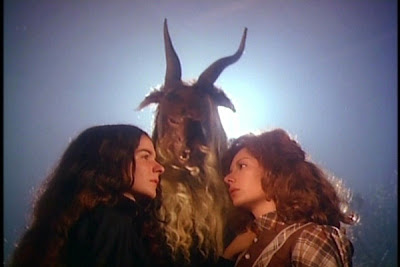
Top: Horror Hotel / Bottom: Alucarda
I know that in all likelihood these ancient aunts of mine were not really witches, but falsely accused by the children of a family wishing to possess the Perkins' wooded bordering acres. But like most Fordians I say print the legend. Maybe my ancestors and the other witches were likely just sexually repressed settlers who found an outlet in the darkness at night, dancing and humping trees. But that's not as fun to imagine, and what else gives history any interest aside from the possibility for something still unknown, something still hidden from us by the dry, dusty historians who get to mould our past? We wouldn't even care today if they were just falsely accused of, say, adultery. So if they weren't necessarily witches back in the day, time has made them so, time and three dozen horror movies that let me know as a 300 years-later ancestor the grisly events might repeat themselves any moment --that all I'd have to do is draw a pentagram on a solstice and Aunt Mary Easty would come roaring up from wherever to make me party with her on her persecutor's grave like in the under-appreciated WITCHOUSE and countless others. Not that I would, because what if it worked, or worse, didn't?


From top: THE DEVILS, SALEM, SHINING, SHINING, SALEM, SALEM, ROSEMARY'S BABY, young Ruth Gordon publicity shot.


Another redeeming trait of the film is just how GILF-ish are the three witch sisters (see CinemArchetype #20): Judy Geeson (GOODBYE GEMINI) has still got it and delivers her bloodthirsty lines with relish, as only a saucy older Brit lady can -- you should check out her amazing half-forgotten 70s sci fi TV series, STAR MAIDENS (my analysis here); also slamming it home with crisp hot fire, Dee Wallace (THE HOWLING) and Patricia Quinn (the gonzo maid in ROCKY HORROR PICTURE SHOW) as the palm-reading sister Megan. And as the dirtiest and most evil witch coming back from the past, Meg Foster. As we've seen them in younger incarnations (doing the time warp / "again"), their aged state seems temporary; soon they shall drink the blood of the 'young' and--with a mere press on the magic wand DVD remote--return once more to their former lovely selves.

WELCOME TO ARROW BEACH (but too pretty to eat) 
I also like that Zombie's main idea of 'a devil' seems to be the aforementioned Baby Bok Choi, a two umbilical cord-cabled Weeblo of the highest order, cunting up the idea that Satan is the original Nephilim rebel, the James Dean of our ancient creators: Lord Enki to some, maybe Merlin, maybe Im-Ho-Tep or Amon Ra or Set or Odin, to others. Here he's more like the failed abortion attempt of  a Nephilim, a baby the Watchers tried to drown with the Great Flood but succeeded only in burying under so much silt he just ended up tunneling downwards and finding sanctuary in firey subterranean caverns, which he decided he'd call "Hell" and rule in, because that would really piss off his parents. Hey his mother still lives up on the moon! Don't believe me,  feast your ears and eyes here!


From top: Moon Maiden Mummy Mother of Lucifer; alien grey, LUCIFER RISING, 2001, LORDS OF SALEM, TWILIGHT, Aborigine drawing, 2001, SALEM

Also, check out my review of the History Channel's documentary, The Gates of Hell, which I loaded with pretty intense photographs from the 70s occult revival.

As for actual Hell, Zombie does well imagining the way our own death is linked to rebirth and transfiguration instead of just the same old Heaven/Hell polarity there's some aspects of Buddhist mythology with Hell being a bardo wherein impure souls are like dirty swords cleansed by thrusting deep into a fiery forge. It's not permanent--it just feels that way if you fight it. Submit to the flames with compassionate non-attachment and soon you will be hammered anew into shape for admission into Valhalla, or wherever (now I've moved over to Conan's riddle of steel but whatever). There's a little of that concept floating through Zombie's film, but it would have been better if he'd bothered to have one unsoiled image, one un-ugly person, one heavenly beauty.

The only sympathetic characters are an exposition-mouthing scholar and his wife, living in a beautiful apartment that looks like it will resume being a Brentano's as soon as filming is finished.
--------


I'm no fan of Ti West's, not after he subjected me to the awful hipster hair and cheap shocks of THE INNKEEPERS (2011), but HOUSE OF THE DEVIL has a few things going for it, some ideas which Zombie might have gleaned but didn't. The main thing Zombie really needed, which Ti West is clearly a proponent of, is tick-tock momentum. That's the 'honest' way of building suspense, wherein dread builds through the careful setup of a particular place over a single evening or 24-hour period, in linear time with no flashbacks and minimal cuts across time and characters. As in its most textbook example, the original HALLOWEEN (it stems from Carpenter's main influence, the great Howard Hawks). After a prologue or night before or a few set-up scenes, the momentum of the remaining bulk of the film usually starts in late afternoon as the sun begins to wane and cast ominous shadows, and the editing seems to slow the progression of time down. Rather than the constant flashy cross-cutting back and forth and sudden wake-ups from nightmares that 'cheat' on situations, tick-tock momentum is a style of storytelling most horror filmmakers never pick up on, even when they rip off HALLOWEEN. West, however, does. Zombie doesn't. Yet these two films have such similar plots they warrant close comparison. They should get together and compare notes.

For example, unlike the relentless "oddity" parade of SALEM where it all seems weird but isn't (the definition of tacky), in HOUSE the setting seems normal but isn't (the definition of the uncanny). All the believable little early 80s-late 70s details are there, and the film is twice as creepy because of them. In SALEM, by contrast there's something a little too lush, too big for Heidi's pad to believably be part of a quaint boarding house, and unless she has a maid there's no way a recovering junky like her should have such clean floors. And she would smoke cigarettes and drink a ton of coffee, or something...

The girls in HOUSE by contrast are believably tied up in petty matters that seem huge to them because they're broke and/or just starting to take care of their own finances. They're believable, and they're girls in a dark autumnal college in upstate New York, where every sunset comes earlier and earlier and bring a deeper and deeper chill the moment the night falls (with a thud).


The girls in HOUSE rule: Gerwig sports some great feathered hair and a cozy college sports shirt and in her late afternoon fast food joint scene with Samantha (Donahue) you feel the ache of an upstate New York fall winter in your bones and want to be able to curl up with them both in a cozy dorm room and not have to go anywhere; you feel the sense of desolation creeping up like tendrils of cold around her broke buddy Samantha for needing to take this babysitter job so badly. Mary Woronov and Dee Wallace (double dose of Dee!) are on point, stunt casting-wise, of course: they were born to this

Alas, in HOUSE the mean fail. The 70s-80s Satanic panic tick-tock momentum vibe of West's mise-en-scene is undone with the sudden arrival of a distinctly modern crustpunk (A.J. Bowen), who comes rolling up on Gerwig's car like an angry Williamsburg hipster fresh from teeth gnashing class. And another anachronistic blow follows with the the old man who hires Samantha, played by Tom Noonan, who is just way too mumblecore, too naturalistic. He has that 'gentle' voice no actor in the 70s or 80s would ever use at least not when trying to sound normal, like a man, like an adult. His blank slate stare and flat wispiness worked in MANHUNTER, where he was trying to seduce a blind girl by being all Fred Rogers, and it might even have worked in SALEM as one of Sherri Moon's dopey fans, but not HOUSE, which is already too subtle.

The combination of him and Bowen derail all the careful build-up provided by the women and setting. Add this pair up alongside the insufferable twerp (Pat Healy) with the terrible hipster hair in West's follow-up, THE INNKEEPERS, and you get the feeling he is insecure around his male actors. They seem like they didn't get the memo of whatever the film is about, or what upstate NY is about, or what the 70s-80s was about, or what acting is really about, outside of twee mumblecore rom-coms. They know nothing about projecting themselves into a room or a situation. Ti West should just keep all men out of his films, like I do, until he finds an actor with some gravitas he's not afraid of, like Scorsese found De Niro, or Tarantino found Samuel Jackson.

The Right: Greta Gerwig note correct hair and clothing)
The wrong: A.J. Bowen (note anachronistic townie hat, beard, and clothing)
Both the scores are also problems: I would love HOUSE OF THE DEVIL twice as much if it had some Carpenter-style synths instead of its creepy but familiar orchestral passages; when analog synths do come across its clear the composer is overthinking them, and doesn't know how to underplay, minimally, and that electric guitars are never good for establishing retro-80s mood. LORDS has moments with kind of making like a Morricone and other times of just sucking with a banal two-note minor key piano. But the hypnotic devil album they play is pretty great, like it's trying to break your sound system and leap through the room and crack open a cold-brewed abyss --a whole slew of great ideas in regards to how one might use the radio to impregnate listeners' minds with Satanic brainwashing come washing across us like a growling Juno synth wipe.

 But then Zombie shuts that aside, too. Maybe he presumes we've already seen PONTYPOOL? We haven't!


In the end, West may be too cool for his own good, and cowed by manly-voiced men; and Zombie is still a music video maker who hasn't yet figured out the rhythms of narrative, but hey! Kudos to both for their subject matter and attention to detail. West's HOUSE wins handily as the post-modern devil pastiche of choice, though LORDS is solid and gorgeous to look at, with more consistency in the cast. These old Brit ladies give it their all and make us gradually lose all interest in the by-then scabby and deranged Heidi as she moves forward into the Satanic mass as via airport moving walkway. Indeed I can see this film ruling like hell if 40 minutes were cut out and Sherri was ten years younger, and the whole thing was timed to the complete Velvet Undergound and Nico like LUCIFER RISING is timed to Bobby Beausoleil's masterfully celebratory soundtrack. But otherwise, what are you left with, in either film, besides admiring Zombie for finding the true Satanic Mass sturm und drang of "All Tomorrow's Parties" and admiring West for his loving recreation of a time and willingness to plunge deep and impressively into tick-tock momentum despite a composer and two male stars with no idea what decade and state they're supposed to be from?

So my advice: West, don't be afraid to put some real men in your films once in awhile, and Rob, that narrative momentum thing will come your way yet. You're already better than the late great Ken Russell. Almost. At any rate, you're already way better at mix-tape movies than Cameron Crowe (see my rant on mix tape movies, Aural Drag). And West, you're the only guy doing tick-tock momentum these days, period. Not even Carpenter still does it!

So, be proud.
As the shrouding darkness crowds the burial mound
and the score carpets the surrounding ground, and the sisters wake
and bake
and bait the beguiled bear to deep and dark despair, be proud.
Peel the newts and stir the baby bok choi in its bubbling cauldron bathwater, til tender
enough to breathe to life. And dry behind / the door.
No witch or cultist ever ages except between shoots (or after shots); no soul is worth stealing once its stolen a million times over by the camera. Magic disappears with the ability to constantly rewind. availability and scrutiny creates demystification. Karl Malden has all the time in the world to lift the shade from the lamp to get a good look at Blanche's wrinkles. Only one place is left where the black arts still occur: that foreboding wet hot jungle corridor deep within each of us...

Long as we're women.

PS - The dog lives! Kinda!
---------
NOTES:
1.  A descendent of mine, a Boston seaman in the War of 1812, was also almost "eaten first, due to his young tender flesh" when he and his crew were shipwrecked. Apparently that's what one did back then, ala the Donners. Only one didn't make such a fuss about it. Luckily they were rescued almost at the last minute before they actually killed him. I'm sure that trip home was plenty awkward. Anyway, I can joke about it now.... because my family lived through it. So this sheet says. 
Related Posts Plugin for WordPress, Blogger...