
October evenings in 2016--the usual chill of autumn warming the corpsey cockles of my hideous heart, but there ain't none. Has the Earth finally run dry of autumn leaf snap? It's the only reason I'm still here! Here where a Rosato Brothers' insulting C-note of an October day barely resonates before summer muggin' of Danny Aiello flattens the coffers. Speaking of Italians, man, maybe I've mellowed with age, but Lucio Fulci's 1981 Quella villa accanto al cimitero aka HOUSE BY THE CEMETERY has sure come along in my esteem. Maybe I'm finally mature enough to admit my prejudices against Italians (too many at my NJ high-school) and confront my childhood fear of a certain basement in our old Lansdale PA house in the 70s, with its cobwebbed corners and scarier crawlspace, beckoning me at halfway down the wooden steps to crawl in and see what was around the dark corners.
If you were ever afraid of your childhood basement yourself, back in the time when you were small and weak and each unaccompanied step was an endeavor, and when just going down there to get something for your mom while she was making dinner was so scary you'd race back up the stairs at the first tiny creak (even if you knew you made that creak), then travel with me back.. back..
Sure, there's a pretty fake bat involved, but we've all seen worse, and at least the wings flap and we wouldn't want Fulci to kill a real bat just for a movie. And if we did, believe me, he would.

What makes Italian cinema of this era endure so well in general (and explains a lot of the rationale behind 'nightmare logic') is its ability to profit from Antonioni's 'signifier-meld' to get over language barriers. No one through line settles over the suspicion and enigmatic movements of the characters, leading to a deep sense of alienation in the viewer, which only seems profound if you realize that feeling is intentional. It also holds itself up well to repeat viewings. Everything is so.... cryptic... that new meanings and connections are constantly occurring. Like Argento, Fulci was coming to the horror genre from mysteries / giallo procedurals, where keeping audiences guessing who the killer was meant having everyone be slightly suspicious--everyone is hiding something--or so it seems. People keep mentioning the last time Norman was up there and he says they must be mistaken but he's that shifty-eyed Italian kind of giallo-brand ectomorph (thin enough that he can be mistaken for a woman if he wears a trench coat and hat) with eyes that make you suspect he's either having an affair with, or trying to kill, everyone he looks at, including the viewer, even as his actions and dubbed words are all regular scared family man. Meanwhile the mom tries to stay 'normal' in this sea of enigma, suffering the standard Monica Vitti meltdown. Emotionally unbalanced, refusing to take prescribed pills even as dad gaslights her ("I read somewhere those pills can cause hallucinations" - she says. Norman replies: "Are you sure?") She and Bob are the only ones psychic enough to recognize the danger before it's too late, but in prime nightmare logic style are unable to change the course they're on. Whether she's imagining or not, there's no arguing that the graves from the cemetery next door run right on under the house, and even inside the living room, with plaques all along the floors and hallways. Regardless of what Norman says, it is weird. "Lots of these old houses have tombs in them," he says, "because the winter's cold here and the ground is too hard for digging."
Are you sure?
CHAPTER 4: ANTONIONUELCRAFT


TICK-TOCKALITY and MOLASSES LIGHTNING
And then, as the basement keeps opening, the bat's blood all over the floor, the hitherto weird mix of nightmare logic and deadpan humor shifts to straight nightmare. No other film of Fulci's is so rife with childhood nightmare and so void of cold adult coherency. Italy's other great horror maestro of the period, Dario Argento, still turned to logical cops and psychologists for eventual explanation (even in Suspirira) but in House, Fulci forgets about cops and rationale as the time window is just too short. By the time the progressively more deranged and horrified recordings left by Norman's mentor reach the part about Freudstein keeping himself alive in the basement via a steady stream of replacement organs and limbs shorn from new tenants, little Bob is already locked in the basement and Freudstein--one of the most genuinely unnerving Italian walking corpses--is shambling towards him, crying like a dozen children. As with Carpenter's Halloween (its sequel was in drive-ins the same year as this) this long scene crawls in melting clock tick-tock momentum. The rest of the film, a protracted climax, occurs in a slow cross-cutting wherein time moves slower than real life while never actually being in slow motion. As in Halloween, moving across a room to open a locked door (ala Leopard Man) can seem to take forever, the more you crosscut, as each parallel action is seen in full, so crosscutting between one person riding to the rescue and another facing danger, over, say, a three-minute period, would take six minutes, if adding a third element (Killer POV), nine minutes, and so on. It's an editing strategy that subverts our the narrative pacing expectations originally set up by DW Griffith. The feeling transcends ordinary excitement to create that nightmare pacing feeling of running through three feet of sucking mud while some demonic entity slowly advances towards you. Usually crosscutting liberates us from time's tedious aspects while enhancing our desire for the two separate threads to finally meet (the pursued or endangered heroine and the cavalry riding - riding to her rescue) which flatters our paranoia. We sense our desire will be met at the conclusion of the sequence, due to associative tendency created through signifier expectation: show me an apple near a pointed black witch hat and I'll think its poisoned with sleeping sickness; show me a racing squad of cop cars crosscut next to an isolated young woman slowly opening her attic door, and I'll think the killer is up there -- etc but she'll be saved in the nick of time. Few American auteurs dare screw with this formula the way Fulci (and Soavi) did until Demme with Silence of the Lambs when at the start of its own scary basement climax, it turns out the FBI SWAT team are rushing an empty house not Buffalo Bill's, who answers the door to find Clarice, alone. It's a betrayal of expectation that creates devastating suspense. The cavalry will not be coming this time, we realize, deep in our gut, from this effect, that Clarice is truly on her own.


Fulci's other films in his undead category, such as The Beyond (also 1981) lack that kind of intense focus; they are all over the place: flashbacks, hospitals, precincts, florists, precincts, barns, morguesm bookstores, and corpses with pink Jello-pop acid waves and tarantulas, seeing eye-dogs and half-headed zombie broads, etc. House alone in Fulci's canon belongs with those classics of horror that focus in on an isolated set of characters experiencing the structural collapses of the social order, patriarchal symbolic edifices toppled by intrusions of the unassimilated real (no cops to the rescue, no red herring "pervert" suspects, and the supernatural element is kept under wraps as long as possible). Once people are killed in House they don't get up and walk again, or wink in and out of existence (as they do in City of the Living Dead), they just get hung up on the basement laundry line for Freudstein's use in his home repair, and then their limbs and voices show up in Freudstein himself.

Thus while many critics will say House by the Cemetery doesn't make sense, that people take so long to walk from one room to another and no one thinks to call the cops or move out, I'd counter that this is intentional. Dream logic isn't an excuse for lazy coherency, to just toss whatever crap together you want and call it dream-like --though that has been done plenty of times. In 'reality,' the structural geography of the dream landscape is just as organized and cohesive as the social order: each element corresponds to an aspect of the psyche, with Freudstein as the Primal father devouring his young like Cronus. Whereas something like, say, American Werewolf in London, will rely on dream sequences to justify senseless but visually interesting 'trailer-ready' moments (such as a squad of werewolf Nazis bursting into the family living room and machine gunning everyone), these scenes are 'cheats' and betrays a faith in the permanence of conscious perception that pegs Landis as part of the provincial pop Spielberg-Lucas-Chris Columbus school of wide-eyed wonder, the type who takes these things literally, and so insists of gruesome latex transformation scenes, and issues like waking up from your rampage naked (your clothes having been shredded off), the kind of literal-mindedness comes from having not taken mind-altering drugs, or experienced drastic social upheaval (a war) or had mental illness issues (they're all the same thing, really).
Take as opposition to that literal-minded approach the more grey-shaded psychic breakdowns from highbrow European immigrants who came to America fleeing wars and revolutions on their home continent. For them it was the shadow of the wolf over Europe vs. the silver bullet promise of the New World. In The Wolfman (1941) and the original Cat People (1942 - below), the transformations don't 'hurt' or leave gory residue, they overtake the person like the physical manifestation of a dream state. I recently made careful observation of the shadowy transformation scenes in Cat People and noticed (thanks to the clarity of DVD) that Irina's transformation to a cat person isn't rendered by effects but by black-on-black animation (if you look closely in the dark shadows in the corner of the pool room you can see--briefly--an animated black ink splotch). Most notably, her transformation back from cat to human is conveyed by wet paw prints gradually becoming--not bare feet--but high heeled shoes! The pad prints of the paws become the print of a heel and toe with just the most minor of adjustments. Val Lewton understood that a black panther cat doesn't become a naked woman but a woman in a fur coat with high-heels. The coat and heels are her skin and paws. The camera doesn't dwell on this detail, merely pans away, but the implication is a truly marvelous Camille Paglia-style fusion of the chthonic feminine and high fashion glamazon.

But Fulci, a dream logic master, doesn't need dream sequences or mystic auras to infuse a simple domestic setting with weird imagery. Like David Lynch or Bunuel, without ever straying too far from the banality of everyday detail he subverts the normal family and their dramas into figures and narratives of childhood nightmares. It's similar to the way we can use the archetypal models of Wizard of Oz and Alice in Wonderland to illuminate reality from the point of view of a paranoid schizophrenic. Imagine a real-life Dorothy who 'no place like home'-s her way back to black-and-white only to find she's murdered Mrs. Gulch by drowning her in the water trough while deep in a post-tornado fugue state. Or imagine a mentally ill Alice, chasing real white rabbits around the woods, killing them, and opening their stomachs to find the ticking watch she keeps hearing. Like The Innocents or The Shining, Cemetery is a study of the magical/archetypal and the real/social, and how easily one becomes the other, and how mental illness is the highest sanity.
For reality to bend this way, isolation is essential. Cops and psychiatrists dispel the fantasmatic by their signifier presence alone. A cop's whole training, and the court system, and doctors in both social function and symbolic authority, is to clear away the cobwebs and separate fact from fiction. The very things that drive people into fits of cabin fever murderousness are ideally abated by the presence of 'the law.' Ghosts come out only when there's no one around to dispel them with the lamp of logic.
Therefore too comes the realization that a terrified kid locked in the basement, hammering at the door screaming and pleading, while his mom pounds on the other side, and the killer lurches slowly across the room--might run on and on, time melting down to stasis, the terror mounting like the swinging of a pendulum, or the slow ascent of a roller coaster. It doesn't matter in the end if the threat is actually real or imagined (if he's scared because of a creak he heard or his own scared kid imagination-embellishment) it can still function along this line - in fact, the two need each other --the isolated paranoid schizophrenic (or terrified child) and the supernatural Other like opposite polarities with a genuine demonic manifestation the lightning strike.
Critics who disagree that House by the Cemetery is art may instead label Fulci a sensationalist, especially in the spoiled mainstream USA where open endings like House's allow for lots of WTF unanswered questions to just hang there. But they wouldn't dare say that about Antonioni or Lucretia Martel, because there's no shambling corpses in The Headless Woman or Red Desert. Instead in both these similarly ambiguity-drenched films we find an ordinary upscale housewife reconfiguring ordinary random events around her so that they almost constitute amnesia or an affair. We can never be sure what's going on in either film, but both capture the way a thrill of guilty fear might pass us when we hear a siren in the distance or the flush of shame when we hear someone laughing behind us. What else is art, anyway, if not that?

"Oh God! His voice... I hear it everywhere!"
 Freudstein's disruptive manifestation comes even into this field, for he's a master of audio mimesis, his voice like Satan's many waters, ranging from unholy Bluto-style laughs that sound like a narrator overdub recorded through a tin can and mixed with a lion at the zoo--to even crying in a child's voice (possibly Bob's own) when injured, a voice that sometimes doubles itself to sound like a chorus (the girl, too) --and, buried in the frying (which sounds very fake, perhaps appropriately), there's an occasional tiny laugh. Are these the voices the ghosts of murdered children or is Freudstein stealing their vocal cords as well as their limbs? Does he have some kind of ability to mimic his previous victims to lure new ones down, ala Attack of the Crab Monsters? or does he just cry if hurt, cuz he's a big baby, or trying to make the family think he is so they'll come closer?
If you need a 'correct' singular answer, then you also may need to state upfront to yourself that the hauntings in The Haunting and The Innocents are just the projections from the deranged mind of a repressed middle-aged virgin hysteric, not actual ghosts from within the cloistered walls of a remote empty mansion (or vice versa) rather than both. Again, Schrodinger's Cat, man. Once one or the other is confirmed, the film becomes either a medical drama (The Snake Pit) or goofy horror (The Snake Woman), but while it's in between, baby it's art. When the sound mixing also captures that 'both/neither' paranoia, the effect doubles into delirium.
 |
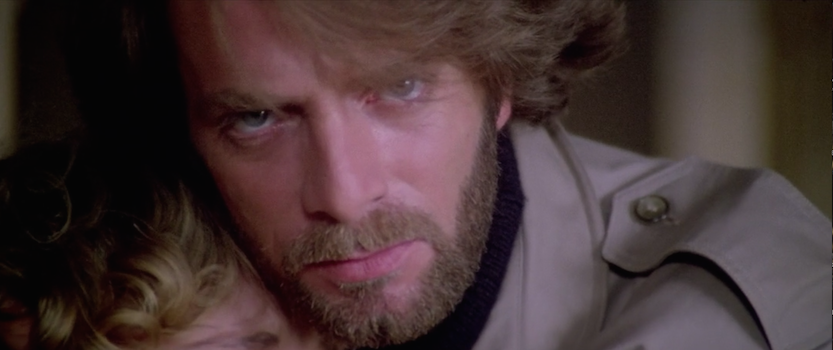
| Norman stares directly into the camera a lot - for the same reason most actors never do: it's uncanny |
In an international film center like Italy, since the language / dubbing is always so iffy from language to language, and there are so damn many, much of any international film's power rides (1) on the ambient noise / foley / sound effects and a style of antithetical music originated by Ennio Morricone. Italian auteurs like Fulci know the tone of a whole film can change with a bad dub job (as in the terrible adult voice doing little boy Bob) but no one can argue with the magnificent way an innocent child's sob of woe is folded into the sprocket-waves of a squeaky door hinge, or a woman's scream becomes a jazz horn. Thus the drive of these films is always based on sound, music, and enigmatic staring contests, rather than lengthy dialogue passages. And what dialogue there is, if meant to be enigmatic, thrives under flat renderings from voiceover dubbing artists, those familiar voices we hear over and over, from movie to movie, yet whose names we never learn.
Walter Rezatti's score for House--rife with the kind of antitheticaly grandiose soapy themes mocked and indulged in equal measure by the post-Morricone composers of Italian cinema--surges between soapy melancholic grand piano and crescendoes of church organ-driven prog rock, taking enough long silent pauses here and there so we can hear the pin drop. It manages to capture also the weird way Fulci's 'melting thunder' time disruption editing mirrors across itself. Modern horror themes come rupturing out of its ground like oil gushers of the putrid dead in between cliffside romantic clinches so that sweeping concert piano virtuosity --which normally is my least favorite Italian soundtrack instrument--fits elegantly as counterpoint. That great semi-ironic Ennio-style antithesis brings depth and emotion in a way the more old-fashioned on-the-nose telegraph orchestration of Spielberg types like John Williams and Howard Shore cannot. As always with Fulci, this music is used sparingly, effectively, sometimes jarringly - roaring to life to cut off actors' last word or stepping on their first, with even what sounds like a 'play' button clicking in the mix. I've written too much in the past validating accidental Brechtianism to just presume Fulci 'missed a few spots' in the sound editing, especially with all those earlier marvelous musical flourishes.
Demerits for some terrible dubbing, especially by whomever did Bob, who sounds like he's always counseling a simpleton in a terrible 60s movie (which is why I can use that word) but that sense of wrongness again helps to give it all a nightmare fatalism. The dad's declaration after dragging the family away from comfy upscale NYC, proves a smug dismissal of their needs and concerns ("you're gonna love it, smell that country air") is also strangely unconvincing --carrying no authority and raising suspicions he's woefully inadequate as a father. You could be coming to him bleeding and on fire and he'd wave it away as new school jitters. It can drive viewers insane but that's part of why it works as a nightmare logic parable -simple buildups from normal tiny incidents seeming slightly out of joint --the way no one in the family really hear what one another is saying - which is why Anna's ominous silence carries such a charge and says way more than all the generic small talk of the mother.

I AM LAZARUS, COME FROM THE DEAD
(but as a kid, so no one listens)
Another example of Fucli's open-ended death/Lazarus metaphors (ala Mike Hammer --va-va-voom! Pow!): Bob, the child, racing in terror through a field, the camera running up behind him with the score roaring to life with crazy synth squiggles of twisted menace. He stumbles, falls atop a grave, the ghost (?) of its occupant's child, Mae Freudstein (redheaded child of horror Silvia Collatina) lifts him off the stone, grabbing him by his arm, which stays folded across his chest like he's in a coffin; Mae turns out to have been chasing him in a game of tag, not trying to kill him via ye old killer POV but now Bob has to run home for lunch. He promises -as we all did as childrem--to race back out to play as soon as he's done. Mae watches as he runs back towards the house before saying (with a robotic fatalism), as if he's right there next to her. "No Bob, don't go inside." but the score surges to life again and cuts off her last syllable.
By then we've already seen Mae in a flashback to her own period (Victorian, judging by the dress), earlier (and again later) saying the same thing, as if in a trance, and we've heard her say it to Bob while he's in a trance. Bob also hears her talking to him from the window of the old photo of the house before they move in, so one ghost friend in the early 1910s is having a conversation with a real boy in "present" time (1981). Fulci give us both sides of the divide, illuminating the flexible immortal quality of film narrative as a perfect medium for ghosts and 'shining.' The girls admonition in the graveyard --"you shouldn't have come, Bob" has a chilling unemotional frankness far beyond the capability of either of them to convey proper terror.
It's not like Bob really has a choice, after all, he is a child and in no position to refuse his parent's moving days. If a child tells his parent not to move somewhere because a girl in a photo told him not to go, they'd just laugh and roll their eyes, think he just doesn't want to leave his local friends or sexy babysitter. Yet even after moving in, when he sees his new babysitter's head bounce down the stairs, Bob is still unable to convey the gravity of the circumstance to his mother. She's the type of parent who-- if you came to her covered in bruises-- would chide you for scuffing up your new pants and send you to your room. Of course from that horror then comes the comedy of Bob shouting down into the basement: "Ann! Mommy says you're not dead!" And then his walking down the stairs to find her, knowing full well something killed her down there, is the stuff of pure shouting "Bob you idiot!!" a the screen.
This is just one of the ways Fulci builds terror in a viewer, the raw molasses slow illogic after all that high-toned paranoia reaches back to the fatalistic dread of kids who aren't heeded until it's too late. It's the big fear preyed on in all the best horror films, most recently in Let the Right One in and It Follows, of being a kid in danger and adults around either unwilling or unable to notice or give your fear the slightest heed. Not until the blood runs under the door will they believe you and even then will rather believe it's somehow a result of your own morbid imagination or your own fault.

NIGHTMARE LOGIC III: Schrödinger's Cat People
As a result, what might be just another dull opening murder of a naughty young girl and/or boy leaves dread in the air like a radio key.
Later: The real estate agent's corpse is dragged across the kitchen and down the stairs, leaving a wide streak of blood; the close-up of blood on the wooden floor is suddenly interrupted by a sponge coming into frame. We wonder for a half-second if Dr. Freudstein is actually cleaning up after himself, but then we see the floor's being cleaned by Anna, throwing down a big mop and bucket. But is she cleaning the real estate agent's blood or was the blood gone before she started cleaning? Is she in league with Dr. Freudstein or is Lucy just hallucinating and by now shrugging it all off (or is it the dead bat blood from earlier still uncleaned)? Lucy comes into the room in her robe, "What are you doing?" she asks. Anna gives her an enigmatic look that could mean either a) what does it look like, genius? You people leave blood everywhere (in other words, Anna think Lucy has been killing people and is now just being coy - maybe planning to blackmail her). and b) I'm going to fuck your husband. But instead, Anna finally says "I made coffee."

Playing more or less the same enigmatic character in each film, she rarely speaks, but her eyes speak volumes. Just seeing her drive by or appear in the music class in tandem with the letter in INFERNO is to get an exciting chill that unfortunately the rest of the movie can never quite match.
In HOUSE BY THE CEMETERY (1981), Pieroni gets a substantially bigger but equally enigmatic role (though she does wind up killed), where she plays the nanny, Anna. Here her ominous silence contrasts with the incessant generic small talk of Lucy, the family's neurotic mother. Anna's eyes seem to say 'cut the crap' with every glare at her: "What a shame you didn't come with us to the restaurant last night" Lucy says, for example, as Anna is cleaning the floor. This gets a knowing, vaguely contemptuous and cuckolding reaction shot stare that could be read many ways, as its no doubt meant to. This ambiguity even continues with the implication Anna is bringing a tray of coffee to Norman at this desk (we see the tray eye view) -leading us to expect she's going to sit on his lap and ask him to read to her, like Lolita sat on Humbert, but instead, the surprise reverse shot reveals Lucy is actually behind the tray, as if she's trying to regularly reverse the usual red telephone course of events. Later Lucy comes out onto the street with a bag of groceries and we think we see Norman driving by in the car, but he doesn't see her or pull over to help her, and just drives on. Did Lucy drive the car and he stole it, leaving her to walk home with two bags of groceries through the woods? Did he say he was going to NYC but really is hanging around the library, listening to disturbing tapes of his predecessor's rantings (accompanied by POV shots of Freudstein's 'workshop' replete enough gore to repel most anyone --no matter how fake most of it looks)? Or did he ditch his wife in town so he can race home and have a quick tryst with Anna?
It would be unfair to make Fulci account for the lack of resolution in all this unspoken
'let's drive the wife insane' red herring anymore than in the 'almost affair' between Richard Harris and Monica Vitti In Antonioni's Red Desert. There's no trope or cliche that sits still and allows us to situate ourself into what kind of movie this is, which again maddens the materialists and paranoid neurotic hausfrau narrative film clingers. They can argue that since nothing comes of it, plot-wise, it's just a waste of time that goes nowhere, that it's just another Italian fooling around with the bag of enigmatic stare tricks so beloved of Italian auteurs and absinthe surrealists.
I would argue that it's because this approach generates a sense of paranoia and unease that it spooks off those materialists, because they don't get that it's the spooking off that was the whole intention, like saying horror movies aren't supposed to be scary, so you don't like Halloween. If you submit to the alienation ambiguity as intentional, it makes the later horror events seem further and further abstracted, so that when they finally cohere from the ambiguity, they come too close to home for easy laughing off. It's like the auteur convincing us the danger is coming towards us from far away, pointing it out in the distance, and then when it's about half-way, stabbing us in the neck and running away (do you get that reference?).
In HOUSE BY THE CEMETERY (1981), Pieroni gets a substantially bigger but equally enigmatic role (though she does wind up killed), where she plays the nanny, Anna. Here her ominous silence contrasts with the incessant generic small talk of Lucy, the family's neurotic mother. Anna's eyes seem to say 'cut the crap' with every glare at her: "What a shame you didn't come with us to the restaurant last night" Lucy says, for example, as Anna is cleaning the floor. This gets a knowing, vaguely contemptuous and cuckolding reaction shot stare that could be read many ways, as its no doubt meant to. This ambiguity even continues with the implication Anna is bringing a tray of coffee to Norman at this desk (we see the tray eye view) -leading us to expect she's going to sit on his lap and ask him to read to her, like Lolita sat on Humbert, but instead, the surprise reverse shot reveals Lucy is actually behind the tray, as if she's trying to regularly reverse the usual red telephone course of events. Later Lucy comes out onto the street with a bag of groceries and we think we see Norman driving by in the car, but he doesn't see her or pull over to help her, and just drives on. Did Lucy drive the car and he stole it, leaving her to walk home with two bags of groceries through the woods? Did he say he was going to NYC but really is hanging around the library, listening to disturbing tapes of his predecessor's rantings (accompanied by POV shots of Freudstein's 'workshop' replete enough gore to repel most anyone --no matter how fake most of it looks)? Or did he ditch his wife in town so he can race home and have a quick tryst with Anna?
It would be unfair to make Fulci account for the lack of resolution in all this unspoken
'let's drive the wife insane' red herring anymore than in the 'almost affair' between Richard Harris and Monica Vitti In Antonioni's Red Desert. There's no trope or cliche that sits still and allows us to situate ourself into what kind of movie this is, which again maddens the materialists and paranoid neurotic hausfrau narrative film clingers. They can argue that since nothing comes of it, plot-wise, it's just a waste of time that goes nowhere, that it's just another Italian fooling around with the bag of enigmatic stare tricks so beloved of Italian auteurs and absinthe surrealists.
I would argue that it's because this approach generates a sense of paranoia and unease that it spooks off those materialists, because they don't get that it's the spooking off that was the whole intention, like saying horror movies aren't supposed to be scary, so you don't like Halloween. If you submit to the alienation ambiguity as intentional, it makes the later horror events seem further and further abstracted, so that when they finally cohere from the ambiguity, they come too close to home for easy laughing off. It's like the auteur convincing us the danger is coming towards us from far away, pointing it out in the distance, and then when it's about half-way, stabbing us in the neck and running away (do you get that reference?).
Fulci's critics wouldn't dare say, for example, that Hitchcock wastes our time with the Melanie Daniels'-Mitch Brenner meet-cute romance in The Birds or Marion Crane's embezzlement in Psycho -- at least not as confidently. Well, Fulci does the same thing Hitch does, only within the confines of wordless stares! In all three examples, Hitchcock's Birds, Psycho and Fulci's House, the suspense and fright comes seemingly from left field - we're not given to expect birds or knives or monsters in the basement in any of these three films because the cinematic signs are all lining up for a different movie, one we've doubtless seen: in The Birds it's the story of a spoiled city heiress / streetsmart moll finding love and meaning while hiding out in a small rustic community (in the vein of The Purchase Price, Green Acres, He Was her Man); in Psycho it's a sexy noir thriller, of the sort where a woman embezzles a wad of cash to run away with her handsome cash-strapped shirtless lover (too many to name); in House by the Cemetery we think we're headed first to a slasher movie, then a ghost story (ala The Shining), then a torrid sexual affair movie where a babysitter and a husband plot to drive an already-neurotic wife insane through mixing LSD into her downers.
The latter plot was widespread in the age of the"Valley of the Dolls" era-- (the 60s-70s), when pampered, confused wives got separated from reality thanks to some blue pill given to her by a man who keeps saying he's her doctor, or husband. Is he arranging the subsequent gaslight-style scenes while he's off on 'business' to make her think she's hallucinating and drive her to suicide? Put strong acid in her Valiums and play weird tape recordings of dead husband's voice under her bed (as they do in The Big Cube?) and get her to jump from the high window down to the sea while you're safely miles away with perfect alibis?
The latter plot was widespread in the age of the"Valley of the Dolls" era-- (the 60s-70s), when pampered, confused wives got separated from reality thanks to some blue pill given to her by a man who keeps saying he's her doctor, or husband. Is he arranging the subsequent gaslight-style scenes while he's off on 'business' to make her think she's hallucinating and drive her to suicide? Put strong acid in her Valiums and play weird tape recordings of dead husband's voice under her bed (as they do in The Big Cube?) and get her to jump from the high window down to the sea while you're safely miles away with perfect alibis?

But, once they get you expecting this kind of film, these auteurs got you at their mercy; they can then use these expectations to make you even more neurotic than one of the rich neurotic housewives from the type of movie your unconscious mind had been fooled into thinking this was!
If you that was confusing, maybe you should lie down... you don't look well.

One final deep fractal example of this style of alienation trick as a tool to generate paranoia and fault line dread might be found after the post-bat blood / real estate lady blood / Anna's mopping / enigmatic stare scene. It's later that afternoon: both parents are out and Anna is alone in the house with her charge, young Bob, who's playing with his remote control car in the living room, wheeling it and around and under chair legs and into the hallway and back. Then the car turns a corner toward the kitchen, moving out of his sight as if overtaken by a rival signal. The car sound stops and uneasy quiet settle over everything; Bob turns the corner, hesitatingly, wondering why it hasn't driven back. But it's gone. There's no sound of it revving at all, but the basement door, which is usually locked, is wide open (we heard no sound of the car clunking down the steps though). With a shock (we'd forgotten about that door), we flash back to the introductory scene with the young lovers (just replace the suddenly unseen/unheard boyfriend with Bob's toy car and the sequence is the same). Bob goes slowly down into the gloom to look for the car and disappears from the frame.
A moment later, Anna comes into frame and calls to him, but he doesn't answer. She too notices the basement is open, looks down the basement steps, and slowly goes down to look for him. Suddenly the door slams shut above and locks her in and some shadowy thing comes moving towards her from the far end of the basement. She starts screaming. Bob is somehow now upstairs, oblivious!
It's so simple, and such a logical progression--from the remote control car disappearance to the babysitter locked in a cellar--that it shatters our concept of time and space, erasing in a flash our distance from the event onscreen (in the chain from toy car to babysitter, it's only one link more to get to us).
She screams for Bob to open the door as the monster shambles towards her out of the gloom. It takes awhile for us to even realize Bob even hears her and is trying to work up his nerve to go down and open the door. While she screams his name, he's slowly collecting his stuffed Curious George and flashlight, and then slowly, leisurely walking down the stairs.
The glacial pace in which Bob suits up to walk across the kitchen floor -taking his sweet time -as she's cut to ribbons on the other side of the door is maddening, a borrowing of a similarly maddening sequence from Lewton's The Leopard Man stretched even further, and yet we certainly can't fault Fulci for choosing this pace. All but the best horror auteurs do the reverse, they move the pace of events faster and faster, but the brave masters of the genre know that to really heighten suspense and dread, one must slow down rather than speed up -- real nightmares seem to take place in knee-deep molasses.

SPOILERS
If it gets too frustrating to see a whole, one-armed family helpless to escape a limping armless dead man who can barely shamble, to see them all cowering helpless and screaming when it would be a simple thing to chop off his other arm (or at least use more than one of your own in defense) well, that's how nightmares are and who knows how we'd really act and maybe that's where the horror is -- the realization that if the shit got heavy enough we'd crumble into a sweaty sobbing ball, too. At least, in this case, we can imagine the terror really is overwhelming - that this thing has been living below them in their locked basement all the while, and has been for over 70 years, repairing himself through fresh victims. This is the first time they see Freudstein, and the last--as if the full horror of his shambling maggoty cadaver is so overwhelming it paralyzes his prey, jamming life's record so bad it hops a groove and leaves you screaming on an eternal skip--a kind of instant repression black-out back to the beginning--to when old doc Freundstein was still really alive (never seen in the flashbacks, involving the mother and nanny instead).
That's why the film's chamber piece momentum works so well, almost like a three-act opera, as all the paranoid 'almost' sub-plots evaporate in the cold finality of the basement, the illogic that a row of corpses could be strung up down there without the smell carrying upstairs through the same crack in which Bob crawls for his own escape (trying to fit his head through that narrow crack provides one last nerve shredding moment that stretches forever) into Mae's and Mother Freudstein's sympathetic decades-departed arms--is so startling, original and final. There is no death but what we make for ourselves, which is called waking up, the alarm clock of your tender throat, raw from claw-choked screaming, pulled up from the pillowy grave like sluggish Lazarus Jr. by a girl who died before your mother was born, to a world with its own set of rules, but the same damned house. Or to put in layman's terms, it's the end of The Shining if its Danny who wound up at the party in 1929, or at least upstairs with a babysitter and those cool creepy twins... forever... and ever... but way cooler, even in those fusty old corsets.

NOTES
1.(since it's going to be dubbed and subtitled in about 20 different languages, Italian film tradition is to shoot MOS (without sound) or silently - each actor in the international cast speaking his or her own language and then dubbing their part for that country's track, ideally, and voice actors in that language doing the rest, which is why nearly every character in Italian horror sounds like one of two or three different voice actors. No one knows their names or where they are - the invisible heroes of the business- as a voiceover actor myself I say their stories must be told!


