Showing posts with label Scotland. Show all posts

Thursday, April 21, 2016

Through the Woodsman: DOG SOLDIERS, THE FINAL TERROR, WITHOUT WARNING, THE HALLOW

The woods --alternately uncanny and familiar--are a 'free' way to draw value from trees that's less damaging than clear-cutting. Shit in the woods = archaic. Lost in the woods = easy to happen. Conclusion: shit in the woods and if only the bears hear it, you know you're fucked. I got lost once in the heart of NYC, just trying to get across the upper wild swaths of Central Park one lonesome afternoon. If you've been up there in the wilds of the Northern sections you know how creepy and forlorn it can get and how fast; I wound up going in a big ass circle for a full hour. Nothing more heartbreaking than walking ever more quickly with a mild panic generating in your stomach only to find you're right back where you started, still no one in sight to ask for help or direction, just some snooty squirrel that stands there staring, mocking you.

Blair Witch Project is still the high benchmark for that kind of unease. Those kids might have literally been a mere half mile from a highway and never known it. Once we lose our orientation in amidst the deep woods, it doesn't matter if civilization is right around the next hill or a hundred miles away; we're on our own.

DOG SOLDIERS
(2002) Dir. Neil Marshall
***

You think it's easy to be a straight male, age 11-55, when it comes to movies, TV, and commercials? Watching a movie on Syfy like Underworld: Awakening for the 100th time, and still not liking it, but sticking with it because it quenches some weird fanboy desire for monsters, sexy pale skin brunettes, violence, and car crashes (a need catered to with pandering directness, punctuated with bro-demo-angling commercials for fantasy football gambling sites, and chips flavored to taste like bacon). Kate Beckinsale, all smokin' crystal blue eyes, in a skin tight leather catsuit wielding twin .45 automatics: it's all for us, SMs age 14-55: for our stunted adolescent minds.  No matter how much our higher self sighs in disdain, we can't resist.

Hoping to galvanize rather than indulge, director Neil Marshall's 2002 debut is a Hawksian, darkly comic male group camaraderie version of his better-known female camaraderie DESCENT (2003). It's a gory, playfully macho, riveting, terse, gory, slightly cheeky 'werewolves vs. British infantry squad on maneuvers' sort of SOUTHERN COMFORT meets the initial 'moors' sequence of AMERICAN WEREWOLF IN LONDON sort of thing. Like THE DESCENT, it ends with an all-out balls-to-the-wall brawl, dwindling down the numbers on both sides until only the true toughies remain. While they last, the cast is tops, especially the cool-in-a-crisis, Max von Sydow-esque Pvt. Cooper (Kevin McKidd) and the bullet-headed badass Sgt. Harry Wells (Sean Pertwee, a kind of Michael Caine, Jason Statham, and Bob Hoskins bolted together with oily lug nuts). Their manly rapport and gives the film an adrenalin savagery-switchpoint boost. Hawksians wit, esprit de corps and armament savvy ("three-round bursts!") provides an outside-the-box form of survivalist enlightenment that overflows the boundaries of both the werewolf and survival-behind-the-lines genre parameters. Some choice dialogue worthy of Leigh Bracket ("I hope I give you the shits, you wimp!") flows in natural, overlapping style (clearly the result of diligent training and rehearsing as an ensemble). There's even a Hawksian woman (Emma Cleasby - top)--a local who takes the boys to the rustic soon-besieged cabin--who'd be right at home in THE DESCENT and it's great to see a strong woman rescue a squad of men rather than the reverse.

Mark Thomas's orchestral theme is mostly good though gets a little to bouncy for horror and at times seems remarkably similar David Julyan's in THE DESCENT... Marshall clearly needs to hear all the great retro-analog synth stuff being done these days, they would have helped, his nonetheless underrated and very Carpenterian DOOMSDAY). The special effects are first rate, creating a blackly comic Howling-esque body horror element without sacrificing terse vivid something-at-stake realness;  and the thick old growth of mountainous Luxembourg (filling in for Northern Scotland) makes ideal territory for such isolated do-or-die standing, and Marshall's gritty 16mm camera swoops around capturing events with an intriguing if washed-out low-light immediacy that evokes early films by Cronenberg, Stanley, Craven, Raimi, Barker, and Romero, and compares well against all of them. Final note: considering the shoddy treatment of dogs in horror films, I thought I should mention that the shifty MI-6 guy (Liam Cunningham) who tries to make Cooper shoot a dog to toughen him up in the intro (and kicks Cooper out of his elite squad when he won't) gets his canine comeuppance, so don't let that moment throw you.


WITHOUT WARNING
(1980) Dir. Graydon Clark
**1/2

There's a few things we need to get straight right now: I know this post is collecting cool woodsy horror flicks, and no one loves scary woods in movies more than me. But honey, this film's woods--supposedly dark and deep and perfect for hunters--looks like the scrub where all the cheap LA cop shows film bodies being dumped and cars pulling over to hand-off ransom money. There are almost no trees, just dry desert shrubbery, yet these woods hold not only bivouacking cub scouts led by a Patton-paraphrasing scoutmaster (Larry Storch), sets of necking teens, a greasy Cameron Mitchell using a very anachronistic blue collar Brooklyn goomba accent while trying to make a grouse-killer of his pacifist son, and a pre-Pedator alien who's been hunting the most dangerous game, using a nearby groundskeeper shed as his trophy room. If you watch Final Terror (reviewed below)--with its great old growth and beautiful stark photography--as I did, right before this, the thoroughly second-rate look of Without Warning can be a tough adjustment. Carpenter cameraman Dean Cundey knocks out a nice magic hour and the occasional Steadicam fleeing (and a funky bat shuriken POV), but couldn't they at least get a permit to shoot at Bronson Canyon like everybody else? And while David Caruso is one of the first-killed teens (during sex in a "lagoon" lower right), his death is mostly off camera! Why else are we here if not to see him die? Worse, the script includes enough strangely-emphatic anti-hunting oratory to count as passive-aggressive screed, even if the landscape looks like all it might yield is a stray golf ball or a shopping cart full of cans as far as game.

But hey, once-top drawer B-list stalwarts like Ralph Meeker, Jack Palance, Neville Brand and Martin Landau enter the story, via a Bodega Bay-ish bar of colorful drunks and eccentric locals, all of whom refuse to believe the outlandish story of our frantic college boy hero, well, things get quite tolerable, and so vividly rendered by Cundey's camera you can smell the blend of musty naugahyde, cigarettes and stale beer. And as much as the other older actors may be phoning it in or hamming it up (Landau especially is awful), Palance-as the big game hunting gas station herald who sees the chance to hunt the alien as a kind of two-way intergalactic Most Dangerous Game--is terrific. Palance never phoned it in or shouted it from across the street in his life, and here he's in his B-list element.

Thou shalt not suffer a ginger in a magic hour pond to live! 
But now to the one real liability (or strength depending on your frame of mind): the teenage male lead, Christopher S. Nelson, a kid who makes Zach Galligan seem like Humphrey Bogart by comparison. One can imagine an acting teacher showing this film as an example of "What Not to Do" in film acting. You can see the way he overthinks and sabotages himself time and again. Sometimes he'll fall into the swing of a scene almost by chance, helped along by the skill of the good actors around him--he'll just 'be' in the scene and not consciously trying to remember his lines---then you see the thought cross his eyes, oops, I forgot where I was! And with a sudden frenetic lurch he starts 'acting' again and you can feel the crew slap their heads and roll their eyes, and then just decide well, 45 takes are enough - we'll roll that one. Such spastic terribleness works when his character is supposed to be wildly unsteady, hysterical with fear, such as laughing maniacally when the windshield wipers knock off the monsters, or paralyzed by nervous confusion (and he does a good job in a scene spinning paranoid tales of world domination to stall paranoid psycho Landau) but everywhere else it seems more like he's auditioning for a student film or trying to make his acting teacher kill himself. He's very pretty though, and, I hate to say it, but Landau's performance is almost just as bad!

Hard to believe? See this film! And realize the way older character actors were valued in the late 70s-early 80s in ways they're not now. Once, nearly every old star could still get work for scale as expository landlords on TV movies or old timer sheriffs on cop shows, or barflies mouthing old timer-style exposition to frightened kids. As long as they weren't too proud--in Dinner at Eight parlance--to play the beachcomber, they were working. But where are they now, aside from dead?

Final girl Tarah Nutter rocks cute braids (above) but her character is such a useless cringing liberal you'll want to jab her with an NRA button 
Things really pick up in the last few reels, even if it never quite gets to its feet. The idea that Invasion of the Body Snatchers-meets-Red Dawn 'nam paranoia would turn Landau into a second threat ("Sarge, you are not in the army no more." shouts the barkeep) is pretty original, as far as it goes, so it's too bad the posters show off the alien right off the bat, squashing the big reveal. But hey, if you've seen Ed Wood's Bride of the Monster as many times as I have, you may appreciate the strength of Without Warning's destitute delusions. Many of my fellow writers saw it and loved it as kids in the early-early 80s on late-night cable (at a time where there often weren't even movie descriptions in the TV Guide, let alone spoiler-alert posters). I never saw Without Warning back then, but I can pretend.

If only I could pretend its canyon scrub was actual woods.


THE FINAL TERROR
(1983) Dir. Andrew Davis
**1/2

If, to savor WW's Corman-like deadpan self-aware humor and adherence to a beloved formula, you sometimes need to let go of any sense of atmosphere, coherence, or quality, it's just the opposite with The Final Terror. Andrew Davis (The Fugitive) not only directs, he does the cinematography, and very well, so there's a total harmony between atmosphere and actors one rarely sees outside, say, John Boorman. This is partly because Davis shipped his cast and crew up to Northern California's old growth forest for his film, and what could be too dark (especially in muddy VHS) or too washed out due to the canopy is--instead--just right on Blu-ray: gorgeous yet ominous, claustrophobic yet Wagnerianly vast.

It’s the tale of some young park rangers rafting downriver with their girlfriends and enjoying a week of freedom from parental restrictions (sleeping bag fornication unfettered) that--as might be inferred-- turns mighty terrifying as someone starts killing them off. A religiously uptight local boy-- played with the usual zest by a miscast Joe Pantoliano--is their chief suspect but, well, I can't spoil the events further except to note that the real message at work isn't the usual slasher covert return to conservative values (i.e. sex leaves you very vulnerable to attack, so return to repression) but the reverse, a realization that no uptight slasher can stand a chance against a crew of outdoorsy young people with some basic training (National Guard, ROTC) under their belt if they stick together.

In other words it's almost a a 'response' to the slasher craze rather than a part of that craze. It's certainly quieter. The cast is a-brim with both future stars (Rachel Ward, Daryl Hannah) and semi-familiar faces (Lewis "Perfect Tommy" Smith, and Mark "Is that a pledge pin? On your uniform?!!" Metcalf) but some unknown named John Friedrich steals the show after he avails himself of too many of the killers' psilocybe cubensis mushrooms and starts oscillating between being the group's military tactician savior and biggest liability (shades of Patton!). He'll evoke Harold Wayne Jones in The Crazies for you one minute, and the next you'll wish there were more guys like them in these kinds of movies, dudes who illustrate how he who protects you from outside evil can't save you from the evil of themselves.

I don’t want to give too much away, but you know that, queasy feminist that I am, if I can enjoy a film in this disreputable subgenre it’s only because there’s no sexual assaults, unnecessary cruelty, terrible gore effects, or shitty dialogue. Final Terror does not have those things... in spades. If it has little else either, hey, the old growth woods look literally dark and deep; the skulking killer's camouflage leaf jacket blends so well into the surrounding vegetation that it’s startling when a filthy hand emerges to smooth a sleeping girl's hair in the early dawn; Susan Justin’s weird piano and atonal synth score hits the right notes every scene... except one... and Daryl Hannah.


THE HALLOW
(2015) Dir Corin Hardy
***

Irish horror--drawing on their national arts funding, eerie emerald-colored landscape (often enhanced with green tints and filters), and dark Celtic folk tales--is on a roll these days and THE HALLOW is a worthy example. Bojana Novakovic and Joseph Mawle star as new parents moving into a woebegone house at the edge of a foreboding Irish forest and the ominous trouble starts the moment mom takes down the window bars. The locals tell the dad--a botanist intent on researching local tree blight--not to wander too deep off the path through the woods, and to take nothing he finds home with him. But he needs samples, and it looked like blight, so no woodland sprite might object to some tree blight being scraped off. But is it blight?

Not according to the legends.

But who believes auld legends these days? Only the spooked locals with their allegedly ignorant tradition. So the wife takes down the bars and charms from around the windows to let in what passes for sunshine in Ireland and dad finds, as you might imagine, some mighty strange black mold samples to bring home. That night they're besieged by an array of Irish faerie lore-originated spooky tricks, the worst of which is the swapping out human babies with weird changelings, raising the human kids in the woods (like the changeling in MIDSUMMER NIGHT'S DREAM so coveted by Oberon) and generating weird suspicion betwixt the couple, and tracking mold all over the walls and floor.

They told ye not to go into those damn woods, ya bómán! Ye auld Leathcheann! 

The feature debut of Corin Hardy. The Hallow is not quite the resounding announcement of 'I am here, I am now!' horror genius we got with Jennifer Kent's BABADOOK or Robert Egger's THE WITCH or David Robert Mitchell's IT FOLLOWS, but it's close enough, and the monsters are interesting fusions of trees, mold and people (like the 1951 THING coupled to the hyper-evolutionary mutation ability in the remake), and the idea of the changeling is very subtle and creepily represented, as Clare must decide if it's her infanticidal husband (mutating from woodland fairy venom infection) or the baby (which she dredged up from the bottom of the lake) who's still 'real.'

Despite semi-strange interludes toward the end (which decency forbids me to explain) everything is fairly believable and all fast moving in the kind of tight kinetic 'all in a single long late afternoon-through-to-dawn' (tick-tock) momentum. You might come away only mildly plussed when all's said and done but it's quite a ride. I didn't get up to refill my drink or have a slash once during the whole 90-minute running-time. The lighting is moody and the acting terrific - I mean Novakovic and Mawle are committed, and at times seem like--institutionally-speaking--they literally should be. They're more terrifying than the monsters crawling through their vents, and their veins, and vice versa.

And like all the films discussed here, the woods are a major element --psychologically and diegetically. Filmed with an ingenious palette of murky green colors seemingly culled from the depth of darkness, they've never looked so creepy and gorgeous. Best of all, there's no gibbering rapists, claustrophobic abductions or sadistic cruelty, all which I'm bloody sick of. I like my horror to be supernatural and trading on deep unconscious drives rather than brutal true crime torture porn. Our world is bad enough on its own! No wonder the trees want to leave.

But in Ireland, aye, the trees seem to be coming back... le bhfeice!


Tuesday, January 13, 2015

10 Reasons DOOMSDAY (2008)


Every blood moon or so comes a movie I seem to be in the minority of calling great. I'm happy to time and again sacrifice my free hour or two on the altar of their DVDs. And for them, the ten reasons: 10 Reasons GHOSTS OF MARS ; 10 Reasons TERMINATOR 3 and 10 Reasons THE THING (2011)

The 10 Reasons -- an idea whose time has come... And so... DOOMSDAY. En garde! 


After the critical and commercial success of his 2005 sleeper hit THE DESCENT, Neil Marshall was Brit-horror's golden boy. Given a big budget for his next project, Marshall chose to go all out and make a big John Carpenter-George Miller-Walter Hill post-quarantine plague semi-apocalypse action thriller. Critics found it muddled and derivative. I never would have found it all had not I checked IMDB to see what he'd been up to a few years ago.

I'll confess it looked terrible from the outside, like just another RESIDENT EVIL-style video game adaptation. But turns out this is a film aimed directly at ME, or my demographic, the type who grew up shaped by the same great 70s-80s films that shaped this, Marshall's gonzo masterpiece. First, let's examine three films which are perhaps DOOMSDAY's main influences:

1. John Carpenter's ESCAPE FROM NEW YORK (1981): JC had scored two big back-to-back hits in HALLOWEEN and THE FOG. He was now a brand name, associated with launching the slasher boom, a sub-genre he had no interest in. So he took his rep and profits and went all out with this gonzo adventure story. His own hero, the maverick iconoclast Howard Hawks, regularly did the same thing, switching genres with impunity and mixing comedy with tension and vice versa. And Carpenter found a cheap source of post-apocalyptic urban wasteland in downtown St. Louis, which had been devastated by a terrible fire and was yet to be rebuilt. He basically had the run of the place and the result are huge marvelous sets, deserted streets, a gigantic train station, etc.
2. George Miller's THE ROAD WARRIOR (1982) 
MAD MAX hadn't made a big dent here in the US, but was a four alarm fireball in the rest of the world (AIP -the American distributor- insisted on dubbing the voices to get rid of the Aussie accents), so Miller had real money for the sequel and it's all onscreen. And he found a cheap source of post-apocalyptic urban wasteland in the Australian outback. We kids didn't quite understand where the Outback was in relation to the rest of Australia... but we sure do now. The idea of needing speed to survive in the wasteland is now totally clear - that vast flat desert emptiness makes the whole continent like one big drag strip. 
3. Walter Hill's THE WARRIORS (1979): Hill found a cheap source of graffiti-covered urban wasteland in 70s NYC, which was then at its most gang-accursed days since the days of the Dead Rabbits. Crime was so rampant the city cried for a vigilante, and got Bernard Goetz, the Guardian Angels, and (onscreen), Charlie Bronson. In THE WARRIORS, taking the subway line from the far heights of Pelham Bay Park all the way back to Coney Island was (and still is) an Odysseus-style journey. We all wanted to be Ajax (James Remar) and laughed at the seriousness and narcissism of Swan (Michael Beck). It's still the quintessential New York movie, and those heady days are returning thanks to our mayor Bill "Cyrus" de Blasio.
I've already written of how my own life was changed the Halloween night in the early 80s when my mom rented us both WARRIORS and ESCAPE and had them waiting when we got back from trick-or-treating. We saw them back-to-back high on our scored candy, the sense of edgy urban danger bringing us higher and higher... and were never the same again. I would never have believed I would ever be crazy enough to want to live in NYC after those two movies, let alone for 20 years. And I've seen all three of the above enough times that this whole blog and my whole life flows with quotes from them - Look at yourself, Max, you're a mess. See what you get, Warriors? See what you get when you mess with the Orphans? You're the Duke! You're A number one. The Ayatollah of Rock and Rolla... you always were smart, Harold. And, to that outfit that had such a hard time getting home, sorry about that, guess all we can do is play you a song.

What a puny plan.

Maggie... he's dead. Come on...
Losers! Losers wait!
I'm gonna shove that bat so far up your ass you'll look like a popsicle...
Keys, map of the bridge, hey! hey! Hey!
We're the Lizzies...
Just walk away... just walk away...

I think DOOMSDAY was in the end undone by one of the most derivative titles and posters that ever haunted a great trashterpiece: the biohazard tattoo and crossed sword-anarchy hybrid symbol, the face tattoos and the graphic novel-esque three color style, along with the tag "Mankind has an expiration date" tag. So banal by then.  I remember seeing this poster outside of a theater and thinking "oh brother, again with the Neo-Pagan post-apocalypse warrior chicks engaged in endless slow mo CGI blood-splattering combat" and the whole RESIDENT EVIL, UNDERWORLD, SUCKER PUNCH, KILL 'EM ALL vibe, all the 360 whip-around slow-mo camera CGI shots of CGI carnage and ammunition expenditure and zero count characterization or giving a damn. Even the Imdb.com main film description is lame. Who needs another "futuristic action thriller where a team of people work to prevent a disaster threatening the future of the human race."?

In short, it looked like yet another adaptation of a manga based on a FINAL FANTASY-style rotoscoped CGI animation TV show based on an arcade game, rather than a moody analog return to the 80s Carpenter-Hill-Miller heyday, a loving homage to a more visceral time. Instead of promoting it as kind of retro Tarantino-esque throwback/homage they banked on the idea we'd be intrigued by graphic novel illustrations of body mods and homemade weapons. Imagining yet another incoherent parade of overused CGI and SIN CITY high def black and white graphic novel cannibal combat, my demographic bravely stayed away. They all but redubbed it into 'American.'


I only hesitatingly Netflixed DOOMSAY in the end because of seeing THE DESCENT yet again a few years ago and checking up on Marshall's imdb page to see if he'd done anything new. Like that Halloween night long ago in the 80s, I knew I'd never be the same. So here they are, 10 reasons with SPOILERS... so beware.


1. Rhona Mitra as the one-eyed Major Eden Sinclair: She lost her eye as a child at the border between England and Scotland (the latter the site of an unstoppable plague) and was the last civilian to make it out, thanks to a compassionate soldier who traded his seat on the last chopper out. Sure it's familiar - but I like the idea that she basically stays with the Special Air Service (SAS) like an adopted mascot (though this isn't clarified), since she takes the place of one of their own, and now has no mom or family. Growing up to the rank of major while her home country disappears behind a robotic machine-guarded quarantine wall, she narrates as the world turns its back on Britain for being so cold to Scotland, basically turning it into a no-fly zone quarantine prison, killing anyone who tries to escape. The eye she loses near the wall melee is replaced by a detachable camera orb that can record images to tiny discs in her watch. Very cool idea. And I like that there's no 'Eden grows up' montage, just her voiceover detailing the ensuing 'gone dark' status of Scotland.


And Mitra plays the Major dead straight - neither macho nor comical nor boring nor sexualized, instead possessed of smartly British esprit de corps. Bob Hoskins is great as her de-facto father figure, who perhaps was even there during her rescue but at any rate has clearly come to regard her as a kind of daughter but not in a corny way. She's Snake Plissken as a military officer. That she winds up in charge of a mostly male insertion force is never a cause for snickering or her needing to prove herself, and there's no romance, nor sex, consensual or otherwise, in the film. No boyfriend, no spark-baiting. It's glorious.


2. Malcolm McDowell and his younger punk son Sol as the bad guys  (in two separate chapters - they're never seen together) and the levelheaded daughter ('the cure'). Dad is living in a castle and reverted to Medieval basics (including torture devices and gladiator combat), while Saul (Craig Conway - one of the monsters in THE DESCENT!) is more a mix of Cyrus from THE WARRIORS and Wes (Vernon Wells) from THE ROAD WARRIOR. It might be hard to imagine why they'd practice cannibalism when fields of cows are just a few miles away, but there you go... it's ceremonial. I like that Sol doesn't try to get rape or torture porn-ish when he has Sinclair trussed up. For these folk, it's all about the spectacle. And Conway is a little much at first, but by the end we're glad he's around. The dude gives every hiss and sneer 110% and his lean muscular body looks like he's actually doing lots of hard work and exercise -they're not gym muscles like a juicehead drinking whey, they're frickin' punching guys in the mosh pit muscles, i.e. not 'sculpted' all uneven based on what he's doing in the real fucking world. Go get 'em, Sol.


As for the father, whose crowned himself king of a new era of medieval barbarism, Malcolm gets a few good scenes but barely has time to register aside from a few CALIGULA at the coliseum-cum-field of honor-style gladiator arena moments. His steel blue eyes glowing in the shadows of the actual castle location look great though.


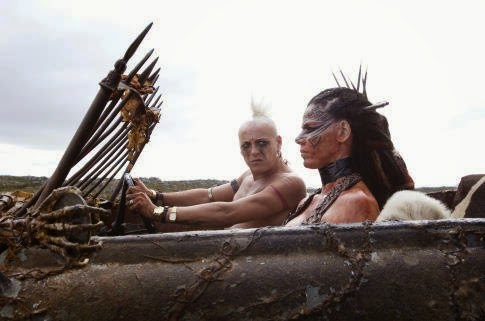
3. The crazy cannibal feast scene and Lee-Anne Liebenberg - which meshes punk club antics with cannibalistic orgies, ska shuffles, Satanic strippers, fire eaters, bikes, the captured soldier dinner trussed up on the front of a vehicle like the captured townsfolk strapped to the gang vehicles in THE ROAD WARRIOR. It's funny (the showmanship involved made me think of similar scenes in IDIOCRACY), electric, and gives everyone a time to shine, especially Lee-Anne Liebenberg, who makes such a good impression as Sol's 'first lady' she wound up on the poster (and the top image). Her part is small but that crazy look in her eyes, pierced tongue fluttering like she's devouring the captured soldier's terror as he watches her light up the grill below him, is a great glimpse of someone dancing in the flames of raw Pagan madness rather than the usual 'actress trying to look scary.'


4. David O'Hara (THE DEPARTED) as Canaris - his "thinning the herd" mentality and gravel-voiced iron hardness makes a great gravitas-enriched parallel to Malcolm - three separate bad guys! And his is a much better comeuppance than Snake's pulling the tape out at the end of ESCAPE to screw over the president (Donald Pleasance).


5. The ROAD WARRIOR-style car chase climax -minus one demerit for cheesy addition of a 90s Siouxie and the Banshees (?) song that I think you need to be British to deem appropriate. Imagine if George Miller put some Men Without Hats song over the climax of THE ROAD WARRIOR, Neil! Yeah, now you know how we feel. Otherwise, sublime. And the cars and trucks are so badass you can't even begin to appreciate the detail the first viewing -- as in the human skeleton hand holding the rearview side mirror above.


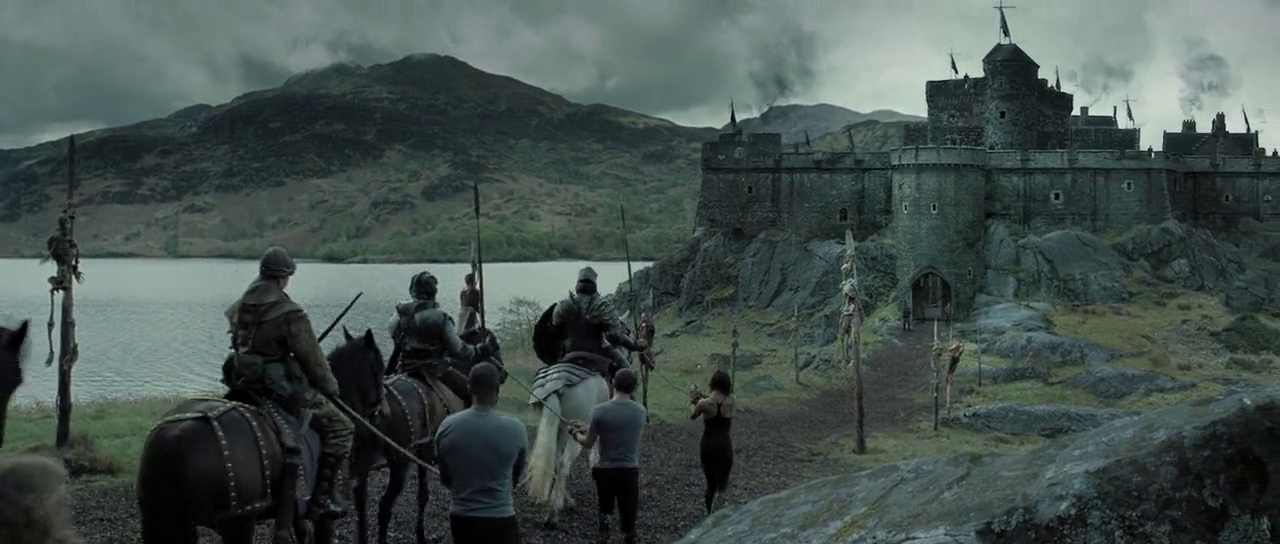
6. Scotland - it's like an EMPEROR JONES of Scottish history - the troupe traveling (in DAMNATION ALLEY-style assault trucks) through the fields and highways first to TRAINSPOTTING punk rock Pagan Glasgow back to BRAVEHEART-era castles and knights on horses, before returning to the modern highway, and eventually to Eden's intact and untouched aside from dust childhood home.


7. The Time Window - They only have 48 hours to complete their mission, 'otherwise there'll be no 'back' to come home to, as the plague has broken out in London. It means they can't slow down for a second, which explains the crazy heedlong wild weekend racing to catch a train vibe. It's not clear why Canaris would come on so menacing--arriving in a giant combat helicopter--when she finally delivers the cure, and she's so stand-offish, and then two seconds later he's saying "come with us" as if there's no reason she would. Well, why wouldn't she be returning with them? They sent her! Did she miss the window? Is it because the PM--the presumed good guy-- her boss (Hoskins) trusts and works for is dead? Hoskins still works there after all. Are there script revisions that don't quite cohere? Well, all the above referenced movies have similar problems, and who cares? It rocks.

8.  Ingenious 'collapse of the real' art direction and set decoration- rewards close notice (i.e the 'souvenir shop' signs in the castle - ironically now a sign of ancient history rather than vice versa), all the great body mods and other details. It didn't have to be so rich. But it is. Just take a look at Liebenberg in the top image, look closely and notice the white ink biohazard tattoo on her shoulder. Savor the rich tribal detail.


9. Another moody score by David Julyan - I wish it had pulsed with analog synths more, but I love its subliminal checks and nods towards scores by Carpenter (ASSAULT ON PRECINCT 13), Tangerine Dream (SORCERER), Vangelis (BLADE RUNNER), Bart De Vorzon (THE WARRIORS), just to let you know the references are lovingly intentional. Rather than doing the helicopter score bit, Julyan deftly acknowledges his references rather than dictating audience emotions. The result is a score that's largely invisible in that it never draws too much attention to itself (except in the above-mentioned Siouxie incident)


10. The great ending The way first Sinclair 'breaks' as she finally gets back to her childhood home in Glasgow, to find a picture of her mother --it's not corny since she's been so stoic all the while.

And then the superb "have a piece of your friend!" last line with the head and the punks. Why didn't every great post-apocalyptic movie end that way? Do I stand up and cheer every time and wish for a sequel that will most likely never come?

I do. 

Monday, April 21, 2014

Antichrist in Translation: UNDER THE SKIN, HABIT

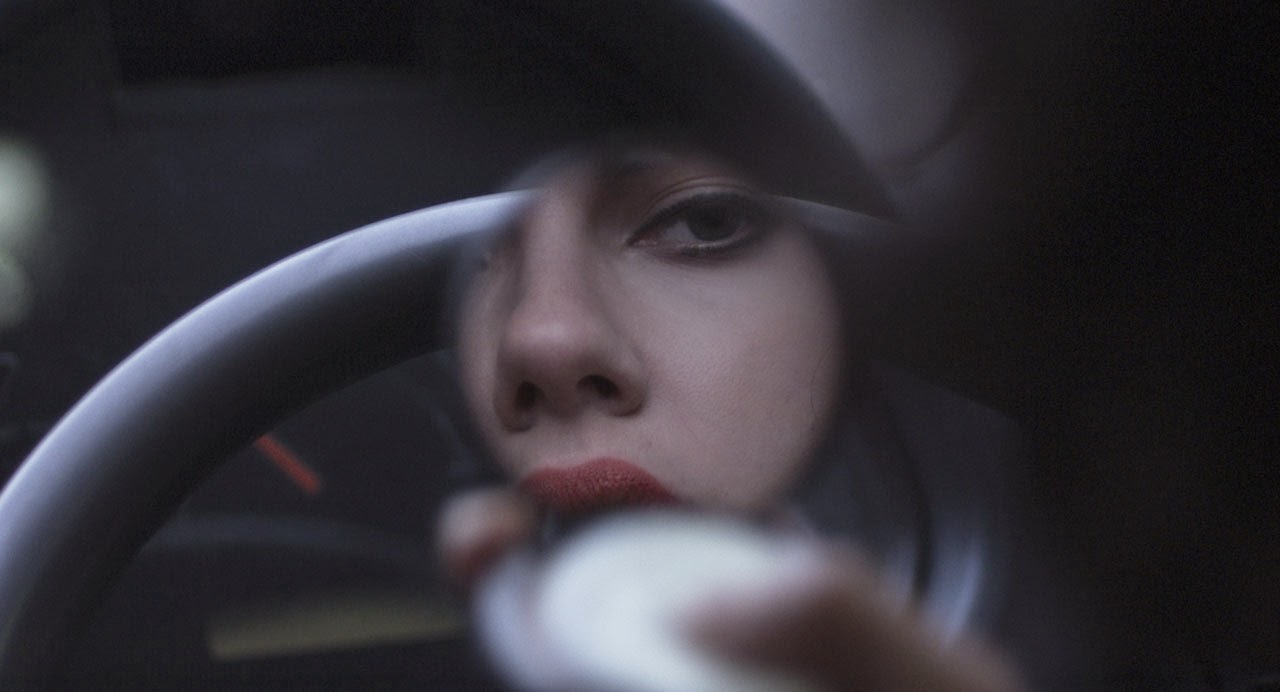
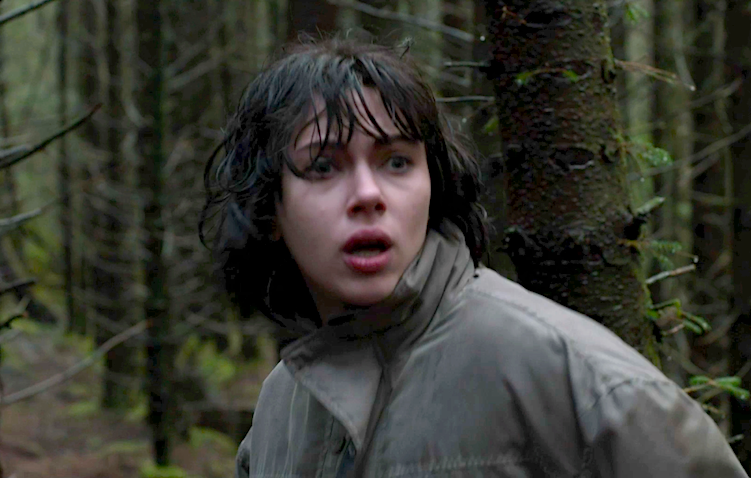
Showing off scars, from top: Under the Skin, Habit
Under the Skin (2014), the new slick dark green opus from Brian (Birth) Glazer, is a film that links up one's panic attacks before and after itself (as seen by you, the viewer) and signals the future of cinematic horror-science fiction as less about acting and thrills and more about the viewer's brain dissolving itself in a pool of black oil in the middle of a dark forlorn forest, wondering as it fades how it hears the rain and sizzle without ears. 2014's first official trans-humanist off-world 'chance to begin again' at that Crystal Peak moment of post-modern social decay, the screen on which it's showing as permeable as a jet black oil-filled swimming pool, Skin is not just mercury mirror from ye auld Cocteau Orphee, not just the menstrual matrix of Shauna Macdonald's Descent. It's the next step deeper. Just don't expect to climb out in the same skin you wore when you dove--or were sucked--in. You emerge as different from your old tar pit-stuck self as a tetrapod is from a placoderm.

I collaged this image/s together/m and are real prowed
I know how it is, bro. I began the weekend with a terrible panic attack. Friday crashed down around me in hailstorms of at-work red tape, hot potato bureaucratic quagmires, April allergies, allergy med-fed depression, and free-form anxiety--based on the need-- to take my girlfriend anywhere other than our couch in front of the TV for the weekend. She can take just so much of my trepidatious sloth and then the pressure is on to amuse her. She said she wanted to go out to the movies this time. My blood ran cold and I shook like the gallows pole was sliding up me arse at the thought. I came home, we looked at the times, and soon I trembling on the floor in a ball of anxiety.

Luckily, she had a stash for emergencies - and so took pity on me - and tossed a half-a Xanax down in front of me and like a good dog I went scrambling after it, ate it down like a good boy, and 20 minutes later was feeling sane enough that we caught the late show of Jonathan Glazer's Under the Skin down at the BAM with minimal hand tremors.

Wandering back home afterwards, up Flatbush towards Park Slope, it was around midnight. Usually busy as hell, the half-deserted and strangely-lit Good Friday-empty Brooklyn was a trash-strewn neon, rain-shined ghost town. Cutting through the uphill haze of alienated Flatbush Ave liquid street lamp and traffic light reflection on the droplets in the mist, stale popcorn nausea and lingering-half Xanax glow wobbliness pulsing through our hamstrings, we knew something weird had happened. I couldn't quite get past the feeling Glazer's film was more of a video art installation swerving towards a last minute And then the Darkness homage than an actual movie, but it was certainly art. Instead of a narrative flow there is--buried in mossy 'membrances of Basil Twist-y underwater shirt twirlings--the sense of drowning-in-place, the theater slowly being flooded with tar--like it would be, for example, at a Marble Index-era Nico concert--and that's all art can ever hope to convey. The darkness of the murky theater swallowed my soul right up, each block behind us falling into Blitz-era blackout, and even as we floated up to the smoky safe squalor of our flat, it was still there: the cord between the Twisty twirling and my body stretched G-sharp and Carpenter-ominous.

The paranoid terror red hot potato Poe-level paranoia was waiting, at home, arms crossed, for that X-half to wear off.

I felt half digested, like that Xanax-was. As it faded, so too my essence.


Then, I realized where my paranoid terror was coming from: it was coming from Mad Men.

It was related to re-watching all six seasons of in prep for the new and final season and realizing I'd mixed up Don Draper's forced hiatus from Sterling Cooper with my own at-work woes. So it's true, then. I'm already half-sunk into the black oil image. I can't always remember where I end and TV begins; since I live in NYC I get confused too and think people I know from TV or movies are people I know from work, and so I wave if I see them on the street (not helping matters, so many of the supporting actors live in my neighborhood - it's far weirder to recognize them and not remember from where).

But when things get too intense at home, by which I mean onscreen, I can move to the kitchen to fix a drink or go to the bathroom and repeat to myself, "it's only a movie, it's only a movie." To our cat we at home must look often like statues, frozen in seated positions on the couch, before the glowing square, awaiting our orders.... hours and weeks at a time pass in addled bemusement, while the cat waits for us to see her.


But does the cat know what we do? That away from the safety zone of our apartment, the world is cold, dark, harsh? The world Glazer lures us into is that zone, a dark and alien theater, built up on the power of Birth (Nicole Kidman enraptured at the concert) and the sexual allure of Scarlett Johansson- we see these ladies movie-size--and suddenly they see us-! Suddenly we're not even safe in our own simulacrum.

Set mostly in and around the dark shroud of Glasgow, Skin is rich with bleakly beautiful panoramas of: bowling alleys; cobblestone streets with sad pubs lined; panic attack-inflicting red-glazed strobe dance clubs; drenching rain over misty mountain moors and lashing surf rolling and crashing down in fast accelerations on a family, first at play and them sucking them all into their presumed deaths in a chain of failed rescues from a relentless riptide. Sans suspenseful music or any indication they've drowned, leaving only a screaming infant behind, it's such a harrowingly existential moment it kind of crawled inside my stomach like a nightmare I had as a child and had forgotten all these years. Suddenly the layers of assurance and support that nothing bad can happen to an infant onscreen are swept away with nary a sympathetic orchestral string to let us know that the filmmakers, too, are horrified rather than as mountain-level indifferent as the alien who only deigns to steal the clothes.

We're not given any indication Glazer cares about the fate of anyone in the film, even himself, his own reputation as a human being, and that kind of ambiguity is chilling, and even somewhat original. And there's also working class yobbos Scarlett hooks: their slang--as indecipherable as an alien tongue--contrasting with her (surprisingly good) posh Londoner accent--setting up a class divide, and... damn -- I can't let it go. How do you get back to talking about this film's familiar Devil Girl From Mars plot after seeing that poor bereft toddler screaming, abandoned to the incoming tide on a deserted stretch of beach as the sun sets down around him like an evil shroud? This poor kid's screams hang like a torture-tricked sucker punch cheap shot over the remainder of the film, until the sheer weirdness of the deformed lion boy pick-up throws us yet another Mickey.

Whole reels of Skin seem to have been carved out, though--based on our familiarity with films like La Femme Nikita and The Man Who Fell to Earth--we can deduce those missing pieces easy enough and patch in the cracks, but why should we have to if it's only so Scarlett can suddenly turn compassionate Ann Bancroft at the Lynchian epidermal symbolism carnival moment? I'm not an animal! See me! Touch me! I'm dreaming. Take the shot, Miss Moneypenny.  Glasgow is for drunks and junkie loo divers but too dangerous even for a black oil seductresses to engulf. Run forest-ward for safety! Wrong way! Take the shot, poured to double size for growing ladies shedding skins, melt into the forest couch so Robert Carlyle can't find ya. and carve his pound of flesh. AYe...

I'm no great lover of children, but to let that child get sucked off to its death purely to illustrate your hard ambivalence makes me not care that you suddenly care later on -- even if you are the divine Miss ScarJo.


That's the problem with this film, though I respect others who love it. Lourde knows I would have followed Miss Scarlett anywhere, even over to the commercial multiplex wherein she's seducing Captain America instead of playing Venus Flytrap to some juicy soccer hooligans. It's strange and scary but her alien here seems to have very little real power and decays in ways that make us hope Lars Von Trier is waiting in the wings to snatch her from the Kubrick coldness and douse her in the Charlotte Gainsbourg womb of old testament Griffith vengeance. Instead all we're left with is the unsettling and dispiriting idea that Scotland's working class might be collectively more dangerous than any carnivorous alien sexually hypnotic prowler.

Still, I saw some things I don't usually get to see at the movies - things so weird they're like the dark rural cousin to Matthew Barney's Cremaster. But I guess I'm on the fence (after one viewing) as to whether this is a real movie, a video artwork of staggering foresight and genius that will one day be regarded as the 2001 of our era, or just a long experimental hot mess like 2001 when you're not in the right mood for a pitch-shifted "Maisie."


The string of previews BAM showed before the film included something for Locke, which is set entirely inside Tom Hardy's car in real time as he talks on the Bluetooth. A whole hour and a half (no doubt) of artsy glistening street lamp reflections on rainy dark streets looking like luminous watercolors dripped on a black canvas whilst techno throbs hypnotically and family members and work acquaintances shout their panicked exposition at him via Siri's surreptitious signals and strings. Is this preview meant to prepare us for the endless driving shots and slow loop to nowhere repetitions of Under the Skin? It seemed an ill omen. If you want a real movie that does real things these days, you need to stay home and just imagine it. Movies are now about big screen compositions set within cars and the minds of predators --they don't expand your horizons but shrink them until they tighten around your neck like a dominatrix dog collar. If they don't tighten your aperture 'til you're gallows engorged, they're worried you won't feel anything at all - like we're a collective of grand theft autoerotic asphyxiation addicts.

The next stage will be where you spend your ten dollars just to sit in your car and think about what the movie you paid to see might look and sound like if it was ever made; while you drive around in parking lot circles, you grow furious that this hypothetical almost-movie would subject you to such violence, that are such awful people in the world. Dig, the movie is you, mate! Deep, man Ten dollars anyway!

Locke 
Another problem with UNDER THE SKIN: what's with the mean male "handler" (Jeremy McWilliams) with the motorcycle humpsuit? There's a kind of icky chauvinist undercurrent--like male filmmakers aren't comfortable with castrating Venusian bitches unless there's a man in charge of them (see my expose of cinema's pimps both before and behind the lens). Scarlett's voluptuous body, stripped to black bra and skintight black jeans, becomes the whole show--just her and the black box rooms with the wet floors --so we really don't give a shit about this handler with his smug countenance. Ain't right he should have such power over her. The first film of this ilk that transcends the pimp factor head on and smashes it? Daughters of Darkness -- the most recent -- Neil  Jordan's Byzantium!

Under the Skin tries hard to puncture some hidden and vital vein in our decaying culture, and it does get down to the way any sense of a dislocated universal all-seeing eye (locus of identification/camera) dissolves when one is alone in the dead of night in the middle of nowhere. When no one can hear you scream, you're not screaming. So Scarlett's web-mobile rolls slowly through Scotland, trying to snare the dusty bodies of hunched-over men, pummeling their way on foot through the darkness towards home from shopping or the bus or working long after normal people go to sleep. This Scotland seems as abandoned as some lifeless corner of the galaxy. She's all alone, and between the darkness of an experimental intro that's just drones and a pinpoint of light, and the rainy woodsy finish, it's hard to get a straight bead on anything. We're used to that pinpoint of light becoming a tunnel, but it's not going to be so easy this time. Aside from 'in Scotland' we never know where we are, except that we're treading the line between modernist ambiguity and hedging indecisiveness... Glazer indeed.

In his second feature, the Kubrickian Birth, Glazer gave us a real soul in Nicole Kidman, whose gamin innocence ruptured all his shady attempts to modernize her. Beautiful with her Rosemary buzz cut and with Anne Heche as a brassy Lady Macbeth that colored the painting of our fear that nothing was true, Birth was more Kubrick than Eyes Wide Shut, but still it lacked the feeling of being aware of Earth's planetary orbit. In The Shining and 2001 you can actually feel the world turning below the feet of the Steadicam operator, the orbit of the Earth spinning around the sun and the longer orbit of the sun around the lip of it's galaxy as the universe expands outwards, and how orbits meet and eclipse each other until both disappear, and with them, the sense that any kind of stasis or stillness is anything but illusion.


Under the Skin has only one decaying orbit, and lots of flashy editing tracks and scars are displayed out from under its sleeve, including an extended melange of overlapping images through which Johansson's strange and lovely face gradually appears, but when the spell's broken there's nowhere to go but towards macroscope finality. It's the kind of film that depends on Wikipedia and summations of the original source novel for its post-mortem autopsy translation. My GF read them to me afterwards but I was sick off too much stale popcorn, and was coming down off that half doggie Xanax, and the terrors of bureaucratic power mixed with Mad Men bleed-over finally besting me and my office fuckup DTs. My weekend was ruined... forever minus two hours. 

At any rate, I appreciate a film that needs a drive or walk to and from itself to cohere. But if even then there's no real coherence, except that which we give, out of our longing to not disappoint sweet Scarlett, then it's not even itself.


Before that, there was Larry Fessenden's 1995 low rent horror opus, Habit (Netflixed after admiring his friend Wingard's You're Next). As befits its post-Blank Generation style and Liquid Sky content, Fessenden wears all the hats and stars as Sam, a bartender and witty drunk from the era of the 90s. Hey I drank the same way, at the same time, in his same neighborhood (he bartends at the Hat, the great Mexican restaurant in the LES with the super strong take-out margaritas, though in parts it looks like Ludlow Bar, and Max Fish rolled together.) I think I've even used his great line about booze and cigarettes being a form committing suicide on the installment plan. Great minds, man. And, with his wild hair and missing front teeth, Fessenden is a great shaggy antihero, of the rare type where intellect and the ability to succinctly share one's inner feelings are not the marks of a square, nor missing teeth the mark of a townie scrub. He must have been really drinking 'cuz I think he's amazing here, and not as paunchy as he is now (drinking will do that), in things like The Innkeepers. And there's some really great drinking scenes, wherein chats with his friends, about his new girlfriend Anna (Meredith Snaider)'s habit of sucking his blood during sex, come out as organic and low-key as any normal conversation, neither forced, melodramatic or otherwise.... and she doesn't need a pimp to wave his wand and 'allow' her to feast like in The Vampire Lovers. Fuck that.


Fessenden also has a great gift for framing shots within the tight confines of small realistically dilapidated apartments. The Halloween party sequence wherein he first meets Anna is a masterpiece of tight economical framing. We've been to that same party before--20-40 people in the 20s all crammed happily into a long but thin railroad apartment set up with streamers and kegs--and the sustained conversational tone Fressenden captures is nothing short of a post-no-wave marvel. Sounding like an early Jack Nicholson but not trying to, Fessenden navigates his way through the start of a sexy relationship with Anna and into a rapidly downward spiraling series of options, as boozers often will. The hand job in Battery Park was one of the hotter punk rock sex scenes I've witnessed in some time, too, for being so sudden, realistic, intense, and out of left field, i.e. real. It left me bleeding psychic energy from out my limp imprisoned genital matrix in a way I've not been bled since Lydia Lunch in Kern's Submit to Me Now!


All that said, there's still the issue of the horror, the weakest element of this otherwise strong and moving film. The vamp fangs are clearly the two dollar plastic variety and while that could have worked --like if he was too drunk to tell if she's just joking or really trying to bite him -- plastic or real - etc., they play it straight and by then the film's run on kind of long. Still, there's still no denying this is a significant and impressive low budget work; if the climax is a let-down it's only because the rest of it is so much better than it has any right to be.


The main issue with both these films' femme fatales of course is the weird dichotomy they represent in a male auteur-verse: Scarlett rocks the posh accent but dresses like a waterfront Lars Von Trier prostitute, and why is her spaceship an SUV? And as vamp Anna, Meredith Snaider is too short to be scary; I would have liked to see her taller, or more mature, played by a real gravitas-bearing actress who somehow seemed separate from the murky twentysomething slacker low-key characters in the film, none of whom emerge to become any archetypal vampire types (the one kid tries to be a Van Helsing rescuer of sorts but it never pans out though he does get in a great stream-of-babblelogue about the real vampire being all around us in the choking overreach of popular culture). So if in the end it may not be effective as a scary horror film, it does work as an authentically booze-engulfed LES twentysomething denizen depiction, wherein the sense of world-weary isolation is so acute that the vampire metaphor is almost redundant.


The reverse is perhaps true for Under the Skin, which has a few striking visuals involving black goo (are the aliens merely tar babies drawn from this murk, as in they're all one giant amoeba that occasionally splits off and dons a pelt like a wolf in sheep clothing?) and in one climactic shot we're able to realize the way even the most horrifying sight can blend in perfectly with twisting sunless old growth forest. Critics have noted the way Earth becomes so easily alien and terrifying through Scarlett's eyes, and how inherently alien she looks to begin with, and the weird similarities between these alien seduction / immersions and the reality of reported alien abductions, and the similarity between these aliens and the weird eye thing in Liquid Sky. While I get all that I'm still not convinced. Were my expectations too high? I wasn't high at all... just poisoned by panic... was that it?

Days later I'm still thinking about it, and the film did help strangeify that long walk uphill from BAM to our Park Slope digs on a late night Good Friday, half the locals seemingly gone upstate to visit relatives for Easter, leaving the neighborhood feeling very abandoned and surreal. Maybe that's the best movies can do if they want to be both artsy and get us to not wait for video: to get us to trek out there into the dark foreboding night and pay over ten bucks to spend a couple hours parked next to strangers, our purse and coat pockets easily accessible to bed bugs and junkie fingers, the film has to seamlessly link up to all those things, to forge a doorway between our lives, where we are inside our own skins and their outer furs, wherein our seeing the film and the film itself merge. If a film can't make the walk home resonate through a different pair of eyes than the ones we came in with, then why did we ever leave the safety of our homes to begin with? Underground nuggets from the 90s like Habit, on the other hand, go the other way, to link up to our memories of being in our 20s in Manhattan in the 90s, a time when trekking to the neighborhood video store in the wearying sunshine of a hungover Sunday afternoon used to help create some kind of anticipatory context, some ceremony, even for old favorites. Both those trips -forward to theater and back to the rental place, are forgotten now in favor of Netflix, the delivery system that sluggens down to a slow-mo swim our escape path through the tar pit black quicksand stasis of reality. One day maybe soon we won't even need our own memories, our own darkness, our own seat, speakers, ears, ossicles, neurons. We'll be the viewer and the viewed in one looping orbital motion, the entirety of our senses transferred onto a stack of DVDs on a dusty shelf, and hopefully none of them, not ever, will be Transcendence. 

Thursday, June 30, 2011

A Tale of Three Anti-Capitalist Musicals: HALLELUJAH I'M A BUM, BRIGADOON, MARAT/SADE

HALLELUJAH I'M A BUM
1933 -  Dir. Lewis Milestone
****

A pre-code salute to vagrancy, anarchism, and the days when Central Park was a bucolic Arden for the eloquent "books in the babbling brooks" breed of Depression-era homelessness. Milestone's delightful film is crammed with half-spoken Rogers and Hart songs lamenting the amount of work it takes to remain unemployed ("You own the world / when you don't own a thing"). There's enough economic savvy and cool Central Park set design here to make it both Brechtian and bucolic, an AS YOU LIKE IT with Central Park as Arden, Jolson as exiled king (he would not change it), and his men a bouncing band of singing bum types played with refreshing lack of hokey sentiment. Frank Morgan is the real mayor of NYC, the kind of duty-bound consciousness type that wistfully tosses change to Jolson's king tramp like he'd love to trade places - their weird symbiotic friendship creates a very cool core that gives the film bounce when it needs to avoid the snares of its second half's collapse into the usual Jolson-gives-up-the-girl City Lights-style melodramatics. Madge Evans is the girl in question: Morgan's neglected mistress, eh takes a jump off central park bridge into the surprisingly deep river where Jolson rescues her, completing the Shakespearean-Jungian geometry, which Ben Hecht has so cagily drafted (Naturally she comes to with amnesia and no place to sleep). With a cool black turtleneck and the swagger of a Bronx Maurice Chevalier, until he turns all plutocrat and schmaltzy, Jolson shows why he was once a box office draw. Aside from the eventual soup stock pathos, the only bad guy is a thousand dollar bill Jolson finds in the trash --the very rumor of which sends the park's once-happy denizens into violent riot. Oh capitalism, could you not spare this one tree? Imagine the Lubitsch touch on a SCARFACE spittoon and you have of course Warner Brothers. One of its many awesome little joys is hearing Frank "The Wonderful Wizard" Morgan saying "there's no place like home, there's no place like home, there's no place like home," six years early!  Capitalism may be the key to getting lovely things--and Evans is lovely, especially when covered in delicious Central Park creek water--but Joson must learn the hard way: sacrifice of happiness for spending power is not admirable! In the end, for all her loveliness, Evans is worse than a dozen thousand dollar bills!


-------------

 BRIGADOON
1954-  Dir. Vincente Minnelli
**1/2

If you never thought a magical Scottish hamlet could be boring, you thought wrong. Vincente Minnelli shows he is not Ford, and thus has no grasp of what makes Scottish culture great, i.e. Scotch whiskey. Alcohol here is clearly associated with a crowded Manhattan bar Gene Kelly and sourpuss drunk Van Johnson inhabit before and after their trip to Scotland (to shoot grouse, like they'd know one if they saw one). Scotland is played by various uninspired sets on which Kelly climbs and taps and sings like a `silly monkey.

Minnelli stacks the deck by making everyone at the bar vulgarians and Kelly's fiancee a social climbing materialistic bitch - there's no redeeming value in the city and nothing but redeemable value in the country. But associating booze with big city shallowness does little to allay the dull piety of the mythical town itself, which is stranded in a fundamentalist annex of John Ford chaperone-and-plow malarkey but without Ford's magic touch (the only way, perhaps, to see the magic in the mossy glens is to be lit up from within by Glenfiddich. This ain't the Scottish musical version of THE QUIET MAN, much as it would like to be, and the widescreen formatting--meant for giant Cinemascope stretch screens-- eschews close-ups and fast edits (such things made audiences nauseous and disoriented on such large canvases) in favor of long shots on obvious stage sets, where, for example, everyone's dancing feet are at the bottom of the screen, and their heads at the top, duplicating a Broadway theater experience, perhaps (the screen matching the height and width of the stage), but in failing to explore the magical possibilities of its subject, even on the big screen it's enough to reduce you to napping in all the wrong places.


If you want something magically Scottish, check out I KNOW WHERE I'M GOING or LOCAL HERO. What you get from BRIGADOON is the dry notion that Scottish culture is so inhibited it makes Irish Catholics look like Haight-Ashbury hippies  Considering the awesomeness of the stars--Kelly and my favorite Cyd Charisse--there's some surprisingly awkward dancing amidst the finery, and the super sexy Cyd is barely recognizable: her legs hidden in thick skirts, shapely upper regions sheathed in a highlands sash. She's supposed to look wan and bonny but often just seems sad and hungover.

Meanwhile Van Johnson is the ugly American personified, grousing about how he came to Scotland to shoot grouse and making alcohol look bad as he drawls off his endless flask and shotguns treed locals. Why does Kelly insist on bringing him along? He's like Ronald Coleman's ungrateful brother in LOST HORIZON. Why go to Scotland just to deal with that kind of crap? Just don't hang out with him! On the other hand, does Kelly really want to eat haggis and smell burning peat moss and offal for the rest of time immortal? Why doesn't he just go back to New York and find a different bar? One less crowded and boorish? He's a grass-is-greener type is our Gene, aye, and sure'n the grass is no greener than in a wee place you can never get to except once every hundred years.

MARAT/SADE
1967 Dir. Peter Brook
****

Glenda Jackson stabs a guy named Marat during the French Revolution, while the Marquis de Sade looks on, delighted, and corrects flubbed lines--or are his corrections part of the play within the play? That's so Brechtian! Meanwhile the mental institution director interrupts too, but in rhyme, so is he part of the play or not? What are all these interruptions! Madame et monsieur, in the vein of Brecht et Artaud, I present la Revolution.

Dats real pretty, Glenda
Based on Peter Weiss's play-within-a-play about some drama therapy at the insane asylum of Charenton under the direction of the Marquis de Sade, the full UK title is "The Persecution and Assassination of Jean-Paul Marat as Performed by the Inmates of the Asylum of Charenton Under the Direction of the Marquis de Sade." And since now you're watching a video of a movie of a play within a play about the French Revolution, you could add onto the title in your head at the end "and filmed by Peter Brook, screened on TCM and watched by me in the 21st century") there's guillotines, a whole maze of fourth walls, and long twisted half-sung monologues about walking through the bloody streets of Paris back when they were flooded by a river of noble blood, bath steam, and the special way syphilis makes you insane (antibiotics had yet to be invented) and hydrotherapy might help for the moment but there's no cure for the madness of trying to create a government for the people when the people are all corrupt, murderous, uneducated, unwashed and  ridden with brain-corroding STDs!  I used to intern in the creative arts therapy drama department at Bellevue, so I know the score, and this here's real! At least it was... on some level... onstage. Watch out Glenda Jackson doesn't reach right out from the screen and stab you too. In her weird swaying narcoleptic way, she's fucking sexy as hell.

Superb on every level, some of the songs are almost Fairport Convention-level psych-folkish but most wind their way into a weird madness that seems to slowly build from murmurings of the masses to become the sort of numbers that would send the entire cast of Les Miserables running for their lives to the safety of foreign ports. Enjoy the digital fruits of your capitalist bourgeois internet whilst you might, noble literate.  New Marats are born every day, or am I thinking of mallrats?

Either way, we're doomed.
Related Posts Plugin for WordPress, Blogger...