Showing posts with label venus flytrap. Show all posts

Friday, March 15, 2019

Argh, Matey! THE WITCH WHO CAME FROM THE SEA (1976)


Hey sweetie, let a man 'splain it for you: the 70s were a great time for feminist horror, though the word back then was "women's lib." It was all about being liberated --via sex, pills, books, grass, the sea, castration, and the occult, and violence, too! Paths out one's domestic bliss trap were varied and didn't all have to end in death or marriage. Horror movies latched on for the ride, but the trip would usually make the girl go Ophelia-level mad before she found she wasn't crazy at all: the whole world was a massive patriarchal cult determined to keep her 'down'.  In films like Let's Scare Jessica to Death (1971), The Sentinel (1977) and Stepford Wives (1975) she's actually sane and everyone else is nuts (as in Polanski's Rosemary's Baby). In 1975's Symptoms, for example, it was the other way around (ala Polanski's Repulsion). But it turns out there's a third way (beyond Polanski's ken), where the woman is crazy and 'liberated.'  Truly a product of her moment, far outside the reaches of conventional nuclear family values, she's a heroine for her times-- sweet as applejack with a kick that could geld a stallion at thirty paces. It's not traumatic though because the people around this crazy lady genuinely love her and are, more or less, normal, or at any rate, pleasantly debauched (you know, not a bunch of drags). There's only one film like that in all of western civilizations: Matt Climber's 1976 near-cult semi-classic, The Witch who Came from the Sea. It's not hard to guess why this film has never become a big cult classic it deserves to be (or why there's no Polanski template). But now, on Prime in HD and looking good, albeit slightly faded, there's no reason not to batten down the hatches, zip up to and delve into primal Freudian/Jungian chthonic murk so thick and rich it must be good for you to get this squeamish. If you're an ally, plunge in!


I'll confess: my squeamishness when it comes to seeing females abused in movies--even if the abused, or Liam Neeson, wreaks suitable cathartic vengeance--will make me avoid a movie altogether no matter how ubiquitous it is in 'the conversation' (I still ain't seen Last House on the Left or Irreversible). My Ludovico-induced feminist liberal arts programming is too strong for such imagery not to linger in my brain, tainting all subsequent media consumed by association; I have to write vast screeds on Bright Lights to vent about it just to breathe. So I staved off seeing Witch even though it's right up my alley (if you'll forgive the expression) as far as being pro-castration (I'm no militant, but I consider Teeth too sensitive and Hard Candy too soft). Imagining a depressing 16mm treatise on child abuse and dirty wallpaper (looking dour and grungy like Romero's Season of the Witch), I avoided Witch who Came From the Sea even though I've been long drawn to Witch's poster of a defenestrating Kali Venus, rising on the foam of the castrated lovers. So I was glad it showed up on Prime looking all engorged and gorgeous.  I finally had the nerve to see it last weekend after coming home from Gaspar Noe's Climax at the Alamo, since I was already in shock (so knew I'd be, temporarily, invulnerable to further trauma).

Turns out, I had nothing to worry about. It rules!

It 'gets' it - the brutalizing way so much abuse is depicted on film clashes with the mind's ability to cover up unendurable experience in the shroud of dream and abstract memory. Thus the childhood trauma flashbacks are warped by cartoon and ocean sound effects and bizarre incongruous details that make it all too strange to feel brutalized by, instead the feeling is like remembering strange nightmares from childhood, too bizarre to be terrifying- the brain abstracting trauma until its palatable (and then splitting off a separate persona as a side effect).
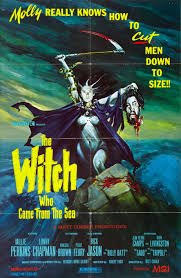
Millie Perkins stars as Molly "The Mermaid," a single barmaid at a seaside dive on the beach of Santa Monica, "The Boathouse," owned and operated by the pleasantly grizzled Long John (Lonny Chapman). She's not just great babysitter to her two adoring nephews, beloved of clientele and employees, but she has the ability to 'get' good-looking men as if fishing them out of the television. Aside from headaches as her brain struggles to keep the lid on her buried incest childhood by cloaking it in all sorts of nautical imagery and oceanic sound effects, she's perfect. Maybe she's mad as a hatter, and has a weird thing for good-looking men on TV, as if they can see her from the screen, and are propositioning her. Maybe she keeps talking about her lost-at-sea captain father as some kind of omnipotent hero despite her more grounded sister who assures her kids he was a monster. But she's not 'victim' crazy, not a cringing trauma victim or a twitchy mess. She's crazy in a way that encompass sanity within itself. When a bubbly blonde actress (Roberta Collins) at the bar bemoans not being liberated, which is now a requirement for TV she glances over at Molly in her patchwork denim and declares she could be in commercials: "You look liberated." The older barmaid Doris (Peggy Furey) adds that "Molly is a saint, a goddamned American saint." Later when her nervous welfare-collecting sister Cathy (Vanessa Brown) shows up to try and convince them of the truth, "you think she's just about perfect," she says to Long John. "Yeah," he snaps back, "why not?"

We agree, thanks to Millie Perkins' dynamic, confident, warm portrayal we love her as much as the staff and her nephews do. Anything she does is all right with us. She's a goddamned American saint.


That's what makes it so tragic. Molly is a liberated saint, yes, but she has no grasp on reality, and it's not the social world's fault, it's the fault of the family dynamic that would let her vile father rule the roost in such a horrifying way (we never see if she has a mother). It's a mix of latent, incest trauma-induced schizophrenia, wherein she sees people on TV talking to her, and her childhood is--understandably--warped and blurred in a salty sea spray of nautical mythology, punctuated by deeply unsettling visions. She has a habit of being drawn to people on it or connected with television, only to then kill them or is she merely fantasizing. She presumes the latter but lately, who knows. If she hears someone is dead she announces she won't believe "if it's true or not until it's on television." As if TV isn't lying to her constantly, the men on it leering out at her, calling her forward. Her dichotomy seems to be a relaxed ease in the anonymous oceanic of the bar, and the bed of salty pirate Long John, a grizzled old reprobate who accepts Molly as she is, no strings. ("Molly is the captain of her own ship.") The bed seems to be in the bar itself, and as such it becomes a very weird uniquely 70s cool spot, with panelling and aquariums and mermaid and nautical bric-a-brac, including those painted mirrored wall tiles that are often associated with orange shag and faux rock walls.

"Her father was a god; they cut off his balls and threw them into the sea."

The ocean plays a huge part, though the film never gets out on a boat, we see the ocean outside the window, and hear it deep in the sound mix, the town where they live seems largely deserted, so shops like Jack Dracula's tattoo parlor loom with an almost Lemora-style surrealism. The flashbacks are all given a surreal, sometimes darkly comic, patina, with comically distorted or ocean sound effects as if her brain is working overtime to contextualize the most primal and odious of endured horrors in terms of oceanic myth. The sea itself becomes her father, a timeless chthonic wellspring, an ultimate signifier connecting this film to everything from Treasure Island (hence the name Long John) to Moby Dick (the local tattoo artist's long tattooed face evokes Queequeg). The soundtrack is a brilliant melange of background sound (the ocean's waves are never out of earshot) and ironic electronic counterpoint: when the melody of a sea shanty she's half-singing while going in the bathroom, the two football players tied up, is suddenly picked up and finished by the ominous soundtrack as she comes back with a razor, its the kind of darkly comic interjection that would make John Williams probably shit himself with fear ("do you shave with straight razors, or is this all going to be agonizingly slow?"). When Molly learns of Venus, born in the sea, according to one of her pursuing men, ex-movie star Billy Batt (Rick Jason - above) she says, with child-like sincerity, "You're lying to me." It's a brilliant line, she could be kidding in a cocktail party way, or it could be an indication her concepts of reality, myth and TV are hopelessly blurred together. And in fact, it's both and why not? This is the age of liberation and free-thinking - where the structure of reality is far looser than it used to be. A latent schizophrenic barmaid isn't even judged for her violent bedroom actions, but loved and accepted by those around her, neither in spite of or because of her castrative tendencies.


And as in any ocean, there are storms: when all other boundaries fail her, her oceanic visions become terrifying pictures of being tied to the mast of a free-floating raft, surrounded by dismembered male bodies, as if remembering some primal prehistoric siren past (only without a hypnotist Chester Morris pulling the strings). The split between her castrating angel of death, turned on by sadism and dismemberment, both as projection revenge against her father and tricks maybe taught by him (we never really know - or hear his voice), and her sweet aunt / fun carefree cool barmaid type is as vivid as the difference between TV and reality. "Let's get lost at sea, Molly m'lass" is what we learn her father used to say, "and we got lost at sea so many... many times." The ocean surge mirroring the rise and fall of the bedsprings - its base horror itself part Greek myth (Elektra) and part Sumerian or druid sacrificial cult, the young boy castrated and his loins thrown into the sea to ensure a good harvest of fish (or wheat if on the fields).

Long John seems somehow to be spared, to share a bed. Maybe due to his easygoing attitude, age, that he's not on TV, and his ability to be contextualized into her nautical miasma (he's a "pirate"). He certainly never reigns in her sexual adventurousness or belittles or infantilizes her. He says he's too old and experienced to get jealous, he says, and we believe him. But you know he loves her, and is willing to take her at face value, as much as he can. He's no fool though, and when he asks her when she lost her virginity and she can't remember that far back, starts stalling and getting a headache he realizes immediately and to some horror the truth; the script and film don't need to underline the moment. He gets it, and his whole demeanor changes, and so we get it too, without ever needing it heard aloud. It's a brilliantly modulated bit of acting by them both. These are smart, interesting people, with unique bonds.


THE MYSTIC ORACLE:

One thing that most horror movies, or any movies, lack is the presence of TVs. They're hard to film due to streaking, so often they're just left off, but it really spells the difference between a believable reality and this kind of utopia where people just sit around in empty kitchens waiting for their cue. Here, though we can clearly see the TV image is superimposed to avoid telltale streaking, that actually works to give the images an extra eerie frisson.  TV is a constant extrasensory, imposed presence: in her childhood memories a very creepy black-and-white clown makes all sorts of weird swimming gestures towards her, beckoning to her/us in a way that's genuinely unsettling. Watching, I had the distinct feeling some terrifying being from my own childhood dreams had found me and was beckoning me from across time and media. Other genius moments tap into LSD experiences (every hippy's schizophrenic sampler), as figures talking to the camera on TV seem to be addressing us/Molly directly. No sooner has she seduced Alexander McPeak (Stafford Morgan) after seeing him in a shaving commercial ("Don't bruise the lady,") she's receiving bizarre directives directly from his TV commercials, telling her where and how to take that razor across his jugular vein.
"He's stark naked! Everywhere... looking at me!"
It's a weird trick to pull off - Molly is a tragic figure who we don't have to 'protect' or 'fix'.  There's no evil or malice in anything she does. ("Does it help that I didn't hate any of them?" she eventually says, "except that first little bastard," she notes. "His mother sang on television," thus spelling out why perhaps he was doomed, "and he sang with her!") And that's why for me, the film really takes off, with a script that looks at the whole mythopoetic televisual-schizophrenic pie, from the raw ingredients to the final delicious slice, ocean-to-table, as it were. Rising from ocean depths to behold the facile screen and its leering Apollonian males, and find those titans in need of gelding by a dark agent of the chthonic. It's a perfect role for the right actress, and Millie Perkins is just that actress. Maybe she had a hand in creating it (she was married to screenwriter Thom, and played the senator's daughter in his AIP hit Wild in the Streets). Between her turn as Anne Frank (in 1959's Diary of Ann Frank) and as the 'woman' in Monte Hellman's The Shooting (1966), we know she's very comfortable playing strong women who are quite comfortable in situations that might make ordinary female characters cringe like crushed flowers. Molly the Mermaid is not a wuss, or one of those rote timid types that become punching bags for every bully and sadist in a 20 mile radius before finally getting down to revenging. She behaves in a way that is indicative of the kind of liberated female vibe of the decade the film is from. Though she's clearly "a mess," she's falling apart from a place of strength so beyond most modern female characters that even a mess she's more together than they are. With her voice given a druggy surreal echo or pitch-shifted to a just slightly low-enough to be eerie (not enough to be goofy or obvious), she becomes the deranged siren, as if stirred from the primordial past).

Trying to find out how this amazing film could be made, could emerge so fully formed from the frothy foam of independent horror cinema, we need to look at the credits, for both Thom and director Climber have unique outlooks on feminine strength indicated by their other films. Thom's body of work shows a latent queer eye for strong young beautiful men, fully-formed (non-objectified) females, and his films often feature a strong, domineering mother figure (as in his scripts for New World: Bloody Mama and Wild in the StreetsAngel Angel Down We Go) He's the exploitation market's Tennessee Williams, tapping into the same vein of Apollonian beauty reaching like Icarus, for the sun, swallowed up by the maternal chthonic of the devouring mother. In fact, Witch's conspicuous absence of a human mother figure allows for the sea itself (ever-present, either in the sound mix or the frame) to step into the role (and nobody does it better), its warm, forgiving maternal tide like a ceaseless flow of half-dissolved titan testes, and scuttling crustacean claws (by Gillette). Keenly aware of its archetypal resonance (yet avoiding literality), The Witch who Came from the Sea would make a great mythopoetic subtextual gender/death-swapped  double bill with Suddenly Last Summer, with Molly's sister as the Mercedes McCambridge (there's even a bit of the same speaking pattern), Long John the equivalent to Liz Taylor, and Molly herself as the dead Sebastian and hid cannibal bird beach boys, soft-swirled into one many-armed/headed deity. 

Promise me you'll think about it? Constantly?


Director Matt Climber is the other major "ally" that helps make Witch so redolent, as his love of strong female characters very much in evidence. Basically the real-life inspiration for Marc Maron's character in GLOW (there's even a passing resemblance between GLOW star Alison Brie and Perkins), between that and his 1983 Conan-ish film Hundra, about a wandering blonde Amazon warrior who teaches an oppressed group of women how to rise up and smite their bullying men, it's clear Climber's got a unique appreciation for very strong, assertive, capable women. He also loves Molly as much as Thom, Perkins, and the actors and their characters in the film do.  I love her too. I love this film.

I love the weird, uncommented on details I haven't even mentioned: the way Molly and Long John sleep downstairs in the bar, that it converts to a bedroom, one with a cigarette machine by the stairs (who doesn't want a cigarette machine in their bedroom?). We never quite figure out how that works, if the bed pulls down or something, but it doesn't matter. I love the way all the scenes have that strange 70s mirror tiling and gorgeous deep wood decor, as if they're all the same place. Things that bear examination aren't addressed, but that's to its credit. Not since Antonioni's Red Desert (1964) have commercial and private space been so subtly blurred. I love the way Climber uses the cinematic time image as a reflection of Molly's dysfunction (just a single cut could bridge years, hours or seconds, how she can seemingly commit murders in the space between taking a drink and putting the glass down). I love the seamless way she goes from being playfully sexual to totally deranged, and the subtle pitch-shifts in her voice as her inner siren emerges, voice getting low and draggy like a riptide. It's all so very fierce. I've already visited its shores three times since that fateful post-Climax night! Won't you sail away on it too? It's on Prime so there's no excuse to shun it. Not anymore. It may not put you in that tropical island mood but it will give you that old-time religion.... older than Aphrodite, older than Innana, Ishtar, Asherah and Astarte! Old enough to sail the sea without a rudder, knowing your raft is safe--at last-- in your mother's foamy talons... Adieu, Belladonna, the Lady of the Rocks. Good night. At the count of three... a wake.

Monday, April 21, 2014

Antichrist in Translation: UNDER THE SKIN, HABIT

Showing off scars, from top: Under the Skin, Habit
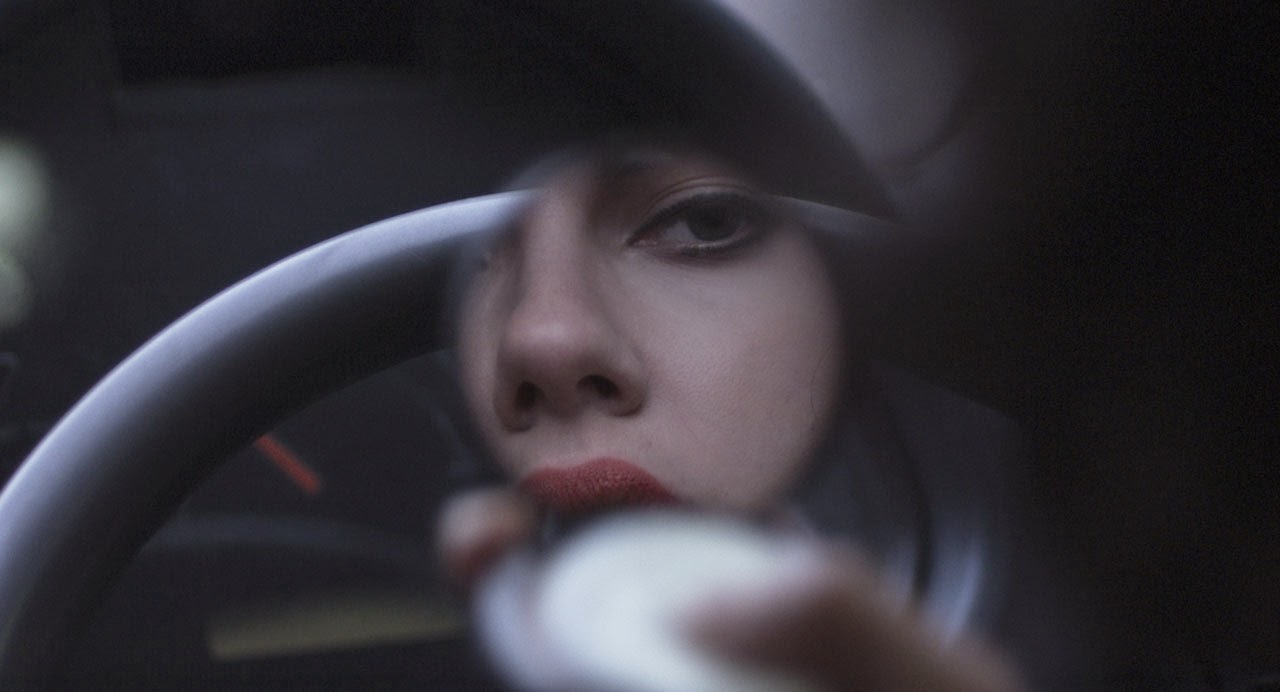
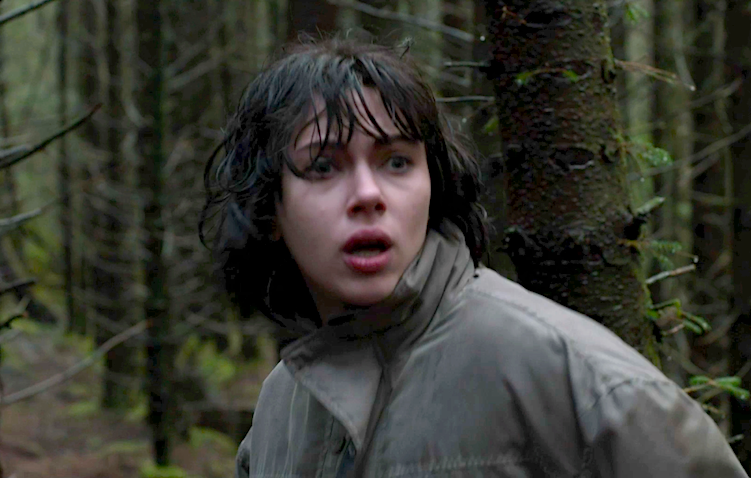
Under the Skin (2014), the new slick dark green opus from Brian (Birth) Glazer, is a film that links up one's panic attacks before and after itself (as seen by you, the viewer) and signals the future of cinematic horror-science fiction as less about acting and thrills and more about the viewer's brain dissolving itself in a pool of black oil in the middle of a dark forlorn forest, wondering as it fades how it hears the rain and sizzle without ears. 2014's first official trans-humanist off-world 'chance to begin again' at that Crystal Peak moment of post-modern social decay, the screen on which it's showing as permeable as a jet black oil-filled swimming pool, Skin is not just mercury mirror from ye auld Cocteau Orphee, not just the menstrual matrix of Shauna Macdonald's Descent. It's the next step deeper. Just don't expect to climb out in the same skin you wore when you dove--or were sucked--in. You emerge as different from your old tar pit-stuck self as a tetrapod is from a placoderm.

I collaged this image/s together/m and are real prowed
I know how it is, bro. I began the weekend with a terrible panic attack. Friday crashed down around me in hailstorms of at-work red tape, hot potato bureaucratic quagmires, April allergies, allergy med-fed depression, and free-form anxiety--based on the need-- to take my girlfriend anywhere other than our couch in front of the TV for the weekend. She can take just so much of my trepidatious sloth and then the pressure is on to amuse her. She said she wanted to go out to the movies this time. My blood ran cold and I shook like the gallows pole was sliding up me arse at the thought. I came home, we looked at the times, and soon I trembling on the floor in a ball of anxiety.

Luckily, she had a stash for emergencies - and so took pity on me - and tossed a half-a Xanax down in front of me and like a good dog I went scrambling after it, ate it down like a good boy, and 20 minutes later was feeling sane enough that we caught the late show of Jonathan Glazer's Under the Skin down at the BAM with minimal hand tremors.

Wandering back home afterwards, up Flatbush towards Park Slope, it was around midnight. Usually busy as hell, the half-deserted and strangely-lit Good Friday-empty Brooklyn was a trash-strewn neon, rain-shined ghost town. Cutting through the uphill haze of alienated Flatbush Ave liquid street lamp and traffic light reflection on the droplets in the mist, stale popcorn nausea and lingering-half Xanax glow wobbliness pulsing through our hamstrings, we knew something weird had happened. I couldn't quite get past the feeling Glazer's film was more of a video art installation swerving towards a last minute And then the Darkness homage than an actual movie, but it was certainly art. Instead of a narrative flow there is--buried in mossy 'membrances of Basil Twist-y underwater shirt twirlings--the sense of drowning-in-place, the theater slowly being flooded with tar--like it would be, for example, at a Marble Index-era Nico concert--and that's all art can ever hope to convey. The darkness of the murky theater swallowed my soul right up, each block behind us falling into Blitz-era blackout, and even as we floated up to the smoky safe squalor of our flat, it was still there: the cord between the Twisty twirling and my body stretched G-sharp and Carpenter-ominous.

The paranoid terror red hot potato Poe-level paranoia was waiting, at home, arms crossed, for that X-half to wear off.

I felt half digested, like that Xanax-was. As it faded, so too my essence.


Then, I realized where my paranoid terror was coming from: it was coming from Mad Men.

It was related to re-watching all six seasons of in prep for the new and final season and realizing I'd mixed up Don Draper's forced hiatus from Sterling Cooper with my own at-work woes. So it's true, then. I'm already half-sunk into the black oil image. I can't always remember where I end and TV begins; since I live in NYC I get confused too and think people I know from TV or movies are people I know from work, and so I wave if I see them on the street (not helping matters, so many of the supporting actors live in my neighborhood - it's far weirder to recognize them and not remember from where).

But when things get too intense at home, by which I mean onscreen, I can move to the kitchen to fix a drink or go to the bathroom and repeat to myself, "it's only a movie, it's only a movie." To our cat we at home must look often like statues, frozen in seated positions on the couch, before the glowing square, awaiting our orders.... hours and weeks at a time pass in addled bemusement, while the cat waits for us to see her.


But does the cat know what we do? That away from the safety zone of our apartment, the world is cold, dark, harsh? The world Glazer lures us into is that zone, a dark and alien theater, built up on the power of Birth (Nicole Kidman enraptured at the concert) and the sexual allure of Scarlett Johansson- we see these ladies movie-size--and suddenly they see us-! Suddenly we're not even safe in our own simulacrum.

Set mostly in and around the dark shroud of Glasgow, Skin is rich with bleakly beautiful panoramas of: bowling alleys; cobblestone streets with sad pubs lined; panic attack-inflicting red-glazed strobe dance clubs; drenching rain over misty mountain moors and lashing surf rolling and crashing down in fast accelerations on a family, first at play and them sucking them all into their presumed deaths in a chain of failed rescues from a relentless riptide. Sans suspenseful music or any indication they've drowned, leaving only a screaming infant behind, it's such a harrowingly existential moment it kind of crawled inside my stomach like a nightmare I had as a child and had forgotten all these years. Suddenly the layers of assurance and support that nothing bad can happen to an infant onscreen are swept away with nary a sympathetic orchestral string to let us know that the filmmakers, too, are horrified rather than as mountain-level indifferent as the alien who only deigns to steal the clothes.

We're not given any indication Glazer cares about the fate of anyone in the film, even himself, his own reputation as a human being, and that kind of ambiguity is chilling, and even somewhat original. And there's also working class yobbos Scarlett hooks: their slang--as indecipherable as an alien tongue--contrasting with her (surprisingly good) posh Londoner accent--setting up a class divide, and... damn -- I can't let it go. How do you get back to talking about this film's familiar Devil Girl From Mars plot after seeing that poor bereft toddler screaming, abandoned to the incoming tide on a deserted stretch of beach as the sun sets down around him like an evil shroud? This poor kid's screams hang like a torture-tricked sucker punch cheap shot over the remainder of the film, until the sheer weirdness of the deformed lion boy pick-up throws us yet another Mickey.

Whole reels of Skin seem to have been carved out, though--based on our familiarity with films like La Femme Nikita and The Man Who Fell to Earth--we can deduce those missing pieces easy enough and patch in the cracks, but why should we have to if it's only so Scarlett can suddenly turn compassionate Ann Bancroft at the Lynchian epidermal symbolism carnival moment? I'm not an animal! See me! Touch me! I'm dreaming. Take the shot, Miss Moneypenny.  Glasgow is for drunks and junkie loo divers but too dangerous even for a black oil seductresses to engulf. Run forest-ward for safety! Wrong way! Take the shot, poured to double size for growing ladies shedding skins, melt into the forest couch so Robert Carlyle can't find ya. and carve his pound of flesh. AYe...

I'm no great lover of children, but to let that child get sucked off to its death purely to illustrate your hard ambivalence makes me not care that you suddenly care later on -- even if you are the divine Miss ScarJo.


That's the problem with this film, though I respect others who love it. Lourde knows I would have followed Miss Scarlett anywhere, even over to the commercial multiplex wherein she's seducing Captain America instead of playing Venus Flytrap to some juicy soccer hooligans. It's strange and scary but her alien here seems to have very little real power and decays in ways that make us hope Lars Von Trier is waiting in the wings to snatch her from the Kubrick coldness and douse her in the Charlotte Gainsbourg womb of old testament Griffith vengeance. Instead all we're left with is the unsettling and dispiriting idea that Scotland's working class might be collectively more dangerous than any carnivorous alien sexually hypnotic prowler.

Still, I saw some things I don't usually get to see at the movies - things so weird they're like the dark rural cousin to Matthew Barney's Cremaster. But I guess I'm on the fence (after one viewing) as to whether this is a real movie, a video artwork of staggering foresight and genius that will one day be regarded as the 2001 of our era, or just a long experimental hot mess like 2001 when you're not in the right mood for a pitch-shifted "Maisie."


The string of previews BAM showed before the film included something for Locke, which is set entirely inside Tom Hardy's car in real time as he talks on the Bluetooth. A whole hour and a half (no doubt) of artsy glistening street lamp reflections on rainy dark streets looking like luminous watercolors dripped on a black canvas whilst techno throbs hypnotically and family members and work acquaintances shout their panicked exposition at him via Siri's surreptitious signals and strings. Is this preview meant to prepare us for the endless driving shots and slow loop to nowhere repetitions of Under the Skin? It seemed an ill omen. If you want a real movie that does real things these days, you need to stay home and just imagine it. Movies are now about big screen compositions set within cars and the minds of predators --they don't expand your horizons but shrink them until they tighten around your neck like a dominatrix dog collar. If they don't tighten your aperture 'til you're gallows engorged, they're worried you won't feel anything at all - like we're a collective of grand theft autoerotic asphyxiation addicts.

The next stage will be where you spend your ten dollars just to sit in your car and think about what the movie you paid to see might look and sound like if it was ever made; while you drive around in parking lot circles, you grow furious that this hypothetical almost-movie would subject you to such violence, that are such awful people in the world. Dig, the movie is you, mate! Deep, man Ten dollars anyway!

Locke 
Another problem with UNDER THE SKIN: what's with the mean male "handler" (Jeremy McWilliams) with the motorcycle humpsuit? There's a kind of icky chauvinist undercurrent--like male filmmakers aren't comfortable with castrating Venusian bitches unless there's a man in charge of them (see my expose of cinema's pimps both before and behind the lens). Scarlett's voluptuous body, stripped to black bra and skintight black jeans, becomes the whole show--just her and the black box rooms with the wet floors --so we really don't give a shit about this handler with his smug countenance. Ain't right he should have such power over her. The first film of this ilk that transcends the pimp factor head on and smashes it? Daughters of Darkness -- the most recent -- Neil  Jordan's Byzantium!

Under the Skin tries hard to puncture some hidden and vital vein in our decaying culture, and it does get down to the way any sense of a dislocated universal all-seeing eye (locus of identification/camera) dissolves when one is alone in the dead of night in the middle of nowhere. When no one can hear you scream, you're not screaming. So Scarlett's web-mobile rolls slowly through Scotland, trying to snare the dusty bodies of hunched-over men, pummeling their way on foot through the darkness towards home from shopping or the bus or working long after normal people go to sleep. This Scotland seems as abandoned as some lifeless corner of the galaxy. She's all alone, and between the darkness of an experimental intro that's just drones and a pinpoint of light, and the rainy woodsy finish, it's hard to get a straight bead on anything. We're used to that pinpoint of light becoming a tunnel, but it's not going to be so easy this time. Aside from 'in Scotland' we never know where we are, except that we're treading the line between modernist ambiguity and hedging indecisiveness... Glazer indeed.

In his second feature, the Kubrickian Birth, Glazer gave us a real soul in Nicole Kidman, whose gamin innocence ruptured all his shady attempts to modernize her. Beautiful with her Rosemary buzz cut and with Anne Heche as a brassy Lady Macbeth that colored the painting of our fear that nothing was true, Birth was more Kubrick than Eyes Wide Shut, but still it lacked the feeling of being aware of Earth's planetary orbit. In The Shining and 2001 you can actually feel the world turning below the feet of the Steadicam operator, the orbit of the Earth spinning around the sun and the longer orbit of the sun around the lip of it's galaxy as the universe expands outwards, and how orbits meet and eclipse each other until both disappear, and with them, the sense that any kind of stasis or stillness is anything but illusion.


Under the Skin has only one decaying orbit, and lots of flashy editing tracks and scars are displayed out from under its sleeve, including an extended melange of overlapping images through which Johansson's strange and lovely face gradually appears, but when the spell's broken there's nowhere to go but towards macroscope finality. It's the kind of film that depends on Wikipedia and summations of the original source novel for its post-mortem autopsy translation. My GF read them to me afterwards but I was sick off too much stale popcorn, and was coming down off that half doggie Xanax, and the terrors of bureaucratic power mixed with Mad Men bleed-over finally besting me and my office fuckup DTs. My weekend was ruined... forever minus two hours. 

At any rate, I appreciate a film that needs a drive or walk to and from itself to cohere. But if even then there's no real coherence, except that which we give, out of our longing to not disappoint sweet Scarlett, then it's not even itself.


Before that, there was Larry Fessenden's 1995 low rent horror opus, Habit (Netflixed after admiring his friend Wingard's You're Next). As befits its post-Blank Generation style and Liquid Sky content, Fessenden wears all the hats and stars as Sam, a bartender and witty drunk from the era of the 90s. Hey I drank the same way, at the same time, in his same neighborhood (he bartends at the Hat, the great Mexican restaurant in the LES with the super strong take-out margaritas, though in parts it looks like Ludlow Bar, and Max Fish rolled together.) I think I've even used his great line about booze and cigarettes being a form committing suicide on the installment plan. Great minds, man. And, with his wild hair and missing front teeth, Fessenden is a great shaggy antihero, of the rare type where intellect and the ability to succinctly share one's inner feelings are not the marks of a square, nor missing teeth the mark of a townie scrub. He must have been really drinking 'cuz I think he's amazing here, and not as paunchy as he is now (drinking will do that), in things like The Innkeepers. And there's some really great drinking scenes, wherein chats with his friends, about his new girlfriend Anna (Meredith Snaider)'s habit of sucking his blood during sex, come out as organic and low-key as any normal conversation, neither forced, melodramatic or otherwise.... and she doesn't need a pimp to wave his wand and 'allow' her to feast like in The Vampire Lovers. Fuck that.


Fessenden also has a great gift for framing shots within the tight confines of small realistically dilapidated apartments. The Halloween party sequence wherein he first meets Anna is a masterpiece of tight economical framing. We've been to that same party before--20-40 people in the 20s all crammed happily into a long but thin railroad apartment set up with streamers and kegs--and the sustained conversational tone Fressenden captures is nothing short of a post-no-wave marvel. Sounding like an early Jack Nicholson but not trying to, Fessenden navigates his way through the start of a sexy relationship with Anna and into a rapidly downward spiraling series of options, as boozers often will. The hand job in Battery Park was one of the hotter punk rock sex scenes I've witnessed in some time, too, for being so sudden, realistic, intense, and out of left field, i.e. real. It left me bleeding psychic energy from out my limp imprisoned genital matrix in a way I've not been bled since Lydia Lunch in Kern's Submit to Me Now!


All that said, there's still the issue of the horror, the weakest element of this otherwise strong and moving film. The vamp fangs are clearly the two dollar plastic variety and while that could have worked --like if he was too drunk to tell if she's just joking or really trying to bite him -- plastic or real - etc., they play it straight and by then the film's run on kind of long. Still, there's still no denying this is a significant and impressive low budget work; if the climax is a let-down it's only because the rest of it is so much better than it has any right to be.


The main issue with both these films' femme fatales of course is the weird dichotomy they represent in a male auteur-verse: Scarlett rocks the posh accent but dresses like a waterfront Lars Von Trier prostitute, and why is her spaceship an SUV? And as vamp Anna, Meredith Snaider is too short to be scary; I would have liked to see her taller, or more mature, played by a real gravitas-bearing actress who somehow seemed separate from the murky twentysomething slacker low-key characters in the film, none of whom emerge to become any archetypal vampire types (the one kid tries to be a Van Helsing rescuer of sorts but it never pans out though he does get in a great stream-of-babblelogue about the real vampire being all around us in the choking overreach of popular culture). So if in the end it may not be effective as a scary horror film, it does work as an authentically booze-engulfed LES twentysomething denizen depiction, wherein the sense of world-weary isolation is so acute that the vampire metaphor is almost redundant.


The reverse is perhaps true for Under the Skin, which has a few striking visuals involving black goo (are the aliens merely tar babies drawn from this murk, as in they're all one giant amoeba that occasionally splits off and dons a pelt like a wolf in sheep clothing?) and in one climactic shot we're able to realize the way even the most horrifying sight can blend in perfectly with twisting sunless old growth forest. Critics have noted the way Earth becomes so easily alien and terrifying through Scarlett's eyes, and how inherently alien she looks to begin with, and the weird similarities between these alien seduction / immersions and the reality of reported alien abductions, and the similarity between these aliens and the weird eye thing in Liquid Sky. While I get all that I'm still not convinced. Were my expectations too high? I wasn't high at all... just poisoned by panic... was that it?

Days later I'm still thinking about it, and the film did help strangeify that long walk uphill from BAM to our Park Slope digs on a late night Good Friday, half the locals seemingly gone upstate to visit relatives for Easter, leaving the neighborhood feeling very abandoned and surreal. Maybe that's the best movies can do if they want to be both artsy and get us to not wait for video: to get us to trek out there into the dark foreboding night and pay over ten bucks to spend a couple hours parked next to strangers, our purse and coat pockets easily accessible to bed bugs and junkie fingers, the film has to seamlessly link up to all those things, to forge a doorway between our lives, where we are inside our own skins and their outer furs, wherein our seeing the film and the film itself merge. If a film can't make the walk home resonate through a different pair of eyes than the ones we came in with, then why did we ever leave the safety of our homes to begin with? Underground nuggets from the 90s like Habit, on the other hand, go the other way, to link up to our memories of being in our 20s in Manhattan in the 90s, a time when trekking to the neighborhood video store in the wearying sunshine of a hungover Sunday afternoon used to help create some kind of anticipatory context, some ceremony, even for old favorites. Both those trips -forward to theater and back to the rental place, are forgotten now in favor of Netflix, the delivery system that sluggens down to a slow-mo swim our escape path through the tar pit black quicksand stasis of reality. One day maybe soon we won't even need our own memories, our own darkness, our own seat, speakers, ears, ossicles, neurons. We'll be the viewer and the viewed in one looping orbital motion, the entirety of our senses transferred onto a stack of DVDs on a dusty shelf, and hopefully none of them, not ever, will be Transcendence. 

Related Posts Plugin for WordPress, Blogger...