
TWIN PEAKS is happening again. Agent Cooper has returned in different places as different selves; DANGER 5 is no longer on Netflix, but THE LOVE WITCH is. Things from the past come back yet nothing from the moment leaves--the selection is so vast picking something is impossible. So we go back in time to when--if we wanted to see weird shit, sex or gore--we had to go the R-rated movie, or... rent it. Limited by what wasn't checked out, and by circumstance, now we miss that simplicity, the narrowness of options. So we make movies that evoke those golden years of limited selection. If you want to make a movie that looks and feels like it was made 20 years ago then you might be a retro-metatextual, but I won't judge you. I'd have to pick a version of me to do that, and I'll leave that to the professionals serenely rooted in space and time, you know who I mean.
What's important is that the acclaim for STRANGER THINGS and IT FOLLOWS helped convince a batch of filmmakers to make the kind of stuff they wanted to see back in the day, their child's mind thrilling to the lurid covers at the store, ominous Carpenter synths dancing in their heads. From the recently discussed SWEET, SWEET LONELY GIRL to as far back as GRINDHOUSE, a kind of borderline nostalgia future-past melancholy has been washing over things to free us all from the terrible burden of the slick but washed-out HD CGI present --wherein STAR WARS films look like video games and video games look like neorealist crime dramas.
Neither feature film discussed below is specifically great (which is why I added a short at the end that is). In fact I'd love to sit them down with each other and have them compare notes. Each has what the other lacks: THE VOID lacks patience, tick-tocakality, self-confidence, and focus; BEYOND THE GATES lacks daring, action and the strength of convictions. One needs the willingness to crank it to eleven rather than constantly dialing back like a repressed schoolmarm resisting temptation; the other needs to dial it down to four and take a deep breath.

THE VOID
(2017) Dir. Jeremy Gillespie and Steven Kostanski
**
An art director and make-up artist teamed up for this co-debut that serves a nice showcase for their specific sets of skills. Solid analog/latex effects and a bizarre Lovecraftian mythos (replete with an transdimensional world of floating black pyramids) liven up an 'all in a single weird night' tale of an understaffed hospital, caught in the midst of closing, deep in the meth belt, that gets hit with a very weird outbreak of... tentacles... and cultists. Aaron Poole stars as the shaky sheriff who lets you know how rattled he is by brining a gunshot wound case into the hospital, then shooting him in the head for the crime of weirding him out. Soon, other guys arrive to hold everyone hostage, and then the hospital is surrounded by a cadre of cultists in white robes with black triangles on the hoods. All Hell breaks loose, literally, and quickly and its all a lot of badly edited, misguided overkill. There's way too much shouting and waving guns to even notice the four different Clive Barker and John Carpenter movie borrowings melting together in the hallway trying to get anyone's attention like a bunch of ill-behaved moppets at the grocery store. Elements of THE THING and ASSAULT PRECINCT 13 merge together and then run screaming IN(to) THE MOUTH OF MADNESS with the PRINCE OF DARKNESS, up to the attics of Clive Barker's HELLRAISER, then out to Stuart Gordon's FROM BEYOND and the Solaris-from-Hell space ship in EVENT HORIZON, there's probably others. These boys don't want you to be bored, so they bludgeon you into an irritated stupor, like the immigrant grandma who mistakes loudness for strength.
Gillespie and Kostanski clearly have a lot to learn about what makes those films they're borrowing from 'good', like when to use dialogue and when not to, how much dialogue is too much, where to put the camera, when to cut, and how to set up an ominous mood or make effective use of a synth drone score. They go for a Carpenter vibe but don't have the patience for Hawksian cool or the slow-building relentless dread that is Carpenter's best auteur trait. Instead there are way too many balls in the air at once. Screaming "c-c-calm down!" in a room full of over-acting, under-directed actors for minutes on end doesn't count as plot development. When the film quiets itself long enough to focus on just one or two characters at a time, sun of a gun if it doesn't almost work! But the drawbacks of the 'more-is-less' approach escape the VOID, probably the one chapter of Robert McKee they shouldn't have skipped over. It's as if all the elaborate monster tableaux are lined up offstage like a make-up artist reel-cum-fashion show and, if they don't keep slithering out, they'll get so backed up the film will end before they can all get their moment.
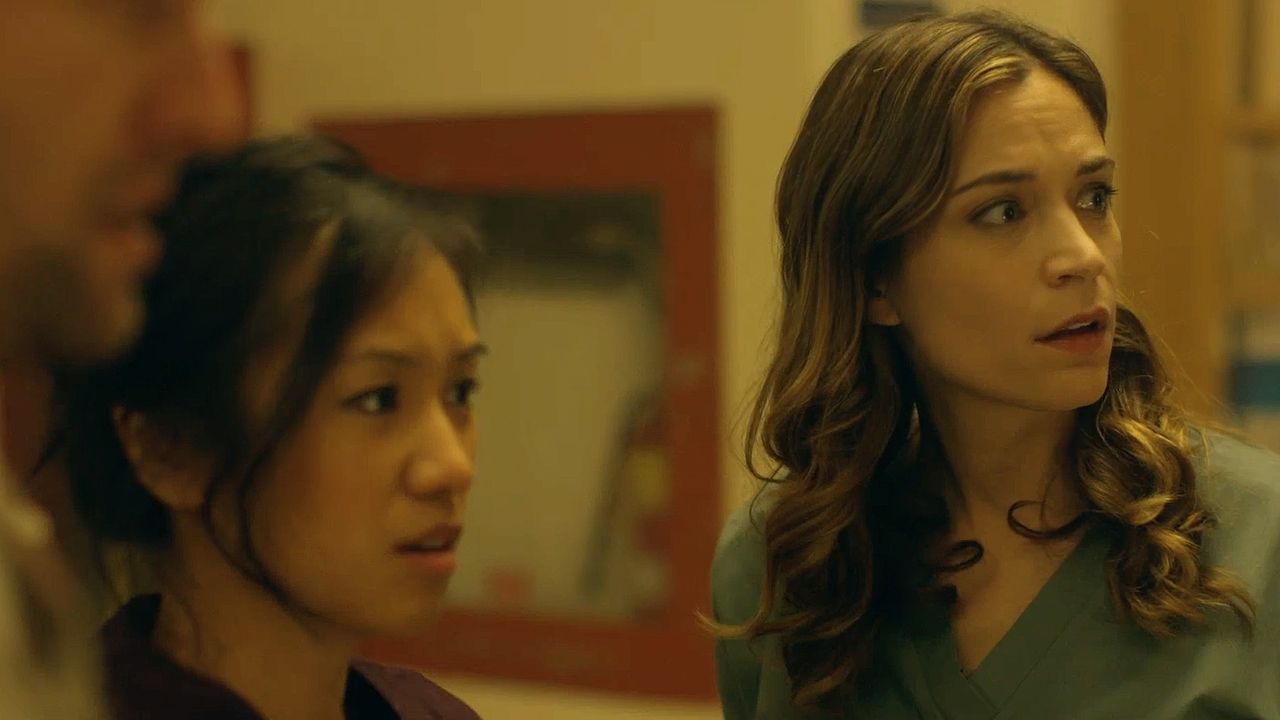
That's not to say it's all that bad. As one of the nurses is played by Kathleen Munroe (above right), a gorgeous blue-cat-eyed creature in the Famke Janssen x Franka Poetente mold who stole a lot of pieces of my heart as a wild Irish lassie equestrian zombie in Romero's unjustly ignored SURVIVAL OF THE DEAD (see my comparison of it with PET SEMETERY + the RNC National Convention). Here, looking all coy in her green scrubs, she reminded me of the cute nurses who gave me Ativan and Librium when I was flipping out at NY-Presbyterian Hospital this past February. Exuding actorly grace and sultry depth, Munroe might have saved THE VOID the way she saved SURVIVAL had the writers allowed her to be a cool Hawksian heroine in the vein of Laurie Zimmer in ASSAULT ON PRECINCT 13. But that would perhaps take cigarettes and balls and low 'indoor voice' talking voices, which maybe made them nervous. Gillespie and Kostanski prefer yelling and hamming, so you know it's intense!
And, worse, after the first chunk of film is over, and all the tableaux in place, Munroe, the one gem in all this dross, is whisked down the rabbit hole of the hospital sub-basement to wait out a few reels before becoming just another imperiled Pauline for our trusty rattled sheriff to rescue. Ugh, hia lame attempt to find her proves way less engaging than the sight of Munroe prowling the empty, quiet hall in search of drugs for a pain-wracked pregnant lady. (They also shoehorn a kind of tired 'mourning a dead child' subplot [the grief broke her marriage with the sheriff], i.e. the kind of lazy screenwriter's shorthand for 'character development' that Carpenter studiously avoids).
 Another thing missing that would have helped here: a 'gateway' drug for all the craziness: meth is name-checked (and seems all around) but there's no evidence of it. The source of all this strangeness turns out to be bizarre rituals carried out in some lonesome meth lab cabin.
But where is the meth, damn it?
I don't have much experience with amphetamines, but it seems to me, from what I have experiences, meth would make a great key to Lovecraftian horror evocation. Gillespie and Kostanski might be better prepared to explore this aspect if they'd done any meth. Dudes, write what you know, bros (sniffles) - betcha Carpenter wouldn't be afraid of a little meth 'for research purposes only.' and I bet that cult leader doctor could get his hands on some wonderful drugs - why would he even need to bother with cheap ass meth? Imagine if the bad guy cult leader doctor had synthesized some new drug - a kind of meth-DMT combo that shattered the fourth dimensional wall? I would have loved to see all sorts of directions that could have gone (and it would have, no doubt, if Stuart Gordon, Carpenter, or maybe Matthew Bright were involved). It's not too late. Matthew Bright and John Carpenter, let's collaborate, call me and bring some...
Ah.... nevermind, I'd probably land right back at NY-Presbyterian.
Another drug-relevant angle: fostering the connection between drug withdrawal and the hell dimension. The high of variation of meth opening their pineal glands the way FROM BEYOND's tuning forks do or my own Salvia Divinorum + Robitussin + light-sound machine + Mingus "Black Saint and the Sinner Lady" journey to the breathing balloon machine elf time-space mandible-weaving beyh\ond-space-time fourth dimension back in '05. Or the anguish of suddenly losing all connection to that bliss as the inevitable pay-back recovery shows us that Hell is as easily accessible as Heaven and that, indeed, one may seldom experience on extreme without inevitably spending time in the other. That, my brothers, would rock.

These caveats aside, Gillespie and Kostanski do offer some superb sequences near the climax, and it's inspiring that they demonstrate the chops to create their tentacled visions in real analog latex. But--once again--the problem is perhaps lack if real-life experience (they don't know what they don't know). The blurry frenzy of action in THE VOID has the air of fear and doubt, like an insecure painter who just throws all his paint on the canvas and runs out of the room, hoping it passes as art, or who wants to hang with the cool trippers but is afraid to take drugs so figures all he has to do is make weird noises, call everyone 'man' and do that annoying "you're going down a tunnel" hand gesture thing that troglodytes all love to do when they find out you're tripping. A seasoned experiencer would know that a huge tentacled thing erupting out of a dead man's stomach would be plenty great on its own; it doesn't have to occur with a flickering overhead lights, crazy Andy Milligan-style camera movements, cross-cuts to a screaming pregnant woman about to get a C-section (with no anesthesia), an over-acting pre-med intern refusing to help cuz it's too gross, and around ten people yelling at the top of their lungs while shooting and swinging axes. The camera seems half in the way of the action instead of chronicling it and none of these elements help establish any kind of mood, making Carpenter's genius for getting out of his own way all the more remarkable and precious.
Like Hawks, Carpenter took his time to make sure we got properly creeped out by the slow evolution of the THE THING. It was creepy because it was a legitimately fucked-up movie trying to pass as 'everything's cool' normal. At the end of, say, the intense autopsy arm-chomping scene, for example, after noticing the king crab eye stalks and legs sprouting out of the removed, crawling head of the dead man, Kurt's exclamation 'Jesus Fucking Christ" has the natural ring of something we might say while trying not to panic. It's funny and all the more terrifying for keeping it 'real' like that. Carpenter knows horror takes time, suspense must be built piece-by-piece.
It's like when making out with someone for the first time: the slow build, just one light kiss first, then going back in for more, the teasing push and pull, ebb and flow; the in-between breaths are just as important as the actual kissing. If you just lunge at the person with tongue extended and don't give them a second to breathe, well, honey, it's called 'suffocation.' It's also called THE VOID. There's so much going on in this film, nothing ever has time to happen. Carpenter's movies seduce you into bed, VOID just runs up and starts humping your leg.

Further detriments: a good deep droning retro-analog synth score (as in STRANGER THINGS or IT FOLLOWS) would have helped immeasurably, instead, we get twangy guitar and the usual orchestral pointlessness. There's four different composers used and none can hold a candle to retro-futurist synth gods like Disasterpiece or Umberto. Those guys were probably available! You wanted to ape Carpenter but didn't want an eerie synth score? Do you watch HALLOWEEN and think, if only there was a nice John Williams or Howard Shore orchestral score instead of that annoying theme song? UGH!
 Missed opportunities aside, at least--unlike THE VOID-- Stewart's film has a compulsive watchability, due perhaps to taking time to develop the characters, and establishing a mood wherein some dreadful thing seems always waiting around the next corner (not easy to do in a tract home).
Too bad then, that the pair of brothers at the center of the story don't make too much sense. They seem to have nothing in common, not even antagonism. They seem to share no common memories, no shared history, and --though they both supposedly worked at the video store-- and despite of all the time they must have spent in and around it -- they never mention or reference a single film, customer, event, ex girlfriend, or anything remotely video-related. Also, though one brother is coded as kind of cool, it's a bit odd that they're both such pussies that they to stop playing the game the moment it gets the least bit spooooky. When Crampton mentions they need to find their father, the first thing they do is call their cop friend, like there's anything he can do about an old 80s board game ("Officer, I demand you place this 80s videotape under arrest!") Would they call the cops if they found a stash of weed back in dad's office too?
Nothing's worse than a kid who looks and acts cool who turns out to be just another narc.
Also, if any movie seemed to invite some SCREAM-style meta commentary it would be this one. None. Similarly, one is supposed to be sober, but there's ne'er a discussion of their past drinking binges, either together or separate. Now me, I've been sober 20 years (give or take, heh heh -see The Void review above) and that's all my brother and I ever talk about! It's a way to connect across our gravitational reverse polarity. Alcohol is the great unifier, even between sober people and hammered drunkards. But here there's no connection or even a shared joke here (the sort of thing that some improvisation or rehearsal might have brought forth), nor is there family resemblance and there's no real understanding why one brother--the sober anal nerd--seems to have inherited the house and store and the other (Chase Williamson, so good in JOHN DIES AT THE END) just stays a kind of stumblebum afterthought, except to add a kind of EAST OF EDEN foreground to its JUMANJI-ish basement backdrop.
My main issue with the film, however, isn't Chase, but the worminess of the square brother (Graham Skipper -intentionally unpictured), a fella so intrinsically unlikeable it makes it impossible to tell why anyone would want anything to do with him (imagining him fooling around with his girlfriend is singularly unsavory). I wanted to smack the glasses off his head and make him do whiskey shots. There are always one or two dorks like Skipper in any given AA meeting, i.e. what we call 'tourists'. They have like a single drink at a single party, get busted by their control freak parents, OR are whisked off to a rehab boarding school the minute mom finds a bag of weed in their sock drawer; OR they just like AA because there everyone has to be their friend OR becasuse their sibling is in it and they're jealous so they need to 'do' AA like they would steal a girlfriend or a soccer ball or an action figure, i.e. some sibling competitive bullshit of the sort they would have to examine in a fearless moral 5th step inventory if they expected to stay sober, but since they're not real alcoholics, they can stay sober without any self-inventory, which they mistake for 'winning').
Instead, what does this pisher Graham do? Earlier in the film, when cleaning up the house, he finds and then pours his dad's liquor down the sink! Why, to make sure his brother or a guest or his girlfriend can't have any just because he's so righteous and smarmy??? And there's still a whole film to go! I may be back to being sober after my--ahem--6 week Suicide Squad-style work release/vacation-- but my thought was still to kill him! KILL! There's no excuse for such criminal alcohol abuse. In AA we hate hearing about people who commit that kind of drink wasting just to feel smug in judgment of their drunken fathers (it's the sort of thing those tourist siblings I was ranting about a few paragraphs ago love to share about, as if they think it will endear us to them). Instead, "Skipper," why not stash it in case dad comes back, or give it away to some needy friend, like that tweaker at the local pub (go-to dirtbag Justin Welborn), who--incidentally--is right to want to deck you and steal your horny girlfriend (Bea Grant). Urgh.
Still, much more so than THE VOID, GATES managed to hold my and my co-viewer's attention all the way through, and is helped no end by Barbara Cramtpon as the master of" the game." She looks terrific and seems to be having a pretty good time --more so than anyone else involved. Brian Sowell's elegant low-budget video cinematography finds new roads within GATES' suburban 70s track house milieu and purple/red/blue video game weird color scheme is like an Easter Sunday afternoon SUSPIRIA)]; Golczewski's synth score keeps burbling, throbbing and buzzing; and seeing the brothers bonding by hacking and stabbing undead demon versions of their slain parents and foes is--in the end--quite heartening.
Also, Chase has a fucking beer once in awhile, thank fucking god.

If you want to see something funny and fleet-footed after these msiguided retro yarns, check out DARK DUNGEONS a 40-minute straight-faced adaptation of Jack Chick's infamous Christian tract denouncing Dungeons and Dragons (as well as books like Harry Potter and Lord of the Rings) as gateways to Satanism and witchcraft. Come along then as two cute young freshmen girls are lured to the dark side during a LARP (Live Action Role Play) session during 'club' rush week. Debbie (Alyssa Kay) turns out to be a natural spellcaster (with real magic) rising under Mistress Frost's (Tracy Hyland) dark red tutelage to a 'level-eight' sorceress; her budding bestie/possibly experimental lesbian crush, Marcie (Anastassia Higham), on the other hand, hangs herself because she's left behind at level-seven! Poor Marcie! She just couldn't keep up. After that tragedy, and being sent on a mission into the tunnels to other dimensions, Debbie finally realizes her soul is in jeopardy. Will God's love find her in time?

Shot off the cuff, DD has a great zero budget gonzo spirit, a deadpan reverence for the Chick source material, a funny, talented and mostly female cast, and a great deadpan "embrace me, Jesus!" ending. If you've even been out on a deep end-bad trip limb in your younger druggy days, and prayed the 'no atheists in a foxhole' prayer (ala AA) then you'll relate to the god stuff, and maybe even mist up. I don't know the extent to which the ending is meant satirically or not, and I don't ever want to. It's both more inspiring and funnier not knowing; and I respect that the spiritual solution is at least treated with some modicum of respect and real love. I don't think either Satan or Jesus would be offended. I'm so proud of these filmmakers, the Ron and Suzy Ormond of their time ! After a weekend enduring THE VOID and BEYOND THE GATES, I really needed DARK DUNGEONS, Otherwise, I think I would have to stop seeing new indie horror films for at least a year. Instead, I'm back on board.


PS: Let me also point you towards the following retro-chic gems, all of whom get my personal, higher recommendations:
IT FOLLOWS
AMER
JOHN DIES AT THE END
BOUNTY KILLER
IRON SKY
THE LOVE WITCH
BEYOND THE BLACK RAINBOW
SWEET, SWEET LONELY GIRL

Further detriments: a good deep droning retro-analog synth score (as in STRANGER THINGS or IT FOLLOWS) would have helped immeasurably, instead, we get twangy guitar and the usual orchestral pointlessness. There's four different composers used and none can hold a candle to retro-futurist synth gods like Disasterpiece or Umberto. Those guys were probably available! You wanted to ape Carpenter but didn't want an eerie synth score? Do you watch HALLOWEEN and think, if only there was a nice John Williams or Howard Shore orchestral score instead of that annoying theme song? UGH!
Next time, boys, instead of just emulating John Carpenter movies, watch the movies he emulates. Watch RIO BRAVO, EL DORADO and THE 1951 version of THING. I've HAD IT! Stumpy, don't make me tell you again. Give Kathleen Munroe a cigarette and a match and punch the first pisher who squawks.

BEYOND THE GATES' musical score on the other hand is the best thing about it: an effective melange of Goblin-esqe synths by retro-analog heavyweight Wojciech Golczewski. Like VOID, BEYOND is not set in the 80s so much as set within a universe clearly indebted to, haunted by, and styled after Videos The Director/s Rented as Impressionable Kid/s. Here however, it's not the Carpenter movies of youth but a video board game called NIGHTMARE. I'd never heard of video bored games before! Now I learn they had real commercials in the early 80s, and everything! Must have been a regional thing because I would have remembered. I'm the type.
And it's because I am the type that I hoped this story would resonate more than it did. A pair of semi-estranged "adult" brothers reunite at their old homestead after their video rental store owner father vanishes. They want to find out where he went, so mull through his old shit back in his office (the store is out of business but still right where they left it, still full of videos, which they exhibit no interest in). Then they find the game.... is it a clue?

BEYOND THE GATES
(2016) Dir. Jackson Stewart
**1/2
BEYOND THE GATES' musical score on the other hand is the best thing about it: an effective melange of Goblin-esqe synths by retro-analog heavyweight Wojciech Golczewski. Like VOID, BEYOND is not set in the 80s so much as set within a universe clearly indebted to, haunted by, and styled after Videos The Director/s Rented as Impressionable Kid/s. Here however, it's not the Carpenter movies of youth but a video board game called NIGHTMARE. I'd never heard of video bored games before! Now I learn they had real commercials in the early 80s, and everything! Must have been a regional thing because I would have remembered. I'm the type.
And it's because I am the type that I hoped this story would resonate more than it did. A pair of semi-estranged "adult" brothers reunite at their old homestead after their video rental store owner father vanishes. They want to find out where he went, so mull through his old shit back in his office (the store is out of business but still right where they left it, still full of videos, which they exhibit no interest in). Then they find the game.... is it a clue?
The 'dead' video store is a great location for a horror film but it's not utilized nearly as effectively in Beyond the Gates as it is, say, in the Blockbuster/Shining episode of SOUTH PARK. It's barely even used at all, except as a means to put the brothers in contact with the last thing dad was watching.
Aside from the bitchin' score, the next best thing about the film is the video board game itself, hosted by Barbara Crampton in new wave hair and eye liner, and easily stealing the show. But even that is given short shrift by the moronic brothers. Instead, most of the film occurs in dad's suburban tract home, where things get scary but nowhere near as scary as they would get a dead video store (what that tells us about ourselves is maybe something some of us aren't ready to hear).

Too bad then, that the pair of brothers at the center of the story don't make too much sense. They seem to have nothing in common, not even antagonism. They seem to share no common memories, no shared history, and --though they both supposedly worked at the video store-- and despite of all the time they must have spent in and around it -- they never mention or reference a single film, customer, event, ex girlfriend, or anything remotely video-related. Also, though one brother is coded as kind of cool, it's a bit odd that they're both such pussies that they to stop playing the game the moment it gets the least bit spooooky. When Crampton mentions they need to find their father, the first thing they do is call their cop friend, like there's anything he can do about an old 80s board game ("Officer, I demand you place this 80s videotape under arrest!") Would they call the cops if they found a stash of weed back in dad's office too?
Nothing's worse than a kid who looks and acts cool who turns out to be just another narc.
Also, if any movie seemed to invite some SCREAM-style meta commentary it would be this one. None. Similarly, one is supposed to be sober, but there's ne'er a discussion of their past drinking binges, either together or separate. Now me, I've been sober 20 years (give or take, heh heh -see The Void review above) and that's all my brother and I ever talk about! It's a way to connect across our gravitational reverse polarity. Alcohol is the great unifier, even between sober people and hammered drunkards. But here there's no connection or even a shared joke here (the sort of thing that some improvisation or rehearsal might have brought forth), nor is there family resemblance and there's no real understanding why one brother--the sober anal nerd--seems to have inherited the house and store and the other (Chase Williamson, so good in JOHN DIES AT THE END) just stays a kind of stumblebum afterthought, except to add a kind of EAST OF EDEN foreground to its JUMANJI-ish basement backdrop.
 |
| You da man, Chase, you almost finished a whole beer! |
It's not all bad though. In fact GATES works its way to some pretty cathartic fifth step style carnage. When the square brother finally gets around to killing and stabbing everything in sight alongside his cooler brother, it's like a cloud parts. Still, there needed to be more of a character change to believably get there -- a kind of change a slug of whiskey would have brought out, like Popeye's spinach, or the magic elixer from Wang's six demon bag in the climax of BIG TROUBLE IN LITTLE CHINA or like Nick Frost's two-fisted relapse in THE WORLD'S END. Now that's a reunion movie.
Instead, what does this pisher Graham do? Earlier in the film, when cleaning up the house, he finds and then pours his dad's liquor down the sink! Why, to make sure his brother or a guest or his girlfriend can't have any just because he's so righteous and smarmy??? And there's still a whole film to go! I may be back to being sober after my--ahem--6 week Suicide Squad-style work release/vacation-- but my thought was still to kill him! KILL! There's no excuse for such criminal alcohol abuse. In AA we hate hearing about people who commit that kind of drink wasting just to feel smug in judgment of their drunken fathers (it's the sort of thing those tourist siblings I was ranting about a few paragraphs ago love to share about, as if they think it will endear us to them). Instead, "Skipper," why not stash it in case dad comes back, or give it away to some needy friend, like that tweaker at the local pub (go-to dirtbag Justin Welborn), who--incidentally--is right to want to deck you and steal your horny girlfriend (Bea Grant). Urgh.
 |
| I wish these girls (from the NIGHTMARE-esque viral trailer actually were in the movie, they'd have made it a lot better, but the filmmakers think we'd rather see a pale buster like Graham Skipper pour liquor down sinks. |
Also, Chase has a fucking beer once in awhile, thank fucking god.
---
and speaking of God....


DARK DUNGEONS
(2014) Dir. L. Gabriel Gonda
***

Shot off the cuff, DD has a great zero budget gonzo spirit, a deadpan reverence for the Chick source material, a funny, talented and mostly female cast, and a great deadpan "embrace me, Jesus!" ending. If you've even been out on a deep end-bad trip limb in your younger druggy days, and prayed the 'no atheists in a foxhole' prayer (ala AA) then you'll relate to the god stuff, and maybe even mist up. I don't know the extent to which the ending is meant satirically or not, and I don't ever want to. It's both more inspiring and funnier not knowing; and I respect that the spiritual solution is at least treated with some modicum of respect and real love. I don't think either Satan or Jesus would be offended. I'm so proud of these filmmakers, the Ron and Suzy Ormond of their time ! After a weekend enduring THE VOID and BEYOND THE GATES, I really needed DARK DUNGEONS, Otherwise, I think I would have to stop seeing new indie horror films for at least a year. Instead, I'm back on board.
Speaking of the Ormonds, know what else can now be found on Prime? MESA OF LOST WOMEN!


See original tract here
PS: Let me also point you towards the following retro-chic gems, all of whom get my personal, higher recommendations:
IT FOLLOWS
AMER
JOHN DIES AT THE END
BOUNTY KILLER
IRON SKY
THE LOVE WITCH
BEYOND THE BLACK RAINBOW
SWEET, SWEET LONELY GIRL
LAKE NOWHERE


