Thursday, July 07, 2011

Capsules of Crank: THE HORDE, RAGING PHOENIX, PIG HUNT, DARK ANGEL: THE ASCENT


DARK ANGEL: THE ASCENT
(1994) ****

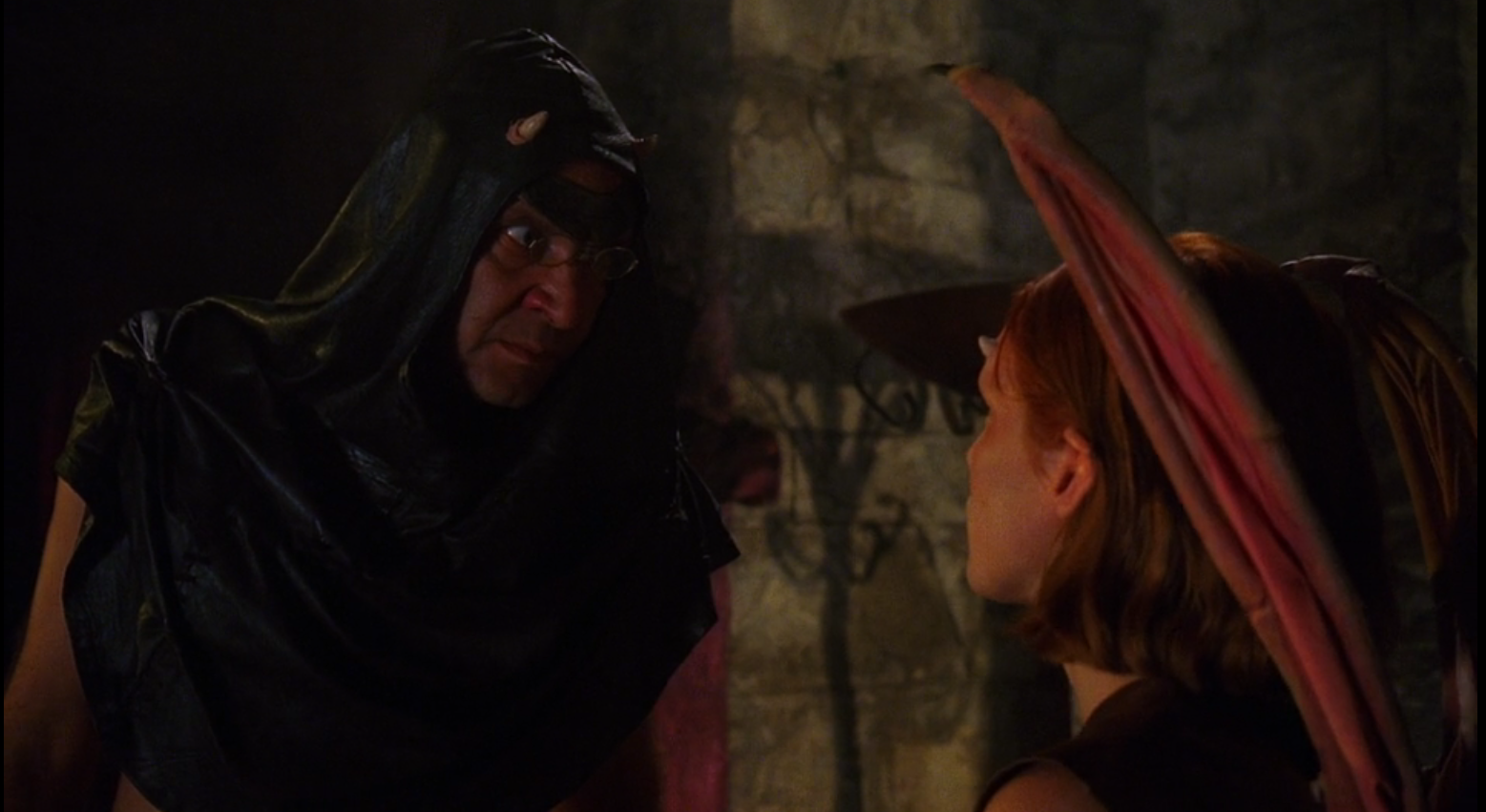
Directed by a woman (Linda Hassani) who is seemingly from another planet, DARK ANGEL (no relation to the TV series starring Jessica Alba) has a bit of a space cadet glow, kind of like MY SO-CALLED LIFE if Angela Chase was a demoness looking to find herself in the world above her Hell home, etc. Charles Band's Full Moon company utilized beautiful Romanian architecture and painterly craftsman lighting to overcome the relative lack of CGI or budget, towards turning this into a sweet 'so wrong it's right' dusty-dream theater fairy tale ala LEMORA: A CHILD'S TALE OF THE SUPERNATURAL or VALERIE AND HER WEEK OF WONDERS. Veronica (Angela Featherstone) feels called to the surface, strictly forbidden the demon set by their Angel employers. Dad's so upset he's motivated to shout in her face in spittle-flecked hysteria of the sort only Nicolas Worth (so chilling as the psycho in DON'T ANSWER THE PHONE) can provide, flogging and striking her, and generally driving her from his door. She escapes with her dog Hellraiser and together they wind up cleaning up an surface city. Romancing a young handsome doctor and wandering around the crime-ridden park at night, ripping spinal columns out of rapists and racist cops and feeding their impure hearts to her dog, Hellraiser. Soon she hooks up with an ER doctor whose karmic balance is strong clearly due to all his selfless healing work, and who's hot and has a nice studio loft apartment for her to move right in.

"To turn away from evil is to be an accomplice to evil"
Through Veronica's actions we learn that demons aren't evil so much as determined to cause suffering and death to those who do evil, and that when acting is really really bad it becomes almost like innocence. Angela Featherstone's zombie acting style gives her crazy lines--part alien free of all humanity's typical shame and fear as she seeks to get the whole picture of life above--and part biblical vengeance--a deadpan flatline sincerity a better actor couldn't hope to match. Her bravely imperious tone when being questioned by suspicious cops is out-of-step even for 90% of other Satanic representatives in film. The way she delivers lines like "I don't require the blessings of the church to engage in unsanctioned sexual relations, Max" is so good I wish I had it as a ringtone. Even the sex scene is tasteful, and I love when she unfolds her true form--wings, horn, tail--after orgasm, in bed, and he's surprised but doesn't freak out, he's just like "hey, it's all right," in a normal late night bedroom voice. He's cool with it! It's all played dead straight, which is why it works so damn well, like Jacques Tourneur making films for a a Satanic Sunday school.


It might not be for all tastes, but in addition to Featherstone's wondrously low-key performance, I love the dreamlike grungy fairytale threadbare Guy Maddin meets Silk Stalkings ambiance (Hassani's directed a few episodes of the latter). It's the perfect film to pass out to by the tenth whiskey of the night. And if you're one of those sober Bickle-ish horror fans who has to really search his collection to find a suitable date movie, here it is. Once you see Veronica offer the would-be rapists spinal column to his intended victim as a trophy, you know there really is a God... and God is good.
--
Though if he really loved us, there would have been eight sequels, or even one.
PS  6/16 - see my updated close-up on this swell film here

 RAGING PHOENIX
(2009) ***1/2

Jija Yanin (CHOCOLATE) is a miracle, a wiry, scrappy little kicking so much ass she should charge by the truckload miracle, especially when she learns a hilarious mix of drunken monkey-style and break dancing. She's an avenging angel against kidnapper gangs, but rather than dipping into the usual sleaze and dispiriting inhumanity at the core of the Thai white slave trade, RAGING PHOENIX involves kidnapping women for their precious pheromones, which are mined via their precious tears in a bizarre underground nightmare lab/dungeon, eerily reminiscent of the tunnels talked about in reptilian conspiracy circles, replete with humans being hypnotized and farmed for emotional response-generated fluids --though melancholy reverie here rather than pain and fear; it's all masterminded by a transgendered martial arts master in a red kimono who does not go down easy.
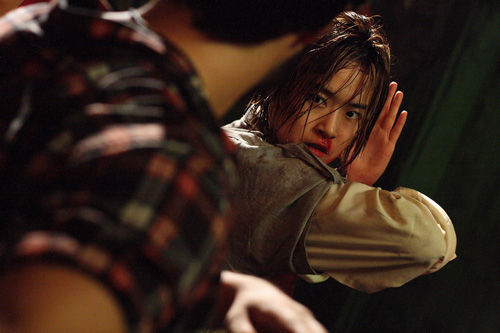

Unlike the basic stuff from Hong Kong, these Thai guys never use guns, or weapons of any kind... just martial arts, not even bo staves, shuriken, or nunchaku. What kind of gang is that? How can you ever expect to compete with the Yakuza, the Tong, or the Golden Hand? I would have liked to see the booze show up at the last minute like Popeye's spinach, to go with the drunken monkey style, but instead there's some last minute emoting, as the guy our Phoenix loves, well blah blah - you know how those Asian countries are when it comes to sweeping soapy doomed young love, but they do some great couple martial arts in between all, he throwing her all over the place an a big elaborate set piece on a stacked series of rope bridge crossings over a vast deep pit is pretty wild, with more of that swanky high-def deep black-saturated color whiplash camera (so freely used in THE HORDE, our next film)  circling and sliding and whirling around our various heroes. And the martial arts--from choreography to camera to high-kicks--are wondrous.In the end, though, where are you, whiskey? I went to do the dishes afterwards and smashed a plate I was so pissed off they forgot about booze, their secret weapon - you can't have drunk monkey style without it, I don't care what your sen-sen says. ! As the subtitles say: "I want Vengence!" (sic)


 THE HORDE
(2009) **1/2

Borrowing liberally across a long line of John Carpenter, George Romero and 28 DAYS, this French allegory is shot in that whiplash urban chic way that's become synonymous with modern horror films. Dudes, are running zombies all the rage now? In the original DAWN OF THE DEAD for example, the slow comical zombie moments allowed the human survivors time to reflect, reload and recognize themselves in the zombie's eyes, and it was more like our actual nightmares, wherein we're always running in mud or trapped as something shambles or crawls inexorably towards us. Then there's the whole RESIDENT EVIL virus that's infected so many zombie movies with 'money shot' climactic moments of one lone human discharging his/her armaments in full slow mo Matrix camera abandon and the shells come popping out of each machine pistol as they flash at acres of zombies pressing forward like literally rabid fans at a rock concert (see my Hell's Angels Vs. The Flower Child Dead).

But as for humans, you can do worse than the old Carpenter's saw of cops and robbers teaming up to fight the common foe. Eric Ebouaney is awesome (he's the guy slapping Rebecca Romjin in FEMME FATALE), playing a crazy Nigerian ex-child soldier turned drug dealer, with--exactly like Ice Cube's situation in the eerily similar GHOSTS OF MARS--a hothead brother who doesn't trust their new white cop allies. I like that they all get jacked up on cocaine--cop and crook alike-- before rushing out to battle, and a female zombie pinned to the floor provides weird cokehead gang rape frisson without having to get icky and dehumanizing and depressing like DEADGIRL (here just implication is enough), and when an old neighbor 'Indochine' veteran gets involved, and thinks the zombies are a "chink" counter-attack, you have the deadpan allegory of Romero, if not the shambling.

PIG HUNT
(2008) **1/4

There's just a few problems here, one is making the sanctimonious pretty boy murph dillweed good guy the hero -John (Travis Aaron Wade) --and having his self-important dillweed girlfriend (Tina Huang) invite herself along on an all-guys Northern California camping trip / boar hunt just so she can make wise-ass cracks about their phallic gunsmanship --just what every boys' night out needs, a girl inviting herself along to heckle and emasculate them. Why even bother? If  a guy can't kick his girlfriend out of the car he doesn't deserve to come!.

 Ben (Howard Johnson Jr), Quincy(Trevor Bullock), and Wayne(Rajiv Shah) are the other friends, killed more or less in accordance with their stereotypes (Asian guy first, fat guy second, etc.). But hey, this film isn't about breaking new ground, its about giant man eating pigs protecting pot fields.


There's odd inconsistencies I shan't spoil, but there's also moments of genuine schlock anarchy: a coven of dope-growing hippie girls who preach back-to-nature while sporting silicone breast enhancements; in-joke homage and quotations (as in the fat guy quoting APOCALYPSE NOW); some good looking buds on the fields (John wants to call the police about the crop, which made me see red... hairs that is - a fucking narc tattletale like that deserves death); a rocking theme song from the reliably deranged Les Claypool (he shows up onscreen as a preacher who dies in a ROAD WARRIOR-homage) and a great antihero duo in the form of DELIVARENTS-ish local boys played supremely well by Jason Foster and Nick Tagas. Spiking their coffee, and ripping crank off their hunting knives, they show the right way to psych yourself up for killin'! I was rooting for them the whole time! Root, Hogs! Gut yourself some narc!

When the situation gets explosive and the DELIVERANCE boys rally the locals against these clean-shaven intruders, there's some riveting driving around and waving guns, and the emotional anguish and subsequent carnage is awesomely bodacious. However the monster finale is disappointing. For one thing, it seems oddly blocked, with a set-up that we don't know where anyone is in relation to each other half the time when they're all in the same outdoor pit. Why is everyone standing around watching this pig, with special fx snot hanging out of its nose, rooting around for victims? Wouldn't they want to hide... or something? It's kind of a let-down. But hey, four beers in, you won't give a sheeeeeeeeeeeeeeeeeeeeYIT

Tuesday, July 05, 2011

Strangers / with wet hair: TREE OF LIFE (2011) and EMA's Past-Life Martyred Saints


There was an annoying commercial awhile ago with a cute 'brother and sister' ordering movie tickets on their cell phone while pretentiously announcing in that Madison Avenue version of Williamsburg Daria hipster flatline voiceover that "images are important to us." Because they're photographers. So they go to a lot of movies together, which is about $25 per film between them, not including popcorn or bedbug removal. If nothing else, THE TREE OF LIFE proves that images are important to Terrence Malick too - he is a cinematographer...

Malick even acknowledges this weakness in a perhaps autobiographical scene where a child or his sibling finds a sheer nightgown in a neighbor's drawer and steals it. One might imagine he does something icky with the garment, but Malick has never cared about sex, onanistic or otherwise. His Texas is not the Texas of THE LAST PICTURE SHOW and its coming-of-age deviant cataloging or of GIANT and its lustful Deans. For Malick, women are symbols meant to glisten with beauty, particularly if they have long red hair that looks good in the setting sunlight (Chastain could be Sissy Spacek, after Martin Sheen's been sent up the river of life), and if they're wearing shimmering sheer nightgowns it's so the light can send a lace shadow over the lawn. Malick brooks no pornographic, only the Joycean aesthetic arrest, so the theft of the nightgown is the first guilty moment of a future cinematographer--the 'capturing' of a gorgeous ephemerality-- the nailing of butterflies to celluloid ala Stan Brakhage. But without a film to bury the image in, there's no reliable 'container.' The kid notably tries first to bury the nightgown under some mud (too much like sending it to the editor) then decides to release it into the stream, into the flowing fleetingness; the cinema he can't himself witness without a helicopter shot (and there are many); the night gown so ephemeral the only eye that can possess it is the fleeting eye of the all-seeing viewer, the 'God' eye-view. The little river/stream itself is something like a long band of film, and each nightgown tossed onto the waves is a little baby Moses of possible meaning and interpretation before it goes over the falls only to return in the next full rotation of the astral take-up reels in time for the next show, and it's never the last... til it's the end of the run.

Unrepentantly personal as Malick's TREE is, so inflated yet intimate are its emotions, it may help to be on substances or dealing with a recent or impending death in the family while viewing. My dad is very sick after chemo-therapy, so a combination with that and other things made these tight little catalogs of instances between Brad Pitt and his tykes extra pronounced for me. And I grew up with a younger brother who I felt the need to dominate via fake wrestling and we were into war, and violence, but with fake punches always and always treated like real punches in scope and dynamic chin swings and dying falls. If TREE was about girls growing up, I can imagine being bored. Real bored, or if I didn't have a little brother, or was on so many drugs and grief and guilt, bored, real bored.

There's no reason to analyze my deep connection too closely, except that if I made too light of death in past posts, I'm sorry now. Preparing for the possibility (which means also, acknowledging the inevitability) you are going to lose your father is like you're going off a slow motion clockwork cliff and realizing you don't even know how deep is the gorge and no one really cares if you scream all the way down - a fall that could take seconds or decades. There's no way they can stave your fall, so they won't try. Malick is Christian enough to know that guilt is the quickest route to humility, which is the quickest route to God. I know I wasn't the only one amidst the sacrosanct BAM audience breaking down in free-flowing tears once or twice, but then a few scenes later, sighs of exasperation and douche chills at trite symbolism; even at the mighty BAM, cell phone blue lights came on like rows of stars below the screen. For shame!


So it's arty, but is it art? Getting the special effects guy from 2001 and BLADERUNNER (Douglas Turnbull) to work on your big bangs might make you cool but Kubrick and Scott were making science fiction not 'mere' student art film abstraction. Kubrick and Scott were showing what might be, stressing the banal aspects of space travel. Making Texas seem to hurtle through space and turn on an axis is only to reveal that which is already is, to undo the tinny illusion of how we seem to be standing still as we whirl around like a mad spinning top across the infinite playroom floor of space-time. Since you are, then, just revealing the real, why presume you're saying anything other than the trite science bombs of a freshman first-time pot smoker? The image of Sean Penn walking through a mysterious desert door frame is the sort of thing they wince at in hip student film festivals, but it still made me cry, not least of reasons being seeing an A-list thesp like Spicoli really commit to such an old trope. Hasn't everyone who ever visited that splotch of desert shot film of themselves going through that door? Only Sean and Terence have returned, dared to bring their experience and weight back to the idealistic naivete of their BFA years.

Malick's going for 'the big fish' as David Lynch would say, and when an artist goes for the big fish they have to get pretentious as a matter of course, lest their spiritual aims get obscured by plot or drive or other tricks of attention getting, or else become boring like Ozu. But in the end, the little bits of character development undo their own seriousness - Brad Pitt's playing the organ at church is undone by the fact he only plays Bach onscreen and we're not subject to tired hymns sung by dusty congregations in fitful slow starts. This isn't the world we're seeing--or even memory with all its weird time images--but an uneasy combo of both, with a biology textbook and Hallmark birthday card stacked on top. I'm amazed I even remembered the dinosaur name 'Ornitholestes' while watching this -- the word coming to me as if from a lost dream of a five year old who learned to spell dinosaur names before he learned how to tie his shoes but hasn't articulated the word 'ornitholestes' in at least three decades - thanks, TREE!


Jessica Chastain as the mother certainly helps redress this Iron John blood poisoning. She reminds me of a girl I wronged, adding all sorts of psilocybic resonance to her wounded dove close-ups, which are so well shot that you can see the 'signature' stamps of alien DNA in her Celtic pale skin, that fair-haired mossy coastline fairness that if you look closely reveals blue webs of capillaries just below the translucent skin, flushing with blood when hot emotions come across her face.


Another plus is the Texas apocalypse angle, which I've written about as far back as 2007, 'the year of the Texas Apocalypse Cinema,' since then we've also had SOUTHLAND TALES (apocalypse-dependent), and Tarantino's DEATH-PROOF (see: The Foxy, the Dead, and the Foxier), all of which are Texas-style apocalyptic if you know how to dig. And for THE TREE OF LIFE, you don't need even need a shovel, as meaning is excavated and then spread upon the bread of the earth. And the earth is without crust, as Emmanuel "Chivo" Lubezki, who was the cinemographer, likes it, as noted by co-producer Nicolas Gonda, “Chivo Lubezki is a vital part of Terry’s process.  In a sense he had to be as much a writer as a D.P. because when the two of them are on the set, things can change in the moment.  It’s a dance between the two of them riffing creatively off each other.”

It's certainly interesting to read the accounts of how they came up with the trippy visual effects in the film--pouring milk through funnels--but who came up with the soundtrack? Better they should have gone with the guy who did the amazing score for THERE WILL BE BLOOD, or Wendy Carlos, or The Stooges' "We Will Fall."  You can get by with being spiritual and non-alienating to atheists. But pick a hymn and you pick a fight.


There's other moments here, like when you see Sean Penn wandering through the steel and glass structures where we works, that conjure Antonioni and his captains of industry striding around glass offices with their manly scrolled-up blueprints -- Rod Taylor in ZABRISKIE POINT; Richard Harris and Carlo Chianetti in RED DESERT. In the equations of Malick, God, Mary Jane, and the theater audience are ultimately indistinguishable, so is Malick referencing Antonioni, or just recreating him, ala Borges' Pierre Menard, Author of Don Quixote?

I can't help but feel that Malick's searching through the miasma of time and evolution, in dopey whisper-overs, is not for God, or his true Dad, or Brecht, but for an ideal art film audience, the kind that 'got' Antonioni and didn't fall asleep or walk out halfway through. He wants a human mind's eye gallery for his photographs, which slowly move--ala Bill Viola--so slow down and weep along or kindly check your messages with your hand over the blue screen. Images are important to us. If the film says anything, it may be "I Am a cinematographer. But is this stuff Tarkovsky, Eisenstein? Ain't no Russians, ain't even any atomic age. I was kind of shocked the mushroom cloud wasn't even addressed, when surely the age of atomic anxiety was at least worth mentioning, or television. Can a family really get along on nothing but prayers and piano lessons? No wonder Brad Pitt's cranky! No wonder that poor son is so starved for images he has to steal female undergarments and hold them up to the light. Unlike the rest of us, he didn't grow up bombarded with TV and in-class movies and filmstrips, and comic books. That lack has made him hot for images the way a reformed Mormon is hot for the pleasures of the flesh. If you've ever made it with an ex-Mormon you know what I mean. They take to your body like someone dying of thirst to an ice cold beer. This is how Malick takes to the image --guilelessly and openly.


But even here trouble arises, for that Mormon might then decide she loves you, and here you're just a no-good tomcat on the prowl, hardly worthy and never intending to stay. Now you have to live with the secret guilt of the dirty Mack every time an actress reminds you of her. Malick's image-worship justifies his lack of familiarity with the lure of scopophilia, or the pornographic, so we never get the idea he's had to lay his tomcat cards on the table. As that old SNL Freud sketch put it: "sometimes a banana is just a banana, Anna." Or in this case, a tree is still a tree, a sigh is just a sigh. A fundamental thing that doesn't apply is that omnipotent POV: What 'eye' is watching the earth form from clouds and dust? What viewer can there be who would have such a correct view of the unfolding universe? Before there were eyes to see, this stuff didn't exist at all. What Malick knows and has seen is brilliantly reproduced: a younger child watching the in-fighting of parents well captured from low, cringing camera angles, and in these scenes culled from foggy memory, flashes of stuff we remember from our own childhood are unearthed and dislodged, relentless as the search for lost keys, or remotes, all that sense of 'fleeting' works devastatingly well. But is that 'lost eye' ever addressed?

2001 has reaction shots: we know who's seeing what for the most part. When David Lynch shows us images where no eyes can be, we shudder with uncanny frisson: a traffic light changing from green to red at a deserted night crossroads, a phone ringing and no one answering, or maybe even calling. We get even with Antonioni this sense of scary freedom when no one is around to see what we see, as in the amazing ending of L'ECLISSE. Gaspar Noe shot an entire film like this in ENTER THE VOID. But the frisson of the disembodied spectator is one sense of the scopophilic gaze that Malick hogs for himself. He's already seen 'deeper' into these images than we ever will.

In its way BIRTH (here) said far more on this subject and aped Kubrick slightly better, and even had another translucent redhead in long lysergic close-ups (Nicole Kidman). For the cosmic journey of TREE we see some in utero light shows, some random arrests, a death at the community pool, the telegram of the older son's death (never explained or seen), mourning, early childhood; glimmers of a dad whose misgivings about the fairness of his business leads him to inflict violence on his kids and their ultimate refusal of that violence. After two hours or so, Malick seems to realize he needs to wrap it all up so pulls a Fellini with an ending on the beach that Woody Allen would make a cliche back in the 1970s.

But perhaps your own parents and children are ultimately strangers, and no amount of reconciliation can change the fundamental separateness unless you all meet in jazz heaven. Perhaps we are all unknowable even to ourselves, and the closest thing to paternal union may be acknowledging the sad frailty at the core of our once-invulnerable father - that precious moment, never really explored in this film, where you and your dad get drunk together and he suddenly seems so painfully vulnerable, and he's suddenly just another dude you hang with, more like you than you dared admit before. Or you can turn back through the whiskey mist and see him having wrestled with everything you've wrestled with, made dumb mistakes, but found in you--maybe, if only for a little while--something to be proud of, a one certain time when he could say this I did right, even if shortly thereafter you were busted for pot, or guns, or car theft.


For the last few years I've lived my life according to the myth of A Star is Born, with me the boozy has-been author, my ward the younger ascendant star in blogging. Then, a couple weeks ago, while listening to my iPod on random shuffle and flipping through TV with the sound off, I stumbled onto TCM in the midst of the long scene of James Mason gearing up for his suicide in the George Cukor-directed 1954 version of A STAR IS BORN. Now, I've seen this version only up to the intermission, but I knew, because of the song on the shuffle, "The Grey Ship" by EMA what the long shots of Mason looking out to sea, saying tearful goodbyes to Judy and friends really meant, what was going to happen. As sometimes happens, the editing and beats matched so perfectly that I knew it was a cosmic message as I thought "Look a ghost grey ship is coming my way," And it didn't even have to stop.It just kept on going. My intermission was over, and the long voyage into the infinite was now underway, like back when I stumbled onto FLATLINERS in 1991 (see here)

I've had other weird synchronicity moments but this was another symbolic death, a substitute for an actual death imagined in my chosen Star is Born mythos. Norman Maine did the long swim so I wouldn't have to. Either way, old personal myths are inevitably shed like a snake's old skin, like a snake of life, and you die for real  many many skins down the line - but as TREE shows, your skins come fast... and furious.


I mention this for several reasons, not least is to credit BORN's director Minnelli with achieving in this scene (with EMA's scoring) what it takes TREE over two hours to do -- to see the way cosmic myths descend on us during key moments in our life - and that every moment, in a sense, can be seen in heavenly hindsight as profound, every breath and touch as vast as a 2001 obelisk, and yet a yellow filmy fog descends on this sense of wonder and dread just so we can get on with business and not waste the day away being awed at a sunflower. And if our every action isn't awash in mythic resonance, whose fault is that? It's the fault of the cinematographer, dictating the direction we look, and how long we look there, and when we decide to walk away, and look again, from farther off, until the final screen recedes and the credits rain down from heaven like an unstoppable flood, and the tree of life is buried once again in a flood of flood footage.

Thursday, June 30, 2011

A Tale of Three Anti-Capitalist Musicals: HALLELUJAH I'M A BUM, BRIGADOON, MARAT/SADE

HALLELUJAH I'M A BUM
1933 -  Dir. Lewis Milestone
****

A pre-code salute to vagrancy, anarchism, and the days when Central Park was a bucolic Arden for the eloquent "books in the babbling brooks" breed of Depression-era homelessness. Milestone's delightful film is crammed with half-spoken Rogers and Hart songs lamenting the amount of work it takes to remain unemployed ("You own the world / when you don't own a thing"). There's enough economic savvy and cool Central Park set design here to make it both Brechtian and bucolic, an AS YOU LIKE IT with Central Park as Arden, Jolson as exiled king (he would not change it), and his men a bouncing band of singing bum types played with refreshing lack of hokey sentiment. Frank Morgan is the real mayor of NYC, the kind of duty-bound consciousness type that wistfully tosses change to Jolson's king tramp like he'd love to trade places - their weird symbiotic friendship creates a very cool core that gives the film bounce when it needs to avoid the snares of its second half's collapse into the usual Jolson-gives-up-the-girl City Lights-style melodramatics. Madge Evans is the girl in question: Morgan's neglected mistress, eh takes a jump off central park bridge into the surprisingly deep river where Jolson rescues her, completing the Shakespearean-Jungian geometry, which Ben Hecht has so cagily drafted (Naturally she comes to with amnesia and no place to sleep). With a cool black turtleneck and the swagger of a Bronx Maurice Chevalier, until he turns all plutocrat and schmaltzy, Jolson shows why he was once a box office draw. Aside from the eventual soup stock pathos, the only bad guy is a thousand dollar bill Jolson finds in the trash --the very rumor of which sends the park's once-happy denizens into violent riot. Oh capitalism, could you not spare this one tree? Imagine the Lubitsch touch on a SCARFACE spittoon and you have of course Warner Brothers. One of its many awesome little joys is hearing Frank "The Wonderful Wizard" Morgan saying "there's no place like home, there's no place like home, there's no place like home," six years early!  Capitalism may be the key to getting lovely things--and Evans is lovely, especially when covered in delicious Central Park creek water--but Joson must learn the hard way: sacrifice of happiness for spending power is not admirable! In the end, for all her loveliness, Evans is worse than a dozen thousand dollar bills!


-------------

 BRIGADOON
1954-  Dir. Vincente Minnelli
**1/2

If you never thought a magical Scottish hamlet could be boring, you thought wrong. Vincente Minnelli shows he is not Ford, and thus has no grasp of what makes Scottish culture great, i.e. Scotch whiskey. Alcohol here is clearly associated with a crowded Manhattan bar Gene Kelly and sourpuss drunk Van Johnson inhabit before and after their trip to Scotland (to shoot grouse, like they'd know one if they saw one). Scotland is played by various uninspired sets on which Kelly climbs and taps and sings like a `silly monkey.

Minnelli stacks the deck by making everyone at the bar vulgarians and Kelly's fiancee a social climbing materialistic bitch - there's no redeeming value in the city and nothing but redeemable value in the country. But associating booze with big city shallowness does little to allay the dull piety of the mythical town itself, which is stranded in a fundamentalist annex of John Ford chaperone-and-plow malarkey but without Ford's magic touch (the only way, perhaps, to see the magic in the mossy glens is to be lit up from within by Glenfiddich. This ain't the Scottish musical version of THE QUIET MAN, much as it would like to be, and the widescreen formatting--meant for giant Cinemascope stretch screens-- eschews close-ups and fast edits (such things made audiences nauseous and disoriented on such large canvases) in favor of long shots on obvious stage sets, where, for example, everyone's dancing feet are at the bottom of the screen, and their heads at the top, duplicating a Broadway theater experience, perhaps (the screen matching the height and width of the stage), but in failing to explore the magical possibilities of its subject, even on the big screen it's enough to reduce you to napping in all the wrong places.


If you want something magically Scottish, check out I KNOW WHERE I'M GOING or LOCAL HERO. What you get from BRIGADOON is the dry notion that Scottish culture is so inhibited it makes Irish Catholics look like Haight-Ashbury hippies  Considering the awesomeness of the stars--Kelly and my favorite Cyd Charisse--there's some surprisingly awkward dancing amidst the finery, and the super sexy Cyd is barely recognizable: her legs hidden in thick skirts, shapely upper regions sheathed in a highlands sash. She's supposed to look wan and bonny but often just seems sad and hungover.

Meanwhile Van Johnson is the ugly American personified, grousing about how he came to Scotland to shoot grouse and making alcohol look bad as he drawls off his endless flask and shotguns treed locals. Why does Kelly insist on bringing him along? He's like Ronald Coleman's ungrateful brother in LOST HORIZON. Why go to Scotland just to deal with that kind of crap? Just don't hang out with him! On the other hand, does Kelly really want to eat haggis and smell burning peat moss and offal for the rest of time immortal? Why doesn't he just go back to New York and find a different bar? One less crowded and boorish? He's a grass-is-greener type is our Gene, aye, and sure'n the grass is no greener than in a wee place you can never get to except once every hundred years.

MARAT/SADE
1967 Dir. Peter Brook
****

Glenda Jackson stabs a guy named Marat during the French Revolution, while the Marquis de Sade looks on, delighted, and corrects flubbed lines--or are his corrections part of the play within the play? That's so Brechtian! Meanwhile the mental institution director interrupts too, but in rhyme, so is he part of the play or not? What are all these interruptions! Madame et monsieur, in the vein of Brecht et Artaud, I present la Revolution.

Dats real pretty, Glenda
Based on Peter Weiss's play-within-a-play about some drama therapy at the insane asylum of Charenton under the direction of the Marquis de Sade, the full UK title is "The Persecution and Assassination of Jean-Paul Marat as Performed by the Inmates of the Asylum of Charenton Under the Direction of the Marquis de Sade." And since now you're watching a video of a movie of a play within a play about the French Revolution, you could add onto the title in your head at the end "and filmed by Peter Brook, screened on TCM and watched by me in the 21st century") there's guillotines, a whole maze of fourth walls, and long twisted half-sung monologues about walking through the bloody streets of Paris back when they were flooded by a river of noble blood, bath steam, and the special way syphilis makes you insane (antibiotics had yet to be invented) and hydrotherapy might help for the moment but there's no cure for the madness of trying to create a government for the people when the people are all corrupt, murderous, uneducated, unwashed and  ridden with brain-corroding STDs!  I used to intern in the creative arts therapy drama department at Bellevue, so I know the score, and this here's real! At least it was... on some level... onstage. Watch out Glenda Jackson doesn't reach right out from the screen and stab you too. In her weird swaying narcoleptic way, she's fucking sexy as hell.

Superb on every level, some of the songs are almost Fairport Convention-level psych-folkish but most wind their way into a weird madness that seems to slowly build from murmurings of the masses to become the sort of numbers that would send the entire cast of Les Miserables running for their lives to the safety of foreign ports. Enjoy the digital fruits of your capitalist bourgeois internet whilst you might, noble literate.  New Marats are born every day, or am I thinking of mallrats?

Either way, we're doomed.

Tuesday, June 28, 2011

Monster Capsules: GHIDORAH, PHANTASM II, KINGDOM OF THE SPIDERS

GHIDORAH, THE THREE-HEADED MONSTER
1964 - dir. Ishiro Honda
***1/2
I'd seen a lot of Godzilla movies as a kid but I never... until lately. Man, GHIDORAH is the best one! Maybe it's Akira Ifukube's great, blowsy ominous-cool bassoon jazz score, which imbues the heaviness of the monsters with Falstaffian hep grandeur as they stagger around and down volcanoes and bump into matchstick apartment complexes. Ifukube's cues repeat over and over but that's fine, they hold up. Maybe too its the crazy 17th century 'ruff'-style collars the citizens of the strange 'small' country of Sergina still wear, even the gangster villains out to kill their princess: the more they try to look tough, the more those clown collars make them ridiculous. Only in Japan! Only in Godzilla movies do big budget large cast conglomerates of heavy duty Japanese actors wringing their hands intermix with ridiculous close-ups of puppet heads: Rodan and Godzilla each with fixed eyes and only one moving part on their head, a separate jaw which can move up and down giving them a kind of marionette shop crudity that, taken with all the gravitas in both the acting (Kurosawa regular Takashi Shimura even has a bit part as a doctor) and the incredible music, makes for some jovial grins on the part of hip gaijin audiences, as well as squeals of delight for all ages of all nations.

So it seems a bunch of scientists have been having nightly meetings with UFOs, so they invite a lady reporter to come check out how cool they are. When the UFOs don't come the night she's there, they accuse her of sending skeptical brainwaves out into the atmosphere and scaring the aliens off! Skeptical brainwaves! When the reporter dismisses the idea that brainwaves even exist, the scientists smile patronizingly. That's cool despite being sexist because it shows the easy way science can flip-flop on issues, condemning non-believers with an array of defense mechanisms, from witch burning to shows like Fact or Faked and Myth-busters. One day they sneer at the 'nuts' who believe UFOs exist; the next day they sneer at the 'cranks' who believe they don't. Look at the scientist's desk above and you see the way science might have matured had not events like Roswell been so effectively hushed up.The dubbing is solid. The framing and colors are comic book perfection. GHIDORAH: Number One!


Anyway, later that bad brainwave night, the princess of Sergina (Akiko Wakabayashi) is abducted mid-flight from her private plane, by a UFO that telekinetacally steers her out the passenger door in mid-flight-- he instant before a terrorist bomb blows the plane to bits. The next day, scientists investigate a meteor that crashed in the mountains and left a huge Ghidorah egg. The princess appears at the dock, dressed in the clothes of an old fisherman and possessed by a Martian (below) for a dockside press conference: "I come from the planet you call Mars! (Ed note: Venus in the Japanese version). The Earth--your planet-- is on the brink of destruction, and you refuse to take it seriously." They laugh. She doesn't. And the hatching egg is their reward. Look who's come all the way from space to show you that three heads are better than one and that killing dolphins in your tuna nets is punishable by monster attack! Ghidorah functions here as a kind of anti-global terrorist bomb, sent to wipe out violent civilizations before they can become a threat to the Galactic Federation (which is a real thing, according to my in-the-know informants!) So stop sending bad vibes!

Of course, the glee with which Japan is wiped out time and again has become dampened by recent cataclysms, but I still got to go with Ghidorah on this one, even if those cute singing Mothra handler sisters are around to sing their little songs to get Godzilla, Rodan and Mothra to unite against him. It takes a lot of singing on their part and cajoling on Mothra's (and she's still just in her larval state), but then that Ifukube drunken bassoon score really stumbles into low, low gear, and the rumble atop the volcanic jungle is on, reminding me that, as a kid watching Speed Racer, I used to root for the bad guys who I thought were super cool, all dressed in black and with dark glasses. Being a tot and inexperienced, I kept thinking "This time... this time they'll finally win." They never won. I eventually got really despondent and I remember my mom finally telling me the facts of life. The bad guys would never win. The race was fixed.

Ghidorah, I want Speed's Mach-5 racer crushed underfoot!

PHANTASM II 
1988 - dir. Don Coscarelli
***
Who knows where we go after we die? Coscarelli knows, or at least he dares to look in the same trans-dimensional direction as fringe theorists like David Icke and Nick Redfern. Like its predecessor, PHANTASM II involves the adventures of an unlucky orphan lad (here James Le Gros) with mental problems and an ice cream vending buddy (Reggie Bannister) pursuing the Tall Man (Angus Scrimm) as he loots the graveyards of the western states for his neighboring dimension's slave army. A very bizarre but consistent mythos deconstructs down to reveal what it's like to see the warped mysteries of humanity's archaic funeral rituals through the eyes of a young terrified child wandering the mausoleum while the adults console each other, and being freaked out by the glint of the fading afternoon sun on the shiny marble walls. Suddenly a flying metal ball comes whipping around the corner looking for him, to drill out his pineal gland (the home of the soul) for use in bizarre fourth dimensional enslavement rites. The resulting slaves, crushed down to dwarf size (for the high gravity of his home world) dress like jawas. The bad guys bleed yellow embalming fluid. Paula Irvine plays the grown-up love interest (the granddaughter of the weird old psychic lady in the first film) and even Reggie gets a girl in the form of a groovy young hitchhiker they pick up named Alchemy (Samantha Phillips). The scene where the two couple link up while crashing in a boarded-up house in one of the decimated towns stands as one of the creepier and more desolate of the series, laden with termite psychometric details that feel like what life on the road in upstate NY really feels like.


As in the first, the creepy Carpenter-esque music and ever-immanent nightfall enhances the sense of suburban ghost town desolation. And then there's the underlying mythos.... considering all the bizarre accoutrements of the funeral trade, you can really imagine there being a hidden white room in each mortuary where corpses are compacted for rebirth in a dimension that eerily resembles near-death experiences of the unlucky ones who miss the white light (as thousands of youtube videos will make clear). Such people report their astral body/soul floating up to the white light and then being snatched by hands emerging from the dark shadows along the tunnel's sides, yanked into this prison of Hell as they march along a long trail through a desert-like plain led in front by a flying saucer that seems to be harvesting elements of their souls! Part Moses leading the Israelites through the wasteland for 40 years, part literal hell. Which is which?

Whoa, hey! Too much? Then just enjoy this low key TERMINATOR-meets-EVIL DEAD thrill-chill ride movie which comes with periodic in-jokes (the name on one bag of cremation ashes is "Sam Raimi") and pretend you're in a car at a crumbling, empty drive-in in the early 1990s, remembering when the parking lot around you was alive with youth, health, and bravado... all now dust scattered to the wind at a sterile ceremony attended only by an evil dwarf in a brown robe, texting furiously and all but ignoring the sympathy offered by your grieving friends. A poor thing but thine own. We named that brat Ghidorah!

Tiffany and friend
KINGDOM THE SPIDERS
1977 - dir. John "Bud" Cardos
***

This loose remake of THE BIRDS, this spawn of the post-JAWS hell (replete with that old 'you can't cancel the such-and-such festival --the town needs those tourists!' bit), this environ-amok (DDT's the devil!) whirligig of desert sand and webbing, stars the always underrated William Shatner as a small town Arizona veterinarian, and the awesome Tiffany Bolling as a big town arachnologist sent out to help when the toxicology report on a dead calf reveals an inordinate amount spider venom. A sly feminist update of Melanie Daniels (she even has a convertible and driving gloves), Bolling even has a worthy Annie Hayworth in the form of Marcy Lafferty (Shatner's real-life wife at the time). The Bolling-Shatner meet cute is at a gas station instead of a pet store, and the genders are reversed, but a lot of the other BIRDS boxes are ticked off: there's the holing up at the local bar (this one adjunct to a set of cozy rustic cabins instead of a hotel) to hash out motives and options; an crashed plane takes the place of gas pumps for the fireball (though I guess they ran out of money for that one). The big attack with people running around in panic with little creatures on them is adorable, and the Arizona scenery is beautiful with mesas like the ones in STAGECOACH, or rather the same exact ones... as STAGECOACH.

The first to get it eaten is, wouldn't you know it, a black rancher (Woody Strode) fearful of losing his livestock in a quarantine ("he worked for seven years to get that bull!") He's allowed much dignity and concern, so we're slowly climbing up the stereotypes from Best's cowardice to this over-serious humble sobriety... still a cliche, though, since his wife's so dumb she blows holes in her own floor and shoots her own hand rather than just getting a broom and sweeping the spiders out the door. That's a real self-reliant homesteader you got there, Woody. God knows what she'd do if she so a mouse.

It's also pretty dumb that the white folks decide to go on a picnic after finding the dead black couple lying in the grass covered with arachnid bites. Dumb... but typical.


But hey, tropes stop with Tiff: when a tarantula--with scary library music cues filling the soundtrack--slowly climbs up onto Bolling's desk and into an open desk drawer while she's in the shower, KINGDOM comes into a greatness all its own, because when she sits down at her desk and sees it she doesn't freak out. She just smiles like she's found a kitten, picks it up, strokes its hair, then releases it gently outside. She's like if Jill Banner in SPIDER BABY survived, nd went on to get a doctorate in arachnology. I love the way she towers over little Bill Shatner in their scenes together, and the way she gently mocks him when he tries to seduce her, while still letting him continue to try. showing his mammalian fumbling the same calm loving detachment she showed the spider. Her reputation amongst the Psychotronic set is well-deserved! I'd never really caught the fever before this, but I instantly ordered BONNIE'S KIDS and rented TRIANGLE (1970) after watching (See my review of both: Bolling Straight).


Bill Shatner earns his cult, too, especially when he does an awesome high-stepping dance while running around the yard, trying to not step on any of the spiders. He sometimes does step on one, of course. Can't be helped. But no hairpieces were harmed during the making of this movie.
Related Posts Plugin for WordPress, Blogger...