Wednesday, October 19, 2016

Nightmare Logic: Lucio Fulci's HOUSE BY THE CEMETERY (1981)

House by The Cemetery - Anna the Babysitter


October evenings in 2016--the usual chill of autumn warming the corpsey cockles of my hideous heart, but there ain't none. Has the Earth finally run dry of autumn leaf snap? It's the only reason I'm still here! Here where a Rosato Brothers' insulting C-note of an October day barely resonates before summer muggin' of Danny Aiello flattens the coffers. Speaking of Italians, man, maybe I've mellowed with age, but Lucio Fulci's 1981 Quella villa accanto al cimitero aka HOUSE BY THE CEMETERY has sure come along in my esteem. Maybe I'm finally mature enough to admit my prejudices against Italians (too many at my NJ high-school) and confront my childhood fear of a certain basement in our old Lansdale PA house in the 70s, with its cobwebbed corners and scarier crawlspace, beckoning me at halfway down the wooden steps to crawl in and see what was around the dark corners.

If you were ever afraid of your childhood basement yourself, back in the time when you were small and weak and each unaccompanied step was an endeavor, and when just going down there to get something for your mom while she was making dinner was so scary you'd race back up the stairs at the first tiny creak (even if you knew you made that creak), then travel with me back.. back..

Sure, there's a pretty fake bat involved, but we've all seen worse, and at least the wings flap and we wouldn't want Fulci to kill a real bat just for a movie. And if we did, believe me, he would.


Before diving in, a word of warning: even some Italian horror film fans I know aren't huge fans of this movie, due to its many confusing anti-ellipses and stubborn adherence to paranoid  nightmare logic. Me, I like it for the same reasons they don't and because he keeps the focus so narrow, so localized and nightmarish, confined to a single locale, tapping the same vein of cabin fever-induced time-bending paranoid 'always been the caretaker' interiority that make films like The Innocents, The Haunting, and The Shining (see Pupils in the Bathroom Mirror) so effective. Nothing evaporates the supernatural like the intrusion of the social order--cops, expository shrinks, fire arms, witnesses, panicky groups of holed-up survivors, reporters, etc.-- and nothing condenses it quite like communication failure between isolated, dysfunctional family members, like the Boyle's here in Fulci's House. Dad Norman is an academic researcher lugging wife and eight year-old son to New England for a six month stay to finish the 'project' started by Eric (his mentor in grad school). Played by gaunt, ever-bearded giallo mainstay Paolo Malco, Norman has a habit of staring conspiratorially at the camera as if its his Mr. Hyde wingman--especially when his emotionally drained and tantrum-prone wife Lucy (Catriona MacColl) is in his arms and can't see his face (which is Italian cinema shorthand for he's either having an affair or is a killer or is read herring); the Danny Torrance-style psychic son Bob (Giovanni Frezza--burdened by a bad dubbing job), is in communication with a young ghost girl named Mae Freudstein (Silvia Collatina) who warns him of the danger if he comes! But what parent ever heeded a tow-headed third grader's babbling (and why isn't he in school?). Mae gives him a large doll of herself and the fact that it's missing an arm and a leg and at least 50 or 60 years old is our first shattering clue). There's also the ever-enigmatic and smoldering-eyed Ania Pieroni (the music student young witch in Inferno) as Anna the babysitter. Cue paranoid vapors from Gaslight (all through enigmatic stares, ingenious destabilizing edits, and unspoken paranoid inference).

What makes Italian cinema of this era endure so well in general (and explains a lot of the rationale behind 'nightmare logic') is its ability to profit from Antonioni's 'signifier-meld' to get over language barriers. No one through line settles over the suspicion and enigmatic movements of the characters, leading to a deep sense of alienation in the viewer, which only seems profound if you realize that feeling is intentional. It also holds itself up well to repeat viewings. Everything is so.... cryptic... that new meanings and connections are constantly occurring. Like Argento, Fulci was coming to the horror genre from mysteries / giallo procedurals, where keeping audiences guessing who the killer was meant having everyone be slightly suspicious--everyone is hiding something--or so it seems. People keep mentioning the last time Norman was up there and he says they must be mistaken but he's that shifty-eyed Italian kind of giallo-brand ectomorph (thin enough that he can be mistaken for a woman if he wears a trench coat and hat) with eyes that make you suspect he's either having an affair with, or trying to kill, everyone he looks at, including the viewer, even as his actions and dubbed words are all regular scared family man. Meanwhile the mom tries to stay 'normal' in this sea of enigma, suffering the standard Monica Vitti meltdown. Emotionally unbalanced, refusing to take prescribed pills even as dad gaslights her ("I read somewhere those pills can cause hallucinations" - she says. Norman replies: "Are you sure?") She and Bob are the only ones psychic enough to recognize the danger before it's too late, but in prime nightmare logic style are unable to change the course they're on. Whether she's imagining or not, there's no arguing that the graves from the cemetery next door run right on under the house, and even inside the living room, with plaques all along the floors and hallways. Regardless of what Norman says, it is weird. "Lots of these old houses have tombs in them," he says, "because the winter's cold here and the ground is too hard for digging." 

Are you sure?

CHAPTER 4: ANTONIONUELCRAFT

Lurking on the threshold between the seventh-dimensional terror of Lovecraft and poker-faced absurdist surrealism of Bunuel, Cemetery requires the kind of reckless willingness to abandon familiar signifier-chains we find only in the post-Antonioni art house intellectuals and the LSD-experienced horror film lovers, whose eagerness to embrace the primal anxieties of nightmare logic enable them to abandon all expectations of narrative direction. A painterly schizophrenic kind of attention is paid to to things like a steak knife being used to turn a key in a rusty hinge, the camera pulling up close and the suspense rising with the intense chalkboard squeak of long-rusted, painted-over bolt slowly turning, while dad comes ever closer to slipping his grip on the knife and slashing open his wrist (or having the knife blade snap off and go ricocheting around the kitchen before lodging in someone's head). For every one time this happens, a dozen more examples pass by, by the skin of their teeth, from erupting into a serious accident. Then the door opens--Norman flashes the flashlight through the thick cobwebs and we wonder if Freudstein really does "live" down there or is some kind of a sporadically re-animating corpse. And then--before Norman can look around--a bat attack. It's quite a sequence - practically as it occurs all in real time from the moment Norman wakes Lucy up (the barbiturates lining up on her night table like little troupers) to the death throes of the bat; from waking up refreshed after a night of (presumably) Valium and sex, and winding up back to being the sobbing out-of-her-depth nervous breakdown, all in a single, prolonged sequence --there's no other horror director who comes close to that kind of micro-focus in a single consecutive event line.

TICK-TOCKALITY and MOLASSES LIGHTNING

And then, as the basement keeps opening, the bat's blood all over the floor, the hitherto weird mix of nightmare logic and deadpan humor shifts to straight nightmare. No other film of Fulci's is so rife with childhood nightmare and so void of cold adult coherency. Italy's other great horror maestro of the period, Dario Argento, still turned to logical cops and psychologists for eventual explanation (even in Suspirira) but in House, Fulci forgets about cops and rationale as the time window is just too short. By the time the progressively more deranged and horrified recordings left by Norman's mentor reach the part about Freudstein keeping himself alive in the basement via a steady stream of replacement organs and limbs shorn from new tenants, little Bob is already locked in the basement and Freudstein--one of the most genuinely unnerving Italian walking corpses--is shambling towards him, crying like a dozen children. As with Carpenter's Halloween (its sequel was in drive-ins the same year as this) this long scene crawls in melting clock tick-tock momentum. The rest of the film, a protracted climax, occurs in a slow cross-cutting wherein time moves slower than real life while never actually being in slow motion. As in Halloween, moving across a room to open a locked door (ala Leopard Man) can seem to take forever, the more you crosscut, as each parallel action is seen in full, so crosscutting between one person riding to the rescue and another facing danger, over, say, a three-minute period, would take six minutes, if adding a third element (Killer POV), nine minutes, and so on. It's an editing strategy that subverts our the narrative pacing expectations originally set up by DW Griffith. The feeling transcends ordinary excitement to create that nightmare pacing feeling of running through three feet of sucking mud while some demonic entity slowly advances towards you. Usually crosscutting liberates us from time's tedious aspects while enhancing our desire for the two separate threads to finally meet (the pursued or endangered heroine and the cavalry riding - riding to her rescue) which flatters our paranoia. We sense our desire will be met at the conclusion of the sequence, due to associative tendency created through signifier expectation: show me an apple near a pointed black witch hat and I'll think its poisoned with sleeping sickness; show me a racing squad of cop cars crosscut next to an isolated young woman slowly opening her attic door, and I'll think the killer is up there -- etc but she'll be saved in the nick of time. Few American auteurs dare screw with this formula the way Fulci (and Soavi) did until Demme with Silence of the Lambs when at the start of its own scary basement climax, it turns out the FBI SWAT team are rushing an empty house not Buffalo Bill's, who answers the door to find Clarice, alone. It's a betrayal of expectation that creates devastating suspense. The cavalry will not be coming this time, we realize, deep in our gut, from this effect, that Clarice is truly on her own.


A similar rupture event occurs earlier in the time-frame of Cemetery as well, between the two children who are in psychic communication--which we only realize at the very end (though we can surely guess) are on opposite sides of the life-death divide, separated by 60 or so 'living' years. Time is much more fluid in its ability to travel both directions, which we're not used to, but film has no problem duplicating. This angle of House confuses some people in its ambiguity but if you know Antonioni's Blow-Up (1967) and the birth of LSD symbolic melt-down post-structuralism and the 70s movement towards ESP, telekinesis, past-life regression, Satanism, post-Manson cults, deprogramming, near death experiences (NDEs), Nigel Kneale's The Stone Tape theoryand the way in which strange visions and dreams might well be some denizen of your house in the far future channeling your ghost (wherein you might be talking to your unborn great granddaughter and not even know it), then yes the ending makes perfect sense. If someone from the past can visit our present why not vice versa. Who knows? Even we might be from the future... right now.

Whether or not Fulci had seen The Leopard Man (1943), with little Maria's blood coming in under the door as her mama rushes to unlock it--is incidental. He takes that one pivotal moment -- a key scene in nightmare horror-- and drains it of all cultural, feminist Jungian-archetypal symbolism, and mixed emotions (our secret, shameful relish in knowing mom deserves to have this death on her conscience for not believing her daughter)--then distills it down into pure fear, turning the whole final act of the film into one prolonged, torturous crosscut scene of a child locked on one side of a door, parents frenzied on the other, father pounding like a crazy man. In doing this, Fulci distills a gallon of vodka down to a pint of 190 proof Everclear just so we can then take an hour and a half to sip it straight with no chaser. We may be dizzy, nauseous and trembling by the end but by god are we drunk.

Fulci's other films in his undead category, such as The Beyond (also 1981) lack that kind of intense focus; they are all over the place: flashbacks, hospitals, precincts, florists, precincts, barns, morguesm bookstores, and corpses with pink Jello-pop acid waves and tarantulas, seeing eye-dogs and half-headed zombie broads, etc. House alone in Fulci's canon belongs with those classics of horror that focus in on an isolated set of characters experiencing the structural collapses of the social order, patriarchal symbolic edifices toppled by intrusions of the unassimilated real (no cops to the rescue, no red herring "pervert" suspects, and the supernatural element is kept under wraps as long as possible). Once people are killed in House they don't get up and walk again, or wink in and out of existence (as they do in City of the Living Dead), they just get hung up on the basement laundry line for Freudstein's use in his home repair, and then their limbs and voices show up in Freudstein himself.


Thus while many critics will say House by the Cemetery doesn't make sense, that people take so long to walk from one room to another and no one thinks to call the cops or move out, I'd counter that this is intentional. Dream logic isn't an excuse for lazy coherency, to just toss whatever crap together you want and call it dream-like --though that has been done plenty of times. In 'reality,' the structural geography of the dream landscape is just as organized and cohesive as the social order: each element corresponds to an aspect of the psyche, with Freudstein as the Primal father devouring his young like Cronus. Whereas something like, say, American Werewolf in London, will rely on dream sequences to justify senseless but visually interesting 'trailer-ready' moments (such as a squad of werewolf Nazis bursting into the family living room and machine gunning everyone), these scenes are 'cheats' and betrays a faith in the permanence of conscious perception that pegs Landis as part of the provincial pop Spielberg-Lucas-Chris Columbus school of wide-eyed wonder, the type who takes these things literally, and so insists of gruesome latex transformation scenes, and issues like waking up from your rampage naked (your clothes having been shredded off), the kind of literal-mindedness comes from having not taken mind-altering drugs, or experienced drastic social upheaval (a war) or had mental illness issues (they're all the same thing, really).

Take as opposition to that literal-minded approach the more grey-shaded psychic breakdowns from highbrow European immigrants who came to America fleeing wars and revolutions on their home continent. For them it was the shadow of the wolf over Europe vs. the silver bullet promise of the New World. In The Wolfman (1941) and the original Cat People (1942 - below), the transformations don't 'hurt' or leave gory residue, they overtake the person like the physical manifestation of a dream state.  I recently made careful observation of the shadowy transformation scenes in Cat People and noticed (thanks to the clarity of DVD) that Irina's transformation to a cat person isn't rendered by effects but by black-on-black animation (if you look closely in the dark shadows in the corner of the pool room you can see--briefly--an animated black ink splotch). Most notably, her transformation back from cat to human is conveyed by wet paw prints gradually becoming--not bare feet--but high heeled shoes! The pad prints of the paws become the print of a heel and toe with just the most minor of adjustments. Val Lewton understood that a black panther cat doesn't become a naked woman but a woman in a fur coat with high-heels. The coat and heels are her skin and paws. The camera doesn't dwell on this detail, merely pans away, but the implication is a truly marvelous Camille Paglia-style fusion of the chthonic feminine and high fashion glamazon.


But Fulci, a dream logic master, doesn't need dream sequences or mystic auras to infuse a simple domestic setting with weird imagery. Like David Lynch or Bunuel, without ever straying too far from the banality of everyday detail he subverts the normal family and their dramas into figures and narratives of childhood nightmares. It's similar to the way we can use the archetypal models of Wizard of Oz and Alice in Wonderland to illuminate reality from the point of view of a paranoid schizophrenic. Imagine a real-life Dorothy who 'no place like home'-s her way back to black-and-white only to find she's murdered Mrs. Gulch by drowning her in the water trough while deep in a post-tornado fugue state. Or imagine a mentally ill Alice, chasing real white rabbits around the woods, killing them, and opening their stomachs to find the ticking watch she keeps hearing. Like The Innocents or The Shining, Cemetery is a study of the magical/archetypal and the real/social, and how easily one becomes the other, and how mental illness is the highest sanity.

For reality to bend this way, isolation is essential.  Cops and psychiatrists dispel the fantasmatic by their signifier presence alone. A cop's whole training, and the court system, and doctors in both social function and symbolic authority, is to clear away the cobwebs and separate fact from fiction. The very things that drive people into fits of cabin fever murderousness are ideally abated by the presence of 'the law.' Ghosts come out only when there's no one around to dispel them with the lamp of logic.

Therefore too comes the realization that a terrified kid locked in the basement, hammering at the door screaming and pleading, while his mom pounds on the other side, and the killer lurches slowly across the room--might run on and on, time melting down to stasis, the terror mounting like the swinging of a pendulum, or the slow ascent of a roller coaster. It doesn't matter in the end if the threat is actually real or imagined (if he's scared because of a creak he heard or his own scared kid imagination-embellishment) it can still function along this line - in fact, the two need each other --the isolated paranoid schizophrenic (or terrified child) and the supernatural Other like opposite polarities with a genuine demonic manifestation the lightning strike.

Critics who disagree that House by the Cemetery is art may instead label Fulci a sensationalist, especially in the spoiled mainstream USA where open endings like House's allow for lots of WTF unanswered questions to just hang there. But they wouldn't dare say that about Antonioni or Lucretia Martel, because there's no shambling corpses in The Headless Woman or Red Desert. Instead in both these similarly ambiguity-drenched films we find an ordinary upscale housewife reconfiguring ordinary random events around her so that they almost constitute amnesia or an affair.  We can never be sure what's going on in either film, but both capture the way a thrill of guilty fear might pass us when we hear a siren in the distance or the flush of shame when we hear someone laughing behind us. What else is art, anyway, if not that?


"Oh God! His voice... I hear it everywhere!"

One of the major quibbles/strengths for the dream logic effect is the sound of paranoia, the diegetic ambient sound effects of a film like House, which are attuned to incongruous dis/association. Using Eisensteinian associative editing style for subliminal sound-editing, ambient noise (birdsong, leaf rustling, children playing) might suddenly go silent, or a strange parrot noise morph into what might have been a child's scream. Was it? Heard but once within the ambient noises, our brain doesn't have time to consciously notice if it was or not, so that the birds never quite become a literal child screaming (they way it would be spelled out under John Landis or Spielberg), it may never even become conscious. In other words, if you hear a tree fall in the woods but didn't see it, and the sound of its creak-and-crash occurs the same time as a rusty door hinge is opened, and a dog barks in the distance, did you really hear it? I mean, maybe you heard the sound itself, but it was buried within all those other sounds, so you didn't think "hey, a tree fell,' and yet, subliminally, you might think, "hmm I wonder if any trees fell lately." Or would you wonder if you just hallucinated a third tone: you heard the dog plus a squeaky screen door hinge and the two, briefly, became the tree falling, like an overtone in Tibetan throat singing? If another tree fell right afterwards or you heard a chainsaw, then you'd realize you heard it. Otherwise.... no. So did we even hear it in the film, either? I could rewind and check but would rather leave it be, Schrodinger's Cat-style. That's Italian!

Freudstein's disruptive manifestation comes even into this field, for he's a master of audio mimesis, his voice like Satan's many waters, ranging from unholy Bluto-style laughs that sound like a narrator overdub recorded through a tin can and mixed with a lion at the zoo--to even crying in a child's voice (possibly Bob's own) when injured, a voice that sometimes doubles itself to sound like a chorus (the girl, too) --and, buried in the frying (which sounds very fake, perhaps appropriately), there's an occasional tiny laugh. Are these the voices the ghosts of murdered children or is Freudstein stealing their vocal cords as well as their limbs? Does he have some kind of ability to mimic his previous victims to lure new ones down, ala Attack of the Crab Monsters? or does he just cry if hurt, cuz he's a big baby, or trying to make the family think he is so they'll come closer?

If you need a 'correct' singular answer, then you also may need to state upfront to yourself that the hauntings in The Haunting and The Innocents are just the projections from the deranged mind of a repressed middle-aged virgin hysteric, not actual ghosts from within the cloistered walls of a remote empty mansion (or vice versa) rather than both. Again, Schrodinger's Cat, man. Once one or the other is confirmed, the film becomes either a medical drama (The Snake Pit) or goofy horror (The Snake Woman), but while it's in between, baby it's art. When the sound mixing also captures that 'both/neither' paranoia, the effect doubles into delirium.
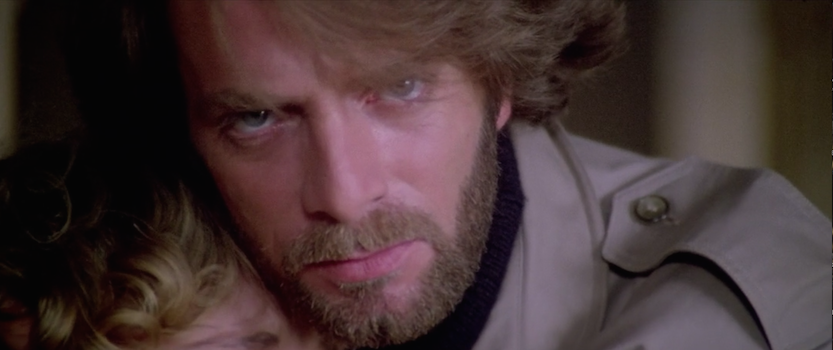
Norman stares directly into the camera a lot - for the same reason most actors never do: it's uncanny 

In an international film center like Italy, since the language / dubbing is always so iffy from language to language, and there are so damn many, much of any international film's power rides (1) on the ambient noise / foley / sound effects and a style of antithetical music originated by Ennio Morricone. Italian auteurs like Fulci know the tone of a whole film can change with a bad dub job (as in the terrible adult voice doing little boy Bob) but no one can argue with the magnificent way an innocent child's sob of woe is folded into the sprocket-waves of a squeaky door hinge, or a woman's scream becomes a jazz horn. Thus the drive of these films is always based on sound, music, and enigmatic staring contests, rather than lengthy dialogue passages. And what dialogue there is, if meant to be enigmatic, thrives under flat renderings from voiceover dubbing artists, those familiar voices we hear over and over, from movie to movie, yet whose names we never learn. 

Walter Rezatti's score for House--rife with the kind of antitheticaly grandiose soapy themes mocked and indulged in equal measure by the post-Morricone composers of Italian cinema--surges between soapy melancholic grand piano and crescendoes of church organ-driven prog rock, taking enough long silent pauses here and there so we can hear the pin drop. It manages to capture also the weird way Fulci's 'melting thunder' time disruption editing mirrors across itself. Modern horror themes come rupturing out of its ground like oil gushers of the putrid dead in between cliffside romantic clinches so that sweeping concert piano virtuosity --which normally is my least favorite Italian soundtrack instrument--fits elegantly as counterpoint. That great semi-ironic Ennio-style antithesis brings depth and emotion in a way the more old-fashioned on-the-nose telegraph orchestration of Spielberg types like John Williams and Howard Shore cannot. As always with Fulci, this music is used sparingly, effectively, sometimes jarringly - roaring to life to cut off actors' last word or stepping on their first, with even what sounds like a 'play' button clicking in the mix. I've written too much in the past validating accidental Brechtianism to just presume Fulci 'missed a few spots' in the sound editing, especially with all those earlier marvelous musical flourishes.

Demerits for some terrible dubbing, especially by whomever did Bob, who sounds like he's always counseling a simpleton in a terrible 60s movie (which is why I can use that word) but that sense of wrongness again helps to give it all a nightmare fatalism. The dad's declaration after dragging the family away from comfy upscale NYC, proves a smug dismissal of their needs and concerns ("you're gonna love it, smell that country air")  is also strangely unconvincing --carrying no authority and raising suspicions he's woefully inadequate as a father. You could be coming to him bleeding and on fire and he'd wave it away as new school jitters. It can drive viewers insane but that's part of why it works as a nightmare logic parable -simple buildups from normal tiny incidents seeming slightly out of joint --the way no one in the family really hear what one another is saying - which is why Anna's ominous silence carries such a charge and says way more than all the generic small talk of the mother.


I AM LAZARUS, COME FROM THE DEAD 
(but as a kid, so no one listens)

Another example of Fucli's open-ended death/Lazarus metaphors (ala Mike Hammer --va-va-voom! Pow!): Bob, the child, racing in terror through a field, the camera running up behind him with the score roaring to life with crazy synth squiggles of twisted menace. He stumbles, falls atop a grave, the ghost (?) of its occupant's child, Mae Freudstein (redheaded child of horror Silvia Collatina) lifts him off the stone, grabbing him by his arm, which stays folded across his chest like he's in a coffin; Mae turns out to have been chasing him in a game of tag, not trying to kill him via ye old killer POV but now Bob has to run home for lunch. He promises -as we all did as childrem--to race back out to play as soon as he's done. Mae watches as he runs back towards the house before saying (with a robotic fatalism), as if he's right there next to her. "No Bob, don't go inside." but the score surges to life again and cuts off her last syllable.

By then we've already seen Mae in a flashback to her own period (Victorian, judging by the dress), earlier (and again later) saying the same thing, as if in a trance, and we've heard her say it to Bob while he's in a trance. Bob also hears her talking to him from the window of the old photo of the house before they move in, so one ghost friend in the early 1910s is having a conversation with a real boy in "present" time (1981). Fulci give us both sides of the divide, illuminating the flexible immortal quality of film narrative as a perfect medium for ghosts and 'shining.' The girls admonition in the graveyard --"you shouldn't have come, Bob" has a chilling unemotional frankness far beyond the capability of either of them to convey proper terror.

It's not like Bob really has a choice, after all, he is a child and in no position to refuse his parent's moving days. If a child tells his parent not to move somewhere because a girl in a photo told him not to go, they'd just laugh and roll their eyes, think he just doesn't want to leave his local friends or sexy babysitter. Yet even after moving in, when he sees his new babysitter's head bounce down the stairs, Bob is still unable to convey the gravity of the circumstance to his mother. She's the type of parent who-- if you came to her covered in bruises-- would chide you for scuffing up your new pants and send you to your room. Of course from that horror then comes the comedy of Bob shouting down into the basement: "Ann! Mommy says you're not dead!" And then his walking down the stairs to find her, knowing full well something killed her down there, is the stuff of pure shouting "Bob you idiot!!" a the screen.

This is just one of the ways Fulci builds terror in a viewer, the raw molasses slow illogic after all that high-toned paranoia reaches back to the fatalistic dread of kids who aren't heeded until it's too late. It's the big fear preyed on in all the best horror films, most recently in Let the Right One in and It Follows, of being a kid in danger and adults around either unwilling or unable to notice or give your fear the slightest heed. Not until the blood runs under the door will they believe you and even then will rather believe it's somehow a result of your own morbid imagination or your own fault.


NIGHTMARE LOGIC III:  Schrödinger's Cat People

House opens up with a mini masterpiece of generating suspense - we pan  up from the gloomy house and there's a gorgeous young women getting dressed by a table where clearly she's just been getting it on with some unseen boy mere moments ago. She's talking to him on the presumption he's off-camera (we never see him... alive). Because of the dusty remoteness of this house we glean the young couple's love is forbidden (probably both living with theur parents), passionate (you'd have to be ripe with sexual heat to get it on in such cobwebbed gloom), and doomed (no one knows they're there, of course, so won't be looking for them). This is not an uncommon way to begin a film, I'll grant you. But rather than the usual exchange, the whole scene is just her talking and slowly realizing he's not answering and must be in the basement, her fear level slowly generating from blithe babble to screaming. Fulci regular Daniela Doria is the girl,  counter-orbiting with the camera around the copulation table in ever wider arcs, introducing us to the house in the process --which is caked in dust now but presumably won't be after the credits. While many Italian filmmakers add weird touches and tricks from Hitchcock etc., Fulci's trick is to cut right to this terrifying scene, like paring away Argento's operatic style to establish a sense of powerless unease in the viewer using very little in the way of backstory, plot, or other stalling tactics. Good writing can convey more mood and information in a glance or line than three pages of lame exposition and that's the case here--all the details add up so that after barely a few minutes of elapsed screen time, the house itself seems doomed, and all who would enter into it are goners. The basement especially is cavernous and foreboding, the kind of place where it's better to just leave it be, and you're not sure why--but we feel it, too, in our bones along with the setting wintry New England desolation.

As a result, what might be just another dull opening murder of a naughty young girl and/or boy leaves dread in the air like a radio key.

Later: The real estate agent's corpse is dragged across the kitchen and down the stairs, leaving a wide streak of blood; the close-up of blood on the wooden floor is suddenly interrupted by a sponge coming into frame. We wonder for a half-second if Dr. Freudstein is actually cleaning up after himself, but then we see the floor's being cleaned by Anna, throwing down a big mop and bucket. But is she cleaning the real estate agent's blood or was the blood gone before she started cleaning? Is she in league with Dr. Freudstein or is Lucy just hallucinating and by now shrugging it all off (or is it the dead bat blood from earlier still uncleaned)? Lucy comes into the room in her robe, "What are you doing?" she asks. Anna gives her an enigmatic look that could mean either a) what does it look like, genius? You people leave blood everywhere (in other words, Anna think Lucy has been killing people and is now just being coy - maybe planning to blackmail her). and b) I'm going to fuck your husband. But instead, Anna finally says "I made coffee."

haunting stare from House by the Cemetery

Playing more or less the same enigmatic character in each film, she rarely speaks, but her eyes speak volumes. Just seeing her drive by or appear in the music class in tandem with the letter in INFERNO is to get an exciting chill that unfortunately the rest of the movie can never quite match.

In HOUSE BY THE CEMETERY (1981), Pieroni gets a substantially bigger but equally enigmatic role (though she does wind up killed), where she plays the nanny, Anna. Here her ominous silence contrasts with the incessant generic small talk of Lucy, the family's neurotic mother. Anna's eyes seem to say 'cut the crap' with every glare at her: "What a shame you didn't come with us to the restaurant last night" Lucy says, for example, as Anna is cleaning the floor. This gets a knowing, vaguely contemptuous and cuckolding reaction shot stare that could be read many ways, as its no doubt meant to. This ambiguity even continues with the implication Anna is bringing a tray of coffee to Norman at this desk (we see the tray eye view) -leading us to expect she's going to sit on his lap and ask him to read to her, like Lolita sat on Humbert, but instead, the surprise reverse shot reveals Lucy is actually behind the tray, as if she's trying to regularly reverse the usual red telephone course of events. Later Lucy comes out onto the street with a bag of groceries and we think we see Norman driving by in the car, but he doesn't see her or pull over to help her, and just drives on. Did Lucy drive the car and he stole it, leaving her to walk home with two bags of groceries through the woods? Did he say he was going to NYC but really is hanging around the library, listening to disturbing tapes of his predecessor's rantings (accompanied by POV shots of Freudstein's 'workshop' replete enough gore to repel most anyone --no matter how fake most of it looks)? Or did he ditch his wife in town so he can race home and have a quick tryst with Anna?

It would be unfair to make Fulci account for the lack of resolution in all this unspoken
'let's drive the wife insane' red herring anymore than in the 'almost affair' between Richard Harris and Monica Vitti In Antonioni's Red Desert. There's no trope or cliche that sits still and allows us to situate ourself into what kind of movie this is, which again maddens the materialists and paranoid neurotic hausfrau narrative film clingers. They can argue that since nothing comes of it, plot-wise, it's just a waste of time that goes nowhere, that it's just another Italian fooling around with the bag of enigmatic stare tricks so beloved of Italian auteurs and absinthe surrealists.

I would argue that it's because this approach generates a sense of paranoia and unease that it spooks off those materialists, because they don't get that it's the spooking off that was the whole intention, like saying horror movies aren't supposed to be scary, so you don't like Halloween. If you submit to the alienation ambiguity as intentional, it makes the later horror events seem further and further abstracted, so that when they finally cohere from the ambiguity, they come too close to home for easy laughing off. It's like the auteur convincing us the danger is coming towards us from far away, pointing it out in the distance, and then when it's about half-way, stabbing us in the neck and running away (do you get that reference?). 

Fulci's critics wouldn't dare say, for example, that Hitchcock wastes our time with the Melanie Daniels'-Mitch Brenner meet-cute romance in The Birds or Marion Crane's embezzlement in Psycho -- at least not as confidently. Well, Fulci does the same thing Hitch does, only within the confines of wordless stares! In all three examples, Hitchcock's Birds, Psycho and Fulci's House, the suspense and fright comes seemingly from left field - we're not given to expect birds or knives or monsters in the basement in any of these three films because the cinematic signs are all lining up for a different movie, one we've doubtless seen: in The Birds it's the story of a spoiled city heiress / streetsmart moll finding love and meaning while hiding out in a small rustic community (in the vein of The Purchase Price, Green Acres, He Was her Man); in Psycho it's a sexy noir thriller, of the sort where a woman embezzles a wad of cash to run away with her handsome cash-strapped shirtless lover (too many to name); in House by the Cemetery we think we're headed first to a slasher movie, then a ghost story (ala The Shining), then a torrid sexual affair movie where a babysitter and a husband plot to drive an already-neurotic wife insane through mixing LSD into her downers.

The latter plot was widespread in the age of the"Valley of the Dolls" era-- (the 60s-70s), when pampered, confused wives got separated from reality thanks to some blue pill given to her by a man who keeps saying he's her doctor, or husband. Is he arranging the subsequent gaslight-style scenes while he's off on 'business' to make her think she's hallucinating and drive her to suicide? Put strong acid in her Valiums and play weird tape recordings of dead husband's voice under her bed (as they do in The Big Cube?) and get her to jump from the high window down to the sea while you're safely miles away with perfect alibis? 


But, once they get you expecting this kind of film, these auteurs got you at their mercy; they can then use these expectations to make you even more neurotic than one of the rich neurotic housewives from the type of movie your unconscious mind had been fooled into thinking this was! 

If you that was confusing, maybe you should lie down... you don't look well. 


One final deep fractal example of this style of alienation trick as a tool to generate paranoia and fault line dread might be found after the post-bat blood / real estate lady blood / Anna's mopping / enigmatic stare scene. It's later that afternoon: both parents are out and Anna is alone in the house with her charge, young Bob, who's playing with his remote control car in the living room, wheeling it and around and under chair legs and into the hallway and back. Then the car turns a corner toward the kitchen, moving out of his sight as if overtaken by a rival signal. The car sound stops and uneasy quiet settle over everything; Bob turns the corner, hesitatingly, wondering why it hasn't driven back. But it's gone. There's no sound of it revving at all, but the basement door, which is usually locked, is wide open (we heard no sound of the car clunking down the steps though). With a shock (we'd forgotten about that door), we flash back to the introductory scene with the young lovers (just replace the suddenly unseen/unheard boyfriend with Bob's toy car and the sequence is the same). Bob goes slowly down into the gloom to look for the car and disappears from the frame.

A moment later, Anna comes into frame and calls to him, but he doesn't answer. She too notices the basement is open, looks down the basement steps, and slowly goes down to look for him. Suddenly the door slams shut above and locks her in and some shadowy thing comes moving towards her from the far end of the basement. She starts screaming. Bob is somehow now upstairs, oblivious!

It's so simple, and such a logical progression--from the remote control car disappearance to the babysitter locked in a cellar--that it shatters our concept of time and space, erasing in a flash our distance from the event onscreen (in the chain from toy car to babysitter, it's only one link more to get to us).

She screams for Bob to open the door as the monster shambles towards her out of the gloom. It takes awhile for us to even realize Bob even hears her and is trying to work up his nerve to go down and open the door. While she screams his name, he's slowly collecting his stuffed Curious George and flashlight, and then slowly, leisurely walking down the stairs.

The glacial pace in which Bob suits up to walk across the kitchen floor -taking his sweet time -as she's cut to ribbons on the other side of the door is maddening, a borrowing of a similarly maddening sequence from Lewton's The Leopard Man stretched even further, and yet we certainly can't fault Fulci for choosing this pace. All but the best horror auteurs do the reverse, they move the pace of events faster and faster, but the brave masters of the genre know that to really heighten suspense and dread, one must slow down rather than speed up -- real nightmares seem to take place in knee-deep molasses.


SPOILERS

If it gets too frustrating to see a whole, one-armed family helpless to escape a limping armless dead man who can barely shamble, to see them all cowering helpless and screaming when it would be a simple thing to chop off his other arm (or at least use more than one of your own in defense) well, that's how nightmares are and who knows how we'd really act and maybe that's where the horror is -- the realization that if the shit got heavy enough we'd crumble into a sweaty sobbing ball, too. At least, in this case, we can imagine the terror really is overwhelming - that this thing has been living below them in their locked basement all the while, and has been for over 70 years, repairing himself through fresh victims. This is the first time they see Freudstein, and the last--as if the full horror of his shambling maggoty cadaver is so overwhelming it paralyzes his prey, jamming life's record so bad it hops a groove and leaves you screaming on an eternal skip--a kind of instant repression black-out back to the beginning--to when old doc Freundstein was still really alive (never seen in the flashbacks, involving the mother and nanny instead).

That's why the film's chamber piece momentum works so well, almost like a three-act opera, as all the paranoid 'almost' sub-plots evaporate in the cold finality of the basement, the illogic that a row of corpses could be strung up down there without the smell carrying upstairs through the same crack in which Bob crawls for his own escape (trying to fit his head through that narrow crack provides one last nerve shredding moment that stretches forever) into Mae's and Mother Freudstein's sympathetic decades-departed arms--is so startling, original and final. There is no death but what we make for ourselves, which is called waking up, the alarm clock of your tender throat, raw from claw-choked screaming, pulled up from the pillowy grave like sluggish Lazarus Jr. by a girl who died before your mother was born, to a world with its own set of rules, but the same damned house. Or to put in layman's terms, it's the end of The Shining if its Danny who wound up at the party in 1929, or at least upstairs with a babysitter and those cool creepy twins... forever... and ever... but way cooler, even in those fusty old corsets. 


NOTES
1.(since it's going to be dubbed and subtitled in about 20 different languages, Italian film tradition is to shoot MOS (without sound) or silently - each actor in the international cast speaking his or her own language and then dubbing their part for that country's track, ideally, and voice actors in that language doing the rest, which is why nearly every character in Italian horror sounds like one of two or three different voice actors. No one knows their names or where they are - the invisible heroes of the business- as a voiceover actor myself I say their stories must be told!

Thursday, October 06, 2016

Occult Streams of the Amazon (Prime): 13 Witching Hour Picks


The welcome and most unholy arrival of this year's big new horror classic, THE WITCH, onto Amazon Prime last week signaled the month (my favorite) of all unholy magic has arrived. Time for great hauntings and macabre classics to come streaming like a running flow of witches o'er town and dale.  Lucky then that--as I wrote re: their Vampiredeliction last week--though Netflix has shied away from the ratty old rarities and sideshow bargain basement found objects, Amazon Prime has more than picked up the slack. Every micro-genre category of October horror now can now hold its own special list, were a man mad enough to make it. This here one, the Occult-themed film list, stretches from silent films from 1922 up until present day, linking Middle Ages gynocide to 70s ouija boards and forward to modern direct-to-DVD scrappy indie gems with surfeit of imagination and paucity of purse. So let the fall foliage crumble in lovely dark red and purples in the crispness of your knobby knuckle caress! We shall collect them for a recliner to plant before our tombstone screens. Wake thy imps from their velvet cloth slumber --the tape's unwound! So to speak.

PS  - as before, each film is rated both for film quality (factoring personal preferences) and image quality (as in the HD clarity, restored crispness/color, etc of Prime's streaming print --which is subject to change)


1. THE CHURCH
(1989) Dir. Michele Soavi
**1/2 (Image- B)
It's long (feels longer than it is), convoluted, and it tries to keep too many balls in the air, but this DEMONS variation makes great use of a vast ancient church set, and involves a treasure map mystery, Templar massacre, and Rube Goldberg-esque Freemason contraptions stirring to dusty life after half a millennia, opening the pit and releasing a horde of long-buried evil spirits and then springing ancient magical masonry traps that close every exit so no evil can escape --but neither can the assortment of tourists, archivists, restoration curators, priests and--as luck would have it--a school field trip and a fashion shoot--that all happened to be in the church at the time the gates and locks swung shut. Like so many horror films dealing with witchcraft, this has its cake (those Templar murderers were wrong to slaughter cute hippie chicks), eats it too (but they were/are real, and evil), and then brings it right back to the store complaining its stale and demanding a refund (so we have to kill them again). As with Soavi's other masterpieces, Stagefright: Aquarius and The Sect, there's a gorgeous olive green tinge to the darkness and a weird playful sense of metatextual humor if you know where to dig for it, as all sorts of little side plots set themselves up and then resolve themselves differently at the last minute from how your sixth horror film sense tells you it will. The model from the shoot (Antonella Vitale) is nearly suffocated in an expensive, beautiful white wedding dress after it's caught up in the gears locking the front gate (with the wardrobe mistress cutting each stitch with tiny scissors while Vitale complains and slowly strangles). There's a Rosemary-style devil copulation (a running theme in Soavi's late 80s-early 90s work), unsettling near-incest with Asia (as her character's working slob father is possessed), hallucinations, gory murders, and a relatively keen sense of who is where in the cavernous space at any given time, which is no easy feat of continuity in an Italian film with so many little bits of business.


Co-written with Lamberto Bava and Dario Argento, this stars Argento company regulars Barbara Cupisti, Asia Argento (when she was still a kid), and Thomas Arana. The music is credited to Phillip Glass and "The Goblins." There's occasionally some annoying prog courtesy Keith Emerson, but most of the time it's quiet enough you can pray to the blessed virgin sans distraction (yet still in vain). The image is a little fuzzy but I think it's always looked like that - on par with Soavi's other films - lots of gray and dust filtering the light. If the CHURCH isn't very good when held up against Soavi's STAGEFRIGHT, THE SECT, or CEMETERY MAN, it still holds up better than most everything else in its league, genre, and field.

(1962) Directed by Sidney Hayers 
***1/2 / Image - A

What makes this film work is its moody black and white photography and AIP talent roster, including Corman Poe screenwriters Charles Beaumont and Richard Matheson, who always instill 'classic' material with an edge of modern wit that does nothing to dispel the unease and terror. It's directed by Sidney Hayers, a TV director who's worked on The Avengers, and Baywatch, among others, but hey - it's all about the script and the actors, and these are top flight, even if there's nary a familiar face in the bunch: Janet Blair is the wife, Peter Wyngarde the brooding Rod Taylor-ish lead, Margeret Johnson the limping rival; Judith Stott an amazing and odd face as the charmed co-ed.

I've been shy about this film since I was afraid half of the running time would be spent with the husband condescendingly lecturing and belittling his wife about her black magic habits. He does, but she fights back with scathing wit and makes her conversion to logic something that's a result of her own self-doubt, rather than his stern paternal berating. Part and parcel to this left brain belittling the right thing is the whole code-enforced demoting of women from sexy independent thinkers to smiling slave drone Stepford wives. I love women! I think they're great / they're a solace to a world in a terrible state. What a nightmare to have no women in the world (Lou Reed). Or as BWB shows, it's a nightmare either way, but beautiful (Bing Crosby). Filmed in black and white, BURN has the arty photography of the British countryside, rocky beaches, and cloudy English skies of the British new wave, and stands up against the cream of Hollywood's post-Lewton / Tourneur ambiguous shadowy whispering.


3. BLOOD ORGY OF THE SHE-DEVILS
(1973) Dir. Ted V. Mikels
 ** (Stream quality - B+)

For this alcoholic, a great simple throbbing synthesizer score goes a long long way towards paving over rough spots (what Carpenter called a 'carpet score' - i.e. it avoids micromanaging). Good old De Palma's preference for high-falutin' longhairs like Hermann and Rota can get a little overwrought, like one long music video for the orchestra, but here in Mikels country a nutcase named Carl Zittrer plays 'special electronic music' that's just one crude sustained repetitive drone that's occasionally broken in on by organ and drums. It works with the crude imagery, like some magic enchantment. Mikels directs the whole thing like he's ingested too much mandrake root and didn't pay his light bill. Lucky for us, this Amazon print/image has blacks so dark and deep they seem to creep down some dreamy dangerous and dusty cinematic alleyway between Kenneth Anger's ceremonial magick outsider art and a Sam Fuller primitivist pulp nightmare. You start to get that Temple Drake-style 'being really wasted at a party and suddenly you look around and everyone you know has left and the room is now filled with sketchy strangers giving you weird looks-style feeling. It's a feeling embodied the high strangeness of the lead witch Mara (Lila Zaborin), who stresses every word of her weird rhyming spells as if channeling Mickey Rooney's Puck in the 1935 Rienhardt film version of Midsummer Night's Dream Together with that Zittrer drone, Zaborin's intense, drawn-out, vaguely amphetamine-tinged hypnotic trance chanting can make even you--at home and half-asleep--a believer.

The scenes of her group of sexy acolytes dancing around prone male victims with spears, their hot midriffs and long legs driving innocent Christian viewers into the embraceable flames, connects it all in some vague way to Hammer's Prehistoric Women (1967), in a good way. What I mean is, I could have used more of these dancers, less of the weird bouncer guy with the fur hat (he looks like he could be Tom Savini's dad screen-testing for The Hills have Eyes) who just stands around looking inscrutable. Before and after these dances, various coven members stare into mirrors and hallucinate their past lives as witches being persecuted by intolerant sadistic townsfolk, priests, or knights. A scene of a girl forced to watch her child mercilessly flogged while she's burned alive is pretty vividly etched and quite painful to endure. There's also Native American dances, and a pope trying to exorcise a woman and then having her stoned to death by the locals when he fails. It's all very appalling and surprisingly well done, with decent crowd scenes. Since the bulk of the film looks all super cheap in dark and dingy rooms in Mara's mansion, these strong scenes offer a curious juxtaposition.

One tangent has Mara accepting a contract to rub out a crusading politician at a cocktail party via totem telepathy. It works, but the client tries to kill her rather than pay up! What kind of idiot doesn't honor a contract with a woman who can kill through telepathy and voodoo doll torture? A dead idiot, that's what kind. There's also a pretty weird seance, maybe the most amateur-creepy since Ed Wood's Night of the Ghouls. In other words, this is clearly a 'can't-miss' Halloween option, perfect for that coveted 4 AM slot. Interesting too that the film so covertly judges the 'good' guys: a normal hetero couple visit Mara's house for some cheap thrills, but then run for their lives when they realize it's legit. They tell a 'good; doctor, known for his ability to "psychometrize" objects ("Some people devote their entire lifetime to study of the mind!") Though we're never sure why this 'average' couple deem her such threat, the Christian doctor is determined to bring Mara down. "There's a sabbath going on in this house at this time" he notes from down on the street as her cool LA pad glows in the dark. Surrounding the house on all four sides with powerful 'good guy' warlocks, he shoots some painted-on lightning and kills everyone inside. After all, he had a right to! Their politics disagreed with his! Christendom is 'saved.' Not even a rubber bat shall be suffered to live.  

(2016) Dir. Robert Eggers
***1/2 / Amazon Image - A

Shrouded in portentous gloom and ominous droning electric cello, THE WITCH (2015) is the first great woodsy pre-Salem devil film in 300 years, a SHINING for the ANTICHRIST x BLOOD ON SATAN'S CLAW subdivision of the HAXAN community (with a dash of the recent HONEYMOON if you're keeping track). Set in 1630s New England on a small patch of farm and field, surrounded by deep (if leafless) woods, it's a character piece that delves into the same dark patch of the soul that many witch and devil movies make feints at but then run away from, i.e. the actual dark superstitions and folk tales, court records, and the twisted folk horror stories of zonked-out American mystics like Hawthorne, Poe and Ambrose Bierce. First time-writer/director Robert Eggers shows flair for the milieu and the genre both, making the narrative work by being straightforward with the paranoia and the reality. Not unlike ROSEMARY'S BABY it functions on both conscious and unconscious levels. It's an historical look at repressed female psychic energy in a patriarchy and the validation of that patriarchy's fear of the dark.


Anya Taylor-Joy stars as Thomasin (above, amidst deepdreamgenerator pareidolia), a naif to the menstrual age, who prays valiantly for deliverance from sinful thoughts but nonetheless falls prey to shady woodsy pagan strangeness, especially once the baby disappears on her watch. Kate Dickie, brilliantly unhinged, is the salt of the earth mom slowly dissolving into the dirt from the loss. The loving yet ineffectual dad (the nicely deep-voiced Ralph Ineson) can do nothing but try, fail, and then shy away from all blame. The son, Caleb (Harvey Scrimshaw), is the sacrificial Barleycorn offering of a young lad starting--since there are no other options--to lust for his developing sister. Running rings around them all are moppet evil twins and a strapping horned goat named Black Phillip who is possibly the embodiment of Goat of Mendes i.e. Baphomet, or maybe just a buck in heat or in the early stages of rabies. Somehow, that goat steals the show and miraculously never seems CGI fake or badly cut-in to appear to not be doing naturally the eerie stuff he's up to. There's also a rabbit and a raven, filmed in such a thin grey light we feel the ominous ambivalence in their empty eyes. They might remind you, as the did me, of being a small child terrified by some strange small (but big to you) animal. That THE WITCH conjures such tremulous memories via just showing a frickin' hare just sittin' there in the deep dusky woods speaks to the film's unholy power. (more)


5. SATAN'S SCHOOL FOR GIRLS
(1973) TVM (prod.by Aaron Spelling & Leonard Goldberg)
*** (Image - C)

A smooth occult TV movie prelude to both Charlie's Angels (1976) and Suspiria (1977), this Spelling/Goldberg joint stems from the halcyon days of relaxed morality, a time when free love and occult practice alike were mainstream-sanctified and girls' schools were allowed to have their male teachers host wine parties, and tell the students to "condemn nothing.... embrace everything... and hang loose" and it was all alright. Future Angels Cheryl Ladd and Kate Jackson are students at an all-girls college where there seems to be only two teachers: both groovy men--Dr. Delacroix (Lloyd Bochner)--who goes crazy imparting the secrets of mind control via a relentlessly-squeaking rat maze--and Dr. Clampett (Roy Thinnes), who teaches art and encourages the girls to embrace their own hallucinatory perceptions: "What we think we see is as real as what we actually see." Dude, that was like our mantra in my 4th-5th grade combined (artistic-minded) class! And maybe in the 70s in general. The less-cool Delacroix meanwhile talks about how terror makes rats and humans alike irrational and suggestive. Jaime Smith-Jackson (who'd just come off Go Ask Alice!) worries she may be next and drops to the hallway floor shrieking in terror between classes for no conceivable reason. Pamela Franklin (the girl-child in The Innocents who'd just come off shooting Legend of Hell House) is Elizabeth, secretly investigating the supposed suicide of her sister (Terry Lumley) whose ironed dirty blonde hair and red sweater / denim jacket ensemble kick things off perfectly in the paranoid opener. Jackson--wearing devilishly long straight black hair is the smart girl who helps Elizabeth with the mystery while espousing the wondrous powers of professor Clampett ("he can't help you if you fight him" she tells her). The all-of-a-piece low-key acting (only Jo Van Fleet's conflicted headmistress hams it up) and lengthy scenes of crackling thunder and blowing wind, girls walking around in their nightgowns in the dark, with a lantern illuminating their scared but determined young faces, all add up to laid-back 70s TV horror movie heaven, or... the other place... Satan, where do I sign?


The print on Amazon isn't great but it's the best we've got and at least the bulk of the artifacts are actual celluloid damage--green lines, cigarette burns, inconsistent color, blotches etc. with very faded color, but it's not blurry or obviously a VHS tape-transfer like some other TV movies floating around. It's over pretty fast and there's nary an uncool moment, so if I were you I'd join them.


----


(1944) Dir. William "One Shot" Beaudine
** / Amazon Image: B

It might be hard to appreciate the beauty of Voodoo Man without the background of having being what Forrest Ackerman called "a monster kid" in 1960s-70s, when it was on local TV in Saturday afternoons a lot, introduced by various horror hosts or just flung onto screens with no warning. If you decided to stay inside and watch it, expecting Lugosi and company to make it worth your while, you'd be forced to admit you made a mistake. But to understand why that mistake was still worth making, and why we look back on this movie now so fondly now, first you must know the combined pain of artsy introversion, blase parents, clingy little brothers, and allergies. OR maybe, if it was in the theater, you needed to understand  the pain of losing sweethearts to Nazi or Japanese gunfire, the pain of soldiers heading overseas to face death at the hand of foreigners and hoping their young brides or sweethearts stay 'on ice' as it were. If you understand either audience, and the way strict censorship tried to wheedle every drop of horror out of horror movies, then maybe you will know the joy we all found in Bela Lugosi's insane megalomania as he broke through all restrictions to do whatever he wanted. Here he hypnotizes, and dresses young women in ceremonial robes and then uses them in weird soul energy transfer voodoo rites to bring his catatonic or dead wife back to life. Sound familiar? He did the same thing in Monogram's Corpse Vanishes a few years earlier, but that time he was truly evil -here he's sympathetic. The film itself isn't very clear about if it's supposed to be the victim's souls going into the wife's body, or vice versa, making it incoherent to a nine year-old Lugosi fan. Where's the monster, we wondered? Why is George Zucco wearing the funny hat with the feathers? Who does voodoo happen in a remote house instead of the jungle? Had the studio no potted fronds?

VOODOO MAN suffers from disrespect and the hostile derision not only of critics but itself (the writer hero disparages even his own past 'voodoo movie' scripts) but we monster kids were used to being told stuff we liked was crap. And we raged against boredom and against every bedtime and in this refusal to kowtow to life's petty rules we really found a kinsman in Lugosi. It didn't matter how bad everyone else was in front of and behind the camera in these dull murky dramas, Bela was the star and he 'got' our pain. He was how we imagined we'd be as adults, for we couldn't imagine life without our world-conquering mania. Bela never phoned it in. His banal surroundings made him glow that much brighter - not unlike ourselves trapped in the tedium of suburbia! 


And this has George Zucco.... in a headdress, acting up a solid 1/2 a shit storm of no tomorrow with mouthfuls of gobble di-gook probably made up on the spot. In these scenes lies the bliss kernel inside the bland screenwriter headed to a wedding shell. Not even John Carradine's painful hamming as an imbecile assistant (which I realize is for the censors--so he scans too childish to molest the zombie brides beyond petting their hair)--or the condescending attitude of the hero-- can dampen the glow, the passion, the moistening in Bela's eyes when he thinks he's finally waking up his sleeping beauty. Life.... to.. death! (more)


7. HAXAN: WITCHCRAFT THROUGH THE AGES
(1922) Dir. Benjamin Christensen
**** / Amazon Image - A

The definitive documentary / dramatization on the 'science' of the Middle Ages, this weird but essential tract on hysteria examines one surefire cure to the problems of overpopulation and unmarried old bitches in the days before women had rights --witchcraft accusations. We follow two different relatively minor incidents which balloon into wholesale slaughter and torture of the innocents. In the first, the father is dying of some unnamed malady; the wife suspects witchcraft; a passing old lady makes the mistake of dropping by to steal bread, and that's all it takes. Event follows event, and soon the entire household is rounded up and burnt at the stake. In the other: a horny young monk can't stop fantasizing about some local girl, so he renounces her as a witch.. Sooner or later all the women confess to lurid fantasias of midnight orgies in the middle of the woods, orgies vividly brought to life as Bosch-style horrors coupled to a Bruegel drunken peasant woodcut facial wrinkles. It might have been made in 1922 but the scenes of the monks laughing and drinking while torturing poor old women to death are pretty Eli Roth-style gut-wrenching. Luckily, there is also a scene of witches kissing the devil's filthy ass like it's a new bride at a wedding reception line; a devil feverishly churning his witch pole and flicking his tongue with enough lascivious obscenity to shame a Pazuzu-possessed Regan McNeil; flying witches on brooms; stop motion imps breaking through doors; flying gold pieces always just out of reach and banquet morsels that turn to squirming toads at first bite --all of it brilliantly-rendered, like some wild datura root nightmare come to life.

On Amazon Prime we have the (to me, superior) 1968 rerelease restored version --the one with a strange and wondrous free-form jazz score (crazy avant garde percussion and the violin of Jean Luc Ponty) with the intertitles replaced by narration from William S. Burroughs! He not only covers both the intolerance, hysteria and the fantasy but begs further thought, especially as regards modern Satanic panic / conspiracy theory / UFO abductions and so forth, as they survive to this day. Did the constant heart-wrenching torture these girls endured unlock past memories through the shattering of the mind and body? Supposedly this how the CIA creates split personalities in its sex slaves and assassins! I muse more on this all over on Divonorum Psychonauticus. 

For those of us familiar with the film through old shitty grey dupes, the Prime transfer is a whole other beast. See it and shudder at the fathomless depths of your own crazy species and all we do not know about where our narrow space-time dependent conception of reality ends and the timeless madness of the collective subconscious begins. 

8. SOUTHBOUND
(2015) Dir. by Roxanne Benjamin, Radio Silence,
David Bruckner, Patrick Horvath
*** (Amazon Print: A)

Immeasurably fueled by the Gifted's wildly retro-analog synth score, this scrappy anthology offers an array of southwestern Satanists, demons, strange voices on radios and cell phones, and world-weary bartenders, all aiding and abetting various characters driving down a stretch of American Southwestern highway someone calls the 'ass end of purgatory.'  Some characters are mere innocents on the wrong turn of their lives, some stuck on endless loops of karma and demonic pursuit, and do they even know which is which? It's as if the idea of watching a film obsessively over and over is more than just the strategy of neurotic film lovers striving to avoid their own existential mortality, it's what lies beyond as well. Some of the vignettes are scarier or funnier than others, but the cumulative effect is one of droll pleasure mixed with that anything-can-happen WTF dread we used to get from Tarantino and his spawn back in the 90s, back when our genre narrative expectations were first used against us with some regularity.

To be honest, those narrative expectations are why I've never been a huge fan of anthology horror films. Too often they rely on lazy scripts full of banal set-up and see-it-coming-a-mile-away twists, by which I mean all the stuff from Britain's Amicus or America's EC comics. Soutbound on the other hand, is more Sin City than either of those, albeit with a quietly remarkable absence of misogyny (there's even a girl director for one segment). Stories range from a Satan-worshipping 'normal' family recruiting most of an all-grrl rock band, to a very chilling and nightmarish trip to a deserted ER, a misguided 'rescue' by some old crazy brother for his long-missing biker tattoo-artist sister, and a murkily-motivated assault on a vacationing family that is almost--but never quite--explained. The patter of the local DJ (rockin' Larry Fessenden) ever-present on all the vehicular radios, unites the tales, not in theme or direction, but in Wolfman Jack-cum-Red Sovine highway philosophizing. But unlike the Crypt Keeper or Alfred Hitchcock, Fessenden's DJ doesn't add bad puns or plothole putty, just keeps the existential road homilies flowin' like a steamy asphalt ribbon down the line. Drive on, good buddy, whether you can't get off the highway and home before dawn, remember one thing: If yer an American, the endless highway already is home. Drive it and never look back, good buddy, because the Bickle freeze-frame rearview glance might be y'alls last, or already was.

9. LITTLE WITCHES 
(1996) Dir. Jane Simpson
*** (Image - B)

It's in full screen if you can believe that but damn, maybe it was never in anything else. I certainly don't remember it in theaters though I imagine it tried to ride the success of the very similar high school girl clique coven flick, The Craft. Much as I like that film and much as critics disparage this one online, I think Little Witches is better. The only advantage The Craft has over this is that career-defining badass performance by Fairuza Balk. Well, this one has a great evil witch performance too, from the lovely dark-haired Sheeri Rappaport. Rocking an insane midriff and baring her (thankfully un-augmented) breasts with diegetic abandon (but sans ickiness), Rappaport is quite a heart-stealer., and it doesn't have the yucky Skeet Ulrich either, adhering more to a Satan's School for Girls format, set an all-girls boarding school, this time Catholic, but with the same chosen coven of orphans and kids whose parents don't want them home for the Easter holiday, i.e. spring solstice!

Unlike SSFG, there is one boy toy character to deal with: a dumb hunk construction guy whose crew uncovers a walled-off room off the campus rectory, exposing a deep well/pit to caverns leading to the sea, and a gaggle of skeletons of missing girls from decades earlier. The (living) students--bored and under-chaperoned--find themselves returning to the uncovered room in the dead of night, again and again, driven to perform unholy rites for reasons that wouldn't make sense to the sober layman (dormant evil has the ability to make you think summoning it forth is your own idea, that is to say, some evil witch made you notice the Ouija board for sale and think it would be 'a lark' to try it --and that witch is the one who answers your attempt to contact those who've 'gone on').


Horror royalty Jennifer Rubin (Elm Street 3: Dream Warriors, Bad Dreams) is the cool nun in charge of the girls; Jack Nance is the priest; Poltergeists's Zelda ("this house.... is clean") Rubenstein is the requisite blind nun tasked with the holy Sentinel-style duty; one of the assembled girls is a very young Clea Duvall. Allow it.

Anyway, where we we, again? Oh yeah --the unholy powers are summoned. The Good Friday solstice convergence threatens reality as we know it and the Lovecraftian tentacles from beyond the door loom like a checkered flag.  Rather hostilely, Arrow in the Head notes that the film is too on the fence about what it wants to give us: "the sex is too soft (no lesbian scenes or sex scenes) to satisfy the [XXX] hounds and the horror too weak to thrill the genre fiends. I don’t even know if the film is supposed to be a comedy or not." But to some of us, Arrow in the Head, that's the very thing (or lack of) that makes it great! Once it's one or the the other, a comedy, a sex film, or a gore fest, it's boring. What Little Witches has that's unique is the in-between, the fluid genre-traversing. I also appreciate the hard-to-duplicate naturalistic Hawksian overlapping rapport between the girls, and the film's refreshing freedom from all the typical characterization shorthand we associate with the boarding school supernatural misadventure. There are no dumb pranks, gross gags; there's no slut-shaming, doofus boys leering through keyholes and snickering about scoring, or dullard parents loping in at the wrong moment. I like the sense of the supernatural arising slowly and naturally, almost like a joke at first but then, like the frog in the boiling water, too late to escape. I'd say anyone who hates on this film is a misogynist idiot whose fate is decreed by the unholy raiment of the Illuminati Sistren shish boom blah blah blah.

Probably, I'd be wrong.

Rapport sexy Linda Fiorentino eyes
Dig Rappaport's Linda Fiorentino-ish brunette feline fierceness
10. CHANDU ON THE MAGIC ISLAND
(1935) Starring: Bela Lugosi
**1/2 (Amazon stream Image -D+)

It's sometimes hard to figure why Bela Lugosi got such mean treatment from the studio system, but films like this may offer a clue: the unsteadiness of opiate dependence (so vividly, if compassionately, chronicled in Ed Wood). A lifelong drug addiction can be controlled, even harnessed, with an endless prescription from a connected quack with the ability to prevent the star from taking either too much (which would make him nod off and miss his cue) or too little (which would turn him into a twitching, sweaty, wild-eyed basket case). The 'too-little' part seems to be Bela's lot for Return of Chandu, the serial from which Magic Island was edited. Perhaps a simple "booster" from a studio doctor (if you were at a studio big enough to have one on call) could have knocked Bela into the outfield of calm, centered brilliance (as he demonstrated in The Black Cat the same year at Universal) but there was likely no studio doctor on a B-movie serial set like this one.

I generally warn you away from Amazon streams with the poor image quality--and this is one of the worst in this list-- but I've never seen a good version of  Magic Island's source material (my old two-tape set of the original serial looked just as bad) and, at any rate, the condensing of 12 dull chapters, keeps it lively; and the blurry pixelation gives weird accidental oomph tto all the shimmering spellcasting. Everyone has a glowing aura/halo and the crystal ball, stirred fountain effects, and fire pit all shimmer like some kind of yard sale surplus Max Reinhardt fairy dust.

Adding to the weirdness is that Bela plays Chandu instead of the villain (confusing those of us who loved him as the evil Roxor in Fox's Chandu the Magician from 1932) and even has a girlfriend in Princess Nadi (Maria Alba). Bela, with a girlfriend? He's more the dead wife type. Sweating, overwhelmed, wild-eyed and messy-haired, in ill-fitting white khakis, Bela can be hard to look at unless you do as I do, and pretend Bela's Chandu really is a junkie and that his (good) magic is the power of mightly Narc-Anon and the evil black magic is centered around opiates; the imprisoned white magician Tyba (Jospeh Swickard) is a friend Bela's Chandu makes in rehab; Chandu/s ancient guru is always reachable via crystal ball, i.e. like a sponsor available on speed dial; and scenes like where he's tied up and tortured with the crushing stone almost an exact mirror of the tortures of withdrawal. So even if --at times-- you'll want to bitch slap Lugosi's character for just standing around letting people get hurt rather than speaking up or launching a spell; and you'll wonder why he keeps toting a big ungainly diplomat family all over the Far East and subjecting them to danger nonstop while he just stands around sweaty and horrified and passive. I say, forgive him, as I have via your magical fourth step. Then keep this film on your Prime watchlist for emergencies.

 Sometimes just taking the edge off is paradise.

11. WITCHOUSE
(1999) Dir. David DeCoteau
*** (Amazon Image: B)

A simple story set in a very cool mansion about a solstice celebration, thrown by well-heeled Goth girl Margaret (Ashley McKinney) for a disparate bunch of Dunwich schoolmates, who come heedless of the fact they don't like her. Do they know their Puritan ancestors burnt her ancestor, Lilith (Arian Aulbright), as a witch 300 years earlier, and Lilith's been revived for the party? The pentagram is drawn. The lights are low. The mansion is gorgeous, and yet some don't give this DeCoteau-via-Charles Band joint a chance since it's shot on video and the witch make-up is kind of Sid and Marty Kroft rudimentary. Actually, Witchhouse looks fantastic once you give it a chance, thanks to patient Romanian craftsmen who use a stunning array of candles and oil lamps instead of unnatural electric light (Band had set up shop there, hiring talented local crews for cheap). There's all the requisite types for that film's totemic sacrifice: the stoner comic relief, the sex addict couple, the dumb jock and his hot blonde punk rock girlfriend, the bookworm hero and the hot-but-doesn't-know-it bespectacled girl. It might be the lamest party ever (pot and whiskey are nixed by buzzkill girlfriends) but the basement seance works like a charm and that natural lighting compensates one hell of a lot, as does woozy camera work (when magic is afoot the camera sways drunkenly) and there's a great sense that the whole mansion is lit up for running around in, rather than just in some static scenes - so the camera goes careening after the actors as they tear all over the place in this huge beautiful house and it's all in a very grand. I love that the uptight smug film major is the first to get zapped and he's the loudest at just saying no - preferring to stay all tense and bothersome--and clearly we're meant to cheer his demise --and we do! And I love that the stoner's girlfriend gets to knock out Lilith with one punch ("I coldcocked her," she flatly declares "and locked her in the other room"). Even the magic laser effects are well done.

L-R: ---Brooke Mueller (the rocker type); seance; Monica Serene Garnich (the cute nerdy type)

So, like Little Witches (above), what we have here is a lesser-known, underappreciated spookshow that's neither all the way sexy, funny or scary. That may bother some folks but I appreciate how unburdened by covertly-misogynistic it is. It may not be that great, story-wise, but so what? It's not trying for anything it can't achieve--it knows the spell we want to see it make, and it makes it. I dig the low-key acting of some of the characters, the engaged acting and clever writing--how innocuously yet lovingly the cinematographer keeps the candlelight in proper atmospheric balance (total termite). There's nothing to upset your babysitting charge's Puritan ancestors, with just enough aching "c'mon and kiss her already" tension that one five second kiss is all the affirmation they need to die for each other even though they just met. Ah kids.

Maybe I'm just partial to the ancestor-of-Salem vibe as I myself am the grand child of Dorothy Perkins, therefore a "direct" (?) descendent of several Salem community 'witches', including Mary Easty and Mary Edwards. Seeing films like this I wonder if I should enact some kind of unholy black magic revenge on their behalf? The simple fact is, 320 years is a long time to hold a grudge. Just to be safe, though, I bore witness against the thinness of Sherri Moon Zombie's lips in my review of Lords of Salem.

Lastly, it might help to have grown up reading/watching shit like The Hardy Boys and Nancy Drew to really resent (as I do) the way gore and graphic sex and sexual assaults are so regularly rubbed in our faces, sex demeaned through pathetic dog-like rutting smash-cuts employed as a cheap shortcut to amping up the intensity. Then again, I'm very particular - the list of things I dislike in my go-to horror films gets longer every year, especially if there's any depressing imprisonment, puerile douchebag snickering, misogyny, or garlic. Witchhouse may not be as stealth great as The Eternal, but it's similar enough that I forgive it all trespasses. Plus the bond between Lilith and Margaret is cute -it's like she's the cool 320 year-old eccentric aunt who visits on the holidays once a year and the niece falls under her sway and gets into crystals and the tarot or something. You know the type? Neither turns on the other as a final bloody twist and the nerds win in the end, but who gets to rock out? Margaret and Lillith. Witches give snitches stitches and damn right they'll be back in another 320 years, whether anyone shows up to fuckin' ever drink that whiskey or not! Fuckin' lightweights
---


(AKA "ANOTHER")
(2014) Dir. Jason Bognacki
**1/2 (IQ -A)

Proof you don't need a huge budget and a ton of scenes or even a sense of linear time in your film, you just need to have done enough drugs, meditation, therapy, or arguing with a manipulative mother to know how slippery identity and self perception really is. This film by newcomer Jason Bognacki shows us he may qualify.  His 2014 debut has q cute young pharmaceutical intern's 18th birthday shift interrupted by the sudden arrival of her absentee body-hopping immortal mother. Guess whose body she wants to inhabit? Lynchian para-sympathetic matriarchal ellipses and horror hallucinations and dreams-within-dreams, make it harder and harder for us to figure out what's real as our plucky intern tries to learns the truth about her coven heritage. For witches, it seems, blood is not only thicker than water, it's the sewer tunnel through which immortal spirits scurry like rats under the river of the centuries. If you have access to a pharmacy, so much the richer.

Newcomer Paulie Redding brings a marvelous range of expressions as the possessed intern: we can instantly tell who's possessing her at any given time. The Skelton Knaggs-nosed Maria Olsen--playing either her mother or herself or her ancient ancestor, makes a terrifying shadow/devouring mother archetype. We feel the futility of trying to fight one's genetic matriarchal heritage (even with rebel 'good witch' guardian Nancy Wolfe trying to help), the same way we feel it's futile trying to convince relatives their politics are wrong at Xmas dinner. Bognacki trusts his imagery to structure a story within the viewer's paranois, sparing him the duty of linear explanation (which seems counter to the workings of real druggie magic anyway). 

Clearly this was originally a short, being stretched to feature length by any means necessary (dig the way the director bides for time by slowing the end credit scroll to ten minutes!) but that's not to denigrate a very promising and unusual debut. Even possessed by Lymcjoam tropes, it remains quite itself.

13. THE ETERNAL 
(1998) Dir. Michael Almereyda
**** (IQ - B)
Like a few other films on this list, I'm shocked at the afforded hostility of the average critic over the loose drunkard druid revisionist  meditation on Irish horror novelist Bram Stoker's Jewel of the Seven Stars that is The Eternal. Have they even seen it? Blood from the Mummy's Tohand that winds up possessing a young Victorian daughter of a catatonic Egyptologist. The book is great, like Dracula, Stoker seems obsessed with a kind round the clock vigil over endangered hotties whose past lives either are these ancient demons or were in love with them. Either way, that ridiculous faux K-horror erotic video cover is terrible, the title is meaningless, and even the other title 'TRANCE' is bad. Michael! Call me I can help! You could have called it She-druid Drunks of the Iron Age - that's just off the top of m'head. And whatever you have against this film, film critics at large, admit that Allison Elliott is sublime in an array of roles, and the idea of a devouring matriarchal druid ancestor jibes very well with the other films on this list, so even though I've written about it a dozen times already (see: Inescapably Her Iron Age Druid Bog Mummy Telekinetic Alcoholic Hottie Self) I had to include it, do you understand? I didn't have a choice!! 


And for Almereyda heads out there, Prime has his first feature, favorite of everyone ever in the world who's seen it (all sixteen of us), 1989's TWISTER, (no relation to the 1996 Jan De Bont action movie), a strange family movie with Crispin Glover, Harry Dean Stanton, Dylan McDermott.... hell yeah.
Also: 


SUGAR SKULL GIRLS
(2016) Dir. Christian Grillo
*4/5 (Image - A)

If Phil Tucker (the 'genius' behind Cat Women of the Moon and Robot Monster) took a bet he could film an all-ages girl power spookshow with just his daughter and her slumber party friends, a few very odd guest stars (such as Michael Hills Have Eyes Berryman) over a single weekend, then this is proof he won that bet. For "adults" of all ages, this is perfect for parents who are trying to turn their ten year-old daughters away from the Neon Demon and the hentai watched by their peers and towards their own Labyrinth / Power Rangers past. It's a demonic Power Puff contingent for the freshly pierced, something the less mature children can show their younger siblings after trick-or-treating - to both laugh at and with, and even get the gist of what good Brechtian so-amateur-it's-genius is all about.

As Prospero says in Corman's Masque of the Red Death, the best swordsman in Europe wouldn't fear the second best, he would fear the worst.  SSG is proof that terrible pacing, clunky editing, amateur acting and muddled writing can be overcome through pure muttonheaded moxy.

I also will ascertain at this juncture I know no one in the cast or crew, have not been sent a copy or courted via emails to review this, I just found it floating in the Amazon stream, like all the rest. Let us give thanks this day, for in my childhood this kind of distribution was a foolhardy dream. The label putting this out is 'Potent media' and their symbol is an inverted pentagram. Something is amok, I mean amiss. Yet I found it - floating in the 'similar titles on Prime' and for a hot sec I felt once again like a single digit-aged Ed Wood fan finding a surreal K. Gordon Murray kiddie import on the 5 AM movie as I waited for ISIS... and SHAZAM.

The DEVIL'S HAND
(1962) Dir. William J. Hole
**
I have tried to see this all the way through a few times but it seems like little more than an Alfred Hitchcock Presents or Karloff 'Thriller' episode padded with a lengthy scene of coven members sprawled on divans watching a floor show of devilish beatnik jazz dancing and bongos. That said, mileage may yet vary if one day feathers prove the ploy. Bruno ve Sota lurks amidst the divans, the Satanic honey trap (above) has excellent posture and look fast for...nah I won't spoil it.

BAY COVE 
(AKA [Easy] BAY COVEN)
(1987) TVM - Dir. Carl Schenkel 
** (IQ - C)

The mid-to-late 1980s TV movie was mired in a lot of regretful fashion choices: pastels, shoulder-pads, Ray Bans; perms, sweatbands and spandex bouncing to aerobics videos, and Armani narcissists like Tom Cruise and Richard Gere who honestly thought that by playing narcissists who finally get their heads out of their own asses, they're somehow 'heroes', that any step forward out of their narcissistic materialism should be accompanied by a parade of gorgeous women's admiring tears. That said, by 1987 we were wising up to such tinny bombast, and we had the abortion affidavits to prove it.

What we needed was a fresh start. Really fresh. We needed to get out of the city, with its boardrooms and Venetian blind-and-cigarette diffused lighting, and get back to small upscale communities with sinful secrets, and farther back still, to harvest sacrifices and chanting covens.

So come thee, hetero DINC couples, to Bay Coven, or Cove as they call it (to throw the persecution-crazy Christians off the scent). Here in this isolated island community ("only" 45 minutes away from San Francisco!), an unholy pact has resulted in all the original members being still alive after 300 years. Their secret: sacrificing the descendants of their olde thyme persecutors. You know, business as usual.. in the '90s... the 1690s. But now they need new blood for the circle, so its time to recruit Timothy Hutton and and his sexy wife (Pamela Sue Martin!), and to welcome them to easy Bay Coven!

We're left with many unanswered questions. The main one: who the hell does the script think Woody Harrelson is? Did the citizens use their magic to kill Pamela's brother and why no mention Woody was her brother until after he's dead? Confused? I am.


Well, I know it's a lot to ask, but if you can handle Pamela Sue Martin's post-New Wave shoulder pads and unflattering Cherry Hill perm and don't mind the movie's stubborn refusal to try even one original plot point of its own instead of "borrowing" everything (right down to the dream sequences) from 70s touchstones like: Let's Scare Jessica to DeathCrowhaven Farm, The Stepford Wives and The Dark Secret of Harvest Home, (and of course, the one they all borrow from -- Rosemary's Baby) and if you're not dissuaded by its dated ersatz neo-noir look (the muted blue-and-grey shot-on-video colors) and you're doing something else at the same time, like laundry or homework, to keep yourself distracted, then you may like Bay Coven or Cove.... whichever.

Maybe that's the whole reason the whole family used to love these old TV movies in the 70s: they were never meant to be original or riveting - never meant to absorb our full attention, never meant to disturb us, or bum us out. They were designed solely to keep us watching through the next commercial, to keep us mildly absorbed but never fully enthralled. We'd joke about lame dialogue or inept special effects while sharing popcorn, guzzling Coke (for the kids) and highballs fort the parents and being able to follow the plot while eight other things were going on--Monopoly games, babysitter pony rides, general carrying on (see also: Satan's School for Girls), talking on the phone (and when a bit older, making out on the couch).

Now that we can watch entire seasons of disturbingly violent and vivid TV shows in one sitting--no commercials, no respite, no return from reality--all that social connection is fading.  The sheer number of options leaves our attention span too short to watch anything less than instantaneously riveting.

Maybe what we need is a fresh start. Really fresh. We needed to get off of TIVO with its brutal SVUs and back to the simple joys of 70s TV horror movies. That said, this is from 1980s.... hand me the sacrificial scythe.

SEASON OF THE WITCH
AKA "Hungry Wives"
(1972) Dir. George Romero
 ** / IQ - C
This doesn't get a lot of love due its hopelessly trite surrealism, depressing aesthetic (terrible greasy paleface make-up that everyone seems visibly sweating under, close-ups of middle-aged faces with yellowed long teeth), and dialogue way too close to how annoying friends of your mom actually used to talk. Sure it's directed by George Romero, sure it was made between Living Dead and The Crazies. Nonetheless, it's too dingy and too didactic to work as either horror or 'cracker factory' polemic. It's like hey, we get it: like so many women in the early days of "women's lib," housewife Joan (Jan White) is bored and sexually frustrated. Her bland husband barely seems to notice her (and vice versa) and she's got nothing to do all day--she thinks--but laze around dreaming in surreal shorthand. Even her witchiness is boring. Honey, we all have to suffer against the sucking tide of societal indifference towards our own inertia. Toying around with New Age accoutrements like it's not just another form of isolation consumerism is not 'doing' anything. And no offense to Romero, but do we really need another man telling a story about the troubles faced by women at man's hands? Instead of just laying around in bed all day dreaming of being led around on a leash by an uncaring bored (impotent) husband, why not get a job, or write your own damned movie? Go work as a dominatrix in the afternoons and you can lead the men around on the leash instead like Catherine Deneuve. Or at the very least, maybe volunteer at the animal shelter.

LATE ADDS:
Since this post more cool titles worth seeing have come out on Prime:
THE LOVE WITCH (review/essay here)
THE WITCHING starring Pamela Franklin! 
Related Posts Plugin for WordPress, Blogger...