
It's hard to say if Jack Hill 'gets' women. The holy father of Pam Grier and WIP (Women in Prison) films, Hill has never shied from lurid sex-sensationalism, but at the same time never belittled, demonized, or completely objectified even the most minor of his female characters, balancing sensitivity with raucousness, insult with retribution, violation with vengeance, and growth over puerility. Sex in a Hill film is positive and empowering. Social change doesn't preclude hedonism; 'morality' and 'the law' fall apart under the female's avenging knife. In a morally restrictive / excessive country like America in the 60s-70s, Hill was, even for today, forward thinking to the point of an implied threat. His murderous cannibal nymphs are the real heroes, no matter who they kill; the grabby lawyers on the other hand, can never be saved.
Either whether all this makes him a feminist or a counterrevolutionary chauvinist, Hill is one of the all-time great drive-in auteurs and stands tall with initial mentor Roger Corman in delivering the drive-in's biggest array of strong female characters. His oeuvre stretches through two decades of variable budgets with many films long available only in shit condition. But life... can be beautiful, and this has been the golden retrospective summer of the mighty Hill. Arrow alone has given us PIT-STOP (racing), SPIDER BABY (carving), and BLOOD BATH (painting) in black and white. And in bleached color but with vivid reds and greens, SWINGING CHEERLEADERS (pouting) and SWITCHBLADE SISTERS (sticking) - Go ladies go!
Shout, Olive, Scorpion, etc. have released the rest. We now have the entirety of the Jack Hill oeuvre available, cleaned up in--mostly--HD sparkle, and fit to marvel at. Many of these discs feature Hill commentary tracks with Elijah Drenner. In case you're unfamiliar with his work, AMERICAN GRINDHOUSE, Drenner is a fine, casual but informed interviewer, knows his shit, and is as a big fan of Hill's as I am, and maybe you are, bringing a balanced blend of reverence and analytical curiosity that never muddies over into pompous pretense the way, say, Peter Bogdanovich's Hawks commentaries (1) do, so that clicking over to the commentary track during one of these great Hill discs is like watching it with the pair of them on the couch, and you're comfortable having them there; they won't embarrass you if your girlfriend is half-listening while reading her phone, or chew your food for you, so to speak, by explaining every last wry in-joke.
The DVD company Scorpion put out SORCERESS from 1982 this summer, too, Hill's last film, for Corman (or ever) and if you're Hawksian then you're also Carpenterian and thus a Hilliard because if you add Carpenter and Hill together you get Hawks, more or less, and if ever a man was holding a bull by a tail, you're it.
I'm too frazzled with excitement to clarify that enigmatic uttering (if you get the reference, you're a Hawksian), so I'm gonna just lay it all out in the grand style of my cannoneer forefathers, i.e. chronologically. First this post for his first four features (in black-and-white), then, later, the color. And then when the smoke clears and the flying tiger bat god of SORCERESS disappears back from whence he came in the sky, we will know... if Hill truly 'gets' women. Or die tryin'.

BLOOD BATH
(1966) - ***
It's not perhaps a coincidence that this approximation of a "movie" comes out on Arrow the same summer as their long-awaited remastering of BLOOD AND BLACK LACE (1964). Mario Bava's seminal color-drenched protean giallo quasi-masterpiece, BABL "speaks to" the idea of art's pinnacle being the killing of a beautiful woman - sex and violence so commingled as to be inseparable. Strutting along the line between lurid exploitation and self-aware qua-feminist statement, riffing on the world of the California beatnik artists ala Corman's 1959 epic BUCKET OF BLOOD and prefiguring Argento's groundbreaking BIRD WITH CRYSTAL PLUMAGE (1968), BATH is more interesting in its larger context perhaps than by itself. Thanks to Arrow's comprehensive packaging and great psychotronic guardians like Tim Lucas on the supporting documentary extra, BATH can finally be appreciated both within and without its context, illuminating the way one movie became two and then four (and all four are included). So far, I've only seen BLOOD, as that's the Hill one. But I know from the documentary it started out as a Hungarian spy thriller, with two versions being shot at the same time, one in English by young Francis Coppola, neither any good. Then back home, Corman gave both to Hill, who shot more stuff around it and took the boring bits out, to make BLOOD BATH. Then, later, Stephanie Rothman shot more so it would fit in the TV slots, and it was TRACK OF THE VAMPIRE. Crazy, pops.
William Campbell (STAR TREK's go-to fop) stars in Hill's version as a crazed painter / reincarnation of an infamous descendent (also a crazed painter) who was burned at the stake based on the testimony of his insane (and insanely hot) model/muse. In flashbacks we learn she danced around the fire and laughed as he burned alive, his canvasses providing the kindling. The horror then is twofold: not just of dying but of being assured your work will indeed not live on, will not lead to some century-later museum show like Van Gogh, because it's all destroyed in front of you as you die. That's the real terror in that story, for are not all obscure writers and artists comforted by the idea of posthumous immortality? I know I am. If you read this and I'm already dead, then right there, for example - I live!
In the best scenes, Campbell tries to paint various local babes he lures over at his stony loft and each time no sooner as he laid down a black background than he sees his ancestor's crazy anima/muse/accuser laughing and sneering at him from inside the canvas' wet surface. In classic Freudian projection, he kills the local babe currently posing for him for revenge, dousing her in hot wax (which he keeps bubbling below his pad) and posing her as a sculpture (his past 'work' just lies around the loft, trying not to sneeze or laugh while wearing what looks like a few dabs of oatmeal on their faces and arms). Meanwhile his "Dead Red Nude" series (painted before or after) sell like hotcakes at the coffee shop gallery in downtown Venice Beach, a dive haunted by a trio of beach bum types (Sid Haig, Jonathan Haze and Fred Thompson), their eyes agog at every new misogynistic abstraction.
William Campbell (STAR TREK's go-to fop) stars in Hill's version as a crazed painter / reincarnation of an infamous descendent (also a crazed painter) who was burned at the stake based on the testimony of his insane (and insanely hot) model/muse. In flashbacks we learn she danced around the fire and laughed as he burned alive, his canvasses providing the kindling. The horror then is twofold: not just of dying but of being assured your work will indeed not live on, will not lead to some century-later museum show like Van Gogh, because it's all destroyed in front of you as you die. That's the real terror in that story, for are not all obscure writers and artists comforted by the idea of posthumous immortality? I know I am. If you read this and I'm already dead, then right there, for example - I live!
In the best scenes, Campbell tries to paint various local babes he lures over at his stony loft and each time no sooner as he laid down a black background than he sees his ancestor's crazy anima/muse/accuser laughing and sneering at him from inside the canvas' wet surface. In classic Freudian projection, he kills the local babe currently posing for him for revenge, dousing her in hot wax (which he keeps bubbling below his pad) and posing her as a sculpture (his past 'work' just lies around the loft, trying not to sneeze or laugh while wearing what looks like a few dabs of oatmeal on their faces and arms). Meanwhile his "Dead Red Nude" series (painted before or after) sell like hotcakes at the coffee shop gallery in downtown Venice Beach, a dive haunted by a trio of beach bum types (Sid Haig, Jonathan Haze and Fred Thompson), their eyes agog at every new misogynistic abstraction.

More so even than BUCKET, it's this deconstructing/deflowering of art as misogyny even with this (relatively) decent beatnik trio (vs. their coterie of strong, sexy take-no-crap girlfriends) that foretells what will later be best in the Hill tradition (and arguably lead to accusations of misogyny against folks like Bava). When art for a man involves bloody women, something's wrong. Red flags abound! "You're a little naive when it comes to men," a fellow expressionist/ballet dancer puts it to Sordi's virginal (therefore spared) girlfriend (Lori Saunders) at the dance studio, but she's the only one in the film who is. Buxom beauty Marissa Mathes all but devours little William Campbell at his studio (he gets the better of her only via drugged wine); Sandra Knight pursues him, thinking he's the killer of her roommate, until he turns into a big blonde Czech and pursues her, and the demoness laughing in the painting taunts him, urging him on. In short, the women are tough, and he's a weak, deranged lunatic, driven to kill by his amok demon shadow anima.

Besides, say what you want about these cats' misogyny, they really do love art. And when push comes to shove these three are the only ones the endangered girls can depend on for help against the weird vampire/Walter Paisley concoction that is William Campbell. Their misogyny is all on the surface. By contrast, there are no cops in the film and when girls in the burly blonde vampires' sights (i.e. Sandra Knight) try and beseech locals for help said locals are all too drunk and dismissive to help. Knight's futile beseeching of a party of masked revelers who--instead of taking her seriously--just dance with her, and even try to push her into the vampire's arms, thinking he's in costume and they're acting, recalls a similar scene in Lewton's Seventh Victim... . Her final end on the carousel, the spectators not noticing her screams for help are the most perfect evocation of one of my key childhood nightmares.
It's those nightmare moments that really casts a mood, conjuring deep dreads associated with being a kid trying to convince adults someone is really hurting you or chasing you and they either ignore you or shrug you off, so locked up in their false sense of permanence that they can't or won't recognize you're in real danger. The only time they snap out of it is when she tries to jump off the carousel, then they all but throw her back into the arms of her killer before blithely skipping off to their own doltish fates. It's a harrowing, brilliantly executed--if frustratingly fractured--part Herk Harvey, part Jacques Tourneur--moment that marks Hill as a real auteur in the works. One wonders why he made so few horror films. Really this and SPIDER BABY are the only ones and that's a comedy. He could have been a unique beatnik Lewton and cranked out a legion of future bargain classics. Like his and Tourneur's Leopard Man, the murders might be gore-free but they're difficult to watch, even today, especially the super eerie European-filmed murders, which skip in and out of the film like a concurrent nightmare reality ever slicing its way into a totally unprepared Venice.
Sorry if this review's disjointed - why should it be different than the film, man? Look at the sea under that boardwalk during the big sandy brawl with the vampire, that's where Dennis Hopper was almost dragged to his death by Knight in Night Tide. She's also the girl in this film killed on the same carousel Dennis Hopper stares at, and Knight was married at the time to Jack Nicholson! In short, now that we have Blood Bath so refined and fine, it's as if a crucial lynch pin Venice Beach beatnik jigsaw puzzle piece is at last in place. No one gives Knight any credit as one of the creative forces of the era- but Hopper and Nicholson are regarded as titans of art. That figures.
DVD Review: A+

(1966) - **1/2
And don't worry, he gets what's coming to him by the end, more or less, and his elegant wife (the very sexy and alluring Adele Rein)--up to this point so hopelessly bored and sex-deprived she winds up shooting heroin and making love to herself in the mirror (a very groovy scene)--meets a guy dressed as Dracula at the big costume party climax who takes her to a big orgy, where she loses--and so finds--herself. Aside from her date having one the worst post-sync Transylvanian accent ever, Adele's the film's true victor. In the commentary Hill lets us know the actor who did the accent is really a helluva nice fella, seriously, but that accent is almost as nauseating as the human salad bar or drunken shaving cream pool scene. Why it wasn't re-done in a director re-cut or left out altogether is just one of those things - half-star deduction!
Pros: Hill's camera captures the moon and string light reflection on the shaving cream coated surface of the pool after all the orgy revelers have straggled off to bed and the ripples stop; its texture reflects the lights like some kind of murky 3-D ant's eye view of a flat ice cream soda idling in a midnight bus boy bin. Adele Rein is gorgeous and our heart bleeds for her - we'd be good to you, Adele! Her crazy groovy house (actually Lamb's) is 60s California architecture at its best.
Despite its issues, this is clearly a Hill film. Between the photography and the gorgeous Rein you're bound to find something you like, and if it gets boring you can listen to the lively commentary between Elijah Drenner and Hill, who explains Lamb's penchant for ripping off pornography mail order customers (based on footage in the movie, it's clear Lamb's behind the mysterious Tortura album that used to be a tripping "favorite" in my old hippie house). Always a welcome presence on a lot of Hill commentaries, Drenner's adroit at keeping the focus on the action onscreen and the pair have a fine rapport. We learn Lamb shot the excellent underwater stuff with a camera he personally designed. He was cuckoo for scuba and big game hunting! Not cool the last one, Lamb.
 |
| The lovely Vicky Wren (Reine) in her and Nick's ultra hip 60s LA pad (dig the Brady Bunch style stone wall) |


SPIDER BABY
(1964, released 1968) ****
See my piece on it back in the day, with Blu-ray update yonder, though I ain't never yet been able to write about it to my full satisfaction. (full review)
Arrow DVD review: A+
PIT STOP
(1969) ***1/2
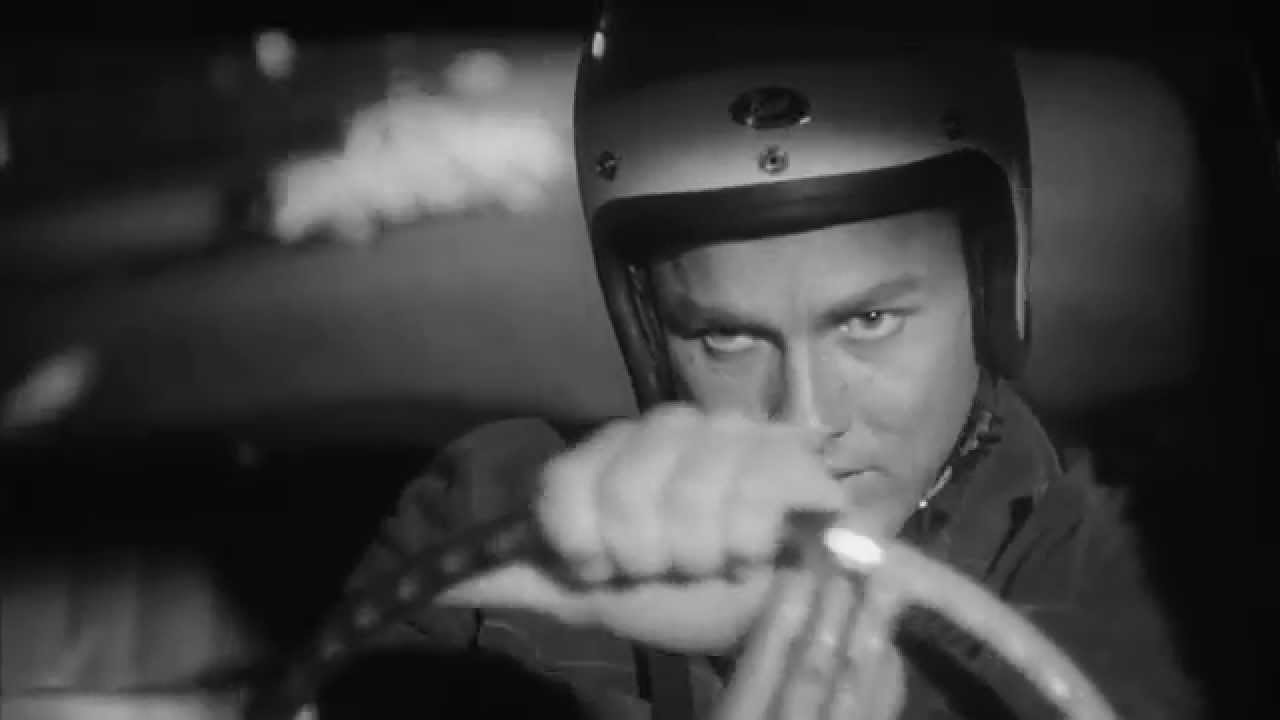
The second best movie about drag racing after Two-Lane Blacktop, Pit Stop has a sporadically slurring Brian Donlevy as a shadowy race promoter Grant Willard, who sees star potential in surly drifter Rick (Richard Davalos) after watching him crash through a department store window. Grant gets Rick a job at a junkyard, and tells him to build himself a smashable car for figure 8 racing, which is as dangerous as it sounds, especially around the crossover-middle of the figure-eight-shaped track. Damn cool idea if you love big wrecks! The big ace wrecker/racer of Grant's stable, Hawk Sidney, is played by--who else?--Sid Haig. Hawk gets so mad at Grant for stealing his girlfriend (Spider Baby co-star Beverly Washburn) he beats the crap out of him and then takes an axe to his car! Is it Sid's ultimate craziest moment? He's had so many, how can we know? It's up there, let's say that. Alas, like Spider Baby (which was filmed in 1964 but didn't get released until 1968) before it, Pit-Stop had a hard time finding an audience on its initial release, as black-and-white was considered passe at the drive-in (unless --like Night of the Living Dead, it offered something too shocking for color), and its a shame, because a lot of those color films from the era/budget look like shit today, but Pit Stop looks geee-yorgeous in this new "director approved" remastered HD Blu-ray from Arrow. Maybe even more so than when it was originally released, the full brilliance of 35mm black and white film is revealed. The silvery grays and deep blacks are so seductive you want to frame every shot and admire it over a period of years. The Blu-ray is maybe up there with Criterion's Blu-ray of Repulsion as far as capturing a late night surrealism that seems to shimmer holotropically with good silver cinematography. Real night (and even day-for-night) is now beautiful, dark and deep (if you have a good HD TV or projector, especially) instead of the glowing gray we've been used to for so long.
As a score there are some generic, but effective, bluesy rock songs played over montages of the lovely little junkyard: tires are hauled in around and hoods and parts and there's even male bonding as the songs grind and sway. I like that Rick actually grows--or seems to--as he moves from combative and surly to being nice and joshing around with the boys--which is an an unusual change for a montage sequence --another element of Hill's ballsy but effective strategy that contrasts Rick's character very well with Sid Haig's wild man figure-8 champeen racer. Tellingly, after parting with track scamp Washburn, Grant hooks up with another rival racer's mechanic girlfriend, this one played by the future Ellen Burstyn (above). Billed as Ellen McRae, her dry, low-key person suits Hill's equilibrium to a Valvoline-splattered tee. You can tell she's going to go onto big things (The Exorcist was just five years away), sharing some romantic clinches amongst the Imperial Sand Dunes that show Hill's mastery of day-for-night shooting, giving it all a delirious, dream-like air.

I'd go so far as it to say that, as far racing movies go, Pit-Stop is more Hawksian than Hawks' own RED LINE 7000... Mind you, it never claims to be better than it is. But for fans of the Hill, it's manna.
Arrow Blu-Ray - A+ - Another great Hill-Drenner commentary, gorgeous restoration, da woiks
--
CONTINUED
NOTES:
1. I know Bogdanovich loves Hawks, and he knew Hawks, but his explaining 'little jokes' in EL DORADO as if they're some pithy New Yorker cartoon being explained to a bored 12 year-old, sucks the wind out of them, like shellacking a soufflé. Drenner avoids all that,


