|
A staple of the game shelf over every 70s rec room closet.
|
When you're no longer afraid of being scoffed at for not scoffing at it, when you can let go of the borders between de-classifying known phenomena back into monsters and magic, masterful deep-cover short form found footage, deeper into deadpan-meta than a double Heidecker, a kind of retrogressive folk horror "return to subjective reality' movement (i.e. a future where anyone dressed slightly vintage seen otherwise deserted forest, graveyard, or tourist trap can become a black-eyed child when seen in an otherwise ordinary video), NY's hottest club is: Paranormal... Caught on Camera. Only on the Trvl Channel.
If you can surrender to its paranoid free association panel of experts, weird videos, stock footage and old time illustrations; if you can pretend the goalpost of conventional reality has been moved waay back; if you can be cool with intentionally believing yesterdays superstitions were never shamed into the Jungian shadows by conventional psychology., you can feel archaic primal electricity roaring back through your neurons. Jung has partnered up with the Travel Channel to usher those skittish superstitions back out into the sun of the 'visible' world. Come to the agrarian cult of the paranormal and get a taste of how wild and weird the world around s before stupid science came along with their stupid-ass naming and classifying and magicidal quest to bust up our myths. Take our diseases and ignorance, but leave us our myths, man. We need them. Disney can only string us along on fairy tale fentanyl for so long, if we don't get a hit of the real Grimm stuff soon, our roster of Jungian archetypes will rise up and drag us down to the mire, and probably take our place at the helm. Someone.... or some thing knows where they'll take us - but we know we'll end up beaching on the rocks.
Luckily then, for Paranormal: Caught on Camera, which rips a hole open in the floor and let loose the accumulated pressures of archaic folklore, giving the archetypes the access to fresh air they were craving. They roar to life, erasing years of science from our blackboards. Familiar animals are made strange again. Videos invariably show something that could be taken at face value (aka pareidolia) with a little effort. Thus our eyes are restored to those of children to whom the world is a wild, unknowable place. Tall black rocks seen from far away are possibly Bigfoot staring at the camera; ropes covered with ice chunks drifting down the winter river are sea serpents, misfired rocket boosters are strange UFOs. Just because a flying shield might actually be the sun doesn't mean you will die in battle against ancient Rome. Our beliefs make this world into what we see it as. So even if we know from other TV shows that a paradigm-shattering sign of the apocalypse may also be a bunch of silver balloons, or a dead sea serpent blob thing actually a chunk of whale blubber, or a flying witch a spider traveling by web parasail, we should keep it to ourselves, like religious views at Thanksgiving, you're not going to convert each other, so just let there be two answers. It's not going to make a difference to your daily life unless they're asking you for money. So if it gives some people the thrill of mystery and the return of myth, why bust their bubble like some third grade Santa-truther? If we're ever going to avoid Civil War II, we have to begin with this mutual respect of each others' realities along the conscious/unconscious divide.
And besides taken as a whole as an object/record of folklore, not unlike an Alan Lomax recording library, the show offers the perfect fusion of past and future, of living myth. Everyone now has cameras at the ready, along with infrared, and all sorts of ghost hunting apps - and they're using them to unearth glimpses of what before could only be relayed as campfire anecdotes. These videos which "catch" the uncatchable, make visible a small shard of our collective unconscious' broken dream mirror--even if we're just seeing what we want to see, we can at least see what that is, and just who inside us wants to see it.
At any rate. we can interpret--along with the assembled and very colorful group of talking head experts-- but we're can never see enough to get the whole picture. We're always so close, but, season after season, we never get closer. Maybe it's important to keep it that way. Knowing none of it is real would be too sad, knowing all of it is real would be too scary. But not knowing either way, we're like a cat chasing god's red laser pointer--if the cat gets frustrated that he never seems to catches it, well, he's looking at it all wrong. If he realizes the futility, gives up and goes back to loafing around, he's missing good exercise for his ancient hunter faculties. But if he suspects it's all an illusion, but still chased anyway, recognizing the benevolent hand of their owner behind the curtain but not letting on, that's myth in action. So even if you think you know the whole story, one way or the other, keep it to yourself, act 'as if' and don't ruin it for the younger kids!
1. JUNGIAN MYTHIC RESONANCE:
“I shall not commit the fashionable stupidity of regarding everything I cannot explain as a fraud." - Jung
The Ouija board: there is perhaps no better illustration of Jung's collective unconsciousness and its ability to manifest autonomous threads into the fabric of (conscious) reality. With everyone's hands on the planchette--presuming no one is consciously trying to consciously move it--the combined unconscious energies fuse together to generate an autonomous spirit, a combination fictional collaboration wrought by our inner children, and perhaps some real incorporeal spirit that's been waiting for just such a surplus of electro-magnetic energy to cohere into 3D time/space reality (the invitation of the ouija users being the equivalent of removing the password on your combined WiFi.) Sure, the answers the resulting 'it' gives may be nothing more than a fiction generated by our combined unconscious desires. Then again, it may be disembodied autonomous spirit, a shared ancestor / past life, or even a nonhuman intelligence, like a demon, using your combined unconscious energies like modeling clay to sculpt itself into a form you'd recognize in your collective memory. Be the demons that manifested at the dawn of civilization (daimons), personifications of the repressed energies that allow modern civilization to properly function (demons) or even elementals dredged up from the slumber of nature (elementals), these beings may transcend the boundaries of self, reality, expression, tine, space, and consciousness.
Then again they could be ghosts of people who lived in the area, or portions of their souls that never quite found the white light exit.
Then again, it could just be a lot of giggling and saying "you moved it!" "No I didn't! You did." and then moving on to some other game. That's my memory of it. And that's just as valid, in its way--that's what Jung's mythic archetypal landscape is all about. Sure it's your own inner journey translated into narrative myth, but it's also 'just a dream.'
But like all good myths, the Ouija board has evolved with each new generation of telephone game mythic improvisation. What was once a harmless spooky slumber party pastime has become the paranormal version of a loaded gun left in the dresser where your kid can find it. To the ghost hunters and psychics who've come to help you with your haunting, admitting you used one in the past has become the myth equivalent telling your doctor you still smoke three packs a day even though you have COPD. The look in their eyes says "you f**ked yourself'." Because you see, in today's world, demons are the ultimate catfish, the psychic internet predator to whom all prey--no matter what their age--are children. And everyone who ever used one, it seems, forgot to lock the front door before going to sleep.
 |
| Note figure running in distance |
2. LEGIT Creepines: Shadow People, Skinwalkers, Orang Bunian, Gnomes, Duende & Black-Eyed Children, Kuntilinaks, Reptilians,
I can take or leave all the videos of unsightly 'paranormal researchers' breaking into abandoned properties in search of subscribers to their YouTube channel. It's funny when they start yelling at ghosts to get a reaction, then running away shrieking in a panic when the ghosts oblige. And I can take or leave the nighttime UFO sightings - they could be anything from that far away. BUT those maybe-accidental captures of shadow people, poltergeist action, trail cams, security cams, and shaky stuff shot by quick-thinking normal people who suddenly see something really weird and remember to film it. Favorites include a strange naked woman/dog thing running around in the jungles caught by accident on some jungle snake expert's nature show; a sleeping panther/human caught on Skinwalker Ranch; a Belgian cyclist's glimpse weird lizard man dropping down into a creek bed in Thailand; a pair of deformed, shadowy orang bunian lumbering out of the darkness towards a foolish ghost hunter in Indonesia (lots of terrifying stuff coming out of Indonesia!); black-eyed children in the background of videos of some kid dancing around the living room' jet black shadow people suddenly peering around the corner or standing in the dark of the basement, darker than dark; babies and dogs reacting to some unseen thing in the corner; weird little monsters captures accidentally running around behind cupboards or reaching out to touch the hand of a kid playing in the closet, or appearing in a basement stairs doorway like some evil little black imp. I'm getting pleasantly scared just thinking about some of this stuff! And I'll take scared of the unknown vs. scared of some real thing.
I also love what I think may be legit ghost when there's an orb shooting by right before something weird happens, and it sometimes elongates or takes a kind of shape before melting away into some action. If any of this shit is real, it's these--and if these are real, than goddamned we live in a crazy world with dimensions far beyond what our human eyes can normally see, an' shit.
3. Earnest witnesses who are either great actors or legit scared out of their skulls
Sure there's a plethora of scabby dirtbag ghost hunters, a most unsightly lot in general (the American ones in particular, no offense) which casts--bearing their yen to acquire YouTube subscribers in mind--doubt on their findings-- but then something happens to them in their videos and they're scared out of their minds, running out of the room, shrieking in a high register nobody would ever intentionally fake. I mean, it not a good look. And either way, horror film actors should really take a good listen.
Most of the witnesses though are normal people from around the world who just happen to catch really weird shit almost accidentally, like little hands reaching out from corners to touch the child they're filming playing in a cupboard; shadow people peering around corners; people on motorbikes in India who pass some bizarre glowing white sheet wearing figure or large naked lady in the rain walking backwards - it sends them driving past, screaming at the top of their lungs. Nothing can stop the involuntary high-pitched shout and exhale screams that come roaring out of their mouths before we lose sight of the thing and the picture goes all chaotic as they race for their lives down the road, or stairs or back to their cars. I especially love the Muslin djinn hunters' in the Middle East, their panicky but rather lovely prayers when things get weird, all translated with subtitles on the show almost like poetry: "I seek refuge with the complete word of god, from the evil which He has created." one man shouts when things get weird. "In the name of God, the compassionate, the merciful " all rattled off in this mounting panic as they hear doors slam shut. It's worth its weight in gold.
Then again, they freak out over a smudge on a window because it's almost a face and they never think twice about pareidolia, which throws everything into question.
4. Folklorist Lynne McNeil
Here is the kind of folklorist/paranormal expert I like: Lynne regularly espouses the correct dualistic approach towards the paranormal, recognizing that a perceived phenomenon may eventually have a scientific explanation without losing its mythic heft. In a landscape marred by reductionist either/or-ness, McNeil brings this eternal paradox into the mainstream. She gets the fluidity of meaning, so concentrates instead on gut reaction, the relevance of folklore's eternal function as the sonar we use to sound the abyss of our collective and personal unconscious. And she knows just what to say that makes the video scarier, even while slyly placing it in the context of folklore rather than conventional reality.
She has the best understanding of how beliefs affect reality as well as vice vera ("You actually draw things to you with your attention to them.") as anyone I've heard, outside of Jung, Patrick Harpur, and Graham Hancock, because she's not afraid to seem like a flake rather than professor, and at the same time is clearly vice versa. G'head, Lynne, keep this shit grounded in a mythic folklore contest, even while treating it all as possibly real as well as psychically symbolic. It's all three, and more.. "We romanticize an openness to belief in children, and we pathologize a belief in adults--we think adults should be over that by now, and that's incredibly unfortunate that we do that because belief is one of the most therapeutic tools we have - if we could get over this inclination to either totally oversell it or totally over-pathologize it, we might actually be able to do something really important and useful with it."
Well put, sister. Belief in a higher power is endemic to survival if you're an alcoholic--fight it as ye may--and the tighter mainstream science circles its wagons, the closer they get to the church that used to burn them. Getting the two to work together--like Col. Potter pitching placebo pain killers in MASH after the drugs run out--and almost nowhere else.... except if ya like to get campfire urban legend-style scared!!
5. Brian Cano
Stoic, slightly wistful, Cano's gently measured brand of freeform sincerity and soul-eyed extempore is the gentle heart of the show. To paraphrase one of his own comments, he makes me question my skepticism. He talks like the camera like he's working the Burning Man chill-out tent, distracting some dosed-out 16 year-olds with supernatural wisdom so they don't start screaming again. (In other words, America).
It's important to remember that all the paranormal expert talking head reactions are presumably unscripted and with Brian it sounds like it, but that just works to his and our benefit, as he lets each para-phenomenal gust of air lift his Socratic wings aloft. Most of the pundits keep it pretty real, not ever-reaching for some kind of profound summation of the human experience but Cano 'goes for distance' and that's why he--so quietly--rocks. I wrote out three my favorite Cano-isms to give you an idea:
On a Loch Ness video:
"Why are people fascinated by lake monsters and things of this sort? Because it infuses wonder back into our world .... The thought that, all right.. there's something out there... that maybe something is eluding us and evading us, and maybe that means all our other hopes and dreams... are possible."
On a UFO video:
"Unidentified flying object: it just means there's something in the sky and I don't know what it is... but I feel like someone knows what it is --and even if I'm not aware of the explanation and.. even if it's not something for public consumption... someone has to know... what that is."
And on a unicorn video:
"While this video isn't definitive proof unicorns exists, it does raise.... questions. And where there are questions there has to be follow up. Maybe someone will want to follow up on this video and go 'you know what? Let's see if we can track down this unicorn..."
I hope if he reads this he doesn't think I'm being snarky. My own freeform talking head style is not too far off. To do it right you have to trust your inner self -- just leap into the air of a thought and hope there's. another there to catch you... it's high wire stuff.
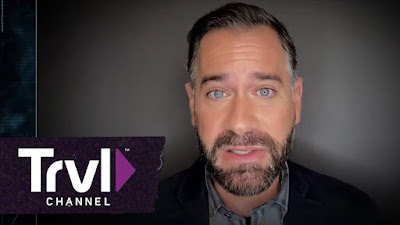 |
Aaron Sagers "are we ready for that?"
|
6. ALL THE OTHERS
They're all well edited together to brainstorm all the wild theories they can within the brackets of commercials, for the oddness they've seen, to deliver a smorgasbord of opinions, precedents, past folklore and modern phenomena. With those ring lights surrounding their pupils like some otherworldly intelligence marker, casually talking at or past the camera in a way that's not alienating (unlike the experts in the British version, Unexplained: Caught on Camera, which does everything wrong that Paranormal does right). Aside from when they sometimes use "spirit" as a singular name/noun even for plurals (like "deer" or "fish" ) there's no one amongst them I don't like. I like especially Aaron Sagers, for his sharp sartorial sense, calm but not cuck-y demeanor; the always visceral and funny Ghost Brothers (in the later seasons, when Travel starts cross-promoting/synergizing) who've been in many recent seasons and provide the unashamed total fear response, and the sweet Susan Slaughter, the blonde babe of the show--i.e. the one with bleached feathered blonde hair, substantial but expertly applied eye liner, and beguiling matte lipstick-- prosaic but informative--especially about cryptids in Central American (her area of familial origin). Saphire Sandalo is the hot brunette, sweet and full of gorgeously gruesome details about the vast and lurid lexicon of cryptids from her own ancestral home of the Philippines. Derek Cayman is the grounded facts-relaying guy, with his podcaster hat and another fine beard (these guys all have jet black beard stubble) Mark Moran with his pale, shaved countenance and ever-present black (Civil War?) infantry hat gives us a measured, thoughtful analysis. Rachel Evans is the one with the quirky glasses and seems to have the most natural, intelligent reaction and seems genuinely amused, genuinely into it in a way that she makes kind of vivvid by contrast to the others who labor a bit towards professorial seriousness.
Taken as a whole, they're all either endearing for trying to sound like an authority at a lecture, pointing out good mythic anchor points, or expressing their natural reactions, it's like a whole camp-out campfire of people with cool stories their grandmothers told them about their own encounters back in wherever, and endearingly flaky insights... and...this being the age it is, they have their videos on their phones to pass around, making everything seem twice as possible.
7. NO BUZZKILL COUNTERPOINTS
I imagine there are some people who get a smug satisfaction when a video later turns out to be a hoax, or misidentified natural phenomena, or pareidolia but those types have been mostly weeded out of the paranormal TV landscape. The powers that be finally realized no one is watching these shows to hear that ghosts aren't real, or the UFOs are swamp gas. And now that UFOs are finally destigmatized,
those rubes look especially foolish and dogmatic and can ghosts be far behind? One gets the idea we're never gonna know for sure either way, so let's ride on it being real--it's more fun. As long as the hoaxers are willing to fully commit to the story, and it looks realistic, it's real enough to get the shivers we want, which are the reason for watching it, then let's do it. I'm in.
It worked with Blair Witch (see my piece in "Frightened Male Monthly") And if any of it is real, which I mean centuries of eyewitnesses and mountains of evidence can't be
all wrong, then this is the frontier!! Just don't spoil it, science!
Just like civilization mows down the forests in its expansion, so too science crowds out the mythic and magical by incessant investigation, and the magicidal urge to name things, to file them away in phyla and kingdoms and trace their DNA until all their mystery and monstrousness is gone. They ask for a hair from a Buddhist relic of a yeti scalp, so they can find out it's from a bear and just ruin the party for half of Tibet. The doofus mythbusters find the secret water supply inside the weeping virgin Mary statue out behind the church, thus rendering a thousand hopes and dreams dashed. Placebos can work miracles, but not when these buzzkills are around.
And hey, they aren't around... on Paranormal: Caught on Camera.
8. The Wry and 'on it' Stream-of-Consciousness Editing and Music
The ability to zip up and in and provide almost everything we think we want to see to back up the theories espoused and witnesses testimony, showing the clips' over and over, zooming in on the creepy parts and freeze framing, each segment opening with a big red blob plopping down over its place of origin; masterful cuts of movement editing, slow-motion zooming in and out of the frame, inserts of TV static between shots, closeups of lights and outdoor security cameras. A lot of stock footage images of helicopters, hospital staff, computer screens with shadowy tech guys, close-ups of newspaper clippings, friendly dogs gazing lovingly at their owners, plenty of old paintings woodcuts, cave drawings, old time sketches of Native Amrericans beholding grey aliens, drone footage of the region, sketches, Northwest forest tracking shot, mountains, volcanoes, dragons, olde historical photos, magic marker illustrations of weird cryptids, enough to keep a dozen interns busy searching for royalty free images off the internet and enough to make each segment so much more than just the video and expert reactions.
I'm not necessarily a fan of their constant use of spooky music even during scenes where we should be straining to listen for creaky footfalls. But generally they do quiet down if we're listening to some EVP or crackle in the attic. And they know just when to insert some Carpenter-style piano, Hans Zimmer-style coxic-buzzing drones, and grinding surges of drums, string samples, and mounting synth tension.
9. THE MYTH-REVIVING MIRACLE OF THE BLOB-SQUATCH
Another great illustration of the collective mythic unconscious in action - 'Blobsquatch' - how so many videos seem to just show a black blob in the distance, as if the Squatch has the ability to blur out his own image on tape, like the producers do for T-shirt logos. Similar to the night time UFO lights - these can have the feel of a 'RORSCHACH BLOTS - CAUGHT ON CAMERA - with the experts all talking about what they see and think it is, letting their pareidolia run wild and free.
Sure it's hard to believe the skunk ape video where he looks like a skinny guy in a black sweatshirt, so waterlogged it sags dow in the arm inseam, trying to run through the swampy muck (it's no easy thing to be blurry and indistinct yet still unconvincing) but in general I like to give them the benefit of the doubt (i.e. that they're not just hoaxing it to sell skunk ape keychains) but that's genius or pareidolia, we have no control over it--our brains will try to make a recognizable face out of just about anything.
But I also believe Sasquatch is real--on some level-- because when I accessed the Akashic records back in 2008, they told me so -- he's the descendent of the nephilim, who live for over hundreds of years. They're hiding from the greys who had a mandated from their extinction via the Great Flood, from back five or six thousand years ago. The ones who survived fled to the mountains where the water never reached or underground in vast caverns full of oxygen-producing moss and trippy mushrooms. Don't think they are ancient just because we still see the same ones that survived the flood (antediluvian people, like Enoch. father of Noah, lived for hundreds of years). They are actually only a few hundred years old since they avoid the greys by skipping through time via alternate dimensions. (When making us, their replacements, they de-activated the DNA strands that let us hop time and space, and also gave us--not unlike that bastard in Blade Runner, a shorter life span, lest we become a threat through our accumulated power). That's why even though they are more primitive in a lot of ways, they're still way more powerful than us. We'll never catch them because they were never really here, or there-- yet they've always been here, more than us.
Yet they are hungry or encroached on they will you and your pets. So if they visit your backyard, leave them some apples or leftovers. Maybe the blobs will come to enough focus you can get a close-up, like this bad boy:
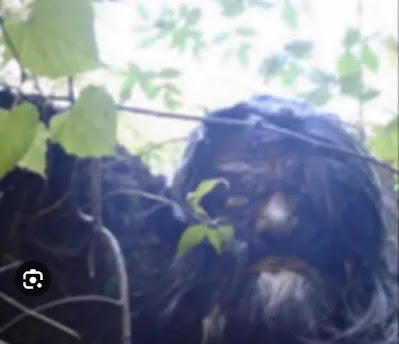 |
I believe in this pic - caught by a guy who says they're more human than ape. I think people confuse them with guys in gorilla suits ala the old dark house movies, or 2001, showing the difficulty we have with imagining a true missing link. But they're just as much hairy giant humans as they are apes. I might be wrong, but this pic is so outside the expectations where he's taller than Chewbacca and blends in so well one wonders if his hair changes to golden brown during droughts. |
That's the Pisces dualism in me: I believe it's all a pareidolia hallucination but I know it's real --more real even than we are. Us trying to trap one is like a sketch of an orange trying to trap a falcon. Or vice versa.
10. Paul Kaup's Narration.... is always..., dependable
Sure he always phrases everything exactly ..... the same way, with that build up...and then.... the point. When he says "Whether it's someone..." you know he's going to pause then add "or some thing." After awhile you can finish... his sentences, while you fold... laundry. And though I miss the kind of voiceovering that was over-the-top ala the old Scariest Places in America show, which ran on the Travel channel 10 years ago-ish, and was awesome in a totally chintzy, Impact font-using melange of tour guides, B-roll, weird insert shots of screaming interns in cheap wig and period costumes--or the grave importance of the guy who does A Haunting, I accept and enjoy his more hinged delivery and less..... hammy... speaking style. Kaup, you're all right.
IN CLOSING
In case you think I'm a flake for loving this show, you're right. But I'm also a die-hard Jungian. and fascinated by the sociologic need this show fulfills. I know Jung and fellow comparative myth analyst auithors influenced by him like Joseph Campbell, Bruno Bettelheim, Maria Louise von Franz, and Robert Bly would all dig it.
These days we don't necessarily get grandparents and nannies sharing the weird folk tales and cryptic encounters told them by their own old country grandmothers the way we used to. Cable TV has stepped in to fill the gap and man is it coming through. Its cup runneth over by rolling with the "it might be real" half-fulls rather than the "but it's probably fake" half-empty skeptics. Sometimes you feel like you've taken crazy pills sometimes when the talking head gallery doesn't roll their eyes at things that are clearly projector images on clouds, box kites covered in foil, big silver balloons running out of air and attracted to the cooling asphalt at night so it looks like they're walking down the street, video artifacts, or barn owls peeping over roofs, possums with broken tails, and so on, but that's just part of the myth-building. This is a zone where the demystifying classifications of science are undone, so known animals are returned to their phantom monster status.
Magicidal (if it's not a word it should be) science is like the gaggle of pinch-faced moral majority bitties running Claire Trevor' chthonic mythic archetypal prostitute out of the town at the start of John Ford's Stagecoach. Luckily there's a border (1) these prim types will never across, to a place where we can be "safe from the blessings of civilization," Those rancid rationalists and false skeptics (1) may pretty brave in town, but dare not follow us into the Geronimo country where truth and reality fall away from each other like amok booster rockets, and found footage horror fiction, analog horror creepy pastas, and real phenomena (which is which?) all swirl together for the ultimate TV equivalent of telling true ghost stories by the fire, PARANORMAL CAUGHT ON CAMERA!
\Further Reading:
Erich's 2012 Guide to Cable's Paranormal Ghost Shows
Frightened Male Monthly: Blow out the flickering student in celebration! Blair Witch Project's 20th.
Zelots of Doubt: Why Skeptics are the New Cranks
Demon Sheets: Sleep Paralysis Theories
Bigfootage: Blobsquatch (2009)
NOTES:
1. (the paranormal is alive and well in Mexico)