Showing posts with label 70s Dads. Show all posts

Saturday, February 23, 2013

Don't go in the light, no wait, go into the light! - The Last of the Great 70s Dads, First Bad 80s: Craig T. Nelson in POLTERGEIST (1982)


The year of 1982 was, as we cineastes know, the great year of American science fiction and fantasy. Not only did we get enduring faves like THE ROAD WARRIOR, CONAN THE BARBARIAN, BLADE RUNNER and THE THING, there were two movies from the Spielberg camp, ET, and POLTERGEIST. Like a capstone to the great 70s, 1982 was a time to regroup on issues of masculinity, fatherhood and the outsider relation to the social order. A dad was notoriously absent from the ET family unit, and figures like Mad Max and Conan (and the entire cast of THE THING) stood firmly on the outside of any sort of social order or role model status, avoiding even feral kids as passengers; Deckard in BLADE RUNNER was a part of the order, a cop, but over the course of the film began to become more and more the bad guy, shooting 'replicants' guilty of little more than self-defense as they searched for a home on a planet beyond saving. In other '82 offerings, like FAST TIMES AT RIDGEMONT HIGH, there were no parents of any sort. So what happened to the 70s dads?

One was left: POLTERGEIST, a rare glimpse into a 'cool' family with a hip, playful, relaxed good provider father, brilliantly played by Craig T. Nelson as a more domesticated version of Harrison Ford; his dry, knowing delivery made him seem fun and employable at the same time. During the opening 20 minutes of POLTERGEIST we get to know him and his family, including hip wife JoBeth Williams and we like them. There is, among other things, a whole great early scene with them smoking dope after the kids are in their beds.

Craig T. Nelson and Jobeth Williams smoking pot in POLTERGEIST

The scenes show the dad shirltless in PJs, his arms or body stretching to the edges of the frame, at ease, a master of his domain yet not a tyrant. He jumps on the bed to demonstrate a high dive to soothe wife Diane (JoBeth Williams) over concerns about their daughter drowning in their under-construction pool. Diane mocks him: "your diving days are over." He barely deigns to acknowledge her remark: arms outstretched, demonstrating form on the high dive, noting with great mock solemnity, "we're talking about the Olympics here, Diane."


Imagine such a scene today in a horror film and you can't. Imagine Tom Cruise playing a dad this mellow, or Nicolas Cage a dad this unencumbered by free-floating anxiety. The wife would never let him jump up on the bed - those are 400 thread-count sheets!

And when the son, Robbie, comes in unannounced, they don't treat him with condescension, or anger he's intruded on their quiet time; they're not ashamed or embarrassed to be caught smoking weed either; they don't fall on some stock response like 'there is no bogey man go back to bed!" or some snide lecture about growing up, some excuse why it smells funny in their room while they bat away the smoke.  They merely deftly put their stash away, and look at him with some concern, but not sappily. "Hey, sport," they say in greeting. They wait for him to tell them what's going on.... they treat him like a person, like a guest, deserving of a straightforwardly respectful response, rather than belittle his fears in some rote, borderline hysteric bid at perfect parenting.


Spielberg's first big breakout film, JAWS had the premiero uno great 70s dad, so it's only natural this guy in his produced (and maybe partly directed) film should close out the decade by starting this cool. Instead of "gimme a kiss... I need it," we have him inviting the son to jump on his back, noting "I am the wind and you are the feather," clearly this is some kind of inside joke between them stretching back to his infanthood. There's no sickly warm strings in their reestablishing their bonds like there would be if John Williams was scoring. He's not, thankfully. Jerry Goldsmith is, so there is no music at all --just the crash of the thunder outside, allowing people to talk in their most relaxed inside voices. Goldsmith might get overwrought in a few places, but he knows when to play it cool. Conjuring a 'safe' kind of menace where applicable, and hanging back in other parts to let the horror build on its own, Goldsmith rocks in ways way beyond the ken of Williams and his overwrought mickey-mousing (i.e. the third act's sea shanty variations).


Poltergeist dad Steve also has an appreciation for nature and the mysteries of the beyond. Robbie is freaked about the tree outside the window, feeling as if it's spying on him. "It knows about us, doesn't it?" he asks.

"It knows everything about us," replies his dad with utmost whispered seriousness. "That's why I built this house right next to it, Rob, so it could protect us. ... It's a very wise old tree." This is a great example of superlative parenting because dad is not diminishing Robbie's concerns, not admonishing him for an overactive imagination, not rolling his eyes and asking wearily if he needs to call Dr. Scherzinger again. He's taking his son's worry seriously but elevating the sense of magical thinking into the proper pronoid direction. (My great 70s dad, for example, took my monster in the closet fear seriously by taping up a sign on the door, "No Monsters Permitted" or something, and I was fine from then on).


But all in 70s dad land --the 80s are looming. soon Steve is at wit's end, besieged by ghostly manifestations he actually becomes more scoffing and rude to those who want to help them. Steve's sense of powerlessness over the events begins to diminish his sense of confidence and self-worth. He starts to act like a sulky child, feeling his mastery of his domain slipping away, he can only sulk over his own powerlessness and snipe at the hands that try to help.


A subtle moment of this slipping occurs when Diane reaches over to him at the family table, telling the team, "He's been wonderful, really," as if boasting of some reformed wayward child to his parole officer. Her tone carries just the hint of belittling condescension (the equivalent of saying "this little lady deserves a big hand"). His acting out shows how slippery the slope is - treat him like a child and he can't help but act that way in protest. When the psychic medium (Zelda Rubenstein) comes over, he makes cracks, referencing Oz and snickering under his breath, even 'mentally' signaling to Zelda, refusing to answer her verbally since he reasons she should be able to pick up his answers if she's so damned psychic. Very insulting, Steven! Besides, just because a psychic can pick up spirit energy doesn't mean she can read thoughts. It's not all part and parcel, like if you can see dead people you should also be able to explode heads and start fires with your mind.


Losing his daughter to the void clearly throws Steve for a loop and for the rest of the film (until the big climax), he broods, seated, in shadows, his masculine force drained. The ghost hunting is in the realm of the feminine here; the older, flask-sipping lady first, and then the psychic Zelda. We see many shots of him sitting in shadow while the women stand above him, indicating his reduced status as an authority figure. Not even a promotion from his boss (who's worried he's missed so much work because he's looking for a better job), can allay his surliness. When he sees the nearby graveyard will have to be moved to make room for the new developments, he's gets especially uneasy. Earlier when his boss was inside Steve's house he'd made clear attempts to hide the paranormal activity going on (such as an organ flying across the room) rather than just letting it freak the boss out, not unlike an abused spouse trying to mask her bruises to visiting police. He doesn't tell his neighbors about his experiences, especially once they initially deny anything's going wrong in their own houses (why there's not is never explained. Maybe it's that they fall asleep with their TV on a lot, enabling the ghosts to come through easier?)

Steve ends the movie homeless and unemployed... presumably he won't be either for long. He's also a whole lot wiser. But what has he lost, this complicated cool dude who smokes weed but reads Reagan biographies, this survivor of poltergeist attacks who scoffs at psychics, this real estate man of the living dead?  It's the 80s and the war against drugs is looming. Will Steve and Diane still be able to smoke pot to relax after the kids are asleep, or will Nancy Reagan's "just say no" campaign convince one of their own kids to report their pot use to the authorities? Will the loss of the house be blamed on Steve, for illegal building of a pool, or something?

In the 80s the free love grooviness drained like a swimming pool over a sinkhole. The threat of invisible ghosts, Russians, terrorists, drug dealers, you name it-- was keeping the Reagan-Bush dynasty in business. Ghosts, slashers, and bogeymen were making their way to every home in America via the arrival of cable TV, which had no American flag sign-off or 5 AM static. Huge lawsuits and civil actions erupted; Satanic panic and pedophile ring hysteria led to massive firings of male childcare workers just to be 'safe;' moms were thrown to the ground in handcuffs when they went to the Fotomat to pick up family pictures that included unclothed photos of their own infants. MADD's boosted drunk driving laws, amped-up drug searches, and the availability of uncensored films rented (in the beginning) at stereo and appliance stores, made Friday and Saturday nights into stay at home affairs. Bars became hotbeds of paranoid moderation; no one wanted to drive to any party even at a friends house a few blocks away, unless their spouse was going to be the designated driver, which then made her a total buzzkill --who wants to drink in front of a judgmental, sober spouse? And god forbid you had a joint in your purse or something when they pulled you over on the way home: you might still be in jail even now.

Oh yeah, and hysteria over AIDS left it open season on firing anyone who happened to be gay, or even sound gay, lest they somehow contaminate our children. Plastic gloves, condoms, fear of inappropriate touching, all led to a great turning away from the social sphere.


The withdrawal of Nelson's Steve Freeling is emblematic of this turn, from cool 70s dad to a sulking, defensive couch potato. We can see it in the way he pulls the rope too early during the rescue of Carol Ann, because his myopic dismissiveness misinterprets what Zelda is saying. The psychic is continually reversing whether or not Diane should go into the light to find Carol-Ann. Because of all the spirit traffic and wind it's too loud to hear well, and he panics; Zelda switches from talking to him to talking to the other trapped spirits who are caught in the crossfire between the demon and the Freelings. She's telling them--the innocent, trapped ghosts-- to go into the light, but Steve thinks he's telling Diane to go into the light and so freaks out, pulling the rope too early.

For me, this misinterpretation and subsequent abortive action indicates the way parental myopia becomes paranoia, and how America's Most Wanted, slasher movies and the advent of home video and Satanic panic turned us against our neighbors. People bunkered down for the long haul, cheering the draconian drug laws that trapped innocent pot and acidheads like fish in a net meant for coke heads and at-risk youth. Homosexuals, male daycare workers, and young drug-addled teens (like m'self) became pariahs. No one could go into the light anymore, period. It was dangerous, so it was illegal. Spirits had no choice now but to just stay trapped in the plowed-over graveyard maze called suburbia.


These sorts of drastic measures can seem very sane, comforting even, to someone who is very, very afraid of what's happening to their neighborhood. Maybe it was Indian immigrants, or blacks or hispanics, instead of ghosts, moving in, but the resulting drive to retreat and fortify defenses was the same. The bad 80s dad had replaced the great 70s edition, and for no clear reason other than media suggestion. It was just our time to withdraw, as a family, from the social sphere; the hangover for the 70s boondoggle bad enough that swearing off having any kind of fun, at least in public, seemed at least some small comfort, like declaring you're going to quit drinking as a way to get your spouse off your back. Beaten down and emasculated by supernatural forces, Steve's final act of defiance, kicking the TV out of the hotel room, seems foolish and short-sighted. You can't shoot the messenger, and more than likely that TV would be stolen before morning and he'd get charged on his bill. One just doesn't do such things, except to get a relief-laugh after the lengthy suspense and family-friendly horror of the rest of the night.

Steve is right in one thing: the TV is the 70s dad's conqueror--it defeated his good vibes, defied and destroyed his sense of self, made his free-wheeling rapport with his kids seem suspect. Men who were comfortable around their own kids now seemed suspect, evil; those who ignored them on the other hand, were neglectful, but clearly not monsters. This paranoia turned children against their fathers and fathers against themselves. Dad's only consolation prize: that 'sign off' national anthem and subsequent white noise static was gone forever. As if quietly correcting the problem for future families, now the screens would never go blank. Now channels were always, always running programs. There was nothing dad needed to do now but wait it out, alone, unemployed, entertained, and shattered to the core by cable's endless aerobics.

Tuesday, September 13, 2011

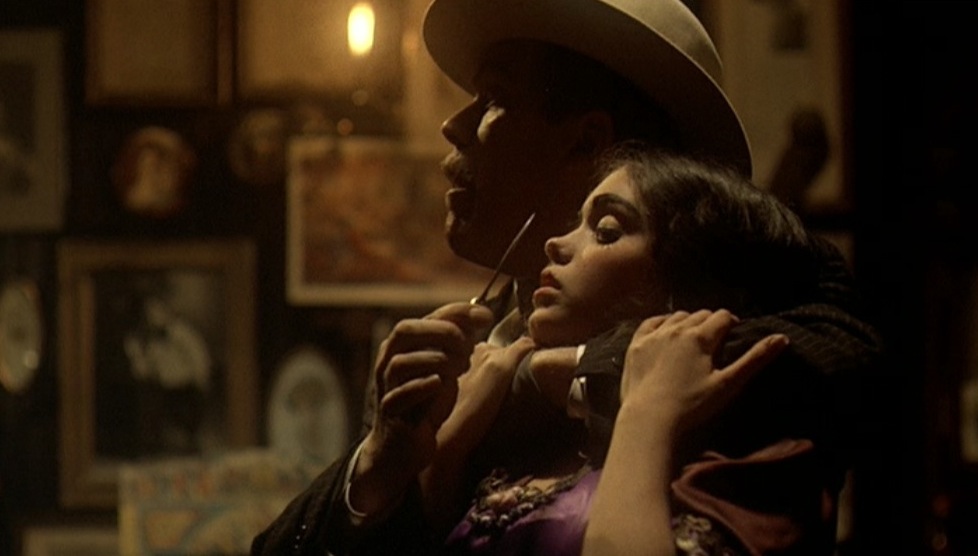
LSD Godfather: Don Fanucci in the Vestibule


Mobsters and LSD: don't doubt that they mix! But forget about Scorsese's mobsters for a minute--they're the cocaine generation, disco and cloth napkins--and instead let's sink down into Coppola's deep dark studies and smoky dens full of fissured old faces half lost in shadow, aka the1970s. I'm talking about the LSD generation's addled children, all tentacled with wild murk. I'm talking about Godfather Part 2 (1974). As Chico Marx would say, Ahsta mana gatsa - Aye shalom!

He's got Giuliani's Smile

The key figure in it all for lysergic resonance is not, as one might suspect, Michael (Al Pacino) or Vito Corleone (Robert De Niro), but the original padrone, Don Fanucci (Gastone Moschin). A monstrous, sinister yet vaguely comical representation of the old country, Fanucci extorts local Italian businesses as an alleged finger of the shadowy organization known as the Black Hand. In the TruTV.com Crime Library, Anthony Bruno lays it all out:
At the turn of the 20th century in America, Italian immigrant extortionists used the mysterious name, the Black Hand, to scare their targets into paying their demands, lest they incur the wrath of some vast underground society.  In fact, these Black Handers were freelancers with no affiliation to any criminal organization.  Nevertheless, the innocent Italian immigrants they targeted believed that a Black Hand organization existed and knew very well that these extortionists generally followed through on their threats when they didn't get what they wanted. (more here)
For frightened immigrants with no grasp of English, a figure like Fanucci could easily step in as an arbiter of the law, a go-between. What Vito Corleone did that made him such a powerful figure (as we see over the course of his part in the film) was to destroy the ties and traps that still snared lesser men, like the guy who introduced him to crime in the first place, Clemenza. Perhaps unwilling or unable to play the assassin as needed, even crooks pay their tribute to Don Fanucci and his mysterious old world crime ring, without even giving it a second thought. It's the willingness and the ability to kill without getting caught that puts Vito into the position of being Clemenza's boss in the years to come. Note too the complete lack of a police presence in the entirety of both films, except for the corrupt police chief Michael shoots in the first film. 

Similarly, the protagonists of 1970s young turk movies (like Coppola's) operated outside the illusion of government. The anti-establishment attempts of Easy Rider (1969) were the only law or 'rightness' in that film. Captain America and Billy maybe never made it to Florida, but Friedkin, Scorsese, and Coppola did. They pulled back the curtain, took one look at old Frank Morgan as Oz, and popped a cap in his cheek (and a tab on their tongues). They busted free. And until they fell down, bloated on their own evil budgets (and coke), operating out there, in the jungles, going insane like Coppola's Kurtz (or Friedkin in the rainforest making Sorcerer; Cimino making Heaven's Gate out west), man did they soar.

The realization that one's own fears, one's fight-or-flight need to feel like someone out there is in charge, that reality means something concrete, makes one a slave, and the guts to just cast off the chains and leave the parade, to realize no one's coming to chase you, that's the big LSD awakening. It not only gives you the awareness of that terrifying 'no one is in charge / reality is an illusion' truth, it gives you the guts to handle embodying its lessons, to follow the Fanucci in your life, and pop a few in his brain and heart -- symbolically of course.

At the same time, you realize you are the Fanucci. You feel every bullet.


Watching this scene on my analog blurry (and cropped) VHS dupe, the bullet holes Vito makes in Fanucci's head and white vest in the infamous vestibule scene seem absurdly tiny for his massive bulk. When shot, he whirls around like a puppet whose master has tangled his strings; his mouth all a- grimace, a bit like Monotsatos, the evil servant of Sarastro, in Mozart's The Magic Flute. And like Monostatos, from a mythic archetypal vantage, Fanucci too is an 'evil servant' - he's chosen personal gain over altruism and what's worse, he thinks that all he wants is a little love, a little respect, just enough to whet his beak.

In the muddy 90s, this section of the film always seemed to be popping up late at night when I was reeling from the effects of some mind-bending substance (I think it came on after 'Psych-Out' on my VHS), and Fanucci's face looked on my blurry VHS like a grotesque theater clown, His last gasps, a mix of profound awareness, surprise and seeming attempts to react in a heroic manner, are all undone by his rapid loss of blood and bodily functioning. He tries to snarl and chokes on it. He realizes, it seems, in a split second, he's going to die before he even gets to spit out a single syllable of some defiant curse at his killer. At the same time, seeing this while in the post-peak period of an LSD trip,  thrust outside the reach of the linear space-time guardrails, we too are unable to give full expression to the intense sensory input one is experiencing in the dark auburn Gordon Willis lighting of the hallway that is the late night of our lives. We all have our Fanucci moment: the death of a loved one, a brutal break-up, a car accident, or taking a whole tab when you should have taken a half, the question is, what do we do with it? Do we cower, or do we stand up and dissolve into the ether like a man, a blood-soaked, pain-wracked but still standing mobster? It doesn't matter to the world, but it matters to us -well not even us, and that's what's so freeing, so terrifying, yet so comical.

It's interesting also to note how Fanucci's death scene mirrors the opening of this particular Vito period segment: it begins at the theater, with the poor Italian immigrant opera singer threatening to kill himself (above) because he just learned his mama is dead back in Naples. In the scene immediately following, Fanucci steps backstage and threatens Vito's skittish paisan's alleged girlfriend for her papa's box office money.  Meanwhile the character onstage in the play has lost his mama, but what's really got him down is the realization his tie to 'home' in Italy no longer exists, Mama Mia! We never see the mother die - it is only a letter, a signifier of something he'd otherwise not know about, just as the idea of 'the Black Hand' doesn't really exist beyond the imagery conjured up by Fanucci. Note that this scene may have been based on a real life case involving Caruso:
It wasn't uncommon for a child to be kidnapped and a severed finger delivered back to the parents to convince them to pay the ransom.  In 1905 a Brooklyn butcher was gunned down in his shop for ignoring an extortionist's demand for $1,000.  The famous opera tenor Enrico Caruso paid a demand for $2,000 when he received a threatening letter signed with a black-ink palm print.

There's the Black Hand cultivating wives' tales with their propensity for violence and then there's that old wives' tale of the LSD user eating a live cat for the 'experience,' a fable I'm not sure I believe so much as remember from my halcyon days. Not that I did, but while you're peaking even a stalk of celery can seem like you're eating a live cat. You can hear the screaming in the crunch, feel the claws in the severed tendrils of the inner stalk. The piece in your hand is like Rhode Island being unmoored from the North American continent, like Jupiter adrift in space; every gesture leaving trails that make it seem like you're wielding a dozen arms, like Vishnu on a bender. In the amber dimness of the apartment doorway where Fanucci is gunned down, a similar collapse of time and space occurs, making my many views of it under the influence in past decades no mere accident. What collapses is not just a man, but the distance between the busy throngs of Manhattan and the Catholic ceremony going on outside in the street. The old world theater, with its constant shuffling of crowds in and out during performances, collapses into itself like a dwarf star, shrunk away into nothing but a few red holes in a white suit. Every time Fanucci dies in that streaky VHS dupe, even if I'm not having a bad trip on too much acid, I still feel the bullets; I burst out laughing from my chest at his grotesque expression, at the bewilderment and anger pulsing out of his face and mine, the realization in the second before he dies that he'll never get to make his last macho boast, his last beak-whet, his last salut.


Thus the Fanucci murder sequence is  the LSD breakthrough moment, the hinge on which turns the wheel that cuts off the head of the imprisoned delegates of the old world, the quintessence of what I like to call "The Dissolving Father" of 1970s cinema.

The concept of the dissolving father is best elaborated in two stages: before and after. The before is the Mad Men era of JFK, the authority figure the father who enjoys the finer things --smoking, women, and martinis-- but who is also a family man at a time when that meant being a provider to a housewife and children, and maid, and maybe gardener. He must be a benevolent and canny ruler who can mix business with pleasure while asserting his dominance without tapping his manly reserves. His womanizing is part of his charm and so he is always partly exposed to judgment, but society hasn't caught up with him yet. He is silver fox-stage Cary Grant or Gary Cooper, mixing drinks in their state of the art Manhattan bachelor pads (the wives are up in Westchester) for girls young enough to be their granddaughters. 


The after, the historical finish of the dissolve, occurs in the 1980s, with all such behavior in our leaders thought of as suspect and the attention turned to an endangered child--poor Vito alone on the boat to America--vulnerable to predators because both his parents work or are dead and so en absentia, the grotesque 'anal father' of Freud and Lacan returns from the shadows, a patched-up Fanucci unaware he's about to get re-punctured by his hockey mask-wearing bastard (or Cimmerian barbarian) 'other' son, the lost prodigal who's been in gladiator school. The only survivor of this 1980s purging is the 'final dad' - he mirrors the slasher movie 'final girl' in his sexless androgyny. To survive he makes his voice high and effeminate when he talks to his kids, deferring power to the mom in all things, a meek co-breadwinner terrified of being rejected by his offspring to the point they have no other choice. 

The dissolving father is the tragic figure of the 1970s, his once inarguable power now slipped away. The institutions he used to signify are now little more than meaningless totems.  Of course this is supposed to happen anyway if you are to fully mature and able to become the father, recognizing it's not a trap or a duty but a symbol, something you represent in the lives of others but don't actually have to 'perform.' In LSD parlance, you become 'experienced' and hip to the whole cosmic flim-flam. It's as if there are two--you and your dad-- in a sealed room, and then just one. But like Poe's William Wilson, or, say, Scanners, it's not like you are still there, and yet neither did you leave. So just how did you absorb the other person? What was the alchemical formula that dissolved you both, did you get absorbed into the 'Father' or did the father get absorbed into you?  When you put a murderous old world Italian crime boss and an innocent (as far as killing) but canny new world upstart into a vestibule, and only one emerges, didn't both really die?  Or didn't you realize, until this very day, it was Barzini all along?


Historically, the father dissolved as a result of changing dynamics in the workplace and at home. As the suburbs became more and more isolated, the nuclear family was more and more cut off from older generations. The outer world grew colder and more hostile. With the arrival of cable TV and VCRs, the family's lack of direct participation in each others' lives reached new heights. Since both mother and father now have to both work all day, the children grow up watching TV, and if the father comes home at all, the best he can do in the way of demonstrative mastery is change the channel from cartoons to the news - an effective display in the 1970s when there was only one television in the house - but by the 1980s we all had at least two, so we kids just trucked it upstairs, fatherly bonding averted. Though it is certainly accidental, this loss is mirrored brilliantly in the arc of the Godfather films. The cleansing fire grows out of control and at the end leaves only dead trees. Fanucci is the old world father, makes a grandly conspicuous show of his connection to the people; he waves and nods to the crowd as if everyone is listening to him, even though we never see a single person do so, he is the anal father of Lacan, the devouring primordial father killed by the sons for his hogging all the women, enjoying conspicuously, Above him stalks Vito along the empty rooftop, alone, the grim chimneys and windows like fortress battlements or tombstones, a place no one has bothered to 'fix up' to look-a nice, a place without symbols and ceremony, where all traces of pleasure and decadence, anything to cloud a man's judgment and purpose, have been excised. The Corleone family will always be on the DL, restrained. We never see Vito laugh or crack more than half a smile. 


To bring it back to The Magic Flute, the murder of Fanucci is akin to the passage of the lovers through the test of Sarastro: the journey through the underworld with the writhing figures menacing from all sides, but are they even really there? Close your eyes and no monster can scare nor vixen lure you. Vito realizes the same thing, that Fanucci's threats just the phantoms of the underworld, all he has to do is be secretive, remove himself from the public eye, and kill the dragon and then he inherits the burden of authority. He becomes the shadow Fanucci, no one can kill him in a vestibule since he lays so low, so discreetly. He has been given the secret, which is of course that there is no secret.  There is no special power that comes with the job of 'Ultimate Signififer', only the belief held by others that there is such a power there, behind the visible. Vito's offering of the self as representative of order, as someone who is not afraid to stand in front of the chaotic void, pull back the curtain, and take over the wizarding. Rather than a big scary projection, it's his surface humility --his steely reserve and secretive 'normal guy' nature -that instill confidence there is a deep power structure below his feet--even the witch pays him, or her monkeys might suddenly go on strike, or wake up with her shattered crystal ball under her sheets. Best to not find out whether that would really happen.

Only you, the new void stander, knows the truth: old Oz has actually been dead for years, and you're the one who shot him! You see the blood on your hands, or at any rate, in your hands, swimming through the blue veins, ever ready to come out and turn red in the grimy air of Emerald City. The darkness always is waiting to engulf you, always just a broken bulb and napkin-wrapped pistol away. But the others, the small fry, your familia, they see only your iron skin. This gives them the assurance they need to go on --it's worth any amount of secret violence to prevent your loved ones from knowing what you know, the full measure of your/the world's horror, is it not?


LSD reveals all these things, because it draws back every curtain and if you cling to outmoded morals and fear, pay Fanucci or get all paranoid about the passing cops, you're headed for a bummer trip, little better than the kid who's afraid to cross the street against the traffic light even though there's no car for miles, or refuses to jump off the cliff when all his friends below are splashing away without him, citing the lack of a lifeguard. Authority is a placebo, as all the LSD kids know this, and so does Hyman Roth. Michael, we're bigger than US Steel. You'd never guess Roth was rich the way he lives, or that he hates the Corleones by the way he acts. There's no need to be mean or a braggart when you're fully awake, by which I mean ever-aware of your own mortality, and that of others. There's so much blood out there, all just waiting to be let. That it stays where it is, most of the time, is a miracle. To paraphrase Joni Mitchell, if you manage to know what you got before it's gone, you realize you may have to steal everyone else's just to keep yours from being stolen away. What you got is a parking lot over paradise, but the question is, who gets the contract for the concrete pouring??


Fanucci is the old world type of deep oak patriarch, the one called 'the terrible father,' the odious ruler who makes a spectacle of his own enjoyment, who insists on being seen enjoying. Witness his conspicuousness at the Sen Gennaro festival at the puppet show when he makes a joke about it being "too violent" for him, and turns around expecting the whole crowd to meet his gaze and break out in approving laughter. When they don't there's a flicker of shame that passes over his face, before he blocks it away with a smirk and moves on. This grandstanding exposes Fanucci as an easy target for a man as streamlined and rid of all personal pleasures as Vito, who has developed the mix of exterior compassion and the canny ability to use the granting of favors as a kind of paperless, untraceable, untaxable currency, and who has mastered the ability to repress anger and then kill in cold blood. This is the 'gift' of bravery, and it's what any successful space cowboy also has, for he must keep a straight face when, for example, his walls are crawling with mutant tentacled wallpaper pattern demons and has to walk past oblivious parents in order to get to the sanctuary of his bedroom, and they're bound to come in and pester him with banalities and he knows one wrong word and he'll be laughing hysterically on the floor while they phone the rehab.

The look of a cobra, couched

CODA: What takes the old world's place? We never really know until it's too late, and Vito's son has distilled and distorted the teachings of his father into remorseless sociopathy, all the familial sense of togetherness totally severed, by Roth's machinations and his own poor choice in a wife (Diane Keaton, ever thinking she can snap Michael out of his 'Sicilian thing' with a New England schoolmarm scolding), the spaces of Las Vegas and Tahoe relative to the crowded earthy space of NYC and NJ. It's a mark of the jet age that families no longer live together in their old neighborhood, but spread out to new horizons and eventually reunite only at Christmas. The values of the Vito age aren't tangible, apparent, easy to bottle can can, and so dismissed. Thus our sense of family, happiness, and wholeness, paradoxically shrinks, dissolves and dissipates, the more our new world expands, solidifies and devours. The ultimate signifier. disappears with only a few shots from a flaming napkin. But the red dots on the blotter that set you free, and threw back the curtain on the bullet-riddled corpse of your paternal Other, are now wearing off. You're coming down, down... and somewhere, up the street, some angry youth is making his way towards you, stalking you like a panther from the high ground rooftops. When you see him--that murdering little snot-- admiring his dilated pupils in the mirror, all young and stupid, don't snort in derision. He's about to pull back your wizard curtain and blat blat blat. So get out the gift bag, pass him his diploma, and then die... die like a real-a Fanucci! 

Saturday, September 10, 2011

Great 70s Dads: Roger Winslet at 2008 Oscars


Of all the key moments at the 2008 Oscars, who could forget the single shot of Kate Winslet's pa, way way back in the mezzanine, his big black slouch hat on, rosy cheeks, as cheery and unshowy about it as you could ask. A bit reminiscent of Jack Nicholson, whose easygoing rapscallion charm usually fills the front row (was he there that night? Who remembers!), without saying a word or even being seen clearly, Winslet's dad bested in the supporting imp category. Winslet won for THE READER, a film that to me epitomizes all  that's wrong with craftsmanship Oscarbait (see my Oscarbait checklist for the Reader here) but she deserved to win for her very first film, Peter Jackson's HEAVENLY CREATURES, a debut still as fresh as auld Auckland to this old codger's eyes, and for past life karmic merits earning her a salty dog of a 70s dad like Roger.

From the site Free Frank Warner 2-23-09

Winslet father whistling Kate Winslet sees Dad  Kate Winslet accepting the best actress Academy Award and wondering aloud where he father was in the audience.
"Dad, whistle or something ’cause then I’ll know where you are."
Roger Winslet whistled so loud everyone in the world heard him. (Dad is an actor, too, appearing in several television productions. Kate is 33. Dad is 69.)
The UK's Daily Mail ran a thing about Kate's childhood where she talked of being poor, fat and bullied, which proved in the face of it to be exaggeration:
Kate Winslet never seems to tire of repeating the story of her miserable adolescence. She says that she was fat, weighing 13 stone when she was 15 years old and nicknamed-Blubber' at school. She was picked on and bullied, mentally and physically, and even locked in a cupboard; or so she says. 'I was bullied for being chubby. Where are they now!' she tells this month's Marie Claire.
Winslet family
Class act: Kate Winslet who grew up in a working class family in Reading, Berks., pictured with her sister Beth and father Roger.
It is interesting that, now that she has won an Oscar as Best Actress, Kate feels that she wants to talk about her past misfortunes.

It rather gives a different dimension to her current achievements and acknowledged beauty: that she has suffered in earlier life makes her seem, perhaps, all the more likeable (sic).

But speaking to some of the friends from those early days, one can't help but become a little suspicious about just how very miserable it all was.

It is true that the Winslet family did indeed live in a small terrace house, and she shared a bedroom with her sister Anna while her father, Roger, took on all kinds of part-time work to supplement his faltering acting career.

And yet, despite a lack of ready cash Roger to this day drives an ancient Vauxhall car, the fact is that money was found to send both Kate and Anna to a private theatre school. Kate went aged ten to Redroofs, then based in Reading, at a cost of £1,000 a term. (more)
Still in a punk band and it's not weird? Yep, 70s dad
Now, why would such a childhood indicate a 70s dad? It's not the childhood, it's the remembrance and the freedom to talk about it. Were her childhood truly dismal, I don't think she would remember it the way she does, or feel so free to talk about it with journalists. Joan Crawford, on the other hand, is an example of the opposite -she has etched into her face, but Winslet's face beams. A great 70s dad, as I've discussed in past 70s dad entries, is a master of indirectly (but intentionally, on some deep grand, unconscious level) inspiring rebellion against himself; he provides for his kids while seeming to be louche and undisciplined; he frees the child from any neurosis that might be caused by parental expectations, anxieties and insecurities, as is so common today. If Kate knew their lives were semi-impoverished JUST SO she could go to a tony drama school, she might have decided not to go. Instead she seems to not make the connection at all, all the more power to the mighty Winslets!

Great 70s dads preach vice but practice virtue; they roll their eyes at the self-sacrificing martyr while doing them one better. Looking at those pics above. The truth is all there in the casual smiles, the relaxed atmosphere. At the Oscar podium Winslet didn't need to paint her father in noble colors; she just spake directly to him, "Whistle!" and he whistled immediately. He was right there, like a faithful steed. He seemed to be having a great old time, way the hell back in the audience but completely relaxed and needing no validation for raising an Oscar winner. He needed no 'credit' for her win the way micro-managing parents would. Not worrying if he would be thanked or not is why he deserves it. In that winning sense, he's a cross between Stella Dallas and Andrew Undershaft in Major Barbara.

Lastly, you can tell he's a 70s dad by the persona of Winslet herself. Her keen thrilling sense of gravitas and lack of self-serious sanctimony? Only a real 70s dad can only be behind that, the kind of dad who gives his daughter even the space to freely criticize the way he brought her up. He doesn't measure himself by his parenting; he pursues his own (mostly TV) acting and music careers and isn't afraid to take a tumbler or two. In the process of being Roger, he created the space for a truly great actress to thrive, for children are like plants: you water them, give them access to sun, transplant as needed, and then step back and let them figure it out on their own, maybe prune back if they grow in bad directions, but otherwise go on about your business. Most stage parents prune and fuss and overfeed until the plant's a leafless wreck of DSM-IV shakes and TIN DRUM-style stunted growth (hence all those baby faces and eating disorders). Not the 70s dad. He leaves an invisible signature. You'd never guess he was even there - until it's time for him to whistle, and show an entire Academy audience the definition of ballsy 70s dadness. Bid them heed!

Thursday, December 13, 2007

Great Dads of the 1970s #1: Jon Voight as Luke in COMING HOME


"Ah, the smugness, I can't stand it." -Jane

"I dont belive it will change, but you're beautiful when you're excited." - Jon

I was just a kid when COMING HOME came out but I remember its impact. Along with THE DEER HUNTER, released the same year, there was a whirlwind of controversy and outpourings of support, anger and raw feeling over a war that hadn't been over more than a few years. The media was aflame and Oscars fell like rain and now, thirty years later all we have left are the DVDs, while another war rages and the best we can get are polemics like LIONS FOR LAMBS. But what of 1978? In hindsight, The DEER HUNTER seems to have almost nothing to do with Vietnam, being instead an American Reifenstahl Alpenfilme, but it's still good and gets repackaged and made glossy and classic, but why not COMING HOME?

The red state stigmatization of Fonda and her strong character may have something to do with HOME's lack of corporate support as far as DVD re-marketing, but I would guess the answer really lies in the fact that its genuinely subversive, in a positive almost painfully human way. Leonard Maltin's guide gives it a mere three and a half stars to the DEER's four, citing the film's "lapses into melodrama" as the reason. Of course THE DEER HUNTER (like APOCALYPSE NOW which came out the following year) is really a "guy" movie. (Maltin says it "packs an emotional wallop"), COMING HOME is neither a man's nor a woman's picture. If I wasn't all obsessive and insane at the moment I would probably never use these sorts of words, but: it's a human picture. It's a picture for the non gender-specific lover archetype which we embody only when we are at our best. A lot of us can't stomach that sort of intimacy for long; we'd rather reach for the easy comfort of our threadbare genre straitjackets. I'm as guilty of that as anyone. I can barely watch COMING HOME even now. I'm watching the DVD as I write this and I have to pause every few minutes, for breaks that stretch into hours. I have to write like mad to deal with the pain.

And no, Voight's character, Luke, is not an actual parent--nor shall he ever be one, apparently, thanks to his waist-down paralysis--so his being considered a 1970's dad might seem a bit odd. But hey, man, there are people all over the world needing parenting, not the bossy, browbeating kind but the unconditional nurturing and sense of strong support kind. One need only grace, gravitas and guts, genuine non-gender specific love, and maybe a mustache and fine foxy beard to be the best of 70s dads; kids will come from all over, from all ages and groups.

Luke has those things and as he goes from soul-ruptured angry young paraplegic to nurturing activist/lover, you get to see deep into his wide-open soul--both the actor and his character--and his innate majesty shines out at you; he's the wounded fisher king accepting the fact no Parsifal is coming. As a knight you need to serve a king, and Voight fits my bill in COMING HOME. I watch and I want to help him do whatever it is he needs to do, because you know it's right and just, whatever it is. He becomes the sort of man that James Dean's character was on the road to becoming in REBEL WITHOUT A CAUSE. He becomes a leader that inspires what is best in men.

Contrasting Voight in the film is Bruce Dern's character, a smarmy officer and Jane's husband. He embodies the Beatles' lyric heard in the film: "Living is easy with eyes closed..." and Bruce Dern is so good at portraying this type you fear for his soul. In short, he's odious. His character eventually loses out and goes for "the long swim" (if only he'd hung around awhile of course, he wouldn't have to worry--the Voights of the world lost to the banal conformity of the Derns after all). Too bad, because the pain he was feeling might have made him a better person if he just faced it rather than running. The Derns of the world don't ever face the mirror, they don't need to and so they don't, and then when they need to suddenly they can't - they'd rather off themselves than see how their unexamined life has left a shitty legacy.

Luke certainly has his work cut out for him in facing that mirror, learning to use the wheelchair, etc. all while being utterly reliant on others. There's a feeling of futility and angst surrounding his situation, and it reaches a head when he first crashes into Jane on her first day volunteering at the VA, sending his colostomy bag flying and humiliating him to the breaking point so that he goes on a furious tirade that would not be topped for sheer greatness until he himself topped it seven years later in RUNAWAY TRAIN. It's a rage that is so fierce it reaches alchemical-level heat and from its raging molten crucible comes a humility akin to divine grace.

Luke's humility in this film represents a path for men that was never overtly spelled out and so was lost in the shuffle when we went from subtle to sledgehammer in our cultural cum corporate aesthetic. If you look at old films--like Howard Hawks' in particular--they all depict an unspoken code of "good" behavior that men measure one another by; it's a code that operates free of gender and physical strength and asks only what was asked of Laertes in Hamlet: "To thine own self be true, and thus it follows as night follows day, thou cannot be false to any man." The path up to this heavenly ethical plateau is through things like therapy,  the 12 steps, meditation, volunteer work, helping others --all the shit we'd often rather die than deal with directly. But if we don't deal with it, it deals with us and we're back in the jungle or the desert faster than we can run. 

There's a great moment when Luke first gets asked to dinner by Jane and as she heads off-screen he slowly pulls himself up the hospital's wheelchair ramp, his newly muscled arms rippling as he pulls his wheelchair and bulk. Those muscles represent not just Voight's devotion to getting the details of his part right--and by association doing right by the paraplegics he studied for the role--they represent the triumph of love against the sort of rage and shame that he expressed earlier. Luke begins to grow like a flower in the sun of Jane Fonda; he will become a dad figure to Billy, the shell-shocked neurotic guitarist played by Robert Carradine; and he will become an inspiration even to a whole high school assembly at the film's climax.

What makes the final speech so moving and profound is not just his tears, but his acceptance of responsibility; he doesn't condemn Vietnam with the self-righteousness of a screaming protestor; he doesn't bemoan his loss. Instead he admits he "doesn't feel very good" about having killed people for "not enough reason, man." He doesn't blame the U.S., or the recruitment officer who spoke before him. He admits defeat and admits he made choices that he believes were wrong. In doing so, he begins the possibility for genuine social change. It's such a scary thought I believe the powers that be would just as soon this movie never existed, was forgotten, and overshadowed by the grim fatalism of The Deer Hunter.

Everyone celebrates and remembers Voight in that big final high school speech, so rather than discuss it further I'm going to delve a bit into their first date at Fonda's apartment: She's nervous and he orders her to sit down. He asks if this is "Bring a gimp over to dinner night," and rather than get indignant (a reaction which you see cross her face) she instead looks him directly in the eye and  slowly shakes her head no; the result is nothing short of a true human connection, and he connects back and admits, "I know you didn't."

In today's edit-happy world this scene would probably be cut down to a few seconds. Instead we're allowed to see each of them overcoming fears and prejudices, connecting as real people, and Ashby makes it possible for us to see this in a magnificent natural light that illuminates their eyes. He gives Voight and Fonda all the room they need to make these characters real. Even though we might squirm in embarrassment while it's happening, in the end we're in love with them as much as they are with each other; the kind of love that transcends sex and gender (literally since Luke is effectively sexless) the kind of love that spreads outwards to all who come in contact with it... except for the Bruce Derns, of course, living easy with their eyes closed.

Later in that same first date, Voight says to Fonda: "When people look at me they see something else, they don't see ... who I really am."  In real life, people still don't see Voight or Fonda as who they really are (I'm sure I'm not seeing Dern as he really is either). They see publicity and Angelina and Hanoi Jane and ANACONDA and whatever else. In 1978's COMING HOME we can feel the aperture of spirit close around us, feel our willingness to embrace the gossip rags rather than the unwritten riches, but first we get this wide open view of the human spirit at its most noble and compassionate... and yes, it can be painful to watch, especially for men. We're not comfortable seeing a man so dependent upon a woman (two words: wheelchair accessible) and COMING HOME lingers right on that sensitive spot, like a lover trying to tickle some embarrassing secret out of us while we're tied to the bed.

Is it any wonder then, that cinema fans in media-saturated 21st century prefer the cool macho alienation of THE DEER HUNTER? COMING HOME challenges us to be more open and loving with one another and it does so by practicing what it preaches; it gets all sticky and gooey, it "lapses into melodrama." It asks us to feel deeply. Conversely, THE DEER HUNTER asks us only to pop open another cold one and turn up the game; to drown out that subtle, soft voice that would point us towards the love we'd prefer to think irretrievable. If things get too intimate, just drown that sensitivity in another game of Russian roulette, like a real man.

And so Jon Voight in COMING HOME gets first place in the 1970s dad pantheon, without his character even having any kids... or even any legs...or the ability to ever walk or inseminate again. All he has are the guts to ask for help, and to love without limit, and to administer a cool beard... and he's beautiful. And I almost forgot: he's got such cunnilingual skills he gives Jane her first orgasm. As far as hostility towards this picture by mainstream society, that explains a hell of a lot.

Friday, October 12, 2007

GREAT 70s DADS #10: Gene Wilder in YOUNG FRANKENSTEIN (1974)


As a kid watching the original 1933 Frankenstein on late night TV (where it was shown quite often) I always felt bad--don’t we all?--for the poor monster (Boris Karloff). Dr. Frankenstein (Collin Clive), upon learning his creature is “Alive… ALIVE!” hardly gives the poor brute a chance to examine his new hands before he’s labeled a senseless horror and chained in the basement, where the doctor allows his hunchbacked servant Fritz (Dwight Frye) to torment him with fire and a whip. No wonder the poor monster went on a rampage!

Clearly, Mel Brooks felt the same way I did, the way we all did, and righted this wrong in a genuinely moving scene in his loving satire of the Universal Frankenstein series, YOUNG FRANKENSTEIN. Gene Wilder, magnificent as the doctor, is determined--in classic 1970s therapy craze style--to break through the communication barrier between him and his monster (Peter Boyle). He decides to go into the room wherein his monster is locked, and instructs his assistants Igor (pronounced ""Aye-gor" - played by Marty Feldman) and Elizabeth (a very sexy young Terri Garr) to lock him in the monster's room and not let him out, no matter how much he screams and pleads (which of course he instantly does) until he's broken through to his self-made son.

Once his initial terror subsides, Wilder’s Dr. Frankenstein is able to dispel the monster’s hostility through flattery. (“You’re kind of cute!”) and gradually the pair bond in a truly beautiful sequence that heals the terrible rift between mad scientist and monster. From the vantage point of the 21st century, where so many men have grown into monsters rejected or ignored by their fathers if their fathers are even there to reject or ignore them-- this scene is something of a spiritual miracle, a turning of the other cheek, a healing moment of transcendence and forgiveness.

Academic film critics love to analyze horror films as instances of Freud’s “return of the repressed,” - i.e. the abject, cast-off ugliness that doesn’t fit in the social order, returning from the outside to disrupt it. The 1970s was the decade where we actually were making headway into healing that continual repression/disruption process through love and tolerance. Nowhere, for my money, is that transformation more succinctly and wittily dramatized than in this scene, a mere throwaway moment between the broader Borscht-belt gags that had them rolling in the aisles--me included--at the theater where I saw it with my parents at age seven, but this touching little moment was something that Brooks clearly felt strongly enough about to do right. Both in this and in the marvelous BLAZING SADDLES, we see Brooks the comic, but also Brooks the humanitarian and, just as the SADDLES is full of good-natured satire towards racism (freely using the N-word, something that would be considered too reckless and controversial today), so too is YOUNG FRANKENSTEIN satirical of intolerance, suspicion and anti-monster conservative positions. Wilder gives a beautiful, loving performance, his eyes dewy with fatherly emotion, and when he cradles Boyle’s bald, sewed-up head in his arms and declares to the heavens: "This is a good boy!" you can, if you let yourself, tap into the electrical current of love that was in the air back in that golden-green decade, feel a true electrical charge of universal compassion. That's Mel's and Gene's gift to all us screwed-up monsters.
Related Posts Plugin for WordPress, Blogger...