Showing posts with label Arnold Schwarzenegger. Show all posts

Monday, December 16, 2013

Coal und der Switches Symplex: JINGLE ALL THE WAY

When it comes to holiday entertainment for the whole family nothing tops the "heroin-smuggling nuns" episode of the BIONIC WOMAN that played Xmas eve back in the 70s and has never been seen again. But we must settle. Mom wants the CHRISTMAS STORY marathon on TNT ("you kids loved that movie as kids, remember?") My brother and I roll our eyes since we endured high school with co-star Scottie Schwartz. My brother Fred likes BADDER SANTA but that kid grosses me out. I vote for the Pagan Solstice celebration of THE WICKER MAN! There's no kid at all in that, just evil Celtic children snickering at a cop's befuddlement, which is badass. We settle, always, for them all... and just wince whenever 'good' or 'normal' kids are present.

Bridgewater-Raritan HS's Scourge
Then there's a second problem with Xmas movies, the classic example of which is in SCROOGED when Bill Murray starts his lengthy rant about how we should all sing soul music together because he's finally learned the meaning of Christmas. My friends, this is nothing more than Münchausen-by-proxy syndrome, the Xmas version, which I call Coal and Switches Syndrome. It's that thing where an egotistical workaholic proceeds to create pointless disasters so that Xmas is almost ruined, all so he can race in at the 11th hour and save it. Beside Murray's Scrooge, there's Nic Cage in The FAMILY MAN (2000) and Arnold Schwarzenegger in JINGLE ALL DER WAY (1996).


To get back to kids, for they pollute many Xmas films. If real kids could have any wish, could be anything they wanted, more than anything they'd want to be adults. They don't ever imagine themselves as kids. There wasn't a single kid in STAR WARS because Lucas understood this (but then forgot it). Misunderstanding this fundamental rule of viewer identification processes led to the idiotic decision to create sidekicks like Robin and Superboy and all those movies where we don't just see what a kid would imagine, but a kid imagining it.

I mention all this because Arnold Schwarzenegger is one of those men children want to be. His overly muscular body is almost a burlesque of how boys confuse muscles with prowess; we love his comically stern accent, his straightforward way with a catch phrase, wherein you can't tell if he gets the joke or not (it's better if he doesn't). Kids delight in seeing someone so free of layers and guile; he's a crazy playful tyrant six year-old in a giant barbarian body --and we love him for it. But in JINGLE, Arnold is just an ordinary gym owner/personal trainer and largely absentee father, avoiding his son's karate performance because (subconsciously) it would mean some other athlete getting the applause. Arnold thinking he can get away with being an average suburban dad in the first place is a really bad sign. He's like an unconvincing superhero alter-ego with no superhero to turn into.

Arnold needs to realize he is not, and has never been, an average dad figure. He is not all-American Joe material, if he was, why would we bother paying to see him? In the symbolic structure of the film, though, being unaverage is a crime tantamount to neglect and he must atone by finding an unavailable/sold out super hero action figure for his emotionally blackmailing son, the superhero itself being a burlesque of impotent male rage (as a kid you have the excuse --you have no rights, are dependent on adults, and easily beaten up by kids even one or two years older). Arnold wants to be his son's action figure, but such a character, like Lacan's Phallus, is defined (in a child's mind) by his absence. And in the guilt trip nanny state PC 90's, absence is also tantamount to neglect, so Arnold has a double neglect thing going. The result is that he has to bow down to a plastic figure because his son prefers the totemic imitation phallus to his dad's genuine absence. It's a bit like Jesus being told he's not a good messiah unless he writes a letter to Santa.  

JINGLE has hints of turning expressions of the capitalist system and its media culture against itself (which Guy Debord dubbed détournement): the film digs a canal into the rotting roots of the American capitalist frenzy Xmas tooth, only to fill it at the last minute with souvenir gift items available for purchase at a store near you. And like any good capitalist product, JINGLE knows how to incorporate its critique against itself within itself. That's recuperation!


One way Arnold tries to become the action figure phallus-fetish for his son is through the aforementioned Coal-Switch Syndrome: He creates drastic emergencies for himself, crises anyone who's lived in suburbia for more than five minutes would easily avoid. But he's an adrenalin junkie who rides suburban angst the way Charlie Sheen rides air currents in MAXIMUM VELOCITY. He ignores his secretary's notes that he needs to go to his kid's karate practice until the last minute, just so he can speed down the emergency lane because of the traffic. He combs through every toy story in town on Xmas Eve like a maniac as he slowly realizes his son's asked-for toy has been sold out for months, unavailable at any price. He asks for help from other shoppers and is genuinely shocked they laugh at him for being so naive. He seems to subconsciously invite contempt from fellow shoppers just so he can throw one of them into a toy display. His inability to get a call through to a radio station giving away one of the dolls leads to him smashing up the DJ booth. The fervency of his son's Xmas wish, and his own terror over seeming a bad father create a kind of eminent domain right to push and shove old ladies and children, resist arrest, trash a kid's jungle gym in the mall, willfully commit legions of traffic violations, impersonate an officer, terrify innocent pedestrians, break into and rob his neighbor's house, punch out a reindeer, and inadvertently interfere with a bust on a bootleg toy factory (run by carny schemers dressed as elves and Santas in the film's funniest bit).

In short he may not be a good dad but his reign of downtown Xmas terror makes a great metaphor for American foreign policy, especially as concerns third world countries: America is a nation so frenzied in our conspicuous consumption we trample every country who gets in the way, barging in wherever we smell oil and trampling any ecosystem like it's some slow-moving old lady shopper.


I imagine we're supposed to sympathize with Arnold's amok American dad, but the only dads who could possibly relate are, I imagine, the Hollywood elite who aren't off their cell phones more than a few minutes a year, and would be as dumbstruck as Arnold is if they suddenly had to do their own Christmas shopping. It would be more believable if Arnold was a toy come to life, fresh out of the box, believing his own cover story, like a Buzz Lightyear or post-Recall Quaid. Here he's supposed to have been living in the suburbs since before his kid was even born.  And that's just not believable.


When all his feigned ignorance and willful bull-in-a-china-shop methods fail, Arnold eventually solves it all by becoming the real life version of toy, by positing himself as the kind of father who's not afraid to use a jet pack to trash an African American family's living room as they're sitting down for Xmas eve dinner, praying! Arnold speeds through one window and out the other, just missing their heads for their heads are lowered in prayer, the only mention of God or Jesus anywhere in the film --all to prevent another African American from stealing the toy he's (unfairly) awarded to his own son by endangering the lives of pedestrians.


Needless to say, this was before 9/11 and now his behavior seems more unnerving than comical, like showing your son you love him by leaving unmarked black suitcases around an airport.

Who is to blame?

1) TOY MARKETING STRATEGIES: Perhaps it makes sense from a PR standpoint for toy companies to deliberately limit production on certain popular toys to drive the demand up, but in a country like America where everyone's self-worth hinges on providing their child with whatever they 'wish' for, it can create real stress on the national fibre. There's no reason that the most productive country in the world (China) can't meet the demands of the most demanding country in the world (U.S.) so the blame becomes personal --the dads who forgot to shop til the last minute are the victims. Movies themselves do this all the time. Disney lets their classic titles go "into the vault" to drive up resale value and ensure higher sales during releases / promotions, and certain rarefied cult director iconoclasts insist on releasing their own films on their own label, like David Lynch or Russ Meyer, ensuring the price never gets too low and avoiding middleman and PR fees but resulting in long stretches where they're not available. But kids don't understand supply and demand. They only know that if they don't get the toy they want, there is no Santa, and so they may as well become a derelict drug addict.

2) MEASURING-UP ANXIETIES: I don't have kids so I don't quite understand, but from movies like JINGLE I glean a certain fear of measuring up to some paternal ideal that, to be honest, I don't remember seeing when I was a kid in the 70's, when parents looked after their own good time first (as on MAD MEN) and got us some, not all, presents we wanted. To get us all was considered bad form, 'spoiling' us. Overall we were much more bored than kids today: we had no internet or cell phones. But, in knowing our father's self-regard didn't hinge our approval, we at least felt secure. In fearing him, we didn't need to fear anyone else. Arnold's kid might not fear his dad, but pays for the luxury with a great deal of collateral anxiety. If the son says he wants a jet ski, for example, and the next day one is waiting in the driveway, what a great dad! But then the kid feels guilty because he sees dad's car is missing, clearly having been sold to pay for the jet ski. Now the kid can't even get a ride to the lake to use it.

A Wizard of Oz version would be if the dad--rather than standing firm on his split subject of the fearsome non-du-pere / old man behind the curtain able to hold the black bag of social decoration (the social order's equivalent to Skeeball prizes--tried to be the wizard all the time, s has to race to set up his smoke and mirrors at school for his son's soccer game or--in this case--karate demonstration. Finally, he collapses from a stroke trying to keep the illusion alive, only in this case since he can't separate the two, the illusion on the smoke and mirrors isn't a fearsome green patriarch but a sensitive square jawed smiling advertisement of the perfect 'soft' dad.


3) NO ONE LEARNS THE RIGHT LESSON FROM CAESAR MILAN: If you don't assert your dominance over your dog, your dog assumes you are weak and thus feels he must take over as pack leader. This makes your dog a nervous wreck. How can a dog take care of a family when he can't even open the front door?  Kids with needy parents wind up in the same position. Adults are able to navigate the social order and assess dangers far better than dogs or children. But if they are too weak-willed to be stern and authoritarian when they need be, then the children or dogs feel, however unconsciously, that they have to step in. This is illustrated perfectly when Arnold calls his wife to tell her his car is totaled in pursuit of the doll, and Hartman answers the phone saying he's eating Arnold's wife's cookies while she takes a shower. Arnold shouts into the phone: "Put that cookie down now!" He's trying to boss around Hartman like he's a kid, showing only a frazzled damage control kind of obsessiveness that's destructive to himself and those around. In other words, Arnold is like a five year-old trying to be the father and falling apart (like a bad pack leader), yapping at falling leaves and biting mailmen. He doesn't realize he needs to embody the role of the father, not the 'fun dad who's a pal' or the superhero or the 'swell generous appeaser' who will only create another nervous idiot like himself out of his son.

That cookie line has gone on to become quite the meme and gives Arnold the quid pro quo revenge excuse he needs to Grinch up Phil's tree :


While we're expected to root for Arnold, it's actually rival doll-seeker and uncouth mailman Sinbad who is the most complex and worthy of sympathy. The only one at the store who doesn't sneer at Arnold's confusion over the absence of Turbo Men, he even offers to join forces, an offer which Arnold coldly rejects. As we see then-relatively unusual sights like people macing and tazing each other over sale items at the department store, what's most amazing and sad is how completely oblivious Arnold is to the idea that he is not the only dad in the world who waited too long, that he is just another dopey sucker paying capitalism's harshest price for waiting to buy buy buy. In other words, he's punished for not fully absorbing the Pavlovian conditioning necessary for impulse spending early and often (he works out at the gym, rather than shops, for his endorphins). But he is still conditioned enough that he genuinely believes it's his right as an American dad to use excessive force in pursuit of his individual needs, never questioning the validity of his Coal and Switches Symplex. Even having a coffee with Sinbad, his only friend, guarantees nothing: Arnold shoves him aside to be the first caller into a radio station, then seems genuinely shocked and hurt when Sinbad does the same to him.


But all is redeemed as far as I'm concerned, when, after he hits bottom, Arnold shares a beer with the reindeer he knocked out the previous shot. It's his moment of alleged redemption, making up for decades of bad blood between him and the animal kingdom from when he drunkenly punched out a camel in CONAN. And even if it skirts around being a total anti-consumerist parable, I applaud the film's brutal satirization of the consumer mindset and the Coal Switches Syndrome, even while endorsing each in the end. That's the unique problem of a country with a free press, namely that once an institution incorporates its own critique, it nulls all criticism by depicting the critic criticizing it, of having the thing itself critique its own thinghood and thus having its cake but charging you for it anyway. Like the kid who punches himself in the face so the bully doesn't get him first, Arnold can only fight bigger guys than himself and have it be fair....just like Rock Hudson has to wait until the end of GIANT before he finally finds someone in his same height and weight class. (Sinbad comes close, as does this guy:)


The point is, fatherhood's integrity takes a bullet in the name of commercial fetishization and makes us wonder: who is it that thinks kids most want to see parents suffering indignities on their behalf? The same idiots who think kids want to see kids in the first place? Arnold's kid is an emotional blackmailer --he needs to have his father not get him the action figure. He needs to feel that terrible sting, suffer in his room for awhile, and get over it. it's part of the maturation process; having the figure under the tree would make him happy for a few hours, but he would lose interest in it by dinnertime, and dad--having busted so many heads to get it--will be upset and hurt his son's not playing with it enough. Not getting it keeps it at maximum value as an objet petit a. His son will need to Adults like Arnold in JINGLE are not avatars of how boys want to imagine themselves, but stooges, cautionary tales, comical, neutered, pleading, desperate, pissing themselves in vain attempts to win their children's fickle favor. A kid trying to impress his father is natural and helps both parties grow, but a father trying to impress a kid is unnatural and stunts the world, as we now know (by which I mean the world is stunted). Feminism, the nanny state, equal rights, and anti-smoking legislation have stolen the balls from out the father and then kicked him where they used to hang, saying 'see, if your balls were still there, that kick would totally hurt, so you're welcome!'

A handicapped man once said of women: "we let 'em smoke, vote and drive, even put 'em in pants! And what do we get? Russian roulette on the highway, a democrat in the White House, you can't even tell male from female.... unless you meet 'em head on."

That old man was played by Stuart Lancaster, and the movie was the Russ Meyer's 1965's FASTER PUSSYCAT KILL KILL! It's currently out of print, but if ever there was an Xmas movie worth running someone over for it's this one. RIP Haji... you were some kind of a woman... and ballsier than most modern dads. We could learn a lesson, if it was only in stock.

Wednesday, September 12, 2012

Creedence and Ivy's Eco-Terrorist Revue: TROLL 2 (1990), BATMAN & ROBIN (1997)


When it comes to environmentalism we're pretty short-sighted...we shout save the old growth! Save the endangered species! Save at least a handful of a dying species; ensure these few trees don't get cut, and then let the corporations do what they will to the rest. Man, it's way too complex to simply do a Noah on the outdated biological responses to gone environments. Watch it all from a plane, swooping over a city at night and you see the world on fire with electric light overcrowding, a cancer. Unchecked population growth and all its needs, its power and food addiction is turning us into Earth's fatal tumor.

But nature can be a bitch, too. It ain't very nice. Five minutes with a nature show will teach you that. Animals, plants and their pollenating bugs are nice and all but sometimes even they can kill you. And maybe they should. Who has a better right?

Mama to the rescue (not to rescue us, but to rescue Earth from us)! Two hot babes in critically panned but so-bad-their-good 90s anti-classics made a bold attempt to face the triffid, as it were. Dark funhouse mirrors to each other, TROLL 2 (1990) and BATMAN AND ROBIN (1997) eloquently bracket the entire tree-hugger experience via nerdy gurl horticulturists by day, who become dangerous but sexy eco-terrorists by night, the bulk of their powers stemming from witchy herbalist savvy and a connection to Gaia beyond man's ken. 

In TROLL 2 (1990), Deborah Reed plays Creedence Leonore Gielgud, bottle cap glasses-wearing, hair-in-a-bun, dentist-deprived horticulturist by day, sexy wild-eyed witch by night, using weird green food to transform humans into plants. Her mission: greenify humanity to feed her goblin children. In BATMAN AND ROBIN (1997) Uma Thurman plays a bottle cap glasses-wearing horticulturist, hair-in-a-bun horticulturist by day, who becomes a sexy, wild-eyed Earth elemental by night, using psychoactive plant powders to transform humans into a green inflatable-muscled henchman. Her mission: 'greenify' Gotham by eliminating its pesky human residents into mulch for her beloved plants.

In both films these earth elemental sirens represent the malignant, understandably misanthropic flip side of the plant world. They are both gorgeous, even in their nerd horticulturist disguises. Smitten males cannot resist them. They have a sense of humor. We're not necessarily encouraged to root for the idiots they slaughter, turn to troll food, or seduce into servitude.  

But the critics--a notoriously reactionary lot--  hated on both these films, missing the camp delight in their gonzo precepts, and the way a filmmaker might secretly root for the bad guys in their films. See them on a double bill and imagine these two lovely eco-terrorists working together! An unstoppably sexy eco-terrorist force! Imagine if Nolan had kept Poison Ivy for DARK NIGHT RISES! Played by Angelina Jolie, aided by a flock of third world child soldier flunkies? Our lives today would be completely different.

BATMAN AND ROBIN (1997) was poorly received in its initial theatrical run but, later, catching it in a Sunday afternoon stupor on cable, and having since seen TROLL 2 twice and most of BEST WORST MOVIE (the celebration of TROLL 2's cult audience, both are on Netflix streaming), it all finally made sense. Director Joel Schumacher's film simply fooled fans expecting more of the dark crusader who scowled through previous films. But Schumacher turns out to be more beholden to the original 1960s camp TV show more than the Gothic gloom of the Burton era. 

On the other hand, like Burton he's got a penchant for referencing past horror classics, only in this case it's not the gloomy German expressionism of Burton, but the classic weird Hollywood pre-codes like the 1934 Edgar G. Ulmer-directed horror classic THE BLACK CAT. Poison Ivy's big centerpiece charity auction attack also involves a clear homage to Dietrich's "Hot Voodoo" sequence in BLONDE VENUS (1932 - below). Tellingly, in each of these two influences, the 'good' people at the party are boring and/or petty, so we root for the ostensible villains, the fallen chanteuse (Dietrich), the smooth Satanist (Karloff) the strangely allied Lugosi.


Like Black Cat's plot where Karloff and Lugosi team up to to trap David Manners and Jacqueline Welles, here Ivy teams up with Mr. Freeze (Arnold Schwarzenegger) to kill all the people, with Freeze planning to ice down the whole planet, but seemingly willing to leave Ivy stretches of spare earth to grow on free of the concrete-pouring human apes. Gleefully shouting such lines as "Ice to see you!" in his comical accent (as per the similarly accented Otto Preminger in the TV show), stealing diamonds for his freeze ray, and keeping his dead wife floating in a see-through tank (like Karloff in Cat), he's a diabolical tribute to Germanic coolness. Poison Ivy lifts him out of his gloomy romantic funk and they stage a big set piece that involves Uma's referencing Dietrich's "Hot Voodoo"number during the tacky Ventures guitar instrumental version of "Poison Ivy,"  slowly slinking out of a hot pink gorilla costume, and hypnotizing all the men with lascivious dancing and pollen dissemination. Thurman's clearly having fun, looking great and adding to the pre-code resonance with a Mae West impression, with bad double entendres ( "my garden needs tending" and "some lucky boys are bound to hit the honey pot") to her holistic Dietrich chemical combo (she could be the love child of their alleged lesbian relationship during their shared stint at pre-code Paramount).


Like so many of the films and TV shows, Batman lives and dies by his villains: Jim Carrey saved the previous entry as the Riddler, but that version lacked a strong female presence and girl supervillains are where Batman comes into its own; DARK KNIGHT RISES would be lost without Anne Hathaway's Cat Woman, the 60s show would have been nothing without the super sexy Julie Newmar's. In BATMAN ROBIN, the black light graffiti CBGB's bathroom awfulness is saved by Uma, who captures some of Newmar's litheness in addition to West's sashay and Dietrich's de-evolution.  Rolling her eyes and carrying on about the plants of Mother Nature having their day, and her plans to rid Freeze and herself of the feathered and furry caped crusaders, Thurman is at least in on the joke as well as exhibiting some sign--lacking in all the other cast members--that she's actually seen some of the films Schumacher is referencing. Bane is ten times more fun in this issue as a hulking, mute inflatable Mexican wrestler under her control instead of a musclebound Marxist professor, and her plan for world domination is ten times cooler, if you'll forgive the expression, than Mr. Freeze's. It's actually something we could root for, for a change.

Alas, the 'good' end of the cast is a mixed bag: Clooney's a one-note Batman, fussing like an old queen over Robin's impetuous risk-taking (DC's buzzkill obsequiousness in evidence). Robin himself, with his buzzcut and oily complexion, is too old to still be a ward, and as Batgirl, Alicia Silverstone is exhibit A in why sometimes you need those special 'slimming' amphetamines in the picture biz (you think Josef von Sternberg wouldn't have kicked Dietrich off his set if showed up looking that dumpy? Instead Schumacher's abashed PC tact falls just short of even resorting to a bat mou-mou or a large cape/shawl). But at least Arnold does recall Otto Preminger, who brought Teutonic menace aplenty to his Freeze on the 1960s TV show, and his melancholy over his chilled wife Nora is palpable; tears freeze as they form on his cheeks in an echo of Bela's melancholy over his suspended animation wives in THE INVISIBLE GHOST, VOODOO MAN, CORPSE VANISHES and THE BLACK CAT (below).


But in order to savor all that high strangeness you have to embrace those Day-glo cityscape colors and huge shrugging Atlases that span hundreds of stories, skyscrapers placed atop skyscrapers with thin little roadways between them, like some kid is combining all his mismatched toys into one huge bi-level mixed-scale battlefield that starts on his bed, slides down books and strings and ends in his little sister's room along the cliffside of an armless plastic Shogun Warrior, this time an Art Deco Mount Rushmore sculpted down to the shoes + the little sister's contribution: cover everything in Day-Glo paint graffiti and turn on the Spencer's Gift black light. 

Come to think of it, Wayne manor is the only place in Gotham not lit by green glowing fire pots, and occupied by lounging thugs too colorful (electric lime and magenta) to be threatening. So what is there left, sans menace? There is only Miss Ivy -- Uma's best work, and that bookend to....


Creedence Leonore Gielgud in TROLL 2

Creedence and her troll underlings have a strict diet and the preparations for this constitute the bulk of their eco-terrorism. Rather than just wipe out humanity they long to turn them into Green Vibrance-style superfood. Why that's so complicated a process is merely one of the facets to this inexplicably beloved 'best worst movie'. Caught in a weird ironic limbo wherein they only eat humans but are strict vegans, these trolls have to turn the humans into plants before they can be properly digested, a long process involving getting the humans to eat some bright green food coloring, which causes them to quickly sprout branches and roots. And so the plant word has its revenge here, too,cand we deserve it a few times over. Creedence then is a bit like Magneto in the first X-MEN when he turns Senator Kelly into a mutant so he can see what it's like to be the hunted. Creedence turns humans into plants for, partly, the same reason, so they can see what it's like to be treated as an object--harvested, burned, smoked, made into newspapers and/or fried or boiled (like some kind of 'super carrot.') While meat may be murder, veganism is anti-human. Aren't most apes, after all, plant eaters? Think of the sprouts!

Keep your eye on the cob, human!

The best part of the film by a milem, Deborah Reed va-vooms the roof off in three different incarnations of Creedence: she's the librarian with bad teeth and Anne Bancroft shades; the wild-haired witch with even worse teeth and a from-the-diaphragm acting approach even Toshiro Mifune might find excessive; and the hot-to-trot TV movie seductress (with great teeth, all the better to castrate you with, my dear) who appears on the last living lunkhead's mobile camper TV screen as he sulks alone, parked way out in the middle of nowhere for no clear reason. It's like any lonesome teenager's fantasy has come true: babes are literally coming right out of the TV screen to 'do it' with him in his trailer. Now all he has to do, he thinks, is keep perfectly still... It's like getting a tattoo or getting a deer to come closer... He just stands there, terrified, and no doubt aroused, trying not to make eye contact while Creedence musses his hair and...


Not so fast. Creedence brings a phallic corn cob in her garter, which she shoves into the mouth of this doltish bro (his lack of response even to this is hilarious) prefiguring his conversion to vegetable and calling the whole issue of phalluses and penetration into turnaround (especially if you read a certain book by Faulkner). Luckily the corn is not green, if you'll forgive the expression. And--especially since the rest of the film is so aesthetically ugly. when Creedence turns hot and displays that stunning thigh (above) you may swoon like you're sixteen and frozen in desire mixed with fear yourself, to the point you feel that any word or action on your part will blow it for you --so you keep inhumanly still, like Jeeter Lester sneaking up on a bag of turnips....


In another great scene, one of the other bros is potted by Creedence and placed amidst the other foliage in her bookstore lobby. She's got quite an arboreal dell going on, showing she's made a lot more headway in her eco-terrorism campaign than Poison Ivy, who clearly made a mistake hooking up with the frigid Mr. F. Creedence thinks and acts locally, showing love for her monstrous children and ensnaring one dumbass human at a time, while Freeze and Ivy's project is so global it's doomed to failure.


Like poor Ivy in BATMAN AND ROBIN, Creedence too may lose out to the human species by the end, but there's no doubt whose side we're on as savvy viewers. Reed's acting varies wildly, careening from subtle to broad, whispery to shrieking, over-the-over-the-top wild, sometimes in the same sentence, or syllable, much to our admiration. Like the music of the Shaggs, she's so far off the mark she goes all the way around the loop, winning the race by running backwards. Lacking perhaps Thurman's formal training, Nordic alien DNA, and Buddhist scholar father /Timothy Leary-godfather calm, she's less pre-code Paramount campy and more genuinely insane. Reed doesn't know how to fake it, so she just becomes it.

Neither film ends with any kind of peace or happily ever after for our eco-terrorist heroines, as one might expect from a 'normal' mythic tale, but at the same time each has a final opened-up ending approach that gives us hope rather than despair. Poison Ivy is locked in a cell with Mr. Freeze, which seems very inappropriate for any jail system, even a co-ed supervillain asylum like Arkham. Does Schumacher even know how jails work? But they both are resourceful so we don't doubt they'll get out soon, if the box office demands (it doesn't, sadly) and as for Creeence, I shan't spoil it, but she's not going anywhere either. So eat your green jello and drink your green beer; smoke your green herb and inhale the green powder blown in your face. Then peel off your pink ape skin and stay awhile, dearie. Be rooted. Il mio divano è il tuo giardino.

Monday, March 12, 2012

Are You Lonesome, Automaton: Terminator and Halloween vs. HUGO / or Woman is the Father of Horror

I am a mechanical man
And I do the best I can
Because I have my Family
   -- Charles Manson ("Mechanical Man")

Was it chance I saw Hugo (2011) and The Terminator (1984) in the same day and Halloween (1978) the next? Three tales of automatons... one amok and one clockwork and one clockwork amok, all about going into the past, as it were, to either repair or destroy icons, be they girls or auteurs.

First the first two: with amazing actors glassening up their eyes and amazing photographers capturing the play of light therein, you don't have much of a chance to stay unmoved on an emotional Sunday afternoon watching Hugo, but the clockwork momentum and awe and everything coming synchroniciously true was much more machine-like than the pre-CGI Terminator; in other words the science fiction film seems ancient and primitive while the nostalgic look back to the silent film era is futuristic slick --the true 'tech noir'.

Like Scorsese, I know there's no getting past the space-time conundrum of my own memories, and like any film critic / theorist I love to dredge long lost celluloid from beneath the skittering heels of post-industrial society. The resurfaced and belatedly lauded (within Hugo) Méliès is just perhaps the latest/first example of a reflexive Cine-Lazarus resurrection in cinematic memory (his films were melted down to make shoe heels during ze war). Alas such resurrections are subject to an unspoken bourgeois law that says ahead-of-their-time 'underground' artists must lie buried for not less than one and ideally not more than seven decades before being exhumed and wept over by the wonderful wizard of film curation, who gives them something better than life: a retrospective! But Hugo's tin man's heart-shaped key can't compete with its own clockwork orange-hued enshrinement in the perma-pantheon as far as shiny tokens. Though the artist's work has not changed its essential form, the world has tick-tocked so many times around the orb that old is new, quaint is revolutionary; whimsical antiquation is post-modern; cheap drive-in fodder and newsprint comic books are hundred million dollar box office business; and night table films about film preservation are filled with enough clocks you'll never have to reach very far to smash the snooze button on the industrial age for another two hours of hand color-tinted dreams...


The problems in Hugo lie with the heart-shaped key (as Sarah's answering machine puts it, "machines need love too"), indication someone convinced old Marty that we need a catchy symbol to recognize a film, and the Méliès 'brand' of that rocket-in-the-moon's-eye must be recognized as iconic (ever try to watch Trip to the Moon in one sitting? Sure it's imaginative but it's also boring - all static long shots), and the douche-chilled bouts of bouncily orchestrated whimsy in the cutaways to the budding romance between old dude and the old lady who sits at the cafe, --oui, monsieur, but she has, 'ow you say, the bitey dog?-- So he gets a dog of opposite gender for to woo said old lady. This contrasts in cakey layers with the plucky orphan film lover's Dickensian bouts with the evil stationmaster (Borat); and in the station works a flower girl (Emily Mortimer) who lost a brother the way the stationmaster lost his leg, and Méliès lost his negatives... in zee Great War! Ze Jews made shoes mit dem. It all must be recognized and underlined and sugar-flecked for easy patenting. Sure, I cried. But I felt cheap for doing so. I felt like someone was trying to be Ron Howard, and that's a bad thing when that someone is already Martin Scorsese.


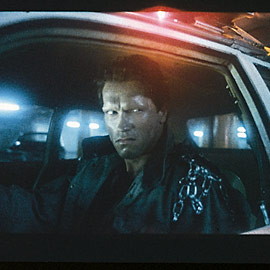
Then there's The Terminator, a film that makes me want to rescue from obscurity that old James Cameron, not the Titanic control freak, the Pirhana 2 protege.  I remember seeing the trailer for The Terminator at the Montgomeryville Drive-In (the main feature was C.H.U.D!) Shuffled in with about six other similar-looking indie sci fi-ish titles, The Terminator looked cheap, sleazy and we in the car, all Conan fans, loudly mourned how far Arnold had fallen since 1982. Focusing on the sad-eyed New Wave disco Tech Noir, with its tacky neon and Arnold dressed like  the kind of guy who usually has Rutger Hauer or a naked screaming woman reflecting in his Gucci sunglasses.

Of course that's not the way it panned out; the reviews glowed and the box office soared, and my jaw dropped in pleased amazement. I remember seeing Terminator by myself up in Woodbridge to get away from my family Thanksgiving day in 1984 and lord knows I felt pretty wowed. The trouble was that it became too popular. Overnight Cameron became an auteur, the most recognized newly minted wunderkind to emerge from the exploitation genre since John Carpenter in 1978 with Halloween. And if you meshed Hugo and Halloween together, wouldn't you have The Terminator? Look at the resemblance of the 'shape' and the mechanical man in the below shots, so many similarities to with the Sarah's roommate and her boyfriend and PJ Soles and hers, right down to the getting killed going for a post-sex snack, the annoying rock headphone-wearing, the presumption--as with so many modern cell phone users--that being myopically absorbed makes you invulnerable, etc.


1. Automaton!: The idea of the automaton goes back to the 1890s (see below right) and was forgotten by the 1920s, but the automaton killer thing began again with Halloween (or maybe the 1940s Mummy sequels). Of course I'm talking about the slow moving but unstoppable variety, the shambling shapes who can't be killed yet are not alive, and are already slowed yet won't be stopped. And like The Terminator, Halloween was a scrappy independent low budget ($6 million; Halloween was $320K) thriller that wound up being iconic and inspiring many much bigger-budgeted imitations, all of which corresponds to the figure of the forgotten auteur and his lost gem 'automaton.' The filmmaker's own alienation from the actual machinations of projection, of the mechanism of screening and seeing the film with an audience (aside from the premiere), anxiety about the cross-country marketing and promotion, and the obsessive need to tinker, to keep taking things in and out of the final cut until the last possible moment. What does it all deconstruct to?

"Draughtsman-Writer" by Henri Maillardet c. 1800

The surrealist concept of 'automatic writing' is probably at the farthest extreme of big budget Hollywood moviemaking: the first is unadulterated raw unconscious, the second has been tooled by a team to wring maximum suspense and greatness, with dozens of unionized voices pitching in and every creative decision having to eventually boil down to entries in a budget ledger. The whole mission becomes capturing the blazing brilliance of the automatic writing session inside the carefully constructed and staggeringly complicated mechanism of filmmaking. It's what occurred to me watching the mechanical man in Hugo start to draw... we don't know what the metal hand will write or create, but neither do we know what our own hand will write during automatic writing... it becomes the opposite end of the Hugo spectrum, the mechanical voice, SKYNET's distant cousin, reaching from beyond the well-guarded door to hopefully scribble something accessible and profound: "I'm sorry, Dave. I can't let you do that." or "we think of the key, each in his prison / thinking of the key, each confirms a prison."

2. Women are the fathers of Horror - And now, gender controversy comes into the mix, because creating mechanical people and automaton killers is a man thing, his approximation of the birth giving experience. The mad scientist is the classic Apollonian archetype, attempting to replace the chthonic madness of woman's birth canal with living tissue over titanium endoskeleton... or big fat cogs. The man rejects reality and creates his own, either a shape, a tower, an automaton, a poem, a science fiction or horror film...

So wouldn't it follow that women, then, are perhaps the 'fathers' of these creations, the automatons, and therefore of all the best science fiction and horror films? Look over the roster and you see women right behind the scenes, letting the man take the director credit, and instead working as producer and writer, script supervisor, and sometimes star


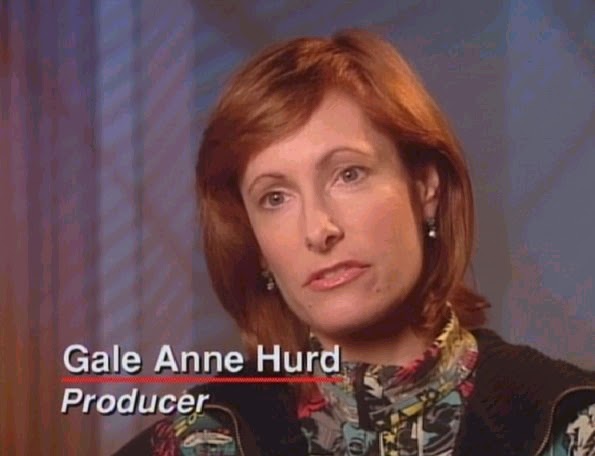
Consider yet another Halloween-Terminator similarity: in both films the target of the monster is a normal, good-hearted girl who locates her true heroic self in the course of events, and both films transcend cheap boy's club sexuality and feel more assured about gender than a genre picture had seemed capable of prior to. And a look at the credits reveals why: women were actively involved, as writers and/or producers, in both productions: Debra Hill in Halloween and Gale Ann Hurd in Terminator, and though their contributions tend to go unrecognized in the rush to canonize directors like Carpenter and Cameron, looking at the later works of each lady you see a lot of the same wit and charm that made both these early films so successful, a wit and charm lacking in the director's work without them. For example Hill also worked with Carpenter on The Fog and Escape from New York and Hurd worked on Cameron's Terminator 2, Aliens, and The Abyss. These films all have a spark and wit and self-effacing deadpan soul that is lacking in later work by the men (unfertilized eggs, if you will). The trick of course is to find and then honor the woman creative voice who understands the masculine psyche without being contemptuous of it (the genius of this being Katheryn Bigelow, below w/ Oscars).


Debra Hill, left
Within the context of Hugo we have the female character played by Chloe Grace-Moritz who, in the end, finds her own groove by deciding to write the book whose adaptation you have just seen. So in a way she's also a female 'producer' helping a male's automated vision make it to the screen, filtering the material through feminine perspective, watching from on high as a man expresses through art his own weird gender-fucked procreation. Like Hurd and Hill, Moritz is participating in the rearing of a film--through support and input the way a husband would in the rearing of the child. Just as a dad helped conceive the actual child, and may help raise it, he will never get the auteur credit for the child's existence, that credit belongs to the woman, no matter what part dad had in it. So it is that great sci-fi and horror films seem to depends on women like Hurd and Hill, who become, in a way, the fathers (Scorsese of course has genius editor Thelma Schoonmaker;  Argento had Nicolodi, even George Lucas had Marcia, the list goes on, and the dip in quality after their split is always noticeable. (Hitchcock stayed the course with wife Alma, so his work stayed good),

Blue Meanies: (from top) Terminator, Halloween, Hugo

3. The Gears: In the end, our 'submission' to the process of entering a film 'dream state' is an interface with a machine - our brains becoming clockwork, revolving with the turning reels of film, the gears and wattage of the projector.  The actual movie may have cost millions to make; it may have been made by talented craftsman tinkering for months, years or it may have cost just a few hundred thousand, shot and edited in a few weeks, but the final result is always the same (as is ticket price): it all boils down to a machine spitting encoded light and shadow out onto a white screen in some suburban multiplex. We enter collective hypnosis willingly - leaving our necks and heads exposed to the person in the row behind us who just might stick a knife through the base of our skull. Sex and sleep may leave you vulnerable to killers onscreen, but film watching is to actually invite them in. 

But it's okay, they're not human - just electromagnetic waves.  We've invited in the machine. Hopefully it's not, you know, become sentient. 

Man Ray - Rayograph

We repress or ignore this cinematic mechanism element when surrendering to a movie (unless it's out of focus, or too quiet, or the sound is out of sync, or the theater is too hot or cold) as easily as we forget that we--personally and finally-- could become raw meat in the blink of an eye on the highway, or that 80% of the voices we hear tend to be electronically reproduced, that we barely speak anymore except to order food... on the phone. The automaton then comes as an eruption of the mechanism even further into consciousness, a black hole opening up in the center of the film, fixing to turn us all into mecha-aberrations, like Chaplin threading through the machine in Modern Times, or Sarah Connor in the crushing metal compactor in the Terminator climax.

To avoid this we like to keep a respectful distance from the mechanism itself, we hide the wires behind the walls, but as we prepare for 2012 it becomes pretty terrifying to realize how hopelessly addicted we are to electricity. One magnetic pulse and we will be totally lost--everything digital wiped blank in the blink of an eye. The tactile will survive, like celluloid, there just wont be any way to project it. 

The Terminator and the mechanical man in Hugo are both examples of machines that don't use electricity, that would survive the pulse - one just needs to be wound up, the other is nuclear-powered. Neither needs an outlet. 

They, alone, are truly independent. Autonomous, far freer than ourselves.

blood and gears (from top: Hugo, Modern Times, Terminator)

4. False Nostalgia Syndrome - Like a suspicious number of films nominated for a 2011 Oscar, Hugo bathes in nostalgia for pre-WWI silent film whimsy, recalling Modern Times if it was remembered by the film scholar who managed to find its lost reel in a mislabeled can and won a prize, and Scorsese is certainly a major savior of film preservation, but is his nostalgia enough to warrant the 'greatness' label for Méliès? Is the subject even a worthy entry in the oeuvre of the man who made Raging Bull and Goodfellas? When dealing with the working class Italian neighborhood of Little Italy or Brooklyn, Scorsese gives us 'real' nostalgia, as in he 'really' witnessed it. For an escapist like myself, Hugo seems as suspiciously self-indulgent as Woody Allen's Midnight in Paris. These are the fantasias of pampered rich kids who have been able to spend their lives tinkering with sound and image and now wonder if maybe, if they could travel back in time, then even Earnest Hemingway would call them geniuses. They'd be able to recognize themselves in work by Ezra Pound and T.S. Eliot and get to drink 'real' absinthe. It works as their fantasy, but it can't work as ours because they've inhaled the fun out of it, and left us nothing but a shrine to their own desire, nothing but the act of showing us something that meant something to them when they were young and dumb like they think we are now. 

The Terminator on the other hand is my experienced moment of childhood whimsy (well, teenagerdom - right at the time I was changing from comic book nerd to punk rocker)--and revisiting the film today it seems, at least on the surface, refreshingly trashy. With its pouffy hair, pastel clothing, Italian rock synthesizers, rear screen-projected stop motion animation, copious neon, pet iguana, and casual sex roommate getting killed off slasher-style, this pre-digital futuristic film is the 'real' wake-up to nostalgia that Hugo can only catch from a fleeting Parisian postcard, that is, unless Scorsese actually remembers going to films at the turn of the century, pinning that rocket-in-the-moon's-eye image on his bedroom door to anger his mama. (Mama, it's just-a la luna.) Because without that genuine connection, only an egoist would think he could deliver any real meaning... unless he admitted Méliès films lacked narrative thrust, and that--depending on how long it's been since we saw our favorite childhood films--our expectations are seldom met. 

Paradoxically, it's in not meeting expectations the actual magic occurs. It's the very gritty low budget tangibility, the tactile vividness, of the 1984 Terminator that somehow makes it seem more alive today than a CGI-sandblasted 2011 film like Hugo. No one knew at the time of Terminator's making that "I'll be back" would become such a catch phrase, to the point there was no way avoid its embarrassing repetition in the sequels. They became a slave to a tossaway line, doomed to repeat and repeat every time someone puts in a nickel and turns the crank.

The original Terminator is a movie free of that kind of presumption and reptition; it presumes it won't be loved any more than most sci-fi down-and-dirty action pics, which is why it's so indelible. Hugo all but tells us we have to let its magic symbols -- the rocket-in-the-moon's-eye, the heart key--into our hall of future golden memories, to make this an Xmas staple to get gooey with grandma over. But for me, even though I well-knew of Méliès beforehand, and I had his Trip to the Moon on super 8mm and we'd project it over our drummer in our band's light show in 1986-9, what that moon makes me think of all these decades later is "Tonight" by Smashing Pumpkins, another recreation that doesn't even bother with the rocket in the moon's eye shot... to its credit. Instead, the Pumpkins take the look and feel of Méliès' pre-modernist world's fair whimsicality and then update it to rock, speeding up the imagery and adding deep emotional hooks.

Scorsese instead tries to slow us all down into Méliès' level, to put the film in a shrine or museum and destroy its last link to the real world. If Hugo were truly to be worthy of the Scorsese canon it might end, for example, with the audience slowly realizing that the static long shots and endless flurries of spastic activity make Méliès' films kind of boring (except maybe on a huge screen so the actors seem approx the size they would be as actors on the stage). Though undeniably creative and elaborate, they're hung up on the magic celluloid provides at the cost of resonance and narrative cohesion. Instead we see a lot of things disappear and reappear as if that never gets old. Today these films only capture attention when used in a new context, a collage or lightshow. Scorsese would have been wiser to try and capture the chaotic making of the films, jilting Hugo altogether. And hey, he fixes the hand-tinting and slyly tweaks out the dullness through just showing a long Academy-style montage of highlights from the found Méliès oeuvre at the very end. There's too many train station vignettes to cover to go much farther.

Hugo's unthinking reverence for the great Méliès reminds me of the ending of the 1958 film Teacher's Pet: Clark Gable plays a scrappy self-taught city reporter butting heads and other parts with Doris Day as an over-educated journalism teacher with no real experience, whose father won a Pulitzer for his smalltown paper editorials. Love happens against their will, with Gable preferring to pick fights with Day's platonic pal Gig Young than make love. It's not until Gable finally reads Day's dad's old editorial clipping that he can proclaim "they stink" and come into his own as the confident uneducated lover of an educated gal. Call it reverence prior to investigation, or just bourgeois idolatry, but it takes him the entire film to learn to value his own opinion enough to make this claim, and until he does he's stranded behind this slab of journalistic integrity that he's expected to measure up to even though he's long since surpassed it. I wouldn't even bring it up if it wasn't so relevant to Marty.... Marty, come back to the 'hood! Stop puttin' on those fancy airs. 


I'm not knocking Hugo; I cried and thought Asa Butterfield was eerily perfect, but while I normally love Moretz she seemed ungainly and confused... 

Spielberg's Super 8, which was released the same year as Hugo but not nominated for an Oscar, is nostalgic for the era that I too was a a young super 8mm filmmaker in (the Terminator era), but also proactive about actually making movies instead of revering the makers or cleaning the projector. Scorsese has never really gone self-reflexive that way, to the point its suspect. There's no real salute to the creative energy of the moment in Hugo; it's all about preservation and repairmanship; it has to run all the way around the massive sets five times just to make us think the right hand doesn't know the left from a hole in the wall, through which it hopes to add some Amelie Rear-Window-Psycho insightwithout drawing attention to its own absurdly over-qualified self-awareness.

Eyes of Laura Mars... or Supergirl?

 Super 8 on the other hand is just as top heavy but it fights from its gut; it kicks and scratches and its orphans are only half-orphans and the pain and the bonding between Elle Fanning and Joel Courtney devastated me a lot more in a lot less time, and seems a more logical film to champion for a ballsy academy. But they weren't awake enough to realize Super 8 isn't about the alien or the evil government but about kids carving their own sacred space out of the lumpen absence of parents too dumb to know either their own beastliness or their kids' frail genius. The alien in Super 8 suggest what might have happened to ET if he'd not been able to phone home, or if we abducted the greys at the end of Close Encounters. In other words, he's pissed! He's the perfect reflection of the suburban teen forever denied any form of dangerous self-expression ala Over the Edge or Rise of the Planet of the Apes. No wonder, then, the old timer Academy dismissed Super 8, probably with the glint of fear in their eyes.

Super 8

Final anecdote: I had my own Hugo moment in 1997 whilst out of my mind on acid up at a friend's big weekend party at her Swiss chalet in the Catskills. It was gorgeous night under the stars and everyone spread out under a massive blanket on the ground, facing the blank white side of the house. Behind them I set up my old super 8 projector on a picnic table bench and projected on the wall an old clip reel from 1931's Dracula, unintentionally at the wrong (slower) speed setting, and since I was tripping I had no way of knowing. An already slow movie became dripping with poetry as that slowness was doubled into a total dream state. Is there a more indelible image of death at 12 frames a second than black-and-white Helen Chandler as Mina, her voice now almost manlike in its druggy depths, slowly explaining her dream of the room becoming filled with mist? As I crouched hallucinating into the weird gears and mechanisms of the projector, threading the machine like some old Rumpelstilskin out of time, shut out by choice and inclination from the orgy of physical warmth going on in front of me with my friends, who lay in a row under a huge zipped together sleeping bag, I felt like an outsider, yet in command. They were watching the films of course, but also doing physical stuff under the covers of which I knew not -- e they would be the last people to notice how... sloow David Manners was talking. He finally sounded like a man.


So there I I was alone, in front, in the cool damp of the night, threading my machine to dazzle them with slow motion vampires from 1931, and while most nights my feeling of disconnectedness would shatter me more than any constant drip of bourbon could repair, that night, under the stars, I accepted my role as 'projectionist' and gave up my hunger for the golden hair and sleeping bag sense of belonging. It all came into focus for me in that moment, and though my friends were all making more money than I was via advertising and computer network maintenance, and were basking in their ability to create human warmth and self-confidence, not all of us can turn down our genius enough to lapse into the tactile bonding of more socialized, less alcoholic peoples. But they accepted me, loved me, I knew that, and meanwhile I had Bela Lugosi... and I was running the films, and here in this Alpine heaven I had proven, despite my lumpen clay demonic self-consciousness, the gravity dragging me back to my level of cinematic isolation, that I belonged. 


If that doesn't make me a Hugo, I don't know what does, or a Kyle Reese (Michael Biehn) in The Terminator, who is also in his way, an archivist, going back in time to preserve some imperiled damsel in mid-bloom. Don't we all hope some Hugo is going to dig up our little forgotten super 8mm films up from some garage sale attic one day? Or some collector of my old hand-drawn comic books look me up in hushed awe? And I'll find out there's a whole cult around me, and they thought I was dead, and --oh wait. maybe I am?

"A mistake is made."

This is what non-family man artists do instead of having real human children of our own and wondering if they'll ever call us once they move out: we make them out of clay and wire and words and weird alchemical machinations, hoping some version of ourselves in a future generation will come along and figure out what we were trying to say. The Mechanical Man's reproductive organ is a camera but women don't need to have one since they can have real babies... Like Manson in the top quote, they have 'a family.' The camera is there already - the man brought it, because he does what he can. 

When will intelligent women stop writing about man's obsession with giving life to the dead, as if it's she who should be jealous?! Honey, why do you think we're doing it. 

We build it to impress you.
We use it to escape you.
We escape from it,
too late.

Elsa Lanchester as Mary Shelley (Bride of Frankenstein)
Related Posts Plugin for WordPress, Blogger...