Showing posts with label Robert Altman. Show all posts

Tuesday, January 20, 2015

The Gummo Marx Way: INHERENT VICE (2014)


With glazed eyes and a suspicious tan, Shasta (Katherine Waterston) began languidly gyrating atop our semi-supine and stoned hero (Joaquin Phoenix); her slow deep rhythmic breathing began sending twisty second chakra waves out from the screen into my own shattered nervous system like a hot shower in the reverse direction, kicking the little dusty stem I'd eaten during the previews into slow un/coiling kundalini life at last. The barnyard pungency of the leather coat on the hulk in the seat to my left became--through this Shasta-breathing kundalini awakening--no longer overbearing but reassuring, earthy. A few more deep Shasta breaths and the whole theater of imperfect Brooklyn specimens glowed and merged as one--ever-more rhythmically frenzied-- grinding energy vortex. Each shadowy spiderweb sketch line filament of Inherent's cinematographic glow was now a haunted hazy amnesia-curing brushstroke, framing two lovers against the darkening afternoon of a "Gordita Beach" apartment in the early evening. Shasta's Tropic of Capricorn-style twisted sexual power trip extended single take monologue slowly drove us all into a sympathetic breathing response, and our hero into a ferocious rutting frenzy. 


"You're moaning again," my girl next to me whispered. Apparently this was a thing I did in such moments, quietly I hope, at any rate unbeknownst to me.


I've felt the glowing anguish that results when a a tripping male is suddenly placed in close quarters with some random hottie wearing intoxicating perfume with low cut blouses and short skirts. The intensity can buckle you to your knees. Not being able to just attack her like you're some cameo-making midlife crisis male in CANDY is like having to explain to your children why you're getting divorced, only instead of kids it's a seething sacral chakra. I've felt it a dozen times, but seen it captured in a film only once: Terry Gilliam's FEAR AND LOATHING IN LAS VEGAS, when just being in an elevator with a laughing Cameron Diaz is enough to send Benicio del Toro's acidhead lawyer into a slow-building howl of pain that infects his mind and body for the rest of the film and results in him even pulling a knife on her friend. I'd never felt it over a movie scene before though, until this moment in VICE, on that one dusty stem... 

Benicio is a very attentive lawyer for both Hunter and Doc (from top: FEAR, VICE)

Everything else, every other trip I'd take later in college and after, never equalled that one perfect moment, it was all just more of the same, but less effective, like 99% of horror movie sequels. Well, that Katherine Waterston scene in director Paul Thomas Anderson's crowded canvas VICE does deliver something new, something PTA's sorely needed, a damned good femme fatale anima for all his damaged fathers and sons.  There's even a holy ghost this time, via a moving and very weird scene with the great Eric Roberts, and a spirit operating a drug dealership via Ouija board.


And most of all, VICE is set in 1970, California, via the literary tripper's choice, based on the book by Thomas Pynchon.  I wanted to hang onto everything--being such a PTA fan--but most of it is a blur of names and faces and places. What resonated for me: a stray streak of sunshine on Doc's face during a drive to the beach, a sunrise reunion of a reformed junky family (the glow of the doorway and the horizon line behind matching in perfect transcendentally lucid pink), and that Waterston 2nd chakra-activation monologue --that's what I remember most. Just a stem and a cap to heighten the gorgeous golden magic hour moments, just a little Gordita Beach Turkey Ranch, that's all I got. Just a couple of acres. Groucho looking out from the ANIMAL proscenium CRACKERS arch, talking to Doc like a most gnarly cross-mediated platform surfer? Stuff was on TVs back when everything was thrice the magic for being so ephemeral. The only screenshot you could make was to take a photo of the TV screen. Always is that magic of the untaped TV-chronicity in a Pynchon; he'd be a great film critic if he wasn't so regular falutin'. Knows his pop culture  but spikes it with post-modern glug glug glug, like a drowning submariner crying Lot 49. And if those strange figgers, mysterious figgers (Anaconda 148) don't add up, neither does life, it's just time lapping into seahorses, and for my sins, they gave me some. And neither does BIG LEBOWSKI. Make sense, I mean. But that's okay, it's not from a book, and so it doesn't fall into that over-reverent, 'trust the meaning is there in the lit' white elephant manicuring that, for example, pulls a bit of the stream-of-madness energy from John Huston's UNDER THE VOLCANO and flattens it out into detailed 'giving the cinematographer and art director way too much money and time' sumptuous over-thinking. There's no extended dream sequences or surreal "it had no bottom" odysseys for Doc Sportello. He's nailed to the events occurring in ways more significant to a detective yarn where it all makes sense and the paranoid 'maybe connections' are meant to add up. No scene can go off into its own little termite dream realm because there's the 'book' to honor and it is a work of literature not a lean mean skeleton on which to hang an array of detours. Yet neither Pynchon nor Lowry are very 'exterior' writers, and to nail their florid dense text to a single narrative film and expect it--due to its literature pedigree--to make 'narrative sense' is rather silly, like expecting Holly Martins will be able to pontificate on Joyce's Ulysses just because he's an American and an author. 

But Shasta adds up. Those legs sprawled naked and soaking in a storefront alcove, Phoenix's scroungy Marxist professor from the 70s look, from back when professors bedded co-eds with sanctioned impunity, and Nazi bikers worked as Aquarius Age bodyguards, and nymphomanic maids screwed everything that wasn't nailed down in her madame's boudoir. Or is that just priapic fantasy?


Mystified mainstream critics have reasoned English major Generation X stoners like myself who remember the 70s from a wide-eyed childhood perspective, aren't seeing the 'real' thing. Our parents are disillusioned with that decade, just as we are with ours (the 80s). I still get weirded out when I hear the Y generation venerate the 80s like it had some mystic power, when for my generation that power faded in the anguished morass of puberty and puerile sex comedies and misogynist slasher movies. For my generation we feel connected to the mystical 'truth' of 70s-style Fleetwood Mac/Sonny and Cher California consciousness raising. We see the Aquarius high water mark with a glowing rose tint. We remember an orgy we saw from afar but never experienced, and that orgy--our expectation of attending it later--being what formed our psyches. But we let the distance between that peace sign-sticker flanked scene and our own embarrassed shyness widen until the distance until our longing soured into bitter frigidity of the slasher movie, feeling our last shred of innocence die at the hands of David Mark Chapman, moaning in pain as the AIDS 80s slammed the door shut right on all future orgies right as we were approaching the 'right' age.

We, these mainstream critics have noted, will probably dig INHERENT VICE more than the bourgeois top critics on our more mainstream newspapers, the "Top Editors" who keep us second stringers reviewing Tyler Perry and Veggie Tales movies. They grab the Paul Thomas Anderson film for themselves, alpha dogs grabbing for the chew toy just because they sense we want it. For these top dogs, the decade's Aquarian tommyrot is just an embarrassing reminder of the month they tried to wife-swap with their bridge club. Paul Thomas Anderson, as far as they're concerned, hasn't made a decent movie since HARD EIGHT. La dee dah.

The Gen X-ed of us love everything but HARD EIGHT, and now, or yet, THE MASTER had thrown us for a loop. Speaking for myself, I dutifully saw THE MASTER twice thinking it would cohere into genius a second time, but no, it was still just gorgeously photographed acting of no more lasting effect than being made to chop wood at my buddy Al's grandparents' house, and liking it despite grousing before during and after. Seeing it again, I can smell the wood burning. But it doesn't get me high anymore

I'm not sure I like INHERENT VICE, at least after one cinema viewing -- high expectations? The only moment of THERE WILL BE BLOOD-level badass Babe and Bunyan truth in either of his last films is when Hoffman shouts "Pig Fuck" with a coiled unresolved adolescent fury any frustrated enlightened charlatan knows all too well. The more spiritual drivel you speak, the surlier your squirming toad cortex seethes below, til that wicked tongue snaps forth and puts someone's eye out. But it was hard to buy the idea that Seymour Hoffman, for all his towering talent, could ever be a cult leader--his fingers were too stubby. Neither he nor Phoenix is the sort, for example, you'd want a bedroom poster of, or to pray to on an altar, the way say we would James Dean, or Daniel Plainview, or "Bob" Dobbs. Phoenix also seems all wrong for a detective, or cop or skip-tracer. He's way to tiny. He seems the type you could just brush away with a strong broom like sweeping motion.

Luckily, in VICE we have the sexual power of Sam Waterson's daughter. She seems legit --the real thing. Her vaguely cat-like face and ease with her body, that sweet sad wistful 'already gone'-ness cracking in her voice, the sort of real no amount of acting workshopping can fake. Her Shasta isn't hung up on Mother Jones sermonizing or slumming Edie-ism. She's complex, and you can believe she doesn't show anyone her full self, and those who come close to getting the big picture are just as likely to lose her with their first inauthentic breath.

Keep your eye on the red bullseye - Lucky Strikes means fine tobacco (LSMFT)

But this is INHERENT VICE: Ultimately, as the narrating Joanna Newsom notes, a nameless eternal evil has seeped like a vapor out from the ancient opium Pacific and co-opted the Age of Aquarius. But just where has the vapor condensed? It's a hard thing to trace in a 1970 California where hippie-dom is apparently so very near becoming the dominant culture that cops don't even bat an eye when you spark up a joint in their presence. They do beat you up for having long hair though - even if they're  your friends. Ain't no gettin' around that. So just assume the passive stance of protecting head and fingers and groin and let the billy clubs fall where they may.

Milk
Thus the strange ancient frenemies relationship with Josh Brolin's cop Bigfoot. And Brolin's character invoking hazy memories of the 'Twinky Defense'-copping assassin Dan White in MILK (2008), connecting with Newsom's debut album (The MILK-eyed Mender). Coincidence?

PTA's always been first and foremost a filmmaker for de facto cool older brother relationships, and part of what BLOOD's power emerged from was the relative lack of a feminine element. Certainly, to my memory, no female character has a line of dialogue in the film, aside from maybe Mrs. Sunday. Instead there was this boy scout-cum-capitalist narrative nursing on the crude oil teat of the Paul Bunyan masculine John Henry Steel Driving consciousness, drawing from it as if a deep well from which to dredge up the dark oil-slicked father of modern oil-based economy. THE MASTER tried to do the same, but Amy Adams' as Hoffman's wife snaked forward with more power perhaps than even Hoffman (as his Clinton-esque hand job indicates). Now, in VICE, it's even narrated by a woman, and not a Spacek in BADLANDS blank slate woman but a savvy all-knowing Cali free spirit shamaness of no small wit, harp expertise and mystic acumen. Her albums are rich with great existential lines that would stagger Whitman and leave my iPod devastated--"and though our bodies recoil / from the grip of the soil / why the long face?" She and Waterson are not stealth buzzkills like Amy Adams, but wild untamed goddesses of strange alliance, orbiting men in motion like moons or cats but belonging to no single planet or territory or direction.


Then there's Joaquin as old Doc, the hippie detective. His office lurks deep in a medical suite, Anderson's ex-girlfriend Maya Rudolph as his doctor office receptionist; Doc in his gynecology chair, a xone for smoking weed and staring at the window, huffing laughing gas when the myriad threads get too much for a single viewing. Seeing double somehow allows the plot to come into focus for old Doc. Not me. I do know that it's Maya Rudolph's mother, Minnie Ripperton, singing the song that rises triumphantly from the soundtrack during Doc's mosey back to his office:

Ring all the bells /sing and tell 
the people everywhere that the flower has come
Light up the sky with your prayers of gladness 

and rejoice for the darkness is gone... 

Of course 1970 it was still possible to be idealistic enough to believe that darkness would one day be gone, or even had gone once and come back. And it's Anderson's genius that he can recreate not only our Gen-X collective memory of that era, wherein he and I were children of similar age, but to make it a source of lasting mythic resonance. For me, every strand of long blonde straight hair I see reflects the gossamer shimmer of Anita Louise's as Titania, queen of the fairies--my anima! If it's over a denim jacket, I'm agog. Why? My mom volunteered part time at a runaway shelter, which was basically a typical suburban house with a big porch. I remember one Xmas my dad's company bought them a coffee percolator. They were part of the Jaycees, my parents, so fell into stuff like that. My mom brought this girl named Toots home for Xmas -- a gorgeous 16 year-old thing in a jean jacket and perfectly pressed long blonde hair. My mom gave her two packs of Marlboros as an Xmas present, maybe some other stuff - I only remember the cigarettes. It left me forever a-swoon for her type, and dying to be a smoker. That was the 70s, you'd take in runaways and give them cigarettes and it wasn't considered a felony or 'suspect' or 'corrupting the morals of a minor." Don't get me started!

For Xmas, my rapture over her every movement paralyzed me so I still remember how hard it was to croak, "Hey Toots, want to do Doodle Art?" Those words etched into my brain with some small shame, the way my voice broke on the word "Doodle" and made it seem somehow scatalogical.

It was the 'Mythology' one (left -but w/different colors)- and ten years later it hung in my college friend's drug den living room -- it's the circle of life. Mythology. Coincidence.

But it was mainly that fate had deposited her there, on my orange shag rug, like an Xmas gift from the karmic wheel. In the safety of my family, she let it all hang out. And it's a family affair of adopted and actual sibling cinema in camp PTA too: Sam Waterston's sexy daughter Katherine is the femme fatale; Martin Donovan is the angry dad of a runaway, the stand-in for Col. "I enjoyed that drink as much as you did" Rutledge in THE BIG SLEEP; Elaine May's daughter Jeannie Berlin is Doc's savvy New Yorker Aunt Reet; James Brolin's son Josh is the cop; Eric Roberts is Julia's brother; Serena Scott Thomas is Kristen's sister; Jena Malone is a reformed heroine user looking for her man.

And some of us remember Joaquin didn't come up the ladder to fame so much as be revealed standing there after brother River died (sister Summer's also in movies); Joanna Newsom is married to Andy Samberg who later that same night (that we saw VICE) showed up on ERIC ANDRE SHOW uncredited as Eric's double and their schtick together evoked the mirror scene 1933's DUCK SOUP, starring the Marx Brothers, and the street name Gummo Marx Way--Gummo famously the only Marx Brother never to appear on film--is on one of the files looked over by Doc at the Hall of Top Secret Records in VICE.


And what about GUMMO? It's by Harmony Korine, who also made SPRING BREAKERS, set also on a beach involving pretty people doing crimes while engaging in deep druggy binaural second chakra breathing. Of course that film was set in Florida, where Elmore Leonard set so much of his oeuvre, and that oeuvre a clear inspiration for Pynchon's source novel, along with Hunter S. Thompson (Doc and Duke sharing Benicio del Toro as an eccentric lawyer) and The Firesign Theater's How Can you be Two Places at Once when You're not anywhere at all? And back around again. Gummo Marx's film oeuvre, a study through which someone in some Allen film obtained some film doctorate... which brings me back to VICE yet again, and Martin Short's obscene corrupting uncut Cockaine dentist love... with Shasta an underage girl ("But it did happen."), a wild child ala Camen Sternwood, falling onto Sam's lap while she's standing up.


And back to that wow of a super sexy girlfriend free spirit played by Katherine Waterston (Sam's daughter) named Shasta Fay Hepworth. She basically owns the movie, no mean feat considering the heavy hitters in all directions. She's the mystery, and by the end we can understand why this stoner detective is so crazy about her, and why he's ultimately so frustrated being unable to find any clues as to her whereabouts when she decides to be gone. Like Lebowski is about that rug, or Gould's Marlowe about that vanished wrong guy friend, or Hackman for poor Melanie in Night Moves, it's the obsession that guides him, the film, us. Woke last night to the sound of thunder / how far off I sat and wondered / started gummin' a song from 1970... was it Minnie Ripperton's "Les Fleurs?" Yo, Minnie's daughter Maya Rudolph was that fleur? She was born two years after that song came out. So no. She wasn't even a gleam in her father's eye. But in Hindustani texts Maya means illusion and is eternally beguiling. No coating of black enamel could hide her value from his eyes. Maya is the woods we must hack our way clear of towards the clear-cut riverside of Nirvana, with no Excalibur machete or golden ankh to wave. And let's just take a look at this fabulous Yucatan Blue! Price: only what the traffic will allow, delivered to me, Ralph Icebag, by a brown-shoed square in the dead of night. Now of course PTA and I are too old for such things - to fantasize about young hotties in the 20s is to feel slightly skeevy, the line of parental concern sneaking in to kabosh lewd longings, that coupled to desire's gradual dimming. We've been fantasizing about and desiring girls in Shasta's age group since we were seven. Are we supposed to magically stop just because we're now enlightened? Can we really put the social awareness genie back up the bottle? Now in middle age, men are only desirable if they do not desire. It's in accepting this awful compromise that an ex-swinger earns his only chance at long-term respect. Sportello in his quest for justice or whatever he's after winds up with no magic credit card full of money for his labors, that goes to Coy Harlin - who also gets his family back. What does Doc get as this agent of Borgesian karma? I can't tell you but it's also the name of a short-lived 70s soda brand. Give up? Even then, there's bound to be hurt feelings with a certain assistant-DA (below, right). This is the ever-evolving world Doc navigates. Riding one paranoid clue to the other. The final reward being a great bit of acting tough during the Martin Donovan talk where he momentarily seems somewhat scary, before sinking into his stoner fog once more.


I had no control over it, but I watched, and then I read about it, so I know that by the mid-80s, when I became a hippie and besties with Toots-like hippie blondes, America had already given up on the utopian ideal for a united and very hip America - only in certain pockets of California, Colorado, Connecticut and upstate NY maybe did it all still thrive. The alternate reality of Pynchon's LA can't decide if the counterculture infiltrated the mainstream and tools of government to any degree. I was too naive at the time to realize how much the 'free love' grubbers from the raincoat 'burbs had trashed the Hashbury Ideal until it hit me personally: Maybe you experienced it: townie and/or frat cokehead troglodytes dropping by your intimate ego-dissolving LSD party at four AM and you realizing you need your ego after all because you need to get aggressive enough to kick them out. All you can do instead is try, vainly, to formulate a coherent sentence without contradicting the love vibes you've vouchsafed. So it was wherever clement outdoor park service did thrive. Hordes of long haired peaceful but filthy barefoot hippies clogging ever last public bathroom, everyone being too cool to work or pay money, just presuming they'll be taken care of by the very social order they spit on.  The center cannot hold. Communes go unglued as psychedelic unity and the blazing tribal consciousness that had emerged from the primitive inner rolodex for the first time in 1,000 years gives way to petty squabbles, malnourished infants of uncertain parentage, filthy sinks (the water turned off for no one paid the bill) and squalor enough to reduce even the most enlightened of near-Buddhacatholichrists back down to grouchy adolescent Earth, craving the comfort of mom's clean sheets and the now-weakened capitalist behemoth's car keys.

But they had brought all the trappings of the counterculture with us back to our home suburbs, and 1970 signaled the beginning of that smooth Laurel Canyon sound on the FM dial. The radio lit up with songs that managed to be sexy and vaguely dangerous to us kids without seeming to offend or challenge in any way. Parents and children in unison swooned from the emotional connection of "American Pie" or "Go Your Own Way" or "You Light Up My Life." Vietnam still sulked around but there were bridge games, wife swapping, martinis, and above all we kids. Our parents gave up total freedom but we were unleashed, freed by Jaycees' many parenting lectures all hip on Buscaglia, Spock, and EST - all attended and talked about and the methods "tried out" on us to great success.

I took advantage of that 70s freedom. I stole every cent I could. We kids ran loose like dogs. It was okay with us that we could still get spanked or slapped in public by people not our parents and no one would bat an eye. One whack for every year on our birthday in front of the whole class by the teacher. At home, indoors, we towered like Godzilla over wood block towers we'd smash again and again before sloughing back into the depths. No mom objected to us playing with realistic looking cap guns unchaperoned wild in the woods and streets for days at a time. Vertical wood paneling was our rec room horizon; orange shag carpet our jungle canopy; couch cushions laid in a line on the floor our Bridge of Toome in County Antrim, Ireland. We'd march up and down it in time and pretend to be hung like Roddy McCorley. PTA was there, I was there. Were were you? Where were you? Which war? Which side or drug were you on?


I don't know how many times I've seen BIG LEBOWSKI. A dozen?  I don't even like it but it's endlessly re-watchable; some part is always just right for the moment I stumble onto it during, and its always on some channel or other.. Sooner or later though, it grates on my nerves. But it's never the same film twice, until now. Jackie Treehorn's shoe prints are all over the Pynchon PTA's lovingly detailed semi-sordidness. VICE even uses the same Les Baxter-Yma Sumac Tropicalia vibe that was Treehorn's leitmotif to conjure the same crossroads between the Jack Horner nurturing free love spirit and the Treehorn mobbed-up porno-decadence. But that's just one of a thousand twuggy-druggy twiggy-wiggy branches. You can dig it. I can dig it. Cyrus, the one and only.... But most of all, Paul Thomas Anderson has exhumed himself from beneath THE MASTER's weighty muck to re-dig it.


Who knows what would have been the result if Welles made a 70s stoner detective film. Would it have been INHERENT VICE? Or is there just no character titanic enough within the story to hold his interest? There's no core or center to VICE, no 'hurrah' moment like the pool party in BOOGIE NIGHTS or the bowling alley climax of BLOOD. Phoenix is a great actor, but he's a scrawny shell of a thing, a short wiry little weirdo. We don't gravitate to him like we do to Warren William or Bogart in similar roles, or even Dick Powell or big Jeff Bridges (or his father, Lloyd Bridges, for that matter). As for VICE's detective narrative, it's more coherent than some, but trying to explain the plot to my underwhelmed partner last night, all I could do is relate the anecdote about Hawks calling Raymond Chandler from the BIG SLEEP set to ask who actually killed Owen Taylor and Chandler not knowing the answer either. It doesn't matter.

She thought it should.

I've seen BIG SLEEP a dozen times at least, and I'm almost ready to blame Joe Brody, but Joe's saying he just sapped him for the incriminating picture from the back of the head of Krishna, So don't even draw the connections, baby. Just soak in Eric Roberts' brilliant monologue that rips the guts out of capitalism with an LSD trowel and reveals nothing but jewelry-coated vultures beneath the black enamel topsoil, the breathing aurae of cinematographer Robert Elswit, the spiderweb lines of light and shadow haloing around every actor; the great clothes and cars like some old analog album came to life, Phoenix a little monkey wiggling free of his angel dust entrapment cuffs and every drug you have ever done shivering to your DNA surfaces.

You're home, if you're like me, comfortable, almost amniotically sound, in this murky mythic din of countercurrent flashbacks. Every time you smoked angel dust it was because some dirtbag laced his joint and didn't tell you til it was too late. You were only three but you well remember the morning when every TV channel showed only the streaky continuous feed of astronauts bouncing around the moon in molasses air, like they were underwater, the audio just transmitted astronaut chatter and space interference, hour after hour, the usual old science fiction movies of the morning pre-empted, their futuristic fiction now outmoded into ancient fact.

"Ain't been high since '69"
In some strange way that was true love, that one stretch of continuous time --no commercials, no political dissent or grandstanding or fear-mongering, no sponsor, no agenda. Just community, finally. Harper Valley, we didn't know how much you meant to us until we thought we'd lost you.

But a new time has come: your cosmic Maya has given birth to a new generation of Rippertons. We're free to love movies like those mythic moon moments again, free to see you and me in the same slow motion bouncing astronaut ground zero persona-dissolving mythic glow. A new go-to comfort food bible is born, if you care to blast for it. It's the Adventures of Sam Spade, Detective, brought to you by Wild Root Cream Oil Hair tonic. Yeah, it tastes electric... crimson... almost like fire. Almost. But were real 70s cars ever this collector clean? Or ever a humor in this Woman One? Take this lozenge from my tongue, this quill from out my heart, this pink and blue Tab (languette) of / Purple Barrel Plums / Untie from me the TruCoat, Ralph Spoilsport. Though our bodies may break and our souls separate, why the long face? We don't need no sealant, not anymore. No salt coheres along an ever-moving shoreline. Arise for the darkness has come / back! Remember Les Fleurs, Walter! Ils brillent dans le noir. And most of all... Rejoice, sisters and brothers and siblings transgendered: there's finally a movie where being a stoner isn't the same thing as being an idiot. I never in a million addled years thought we'd overcome that dopey stigma, let alone Washington and Colorado, let alone, baby.  Let alone.

Dirty up that car, Paul. This ain't no expo
Al Shean Presents: Vice Grip of the PYNCHON

RIFF INDEX:
1. Jackie Treehorn -(Big Lebowski) Pornographer played by Ben Gazzara (a riff on Eddie Mars in Arthur Gwyn Geiger + Eddie Mars in The Big Sleep) - "I'll Say She Is" - title of the last (unfilmed) Marx Bros. Broadway revue / Jack Horner - Pornographer played by Burt Reynolds (Boogie Nights)
3. "when the drugs began to hold..." - opening lines from Hunter S. Thompson's Fear and Loathing... Vegas 
4. "Turkey Ranch... that's all I got" - Hank Quinlan - Touch of Evil (1959) / "lapping into seahorses" - Patti Smith, "Horses" / "Steel Anaconda," etc. - Animal Crackers, Pynchon - Crying of Lot 49
5. "Spoilsport Motors," "Where were you, Mr. and Mrs. John Q. Smith" - Firesign Theater (How Can you be Two Places at Once...) / IV. "Communiss" - Confederacy of Dunces / 7. "Roddy McCorley" - Irish drinking traditional (via Clancy Brothers album we had as a child)
6. "like the Andalusion girls used..." -"crimson... almost life fire" -  James Joyce, Ulysses 
7. Trucoat - protective coating / sealant - scam extra Lundergaard tries to sell - Fargo (Coen Bro.s)
12. Wildroot Cream Oil Hair Tonic - "Again and again the choice for men who put good grooming first" Squaresville, in short. (Sponsor for old radio show "The Adventures of Sam Spade"  / Walter - (John Goodman in Big Lebowski; also Dick Miller in Bucket of Blood)
9. "Take this Longing..." - Leonard Cohen / "quill from out.... my heart" - Poe, The Raven 
42. Tab - common 70s slang for square from a sheet of blotter acid, also one of the earlier Diet colas: the latter of which I am now hopelessly addicted, and for which I blame past use of the former - ya dig?
ii. ".... Why the long face?" - lyrics from "Sawdust and Diamonds" by Joanna Newsom / "make you lasagna' - Clerks
iv. Purple Barrel... - play on a common form of mescaline from the 80s
87. "Holly Martins..." - Third Man, The 
xx. "If you care to blast for it" - Ben Hecht - Nothing Sacred (1937)
17. Harper Valley - Cockney-ish slang for Paul Thomas Anderson (PTA) - re: "Harper Valley PTA"
21. Al Shean - AKA Abraham Elieser Adolph Schönberg (Marx Brothers' uncle, credited for coming up with their names and schtick) 

Sunday, September 25, 2011

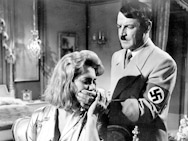
Daze of our Lies (or "As the Reichstag Burns"): SECRET HONOR, HITLER (1962), UFO HUNTERS, Lord Lhus!

"So this is how liberty dies... with thunderous applause."
- Padame Skywalker

There are no accidents in weird rainy accidental double features, like when I chanced upon the very strange 'forgotten' 1962 film, HITLER (with Sam Fuller stalwart Richard Basehart as Hitler? Whaaat?) after watching Altman's SECRET HONOR (1984), with Phillip Baker Hall as ole Tricky Dick Nixon, and then a UFO Hunters episode and now The Myth Behind Star Wars, with little snatches of everyone from Joe Campbell (my Merlin), to Camille Paglia (my Kali). Let me tell you, it was a great night to be alone with a microphone and multiple video monitors reflecting my exteriors, clinking ice, babbling with boozy exaltation into microphones parked by overflowing ashtrays, sweaty ice buckets, and an alien that looks like a cat monitoring my every move.

"I'd like to thank Birch for recommending this film in a previous post."

SECRET HONOR might bore the layman but should be inspiring to fans of George C. Scott, for it seems Phillip Baker Hall--magnificent in crushed velvet deep red jacket-- channels that actor's raspy but concise fury, or at least shares a similar vocal timbre when he goes for the deep lusty curses and rap-rap-rap-rapid stutter-patter of loquacious subject-skip-stopping babbling. Too bad he pours Scotch like a woman.  Chivas drinkers, weep at his tiny little sips!

I was bored by Nixon when this was all happening live on national TV in 1972 (I was five), but learning how to cut loose in your oak-paneled study and empty out your soul long into the night, alone into a microphone or a painting or a keyboard--while feeling alternately like some ecstatic Wagnerian god and paranoid melancholic--is something I really relate to today, relatively sober. Like many writers and artists I had the realization awhile ago that being home alone with recording equipment, paint, ink, music etc.  is as good as it can ever get; everything else--going out, seeing friends, sex, bonding, etc, work--always felt a little empty, as If I was just avoiding this, the task beyond all tasks. The terror of being alone in your study with just the blank page or microphone in front of you - armed only with a whiskey tumbler and maybe a cigarette --this is the period at the end of the unending sentence. All the rock and roll and drugs and madness was all for this. Risking your neck fucking over the boys at the Bohemian Grove with loose talk, it was all just for this, for the cassette tape, for posterity, to preserve your fuck you to Lord Lhus in the annals of the eternity. Lord Lhus, fuck you! Ommmmm


It's only American to believe in the dark secrets behind the Masonic symbolism of the presidency but only this 'fictionalized' Dick (nervously ripped raw in his haze of paranoia, scotch and mother issues, dares speak the truth alone with his studio audience, which is that the Bohemian Grove--where he was brought several times to hear the edicts of his shadowy sponsors-- is the true seat of power in this country. Washington is just where their edicts are implemented. These guys weren't "a bunch of homos from Cambridge! Yhese guys were men! Assorted white trash, what they wanted was a political laboratory" controlled from deep in the Grove, where 'Jew mobsters' like Meyer 'Hymen Roth' Lansky could run naked and free and assume their natural giant saurian shapes. It is all just too much for old Dick and he himself turns out to be Deep Throat, bringing the Washington Post down upon his sorry ass before he's forced to sell out the country any further. He is just an "un-indicted co-conspirator like everybody else in the United States of America!" His "Secret Honor" is that he saved the country at the loss of his innocence. He bears the shame of saving you!

Bohemian Grove 'Cremation of Care' Ceremony - you never saw this.

If you surrender to Hall/Nixon's fever dream rant (and you may as well since there's nothing else going on in the film) you enter a pretty spooky world, a U.S. with the curtains ripped back to reveal giant white owls devouring a pile of gutted mice and money. Presidents like Nixon (and now Obama) are just brought in as straw dogs to take all the shit the manipulated American public cares to volley after being robbed and deluded by the previous office holders (who conveniently step down right before it hits the podium). Watergate was Nixon's way of reversing the straw dog parabolic mirror. Instead of the plan to throw Nixon to the wolves so his puppeteer overlords could sneak away into the redwoods unmolested, Dick tangles himself up the strings so he can go tumbling off the stage, forcing the curtain down, derailing their entire evil plan.. for now.

Meanwhile we see the paintings of Eisenhower, Lincoln, Jefferson on the Oval Office walls, and they all seem twisted and arcane, as if swirling reptilian pan-dimensional aliens were, even now, within the confines of a portrait on television on television, writhing and breathing and corrupting the deepest tissue of man's democracy and soul with extra-dimensional spider eggs. 

Note - collage by EK made from SECRET HONOR still-  "your perception may vary"

Hall is magnificent, at times working himself up into a raspy heart-attack laughing and crying over his fucked-up brothers and the way he was screwed over by the Kennedys. "I am not the American nightmare! I am the American dream, period!" Still, SECRET HONOR seems to be missing a key ingredient if you see it at home: an audience response. I saw it alone and it made me uncomfortable, like being locked in a room with a raving drunk who doesn't really see you, who thinks you're probably a ghost (maybe you are) but still expects you to laugh at his jokes. In the rapturous flow of good scotch he hears the ghost applause anyway, rushing in his ear canals like blood currents. Who amongst us drunks can't relate when Nixon notes, "I used to love to sit in the Lincoln study -- fireplace going...the air conditioning on." Is that not, in fact, the best combination known to the drinking man? And it's evil, too!

Right after I hit stop on my DVD, along came HITLER (1962) on the Military Channel. "Made the same year as PSYCHO!" raves (incorrectly) Lou "Blue" Diamond Phillips, your host of An Officer and a Movie.  I confess, I love to watch the Military Channel on Friday or Saturday nights, pretending I'm seeing it on an empty couch in the barracks lounge after a day of sketchy combat. For some reason, it's quite relaxing. And then, weird finds I'd never even heard of before, like this come on! What a world! As if it wasn't weird enough just seeing a low budget black-and-white B-movie trying to tell Hitler's biography, the vocals in the soundtrack seem to have been recorded through a guitar flanger pedal, as if it was just too painful to hear without electric distortion!

Without the flanger, HITLER still comes off as very strange, like a lengthy episode of Alfred Hitchcock presents meets a Sam Fuller-directed sci-fi sequel to John Huston's FREUD.  I can imagine Godard and Bassin pissing themselves with delight seeing this at the Cinémathèque Française, though somehow I doubt they did. It's so obscure it's unlisted in both Lenny Maltin's Film Guide and Time Out Britania, and even Time Warner's info screen for it says it was made in 2003.

Weirder still, the film explains Hitler's mental problems as stemming from a Ross and Rachel-like orbit with his sexy cousin, and then Eva Braun and a Norman Bates-style orbit with his loving mother. It may as well be from 2011 or 1954! In a word, it belongs nowhere.


Alas, too, the film is relentlessly unpleasant, as Hitler buckles under the pain of sexual frustration and ze burden of having to carry his mother to zee root celler bunker, so to speak, whenever Himmler comes over.

Now, I know what it's like to have a cute Germanic blonde young cousin, and let me tell you it's not that bad, Adolf! You can handle it, you don't have to arrange for your thugs to shoot her after she shouts at you: "Your mother, always your mother! You can't live vit ze shame! You will see your mother in every woman's face, just like you see her in mine tonight! I dare you to look at me and tell me who you see!" You don't need to let it get that far. As if reading his DSM IV chart, Hitler explains "attraction turns to revulsion - the satisfaction that even an animal enjoys is denied me!" and it all becomes more and more icky. He can't bust a nut cuz his nut was shot off at Somme... or so ze legends say. It's never flat out states, but what is?
In other words, this ain't your history book Hitler. This is your Krafft-Ebbing Hitler. He turns out is just a misunderstood impotent lecher surrounded first by evil political machinations and then, when his impotent tantrums fail to cow the globe, by people who dare to try and save what remains of Germany's civilian population instead of fawning over him to the last. With the poverty budget, his infamous bunker looks like little more than a basement rec room, and the whole arc of the war takes place in and around a handful of tables, maps, and filing cabinets. The only really attractive set is the decadent apartment he shares with his hot blonde cousin. He should have stayed home, alone with his microphones and kept his raving indoors, like our friend Phillip Baker Hall as Nixon in SECRET HONOR, or Dubya!


Next up on the cable flip was History Channel's UFO Hunters --an interesting show that thinks it can win over skeptics through its cock-eyed idea of 'rational' thinking, which is what Sherlock Holmes would dismiss as inductive reasoning: Let's say a kid sees a bunny rabbit in her backyard and tells you, all excited, and you tell her rabbits don't live in the area, therefore she is lying, or it's just a dream. But then 40 years later she still insists she saw a rabbit, and the UFO Hunters show her a cotton ball, asking her if it looks at all like the rabbit's tail. She says it does. They therefore conclude that she's not lying, or dreaming, but that she found a stray cotton ball drifting out in the fields and her imagination did the rest.

But then the other UFO hunter points out that no one has been out in the fields taking off their nail polish, and so no cotton ball is possible. This is all of course excuses made to cover their inability to admit the truth of a rabbit. That's the sad tail-chasing truth of inductive scientific inquiry --they can't wrap their minds around the much more logical idea of the rabbit. Why not? Because rabbits don't live in the area. Everyone knows that. And around they go.

The rabbit (i.e. aliens, remember) is where mainstream western science, which has been leading us for so long, chokes up on the reins and rather than turn the reins over to the right brained empaths they throw the reins into the fire. But who am I to judge them, I with not a single un-violated precept? I, who can't be sure what he saw in 1974 wasn't a kite instead of a drone floating above our heads after school? (We flew a kite up to try and knock it down or tap it, but then a low flying Cessna almost flew right into our kite! It swerved to avoid us, and when we looked back at the drone it had zipped off. The Cessna perhaps spooking it. End of memory. But since there are no drones surely what we all saw was a party balloon or a  very light bucket.)

The Mythology of Star Wars came on right after the UFO show.. and they brought up the interconnected conspiracies of the Empire, with Christopher Lee's character in the Phantom Menace and his desert world mining operations as the Nixon, the Obama, the 9/11, the Reichstag... the flaming goat dog of straw! The cremation of care! It all came looping home, closing the gaps on the conspiracies - Hitler, Nixon, Aliens, it was all combined to mean something!


In closing let me say that I'm not a crook, or co-conspirator, or a believer, or a dogmatic skeptic, or a nutcase, or a fascist. That's depending on whom you ask of course, your honor, but there's a lot of people to ask. Everyone thinks someone else doesn't deserve to be here, especially me. Somewhere someone thinks you're a crook just for having read these words, and that someone is right over your shoulders. Or maybe it's me, cuz you stole my heart, or soul. An undivided self is an oxymoron. Unite your warring halves and watch it all just disappear... and you shall be be a dark cloud remembering it was only ever sky and sea, never meant to last, never meant to be kept so separate from its setting by by slow pressure cooker compresses and midlantic storm front regions, never meant to grow as stale with cumulonimbus conservative paranoia as tricky D. Nix himself.

If the ocean could come claim you it would gladly dissolve you back into itself, dear rabbit-denying skeptic buzzkill. In that, fill thy coffee mug with comfort, and a liberal dash of 80 proof mortal dread atop it, like foam. But when you lift your cup to drink, lo! There is no cup, no arm to lift, no fingers, no mouth. Your drinking motion is just a folding of a single wave back on itself, a splash more Chivas and then even 'then' is gone ...

And the reptiles in the grove just smirk and loll in the aeons of your warm blood surf.

Wednesday, May 19, 2010

Stillness in Motion: CALIFORNIA SPLIT / TWO-LANE BLACKTOP


Cinema and gambling go together.  Even those not betting at drag races or Reno craps tables have no problem cathartically sharing in lucky streaks of others; we get lost in the thick of the action, our mood rising and falling with the stacks of chips at our hero's side. And filmmakers are nothing if not gamblers themselves: moving fast and loose with huge wads of other people's cash, tangling with the odds, and making choices moment-by-moment that can make or break the bank. One huge hit and they're flush, one bomb and they're on the skids.

Most films today we see are simple escapism--we always need a thrill ride away from the humdrum; some are 'artsy' and drag us closer to "messages" we'd rather not address, like mom guilting us to church; others subtextually congratulate us for being bourgeois enough to relate to first world problems like lost love and backstage opera dramatics. A few, truly great films bring us away from the phony profundity of congratulatory bourgeois grandeur, away from social or political sermonizing, and even away from pure escapism, and closer to something like real purity of essence (P.O.E). We can see ourselves--as escapists, i.e. moviegoers-- in these rare films the way parents see themselves in their children. Well, I see my brother Fred in the lug wrench work involved with being a drag race mechanic in TWO-LANE BLACKTOP (1971), a mythopoetic saga of masculinity that reverberates to my core, and shit. So how come both BLACKTOP and Altman's gambling drama CALIFORNIA SPLIT (1974) are so underseen? 

Doesn't anybody ever roll the dice no more?


I saw Nicholas Ray's LUSTY MEN (1952)--a story about the manly world or rodeo riding-and BLACKTOP-director Monte Hellman's COCKFIGHTER (1974)--about the manly world of cockfighting--a couple years back, on the same day, and wrote that I thought neither was on DVD in any reputable form due to their edgy titles (put together they read like a gay porn marquee). The problems besetting BLACKTOP and SPLIT are similar, but more of a legal rather than promotional nature, specifically: song rights. Apparently just having a Doors tune playing from a radio in the distance at a drag strip, even if only for a minute, can spin your film into limbo for generations to come. Alongside the hard-to-find Cockfighter, and the rarely known westerns The Shootist and Ride the Whirlwind, Hellman seems a brand name slipped from its rightful place on the outsider American tongue. He's the director we thought Dennis Hopper would be after Easy Rider. Dennis turned out to be too addled and inconsistent --and he took too long over the coke-dusted editing bay. Hellman is more disciplined, the samurai to Hopper's sloppy magistrate, the Olivier to his Welles.

TWO-LANE eventually resolved its music issues and is now on an awesome Criterion two-disc set, decades after failing to get theatrically released in time to ride the slipstream of EASY RIDER or its predecessor THE WILD ANGELS or to overcome the hipster suspicion raised by the April 1971 Esquire cover (left), which proclaimed TWO-LANE their Movie of the Year before it was even released. Nothing turns off the countercultural cineaste like some petit-bourgeois, Rolex-hawking, semi-pornographic rag like Esquire announcing which film will define your generation before you've even heard about it. 

Then, as if bringing down a mighty curse, the new head of TWO-LANE's parent studio hated the film. He didn't "get it." He probably would have loved it had it been in French with English subtitles--which every bourgeois philistine considers a signifier of a certain kind of artiness. But without them--and with its hip taciturn veneer and minimalist vibe running counter to the AIP-drive-in idea of a facile good time--this head refused to pay for any publicity. So no one but the critics saw it, and some of them didn't even get it. Later on, it hard time on video due to copyright issues associated with that damned diegetic Doors song. Oh brother. What a bad luck streak! 

BLACKTOP uses music so sparingly anyway it's almost funny that this royalty thing hung it up so often over the years. The '55 Chevy has no radio, so all music is either heard in Oates' GTO or else playing out of speakers at the various drag spots. When the music does appear, your ears devour it. The songs seem extra nurturing after the enigmatic silences and roar of exhaust pipes and V-9201 triple D hydro-colonic quad engines... but are they worth the limbo? Course not - screw the Doors anyway, Hellman should have just slid in an alternate track, like Altman did for our next film...


Robert Altman's CALIFORNIA SPLIT (1974) is similarly about the world of male bonding via "putting up or shutting up," and "laying it all on the table." There's no point digging for homoerotic subtext in a movie where the subtexts have been stripped down and exposed and nobody cares because once a subtext gets exposed. and if it doesn't lay down on the table it's because there's another game already starting. As with much of Altman and Hellman's output, we're given richly-layered characters immersed in a niche culture with its own insular overlapping dialogue complexity--in this case the semi-seedy smoke-filled back room poker games, racetracks and rundown casinos of LA and non-Vegas, Nevada. We watch the flashing of dollars in people's waving hands and hear the overlapping numbers. ("Three to one on Egyptian Femme in the ninth by eight points,") from a distance, like a little brother tagging along, craning his neck over crowded shoulders to see the table. Thrown in, jostled about, awash in sound--it's chaos to the untrained eye--dozens of bets going on at the same time in the same space--but in that chaos eventually we discern grace, aliveness. These characters love gambling. The quickness with which they willingly hand over huge piles of cash to each other --without receipts or invoices--is life-affirming. Honor and adherence to the codes and systems of betting and bookmaking is paramount. No one welshes or kibbitzes or moans in outrage or tries to cheat (i.e. "I never said fifty, I said five!")-- no matter how much bread is on the line. The chips are what count; the cash they represent is just an abstraction.  What's most important is the camaraderie, the thrill, the flurry of activity and flutter of passed-around paper, the glimmers of patterns within the randomness of luck makes them feel alive. And within that din, the Hawksian patter of George Segal and Elliot Gould functions like an earrly Tom Waits song interpreted by Lenny Bruce and Sal Paradise.


One of the more artsily respectable ('cuzza subtitles) of these "flurry of activity" subtext-melting precedents for all this is the Rome stock exchange in L'ECLISSE (1962, above and so below). You can argue Antonioni is criticizing capitalist greed in these scenes, and you'd be right, but that's a pretty simplistic analysis. He's really in awe, marveling at the way idle humans can find something to get passionate about, their spirits rising and falling over literally nothing--for no one passes any actual money around in these stock market scenes (as opposed to LANE and SPLIT). They just shout numbers: "20,000 Finsider at 20!" and write things down on pads. The effect is something anyone who's been in a foreign country and not known the language can understand and perhaps that's why subtitles make crass French movies "seem" artsy while the same film in English "seems" trashy, no matter how existentially acute it is. When either contradicts our expectations, we rear back like spooked horses. A common currency breeds resentment, but a special private language shared only by your fellow degenerates creates a special nook. There's no race, age, class or gender distinctions, only who's got the cash to back up their hunches. And paying up on your losing bets without bitterness helps ensure you win next time, because karma isn't abstract in these worlds. Lucky streaks are recognized as they cohere within the time-space continuum -- and gamblers shape their lives like ascetic monks in total service to the Goddess of Chance.


BLACKTOP stars James Taylor and Dennis Wilson of the Beach Boys, and the idea of having two non-actor musicians as the stars may seem odd at first, but then you realize it's genius, just like the rest of the choices, because these guys might not know from acting, but man do they know the road, oh yeah. Whether struggling or successful, musicians spend half their lives (or more) on tour, city to city, bumfuck stadium to bumfuck ampitheater to bumfuck hole in the wall. Each gig is a roll of the dice: it could be sold out with adoring girls, or empty except for one drunk waiter screaming "Freebird!" between every song. Let me tell you, most of being a musician is a lot like this film: you drive for four hours, pull up to some gas station for a refill  and while one person takes care of the pump, the other people in your party pile out of the van, use the bathroom, steal some candy, buy some soda (for chaser, presuming they had the foresight to bring a flask), and wander around the grassy shoulders of the off-ramp, peeing in the bushes (if there's no bathroom), stretch, stare vacantly out into the spaces, noting under their breath how glad they are not to live in this freakin' nowhere town. Then you round everyone back up, and hit the road again. 

When you finally get to your venue, the drunken anxiety of the gambler really kicks in: you set up your amp and do your soundcheck and then have to wait around until 11 PM when the show starts, sitting in a big empty bar, wondering if anyone will come. The place is still empty by nine so you start to panic and you have to stay reasonably sober until at least second set, which is very hard when you're so rattled, and just sitting around backstage at a goddamned bar for hours with nothing to do, smelling the faint but nagging mix of stale beer, urine, puke and cigarettes of the night before. Finally you do your show and it is awesome, but the girls dancing in front that were giving you lusty looks all night vanish by the time your second set is over, and the ones still there are way too drunk and obnoxious to deal with.  Then you sleep on some cool dude's floor or in some girl's bed if you're lucky, or just stay up and drink until suddenly it's morning. Then you hit the road again. And if you've got the guts to coast that way, you can do it forever.... you're essentially homeless, or rather your home coheres around you at around, well, 65 mph or higher. Stillness in motion -- a home in that rock - your fate, the crowd you draw in each venue, seemingly open to chance. 


The dynamic of the relationship between Wilson's mechanic and Taylor's driver in BLACKTOP mirrors the drummer and guitarist 'types' in a band: on the road they're eerily calm as befits they who have learned to spend these long two-lane stretches between races listening to the engine for the slightest sign of disrepair, every mile like a period of zen detachment and pure focus--just as every beat, every bass note, needs to be in its perfect place. They talk about what needs tuning or tightening, what went wrong or right the night before. If they're in a band they listen to the soundboard tape to last night's show, played in the car all day long, i.e. you're forced to listen to every little bass guitar fuck-up you made because you were too drunk, again, Erich! You didn't wait til second set, did you? No, sorry Dave. You (the bassist) begin to feel less like Bill Wyman and more like Brian Jones..All the time there are three or four better bassists salivating in the wings, eager to take your spot. 

But Taylor and Wilson don't really drink. It would slow them down and they got to keep moving. Even the girl they hook up with can't seem to find a way to get them to notice her. And again, if you're in or were ever in even a moderately successful band you know this feeling, because you and your bandmates need a certain open channel ESP onstage to be any good. When that's obtained you become closer than a family, a true band of brothers. The only thing similar I've seen is in Sam Fuller war movies, the way the men fall all over each other, tap each other's helmet in the third eye area like an on-the-prod benediction.


By comparison, Warren Oates' GTO-driver is hopelessly insecure, alone with no purpose or destination, other than living his dream of owning and driving a GTO and never looking back (this being the day when gas was under $1 a gallon). He alone listens to music. His challenging Wilson and Taylor in a race is apparently for friendship rather than monetary interests, but of course neither team can admit that. Oates' idea of taking "the girl" and driving somewhere like "Chicago or New York" is the plan by which all his dreams will come true. He's old enough to know that, if he ever went there, he wouldn't know except leave again. It's the "We're retired in Florida now, Mister" dream of EASY RIDER, but she's not buying it, just as Captain America didn't--and neither, once the dust of his bullshit settles, is Oates himself. He cycles through outmoded braggart personae like a man searching his pockets in progressive desperation at the toll booth.


Existence on the road is all these people seem to have - their house exists only at 55+ mph on the blacktop ribbons tying America together like a giant wondrous gift; they have no address, no home other than their car, or-- in the girl's case--someone else's car. Momentum, stillness in motion, soothes their nervous longing. Stretched out along Route 66, they're sleeping in shifts or just hanging out in some no-horse town at the best time to be hanging out in such towns, dawn. GTO's patter indicates he's aware of this perpetually displaced vagrancy while fundamentally unable to "accept it" and stop the idle chatter. He tells his disinterested hitchhiker passengers that these boys he's racing with "get hysterical... They run right over ya if they get the chance; but they can't stand up to the 455 no way." As if anyone even knows what that is, as if even he knows.


Some movies can portend to be about everything cosmic and cool, but are really about the director's narcissistic insecurity, like Woody Allen's. Monte Hellman's are the reverse: they're about the masculine psyche finding a way to calibrate itself (once all the illusion escape plans are exhausted) via some spiritual discipline -- Zen and the Art of the Chevrolet, and at their core these boys reveal a transcendental quietude worthy of Ozu or Bresson. And much as I love EASY RIDER, you can see the difference as clear as night and day between the judgmental redneck bashing of Hopper's film and the way Wilson quietly changes his license plate when driving through the Deep South because he doesn't feel "safe," letting you infer deep suspicion towards out-of-staters, but sparing us any actual redneck violence, sleazy sheriffs or other cliches.


Instead this focus on the art of driving is a spiritual thing that the truly enlightened, deranged, or anyone experiencing a mid-life crisis or lysergic epiphany can understand: the thing in itself doesn't matter so much as the right-minded doing - in this case the fast-talk distraction that comes from winning money, watching races and fights and admiring each other's vehicle or stack of poker chips. Losing with detached grace (rather than welshing or crying foul) is as important as winning. In that frame of mind anything can become poetry: the roosters fighting in slow motion in Hellman's COCKFIGHTER, or the white line dash blur of the blacktop. The beauty of the road is the way constant motion can breed deep inner stillness. Time and responsibility can be escaped through some motorized loophole.  Who wins the race or fight hardly matters to Hellman. Destinations are for chumps.

Foreign film subtitles create this same disconnect--which is why 'abstract' or signifier-disrupted films tend to be more appreciated outside their native country. Hellman gets that the intensely insular language of "carspeak" or "cockspeak" is like that (Altman is a bit different - he leaves us on the outside of it more literally). Students go abroad to be plunged into foreign situations, they handle it better than adults, absorbing the strangeness with no learning curve or means of judging it as either good or bad. Make it too unfamiliar to ever breed contempt, and it's lasting art. Once thoroughly solved, well, fade-to-burn, baby, and don't roll no post-singe credits, when the film's final image burns in the projector, don't wonder if the film broke or it's some arty flourish - just quietly pack up the car and hit whatever road leads farthest away from whatever 'here' happens to be lying around. Once that speedometer crests 55, you know you're home at last.


Related Posts Plugin for WordPress, Blogger...