
Showing posts with label Carole Lombard. Show all posts

Tuesday, April 28, 2015

Grave Diggers of 1933: THE INTRUDER, SECRET OF THE BLUE ROOM, BEFORE DAWN, TOMORROW AT SEVEN, SUPERNATURAL


As I've written in the past, 1933 was a magical year for movies, and America: it saw the election of FDR, the repeal of prohibition, and 'ahem' the rise of Hitler into power (that last part, not so magical but the war effort did lift us out of the Great Depression). At any rate -- change was afoot, probably akin to our modern years of Obama, legalization of marijuana, and gay marriage. Or worse, or better. And I myself turn to old dark house movies every May or so, because they understand hay fever, the way allergies imitate the first signs of a cold and make the bright sunny day with the calla lillies in bloom again seem a jeweled scorpion, glistening shiny chitinous flowers on the outside and stinging venom within; and by contrast murky AC darkness an opium den refuge of creaking doors, whistling wind and hands coming out from secret panels behind oblivious heiresses. Maybe it's that May is on the opposite end of the year from Halloween, and as such I can see it clear across the circle. Here's five from '33, with my ratings for both film itself and, since they vary so crazily in quality, the transfers I, at least, have seen.

THE INTRUDER 
1933 - Dir Albert Ray
** (Retromedia DVD- *1/2)

This weird Allied Pictures cheapie is one of those castaway flicks so big in the silent and early sound era, providing as they did an excuse for (partially obscured) nude bathing, reversion to savagery, (inexpensive) beach locations and ye olde gorilla suit. The castaways always include one indignant rich lady unaccustomed to 'roughing it,' a salty sea dog, a virgin and party girl who bunk together (ala Mary Anne and Ginger) and a comic relief drunk. This time there are also stolen diamonds, and a murder that occurred aboard ship before she sank. The killer is.... right in this lifeboat. Mischa Auer lifts the proceedings from its stasis as a Ben Gunn type, stranded there so long he's started gibbering insanely to the skeletons of former cohabitants, but he's not a monster! Just because he's a crazed castaway with a thick beard is no reason to portray old Mischa as a monster on the poster (below left). He doesn't even do his gorilla impression (seen in My Man Godfrey), just beats up one of the skeletons when the communication gap proves too much. Meanwhile, his gorilla buddy works to keep the girls on edge with intermittent howling.

Of the cast, Auer is the only familiar face (to me) but that can be a good thing because everyone eventually looks like a B-movie version of someone else. Lila Lee seems like the taller, gawkier older sister of Gloria Swanson; Gwen Lee is a Mae West/Pat Kelton-ish gold digger (she gets all the best double entendre lines not that there's many). There's also Monte Blue (who got his start with D.W. Griffith) as the nominal hero; William P. Davidson as the numb nuts copper; perennial lush Arthur Housman as the drunk who's barely feign interest in how his girl (or is it his sister?) is being wooed by the square-jawed hero --I think! Needless to say, he's my favorite. Anyway it's hard to tell who's who when the tops of all the heads are cut off, either by inept camerawork or the shitty Retromedia DVD frame cropping.

Director Ray does deliver one masterful scene: the morning after the shipwreck, when the lifeboat survivors all wake up and--silently--without others noticing--begin to take stock of where they are: each remembering what happened, (or coming out of a boozy black-out) and either forging silent eye-alliances, passing notes to one another about the stolen cache, or getting scared, but quietly, wordlessly, like you might with your buddy while standing in line at a customs check with a pocket full of weed or conflict diamonds. I learned more of the plot in that one silent stretch than in all the malarkey fore and aft. Albert Ray, your silent film roots are showing!


I like too that the girls sleep in the cave on the beach and wake up to find skeletons of past castaways sitting right near them (it was too dark to see anything the night before), and I like the lurid, sexual, almost HBO-level roughie vibe when the rapey killer forces the two girls deeper into the woods at gunpoint, and that it's wild man Mischa's gorilla and the skeleton crew to the rescue, and that on his tiny island with his old age and his wisdom, he cries "Mary!" (that's his skeleton's name). And I like how Housman, the lush, slowly morphs from bleary to tipsy to hungover to competent and alert--like three different separate characters (and all without being grandstanding about it) and that he's so thrilled to be back in the presence of booze after they're rescued by a French steamer that he brings the whole tray, whiskey, seltzer bottle, ice, and all, to the inquest!  Prohibition, thou art repealed!  Hell, it was probably why they were all on that boat to begin with --the old international waters thing that led to lots and lots of three-hour tours and bootleggers hiding behind old ghost legends to keep snooping kids away from their stills...

Mischa and Mary (left)
Retromedia's Forgotten Terrors DVD is shit but hey! Hey! It's a collection of stuff you'd never find in a million years on your own, including Tangled Destinies and The 1931 Phantom! They don't look so good but then again, they're at least made available on disc. (P.S. they're also on on youtube)

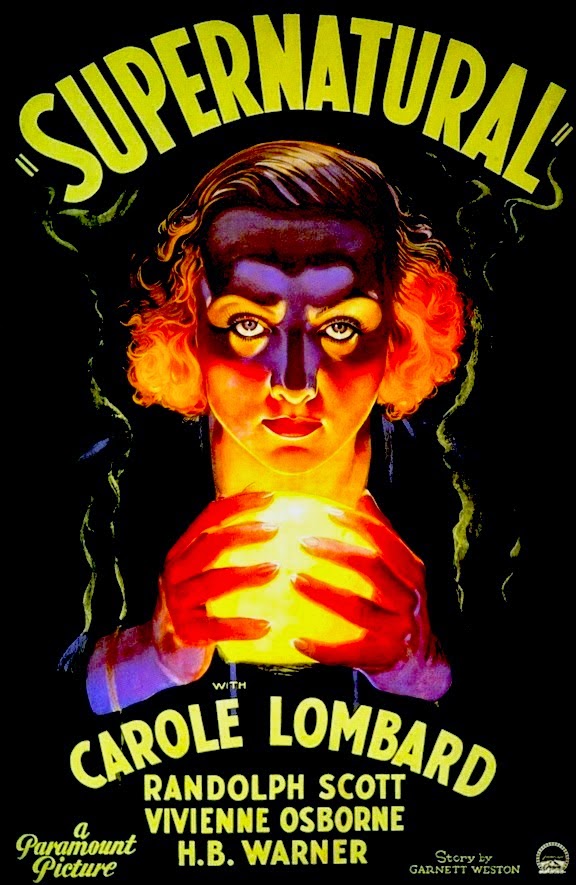
SUPERNATURAL
1933 - Dir. Victor Halperin
*** (DVDR- ???)

"Life does continue after death," notes Dr. Carl Houston (H.B. Warner), the psychologist friend of bereaved heiress Carole Lombard. He wants to experiment on the corpse of soon-to-be-executed murderess/free spirit artist Ruth Rogen (Vivienne Osborne), a kind of prototype for Catherine Trammell or Michelle Pfeiffer in White Oleander. Lombard wants to hear from her dead brother, and bogus medium Paul Bavian (Alan Dinehart) can deliver! Expert at delivering the old glowing death mask /blackmail/lost loved one's voice giving banking instructions via a long horn floating in the air, he's forced to kill his drunken blackmailing landlady (Beryl Mercer) after she forgets the golden rule of blackmail: never threaten to expose a creepy fraud when you're alone in the room with him and haven't yet arranged to leave some 'in event of my death' file in your safety deposit box. What do these two threads have in common? Lombard's seance at Paul's pad seems to go as planned, ka-ching, but then she stops at Houston's office for a second opinion right as he's doing electrical experiments on the Rogan's recently-hung corpse.  In one of those left turns of coincidence she becomes possessed by the very same murderess who swore revenge on the medium (he ratted her out)! What are the odds?

If the plot sounds familiar, it's because Boris Karloff played versions of the same scenario about a million times all through the late 30s and 40s, indicating America was obsessed with the electric chair, radio waves, curses, and soul transference (in that order) but this one does it first, and better, in its odd way. Sharp eyed fans will note some of the walls from Halperin's White Zombie have been reformatted for Paul's seance parlor, with one great touch: the above ground subway runs right past his apartment window, adding just the right amount of tawdriness.  It's stilted as hell, but the last third of the running time occurs over one long night as the possessed Lombard seduces Paul, her strong sculptress hands ever fighting to refrain from strangling him while they're canoodling out on her yacht. Too bad her dull boyfriend (Randolph Scott) is put-putting to the rescue. Pre-code points should be awarded for the scene when Paul cups Lombard's breast on the divan (the sleazy heat between them leaves no doubt of the film's pre-code year of release). When they sneak into Ruth Rogen's studio apartment to fool around in front of her creepy life-size self portrait, they recall Marcello and Anouk in the beginning of La Dolce Vita. I froze the projector and did two paintings off the moment they embrace (acrylic on canvas -2003), to capture a kind of post-modern ghost refractionnn-ion-nn.... And Lombard shows her true chops by morphing between possessed killer and grieving heiress with sensuous conviction.


Minus points for the sight of a big dog perennially chained in the psychic's house; I'd have liked to see him getting a nice walk or some affection. Instead he conveniently disappears, never to be seen again. I don't have the Universal Vault DVR yet, because I have a pretty solid burn from an old airing, but it's only a matter of time before it too dissolves, warps... wane, as does all matter...

SECRET OF THE BLUE ROOM
1933 - Dir Kurt Neumann
** / (DVR - ****)

With its use of Swan Lake over the opening credits (also used in Dracula and Murders in the Rue Morgue) and the presence of Lionel Atwill, you'd think this was going to be a real pre-code Universal horror treat: Atwill stars as the father of Gloria Stuart, who's celebrating her birthday in a big cozy castle while the whistling wind howls outside in the night. What a lame party it is! Three of her suitors are the only other guests (kind of like Lucy Westenra's house, at least in the book). The creepiest part is that dad Atwill doesn't mind having these three fools fight over her right in front of him, or to have them all sleep over, and for who knows how long, etc. Again, they are his only house guests. Instead of ordering them out, Atwill tells her to "give us all a nice birthday kiss." Yeeesh

The one with the best chance at Stuart's hand, the clear winner alas, among the very sorry lot, is an older foreigner played by Paul Lukas (at his flattest); the one with no chance at all is the abashed adenoidal pup who grew up moping after her on the swings (Onslow Stevens); the third, William Janney, considers himself a mystery writer. He bunks with Lukas, even though there's like a hundred rooms in the castle and no one else stays there but servants.

These strange details are way more fascinating than the titular mystery, which involves each suitor sleeping in the cursed blue room, one by one, to prove their courage. Stevens goes first. In the morning... he's gone!

If Stuart and Atwill weren't so imbued with classic horror moxy this would be the smallest, saddest mystery film ever. The cast is utterly void of character details or anything else to talk about beyond the titular ---very predictable and inane--"secret." There are no other guests, and no other women characters aside from a maid. Thank heaven Edward Arnold shows up halfway through as the local detective; his character alone seems to have a life beyond this half-baked mystery story. The ubiquitous Robert Barrat (Babs' pimp dad in Baby Face the same year) is the butler who keeps signaling at the window in a red herring bit borrowed whole from Hound of the Baskervilles. 

Despite these quibbles, it will still be 'catnip' to Universal pre-code horror fans like me after they've already re-run the gamut (Frankenstein, Old Dark House, Black Cat, Raven, Murders in the Rue Morgue, Dracula, Invisible Man, etc.) and crave more, like a junky. Seems a bit, though, like Laemmle Jr. was scraping the old dark script barrel, and Neumann's direction is as clueless as a June bride. He seems to think the only time to ever cut a scene is when something interesting or at least atmospheric is just about to happen. At one point we literally have like a full minute of just Arnold and his cops in a bedroom looking at their watches. It's a remake of Geheimnis des blauen Zimmers from the year before, so blame the Germans!

Soon enough, they'd deserve it.

The Universal vault DVR looks great though.

BEFORE DAWN
1933 - Dir Irving Pichel
**3/4 (TCM airings - ***)

Seances were all the upper crust rage in the early 30s (the way Ouija was in the 70s) and while most of the mediums turned out to be phonies, there was a general consensus that ESP was scientifically proven and real mediums did exist, as in Charlie Chan on Treasure Island. Here the true psychic is mellow gamin Dorothy Wilson, who makes up in a naturalistic low key sincerity what she lacks in dramatic range. Her trances tell her nearly everything but even when evidence comes fast and furious the cops don't believe her and consider it a favor not busting her as a phony just because her ruthless swindler of a father (Dudley Digges) refuses to refund three bucks to bunco squad undercover man Stu Erwin. Old Stu takes a shine to Wilson, though, and call me crazy (I dislike Erwin on principle) but the two have a cutely abashed chemistry, with Erwin's cop authority helping to offset his patented aww-shucks everyman awkwardness. He might not have been able to stand the strain of Peggy Hopkins Joyce in International House, and he might make Jackie Oakie seem like Arthur Kennedy but he's at least adequate to the task of breaking down a wall and slugging it out on steep stairs with the murderer, and he's not getting sick. Maybe it's that they're both a little anemic, lost artistic souls in a world of crass profiteers and sneering killers.

The plot is the old Bat Whispers bit with hidden loot in an old spooky mansion and assorted seekers posing as heirs or one another and all that. Here an old dying gangster tells the Viennese Dr. Cornelius where he hid his stolen million in the old lady's house. Soon the old lady is menaced by a floating death mask and draggy second floor footsteps. Her old maid/widow/sister/whatever (the pair have a lesbian vibe ala Cries and [or BatWhispers) winds up tighter than a clam about what she may or may not know so that she won't be next.

I love Irving Pichel as an actor--that otherworldly deep voice really sends me--but his direction here (and in 1935's She) lacks momentum and mood. The bland lighting is a long way from the stark expressionist intensity of the Bat Whispers, for example. Warner Oland is magnificent as Dr. Cornelius though, so almost makes up the difference. His owlish spectacles alight with thoughts of "walking off the loot," he's intoxicated with mischief, trying a wild array of approaches to getting the money out of the old lady to the point we can't tell if he's evil or just a shrink playing a guy able to confess he's evil in order to get the money from the old lady and give it up to the authorities. His advanced level head games remind me of my own strategies in my daily job, i.e. if you want to make your patients (or students) open up to you, act crazier than they are. The problem is, eventually you become crazier then they are; I saw it all the time at Bellevue! We know Oland's a great, fun actor, but this is a whole new side of him, seemingly drunk and alight with mischief behind owlish spectacles. And who would imagine old Daddy Digges could suddenly turn so grave and evil, even bullying, to his daughter? It's a spooky sudden transformation from a flim-flammer with a cute daughter in tow (ala Fields in Poppy) to an obsessed monster (ala Mason in Bigger than Life), letting us know Digges had a range larger than his usual alcoholic colonialist trader (or traitor). With better lighting and/or a stronger comic hero, Dawn might have been a classic. At least there's a great dark secret passage climactic stretch down super cool secret stairs to a giant round abyss! Don't quite before the miracle! 

TOMORROW AT SEVEN
1933 - Dir Ray Enright
*** (Alpha DVR - *)

Just when you thought blurry old Alpha couldn't get worse in their handling of these old independent clunkers, they switch to DVR greymarket format, with blurry color Xerox labels and tracking streaks on the bottom of the blurry image. On the other hand, at least they still put out, making them the old whore of hoary old dark house house preservers.

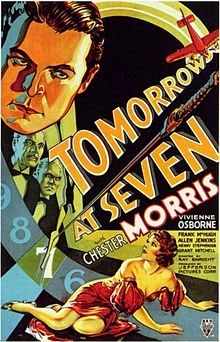
More important is that, for all its blur, Tomorrow at Seven is worth the trouble: Director Enright surprises with some very modern camera moves, especially in the killer POV opening murder. And there's colorfully hipster druggy inference in the banter between two bumbling Chicago detectives (Frank McHugh and Allen Jenkins) is rife with slang-filled pre-code discourse (relating how they got some tips on mysterious villain 'The Black Ace' they mention cutting lines of gold dust for the nostrils of some initially clammed up twist). Whether it's real slang of the period or not, it's quite vivid! When the imperiled (sentenced to die "tomorrow at seven") rich old duffer Thornton Drake (Henry Stephenson) admits can't understand a word they say, McHugh tells Jenkins: "these guys don't understand these technical toims." They're all part of a houseful of suspects that have taken Drake's private plane down to his Louisiana mansion to hide out. But of course they're playing right into the Black Ace's hands! If it sounds awfully similar in plot to The Bat and/or The Gorilla, so what? Just dig the surreally mismatched rear projections on the train where Vivienne Osborne (the maniac killer in Supernatural - above) meets Chester Morris early in the film and the strange plane crash.

On the other hand. Jenkins and McHugh must have been hitting the gold dust en route because their comedic sense gets broader and dumber with each passing page of dialogue. When they're reading the identity of the Ace all slow from a message found in a dead man's pocket, the lights go out before they can finish. When the lights. come back on there's no letter, of course this pair of cops are so dumb they start reading anyway... yikes. Oh well. If only they could have read faster or learned to hold onto evidence when the lights go suddenly out, the movie would be over.

Still, we didn't come down this way for originality but to savor the gravediggers of '33. So when Charles "Ming" Middleton shows up as a mysterious coroner we're happy he's there. We also get Virginia Howell as a creepy mute housekeeper (she keeps giving the cops the finger 'in sign language'), and a hulking, genuinely menacing (rare in these fiilms) African-American butler-henchman (Gus Robinson --his only credited role). So give up waiting for a better version, and just make sure to watch it on the crappiest, smallest TV you can find so you can pretend it's four AM and 1975 and you're pulling it down out of the ether on your UHF rabbit ears... gold dusted stew insomniac that you are.


Thursday, January 17, 2013

Radium Girls Vs. the 1%: Eva Green in DARK SHADOWS, Carole Lombard in NOTHING SACRED

 
It's always a good idea to lay massive curses upon the rich --haven't they deserved it since the dawn of time? Haven't they, in a way, already cursed us? Their ancestors robbed ours and left no evidence of the crime, leaving our forefathers poor while theirs grew rich, for you need money to make money. So we fight back the only way the poor can, magical curses and chicanery. In two films made in wildly different but eerily similar decades, 1930s and 2010s, two downtrodden women lay down some nice curses on the rich, in cinema: Carole Lombard as Hazel Flagg in 1937's Nothing Sacred and Eva Green in 2012's Dark Shadows remake. Damn, are they twins? Or is it just that I saw them both in the same day?

So the big date 12/21/12 came and went with nary a tremor; I'd been hoping some major disaster would wipe out the uncouth and leave we chosen angels with a chance to start again from scratch. But the greed of the mega-rich is still strangling us too slowly to count as apocalypse: hypocritical politicians leave our east coast to suffer in the mud just because we ignored their own states' disasters. Australian moguls using patriotism against our own American yokel; dogs in the wind and casts of Cats living to--you know the drill, it's the same damn one, slog swamp, slog...

NOTHING SACRED recently released on a sparkling Blu-ray reminded me that my bitterness over the loss of the illusion that our half-strangled human culture was about to end makes me like Oliver Stone, furious that Hazel Flagg (Carole Lombard, top) is not really dying of radium poisoning. Nowadays it may be hard to imagine such a un-fact-checked farce playing out in the local papers, but it happened, I think, a lot, presumably, or Ben Hecht wouldn't have written this movie, nor Capra MEET JOHN DOE. At any rate, the media circus surrounding young girls dying of radium poisoning was no fantasy, even if old news by '37:
The Radium Girls were female factory workers who contracted radiation poisoning from painting watch dials with glow-in-the-dark paint at the United States Radium factory in Orange, New Jersey around 1917. The women, who had been told the paint was harmless, ingested deadly amounts of radium by licking their paintbrushes to sharpen them; some also painted their fingernails and teeth with the glowing substance.

Five of the women challenged their employer in a case that established the right of individual workers who contract occupational diseases to sue their employers. (WIKI)
 But the girls who won America's hearts as they shambled to the stand were hideously deformed (here) while Lombard comes to the city unmarred and super hot and in robust health so the German specialists called in at great expense are instantly, ow you say, zuss-PISH-iouss? Still, if Hazel was as sick as a real radium girl she'd be far too tragic to parade around New York City. The hooplah-spinning Morning Star reporter Frederic March falls in love with Hazel, and his own words praising her and what he reads into her wide blue eyes as courage in the face of death when it's just desperation to get out of her crappy homespun Americana New England town. He's mad but also thrilled to learn she's just faking to get out. And anyway, fake or not, her story is life-affirming just like my precious, lost apocalypse.


I've always felt that doomsday anticipation makes life post-Scrooge precious. It fills me with gallows' gratitude and Fight Club ("it's only after we've lost everything that we don't fear anything") euphoria. But as I recently learned ("cough") there is a downside: that sense of horrible disappointment when the world keeps turning after the expiration date. In the end you can use up all your pre-death euphoria credits and have nothing left for when they're truly needed. Hecht knows this all to well. His  TWENTIETH CENTURY (1934) found Lombard giving a tearful goodbye to her young college boy lover as she boards her train for New York, only to groan in annoyance when he decides to come along regardless of her tearful farewell scenes: "George, you bore me!" In NOTHING SACRED, the power brokers of New York all wince in despair when they learn Flagg's faking her radium poisoning. They've already used her 'plight' to advance their careers and don't want to give up the gains. Girls have been exposed to radiation poison for real for less (SILKWOOD).


A similar exploitation of a scheming harridan by the elite occurs in the Tim Burton DARK SHADOWS (2012), wherein the haute bourgeois Barnabas (Johnny Depp) sleeps with and then coldly spurns the housekeeper's daughter, Angelique (Eva Green). A spurn is bad enough in itself, but to spurn a woman who was born into the same house as you around the same time and yet is expected to live a life of servitude while you live it up, that's pretty piggish, Barnabas! For all we know, his dad might be Angelique's father, too, like with the Schwarzenegger family. So I couldn't really muster much sympathy for him even when Angelique kills his parents via her witchy spells, confines him to a coffin for 200 years, and reduces his estate to a crumbling relic for future generations to waft through. Hey, some of my great great great great great great great aunts were New England witches so naturally I'm on her side. And say what you like about Robert Stack in WRITTEN ON THE WIND, at least he knew he was a shit, you could see it in his desperate, rolling eyes. Depp doesn't even shift his arch posture a whit. His boorish snobbery and thoughtlessness are not even something either Burton or Depp seems to notice. They're too busy capturing the imperious posture and Gothic lingo, doing that old sly bag of 70s era art direction tricks first seen in ZODIAC and RON BURGUNDY. 


One scene is very telling early on concerning the dirty class inequality lurking underneath the soapy gloss of Burton's film: after spurning Angelique's professed love, Barnabas starts showing up at the house with a doe-eyed Gothic Windswept Barbie (Bella Heathcote), pledging love to her while Angelique is scrubbing the floor down on her knees, in the same damned room. Even while alive Barnabas doesn't imagine her feelings might be hurt. Once he's dead, Barnabas is even more oblivious. Declaring himself a family man and reading his latest bland doe-eyed waif-carnation Jonathan Living Seagull (a good way to make her understand what 200 years in a box is like) and positing himself as somehow superior to Angelique, while slaughtering (blue collar) locals and passing hippies by the vanload, anyone that might be a threat to his vast fortune.  He sates his thirst like a camel, apparently, spending whole montages of cannery restoration as a kind of saintly captain of industry revitalizing the neighborhood, then wiping out a whole love child traveling hippie enclave after not even trying their joint. There's a kind of snobby cluelessness at work here that lets us know very little about the subject but a whole lot about how tons of money and artistic freedom can sometimes bring a star like Depp and an auteur like Burton way too far away from how reality really is, or was. They have much more in common with the clueless mega-rich than they maybe even realize. They think they're part of the disenfranchised barbers and street urchins, but they're the Marie Antoinette offering cake to the bloody starving throngs.


Victoria, the big-eyed waif reincarnation of his old love (also Heathcote), unwittingly sours the situation even more. For a 'true love' she's very one dimensional, passive, a valium Jane Eyre, the Audrey Long in TALL IN THE SADDLE rather than the Ella Raines. She seems dubbed-in by a different actress--one much more mature and self-assured-- a voiceover artist milking emotion from every syllable while Heathcote shyly peeps. Being the victim of icky mental institution flashbacks is no excuse, though she could be frickin' James Dean and it wouldn't matter: no mortal woman can compare when Green's voice gets deep and throaty in a Hawks heroin chain-smoker purr (or the very slight American twang snakes through her voice when talking to the locals). As Green noted in an interview:
"Angelique is a woman who has changed with the times. During the 18th century, Angelique was a dark-haired servant girl. As Angie, the CEO of Angel Bay, she’s a successful blonde businesswoman. “Tim wanted her to look like the American dream,” says Green. “Everything about her is perfect. Too perfect. Perfect makeup, red lips, platinum hair." (Inquirer)
Damn right. And Barnabas and Angelique even get in on again in their new incarnations as monsters, trashing her office in a fit of demon craziness set to some 70s hard rock song we all remember, or better remember since it surely cost a pretty farthing. This scheming witch and murderous vamp clearly belong to one another and so it's hard, very hard, to root for Barnabas in his endeavors to drive her from his ancestral town in favor of Heathcote's doe-eyed doormat, especially when Angelique is initially so thrilled to see him and races to his mansion for a reunion tryst, all grudges forgotten, his debt  paid, in her mind. But he, apparently, forgives nothing while demanding total sympathy with his hypocritical yen for banal family values.

In better films that's more or less what happens, the wild man and the wild woman find or settle for each other and eschew the staid mannered rivals, ala SHREK or KLONDIKE ANNIE or TALL IN THE SADDLE or BRINGING UP BABY. But this is more of a film like KISSING JESSICA STEIN or BEYOND THE VALLEY OF THE DOLLS or even STEPMOM or STEEL MAGNOLIAS, or JUNO, wherein the conventions of pro-dogma pro-life patriarchal conservatism are served on the sly. Man, 200 years of being locked in a coffin is a stiff price to pay just to preserve your social conservative trust fund dickheadedness.


How is Barnabas conservative? He holds a grudge and he takes the moral high ground no matter what sordid things he does on the sly, just like the Republicans. Barnabas can't help himself, you see, she cursed him by draining his precious... bodily fluids. Even though she doesn't kill anywhere near the amount of innocent people that he does (those construction workers he killed probably had children! families!), it is she who must be burnt at the stake for this to be a proper happening. The true Neo-conservative doesn't care about the dead workers, after all, unless they're in his direct family. Drinking the lifeblood of labor and youth while presuming we'll root for him anyway since he has such good family values is sooooo 1%. Meanwhile he's so eager to become a man again and cleanse his soul he seems a bit like Gomez Addams dreaming of becoming Herman Muenster, i.e. a rich eccentric longing to be a suburban nuclear family patriarch. Ick. Meanwhile Victoria flashes back to her sweet banal childhood ruined by parents quick to label her psychic ability as mental illness and shuttle her off to institutions so even there, Burton feels somehow apologetic for his own tastes... like he's ashamed of his need to be scary, in other words he's making a goddamned MGM horror movie rather than a Universal.

This kind of belief system, if left unfucked with, inevitably leads to a people's revolution! Barnabas shouldn't be reading Erich Segal's Love Story but rather Howard Zinn's The People's History of the United States!


Me, I'd take the lusty strong, slightly crazy fallen woman, be she fair in looks and enterprising in drive, over some waif who look like a Nina Friday or Jasmine Becket-Griffith painting come to life but has nothing else really to offer. Rejecting a badass babe with the power to destroy him and his loved ones is not only short-sighted, it's why--when push comes to shove--this film will never quite becomes an enduring classic like GHOSTBUSTERS or the TV show version of THE ADDAMS FAMILY. At least those had the courage to ride to the end of the subversive road they started on. DARK SHADOWS makes a hard U-turn and heads to a different world, one where Mitt Romney won and women are still expected to faint at the sight of blood, even if here she does at last wind up in a kind of very special place - the Barbara Steele-ish crossroads between the endings of every Corman Poe film ever made, and her surrounding art direction is always stunning, putting the best 70s romantic-Gothic paperback covers to shame.

from top: Bella Heathcote; Jasmine Beckett-Griffith; Lombard
But 2012 is over, man. Barnabas Collins' attitude of mystified old world 'ruling class' entitlement resembles Mitt Romney's, and Romney lost. There's a new kid in town, Barnabas, they're called the minority collective, and their blonde sorceress Hillary Clinton aims to unbuckle you from the throne. Victoria's passive dullness meanwhile is reminiscent of past Victorian (get it?) heroines who study how to be completely vacant so as to not alienate their shallow man, and stand straight up to hide the fact they've become addicted to morphine. Preferring her to a real 3-D hussy like Angelique would be like if March preferred a dead but honest Hazel Flagg to a live, lying, laughing, punching, slugging Carole Lombard.


The ending of NOTHING SACRED though has no intention of doing any Burton-Disney pussying out. Instead of Hazel granting New York the grand tragedy of her funeral she leaves a note saying she's off to die alone, and the end finds her incognito on a boat with March. Isn't that just what all the doomsday soothsayers are doing right now, myself included? Instead of a raging Eva Green Kali whirlwind solar storm apocalypse of human sacrifice on the altar of populist journalism we face yet another 200 years or more of the same damn bloodsuckers we've always had.

SHADOWS is still pretty entertaining, fast-moving, and there's slew of strong, beautiful women in hot 70s clothes and pale white skin to ease your suffering over Barnabas' unrepentant tea party douche baggery and Victoria's wan torpor. The ubiquitous Danny Elfman's score is, for once, inspired, with those willowing woodwinds so indicative of 70s supernatural TV shows (I never saw the original DARK SHADOWS soap, but I played the board game) reminding me of everything from the original Charlie's Angels to Night Gallery and Satan's School for Girls (though once more Hendrix's "All Along the Watchtower" shows up to indicate hippie freedom - see "WATCHMEN Dig my Earth"). 

But fun as it is to watch, DARK SHADOWS leaves me very dissatisfied. I don't mind rooting for the villain if he knows he's the villain. But here Barnabas is the most entitled, snobby psychopath who thinks he's the good guy since Dustin Hoffman in the original STRAW DOGS.  He's like those slimy male scientists who wore lead aprons and goggles while insisting the buckets of radium paint they were giving the girls to paint watch hands with was completely harmless. Compared to this kind of villainy Angelique and Hazel Flagg are bastions of blonde decency --at least they know they're evil. The real tragedy is that 200 years of entombment did nothing whatever to wise Barnabas up to others' suffering.  Ah well, the apocalypse may not have happened in real life but at least civilization's descent into moldy decay is still visible onscreen... if you care to blast for it.

Sunday, July 10, 2011

TCM Diary: LURED, THE MALE ANIMAL, THIS COULD BE THE NIGHT, NOTHING SACRED

LURED
(1947) Dir. Douglas Sirk
***1/2

For some of us, the name Lucille Ball produces shudders. Her long-running TV show was in constant late night reruns, and when nothing else was on TV we'd watch it, and so began to associate it in our minds with a feeling of trapped isolation. That's what's kept me away from LURED (1947), all the while, which is too damned bad, for it's a grand tale of Sherlock Holmes x The Lodger atmosphere and foggy mystery, gamely directed by Douglas Sirk, with Ball as a tough, sassy distinct individual far more resonant than the the proto-Cathy "waaaa" housewife married to some slow burn Cuban bandleader she'd later become. Laden with Hitchcockian drollery and pluck, it's stocked with some of my favorite supporting and leading actors: George Sanders is a semi-cavalier playboy who gets all schoolboy-ish over Ball's moxy and red hair; Boris Karloff mugs deliciously as deranged red herring fashion designer stuck in the 19th century (the DVD cover can make you think the whole film is set in the 19th century but it's just because they use an image from one of Karloff's scenes); Alan Mowbray and Joseph Calea are coded white slavers (the fate of the abducted girls is disguised for the censors ala the "classy dips and burglars" in SHE DONE HIM WRONG). Charles Coburn (Piggy himself) is the head of Scotland Yard who recruits Ball as a deputy to go undercover as a taxi dancer; George Zucco is Ball's cop shadow. His sussing out crossword clues from random things Ball says is the dumbest thing about the film, but it's great to see him playing an easy-going cop under a watchful -list eye like Sirk's, instead of another PRC heavy, not that there's anything wrong with that, either.

As fast moving and fun as a London fog murder movie can get, there's great termite bits like Karloff spying the camera in the mirror and breaking the fourth wall to tell us in the audience "I'll be with you in a moment!" in that full creepy/wink voice of his. Ball's natural gift for working girl 'take no shit' toughness and fearless snooping makes it also very feminist; the way she seems wowed by Mowbray's offer of a trip to South America only to trick him into giving her the name of the boat, or the way she intentionally fools us as well as the suspects into thinking she's dumb, then springing the trap, or growling at Sanders like a hungry dog, ruff!

 Things get suspenseful, and then they get looser in that vein similar to Hitchcock's, where suspense doesn't slacken even as the wit and winks fly. Sanders' presence even makes it connected to REBECCA in its tale of an ordinary girl destined for ritzier things due to her surplus of character, figure and intellect, but best of all she starts out way tougher and more self-confident than Joan Fontaine. Ball can be charming as needed, well who can't? But she can also relax, like a real woman, right there onscreen, smoking and knocking back cakes with her big feet up on her day off. It's such a rare thing to see, a warts-and-all portrayal of a real live woman, unafraid to let it all hang out, that it's priceless to see. Like a whole new version of striptease, Ball's character can shed her fake personae as easily as a nightgown. Yeah, but anyone can take off their clothes! Who can take off their mask all the way, to the hairy human animal beneath, with a whole film crew and blazing hot lights breathing down your neck yet--and still be a knock-out?

I know of a few (Stanwyck, Davis) but never thought Lucy was one, til now...

THE MALE ANIMAL
(1942) Dir. Elliot Nugent
***1/2

With deep shadows from a roaring bonfire, the camera low, his shadow large and Wellesian sinister, crypto-fascist Eugene Pallette shouts "Fight! Fight!" while humanities prof Henry Fonda and his acolyte look through round Leninish spectacles, aghast at the horror of mob mentality in action. No, it's not TRIUMPH OF THE WILL, it's homecoming week at Beardsley College! The always durable and ready Jack Carson is the All-American football hero who dated English professor Fonda's wife before Fonda, and if you, as a cinema blog-reading smartypants, ever sneered at the sporting events of your college, city, or state, you'll enjoy THE MALE ANIMAL. It has a kind of Capra-ish ending with Fonda reading a letter from anarchist Vinzetti against massive public outcry, but it's hard to take such clear-cut fascism seriously when it comes from Eugene Pallette, the wondrous bullfrog who played Fonda's dad in THE LADY EVE. Here it's dopey Fonda who's the smart one, but Palette get's the film's last and best line as they march in a parade in honor of Fonda and Pallette notices a troublemaking student isn't cheering, "What's the matter with you?" he barks. "You a fascist or something?"

THIS COULD BE THE NIGHT
1957 - **1/2

Jean Simmons is a virgin secretary-teacher who helps kids cheat at geometry and sexy bespectacled dancer (Neile Adams) cheat at baking contests. So she must be okay. Wait, what? Well, the nightclub environment they work in is cozy and cute, with everyone more or less nice to each other, a rarity for these types of things, and occasionally the club floor is lit in an almost Sternbergianly chthonic nest of curvy shadows. Tony Franciosa is at his sweaty, grinning best as a taut nightclub manager struggling to stay free in the face of marriage's inescapable vortex (to Simmons). The other reason to see this Nellie Adams, a scrappy brunette-bobbed bombshell who comes across like a curvier, smarter, black-haired Shirley MacLaine, with cute glasses and, shortly after this film was released, the power to lure Steve McQueen into marriage. Hubba Hubba! Alas, she didn't do much other than some TV shows after this, having two kids to keep her busy. Steve McQueen, you dick! You stole a gal who could have won the heart of a heartless, cynical world.

NOTHING SACRED
1937 -Dir. William Wellman ****

If you're a screwball fan, or Ben Hecht fan, or both, you probably saw NOTHING SACRED first as a crummy public domain dupe, with its primitive three-strip color washed near to mud. It's still hard to see a good copy today, for this and other reasons. On TCM it looks okay, but the colors still make everything seem kind of muddy/ Plus, I don't think Frederic March is ideal for Ben Hecht's dialogue; he just tosses it off when it could use some John Barrymore-style ballyhoo. All that said, this film only improves on repeat viewings, with great bit players like Max Rosenbloom as a slugger from circulation ("It's me, Moe! Yer brudda!"), Sig Rumann as Dr. Emil Egglehoffer; John Qualen as a Swedish fire chief ("Yumpin' Yimminy..."); the music of Raymond Scott's bouncy quintet; Owlin Howlin (baggage), Margaret Hamilton (matron), and Troy Brown Sr. as a rotund phony maharaja.


Credit William Wellman with his keen eye for earthy detail and Hecht for his flash-frozen cynicism, which stains even the most seemingly mundane of dialogue a frosty black, and Carole Lombard as Hazel Flagg, paraded around the city like a Joan of Arc on slow-glam burn, and the way Frederic March falls in love with the sound of his own sorrow. As a kid who often faked illnesses to avoid sports and school, I can relate with the horrible guilt Flagg experiences, writhing in her first class suite as maids fret over her (including Hattie McDaniel, uncredited). Good old Hecht, you come away basking in the warmth of the evening star, the spectre of death--momentary or eventual--still hanging over everything, the lure of fascism, sentimentality, phony morals, sensationalism, and tawdry exploitation dangling like a anglerfish's lantern luring, luring us all into our cold Stygian comfort zone.

Friday, November 20, 2009

Momentum Mori: TWENTIETH CENTURY (1934)

A crazy screwball masterpiece (for once all three of those words are stunningly apt), Howard Hawks' TWENTIETH CENTURY is a must-see regardless of its flaws, i.e. a kind of shrill fast-talking lack of sympathetic characters. PS - The title is because it is on the train, the 20th Century Limited, that runs from New York to Chicago (and thence on to LA, a kind of fast track between Broadway and Hollywood); hence it's not one of those historical odes to a simpler more morally repressive time that make you sleepy with all the trotted-out bonnets and high collars and quaint old aunt spinsters (which the name might otherwise evoke). This has John Barrymore as more or less himself, born under the sign of Sagittarius ("That's the Archer!!") harassing Carole Lombard, all night long, and her realizing they're both trapped within the confines of a frame that's both coffin and train car, a screen-shaped hall of mirrors trying to escape its frame and finally, in a supreme moment of triumph, ending up right back at the beginning. As the impresario of his own theater and turgid historical productions, Jaffe at least pursues the illusion they can escape the screen at any time, while Hawks looks upon such thoughts as a Hickey pipe dream and just makes maximum use of the space that's there before it constricts to a single dying light. The Dutch act, it's called, even suicide being just another dramatic posture. Theater is the only escape from death, but in TWENTIETH CENTURY, death is the only escape from theater, and always just one step ahead of the sheriff.

I mention the frilly old clothes because TWENTIETH CENTURY is one of the more self-reflexively psychedelic and modern of all the old pre-code comedies, while  the ponderous trappings of costume dramas, the sort of thing that gets the highbrow ladies out of their mansions, are clearly Jaffe's stock and trade (the first play he casts his starlet in has a character named 'Uncle Remus'); the film itself is kind of anti-Southern Gothic. It is awake and alert in the way it explores the nature of persona, of mask-wearing, of "Who am I this Time?"-style thespian identity melt-down and, how through this melt-down, one can begin to 'wake up' out of one's life, the way one wakes from a dream or is knocked from perfect communion with a film by the need to go to the bathroom.

Consider Barrymore's co-star: a young girl named Jane Alice Peters who changed her name to Carole Lombard, here playing a girl named Mildred Plotka who Jaffe gives the name Lilly Garland so she can play Mary Jo in Jaffe's latest southern Gothic melodrama, right there that's four masks stacked on the other like pancakes. "You're not Lilly Garland anymore," Jaffe coaches his terrified new protege, like she's been coasting on the wattage of that name for years when he just christened her with it not two minutes ago. "You're little Mary Joe. The scene is pure purple!"


A similar journey of identity and origin blows in the wake of this speeding screwball train. It's from a Ben Hecht-Charles McArthur script, adapted from Charles Millholand's play, Napoleon of Broadway, of which I profess to know little, except that its based on real Broadway tyrants and that Alec Baldwin played the Jaffe in a stage version a few years back but kept the name of the film. I do know Hecht is one of my writers. He wrote SCARFACE (1933) and NOTHING SACRED (1937) just for starters--too great comedies about death. Perhaps it was his years as a reporter and theater wit that left him witch such a rare ability to stare the void straight in the face and laugh, wryly. Or maybe it was just that he liked to write on trains (back when Broadway artistes like himself did ride the Twentieth Century Limited back and forth from New York to Chicago and/or Hollywood) and trains give one time to muse and reflect and notice the way one's dim reflection in the window rolling through endless wheat fields begins to look like a skull, and time and distance blur and you can drink all you want without worrying causing an accident or being picked up for vagrancy, and all rich with meaning so that if you keep your eyes unfocused, you can see Death there, waving, right outside your peripheral vision, blurring by in the fences and trees along the tracks, the way a director might wait right off the stage during a show, biding his time...

Death is all around in TWENTIETH CENTURY. Oscar Jaffe threatens suicide (with sublime melodramatic flair) every time he starts to lose control of his actress or budget and the dialogue is choked with hilarious threats and insults, like "If he were dead and in his grave, I'd throw a rope around his neck and drag him on a Cook's tour!" But like some crazy shaman, Jaffe treads the lip between life and death in split second ham doses. Contorted like his old silent version of Mr. Hyde with hands curled in pre-strangling mode one moment, lowering them them gently at his sides in the manner of a priest to meet a backer that wants to finance his play "from a religious angle" the next. In a split second after split second, Barrymore's whole soul morphs and erupts into entire plays worth of indelible moments bashed together in long single shot takes where Hawks just uses the edges of the image as the train dimensions and lets these cats with their tails tied together have at it. It's ham-shamanistic alchemy, and the  great, dark self-reflexive material brings out a full-on dose of Barrymore mania...kind of like what Robin Williams pulls off sporadically as the voice of the genie in ALADDIN or the TERMINATOR 2000 model dying in a molten pool of steel. A tale, ultimately, of a doomed impresario hurtling ever forward into the void, we wouldn't see a better locomotive-character/fearlessly self-depth-plumbing actor combo until Jon Voight's crazed escaped convict in RUNAWAY TRAIN.

It may be hard to believe for modern audiences, but Barrymore played romantic leads in silent films (he was known as the "Great Profile"), but with the coming of sound he was already "washed up," an alcoholic for whom coherence was a matter of some effort and little regard. CENTURY was amongst his post-code last gasps, proving he could definitely be counted on to play himself, a gentlemanly but hopeless drunk with sporadic moments of genius clarity peppered through his UNDER THE VOLCANO-like staring contests with the onrushing blackness.

He brought plenty of tragedy as the debauched, broke count wooing Greta Garbo in GRAND HOTEL (1932); was a believably mentally ill father returned from the asylum to re-connect with daughter Kate Hepburn in A BILL OF DIVORCEMENT (1932);  brokenhearted that Trilby doesn't love him as a hammy SVENGALI (1931); and like a gut-crushing portrait of me in the early 90s as a suicidal alcoholic movie star dealing with his much younger paramour named Paula in DINNER AT EIGHT (1933 - left). In all these, among his only good films of the sound era, he's alternately brilliant and unfocused, cordial and disoriented. In DINNER AT EIGHT in particular he's amazing, preparing his suicide with great formality only to emit this pained choked sob, just one, which he chokes back, for whatever ghost cameras happen to be around.

As Oscar Jaffe in TWENTIETH CENTURY however, he is transcendent, as if arising from his suicide hotel grave in DINNER AT EIGHT for one final phoenix expenditure. Imagine an alternative ending for SUNSET BOULEVARD (1950), wherein Norma Desmond convinces DeMille to make Salome, bending reality to accommodate her grandiose self-image by, say, her playing both herself, Von Stroheim, William Holden, the dead chimp and even Billy Wilder in a frenzied audition, channeling the spirits of every Broadway and Hollywood has-been and vindicating their endless struggles against death, disease, age, and--worst of all--obscurity.

Good as that might be, Barrymore is better.


Then there's the light and shadow aspect of the film, deep shadows Hawks absorbed back in SCARFACE that allows the relatively cramped train sets to appear deeper than they are. At the end, after Jaffe's been shot and lies "dying" in the middle of his compartment the lights are dimmed for perfect mood and suddenly we too are swept up in the drama of it all. With everyone crying over the fallen Jaffe as he reaches into the approaching darkness for one last contract to get Lily to sign, you get the feeling that everyone is moving into a place of perfect freedom. In dramatizing death, we defeat it. With opened eyes you can see that these images from decades ago are alive; they know you are looking, watching, and so it is that our mind animates the world of other minds, like they've conjured a rip in the screen via this self-reflexive celebration of ham acting and the power of pretend death to grant eternal life. The darkness of an empty theater becomes reflected now in every depth-filled shadow. As the stickers the crazy backer spreads around the train read: Repent, for the time is at hand.

The other light Hecht counters with as a possibility throughout is of course, God - the Passion Play, the Patent Medicine King's stickers, even the pin Lily Oscar first poked her with is kept in a church-like box --the idea of fakery as a kind of avoidance of God and a "spiritual calling" is detailed throughout but is it either one or the momentum between the two, the fluidity of emotional change-overs exhibited by both of them compared to their one-note underlings sets them apart, in a higher frame -- "entitled to privileges."


Considering religion, the sanctity of the home and children as it whizzes through Illinois and Ohio on the way to New York, Hawks' film finds that the healthiest choice of all to live in a state of constant morbid obsession and histrionic ego, keeping reality forever at bay through constant play-acting, a kind of forward momentum mori.

Or maybe it's just that as a young Hawks devotee, TWENTIETH CENTURY blew my mind, my first post-modern art wake up call, the slap in the face of aesthetic arrest as actors seem to transcend the walls of the screen and compartments with lacerating self-awareness and Algonquin savagery. It was the first time the curtain pulled back for me and I realized that not only is all the world a stage, but every action and reaction blocked (with chalk) by some unseen guiding hand. Are we our own Oscar Jaffes, coming from a place far in our future, bedeviling our present time/space-anchored cast of selves with outrageous stage directions, or do we wish we were? Maybe that pin is in a churchy-looking box for a reason, because any suffering we endure in this world is for our own benefit, to access our lungs in a holy scream. When we finally do have 'the scare' of getting bad news from doctors over X-rays or C-scans, or get phone calls in the middle of the night about accidents, or lose jobs and girlfriends and apartments, all so God can get through to us, to puncture our illusion bubbles and put 'the fear of God' into us and scares our ego at last to silence. When our ego gets too titanic, God can't even get us on the phone. And so he breaks us down, gets that scream out, helps us stagger Broadway with it, and then the ego gets titanic all over again. There's just one way out, Lilly Garland! Let the psychedelic pistol shot of this movie to open up your mind and bid your ghost grab hold of Barrymore's coattails as he rides into the valley of the shadow of death at a mad gallop!

Related Posts Plugin for WordPress, Blogger...