

An oft overlooked part of Universal's monster pantheon, Paula Dupree, the gorilla/human hybrid, starred in her very own trilogy: CAPTIVE WILD WOMAN, JUNGLE WOMAN, and JUNGLE CAPTIVE, all released in a three year-span of 1943-5 (the height of wartime and--for some reason--the height of gorilladom - see RETURN OF THE APE MAN: Revisiting the Wartime Savage from a Post-Modern Perspective!). Like any number of popular monsters, she was regularly brought back from the dead by unscrupulous scientists, made a human enough to 'pass' but would inevitably revert back to her fanged half-animal self as soon as some dull as dishwater leading man overlooked her as a romantic partners in favor of Universal's wartime scream queen, Evelyn Ankers.
In all three films, Paula ends up shot, shot up, or otherwise killed. Three times! What a lives! And what a set from Scream Factoy. All three films (+ another gorilla-friendly sub-classic) comprise Volume Six of their Universal Horror Collection, a series which rounds up all the titles that Universal didn't consider 'pantheon' enough to release on their own label. (unlike the dishwater dull Phantom of the Opera).
Whatever your impressions, Paula the Jungle Wild Woman/Captive's origins as a character are easy enough to trace: she's clearly conjured by Universal idea men after noticing the box office generated by RKO's Cat People (which came out the year before). Like Irina (Simone Simon) in that film, Paula's animal instincts are triggered by raging jealousy and sexual frustration, bringing home the war-enforced separation anxiety subtext loud and clear: American women are climbing the walls at home in sexual frustration, thinking about foreign women with their clingy claws, gypsy ways, out and exotic STDs.
A gorilla brain transplant melodrama that was recently introduced on TCM by its biggest fan, ape suit connoisseur John Landis, the set's fourth and last film is THE MONSTER AND THE GIRL (1941), a groovy strangely noir-esque and poetic tale of a man wrongly convicted and executed whose brain is transplanted into a gorilla body after death and then comes back to find and kill the the gangsters who framed him and are now after his moll. It's interesting and cool but don't try and steal Paula's agency, you sexist/species-ist! It would be nice if Scream gave us an ape woman documentary. Even a commentary--even a five minute bit on the sexism that has led to the characters exclusion from the Universal pantheon.
But the films themselves have never looked better. You'll be surprised at the attention given to spooky lighting Dmytryk's CAPTIVE WILD WOMAN. It's so gorgeous now in the HD glimmer it's beguiling; and the beauty of Evelyn Ankers' face is more striking than it ever was on video or TV; her flawless white make-up; the planes of her face marvelous in their matte alabaster, she's got 'it.' Even her hats are dynamite.

 Our objections to Carradine's Mirakle-style plan in today's more enlightened era aren't as extreme as they might have been back in 1943 (when the sordudness was evoked by implied bestiality!). Today the objections come via our compassion for abused women and animals (namely the lions and tigers Stone forces to work together in his sick big top displays). Our 21st century hearts sink in films like this, especially when we hear he's captured and brought back "20-30 cats", all in these tiny crates that don't even give them room to turn around. It's images like that that keep this off my rotation. Neither the cats nor the now-human "Paula Dupree" (Aquanetta) get an ounce credit for making Stone the big top big shot he is. i.e. the cats aren't praised or rewarded for learning tricks, the way they seem to be in the Clyde Beatty footage that's intercut with Stone's, and which shows Beatty more of a hypnotist with a real connection to the cats. Stone is more like a dopey front for uncredited female agency (since Paula is able to control the animals through telepathy and a deep jungle connection - like a glandular side effect). And Sheela/Paula isn't awarded for her loyalty to lion tamer Stone, whose life she saves from outside the training cage with her moody stares, Stone just admits she can be a big help to him and assumes she'll always be there in the wings as long as he needs her; he doesn't ask her permission to use her this way; he acts Carradine's permission, like he's her goddamned pimp!
Actually, it's really Paula who trains the big cats with her staring, and Stone isn't needed at all. He should be fired and Paula hired full time, given a big hat to make her look taller, like Mae West as Tyra the lion tamer in I'm No Angel (yet there's no mention of her even going on the payroll). Instead, super square Milburn is only too willing to take all the credit, with the indispensable Paula as forgotten as, perhaps, a stuntwoman or voice artist who dubs a character's singing voice, doomed to anonymity to foster the illusion of another actor's supremacy in all things. She does get some publicity but the papers admit they don't quite know how she figures in, just that she's pretty in an exotic (i.e. vaguely nonwhite) kind of way.
The second film in the Dupree saga is easily the worst, thanks to both the jumbled, lazy flashback structure and banal time-wasting bits of low-energy hamming by a woefully miscast J. Carroll Naish as whisper-talking psychiatrist Dr. Fletcher. The narrative itself occurs as flashbacks, illustrating Fletcher's whispery testimony at the second inquest for Paula, after he revived her from the last film (and then killed her again). Thus, the film is structured as a flashback but then the first part of the flashback is a flashback to the last film, all of which is stretched to tedium as Naish putters around one issue of the case after another, as if he hates to part with a single line of dialogue.
CAPTIVE WILD WOMAN
(1943) Dir. Edward Dmytrk
Film: *** / Image - A+ / Extras - F
We first meet Paula while she's in full gorilla form, happily (for some unknown reason) being lifted out of ship storage in a tiny little cage and loaded onto the docks of America for her life of exploitation in he circus (after a presumably normal life in Africa). She's a naive sweetheart with way too much faith in the inherent goodness of her captor, dullard lion tamer Milburn Stone. Her life might have been one of happy caged exploitation if only she didn't catch the eye of a visiting glandular specialist played with superbly creepy understatement by John Carradine. Like the evil fairy godfather of some kind of Moreau island Cinderella myth, Carradine steals her from the circus, brings her back to his clinic and turns her human--thanks to the glandular extracts from patient Martha Vickers (three years before trying to sit in Bogey's lap while he's standing up in The Big Sleep) so she can land a prince charming, i.e. Stone, who prefers cool hat-sporting Evelyn Ankers. Vicker's older sister, who read in a medical journal that Carradine fixed up "a completely deformed child" and also "reversed acromegaly 'due to a hyper secretion in the pituitary gland." This article then is why, for some reason not evident in her beautiful countenance, she takes her kid sister to his isolated, creepy mansion "clinic" in the first place. Never believe what you read in a magazine! Naturally his operating room is hidden behind a false bookcase, far from prying eyes. That Ankers would just leave her sister alone for days in this spooky isolated, lonely place seems rather careless, but as Carradine's picture is in all the medical journals, she reckons he must be trustworthy (as evinced by her engagement to the idiot Stone, she clearly places far too much faith in the era's smug, entitled patriarchy).
If Captive Wild Woman is actually good, rather than just kind of smirky and uncouth (due to the unconscious sexism and animal cruelty and the uneasy they blend together), it's thanks to the flair for horror shown by director Edward Dmytryk, who takes the time to get the atmosphere and peripheral horror details just right. The glint of madness in the eyes of John Carradine as he watches an offscreen Sheela strangle her drunken abusive handler; this shadows on the walls of hillside clinic as its bathed in thunderstorms and billowing winds, it's inviting in the best kind of creepy Universal 40s B-movie way, i.e. spooky, mildly thrilling and nostalgic for monster kids (who grew up watching Universal B-movies on TV as kids) without being the slightest bit scary or suspenseful.
 Our objections to Carradine's Mirakle-style plan in today's more enlightened era aren't as extreme as they might have been back in 1943 (when the sordudness was evoked by implied bestiality!). Today the objections come via our compassion for abused women and animals (namely the lions and tigers Stone forces to work together in his sick big top displays). Our 21st century hearts sink in films like this, especially when we hear he's captured and brought back "20-30 cats", all in these tiny crates that don't even give them room to turn around. It's images like that that keep this off my rotation. Neither the cats nor the now-human "Paula Dupree" (Aquanetta) get an ounce credit for making Stone the big top big shot he is. i.e. the cats aren't praised or rewarded for learning tricks, the way they seem to be in the Clyde Beatty footage that's intercut with Stone's, and which shows Beatty more of a hypnotist with a real connection to the cats. Stone is more like a dopey front for uncredited female agency (since Paula is able to control the animals through telepathy and a deep jungle connection - like a glandular side effect). And Sheela/Paula isn't awarded for her loyalty to lion tamer Stone, whose life she saves from outside the training cage with her moody stares, Stone just admits she can be a big help to him and assumes she'll always be there in the wings as long as he needs her; he doesn't ask her permission to use her this way; he acts Carradine's permission, like he's her goddamned pimp!
Actually, it's really Paula who trains the big cats with her staring, and Stone isn't needed at all. He should be fired and Paula hired full time, given a big hat to make her look taller, like Mae West as Tyra the lion tamer in I'm No Angel (yet there's no mention of her even going on the payroll). Instead, super square Milburn is only too willing to take all the credit, with the indispensable Paula as forgotten as, perhaps, a stuntwoman or voice artist who dubs a character's singing voice, doomed to anonymity to foster the illusion of another actor's supremacy in all things. She does get some publicity but the papers admit they don't quite know how she figures in, just that she's pretty in an exotic (i.e. vaguely nonwhite) kind of way.
The other women in the cast fare no better; Carradine's long-loyal female assistant balks at taking the life of Vickers in the name of science, so Carradine kills her without so much as a second thought (word to the wise: if you're going to turn your mad scientist boss into the authorities, don't boldly proclaim your intentions while alone with him down in their scream-proof secret basement). Ankers' job at the circus (she's the owner's assistant) is treated as utterly superfluous to Milburn, to whom she's little more than another subservient animal ("I hope you're as easy to train when we're married.") Poor Martha Vickers meanwhile exhibits no signs of illness, whatsoever. Her opinion is not asked as to whether she's comfortable being left at some male stranger's eerie house for an indeterminate amount of time. She's not mentally ill or otherwise not allowed a vote by law - she doesn't even feel she's allowed to speak. She's just there to offer free glands.
in short, she is as indentured to the patriarchy as Sheela the gorilla. When she displays a sign of trepidation, Ankers even chides her, treating her with the same infantilizing contempt with which she herself allows herself to be treated by Stone. Any sense of intuition of danger, being a feminine trait, is dismissed by her own sister as a sign of childish animal idiocy, while a magazine article is taken as a kind of gospel truth. Carradine's picture is in a medical journal, therefore a girl is betrayed by her own sister, the way Catholic parents might punish a child for saying he was molested by a respected priest.
Unlike Stone's lion tamer, however, at least glandular expert Carradine is cool. He has no interest in Vickers, sexually; he's prideful but he recognizes his own psychopathic villainy, and it's all in the service of science and his wild ideas. He takes risks because he's driven to create something new. There's no such excuse for Milburn's villainy because it's so unconscious and accepted by the social order that it takes us decades of slow-burn enlightenment to finally realize how vile he is. Carradine is way more likable purely for being so openly mephistophelian.
Fortunately, Dmytryk --unconsciously or not -- is an ally. Although homicidally jealous to the point of climbing into Ankers' girls' residence window (she got a crush on Milburn while still a gorilla) and killing the house matron (a kind of fractured mirror to the pool sequence in Cat People) and--once back in full ape mode--she does end up killing Carradine and then rushing to her no-good man's rescue after the big top catches fire and the lions and tigers run loose. Of course she's shot and killed by a nervous cop who who doesn't deign to figure out if she's a good ape or not as she runs through the fire with Milburn slumped over her shoulder like a frail and useless damsel. Two seconds after what should be her celebrated martyrdom--the way say the gorilla Samson was acknowledged for his sacrifice in Nabonga-- she's totally forgotten. The circle has closed around Stone's white male privilege once more. The cop is not even reprimanded for an obviously dangerous shot (he could have easily killed Milburn instead). Stone plans his big show to come, oblivious to the fact he's lost his apron string safety net; and we actually end up with a homage to Carradine's looney doctor, whose ever-windswept sanitarium gets a final glide-over during a coda voiceover about the price of daring to delve into God's domain. Ugh... Men.
Unlike Stone's lion tamer, however, at least glandular expert Carradine is cool. He has no interest in Vickers, sexually; he's prideful but he recognizes his own psychopathic villainy, and it's all in the service of science and his wild ideas. He takes risks because he's driven to create something new. There's no such excuse for Milburn's villainy because it's so unconscious and accepted by the social order that it takes us decades of slow-burn enlightenment to finally realize how vile he is. Carradine is way more likable purely for being so openly mephistophelian.
 |
| Martha Vickers is refused one phone call by sinister Carradine - Captive Wild Woman |
 |
| Paula (Aquanetta) tries to restrain her delight at having these two grade-A specimens (J. Caroll Naish, left; Eddy Hyans, right) as her sole companions during her post-surgery convalescence |
JUNGLE WOMAN
(1944) Dir. Reginald LeBorg
*1/2 / Image Quality - A / Extras - F
The second film in the Dupree saga is easily the worst, thanks to both the jumbled, lazy flashback structure and banal time-wasting bits of low-energy hamming by a woefully miscast J. Carroll Naish as whisper-talking psychiatrist Dr. Fletcher. The narrative itself occurs as flashbacks, illustrating Fletcher's whispery testimony at the second inquest for Paula, after he revived her from the last film (and then killed her again). Thus, the film is structured as a flashback but then the first part of the flashback is a flashback to the last film, all of which is stretched to tedium as Naish putters around one issue of the case after another, as if he hates to part with a single line of dialogue.
As with Carradine's mansion clinic, Dr. Naish's sanitorium is a huge, plush and terrifically understaffed. There's only inhabitants seem to be himself, a few staff members, his daughter (Lois Collier) and her bland fiancee (Richard Davis) who drop by now and again-- and the gorilla he takes home from the circus fire of the last film, who then becomes Aquanetta again, but then walks away from her bed before Dr. Fletcher or the nurse notices the change. This means Naish gets to eat up more time as Fletcher wonders where his comatose gorilla may have gone and how this cute amnesiac managed to just wander in. While Fletcher tries to put two and two together, history repeats itself as another super bland idiot fiancee catches Paula's eye.
But neither that bland fellow nor Naish are even the real reason the film is such a drag. That dubious honor goes to Eddie Hyans as big old George (upper right), the orderly at Fletcher's sanitarium. He plays a needy Lenny-style imbecile with the kind of flat almost self-sabotaging half-assedness that makes you feel like a fool for even paying attention to the movie at all. As he falls into a childish obsession with Paula. (Why the hell wouldn't he?), lines like "I don't annoy her; I was just bringin' her lunch," or "aw, it's a gyp," sound like he's doing a drunk impression of Tammany Young in It's a Gift (1934). Not a bad thing when your drinking buddy does it at 3 AM, but the last thing you want to see in an already draggy Universal horror film.
At least there are one or two great Cat People-like nighttime stalking scenes where Dupree (unseen) stalks Naish's daughter through the grounds. In the best of the two, we see the couple out on a canoe out on the estate's groovy pond/lake at night. The scene is quiet, romantic, no music; everything is perfect enough we start noticing details like the moon, the reflection on the still water, and then something stirring below the surface, starting from shore but making a bee-line ripple-eddy straight towards the lovers' canoe. You can feel the typical over-emphatic mickey mouse composer chomping at the bit, begging to underscore everything with suspenseful strings and woodwinds. That he didn't bespeaks to the fact that someone, somewhere, along the film's assembly line, decided to risk the uniform banality by making a genuine eerie cinematic moment, simply by removing, rather than adding.
Meanwhile Dr. Fletcher us so dumb he still can't figure out what is going on; even with all the copious evidence, he finally needs Milburn Stone to show up to try and fill in the blanks for him. And Fletcher is so removed from cognizant reality, he refuses to call the police, even after George's body is discovered on the grounds, torn to shreds, not out of squirmy guilt but because he genuinely believes it was some wandering animal, and therefore just an accident not worth a policeman's time! One can only presume he's dangerously incompetent and not sociopathic, as the bodies pile up it never occurs to him to even consider hiring a security guard. The reason is probably pretty clear: in grand Universal B-lot style, nary an extra outside of stock footage may be found.
Even at only an hour long--even packed with footage from the last film--this is pretty slow going. Only the rage expressed by Paula has any resonance. The angrier she becomes the scarier she gets. All the while. one wonders why Aquanetta was cast in the role. Did some producer think she resembled some idealized fusion of Dorothy Lamour (then a hit at Paramount) and Simone Simon? Whatever the reason, she's too short to be menacing. She also lacks the eerie poise and dark feeling of ex-pat isolation that Simon brought to Irina in Cat People. But she can glower.

JUNGLE CAPTIVE
Jungle Captive is certainly terrible but at least it is atmospheric and miles above Jungle Woman (1945) thanks to an amusingly sinister turn by Otto Kruger and the always fascinating Rondo Hatton as the smitten assistant who steals Paula's body from the morgue (an ape woman's corpse just can't get a break). Hatton and Kruger are so good they aren't even the same genus as Naish and Hyans from the last film in the trilogy, so don't hold your past-film resentment against them. There is no pretending to be anything but shady with this pair. Standahl (Kruger) isn't even a doctor, just a laboratory scientist who sees Paula as the perfect loophole to the 'no experimenting on humans' rule in science (she's technically a lab animal), so he's moving up a few steps from his experiments bringing life back to dead rabbits. And Rondo, snarling and holding a gun on morgue technicians, is a far cry from dopey Hyans mooning over Paula and mumbling like some half-assed Bugs Bunny gangster flunky. Helping further is droopy-eyed Jerome Cowan as Detective Harrigan of Homicide. and Amelita Ward as the fetching Liz Taylor-eyed assistant. Vicky Lane steps in as Paula Dupree. Everything just got better! Almost.

Another element that lifts this above Universal's tossed-off B-movie dregs: little bits of macabre deadpan humor, like Hatton advancing from behind on Ann, his big hands all looming in the grand 'Creeper' tradition, only to then just take off her coat. Kruger has a nice way of bugging his eyes out as the moody noir shadows hit his features just right when Ann realizes-- too late-- that Kruger is the one who stole the ape. Relishing her shock, he announces he needs her ("You see, Ann, I need you... I need your blood.") When she tries to reason with Molloch (Hatton), he's unswayed. Stendahl comments: "You see, Molloch (Hatton) is a true scientist. He understands the unimportance of a mere life when it might impede progress." Kruger could be awfully bland as a good guy, ala his sober sages in Dracula's Daughter and Magnificent Obsession, but when he's a villain he's pretty intriguing, eagerly playing those same noble features against type with a kind of aglow eerie relish. Here especially he's pretty good, maybe even better than he was Murder, My Sweet. And he and Hatton have a fine working colleague rapport, for awhile.


I could go into the MONSTER AND THE GIRL (1941) also included on this Shout Universal Horror edition and maybe I will at some future date. But I don't want to steal any more of Paula's agency than the world has already. She's too far gone now to ever be redeemed or suddenly re-valued, anyway, but why add insult to injury. Ignored and maligned by history, to ever have her likeness reproduced on a stamp, or an Aurora model, or even rate as either a coded lesbian archetype ala Irina in Cat People or a Halloween hairdo like The Bride of Frankenstein. She may have been exhumed and revived in the diegesis of her films, but never in real life. Though her closest cousin may well be the Wolf Man as far looks go (when she's right in between gorilla and human girl form) the bottom line is, Paula just doesn't know what she wants to be. Clearly her murderous behavior has much to do with Cat person Irina's - in that being ignored and belittled and slighted by the guy who catches her eye makes her insanely jealous over the girl he prefers, leading to her turning all crazed with animal hatred and vengeance. That she and her writers never figure out where to go beyond that speaks woefully of their imaginations. Never quite all the way a bad guy or a good, her murders are all emotionally driven, failing the Bechdel test in so many ways, but paid for in the end by her coming to the rescue of the code-approved (i.e. human, white, Christian, heterosexual, and age appropriate) pair bond, killing the real villains, usually as flames lick her fur.
Maybe it's all that middle of the road-ness that stops her from connecting with audiences today. She lacks a James Whale / Karloff or Lewton/Tourneur combination to make her sense of all consuming isolation connect with wartime audiences, and a Browning / Lugosi combination to make the monster's sense of otherworldly Gothic sex fever resonate across deeper valleys of the unconscious. She lacks a Chaney/ Siodmak fatalism, or even a Ricou Browning /Arnold sense of eco-awareness.
What she has instead is the story of absence; or a gaping void where her own arc and narrative might have grown had it managed to escape patriarchal manipulation and exploitation. Women (and animals) are still recovering from such blatant encroachment, ever trying to shake the yoke of 'captivity' and finding it impossible, even in death, three times. Lucky for her (as opposed to the gloomy Larry Talbot/Wolfman who seeks 'release' all through his last five or six films) after her third film she's able to finally, permanently die. In this one thing, maybe, she reigns triumphant.
At least there are one or two great Cat People-like nighttime stalking scenes where Dupree (unseen) stalks Naish's daughter through the grounds. In the best of the two, we see the couple out on a canoe out on the estate's groovy pond/lake at night. The scene is quiet, romantic, no music; everything is perfect enough we start noticing details like the moon, the reflection on the still water, and then something stirring below the surface, starting from shore but making a bee-line ripple-eddy straight towards the lovers' canoe. You can feel the typical over-emphatic mickey mouse composer chomping at the bit, begging to underscore everything with suspenseful strings and woodwinds. That he didn't bespeaks to the fact that someone, somewhere, along the film's assembly line, decided to risk the uniform banality by making a genuine eerie cinematic moment, simply by removing, rather than adding.
Meanwhile Dr. Fletcher us so dumb he still can't figure out what is going on; even with all the copious evidence, he finally needs Milburn Stone to show up to try and fill in the blanks for him. And Fletcher is so removed from cognizant reality, he refuses to call the police, even after George's body is discovered on the grounds, torn to shreds, not out of squirmy guilt but because he genuinely believes it was some wandering animal, and therefore just an accident not worth a policeman's time! One can only presume he's dangerously incompetent and not sociopathic, as the bodies pile up it never occurs to him to even consider hiring a security guard. The reason is probably pretty clear: in grand Universal B-lot style, nary an extra outside of stock footage may be found.
Even at only an hour long--even packed with footage from the last film--this is pretty slow going. Only the rage expressed by Paula has any resonance. The angrier she becomes the scarier she gets. All the while. one wonders why Aquanetta was cast in the role. Did some producer think she resembled some idealized fusion of Dorothy Lamour (then a hit at Paramount) and Simone Simon? Whatever the reason, she's too short to be menacing. She also lacks the eerie poise and dark feeling of ex-pat isolation that Simon brought to Irina in Cat People. But she can glower.

JUNGLE CAPTIVE
(1945) Dir. Harold Young
**1/2 / Image - A / Extras - F
Jungle Captive is certainly terrible but at least it is atmospheric and miles above Jungle Woman (1945) thanks to an amusingly sinister turn by Otto Kruger and the always fascinating Rondo Hatton as the smitten assistant who steals Paula's body from the morgue (an ape woman's corpse just can't get a break). Hatton and Kruger are so good they aren't even the same genus as Naish and Hyans from the last film in the trilogy, so don't hold your past-film resentment against them. There is no pretending to be anything but shady with this pair. Standahl (Kruger) isn't even a doctor, just a laboratory scientist who sees Paula as the perfect loophole to the 'no experimenting on humans' rule in science (she's technically a lab animal), so he's moving up a few steps from his experiments bringing life back to dead rabbits. And Rondo, snarling and holding a gun on morgue technicians, is a far cry from dopey Hyans mooning over Paula and mumbling like some half-assed Bugs Bunny gangster flunky. Helping further is droopy-eyed Jerome Cowan as Detective Harrigan of Homicide. and Amelita Ward as the fetching Liz Taylor-eyed assistant. Vicky Lane steps in as Paula Dupree. Everything just got better! Almost.
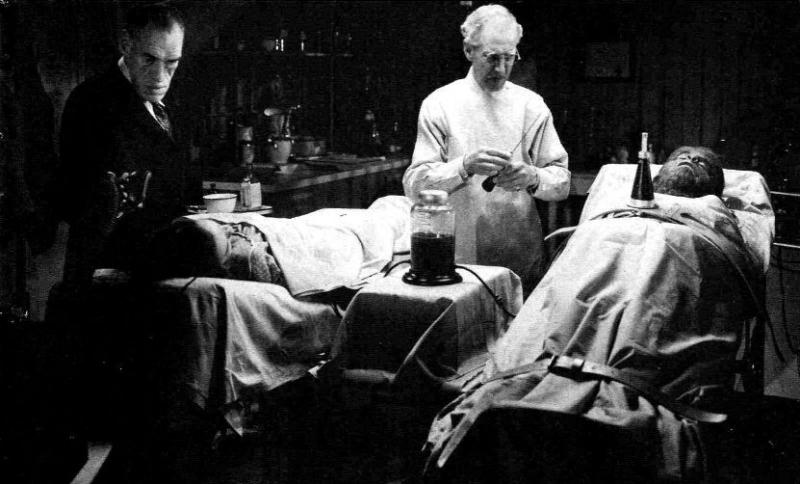

Ann is pretty dimwitted but she trusts Kruger, who harvests her blood to bring back Paula and she's been nice to Molloch. That's where Stendahl makes his mistake, for like all ugly brute thug assistants, he develops a crush on the pretty victim. "Why, Molloch!" Kruger says. "I believe you feel sorry for my pretty assistant. Don't be a fool! We're scientists, not sentimentalists."
Alas, aside from Kruger's wry delivery, Hatton's looming, and the atmospheric almost James Wong Howe-ish lighting (which was never really in evidence prior to Shout's sublime Blu-ray restoration). it's still kind of a shrug of a film thanks to the blank space where an ape woman should be. Paula never seems to shake her somnambulistic amnesia throughout the film. She can barely be bothered to be jealous over some lame no-good dullard white man. Instead, it's all much more about Otto and Molloch vs. Detective Cowan and the 'good' couple, with Paula only real snapping to life when she has a chance to play rescuer as the lab inevitably (I think?) goes up in flames.
A few extraneous details: my old girlfriend was named Paula so I sampled more than a few lines from this movie in my DJ phase in the 90s, including "Paula's brain is gone. Her reactions are those of an animal." But that will mean little to you, though it took me a long time to realize it. In fact the reason I bought all three films on video tape over the years was because her name was Paula. It soothed my broken heart in many a way, even though our breakup was mutual and I didn't want her back, it was just that she was so far away, and so pretty, and I was suffering from missing her. Watching Jungle Captive, I still do.
----A few extraneous details: my old girlfriend was named Paula so I sampled more than a few lines from this movie in my DJ phase in the 90s, including "Paula's brain is gone. Her reactions are those of an animal." But that will mean little to you, though it took me a long time to realize it. In fact the reason I bought all three films on video tape over the years was because her name was Paula. It soothed my broken heart in many a way, even though our breakup was mutual and I didn't want her back, it was just that she was so far away, and so pretty, and I was suffering from missing her. Watching Jungle Captive, I still do.

Maybe it's all that middle of the road-ness that stops her from connecting with audiences today. She lacks a James Whale / Karloff or Lewton/Tourneur combination to make her sense of all consuming isolation connect with wartime audiences, and a Browning / Lugosi combination to make the monster's sense of otherworldly Gothic sex fever resonate across deeper valleys of the unconscious. She lacks a Chaney/ Siodmak fatalism, or even a Ricou Browning /Arnold sense of eco-awareness.
What she has instead is the story of absence; or a gaping void where her own arc and narrative might have grown had it managed to escape patriarchal manipulation and exploitation. Women (and animals) are still recovering from such blatant encroachment, ever trying to shake the yoke of 'captivity' and finding it impossible, even in death, three times. Lucky for her (as opposed to the gloomy Larry Talbot/Wolfman who seeks 'release' all through his last five or six films) after her third film she's able to finally, permanently die. In this one thing, maybe, she reigns triumphant.
It must be.. fabulous.




_NRFPT_03S.jpg)