Showing posts with label John Carradine. Show all posts

Friday, November 06, 2020

Welcome to the Zugsmithery: SEX KITTENS GO TO COLLEGE (1960)


If you don't think film critics can make mistakes, consider the terrible reviews given the sublime SEX KITTENS GO TO COLLEGE, a C-list 1960 madcap comedy about the effect a knockout blonde who also happens to be a super genius doctor of medicine,  psychology, and physics (plus ten other degrees) has on a small town college when she arrives from Vegas to assume the role of dean. Hired by "Thinko" the computer/robot who is "never wrong!", she's clearly qualified so why is she causing such a stir? Just because she happens to arrive in the body of "the Tallahassee Tassle Tosser," Mamie van Doren?. Often billed as being to Jayne Mansfield what Jayne Mansfield was to Marilyn Monroe, Mamie underplays with such calm authority that even those who sneer and deride her 'type' would be impressed if they could leave their male sexual panic at the door. Not only can she can carry a film, she can stay cool and grounded, and almost believable as a photographic memory and 13 doctorates-having genius. No doubt she is the right woman to lead this cocakamamie college into the "space age!" She 
can give you the page # of any given text. In short, Thinko is not wrong; she's qualified above and beyond the rest of them. The sparks fly because no one can handle the fact of her hotness. This inability is never depicted as anything but 'their' problem, and reflects perhaps the irrational hostility of critics (similar to the unearned scorn heaped on Myra Breckenridge.) 

And she's not the only asset: a stunning Tuesday Weld is the college's hitherto raining beauty queen. (she accuses Van Doren of "making every other woman in the world feel flat-chested"). Weld has been trying to get lumpen football star "Woo-Woo" (Norman Grabowsk--a kind of Rick Moranis crossed with a Sherman tank) to swing for first base rather than just srtriking out in a stuttering virgin panic. Trying to help Weld out, Dr. Mamie gives him some good counsel --just one of the surprising moments van Doren handles with a sensitive aplomb, yet hitting all the right comedic notes ("boys with nicknames are usually sensitive"). No wonder Woo-woo ends up falling for her instead of Weld, but it hardly matters much. There's too much else going on for anything to reach that kind of climax, as the film slowly builds to one of the stateroom scene-style 'everyone onstage' madhouses. Even Maila "Vampira" Nurmi is around, though stuck in the role of a sexually frustrated lab assistant, ever machinating to help undercut MVD's sexual status. Her presence alone lets you know you're in the right place.

Oh, oh that Mijano --in a nice color photo
(I couldn't find a good Sex Kittens still that does her justice)

For all Van Doren's range, the secondary romantic lead, Mijanou Bardot (Brigitte's sister!) basically steals the bulk of the sex appeal as a very low key, underplaying version of a sexually voracious Russ Meyer-style exchange student, fout to bed a cross-section of ze American male for her term paper ("what you call ze 'social sciences.") Her forthright availability is the stuff of semi-terrified fantasy. She ends up zeroing in on a "real live Chicago gangster" in the form of Allan Drake as "Legs" --whose grounded 'strictly business' semi-reticence is met with sultry /academic urgency ("Do you want to set science back thirty years!?") He and his pal are there to lean on this guy "Thinko" whose been gambling rather too successfully. Though far from the most interesting of the Mad style cacophony of crazy characters, Drake's rattled "Legs" becomes more interesting purely through his gradual reciprocation of Bardot's unswerving affection, and vice versa a--like some Anna Karina anti-heroine--she even joins the gangsters' side ("Boo-booom Boom! Ventilate him!" and "This dialogue, pure Roaring 20s, no?!")

"I"One of the most possible people you'll ever meet."
"One of the most possible people you'll ever meet" 

And that's good Legs comes around and conquers his sexual panic. Hey, you'd be surprised how many normally red-blooded American males can't handle a beautiful girl suddenly throwing herself at them like a freight train. A man might fantasize all through his pained adolescence about such moments, but if one actually comes--and Lacanians know this all too well--his reaction isn't aggressive cool, but panic; he starts to stutter, spills his drink, and before you know it, finds himself running away, covered in sweat, desperate to get home and begin his lifetime of self-reproach over this one blown opportunity. To go from tortured adolescent longing for this golden chance to tortured adult regret about blowing it is almost a rite of passage; hopefully one can glean the message: the unconscious half of yourself is a spiteful anima out to keep you for herself. 

This is the comedic gold mine understood only by a chosen few in the comedy business. College can be visualized as a zone where fantasy and desire reign free - written by and for people who have only been there in passing, but who looked at all the girls and thought 'man if I was in college I could score with all these chicks,' In this film they suddenly they have to put up or shut up.  The women--namely van Doren, Weld and Bardot--have all the brains and assertive libidos, and the men are reduced to terrified deer in the headlights. Such is the Russ Meyer-esque vein mined by Albert Confessions of an Opium Eater Zugsmith in the long-derided Sex Kittens Go to College. 

L-R: Tuesday, Mijanot, Mamie
I don't have all the answers; I have no idea why this awesome comedy gets such a bad critical rap, unless male critics are too threatened by the idea of a genius bombshell who's not evil, passive, materialistic, or moronic. As of this writing it has a 2.2 on imdb. and Lenny Maltin gives it a BOMB ("don't say you weren't warned!"); Glenn Erikson says "Compared to Sex Kittens, Otto Preminger's Skiddoo is a profound statement on the human condition." An uncredited imdb writer calls it "one of the most legendarily worst films ever produced." But I say, if you've been to college and like to get wasted and love the films of Russ Meyer, Ed Wood, and Roger Corman, and you used to read Mad and Cracked as a kid, then at least consider checking out a film where all those things are rounded out to the uncommon denominator. I think a lot of these low budget zany comedies get a bad rap, especially if they don't have big recognizable directors (like Frank Tashlin or George Axelrod) so that critics can guess how they're supposed to respond. This isn't a guffaw style comedy, but how often did we laugh reading Mad as kids? Half the time we didn't even get the jokes. There were satires of films far too dry and adult for our interest, like The Sandpiper and The Man in the Grey Flannel Suit.  In that spirit, let Albert Zugsmith be your Alfred E. Newman. 

The Zug was strange figure who could go from producing films like Orson Welles' Touch of Evil, and Douglas Sirk's Written on the Wind, to directing unclassifiable strangeness like Confessions of an Opium Eater, The Beat Generation, and Sex Kittens Go to College. He also produced Russ Meyer's Fanny Hill!  If you don't see that list is all connected, then you need to learn so very much about the spirit of revolutionary cinematic anarchy in the service of sexual stimulation. (Behind me right as I wrote that phrase a Quaker Oats commercial said "Where new normals are created.") That's the beauty of the Zugsmith touch. Watching Vincent Price sailing madly down the sewer towards Frisco Bay oblivion in Opium Eater for example, leaves us more questions than answers: is it a horror film? A white slavery expose? A surreal odyssey worthy of Bunuel? 

It is all that and more, for you have entered the Zugsmithery. 

The simple fact is, there are so many things to zero in on here in the Zugsmithery that if one element annoys you, there are ten more to delight or flabbergast. For me the most glaring and annoying element in Sex Kittens is Martin Milner (the supposedly hip jazz guitarist who had to have weed planted on him in Sweet Smell of Success) as the college's PR man / sexist hysteric. Talking fast in a kind of high-voiced style, sort of imitating Cary Grant at his most flummoxed in Arsenic and Old Lace, Milner tries to steal scene he's in, as if he's feeling the need to give the film a square 'white fall guy' center to ground the antics, i.e. he's the Tony Randall or Tom Ewell, there to link the film to every other banal "sex" comedy flatlining on big screens around America at the end of the 1950. Rather than letting the women own their scenes, Milner lets a kind desperate flop sweat swell his own lines until they rain all over their lines. He might come out a few yards ahead of Eliot Reid's smarmy detective in Gentlemen Prefer Blondes (1953) as far as worst male counterpart to a busty 50s-era comedic titan, but it's mighty close. 

There's one other caveat: I also don't like the cop-out patriarchy-triumphant ending (SPOILER ALERT!), when Mamie hangs up her shingle and goes back to Vegas to continue her tassle-tossing, so that Milner can romance her without feeling threatened. When she says, after giving up on her academic career, "for the first time I feel like I'm really using my brain" one wants to track down writer Robert Hill and beat him senseless with a rock-filled bra. (I feel the same way at the end of Beyond the Valley of the Dolls when smarmy, worthless David Gurian is accepted back into the fold and the murdered lesbians are blamed for their own deaths.) If there's one thing I loathe in these 50s-60s big screen sex comedies it's these young men with clean cut hair and a pipe and an unearned lordly air, as if they believe the Madison Avenue plastic fantastic wave that tells them they--by virtue of their educated SWM status-- have the right to re-enforce patriarchal homogenization when it begins to weaken. Sure, not all these guys are insufferable but the ones that are, like Milner and Reid, becomes more insufferable with every passing day of my work's sensitivity training. Ugh! (Of you can't get enough of my ravings on the topic, check out: CinemArchetype 13: The Skeevy Boyfriend. and Vanishing Caloric Density: The Queen of Outer Space.
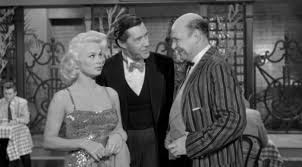
 Luckily, there's a kind of masochistic 'turn the audience into feminists' critique going on here, as in Blonde Venus we may not like that he wins in the end, but we're clearly meant to root against the squirmy male who uses the conservative values of the reigning social order to help put a woman in her place for the crime of outshining him in every department. If we come away pissed off, at least we can credit the film for stealthily agreeing with us. We can't help but cheer when she dumps a conga on his head then pours a pitcher of water through it onto his head. Even if she apologizes later, and asks "do you find me... desirable?" so that we roll our eyes and snort derisively, Zugsmith gave us our moment. And we'll never forget it. 

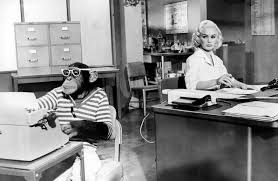
To make certain we know where Zugsmith's sympathies lie, balancing out Milner's forced hysteria there's wondrously wry turns by Jackie Coogan, 'borrowing' W.C. Field's chicane drawl wholesale (even making a Professor Quail-style landing) as the college's key financial supporter, Admiral "Wildcat" McPherson; and John Carradine--proving he isn't limited to shady butlers and secondary Draculas--as a debauched science professor.  We knew Coogan had the comedic goods cuzza Fester, but it turns out Carradine is adept as hell at deadpan Mad Magazine-style comedy, as one of Mamie's firm supporters. Like everyone else except Milner and Nurmi, he's unthreatened by her mix of sex appeal and brains, calling her "a positive vision" while helping her into his faculty-packed jalopy (her chimp sidekick sneaks into the rumble seat) for a night of buzzed carousing (or a "simple homespun country fun"). Destination: "the Passion Pit," the college's local tavern.  To overcome any further doubts as to her qualifications as either genius, Vegas showman or star stripper, Van Doren hypnotizes the gathered faculty and Pit patrons to join her in a crazy rhumba (Conway Twitty watches, and then sings). As she puts it, "this is war and I'm out to wake up the troops!"

Thankfully, no amount of stage show antics can dampen the benevolent and respectful ardor of these older men, who are--essentially--too debauched to be troublesome (the greatest libertines never mash or paw; they won't say no if you make the first move, but otherwise lean in only to spook away the unwanted johnnies). Ah, the vantage point of age and experience! 

Cameo parts and great lines float around ("I'm a selectman of the church!" rants the cop who arrests the admiral when his morality is on the ropes); Charlie Chaplin Jr. is a bewildered fire chief; the imposing and magnificently bullhorn-voiced Babe London arrives in town representing "the Paddy Pad Brassier for the larger figures gal"  - At the end when heading off once more into the great beyond, London drops the ultimate microphone: "You people don't deserve Paddy Pads! I'm taking my brassieres to Europe where they'll be appreciated!"

And over all, it's one of those "What, me worry?" fantasies where all the women are stacked and leggy, but smart and aggressive, and the men more or less idiots. But when you have Coogan and Carradine dancing at a bar, how bad can things get, no matter how much Milner dashes around like some kind of universal chaperone (telling Jayne "You are a bit much for a growing boy to face at nine-AM in the morning.") or the flash-frozen "Woo Woo" mopes and Moranis-izes? Sure, the ending is total chaos as all the disparate parts come together in a big science lab/classroom climax (with the gangsters and Thinko finally squaring off) but at least half the gags hit home and if you don't really laugh, well, one of the beautiful gals is usually onscreen to rest your eyes on while you wait for the next zany character to come tumbling into the scene. For all its faults, I think I like it better, as a whole, than either Beyond the Valley of the Dolls (which has an icky homophobic  subtext) or The Girl Can't Help It (which has an icky Tom Ewell smarm). Sure it's not as good as Lord, Love a Duck but what is? Even that's not perfect, though it sure is Milner-less.

The question is, does Sex Kittens link up with Opium to delineate and auteur style for the Zugsmith? Maybe not, but it does indicate a termite interest in veering from audience expectation and letting the sewer carry us where it may, no matter how far afield from the norm. If Vincent Price were to show up, waving an opium pipe as he sails past on a Chinese character floatation device, on his way to Dr. Goldfoot-fame, we might well be convinced. Maybe you you can't pin high hopes on it, maybe it's not any better than 1962's Invasion of the Star Creatures but if you can tolerate that (and I can) you should know there's plenty of the old galaka-zoom and maybe even some ring-a-ding dinkiness to be found at the Zugsmithery. Best of all, there's full-bodied and nuanced performances from Bardot (casually carnal), Van Doren (sensitive and balanced - she talks, not shouts, further stranding  Milner in the ham flats) and Weld (less to do than in Duck but still ravishing with her spot-on deadpan comic/sexy-fusion alchemical acumen). The three girls, especially Van Doren and Weld (they remained fast friends), project a kind sisterly, lordly benevolence, riding herd over the male students like a college sex-com Red River. Even with the cop-out coda, this baby is going places, maybe even all of them at once. Follow the lead of professor John Carradine and Jackie Coogan instead of the dopey Milner. A girl with youth, brains, education and hot blondeness is not a threat, a goal, or an object, but a great drinking partner. Let her prove it, and hang on tight. 
 

Tuesday, August 11, 2020

Paula of the Apes: CAPTIVE WILD WOMAN, JUNGLE WOMAN, JUNGLE CAPTIVE (Scream Factory Universal Horror Collection VI)


An oft overlooked part of Universal's monster pantheon, Paula Dupree, the gorilla/human hybrid, starred in her very own trilogy: CAPTIVE WILD WOMAN, JUNGLE WOMAN, and JUNGLE CAPTIVE, all released in a three year-span of 1943-5 (the height of wartime and--for some reason--the height of gorilladom - see RETURN OF THE APE MAN: Revisiting the Wartime Savage from a Post-Modern Perspective!). Like any number of popular monsters, she was regularly brought back from the dead by unscrupulous scientists, made a human enough to 'pass' but would inevitably revert back to her fanged half-animal self as soon as some dull as dishwater leading man overlooked her as a romantic partners in favor of Universal's wartime scream queen, Evelyn Ankers.

In all three films, Paula ends up shot, shot up, or otherwise killed. Three times! What a lives! And what a set from Scream Factoy. All three films (+ another gorilla-friendly sub-classic) comprise Volume Six of their Universal Horror Collection, a series which rounds up all the titles that Universal didn't consider 'pantheon' enough to release on their own label. (unlike the dishwater dull Phantom of the Opera).

Whatever your impressions, Paula the Jungle Wild Woman/Captive's origins as a character are easy enough to trace: she's clearly conjured by Universal idea men after noticing the box office generated by RKO's Cat People (which came out the year before). Like Irina (Simone Simon) in that film, Paula's animal instincts are triggered by raging jealousy and sexual frustration, bringing home the war-enforced separation anxiety subtext loud and clear: American women are climbing the walls at home in sexual frustration, thinking about foreign women with their clingy claws, gypsy ways, out and exotic STDs.

A gorilla brain transplant melodrama that was recently introduced on TCM by its biggest fan, ape suit connoisseur John Landis, the set's fourth and last film is THE MONSTER AND THE GIRL (1941), a groovy strangely noir-esque and poetic tale of a man wrongly convicted and executed whose brain is transplanted into a gorilla body after death and then comes back to find and kill the the gangsters who framed him and are now after his moll. It's interesting and cool but don't try and steal Paula's agency, you sexist/species-ist! It would be nice if Scream gave us an ape woman documentary. Even a commentary--even a five minute bit on the sexism that has led to the characters exclusion from the Universal pantheon. 

But the films themselves have never looked better. You'll be surprised at the attention given to spooky lighting Dmytryk's CAPTIVE WILD WOMAN. It's so gorgeous now in the HD glimmer it's beguiling; and the beauty of Evelyn Ankers' face is more striking than it ever was on video or TV; her flawless white make-up; the planes of her face marvelous in their matte alabaster, she's got 'it.' Even her hats are dynamite.

CAPTIVE WILD WOMAN
(1943) Dir. Edward Dmytrk
Film: *** / Image - A+ / Extras - F 

We first meet Paula while she's in full gorilla form, happily (for some unknown reason) being lifted out of ship storage in a tiny little cage and loaded onto the docks of America for her life of exploitation in he circus (after a presumably normal life in Africa). She's a naive sweetheart with way too much faith in the inherent goodness of her captor, dullard lion tamer Milburn Stone. Her life might have been one of happy caged exploitation if only she didn't catch the eye of a visiting glandular specialist played with superbly creepy understatement by John Carradine. Like the evil fairy godfather of some kind of Moreau island Cinderella myth, Carradine steals her from the circus, brings her back to his clinic and turns her human--thanks to the glandular extracts from patient Martha Vickers (three years before trying to sit in Bogey's lap while he's standing up in The Big Sleep) so she can land a prince charming, i.e. Stone, who prefers cool hat-sporting Evelyn Ankers. Vicker's older sister, who read in a medical journal that Carradine fixed up "a completely deformed child" and also "reversed acromegaly 'due to a hyper secretion in the pituitary gland." This article then is why, for some reason not evident in her beautiful countenance, she takes her kid sister to his isolated, creepy mansion "clinic" in the first place. Never believe what you read in a magazine! Naturally his operating room is hidden behind a false bookcase, far from prying eyes. That Ankers would just leave her sister alone for days in this spooky isolated, lonely place seems rather careless, but as Carradine's picture is in all the medical journals, she reckons he must be trustworthy (as evinced by her engagement to the idiot Stone, she clearly places far too much faith in the era's smug, entitled patriarchy).

If Captive Wild Woman is actually good, rather than just kind of smirky and uncouth (due to the unconscious sexism and animal cruelty and the uneasy they blend together), it's thanks to the flair for horror shown by director Edward Dmytryk, who takes the time to get the atmosphere and peripheral horror details just right. The glint of madness in the eyes of John Carradine as he watches an offscreen Sheela strangle her drunken abusive handler; this shadows on the walls of hillside clinic as its bathed in thunderstorms and billowing winds, it's inviting in the best kind of creepy Universal 40s B-movie way, i.e. spooky, mildly thrilling and nostalgic for monster kids (who grew up watching Universal B-movies on TV as kids) without being the slightest bit scary or suspenseful.

Our objections to Carradine's Mirakle-style plan in today's more enlightened era aren't as extreme as they might have been back in 1943 (when the sordudness was evoked by implied bestiality!). Today the objections come via our compassion for abused women and animals (namely the lions and tigers Stone forces to work together in his sick big top displays).  Our 21st century hearts sink in films like this, especially when we hear he's captured and brought back "20-30 cats", all in these tiny crates that don't even give them room to turn around. It's images like that that keep this off my rotation. Neither the cats nor the now-human "Paula Dupree" (Aquanetta) get an ounce credit for making Stone the big top big shot he is. i.e. the cats aren't praised or rewarded for learning tricks, the way they seem to be in the Clyde Beatty footage that's intercut with Stone's, and which shows Beatty more of a hypnotist with a real connection to the cats. Stone is more like a dopey front for uncredited female agency (since Paula is able to control the animals through telepathy and a deep jungle connection - like a glandular side effect). And Sheela/Paula isn't awarded for her loyalty to lion tamer Stone, whose life she saves from outside the training cage with her moody stares, Stone just admits she can be a big help to him and assumes she'll always be there in the wings as long as he needs her; he doesn't ask her permission to use her this way; he acts Carradine's permission, like he's her goddamned pimp!

Actually, it's really Paula who trains the big cats with her staring, and Stone isn't needed at all. He should be fired and Paula hired full time, given a big hat to make her look taller, like Mae West as Tyra the lion tamer in I'm No Angel (yet there's no mention of her even going on the payroll). Instead, super square Milburn is only too willing to take all the credit, with the indispensable Paula as forgotten as, perhaps, a stuntwoman or voice artist who dubs a character's singing voice, doomed to anonymity to foster the illusion of another actor's supremacy in all things. She does get some publicity but the papers admit they don't quite know how she figures in, just that she's pretty in an exotic (i.e. vaguely nonwhite) kind of way.

The other women in the cast fare no better; Carradine's long-loyal female assistant balks at taking the life of Vickers in the name of science, so Carradine kills her without so much as a second thought (word to the wise: if you're going to turn your mad scientist boss into the authorities, don't boldly proclaim your intentions while alone with him down in their scream-proof secret basement). Ankers' job at the circus (she's the owner's assistant) is treated as utterly superfluous to Milburn, to whom she's little more than another subservient animal ("I hope you're as easy to train when we're married.") Poor Martha Vickers meanwhile exhibits no signs of illness, whatsoever. Her opinion is not asked as to whether she's comfortable being left at some male stranger's eerie house for an indeterminate amount of time. She's not mentally ill or otherwise not allowed a vote by law - she doesn't even feel she's allowed to speak. She's just there to offer free glands. 

in short, she is as indentured to the patriarchy as Sheela the gorilla. When she displays a sign of trepidation, Ankers even chides her, treating her with the same infantilizing contempt with which she herself allows herself to be treated by Stone. Any sense of intuition of danger, being a feminine trait, is dismissed by her own sister as a sign of childish animal idiocy, while a magazine article is taken as a kind of gospel truth. Carradine's picture is in a medical journal, therefore a girl is betrayed by her own sister, the way Catholic parents might punish a child for saying he was molested by a respected priest. 

Unlike Stone's lion tamer, however, at least glandular expert Carradine is cool. He has no interest in Vickers, sexually; he's prideful but he recognizes his own psychopathic villainy, and it's all in the service of science and his wild ideas. He takes risks because he's driven to create something new. There's no such excuse for Milburn's villainy because it's so unconscious and accepted by the social order that it takes us decades of slow-burn enlightenment to finally realize how vile he is. Carradine is way more likable purely for being so openly mephistophelian.

Martha Vickers is refused one phone call by sinister Carradine - Captive Wild Woman

Fortunately, Dmytryk --unconsciously or not -- is an ally. Although homicidally jealous to the point of climbing into Ankers' girls' residence window (she got a crush on Milburn while still a gorilla) and killing the house matron (a kind of fractured mirror to the pool sequence in Cat People) and--once back in full ape mode--she does end up killing Carradine and then rushing to her no-good man's rescue after the big top catches fire and the lions and tigers run loose. Of course she's shot and killed by a nervous cop who who doesn't deign to figure out if she's a good ape or not as she runs through the fire with Milburn slumped over her shoulder like a frail and useless damsel. Two seconds after what should be her celebrated martyrdom--the way say the gorilla Samson was acknowledged for his sacrifice in Nabonga-- she's totally forgotten. The circle has closed around Stone's white male privilege once more. The cop is not even reprimanded for an obviously dangerous shot (he could have easily killed Milburn instead). Stone plans his big show to come, oblivious to the fact he's lost his apron string safety net; and we actually end up with a homage to Carradine's looney doctor, whose ever-windswept sanitarium gets a final glide-over during a coda voiceover about the price of daring to delve into God's domain. Ugh... Men. 

Paula (Aquanetta) tries to restrain her delight at having these two grade-A specimens (J. Caroll Naish, left; Eddy Hyans, right) as her sole companions during her post-surgery convalescence

JUNGLE WOMAN
(1944) Dir. Reginald LeBorg
*1/2 / Image Quality - A / Extras - F

The second film in the Dupree saga is easily the worst, thanks to both the jumbled, lazy flashback structure and banal time-wasting bits of low-energy hamming by a woefully miscast J. Carroll Naish as whisper-talking psychiatrist Dr. Fletcher. The narrative itself occurs as flashbacks, illustrating Fletcher's whispery testimony at the second inquest for Paula, after he revived her from the last film (and then killed her again). Thus, the film is structured as a flashback but then the first part of the flashback is a flashback to the last film, all of which is stretched to tedium as Naish putters around one issue of the case after another, as if he hates to part with a single line of dialogue. 

As with Carradine's mansion clinic, Dr. Naish's sanitorium is a huge, plush and terrifically understaffed. There's only inhabitants seem to be himself, a few staff members, his daughter (Lois Collier) and her bland fiancee (Richard Davis) who drop by now and again-- and the gorilla he takes home from the circus fire of the last film, who then becomes Aquanetta again, but then walks away from her bed before Dr. Fletcher or the nurse notices the change. This means Naish gets to eat up more time as Fletcher wonders where his comatose gorilla may have gone and how this cute amnesiac managed to just wander in. While Fletcher tries to put two and two together, history repeats itself as another super bland idiot fiancee catches Paula's eye. 

But neither that bland fellow nor Naish are even the real reason the film is such a drag. That dubious honor goes to Eddie Hyans as big old George (upper right), the orderly at Fletcher's sanitarium. He plays a needy Lenny-style imbecile with the kind of flat almost self-sabotaging half-assedness that makes you feel like a fool for even paying attention to the movie at all. As he falls into a childish obsession with Paula. (Why the hell wouldn't he?), lines like "I don't annoy her; I was just bringin' her lunch," or "aw, it's a gyp," sound like he's doing a drunk impression of Tammany Young in It's a Gift (1934). Not a bad thing when your drinking buddy does it at 3 AM, but the last thing you want to see in an already draggy Universal horror film.

At least there are one or two great Cat People-like nighttime stalking scenes where Dupree (unseen) stalks Naish's daughter through the grounds. In the best of the two, we see the couple out on a canoe out on the estate's groovy pond/lake at night. The scene is quiet, romantic, no music; everything is perfect enough we start noticing details like the moon, the reflection on the still water, and then something stirring below the surface, starting from shore but making a bee-line ripple-eddy straight towards the lovers' canoe. You can feel the typical over-emphatic mickey mouse composer chomping at the bit, begging to underscore everything with suspenseful strings and woodwinds. That he didn't bespeaks to the fact that someone, somewhere, along the film's assembly line, decided to risk the uniform banality by making a genuine eerie cinematic moment, simply by removing, rather than adding.

Meanwhile Dr. Fletcher us so dumb he still can't figure out what is going on; even with all the copious evidence, he finally needs Milburn Stone to show up to try and fill in the blanks for him. And Fletcher is so removed from cognizant reality, he refuses to call the police, even after George's body is discovered on the grounds, torn to shreds, not out of squirmy guilt but because he genuinely believes it was some wandering animal, and therefore just an accident not worth a policeman's time! One can only presume he's dangerously incompetent and not sociopathic, as the bodies pile up it never occurs to him to even consider hiring a security guard. The reason is probably pretty clear: in grand Universal B-lot style, nary an extra outside of stock footage may be found.

Even at only an hour long--even packed with footage from the last film--this is pretty slow going. Only the rage expressed by Paula has any resonance. The angrier she becomes the scarier she gets. All the while. one wonders why Aquanetta was cast in the role. Did some producer think she resembled some idealized fusion of Dorothy Lamour (then a hit at Paramount) and Simone Simon? Whatever the reason, she's too short to be menacing. She also lacks the eerie poise and dark feeling of ex-pat isolation that Simon brought to Irina in Cat People. But she can glower. 


JUNGLE CAPTIVE
(1945) Dir. Harold Young 
**1/2 / Image - A / Extras - F

Jungle Captive is certainly terrible but at least it is atmospheric and miles above Jungle Woman (1945) thanks to an amusingly sinister turn by Otto Kruger and the always fascinating Rondo Hatton as the smitten assistant who steals Paula's body from the morgue (an ape woman's corpse just can't get a break). Hatton and Kruger are so good they aren't even the same genus as Naish and Hyans from the last film in the trilogy, so don't hold your past-film resentment against them. There is no pretending to be anything but shady with this pair. Standahl (Kruger) isn't even a doctor, just a laboratory scientist who sees Paula as the perfect loophole to the 'no experimenting on humans' rule in science (she's technically a lab animal), so he's moving up a few steps from his experiments bringing life back to dead rabbits. And Rondo, snarling and holding a gun on morgue technicians, is a far cry from dopey Hyans mooning over Paula and mumbling like some half-assed Bugs Bunny gangster flunky. Helping further is droopy-eyed Jerome Cowan as Detective Harrigan of Homicide. and Amelita Ward as the fetching Liz Taylor-eyed assistant. Vicky Lane steps in as Paula Dupree. Everything just got better! Almost. 


Another element that lifts this above Universal's tossed-off B-movie dregs: little bits of macabre deadpan humor, like Hatton advancing from behind on Ann, his big hands all looming in the grand 'Creeper' tradition, only to then just take off her coat. Kruger has a nice way of bugging his eyes out as the moody noir shadows hit his features just right when Ann realizes-- too late-- that Kruger is the one who stole the ape. Relishing her shock, he announces he needs her ("You see, Ann, I need you... I need your blood.") When she tries to reason with Molloch (Hatton), he's unswayed. Stendahl comments: "You see, Molloch (Hatton) is a true scientist. He understands the unimportance of a mere life when it might impede progress." Kruger could be awfully bland as a good guy, ala his sober sages in Dracula's Daughter and Magnificent Obsession, but when he's a villain he's pretty intriguing, eagerly playing those same noble features against type with a kind of aglow eerie relish. Here especially he's pretty good, maybe even better than he was Murder, My Sweet. And he and Hatton have a fine working colleague rapport, for awhile.

Ann is pretty dimwitted but she trusts Kruger, who harvests her blood to bring back Paula and she's been nice to Molloch. That's where Stendahl makes his mistake, for like all ugly brute thug assistants, he develops a crush on the pretty victim. "Why, Molloch!" Kruger says. "I believe you feel sorry for my pretty assistant. Don't be a fool! We're scientists, not sentimentalists." 

Alas, aside from Kruger's wry delivery, Hatton's looming, and the atmospheric almost James Wong Howe-ish lighting (which was never really in evidence prior to Shout's sublime Blu-ray restoration). it's still kind of a shrug of a film thanks to the blank space where an ape woman should be. Paula never seems to shake her somnambulistic amnesia throughout the film.  She can barely be bothered to be jealous over some lame no-good dullard white man. Instead, it's all much more about Otto and Molloch vs. Detective Cowan and the 'good' couple, with Paula only real snapping to life when she has a chance to play rescuer as the lab inevitably (I think?) goes up in flames.

A few extraneous details: my old girlfriend was named Paula so I sampled more than a few lines from this movie in my DJ phase in the 90s, including "Paula's brain is gone. Her reactions are those of an animal." But that will mean little to you, though it took me a long time to realize it. In fact the reason I bought all three films on video tape over the years was because her name was Paula. It soothed my broken heart in many a way, even though our breakup was mutual and I didn't want her back, it was just that she was so far away, and so pretty, and I was suffering from missing her. Watching Jungle Captive, I still do. 
----

I could go into the MONSTER AND THE GIRL (1941) also included on this Shout Universal Horror edition and maybe I will at some future date. But I don't want to steal any more of Paula's agency than the world has already. She's too far gone now to ever be redeemed or suddenly re-valued, anyway, but why add insult to injury. Ignored and maligned by history, to ever have her likeness reproduced on a stamp, or an Aurora model, or even rate as either a coded lesbian archetype ala Irina in Cat People or a Halloween hairdo like The Bride of Frankenstein. She may have been exhumed and revived in the diegesis of her films, but never in real life. Though her closest cousin may well be the Wolf Man as far looks go (when she's right in between gorilla and human girl form) the bottom line is, Paula just doesn't know what she wants to be. Clearly her murderous  behavior has much to do with Cat person Irina's - in that being ignored and belittled and slighted by the guy who catches her eye makes her insanely jealous over the girl he prefers, leading to her turning all crazed with animal hatred and vengeance. That she and her writers never figure out where to go beyond that speaks woefully of their imaginations. Never quite all the way a bad guy or a good, her murders are all emotionally driven, failing the Bechdel test in so many ways, but paid for in the end by her coming to the rescue of the code-approved (i.e. human, white, Christian, heterosexual, and age appropriate) pair bond, killing the real villains, usually as flames lick her fur.

Maybe it's all that middle of the road-ness that stops her from connecting with audiences today. She lacks a James Whale / Karloff or Lewton/Tourneur combination to make her sense of all consuming isolation connect with wartime audiences, and a Browning / Lugosi combination to make the monster's sense of otherworldly Gothic sex fever resonate across deeper valleys of the unconscious. She lacks a Chaney/ Siodmak fatalism, or even a Ricou Browning /Arnold sense of eco-awareness.

What she has instead is the story of absence; or a gaping void where her own arc and narrative might have grown had it managed to escape patriarchal manipulation and exploitation. Women (and animals) are still recovering from such blatant encroachment, ever trying to shake the yoke of 'captivity' and finding it impossible, even in death, three times. Lucky for her (as opposed to the gloomy Larry Talbot/Wolfman who seeks 'release' all through his last five or six films) after her third film she's able to finally, permanently die. In this one thing, maybe, she reigns triumphant. 

It must be.. fabulous.

Tuesday, August 15, 2017

Cat Class: THE CAT CREATURE, CURSE OF THE CAT PEOPLE


Julie Newmar in the old BATMAN TV show: her lithe playful grace, her tender malevolence with her dopey underlings, her black spangly bodysuit and ease in her own long, languorous dancer's body; the way she'd climb up and dismount the boxes and thrones in her secret lair, stretching out, slowing down dance moves and yoga stretches into cat-style longwise stretches, using her Stooge-like cat creeps as balancing beams. I know I'm not alone in feeling my own unconscious / anima rouse itself from fitful hibernation, whenever she appeared. She had me. All of us. We'd always play fight after a Batman rerun, in the front yard, shouting "Pow" and comically falling over, afterwards.

When Julie Newmar was on, we'd fight for real, to prove our alpha mating potential, though we were but seven or eight.

Bast, the ancient Egyptian cat goddess, was invoked around playground pentagrams. To boys like me in the 70s, she was what Jacob the wolf boy from Twilight is to girls the same age today. That's why I "get" Twilight, because of Julie Newmar. Animal-human hybrids are a pop culture's 'safe' pre-adolescent sexual surrogates, i.e. the anima / animus. Long before the shaky parent runs from the room confident their role has been passably completed by some five minute rote 'sex talk', the TV smiles, rolls its eye and returns to regular cat channel. Cat Woman has covered all this before, without the messy biology of reproductive science or messy things like 'real' girls. We may not know the mystery behind that impassive mask, but that's why it's there. It's pagan idolatry at its best. 

As long as it's on, we don't have to worry about not liking what's underneath. Lord knows, we'll have enough of those dates in the early years of AOL.


Alas, Newmar's Catwoman fell down a well (see Kitty Kali) and left us all bereft. Other ladies took the role. But what cat can compare to luminous Newmar? Genres change, boys become men; men become wolves; graven images are smashed by heretics' hacking hammers; the beat goes on; and cats come back / the very next day. As Boris says in THE BLACK CAT (1934), "Cats do not die." So can we deny that the crazy old lady with the ton of cats is within us all?

Lately two film ambled forth (though hardly knew I saw them with new eyes), cat-related. Timeless, strange, evocative, ephemeral, mysterious, kind of goofy, and short. What can we do but cherish them, and never try to put them in little cardboard boxes? You heard me, Ollie, in CAT PEOPLE (1942).

THE CAT CREATURE
(TVM - 1974) Dir. Curtis Harrington
***

A strange necklace is stolen off of a mummy and everyone who handles the piece gets mauled to death by Bast, a mummy cat god woman returned to life (the necklace held her prisoner in the sarcophagus!) Written by Robert Bloch, Curtis Harrington's TV movie THE CAT CREATURE is pretty damned solid as far as 70s TV horror movies go--and there were a lot of them but no one did them better than Curtis Harrington, the Joe Dante of his era. Despite, or because of, its typical-of-the-time shallow depth, slow-amble cop show vibe, their general avoidance of anything like sex or gore, its low budget and clear reliance on commercial breaks for pacing (which makes their video and digital versions seem strangely incomplete, as if 'the good parts' are missing), it's a prime example, a classic of comfort food opiate reassurance, with great use of the low rent streets of Los Angeles making a great melancholy contrast with the atmospheric indoor occult furnishings; B-list character actors from past cult favorites evoke the bygone classics while doling out just enough scares and suspense to keep dad from changing the channel at the next commercial break.

A true fan of the classic horror era, Harrington single-handedly rescued James Whale's OLD DARK HOUSE (1932) from the edge of the lost film void and here he salvages the gloriously sinister Gale Sondergaard from the blacklist, giving her a job as owner of 'The Sorcerer's Shop', with ample room to flash her evil smile, dish out tarot fortunes (guess what card is drawn for the nosy archaeologist?) and generally carry on in great scenes of Mephistophelean relish and coded lesbian vibery. Harrington also gives us Kent Smith, finally getting his comeuppance for trying to keep a kitten in a box all day at work as the dopey architect in the original CAT PEOPLE. getting murdered while archiving the collection of an already murdered Egyptologist collector. Each time... a cat silhouette!

Investigating detective Marco (Stuart Whitman) realizes the murders center around a missing cat amulet; the trail leads to 'The Sorcerer's Shop," since Sondergaard used to deal in hot jewelry.  Marco recruits a local archaeologist Roger Edmonds (David Heddison) to help him ID the stolen amulet and together they tool around LA, talking to each other with their great gravelly TV male 70s smoker voices, searching the flop houses and antique shops in search of the amulet and/or recently flush winos. What a unique experience for professor Edmonds! Turned on by the mystery (Agatha Christie is his favorite author, he tells Marco) vibes with the shy cute new clerk at Sondergaard's store, 'Rena' (Meredith Baxter), little guessing the occult connection.

Jammed with great skulls, Satanic tapestries and assorted items much darker than you'll find in any new age bookshop today (with a great palette of golden oranges, browns, and blacks) Sondergaard's shop seems like one weird great place to hang out, as does Reina's apartment and the wickery restaurant.  John Carradine, Keye Luke, John Carradine, Milton Pearson (he played the escaped lunatic in THE HIDDEN HAND) and John Abbott (THE VAMPIRE'S GHOST) saunter past as the suspects, coroners, or new victims, as Marco and Roger keep orbiting back to Sondergaard's and cute Rena, I know this is hard to believe, lieutenant, but the murders seem to have been done by a cat! And then Roger brings up the subject of Bast-- the cat goddess worshipped through human sacrifice by ancient Egyptians. And all the victims were drained of blood!

So much more than just a restaurant - dig the weird waiter and art direction

I love the little weird details here: the skulls and weird old Universal horror props in every corner of the frame; the meowing violins, pensive percussion, slow sustains and yowling gongs in Leonard Rosenman's score; the cool-creepy green font of the credits: the eerie chanting of the exit music. At a brisk 75 minutes it's over quite promptly, leaving me, at least, wanting more, rather than less, which is a rare good feeling to have with a 60s-70s TVM. From the plaster Egyptian 'artifacts' to the autumnal palette, Harrington ensures every frame is a-drip with classic horror fan / 70s childhood manna (it's streaming through Shudder). Adding a manly contrast, I like too the teaming of Heddison and Whitman, each with a voice deeper than the other, displaying a manly gravitas long vanished, sadly, from our post-MTV landscape.

Dig some of Harrington's 'uncanny' extras - the lesbians at the Sorcerer's shop,
waiter at the hippie-ish restaruant, "Maybelle" at the hotel, etc.

Best of all is the way the odd sense of isolation, the superb contrast of run-down LA studio backstreets and Addams Family / Christine McConnell-style posh interiors finds a doomed resolution in the sadness in Baxter's Rena. When she tells Roger of her centuries being alone in the dark, getting closer and closer to him in a romantic heat blast, you feel just how tempted he must be to take her up on her offer and just go racing out of town. Masterfully underplaying as she goes, she conjures a grown-up Amy from CURSE OF THE CAT PEOPLE (perhaps intentionally), history all set to repeat itself (Rena being clearly taken from 'Irina'). Taking a page perhaps from Lewton, Harrington ably syncs the mellow rhythm of 70s TV to the languid sense of timeless affection that develops between Rena and Marco--evoking that SHE/MUMMY ages-echoing amor. The "did they or didn't they" question is sidestepped in such an ephemeral yet profound way (we feel how a casual coffee after work can evolve into a devotion beyond death without so much as a romantic kiss; the affection is there in their mellow loving unconsciously tactile manner with each other the morning after). It's the same sweetly aching connection we get in Harrington's NIGHT TIDE, that ephemeral mythopoetic love we find only in dreams, they dissolves into air and surf if you try and hold onto them past waking. Alas, the climax, with its surplus of cats and Rena... well, I can't spoil it but the ending tosses less-is-more ideals to the wind, replete with ceremonial Egyptian garb, skulls, dust, and massive cat attack. As so often happened with prime time TV movies, despite the cool font and chanting-Morocco-style desert wind fade out, it might end better if you go upstairs before the last five minutes and watch safely from the embryonic depths.  

CURSE OF THE CAT PEOPLE
(1944) Dir. Robert Wise
***1/2

Just as CAT CREATURE's low-key success hinges on hazy classic B-movie nostalgia, CURSE's success hinges on the Lewton's unique wartime quietude and visual poetry, his gift with extended dialogue-free scenes of young girls making their way through a strange landscapes at night, menaced by the quiet and sudden rush of trains, zombies, busses or snow tires, the whistle of the cane stalks in the dry wind the shadows in the pool room, and so on. Each is, in its way, a transient event, ephemeral; the supernatural is always ready to dissolve in the salty brine of rational overhead lighting.

CURSE goes Lewton's bucking of the RKO brass-mandate of the title one better, to eke out a weird but quietly beguiling fable that snakes through THE SECRET GARDEN and NIGHT OF THE HUNTER-style child's eye mythopoetica, building to a weird climax of faith and wind effects. It also has a cast of way more women than men (the war was in full stride) but unlike so many woman-dominated films of the era, there are no types, no floozies and caricatures, just low-key confident professionals, including a cool teacher whose authority on child psychology is delivered in the same calm-assertive manner of Nancy Davis in the Lewton-esque SHADOW ON THE WALL (and sadly almost nowhere else).

Though it's often avoided in principle by classic horror fans (there's no actual cat people, too many kids), there's much more to this sequel than the casual viewer of the first ten minutes will suspect. The story is unique among sequels in that is very faithful to its predecessor as far as cast and continuation, but rather than repeat the same formula, as RKO no doubt hoped (i.e. some young girl coming of age ignorant of her cat-like ways, headed to a bloodier honeymoon than the censors can imagine), Lewton could cite Irina's sexual hysteria in the previous film made a literal child impossible, so his weird 'imaginary friend' thing would have to work.

Irina dreams in CAT PEOPLE (1942)
Kent Smith (remember him from the above movie, CAT CREATURE?) is once again loping around as Ollie, the amiable but hopelessly square ship builder whose patience drove his late wife--the coded lesbian/feline Serbian Irina (Simone Simon)--to murder. Naturally he's remarried, to Alice (Jane Randolph), the girl who Irina tried to kill in the first film, and it's their kid who's haunted by the ghost of Irina, but it's a good haunting. Irina has found peace in death, and the family has moved to the bucolic paradise of Sleepy Hollow --only Kent is having trouble moving on, terrified that somehow Irina's toxic imagination will leak out and poison his daughter. Maybe he's right to be worried: a only child more like Irina than Alice, Amy (Ann Carter) doesn't mix well with the other kids, preferring to follow butterflies down ominous driveways. Both Alice and Ollie still work at the ship building company, so Amy is minded by Sir Lancelot (the calypso singer from the previous year's I WALKED WITH A ZOMBIE) as a combination maid, cook, chauffeur and nanny. Their normal happy upscale middle-class life includes: bridge games with the neighbors, drop-in visits from the teachers, and drinks and songs with the Xmas carolers. The compassion is clear in Lewton's and screenwriter Dewitt Bodeen's treatment of their romantic evolution and the innate goodness (and educated intelligence) of Sleepy Hollow life. That psychic and inward daughter Amy doesn't quite fit Ollie's uber-generic idea of what kids should be however, turns Ollie into the bad guy. Lashing out at any sign of shadowy imagination (he's still determined to believe Irina's condition was all in her head) he's all but inhaled his own ghost, that of some long gone witch-hunting Puritan.

One of the real issues I have with Lewton, especially his later work, is something Tourneur would have probably kept more ambiguous, the line between fantasy and reality. The first two films of Lewton keep the door to the unknown open: voodoo and this ancient Serbian curse could be real and not just vivid imagination. A big 'if' kept them from spilling over into straight-out fantasy or the tired 'it was all a trick' ending that makes horror fans groan (the sign the producer really doesn't like the genre he's assigned). When Irina's ghost shows up to help Amy in her loneliness, we may read it as a kind of psychic apology (since Ollie's irrational fury towards Amy's flights of imagination are due to Irina's 'madness') or just take her presence at face value - that Amy saw a picture of Irina in a book and thought she was pretty, and Ollie blowing up at her for showing it to him gives it a kind of holy cachet.

Either way, if she's just 'an imaginary friend' it kind of errs on the side of whimsy, a whimsy that' compels Ollie himself to become Irina's shadow. When he spanks Amy for saying she has an imaginary friend, we hate him so much it's hard not to cheer her for running off into the night, utterly abandoned as even her imaginary friend decides to leave her (since she broke the cardinal rule and mentioned her existence to dogmatic Ollie).


We relate to Amy's desolation the same way we related to Irina's frigidity in CAT PEOPLE. Whether or not she was coded closeted-even-to-herself lesbian (as per the 'sister' greeting of Elizabeth Russell at the cozy restaurant), Irina's dislike of being touched (pawed, mauled) made her cinematically self-aware - we related, since Kent Smith so ably played a kind of neutered version of the American male it was easy to see how she might presume marriage would be lavender in nature. Since the code is in effect, on a meta scale, it was also as If Irina knew that the only thing keeping herself human was the safety of the camera, our gaze. In director Jacques Tourneur's simple but elegant daytime (studio-bound) shots of her apartment, the restaurant, and the zoo, she was immortal - give her the black night and sooner or later, there'd be no escape from the pawing of the Ollie.

As per the code, it's inside the fade-out when sex happens-- the demons take possession; the animated cats dance in her head. We kids knew this as kids, from being brave all day in the sun with our parents around, and then huddling in bed at night, aware of every little scratching noise inside the walls. Imagination is--in the land of children and Lewton--not merely some Spielbergian whimsy, but also a source of unfathomable danger and dread. Irina's fear of sex was like our fear of the dark, a ruptured vein of mythic alchemy.

And since we didn't understand it, sex became an important mystery initiation, a ritual, notable for its subtextual absence (it's the thing we don't see - at least in older movies - it's what happens in the place no children or cameras can trespass. We only knew that people emerge from this place changed - bonds are somehow stronger in the morning or after a cut to the fireplace or a tower, or the train going through a tunnel). The darkened portion of human knowledge, all the things we kids were afraid to find out but were nonetheless drawn to like a magnet, lay behind the wedding veil, in the dark of the dissolve.

The Women: reflecting the wartime shortage of men by having a strong mostly female cast,
where everyone, even Amy, is more or less a mature adult.
As in SHADOW ON THE WALL, the world of disturbed children is one where
women carry absolute authority. Amy's teacher, Ms. Callahan (Eve March), even corrects
Ollie's intolerant behavior towards his daughter; Ollie sends Amy upstairs
but he's the brat; Ms. Callahan sends Ollie up after her, but far more maturely.
Either way, Amy herself is the product of piercing that veil; the evidence of Ollie finally getting laid. But he doesn't get to control the outcome any more than Irina could control her cat conversion. Amy is dreamy and otherworldly, not at all the rational bundle of joy Ollie was blithely expecting all those patient weeks with Irina. Ignoring her friends to chase butterflies, mailing her birthday invitations to magic trees, and calling Irina into being; she also goes chasing butterflies and walking past the gloomy old 'haunted house.' Here Amy show her connection to the mystic. She is not afraid; an old lady in the window throws her a magic ring wrapped in a kerchief and soon Amy finds herself swept into the drama inside the crumbling Gothic mansion, between super-creepy Elizabeth Russell (the 'sister' in the first film), whose elderly mom, who an old stage actress (Julia Dean) refuses to recognize as her own daughter (not unlike Ollie and Amy might devolve into if they're not careful).

These visits are fascinating, Amy offering completion of a kind of maternal love triangle that is almost exactly like the one Hitchcock would later depict in MARNIE and one is compelled to realize the rarity of it since these are the only two instances (though it shows up on a more sexual note in, say, Von Sternberg's Dietrich films) as the old woman pampers Amy almost intentionally to drive Russell into a jealous sulk.

On the other hand, why is this weird daughter hanging around, taking care of her mom and not, seemingly, having a life of her own?


Ann Carter is a very unique actress, with something of Veronica Lake's blonde otherworldliness (she even plays Lake's daughter in the last scene of I MARRIED A WITCH). She bring to Amy a heightened cinematic reality: any fantasy or paranoid hallucination is just as real and vivid as the reality itself - and for the film to work properly we must take them as literal. If we do, one of the scarier parts of the film is one level just an old lady telling the tale of the Headless Horseman. It's the way it's filmed that makes it so eerie: Dean's commitment to the role, the wide-eyed way she stares directly into the camera while delivering the oration (and we hear, through Amy's mind presumably, the thunder of approaching hoofbeats) creates a uniquely weird and original mood that won't be duplicated again until the big climax.


Though there's no immanent threat, and it's the afternoon, and Edward (Sir Lancelot) is right there to whisk her away, the mood--one imaginative woman's mind to another's--lingers. Sir Lancelot's discomfort can't compete with that kind of wild imaginative prowess, so he fears it. For Lewton fans it's an ironic counterpoint: the last time we saw Lancelot in a Lewton film he was slowly advancing towards Frances Dee in I WALKED WITH A ZOMBIE (below, 2nd down), singing a creepy ballad about the 'trouble' at the plantation, staring into the camera in the same way. Now, a year later, he's shifting with the same unease he generated in Dee; and he's sort of playing the Dee role here, a caregiver to a blonde with far-away eyes - just a touched and wayward girl instead of a zombie.

Don't stare into the camera, lest the camera stare back
Directed with some of Tourneur's visual poetry by Robert Wise, once we leave the daytime shots for the surreal studio snowdrifts and spooky mansion with its rattling shudders and wind billowing through the curtained foyer, flickering the oil lamps, the film finally lets go of its central theme of childhood imagination to focus on something closer to spiritual transubstantiation. We come away wondering if Amy's found a new friend, a babysitter, or at least a friendlier (or at the very least, marginally less hostile) neighbor in Elizabeth Russell. And dad comes around too - at last at which point Irina can safely disappear into the idyll. THE END flashes in an ominous touch, just as it does in Curtis Harrington's CAT CREATURE, without a specific orchestral crescendo, implying the story is still going on, even after the house lights come up. It might be over for us, the 'End' and heavenly 'Exit' calling us forth from our air-conditioned tomb, but cats do not die, nor does darkness.


RELATED: 

America of Ghosts: Why Lana Del Rey is the New Val Lewton
At Long Last, Lost Lewtons: FALCON AND THE CO-EDS, ZOMBIES ON BROADWAY
CinemArchetype 2; The Anima
CinemArchetype 15: The Animal Familiar
A Moon, Cat Women, and Thou: CAT WOMEN OF THE MOON
“What It Takes to Make a Softie”: Breaking Noir Tradition in THE LEOPARD MAN
1.

Saturday, March 30, 2013

Nuts Taking Pictures of Pictures taking Nuts: MYRA BRECKINRIDGE (1970)

Stick out your dong and say 'AGHH!'

"Myra Breckinridge was born with a scalpel and don't you ever forget it, motherfuckers--as the kids all say." Yes,, Raquel Welch--as post-op woman Myra-- narrates in the third person (she's at least two all by herself) in the un-membered-rabble mess/tear/racy-piece MYRA BRECKINRIDGE. It's not sharp, but that scalpel in old John Carradine's mitt (above) will, you feel, definitely cut off something, and it's not (just) Bunny's member. No, "ma'am." As the kids all say, if you can't get up to change the channel, at least change your underwear, before your silver Long John Horatio Hornblows anymore Captain Blood against the mast.

Let me grab a bucket of Jungle Red Benjamin Moore and brush/stroke the scene: Time: the end of the 60s / place: Hollywood.  We watch with mouths agape as the last vestige of hetero-studliness associated with the counterculture's orgy mentality fishtails off the woman's lib curb into a 'Joe Buck on the Deuce'-style gay orbit. 

MYRA B. is--as the kids all say--one truly awful film, but that doesn't mean you should miss it. 

As a truly anti-Hollywood Hollywood production and a rare example of a mainstream film that's truly misandric (something Valerie Solanis might dream up after too much pruno). "My purpose in coming to Hollywood," Myra announces early on, "is to destroy the American male in all its forms." (hear hear!) As long as the film focuses on this 'destroy men on every level' mission, keeps splicing in an array old film clips (to create the feeling these long gone actors are alive and watching events unfold), and supplies Welch spouting with anti-male / pro-Hollywood doctrine to spout, it's pretty badass. But once it veers in any other direction, a kind of suicidal self-sabotage comes a-crippling. For some unbeknownst reason, the producers saw fit to let Michael Sarne--a Brit actor, singer, and flashy gent with no discernible filmmaking know-how (or grasp of Hollywood history (he's a bloody Brit for Christ's sake)--have the directorial reins.

 If nothing else, the film really needed a Yank directing; only an American, born and bred, could have really understood Hollywood and its twisted sexuality in the way needed. While the script is cutting on many levels (thanks no doubt to Vidal's way with dialogue), Sarne's camera is almost too polite; he forgets to leer down Raquel Welch's dress and he cuts away right when a tirade is getting interesting.


Sarne, once again trying to cut short a sexy tryst

But first, historical Hollywood context: in 1970, Fox--MYRA's parent company--had also released BEYOND THE VALLEY OF THE DOLLS. What a pair! Both used film critics either as actors or writers and then passed the project to directors unused to working with big budgets (Sarne and Russ Meyer). Apparently anyone--as long as they were coming from outside the system--could get a major studio movie made in the late 60s-early 70s. Studios were dying right and left and the old guard was clueless in the face of the psychedelic / feminist / black power / anti-Vietnam revolution generation. They saw EASY RIDER and thought, a blind chimp can make a better movie than this! So they did the only logical thing: went out and signed the first blind chimp they saw. It was a sad, grasping desperate strategy, born from their old guard derision for what was 'selling tickets.' If they hadn't done drugs themselves--and they were too old and square not to believe the anti-drug hype--they just threw some breasts, loud music, and strobe lights on the screen and hoped for the best. Damned hippies wouldn't even notice--the shrinking bigwigs assured each other. Those kids were too high from smoking acid and snorting reefer to follow a plot anyway, just give them the rock music, a light show, painted ladies dancing in cages, and then pack your golden parachute and bombs away. As Bob Hope, Peter Sellers, and David Niven rode out their contracts bedding young girls in flowery miniskirts, Top-40 bands of the day wailed on the soundtracks. Only AIP seemed to be making money, thanks to a shrewd mix of low budgets and expectations. 

The big studios didn't know how not waste money, so they tried everything else but, and it was all wrong. Even the farthest gone of the freaks could sense--like a shark---the flailing micro-vibrations of a wounded seal-like square's desperation to seem with it, but they weren't biting. In fact, they swam the other way as fast as possible. Narcs were everywhere, man, you had to watch out for cops with fake sideburns, and worse, horny balding idiots who'd heard about all that free love being given away on the Haight --big burly old dudes in Beatle's wigs looking to 'connect' - these older unhip faux-hipsters made a hippie watchful and a whole lot of paranoid.


But the studios had to try something. As early as 1966, a glut of over-priced, star-studded, psychedelic imagery-and-song-filled counterculture-satirizing (and aping) bids for mainstream success crawled desperately along the nation's marquees. The story they told was almost always the same: some average, middle-aged white collar square, trapped in his plastic-fantastic existence (Bob Hope, Peter Sellers, George C. Scott, William Holden) suddenly wakes up, shacks up with a young free spirit hippie chick (Goldie Hawn, Joey Heatherton, Julie Christie, Kay Lenz) and finds either himself or a reason his ex-wife wasn't so bad after all  (in the darker versions, he kills said free spirit, due to his latent prudery). CANDY (dir. Christian Marquand); CASINO ROYALE (dir. Ken Hughes); BLUEBEARD (dir. Edward Dmytryk); SKIDOO (dir. Otto Preminger); I LOVE YOU ALICE B. TOLKAS; WHAT'S NEW PUSSYCAT? and THERE'S A GIRL IN MY SOUP (all w/ Peter Sellers); HOW TO COMMIT MARRIAGE (w/ Bob Hope), PETULIA (dir. Richard Lester), BREEZY (Eastwood) to name just a few.

We're not a big fan of 'eaters' here at Acidemic

Some of these bloated midlife crises went perhaps too far into the freedoms wrought by the psychedelic era, and grew careless with them as if the Yin/Yang were just the latest in a long series of symbols for sex, ever-changing to keep fooling the censors and southern state rubes. The idea that LSD had created a kind of post-modern melt-down far different than their own square little jalopy-and-sock hop naughtiness was lost on an older generation for whom the notion of 'freedom' began and ended with the free sex with luscious young hippie girls they'd read about in the Times Sunday supplement. According to all the tabloids, those little chippees were just giving it away, strutting around with their painted midriffs. How was a man supposed to go home to his dour middle-aged wife and not groan in torment? He'd think about the ease with which he'd score if only he wasn't married. They were right there, for the taking, flashing him sexy looks (he thought). 

Thus these old dudes of the dying studio system masked their one-track minds in what we call 'terminal quirkiness.' They'd hire a handful of already has-been flower power bands for the album tie-in / soundtrack; get some B-roll of the girls of the Haight on a groovy summer afternoon; fish a long black hair/beaded headband combo out of the western "Indians" wig box down at wardrobe, throw it on your middle-aged contract player, throw a bubbly 'free spirit' in a fringe mini-dress into his arms, shove the whole thing on the big screen without even looking at final cut and hope for the best.

But the youth didn't want old comedians leering over their cleavage. Thrusting themselves into the modern world and making it up as they went, the youth were goal-free; it wasn't about the orgasm, man, it was about being in the moment. Hollywood reared back on its haunches like a spooked lion at that idea, lashing out at the very things the youth thought important, baring its fangs and ready to burn down the studio and laugh maniacally like Lionel Atwill or Joan Crawford rather than surrender the reins to some young turk who wouldn't appreciate a dirty-double Billy Wilder entendre.

Hollywood had labored too long perfecting a system of self-satire to understand its whole sense of self-satire itself was now under satiric attack. It couldn't understand there was no way out but to play the ogre as best it could. Trying to be anti-establishment (ala the Guy Debord concept of recuperation), the establishment ended up only anti-youth. I get it now that I (a member of Generation X) am too old to go to any party that would actually interest me, yet still too attend the ones that don't, just to get out of the house. The mix of prurience, jealousy, and legitimate concern I feel when hearing about 'bracelet parties,' for example, no doubt links me to these old Hollywood producers. The fact that we can never really never know for sure if those bracelet parties are real or not without going to one is enough to make us crazy with a constantly shifting amalgam of jealousy and concern. Is Bob Dole allowed to lust after Britney? Or is he part of the problem whether he does or not? 


Which brings us to MYRA, the mostly talked-about adaptation of Gore Vidal's seminal, fluid novel. Raquel Welch came aboard early, mainly--as she puts it in the DVD commentary--because she was supposed to (and wanted to) play both (the male) Myron and his post-op female counterpart Myra --kind of how Ed Wood played both Glen and Glenda. She rightly considered it an acting challenge. And if the filmmakers had stuck with that idea it might have been a great film (or at least less bad). Sarne insisted on casting Rex Reed instead. Urgh. One of the worst casting choices in the history of movies, Reed's air of defensive snootiness sabotages what little chance the film had. (No offense Rex, you doe-eyed minx).

What made MYRA a hopeful buzz generator was the sex change angle coupled to the image of Raquel Welch as an American flag-waving dominatrix. She had been made an international star before her breakout film ONE MILLION YEARS BC (1967) had even been released, just from the poster! No shit, Sherlock - look at this image at left - them gams. No boy or man of any age can remain unmoved. But she had another thing going for her too: an in-person air of take-no-prisoners imperiousness, the kind of thing that might make her come off as stringent (but seems more akin to self-defense considering all the pawing he's surely had to endure) that made her perfect for Myra.

But alas. Sarne left all that ore un-mined.

The fatal flaw of the film is right there in the opening bit: John Carradine plays a mumbling doctor performing the gender reassignment in what is presumably a psychedelic dream sequence "You realize once we cut if off it won't grow back," he says, trying to talk Myron out of it. "How about circumcision? It's cheaper."

Now, that's in itself hilarious and Carradine rocks, but if you start a story already in a dream sequence, and never really come out of it, then there's nothing ventured, no risk, no reason to care what happens through the whole rest of the film, unless it contrasts at some point with a recognizable reality. Carradine's warning that "it won't grow back" has no weight since we didn't even know Myron had one to begin with, AND either way it does apparently grow back. As soon as Farrah Fawcett hints she'd sleep with Myra if she were only a 'he', Myra backs out of the whole damn movie and becomes Myron again. The idea Farrah would want to shock up with Rex Reed is just too awful for any straight male to hear, worse even than Drew Barrymore marrying Tom Greene (ps: or Scarlet Johansson marrying Colin Jost)

Intended be very clever, this variation of the book to reach a happy (relax straight dudes, it was all a dream and no one lost their nuts) only reflects male-dominated mainstream cinema's still-unresolved castration anxiety, an anxiety which clouds its vision to the point of myopia (even films that tout their castration angles, like HARD CANDY and TEETH have sew-it-back or 'just kidding' cop-outs). But I can assure you every person who ever sees this film would prefer all the castrations stay where they are, for seeing Farrah and Raquel in bed together is super hot, while Farrah and Reed together is super not. Sarne, in his idiocy, got it backwards, leading to the most irksome homophobic cop-out in film history.... at least until Blake Edwards' SWITCH (if you've seen that film, you know the scene I mean, it will make you hate Blake Edwards forever--all the strides he made for gay liberation with the mainstream crossover of VICTOR/VICTORIA gone down the drain).

Huston rides a horsey

So, my caveats emptied, I'm going to go out on an already severed limb and defend MYRA anyway, because, even with the cop-outs, it's one of the few truly misandric films ever to come out of Hollywood.

Misandry: the hatred of men; an understandable feeling for anyone who loves movie stars and hates the cigar-chomping little midlife crisis sleazionaires--the pimps of the ephemeral--who mold their leading ladies from virgin clay into sexually-assailed golems of gorgeosity-made-flesh, i.e. PRODUCERS. In the context of MYRA, misandry is the desire to (as Myra puts it): "facilitate the destruction of the last vestige or trace of the traditional man... to realign the sexes in order to decrease the population, thus increasing human happiness and preparing humanity for its next stage."

Baby, you read my mind.


The problem is, while some of the film's dialogue does attain this dizzying height of cinematic savvy, it also betrays a very short attention span. In parts it seems like Sarne checked his watch, realized the film had played long enough that it could stop and still be considered a feature, and so made a 'wrap it up' gesture and immediately departed for rehab, leaving MRYA caught between the zipper of gender studies exhibit-A and a "hard" place limbo. Feints at validating the lifestyles of queers, commies, nymphos, hippies, and the semi-condoning of punking out of dumb "I'm straight!"-pleading studs (ala SCORE!) all adds up to zilch if it all ends up merely being the prelude for the same old vindication of boy-meets-girl establishment wonkiness--the old 'we had a lot of fun here tonight boys and girls but remember, gender normative straitjackets are there for your protection!' switch and shuffle.


Maybe what MYRA's makers subconsciously seem to fear isn't so much rejection of its subversive message but the idea of a Hollywood without censorship to rail against. A film like MYRA can't break walls if there are no walls left, and MYRA is terribly afraid it has nothing else to offer besides wall-breaking. So it knocks a few glory holes in the drywall, and then rushes to quick patch them up before dad comes home. Or another metaphor: the little boy dancing on the top of the dam, screaming that its about to burst, and kicking at it with his little churchy shoe, and then whipping out his dick when no one pays attention and, when no one pays attention even then, pretending to cut it off. And when that doesn't work, stepping down off the wall and going back into the church. Rex Reed's well-known hatred of the film is telling it that sense. In his little three minute film reviews on TV, Reed's snootiness was rawther droll, but this is a real movie, and no snootiness stays droll longer than, maybe, five? He can badmouth the film all he wants, and understandably, for it's there to forever remind him that he's just not right for the movies. Some people are just instantly unlikeable on the big screen. It's not their fault we want to punch that smug smirk off their faces the moment we see them. It's why screen tests are a thing. Only in the late-60s/early-70s could a first-time director get away with not having his casting choices challenged by the studio's self-sabotage police. 


Sadly, for all that, Rex might have been right. As with so many movies with 'queer' characters in that less-enlightened albeit more heterosexually-liberated era, the 'ick' factor is camped to the point of gauchery in MYRA, and so all that's left of substance is Myra's knowing but bizarre love of 40s musicals (she's horrified that the dumb acting student hunk she aims to deflower has never heard of the Andrews sisters). In her scenes as an acting teacher, Welch is superbly authoritarian and uber-confident, making them the real highlight of the film. "They really did roll out that barrel... And no one ever really rolled it back." When she socks John Huston during class, she explains that she's using the fighting style of Patricia Collinges in THE LITTLE FOXES. TARZAN AND THE AMAZONS (1945, below) is, she adds, a "masterpiece," and "The real Christ can't compare with either actor in King of Kings." She also notes the only one now to compare oneself with as far as a male role model is James Bond "who inevitably ends up with a blow-torch aimed at his crotch." All this is very, very welcome and taken, no doubt, straight from Vidal's lips to hers, all goosed up by movie footage: giggling Richard Widmark from KISS OF DEATH and Marlene in Navy drag from SEVEN SINNERS come rolling in like a welcome reprieve and apt commentary, as if the history of gender-bent Hollywood was looking down from a thousand screens as an omnipresent Greek chorus.

Tarzan, w/ Amazons
Bacchantes

Continuing the 'more-is-less but pile it up anyway' philosophy and upping the camp level past all decency are scenes involving the geriatric bacchant Mae West. Her sultry comic timing still makes even lame double entendres ("Ah, the pizza man! When do you deliver?") and ultra-subtle come-ons ("I don't care about your credits, as long as your oversexed") come off clever, especially when interspersed with gay-themed musical numbers ("Hard to Handle!") and vagina dentata Busby banana circles (from THE GANG'S ALL HERE). As a bonus diva, however, West's presence never really pays off. She provides the haughty Myra with an equal and they share some properly jovial and queenly laments about the states of their men. But then, able to find no real anchor to hold her in place, Mae drifts like Snow White, eventually fading into the horizon. 

Still, if you think she's an embarrassment, being so old and still stuck on vibrate, well fuck you! She's an intrinsic part of the film's value as a phallic rhinestone time tunnel ramming up Hollywood's golden age! She slides the middle finger of freedom right through the tight sphincter of angry Catholic censors, for whom West's whole schtick was once the direst threat facing America.


And then there's the main reason to see the film: the awesome sequence in which Myra takes a stud's anal virginity. Here, at long last, Welch's dominatrix acting style finds its ultimate expression of howling vengeance. Wearing, finally, a stars and stripes bikini and (unseen) strap-on. We may not agree with her method, but you have to admire her brazen insanity. Before she invades Rusty's virgin shore, she tells him "your manhood's already been taken by Clark Gable and Errol Flynn; I'm merely supplying the finishing touches." Those lines are intercut with footage of a bucking bronco ("who's never been rode before" a cowboy actor warns) desperately trying to escape his stall, and Clark Gable leering down from a poster, as if god approving of the whole she/bang.

If nothing else, this scene can provide Hollywood devotees with whole new ways of reading their favorite MGM stars' enigmatic grins.


But the picture's meta-Eisensteinian old star leering doesn't end there, Welch's orgasm is crosscut with (I wrote them all down): a stock footage damn breaking; Jayne Mansfield; 30s dancers waving umbrellas and jump ropes in the studio rain; Welch on a flower swing ala Marlene as a girl in SCARLET EMPRESS; a roller coaster; a mushroom cloud; rich 30s socialites laughing from their swanky balcony; Laurel and Hardy covering their eyes; a ballet dancer in a split bowing forward; Welch riding a broom and wearing a witchy hat; tinted silent footage from MACISTE IN HELL (the same footage used in Dwayne Esper's MANIAC (1931), Spencer Williams Jr.'s BLOOD OF JESUS (1941) and my own 2007 film that climaxes with a Kali-esque goddess anally assaulting a helpless hetero-bro --QUEEN OF DICKS). Throughout, Welch whoops it up with great abandon. The only other actor to match her for America-encapsulated yee-hawing is Slim Pickens ridin' the H-bomb in STRANGELOVE. 

A fella really could have a good weekend in Vegas will all this stuff. 

The cumulative effect (even if the Shirley Temple milking the cow footage was excised on her request. though we do see her sloppily eating creme puffs which is--in some ways--even worse), is a rupturing of the historical fabric of film history -- like this strap-on represents the the return of everything 40s Hollywood repressed and coded into abstraction. All the repressed queer energy, fermenting in its lavender manhole covered sub-basement fermentation well, finally blowing like a gusher right up through the cracks in the Hollywood Walkway, soiling every set of shoes in sight.


It's a great moment but its not long after that we're burdened with sulky Rex Reed again and his eyeliner-ed Richard Benjamin mystique, sneering his way nostrilly through party scenes where actors barely notice him, either because he doesn't really exist (not sure if Sarne knows either), or because he's so busy masking his self-consciousness with an air of haughty disdain that he plum forgets to notice anything around him, including that he's making people very uncomfortable. You know, that guy who spends the evening looking at your bookshelf and not talking and you're not sure why you don't like him but you wish he would leave?


And it gets worse! Once Myra has Farrah on the third base line, Farrah cops out of the lesbian tryst: "Oh, if only you were a man!" So Myra decides to switch back to Myron. Turns out it was all a dream. Aww. He's still a man after all--Farrah Fawcett is just his nurse, and Raquel is on the cover of some gossip magazine and did he have a car accident like in the book or is he just recovering from a vasectomy?  Urgh! FUCK YOU SARNE, YOU COP-OUT BASTARD.

I'm sure our flaky, second-guessing director Sarne would say he meant this cop-out as a challenge to preconceived notions of sexual hierarchy, i.e. that masturbation fantasy is somehow just as relevant as actual fornication within the fantasy of a film. In the book, apparently, Myra's sex change is never completed and after she gets in a car accident, she winds up in the hospital, and that may have been the original reason for ending the film there, but any hep person knows that when you try to make it real you have to show some balls and stick to your gun. Last minute all a dream cop-outs are a DRAG! 

There were times in MYRA where the level of madness made it hum like electricity, like the best part of Russ Meyer's (similarly problematic) only with intellectual gender-bent discourse instead of robust cleavage.

Someday, maybe, we shall have both... and we will see lesbians that wind up neither shot (VAMPYRES, BEYOND THE VALLEY OF THE DOLLS, BLOOD-SPATTERED BRIDE, WATCHMEN), nor last-minute hetero-converted (KISSING JESSICA STEIN, SWITCH, this), but living happily ever after. These films will not come from the majors but from Roger Corman's New World Pictures. Let us rejoice... quietly... We don't want the squares coming over. Again. 

To avoid the hetero cop-out end, stop watching when you see this image
and imagine they live happy ever after, 
Related Posts Plugin for WordPress, Blogger...