
 |
| Stick out your dong and say 'AGHH!' |
"Myra Breckinridge was born with a scalpel and don't you ever forget it, motherfuckers--as the kids all say." Yes,, Raquel Welch--as post-op woman Myra-- narrates in the third person (she's at least two all by herself) in the un-membered-rabble mess/tear/racy-piece MYRA BRECKINRIDGE. It's not sharp, but that scalpel in old John Carradine's mitt (above) will, you feel, definitely cut off something, and it's not (just) Bunny's member. No, "ma'am." As the kids all say, if you can't get up to change the channel, at least change your underwear, before your silver Long John Horatio Hornblows anymore Captain Blood against the mast.
Let me grab a bucket of Jungle Red Benjamin Moore and brush/stroke the scene: Time: the end of the 60s / place: Hollywood. We watch with mouths agape as the last vestige of hetero-studliness associated with the counterculture's orgy mentality fishtails off the woman's lib curb into a 'Joe Buck on the Deuce'-style gay orbit.
MYRA B. is--as the kids all say--one truly awful film, but that doesn't mean you should miss it.
As a truly anti-Hollywood Hollywood production and a rare example of a mainstream film that's truly misandric (something Valerie Solanis might dream up after too much pruno). "My purpose in coming to Hollywood," Myra announces early on, "is to destroy the American male in all its forms." (hear hear!) As long as the film focuses on this 'destroy men on every level' mission, keeps splicing in an array old film clips (to create the feeling these long gone actors are alive and watching events unfold), and supplies Welch spouting with anti-male / pro-Hollywood doctrine to spout, it's pretty badass. But once it veers in any other direction, a kind of suicidal self-sabotage comes a-crippling. For some unbeknownst reason, the producers saw fit to let Michael Sarne--a Brit actor, singer, and flashy gent with no discernible filmmaking know-how (or grasp of Hollywood history (he's a bloody Brit for Christ's sake)--have the directorial reins.
If nothing else, the film really needed a Yank directing; only an American, born and bred, could have really understood Hollywood and its twisted sexuality in the way needed. While the script is cutting on many levels (thanks no doubt to Vidal's way with dialogue), Sarne's camera is almost too polite; he forgets to leer down Raquel Welch's dress and he cuts away right when a tirade is getting interesting.

 |
| Sarne, once again trying to cut short a sexy tryst |
But first, historical Hollywood context: in 1970, Fox--MYRA's parent company--had also released BEYOND THE VALLEY OF THE DOLLS. What a pair! Both used film critics either as actors or writers and then passed the project to directors unused to working with big budgets (Sarne and Russ Meyer). Apparently anyone--as long as they were coming from outside the system--could get a major studio movie made in the late 60s-early 70s. Studios were dying right and left and the old guard was clueless in the face of the psychedelic / feminist / black power / anti-Vietnam revolution generation. They saw EASY RIDER and thought, a blind chimp can make a better movie than this! So they did the only logical thing: went out and signed the first blind chimp they saw. It was a sad, grasping desperate strategy, born from their old guard derision for what was 'selling tickets.' If they hadn't done drugs themselves--and they were too old and square not to believe the anti-drug hype--they just threw some breasts, loud music, and strobe lights on the screen and hoped for the best. Damned hippies wouldn't even notice--the shrinking bigwigs assured each other. Those kids were too high from smoking acid and snorting reefer to follow a plot anyway, just give them the rock music, a light show, painted ladies dancing in cages, and then pack your golden parachute and bombs away. As Bob Hope, Peter Sellers, and David Niven rode out their contracts bedding young girls in flowery miniskirts, Top-40 bands of the day wailed on the soundtracks. Only AIP seemed to be making money, thanks to a shrewd mix of low budgets and expectations.
The big studios didn't know how not waste money, so they tried everything else but, and it was all wrong. Even the farthest gone of the freaks could sense--like a shark---the flailing micro-vibrations of a wounded seal-like square's desperation to seem with it, but they weren't biting. In fact, they swam the other way as fast as possible. Narcs were everywhere, man, you had to watch out for cops with fake sideburns, and worse, horny balding idiots who'd heard about all that free love being given away on the Haight --big burly old dudes in Beatle's wigs looking to 'connect' - these older unhip faux-hipsters made a hippie watchful and a whole lot of paranoid.


But the studios had to try something. As early as 1966, a glut of over-priced, star-studded, psychedelic imagery-and-song-filled counterculture-satirizing (and aping) bids for mainstream success crawled desperately along the nation's marquees. The story they told was almost always the same: some average, middle-aged white collar square, trapped in his plastic-fantastic existence (Bob Hope, Peter Sellers, George C. Scott, William Holden) suddenly wakes up, shacks up with a young free spirit hippie chick (Goldie Hawn, Joey Heatherton, Julie Christie, Kay Lenz) and finds either himself or a reason his ex-wife wasn't so bad after all (in the darker versions, he kills said free spirit, due to his latent prudery). CANDY (dir. Christian Marquand); CASINO ROYALE (dir. Ken Hughes); BLUEBEARD (dir. Edward Dmytryk); SKIDOO (dir. Otto Preminger); I LOVE YOU ALICE B. TOLKAS; WHAT'S NEW PUSSYCAT? and THERE'S A GIRL IN MY SOUP (all w/ Peter Sellers); HOW TO COMMIT MARRIAGE (w/ Bob Hope), PETULIA (dir. Richard Lester), BREEZY (Eastwood) to name just a few.
 |
| We're not a big fan of 'eaters' here at Acidemic |

Thus these old dudes of the dying studio system masked their one-track minds in what we call 'terminal quirkiness.' They'd hire a handful of already has-been flower power bands for the album tie-in / soundtrack; get some B-roll of the girls of the Haight on a groovy summer afternoon; fish a long black hair/beaded headband combo out of the western "Indians" wig box down at wardrobe, throw it on your middle-aged contract player, throw a bubbly 'free spirit' in a fringe mini-dress into his arms, shove the whole thing on the big screen without even looking at final cut and hope for the best.
Hollywood had labored too long perfecting a system of self-satire to understand its whole sense of self-satire itself was now under satiric attack. It couldn't understand there was no way out but to play the ogre as best it could. Trying to be anti-establishment (ala the Guy Debord concept of recuperation), the establishment ended up only anti-youth. I get it now that I (a member of Generation X) am too old to go to any party that would actually interest me, yet still too attend the ones that don't, just to get out of the house. The mix of prurience, jealousy, and legitimate concern I feel when hearing about 'bracelet parties,' for example, no doubt links me to these old Hollywood producers. The fact that we can never really never know for sure if those bracelet parties are real or not without going to one is enough to make us crazy with a constantly shifting amalgam of jealousy and concern. Is Bob Dole allowed to lust after Britney? Or is he part of the problem whether he does or not?

 What made MYRA a hopeful buzz generator was the sex change angle coupled to the image of Raquel Welch as an American flag-waving dominatrix. She had been made an international star before her breakout film ONE MILLION YEARS BC (1967) had even been released, just from the poster! No shit, Sherlock - look at this image at left - them gams. No boy or man of any age can remain unmoved. But she had another thing going for her too: an in-person air of take-no-prisoners imperiousness, the kind of thing that might make her come off as stringent (but seems more akin to self-defense considering all the pawing he's surely had to endure) that made her perfect for Myra.
But alas. Sarne left all that ore un-mined.
The fatal flaw of the film is right there in the opening bit: John Carradine plays a mumbling doctor performing the gender reassignment in what is presumably a psychedelic dream sequence "You realize once we cut if off it won't grow back," he says, trying to talk Myron out of it. "How about circumcision? It's cheaper."
Now, that's in itself hilarious and Carradine rocks, but if you start a story already in a dream sequence, and never really come out of it, then there's nothing ventured, no risk, no reason to care what happens through the whole rest of the film, unless it contrasts at some point with a recognizable reality. Carradine's warning that "it won't grow back" has no weight since we didn't even know Myron had one to begin with, AND either way it does apparently grow back. As soon as Farrah Fawcett hints she'd sleep with Myra if she were only a 'he', Myra backs out of the whole damn movie and becomes Myron again. The idea Farrah would want to shock up with Rex Reed is just too awful for any straight male to hear, worse even than Drew Barrymore marrying Tom Greene (ps: or Scarlet Johansson marrying Colin Jost)
Intended be very clever, this variation of the book to reach a happy (relax straight dudes, it was all a dream and no one lost their nuts) only reflects male-dominated mainstream cinema's still-unresolved castration anxiety, an anxiety which clouds its vision to the point of myopia (even films that tout their castration angles, like HARD CANDY and TEETH have sew-it-back or 'just kidding' cop-outs). But I can assure you every person who ever sees this film would prefer all the castrations stay where they are, for seeing Farrah and Raquel in bed together is super hot, while Farrah and Reed together is super not. Sarne, in his idiocy, got it backwards, leading to the most irksome homophobic cop-out in film history.... at least until Blake Edwards' SWITCH (if you've seen that film, you know the scene I mean, it will make you hate Blake Edwards forever--all the strides he made for gay liberation with the mainstream crossover of VICTOR/VICTORIA gone down the drain).
 |
| Huston rides a horsey |
Misandry: the hatred of men; an understandable feeling for anyone who loves movie stars and hates the cigar-chomping little midlife crisis sleazionaires--the pimps of the ephemeral--who mold their leading ladies from virgin clay into sexually-assailed golems of gorgeosity-made-flesh, i.e. PRODUCERS. In the context of MYRA, misandry is the desire to (as Myra puts it): "facilitate the destruction of the last vestige or trace of the traditional man... to realign the sexes in order to decrease the population, thus increasing human happiness and preparing humanity for its next stage."
Baby, you read my mind.

The problem is, while some of the film's dialogue does attain this dizzying height of cinematic savvy, it also betrays a very short attention span. In parts it seems like Sarne checked his watch, realized the film had played long enough that it could stop and still be considered a feature, and so made a 'wrap it up' gesture and immediately departed for rehab, leaving MRYA caught between the zipper of gender studies exhibit-A and a "hard" place limbo. Feints at validating the lifestyles of queers, commies, nymphos, hippies, and the semi-condoning of punking out of dumb "I'm straight!"-pleading studs (ala SCORE!) all adds up to zilch if it all ends up merely being the prelude for the same old vindication of boy-meets-girl establishment wonkiness--the old 'we had a lot of fun here tonight boys and girls but remember, gender normative straitjackets are there for your protection!' switch and shuffle.

Maybe what MYRA's makers subconsciously seem to fear isn't so much rejection of its subversive message but the idea of a Hollywood without censorship to rail against. A film like MYRA can't break walls if there are no walls left, and MYRA is terribly afraid it has nothing else to offer besides wall-breaking. So it knocks a few glory holes in the drywall, and then rushes to quick patch them up before dad comes home. Or another metaphor: the little boy dancing on the top of the dam, screaming that its about to burst, and kicking at it with his little churchy shoe, and then whipping out his dick when no one pays attention and, when no one pays attention even then, pretending to cut it off. And when that doesn't work, stepping down off the wall and going back into the church. Rex Reed's well-known hatred of the film is telling it that sense. In his little three minute film reviews on TV, Reed's snootiness was rawther droll, but this is a real movie, and no snootiness stays droll longer than, maybe, five? He can badmouth the film all he wants, and understandably, for it's there to forever remind him that he's just not right for the movies. Some people are just instantly unlikeable on the big screen. It's not their fault we want to punch that smug smirk off their faces the moment we see them. It's why screen tests are a thing. Only in the late-60s/early-70s could a first-time director get away with not having his casting choices challenged by the studio's self-sabotage police.

Sadly, for all that, Rex might have been right. As with so many movies with 'queer' characters in that less-enlightened albeit more heterosexually-liberated era, the 'ick' factor is camped to the point of gauchery in MYRA, and so all that's left of substance is Myra's knowing but bizarre love of 40s musicals (she's horrified that the dumb acting student hunk she aims to deflower has never heard of the Andrews sisters). In her scenes as an acting teacher, Welch is superbly authoritarian and uber-confident, making them the real highlight of the film. "They really did roll out that barrel... And no one ever really rolled it back." When she socks John Huston during class, she explains that she's using the fighting style of Patricia Collinges in THE LITTLE FOXES. TARZAN AND THE AMAZONS (1945, below) is, she adds, a "masterpiece," and "The real Christ can't compare with either actor in King of Kings." She also notes the only one now to compare oneself with as far as a male role model is James Bond "who inevitably ends up with a blow-torch aimed at his crotch." All this is very, very welcome and taken, no doubt, straight from Vidal's lips to hers, all goosed up by movie footage: giggling Richard Widmark from KISS OF DEATH and Marlene in Navy drag from SEVEN SINNERS come rolling in like a welcome reprieve and apt commentary, as if the history of gender-bent Hollywood was looking down from a thousand screens as an omnipresent Greek chorus.
 |
| Tarzan, w/ Amazons |
 |
| Bacchantes |
Continuing the 'more-is-less but pile it up anyway' philosophy and upping the camp level past all decency are scenes involving the geriatric bacchant Mae West. Her sultry comic timing still makes even lame double entendres ("Ah, the pizza man! When do you deliver?") and ultra-subtle come-ons ("I don't care about your credits, as long as your oversexed") come off clever, especially when interspersed with gay-themed musical numbers ("Hard to Handle!") and vagina dentata Busby banana circles (from THE GANG'S ALL HERE). As a bonus diva, however, West's presence never really pays off. She provides the haughty Myra with an equal and they share some properly jovial and queenly laments about the states of their men. But then, able to find no real anchor to hold her in place, Mae drifts like Snow White, eventually fading into the horizon.
Still, if you think she's an embarrassment, being so old and still stuck on vibrate, well fuck you! She's an intrinsic part of the film's value as a phallic rhinestone time tunnel ramming up Hollywood's golden age! She slides the middle finger of freedom right through the tight sphincter of angry Catholic censors, for whom West's whole schtick was once the direst threat facing America.

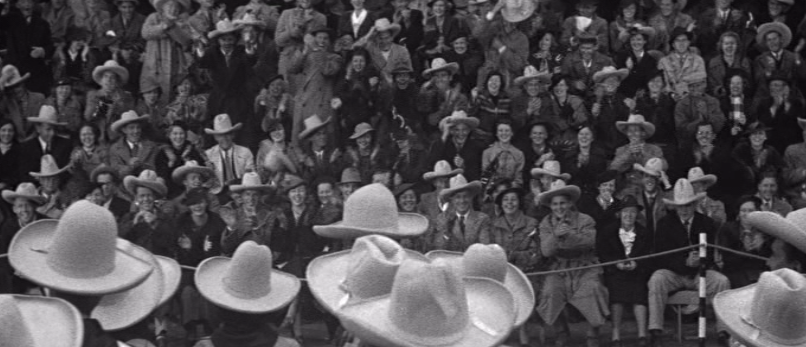
And then there's the main reason to see the film: the awesome sequence in which Myra takes a stud's anal virginity. Here, at long last, Welch's dominatrix acting style finds its ultimate expression of howling vengeance. Wearing, finally, a stars and stripes bikini and (unseen) strap-on. We may not agree with her method, but you have to admire her brazen insanity. Before she invades Rusty's virgin shore, she tells him "your manhood's already been taken by Clark Gable and Errol Flynn; I'm merely supplying the finishing touches." Those lines are intercut with footage of a bucking bronco ("who's never been rode before" a cowboy actor warns) desperately trying to escape his stall, and Clark Gable leering down from a poster, as if god approving of the whole she/bang.
If nothing else, this scene can provide Hollywood devotees with whole new ways of reading their favorite MGM stars' enigmatic grins.


But the picture's meta-Eisensteinian old star leering doesn't end there, Welch's orgasm is crosscut with (I wrote them all down): a stock footage damn breaking; Jayne Mansfield; 30s dancers waving umbrellas and jump ropes in the studio rain; Welch on a flower swing ala Marlene as a girl in SCARLET EMPRESS; a roller coaster; a mushroom cloud; rich 30s socialites laughing from their swanky balcony; Laurel and Hardy covering their eyes; a ballet dancer in a split bowing forward; Welch riding a broom and wearing a witchy hat; tinted silent footage from MACISTE IN HELL (the same footage used in Dwayne Esper's MANIAC (1931), Spencer Williams Jr.'s BLOOD OF JESUS (1941) and my own 2007 film that climaxes with a Kali-esque goddess anally assaulting a helpless hetero-bro --QUEEN OF DICKS). Throughout, Welch whoops it up with great abandon. The only other actor to match her for America-encapsulated yee-hawing is Slim Pickens ridin' the H-bomb in STRANGELOVE.
A fella really could have a good weekend in Vegas will all this stuff.
The cumulative effect (even if the Shirley Temple milking the cow footage was excised on her request. though we do see her sloppily eating creme puffs which is--in some ways--even worse), is a rupturing of the historical fabric of film history -- like this strap-on represents the the return of everything 40s Hollywood repressed and coded into abstraction. All the repressed queer energy, fermenting in its lavender manhole covered sub-basement fermentation well, finally blowing like a gusher right up through the cracks in the Hollywood Walkway, soiling every set of shoes in sight.



It's a great moment but its not long after that we're burdened with sulky Rex Reed again and his eyeliner-ed Richard Benjamin mystique, sneering his way nostrilly through party scenes where actors barely notice him, either because he doesn't really exist (not sure if Sarne knows either), or because he's so busy masking his self-consciousness with an air of haughty disdain that he plum forgets to notice anything around him, including that he's making people very uncomfortable. You know, that guy who spends the evening looking at your bookshelf and not talking and you're not sure why you don't like him but you wish he would leave?

And it gets worse! Once Myra has Farrah on the third base line, Farrah cops out of the lesbian tryst: "Oh, if only you were a man!" So Myra decides to switch back to Myron. Turns out it was all a dream. Aww. He's still a man after all--Farrah Fawcett is just his nurse, and Raquel is on the cover of some gossip magazine and did he have a car accident like in the book or is he just recovering from a vasectomy? Urgh! FUCK YOU SARNE, YOU COP-OUT BASTARD.
I'm sure our flaky, second-guessing director Sarne would say he meant this cop-out as a challenge to preconceived notions of sexual hierarchy, i.e. that masturbation fantasy is somehow just as relevant as actual fornication within the fantasy of a film. In the book, apparently, Myra's sex change is never completed and after she gets in a car accident, she winds up in the hospital, and that may have been the original reason for ending the film there, but any hep person knows that when you try to make it real you have to show some balls and stick to your gun. Last minute all a dream cop-outs are a DRAG!
There were times in MYRA where the level of madness made it hum like electricity, like the best part of Russ Meyer's (similarly problematic) only with intellectual gender-bent discourse instead of robust cleavage.
Someday, maybe, we shall have both... and we will see lesbians that wind up neither shot (VAMPYRES, BEYOND THE VALLEY OF THE DOLLS, BLOOD-SPATTERED BRIDE, WATCHMEN), nor last-minute hetero-converted (KISSING JESSICA STEIN, SWITCH, this), but living happily ever after. These films will not come from the majors but from Roger Corman's New World Pictures. Let us rejoice... quietly... We don't want the squares coming over. Again.
Someday, maybe, we shall have both... and we will see lesbians that wind up neither shot (VAMPYRES, BEYOND THE VALLEY OF THE DOLLS, BLOOD-SPATTERED BRIDE, WATCHMEN), nor last-minute hetero-converted (KISSING JESSICA STEIN, SWITCH, this), but living happily ever after. These films will not come from the majors but from Roger Corman's New World Pictures. Let us rejoice... quietly... We don't want the squares coming over. Again.
 |
| To avoid the hetero cop-out end, stop watching when you see this image and imagine they live happy ever after, |


