
According to some wide mean streak in American pop criticism--stretching from bourgeois Academy voters all the way to the soured douchebags of the comments sections--gorgeous sexy young girl artists and performers are meant to be just about anything but genuinely subversive. Never challenging to the status quo in any other way but via shrill feminist harangues and union cards. They can be gazed on but not gaze back, not threaten our place of omnipotent safety in the theater/living room. Medusas in Reverse, we presume our right to gaze upon their loveliness (or lack of) at our Mulveyan leisure, judging them for their garb, hair, posture, youthfulness; but if they look at us the same way, it turns us instantly to stone. It's the revenge of Lacan's petit a, when one's persona-accruing object of desire turns suddenly and stares back, or even worse, sends us a come hither stare. Suddenly they're no longer achingly far away but too close for comfort. We run shrieking to the channel changer like a window shade, embarrassed and angry. Later when they've closed those eyes to sleep we creep up from the dark and scribble mean things on their door. We're so mature.
If you don't know what I mean, here's an example: you're a regular straight dude gazing at some beautiful woman across a crowded room or street, not even thinking consciously, just spreading some proprietary gaze around like a radar, as a man does, especially in our constant state of televisual hypnosis, where we're conditioned to treat all pretty girls as if they're onscreen and can't gape back. So there's this one girl you see across the street and she's way hot, so you're gazing a little more wistfully, as if she was your favorite new actress. Then suddenly she sees you. She stares back at once, unflinching, smiling enigmatically, and starts to cross the street towards you, slowly but not shyly.
Before you can stop yourself, you blush and turn away, start walking in the other direction, like you got caught at something. A second later you reconsider. You're not a shy poseur, you should turn and meet her and who knows? Is she waiting there for you to nut up or shut up, gaze-wise?
Of course not. She's already gone. It's too late. She's talking to someone else, or was actually walking towards someone behind you. You realize her proprietary gaze is way more advanced than yours. For you she was pretty, for her, you were fresh meat. She knew she'd cow you, knew you were all gaze and no follow-through. Now though, you hate her. She popped your balloon with a pin eyelash.

Welcome to the New Depression. For the American critic, who is too high up the bourgeois ladder to look down without getting vertigo, this is where it ends. That hate constitutes sufficient ground for the poison pen to write and having writ, move on, and often that means on down to their parents' basement, as they been fired, their editors have had their budget slashed and can hire prettier younger critics at 1/4 their price... all these old dog critics can do is bark petulantly from the safety of their wordy leash columns. And their reviews get more and more blatantly misogynist the more and more power--imaginary or other--they're forced to secede to women 1/2 their age eager to work twice as hard for 1/4 the money. Most obvious of all though is something I see in academia all the time, a complete blindness to their own faults and foibles. Having years of clout, all access laminates, and Fed-Exed daily screeners have left them spoiled and egotistical, and if someone comes along and points out their writing betrays an insecure misogynist virgin at its core, they wig out like it's not just they have been insulted, but--as JJ Huensecker would say--all 20 million of their readers. And if the someone pointing it out is a hot bitch 1/3 their age who writes twice as well for 1/10 the price and just got the exact same all-access laminate and put on all the same PR screener mailing lists, they lash out blindly and viciously. In the words of some pompous silver-bearded bourgeois behind me at Magno Screening Room circa 2003, "how dare that little blonde bimbo call me a misogynist?!"
Isn't this the reason so many women don't gaze back? The average male gaze becomes like a prison searchlight, or a buzzing hornet. The woman mustn't seem like it bothers her, that she even notices, lest that average male gaze turn hateful, fearful, threatened. This gives her power in its way, as she becomes more and more like an onscreen heroine, a babe on a jpeg, an abstract locus of petit a Lacanian desire. But it's got to be withering on the nerves, like not flinching while one hornet after another buzzes around your ears and eyes for minute after minute, year after year.
 |
| Kristen Stewart, looking |
On the screen this translates more or less automatically, which is why for example I hate to see an actress I admire date an actor I don't (in a movie). George Brent or Fred MacMurray, for example, have faces my fists clench up instinctually to punch. I want my girl to date someone played by Cary Grant or William Powell, someone with class and wit. They can return that gaze without blushing and looking away, and I can watch them as their unborn child might from some Enter the Void perspective, their godlike figures looming on the screen. It's this position most film critics refuse to acknowledge, as it's way more prenatal than their billing/cooing staring judgment. It's the Studlarian masochistic viewer rather than the Mulveyan sadistic. This position posits that viewers we inhabit a perspective beyond age and gender, beyond control, tied to the winds like a roller-coaster like a newborn. We are subject only to the presence/absence of the goddess, our gigantic mom idol, Nicole Kidman beaming overhead like a rectangular religious vision over the 'Exit' sign when you see Birth alone in the dark of the Orpheum.
First we need to erase from our brains certain rom-coms that try undo von Sternberg's masochistic gaze, that try to flatter the shot guy complex neediness of certain little pisher comics desperate to seem desirable to hot blonde shiksas.
 |
| Rot in Hell, "Harry"! |
THE DEFAMATION OF THE PLATONIC PAIR BOND:
WHEN HARRY MET SALLY (1991)
In American rom-coms of today, love scenes are generally written and acted by people drawing on a collective cinematic memory that doesn't reach father back than 1991's When Harry met Sally, which smugly taught that men and women can't be best friends without eventually hooking up, that even if you're smaller than she is with a voice like a tin piano, you can pull some late inning guilt trip to get her into bed, craftily knock her up, and then live happily ever after, elf princess hand-in-hand with craven Gollum.
Sally's arrival into the mainstream lexicon ("I'll have what she's having") stunted the sexual development of American romantic comedy, trapped it in a nose-wrinkling cutesy fake orgasm tourist mentality ever since. There's only a handful of romantic comedies made in Hollywood in the last 20 years that get the complexity of French love stories by say Rohmer or even Clint Eastwood's early films like Breezy. And none have been able to really show falling in love happening right there onscreen; as Yogi Berra might say, they can't slow down fast enough. Maybe that's because the PC corrective shoes on our 70s swinger feet have left us hobbled so that we can't even retreat. There's no Mae West to lead us out from under the unending parade of televisual hot mess permafrost. Amy Schumer came close in Trainwreck but then copped out by learning cheerleader dances and curbing her drinking. Only recently, with women-penned young adult novels like Twilight and Hunger Games, are we presented with female protagonists too strong and complex for insecure male screenwriters and directors to sabotage, and actresses too young and strong to be yet cowed by that old devil searchlight male gaze. They got gazes all their own, these dames, and god forbid they cast their beams back into the camera, the whole audience freezes up like a corrupted share drive.
Not since the days of Mary Pickford and Lillian Gish have women characters been so true to novels and plays, i.e. genuinely complex--even to the point of feigning weakness-- rather than our current movie idea of strong, where no heroine is allowed to go farther than her own surface and becoming empowered means a gun and a new hat, rather than ripping a hole in the glass ceiling and smoking the sky like crack. These Reverse Medusas don't get the same kind of open praise as the 'little sisters" (Jennifer Lawrence), or old school Hollywood knock outs (Scarlett Johansson)-- the ones who fit inside established persona categories, who talk the walk and wow the interviewers and generally play the game, the kind your parents want you to marry when you bring them home over Christmas (as opposed to locking up the liquor cabinet and shooting you baleful looks). I love both those actresses, I love most all actresses in fact. But I have a soft spot for the apple cart kickover artists, the hot mess crazy wreckers.
But to swap the genders, in which category do you think Brando or James Dean would have fallen in the early 50s? Certainly they would scare the shit out of your parents' parents, simultaneously generous and miserly, girly and manly, fey and churlish, mercurial, dangerous, alive, smelling terrible. These bad girls and reckless boys were all over the 70s, and the drive-in, but where are they now? We need them! Go to bed already "mom" and let the bad kids come over. And if some shit gets broken, stolen, or bloodied, so what? Crazy is so close to genius you have to just trust all the smashing is going somewhere relevant, even if it never does. Otherwise, we'll never make a movie any better than Forrest Gump.

THE REDEMPTION OF THE PLATONIC PAIR BOND: MY BEST FRIEND'S WEDDING (1997):
You can still find mainstream badass women characters that average critics love but don't recognize for their genius, any more than they do Kristen Stewart (until she was lionized by the French this year). Julia Roberts is brilliant in My Best Friend's Wedding but those who revere her tend not to be film theorists, maybe for no other reason than they haven't seen it due to the title and dippy ad campaign/poster. If not for Robin Wood's high praise in Sexual Politics in Narrative Cinema I wouldn't have seen it either. From afar it looks like a typical rom-com except for one thing: Julia's two best friends are men, one an aesthete gay editor (Rupert Everett) miles away from the 'gay best friend' cliches, and the other a blank slate sports writer (Dilbert McDevitt) who has a sexual past with Julia which was transcended by friendship, which is in the context of the film, proved more important.
The moral of the film, that Wood picked up on is essay and I'm running with here, is that having a platonic love affair/best friend of the opposite gender one never hooks up with (either anymore or ever to begin with) is not only possible it's better than actual carnal love, at least for a certain kind of person, i.e. a true writer in the sense that sex and procreation are never as important to a writer as writing, or shouldn't be. Writers only engage in sex long enough to write about it later. In The Leopard, Burt Lancaster says "marriage is six months of fire and forty years of ashes," but the platonic soulmate best friendships are more like forty years of smoldering coal, continually giving enough heat to warm the entire room and allow for freer movement, but with a sweater on instead of naked on a bearskin rug, with roaring fire sweating followed by post-orgasmic freezing.
DAMAGE
And so today, a new age is born, where women cut through the male gaze barbed wire and emerge bloody and triumphant. We have subversive outside-the-box genius women on screen and airwave who are unafraid to tap into their own personal hells, their bi-polar melancholia, drug addiction, abusive past, as colors for their performer paintbox. And above all they unveil the willingness to sit there, in make-up, furs and write large upon our screens such reverse Medusa gazing as Hollywood not seen since the era of screwball comedy. They are like a relatively young version of Gloria Swanson, continually shedding her Norma Desmond reptilian scaly hide on a monthly basis, rather than letting it accrue, get flaky and become the ascendent ego.
It's terrifying for a man to realize just how much damage his gaze inflicts; he doesn't even think he has a gaze at all until some girl gazes back and he feels so suddenly caught and threatened. For startled bourgeois critics, self-assured return gaze brazenness better have a British or French accent attached, or she better be over 40 and playing a villain. If she's one of ours, a young American, then she's just being uppity, trying to glorify those haughty hussy habits which mothers would willingly ween from the line. If these dangerous women try to find the poetry that is there in the abyss of the mirror, they become a threat.
The Europeans aren't as threatened, which is why their women are allowed to be so much more vibrant, intellectual and confident. They know that just because it's destructive and pointless doesn't mean it's not brave, beautiful and poetic. Sixty years ago the whole continent was smashed to shit, but look where they are now compared to us! Shit doesn't matter. Only occasionally are there critics in the American press and mommy blogs who can locate and analyze the dark chthonic core of feminine power and celebrate its destructive Kali currents rather than moping like some Fordian Irish scrubwoman.
You know you are, you Kali flame dancin' foxy fur-wearin' bitchez!

That's okay, that's her trip. Who am I to judge her on what she says or does (Dan Hill, bro), now. But she used to be a bona fide badass, as you can see if you scroll up her red carpet moments at the 1999 Oscar ceremony where she showed the kind of black widow resonance a genuinely dangerous actress could radiate, especially since her date was her equally sexy/creepy brother (above left).
Because such crazy sexy cool as hers in that picture is usually only celebrated in men (Jack Nicholson, De Niro, Day Lewis), the only way American actresses can show their fiery goddess of chthonic psychosexual power and still catch an Oscar is if said fire is contextualized and confined to the psych ward, or meets death at the end. Angelina Jolie could win an Oscar because her Lisa in Girl wound up even crazier and less likely to be released than when we first meet her. The bourgeois were 'safe' in applauding her, loving the caged lion but ready to run like hell if it ever got loose.

French publications like Cahiers du Cinema, meanwhile, once our tastemakers, pointing out what amongst our perceived B-movie dross was gold and in the process helping us re-examine all B-films in a new light, are becoming more bourgeois, busy praising small third world proletariat struggle documentaries rather than Ants in your Plants of 2009. And so our White Elephants stampede towards Oscar gold, renting space on the dwindling art house screens for a week to be eligible, pushing the real art, the dangerous art, off in just the same way their editorial champions were pushed off their mastheads. Only a few Europeans like Von Trier, Assayas, Refn, and Noe seem to be still trying to unearth the weird undiscovered worms beneath unturned rocks of the Now, but they get very hung up on sex and violence, both to please executive producers and to get shocked write-ups. If the critics feel something, these auteurs reason, even if it's just shock and disturbed trauma, at least they felt.
Meanwhile, in America, we just don't get deluges of German Expressionists fleeing the Fatherland to Hollywood any more, bringing women like Marlene Dietrich and Garbo to school us in the return gaze, the sick pleasure in seeing a beautiful self-possessed women seen both herself seeing you and you seeing what she sees, and feeling the sting of rejection when she turns to look at someone else (hopefully not goddamned George Brent).
As Mick La Salle points out in his book Dangerous Women, there was nothing sexual in the love of a 1920s moviegoing male for Garbo. They'd go to the theater every night, eyes looking up to the big screen, with a love that encompassed and then transcended even the giant mommy aspect (her silver screen projected face as large as mom's was when he was a suckling child); the 'Garbo widow' effect tapped into primordial matriarchal pagan harvest goddess worship, and outwards into a kind trans-behavioral oceanic state of aesthetic arrest.
But today Laura Mulvey's theory of the sadistic gaze is treated more or less as factual gospel in academia, and so pre-empts and denies that relationship can exist. Though Mulvey is on record saying the meant her theory more as a conversation starter rather than the first and last word, mainstream theory has irrevocably begun using it as a new dogma. And now even the Femme Fatale is criticized as a male design, and the result has been a generation of crypto-feminists trying to slap the imagined masculine gaze from out of their eyes and face like a crazy person batting at invisible mosquitos.

LANA DEL REY: 60s AMERICA'S SWEETEST SUICIDE NOTE
Lana Del Rey's made a string of great sad sexy videos that seemed to prove the ghosts of early 60s Los Angeles suicides are the only thing of substance left in America, and even then only because their last few memories were shot on Super 8 and 16mm home movie stock. But the negative feedback her schtick received, even from third wave feminist pundits, back in the early days, was quite alarming. It wasn't exactly new (she would fit right in any David Lynch or Don Draper nightmare) but she tapped a nerve. She was gorgeous yet strange, with those lips that hovered between seeming real and seeming augmented; a dazzling body and great cascading beehive-ready hair and a never say no policy to drugs, alcohol and bad boys that sent our American Puritan minds racing. She was just doing whatever drugs the bad boys have, getting into cars with strangers, and engaging in all sorts of twisted scenes with hot black guys and middle-aged bikers, much to our masochistic Von Sternbergian fury. The privileged PC Communist infiltrator liberal arts faculty-brainwashed feminists found themselves angry over the most mundane inconsistencies in her origin story. She used to be named Lizzy Grant and have curly hair and sing bubblegum pop or something, like she was the only singer who ever changed names or personas.
Meanwhile, the Jungian mythos and psychomythological natural law-abiding Paglia feminists like myself were genuinely enthralled by Lana del Rey/Lizzy Grant's ability to zero in on and then embody the dark dream anima of the American culture dreamscape consciousness, as if she was a succubus from space who'd lived many lives and been soaking up America's broadcast radio, TV and dream transmissions as she flew closer and closer to our dreaming third eye, ready to meet that return gaze and Medusa us at a moment's notice should our sympathy but waver a nanosecond.
In short, if the naysayers had gone in for Jung or even modernism then they'd know their their indignant anger was the correct aesthetic response, the same one response solicited by the girl who stares back and causes us to blush instinctively, look away, and feel like a loser. The anger over the sting of shame is the correct aesthetic response; it's the not realizing this--not realizing masochism is the purist cinematic experience--that's the problem. It takes self-awareness to be able to detach from one's shame long enough to appreciate its all-encompassing beauty, rather than just presuming you're right to hit back if you feel hit, regardless of you actually were. Those Del Rey videos sting our pride like a slap in the face. We can storm off and volley off some outraged tweets or use the pain, the humiliation, as a kind of reset button. We can savor it the way we savor dream cinema, the type where not possessing or controlling the seen stimuli that so affects our emotions is a liberation through enslavement.

ROSE McGOWAN'S COUNTER-TERRORISM AESTHETIC: RM486
Trained as we Americans are by today's multiplex cinema to slough off actresses and characters into various boxes (sullen daughter, misguided vixen, All-American heimliches dumbmadchen, materialistic villain, traumatized victim / avenging angel, etc.) we feel bewildered when a woman, especially a young pretty woman kicks them over, not after a third act sulking montage but within the same bedroom conversation, navigating a push-me-pull you Sun Tzu-Rommel strategy. We're Americans, we're not comfortable with ambiguity and fluid personae in attractive young women. It makes us nervous. Would we want to sleep with them or not? It's a simple question! Yes or no? Our fantasy is being punctured by her bi-polar ambiguity.
Let's say you're an average SWM in the 90s but haven't had any luck with the ladies for almost a year. Then, you see "her," everyone in your posse thinks she's gorgeous, and you are the one who brings her home to your bachelor pad. You sit her down on the bed, and go to make some drinks in the kitchen, high on yourself, already mentally slapping five with your clique the next day at brunch. Then... as you mix the drinks and she unfurls, she remembers she has to quick call her friends so they don't worry where she is. Her mom cuts in on another line and she spends an hour shouting in Russian. After ten minutes, you go in the other room and watch TV; you come back when she hangs up but within minutes she's already asleep, totally passed out. You're a gentleman so that's that; you tuck her in under the covers and lock up your valuables, go in the other room and watch The Lost Weekend as the sun comes up. Then you crawl into bed, on top of the covers, and a few hours later you half-asleep mumble a good-bye as she slips out the door.
Man, if your buddies could see you now.
But if you're bitter the next afternoon; if you feel you were owed some sex or something--to justify those high-fives-- that's on you, bud. Sorry your fantasy, or rather "the" fantasy--the one conjured and subliminally promised by Esquire, NBC, and cinema--didn't pan out just exactly as you fantasized, that you'll have nothing to boast of. But! If you can sublimate that frustration and shame into your art, then it's just a question of masochistic tolerance, and love of women moves into the abstract. That's when you can appreciate her ferocity and honesty rather than what your boys expect you to "get out" of her, what "base" you crossed.
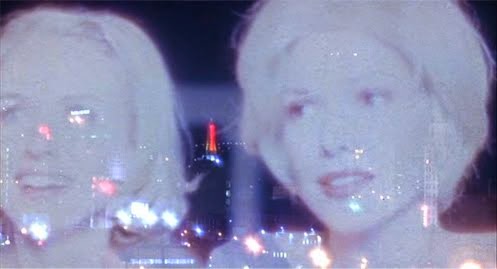
But even we Von Sternberg masochists, we debauched libertines who worship the Medusa, feel slightly like we let Rose McGowan down when we see her looking like a gray alien or Argento Opera-lashed post-pagan in her badass music video, RM486. Bald, chalk-white, whispering Roy Batty's Blade Runner monologue like her full WB Network-encoded matrix is being spat out in digital ticker tape, she's a new model, a Nexus 9, fluid and beyond duality, the gender strait-jacket in chewed-up tatters at her feet. She's let the full brunt of our collective gaze rain on her, raze her, and let the old self dissolve like William Shatner's tears... in The Devil's Rain.
To paraphrase Lori Williams in Faster Pussycat Kill Kill, whatever she's training for, she's ready.
There was only one imdb user comment (last I checked) on her video's page, from a German guy named Thomas who notes:
"I must say I quite like her as an actress, saw all her 'Charmed'" episodes, but it's tough for me to appreciate these 4 minutes, maybe because I find her very attractive and in here, she goes for the exact opposite."
 I don't mean any disrespect to Thomas--he at least is self-aware enough to imply he's biased because he find finds her attractive. But Thomas, that's it in a nutshell! Being 'tough to appreciate' is the goal of all modern art. Rose and her video artist director Jonas Åkerlund have taken your attraction to beauty and used it to fuck with you.
When a hot woman transforms herself not into an approximation of a Maxim airbrush but into a kind of abject Molloch style alien--as RM does here--she's reacting to the beauty and youth industrial complex that's kept her and her sisters in anxiety and paranoia to the point they torture their face with collagen and Botox late into the night until they emerge at dawn like Universal pre-code Jack Pierce abominations, teeth scarred from eating disorders, faces frozen fast in a hideous duck-like grimace; they go from aging beauty to avian gorgon in a single long and tortured night. RM's given you the real Self beneath the illusion and if an hour phone call in shouted Russian wasn't your expectation when taking the hot girl home, relish that feeling of alienation and confusion, because so few men even get to that level--it's like secret initiatory hazing, the first step to liberation from desire. It's the true "modern" aesthetic response, as important as the initial riots over Picasso's debut of Les Demoiselles d'Avignon. (upper left)
Maybe there's something deeper than narcissism and fear at work behind RM's overpainting, self-sabotage, reverse beautification, a kind of counterespionage CIA mind trick, throwing a Perseus mirror shield visor over your face, to reflect Medusa's Vogue-Revlon gaze, to freeze it with horror, paranoia, creeping dread as it beholds its own hideous reflection. Rose McGowan's lashing out against the Hollywood beauty grist mill is heroic, as the Brits would say: it's absolutely bonkers! As daft and admirable and crazy as they come: half Frances Farmer punching out cops, half Saint Francis marching the dye-stained child laborers out of his parent's textile mill into the blazing sunlight.
 |
| Sleeping with the enemy of my enemy on his enemy's command = a cinematic love story for the ages |
HITCHCOCK'S LADY SPIES
I used to think that the casting of so many attractive young girls in high ranking CIA spots in movies like Zero Dark Thirty and TV shows like Homeland and Alias was just licentious license, but if you see an actual CIA documentary, like the one on HBO, recently you realize it's the truth: pretty young women are all over the upper ranks of the CIA. They are brilliant and brave and better at connecting the dots of seemingly unrelated events and movements into a serpentine whole than men. Beauty and charisma are keys to success in any field that relies on winning people's loyalty, turning their allegiances around using nothing more than a warm smile and maybe waterboarding. Acting and spying are really more or less the same, drawing on the same skills. Beauty is as valuable to a spy as a photographic memory or crack shot marksmanship. Only an American would think that using beauty to excel in your job is somehow 'cheating.'
Hitchcock's movies point even darker: spies are not only actresses but whores, stealing uranium secrets instead of 'earning' cash, forced to sleep with the bad guy by the good guy for the country she loves (there's no concrete difference between a CIA handler and a pimp), doing what needs be done to get evidence, cash, the part, or the script. Even if it means losing the respect of Cary Grant, the show must go on. If she pretends she's in love with someone long enough that even she starts to believe it, well, isn't that the same as falling in love for real? It's the kind of thing that can drive a girl mad even while earning her Globes, Oscars, and jury prizes. Glittery ephemeral dreams leave just a blue key and an empty box where once was a Betty and Diana. Slimy spiders scatter through the bulletin board web, pinning every nude scene movie still helplessly out of context, then hating you for your image's power over them. You've become not just a spy, not just an actress, not just a whore, but a target, a bullseye at the center of the board, the spider that all strands lead to, your every trapped panicked thrashing movement part of the inexorable slow sexual strand red carpet roll up between fear, desire, and procreation. It's this exact madness censorship tries to stem, in vain.
When it gets out of hand, it's time to tell mother.
 |
| Notorious |
And then to choke them aye... that is art, and the core of honey trap assassination.
 |
| Hail Stewart! |
A César for Kristen...
In European cinema, the performance of dangerous womanhood within feminist parameters is more alive and less bourgeois, less dour and militant. You can still smoke and dance in the cafe (I think?) prostitution is far less stigmatized (still?), and May-December romances accepted without Puritanical staring (for now). Women are assertive without being bitchy (and are still hot). Just compare the self-possession of Isabelle Huppert vs. say, Susan Sarandon, or Isabelle Adjani vs. Geena Davis as they look and act today. And this is not to say Davis and Sarandon are not great actresses, just that what they were fighting for as American women in Thelma and Louise is a birthright to Europeans. Luckily, bourgeois America's Puritanical sexism is eclipsed only by its trust in intellectual Europe's opinion. What fearless actress titans from the US need in order to not be maligned domestically is Europe's sanctification. Now that Kristen Stewart won a Cesar for Clouds of Sils Maria she can begin to earn the awed respect me and a scattered few always felt she was due. Maybe we missed something, reason our own critics. So they go back with less provincial-reactionary hostile unconsciously misogynist glasses over the Stewart oeuvre and decide yes, we did believe in her all along.
Another fact about Europe is sex itself, in which standards are far more relaxed. People want to have sex, they do. They don't wait for a Mr. or Mrs. Right they feel they're owed by years of televisual, cinematic, and magazine promises. But there's more to the cultural difference between USA and Europe than just that, for in losing the unrealistic ideals so critical to American conspicuous consumption, the Europeans become less hypnotized, less locked in a state of Lacanian 'pressure to enjoy,' a pressure which all but squelches actual enjoyment in the cradle. There's not a lot of TV commercials in Europe (relative to here, I mean), and what there are are generally more clever, existential and risque, less shrill and incessant. As a result, maybe, European women aren't as broken down by the staggering sexism that comes from the constant consumerist barrage. I'm sure there are pockets of unconscious consumerism in the East, especially, where it carries anti-authoritarian currency, but socialist education and freedom from the hobbling albatross of an anti-intellectual 'moral majority' voting bloc have helped the West stay progressive. Partying with them when they come to visit us in NYC provides a huge relief from the stultifying cluelessness with which Americans party every day. Finally we can talk about Freud and Jung instead of just pretending to already know them and be 'over' them in favor of banal cognitive behavioralism (as seen in Von Trier's Antichrist).
 |
| If she was a guy, she'd be dubbed the new De Niro |
If great acting isn't met halfway it can look like bad acting, just like avant garde music and random ambient noise are indistinguishable, and so great artists must march off to places where they 'get' greatness and can better be contextualized by critics as 'other.' Hendrix was dismissed in the US until he found acclaim in London; crazy-haired Nicholas Ray was just some idiosyncratic journeyman until Godard declared he 'was' cinema, forcing American critics (terrified of being left behind on a trend) to re-evaluate soul-withering explorations of human darkness like In a Lonely Place and Bigger than Life. In other words we respect Europe's opinion so much we're willing to go back and re-evaluate the work of American artists we previously marginalized. Oh now we get it. Now we get Kristen Stewart.
The French critics have mapped out a route through our cinema's past like a museum guide trying to unravel the opaque and meaningless tangle of a Pollack to an incredulous Indiana tourist. The last voice we had in the States with the clout and guts to champion the underdog, Pauline Kael, is gone. Without her, would we even have noticed Bonnie and Clyde or Taxi Driver? Maybe not. She would have loved Kristen Stewart and would have explained and contextualized her work to the point we'd be valuing her here well before that Cesar.
Kael is dead though, and it behooves our new Bonnies and Bickels to go once again back to Europe to seek the recognition they warrant. In the US, alas, if you put a relatively hot young broad in a debate with a stodgy, sexist older man like Norman Mailer (as in Town Bloody Hall), and the broad is more than holding her own, calling him out on his bullshit, she's a dour buzzkill and he's a hero to the lumpen proletariat. In Europe the mixture of different languages keeps everyone guessing and leads to a kind of of eternal now unbound by the past or religious dogma, a now that floats constantly on the cutting edge of thinking and social connection, because language can't grow stale when no one understands each other.
In the States we expect the Ruby Tuesdays in White Plains to be the same as the one in Toledo rather than a unique snowflake. Appearances are measured up to, fit into, the excess cut away. So if we can't rely on the basic maxim that someone in a suit and tie, white, straight and over 60, is more intelligent and worldly than a cute under-30 blonde in a tight sweater, then we can rely on nothing, and are too terrified to pay attention. Our fingers tighten on our pitchforks and torches instinctively. Europeans would just be amused and intrigued--after all, to the young women in Paris white male writers over 60 are sex objects--but Americans froth at the mouth when their obtuse book-by-cover dictums are challenged by cool-headed pretty blonde undergrads. And it doesn't even matter who's right or wrong in a debate, it's that the prettier they are, the more hostile the (middle-aged bachelor) professor gets. He has tenure! Why is he shouting!? It's because she's too pretty, and young and would never in a million years go out with him and anyway, it's frowned upon by the academic senate... at least now, at least here, but if this was Paris '68, oooh chippie, thinks the prof.
And there she is, expecting an A without even so much as sleeping with him once; her intellect an affront to his sense of entitlement, a sense that our outdated counter-productive practice of tenure encourages. And then who has to deal with her? Me, as she comes to my office to complain about him.
I explain to these understandably aggrieved girls that higher learning doesn't always accompany or even encourage self-knowledge. The development of one's own unconscious madness, the source of all genius, is criminally neglected in academia. Higher learning often serves only to convince the teacher that his dull sanity trumps chaotic madness, and why? Because that glint can't be taught and therefore can't be measured so must in academia be devalued. All we need from the higher ed wizard to be a real museum-ready artist is a grant, an endowment, a write-up in Artforum. If we're not going for the grants and endowments then we're either mere 'entertainers' or outsiders; either we get a three picture deal or a prescription to Lithium, either way, the madness that creates genius stops through lack of oxygen. The diploma is awarded... the ship sinks... the guns go silent.
 COURTNEY LOVE, AMERICAN SMOKER
And either way all the reckless energy the hussy young girl genius pours into her career is suddenly sidestepped when she has a kid. That's the moment when I get mad and the drink-counting mothers relax. When a great insane hot mess skirting the lip of brilliance thinks she can put that all on hold to become a mom, eat healthy and quit her vices, and then come back and be the same badass, I know that, like Uncle Paulie when Henry starts peddling the garbage, I have to turn my back on them. They're acting selfish, denying their madness a voice, giving all their love to a newborn instead of me, her public. If, like Courtney Love, she can somehow stay rowdy, raise the child punk rock style, but without that Ann Dvorak in Three on a Match-type negligence, that's a frickin' rarity.
Hats off to Courtney Love, still rockin' and still terrifying the academy and still, as of this post, sober.
She may not still be the siren voice unconscious of L.A. but I listen to Celebrity Skin and remember the last time I was there, whipping too fast around curves up in the hills, wind pulling my hair like a crazy hottie sitting behind me in the car, trying to either strangle me or give me a massage as I cringed in the shotgun seat, the crazy gorgeous blonde driver--who I flew in to visit over spring break--didn't get off her cell phone once during the week I was there, even after the car almost flipped over zipping around those dangerous hills; and "Boys on the Radio" roared to life in the speakers right in the moment we almost "crashed and burned". Love's rock oomph carved a space for a soul inside L.A's bottomless surface, celebrating these same curves and the countless honored drunks and druggies they'd taken, honored the scuzzy bottom feeders photographing the wreckage that is Hollywood's rapture with self-immolation (we wouldn't see a better incarnation until Cronenberg's Maps to the Stars.)
Mark my words, one day, once she's safely dead, Love's letters and notebooks will be researched and archived ad nausea. Dabbing their pens in the theoretical equivalent of Dillinger's blood, the academia will hug themselves with the richness of her life's work, digging numerological cryptograms from her teenage speedfreak Boggle word lists, gin rummy scores, Paglian chthonic feminist poetry.
But only when she's dead and therefore immortalized (and unable to bite them) will they dare appreciate the thing that so scared them when it came roaring up on them alive at a party. "You're brave with a fish as long as it's a dead fish" the cook says in Night of the Iguana.
But Love's not dead, yet. She'll piss on your luggage and hide the distributor cap and help the sky begin to blanche while you're still struggling for a hip disaffected response to her first question. She's the female Keith Richards, a survivor because she can play guitar and loves rock over drugs, music over sex, and even death, but what's the difference? She's Orpheus descending into the reptilian tunnels beneath downtown LA, armed with a blazing guitar torch. She rides her amp's electric currents high above the glitter, an overdose-surviving valkyrie swooping down onto LA rooftops to collect the beautiful and dying boys about to jump and see if they can fly, for her Valhalla bloody chamber record collection. Let the haters hate, and they do all over the web; to earn such vitriol, from so many losers, she must be doing something right.
 |
| Asia Argento (Scarlet Diva) |
THE KEYHOLE MIRROR: ASIA ARGENTO
A very unique and raw analysis of what it means to be young, gifted and constantly mauled as an Italian film starlet while roaming through daytime press junkets and financing meetings, photo shoots and hotel room film pitches, and having it be no big deal to smoke while pregnant (and burn herself with the lit end on purpose), Aregento's SCARLET DIVA really unnerved some critics over here. If you read the average Amazon comment it's of the bent that 'Asia's like totally hot but I couldn't get turned on by it,' (i.e. that comment on McGowan's music video) like the film was mispromoted, its promos a tease promising softcore sex and delivering only self-mutilation and nervous K-hole breakdowns instead.

It's like dude that's the point!
That's the only way Europe can sneak art down middle America's throats, on the Trojan horse of sex. Art House cinema as we know it got big in the US in the late 1950s only by promising "European" and "Art" in the same sentence meant the kind of frank openness about sex and nudity our own puritanical censorship forbade. A single nude shot or dirty word could create lines around the block. But eventually they didn't need the promise of 'dirt' because the art had taken hold. Subtitles had a Pavlovian association with lack of censorship, which allowed for more imports, allowing art to take root. And with it, strong intelligent women. The amount of backbone in an actress like Kate Winslet, Helen Mirren or Keira Knightley in England, or Isabelle Huppert and Adjani, Beatrice Dalle, or Sophie Marceau in France, or Monica Vitti in Italy vs. that of, say, Sandra Bullock, Julianne Moore, Drew Barrymore, Cameron Diaz, Winona Ryder, even Jodie Foster here is as different as that between a tiger and a house cat. Both are still cool, sleek, stylish, but which could more believably devour you?
I've got theories: I recently saw a Hammer film DVD extra where an old writer or someone was remembering the way Britain and American censorship of the 50s-60s was vastly different - the Americans would demand cuts to the sex, but the violence was allowed; the British would allow the sex but demand cuts to the violence! This ties perfectly into my theory, as exposited in Acidemic #6, that sex is to the French what guns are to Americans, and vice versa. And there's that old Dietrich quote "In Europe, sex is a fact. In America, it is an obsession." And there's no doubt it's much easier to get a gun in this country than to hook up at a party. And vice versa.
My final theory on this has to do with World War Two: Being bombed nearly to death in the 40s made Europe permanently less enthralled with global destruction than we are here in the US, and their more liberal views on sex may well be a result of that too; the result ensures that premarital sex plays quite a larger and more healthily complex sophisticated yet accessible and straightforward part there, and in its way, so does prostitution, which seems more than a few degrees less tawdry in, say, Paris or Amsterdam, than here. We see these demoiselles crop up in French New Wave films, but less in a tawdry Taxi Driver manner (or Liam Neeson manner) and more in a just two casual 'people hooking up' sort of way. It's still no kind of a life for a lady, but for a lonely dude and a cash hungry Parisian of the same approximate age and class, what's the harm?
At least it's regulated to an extent and therefore less overrun by sleazy gangsters, presumably, and the pimps are French, little guys who just get funnier the harder they try to be menacing. Meow, n'cest pas?

Then again, that impression, like all my others, comes from films not France itself, which I have never visited. What do I know about actual reality? I never watch it. From what I have seen, it's a real mess.
And it's my fault, probably, for never looking.
And it's my fault, probably, for never looking.

Further Reading on: LANA DEL REY:
America of Ghosts: Why Lana Del Rey is the New Val Lewton
Kiss Me Del Rey
America of Ghosts: Why Lana Del Rey is the New Val Lewton
Kiss Me Del Rey

All the Usual Vices: THE RUNAWAYS
Choose Death: Revisiting Twilight's Junky Delerium
Bella's Big Bounce: TWILIGHT: BREAKING DAWN PART II
Metatextual Exorcist's Assistance: CLOUDS OF SILS MARIA, MAPS TO THE STARS

Choose Death: Revisiting Twilight's Junky Delerium
Bella's Big Bounce: TWILIGHT: BREAKING DAWN PART II
Metatextual Exorcist's Assistance: CLOUDS OF SILS MARIA, MAPS TO THE STARS
European Art House:
Enhancement of Anguish: Godard's VIVRE SA VIE (1963) on Blu-ray
le rayon bleu Deneuve REPULSION
GIRLS (1968)
Her Body, Her Ashtray: Asia Argento's SCARLET DIVA (Acidemic #1)
Erica Jonrosh's Spoils of the RED DESERT
Hey BETTY BLUE, Come Blow Your Mind (+ INSIDE, TROUBLE EVERY DAY)
 Relevant Cinemarchetypes:
The Human Sacrifice
NOTES:Enhancement of Anguish: Godard's VIVRE SA VIE (1963) on Blu-ray
le rayon bleu Deneuve REPULSION
GIRLS (1968)
Her Body, Her Ashtray: Asia Argento's SCARLET DIVA (Acidemic #1)
Erica Jonrosh's Spoils of the RED DESERT
Hey BETTY BLUE, Come Blow Your Mind (+ INSIDE, TROUBLE EVERY DAY)

The Human Sacrifice
1. Hey STELLA: Do you imagine they would dare show such a complicated monster as Stanley Kowalski in today's draconian PC environment? He'd either have to be an irredeemable brute whose every gesture is amped up with ominous music cues and lewd looks (so there's no possible way we can like him)--the particulars of the rape spread out in ugly rutting and sadistic sexual violence and intensity (instead of just showing a shattered mirror)--or they'd cut it out altogether, block it out of the screenplay, and just turn him into a passive whiner who cockblocks buddy Karl Malden. And now, going back and watching Dean's three film roles, it's hard to understand sometimes what the fuss was about. He seems to mince a lot in Rebel -- stopping the action cold so he can play with little toys or befriend Sal Mineo as if he's a timid marsupial at the zoo he's trying to feed a peanut by hand. He doesn't make a lot of sense - he mumbles - one minute he's cool and playing chicken, and winning, and smoking and putting dirt on his hands, the next he's trying to rat the whole gang out to cops even though even his parents don't want him to (they're not squealers --they're actually cooler than he is). "Just once I want to do something right!" he says. So he wants to drag everyone else down with him so he can be noble. In New Grenada we say something too: "a kid who squeals on another kid is a dead kid." Wanting to call in the cops is almost as bad as not making a more coherent effort to hook up with Carroll Baker in GIANT.