Showing posts with label Rose McGowan. Show all posts

Thursday, July 21, 2016

Angels of Death Summer Viewing List: The Badass Brunette Edition


It's summertime here in the East Coast and if you're a Nordic in genes and temperament it's not your favorite season--in fact it's loathsome: too muggy, humid, sweaty and everyone frolicking about without a care in the world, mocking you and your Swedish allergy medicine depression. That means lots of time staying home and watching old horror movies on TV, the AC blasting, for that special chill cool horror causes. And cool horror means cool women, and if you love dark long flowing hair then you want brunettes, ideally with guns and sharp swords, slightly biker-tough. Blondes are the cornerstone of horror, but your Nordic mom is blonde, and you can't abide seeing a girl who looks like your mom when she was 29 and you were three years old and constantly struggling to get her attention, which to your three year-old emotional state is more precious than gold. Right? And then she comes at you like a wurdalak to drink your blood. You kneel at the base of her bed screaming and crying in terror, and she finally wakes fully up and you realize she was just moaning from having to deal with your three-year old's nightmare nonsense. (True story!) Nothing in my life has measured up to the fear of that three year-old nightmare moment. All the rest of our lives, mom and I used to joke about it, that is... by day. My mom was a mix of Doris Day, Bibi Andersson and Janet Leigh, and they've effectively split up for different parts of my psychic projection -- Doris I have a kind of hatred for, that aspect of mother one must reject and avoid when hitting latent puberty; Anderson, the sensual anima with far-away eyes and Nordic beauty, whose attention I still crave and lack; and Leigh, the vulnerable deer-in-the-headlights, stirring the responsibility one feels when made 'the man of the house' before they actually become men.


Knowing this you can imagine that I was sooo looking forward to Swedish director Nicholas Windig Refn's NEON DEMON; but then I read April Wolfe's review in the Voice. I can't even seem to think about it now without starting to shake in rage, like I did hearing a professor had screen IRREVERSIBLE in class without even a warning. So rather than get livid (which would just raise my heat index, the opposite of why we're here) let's talk cool brunettes, the capable women who win my affection by not depending on it. I see them completely as other - more associated with my dark-haird father, surely, and like him, strong, affectionate and kind of a partying badass.

9.  Arly Jover, Natasha Gregson Wagner 
VAMPIRES: LOS MUERTOS 
Dir. Tommy Lee Wallace (2002)
**1/2
A sequel to Carpenter's James Woods-starred vamp hunting movie, it's directed by Carpenter wingman Tommy Lee Wallace and I actually like it better than the original, which seemed surprisingly misogynistic and mean-spirited for Carpenter, with little of his old Hawksian reverence for cool feminine energy. This almost makes up for it as that the main vampire villain, Una (Arly Jover) is unreservedly fierce, strong and super-sexy but in a sleek, lithe dancer way, not in a softcore bimbo objectified way as women were in the first film (except for poor Laura Palmer vampire, saddled with meta-murph Danny Baldwin, for a love interest). Lightning fast, super strong and mentally unstoppable, Una hopes a bizarre priest-crucifying ceremony will enable her to walk in daylight, but a priest has to do it willingly, so elaborate preparation (and a good hostage) is needed. Sheathed in a lovely grey lame wrap dress (high fashion meets the mummy), Jover doesn't get many lines, nor does she need them; too fast for the naked eye, we see her moving back and forth like a swaying cobra, turning herself on by tuning into the beating hearts of her impending victims, giving playful licks to the neck of lovely Natsha Gregson Wagner, seducing the claustrophobic black vampire slayer (Darius McCarey), scaring James Wood's replacement in the Vatican vamp slaying business, Jon Bon Jovi (he's great - who knew?), and his priest acolyte, she handily wins us to the dark side.


If Jover doesn't entirely make up for the direct-to-video budget, dig too the cute love story between shoot-first ask-questions-never Jovi and "I'm bit but got pills that stop me turning vamp"- HIV analogy-trundling naif Natasha Gregosn Wagner. And is that future Mexican film star Diego Luna (Et tu mama tambien) as the local kid who signs on for the kill with a (falsified?) note from his parents? It is, and even with his weird face and strange manner the kid has undeniable screen charisma; you don't know why but you can smell impending stardom all over him. Blood never lies. 

10. Natasha Gregson Wagner
MODERN VAMPIRES  (1998) 
Dir. Richard Elfman
***

From VAMPIRE'S KISS, THE ADDICTION and NADJA in the east, and NEAR DARK and VAMPIRES in the west, the 90s was a high time for hipster vampires and this little honey of a made-for-cable horror has a lot of that 'blood as an addiction/heroin/schizophrenia metaphor vibe' so essential to the zeitgeist, only with almost none of the tired morality. This one follows the love affair between roaming vampire Casper Van Dien (showing a real relish for this kind of morale-free bloodthirsty killer romantic role, rather than his usual dull square-jawed heroes) whose arrival back in LA garners the ire of local party legend Dracula, (seems Dien initiated Van Helsing into vamp killing by turning Van's sick son way back when and Drac never forgave him). Alas, this all also coincides with Van Helsing's visit, and a girl Dien vamped out years ago (Natasha Gregson Wagner) who's been running wild, feasting on the dumb johns, rubes, squares, suckers, and marks of Hollywood Boulevard, without a  thought to covering her tracks. Drac doesn't like that nonsense either. Uh oh. 


What's so great about this nutty film is that, thanks to a gleefully savage script by Matthew Bright, these vamps are portrayed as nice cool folks to party with on the one hand, but vicious sociopaths on the other. These creatures don't waste their time hunting deer for blood like the Twilight crowd --they go right for the jugulars of human beings, showing cheerful disregard for all the screaming and pleading. Seeing naked bound humans terrorized and bled at the local vamp club presented as mere background to the dialogue and typical club exposition is wondrously refreshing in that its amorality is so disturbing. That may sound callous of me, but after so many films where 'newborn' vamps hold onto their moral center by refusing to drink humans, preferring to get the blood secondhand from their girlfriend vamp's vein (ala Lost Boys or Near Dark - which somehow makes it okay) or stay "vegetarian" (drinking animal blood) in order to--let's face it--spare the audience the discomfort of sympathizing with killers. I mean I'm as sensitive or more so than the next guy, but that kind of honesty is such a relief after so much of the namby-pamby compromise that deadens vamp romances. It's a reminder of just how long it was from Clockwork Orange to 1994: the Year Tarantino and Fiorentino saved us from Vampire Morality

Friend of scriptwriter Bright, and director brother Richard (the three of them worked on The Forbidden Zone), Danny Elfman delivers one of his better scores of vocalizing and vamping (ala his work on Burton's Ed Wood and Mars Attacks) which fuses nicely with wild panther noises when newbie vamp Natasha Gregson Wagner--strutting and looking glamorous as all hell even in slutty short-shorts--strikes at her johns and bloodies their cars and nearby alleys. Smokin' hot but sufficiently ferocious not to seem chintzy about it, with her shock of (dyed - hence makes the list) blonde hair, and habit of cartwheeling drunk into trash piles, Wagner just might be the best 'hot mess' vamp of the 90s. Not only that, her love affair with CVD is genuinely touching. How rare is that?

And damn right you'll be IMDB-ing Bright after this if you don't already know the name, and once you do and realize he also wrote FREEWAY and DARK ANGEL: THE ASCENT, then suddenly you're hooked. Who is this guy and why isn't he revered to this day as the blood-slicked gully between the Hills Jack and Walter? Not sure. He fell off the map a little bit after this and devolved into downers like FREEWAY 2: CONFESSIONS OF A TRICK BABY and BUNDY, which is a drag. Oh well, no one is perfect forever, and as far as made-for-late-night-cable schlock goes, this film is a frickin quasi-gold nugget I'd never have known about it if not for Quiet Cool puttin' me wise. 

What I love about Bright, so apparent in this, DARK ANGEL and the first FREEWAY is that he has a yen for truly dangerous women--the type who don't need to be assaulted by men before they're allowed to kill them. I can sense Bright shares too my hatred of films where newbie vamps suffer tortures of thirst rather than bite some random pedestrian cuz it would be wrong or something. Dude we're adults, why not have him kill a bunch of people and then feel guilty about it later, like the rest of us probably would? That's just life... and death. We're all adults here! Or will be by the time we get to see this movie on Blu-ray! 

That's not to say it's a perfect film. I abhor the gangbang scene, and Rod Steiger makes an unbearably hammy Van Helsing (that accent is maybe the worst thing he ever did - but who's going to tell him? The guy's a fucking legend). But the rest of supporting cast is to willingly die for: Udo Kier. Craig Ferguson, Kim Cattrall, and Natalya Andreychenko, plus a hilarious trio of Crips whom Van Helsing hires to help him raid vampire nests. You may have to buy the Uranian DVD to see it, but you must, no matter how missable it may seem from the made-for-cable 90s flatness of the hair and clothes.

Joséphine de La Baume and Roxane Mesquida
KISS OF THE DAMNED
(2012) Dir. Xan Cassavettes
***
Bearded screenwriter Paolo's (Milo Ventimiglio) smoldering eyes meet those of the alluring but stand-offish Djuna (Joséphine de La Baume) at the local video store. They both love movies, what a connection! But they can only hook up if he chains her to her bed, as she finally tells him, because she grows fangs and glowing eyes when aroused. After an impressively short bout of initial disbelief, Paolo's just too turned-on to not unchain her and let the bites fall where they may. Hey, it's like when you're so in love you don't bother with a condom. This movie gets that. It's a level of romantic attraction that can no sooner stop for 'safety' than a tidal wave pause to spare a sandcastle. In this day and age the vampire heterosexual love thing may seem trite, but Paolo and Djuna are so good together, so model-perfect without being smug or arch about it, that it's hard not to swoon regardless of any initial impulse to hate him on principle. With its impeccable color schemes (all the better to perfectly bring out La Baume's gorgeous red hair and pale skin) the occasional bouts of vivid sex (not so much it ever gets tiresome or superfluous), and the vintage mellotron slink of Steven Hufsteter's score, this retro-lyrical vampire love story would be a hard thing to fuck up, and this impressive debut from the daughter of John Cassavetes is far from fucked-up. It almost doesn't even matter if it goes anywhere other than 'not very not far' because it goes there so very coolly. 

In that sense too I like it worlds better than the similarly stylized and better-reviewed Duke of Burgundy which is burdened by a fundamental bad casting decision (to use ordinary looking actresses in frumpy middle age or thereabouts rather than gorgeous clothes horses for the leads is an interesting idea but it doesn't work for the Eurosleaze genre - if you're going to do Petra von Kant or Warhol-style aging divas they at least need to be histrionic--as there's nothing else going on to hold our attention, especially in HD--we hunger for beauty). Here the delicately low-key romantic chemistry of La Baume and Ventimiglio intoxicates so much because they're both so beautiful on their own but have genuine 'cosmetic chemistry' that's both skin deep and regular deep. The result- together they transcend mere window dressing smolder. The result is sublime cinema crack cocaine for the eye, so when Djuna's wild child vamp sister Mimi (Roxane Mesquida) shows up, needing a place to crash after laying waste to the clubs of Amsterdam, we recoil in frustration like we're Gene Tierney cockblocked by apple-cheeked cherubs in Leave Her to Heaven in reverse... What kid of a famous filmmaker has ever made us feel that inclusive intoxication, aside from Sofia Coppola once? 


12. Alison Elliott as Nora, and the reincarnation spectra of Irish druid generations
THE ETERNAL 
(1998) Dir. Michael Almereyda
***1/2

If Eugene O'Neill adapted Bram Stoker's "Jewel of the Seven Stars" and set it in NYC 90s with the help of Hemingway and Lew Landers, I think we'd have the ETERNAL. I found this gem by being into Almereyda's black and white vampire hipster film NADJA and learning he made this afterwards, another hip salute to classic horror films utilizing contrasting film stocks and speeds to create weird ESP interconnectivity between past, present, human and witchy... Starting in NYC and ending up on a windswept Irish shore, it's about reincarnation and a mummified druid priestess found in the basement and woken up by Christopher Walken right as Nora returns home. Noting her body's been preserved by all the tannin in the peat, Walken's pretty enthralled by his discovery--an ancestor of his family... and therefore Alison's (Alison Eliot) who's been having migraine black-outs and drinking and goes to the homestead in Ireland almost as if called by some unseen force, her fun-loving drunk husband (Jared Harris) and owlish ginger son in tow.

One of the unique subtexts at work here is an undercurrent of pro-drunken feminist anger as pointed as Eugene O'Neill's in Anna Christie. Nora regularly has drinks taken out of her hands by fellow drunk husband Jim who says "none for us, we're quitting" and makes a big show of enjoying life without it all while nipping from a flask unseen. That kind of balderdash makes me want to wretch! The way the drinks pass her wide eyes by, or the way she works hard to seem deadpan when getting offered some whiskey down in the basement once Jim's upstairs with the ginger kid --it's the kind of stuff only drunks like myself probably feel so keenly, and non-drunk directors don't even seem to notice as keenly as others when adapting O'Neill's works. Very few playwrights capture the way every offered drink, every vulnerable liquor bottle, warms the alcoholic's blood like a siren call, and every 'no thanks' on their behalf freezes the blood like a gut punch they're not allowed to wince from, lest they prove just how valid their family's concerns are. I lost my train of thought. (more)

FURTHER BRANCHING:
See also: Michael Almereyda's previous hipster/30s horror deconstruct, NADJA (Elina Löwensohn)
See also: Hammer's adaptation of Stoker's Jewel of the Seven Stars: BLOOD FROM THE MUMMY'S TOMB  (Valerie Leon, above) 
See also: Virginia Christine in: CURSE OF THE MUMMY (1942) 

 2-3. Lili Taylor + Catherine Zeta Jones
THE HAUNTING
(2001) - Dir Jan de Bont
 **1/2

Whenever I feel a close sisterly affinity with an actress I check when and where she was born - sure enough, like me Lili Taylor is a Pisces born in 1967 Illinois. Like me, she's an introverted mirrorer - meaning she can reflect, distort, match and amplify other people in one-on-one encounters; we love one or two people at a time, but we start to lose ourselves the larger the group. We can't mirror everyone at the same time, so we begin to vanish, or freeze, get a panic attack trying to process all the voices. Still, give us time alone with a cool chick reflector like Catherine Zeta Jones, we're like an awesome sexy feedback machine - it's only when the dull boys show up things wonk out. Jones' dialogue, clunky, in their initial meeting, her bragging about her Prada Milan boots and so forth is overcome by her knack for delivering lines with a cheeky delight: "This is so twisted, Susan Foster Kane meets the Addams Family," it's that playful knack Taylor mirrors so well.

An Aires born 1969 in Wales, Jones has a twin sign reflector skill herself. She's never been outshone in any film - always able to reflect her co-star/s' radiance, no matter how acclaimed they are. Put two reflectors together like Jones and Taylor in the first chunk of Haunting- and there's instant lesbian affinity that overwhelms Taylor's character right out of her mousy caretaker role, and delights Jones who in turn is fascinated by Taylor's instant crush on her, then quickly moves on once the rest of the guests arrive. Most hilariously is the way, for example, Taylor echoes the ominous words of the uptight housekeeper ("we lock the gates after dark") while giving Jones a sly grin. If only it was just the two of them, running through the house in all its giddy overdressed splendor (funhouse rooms with mirrors and revolving floors, etc), secret panels, living griffins, imprisoned souls, et al. Haunting would be a total classic. But then comes the boys--Liam Neeson and Owen Wilson--in career acting lows apiece. It's as if--realizing the film's already been stolen by these two raven-haired demonesses-- they decide to just wreck the remaining reels with their smarmy banality.

Jones toys with Owen, bemusedly, partially to get under Taylor's skin, partially out of habit, but always good-naturedly (girls who want guys to stop hitting on them without making them feel angry and dejected should study her deflector skill), and eventually Owen drops the "my smile is so disarming" confident smugness and starts to accept his position in her life as a little brother figure not a possible lover.

As for Neeson, well, he is --plain and simple-- an embarrassment.

As I've written, I prefer this film to the original Haunting - I know its' heresy--and I know the original is a vastly better movie, scarier, better acted, far more artistic and psychologically complex-- but I'm sorry - Russ Tamblyn's little Bronx gremlin face and one-track greed dialogue and hipster "don't give me any of that supernatural jazz" is as wearying as the smug puns, strained exposition ("that's the easiest way to dismiss the supernatural, by pleading insanity or accusing others of it"), diatribes, and shrill shouting. Between Julie Harris' snapping at everyone, the rest of the cast patronizing her so relentlessly, it's hard to tell if they're right and she needs psychiatric care or they are provoking her deliberately for some sadistic 'scientific' effect. Either way, it all aggravates my hangover whether or not I have one. More proof? Compare Harris' dowdy provincialism to say, Deborah Kerr's 'unhinged Poppins' in The Innocents and you're reminded that while some Brit actresses lend oomph, warmth and gusto to even their spinster roles, others--like psychic vampires--just drain the life out of everything but their own repressed bitterness.  On the other hand, the 1963 version has great prowling camerawork, an ethereal paranoia-engendering sound mix, and goddess Claire Bloom. When she's wearing that pendant and black sweater I feel my soul waken from its elder god slumber. When Harris calls her "nature's mistake," implying her lesbian tendencies, I lose all sympathy for that spinster bitch. That never happens with Taylor, even if the film goes way off the rails around her.


Also check Taylor in THE ADDICTION (1991) my favorite of both Taylor's and of Abel Ferrara's- with perfect fusion between her off-the-cuff whispery thrilled aliveness, Ferrara's druggy downtown cool, and screenwriter Nicholas St. John's doctoral thesis in philosophy-on-heroin stream-of-consciousness and the Village at the height of its rock sticker-layered post-punk decadence. I was living on 15th and 7th and used to walk past all these spots, hungover or drunk out of my mind, and lemmie tell ya, it was really like that - all the black tailgate partying on the weekends, Rastas sellin' ganja (maybe), used record and clothing stores every half-step, awesome. All gone now... god damn it all.

4. Rose McGowan
PLANET TERROR
(2007) - Dir. Robert Rodriguez
****

Now that I've had the chance to see the Hateful Eight three or four times, it's become apparent to me just how much that film belongs to Samuel Jackson--how he 'owns' it and centers it and gets the bulk of dialogue. Similarly, seeing PLANET TERROR seven or more times it becomes apparent just how much Rose McGowan's movie this is - how even surrounded by heavy hitters (Jeff Fahey, Josh Brolin, Freddy Rodriguez)  she OWNS it. As go-go dancer Cherry, she gets the most lines and screen time and chances to display range; she changes the most as a character, starting from 'it's go-go not cry-cry' to becoming all she can be all over one long crazy night, spilling gallons of infected blood while running (with one leg and no crutches) the gamut (bottoming out with her crying one-legged striptease for a repugnant Quentin) and then ever upwards. 

Part of what makes the film work is its moral twilight where none are good or evil without some part of the other (for example, Marley Shelton plays a terrible mother and wife, but one of the intrepid hero survivors; Brolin is at least a 'great 70s dad' and good doctor ["we're gonna have to take the arm, Joe"] while also being Shelton's murderously jealous husband); Biehn focuses on arresting El Rey ("are you a 'wrecker,' Rey?") rather than focusing on the town going to shit all around him; Bruce Willis shot Osama bin Laden and was screwed over by the army brass so went rogue, etc. Only Rey himself and Cherry (McGowan)--the least respectable on paper (ex-con, go-go dancer)--are truly the knight-errants. Repeat viewings reveal McGowan's journey is one shared by every college graduate with no prospects - how to make use of your list of seemingly useless talents to find a life purpose, all while the biological clock is ticking and opportunity windows are closing before they're even all the way open. Sometimes the less options there are, the bigger the yet-uncreated role you were meant to fill. Is that what real heroism is all about? Funny that her and Rey's motto is 'two against the world,' when they're the most unselfish ones of their group, and therefore truly their sisters' keepers and the finders of immune survivors.

Rose McGowan
 PHANTOMS
(1991)  **1/2

I suppose most people would think of Charmed or Scream  when they think of Rose McGowan (1), but me? I think of Planet Terror and this. I don't love it but I sure can watch it a lot. It's got several things I like (strong, cute women with guns walking down a deserted snowy street, flanked on all sides by mountains; a lowering of the line of the chains that separate walks of life and law so the civilians, the military, cops, crooks, drunks etc. unite against a common foe; a cool monster); and nothing I don't. There are no tedious small town Americana details, no kids, moms, and old folks and checker games and moseying along familiar set-ups and corn pone cliches; there is no feel-bad Kramer-esque liberalism of the 'we're the evil aliens' soapboxing, like Day the Earth Stood Still, Man from Planet X, etc. And I love its shades of Carpenter's Thing, and Prince of Darkness  (and that it's set over one long night). And I relate to being all freaked out when a sibling or best friend lures you to their bohunk town for the holidays, and you're all cranky and anxious, dreading being stifled by the above small town niceness, only to find the town empty, dark and seemingly alive inside its own shadow. I like the ominous pipe groans, the readiness of the girls to cowboy up at the sheriff's office. I don't love it, but I like it all. 


Rose McGowan is great as the grumpy visiting heroine and some cute chick named Joanna Going is her sister, the local. I don't even mind Ben Affleck as the pleasingly nondescript sheriff or the miscast Nicky Katt and the beady-eyed Schreiber as the deputies. I don't mind that these three New Yorker types are so out of place in Colorado law enforcement. The only person in the whole cast who seems believably from the Rocky Mountain area is Bo Hopkins, stealing a scene with O'Toole in a private plane. Affleck's too young and his hair's too slick and short to be believable as a sheriff but he's not all Batman pudgy yet either, so... hey, and there's Peter O'Toole for god's sake! Are you not hooked?


4. Melanie Scorfano
WYNONNA EARP
(SyFy series)
***

Sharknado is the kind of movie Syfy premieres, but they also import cool shows from Canada, where strong female leads remind us that not every country is as repressed and sexist as us. I was a fan of Lost Girl for awhile but it got annoying when Bo started getting all self-righteous and refusing to kill people and suck up their souls. Wynona Earp is comfortable with killing in cold blood, and I like that. I'm also a fan of the star Melanie Scorfano, playing an accursed direct descendent of Wyatt Earp, whose past enemies, whom he hung all in a row, are back to haunt his ancestors, and she has an ornate demon killing gun to help her finally undo the curse. Wynonna's sister Waverly tends bar at the local watering hole and has a lesbian relationship with a cute cop. It's Canadian, so booze and casual sex aren't considered inherently evil, thus there's lots of both, occasionally on-point Black Hills-ish South Dakota country accents, and creative plot twisets. Even the main bad guy (Bobo) is at least cool in a Hitchcockian sort of way, even forging a strange bond with Waverly, etc. and there's females in traditionally male roles (like the blacksmith) and so the intersection of newer progressive values and old school western traditions making it all very nice and wry. Kickass Scrofano could be the cooler little sister of Linda Fiorentino in The Last Seduction and manages to hold it all together without ever becoming bitchy, maternal, or cross, all without an ounce of cloying sedimentary sweetness, but plenty of sisterhood, drinking, and weird curses, hellfire, and two-fisted-but-very-womanly gusto that's way beyond most American actresses. 


6. Famke Janssen - WITCH!
HANSEL+GRETEL: WITCH HUNTERS
(2012) - Dir Tommy Wirkola 
**1/2
Since I have distant ancestors hung as witches in Salem I'm still sensitive on this issue (that's a joke, how could I possibly remember them? 300 years is a long time, even the ancestral curses have worn off) but you can't call a film misogynist for using the words 'witch' and 'hunters' back to back (though when this first came out I certainly did try), and if there's any unsettling aura of gynocide in this semi steampunk past it's only in dickweed Peter Stormare and his good ole boy constabulary, who try to get rapey with our Gemma Arterton (sister witch hunter) and get smashed up real troll-wise instead. Still we learn not to budge jooks by the clubbers as there's a good witch too (Phila Vitala) and the bad ones are led by the great Famke Janssen, fast proving herself to be such a welcome beauty that perhaps the entire world is as smitten with her as poor Logan in X-Men (and me). We'd follow her off a cliff and director Wirkola (who gave us Dead Sno 2 after this) pulls no punches, even as it's got so many strong females that if it is misogynist it's also a tribute to the inner resilience of womankind. See also Famke's great work in Lord of Illusions, Deep Rising and fuckin' love you, Famke.


See also with Famke

11. THE FACULTY 
(1998) Dir. Roberto Rodriguez
***
This movie came and went in theaters and is easy to overlook, awash as Netflix is in dumped-to-video teen horror films. But I saw this in the theater, and dug the romance between Famke Janssen and the drug-dealing high school brooder Josh Hartnett; there's also a new girl in school (Laura Harris), a mysterious outbreak of body-snatcher's style teacher takeover. The resulting film has the best use of getting called into the principal's office as a cause for genuine terror ever, and a keenly-felt amount of dread and frustration with parents that would rather tear apart your room looking for drugs then take seriously your strange claims about alien takeovers. The all-star cast includes: John Stewart as the science teacher; Terminator 2's Robert Patrick as the gym coach; Famke Jannsen as an English teacher; Selma Hayek as the nurse; Bebe Neuwirth and Piper Laurie as vice principals, apparently all jumping at the chance to work with Roberto Rodriguez and Scream writer Kevin Williamson (this time he keeps the film references in check, focusing instead on sci-fi novels). The younger cast includes Clea Duvall is the Aly Sheedy-style outcast (in case you didn't make the Breakfast Club connection); Josh Hartnett as the drug dealer who does some magical thing to Famke (she masks it in concern for his lifestyle); and Jordana Brewster as a bitchy school newspaper reporter cheerleader bemused by photographer Elija Wood's infatuation with her. To make sure we get Kevin Williamson self-reflexive intertextuality, Duvall explains that Finney's Body Snatchers was a rip-off of Heinlein's The Puppet Masters, and Wood theorizes aliens promoted these themes in fiction as advance disinformation, so that no one would believe it when they happened for real, ala Bruce Rux, MAJ-12, etc.)

It all might seem kind of self-consciously satirical, but the attempts of the new student (Laura Harris) to connect are pretty touchingly rendered, her existential loneliness the closest thing to a genuine high school emotion. Oh yeah, aside from stoner crank dealer Josh Hartnett, hottie nerd teacher Famke Janssen, nerdo Baggins, there's Usher as a football jock! A memorable Marilyn Manson "We Don't Need No Education" runs under the uber-violent football game, connecting the cosmic dread of death with the fascist-pagan ceremonial barbarism of small town high school football. Best of all is how fast the heroes fall prey to the alien take-over: their romances flare up and fade before they get tiresome and it all moves inexorably onwards through to a brief but satisfying running time. Roberto Rodriguez's direction is tight, as it often is when he's not trying to make an auteur statement. This baby came and went in the Kevin Williamson post-Scream gold rush (i.e. I know What You Did Last Summer), by 1999, Blair Witch Project and Sixth Sense had taken over. That's show biz. Sooner or later every form and genre is absorbed and replaced by some thirsty imitation.

See also by Wirkola:

 Ingrid Haas, and the lovely Jocelyn DeBoer
9. DEAD SNOW 2: RED VS. DEAD
"Dod Sno" (2014) Dir. Tommy Wirkola
***1/2
The Bride of Frankenstein of satirical Nazi zombie pictures, it starts during the climax of the first film: Martin (Vegar Hoel) wakes up in Norway's socialized healthcare system with the the dreaded Colonel Herzog's (Ørjan Gamst) arm sewed onto him (the EMPs found it in the car with him) and now Martin can raise the dead. Naturally once he's released he resurrects a bunch of Russian POWs (that were executed by the Nazis and buried in a mass grave up in the Norwegian mountains - so I guess the frost preserved them fairly well), to go up against Herzog's still slaughterin' crew (who find time to rampage through a WW2 museum and get their hands on an old still-functional Panzer tank!). Martin also recruits three young American geeks-- 'the Zombie Squad' --to fly up to help him: Martin Starr (Party Down, Burning Love), Ingrid Haas, and the lovely Jocelyn DeBoer (above center) as the type who can have her pick of any man at the San Diego comic-con but probably doesn't even realize it, which adds to her smokey eyes and long red hair to make her the coolest thing south of the Arctic circle. Best of all, aside from an over-the-top small town sheriff (who thinks Martin is the one killing everyone), the cast plays it dead straight, as nature, science and Nordic tradition demands. Miss it at your own risk. It's in English (not dubbed): even the non-American actors speak it beautifully, but if you watch this back-to-back with the Norwegian language first film the result can be jarring, so don't.

See also w/ Gemma Arterton:


8. Gemma Arterton
BYZANTIUM
(2013) Dir Neil Jordan
***
Irish director Neil Jordan loves cinema, beautiful girls, cinematic violence and the tawdry vice-ridden tourist traps of the UK seaside. He does them all well, if not too wisely, and here he swirls them together like frosting on the existential women's picture (ala Suzuki not Cukor), yoked sublimely to the Anne Rice-readymade tale of a 200+ year old vampire streetwalker and her equally ageless euthanasiast daughter (Saoirse Ronan). The film has a rare, sure style, it's filmed in such gorgeous purple and blue filters it seems unfixed to any one century. It's a film out to ensnare the hearts of the real life Edgar Allen Poe, his child wife/cousin, the Bronte sisters, and 15 year-old Twilight fans all in the same razor-studded wire net. Gemma Arterton stars as Carmilla (!), we see her tossed by an uncaring officer into a brothel back in the 1700s, later following him off to the remote Irish coast island (Hy-Brasil?) where anyone who enters a certain cave and bathes in bats or whatever is imbued with immortal vampirism - a secret kept by an all-male Illuminati-style brotherhood who don't want any girls mucking it up, to the point they've had hit teams on her trail since they found out she'd been turned. By 2013 she's still making her way by turning tricks, drinking her johns, as it were, if they get too bold, and building a home for her daughter however she can. Saoirse is more introverted, she writes in longhand (leading to the narration), and plays angel of mercy by only drinking-killing old folks who are 'ready' to go and who all seem to recognize her as their deliverance come at last.

Actually, she's kind of a drip, a bit like Edwina's daughter in Absolutely Fabulous, while Arterton is a ferocious force of nature (and hence makes the cut). Though hundreds of years old, she's still just as daft as the day she was bit, and it's odd hearing a working class Brit accent on such a creature but it fits with her voracious brio, the affection she garners for the gentler--often terribly lonely--clients of her ancient trade and her rabid relish in tearing the bad ones apart, especially if they impugn her mothering skill or threaten her daughter. Still, if, in the end, Jordan's film, somehow doesn't ultimately seem to add up or say anything new, that doesn't mean he's fallen short of any mark, for this is a wild, rich, odd film marred only by its dawdling over boys and Dickensian flashbacks. Jordan has a huge, rich body of work behind him, and you can feel it all coming to bear here to deliver a vivid mix tawdry seaside grunginess, historical costume bodice ripping, fairy tale dream poetics, and a uniquely humane tolerance towards deviance.

Anitra Ford and Joy Bang
MESSIAH OF EVIL
(1973) ****
You can argue the rest of the film is merely a very cool quiet Lovecraft of the Living Dead-style melt down with some very cool wall paintings but you can't compare the strange bond between the two girlfriend's of the sleepy-eyed aesthete (Michael Greer) to any other menage-a-trois in any film (except of course Performance). Though the three are all apparently lovers there's never much sexual chemistry betwixt them or anywhere in the film, but there's a drowsy affection, very laid kind of tranquility, and a wordless deep sense of connection that's way more interesting and rarely seen anywhere else in film. You get the sense these three people have done quite a bit of driving together, seen some crazy shit, and--maybe a month or so ago--were deeply enthralled with each other, vibing on a communal three-way LSD-fueled artistic road trip odyssey that's now coming to its end as organically as it started. Tired from a lot of sex and drugs and monkey-grooming, caught up in the rhythm of the sea outside the windows, they're still close but Anitra Ford (never hotter or cooler dressed with that gorgeous contrast of long, willowy trunk and crazy hot mess of hair) and her associate, cute little Joy Bang (whom you presume Hill and Greer picked up a few states back hitch-hiking and who's become their de facto Michele Breton) are both getting restless and ready to disappear back into the night. Ford gets mildly perturbed when Greer loses all interest in her as Arletty (Mariana Hill) rolls into his sights, and so leaves him and Joy behind to go wander into the town, presuming she can hitch a ride and start a whole new adventure. Her confident slow vanishing into the quiet abyss of the oceanside night is chilling in its Edward Hopper-ish ominous finality... Bang follows awhile later to go to the movies, and is more the unconscious popcorn smacker, but she's young and tender, and for the hungry locals she's a perfect snack before the main feature. In short, though I only got this disc a few years ago, I've already seen it at least six times. So shouldn't you? Maybe like me you'll love everything about it, even the little creatures!

65. Anna D'Annunzio as Barbara
 STRANGE COLOR OF YOUR BODY'S TEARS
(2013) Dir Hélène Cattet, Bruno Forzani
***1/2

Hélène Cattet et Bruno Forlani, of the Darionioni Nuovo take Argento and smash him into a thousand mirror shards for this hyper-surreal Freudian mind-meld. Arriving late from traveling into his very gorgeous art nouveau apartment building, French middle-aged executive Dan (Klaus Tange) finds his wife missing and only a series of bizarre clues as to where she disappeared to. Apparently she's either dead or in bed with some sadistic lesbian lover somewhere inside the massive byzantine, super strange building. As we gawk in awe and wonder what parts of this amazing edifice are sets and which actual building interiors, we-- irregardless of the sensual dangers behind every wall--long to move in forever. As strange clues are whispered through vents; elderly neighbors relate haunting story flashbacks that don't ever return to the present; eyes peer through ceiling holes and vice versa; a gendarme detective drops to help Dan knock on doors but no one he's met before is the same person who answers this time, so of course Dan looks guiltier than ever.

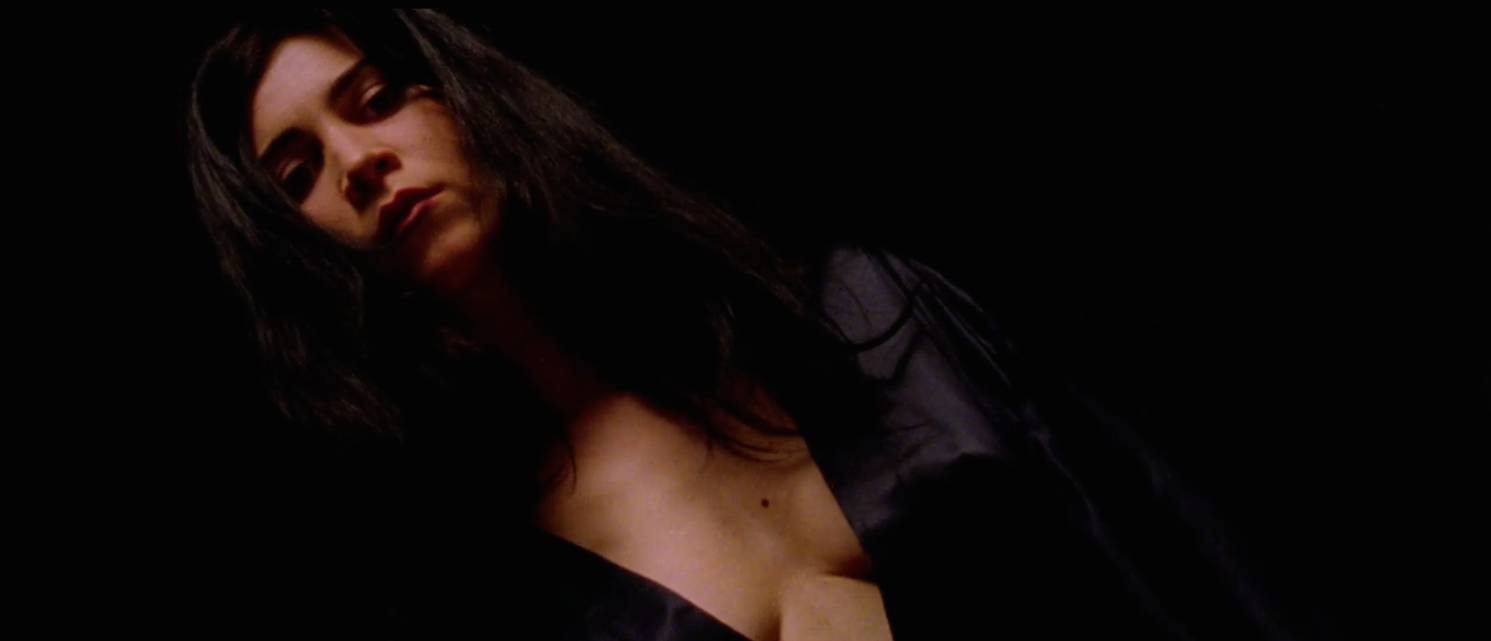
Going up to the roof for a cigarette Dan meets Barbara (Anna D'Annunzio) and we just know he's found some dark dangerous anima void, probably the one who killed his wife or knows where she's stored. She's the type of girl a man meets only in rare and strange dreams where she hides or waits within rooms within locked rooms and only by sheerest chance do we ever actually meet her face-to-face. She's so hot yet dark and dangerous that death and desire, agony and ecstasy orbit and merge into her aura as time stands whirlpool maelstrom still - she could be the evil daughter of those witches in the Three Mothers Trilogy. How she manages to convey this with little more than a black satin shirt, open collar and long dark hair, dark red lipstick is beyond me, but just meeting her causes a blood chilling sensation in both Dan and the viewer that's like a razor blade dipped in ice water run down our backs. A sublime and terrifying anima, we get the feeling that we'll never find her again, or escape her bedroom vortex if we do, except on her own mutilating terms. She may be the one who sliced up our wife (presuming she's dead) and going to bed with her will be a fatal mistake we'd be a fool not to make. Harrowing enough to make Hellraiser's Pinhead reach for his safe word, this harbinger of slashing, glass-eating, and multicolored gem fingernail gashing, is so vividly photographed that sweet pain and unbearable pleasure, intoxicating agony, nonexistent time blow your brains back in right onscreen like a reverse R. Bud Dwyer. Rewind forever, Dan, and learn nothing. 

Monday, December 14, 2015

Babes of Wrath: Dangerous Women of the New Depression vs. American Dogma


According to some wide mean streak in American pop criticism--stretching from bourgeois Academy voters all the way to  the soured douchebags of the comments sections--gorgeous sexy young girl artists and performers are meant to be just about anything but genuinely subversive. Never challenging to the status quo in any other way but via shrill feminist harangues and union cards. They can be gazed on but not gaze back, not threaten our place of omnipotent safety in the theater/living room. Medusas in Reverse, we presume our right to gaze upon their loveliness (or lack of) at our Mulveyan leisure, judging them for their garb, hair, posture, youthfulness; but if they look at us the same way, it turns us instantly to stone. It's the revenge of Lacan's petit a, when one's persona-accruing object of desire turns suddenly and stares back, or even worse, sends us a come hither stare. Suddenly they're no longer achingly far away but too close for comfort. We run shrieking to the channel changer like a window shade, embarrassed and angry. Later when they've closed those eyes to sleep we creep up from the dark and scribble mean things on their door. We're so mature.

If you don't know what I mean, here's an example: you're a regular straight dude gazing at some beautiful woman across a crowded room or street, not even thinking consciously, just spreading some proprietary gaze around like a radar, as a man does, especially in our constant state of televisual hypnosis, where we're conditioned to treat all pretty girls as if they're onscreen and can't gape back. So there's this one girl you see across the street and she's way hot, so you're gazing a little more wistfully, as if she was your favorite new actress. Then suddenly she sees you. She stares back at once, unflinching, smiling enigmatically, and starts to cross the street towards you, slowly but not shyly.

Before you can stop yourself, you blush and turn away, start walking in the other direction, like you got caught at something. A second later you reconsider. You're not a shy poseur, you should turn and meet her and who knows? Is she waiting there for you to nut up or shut up, gaze-wise?

Of course not. She's already gone. It's too late. She's talking to someone else, or was actually walking towards someone behind you. You realize her proprietary gaze is way more advanced than yours. For you she was pretty, for her, you were fresh meat. She knew she'd cow you, knew you were all gaze and no follow-through. Now though, you hate her. She popped your balloon with a pin eyelash.


Welcome to the New Depression. For the American critic, who is too high up the bourgeois ladder to look down without getting vertigo, this is where it ends. That hate constitutes sufficient ground for the poison pen to write and having writ, move on, and often that means on down to their parents' basement, as they been fired, their editors have had their budget slashed and can hire prettier younger critics at 1/4 their price... all these old dog critics can do is bark petulantly from the safety of their wordy leash columns. And their reviews get more and more blatantly misogynist the more and more power--imaginary or other--they're forced to secede to women 1/2 their age eager to work twice as hard for 1/4 the money. Most obvious of all though is something I see in academia all the time, a complete blindness to their own faults and foibles. Having years of clout, all access laminates, and Fed-Exed daily screeners have left them spoiled and egotistical, and if someone comes along and points out their writing betrays an insecure misogynist virgin at its core, they wig out like it's not just they have been insulted, but--as JJ Huensecker would say--all 20 million of their readers. And if the someone pointing it out is a hot bitch 1/3 their age who writes twice as well for 1/10 the price and just got the exact same all-access laminate and put on all the same PR screener mailing lists, they lash out blindly and viciously. In the words of some pompous silver-bearded bourgeois behind me at Magno Screening Room circa 2003, "how dare that little blonde bimbo call me a misogynist?!"

Isn't this the reason so many women don't gaze back? The average male gaze becomes like a prison searchlight, or a buzzing hornet. The woman mustn't seem like it bothers her, that she even notices, lest that average male gaze turn hateful, fearful, threatened. This gives her power in its way, as she becomes more and more like an onscreen heroine, a babe on a jpeg, an abstract locus of petit a Lacanian desire. But it's got to be withering on the nerves, like not flinching while one hornet after another buzzes around your ears and eyes for minute after minute, year after year.

Kristen Stewart, looking
If you are man able to embrace that reciprocal sting of the woman's return gaze, without needing to sting in return (recognizing your flinching as a pre-conditioned response that's 'on you' not them) even savor it like a Joseph von Sternberg protagonist, then you can stay in awe, as a friend and admirer, and thus not lose her as a source of soothing beauty, inspiring cool, and seething wit. You can bask in her soothing charm and imperious aura as she commands the dream screen cabaret, not imagining oneself as her would-be wooer but as her life coach, a cool friend, advisor in romantic affairs.

On the screen this translates more or less automatically, which is why for example I hate to see an actress I admire date an actor I don't (in a movie). George Brent or Fred MacMurray, for example, have faces my fists clench up instinctually to punch. I want my girl to date someone played by Cary Grant or William Powell, someone with class and wit. They can return that gaze without blushing and looking away, and I can watch them as their unborn child might from some Enter the Void perspective, their godlike figures looming on the screen. It's this position most film critics refuse to acknowledge, as it's way more prenatal than their billing/cooing staring judgment. It's the Studlarian masochistic viewer rather than the Mulveyan sadistic. This position posits that viewers we inhabit a perspective beyond age and gender, beyond control, tied to the winds like a roller-coaster like a newborn. We are subject only to the presence/absence of the goddess, our gigantic mom idol, Nicole Kidman beaming overhead like a rectangular religious vision over the 'Exit' sign when you see Birth alone in the dark of the Orpheum.

First we need to erase from our brains certain rom-coms that try undo von Sternberg's masochistic gaze, that try to flatter the shot guy complex neediness of certain little pisher comics desperate to seem desirable to hot blonde shiksas.

Rot in Hell, "Harry"! 
THE DEFAMATION OF THE PLATONIC PAIR BOND: 
WHEN HARRY MET SALLY (1991)

In American rom-coms of today, love scenes are generally written and acted by people drawing on a collective cinematic memory that doesn't reach father back than 1991's When Harry met Sally, which smugly taught that men and women can't be best friends without eventually hooking up, that even if you're smaller than she is with a voice like a tin piano, you can pull some late inning guilt trip to get her into bed, craftily knock her up, and then live happily ever after, elf princess hand-in-hand with craven Gollum.

Sally's arrival into the mainstream lexicon ("I'll have what she's having") stunted the sexual development of American romantic comedy, trapped it in a nose-wrinkling cutesy fake orgasm tourist mentality ever since. There's only a handful of romantic comedies made in Hollywood in the last 20 years that get the complexity of French love stories by say Rohmer or even Clint Eastwood's early films like Breezy. And none have been able to really show falling in love happening right there onscreen; as Yogi Berra might say, they can't slow down fast enough. Maybe that's because the PC corrective shoes on our 70s swinger feet have left us hobbled so that we can't even retreat. There's no Mae West to lead us out from under the unending parade of televisual hot mess permafrost. Amy Schumer came close in Trainwreck but then copped out by learning cheerleader dances and curbing her drinking. Only recently, with women-penned young adult novels like Twilight and Hunger Games, are we presented with female protagonists too strong and complex for insecure male screenwriters and directors to sabotage, and actresses too young and strong to be yet cowed by that old devil searchlight male gaze. They got gazes all their own, these dames, and god forbid they cast their beams back into the camera, the whole audience freezes up like a corrupted share drive.

Not since the days of Mary Pickford and Lillian Gish have women characters been so true to novels and plays, i.e. genuinely complex--even to the point of feigning weakness-- rather than our current movie idea of strong, where no heroine is allowed to go farther than her own surface and becoming empowered means a gun and a new hat, rather than ripping a hole in the glass ceiling and smoking the sky like crack. These Reverse Medusas don't get the same kind of open praise as the 'little sisters" (Jennifer Lawrence), or old school Hollywood knock outs (Scarlett Johansson)-- the ones who fit inside established persona categories, who talk the walk and wow the interviewers and generally play the game, the kind your parents want you to marry when you bring them home over Christmas (as opposed to locking up the liquor cabinet and shooting you baleful looks). I love both those actresses, I love most all actresses in fact. But I have a soft spot for the apple cart kickover artists, the hot mess crazy wreckers.

But to swap the genders, in which category do you think Brando or James Dean would have fallen in the early 50s?  Certainly they would scare the shit out of your parents' parents, simultaneously generous and miserly, girly and manly, fey and churlish, mercurial, dangerous, alive, smelling terrible. These bad girls and reckless boys were all over the 70s, and the drive-in, but where are they now? We need them! Go to bed already "mom" and let the bad kids come over. And if some shit gets broken, stolen, or bloodied, so what? Crazy is so close to genius you have to just trust all the smashing is going somewhere relevant, even if it never does. Otherwise, we'll never make a movie any better than Forrest Gump. 


THE REDEMPTION OF THE PLATONIC PAIR BOND: MY BEST FRIEND'S WEDDING (1997):

You can still find mainstream badass women characters that average critics love but don't recognize for their genius, any more than they do Kristen Stewart (until she was lionized by the French this year). Julia Roberts is brilliant in My Best Friend's Wedding but those who revere her tend not to be film theorists, maybe for no other reason than they haven't seen it due to the title and dippy ad campaign/poster. If not for Robin Wood's high praise in Sexual Politics in Narrative Cinema I wouldn't have seen it either. From afar it looks like a typical rom-com except for one thing: Julia's two best friends are men, one an aesthete gay editor (Rupert Everett) miles away from the 'gay best friend' cliches, and the other a blank slate sports writer (Dilbert McDevitt) who has a sexual past with Julia which was transcended by friendship, which is in the context of the film, proved more important. 

The moral of the film, that Wood picked up on is essay and I'm running with here, is that having a platonic love affair/best friend of the opposite gender one never hooks up with (either anymore or ever to begin with) is not only possible it's better than actual carnal love, at least for a certain kind of person, i.e. a true writer in the sense that sex and procreation are never as important to a writer as writing, or shouldn't be. Writers only engage in sex long enough to write about it later. In The Leopard, Burt Lancaster says "marriage is six months of fire and forty years of ashes," but the platonic soulmate best friendships are more like forty years of smoldering coal, continually giving enough heat to warm the entire room and allow for freer movement, but with a sweater on instead of naked on a bearskin rug, with roaring fire sweating followed by post-orgasmic freezing.

DAMAGE

And so today, a new age is born, where women cut through the male gaze barbed wire and emerge bloody and triumphant. We have subversive outside-the-box genius women on screen and airwave who are unafraid to tap into their own personal hells, their bi-polar melancholia, drug addiction, abusive past, as colors for their performer paintbox. And above all they unveil the willingness to sit there, in make-up, furs and write large upon our screens such reverse Medusa gazing as Hollywood not seen since the era of screwball comedy. They are like a relatively young version of Gloria Swanson, continually shedding her Norma Desmond reptilian scaly hide on a monthly basis, rather than letting it accrue, get flaky and become the ascendent ego.

It's terrifying for a man to realize just how much damage his gaze inflicts; he doesn't even think he has a gaze at all until some girl gazes back and he feels so suddenly caught and threatened. For startled bourgeois critics, self-assured return gaze brazenness better have a British or French accent attached, or she better be over 40 and playing a villain. If she's one of ours, a young American, then she's just being uppity, trying to glorify those haughty hussy habits which mothers would willingly ween from the line. If these dangerous women try to find the poetry that is there in the abyss of the mirror, they become a threat.

The Europeans aren't as threatened, which is why their women are allowed to be so much more vibrant, intellectual and confident. They know that just because it's destructive and pointless doesn't mean it's not brave, beautiful and poetic. Sixty years ago the whole continent was smashed to shit, but look where they are now compared to us! Shit doesn't matter. Only occasionally are there critics in the American press and mommy blogs who can locate and analyze the dark chthonic core of feminine power and celebrate its destructive Kali currents rather than moping like some Fordian Irish scrubwoman.

You know you are, you Kali flame dancin' foxy fur-wearin' bitchez!

ANGELINA JOLIE, for example, once had the kind of crazy that scares the shit out of the status quo Oscar-giving bourgeois (they gave her one anyway) but then she starred in Beyond Borders (2003) and became that character, i.e. a Red Cross Saint Theresa-type enamored of saving the third world's children. Now she just earns an eight figure check on the blockbusters to pay the orphanage bills but saves her real chutzpah for saintly suffering mother roles like Changeling.

That's okay, that's her trip. Who am I to judge her on what she says or does (Dan Hill, bro), now. But she used to be a bona fide badass, as you can see if you scroll up her red carpet moments at the 1999 Oscar ceremony where she showed the kind of black widow resonance a genuinely dangerous actress could radiate, especially since her date was her equally sexy/creepy brother (above left).

Because such crazy sexy cool as hers in that picture is usually only celebrated in men (Jack Nicholson, De Niro, Day Lewis), the only way American actresses can show their fiery goddess of chthonic psychosexual power and still catch an Oscar is if said fire is contextualized and confined to the psych ward, or meets death at the end. Angelina Jolie could win an Oscar because her Lisa in Girl wound up even crazier and less likely to be released than when we first meet her. The bourgeois were 'safe' in applauding her, loving the caged lion but ready to run like hell if it ever got loose.

Well, it escaped, collectively, and the bourgeois critical consensus has been running ever since, still loping around behind the web's instant feedback loop like that old Italian guy chasing after Barbara Steele in 8 1/2. unaware they're on a goddamned hamster wheel, fighting every day for space in actual print publications like wildebeests at a shrinking watering hole. There's no more Pauline Kael to call them out as they pile into any old van marked 'Important' art cinema, only to find they have nowhere to come back to when the festival is over; they've been replaced on the mastheads by cute interns with six-digit Twitter followers who never even heard of Hitchcock.

French publications like Cahiers du Cinema, meanwhile, once our tastemakers, pointing out what amongst our perceived B-movie dross was gold and in the process helping us re-examine all B-films in a new light, are becoming more bourgeois, busy praising small third world proletariat struggle documentaries rather than Ants in your Plants of 2009. And so our White Elephants stampede towards Oscar gold, renting space on the dwindling art house screens for a week to be eligible, pushing the real art, the dangerous art, off in just the same way their editorial champions were pushed off their mastheads. Only a few Europeans like Von Trier, Assayas, Refn, and Noe seem to be still trying to unearth the weird undiscovered worms beneath unturned rocks of the Now, but they get very hung up on sex and violence, both to please executive producers and to get shocked write-ups. If the critics feel something, these auteurs reason, even if it's just shock and disturbed trauma, at least they felt.

Meanwhile, in America, we just don't get deluges of German Expressionists fleeing the Fatherland to Hollywood any more, bringing women like Marlene Dietrich and Garbo to school us in the return gaze, the sick pleasure in seeing a beautiful self-possessed women seen both herself seeing you and you seeing what she sees, and feeling the sting of rejection when she turns to look at someone else (hopefully not goddamned George Brent).

As Mick La Salle points out in his book Dangerous Women, there was nothing sexual in the love of a 1920s moviegoing male for Garbo.  They'd go to the theater every night, eyes looking up to the big screen, with a love that encompassed and then transcended even the giant mommy aspect (her silver screen projected face as large as mom's was when he was a suckling child); the 'Garbo widow' effect tapped into primordial matriarchal pagan harvest goddess worship, and outwards into a kind trans-behavioral oceanic state of aesthetic arrest.

But today Laura Mulvey's theory of the sadistic gaze is treated more or less as factual gospel in academia, and so pre-empts and denies that relationship can exist. Though Mulvey is on record saying the meant her theory more as a conversation starter rather than the first and last word, mainstream theory has irrevocably begun using it as a new dogma. And now even the Femme Fatale is criticized as a male design, and the result has been a generation of crypto-feminists trying to slap the imagined masculine gaze from out of their eyes and face like a crazy person batting at invisible mosquitos.


LANA DEL REY: 60s AMERICA'S SWEETEST SUICIDE NOTE

Lana Del Rey's made a string of great sad sexy videos that seemed to prove the ghosts of early 60s Los Angeles suicides are the only thing of substance left in America, and even then only because their last few memories were shot on Super 8 and 16mm home movie stock. But the negative feedback her schtick received, even from third wave feminist pundits, back in the early days, was quite alarming. It wasn't exactly new (she would fit right in any David Lynch or Don Draper nightmare) but she tapped a nerve. She was gorgeous yet strange, with those lips that hovered between seeming real and seeming augmented; a dazzling body and great cascading beehive-ready hair and a never say no policy to drugs, alcohol and bad boys that sent our American Puritan minds racing. She was just doing whatever drugs the bad boys have, getting into cars with strangers, and engaging in all sorts of twisted scenes with hot black guys and middle-aged bikers, much to our masochistic Von Sternbergian fury. The privileged PC Communist infiltrator liberal arts faculty-brainwashed feminists found themselves angry over the most mundane inconsistencies in her origin story. She used to be named Lizzy Grant and have curly hair and sing bubblegum pop or something, like she was the only singer who ever changed names or personas.

Meanwhile, the Jungian mythos and psychomythological natural law-abiding Paglia feminists like myself were genuinely enthralled by Lana del Rey/Lizzy Grant's ability to zero in on and then embody the dark dream anima of the American culture dreamscape consciousness, as if she was a succubus from space who'd lived many lives and been soaking up America's broadcast radio, TV and dream transmissions as she flew closer and closer to our dreaming third eye, ready to meet that return gaze and Medusa us at a moment's notice should our sympathy but waver a nanosecond.

In short, if the naysayers had gone in for Jung or even modernism then they'd know their their indignant anger was the correct aesthetic response, the same one response solicited by the girl who stares back and causes us to blush instinctively, look away, and feel like a loser. The anger over the sting of shame is the correct aesthetic response; it's the not realizing this--not realizing masochism is the purist cinematic experience--that's the problem. It takes self-awareness to be able to detach from one's shame long enough to appreciate its all-encompassing beauty, rather than just presuming you're right to hit back if you feel hit, regardless of you actually were. Those Del Rey videos sting our pride like a slap in the face. We can storm off and volley off some outraged tweets or use the pain, the humiliation, as a kind of reset button. We can savor it the way we savor dream cinema, the type where not possessing or controlling the seen stimuli that so affects our emotions is a liberation through enslavement.


ROSE McGOWAN'S COUNTER-TERRORISM AESTHETIC: RM486

Trained as we Americans are by today's multiplex cinema to slough off actresses and characters into various boxes (sullen daughter, misguided vixen, All-American heimliches dumbmadchen, materialistic villain, traumatized victim / avenging angel, etc.) we feel bewildered when a woman, especially a young pretty woman kicks them over, not after a third act sulking montage but within the same bedroom conversation, navigating a push-me-pull you Sun Tzu-Rommel strategy. We're Americans, we're not comfortable with ambiguity and fluid personae in attractive young women. It makes us nervous. Would we want to sleep with them or not? It's a simple question! Yes or no? Our fantasy is being punctured by her bi-polar ambiguity.

Let's say you're an average SWM in the 90s but haven't had any luck with the ladies for almost a year. Then, you see "her," everyone in your posse thinks she's gorgeous, and you are the one who brings her home to your bachelor pad. You sit her down on the bed, and go to make some drinks in the kitchen, high on yourself, already mentally slapping five with your clique the next day at brunch. Then... as you mix the drinks and she unfurls, she remembers she has to quick call her friends so they don't worry where she is. Her mom cuts in on another line and she spends an hour shouting in Russian. After ten minutes, you go in the other room and watch TV; you come back when she hangs up but within minutes she's already asleep, totally passed out. You're a gentleman so that's that; you tuck her in under the covers and lock up your valuables, go in the other room and watch The Lost Weekend as the sun comes up. Then you crawl into bed, on top of the covers, and a few hours later you half-asleep mumble a good-bye as she slips out the door.

Man, if your buddies could see you now.

But if you're bitter the next afternoon; if you feel you were owed some sex or something--to justify those high-fives-- that's on you, bud. Sorry your fantasy, or rather "the" fantasy--the one conjured and subliminally promised by Esquire, NBC, and cinema--didn't pan out just exactly as you fantasized, that you'll have nothing to boast of. But! If you can sublimate that frustration and shame into your art, then it's just a question of masochistic tolerance, and love of women moves into the abstract. That's when you can appreciate her ferocity and honesty rather than what your boys expect you to "get out" of her, what "base" you crossed.

But even we Von Sternberg masochists, we debauched libertines who worship the Medusa, feel slightly like we let Rose McGowan down when we see her looking like a gray alien or Argento Opera-lashed post-pagan in her badass music video, RM486. Bald, chalk-white, whispering Roy Batty's Blade Runner monologue like her full WB Network-encoded matrix is being spat out in digital ticker tape, she's a new model, a Nexus 9, fluid and beyond duality, the gender strait-jacket in chewed-up tatters at her feet. She's let the full brunt of our collective gaze rain on her, raze her, and let the old self dissolve like William Shatner's tears... in The Devil's Rain.

To paraphrase Lori Williams in Faster Pussycat Kill Kill, whatever she's training for, she's ready.


There was only one imdb user comment (last I checked) on her video's page, from a German guy named Thomas who notes:
"I must say I quite like her as an actress, saw all her 'Charmed'" episodes, but it's tough for me to appreciate these 4 minutes, maybe because I find her very attractive and in here, she goes for the exact opposite."
I don't mean any disrespect to Thomas--he at least is self-aware enough to imply he's biased because he find finds her attractive. But Thomas, that's it in a nutshell! Being 'tough to appreciate' is the goal of all modern art. Rose and her video artist director Jonas Åkerlund have taken your attraction to beauty and used it to fuck with you.

When a hot woman transforms herself not into an approximation of a Maxim airbrush but into a kind of abject Molloch style alien--as RM does here--she's reacting to the beauty and youth industrial complex that's kept her and her sisters in anxiety and paranoia to the point they torture their face with collagen and Botox late into the night until they emerge at dawn like Universal pre-code Jack Pierce abominations, teeth scarred from eating disorders, faces frozen fast in a hideous duck-like grimace; they go from aging beauty to avian gorgon in a single long and tortured night. RM's given you the real Self beneath the illusion and if an hour phone call in shouted Russian wasn't your expectation when taking the hot girl home, relish that feeling of alienation and confusion, because so few men even get to that level--it's like secret initiatory hazing, the first step to liberation from desire. It's the true "modern" aesthetic response, as important as the initial riots over Picasso's debut of Les Demoiselles d'Avignon. (upper left)

Maybe there's something deeper than narcissism and fear at work behind RM's overpainting, self-sabotage, reverse beautification, a kind of counterespionage CIA mind trick, throwing a Perseus mirror shield visor over your face, to reflect Medusa's Vogue-Revlon gaze, to freeze it with horror, paranoia, creeping dread as it beholds its own hideous reflection. Rose McGowan's lashing out against the Hollywood beauty grist mill is heroic, as the Brits would say: it's absolutely bonkers! As daft and admirable and crazy as they come: half Frances Farmer punching out cops, half Saint Francis marching the dye-stained child laborers out of his parent's textile mill into the blazing sunlight.

Sleeping with the enemy of my enemy on his enemy's command = a cinematic love story for the ages

HITCHCOCK'S LADY SPIES

I used to think that the casting of so many attractive young girls in high ranking CIA spots in movies like Zero Dark Thirty and TV shows like Homeland and Alias was just licentious license, but if you see an actual CIA documentary, like the one on HBO, recently you realize it's the truth: pretty young women are all over the upper ranks of the CIA. They are brilliant and brave and better at connecting the dots of seemingly unrelated events and movements into a serpentine whole than men.  Beauty and charisma are keys to success in any field that relies on winning people's loyalty, turning their allegiances around using nothing more than a warm smile and maybe waterboarding. Acting and spying are really more or less the same, drawing on the same skills. Beauty is as valuable to a spy as a photographic memory or crack shot marksmanship. Only an American would think that using beauty to excel in your job is somehow 'cheating.'

Hitchcock's movies point even darker: spies are not only actresses but whores, stealing uranium secrets instead of 'earning' cash, forced to sleep with the bad guy by the good guy for the country she loves (there's no concrete difference between a CIA handler and a pimp), doing what needs be done to get evidence, cash, the part, or the script. Even if it means losing the respect of Cary Grant, the show must go on. If she pretends she's in love with someone long enough that even she starts to believe it, well, isn't that the same as falling in love for real? It's the kind of thing that can drive a girl mad even while earning her Globes, Oscars, and jury prizes. Glittery ephemeral dreams leave just a blue key and an empty box where once was a Betty and Diana. Slimy spiders scatter through the bulletin board web, pinning every nude scene movie still helplessly out of context, then hating you for your image's power over them. You've become not just a spy, not just an actress, not just a whore, but a target, a bullseye at the center of the board, the spider that all strands lead to, your every trapped panicked thrashing movement part of the inexorable slow sexual strand red carpet roll up between fear, desire, and procreation. It's this exact madness censorship tries to stem, in vain.

When it gets out of hand, it's time to tell mother.

Notorious
Now the spy comparisons get too close for comfort, and the terrorism of celebrity begins, the slow poisoning by flash bulb and corrosive gossip. Wherever you go people stare or demand to be stand next to you for a selfie. The only sane response is to go mad. There's that old koan about the beautiful woman who wanted to become a Buddhist monk but the master wouldn't let her because she was too beautiful to not be distracting. Undaunted, she took a hot iron to the side of her face, and was admitted immediately. The moral: you shouldn't seek enlightenment unless you do so as one whose hair is on fire seeks a pool of water. And if you've never been on fire then what good are you, o uncooked roast, o churlish banal carcass that for wont of heat doth rot and bloat with banal surmise, while impaled on spit and turned on flame to sizzle doth a kingly feast make?

And then to choke them aye... that is art, and the core of honey trap assassination.

Hail Stewart!

A César for Kristen...

In European cinema, the performance of dangerous womanhood within feminist parameters is more alive and less bourgeois, less dour and militant. You can still smoke and dance in the cafe (I think?) prostitution is far less stigmatized (still?), and May-December romances accepted without Puritanical staring (for now). Women are assertive without being bitchy (and are still hot). Just compare the self-possession of Isabelle Huppert vs. say, Susan Sarandon, or Isabelle Adjani vs. Geena Davis as they look and act today. And this is not to say Davis and Sarandon are not great actresses, just that what they were fighting for as American women in Thelma and Louise is a birthright to Europeans. Luckily, bourgeois America's Puritanical sexism is eclipsed only by its trust in intellectual Europe's opinion. What fearless actress titans from the US need in order to not be maligned domestically is Europe's sanctification. Now that Kristen Stewart won a Cesar for Clouds of Sils Maria she can begin to earn the awed respect me and a scattered few always felt she was due. Maybe we missed something, reason our own critics. So they go back with less provincial-reactionary hostile unconsciously misogynist glasses over the Stewart oeuvre and decide yes, we did believe in her all along.

Another fact about Europe is sex itself, in which standards are far more relaxed. People want to have sex, they do. They don't wait for a Mr. or Mrs. Right they feel they're owed by years of televisual, cinematic, and magazine promises. But there's more to the cultural difference between USA and Europe than just that, for in losing the unrealistic ideals so critical to American conspicuous consumption, the Europeans become less hypnotized, less locked in a state of Lacanian 'pressure to enjoy,' a pressure which all but squelches actual enjoyment in the cradle. There's not a lot of TV commercials in Europe (relative to here, I mean), and what there are are generally more clever, existential and risque, less shrill and incessant.  As a result, maybe, European women aren't as broken down by the staggering sexism that comes from the constant consumerist barrage. I'm sure there are pockets of unconscious consumerism in the East, especially, where it carries anti-authoritarian currency, but socialist education and freedom from the hobbling albatross of an anti-intellectual 'moral majority' voting bloc have helped the West stay progressive. Partying with them when they come to visit us in NYC provides a huge relief from the stultifying cluelessness with which Americans party every day. Finally we can talk about Freud and Jung instead of just pretending to already know them and be 'over' them in favor of banal cognitive behavioralism (as seen in Von Trier's Antichrist).

If she was a guy, she'd be dubbed the new De Niro
I think if a pretty young actress is really leagues above her peers the critical mainstream (in America) is unwilling to take the leap, to climb up and risk being exposed by championing her, to be the first to applaud amongst the booing Moroccan mob when Marlene walks onstage for the first time, to cheer her for having the guts to call into question everything that's grown familiar.

If great acting isn't met halfway it can look like bad acting, just like avant garde music and random ambient noise are indistinguishable, and so great artists must march off to places where they 'get' greatness and can better be contextualized by critics as 'other.' Hendrix was dismissed in the US until he found acclaim in London; crazy-haired Nicholas Ray was just some idiosyncratic journeyman until Godard declared he 'was' cinema, forcing American critics (terrified of being left behind on a trend) to re-evaluate soul-withering explorations of human darkness like In a Lonely Place and Bigger than Life. In other words we respect Europe's opinion so much we're willing to go back and re-evaluate the work of American artists we previously marginalized. Oh now we get it. Now we get Kristen Stewart.

The French critics have mapped out a route through our cinema's past like a museum guide trying to unravel the opaque and meaningless tangle of a Pollack to an incredulous Indiana tourist. The last voice we had in the States with the clout and guts to champion the underdog, Pauline Kael, is gone. Without her, would we even have noticed Bonnie and Clyde or Taxi Driver? Maybe not. She would have loved Kristen Stewart and would have explained and contextualized her work to the point we'd be valuing her here well before that Cesar.

Kael is dead though, and it behooves our new Bonnies and Bickels to go once again back to Europe to seek the recognition they warrant. In the US, alas, if you put a relatively hot young broad in a debate with a stodgy, sexist older man like Norman Mailer (as in Town Bloody Hall), and the broad is more than holding her own, calling him out on his bullshit, she's a dour buzzkill and he's a hero to the lumpen proletariat. In Europe the mixture of different languages keeps everyone guessing and leads to a kind of of eternal now unbound by the past or religious dogma, a now that floats constantly on the cutting edge of thinking and social connection, because language can't grow stale when no one understands each other.

In the States we expect the Ruby Tuesdays in White Plains to be the same as the one in Toledo rather than a unique snowflake. Appearances are measured up to, fit into, the excess cut away. So if we can't rely on the basic maxim that someone in a suit and tie, white, straight and over 60, is more intelligent and worldly than a cute under-30 blonde in a tight sweater, then we can rely on nothing, and are too terrified to pay attention. Our fingers tighten on our pitchforks and torches instinctively. Europeans would just be amused and intrigued--after all, to the young women in Paris white male writers over 60 are sex objects--but Americans froth at the mouth when their obtuse book-by-cover dictums are challenged by cool-headed pretty blonde undergrads. And it doesn't even matter who's right or wrong in a debate, it's that the prettier they are, the more hostile the (middle-aged bachelor) professor gets. He has tenure! Why is he shouting!? It's because she's too pretty, and young and would never in a million years go out with him and anyway, it's frowned upon by the academic senate... at least now, at least here, but if this was Paris '68, oooh chippie, thinks the prof.

And there she is, expecting an A without even so much as sleeping with him once; her intellect an affront to his sense of entitlement, a sense that our outdated counter-productive practice of tenure encourages. And then who has to deal with her? Me, as she comes to my office to complain about him.

I explain to these understandably aggrieved girls that higher learning doesn't always accompany or even encourage self-knowledge. The development of one's own unconscious madness, the source of all genius, is criminally neglected in academia. Higher learning often serves only to convince the teacher that his dull sanity trumps chaotic madness, and why? Because that glint can't be taught and therefore can't be measured so must in academia be devalued. All we need from the higher ed wizard to be a real museum-ready artist is a grant, an endowment, a write-up in Artforum. If we're not going for the grants and endowments then we're either mere 'entertainers' or outsiders; either we get a three picture deal or a prescription to Lithium, either way, the madness that creates genius stops through lack of oxygen. The diploma is awarded... the ship sinks... the guns go silent.

 COURTNEY LOVE, AMERICAN SMOKER

And either way all the reckless energy the hussy young girl genius pours into her career is suddenly sidestepped when she has a kid. That's the moment when I get mad and the drink-counting mothers relax. When a great insane hot mess skirting the lip of brilliance thinks she can put that all on hold to become a mom, eat healthy and quit her vices, and then come back and be the same badass, I know that, like Uncle Paulie when Henry starts peddling the garbage, I have to turn my back on them. They're acting selfish, denying their madness a voice, giving all their love to a newborn instead of me, her public. If, like Courtney Love, she can somehow stay rowdy, raise the child punk rock style, but without that Ann Dvorak in Three on a Match-type negligence, that's a frickin' rarity.

Hats off to Courtney Love, still rockin' and still terrifying the academy and still, as of this post, sober.

She may not still be the siren voice unconscious of L.A. but I listen to Celebrity Skin and remember the last time I was there, whipping too fast around curves up in the hills, wind pulling my hair like a crazy hottie sitting behind me in the car, trying to either strangle me or give me a massage as I cringed in the shotgun seat, the crazy gorgeous blonde driver--who I flew in to visit over spring break--didn't get off her cell phone once during the week I was there, even after the car almost flipped over zipping around those dangerous hills; and "Boys on the Radio" roared to life in the speakers right in the moment we almost "crashed and burned". Love's rock oomph carved a space for a soul inside L.A's bottomless surface, celebrating these same curves and the countless honored drunks and druggies they'd taken, honored the scuzzy bottom feeders photographing the wreckage that is Hollywood's rapture with self-immolation (we wouldn't see a better incarnation until Cronenberg's Maps to the Stars.)

Mark my words, one day, once she's safely dead, Love's letters and notebooks will be researched and archived ad nausea. Dabbing their pens in the theoretical equivalent of Dillinger's blood, the academia will hug themselves with the richness of her life's work, digging numerological cryptograms from her teenage speedfreak Boggle word lists, gin rummy scores, Paglian chthonic feminist poetry.

But only when she's dead and therefore immortalized (and unable to bite them) will they dare appreciate the thing that so scared them when it came roaring up on them alive at a party. "You're brave with a fish as long as it's a dead fish" the cook says in Night of the Iguana.  

But Love's not dead, yet. She'll piss on your luggage and hide the distributor cap and help the sky begin to blanche while you're still struggling for a hip disaffected response to her first question. She's the female Keith Richards, a survivor because she can play guitar and loves rock over drugs, music over sex, and even death, but what's the difference? She's Orpheus descending into the reptilian tunnels beneath downtown LA, armed with a blazing guitar torch. She rides her amp's electric currents high above the glitter, an overdose-surviving valkyrie swooping down onto LA rooftops to collect the beautiful and dying boys about to jump and see if they can fly, for her Valhalla bloody chamber record collection. Let the haters hate, and they do all over the web; to earn such vitriol, from so many losers, she must be doing something right.

Asia Argento (Scarlet Diva)


THE KEYHOLE MIRROR: ASIA ARGENTO

A very unique and raw analysis of what it means to be young, gifted and constantly mauled as an Italian film starlet while roaming through daytime press junkets and financing meetings, photo shoots and hotel room film pitches, and having it be no big deal to smoke while pregnant (and burn herself with the lit end on purpose), Aregento's SCARLET DIVA really unnerved some critics over here. If you read the average Amazon comment it's of the bent that 'Asia's like totally hot but I couldn't get turned on by it,' (i.e. that comment on McGowan's music video) like the film was mispromoted, its promos a tease promising softcore sex and delivering only self-mutilation and nervous K-hole breakdowns instead.


It's like dude that's the point!

That's the only way Europe can sneak art down middle America's throats, on the Trojan horse of sex. Art House cinema as we know it got big in the US in the late 1950s only by promising "European" and "Art" in the same sentence meant the kind of frank openness about sex and nudity our own puritanical censorship forbade. A single nude shot or dirty word could create lines around the block. But eventually they didn't need the promise of 'dirt' because the art had taken hold. Subtitles had a Pavlovian association with lack of censorship, which allowed for more imports, allowing art to take root. And with it, strong intelligent women. The amount of backbone in an actress like Kate Winslet, Helen Mirren or Keira Knightley in England, or Isabelle Huppert and Adjani, Beatrice Dalle, or Sophie Marceau in France, or Monica Vitti in Italy vs. that of, say, Sandra Bullock, Julianne Moore, Drew Barrymore, Cameron Diaz, Winona Ryder, even Jodie Foster here is as different as that between a tiger and a house cat. Both are still cool, sleek, stylish, but which could more believably devour you?

I've got theories: I recently saw a Hammer film DVD extra where an old writer or someone was remembering the way Britain and American censorship of the 50s-60s was vastly different - the Americans would demand cuts to the sex, but the violence was allowed; the British would allow the sex but demand cuts to the violence! This ties perfectly into my theory, as exposited in Acidemic #6, that sex is to the French what guns are to Americans, and vice versa. And there's that old Dietrich quote "In Europe, sex is a fact. In America, it is an obsession." And there's no doubt it's much easier to get a gun in this country than to hook up at a party. And vice versa.

My final theory on this has to do with World War Two: Being bombed nearly to death in the 40s made Europe permanently less enthralled with global destruction than we are here in the US, and their more liberal views on sex may well be a result of that too; the result ensures that premarital sex plays quite a larger and more healthily complex sophisticated yet accessible and straightforward part there, and in its way, so does prostitution, which seems more than a few degrees less tawdry in, say, Paris or Amsterdam, than here. We see these demoiselles crop up in French New Wave films, but less in a tawdry Taxi Driver manner (or Liam Neeson manner) and more in a just two casual 'people hooking up' sort of way. It's still no kind of a life for a lady, but for a lonely dude and a cash hungry Parisian of the same approximate age and class, what's the harm?

At least it's regulated to an extent and therefore less overrun by sleazy gangsters, presumably, and the pimps are French, little guys who just get funnier the harder they try to be menacing. Meow, n'cest pas?


Then again, that impression, like all my others, comes from films not France itself, which I have never visited. What do I know about actual reality? I never watch it. From what I have seen, it's a real mess.

And it's my fault, probably, for never looking.

And of course, the four furies:
Pauline Kael
Camille Paglia
Kim Morgan
Molly Haskell
NOTES:
1. Hey STELLA: Do you imagine they would dare show such a complicated monster as Stanley Kowalski in today's draconian PC environment? He'd either have to be an irredeemable brute whose every gesture is amped up with ominous music cues and lewd looks (so there's no possible way we can like him)--the particulars of the rape spread out in ugly rutting and sadistic sexual violence and intensity (instead of just showing a shattered mirror)--or they'd cut it out altogether, block it out of the screenplay, and just turn him into a passive whiner who cockblocks buddy Karl Malden. And now, going back and watching Dean's three film roles, it's hard to understand sometimes what the fuss was about. He seems to mince a lot in Rebel -- stopping the action cold so he can play with little toys or befriend Sal Mineo as if he's a timid marsupial at the zoo he's trying to feed a peanut by hand. He doesn't make a lot of sense - he mumbles - one minute he's cool and playing chicken, and winning, and smoking and putting dirt on his hands, the next he's trying to rat the whole gang out to cops even though even his parents don't want him to (they're not squealers --they're actually cooler than he is). "Just once I want to do something right!" he says. So he wants to drag everyone else down with him so he can be noble. In New Grenada we say something too: "a kid who squeals on another kid is a dead kid." Wanting to call in the cops is almost as bad as not making a more coherent effort to hook up with Carroll Baker in GIANT.
Related Posts Plugin for WordPress, Blogger...