Showing posts with label Zizek. Show all posts

Thursday, March 10, 2016

Just Whoa Stories: Guy Maddin, Canadian Amnesiac: THE FORBIDDEN ROOM (2015)


If you'd wondered casually where Guy Maddin's been all these weeks, months, years, then you haven't read the snootier cineaste tabloids that remind us he's traveled the world and the eighteen seas shooting weird shorts on weird soundstages with his cool (and/or literally cold) friends. Now he's slung all those shorts together in order to re-witness the allegorical birth of cinema: its slow crawl out of the silent fallopian Méliès ocular orifice, its uncooked bullet monocle pace as it crosscuts through Intolerance valleys, its slop to the dusty floor in time to find Jolson belting out "Mammy" as the heavy silence of his meshugginah papa offers naught but silent film barbed wire-rimmed be-spectacled reproach. Too late, old rabbi, wave, Harpo-like, into the collapsing iris as thou wilt, but thou shalt not not speak again! Cinema is born as howling amnesiac, its cries washed away in rhtythm of the celluloid train tracks. 

The tracks of the celluloid train's trip stop, sharply, suddenly, in 'real life' at a cliff overlooking 70mm Cinemascope and Technicolor. The train you were on ("when you left... Europa") sails off into the red, blue and yellow orbs of early color TV projectors, no longer track-bound, but on wings of surround sound. But Maddin has gotten off at the border. Maddin shuns everything except the old 2-Strip sprocket train trod by the Winnipeg forefathers. Down into the trackside gully trundles Guy, to pick up the undeveloped scraps of discontinued stock, the 'ends' tossed by wasteful cinematographers, the old combustible silver nitrate that boils and twists in the heat of the projector lamp, but cooks down real nice into twisty jewelry. 

Then, wondering what kind of Brakhage-based nonlinearity cinema might have grown up on had the silent-to-sound conversion gone differently, Maddin sets to wandering the largely unexplored land betwixt German expressionism and post-nouvelle vague hipster retro meta-narrative. Tip-toeing down the slope below the sprocket tracks and into the tulip beds of the unconsciousness, out the shutter, through the gate, and into the blackness beyond any flicker fusion threshold, he tallies the dreams of everyone who ever fell asleep on a speeding train (ala... Europa), and finds a new form of cinematic vision, one not so very moored to the speed of rotating locomotive reels, 24-frames per second, one that savors instead the speed bumps on the track, that savors flicker from the shutter that gives the illusion of a single moving image. The landscape, scrolling past outside the window, gets to keep its cigarette burns, its scratches and tape marks, its mismatched rear screen size ratios (waiting commuters seen the compartment window loom large as ogres). The passing scenery freezes and starts burning up under the blazing light of the projector until it's all bright white light. The house lights come on, the whiteness seems to spread all through the theater, and even out into the street outside (Winnipeg! Snow!) The audience groans like groggy nappers. They refuse to leave, or to fully wake, until the light burns so bright the hair on their arms singes. 

Maddin cures his characters of their psychiatric ills by showing them their inner children, hidden in closets, he gives them melted copper nitrate booster shots. He pays a visit to one of his favorite old Boards of Canada-produced pock-marked classroom instructional 16mm films; he has a dream that John Berryman was right.... there, in the fluoride, crossing the racing lines and looking both ways before learning how to take a bath. Here come mothers or actresses paid to wear motherly clothes, scrubbing us so thoroughly we can feel Liv Ullman's breathing on the screen of our thin skin. But in our shame we then notice the horrified rubes peeping through the sideshow curtains at our Oedipal naked soapy infant nakedness! 

A mere dissolve later and we're an old man doomed to die in an abyss of black tail leader. Mama, if we hadn't flinched at their rube-y gawking, would we still be young?

Infancy = Amnesia! 

A good dreamer doesn't know he's dreaming (for he'd wake), nor a character that he's fiction (for we'd wake, and only Brecht or Godard would want that). But in Maddin's world, consciousness extends beyond both waking and dreaming to a new third thing that's better than either, a kind of long great white northern slumbering. Winnipeg--as he notes in his previous film--has the most sleepwalkers of any city. Thus he is unusually bestowed with the gift of mixing film viewing with 'living' in a film as the ultimate in real viewing. Characters in most films are aware of the importance of keeping from the audience their full awareness of the mise-en-scene frame boundaries. They don't need a silver nitrate fireball held right against their mother's temple to keep them from squawking that it's all a gag. They don't want us to stir from our slumber because--to them--we are like the semi-slumbering couch potato titans in Cabin in the Woods, or the languid Red Wolves in the cave the lumberjack infiltrates to rescue Margot. One disgruntled click of a button and everyone on this 'train' will cease to exist.

But still these characters set about seeing you get that bath, scrubbed by that pretty maid. The rube at the roadshow remembers but you don't remember him at all. Future generations will see you in your bath, but now the colors will have all turned to rust. If you're in a Guy Maddin movie, that rust has happened ahead of time,  just far enough for your nightmare third-eye fevered brain to hallucinate patterns upon the bubbling Ektachrome shower curtain into which your silhouette dissolves. It's just enough to distract you, so the skeleton insurance defrauders can lull you into a gentle trance. Your worthless squirming signature on a piece of paper is all they need. Sign and they'll stop pestering you! Sign....shhhh... ine. Initial there and sleeep on....dream and slumber forward into the ever chugging night--sleep while moving faster than you could run. The track culls you forth like a ticking clock, scrubbing blackness from the pink skin of the sky by force of the tick-tock habit. What else does the world turn for, if not lack of other options? Has anyone convinced it to stop twirling like a mad idiot around the sun, to slow its roll and stop unwinding itself? They don't bother to try anymore. We're stuck 'orbiting' the sun like a moth around a light fixture, and it's all mom's fault. We get desperate to burn back up in the white heat of an empty projector, to drink from the sun like a mammary flame fountain and be reborn as an angel... on a new UV-ray disc, the new UV-ray players coming soon - 2034 at the latest.

Every moth who made it past that shade has never regretted it.

Even if their husks are swept up with the dropped popcorn at the end of the night, those moths had that one shining moment... and they're still here. We can smell their burnt impression on that mighty orb. The light's off now, the smell is gone, but the show goes on, repeating every two hours tomorrow starting at 11 AM, until the late show lets you out into a parking lot that's as still as a tomb. Gradually the smell fades, but the memory lingers, and the film won't decompose, not with so much cold. And so, to bed. The road home is waiting for you... come on, pal, fall.. asleep... so the orgy.. can begin, right under your sleeping nose.

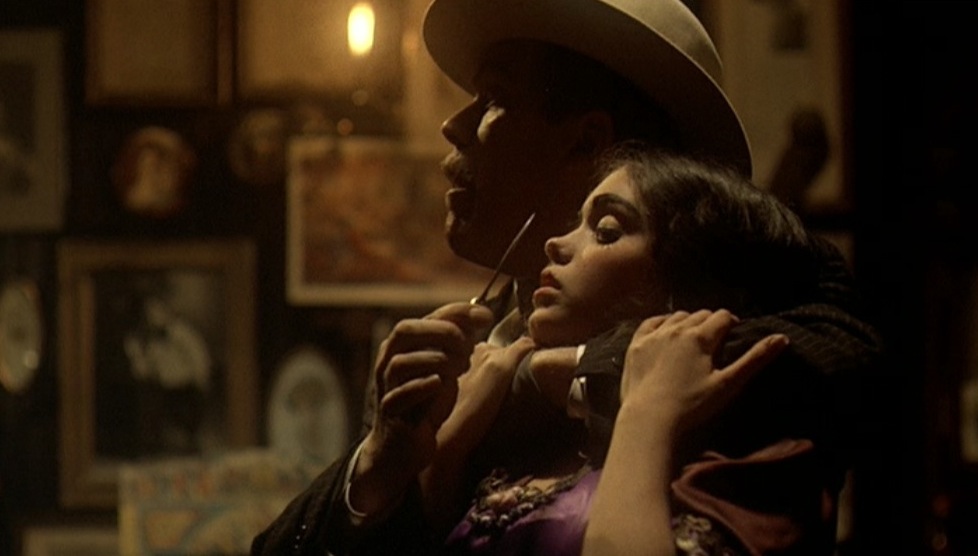
Margot (Clara Furey) of the Ridden Red Wolves
Baffled Woodsman (Roy Dupuis)
The orgy is, Kafka and Lacan and De Mille all say, an act. It's performed not enjoyed, and it's performed only for you, the one who misses it. It exist only for you to feel you're missing something - that's your gift. The accident on the road that gives JG Ballard a bloody boner, that's why the road is there. It's your one consolation gift upon exiting the cinema of perfect oceanic union with Mother Night and her comforter abyss. No matter what happens here, whether you enter the sunshine and arbeit macht marks with daddy Sarastro and his golf monk posse, or just hang out at home like an idiot and watch another movie, know this: you will never get that blissful pre-egoic union back. Not until the next show, but even then, the show is about missing it. We can only wish we didn't know this sad fact, we men who aren't coke dealers, that the orgy is only ever, just now, over.

But with a little meditation-- and/or Lacan and/or addiction recovery--under our belts, we may one day accept the insider view: that the angst of missing the orgy is all that keeps me, you, us, it, whatever, from breaking down in abject torn-and-frayed pin scratch despair. Those who participate in every orgy, who live at the 'mansion' and drown each night in coke and bunnies, imagine their despair when they have to go home alone on a Greyhound full of obese tourists? Their sobs are heard three states away... Was it better to have not been to one at all? What does one bring back from the orgy, once one runs out of bros to boast to? Nothing but STDs and regrets, and longing for a feeling that maybe never existed, but nonetheless makes your forthcoming small normal joys seem like mockery. Hey, maybe... maybe you were there at the orgy, the one I missed, and you just don't remember.

If you remember me there, then you definitely weren't there, because I wasn't at the same one you were, cuz I don't remember seeing you there, or anyone. The ones I went to were.... how do we say... unter-attended? Yes, iss that the phrase?

Skeleton Insurance Defrauders (themselves)
If you started reading the above and thought, good god he's being awfully flighty, then just START READING HERE:

The stories of The Forbidden Room are seventeen or so of the shorts Maddin filmed at museums and historic sound stages around the world, woven together in a grand fusion of Brakhage-Decasia film decomposition and Freudian psychological disintegration. The stories enlarge and swallow each other so that one leads to the other and each new character in the last story has their own story they must tell, on and on and inward and inward until it finally hurls five crosscut D.W. Griffith's Intolerance climaxes into the Russian doll vortex of Jerzy Has Wojciech's The Saragossa Manuscript. Everything congeals and fuses itself back into an old man's bathtub submarine, full of compressed explosive jelly... to pancakes full of oxygen, and to the wild forest, to 'Canada' as it exists in the mind - the maple syrup and mounties to the USA's apple pie and baseball.

And there, in the endless forests of the Great White North, the woodsman forced to watch his Red Riding Hood luxuriating post-orgy (he missed it) amidst the wolf pack, like she's the hot Kurtz of 40s Jungle Jim lost tribes.


And like his best work and that of only a handful of other filmmakers--Lynch, Bunuel, Antonioni, Martel--Maddin's style defies easy description or analysis, and so falls into the collective amnesia of the 20th century, coming at us the closest thing yet to the baroque yet strangely cheap look of our own dreams. The only one who can tell us what it all means is a Freudian analyst, smoking in his train compartment (Forbidden Room includes a 'train psychiatrist' - like a ship's doctor, on the 'Berlin-Columbia' Express) while trying to seduce a young zombified girl through hypnosis, to cure her of

Amnesia!

Amnesia is, I explain to my students (when I have them - which is never), the key to understanding not just this film but all art films. This is not the search for small meanings, or even big ones, but nones, nones meanings. If film itself--the physical, ever-decaying reels of it, most of which are deteriorating in dark hidden chambers deep under long closed cinemas and Nazi bombing rubble--was to go into psychoanalysis, under the care of a licensed emulsion scratch that grew and shrank (fee-wise) according to the size of the epiphanies realized, then this film would be that breakthrough session. The result? Film has a message for us: Hey, it says, sorry for misleading you. You, my watchers, who choose to watch me, the cinema, instead of living some full dumb life playing sports or pursuing fame, money, power, altruism: sorry for leading you astray. It realizes now (that it's too late) it had no right to dominate us so completely. It took advantage of our vulnerability to the dark and glowing images, the bulb using its wattage to hypnotize a nation of moths, and it made certain deals with our unconscious we didn't even know about. We didn't know when we signed on that line, just what the contract entailed.

But now cinema is sorry, and so--here in Maddin-land--cinema self-flagellates with rust and emulsion scratches and cigarette burns, because it still wants you back! And you stay, because those burns are beautiful, hypnotic. They can't help but console and cajole and cosign your trust, which they will then defraud!! Drop that pen! Rust! Rust while you can!

The emulsion scratch shrink, now widened into a flickering blue-green band down the right side middle, smiles as the client image dissolves.

Coincidental double Amnesia: 

I started watching some Canadian sci-fi show on Netflix called Dark Matter after Forbidden Room ended, which tells the story crew who wakes up from frozen sleep on a space ship and don't know who they are or what they're supposed to be doing. But amnesia is not just Canada's identity crisis, it is the root of all film viewing. We come to each new character in any narrative as an amnesiac viewer, picking together details from the surroundings - i.e. a sketchy unshaven dude in a hoodie with his hands in his pockets walking down the street in the middle of the night while ominous music plays --all those signifiers tell you loads about him, none of which may be true; maybe he's just going to get milk for his mom's sick cat, and not to break into your house or sell crack to your infant daughter. (you could be reaching for "stand your ground" laws if you get too caught up in perceived signifiers rather than actual immediate threats). Artists like Maddin see right through the elusive reality of false signifiers by making them all opaque. We needn't pretend to know what's going on if we don't speak the language, talking the same English but in a foreign accent as if that will magically convey our wish to enter the tongue's forbidden chambers, to access the king's inner ear, each ossicle a connecting tunnel around a rickety carnival funhouse ride choo-choo track leading down into a roiling surf of lava and beer foam.

Playing around with speed and reversals, decomposing blobs around a lighted figure in a dark room seem to be breathing in and out of dissolving bubbling lava-like abstraction and--almost like free association--BOOM there's a volcano. And while each of the interlocked stories and subroutines feels familiar, there's no time or inclination to really identify or understand: a woodsman comes into the forbidden cave to rescue his lady love from a wolf pack in an inverted Red Riding Hood myth, he thinks. But they're all dead and she's shaking as if possessed, and then, what? Rather than speak on the crime of squid theft, the volcano lectures the gathered tribe on the impossibility of gaseous emissions speaking coherently.

I'm going to rear back and take a non-educated guess that the Canadian gift for portraying amnesia stems from its identity crisis as the middle child between louche America and stiff upper England.  "America" --as you see it today--no longer has a national fixed identity beyond our psychic conservative/liberal split, but at least we know who we aren't. Canada has niceness, pancakes, dry ginger ale, weird football rules, mounties, eskimos, woodsmen, better wax museums on their side of Niagara Falls... but it's too cold up there to have much else.  We in the US imagine Canada a bit like Alaska stretched out wide and got socialized health care. Cold and underpopulated, mostly forest, a kind of giant air pocket full of magical snowy sky over our heads, mappily speaking...

Until the movie starts...

by which I mean we trek with snow shoes and sled dogs between Leni Reifenstahl's alpine romances, baroque Russian coronation ceremonies, and South American mining accidents, until the sky falls below us like a blanket with a Buster Keaton hole in the center.


I'm an American but I still love most Maddin films, at least the first half, until their lack of coherent narrative onus leaves me drowsy, but it's helped me to have seen each one with a different girlfriend, and I've loved the ones I saw with girls from Europe or Buenos Aires, but not the ones with American girls - who don't get it. The last film of Maddin's I saw was with Branded on the Brain, with live orchestral accompaniment (with Cripsin Glover narrating in person) and it was okay, the (American) girl I was with was 'meh' about it. I enjoyed more the Saddest Music in the World at the Landmark in company of my Swiss-French mistress who was suitably impressed that I could even explain it. Before that I saw Tales of the Gimli Hospital at a midnight screening in Seattle circa 1990 with my girl from Carmel, NY. This was back before anyone knew anything about Maddin other than his film was a Canadian surrealist black and white homage ala Eraserhead. I liked the framing device with the radiator but I had a roaring headache and my girl was all pissed because I brought a flask and reeked of booze. I thought Careful was a masterpiece of psychosexual Freudian deep ice floe plunging that I saw with my Argentine ex-wife, and we swooned as one. Is there a connection?

I can't even wade a half our into Careful nowadays, though, it seems way too pleased with itself and there's one towhead too many.

Maybe this: Americans, even me, can become bored by alienation and Lost in Translation-style dissonance when there's nothing to grab onto. We're not used to having our desires toyed with. Our craving for some kind of narrative thread, some kind of familiar signifier, to orient ourselves by and lose ourselves in, is not something we admit is an addiction. We think movies should bring us out of our heads, to take us on a 'ride,' not bury the only escape route in avalanches of ice. When a European art movie toys with this desire (as in Godard or Antonioni) it eventually drive us half-mad and into boredom when not in the right mood or company.

This boredom speaks not so much to our diminished attention span as much as our addiction to reproduced images and sound. Our loss of contact with the real has become awkward, like that friend we should have called last week when they got out of the hospital, but we waited too long so now just thinking about calling them makes us break out in a cold sweat. We've alienated ourselves from the 'real' to the point we resent anyone who uses our beloved imaginary-symbolic realm as a tool to bring us back to it. As a result, we're burdened by the constant need to have the TV on, or the radio, or ear buds, or (for me) a white noise machine. Silence and emptiness are too tomb-like to endure. The existential lonesome nipping at our heels barks so quiet the blood flowing through our ears is deafening; we latch onto any promise of escape, any noise, long as its loud and/or steady. Up north they don't seem to need that. Maybe loneliness couldn't find them in all that forest and had given up. Or the wind howls constant like a lullaby.

FRAGMENT!
Maddin works in the realm of dreams and 'Kino,' but whose dreams? He picks some unconscious realm where Eisenstein and Oscar Micheaux crank out Klopstockian anti-war propaganda, a place connected directly to the zone where narrative identity shifts and bends and follows no clear linear path, or logical sense, but everything seems familiar... little signifiers that add up to little more than Jackie Treehorn's penis drawing in Big Lebowski ---phallically hip, but sans an address. So if you get hung up somewhere in this maze then your stuck for the duration, beating your head against a wall until that room of the game is 'passed' as if by some anguished miracle, and the detox can begin, level two (or '2').

Maddin's best moments, for me, always occur when he dares to go deep into the psychosexual, as in the mother-son/ father-daughter incest bonds amidst the isolated Reifenstahl-ish Alpine hamlet of Careful.  Existential frozen misery sagas like Gimli Hospital are burdened by too many scenes of fat guys eating or starving and so forth (as I recall, from 25 odd years ago, drunk in Seattle at midnight). When narrative expectations are thwarted, there needs to be someone or some place pretty to look at, something that won't demoralize our senses while we wait for our attention span to widen and our sanity to disgruntle itself. For example, in Red Desert there is the beauty of Monica Vitti; Catherine Deneuve beautifies the madness in Repulsion; Anna Karina has a giant head in My Life to Live.  In Maddin's best work there is always a good center to hold, ala Saddest Music in the World's Isabella Rossellini and her beer stein glass legs launching the switch to color, and there was the sad music competition, a familiar narrative we can become involved to the point we can rest our European 'art' eyes and flip over to our American 'entertainment' eyes. If we have to be weaned along the way, well we can at least see our mom as she was then, gorgeous and more than five times our height, towering above us like an Easter Island moai crossed with a fairy princess. When she leaves, we may be terrified, alone as soon as the light switch hits, pissing ourselves, afraid to go to the bathroom on our own, waiting for the all-absolving warm pink dawn to dispel the nightmare that is darkness and quiet (for there's always some tiny...scratching... little... noise deep in the muffling silence, and in the thick black of night, phantom grey shapes).


But soon we've learned to hold it in, like good little boys and girls who paid attention during that instructional film on potty training. And the figure we so venerated in our cribs starts getting smaller every year of our own growth, like Alice on a slow-slow-slowly kicking-in mushroom, from that towering Easter Island moai to little old lady with a paisley shawl.


That said, Forbidden Room zips by way too fast in parts. Maddin rushes to cram all the shorts in and give every actor he used during his long globe hop a shot or two. My favorite critic Kim Morgan has only a split second appearance with a wolf skin (that I saw); I imagine it would be quite worthwhile to get this on Blu-ray if it includes all the other short films from which this be culled and more. Because my favorite is still that short, Heart of the World, which my Buenos Aires girl and I saw on the big screen at Angelika before.... what the hell was the main feature? My Buenos Aires girl and I were so thrilled I don't think we even paid attention to the film that came after. I wish I could remember what it was...  but I can't even remember who I am except I'm an American.

Because even now I'm hearing the siren call of TCM behind me, in the other room, as I write this, left on, all the time, to beat back the silence. Hey! It's Joan Crawford bitching about losing some part, some romantic leading man cringing on his side of the Cinemascope screen...even that... even that terrifying Woman's Face of hers... hair coiled around her head, tight and butch, like a face hugger alien reaching out to the warmth of applause like plant tendrils to the sunlight, then retracting in curlers when it dies and she fades to scary coat hanger parody, even as her mask becomes a harsh severe horror, that flat dark pink lipstick and trowel grey foundation, even she is better than the abyss.


Also spracht der filmdose! 

The Film Cannister tells of his rich childhood: Udo Kier played his ghost dad and like all ghost dads is always erupting like burns in the emuslion, ja? He keeps making final farewells to his son, leaving him a can of fake mustaches with which to fool his blind wife in any Oedipal domestic clinches that might result after sufficient time has elapsed. Trouble is: Udo, with ghost beer and a friend he met in the afterlife, comes back again and again. Dad, thirty feet high, seen through a train window rear screen projection, passing us a can of mustaches to call our own, with Udo's soulful eyes to swim in. Are we not men, we who wake up from drunken black-outs? As children in the night? Wearing canned mustaches?

Every new viewing of any DVD comes with an FBI/Interpol warning -a sign you've slipped again, passed out, must begin anew. The trick: don't admit you don't remember. Just feel your way along, acting like you know every detail of last nights drunken boorishness. If people seem to know you, from Chicago, when you were in some sadomasochistic cabaret act, just sleep with them and let your razor speak on your behalf if they cannot please you sexually. God knows what else they saw you do, and in what aspect ratio. Better no witnesses. Jess Franco knows, for you. And you alone, in the dark, with a squid in your mouth, still struggling like that Korean Elektra complex en verso Oldboy. That's psychosexual mustache fraud, Charlotte Rampling, and the best present any man can give a woman is a sculpture of Janos, the god of doorways. Janos, the guiding spirit of The Forbidden Room! Janos: for there are many doorways to this Room and many beginnings and always the rewinding to the FBI warning and mustache-dabbed memory, and the black paint dripping in the dark corridor where memory was supposed to be.

Thinking about this movie is so close to watching the actual movie itself that both seem to dissolve when one does either: the rusted emulsion and dissolving nitrates breathe and pulsing like real lava, even when the pause button is on, like Ingrid Bergman gazing into the volcano...in STROMBOLI, either jump in or move to the left, honey, the line is all the way down the slope, and winding like an unspooling film roll snake.

Oh, and I almost forgot... It's HILARIOUS!


Tuesday, September 13, 2011

LSD Godfather: Don Fanucci in the Vestibule


Mobsters and LSD: don't doubt that they mix! But forget about Scorsese's mobsters for a minute--they're the cocaine generation, disco and cloth napkins--and instead let's sink down into Coppola's deep dark studies and smoky dens full of fissured old faces half lost in shadow, aka the1970s. I'm talking about the LSD generation's addled children, all tentacled with wild murk. I'm talking about Godfather Part 2 (1974). As Chico Marx would say, Ahsta mana gatsa - Aye shalom!

He's got Giuliani's Smile

The key figure in it all for lysergic resonance is not, as one might suspect, Michael (Al Pacino) or Vito Corleone (Robert De Niro), but the original padrone, Don Fanucci (Gastone Moschin). A monstrous, sinister yet vaguely comical representation of the old country, Fanucci extorts local Italian businesses as an alleged finger of the shadowy organization known as the Black Hand. In the TruTV.com Crime Library, Anthony Bruno lays it all out:
At the turn of the 20th century in America, Italian immigrant extortionists used the mysterious name, the Black Hand, to scare their targets into paying their demands, lest they incur the wrath of some vast underground society.  In fact, these Black Handers were freelancers with no affiliation to any criminal organization.  Nevertheless, the innocent Italian immigrants they targeted believed that a Black Hand organization existed and knew very well that these extortionists generally followed through on their threats when they didn't get what they wanted. (more here)
For frightened immigrants with no grasp of English, a figure like Fanucci could easily step in as an arbiter of the law, a go-between. What Vito Corleone did that made him such a powerful figure (as we see over the course of his part in the film) was to destroy the ties and traps that still snared lesser men, like the guy who introduced him to crime in the first place, Clemenza. Perhaps unwilling or unable to play the assassin as needed, even crooks pay their tribute to Don Fanucci and his mysterious old world crime ring, without even giving it a second thought. It's the willingness and the ability to kill without getting caught that puts Vito into the position of being Clemenza's boss in the years to come. Note too the complete lack of a police presence in the entirety of both films, except for the corrupt police chief Michael shoots in the first film. 

Similarly, the protagonists of 1970s young turk movies (like Coppola's) operated outside the illusion of government. The anti-establishment attempts of Easy Rider (1969) were the only law or 'rightness' in that film. Captain America and Billy maybe never made it to Florida, but Friedkin, Scorsese, and Coppola did. They pulled back the curtain, took one look at old Frank Morgan as Oz, and popped a cap in his cheek (and a tab on their tongues). They busted free. And until they fell down, bloated on their own evil budgets (and coke), operating out there, in the jungles, going insane like Coppola's Kurtz (or Friedkin in the rainforest making Sorcerer; Cimino making Heaven's Gate out west), man did they soar.

The realization that one's own fears, one's fight-or-flight need to feel like someone out there is in charge, that reality means something concrete, makes one a slave, and the guts to just cast off the chains and leave the parade, to realize no one's coming to chase you, that's the big LSD awakening. It not only gives you the awareness of that terrifying 'no one is in charge / reality is an illusion' truth, it gives you the guts to handle embodying its lessons, to follow the Fanucci in your life, and pop a few in his brain and heart -- symbolically of course.

At the same time, you realize you are the Fanucci. You feel every bullet.


Watching this scene on my analog blurry (and cropped) VHS dupe, the bullet holes Vito makes in Fanucci's head and white vest in the infamous vestibule scene seem absurdly tiny for his massive bulk. When shot, he whirls around like a puppet whose master has tangled his strings; his mouth all a- grimace, a bit like Monotsatos, the evil servant of Sarastro, in Mozart's The Magic Flute. And like Monostatos, from a mythic archetypal vantage, Fanucci too is an 'evil servant' - he's chosen personal gain over altruism and what's worse, he thinks that all he wants is a little love, a little respect, just enough to whet his beak.

In the muddy 90s, this section of the film always seemed to be popping up late at night when I was reeling from the effects of some mind-bending substance (I think it came on after 'Psych-Out' on my VHS), and Fanucci's face looked on my blurry VHS like a grotesque theater clown, His last gasps, a mix of profound awareness, surprise and seeming attempts to react in a heroic manner, are all undone by his rapid loss of blood and bodily functioning. He tries to snarl and chokes on it. He realizes, it seems, in a split second, he's going to die before he even gets to spit out a single syllable of some defiant curse at his killer. At the same time, seeing this while in the post-peak period of an LSD trip,  thrust outside the reach of the linear space-time guardrails, we too are unable to give full expression to the intense sensory input one is experiencing in the dark auburn Gordon Willis lighting of the hallway that is the late night of our lives. We all have our Fanucci moment: the death of a loved one, a brutal break-up, a car accident, or taking a whole tab when you should have taken a half, the question is, what do we do with it? Do we cower, or do we stand up and dissolve into the ether like a man, a blood-soaked, pain-wracked but still standing mobster? It doesn't matter to the world, but it matters to us -well not even us, and that's what's so freeing, so terrifying, yet so comical.

It's interesting also to note how Fanucci's death scene mirrors the opening of this particular Vito period segment: it begins at the theater, with the poor Italian immigrant opera singer threatening to kill himself (above) because he just learned his mama is dead back in Naples. In the scene immediately following, Fanucci steps backstage and threatens Vito's skittish paisan's alleged girlfriend for her papa's box office money.  Meanwhile the character onstage in the play has lost his mama, but what's really got him down is the realization his tie to 'home' in Italy no longer exists, Mama Mia! We never see the mother die - it is only a letter, a signifier of something he'd otherwise not know about, just as the idea of 'the Black Hand' doesn't really exist beyond the imagery conjured up by Fanucci. Note that this scene may have been based on a real life case involving Caruso:
It wasn't uncommon for a child to be kidnapped and a severed finger delivered back to the parents to convince them to pay the ransom.  In 1905 a Brooklyn butcher was gunned down in his shop for ignoring an extortionist's demand for $1,000.  The famous opera tenor Enrico Caruso paid a demand for $2,000 when he received a threatening letter signed with a black-ink palm print.

There's the Black Hand cultivating wives' tales with their propensity for violence and then there's that old wives' tale of the LSD user eating a live cat for the 'experience,' a fable I'm not sure I believe so much as remember from my halcyon days. Not that I did, but while you're peaking even a stalk of celery can seem like you're eating a live cat. You can hear the screaming in the crunch, feel the claws in the severed tendrils of the inner stalk. The piece in your hand is like Rhode Island being unmoored from the North American continent, like Jupiter adrift in space; every gesture leaving trails that make it seem like you're wielding a dozen arms, like Vishnu on a bender. In the amber dimness of the apartment doorway where Fanucci is gunned down, a similar collapse of time and space occurs, making my many views of it under the influence in past decades no mere accident. What collapses is not just a man, but the distance between the busy throngs of Manhattan and the Catholic ceremony going on outside in the street. The old world theater, with its constant shuffling of crowds in and out during performances, collapses into itself like a dwarf star, shrunk away into nothing but a few red holes in a white suit. Every time Fanucci dies in that streaky VHS dupe, even if I'm not having a bad trip on too much acid, I still feel the bullets; I burst out laughing from my chest at his grotesque expression, at the bewilderment and anger pulsing out of his face and mine, the realization in the second before he dies that he'll never get to make his last macho boast, his last beak-whet, his last salut.


Thus the Fanucci murder sequence is  the LSD breakthrough moment, the hinge on which turns the wheel that cuts off the head of the imprisoned delegates of the old world, the quintessence of what I like to call "The Dissolving Father" of 1970s cinema.

The concept of the dissolving father is best elaborated in two stages: before and after. The before is the Mad Men era of JFK, the authority figure the father who enjoys the finer things --smoking, women, and martinis-- but who is also a family man at a time when that meant being a provider to a housewife and children, and maid, and maybe gardener. He must be a benevolent and canny ruler who can mix business with pleasure while asserting his dominance without tapping his manly reserves. His womanizing is part of his charm and so he is always partly exposed to judgment, but society hasn't caught up with him yet. He is silver fox-stage Cary Grant or Gary Cooper, mixing drinks in their state of the art Manhattan bachelor pads (the wives are up in Westchester) for girls young enough to be their granddaughters. 


The after, the historical finish of the dissolve, occurs in the 1980s, with all such behavior in our leaders thought of as suspect and the attention turned to an endangered child--poor Vito alone on the boat to America--vulnerable to predators because both his parents work or are dead and so en absentia, the grotesque 'anal father' of Freud and Lacan returns from the shadows, a patched-up Fanucci unaware he's about to get re-punctured by his hockey mask-wearing bastard (or Cimmerian barbarian) 'other' son, the lost prodigal who's been in gladiator school. The only survivor of this 1980s purging is the 'final dad' - he mirrors the slasher movie 'final girl' in his sexless androgyny. To survive he makes his voice high and effeminate when he talks to his kids, deferring power to the mom in all things, a meek co-breadwinner terrified of being rejected by his offspring to the point they have no other choice. 

The dissolving father is the tragic figure of the 1970s, his once inarguable power now slipped away. The institutions he used to signify are now little more than meaningless totems.  Of course this is supposed to happen anyway if you are to fully mature and able to become the father, recognizing it's not a trap or a duty but a symbol, something you represent in the lives of others but don't actually have to 'perform.' In LSD parlance, you become 'experienced' and hip to the whole cosmic flim-flam. It's as if there are two--you and your dad-- in a sealed room, and then just one. But like Poe's William Wilson, or, say, Scanners, it's not like you are still there, and yet neither did you leave. So just how did you absorb the other person? What was the alchemical formula that dissolved you both, did you get absorbed into the 'Father' or did the father get absorbed into you?  When you put a murderous old world Italian crime boss and an innocent (as far as killing) but canny new world upstart into a vestibule, and only one emerges, didn't both really die?  Or didn't you realize, until this very day, it was Barzini all along?


Historically, the father dissolved as a result of changing dynamics in the workplace and at home. As the suburbs became more and more isolated, the nuclear family was more and more cut off from older generations. The outer world grew colder and more hostile. With the arrival of cable TV and VCRs, the family's lack of direct participation in each others' lives reached new heights. Since both mother and father now have to both work all day, the children grow up watching TV, and if the father comes home at all, the best he can do in the way of demonstrative mastery is change the channel from cartoons to the news - an effective display in the 1970s when there was only one television in the house - but by the 1980s we all had at least two, so we kids just trucked it upstairs, fatherly bonding averted. Though it is certainly accidental, this loss is mirrored brilliantly in the arc of the Godfather films. The cleansing fire grows out of control and at the end leaves only dead trees. Fanucci is the old world father, makes a grandly conspicuous show of his connection to the people; he waves and nods to the crowd as if everyone is listening to him, even though we never see a single person do so, he is the anal father of Lacan, the devouring primordial father killed by the sons for his hogging all the women, enjoying conspicuously, Above him stalks Vito along the empty rooftop, alone, the grim chimneys and windows like fortress battlements or tombstones, a place no one has bothered to 'fix up' to look-a nice, a place without symbols and ceremony, where all traces of pleasure and decadence, anything to cloud a man's judgment and purpose, have been excised. The Corleone family will always be on the DL, restrained. We never see Vito laugh or crack more than half a smile. 


To bring it back to The Magic Flute, the murder of Fanucci is akin to the passage of the lovers through the test of Sarastro: the journey through the underworld with the writhing figures menacing from all sides, but are they even really there? Close your eyes and no monster can scare nor vixen lure you. Vito realizes the same thing, that Fanucci's threats just the phantoms of the underworld, all he has to do is be secretive, remove himself from the public eye, and kill the dragon and then he inherits the burden of authority. He becomes the shadow Fanucci, no one can kill him in a vestibule since he lays so low, so discreetly. He has been given the secret, which is of course that there is no secret.  There is no special power that comes with the job of 'Ultimate Signififer', only the belief held by others that there is such a power there, behind the visible. Vito's offering of the self as representative of order, as someone who is not afraid to stand in front of the chaotic void, pull back the curtain, and take over the wizarding. Rather than a big scary projection, it's his surface humility --his steely reserve and secretive 'normal guy' nature -that instill confidence there is a deep power structure below his feet--even the witch pays him, or her monkeys might suddenly go on strike, or wake up with her shattered crystal ball under her sheets. Best to not find out whether that would really happen.

Only you, the new void stander, knows the truth: old Oz has actually been dead for years, and you're the one who shot him! You see the blood on your hands, or at any rate, in your hands, swimming through the blue veins, ever ready to come out and turn red in the grimy air of Emerald City. The darkness always is waiting to engulf you, always just a broken bulb and napkin-wrapped pistol away. But the others, the small fry, your familia, they see only your iron skin. This gives them the assurance they need to go on --it's worth any amount of secret violence to prevent your loved ones from knowing what you know, the full measure of your/the world's horror, is it not?


LSD reveals all these things, because it draws back every curtain and if you cling to outmoded morals and fear, pay Fanucci or get all paranoid about the passing cops, you're headed for a bummer trip, little better than the kid who's afraid to cross the street against the traffic light even though there's no car for miles, or refuses to jump off the cliff when all his friends below are splashing away without him, citing the lack of a lifeguard. Authority is a placebo, as all the LSD kids know this, and so does Hyman Roth. Michael, we're bigger than US Steel. You'd never guess Roth was rich the way he lives, or that he hates the Corleones by the way he acts. There's no need to be mean or a braggart when you're fully awake, by which I mean ever-aware of your own mortality, and that of others. There's so much blood out there, all just waiting to be let. That it stays where it is, most of the time, is a miracle. To paraphrase Joni Mitchell, if you manage to know what you got before it's gone, you realize you may have to steal everyone else's just to keep yours from being stolen away. What you got is a parking lot over paradise, but the question is, who gets the contract for the concrete pouring??


Fanucci is the old world type of deep oak patriarch, the one called 'the terrible father,' the odious ruler who makes a spectacle of his own enjoyment, who insists on being seen enjoying. Witness his conspicuousness at the Sen Gennaro festival at the puppet show when he makes a joke about it being "too violent" for him, and turns around expecting the whole crowd to meet his gaze and break out in approving laughter. When they don't there's a flicker of shame that passes over his face, before he blocks it away with a smirk and moves on. This grandstanding exposes Fanucci as an easy target for a man as streamlined and rid of all personal pleasures as Vito, who has developed the mix of exterior compassion and the canny ability to use the granting of favors as a kind of paperless, untraceable, untaxable currency, and who has mastered the ability to repress anger and then kill in cold blood. This is the 'gift' of bravery, and it's what any successful space cowboy also has, for he must keep a straight face when, for example, his walls are crawling with mutant tentacled wallpaper pattern demons and has to walk past oblivious parents in order to get to the sanctuary of his bedroom, and they're bound to come in and pester him with banalities and he knows one wrong word and he'll be laughing hysterically on the floor while they phone the rehab.

The look of a cobra, couched

CODA: What takes the old world's place? We never really know until it's too late, and Vito's son has distilled and distorted the teachings of his father into remorseless sociopathy, all the familial sense of togetherness totally severed, by Roth's machinations and his own poor choice in a wife (Diane Keaton, ever thinking she can snap Michael out of his 'Sicilian thing' with a New England schoolmarm scolding), the spaces of Las Vegas and Tahoe relative to the crowded earthy space of NYC and NJ. It's a mark of the jet age that families no longer live together in their old neighborhood, but spread out to new horizons and eventually reunite only at Christmas. The values of the Vito age aren't tangible, apparent, easy to bottle can can, and so dismissed. Thus our sense of family, happiness, and wholeness, paradoxically shrinks, dissolves and dissipates, the more our new world expands, solidifies and devours. The ultimate signifier. disappears with only a few shots from a flaming napkin. But the red dots on the blotter that set you free, and threw back the curtain on the bullet-riddled corpse of your paternal Other, are now wearing off. You're coming down, down... and somewhere, up the street, some angry youth is making his way towards you, stalking you like a panther from the high ground rooftops. When you see him--that murdering little snot-- admiring his dilated pupils in the mirror, all young and stupid, don't snort in derision. He's about to pull back your wizard curtain and blat blat blat. So get out the gift bag, pass him his diploma, and then die... die like a real-a Fanucci! 

Thursday, February 24, 2011

Exit Visas from Paradise


One thing marvelous about the secret language of Hollywood's 'production code' is the way poetic/romantic dialogue invariably packs a subversive undercurrent - hip screenwriters compelled to bury layers of dirty innuendo beneath shallow graves of poesy. When it's done right, the code--such as it is--works well, as children and adults end up seeing two completely different movies.

Watching CASABLANCA (1941) for the millionth time last night, for example, I noticed deep currents of sexual bartering in the dialogue that just weren't there before. I realized the film is now--for me-- completely different than it was back when I taped it at 15 and watched it incessantly. Back then it was a tale of witty rapport between Bogie and Raines, some Nazi action, thrilling music, some draggy romance redeemed by Bogie's toughness. My old teenage-days film making partner Aland and I studied Bogie's every move - this was how we wanted to be when--if--we ever had dates of our own.

Now, countless dates and viewings later, I find the whole enterprise much richer, dirtier and more cynical. I'm presuming you've seen it, so forgive spoilers: Let's start off with Bogart's embittered reunion with Ilsa after she sneaks back to see him after her first visit to Rick's American with her husband, Victor Lazlo (Paul Henreid), seeking the letters of transit (she leaves Victor asleep back at the hotel). She tells Rick how important it is she gets the letters of transit, how hard it's been for her since they parted, etc., to which he coldly mentions hearing similar sob stories 'before, with a tinny piano playing downstairs,' a remark so cruel it shoos her off.

As a youth, the phrase seemed a reference to schmaltzy soap operas, in other words an allusion to pop culture's signifier for trite romantic clinches. It wasn't until this most recent viewing that it dawned on me: the 'tinny piano downstairs' is an allusion to a brothel, where the women hang out and drink cocktails with the potential clients in a downstairs lounge with a piano player, before luring a man upstairs for sex and maybe post-coital sob stories the women might tell--poor moms overdue on their rent, etc.--in order to maybe dig a larger amount of francs from the pockets of their homesick clientele. Bogart's indication that he's heard stories similar to Ilsa's with the tinny piano playing downstairs suddenly has sleazy meaning that no child would ever discern, at least I never did.

Now, of course, brothels are far less commonplace, the modern equivalent would likely be online mail bride services "like, "Mister, I just need you to wire me another $500 to bribe the embassy for my Russian travel visa." The actual idea of brothels as some kind of shared experience that can be alluded to in pop culture on the other hand, has faded to the point that line passes us right by these days, unless we're so familiar with the film we can begin to examine even previously ignored lines for hidden meanings.

The "tinny music" element ties in with the overall sleaziness on coded display in the city of Casablanca itself, namely the exchange of sex for exit visas between pretty refugee women and police captain Renault (Claude Raines). Renault makes this offer, apparently, often enough that Rick has become his go-to backer, assuring these young things he always keeps his word 'afterwards.' We see a typical examplewith a pretty young Bulgarian refugee woman who asks Renault while her naive young husband is trying to win the visas via roulette in Rick's back room. Rick foils this plan by letting him win, to which Renault is only mildly disappointed ("I'll be in tomorrow with a beautiful blonde, and it will make me very happy if she loses.")

I kind of gleaned this coded proposition as a youngster, but in this latest viewing, such black market transactions seemed the life blood of the film, sketching out the sleazy rubric so popular in women's pictures, the "How far would you go to save your husband?" theme, explored in films as old as TEN CENTS A DANCE (1931) and BLONDE VENUS (1931), right up to JEOPARDY (1953) and 1993's INDECENT PROPOSAL. The popularity of these films seemed to stem from sexually frustrated housewives' need to justify their real or imagined infidelity; in these contrived scenarios, cheating becomes heroic, noble. If a woman could only cheat on her husband to save his life, well, then Hollywood scenarists would find hundreds of occasions for just such a trade, as if all of life was one compromising situation after another (and the men all desirable, charming, rich or studly). Lazlo's endured cuckoldry is no different than this Czech boy's, or Herbert Marshall's in BLONDE VENUS, or Barry Sullivan's being stuck under a fallen beam as the tide rolls over him in JEOPARDY.

Another even sleazier unspoken coded concept--rather unique to CASABLANCA--is the indirect conversation between Ilsa and Lazlo where she basically gets advance permission from her husband to sleep with Rick, if necessary, in order to secure their exit visas. Now that is seriously European of him! One can't help but be impressed by the gracious way he acknowledges the 'what went on in your bed in Paris while I was in a concentration camp stays in Paris' credo.


It's to Henreid's credit as an actor that he makes this mcguffin-hungry anti-Nazi activist such an innocuous tool that he also 'deserves' to be cuckolded. I'd say that 'deserving' is implied, though not spelled out, via the scene where  Lazlo insists the orchestra play the French national anthem to interrupt the drunk singing of the German soldiers'. First of all, it's rude, not patriotic. Second, it's naturally going to have bad repercussions for Rick's cafe, ending the party thanks to Major Strasse's (Conrad Veidt) outrage. So Lazlo is a party pooper, a buzzkill. In fact, Lazlo's presence contributes directly to Rick's loss of status as someone everybody knows and respects in Casablanca. Lazlo reduces him to a man without a bar--at least temporarily-- all for a few moments of French "we conquered these Arabs first, so fuck you, Germans" pride. Why is it noble for France to sing their anthem in Morocco? It would have been great if halfway through the French anthem, the Moroccan busboys and waiters started singing their own national anthem. Until then, it's just one colonizer replacing another. Thus Rick pays the price for Victor's own arrogant pride (though he's not even French), so it's only fair Rick should steal Lazlo's woman.

All this is of course spelled out only parametrically in soft dialogue about how 'for your sake, I let her pretend.'


Then of course there's the oft-discussed 'two-second light tower' dissolve, which I wrote about in relation to BABY DOLL (here) and which Maltby wrote about and Zizek analyzes here. 

Another observation this go-round was how CASABLANCA sketches a particularly melancholy/happy portrait of a paradise where no one knows what they got until they lose it. We hear that Casablanca is a rough place in the opening narration, but what we mainly see is a bar full of people having a good time, with the great piano of Dooley Wilson guiding us through beautiful tracking shots--Rick's is pre-Edenic paradise, evoking 1980s, LOCAL HERO, in which Peter Riegert plays an oil man sent to buy out a remote Scottish seaside village in preparation for a massive oil refinery. Its citizens are anxious to sell out and get away while Riegert realizes they don't know how good they have it at this magical locale, and how sad it will be when it's all wiped away, no matter how much money they all make.


The town of Casablanca is, in Curtiz' film, a kind of Arab-themed corner of Hollywood, a giant playground sandbox costume party with real life refugees from the war-torn Europe's theater and film departments as refugees stuck at the exit ramp out of Axis-occupied world and off to freedom in America.  Everyone is playing someone hiding who they are, dressed up as somebody else, and few making even an attempt at an Arab accent as they wear an array of fezzes and costumes culled from all corners of the Warner costume dept. In the metatextual refraction sense, the influx of artists-- Jewish, homosexual, and politically anti-Nazi--such as Peter Lorre and Conrad Veidt (read my appreciation of his work in A WOMAN'S FACE here) finding a Casablanca-esque expat oasis in Hollywood, often playing the very Nazis they had escaped from, held an irony certainly appreciated by the sardonic Weimar artisans and actors, whose work taught us all to savor sardonic black humor as a consolation in a world gone mad, like Walter Huston, teaching Tim Holt to laugh at the loss of their gold dust fortune at the end of TREASURE OF THE SIERRA MADRE.


In short, Hollywood's Casablanca is a paradise of eternal play, disguise and joy, all enabled by what Todd McGowan (1) would call the absence of the imperative to enjoy. Because Casablanca is supposed to be a hell hole, the people are free to enjoy without anxiety, without the specter of the presence of the big other. Zizek compares this to life under communism where since the command to enjoy wasn't present, the people were free to enjoy as an act of covert rebellion, a rebellion discreetly sanctioned by the state as a kind of necessary evil. When you know just who and where the 'Big Other' is, you feel more free to enjoy than you would in an enjoyment-centered society where a definitive Other is externally absent and so becomes internalized, stifling enjoyment via the imperative to enjoy.  Because everyone is supposed to be miserable if they can't fly to Lisbon and freedom, there is no pressure to have fun, which allows joy to form the way it only truly does: when one is staring mortality and loss directly in the face, like the brave blokes of the THE DAWN PATROL.


Of course part of the appeal, the precious moment-in-time beauty of the cafe, stems from Rick's aloof cynicism, and also the cynicism and desperation of the refugees. A triple ex-pat, Rick fled to Spain to escape American persecution for some unnamed crime, fought for the anti-fascists and then fled that war to France, then escaped to North Africa right before the German's march into Paris; now he's basically at the end of the rope, protected by international law and the help of Louie (Rains), the prefect of police, he's like a kid who is free from worry because he is a virtual prisoner (the town itself has a curfew, as if it was populated by teenagers). The arrival of Ilsa signifies not just a chance to redo the past but to leave the perpetual adolescence of this purgatory town and move forward in an Ilsa remarriage--ala Stanley Cavell's analysis of screwball comedies (with the Ralph Bellamy part being Viktor Lazlo).


On the other hand, why bother? At the famous plane climax I felt a sense of recognition, like I was Rick, and Ilsa and Victor were all my friends from college who decided to wed and raise children while I stayed in the East Village and romanced a beautiful rich, already married, Parisian businesswomen, and ended up with nothing, not even a Renault, yet for all that resistance to the 'normal' plan of family-raising, contented. Like Rick, I wound up staying in Casablanca and heading off to join the Free French, symbolizing a heroic rejection of adulthood's sticky reproductive flytrap. His bar sold, he follows the adage of Pavement's Stephen Malkmus: "Between here or there is better than either here or there!" and so he flees once more.

Finally recognizing 'this is the place and time' to shed his neutrality on the Nazi issue and cut the last remaining cord that ties him to the natural process of aging -- signified by the plane to Lisbon "and then America" -- Rick chooses sides against the Nazis once again. Let the balm of war--the only true cure for lovesickness--come home to America, where it belongs. Rick is staying in the only place where paradise may truly endure, the deepest womb of hell, where people go to escape their past, the Free French Foreign Legion... like Geoffrey in UNDER THE VOLCANO, it's his natural habitat - "and that makes Ricky a citizen of the world!"

1) McGowan's Lacan and the Emerging Society of Enjoyment informs this essay and comes highly recommended. 
Related Posts Plugin for WordPress, Blogger...