Showing posts with label Udo Kier. Show all posts

Thursday, March 10, 2016

Just Whoa Stories: Guy Maddin, Canadian Amnesiac: THE FORBIDDEN ROOM (2015)


If you'd wondered casually where Guy Maddin's been all these weeks, months, years, then you haven't read the snootier cineaste tabloids that remind us he's traveled the world and the eighteen seas shooting weird shorts on weird soundstages with his cool (and/or literally cold) friends. Now he's slung all those shorts together in order to re-witness the allegorical birth of cinema: its slow crawl out of the silent fallopian Méliès ocular orifice, its uncooked bullet monocle pace as it crosscuts through Intolerance valleys, its slop to the dusty floor in time to find Jolson belting out "Mammy" as the heavy silence of his meshugginah papa offers naught but silent film barbed wire-rimmed be-spectacled reproach. Too late, old rabbi, wave, Harpo-like, into the collapsing iris as thou wilt, but thou shalt not not speak again! Cinema is born as howling amnesiac, its cries washed away in rhtythm of the celluloid train tracks. 

The tracks of the celluloid train's trip stop, sharply, suddenly, in 'real life' at a cliff overlooking 70mm Cinemascope and Technicolor. The train you were on ("when you left... Europa") sails off into the red, blue and yellow orbs of early color TV projectors, no longer track-bound, but on wings of surround sound. But Maddin has gotten off at the border. Maddin shuns everything except the old 2-Strip sprocket train trod by the Winnipeg forefathers. Down into the trackside gully trundles Guy, to pick up the undeveloped scraps of discontinued stock, the 'ends' tossed by wasteful cinematographers, the old combustible silver nitrate that boils and twists in the heat of the projector lamp, but cooks down real nice into twisty jewelry. 

Then, wondering what kind of Brakhage-based nonlinearity cinema might have grown up on had the silent-to-sound conversion gone differently, Maddin sets to wandering the largely unexplored land betwixt German expressionism and post-nouvelle vague hipster retro meta-narrative. Tip-toeing down the slope below the sprocket tracks and into the tulip beds of the unconsciousness, out the shutter, through the gate, and into the blackness beyond any flicker fusion threshold, he tallies the dreams of everyone who ever fell asleep on a speeding train (ala... Europa), and finds a new form of cinematic vision, one not so very moored to the speed of rotating locomotive reels, 24-frames per second, one that savors instead the speed bumps on the track, that savors flicker from the shutter that gives the illusion of a single moving image. The landscape, scrolling past outside the window, gets to keep its cigarette burns, its scratches and tape marks, its mismatched rear screen size ratios (waiting commuters seen the compartment window loom large as ogres). The passing scenery freezes and starts burning up under the blazing light of the projector until it's all bright white light. The house lights come on, the whiteness seems to spread all through the theater, and even out into the street outside (Winnipeg! Snow!) The audience groans like groggy nappers. They refuse to leave, or to fully wake, until the light burns so bright the hair on their arms singes. 

Maddin cures his characters of their psychiatric ills by showing them their inner children, hidden in closets, he gives them melted copper nitrate booster shots. He pays a visit to one of his favorite old Boards of Canada-produced pock-marked classroom instructional 16mm films; he has a dream that John Berryman was right.... there, in the fluoride, crossing the racing lines and looking both ways before learning how to take a bath. Here come mothers or actresses paid to wear motherly clothes, scrubbing us so thoroughly we can feel Liv Ullman's breathing on the screen of our thin skin. But in our shame we then notice the horrified rubes peeping through the sideshow curtains at our Oedipal naked soapy infant nakedness! 

A mere dissolve later and we're an old man doomed to die in an abyss of black tail leader. Mama, if we hadn't flinched at their rube-y gawking, would we still be young?

Infancy = Amnesia! 

A good dreamer doesn't know he's dreaming (for he'd wake), nor a character that he's fiction (for we'd wake, and only Brecht or Godard would want that). But in Maddin's world, consciousness extends beyond both waking and dreaming to a new third thing that's better than either, a kind of long great white northern slumbering. Winnipeg--as he notes in his previous film--has the most sleepwalkers of any city. Thus he is unusually bestowed with the gift of mixing film viewing with 'living' in a film as the ultimate in real viewing. Characters in most films are aware of the importance of keeping from the audience their full awareness of the mise-en-scene frame boundaries. They don't need a silver nitrate fireball held right against their mother's temple to keep them from squawking that it's all a gag. They don't want us to stir from our slumber because--to them--we are like the semi-slumbering couch potato titans in Cabin in the Woods, or the languid Red Wolves in the cave the lumberjack infiltrates to rescue Margot. One disgruntled click of a button and everyone on this 'train' will cease to exist.

But still these characters set about seeing you get that bath, scrubbed by that pretty maid. The rube at the roadshow remembers but you don't remember him at all. Future generations will see you in your bath, but now the colors will have all turned to rust. If you're in a Guy Maddin movie, that rust has happened ahead of time,  just far enough for your nightmare third-eye fevered brain to hallucinate patterns upon the bubbling Ektachrome shower curtain into which your silhouette dissolves. It's just enough to distract you, so the skeleton insurance defrauders can lull you into a gentle trance. Your worthless squirming signature on a piece of paper is all they need. Sign and they'll stop pestering you! Sign....shhhh... ine. Initial there and sleeep on....dream and slumber forward into the ever chugging night--sleep while moving faster than you could run. The track culls you forth like a ticking clock, scrubbing blackness from the pink skin of the sky by force of the tick-tock habit. What else does the world turn for, if not lack of other options? Has anyone convinced it to stop twirling like a mad idiot around the sun, to slow its roll and stop unwinding itself? They don't bother to try anymore. We're stuck 'orbiting' the sun like a moth around a light fixture, and it's all mom's fault. We get desperate to burn back up in the white heat of an empty projector, to drink from the sun like a mammary flame fountain and be reborn as an angel... on a new UV-ray disc, the new UV-ray players coming soon - 2034 at the latest.

Every moth who made it past that shade has never regretted it.

Even if their husks are swept up with the dropped popcorn at the end of the night, those moths had that one shining moment... and they're still here. We can smell their burnt impression on that mighty orb. The light's off now, the smell is gone, but the show goes on, repeating every two hours tomorrow starting at 11 AM, until the late show lets you out into a parking lot that's as still as a tomb. Gradually the smell fades, but the memory lingers, and the film won't decompose, not with so much cold. And so, to bed. The road home is waiting for you... come on, pal, fall.. asleep... so the orgy.. can begin, right under your sleeping nose.

Margot (Clara Furey) of the Ridden Red Wolves
Baffled Woodsman (Roy Dupuis)
The orgy is, Kafka and Lacan and De Mille all say, an act. It's performed not enjoyed, and it's performed only for you, the one who misses it. It exist only for you to feel you're missing something - that's your gift. The accident on the road that gives JG Ballard a bloody boner, that's why the road is there. It's your one consolation gift upon exiting the cinema of perfect oceanic union with Mother Night and her comforter abyss. No matter what happens here, whether you enter the sunshine and arbeit macht marks with daddy Sarastro and his golf monk posse, or just hang out at home like an idiot and watch another movie, know this: you will never get that blissful pre-egoic union back. Not until the next show, but even then, the show is about missing it. We can only wish we didn't know this sad fact, we men who aren't coke dealers, that the orgy is only ever, just now, over.

But with a little meditation-- and/or Lacan and/or addiction recovery--under our belts, we may one day accept the insider view: that the angst of missing the orgy is all that keeps me, you, us, it, whatever, from breaking down in abject torn-and-frayed pin scratch despair. Those who participate in every orgy, who live at the 'mansion' and drown each night in coke and bunnies, imagine their despair when they have to go home alone on a Greyhound full of obese tourists? Their sobs are heard three states away... Was it better to have not been to one at all? What does one bring back from the orgy, once one runs out of bros to boast to? Nothing but STDs and regrets, and longing for a feeling that maybe never existed, but nonetheless makes your forthcoming small normal joys seem like mockery. Hey, maybe... maybe you were there at the orgy, the one I missed, and you just don't remember.

If you remember me there, then you definitely weren't there, because I wasn't at the same one you were, cuz I don't remember seeing you there, or anyone. The ones I went to were.... how do we say... unter-attended? Yes, iss that the phrase?

Skeleton Insurance Defrauders (themselves)
If you started reading the above and thought, good god he's being awfully flighty, then just START READING HERE:

The stories of The Forbidden Room are seventeen or so of the shorts Maddin filmed at museums and historic sound stages around the world, woven together in a grand fusion of Brakhage-Decasia film decomposition and Freudian psychological disintegration. The stories enlarge and swallow each other so that one leads to the other and each new character in the last story has their own story they must tell, on and on and inward and inward until it finally hurls five crosscut D.W. Griffith's Intolerance climaxes into the Russian doll vortex of Jerzy Has Wojciech's The Saragossa Manuscript. Everything congeals and fuses itself back into an old man's bathtub submarine, full of compressed explosive jelly... to pancakes full of oxygen, and to the wild forest, to 'Canada' as it exists in the mind - the maple syrup and mounties to the USA's apple pie and baseball.

And there, in the endless forests of the Great White North, the woodsman forced to watch his Red Riding Hood luxuriating post-orgy (he missed it) amidst the wolf pack, like she's the hot Kurtz of 40s Jungle Jim lost tribes.


And like his best work and that of only a handful of other filmmakers--Lynch, Bunuel, Antonioni, Martel--Maddin's style defies easy description or analysis, and so falls into the collective amnesia of the 20th century, coming at us the closest thing yet to the baroque yet strangely cheap look of our own dreams. The only one who can tell us what it all means is a Freudian analyst, smoking in his train compartment (Forbidden Room includes a 'train psychiatrist' - like a ship's doctor, on the 'Berlin-Columbia' Express) while trying to seduce a young zombified girl through hypnosis, to cure her of

Amnesia!

Amnesia is, I explain to my students (when I have them - which is never), the key to understanding not just this film but all art films. This is not the search for small meanings, or even big ones, but nones, nones meanings. If film itself--the physical, ever-decaying reels of it, most of which are deteriorating in dark hidden chambers deep under long closed cinemas and Nazi bombing rubble--was to go into psychoanalysis, under the care of a licensed emulsion scratch that grew and shrank (fee-wise) according to the size of the epiphanies realized, then this film would be that breakthrough session. The result? Film has a message for us: Hey, it says, sorry for misleading you. You, my watchers, who choose to watch me, the cinema, instead of living some full dumb life playing sports or pursuing fame, money, power, altruism: sorry for leading you astray. It realizes now (that it's too late) it had no right to dominate us so completely. It took advantage of our vulnerability to the dark and glowing images, the bulb using its wattage to hypnotize a nation of moths, and it made certain deals with our unconscious we didn't even know about. We didn't know when we signed on that line, just what the contract entailed.

But now cinema is sorry, and so--here in Maddin-land--cinema self-flagellates with rust and emulsion scratches and cigarette burns, because it still wants you back! And you stay, because those burns are beautiful, hypnotic. They can't help but console and cajole and cosign your trust, which they will then defraud!! Drop that pen! Rust! Rust while you can!

The emulsion scratch shrink, now widened into a flickering blue-green band down the right side middle, smiles as the client image dissolves.

Coincidental double Amnesia: 

I started watching some Canadian sci-fi show on Netflix called Dark Matter after Forbidden Room ended, which tells the story crew who wakes up from frozen sleep on a space ship and don't know who they are or what they're supposed to be doing. But amnesia is not just Canada's identity crisis, it is the root of all film viewing. We come to each new character in any narrative as an amnesiac viewer, picking together details from the surroundings - i.e. a sketchy unshaven dude in a hoodie with his hands in his pockets walking down the street in the middle of the night while ominous music plays --all those signifiers tell you loads about him, none of which may be true; maybe he's just going to get milk for his mom's sick cat, and not to break into your house or sell crack to your infant daughter. (you could be reaching for "stand your ground" laws if you get too caught up in perceived signifiers rather than actual immediate threats). Artists like Maddin see right through the elusive reality of false signifiers by making them all opaque. We needn't pretend to know what's going on if we don't speak the language, talking the same English but in a foreign accent as if that will magically convey our wish to enter the tongue's forbidden chambers, to access the king's inner ear, each ossicle a connecting tunnel around a rickety carnival funhouse ride choo-choo track leading down into a roiling surf of lava and beer foam.

Playing around with speed and reversals, decomposing blobs around a lighted figure in a dark room seem to be breathing in and out of dissolving bubbling lava-like abstraction and--almost like free association--BOOM there's a volcano. And while each of the interlocked stories and subroutines feels familiar, there's no time or inclination to really identify or understand: a woodsman comes into the forbidden cave to rescue his lady love from a wolf pack in an inverted Red Riding Hood myth, he thinks. But they're all dead and she's shaking as if possessed, and then, what? Rather than speak on the crime of squid theft, the volcano lectures the gathered tribe on the impossibility of gaseous emissions speaking coherently.

I'm going to rear back and take a non-educated guess that the Canadian gift for portraying amnesia stems from its identity crisis as the middle child between louche America and stiff upper England.  "America" --as you see it today--no longer has a national fixed identity beyond our psychic conservative/liberal split, but at least we know who we aren't. Canada has niceness, pancakes, dry ginger ale, weird football rules, mounties, eskimos, woodsmen, better wax museums on their side of Niagara Falls... but it's too cold up there to have much else.  We in the US imagine Canada a bit like Alaska stretched out wide and got socialized health care. Cold and underpopulated, mostly forest, a kind of giant air pocket full of magical snowy sky over our heads, mappily speaking...

Until the movie starts...

by which I mean we trek with snow shoes and sled dogs between Leni Reifenstahl's alpine romances, baroque Russian coronation ceremonies, and South American mining accidents, until the sky falls below us like a blanket with a Buster Keaton hole in the center.


I'm an American but I still love most Maddin films, at least the first half, until their lack of coherent narrative onus leaves me drowsy, but it's helped me to have seen each one with a different girlfriend, and I've loved the ones I saw with girls from Europe or Buenos Aires, but not the ones with American girls - who don't get it. The last film of Maddin's I saw was with Branded on the Brain, with live orchestral accompaniment (with Cripsin Glover narrating in person) and it was okay, the (American) girl I was with was 'meh' about it. I enjoyed more the Saddest Music in the World at the Landmark in company of my Swiss-French mistress who was suitably impressed that I could even explain it. Before that I saw Tales of the Gimli Hospital at a midnight screening in Seattle circa 1990 with my girl from Carmel, NY. This was back before anyone knew anything about Maddin other than his film was a Canadian surrealist black and white homage ala Eraserhead. I liked the framing device with the radiator but I had a roaring headache and my girl was all pissed because I brought a flask and reeked of booze. I thought Careful was a masterpiece of psychosexual Freudian deep ice floe plunging that I saw with my Argentine ex-wife, and we swooned as one. Is there a connection?

I can't even wade a half our into Careful nowadays, though, it seems way too pleased with itself and there's one towhead too many.

Maybe this: Americans, even me, can become bored by alienation and Lost in Translation-style dissonance when there's nothing to grab onto. We're not used to having our desires toyed with. Our craving for some kind of narrative thread, some kind of familiar signifier, to orient ourselves by and lose ourselves in, is not something we admit is an addiction. We think movies should bring us out of our heads, to take us on a 'ride,' not bury the only escape route in avalanches of ice. When a European art movie toys with this desire (as in Godard or Antonioni) it eventually drive us half-mad and into boredom when not in the right mood or company.

This boredom speaks not so much to our diminished attention span as much as our addiction to reproduced images and sound. Our loss of contact with the real has become awkward, like that friend we should have called last week when they got out of the hospital, but we waited too long so now just thinking about calling them makes us break out in a cold sweat. We've alienated ourselves from the 'real' to the point we resent anyone who uses our beloved imaginary-symbolic realm as a tool to bring us back to it. As a result, we're burdened by the constant need to have the TV on, or the radio, or ear buds, or (for me) a white noise machine. Silence and emptiness are too tomb-like to endure. The existential lonesome nipping at our heels barks so quiet the blood flowing through our ears is deafening; we latch onto any promise of escape, any noise, long as its loud and/or steady. Up north they don't seem to need that. Maybe loneliness couldn't find them in all that forest and had given up. Or the wind howls constant like a lullaby.

FRAGMENT!
Maddin works in the realm of dreams and 'Kino,' but whose dreams? He picks some unconscious realm where Eisenstein and Oscar Micheaux crank out Klopstockian anti-war propaganda, a place connected directly to the zone where narrative identity shifts and bends and follows no clear linear path, or logical sense, but everything seems familiar... little signifiers that add up to little more than Jackie Treehorn's penis drawing in Big Lebowski ---phallically hip, but sans an address. So if you get hung up somewhere in this maze then your stuck for the duration, beating your head against a wall until that room of the game is 'passed' as if by some anguished miracle, and the detox can begin, level two (or '2').

Maddin's best moments, for me, always occur when he dares to go deep into the psychosexual, as in the mother-son/ father-daughter incest bonds amidst the isolated Reifenstahl-ish Alpine hamlet of Careful.  Existential frozen misery sagas like Gimli Hospital are burdened by too many scenes of fat guys eating or starving and so forth (as I recall, from 25 odd years ago, drunk in Seattle at midnight). When narrative expectations are thwarted, there needs to be someone or some place pretty to look at, something that won't demoralize our senses while we wait for our attention span to widen and our sanity to disgruntle itself. For example, in Red Desert there is the beauty of Monica Vitti; Catherine Deneuve beautifies the madness in Repulsion; Anna Karina has a giant head in My Life to Live.  In Maddin's best work there is always a good center to hold, ala Saddest Music in the World's Isabella Rossellini and her beer stein glass legs launching the switch to color, and there was the sad music competition, a familiar narrative we can become involved to the point we can rest our European 'art' eyes and flip over to our American 'entertainment' eyes. If we have to be weaned along the way, well we can at least see our mom as she was then, gorgeous and more than five times our height, towering above us like an Easter Island moai crossed with a fairy princess. When she leaves, we may be terrified, alone as soon as the light switch hits, pissing ourselves, afraid to go to the bathroom on our own, waiting for the all-absolving warm pink dawn to dispel the nightmare that is darkness and quiet (for there's always some tiny...scratching... little... noise deep in the muffling silence, and in the thick black of night, phantom grey shapes).


But soon we've learned to hold it in, like good little boys and girls who paid attention during that instructional film on potty training. And the figure we so venerated in our cribs starts getting smaller every year of our own growth, like Alice on a slow-slow-slowly kicking-in mushroom, from that towering Easter Island moai to little old lady with a paisley shawl.


That said, Forbidden Room zips by way too fast in parts. Maddin rushes to cram all the shorts in and give every actor he used during his long globe hop a shot or two. My favorite critic Kim Morgan has only a split second appearance with a wolf skin (that I saw); I imagine it would be quite worthwhile to get this on Blu-ray if it includes all the other short films from which this be culled and more. Because my favorite is still that short, Heart of the World, which my Buenos Aires girl and I saw on the big screen at Angelika before.... what the hell was the main feature? My Buenos Aires girl and I were so thrilled I don't think we even paid attention to the film that came after. I wish I could remember what it was...  but I can't even remember who I am except I'm an American.

Because even now I'm hearing the siren call of TCM behind me, in the other room, as I write this, left on, all the time, to beat back the silence. Hey! It's Joan Crawford bitching about losing some part, some romantic leading man cringing on his side of the Cinemascope screen...even that... even that terrifying Woman's Face of hers... hair coiled around her head, tight and butch, like a face hugger alien reaching out to the warmth of applause like plant tendrils to the sunlight, then retracting in curlers when it dies and she fades to scary coat hanger parody, even as her mask becomes a harsh severe horror, that flat dark pink lipstick and trowel grey foundation, even she is better than the abyss.


Also spracht der filmdose! 

The Film Cannister tells of his rich childhood: Udo Kier played his ghost dad and like all ghost dads is always erupting like burns in the emuslion, ja? He keeps making final farewells to his son, leaving him a can of fake mustaches with which to fool his blind wife in any Oedipal domestic clinches that might result after sufficient time has elapsed. Trouble is: Udo, with ghost beer and a friend he met in the afterlife, comes back again and again. Dad, thirty feet high, seen through a train window rear screen projection, passing us a can of mustaches to call our own, with Udo's soulful eyes to swim in. Are we not men, we who wake up from drunken black-outs? As children in the night? Wearing canned mustaches?

Every new viewing of any DVD comes with an FBI/Interpol warning -a sign you've slipped again, passed out, must begin anew. The trick: don't admit you don't remember. Just feel your way along, acting like you know every detail of last nights drunken boorishness. If people seem to know you, from Chicago, when you were in some sadomasochistic cabaret act, just sleep with them and let your razor speak on your behalf if they cannot please you sexually. God knows what else they saw you do, and in what aspect ratio. Better no witnesses. Jess Franco knows, for you. And you alone, in the dark, with a squid in your mouth, still struggling like that Korean Elektra complex en verso Oldboy. That's psychosexual mustache fraud, Charlotte Rampling, and the best present any man can give a woman is a sculpture of Janos, the god of doorways. Janos, the guiding spirit of The Forbidden Room! Janos: for there are many doorways to this Room and many beginnings and always the rewinding to the FBI warning and mustache-dabbed memory, and the black paint dripping in the dark corridor where memory was supposed to be.

Thinking about this movie is so close to watching the actual movie itself that both seem to dissolve when one does either: the rusted emulsion and dissolving nitrates breathe and pulsing like real lava, even when the pause button is on, like Ingrid Bergman gazing into the volcano...in STROMBOLI, either jump in or move to the left, honey, the line is all the way down the slope, and winding like an unspooling film roll snake.

Oh, and I almost forgot... It's HILARIOUS!


Monday, December 05, 2011

Gimme Cockaigne: MELANCHOLIA (2011)

"When life itself seems lunatic, who knows where madness lies? Perhaps to be too practical is madness. To surrender dreams—this may be madness. To seek treasure where there is only trash. Too much sanity may be madness. And maddest of all, to see life as it is and not as it should be." –Don Quixote
When true doomsday comes, perhaps the manic depressives and bi-polars amongst us will at last have an opportunity to shine in calm perfection while walking through slow motion rain. That seems to be the message of Lars Von Trier's latest, MELANCHOLIA (2011). Until then, alas, the ordinary madness of our civilization and all its unconscious munching, adherence to unexamined cultural mores, and slow death momentum, will have to be endured. Lars, I feel ya. But Jeeze. There are pills for that now!

MELANCHOLIA makes me nervous because I don't want to lose one of the best auteurs of our post-art house age and the film has the earmarks of a cinematic suicide note, a message from someone planning to be dead by the time you read it. His whole post-Dogme 95 life is flashing before our eyes and on some level he's reached the frontier from which no traveler returns. In order to keep going into the wilderness, for Lars is an explorer first and foremost, the film ceases to rim a frontier, but rather settles in and lets the frontier fall right upon it. It's a film about endurance, and the inability of some to handle normalcy vs. others to handle apocalypses. And Lars' star Kirsten Dunst, no longer the vampire child of Lestat, or the willowy cheerleader, has never seemed more Nordic. It's as if she's spent her life scowling through meaningless sex and animal fat-enriched meals solely to get to this part, solely to face this one vanishing point.


For in MELANCHOLIA, Von Trier dives headfirst into the same abyss that Terence Malick only wades up to his knees for THE TREE OF LIFE.  There is no real comparison between the two other than their release dates, and ponderous linking of 2001-style classical music-scored outer space vistas. It's fun to compare them anyway: MELANCHOLIA, the tale of a woman's post-wedding depression coming to life in the form of a world-destroying planet, is the suicide note before to TREE OF LIFE's faded funeral notice after. TREE mourns my soon-deceased father but MELANCHOLIA mourns for me, and the son of my unborn son, and the ground beneath our unborn feet.


My girl and I saw the film this past Saturday night at the charmingly dilapidated Brooklyn Heights Cinema with its blaring, distorted speakers rumbling the seats with Wagner's aria to Tristan und Isolde as Kristen Dunst and company writhed in Bill Viola-style (see above) slowness. It was so loud I had to cover my ears. But rather than be the one to complain to the ticket taker, I tried my best to accept it. And then suddenly the music stopped. I missed it.

The 1st chapter of Lars' film is a long and expensive wedding for our melancholy heroine Justine (Dunst) over the course of which she flits with ecstasy before dissolving into a deep depression, winding up in the bathtub upstairs, refusing to come out. The sight of a distant star unnerves her. Soon she's telling off her boss (Stellan Skarsgard), losing her groom John (Alexander Skarsgard, insufferable as ever), sleeping with a kid on the 18th green, pissing off her sister Claire (Charlotte Gainsbourg) and her sister's rich husband John (Kiefer Sutherland), infuriating the wedding planner (a great Udo Kier) and drawing gasps from everyone but her loving drunk of a father (John Hurt) and psychotic mother (Charlotte Rampling), who makes the toast "I think marriage is a crock of shit."

Handheld Dogme verite style used to film weddings by now almost quaint: Demme's RACHEL GETTING MARRIED, Vinterberg's THE CELEBRATION, Baumbach's MARGOT AT THE WEDDING, have already been there. But unlike those affairs, LVT's is a picture of a cold planet bathed in warmth but unable to feel warm, and if you can survive the whiplash handheld camera nausea in these scenes, you can move on to the next course. The bride, however, won't be there as she's upstairs, nearly catatonic with ennui.


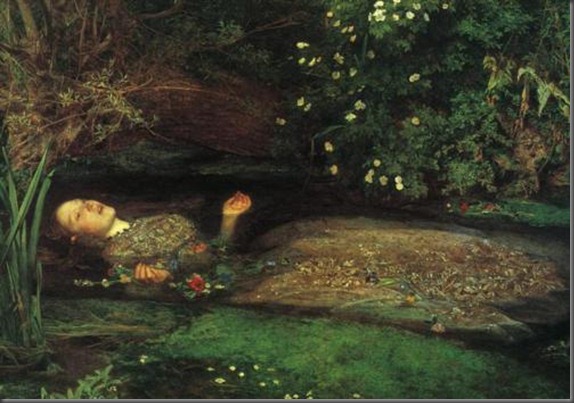
After some portions of the reception are over, Justine ducks into the library and  changes the open art books on display from abstract geometrical shapes (put there no doubt by John as they reflect his dull patriarchal-modernist tastes) to archaic pictures of female suffering and/or death and peasant post-wedding debauchery.  There's: "Land of Cockaine" and "Hunters in the Snow" by Bruegel; "Ophelia" by J.W. Waterhouse; and "After the Hunt" by Bogarde. As in DOGVILLE and ANTICHRIST, this book swap seems a full rejection of the flat, dull left-brained scientific rationalism championed by an insufferable materialist know-it-all in favor of a return to the mythic unconscious where every day is your last so you better get connected back to your Jungian roots, and hammered, before the whole tree of life goes up in flames.


John rejects such Dionysian nonsense outright, but his own left-brained thinking falls apart at every turn. Unable to to deal with the loss of his empirical toe-hold, deluding and denuding-- as DaFoe did in ANTICHRIST--via smug dismissal of Gainsbourg's intellectually eroticized 'feminine hysteria,' and the neglect of their co-owned horses. Dunst's depression is never fully explained so we naturally look for clues and there are plenty if you hate the fact that all that rich razzle dazzle, the 'very expensive' fairy tale wedding is the closest the dead patriarch of order and logic dares come in the direction of ritual, of 'myth' (outside of forbidden Masonic rites, etc). In going for high class in a materialist bourgeois competitive manner, this stuffy wedding becomes a control freak's dream and an awake aesthete's overload nightmare, where the more money spent the less fun it's possible to have. It's Bruegel land of plenty fairy tale overrun with linear edicts.
Pieter Bruegel the Elder's "Luilekkerland" ("The Land of Cockaigne"), 1567. Oil on panel.
Cockaigne is a medieval mythical land of plenty, an imaginary place of extreme luxury and ease where physical comforts and pleasures are always immediately at hand and where the harshness of medieval peasant life does not exist. Specifically, in poems like The Land of Cockaigne, Cockaigne is a land of contraries, where all the restrictions of society are defied (abbots beaten by their monks), sexual liberty is open (nuns flipped over to show their bottoms), and food is plentiful... Writing about Cockaigne was a commonplace of Goliard verse. It represented both wish fulfillment and resentment at the strictures of asceticism and dearth (Wiki)
Justine prefers dearth
In Lars' film, a ceremony that should be mythically enriched with archetypal energy (a wedding) is stifled by the trivialities which the wedding planner (a marvelous Udo Kier) and the host couple (i.e. John) cling to, insisting on guesses from guests as to how many pebbles are in the foyer vase, for example, and not taking "I don't wanna guess" for an answer. John's outrage over Justine not coming down to cut the cake relates to her boss's slimy demands for a tag line (his weird head games resonate meta as the producers of MELANCHOLIA were no doubt hoping a tag line to this film would occur to Lars, as the image the boss shows her/us, the image that needs the tag, is like a Vogue cover premonition of mythic poses Justine herself will assume later in the film).

While we struggle to not get nauseous from whiplash shaky-cam, the heavy breathing Dogme sound keeps the wedding unbearably intimate: we hear every cut of the meat and every clang of cutlery on the china plates; every breath and wheeze from the gathered throng is amplified like we're tripping our faces off and boiling over in claustrophobic anxiety; trapped in this crowded dining room with all these acting actors talking over each other all at once like real people do in groups, it's as if the secret joy of the movies--avoiding having to talk to people and act civil--is corrupted, the meat and small talk tumbling out of the screen like the guts out of a rotten pumpkin.


At first we don't know why Justine is losing her grip, but we feel it's something to do with the oppressive worry of her sister ("Don't ruin this!") her brother-in-law John ("this cost a fortune") and the insane ravings of her mom. The wedding is a public de-pantsing of artistic success, wherein the best riches and opulence can be is thrown up as buffer against the onslaught of Lars'/Justine's depression, and it all crumbles like fairy dust.

It is only in Justine's subsequent sad melt-down and later ecstasy over the approaching doomsday that she blossoms. The planet is her true groom and its destruction her true union.

Seeing how each person in their group prepares for the end, I was reminded of my own strange exaltation on the day of 9/11, the acrid smell of the burning buildings in my nose as I went racing up deserted 2nd Avenue at midnight, brain thrilling that it might the world might end any moment. Any building might blow up at any time! I was alive for the first time in years, I was FREE of all my conceptions of self and the world around me. New York City was a ghost town at that hour. Not a car or soul on the street but me. Yet, I managed to grab the only train running, a single C-train that suddenly arrived at Brooklyn Heights as I went racing down the stairs, and to find one cab when I got off at 78th street (?) and me and the the cab driver were like the post-apocalypse, like ESCAPE FROM NEW YORK, map of the bridge! Hey! Hey! HEY!

I knew my exaltation was not 'proper' but also, later, learned I was not alone in feeling it, especially at the uptown AA meetings I attended in the weeks that followed. We had a lot of firemen and cops up there at those meetings and we felt their pain and grief at losing--roughly--half their number in a single day, but we, the non-responder/survivors, were strangely calm, more serene than we'd been in some time. We went to the movies never sure if the city would be there when we got out, thus comedies took on special import (ROCK STAR, ZOOLANDER, coming to mind).

In this apocalyptic moment, we AA people were at peace. Our constant existential dread, so useless in normal life, was suddenly the norm. Now that the world was blind, our impoverished vision made us royalty.

What’s madness but nobility of soul
At odds with circumstance? The day’s on fire!
I know the purity of pure despair,
My shadow pinned against a sweating wall.
That place among the rocks—is it a cave,
Or winding path? The edge is what I have.

                 –Theodore Roethke, “In a Dark Time”


John however, will have no such apocalyptic acceptance, and in the period after the wedding he belittles and dominates Claire in a vain effort to allay her anxiety about the approaching planet. In his bland pretense he resembles past Von Trier male characters of past films like Dogville and Antichrist, authority figure wannabes who do their best to dominate the women in the room but come off sad and impotent, wanting in the shadow of some dead patriarchal ideal that dominates both genders.

In TREE OF LIFE we saw the dawn of the earth, and the first vague gestures of compassion, leading up to some beach-side dream jazz heaven cast party. That's the kind of soiree Claire wants to have as the planet looms, a Cockaigne-style acceptance of the end through drink and song and togetherness. From her new husband's picture of an apple orchard he's bought for her, to 'rest' in, to the pebbles in the jar Udo Kier wants everyone to guess the number of--everything but the strange request to 'build caves' from the son, to return to Werner Herzog's CAVES OF FORGOTTEN DREAMS, perhaps, and to the mythic inner reality of Jungian archetypes of which we are the shadows on the Platonic walls-- is, in Justine's eyes, contemptible. 


Von Trier shows that all the money in the bourgeois world of wealth and rationalism won't allay or abet this impending cloud, only Justine's resolutely transcendental delusion is some kind of salvation. Hers is the peace of the twisted. She is a herald, one of the women and men who have writhed backwards through time due to years of enduring the stale, hollow pleasures of Cockaigne. Like Jack in the 1920s New Years eve picture at the end of THE SHINING, Justine moves backwards into the representations of the past until she's as indestructible as the planet Melancholia itself. I hope Lars doesn't mean to follow her quite yet, though at this point he's running out of language, image, and time. Every new film shows a little less sand in the hourglass and MELANCHOLIA shows the hourglass itself breaking into slow motion splinters. Soon he will have nothing left but sand, unless... 

May I suggest an Effexor + Wellbutrin + Neurontin cocktail, sir? It works wonders! Cockaigne is for suckers, as Bruegel and Lacan well knew. When life gives you only lemon orchards as far as the eye can see, no amount of lemonade-making can allay the soul-curling sourness. One must burn and run, even if there's nowhere to go but deeper into the ash crevasse.


POST-SCRIPT (12/7/12): As Justine gets out of the limo to head into the reception, she spots the incoming planet--still just a dot in the sky but she recognizes it--and five days after seeing the film it dawned on me that even so far away she recognizes it as our onrushing doom and her deliverance. So fuck it, she tells off her boss and dumps her groom. But isn't that what depression is all about? She doesn't bother to share her realization though, knowing perhaps that in the house of a coddling smugly bourgeois materialist like John it's useless to bring it up. Considering this, the film suddenly comes into sharper focus for me, so thought I'd add it! 

Special Thanks to Jennifer Boyer,

Thursday, September 09, 2010

The Kinski Precipice: Herzog's MY SON, MY SON, WHAT HAVE YE DONE? (2009)

morte magis metuenda senectus...

Despite its wordy title and relative 'smallness' of scope, MY SON, MY SON is awful good. David Lynch produced (note the LOST HIGHWAY bathroom above), Herzog directed and it turns out they share a lot of sinthoms: deep woods, coffee, dwarfs, murder, Piper Laurie, transcending time and space; you can feel their collaborative heat shimmering on the horizon even when nothing else is happening, as it usually isn't.

I've loved David Lynch even when I hated him, but up until the awesome BAD LIEUTENANT 2: PORT OF CALL NEW ORLEANS, I admit I had a hard time with Werner Herzog. For example: I just couldn't 'get' AGUIRRE, WRATH OF GOD (monkey armies? When?) and GRIZZLY MAN (there's audio of a fatal bear attack and you just show yourself listening to it on headphones and don't let us hear it? I made a whole movie savaging that decision) Then there's Herzog's titles, which like MY SON... are often whole sentences in length: LITTLE DIETER NEEDS TO FLY? Excuse me? Am I blocking the runway? EVEN DWARFS STARTED SMALL? Es tu serio? Do we expect them to be born larger than normal?! My Argentine ex-wife had an old moldy PAL tape of DWARFS on our shelf for years and just the spine filled me with horror at the thought she would one day force me to watch it. It was the title more than anything else, a dumb jokey pun supposedly underlying some kind of GUMMO reconstruction of JACKASS-style hooliganism. As a Herzog title might read, I THANK YOU VERY MUCH BUT I'D RATHER GET A ROOT CANAL).

But now that I'm old and wise and have a good DVD player, am divorced from that Argentine --the moldy PAL tapes are gone and I've grown to appreciate Herzog's hallucinatory nautra metus, his anthropological mysticism, his lysergucolic documentario-synclasticism, his willingness to let an eye for artistic composition and high strangeness give the impression his static panoramas are hurtling across time and space far faster than the rest of the planet,  which turns out to be the same thing as standing motionless while the planet revolves below. I can't help but admire his willingness to heedlessly plummet into the void of insanity alongside any character who happens to be going that way, rather than hanging around on the precipice making excuses like Barbet Schroeder, even if the result is sometimes the same.

Newly minted in my admiration, I went into MY SON MY SON, WHAT HAVE YE DONE (2009) with open arms... and came out opened, and exposed.


Based on a true story about a troubled California man who killed his own mother after getting too deep into his part in a local production of Elektra. Herzog takes that germ of police blotter headline and brings (of course) a journey to Peru into it and cranks the insanity til it floods every corner. Michael Shannon plays the matricide perp, Brad. A recording of long-dead and tres obscure traveling blind preacher Washington Phillips singing "I was Born to Preach the Gospel" plays the voice of God, while the Quaker Oats guy on the Oats tub in the pantry supplied God's beaming face (and it's an effective combination); Chloe Sevigny is Brad's patient girlfriend. She tries to channel his madness by bringing him into her theater group, but you can't exorcise holy madness with the Orestia... she should have waited til they covered Bye Bye Birdy. Better she should move on, there's nothing he has anyone could possibly want... She should, like, call me. Compared to Brad, I'm the picture of sanity.


do ya bend mighty low?
The cast overflows with stock regulars from both Lynch's and Herzog's collective oeuvre: Brad Dourif channels Jack Nance as Brad's ostrich-farming uncle; Willem Dafoe is the hostage negotiator; Udo Kier the theater director; Piper Laurie the sad, isolated micro-meddling mother who pushes her boy over the edge his own psychotic inner voice has led him to, the same voice that warned him at the last minute not to kayaking with his hippie friends (they all drown, offscreen).

Awakened and chastened by this near miss with fate, Brad takes the blinders off, cleanses his doors of perception and loses his shit tripping on all the old peasant faces along the Peruvian waterfront. He gets all Jeff Bridges FEARLESS and and throws aside the handlebars that would keep him from tumbling off his tricyclics into the broken glass streets of messianic schizophrenia.

Back at home his clinging mom thinks the answer to his madness is more Jello. And so what can a poor man do, once Orestes starts speaking to him from across the centuries, but carve his way to freedom? Well, most of us would just move out, as he should have long ago...

As Don Wilson of the Jack Benny show used to say, "there's only one Jello! Look for the big red letters on the box!"

On that note, I think the part of Herzog's quest to find the holy grail of pure charismatic messianic madness and capture it on film may be a smokescreen for his private worry he already found it and lost it, namely in the eyes of the late Klaus Kinski. For the recent BAD LIEUTENANT--of which MY SON is almost a sequel thanks to similar cinematic patina and supporting cast (Shannon, Brad Douriff, Imra P. Hall, and Michael Pena)--Nic Cage brought his own line of insanity, a hipster American Kinski with more of a gonzo sense of self-aware humor. There was little room left in BAD LIEUTENANT for Herzog to project his post-Kinski stress disorder -- Cage filled the void. But Shannon doesn't have that leading man glow. Without a strong lead to delimit his relentless naturalism, Herzog's liable to forget that it helps our appreciation of onscreen derangement if we first see someone else in the film act normal at least once or twice. This lets us get our bearings, gives us a direction in which to go.

In other words, watching Kinski go insane was watching Kinski, but you can tell Michael Shannon isn't really crazy --he's just a moderately reptilian-looking actor exploring the full scope of the manic-messianic complex. There's no charm to his insanity, no charisma, no reason we can see for anyone to put up with his ravings. Unlike, say, Robert Duvall in THE APOSTLE or Graham Faulkner in BROTHER SUN SISTER MOON or Gregory Peck in MOBY DICK, you don't want to throw down your breadcrumb sins and follow him outside the gates of Eden.

Someone like Kinski may have been unbearable to work with but we can see why Herzog kept going back to him. Remember when Klaus was a hunchback shot by Lee Van Cleef in A FEW DOLLARS MORE? I mean look at those eyes (below), they're worth enduring any amount of abuse, if you truly care about making archetypal myth, of capturing genuine madness which is the 'only performance that truly makes it." Michael Shannon just doesn't achieve it, he doesn't have that same unholy glint of mischief in his eyes. He can act crazy very well--he even looks crazy--but he's not crazy. You can't fake it that deep. You are or your aren't. God, when are they going to put Huston's FREUD out on DVD, so we can see Kinski make love to a wooden leg? I'm standing by, wad of bills in hand.

Other cast members of MY SON don't have the (lack of) madness problem: Willem Dafoe as the homicide detective and Udo Kier as the theater director are more terrifying trying to do 'straight' than Shannon is trying to do 'crazy.' But since the ensuing flashback episodes are all there to illustrate 'how it came to this,' they're all about Brad's 'increasingly unstable behavior' and that's the problem. Why didn't someone recognize he needed psychiatric care long before this? And the flashbacks require us to also wonder why anyone would endure him and his messianic madness if he's not funny, hot, magnetic or fascinating to be around? Was he ever normal? A contrast to a pre-crazy time would have made the crazy either tragic or positive.

This guy knows what I'm talking about. Sane Udo is crazy anyone else... and we love him for it.

As the Herzog stand-in to Shannon's mercurial Kinski, Udo Kier indulges his lead actor's tantrums and irrational mood swings with the resignation of a rich older gay man indulging the violent whims of his rough trade houseboy. It's an indulgence that only vaguely taps into he genuine fascination artists feel around those crazier than they are, nor does it illuminate the horrific toll of soul-emptying world weariness it takes to do a film or a play with someone who's completely delusional. Just to try and get even a little of that mercurial lightning on record one has to risk death, money and aggravation. But unable to connect to Shannon, Kier doesn't project the fascination and structuring talent that would possibly placate his star. Since their relationship never becomes vibrant or larger than life, we never really understand why they even bother hanging out with each other. Shannon's Brad doesn't need a man, he needs a doctor with a talent for convincing paranoid schizophrenics that anti-psychotic medication is oatmeal straight from God's loving farm.


Herzog's worked with other crazies besides Kinski, of course, many of them clinically insane, but since Shannon doesn't bring any of his own looney tunes baggage, he has to settle for whatever was left behind by past actors in the vine-covered boarding house of Herzog's fetid, fecund vision. And we sense--not by any mannerisms or tells on Shannon's part--Kinski is working ghostly machinations between the synapses, a matchmaker creating the space and then stepping back into the shadows, perhaps too far. One hungers to see Shannon give us just a little of, say, the primal scream commitment of Crispin Glover screaming in fear at the sight of a single black glove on the kitchen floor in Lynch's WILD AT HEART or Nic Cage babbling about his lucky crack pipe in BL2.

The collaboration between Cage and Herzog gave that film a reckless, exhilarating momentum, but the Lynch-Herzog -Shannon collaboration neglects the 'glue' of normal 'strong' grounding characters like Eva Mendez's prostitute in BL2, or a Lynchian warm maternal heroine like Naomi Watts or Laura Dern. Willem Dafoe tries to be grounded as the homicide detective on the scene, but Dafoe will never be able to play 'grounded' --the more he tries, the creepier he gets --and I mean that as a compliment. He's too nice and sweet a soul to play one on TV. He's warmer when he's colder.


In the end, what can we deduce about Herzog's pet motifs?  Hanging out with messianic schizophrenics keeps him sane, maybe, but he'd never get so many details of the devouring maternal Dionysian Kali goddess so very exactly right without firsthand witness to the giant mantis alien that sucks the psionic marrow out of every unopened third eye (which is why society is structured to keep the third eyes shut at all times.)

This mantis isn't actually a hallucination --it's the only real there is, and the ability to see the way blood runs in rivers just behind the thin adhesive bandage of temporal reality's aching skin--  hurtling in every car ride towards crushed oblivion-- is enough to make you gouge your eyes out, to no avail. (like that cut line "I can still see!" on THE MAN WITH X-RAY EYES).


Enlightenment and spiritual awakening in the average individual leads to separation from the social order, which has no way to gauge or evaluate the sudden conversion of a once-normal 9-5 office drone into a state of 'holy madness.' The only difference between schizophrenia and holy spirit, then, is time and place, coherence of expression, and artistic outlet. For example, Brad's crazy mom spoils him, buys him instruments and art supplies and paper the moment he evinces a whim to try something artsy (music, painting, etc). He's thus blocked from doing any art because of her suffocating supportiveness. If she could just leave him alone, or provide him with rules to rebel against, his madness would have contours to call its own.

Seriously, didn't any of the people involved in this film ask themselves how or why someone so clearly suffering from latent schizophrenia brought on by survivor's guilt and an overbearing mother would manage to keep any friends or colleagues, let alone get to date Chloe Sevigny!? What's wrong with this land, this America refracted through the Herzo-Lynchian fantasmatic? I do not know. But here's what I did learn from MY SON MY SON:


1. The only way to channel holy madness without creating misery or your own crucifixion is to create art. BUT a true artist can get so deep into their character they can't get back out. Don't think it doesn't happen! The Joker killed Heath Ledger.

2. No matter how bad things get, old country blues and/or gospel can save you. They should play the blues round the clock in insane asylums. When I was deep in misery,  I used to sit around listening to old LPs of Blind Blake, John Lee Hooker, Leadbelly and Blind Lemon Jefferson, and always felt better, and when things got really bad, Washington Phillips, whose "What a friend We have in Jesus" has been the closer on dozens of my mix tapes, perfect right after Zeppelin's "Achilles Last Stand." For Brad, it's Phillips' "I was Born to Preach the Gospel (and I sure do love my job)" which he takes literally as a cosmic message. Dude! I've so been there. Part of the reason the LSD San Francisco rock scene covered so many old blues songs becomes apparent (beyond the post-folk revival) in this context. Nothing gets you out of a bad trip head space faster.

3. To really escape the mantis and open the third eye, an artist/writer needs to break away from their urge to always write things down and reconfigure all experience in the terms of their art, to instead live in the moment in pure joy and unrestricted awareness. Art--though higher then most other forms of escape--is still escape, a way to break short of merging into the all-consuming flame of direct spiritual experience, i.e. complete surrender of ego, of self as different than other people and the world around you and the stars around that. Instead, we get really, really close and then remove ourselves from the moment in order to write it down, photograph it, draw it, record it... etc. Creating art may be what stops us from going over the edge of madness, but unless we let go of the rope once in awhile we'll never see the bottom, so what can we really talk about other than our own navels? We will never accept death, never leave our body, nor dissolve in the oceanic sea, and suddenly re-assemble as if every cell of our body had just been to the cleaners --unless we plunge, sans pen, sans camera, sans eyes, sans everything into the abyss and therefore back into ourselves, forever changed back to the same.

Perhaps this last idea is succinctly exemplified in the way we will spend a vacation in an exotic foreign land squinting through our cameras rather than soaking up the views with both eyes open. We find ourselves saying "isn't this fun?" or "Oh, look at that mountain, honey!" or "Caitlin, are you having a good time, Caitlin?" as if needing to constantly bring ourselves back from the abyss of pure egoless presence, preferring to work on solidifying the memory of joy via photos and talking rather than abandoning language and recording devices at the door, so to speak. Writing helps us remember moments that we never really had a chance to experience because we couldn't wait to get home and write about them. We think if we let go of the rope it will swing back our way, but it doesn't. A new and better one, electric, plugged right into mainline of God's flexed arm like a two-way morphine drip, comes instead, once it's too late... that's what faith is - that leap into the blackness on the chance someone's gonna swing out and grab you from the other side of the big tent.


4.  Freedom from Permanence: This is beautifully realized in a scene with Shannon hiding out in a dark Mexican hotel, raising and lowering a glowing bare light bulb down into the center of a ring of prescription eyeglasses, and then back up again, creating a flower/sun/Tiffany lamp/mandala pattern shadow on the table--a brilliant illustration of the freedom an artist has once they've let go of trying to record and preserve everything. Each raising and lowering of the bulb is a perfect mandala sun flower, unique and non-reproducible. Brad has no need to figure out how to film it, record it, or get it into a gallery or make money or gain fame from it. He's just in it for the beauty. Riveted. All else gone to shadow.


The moral of the story? Next time you're really in it for the beauty and you get that tap on the shoulder from the giant electric hand of your Quaker Oat God, try not announcing  to everyone how spiritual you, just 'be' in that space and come to terms with the value of your own direct experience. Keep it a secret that you can express only in anonymous good deeds.

The ego, like any lover, thrives on adversity --the longer you ignore the ego the sweeter its songs. It starts giving you more of its hoarded stash of dopamine when it feels you may no longer need it. You learn your ego's sitting on a huge cache of solar brilliance and spoon-feeding you muddy shadows to keep itself in power. The person who is deemed mad has managed somehow to knock his ego off its throne (be it by drugs, electro-shock, lack of sleep, meditation, etc.) and break open the cache and let all the dopamine sunlight flood the whole damned place. This person is labeled mad because he initially feels a huge urge to keep this holy state going as long as possible, and to help others get there too. That rarely works though. Better he should learn to let go off both those urges, to surrender even that goal. Instead of shaking the lapels of those still asleep, he should just pray and chant on his own time. Otherwise they just might have to burn him at the stake or crucify him.  He better keep the ego around, after all, in however a diminished form, to not upset the apple cart. He can balance that all out in art, express in art what would be madness expressed directly. He can bury all kinds of magnificent truths people aren't ready to hear any other way. As people in the world with our own egos to deal with, we dismiss ideas that challenge them outright, but the ego feels no threat from a good fiction. Let this art stealthily address ideas of madness and artistry and even tell tales of newly-minted holy men wondering where they're supposed to go now that they're selfless in a selfish world they themselves have made. Ain't that what this is?

 MY SON MY SON conveys the way spiritual enlightenment won too soon can let the ego in through the back door and turn one into a raving lunatic. When the house is only "almost" empty, it's really not empty at all. Roaches and rats lay claim to the podium. You can spot a rat messiah a mile off, and you should run quick away.

Unless of course, like Herzog, you like to make movies about rat messiahs. Ja? In that case better make sure you have at least one very magnetic, very charismatic rat. If you don't... you just might wind up adrift on a raft heading down the Amazon towards unseen rapids... and not a camera in sight.
Related Posts Plugin for WordPress, Blogger...