Showing posts with label Lars Von Trier. Show all posts

Monday, December 05, 2011

Gimme Cockaigne: MELANCHOLIA (2011)

"When life itself seems lunatic, who knows where madness lies? Perhaps to be too practical is madness. To surrender dreams—this may be madness. To seek treasure where there is only trash. Too much sanity may be madness. And maddest of all, to see life as it is and not as it should be." –Don Quixote
When true doomsday comes, perhaps the manic depressives and bi-polars amongst us will at last have an opportunity to shine in calm perfection while walking through slow motion rain. That seems to be the message of Lars Von Trier's latest, MELANCHOLIA (2011). Until then, alas, the ordinary madness of our civilization and all its unconscious munching, adherence to unexamined cultural mores, and slow death momentum, will have to be endured. Lars, I feel ya. But Jeeze. There are pills for that now!

MELANCHOLIA makes me nervous because I don't want to lose one of the best auteurs of our post-art house age and the film has the earmarks of a cinematic suicide note, a message from someone planning to be dead by the time you read it. His whole post-Dogme 95 life is flashing before our eyes and on some level he's reached the frontier from which no traveler returns. In order to keep going into the wilderness, for Lars is an explorer first and foremost, the film ceases to rim a frontier, but rather settles in and lets the frontier fall right upon it. It's a film about endurance, and the inability of some to handle normalcy vs. others to handle apocalypses. And Lars' star Kirsten Dunst, no longer the vampire child of Lestat, or the willowy cheerleader, has never seemed more Nordic. It's as if she's spent her life scowling through meaningless sex and animal fat-enriched meals solely to get to this part, solely to face this one vanishing point.


For in MELANCHOLIA, Von Trier dives headfirst into the same abyss that Terence Malick only wades up to his knees for THE TREE OF LIFE.  There is no real comparison between the two other than their release dates, and ponderous linking of 2001-style classical music-scored outer space vistas. It's fun to compare them anyway: MELANCHOLIA, the tale of a woman's post-wedding depression coming to life in the form of a world-destroying planet, is the suicide note before to TREE OF LIFE's faded funeral notice after. TREE mourns my soon-deceased father but MELANCHOLIA mourns for me, and the son of my unborn son, and the ground beneath our unborn feet.


My girl and I saw the film this past Saturday night at the charmingly dilapidated Brooklyn Heights Cinema with its blaring, distorted speakers rumbling the seats with Wagner's aria to Tristan und Isolde as Kristen Dunst and company writhed in Bill Viola-style (see above) slowness. It was so loud I had to cover my ears. But rather than be the one to complain to the ticket taker, I tried my best to accept it. And then suddenly the music stopped. I missed it.

The 1st chapter of Lars' film is a long and expensive wedding for our melancholy heroine Justine (Dunst) over the course of which she flits with ecstasy before dissolving into a deep depression, winding up in the bathtub upstairs, refusing to come out. The sight of a distant star unnerves her. Soon she's telling off her boss (Stellan Skarsgard), losing her groom John (Alexander Skarsgard, insufferable as ever), sleeping with a kid on the 18th green, pissing off her sister Claire (Charlotte Gainsbourg) and her sister's rich husband John (Kiefer Sutherland), infuriating the wedding planner (a great Udo Kier) and drawing gasps from everyone but her loving drunk of a father (John Hurt) and psychotic mother (Charlotte Rampling), who makes the toast "I think marriage is a crock of shit."

Handheld Dogme verite style used to film weddings by now almost quaint: Demme's RACHEL GETTING MARRIED, Vinterberg's THE CELEBRATION, Baumbach's MARGOT AT THE WEDDING, have already been there. But unlike those affairs, LVT's is a picture of a cold planet bathed in warmth but unable to feel warm, and if you can survive the whiplash handheld camera nausea in these scenes, you can move on to the next course. The bride, however, won't be there as she's upstairs, nearly catatonic with ennui.


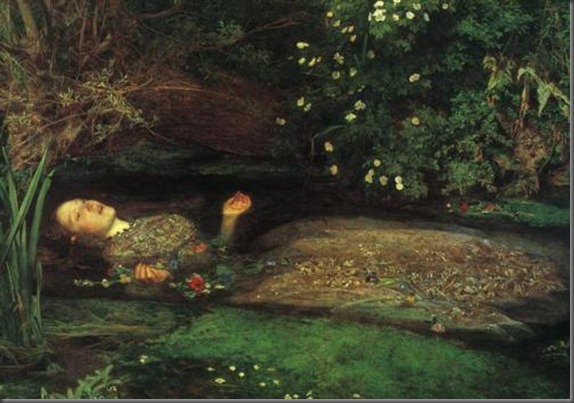
After some portions of the reception are over, Justine ducks into the library and  changes the open art books on display from abstract geometrical shapes (put there no doubt by John as they reflect his dull patriarchal-modernist tastes) to archaic pictures of female suffering and/or death and peasant post-wedding debauchery.  There's: "Land of Cockaine" and "Hunters in the Snow" by Bruegel; "Ophelia" by J.W. Waterhouse; and "After the Hunt" by Bogarde. As in DOGVILLE and ANTICHRIST, this book swap seems a full rejection of the flat, dull left-brained scientific rationalism championed by an insufferable materialist know-it-all in favor of a return to the mythic unconscious where every day is your last so you better get connected back to your Jungian roots, and hammered, before the whole tree of life goes up in flames.


John rejects such Dionysian nonsense outright, but his own left-brained thinking falls apart at every turn. Unable to to deal with the loss of his empirical toe-hold, deluding and denuding-- as DaFoe did in ANTICHRIST--via smug dismissal of Gainsbourg's intellectually eroticized 'feminine hysteria,' and the neglect of their co-owned horses. Dunst's depression is never fully explained so we naturally look for clues and there are plenty if you hate the fact that all that rich razzle dazzle, the 'very expensive' fairy tale wedding is the closest the dead patriarch of order and logic dares come in the direction of ritual, of 'myth' (outside of forbidden Masonic rites, etc). In going for high class in a materialist bourgeois competitive manner, this stuffy wedding becomes a control freak's dream and an awake aesthete's overload nightmare, where the more money spent the less fun it's possible to have. It's Bruegel land of plenty fairy tale overrun with linear edicts.
Pieter Bruegel the Elder's "Luilekkerland" ("The Land of Cockaigne"), 1567. Oil on panel.
Cockaigne is a medieval mythical land of plenty, an imaginary place of extreme luxury and ease where physical comforts and pleasures are always immediately at hand and where the harshness of medieval peasant life does not exist. Specifically, in poems like The Land of Cockaigne, Cockaigne is a land of contraries, where all the restrictions of society are defied (abbots beaten by their monks), sexual liberty is open (nuns flipped over to show their bottoms), and food is plentiful... Writing about Cockaigne was a commonplace of Goliard verse. It represented both wish fulfillment and resentment at the strictures of asceticism and dearth (Wiki)
Justine prefers dearth
In Lars' film, a ceremony that should be mythically enriched with archetypal energy (a wedding) is stifled by the trivialities which the wedding planner (a marvelous Udo Kier) and the host couple (i.e. John) cling to, insisting on guesses from guests as to how many pebbles are in the foyer vase, for example, and not taking "I don't wanna guess" for an answer. John's outrage over Justine not coming down to cut the cake relates to her boss's slimy demands for a tag line (his weird head games resonate meta as the producers of MELANCHOLIA were no doubt hoping a tag line to this film would occur to Lars, as the image the boss shows her/us, the image that needs the tag, is like a Vogue cover premonition of mythic poses Justine herself will assume later in the film).

While we struggle to not get nauseous from whiplash shaky-cam, the heavy breathing Dogme sound keeps the wedding unbearably intimate: we hear every cut of the meat and every clang of cutlery on the china plates; every breath and wheeze from the gathered throng is amplified like we're tripping our faces off and boiling over in claustrophobic anxiety; trapped in this crowded dining room with all these acting actors talking over each other all at once like real people do in groups, it's as if the secret joy of the movies--avoiding having to talk to people and act civil--is corrupted, the meat and small talk tumbling out of the screen like the guts out of a rotten pumpkin.


At first we don't know why Justine is losing her grip, but we feel it's something to do with the oppressive worry of her sister ("Don't ruin this!") her brother-in-law John ("this cost a fortune") and the insane ravings of her mom. The wedding is a public de-pantsing of artistic success, wherein the best riches and opulence can be is thrown up as buffer against the onslaught of Lars'/Justine's depression, and it all crumbles like fairy dust.

It is only in Justine's subsequent sad melt-down and later ecstasy over the approaching doomsday that she blossoms. The planet is her true groom and its destruction her true union.

Seeing how each person in their group prepares for the end, I was reminded of my own strange exaltation on the day of 9/11, the acrid smell of the burning buildings in my nose as I went racing up deserted 2nd Avenue at midnight, brain thrilling that it might the world might end any moment. Any building might blow up at any time! I was alive for the first time in years, I was FREE of all my conceptions of self and the world around me. New York City was a ghost town at that hour. Not a car or soul on the street but me. Yet, I managed to grab the only train running, a single C-train that suddenly arrived at Brooklyn Heights as I went racing down the stairs, and to find one cab when I got off at 78th street (?) and me and the the cab driver were like the post-apocalypse, like ESCAPE FROM NEW YORK, map of the bridge! Hey! Hey! HEY!

I knew my exaltation was not 'proper' but also, later, learned I was not alone in feeling it, especially at the uptown AA meetings I attended in the weeks that followed. We had a lot of firemen and cops up there at those meetings and we felt their pain and grief at losing--roughly--half their number in a single day, but we, the non-responder/survivors, were strangely calm, more serene than we'd been in some time. We went to the movies never sure if the city would be there when we got out, thus comedies took on special import (ROCK STAR, ZOOLANDER, coming to mind).

In this apocalyptic moment, we AA people were at peace. Our constant existential dread, so useless in normal life, was suddenly the norm. Now that the world was blind, our impoverished vision made us royalty.

What’s madness but nobility of soul
At odds with circumstance? The day’s on fire!
I know the purity of pure despair,
My shadow pinned against a sweating wall.
That place among the rocks—is it a cave,
Or winding path? The edge is what I have.

                 –Theodore Roethke, “In a Dark Time”


John however, will have no such apocalyptic acceptance, and in the period after the wedding he belittles and dominates Claire in a vain effort to allay her anxiety about the approaching planet. In his bland pretense he resembles past Von Trier male characters of past films like Dogville and Antichrist, authority figure wannabes who do their best to dominate the women in the room but come off sad and impotent, wanting in the shadow of some dead patriarchal ideal that dominates both genders.

In TREE OF LIFE we saw the dawn of the earth, and the first vague gestures of compassion, leading up to some beach-side dream jazz heaven cast party. That's the kind of soiree Claire wants to have as the planet looms, a Cockaigne-style acceptance of the end through drink and song and togetherness. From her new husband's picture of an apple orchard he's bought for her, to 'rest' in, to the pebbles in the jar Udo Kier wants everyone to guess the number of--everything but the strange request to 'build caves' from the son, to return to Werner Herzog's CAVES OF FORGOTTEN DREAMS, perhaps, and to the mythic inner reality of Jungian archetypes of which we are the shadows on the Platonic walls-- is, in Justine's eyes, contemptible. 


Von Trier shows that all the money in the bourgeois world of wealth and rationalism won't allay or abet this impending cloud, only Justine's resolutely transcendental delusion is some kind of salvation. Hers is the peace of the twisted. She is a herald, one of the women and men who have writhed backwards through time due to years of enduring the stale, hollow pleasures of Cockaigne. Like Jack in the 1920s New Years eve picture at the end of THE SHINING, Justine moves backwards into the representations of the past until she's as indestructible as the planet Melancholia itself. I hope Lars doesn't mean to follow her quite yet, though at this point he's running out of language, image, and time. Every new film shows a little less sand in the hourglass and MELANCHOLIA shows the hourglass itself breaking into slow motion splinters. Soon he will have nothing left but sand, unless... 

May I suggest an Effexor + Wellbutrin + Neurontin cocktail, sir? It works wonders! Cockaigne is for suckers, as Bruegel and Lacan well knew. When life gives you only lemon orchards as far as the eye can see, no amount of lemonade-making can allay the soul-curling sourness. One must burn and run, even if there's nowhere to go but deeper into the ash crevasse.


POST-SCRIPT (12/7/12): As Justine gets out of the limo to head into the reception, she spots the incoming planet--still just a dot in the sky but she recognizes it--and five days after seeing the film it dawned on me that even so far away she recognizes it as our onrushing doom and her deliverance. So fuck it, she tells off her boss and dumps her groom. But isn't that what depression is all about? She doesn't bother to share her realization though, knowing perhaps that in the house of a coddling smugly bourgeois materialist like John it's useless to bring it up. Considering this, the film suddenly comes into sharper focus for me, so thought I'd add it! 

Special Thanks to Jennifer Boyer,

Thursday, January 28, 2010

Cinema's Naughtiest Germans, Part Two

  BIG GIRLS DON'T CRY 
(2002)

The best aspect of this strange tale of German gymnasium girls--torn apart by conflicting development rates-- are the two actresses, one of whom, Karoline Herfurth, looks a bit like Liv Ullman. She plays Steffi, the poutier of the pair, while the radiant and very German looking Anna Maria Muhe plays Kati, her more "normal" friend. Whenever the film is focused on either of their faces, it’s fascinating as they are natural actors who--like real teenagers do-- hide as much from the camera as they show, even if they don’t deliver the powerhouse performances of Oscar-minded Americanische jungen.

On one of the girls' nights out they wind up being picked up by two older men and brought over to a "grown ups" lounge. In Germany, kids can enter bars and drink without i.d.s, making this an interesting contrast with the forbidden, glamorized nature of drinking in typical American teen films, though this environment is still seen as adulthood ground zero, full of sex, drugs, music and disillusionment. Among the disillusioning sights: Steffi's dad, making out on a couch with a woman not her mom and--even worse--the woman is East German! Steffi and Kati key woman's car, track her down to a shitty East Berlin tenement, and then Steffi proceeds to trick the woman's teenage daughter (Josephine Domes) into auditioning at a modeling agency which specializes in adult videos, under the pretext that it’s a record company (knowing from personal embittered experience the owner is a sex predator). Mein Gott! Are Germans really so vindictive that they would want to send girls they don't even know to their death? Oh wait! Of course they are! Was eine unheimliche frage!

Meanwhile another cute blonde girl has disappeared and the whole city is up in arms. Only Steffi knows the truth, and she's too self-absorbed over her dad’s divorce to consider that the psycho killer who almost raped Kati could be behind it. It's as if city-wide manhunts ala Fritz Lang's M were something a teenager would barely notice compared to her own petulant sulking. It really becomes Kati's movie as she must stand up to Steffi, who by this point is snorting coke, sleeping around, and not going to class. Eventually it all boils down to suicide and self-cutting, but along the way there’s lots of music sung in English, and everyone seems to be bilingual. B

 AIMEE AND JAGUAR (1999)

Based on a true story, this is a nice mix of WW2 period craftsmanship and forbidden love that makes most life-under-Nazi-rule dramas look like mopey bourgeois white elephant glad-handing tripe. There's more human warmth and joy in three minutes of screen time with this pair of star-crossed lesbians (one Jewish, one "Aryan") then in the whole goddamned three hours of THE READER (2008). Why am I even comparing? Perhaps because many are the films that mix Nazi vs. Jew persecution with forbidden love and sumptuous period decor and wartime lighting schemes, but few are any good, and this one is great, and didn't even get consideration for best foreign film in 1999. It did get nominated for a Golden Globe, Oscar's sleeker more artistically comprehensible, less bourgeois self-congratulatory cousin.

As Felice the Jewish lesbian "hiding in plain sight" as assistant editor of a Nazi newspaper in 1943, Maria Schrader is an absolute knock-out, a jovial gamin who'd be ideal as a cross-dressing Shakespeare heroine, ala Rosalind in AS YOU LIKE IT. We believe her dangerous good cheer because Schrader plays the role with a fearless recklessness that perfectly captures our hearts and her character... her decision to risk discovery in order to stay with her Aryan hausfrau lover Lilly (Julianne Kohler) is the most beautifully brave and foolish move since Winslet jumped off the lifeboat in TITANIC (1997). Their love is hot enough that you understand why she makes this suicidal gesture. It's beautiful to be that swept away, like THELMA AND JULIET! Even more startling, the film seems true even as it's completely insane, and still covers all its thematic and narrative bases to leave you profoundly moved. Best of all, sullenly self-righteous books-on-tape artist Ralph Fiennes is nowhere to be found. A

ZENTROPA 
(AKA EUROPA, 1991)

An early Lars Von Trier gem, not quite a masterpiece, perhaps due to lack of star wattage, a killer performance from Ernst-Hugo Jaregard and Udo Kier aside. Von Trier fans know Jaregard best as THE KINGDOM's  Dr. Helmer and Udo Kier from.... well where do you begin? Here he's an ennui-ridden gay brother of femme fatale love interest Barbara Sukowa (LOLA), and maybe a werewolf (in the post-war German terrorist sense). Alas, much screen time is eaten up watching dumbkopf American expatriate Kessler (Hean Marc-Barr) mess things up for his exasperated sleeper car conducting uncle. If you're a fan of trains you don't have to know why Kessler expressly requests the sleeper car. Damn is it sexy there. A giant box full of dreaming passengers, careening along through the Hamburg night, it's an ideal mirror to the audience in a dark theater. But Kessler is like that temp you hire only to have to spend so much time correcting his mistakes you may as well do his job yourself in addition to your own. No doubt Von Trier wanted it this way. He considered this a masterpiece and gave the Cannes jury the finger when he didn't win the Palme d'Or. But Americans don't like seeing Americans portrayed as incompetent patsies by Europeans. We hate that they love Jerry Lewis, or maybe just I do.


Yeah, Von Trier is Danish, but the film's set in post-war Germany so it still counts! Best of all it's got a German message: if you're not fighting to the death for a cause, no matter how doomed, then you're asleep at the wheel and may as well go off the rails. Words to live by, until someone reminds us it's from Mein Kampf.  And the Germans love trains, punctuality and death in equal measure. PS - there actually wasn't too much werewolf activity in Germany aside from some vivid pirate radio shortwave messages, as most of the werewolf engineers fled to Palestine to help organize, you guessed it, anti-Israeli terrorism!  Gott in Himmel! B+

Friday, November 13, 2009

Acid's Greatest Horror #1: ANTICHRIST (2009)

My original conception of a #1 one horror acid movie has hovered between THE HOLY MOUNTAIN, THE WICKER MAN and HOUR OF THE WOLF. How awesome then, that Lars Von Trier's ANTICHRIST should come along and perfectly encompass all three, and work almost as a remake of POSSESSION besides?

Anyone who ever wondered what ZABRISKIE POINT would be like if done by David Lynch, and if he was a bigger fan of David Cronenberg and D.W. Griffith, would be wise to brave it. Don't let the frightened critics spook you just because there's some genital mutilation and shocking sexuality. You can handle it. If you're like me and a lifelong victim of anxiety and depression, then you'll really handle it. In fact, you'll dig into it so deep you may just decide to lie in it like a deep root coffin, hoping for your own Charlotte Gainsbourg to come fill the hole above you with comforting black dirt, while you wait for the comforting kiss of the conqueror worm!

Though a toddler figures into it, and some talking forest animals (!) this is a two person piece, which is fine when the people are Willem Dafoe and Charlotte Gainsbourg and the man behind the scenes is the public depressive Von Trier (and even the illiterate can relax since it's in English!) The story is simplicity itself: a pair of screwed up marrieds head to a cabin in the woods after their child dies, there to "face her fears" mainly because he doesn't want to sleep with her. Charlotte goes insane from grief and her man's constant self-righteous attempts to "cure" her crippling anxiety (he's a behavioral therapist). Along the way, ye olde link between psychiatry and witch burning is exhumed, but mainly the landscape warps and weaves just like its wont to do when one is... warped. If you've ever been on major psychedelic drugs in the woods and gotten lost and wound up having a six hour conversation with a tree root about your impending death by starvation and exposure, only to find out you've been sitting in the petrified remains of a half-eaten fox and--oh wait, it's just some leaves--and anyway you've only been outside two minutes, and you're just a yard from the house where your friends are inside laughing hysterically while watching WAY DOWN EAST, then you'll know why this movie rocks so bad!

It's always amazing to see how many apparently normal people think Von Trier (like Neil LaBute) is a misogynist just because he makes films that address misogyny. In his films misogyny is a warping factor in archetypal cinema-psychology, not just an unconsciously endorsed lifestyle ala every "rom-com." If you want a list of real misogynists in cinema, just look at: Michael Bay, Cameron Crowe, or the geniuses behind PORKY'S, LAST AMERICAN VIRGIN and/or any stupid sex comedy or most of the slasher films to come along in the early 1980s.

Can I venture to say that the label "misogyny" is in this context only a detriment if its clearly unconscious on the part of the director and the film is marred by a subtextual contempt/hostility for the feminine? Von Trier's film may be partially about the "misogynistic response" but it in no way condones that response, and in fact rejects it. Yet the same critics who hate ANTICHRIST undoubtedly are rejecting the right of femininity to show its true warts-and-all self, its ambiguity over desire and fear, creation and destruction. For many supposedly enlightened critics, to see this thing is to automatically have to throw a rock at it, like a snake in the woods. And yet, it's Von Trier that they then accuse of hating snakes.


Compare ANTICHRIST to a Michael Bay movie such as TRANSFORMERS, wherein the fear of the feminine means every chick in the film (the few) have to be stunningly gorgeous, in form-fitting slutty clothes, walking in slow motion to an Aerosmith song and men in the audience are encouraged to leer from the safety of the dark and their pack of dudes, or basements. This snarkiness stems from a fear of the "other" that hinges on the sociopathic. Since there's not enough access to full understanding of female oppression vs. the barrage of sensationalistic media that assaults the average American every day, it's not surprising a pampered/sheltered American auteur sees so shallowly into the murky waters of the female psyche. The film adaptation of Margaret Atwood's HANDMAID'S TALE (1990), by contrast, shows misogyny as a widespread institution, yet what feminist would dare accuse Margaret Atwood of misogyny? And the genital mutilation shown in ANTICHRIST is forced upon many girls--even today--as they reach puberty, so who is more a misogynist, Lars, or those who just ignore/deny the barbaric practices of some of our extremely fundamentalist Muslim brethren? To me, that act itself means war! We should invade, and rescue these girls before it's too late!

May I venture to take a page from the book of Camille Paglia and suggest that if someone is afraid to look head on into the wild devouring Dionysian oceanic dissolution represented by pure unleashed feminine sexual drive then it is they who are the misogynists, not the artists who at least have the cajones to face such a deluge? Women get knocked around in the films of Von Trier, Peckinpah, Polanski, Hitchcock, but they don't fall down. In a lot of more conventional movies women never even get to stand up. Those directors who--rather than wade into the vaginal sea-- just scoop out a handful of muck from off the bank and then parade it around on a stick, or wrap it in tight spandex and shoot it out of a wet t-shirt canon, then wait to film it after the threat has been "subdued", i.e. objectified, crashed, burned at the stake, and/or mangled --they are the enemies! Is there a difference between silicone and sawdust when it comes to Norman's mommy's smothering breasts?

Ding-dong the witch is dead, but when the witch in OZ melts it's no more a permanent defeat than it would be for Medusa losing a single snake of her hair. Norman knows this all too well; he must kill and display his trophies over and over again. Their hair keeps growing long after their bodies have withered to bone and parchment skin. Death not ends it, only castration... old Teiresius with his dugs, wandering off into the Led Zeppelin wasteland night.

But enough of my deftly Eliot-alluding tirade, I've gone way off-path; let's wander back to the wild of the woods, where there's Charlotte Gainsbourg--raw and feral--as a castrating lunatic, digging deep into warrens to hunt her smug, covertly gynocidal therapist husband...

Gainsbourg, even as a child showed, she gave not a crap about social taboo, just by being sired by reprobate Serge (they sang "Lemon Incest" together on her teen pop debut) and here she is, acting it up in a string of solid Gallic hits (and albums) and now this performance, which is the gutsiest, rawest thing I've seen since Isablle Adjani in POSSESSION or Isabelle Huppert in THE PIANO TEACHER, and if the Oscars had any chutzpah she'd win next March, but there you go, more proof who really is the misogynist here - c'est Oscar!!


FURTHER VIEWINGS:


If ANTICHRIST confuses thee even after this sterling review, forget about the last 40 years of cinema, and compare it to 1960s and late 1950s Freudian Gothics like SUDDENLY LAST SUMMER, REFLECTIONS IN A GOLDEN EYE and WHO'S AFRAID OF VIRGINIA WOOLF... You might also bring in Tarkovsky's SOLARIS and NOSTALGIA. Lastly, of course, you should compare it to IN THE REALM OF THE SENSES and every other good movie about castration. Aint nothing wrong with sparagmos and genital mutilation if it's done with clear-eyed awareness of the symbolic associations thereto, and by the mutilatee's own choice, not by some barbaric institutionalized misogyny. Second to lastly, dig up some moldy wet dirt-encrusted comparisons to the Japanese horror film, MATANGO and of course FEMALE CONVICT SCORPION: JAILHOUSE 41.
--

In the end, just keep repeating "No sexual organs or appendages were harmed during the making of this movie." It's all a dream. All just stuff that transpires in that murky woods that exists between the unconscious symbolic and the ambiguity of the real, all just what the tree root says while you're outside, lost and tripping, a mere 20 feet from the front door. And if you're going / to San Fran / cisco / be sure to wear / some flowers in your hair... otherwise the loving people there will rip you to shreds and eat you alive, until all that's left is just a mouth, still screaming down the wind... for pusss-ay.
Related Posts Plugin for WordPress, Blogger...