Showing posts with label castration. Show all posts

Friday, March 15, 2019

Argh, Matey! THE WITCH WHO CAME FROM THE SEA (1976)


Hey sweetie, let a man 'splain it for you: the 70s were a great time for feminist horror, though the word back then was "women's lib." It was all about being liberated --via sex, pills, books, grass, the sea, castration, and the occult, and violence, too! Paths out one's domestic bliss trap were varied and didn't all have to end in death or marriage. Horror movies latched on for the ride, but the trip would usually make the girl go Ophelia-level mad before she found she wasn't crazy at all: the whole world was a massive patriarchal cult determined to keep her 'down'.  In films like Let's Scare Jessica to Death (1971), The Sentinel (1977) and Stepford Wives (1975) she's actually sane and everyone else is nuts (as in Polanski's Rosemary's Baby). In 1975's Symptoms, for example, it was the other way around (ala Polanski's Repulsion). But it turns out there's a third way (beyond Polanski's ken), where the woman is crazy and 'liberated.'  Truly a product of her moment, far outside the reaches of conventional nuclear family values, she's a heroine for her times-- sweet as applejack with a kick that could geld a stallion at thirty paces. It's not traumatic though because the people around this crazy lady genuinely love her and are, more or less, normal, or at any rate, pleasantly debauched (you know, not a bunch of drags). There's only one film like that in all of western civilizations: Matt Climber's 1976 near-cult semi-classic, The Witch who Came from the Sea. It's not hard to guess why this film has never become a big cult classic it deserves to be (or why there's no Polanski template). But now, on Prime in HD and looking good, albeit slightly faded, there's no reason not to batten down the hatches, zip up to and delve into primal Freudian/Jungian chthonic murk so thick and rich it must be good for you to get this squeamish. If you're an ally, plunge in!


I'll confess: my squeamishness when it comes to seeing females abused in movies--even if the abused, or Liam Neeson, wreaks suitable cathartic vengeance--will make me avoid a movie altogether no matter how ubiquitous it is in 'the conversation' (I still ain't seen Last House on the Left or Irreversible). My Ludovico-induced feminist liberal arts programming is too strong for such imagery not to linger in my brain, tainting all subsequent media consumed by association; I have to write vast screeds on Bright Lights to vent about it just to breathe. So I staved off seeing Witch even though it's right up my alley (if you'll forgive the expression) as far as being pro-castration (I'm no militant, but I consider Teeth too sensitive and Hard Candy too soft). Imagining a depressing 16mm treatise on child abuse and dirty wallpaper (looking dour and grungy like Romero's Season of the Witch), I avoided Witch who Came From the Sea even though I've been long drawn to Witch's poster of a defenestrating Kali Venus, rising on the foam of the castrated lovers. So I was glad it showed up on Prime looking all engorged and gorgeous.  I finally had the nerve to see it last weekend after coming home from Gaspar Noe's Climax at the Alamo, since I was already in shock (so knew I'd be, temporarily, invulnerable to further trauma).

Turns out, I had nothing to worry about. It rules!

It 'gets' it - the brutalizing way so much abuse is depicted on film clashes with the mind's ability to cover up unendurable experience in the shroud of dream and abstract memory. Thus the childhood trauma flashbacks are warped by cartoon and ocean sound effects and bizarre incongruous details that make it all too strange to feel brutalized by, instead the feeling is like remembering strange nightmares from childhood, too bizarre to be terrifying- the brain abstracting trauma until its palatable (and then splitting off a separate persona as a side effect).
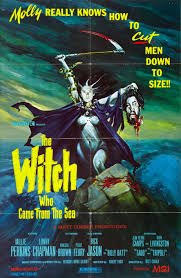
Millie Perkins stars as Molly "The Mermaid," a single barmaid at a seaside dive on the beach of Santa Monica, "The Boathouse," owned and operated by the pleasantly grizzled Long John (Lonny Chapman). She's not just great babysitter to her two adoring nephews, beloved of clientele and employees, but she has the ability to 'get' good-looking men as if fishing them out of the television. Aside from headaches as her brain struggles to keep the lid on her buried incest childhood by cloaking it in all sorts of nautical imagery and oceanic sound effects, she's perfect. Maybe she's mad as a hatter, and has a weird thing for good-looking men on TV, as if they can see her from the screen, and are propositioning her. Maybe she keeps talking about her lost-at-sea captain father as some kind of omnipotent hero despite her more grounded sister who assures her kids he was a monster. But she's not 'victim' crazy, not a cringing trauma victim or a twitchy mess. She's crazy in a way that encompass sanity within itself. When a bubbly blonde actress (Roberta Collins) at the bar bemoans not being liberated, which is now a requirement for TV she glances over at Molly in her patchwork denim and declares she could be in commercials: "You look liberated." The older barmaid Doris (Peggy Furey) adds that "Molly is a saint, a goddamned American saint." Later when her nervous welfare-collecting sister Cathy (Vanessa Brown) shows up to try and convince them of the truth, "you think she's just about perfect," she says to Long John. "Yeah," he snaps back, "why not?"

We agree, thanks to Millie Perkins' dynamic, confident, warm portrayal we love her as much as the staff and her nephews do. Anything she does is all right with us. She's a goddamned American saint.


That's what makes it so tragic. Molly is a liberated saint, yes, but she has no grasp on reality, and it's not the social world's fault, it's the fault of the family dynamic that would let her vile father rule the roost in such a horrifying way (we never see if she has a mother). It's a mix of latent, incest trauma-induced schizophrenia, wherein she sees people on TV talking to her, and her childhood is--understandably--warped and blurred in a salty sea spray of nautical mythology, punctuated by deeply unsettling visions. She has a habit of being drawn to people on it or connected with television, only to then kill them or is she merely fantasizing. She presumes the latter but lately, who knows. If she hears someone is dead she announces she won't believe "if it's true or not until it's on television." As if TV isn't lying to her constantly, the men on it leering out at her, calling her forward. Her dichotomy seems to be a relaxed ease in the anonymous oceanic of the bar, and the bed of salty pirate Long John, a grizzled old reprobate who accepts Molly as she is, no strings. ("Molly is the captain of her own ship.") The bed seems to be in the bar itself, and as such it becomes a very weird uniquely 70s cool spot, with panelling and aquariums and mermaid and nautical bric-a-brac, including those painted mirrored wall tiles that are often associated with orange shag and faux rock walls.

"Her father was a god; they cut off his balls and threw them into the sea."

The ocean plays a huge part, though the film never gets out on a boat, we see the ocean outside the window, and hear it deep in the sound mix, the town where they live seems largely deserted, so shops like Jack Dracula's tattoo parlor loom with an almost Lemora-style surrealism. The flashbacks are all given a surreal, sometimes darkly comic, patina, with comically distorted or ocean sound effects as if her brain is working overtime to contextualize the most primal and odious of endured horrors in terms of oceanic myth. The sea itself becomes her father, a timeless chthonic wellspring, an ultimate signifier connecting this film to everything from Treasure Island (hence the name Long John) to Moby Dick (the local tattoo artist's long tattooed face evokes Queequeg). The soundtrack is a brilliant melange of background sound (the ocean's waves are never out of earshot) and ironic electronic counterpoint: when the melody of a sea shanty she's half-singing while going in the bathroom, the two football players tied up, is suddenly picked up and finished by the ominous soundtrack as she comes back with a razor, its the kind of darkly comic interjection that would make John Williams probably shit himself with fear ("do you shave with straight razors, or is this all going to be agonizingly slow?"). When Molly learns of Venus, born in the sea, according to one of her pursuing men, ex-movie star Billy Batt (Rick Jason - above) she says, with child-like sincerity, "You're lying to me." It's a brilliant line, she could be kidding in a cocktail party way, or it could be an indication her concepts of reality, myth and TV are hopelessly blurred together. And in fact, it's both and why not? This is the age of liberation and free-thinking - where the structure of reality is far looser than it used to be. A latent schizophrenic barmaid isn't even judged for her violent bedroom actions, but loved and accepted by those around her, neither in spite of or because of her castrative tendencies.


And as in any ocean, there are storms: when all other boundaries fail her, her oceanic visions become terrifying pictures of being tied to the mast of a free-floating raft, surrounded by dismembered male bodies, as if remembering some primal prehistoric siren past (only without a hypnotist Chester Morris pulling the strings). The split between her castrating angel of death, turned on by sadism and dismemberment, both as projection revenge against her father and tricks maybe taught by him (we never really know - or hear his voice), and her sweet aunt / fun carefree cool barmaid type is as vivid as the difference between TV and reality. "Let's get lost at sea, Molly m'lass" is what we learn her father used to say, "and we got lost at sea so many... many times." The ocean surge mirroring the rise and fall of the bedsprings - its base horror itself part Greek myth (Elektra) and part Sumerian or druid sacrificial cult, the young boy castrated and his loins thrown into the sea to ensure a good harvest of fish (or wheat if on the fields).

Long John seems somehow to be spared, to share a bed. Maybe due to his easygoing attitude, age, that he's not on TV, and his ability to be contextualized into her nautical miasma (he's a "pirate"). He certainly never reigns in her sexual adventurousness or belittles or infantilizes her. He says he's too old and experienced to get jealous, he says, and we believe him. But you know he loves her, and is willing to take her at face value, as much as he can. He's no fool though, and when he asks her when she lost her virginity and she can't remember that far back, starts stalling and getting a headache he realizes immediately and to some horror the truth; the script and film don't need to underline the moment. He gets it, and his whole demeanor changes, and so we get it too, without ever needing it heard aloud. It's a brilliantly modulated bit of acting by them both. These are smart, interesting people, with unique bonds.


THE MYSTIC ORACLE:

One thing that most horror movies, or any movies, lack is the presence of TVs. They're hard to film due to streaking, so often they're just left off, but it really spells the difference between a believable reality and this kind of utopia where people just sit around in empty kitchens waiting for their cue. Here, though we can clearly see the TV image is superimposed to avoid telltale streaking, that actually works to give the images an extra eerie frisson.  TV is a constant extrasensory, imposed presence: in her childhood memories a very creepy black-and-white clown makes all sorts of weird swimming gestures towards her, beckoning to her/us in a way that's genuinely unsettling. Watching, I had the distinct feeling some terrifying being from my own childhood dreams had found me and was beckoning me from across time and media. Other genius moments tap into LSD experiences (every hippy's schizophrenic sampler), as figures talking to the camera on TV seem to be addressing us/Molly directly. No sooner has she seduced Alexander McPeak (Stafford Morgan) after seeing him in a shaving commercial ("Don't bruise the lady,") she's receiving bizarre directives directly from his TV commercials, telling her where and how to take that razor across his jugular vein.
"He's stark naked! Everywhere... looking at me!"
It's a weird trick to pull off - Molly is a tragic figure who we don't have to 'protect' or 'fix'.  There's no evil or malice in anything she does. ("Does it help that I didn't hate any of them?" she eventually says, "except that first little bastard," she notes. "His mother sang on television," thus spelling out why perhaps he was doomed, "and he sang with her!") And that's why for me, the film really takes off, with a script that looks at the whole mythopoetic televisual-schizophrenic pie, from the raw ingredients to the final delicious slice, ocean-to-table, as it were. Rising from ocean depths to behold the facile screen and its leering Apollonian males, and find those titans in need of gelding by a dark agent of the chthonic. It's a perfect role for the right actress, and Millie Perkins is just that actress. Maybe she had a hand in creating it (she was married to screenwriter Thom, and played the senator's daughter in his AIP hit Wild in the Streets). Between her turn as Anne Frank (in 1959's Diary of Ann Frank) and as the 'woman' in Monte Hellman's The Shooting (1966), we know she's very comfortable playing strong women who are quite comfortable in situations that might make ordinary female characters cringe like crushed flowers. Molly the Mermaid is not a wuss, or one of those rote timid types that become punching bags for every bully and sadist in a 20 mile radius before finally getting down to revenging. She behaves in a way that is indicative of the kind of liberated female vibe of the decade the film is from. Though she's clearly "a mess," she's falling apart from a place of strength so beyond most modern female characters that even a mess she's more together than they are. With her voice given a druggy surreal echo or pitch-shifted to a just slightly low-enough to be eerie (not enough to be goofy or obvious), she becomes the deranged siren, as if stirred from the primordial past).

Trying to find out how this amazing film could be made, could emerge so fully formed from the frothy foam of independent horror cinema, we need to look at the credits, for both Thom and director Climber have unique outlooks on feminine strength indicated by their other films. Thom's body of work shows a latent queer eye for strong young beautiful men, fully-formed (non-objectified) females, and his films often feature a strong, domineering mother figure (as in his scripts for New World: Bloody Mama and Wild in the StreetsAngel Angel Down We Go) He's the exploitation market's Tennessee Williams, tapping into the same vein of Apollonian beauty reaching like Icarus, for the sun, swallowed up by the maternal chthonic of the devouring mother. In fact, Witch's conspicuous absence of a human mother figure allows for the sea itself (ever-present, either in the sound mix or the frame) to step into the role (and nobody does it better), its warm, forgiving maternal tide like a ceaseless flow of half-dissolved titan testes, and scuttling crustacean claws (by Gillette). Keenly aware of its archetypal resonance (yet avoiding literality), The Witch who Came from the Sea would make a great mythopoetic subtextual gender/death-swapped  double bill with Suddenly Last Summer, with Molly's sister as the Mercedes McCambridge (there's even a bit of the same speaking pattern), Long John the equivalent to Liz Taylor, and Molly herself as the dead Sebastian and hid cannibal bird beach boys, soft-swirled into one many-armed/headed deity. 

Promise me you'll think about it? Constantly?


Director Matt Climber is the other major "ally" that helps make Witch so redolent, as his love of strong female characters very much in evidence. Basically the real-life inspiration for Marc Maron's character in GLOW (there's even a passing resemblance between GLOW star Alison Brie and Perkins), between that and his 1983 Conan-ish film Hundra, about a wandering blonde Amazon warrior who teaches an oppressed group of women how to rise up and smite their bullying men, it's clear Climber's got a unique appreciation for very strong, assertive, capable women. He also loves Molly as much as Thom, Perkins, and the actors and their characters in the film do.  I love her too. I love this film.

I love the weird, uncommented on details I haven't even mentioned: the way Molly and Long John sleep downstairs in the bar, that it converts to a bedroom, one with a cigarette machine by the stairs (who doesn't want a cigarette machine in their bedroom?). We never quite figure out how that works, if the bed pulls down or something, but it doesn't matter. I love the way all the scenes have that strange 70s mirror tiling and gorgeous deep wood decor, as if they're all the same place. Things that bear examination aren't addressed, but that's to its credit. Not since Antonioni's Red Desert (1964) have commercial and private space been so subtly blurred. I love the way Climber uses the cinematic time image as a reflection of Molly's dysfunction (just a single cut could bridge years, hours or seconds, how she can seemingly commit murders in the space between taking a drink and putting the glass down). I love the seamless way she goes from being playfully sexual to totally deranged, and the subtle pitch-shifts in her voice as her inner siren emerges, voice getting low and draggy like a riptide. It's all so very fierce. I've already visited its shores three times since that fateful post-Climax night! Won't you sail away on it too? It's on Prime so there's no excuse to shun it. Not anymore. It may not put you in that tropical island mood but it will give you that old-time religion.... older than Aphrodite, older than Innana, Ishtar, Asherah and Astarte! Old enough to sail the sea without a rudder, knowing your raft is safe--at last-- in your mother's foamy talons... Adieu, Belladonna, the Lady of the Rocks. Good night. At the count of three... a wake.

Monday, July 29, 2013

Mater Testiculorum: SCARFACE, SUSPIRIA, CARRIE

"Masculinity must fight off effeminacy day by day.
Woman and nature stand ever ready to reduce the male to boy and infant."
-Camille Paglia (proud Italian-American)
"Son? I wish I had one! He's a bum!"
--Mama Mantana (Scarface)
 You can argue that gangster cinema began at Warners with Cagney and Robinson, but a few pre-code masterworks aside, the gangster never hit his grandiose peak until it became a distinctly Italian-American saga, directed by an Italian-American with maximum tactility. Robert Evans knew this, and so insisted on Coppola for The Godfather (1972). An Italian director for an Italian story, this according to Evans' Kid Stays in the Picture. Defamatory? Maybe. But the Italian-American Anti-Defamation league was founded by one of the heads of the five families, Joe Colombo, as a front for mob activity, so who can you truss? Me, 'ass who.

And so you need an Italian-American director, or an Italian straight-up, one who is going to ideally bring in a sense of Italian flair and artistry, i.e. the Scorsese 'boy pack' forward momentum, the Coppola darkness, and the De Palma operatics. And just the word "opera" should make you think of Argento, an Italian, straight-up, whose films have such elaborate beauty, brutal violence and strange rhythms that he even called on of his films Opera (check out my 10/2009 companion to this piece, "Nightmare Drive-In Logic, Italian-style); they transform the work of everyone who sees them... whatever that work may be. Mine included


Italian-Americans and Italian-Italians don't all love opera but it's emblematic of their artistic genes, along with the poetry of Dante, the art of Botticelli, Da Vinci, Michelangelo, and the masochism of Catholicism (each centurion lash upon the wrecked torso of Christ fantasized about in excruciating detail). All this and more pumps, drives, twists the flagellant Italian heart, consumed by "original sin," which stretches its exposed raw nerve beating-heart history back through Roman orgies, gladiators, court intrigues, brutal inquisitions, the plague, Il Duce. Thus the murders in Argento and De Palma and Scorsese and Coppola sing like operas of the damned, in which every emotion is heightened, and played out in full, wringing every last drop of blood and pain. They present characters who are adults, who sometimes joke around with each other, but never about business, and who keep their wives and mother out of it --wayyy to the side, and do not let the apron string hydras devour them the way they devour our 'sensitive' liberal guys. They're real men, unless they're really women, and when violence occurs to or through them it's always painful, always transmitted across the screen with time for the victim to scream, or scrawl a note on the tile steam, or be confronted by his own pulled-out small intestine, to protest, cringe, plead, try and crawl away and--recognizing the end, to screw forth enough macho courage to stare one last time into the eyes of their killer and shout "Fack Yew!"

In these films, death may be cinematic and beautiful, but it also hurts. No one dies easy; no one just gets shot or strangled and dies in a second. Characters get time--even if just a second--to register the horror of realizing their whole life is about to end, suddenly and with no good reason, and so much left undone. They see death coming, and if they live long enough to kill in kind they make sure their opponents get the same luxury. There's a feeling in this operatic Italian schemata of what might really involved with killing people. In normal gangster films people just get shot, Blammo! But being true to Italian operatic rhythms means one needs time to die, a whole scene for one lengthy tortured aria while Ennio Morricone strings play a semi-mocking eulogy overhead and you look at your killer with a slow turn from pleading to fear to anger and oaths, to resignation and then downwards or up into the infinite abyss, or onto some busy Rome street while passers-by hustle past you on your way to work and it's not until you fall face down and the blood pools in the middle of the sidewalk do they finally stop and scream. Death isn't the scariest thing in De Palma or Argento films, it's the loneliness of it that hurts the worst.


Thus it makes sense that De Palma has no real interest in capturing the Cuban culture of Miami, filling the score instead with the boss Italian synths of Giorgio Moroder, and the gaudy pre-fab architectures of the Floridan disco. Hawks' 1932 Scarface bounced around with merry good-cheer and a mock-Italian comedy-team rhythm that made a stunning counterpoint to the violence; Paul Muni showed that thing we all love about our one Italian-American friend: their positive life force--always on, never wavering, how-- even when they're breaking your thumbs for not paying your debts-- they can joke around and make you feel like a regular guy and ask you how's your mother and seem to mean it. And if you dated one then you know how nurturing their women are, cradling your head when you throw up, and only crying and freaking out when they realize you are never going to stop drinking long enough to be much of a take-home-to-the-parents-style boyfriend.


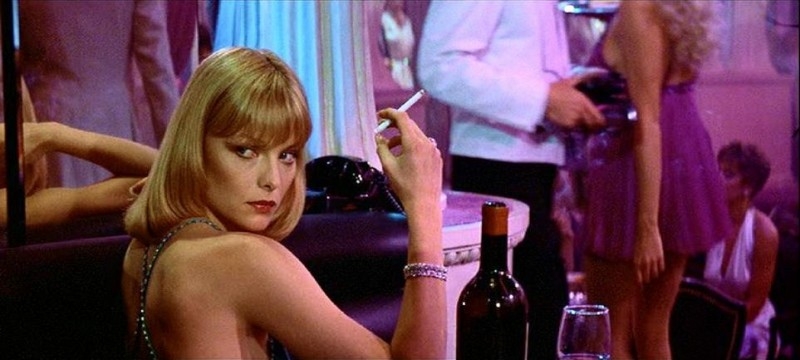
Scarface's ice princess blonde Elivra, played as a bundle of nerves snaking themselves through sheer brass will into the shape of a svelte cat-eyed bombshell (by Michelle Pfeiffer in her big breakthrough) is the opposite of the gaudy Italian persona. She's so trapped in the narcissist WASP mirror she can't wait to snort the lines off it, all the better to see herself with. But if you can get her to laugh, a woman like that? Ah Manolo, she break her septum for you. Plus, she's forbidden. That's the boss's lady, ogay? But Tony values only that which he cannot have because he's too dumb to know in advance that attaining it will bring him no satisfaction. when he gets all he wants even then he has to look closer to home, towards the ultimate taboo of incest. He falls for his sister the first time he sees her as a young woman. That he's been in jail for five years in Cuba excuses it somewhat at first (the way it didn't in the original) but then he makes no effort to rein in his incestuous impulse. He can't even admit he feels it, so makes no attempt to question the violence of his jealousy.


As Tony, Pacino is filmed first in long shots, his musky tan face paint dripping off when he's hot--which is all the time--or being bathed in Angel's watery blood with a gun to his head, the blood and brown make-up swirling together to form a muddy rust. In the early scenes, when he's bluffing his way up into Lopez's good graces, he seems to fold into himself like a sullen teenager. All terrible bangs and loud shirts, short frame and hairy arms, he's an illiterate peasant trying to cover up his clueless innocence with tough talk and bravado and big cigars (see below). De Palma's camera doesn't circle at this early stage, but rather observes him from on high, in a kind aloof regard. As Tony increases in stature and drive, De Palma's camera moves in for close-ups and lower angle shots, subliminally accentuating both his rise in stature and the disorientating effect of chronic cocaine abuse. Pacino's performance imperceptibly mutates to accompany this slow trend, oscillating at first back and forth between tough guy killer and loyal clown, gradually losing the clown aspect along the way and replacing it with self-absorbed money-obsessed paranoia, as if Elvira's glum narcissism is seeping into him through prolonged proximity. 


We learn from books like The Devil's Playground that De Palma 'knew something about gogaine' and if you look at this movie and the bloated satire of Bonfire of the Vanities (1990) and The Untouchables (1987), as a trilogy, you get a saga of desire, loss, and how empires might be built on the underbelly of America's endless thirst for getting fucked up vs. the futile attempts to inflict the morals of senator's wives onto the common people while their rarely-home husbands get rich from under-the-table kickbacks, the money increasing relative to the intensity of government crackdown. The importance of not getting high on one's supply is understood so deeply you can feel De Palma's good judgment slipping away as the film goes on, for he too, clearly, is breaking that rule. I don't think that's libelous to say - it's not like it wasn't the style of the time. I'm not judging - you know me.

To bring it back to opera, consider that Verdi's La Traviata begins at a beautiful party and a party girl luxuriating amidst a rich paramour's baubles and ends with her broke, dying, all her remaining furniture being carted away as she dies in bed, alone but for a nurse who wonders if she'll ever be paid. Substitute Tony's paranoia for Camille's noble self-sacrifice, i.e. her betrayal of her courtesan code by turning noble, and the way Tony sacrifices his empire because of some dumb refusal to kill kids, and then you see it all so plain... Tony is a whore. 

Fade to Black, from sun to setting sun image to dark marble death
Looking back at it now on an anamorphic DVD (after decades of watching it religiously on pan and scan VHS), Scarface looks badly blocked: sets seem to end a few feet from the side edges of the screen and the backdrops often look like freestanding drywall in the midst of slow waterlogged-curling. We start the film sensing this will be a big budget panorama: Cuban refugee stock footage, crowded sweaty scenes under-highway encampments, dishwashing, stabbing, twilight phone booths, the wild Colombian chainsaw set piece, but then the gradual tightening noose of opportunity boils it all down to that La Traviata garrett. As Tony "makes his own moves" there are only a few places to be, and fewer actors stick around as the scenes tighten up in a forward Apollonian arc that begins to wither into fecund limpness: real Miami sunshine devolving to that car dealer backdrop of a sunset, its edges just visible enough on either side of the action to seem meta-textually accidental; hot disco lady dancer montages devolve into some dorky dancing 'El Gordo.' More and more mirrors dilute Tony's vibrancy, as if the vast empire of Scarface merchandise was already draining his snarl of tragic meaning. The architecture eventually turns to gold trim and black marble (a symbol of death like the 'X' markings in the 1932 version) that Gina finally enters like a ghostly echo with her flimsy negligee open and gun like the fish-eyed demoness at the climax of Suspiria. I'll go even further on a limb and say that Suspiria borrows quite a bit in color and nightmare logic pacing from De Palma's big break-out Carrie which came out the year before (1976 -though Carrie was still in theaters, and drive-ins by then, as it had become such a cultural landmark even parents were going to see it).


But this crazy "Fuck me Tony" scene with Mary Elizabeth Mastrantonio and her nightmare black halo and temple of Dionysus sacrificial dress, is where De Palma truly comes to life: mixing that queasy, death-saturated Argento color scheme and slowed-down time (which he mastered with the nightmare pace of the prom queen stair climb in Carrie) with the queasy sense of post-modern sexual displacement emblematic of his idol Hitchcock (i.e., Tony can't realize he's in danger until it's 'on TV'). Not until this final bloody incestuous kiss-off does De Palma find the pitch black death rattle wide-eyed in the face of horror wit that Hecht and Hawks understood better than any others before or since --though for them the preparation for facing death took courage, the actual death itself was a bit of a joke, whereas with De Palma death comes before there's much time to fix a game face, but the actual process of dying stays as felt and faced as in the grimmest of Italian horror films.

Despite all his problems, Tony lives on today, twenty years later, as a kind of living demi-god - his image is as ubiquitous within hood cosmology as Tupac, Jesus, and Che Guevara. But as a character he has aged less well than the the emulators might think. If there's something heroic about his "say 'ell to my leedle fren!" last stand, it's tempered by his blindness to his monitors, his letting his security team get slaughtered, his own impulse killings of Manny and Alberto the Shadow. Mired in cocaine and confusion, he pulls the plug on his existence by letting his coked-up ego and repressed love of kids and guilt over his mama get the best of him (sooner or later, the apron string hydra wins out). His final shoot-out can be read academically as a zero point tantrum of grief and self-absorption. He doesn't know how to handle success, but blazing shoot-outs? Why not - if it comes to him, delivered like a pizza so he doesn't have to try and cook. He's comfortable when he has nothing to lose, but having everything is too much responsibility, especially if his mama won't take any of it.

To get back to the "Italian thing" - one aspect we admire about these mama-free men is how true they stick to their working class roots. Scarface was--the original version--modeled very clearly on Al Capone, so naturally the Untouchables' version Al Capone doesn't let wealth compel him to hide his working class roots. Note the pic below where he's getting shaved by his old barber in a beautiful palatial space under twisted dark manly flooring. This is wealth spent by the man, to realize his aesthetic, not to placate some rich wife's drive for respectability. No flowers, white tiles and dinner parties with all the best snobs. This is instead the nouveau riche bachelor in full flower, wherein the dark sleek look of the Corleone compound, the Italian aesthetic, free of WASP petit-bourgeois wife redecorating, is allowed to flower in its own dark orchid fashion, and it is beautiful, because darkness is beautiful and because today's man gets only one room, his 'man cave' in which to express his taste.

From top: Suspiria, Untouchables, Bonfire of the Vanities


Carrie
The only real separation between Italian-American gangster films and Italian-Italian horror perhaps is that death is where the gangster film stops, but horror keeps going. And the brutal circumstances of that trip, the violence of going out, is everything. If you look at non-Italian American horror of the same approximate time, once it appears, death doesn't dawdle. Even most slasher films, the American ones, like Halloween, are really about the stalking and POV camera: when death comes it's almost a relief, since as I pointed out in "A Clockwork Darkness", we now know where the killer is, so there's no more worrying from where and when he will strike, how the person will die or if they will escape. They're dead, so they're safe. For the slasher era suspense-sufferer, no onscreen death can match the dread of not knowing when it will strike. But Argento's murders, De Palma's or Scorsese's or Coppola's first two Godfathers, are the exceptions: the moment of the first bullet, stab, or slash doesn't necessarily end the escape chances of survival, or mean a close to the episode. Death throes might go on for a full reel of near escapes, feeble cries for help, and forlorn looks up at the uncaring sky or (as in Fulci's Don't Torture the Duckling) busy highway, pleading for someone to stop...

And architecture plays another part in prolonging the sense of helplessness. In the apartment building where the first murder goes down in Suspiria, the multiple reflective frosted windows, the bizarre wallpaper, strange vertical angles, unholy lighting, and the howling, strange music and create a sense of complete alienation, an inescapable interior 'Hotel Overlook'-style space (though far less recognizable), we feel we recognize from our own nightmares. We're never sure what is a mirror and what a window; the smoked glass of the bathroom shower stall seems to look right out on the hallway elevator!

De Palma is more rooted in the concrete at least in Scarface, and his vision less baroque, more enthralled by the surface, the mirrors reflecting Tony in ever increasing distortion. De Palma has a natural tendency to use crane shots to create a mood of unease. In the climax, it is Tony himself who is the Mater Suspiriorum, or rather Mater Testiculorum Fide and the Bolivian hit squad is Jessica Harper sneaking in with her sewing scissors.  


In the above quotes at the top of this article I wanted to exhume the roots of the Italian artistry as the constant need to escape from mama (or even kill her symbolically, as in Suspiria). In the end of Scarface, Tony realizes even a macho endeavor like criminal empire management can turn him matronly ("Got tits," he drunkenly laments to Manny, visualizing his future as another complacent Lopez, "need a bra"). I say unto thee, blessed is the filmmaker who can recognize his own mom-haunted apron-string slashing anger as art and not feel the need to apologize to both women and the social order in general for his venting. As long as he's conscious of it. And both Argento and De Palma revere strong women, but fear them as well. They are conscious of the animas' warped ferocity and respectful of its power. A strong woman can make a man feel outgunned at every step, emasculated (since nothing he can do--even killing--will ever measure up to the raw violence of giving birth) but if he can stare death square in the face and say hello to his little friend --this is his balls. And balls alone can deliver us into the sad twisting architecture of the last breath, the byzantine nightmare realm where reality and dreams switch place, and life disappears like those fading scraps of a dream after you just woke up.


Mom would pull you back from that void. She's afraid you'll fall. If you heed her, you no longer have your balls, just your word, and the words is: be good, call more often, and take out the trash. Being a safe distance from the void may please her, but bores the rest of us stiff. God bless the director who says mama, back off-a me, and then dives right over the ledge with his camera

He who chooses hell over heaven, death over life, he is alone truly free of those apron string jelly fish stingers. He looks at the modern reverence for life, health, the family, and winces. He knows these gym rats and granola moms are all just scaling heights to nowhere, preserving their mortal husk on entomology's display board both in vain and vanity (or that old excuse, 'for the kids'). We men are from birth trained to apologize for our own measly drives, our desire for younger girls rather than the husks our own age; we apologize even our desire for death, and so we follow some vague plan of being 'good' or even 'true' -- yoking ourselves ever further beneath the plow to compensate for our inexcusable appendage. Missing the brass ring circle of light on the swim out of the merry-go-round abyss, we may well wind up permanently trapped in Lucifer's pool filter. All we can do when that happens is throw some of our magic seeds out onto the grass over our heads and hope it's enough to leave some kind of weed in our name that will survive the mower. All we had in this world was balls and words, but mama's world can find no use for either. Our writing is still ours, at least, unless-a someone pays us for the rights. Either way, our balls are yours, Cook's Tours! Take them around that womb globe. Sow their seed like Set sowed Osiris's chopped-up body, or else get stuffed, into the palatial tree coffin, the polluted womb. Marry well and often and love your chil--no, don't do either, just run! Run before she gets here she .../// Vito! Where are you going now, you silly boy! 

See Also:
Two hearts stab as one: Brian De Palma + Dario Argento = split/subject psychic twins of the reptile dysfunction

Thursday, September 16, 2010

Paul Thomas Anderson Blogathon: There Will Be Blood, Elizabeth!


The awesome Jeremy Richey of Moon in the Gutter and the Jean Rollin Experience, two of the grooviest and nicest blogs in the world, is--as would befit a nice and groovy writer--hosting a Paul Thomas Anderson blogathon. In sympatico, here's a remodeled version of a Feb. 08 Bright Lights piece comparing Anderson's THERE WILL BE BLOOD to ELIZABETH: THE GOLDEN AGE which came out the same year (2007).

Thrilling and underrated is how I find ELIZABETH: THE GOLDEN AGE. I’ve read some of the reviews and probably waited this long to see it because of them, but now I’d like to blow those critics back to the Spanish Inquisition-themed S/M dungeons they came from. Yes it’s true the costumes and set design and CGI ships are all a little too fresh off the romance novel cover, and all the colors have been retouched to the point that even Edgar Burne Jones might urge restraint. But coming to it after watching THE PRIVATE LIFE OF HENRY THE EIGHTH I realize that this is how it’s done when depicting the Monarchy: the characters need to stand very still, like tarot cards, while lighting technicians fuss over them as grooms of old.

Call me crazy, but with ELIZABETH, all the over-doing it kind of works, mainly because at the heart of it all is a great actor who nails the royal spirit down to the last nuance while still being “real” and alive with wit and sauce. Cate Blanchett! Charles Laughton brought a sprightliness to Henry, Blanchett brings sultriness and stealth warmth to Elizabeth, and each without ever breaking their painted poses.

What does this have to do with THERE WILL BE BLOOD? Indeed, consider that both Plainview and Elizabeth eschew sexual partners in favor of becoming the stuff of legend. Each gets to smite down with DOGVILLE-style vengeance the rabid dogma of those who would convert them from their own narcissistic perfection, in Elizabeth's case the Spanish Inquisition. In Plainview's case, a pisher of a preacher trying to douse him in the blood of the lamb.

I say this as a decree and a challenge. Cinema rides with Elizabeth and Daniel ride against Joseph Breen and his Censorship Armada!

I love a good whipping as much as anyone, but not from Joseph Breen, who used Catholicism’s mighty power to inflict a state of cinematic censorship so barbaric and stifling as to be akin to the Inquisition itself. In 1934, all the hitherto free flappers and sexually promiscuous lady aviators were tortured into submissiveness, chained in ugly skirts and pregnant to homey stoves, wed to sullen bullies like George Brent. Struggling for a moment’s happiness, they’d have to be killed at the end if they dared have sex out of wedlock with someone flashy. Emphasis on the lock in that last sentence!

At last there are movies like THERE WILL BE BLOOD and ELIZABETH, which are free of censorship enough for their leading characters to skip sex altogether. That is true subversive power, like the eunuchs in Shaw Brothers Hong Kong films. In order to learn the last and most deadly secrets of Kung Fu, you must castrate yourself… quickly, before you chicken out! Then you gain the freedom from desire and the magical power that comes from being beyond sex and gender.


Though neither preacher nor virgin queen, I too have known perfect happiness in platonic love affairs with phantoms; Cate Blanchett as she rides out with long red hair flowing over cool body armor on a white horse is one such phantom. This is spirituality and love united and the flame of cinema shall never die. Now that all the world’s a screen, Cinema is the only place perhaps where perfect love can happen. Oh ye repentant sinner, will you join hands with me in demanding, for the love of god and Elizabeth, Daniel Plainview and freedom from censorship, a DVD release of the 1982 Italian trash classic, HEARTS & ARMOR, starring Tanya Roberts? Amen.

Friday, November 13, 2009

Acid's Greatest Horror #1: ANTICHRIST (2009)

My original conception of a #1 one horror acid movie has hovered between THE HOLY MOUNTAIN, THE WICKER MAN and HOUR OF THE WOLF. How awesome then, that Lars Von Trier's ANTICHRIST should come along and perfectly encompass all three, and work almost as a remake of POSSESSION besides?

Anyone who ever wondered what ZABRISKIE POINT would be like if done by David Lynch, and if he was a bigger fan of David Cronenberg and D.W. Griffith, would be wise to brave it. Don't let the frightened critics spook you just because there's some genital mutilation and shocking sexuality. You can handle it. If you're like me and a lifelong victim of anxiety and depression, then you'll really handle it. In fact, you'll dig into it so deep you may just decide to lie in it like a deep root coffin, hoping for your own Charlotte Gainsbourg to come fill the hole above you with comforting black dirt, while you wait for the comforting kiss of the conqueror worm!

Though a toddler figures into it, and some talking forest animals (!) this is a two person piece, which is fine when the people are Willem Dafoe and Charlotte Gainsbourg and the man behind the scenes is the public depressive Von Trier (and even the illiterate can relax since it's in English!) The story is simplicity itself: a pair of screwed up marrieds head to a cabin in the woods after their child dies, there to "face her fears" mainly because he doesn't want to sleep with her. Charlotte goes insane from grief and her man's constant self-righteous attempts to "cure" her crippling anxiety (he's a behavioral therapist). Along the way, ye olde link between psychiatry and witch burning is exhumed, but mainly the landscape warps and weaves just like its wont to do when one is... warped. If you've ever been on major psychedelic drugs in the woods and gotten lost and wound up having a six hour conversation with a tree root about your impending death by starvation and exposure, only to find out you've been sitting in the petrified remains of a half-eaten fox and--oh wait, it's just some leaves--and anyway you've only been outside two minutes, and you're just a yard from the house where your friends are inside laughing hysterically while watching WAY DOWN EAST, then you'll know why this movie rocks so bad!

It's always amazing to see how many apparently normal people think Von Trier (like Neil LaBute) is a misogynist just because he makes films that address misogyny. In his films misogyny is a warping factor in archetypal cinema-psychology, not just an unconsciously endorsed lifestyle ala every "rom-com." If you want a list of real misogynists in cinema, just look at: Michael Bay, Cameron Crowe, or the geniuses behind PORKY'S, LAST AMERICAN VIRGIN and/or any stupid sex comedy or most of the slasher films to come along in the early 1980s.

Can I venture to say that the label "misogyny" is in this context only a detriment if its clearly unconscious on the part of the director and the film is marred by a subtextual contempt/hostility for the feminine? Von Trier's film may be partially about the "misogynistic response" but it in no way condones that response, and in fact rejects it. Yet the same critics who hate ANTICHRIST undoubtedly are rejecting the right of femininity to show its true warts-and-all self, its ambiguity over desire and fear, creation and destruction. For many supposedly enlightened critics, to see this thing is to automatically have to throw a rock at it, like a snake in the woods. And yet, it's Von Trier that they then accuse of hating snakes.


Compare ANTICHRIST to a Michael Bay movie such as TRANSFORMERS, wherein the fear of the feminine means every chick in the film (the few) have to be stunningly gorgeous, in form-fitting slutty clothes, walking in slow motion to an Aerosmith song and men in the audience are encouraged to leer from the safety of the dark and their pack of dudes, or basements. This snarkiness stems from a fear of the "other" that hinges on the sociopathic. Since there's not enough access to full understanding of female oppression vs. the barrage of sensationalistic media that assaults the average American every day, it's not surprising a pampered/sheltered American auteur sees so shallowly into the murky waters of the female psyche. The film adaptation of Margaret Atwood's HANDMAID'S TALE (1990), by contrast, shows misogyny as a widespread institution, yet what feminist would dare accuse Margaret Atwood of misogyny? And the genital mutilation shown in ANTICHRIST is forced upon many girls--even today--as they reach puberty, so who is more a misogynist, Lars, or those who just ignore/deny the barbaric practices of some of our extremely fundamentalist Muslim brethren? To me, that act itself means war! We should invade, and rescue these girls before it's too late!

May I venture to take a page from the book of Camille Paglia and suggest that if someone is afraid to look head on into the wild devouring Dionysian oceanic dissolution represented by pure unleashed feminine sexual drive then it is they who are the misogynists, not the artists who at least have the cajones to face such a deluge? Women get knocked around in the films of Von Trier, Peckinpah, Polanski, Hitchcock, but they don't fall down. In a lot of more conventional movies women never even get to stand up. Those directors who--rather than wade into the vaginal sea-- just scoop out a handful of muck from off the bank and then parade it around on a stick, or wrap it in tight spandex and shoot it out of a wet t-shirt canon, then wait to film it after the threat has been "subdued", i.e. objectified, crashed, burned at the stake, and/or mangled --they are the enemies! Is there a difference between silicone and sawdust when it comes to Norman's mommy's smothering breasts?

Ding-dong the witch is dead, but when the witch in OZ melts it's no more a permanent defeat than it would be for Medusa losing a single snake of her hair. Norman knows this all too well; he must kill and display his trophies over and over again. Their hair keeps growing long after their bodies have withered to bone and parchment skin. Death not ends it, only castration... old Teiresius with his dugs, wandering off into the Led Zeppelin wasteland night.

But enough of my deftly Eliot-alluding tirade, I've gone way off-path; let's wander back to the wild of the woods, where there's Charlotte Gainsbourg--raw and feral--as a castrating lunatic, digging deep into warrens to hunt her smug, covertly gynocidal therapist husband...

Gainsbourg, even as a child showed, she gave not a crap about social taboo, just by being sired by reprobate Serge (they sang "Lemon Incest" together on her teen pop debut) and here she is, acting it up in a string of solid Gallic hits (and albums) and now this performance, which is the gutsiest, rawest thing I've seen since Isablle Adjani in POSSESSION or Isabelle Huppert in THE PIANO TEACHER, and if the Oscars had any chutzpah she'd win next March, but there you go, more proof who really is the misogynist here - c'est Oscar!!


FURTHER VIEWINGS:


If ANTICHRIST confuses thee even after this sterling review, forget about the last 40 years of cinema, and compare it to 1960s and late 1950s Freudian Gothics like SUDDENLY LAST SUMMER, REFLECTIONS IN A GOLDEN EYE and WHO'S AFRAID OF VIRGINIA WOOLF... You might also bring in Tarkovsky's SOLARIS and NOSTALGIA. Lastly, of course, you should compare it to IN THE REALM OF THE SENSES and every other good movie about castration. Aint nothing wrong with sparagmos and genital mutilation if it's done with clear-eyed awareness of the symbolic associations thereto, and by the mutilatee's own choice, not by some barbaric institutionalized misogyny. Second to lastly, dig up some moldy wet dirt-encrusted comparisons to the Japanese horror film, MATANGO and of course FEMALE CONVICT SCORPION: JAILHOUSE 41.
--

In the end, just keep repeating "No sexual organs or appendages were harmed during the making of this movie." It's all a dream. All just stuff that transpires in that murky woods that exists between the unconscious symbolic and the ambiguity of the real, all just what the tree root says while you're outside, lost and tripping, a mere 20 feet from the front door. And if you're going / to San Fran / cisco / be sure to wear / some flowers in your hair... otherwise the loving people there will rip you to shreds and eat you alive, until all that's left is just a mouth, still screaming down the wind... for pusss-ay.
Related Posts Plugin for WordPress, Blogger...