Showing posts with label death. Show all posts

Wednesday, May 28, 2014

From my grave to yours: PENNY DREADFUL (Showtime), FROM DUSK TIL DAWN (El Rey)


Two new horror series are worth checking out, presuming you have the patience, the cajones, and the channels on your cable. The Robert Rodriguez-backed channel El Rey (read my shuddering praise here) launched a month or so ago with the From Dusk til Dawn series, a ten episode-long elaboration of the RR-QT 1999 film, adding the full measure of hallucinations and Tex-Mex flavor and replacing Tarantino in the part of psycho brother Richie Gecko with a much more mesmerizing low key lad named Zane Holz. As Richie's brother and fellow bank robber Seth, D.J. Cotrana diffuses Clooney's terminal charm with hothead overreactions, so now the two feel like real brothers who actually grew up together, rather than the charismatically mismatched Quentin and Clooney, and each has problems the other helps correct, like real siblings. And the queen Mayan reptilian hottie Santanico Pandimonium (Selma Hayek in the original) has a much more integral part with lots of dialogue and empowering femme fatale inscrutability, embodied by Mexican TV actress/pop singing star (and staggering beauty) Eiza Gonzalez. Robert Patrick is the disillusioned preacher, Don Johnson the sheriff, and a cast of handsome Mexican-Americans with either admirable swagger or furrowed brow intensity. The ten part series all occurs over the course of one 24-hour period, from dusk to dawn more or less, which slows things way down with that old tick-tockality and a novelistic attention to detail.

Eiza on the street! 
It all works because it's not that the performances are great, but that they are all of a piece; as is so essential for a good horror, they play it deadpan straight while never overdoing it and driving their ordeals into bummer territory (I mean, there's a way to act pained and ennui-ridden without causing viewers to get depressed or upset). I mention all that because, in Showtime's new horror series Penny Dreadful, that level of solid team player dynamics vanishes to be replaced with a bunch of breathing exercise-prepared actors all fighting over every syllable like it's their last chance at an Emmy. Only dimly aware there's other actors across the dark expanses of the cavernous Victorian era sets, they rant and rave and hope... hope....


I'll confess I desperately wanted to love Penny Dreadful. I am a chronic disciple of Eva Green. But the show simultaneously tries too hard and not hard enough, cramming in all the famous literary characters from the Victorian era's (and earlier) literary mythology it can remember from its year at Cambridge. It never seems to know what to do with all these public domain easily-recognized monsters, though, other then send them walking in ornately-stressed Victorian garments through long tracking shots or into bed for joylessly graphic sex scenes. I'm hoping they rectify the absence of any characters or monsters actually from the real penny dreadfuls (such as seen above in my hand-made collage), instead of the same old Dracula (here a Drac-mummy hybrid) or Jack the Ripper (and no doubt Burke and Hare are soon to follow), or Frankenstein. Where's Spring-Heeled Jack? Wither Varney the Vampire? Just because Dorian Gray's an immortal bunburying Sadean doesn't make him a monster, just an aesthete.


On the other hand, as far as I'm concerned this young fellow playing him, Reeve Carney (left), has the whole show sowed up in his pocket. While the other characters rant and rave and underplay, Carney's Gray seems genuinely entranced, not in any effusive way but in a delicate, eerily jaded way, and graced with an in-the-moment openness that makes him seem to me one of the few young actors around who seems to understand the importance of seeing as much as being seen and who seems to fully inhale the atmosphere. (the only other one I can think of offhand is Kristen Stewart). Trying to figure out who Carney reminds me of, then it hits me --he could be the son of old Brian Deacon, the young man in the trailer outside the castle in VAMPYRES (1974).


Meanwhile the murky dim brown Victorian London craftsmaship often runs the risk of choking the life out of things (though the darkness can be very very dark, almost 3-D and it seems thrillingly real, like life before electricity was one long SILENCE OF THE LAMBS climax) and the writers are so busy paraphrasing the eloquent flights of 19th century authors that the British thesps run unsupervised over actorly monologues until every line sings with resonant oratory. In other words, it's very gay, in its way, though not in a giddy, delightful Tim Curry or Udo Kier way, more a Sal from Mad Men kind of humorless straight burlesque. And each of these unsmiling characters must play many parts: Eva Green is a vampire hunter who is also a trance medium easily possessed by demons and departed angry daughters; Timothy Dalton is the Qatermain / Dr. Ven Helsing / Seward who just wants his daughter back (Mina, the daughter who's already gone to Dracula arms); Josh Harntett is a Wild Bill Hicocky dead shot who may also be Jack the Ripper; a brilliant young Frankenstein is probably going to have to be Jekyll and Hyde later on (his monster doubles as the Phantom of the Opera, Quasimodo, and The Crow). I have no doubt Drac will turn out to be another hunky British monologuist impeccably attired in elegantly distressed Victorian fashion who says things like "the burden of eternal life wears me down like a slow watch, like the taste of withered dying opium addicts, their narcotic blood crawling time to a standstill...."

Second Episode is a big improvement - it gets more down to a set of reversals and twists and seems less about getting its lighting as painterly and haunted. The purplish blue mist of London coal fog in gorgeous compositions of ships in harbor and snug waterfronts is impressive, but the centerpiece Eva Green possession monologue, while a brilliant showcase for a brilliant, nervy performer (her voice sails up and down octaves while her body writhes and contorts and eyes glare with unholy fire) goes on long past our patience or its own effectiveness. By contrast, FX's AMERICAN HORROR STORY might pick up and abandon story threads like an impatient schoolkid but it understands momentum as key, and transgression as a locomotive, and above all it doesn't take itself a tenth as seriously. PENNY is so busy covering the period and its famous characters that it doesn't notice a real person squeezed through. Played by Billie Piper as a de facto heroine streetwalker, she's coughing up blood like a Poe heroine or Doc Holiday, but doesn't complain and not only that, has large measures of bar whiskey for breakfast (Doc, is it you?) with Josh Hartnett's Earp, whose staying at her same inn? They lounge with ease in the saloon window they're written by Eugene Goddamned O'Neill waiting for Hickey and for just a minute there, the show is awesome. It's not trying to be eight ways of macabre at once and winding up paralyzed, waiting on the x while the art director fiddles with the sun-dappled coal dust streaks. These two are in a real scene and it's lovely and vivid and not overwrought or trembling with import.


These kind of character-based critiques don't concern FROM DUSK TIL DAWN.  As Santinico, Eiza Gonzalez is no Eva Green she's got a certain cold allure, even naked but for a golden bronze tan, brown bikini and Aztec shaman blood queen headdress she's always capably holding her own, in charge, using her body to seduce and ensnare men, to believably conjure ancient Mayan deities, to pit brothers against each other, not to be objectified but worshipped, and she's no ham. In DAWN, even big tearful farewells or life and death anxieties are--in the American Carpenter-Hawks tradition-- nicely underplayed (rather than being overly underplayed in the British style of PENNY). If only PENNY's writers were up to the challenge. DAWN goes for the jugular with a laid-back shrug, while DREADFUL, like so many other pieces of 'mature audience' horror hackwork, confuse graphic sex and violence with what being truly dreadful really entails.


POST SCRIPT (6/2/14) - Just saw the fourth Penny Dreadful episode and things are picking up, with a detailed evening at La Grand Guignol that managed to weave together nearly all the disparate threads, as well as a climactic absinthe scene that allows the series' hitherto locked closet door to finally burst open. Can't spoil it of course... 

Tuesday, October 15, 2013

Your Clowns Bid You Goodbye: THIS IS THE END, IT'S A DISASTER


A cohesive, 'tight' film, funny even into the maw of Hell, THIS IS THE END (2013) comes long after 12/21/12, late to the apocalypse party, which is of course in character considering the cast of stoner royalty --James Franco and Seth Rogen, still soaring on PINEAPPLE EXPRESS fumes, Craig Robinson, Danny McBride, Jonah Hill, Michael Cera, Jay Baruchel, Emma Watson, Channing Tatum, and so on--all playing themselves. Unlike 95% of its ilk, END skips the zombies and instead goes full literal-biblical, mixing heavenly ascension, childhood buddy friendships stressed by fame and distance, growth and kindness as essential to survival, an actual bible, LA vs. NYC rivalry, raping demons, ethical dilemmas, and lots of weed. The genius touch is to have them all play themselves (only more so) and they bring a lot of brutal self honesty: Jonah Hill acts like Oscar's A-list sycophant, bandying the word "tight" around and treating resentful New Yorker Jay Baruchel like a special needs child. Jay instead blames his own paralyzing social shyness on LA; Michael Cera snorts coke and bullies groupies in fits of drunken Reptillian overlordsmanship; Daniel McBride ramps up his dirtbag townie craziness; James Franco is a vain but guarded host with a weird bi-curious vibe; Rhianna, Aziz Anzari, and countless others disappear down a giant blast furnace hole in the ground. Being a star guarantees nothing as the flame pit widens and the stars are revealed to be tough and resourceful only via movie magic. While the demons howl outside and devour those unlucky stragglers, these dudes duct tape the cracks in the concrete of Franco's party fortress, pool their booze, and wait for the cable to come back on.

When I was counting days inside the rooms of Alcoholics Anonymous, I used to like to imagine Armageddon as a great excuse to relapse on whiskey, and hoped one day I would get the chance, for whiskey is so so good. But if an alcoholic vows to drink again only when hell froze over, sooner or later he'd drive down into the flames on a stolen Zamboni. That's in the bible... if you know which bible I mean. Still, for some of us, the apocalypse is our last chance to reunite with our deranged lover in all her brown... intoxicating....  proof.


In other words, I would be the first to volunteer to leave the compound and forage, because maybe... maybe somewhere in the hellish mist of the Hollywood Hills... there might be unbroken bottles of sweet sweet booze. That's the comfort for a recovering alcoholic in the apocalypse. No demon can compare with that one, no scare or threat can stay that eternal thirst. Without that carrot lure I can't see ever stirring from my bunker. But I am the alcoholic thing in the black crib with the upside cross baby mobile ROSEMARY'S BABY dashboard. I am the third heat, the eternal thirst carved large as Asmodeus' initials into the EQUINOX oak tree soul. I guess we all have our reasons for wanting this damned parade to finally end, in a blaze of glory. That's one of mine.

But these guys--Seth Rogen, Franco, Danny McBride, Jonah Hill, Craig Robinson, all playing themselves-- are more grounded than I am... which is odd, considering they don't seem to have girlfriends and the first thing they wish for (outside of weed) is a Back Street Boys reunion (nope, nothing gay here). Perhaps that's the secret to success: girls always Yoko up a band sooner or one of you goes to college, or leaves it. I can only imagine what would happen if I never moved to NJ or my buddy's parents didn't get divorced and turn him militant, or if I never became a hippy punk rock boozer. All these things killed our comic book making, super 8mm filming, dungeon and dragons module creating, and selling, and marketing company. Girls were but the coup de grace. 

If I had known nerds would conquer the world, that the "Comic Con" would one day be a prestigious event, I might have never have choked down that first pilfered warm beer at my punk rocker friend's graduation party. I'm funny, too, man. Can't you tell? Why did I give it all up for a life of hipness, boozy abandon, and relationship-attempting? None of the dudes who wind up at Franco's seem to have any long term relationships, or kids, to worry about, and it's damned refreshing. At no point does any character say, "I can't leave without my children!" or "If Kathy's back there, I'm going to get her!" These guys don't give a shit!


The main star of THIS IS THE END though is the raw kinetic energy and flow of weird ideas that doesn't stop, just snakes forward from LAX to chillin' with buds to a party at James Franco's house all the way to....  The big budget CGI in the film isn't used for guns and nonsense. There's only one gun in the whole damned movie. Instead there's great towering demons to rival The Night on Bald Mountain sequence in FANTASIA, and Jonah Hell spewing green bile like a portly homoerotic Linda Blair, but no monster is quite as scary as Emma Watson with an axe. Or more balls-out-gonzo than McBride gone cannibal --the role of the year in the movie of the year.  Like many Piscean artists and writers, I've always admired--from a distance--the McBride type. We Pisces never invite them to parties but they always show up, draining our bar but bringing us awful weird new drugs like angel dust, jimson weed, and crank and introducing us to carnivorous whores. You can't get rid of them, so you may as well enjoy their ferocity, use it before it destroys you. When the world ends and the savage monsters reign, we could use a man like Frank Booth again.

Didn't need no welfare state
I don't want to spoil what may be my favorite movie so far this year, but if you haven't seen it yet, you can still take a page from its bible and start to be nicer to people; even if there is no one true God it couldn't hurt your chances for ascension. I've written extensively on my arcane beliefs regarding soul density, in that the more self-centered and hateful you are, the more dense your soul gets, allowing demons to capture it when you try to ascend; it follows then that the more positive and selfless you are, the lighter and more expanded your soul gets, so demons can't catch it anymore than one can catch smoke in a butterfly net. Hence demons are all about convincing you goodness and lightness is for suckers. It's just a theory, based on a mix of Thaddeus Golas, Egyptian mythology, and David Icke, but it's a solid way to structure it.


If only life were just buds and booze, how simple and joyous! But instead how complicated and downer-ish it is to watch dudes from your crew marry and--unless you join their creepy 'we have kids' cult--never be seen from or heard through again. Maybe that's the real fantasy, that the world will end before maturity's inevitable bro-pocalypse wipes out your network. I hear it's just like falling asleep. Push... push... and then, I hear, lots of worry about the right schools. Dragged to recitals... pretending to give a shit about Little League. Oh the smell. Pass. I'll stay awake.

And that brings me to the stifled world of the couple's brunch where--if they had girlfriends with bourgeois hipster tastes--the dudes in END would be going on Sunday afternoon (after a nice early bedtime) instead of to Franco's on Saturday night (or if I was there and it was the 90s, both). I'm of course referring to the 2012 'couples' comedy IT'S A DISASTER.

David Cross is the stranger being vetted by his internet-met steady Julia Stiles' posse. He moseys around the nice house, drinks some Scotch with the boys, hears how they got problems of their own, blah blah. Suddenly, a neighbor comes in decked out in a hazmat suit. A dirty bomb has gone off downtown, poison gasses everywhere. Commence duct taping! And then the couple who are always super late try to come in, coughing and hacking and begging to be let it in. But the duct tape is on. What do you do?

Damn right you don't.


That kind of satiric moral querying is welcome when the less humanist decision is pre-empted, and the swinger couple (Rachel Boston and Kevin Brennan) slipping a subtle menage a trois come-on to Cross are hilarious; America Ferrara mixing all the drugs in the house together to create some homemade ecstasy--determined to get super high to face the end--she is my hero. While her beau seems to think ranting about conspiracies will turn the deadly real situation abstract enough to deal with, i.e. what you can deconstruct can't kill you, she's doing the right thing, the thing the old black jazz pianist on the cruise ship or Woody Harrelson does in the movie 2012, get lit bright as a Lincoln Center Xmas Tree.

Overall it's some good ensemble work, giving off the impression these people all know each other and respect one another's comedic rhythms, and if it all seems over before there's any special effects fire and brimstone to run up the tab, well, it makes up with in the kind of inner-hell only the relationship-anchored truly know.


So what, in the end, is the right scenario for you? A lot of us were hoping the world would end last December 21st, so we could skip that much-needed root canal, or get out from under our credit card debt. Now here it is a year later and we know we're saddled with seemingly immortal life. So pick your poison and live to die another day: going out with the bros is of course the more fun option than meeting the new girl's posse at a petit-bourgeois couples brunch, because the deeper you look the more you see how hard it is to grow when you can just blame your significant other for holding you back.

Unfortunately real personal growth only seems to come with pain, fear, and trauma. With the boys up in the Hills of THIS IS THE END, though, there's no one else to blame, no one to take the bottle out of one's hands and wag her finger, and so, convexly, no escape from the awfulness of one's own true self and one's own addictions. If that's not a reason to relapse I don't know what is, 'hic'.

Oh how time flies / with crystal clear eyes

Monday, September 09, 2013

1994: The year Fiorentino and Tarantino saved us from Vampire Morality


Now more than ever we're remembering the pre-CGI sci fi horror boom of the 1980s as a golden age, not just because we miss actual celluloid but because between drive-ins and theaters on the one side and VHS rental on the other, money was being made (this being the era still when video tapes cost $100 each and were bought only by video stores for rentals). In 1987 alone, two semi-big budget films came out about vampire teens, with almost the same story:  Near Dark and The Lost Boys. Both involve a vain, bland, petulant teenage hunk ready for his first false step, seduced by a hot young vampire girl who lures him into her weird pack (cuz he's hot) rather than just eating him. The pack in each film includes a small child vampire frustrated by their being frozen so long in a tiny form. And in both, this vain young male fledgling vamp wastes his gifts in lots of moral hand-wringing about drawing innocent blood.

Ugh, there's the rub. Like joining the army for the uniform's effect on girls but then refusing to pick up a gun as your mom told you not to, and being outraged when you're not allowed to just sidestep that part of training, because hotness = morality. It might seem noble but there's a name for men who live off women. In both films the hot vamp girl feeds the hero from her own wrist after she does the dirty work. But he gets no blood on his hands, thus doesn't lose his self-righteous sparkle. Oh Prunella! Oh Heaven forfend! Son, that's called being a mooch, the worst kind of pimp.

I refused to see either films in the theater at the time, because I hated seeing the 'brat pack' spill over into my favorite genres --me being around their same age, insecure, and deeply allergic to their sullen narcissism. I still am but I can tolerate the movies for two reasons: one, I'm older than them now (their image frozen by celluloid's vampirism) and two, because in 1994, Tarantino and Fiorentino set me free.

The Cool Kids (Top 2: Near Dark)
---------

The buzzkills
Yeah man, Jason Patric in Lost Boys, Adrian Pasdar in Near Dark: two doe-eyed hunks used to getting every girl they want just be batting their doe eyes and looking across the room or plain at them with a slight sneer that reads "I'm already disappointed in you, yet I see something special, worthy of my time. Even so they rely on their potency signifier--a motorbike or horse--to do their small talk. But once they're 'bitten' or hooked into the life, they're clinging to their vamp girl like she's their new mommy (one of perhaps a long string of blank doormats expected to worship their lame peccadilloes). They suck, in short, not literally.

Both films assume we know and respect the hierarchy of attractiveness in boys but young male viewers who aren't doe-eyed hunks aren't about to identify with these clowns and we're the ones who watch these kind of movies, the ones who would--without a second thought--kill some humans and drink their blood if it meant getting a hottie into bed. We'd worry about our immortal souls at the proper time (after it was too late to do anything about it), when it was more Sophoclean. That would be a good angle: the awkward shy kid uses his vamp gifts to bite everyone whoever wronged him and gets so high off the hottie vamp's attention and the sense of belonging to the cool kids for the first time in his 'life' that he doesn't eve have a second thought until it's far too late to save his soul, yet still early enough he can still sense and mourn its loss.

Instead, in these two films, the doe-eyes just squirm and try to dodge their bloodletting responsibilities like Donnie Brasco with a gun to a squealer's head, waiting for a deux ex machina to rescue them from feeling compromised, unaware (due to bad writing or nervous producers) that those  'yellow brick road to hell' choices are what gives the tale oomph. Instead, they get to keep their hero's armor untarnished and we end up loathing these self-righteous mooches with a passion that lasts far longer than our ugly duckling phase. It lingers on all through our life that loathing, until we're old enough that we begin to beam nondescriptly at their moody foibles as we would our own grandchildren's.


Jason Patric in Lost Boys is exhibit A: When he sees Star (Jami Gertz) in a big beachside crowd gathered around an open air stage, he starts following her around as if he's already pissed at her for walking away from him, instead of falling onto her knees before his physical beauty. He considers his prettiness a sacred church. No laughing or running around should be allowed in his presence. This overconfidence gets a comeuppance when he's goaded into a dangerous beach race to one of the cooler vamp cavern hideouts and manipulated into drinking vampire blood. And for that reason alone these scenes are the best in the film, and director Schumacher ably captures the adrenalized swirl of energy around hooking up with a group of wild new friends, the need to belong weighed against the alarm bells going off deep in your sacral chakra.

Star, it turns out, has chosen to initiate a new member to the clan but dumbshit Patric can't figure out what's happening... chalking it up to some ecstasy or something in the blood wine he was given. Next day he's a pale, shaky mess who can barely keep his feet on the ground, which would still just be similar to the next day after bad ecstasy. Some of us back in the 90s had to fill our high heels with sand just to stop from floating away after nights of drinking weird potions in the basement with the boys, trippin' out on Miles Davis' Live Evil and driving home at dawn on the back of undulating black asphalt serpents with yellow dash line dorsal ridges. Even when cheap chemsits cut the MDMA with strychnine, we didn't blink!

Patric's a pussy.

Almost the exact same plot serves Near Dark but instead of Schumacher's ingenuity with packed beach boardwalk scenes, thousands of coordinated extras, colorful taxidermy gardens, folk art eccentrics, pumping anthem rock, and the ingenious literalizing of common phrases of parents (if your new friends jumped off a bridge, would you?), there's Kathryn Bigelow's moody Badlands-esque emptiness. She brings us vast fields like a lover's skin, the few straight roads like arteries begging to be punctured with gas stations, phone booths, and silos, and one of the more realistic looking biker bars caked with dust and the muted loneliness of the aging regulars, all the fight leeched out of them slowly by prolonged exposure to the emptiness of the landscape. When the vampire pack invades the bar, it's almost like they come as angels of deliverance from this glum nothingness.

Near Dark wins the contest just because it at least thinks to critique its doe eyed hunk's willingness to literally leech off his girlfriend. One could conceivably view this second-hand gulping as a metaphor for the hypocrisy of today's consumerist carnivores who get super indignant when confronted with images of factory farming. Who resent being compelled to look into their own prey's eyes as if willful blindness is a moral defense. Serve the calf's brains jellied inside the cow skull, you're gross, but the rump steak, a chef. Killing humans is no different than choosing your own lobster once you're not a human anymore. If we all had to do a few days work in the slaughterhouse, co-op style, how much you want to bet this country would be easily 70% vegetarian? No wait, I don't gamble. It might send the wrong idea to children!


I feel guilty every time I leave my cat or dog in the morning, or when I go to the zoo. I never got comfortable even fishing. Even throwing them back in, I winced at the pain from imagining a hook in my cheek. Rules of the Game (1939) is very brave in that - what other comedy shows dozens of bunnies and birds being shot, for real, and the hunters barely noticing, so wrapped up in their petty romantic intrigues? And though the characters don't flinch, Renoir does. But he doesn't blame them -- they are after all the very rich, the predator species of all cultures. It's what they do. That's real morality and if it leaves a strange taste in the mouth, savor it --that's the bitter tang of real art!


I tried being vegan during my big spiritual awakening of last fall (see 'Scrooge Satori Apocalypse', The Holy Madman for proof!) but simply got too dizzy in the end to keep it up. My body delighted in shedding all the crap from my system, but then ran out of stuff to shed, and began feeding on itself. My body was like fuck you I'm a meat eater, give me meat or after the little bit of fat we've stored is gone I'll start in on the muscle, bro, I just don't give a fuck. So I obeyed it, the way a vegan game warden obeys its aristocratic ruler. I learned one simply can't be holy these days without one's own private cook. And whatever happened to the apocalypse of 12/21/12? Aside from the trans-galaxial enlightenment I and dozens of others received either from galactic alignment or placebo effects, nothing happened. Not even ice cream... 'cuz it's dairy.

Going back to meat took its toll though, and now I'm blind in one eye again, so I don't have to think about the pain and bottom line-minded torture my dinner went through to reach me. Maybe the whole point of ignorance is bliss, there's a reason that Italian guy eats a steak in The Matrix and not a celery stalk.

Tony Scot's parallel lines 
Too bad filmmakers, even talented ones with some moral fibre (mmm mmm) like Neil Jordan, Bigelow, and Tony Scott, balk at the chance for true vampiric ambiguity: The Hunger, Interview with a Vampire, We Own the Night, Near Dark, The Lost Boys, the list of movies where a lucky stiff is vamped only to get all moral about killing is endless. It makes me wonder... is there any vampire movie where the newborn actually does kill a human or two without moping about it for the rest of the story? (see my post on Vampire Morality Blues). Damn I need a drink. Oh wait. I can't anymore. I'm like one of these vegan vamps, but for booze.


But then... a miracle happened. The year was 1994, a boozy flood came and washed the lack of sin off the screen. All that bad faith ended with a triple threat of charismatic young leads who got away with cold stone murders: Natural Born Killers and Pulp Fiction, and The Last Seduction. And in a less permanent way, Ferrara's The Addiction (1994).


Looking at them now, they're still cool -- but what was so energizing about them has been forgotten by the skin deep imitations - and what was that? That the lead characters all got away with murder. They killed the innocent and robbed and arranged murders and in the end got away scot-free. And we rooted for them every step of the way.

There are no words to describe our exhilaration after having to suffer through so much leftist moral hand-wringing over onscreen killing. Superheros crashing Humvees through shopping malls like maniacs, probably wiping out dozens with collateral damage, but then braking to not hit the main villain; whole crates of ammo being fired by The A-Team without one guy being even wounded; Cameron having to show that the hundreds of cops Arnold shot in T2 are only clipped in the leg (Fatalities = 0, it says on his monitor), it all got to be a serious problem.  But then came True Romance (1993), and the crazy couple got away with the loot, for once, and the girl didn't browbeat the man for killing her pimp! Hallelujah.


Naturally there has been some kickback. A couple of dumbass kids out in the boonies went on a killing spree after being inspired by Mickey and Mallory Knox, but their parents' lawsuit against Oliver Stone was unsuccessful!

Sadly, as they have always done, the Hollywood imitators of the Tarantino mythos got the surface right but missed the point. The skinny black ties and pop culture references didn't make the QT films great, it was the flatline savvy about death, about understanding that cinematic death doesn't equate to real life death, but that in realizing this the onscreen deaths actually become more real, more vivid; the more they are recognized as cinematic expressionism rather than glum social sermonizing, the more true they are. Audiences can be trusted to not all go home and kill Rodney Dangerfield. As Godard once said, it's not blood, it's red. When we want insincere Hollywood hedonists to lecture us about the sanctity of life and death we'll ask them. Go ahead and bite a neck or shoot a man, Billy! You've got nothing to lose but your fear of flying. Can't you ever let go of the handrails.. even in a dream?
Monday, July 29, 2013

Mater Testiculorum: SCARFACE, SUSPIRIA, CARRIE

"Masculinity must fight off effeminacy day by day.
Woman and nature stand ever ready to reduce the male to boy and infant."
-Camille Paglia (proud Italian-American)
"Son? I wish I had one! He's a bum!"
--Mama Mantana (Scarface)
 You can argue that gangster cinema began at Warners with Cagney and Robinson, but a few pre-code masterworks aside, the gangster never hit his grandiose peak until it became a distinctly Italian-American saga, directed by an Italian-American with maximum tactility. Robert Evans knew this, and so insisted on Coppola for The Godfather (1972). An Italian director for an Italian story, this according to Evans' Kid Stays in the Picture. Defamatory? Maybe. But the Italian-American Anti-Defamation league was founded by one of the heads of the five families, Joe Colombo, as a front for mob activity, so who can you truss? Me, 'ass who.

And so you need an Italian-American director, or an Italian straight-up, one who is going to ideally bring in a sense of Italian flair and artistry, i.e. the Scorsese 'boy pack' forward momentum, the Coppola darkness, and the De Palma operatics. And just the word "opera" should make you think of Argento, an Italian, straight-up, whose films have such elaborate beauty, brutal violence and strange rhythms that he even called on of his films Opera (check out my 10/2009 companion to this piece, "Nightmare Drive-In Logic, Italian-style); they transform the work of everyone who sees them... whatever that work may be. Mine included


Italian-Americans and Italian-Italians don't all love opera but it's emblematic of their artistic genes, along with the poetry of Dante, the art of Botticelli, Da Vinci, Michelangelo, and the masochism of Catholicism (each centurion lash upon the wrecked torso of Christ fantasized about in excruciating detail). All this and more pumps, drives, twists the flagellant Italian heart, consumed by "original sin," which stretches its exposed raw nerve beating-heart history back through Roman orgies, gladiators, court intrigues, brutal inquisitions, the plague, Il Duce. Thus the murders in Argento and De Palma and Scorsese and Coppola sing like operas of the damned, in which every emotion is heightened, and played out in full, wringing every last drop of blood and pain. They present characters who are adults, who sometimes joke around with each other, but never about business, and who keep their wives and mother out of it --wayyy to the side, and do not let the apron string hydras devour them the way they devour our 'sensitive' liberal guys. They're real men, unless they're really women, and when violence occurs to or through them it's always painful, always transmitted across the screen with time for the victim to scream, or scrawl a note on the tile steam, or be confronted by his own pulled-out small intestine, to protest, cringe, plead, try and crawl away and--recognizing the end, to screw forth enough macho courage to stare one last time into the eyes of their killer and shout "Fack Yew!"

In these films, death may be cinematic and beautiful, but it also hurts. No one dies easy; no one just gets shot or strangled and dies in a second. Characters get time--even if just a second--to register the horror of realizing their whole life is about to end, suddenly and with no good reason, and so much left undone. They see death coming, and if they live long enough to kill in kind they make sure their opponents get the same luxury. There's a feeling in this operatic Italian schemata of what might really involved with killing people. In normal gangster films people just get shot, Blammo! But being true to Italian operatic rhythms means one needs time to die, a whole scene for one lengthy tortured aria while Ennio Morricone strings play a semi-mocking eulogy overhead and you look at your killer with a slow turn from pleading to fear to anger and oaths, to resignation and then downwards or up into the infinite abyss, or onto some busy Rome street while passers-by hustle past you on your way to work and it's not until you fall face down and the blood pools in the middle of the sidewalk do they finally stop and scream. Death isn't the scariest thing in De Palma or Argento films, it's the loneliness of it that hurts the worst.


Thus it makes sense that De Palma has no real interest in capturing the Cuban culture of Miami, filling the score instead with the boss Italian synths of Giorgio Moroder, and the gaudy pre-fab architectures of the Floridan disco. Hawks' 1932 Scarface bounced around with merry good-cheer and a mock-Italian comedy-team rhythm that made a stunning counterpoint to the violence; Paul Muni showed that thing we all love about our one Italian-American friend: their positive life force--always on, never wavering, how-- even when they're breaking your thumbs for not paying your debts-- they can joke around and make you feel like a regular guy and ask you how's your mother and seem to mean it. And if you dated one then you know how nurturing their women are, cradling your head when you throw up, and only crying and freaking out when they realize you are never going to stop drinking long enough to be much of a take-home-to-the-parents-style boyfriend.


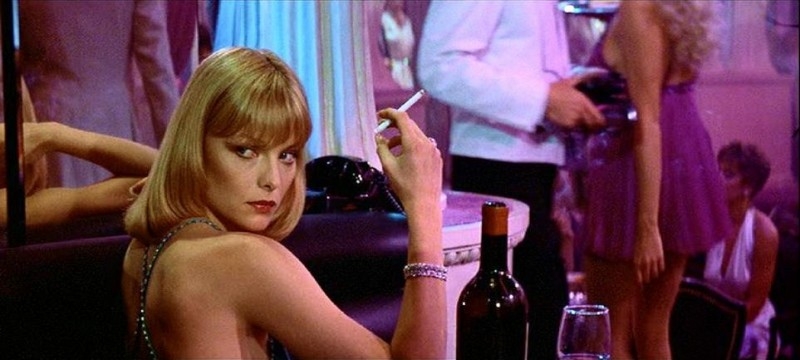
Scarface's ice princess blonde Elivra, played as a bundle of nerves snaking themselves through sheer brass will into the shape of a svelte cat-eyed bombshell (by Michelle Pfeiffer in her big breakthrough) is the opposite of the gaudy Italian persona. She's so trapped in the narcissist WASP mirror she can't wait to snort the lines off it, all the better to see herself with. But if you can get her to laugh, a woman like that? Ah Manolo, she break her septum for you. Plus, she's forbidden. That's the boss's lady, ogay? But Tony values only that which he cannot have because he's too dumb to know in advance that attaining it will bring him no satisfaction. when he gets all he wants even then he has to look closer to home, towards the ultimate taboo of incest. He falls for his sister the first time he sees her as a young woman. That he's been in jail for five years in Cuba excuses it somewhat at first (the way it didn't in the original) but then he makes no effort to rein in his incestuous impulse. He can't even admit he feels it, so makes no attempt to question the violence of his jealousy.


As Tony, Pacino is filmed first in long shots, his musky tan face paint dripping off when he's hot--which is all the time--or being bathed in Angel's watery blood with a gun to his head, the blood and brown make-up swirling together to form a muddy rust. In the early scenes, when he's bluffing his way up into Lopez's good graces, he seems to fold into himself like a sullen teenager. All terrible bangs and loud shirts, short frame and hairy arms, he's an illiterate peasant trying to cover up his clueless innocence with tough talk and bravado and big cigars (see below). De Palma's camera doesn't circle at this early stage, but rather observes him from on high, in a kind aloof regard. As Tony increases in stature and drive, De Palma's camera moves in for close-ups and lower angle shots, subliminally accentuating both his rise in stature and the disorientating effect of chronic cocaine abuse. Pacino's performance imperceptibly mutates to accompany this slow trend, oscillating at first back and forth between tough guy killer and loyal clown, gradually losing the clown aspect along the way and replacing it with self-absorbed money-obsessed paranoia, as if Elvira's glum narcissism is seeping into him through prolonged proximity. 


We learn from books like The Devil's Playground that De Palma 'knew something about gogaine' and if you look at this movie and the bloated satire of Bonfire of the Vanities (1990) and The Untouchables (1987), as a trilogy, you get a saga of desire, loss, and how empires might be built on the underbelly of America's endless thirst for getting fucked up vs. the futile attempts to inflict the morals of senator's wives onto the common people while their rarely-home husbands get rich from under-the-table kickbacks, the money increasing relative to the intensity of government crackdown. The importance of not getting high on one's supply is understood so deeply you can feel De Palma's good judgment slipping away as the film goes on, for he too, clearly, is breaking that rule. I don't think that's libelous to say - it's not like it wasn't the style of the time. I'm not judging - you know me.

To bring it back to opera, consider that Verdi's La Traviata begins at a beautiful party and a party girl luxuriating amidst a rich paramour's baubles and ends with her broke, dying, all her remaining furniture being carted away as she dies in bed, alone but for a nurse who wonders if she'll ever be paid. Substitute Tony's paranoia for Camille's noble self-sacrifice, i.e. her betrayal of her courtesan code by turning noble, and the way Tony sacrifices his empire because of some dumb refusal to kill kids, and then you see it all so plain... Tony is a whore. 

Fade to Black, from sun to setting sun image to dark marble death
Looking back at it now on an anamorphic DVD (after decades of watching it religiously on pan and scan VHS), Scarface looks badly blocked: sets seem to end a few feet from the side edges of the screen and the backdrops often look like freestanding drywall in the midst of slow waterlogged-curling. We start the film sensing this will be a big budget panorama: Cuban refugee stock footage, crowded sweaty scenes under-highway encampments, dishwashing, stabbing, twilight phone booths, the wild Colombian chainsaw set piece, but then the gradual tightening noose of opportunity boils it all down to that La Traviata garrett. As Tony "makes his own moves" there are only a few places to be, and fewer actors stick around as the scenes tighten up in a forward Apollonian arc that begins to wither into fecund limpness: real Miami sunshine devolving to that car dealer backdrop of a sunset, its edges just visible enough on either side of the action to seem meta-textually accidental; hot disco lady dancer montages devolve into some dorky dancing 'El Gordo.' More and more mirrors dilute Tony's vibrancy, as if the vast empire of Scarface merchandise was already draining his snarl of tragic meaning. The architecture eventually turns to gold trim and black marble (a symbol of death like the 'X' markings in the 1932 version) that Gina finally enters like a ghostly echo with her flimsy negligee open and gun like the fish-eyed demoness at the climax of Suspiria. I'll go even further on a limb and say that Suspiria borrows quite a bit in color and nightmare logic pacing from De Palma's big break-out Carrie which came out the year before (1976 -though Carrie was still in theaters, and drive-ins by then, as it had become such a cultural landmark even parents were going to see it).


But this crazy "Fuck me Tony" scene with Mary Elizabeth Mastrantonio and her nightmare black halo and temple of Dionysus sacrificial dress, is where De Palma truly comes to life: mixing that queasy, death-saturated Argento color scheme and slowed-down time (which he mastered with the nightmare pace of the prom queen stair climb in Carrie) with the queasy sense of post-modern sexual displacement emblematic of his idol Hitchcock (i.e., Tony can't realize he's in danger until it's 'on TV'). Not until this final bloody incestuous kiss-off does De Palma find the pitch black death rattle wide-eyed in the face of horror wit that Hecht and Hawks understood better than any others before or since --though for them the preparation for facing death took courage, the actual death itself was a bit of a joke, whereas with De Palma death comes before there's much time to fix a game face, but the actual process of dying stays as felt and faced as in the grimmest of Italian horror films.

Despite all his problems, Tony lives on today, twenty years later, as a kind of living demi-god - his image is as ubiquitous within hood cosmology as Tupac, Jesus, and Che Guevara. But as a character he has aged less well than the the emulators might think. If there's something heroic about his "say 'ell to my leedle fren!" last stand, it's tempered by his blindness to his monitors, his letting his security team get slaughtered, his own impulse killings of Manny and Alberto the Shadow. Mired in cocaine and confusion, he pulls the plug on his existence by letting his coked-up ego and repressed love of kids and guilt over his mama get the best of him (sooner or later, the apron string hydra wins out). His final shoot-out can be read academically as a zero point tantrum of grief and self-absorption. He doesn't know how to handle success, but blazing shoot-outs? Why not - if it comes to him, delivered like a pizza so he doesn't have to try and cook. He's comfortable when he has nothing to lose, but having everything is too much responsibility, especially if his mama won't take any of it.

To get back to the "Italian thing" - one aspect we admire about these mama-free men is how true they stick to their working class roots. Scarface was--the original version--modeled very clearly on Al Capone, so naturally the Untouchables' version Al Capone doesn't let wealth compel him to hide his working class roots. Note the pic below where he's getting shaved by his old barber in a beautiful palatial space under twisted dark manly flooring. This is wealth spent by the man, to realize his aesthetic, not to placate some rich wife's drive for respectability. No flowers, white tiles and dinner parties with all the best snobs. This is instead the nouveau riche bachelor in full flower, wherein the dark sleek look of the Corleone compound, the Italian aesthetic, free of WASP petit-bourgeois wife redecorating, is allowed to flower in its own dark orchid fashion, and it is beautiful, because darkness is beautiful and because today's man gets only one room, his 'man cave' in which to express his taste.

From top: Suspiria, Untouchables, Bonfire of the Vanities


Carrie
The only real separation between Italian-American gangster films and Italian-Italian horror perhaps is that death is where the gangster film stops, but horror keeps going. And the brutal circumstances of that trip, the violence of going out, is everything. If you look at non-Italian American horror of the same approximate time, once it appears, death doesn't dawdle. Even most slasher films, the American ones, like Halloween, are really about the stalking and POV camera: when death comes it's almost a relief, since as I pointed out in "A Clockwork Darkness", we now know where the killer is, so there's no more worrying from where and when he will strike, how the person will die or if they will escape. They're dead, so they're safe. For the slasher era suspense-sufferer, no onscreen death can match the dread of not knowing when it will strike. But Argento's murders, De Palma's or Scorsese's or Coppola's first two Godfathers, are the exceptions: the moment of the first bullet, stab, or slash doesn't necessarily end the escape chances of survival, or mean a close to the episode. Death throes might go on for a full reel of near escapes, feeble cries for help, and forlorn looks up at the uncaring sky or (as in Fulci's Don't Torture the Duckling) busy highway, pleading for someone to stop...

And architecture plays another part in prolonging the sense of helplessness. In the apartment building where the first murder goes down in Suspiria, the multiple reflective frosted windows, the bizarre wallpaper, strange vertical angles, unholy lighting, and the howling, strange music and create a sense of complete alienation, an inescapable interior 'Hotel Overlook'-style space (though far less recognizable), we feel we recognize from our own nightmares. We're never sure what is a mirror and what a window; the smoked glass of the bathroom shower stall seems to look right out on the hallway elevator!

De Palma is more rooted in the concrete at least in Scarface, and his vision less baroque, more enthralled by the surface, the mirrors reflecting Tony in ever increasing distortion. De Palma has a natural tendency to use crane shots to create a mood of unease. In the climax, it is Tony himself who is the Mater Suspiriorum, or rather Mater Testiculorum Fide and the Bolivian hit squad is Jessica Harper sneaking in with her sewing scissors.  


In the above quotes at the top of this article I wanted to exhume the roots of the Italian artistry as the constant need to escape from mama (or even kill her symbolically, as in Suspiria). In the end of Scarface, Tony realizes even a macho endeavor like criminal empire management can turn him matronly ("Got tits," he drunkenly laments to Manny, visualizing his future as another complacent Lopez, "need a bra"). I say unto thee, blessed is the filmmaker who can recognize his own mom-haunted apron-string slashing anger as art and not feel the need to apologize to both women and the social order in general for his venting. As long as he's conscious of it. And both Argento and De Palma revere strong women, but fear them as well. They are conscious of the animas' warped ferocity and respectful of its power. A strong woman can make a man feel outgunned at every step, emasculated (since nothing he can do--even killing--will ever measure up to the raw violence of giving birth) but if he can stare death square in the face and say hello to his little friend --this is his balls. And balls alone can deliver us into the sad twisting architecture of the last breath, the byzantine nightmare realm where reality and dreams switch place, and life disappears like those fading scraps of a dream after you just woke up.


Mom would pull you back from that void. She's afraid you'll fall. If you heed her, you no longer have your balls, just your word, and the words is: be good, call more often, and take out the trash. Being a safe distance from the void may please her, but bores the rest of us stiff. God bless the director who says mama, back off-a me, and then dives right over the ledge with his camera

He who chooses hell over heaven, death over life, he is alone truly free of those apron string jelly fish stingers. He looks at the modern reverence for life, health, the family, and winces. He knows these gym rats and granola moms are all just scaling heights to nowhere, preserving their mortal husk on entomology's display board both in vain and vanity (or that old excuse, 'for the kids'). We men are from birth trained to apologize for our own measly drives, our desire for younger girls rather than the husks our own age; we apologize even our desire for death, and so we follow some vague plan of being 'good' or even 'true' -- yoking ourselves ever further beneath the plow to compensate for our inexcusable appendage. Missing the brass ring circle of light on the swim out of the merry-go-round abyss, we may well wind up permanently trapped in Lucifer's pool filter. All we can do when that happens is throw some of our magic seeds out onto the grass over our heads and hope it's enough to leave some kind of weed in our name that will survive the mower. All we had in this world was balls and words, but mama's world can find no use for either. Our writing is still ours, at least, unless-a someone pays us for the rights. Either way, our balls are yours, Cook's Tours! Take them around that womb globe. Sow their seed like Set sowed Osiris's chopped-up body, or else get stuffed, into the palatial tree coffin, the polluted womb. Marry well and often and love your chil--no, don't do either, just run! Run before she gets here she .../// Vito! Where are you going now, you silly boy! 

See Also:
Two hearts stab as one: Brian De Palma + Dario Argento = split/subject psychic twins of the reptile dysfunction
Related Posts Plugin for WordPress, Blogger...