Showing posts with label apocalypse. Show all posts

Wednesday, March 15, 2017

10 Reasons LIFEFORCE (1985)


True story - I was staying with my buddy Alan at his grandparents' cottage in Cape May for the summer of '85 and they dropped us off to see LIFEFORCE, by which I mean, to see THE GOONIES which was playing in the adjacent theater of this old Cape May dual-plex out there - gone by now I'm sure, we had to buy tickets for that as we lacked ID and LIFEFORCE was R (we had to sneak across the lobby to the theater, but we were masters of that by then). Anyway, we couldn't have known then that the film was the shorter American cut. We just knew it seemed put together by a sugar-addled Armenian (and we knew one, Peter Oskanian) with no regard for pacing or tone. We agreed the babe was hot, but the rest was ridiculous --I forgot all about it by the end of the week. I still refuse to see THE GOONIES though. It felt then, and still does, like some contrived Raiders of the Lost Ark Jr. League edition, shamelessly marketed to those too young to realize they were being pandered to, for whom RAIDES OF THE LOST ARK was too scary but who liked the ride. (I'd also been burned by TREASURE OF MATECUMBE nine years earlier, which I saw as a double feature matinee with (wait for it...) SONG OF THE SOUTH, at the Plymouth Meeting Mall as a kid with mom. TREASURE was Disney's bait-and-switch promise of Pirates of the Caribbean style skeleton pirates and delivering banal plotting I was too bleary from Uncle Remus to follow. The skeleton just being one cutaway shot to one in a corner of a cave.

With the advent of widescreen HD however, especially now that the longer British cut is more widely available, well, it turns out Alan and I were wrong. LIFEFORCE is very memorable. It still seems rushed, but it's a little funnier--in a deadpan manly way--and better every time I see it. The sugar-addled Armenian has been replaced by a very deadpan Ukranian. As with other 'Ten Reasons' films like DREAMCATCHER and 1978's  THE LEGACY it might not hold up to logic's cold light but I'd watch it a fourth or fifth time over sober, logical better-made inquiries any old time. Still ain't seen THE GOONIES though. No director's cut shit gonna change that. 


I should preface that, even for its longer cut, LIFEFORCE has issues: dried corpses come to life are just painted body stockings over what looks like half-inflated sex dolls are used on some of his zombie/vampire undead --they look worse even than some of the corpses in Hopper's next film, TEXAS CHAINSAW 2. And the intro is pretty slow, though the VO about the "Minerva Engine" and its constant acceleration creating gravity deflects our attention into thinking, especially with the thunderous Mancini score, that this is going to be an old-school space adventure rather than.... what it is. I wish the score was more analog synth, not that Mancini's score isn't full-bodied and bold as love and way better than anything we might hear from John Williams (love those gongs!)

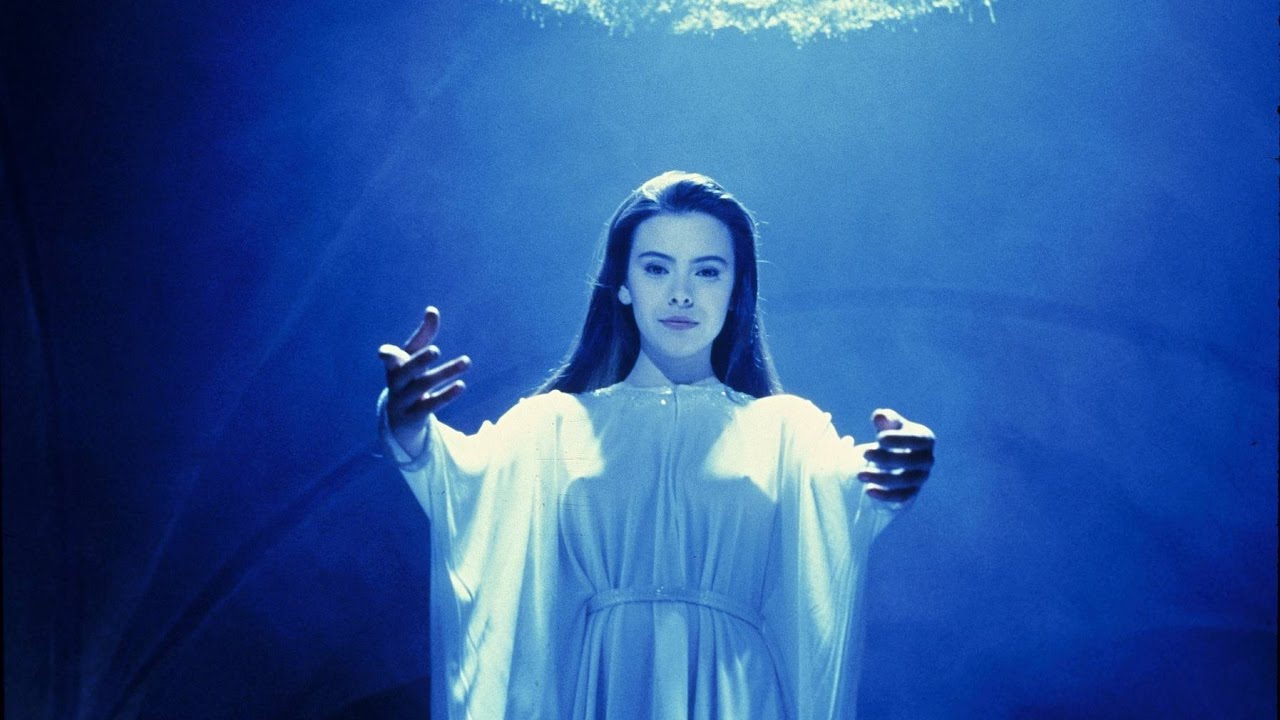
1. Mathilda May as the Space Girl

For these alluring sirens archetypes to function properly, the girl has to be mad hot, young, and visceral, so she overloads a straight male's circuitry and leaves him exposed to danger. When there's someone like Natashsa Henstridge in SPECIES or Matilda May in LIFEFORCE: impossibly young, perfectly formed, as if from heaven's mint, then it all works (and when there's someone like Liz Taylor in DOCTOR FAUSTUS, it doesn't). I mention all this not to seem sexist or ageist but because nature and the unconscious is sexist and ageist. Whether we're 17-18 (as I must have been) or 80 we know we'd damn our souls to hell and jump off a cliff or whatnot if Henstridge in SPECIES or May beckoned. We'd have no choice. 

That's why, when Scott shouts in her face during the climactic soul drain, "WHAT ARE THESE FEELINGS?!" it's gut-bustingly funny. He seems to react towards her touch by screaming at the top of his lungs. A lot of time she has no real acting to do, just a wolfish smile and eyes that dilate and occasionally widen (with spiral irises!) as if throwing a lot of invisible carnal force in these male's directions. You can feel it. You can feel why she scrambles these men's senses so completely. She's "totally alien... and totally dangerous."

2. Ancient Alien Hypothesis explaining the Periodic Reality of Vampirism via Halley's Comet

Several steps ahead of our current internet paranoia dot-connectors (myself included), Dan O'Bannon's (the co-creator of ALIEN) adaptation of British mystic Colin Wilson's novel is adept at connecting ancient vampire lore with pre-Halley pass excitement. Here it turns out vampires are ancient aliens who basically ride around in the wake / gravitational drag of Halley's comet, deep in hibernation until they get near enough on the long orbit to sense the brain waves of life forms to feed on, then draw them close and assume the forms they most desire so they'll get brought in. Jungian archetypal psychology, ancient alien theory and Bob Lazar's Area 51 statements (how we're a soul farm, and aliens want to make sure no extra-planetary force damages their harvest's 'containers'), and even Cronenberg-Romero-style outbreaking (the emptied containers come back and have an hour or so to try and 'fill up' again or they exploded in a shower of dust, ditto their own victims, etc.,) all ties in perfectly with the 1986 (then a year away in real life) arrival of Halley's comet. as explored in another personal favorite, from the previous year, 1984's NIGHT OF THE COMET. It's all connected. By Halley.

3. Addiction 

The same year LIFEFORCE came out, 1985, saw Dan O'Bannon's RETURN OF THE LIVING DEAD (by then I had just started drinking and smoking weed-- what a year!), and as opposed to Romero's slower, downer, DAY OF THE DEAD (also '85), there's a sense of real junkie madness in O'Bannon's zombies in both films. His zombies are the only ones who talk, and who eat only brains, and moan for "more brains!" But what stands out is their crazed desperation, the agony that devouring brains or electromagnetic soul energy can allay, even temporarily. That terrifying sense of junky withdrawal agony and its prolonged, gathering intensity-- to the point you'd cut off your own hand to be free of it for even a few minutes--is something I've recently directly experienced (what a year!) and can vouch for O'Bannon's monsters doing it better than anyone, in both films.

4. Michael Gothard as Dr. Bukovsky

One of the few scientists in Britain's space building who gets the full Mathilda May sex treatment but survives, our Bukovsky is left a shivering wreck. That he can't help the investigation as he's too worn out from almost hooking up would be either laughable or idiotic in lesser hands, but Gothard, with his great deep actorly voice, masterfully makes his declaration both hilarious and deadpan believable. Too bad he barely got to speak as the Germanic assassin in FOR YOUR EYES ONLY! Most of his other credits seem to be in long-forgotten BBC shows and direct-to-video OOP stuff. 

Gothard, you're so good here you deserve better! I love his reactions to all the veiled disses from the other guys, ala 'you were overpowered by a cute young naked woman who'd just come out of a long coma?' And he's like 'yes.' You also have to like how his groovy space center is in, like, the heart of London, and guarded at night only by a few bumbling security guards, when compared with, say Area 51 and the military fuss we'd make over a similar alien body find.

5. The Col. Caine / Quatermass Connection

With his dope name offset by his halo of blonde curls, Peter Firth (EQUUS) is in rare form as the 'what you haven't heard of me?' Col. Caine, the big MI6 or Special Service guy called in on these spook details. Once the space girl busts loose and the body count's too big to cover up, Caine's the man they send for, and we're treated to his spirited cut-the-shit/ solve-the-problem attitude with the scientist survivors. Curly tow-headedness or not, Firth slams it out of the park. 

Note: don't watch EQUUS (1977) the same night as LIFEFORCE, or ever.

6. The comical reaction cutaways.

Throughout there are cutaways to reaction shots so absurdly mismatched you can tell they were edited in half tongue-in-cheek (I imagine Hooper shouting at the actors off camera during their close-ups: "now you're scared,  now some bright light is shining, cover your eyes! Look! You're scared again! Oh no!") and the actors trying not to smile or look too unmanly (one shining reaction shot of Firth is soooo fey it's like one of Price's Phibes pantomimes). Maybe these were taken out of the original American release to make it less funny? At any rate, I'm glad they're back.


7.a. Ellen, EXTREME masochist: 

In my favorite scene, Railsback interrupts an interview with the nurse to grab her and start slapping her around: "This woman is a masochist!," Railsback shouts. "An extreme masochist! She wants me to hurt her!" How he knows this is a mystery (or I forget). Maybe it's the David Bowie poster on wall, the Hallmark store harlequin decor like it's her junior college one-bedroom, bespeaking the nature of the nursing profession in the world of socialized medicine. Railsback's abuse of this poor lady, all but 50 Shades of Gray-molesting her right there in her room while Firth looks on, trying to seem more concerned than kinkily turned on ("I'm a natural voyeur") is a true highlight of the genre, highlighted by when Railsback screams in her face, "Are you IN THERE???" - I've seen this movie a dozen times and I'm always in hysterics at that. Not to mention pretty soon he's pumping Patrick Stewart the same way.


7.b. Railsback's make-out sesh with Patrick Stewart, in whom the Space girl is hiding (?) so Caine can drug him/her so she can't escape. Wait, so she isn't bound to any one body (?). The rules of the plot don't necessarily make sense by then but who cares? Think of this scene as forerunner to when Stewart channels Jean Grey's romantic goodbye to a crying Cyclops in XMEN 2 and you realize old Patrick Stewart is the go-to sci-fi channeler of psychic babes!

8. Headlong Momentum

With no adamant denial and military bullshit obstructing things (the way Qaatermass and the Pit had to contend with the dogmatic skepticism and paranoia of the aptly named Col. Breen), no one challenges each others' authority or theories here. There's no time. Thus a cool boy's club network of brains and quick thinkers make it hum: Gothard and Frank Finley carry the first chunk of the film once we're back on Earth, before Railsback and Firth take over; then  Aubrey Morris comes in! The way these three jet around in the helicopter makes for some highly amusing and very British business. We're spared all the laggy elements, needing to convince the PM, etc. --yet the pace is never too choppy and forced. I like for example that all of London goes to shit in the time it takes Caine and company to chopper over to the looney bin and back. In other words, like only a handful of other films in its genre, there's a sense that events progress with or without our heroes witnessing it, and faster than they can really control or halt with any effectiveness.

9. Great ensemble of adult males who like to scream a lot: 

Aubrey Morris (yessss?)! Patrick Stewart! (Arrrgh!) Frank Finlay ("here.. I .... go") --all sublime. The amount of first-rate British male acting muscle here is pretty substantial, they have a great rapport, and I love little bits all over this movie, like Col. Caine's asking of normal questions, and the pained but polite answers of Gothard's Bukovsky and death-studying doctor Kulada (Frank Finlay), or the way Aubrey Morris' govt. man just rolls with the weirdness, looking up to these taller actors with a kind of puppyish adoration, trusting their thespian chops to get him out of any bad script scrape and just covering his mouth with a hanky when he starts to 'break' (as in burst out laughing). Deadpan dialogue is punctuated by screaming hysterics (at least four male actors scream at the top of their lungs for several consecutive breaths - with Stewart and Railsback taking at least two turns). With only two women with speaking parts in the whole cast (one on the space crew is basically an extra), it's very much a story of male sexual panic, but so cloaked in British reserve that the deadpan hilarity magnifies with every new beat, not unlike the ever-accelerated Minerva engine! Scream your heads off, men! Here she comes again!

A rose by any other name would still carry deep post-Giger fallopian resonance

10. The odd mix of super low budget with big budget sequences.  
All the money must have been spent out in space, the effects are all cool if it's a bit slow (and the British-style space suits evoking Kubrick more than Ridley Scott) so that by the time we get to the climax of all the dead hanging around outside London's Carfax Abbey or St. Paulie Girl Cathedral or wherever, London is represented by basically just one big alleyway of writhing extras, all crowded together to seem like all London is just stairs and back alleys, going up in smoke; again we get a QUATERMASS AND THE PIT evocation for that film too tore down a small section of London outdoor space to evoke the whole, and in the end, it's tough to tell which side won. I love it for that.

The ship, full of captured souls like a trunk full of groceries, heads off to deep space once more, until the next time Halley runs past, which should be in a mere 41 years!! If I'm still alive, I hope they make a sequel, or if I'm not, that they 'wake' me up!

I didn't even mention the groovy score! No time! ARGGGHGHHH!

WHAT ARE THESE FEELINGS??!?!

Tuesday, February 18, 2014

Monster Capsules: BAD DREAMS, THE ROOST, DAMNATION ALLEY, AFTER MIDNIGHT, TALES FROM THE DARKSIDE

 BAD DREAMS
(1988) Dir. Andrew Fleming
***

This is a film that took a long hard look at the Nightmare on Elm Street 3: The Dream Warriors box office receipts in 1987 and said, "I have great idea for a movie!" So in they cast the same girl from Nightmare 3: Dream Warriors, Jennifer Rubin, to play basically the same role in basically the same mental hospital." Instead of a Freddie (that would be pushing their luck) there's Harris, a hippie cult leader who burned himself up, intentionally (rather than let someone else do it --see, it's not the same film at all!) played by Richard Lynch (who also burned himself up intentionally in real life!). In the 70s-set prologue he coaxes his hippie flock (called "Unity Field") to burn themselves alive together, in order to "unify" their souls. Rubin is the only survivor, she chickens out, and is pulled from the roaring flames, full head of hair intact, and in a coma. She awakens 13 years later, and finds herself promptly stuck in a mental ward and, worse, it's the 80s. Jeffrey (Re-Animator) Combs is the strange, handsome shrink who brings her to group therapy in order to introduce a rapidly bumped-off set of emotionally troubled young patients. At night, the stressed Rubin sees the ghost Harris wafting around the hospital, beckoning to her with a ghostly 'Join us!' wave of his burned hand, and settling for one of her group when she declines. As in Dream Warriors, it's hard to sound sane while trying to convince the authorities that a rash of suicides amongst your fellow mental hospital inmates is the result of a long-dead burn victim taking revenge. But Jennifer Rubin just keep trying.

The creepiest aspect here--far creepier than Englund's Freddie, actually, because he's trying not to be--is surely Richard Lynch as the cult leader. This Lee Strasberg-trained and scary-funny as all hell actor makes a great villain, as anyone who's seen DEATHSPORT well knows, though he's not a convincing cult leader. Look at that picture at left, would you want to follow him? A cult leader needs to be seductive as well as just creepy. Could you imagine Robert Englund running a cult? It's hard not to imagine what a cobra-hypnotic presence like Lance Henriksen or Michael Ironside might have brought to the role. No offense to Lynch meant. His voice alone could run a cult-- it's serpentine, deep and magnetic, but even before his character burns up, it looks like he insisted on having a textured flame retardant gel around his face at all times (which seems wise considering the amount of flame he's exposed to in the film --and his real life burns - I'm not surprised). Maybe I'm jealous because I've always felt I'd make a great cult leader, and my dad was always urging it on me, saying that's where the real money is. In other words, I want my own Unified Field! I almost started one once or twice but then realized the old Groucho Marx adage, paraphrased for cult leading (I'd never want to lead anyone gullible enough to follow me).


The rest of the cast is very good in that 80s teen horror sort of way, it's actually kind of a surprise how good the writing and acting is underneath the low budget. Sharp-eyed punk rock fans may wonder whey they're strangely drawn to Susan Barnes (it's cuz she was in both Ladies and Gentlemen the Fabulous Stains, and Repo Man!) and the terrifying Dean Cameron will linger in your mind thanks to his skill at amok basement leaping and bulb punching. As Pauline Kael might say, he all but smashes a hole in the picture. Rubin is very good at wearing her emotions on her sleeve and the Shout Blu-ray reveals every gossamer strand of the glisten in her eyes So yeah, this movie grows on you, separating itself from Freddie Krueger comparisons as it matures. A lot of that probably has to do too with its incomparable pedigree: Gale Ann Terminator Hurd produced, and Andrew The Craft Fleming directed. In their hands, anything can take wing beyond its dubious origins (after all, James Cameron got his start working on Star Wars and Alien ripoffs for Corman - it's the highest flattery of form!).


POST SCRIPT (I wrote this having no idea of the weird link of Lynch's burns coming from lighting himself on fire while on an LSD trip in Central Park in 1967 - now that's a brave actor - not setting himself on fire, but playing a psychedelic-era cult leader who sets himself and his congregation on fire in order to bring them all close together - that's the kind of art imitating life through the artist that lived it kind of meta shit that gets me all a-flutter - so, in its way - this film is a nice harbinger of Freddy's New Nightmare! Art imitating the Imitation of its previous incarnation imitating life!).

THE ROOST
(2005) Dir. Ti West
***

Ti West's first film--hampered only by his inability apparently to motivate actors into a state of wakefulness--The Roost is a surprisingly engaging work of horror retro minimalism. Even the carload of mumblecore hipsters are bearable thanks to their low-key delivery, voices low so as not to disrupt our fading attention span. Taking a midnight shortcut along a mysterious road on their way to a wedding, a bat flies into the windshield causing a crash! Cue a kind of Jim Jarmusch version of Planet Terror on a Plan Nine budget as the bunch knock on doors to get help, and the bats inhabit a nearby barn, and their bite turns humans into zombie monsters.


The acting is pretty bland (with the exception of newcomer Vanessa Horneff) but it's hard not to be awed by West's unshakable grasp of what makes horror work. In this case it means trusting his audience and his grasp of the genre in order to use minimalism to generate unease, rather than the usual overwrought whiplash editing and bombast. West's instincts for how long to play a shot or moment are so spot-on he can confidently throw most of the usual horror symbols and dross away. Close-ups of doors slowly opening, for example, are presented completely out of context and for some reason it's scary because we don't even know who's opening the door or who's standing on the other side, if anyone. Genius. He also makes great use of tick-tock momentum, 16mm grain, no daytime scenes at all, a remote location (the Marnie barn) and, most effectively, only diegetic (headlights, porch, dashboard) light which makes the all-consuming darkness of a lonely rural shortcut palpable. The score's an effectively minimalist avant garde mix of drones and cello.

Maybe all this doesn't sound like much on 'paper' but it's all the spookier for being so apparently haphazard. Too bad there's dull stretches of horror host filler with West favorite Tom MANHUNTER Noonan underplaying to the point of sad distraction. If nothing else, it contextualizes the inner film proper, adding a whole new chill by association. Or if you like- it's filler so West could enter THE ROOST in festivals as a full-length feature.

TALES FROM THE DARKSIDE
(1990) Dir. John Harrison
**

Three stories, with past and future stars: James "Ajax from The Warriors" Remar is a struggling artist who is almost killed--but then spared at the last minute--by an inner city gargoyle; he falls for Rae Dawn Chong on the same night and has never seen Kwaidan (1964) so never makes the connection and/or avoids the same mistake. Another tale has a young Christian Slater, young Julianne Moore, and young Steve Buscemi encountering a shambling mummy (from an Arthur Conan Doyle story) - future stars or no, it's really dull. In another, David "New York Dolls" Johansen is an assassin hired by wheelchair bound William Hickey to kill a cat. It's a segment conceived by Stephen King (Breathing Lessons) and scripted by George Romero (Season of the Witch) but you'd never know. Debbie Harry as a modern cannibal housewife trying to cook for a child occupies the connecting tissue (The Hansel bides for time by telling the tales, ala 1001 Arabian Nights).


I've never been a fan of horror anthologies (except, of course, Bava's Black Sabbath) as too many get hung up on the tired old EC comics-style supernatural comeuppance formula (exceptions might appear, like Toby Dammit) but the film as a whole drags. I have the same problems with Darkside. Even Debbie Harry is surprisingly flavorless as the cannibal gourmet. Haha! "Flavorless,"get it? The script's loaded with that kind of thing.

AFTER MIDNIGHT
(1995) Dir. The Wheat Brothers
***

At last, a trilogy free of 'supernatural comeuppance.' Underrated fringe weirdo Ramy Zada goes for distance as the psychology teacher who pulls a gun out during class and points it at a snickering jock to teach the class all about fear. Said jock is pretty pissed - in both the classic "his pants" sense and figuratively - to the point he later breaks into Zada's basement with an axe planning his own gruesome fear exercise. He doesn't know Zada's upstairs conducting a ghost story round robin with some of his cutest students because hey, it's a dark and stormy night. And hey, one of the students is a psychic who senses something wicked's coming up from the basement... First, lets hear these tales!

I dug the middle segment best, with its looney tunes midnight warehouse dog attack. Most critics prefer the final story, wherein a creepy celebrity stalker switches gears and comes after said celeb's answering service operator, played by the always worthwhile Marg Helgenberger. The first bit is a short and sweet one sure to grab ya with a chuckle and a gasp -if you're not expecting a chuckle and a gasp that is, so forget I said anything. Just make sure you stick around for the bizarre climax, wherein a burnt skeleton chases the psychic girl through all the other sets in a vague nod to the climax of The Terminator and    With its simple minimalist set design and slim budget, After Midnight proves that less can be more when it comes to horror: by contrast Tales from the Darkside has the money but can't venture out of its predictable DC Comics House of Mystery twist-endings uber alles vibe - the sort that, like many of the Amicus anthologies of the 60s-70s, is barely concerned with atmosphere or fun, just set up for the somewhat Diaboloque-ish punchline.  After Midnight isn't that interested in the final destination, it would rather enjoy the ride. It quits all sense of consensual reality, throws its meager budget at the screen as a distraction and lunges straight for the nightmare logic jugular.

DAMNATION ALLEY
1977 - Directed by Jack Smight - ** 
(for male viewers who were kids in the 70s - ***)

Not an easy film to love but, for some of us, loving Damnation Alley is a challenge that beckons like Everest. We really want, even need, to love it, even if the actual film goes out of its way to suck. Still, if you were a boy in the 70s and read Famous Monsters of Filmland, chances are you longed to take that climb, to escape your stupid life by jumping into that cool armored cruiser (above) and setting out across a nuclear landscape, pausing only to jump over giant scorpions on your motorbike, or outrun giant scorpions, man-eating cockroaches, psychotic rednecks, and other things one needn't feel the slightest bit guilty about decimating with rooftop rocket launchers or at the very least, running over or gunning down. Every boy of a certain age dreamt of that kind of bedtime-less freedom. A time when drinking or driving age limits, cops and homework would all evaporate like a bad dream in the fall-out (and if there is a girl, she's an easygoing cool Hawksian prostitute/dancer rather than a bossy Fordian pioneer mother/wife). And who better to teach you to drive and fire roof-mounted rocket launchers as soon as you're old enough to see over the steering column, and to have a beer and a smoke while you're at it, than Jan Michael Vincent and George Peppard?

Directed by Jack Smight, who gave us such other awful but irresistible films as Midway and Airport 1975, Damnation Alley is a film as wholesome in its fashion as reading a Playboy sandwiched inside a Boy's Life magazine at a Boy Scouts lodge meeting instead of paying attention and then sneaking out to light fireworks, choke down sips of stolen beers, and shoot your grandfather's 8 gauge shotgun at his empty beer cans back by the creek before your mom comes to pick you up. George Peppard rocks a terrible fake mustache and lame Southern accent as the dad who teaches you to drive; Jan Michael Vincent is the starry-eyed older brother who gets the girl but lets you ride his cool motorbike; the girl is a young Meryl Streep-style French beauty (Dominique Sanda) they pick up in--where else?--a giant gaseous ant-infested Vegas; Paul Winfield is the fifth wheel black guy, killed off early as was (and sadly still is) the custom.


The film begins in one of the best nuclear war recreations in film history: no drama, no hand-wringing, just by-the-book monitoring of screens at a remote missile silo deep in the American southwest: no women or bleeding hearts, no morality or ethics or drama--they just do everything they've been taught --perfectly-- and then ---oops yeahhh, so did the Russians. Game over all around. A few years go by and a chain reaction explosion at their remote facility makes sticking around inadvisable, as well as trimming the survivors down to a convenient handful. They get word of a small thriving town of survivors out in Albany (of all places), so they take off across country from deep in the desert of the west. There's supposed to be two of these big mad cool vans to traverse the nuclear terrain in, but the film's budget only allows for one, so we seldom see the both of them together. But Smight, we don't need two to start with. Why bother?! Make with tha monstiz!

It's small random stressing of details like that which lead to the true weird charm of Damnation Alley! This is a pre-Mad Max / post-apocalyptic wanderer movie made by a sweet very cool older brother who doesn't want either mollycoddle his young brother or traumatize him with too much brutality. Aside from a few traumatic deaths and a decent into some sadistic redneck threats and danger pre-retaliation, there's almost nothing here that wouldn't get this a 'G' rating - except that title! It had DAMN in it! As kids in the 70s, that title alone was daunting - made it seem like the kind of thing you needed your friend's cool older brother to take you to see, or you didn't see at all... ever.... and only dreamed of how boss it was.

Myriad technical difficulties aside, this has to overall be the mellowest post-nuclear war movie of the 70s, so it's got that at least going for it. Mostly the whole film is long shots of driving through psychedelic electric storms--which I personally love. There's also a strange flood (luckily these vehicles are built to float) and mostly empty deserts. Even the arrival of a kid isn't cause for alarm, since he's played by the perennially feral Jackie Earle Haley, who would never harsh a mellow van vibe. We kids generally hated kids in our movies, but Haley was cool because of Bad News Bears. He was the type who seemed a bit sketchy, from the wrong side of any tracks, unkempt, un-mothered, like he'd be a bully, but in reality he'd only pick on other bullies and protect the snot-nosed rest of us, even from guys twice his size. The 12 year-olds in us thrilled regularly to words like "we can now all take a shower once a week, whether we need to or not."

As for the Shout! Blu-ray, I almost never find anything disparaging to say about this label, who have been cleaning up and releasing to Blu-ray a vast host of previously disrespected sci-fi and horror titles from the 70s and 80s that would likely be forgotten or bungled otherwise. The Blu-ray of Damnation Alley however disappoints on the color front, despite groovy deep blacks. But instead of restoring all the weird colors of the post-apocalyptic open skies, they've just lightened the whole thing and deepened the shadows; the blue skies now have a sun-bleached video box cover look; when they do let the skies look post-apocalyptic, they pick one faded color rather than the multiple hues of the analog original version we can catch on Prime, VHS, Youtube, etc. In the earlier versions, we can see the overlay lines between the actors and the color tint, and the whole movie looked like we were watching it through sunglasses, but so what? Did the restorers not realize this was a post-apocalyptic storm sky and not meant to seem realistic? Thirty degrees of coolness are lost in a brushstroke, or the lack of one.

Aside from that, who can complain; and having it on Blu-ray is literally my 70s boyhood dream come true- seriously, I imagined being able to watch it over and over on a Famous Monsters Magazine - shaped and sized rectangle! And as Lacan might say after a dinner with Lao Tzu, only those fortunate enough to fulfill their childhood dreams have the honor of realizing just how empty such dreams are. Imagine the misfortune of those who die still clutching their Rosebud snow globes instead of the warm hand of a Hawksian Vegas showgirl playing nurse?

Top: Amazon Instant Video / Bottom: Shout Blu-ray

Tuesday, October 15, 2013

Your Clowns Bid You Goodbye: THIS IS THE END, IT'S A DISASTER


A cohesive, 'tight' film, funny even into the maw of Hell, THIS IS THE END (2013) comes long after 12/21/12, late to the apocalypse party, which is of course in character considering the cast of stoner royalty --James Franco and Seth Rogen, still soaring on PINEAPPLE EXPRESS fumes, Craig Robinson, Danny McBride, Jonah Hill, Michael Cera, Jay Baruchel, Emma Watson, Channing Tatum, and so on--all playing themselves. Unlike 95% of its ilk, END skips the zombies and instead goes full literal-biblical, mixing heavenly ascension, childhood buddy friendships stressed by fame and distance, growth and kindness as essential to survival, an actual bible, LA vs. NYC rivalry, raping demons, ethical dilemmas, and lots of weed. The genius touch is to have them all play themselves (only more so) and they bring a lot of brutal self honesty: Jonah Hill acts like Oscar's A-list sycophant, bandying the word "tight" around and treating resentful New Yorker Jay Baruchel like a special needs child. Jay instead blames his own paralyzing social shyness on LA; Michael Cera snorts coke and bullies groupies in fits of drunken Reptillian overlordsmanship; Daniel McBride ramps up his dirtbag townie craziness; James Franco is a vain but guarded host with a weird bi-curious vibe; Rhianna, Aziz Anzari, and countless others disappear down a giant blast furnace hole in the ground. Being a star guarantees nothing as the flame pit widens and the stars are revealed to be tough and resourceful only via movie magic. While the demons howl outside and devour those unlucky stragglers, these dudes duct tape the cracks in the concrete of Franco's party fortress, pool their booze, and wait for the cable to come back on.

When I was counting days inside the rooms of Alcoholics Anonymous, I used to like to imagine Armageddon as a great excuse to relapse on whiskey, and hoped one day I would get the chance, for whiskey is so so good. But if an alcoholic vows to drink again only when hell froze over, sooner or later he'd drive down into the flames on a stolen Zamboni. That's in the bible... if you know which bible I mean. Still, for some of us, the apocalypse is our last chance to reunite with our deranged lover in all her brown... intoxicating....  proof.


In other words, I would be the first to volunteer to leave the compound and forage, because maybe... maybe somewhere in the hellish mist of the Hollywood Hills... there might be unbroken bottles of sweet sweet booze. That's the comfort for a recovering alcoholic in the apocalypse. No demon can compare with that one, no scare or threat can stay that eternal thirst. Without that carrot lure I can't see ever stirring from my bunker. But I am the alcoholic thing in the black crib with the upside cross baby mobile ROSEMARY'S BABY dashboard. I am the third heat, the eternal thirst carved large as Asmodeus' initials into the EQUINOX oak tree soul. I guess we all have our reasons for wanting this damned parade to finally end, in a blaze of glory. That's one of mine.

But these guys--Seth Rogen, Franco, Danny McBride, Jonah Hill, Craig Robinson, all playing themselves-- are more grounded than I am... which is odd, considering they don't seem to have girlfriends and the first thing they wish for (outside of weed) is a Back Street Boys reunion (nope, nothing gay here). Perhaps that's the secret to success: girls always Yoko up a band sooner or one of you goes to college, or leaves it. I can only imagine what would happen if I never moved to NJ or my buddy's parents didn't get divorced and turn him militant, or if I never became a hippy punk rock boozer. All these things killed our comic book making, super 8mm filming, dungeon and dragons module creating, and selling, and marketing company. Girls were but the coup de grace. 

If I had known nerds would conquer the world, that the "Comic Con" would one day be a prestigious event, I might have never have choked down that first pilfered warm beer at my punk rocker friend's graduation party. I'm funny, too, man. Can't you tell? Why did I give it all up for a life of hipness, boozy abandon, and relationship-attempting? None of the dudes who wind up at Franco's seem to have any long term relationships, or kids, to worry about, and it's damned refreshing. At no point does any character say, "I can't leave without my children!" or "If Kathy's back there, I'm going to get her!" These guys don't give a shit!


The main star of THIS IS THE END though is the raw kinetic energy and flow of weird ideas that doesn't stop, just snakes forward from LAX to chillin' with buds to a party at James Franco's house all the way to....  The big budget CGI in the film isn't used for guns and nonsense. There's only one gun in the whole damned movie. Instead there's great towering demons to rival The Night on Bald Mountain sequence in FANTASIA, and Jonah Hell spewing green bile like a portly homoerotic Linda Blair, but no monster is quite as scary as Emma Watson with an axe. Or more balls-out-gonzo than McBride gone cannibal --the role of the year in the movie of the year.  Like many Piscean artists and writers, I've always admired--from a distance--the McBride type. We Pisces never invite them to parties but they always show up, draining our bar but bringing us awful weird new drugs like angel dust, jimson weed, and crank and introducing us to carnivorous whores. You can't get rid of them, so you may as well enjoy their ferocity, use it before it destroys you. When the world ends and the savage monsters reign, we could use a man like Frank Booth again.

Didn't need no welfare state
I don't want to spoil what may be my favorite movie so far this year, but if you haven't seen it yet, you can still take a page from its bible and start to be nicer to people; even if there is no one true God it couldn't hurt your chances for ascension. I've written extensively on my arcane beliefs regarding soul density, in that the more self-centered and hateful you are, the more dense your soul gets, allowing demons to capture it when you try to ascend; it follows then that the more positive and selfless you are, the lighter and more expanded your soul gets, so demons can't catch it anymore than one can catch smoke in a butterfly net. Hence demons are all about convincing you goodness and lightness is for suckers. It's just a theory, based on a mix of Thaddeus Golas, Egyptian mythology, and David Icke, but it's a solid way to structure it.


If only life were just buds and booze, how simple and joyous! But instead how complicated and downer-ish it is to watch dudes from your crew marry and--unless you join their creepy 'we have kids' cult--never be seen from or heard through again. Maybe that's the real fantasy, that the world will end before maturity's inevitable bro-pocalypse wipes out your network. I hear it's just like falling asleep. Push... push... and then, I hear, lots of worry about the right schools. Dragged to recitals... pretending to give a shit about Little League. Oh the smell. Pass. I'll stay awake.

And that brings me to the stifled world of the couple's brunch where--if they had girlfriends with bourgeois hipster tastes--the dudes in END would be going on Sunday afternoon (after a nice early bedtime) instead of to Franco's on Saturday night (or if I was there and it was the 90s, both). I'm of course referring to the 2012 'couples' comedy IT'S A DISASTER.

David Cross is the stranger being vetted by his internet-met steady Julia Stiles' posse. He moseys around the nice house, drinks some Scotch with the boys, hears how they got problems of their own, blah blah. Suddenly, a neighbor comes in decked out in a hazmat suit. A dirty bomb has gone off downtown, poison gasses everywhere. Commence duct taping! And then the couple who are always super late try to come in, coughing and hacking and begging to be let it in. But the duct tape is on. What do you do?

Damn right you don't.


That kind of satiric moral querying is welcome when the less humanist decision is pre-empted, and the swinger couple (Rachel Boston and Kevin Brennan) slipping a subtle menage a trois come-on to Cross are hilarious; America Ferrara mixing all the drugs in the house together to create some homemade ecstasy--determined to get super high to face the end--she is my hero. While her beau seems to think ranting about conspiracies will turn the deadly real situation abstract enough to deal with, i.e. what you can deconstruct can't kill you, she's doing the right thing, the thing the old black jazz pianist on the cruise ship or Woody Harrelson does in the movie 2012, get lit bright as a Lincoln Center Xmas Tree.

Overall it's some good ensemble work, giving off the impression these people all know each other and respect one another's comedic rhythms, and if it all seems over before there's any special effects fire and brimstone to run up the tab, well, it makes up with in the kind of inner-hell only the relationship-anchored truly know.


So what, in the end, is the right scenario for you? A lot of us were hoping the world would end last December 21st, so we could skip that much-needed root canal, or get out from under our credit card debt. Now here it is a year later and we know we're saddled with seemingly immortal life. So pick your poison and live to die another day: going out with the bros is of course the more fun option than meeting the new girl's posse at a petit-bourgeois couples brunch, because the deeper you look the more you see how hard it is to grow when you can just blame your significant other for holding you back.

Unfortunately real personal growth only seems to come with pain, fear, and trauma. With the boys up in the Hills of THIS IS THE END, though, there's no one else to blame, no one to take the bottle out of one's hands and wag her finger, and so, convexly, no escape from the awfulness of one's own true self and one's own addictions. If that's not a reason to relapse I don't know what is, 'hic'.

Oh how time flies / with crystal clear eyes

Tuesday, July 05, 2011

Strangers / with wet hair: TREE OF LIFE (2011) and EMA's Past-Life Martyred Saints


There was an annoying commercial awhile ago with a cute 'brother and sister' ordering movie tickets on their cell phone while pretentiously announcing in that Madison Avenue version of Williamsburg Daria hipster flatline voiceover that "images are important to us." Because they're photographers. So they go to a lot of movies together, which is about $25 per film between them, not including popcorn or bedbug removal. If nothing else, THE TREE OF LIFE proves that images are important to Terrence Malick too - he is a cinematographer...

Malick even acknowledges this weakness in a perhaps autobiographical scene where a child or his sibling finds a sheer nightgown in a neighbor's drawer and steals it. One might imagine he does something icky with the garment, but Malick has never cared about sex, onanistic or otherwise. His Texas is not the Texas of THE LAST PICTURE SHOW and its coming-of-age deviant cataloging or of GIANT and its lustful Deans. For Malick, women are symbols meant to glisten with beauty, particularly if they have long red hair that looks good in the setting sunlight (Chastain could be Sissy Spacek, after Martin Sheen's been sent up the river of life), and if they're wearing shimmering sheer nightgowns it's so the light can send a lace shadow over the lawn. Malick brooks no pornographic, only the Joycean aesthetic arrest, so the theft of the nightgown is the first guilty moment of a future cinematographer--the 'capturing' of a gorgeous ephemerality-- the nailing of butterflies to celluloid ala Stan Brakhage. But without a film to bury the image in, there's no reliable 'container.' The kid notably tries first to bury the nightgown under some mud (too much like sending it to the editor) then decides to release it into the stream, into the flowing fleetingness; the cinema he can't himself witness without a helicopter shot (and there are many); the night gown so ephemeral the only eye that can possess it is the fleeting eye of the all-seeing viewer, the 'God' eye-view. The little river/stream itself is something like a long band of film, and each nightgown tossed onto the waves is a little baby Moses of possible meaning and interpretation before it goes over the falls only to return in the next full rotation of the astral take-up reels in time for the next show, and it's never the last... til it's the end of the run.

Unrepentantly personal as Malick's TREE is, so inflated yet intimate are its emotions, it may help to be on substances or dealing with a recent or impending death in the family while viewing. My dad is very sick after chemo-therapy, so a combination with that and other things made these tight little catalogs of instances between Brad Pitt and his tykes extra pronounced for me. And I grew up with a younger brother who I felt the need to dominate via fake wrestling and we were into war, and violence, but with fake punches always and always treated like real punches in scope and dynamic chin swings and dying falls. If TREE was about girls growing up, I can imagine being bored. Real bored, or if I didn't have a little brother, or was on so many drugs and grief and guilt, bored, real bored.

There's no reason to analyze my deep connection too closely, except that if I made too light of death in past posts, I'm sorry now. Preparing for the possibility (which means also, acknowledging the inevitability) you are going to lose your father is like you're going off a slow motion clockwork cliff and realizing you don't even know how deep is the gorge and no one really cares if you scream all the way down - a fall that could take seconds or decades. There's no way they can stave your fall, so they won't try. Malick is Christian enough to know that guilt is the quickest route to humility, which is the quickest route to God. I know I wasn't the only one amidst the sacrosanct BAM audience breaking down in free-flowing tears once or twice, but then a few scenes later, sighs of exasperation and douche chills at trite symbolism; even at the mighty BAM, cell phone blue lights came on like rows of stars below the screen. For shame!


So it's arty, but is it art? Getting the special effects guy from 2001 and BLADERUNNER (Douglas Turnbull) to work on your big bangs might make you cool but Kubrick and Scott were making science fiction not 'mere' student art film abstraction. Kubrick and Scott were showing what might be, stressing the banal aspects of space travel. Making Texas seem to hurtle through space and turn on an axis is only to reveal that which is already is, to undo the tinny illusion of how we seem to be standing still as we whirl around like a mad spinning top across the infinite playroom floor of space-time. Since you are, then, just revealing the real, why presume you're saying anything other than the trite science bombs of a freshman first-time pot smoker? The image of Sean Penn walking through a mysterious desert door frame is the sort of thing they wince at in hip student film festivals, but it still made me cry, not least of reasons being seeing an A-list thesp like Spicoli really commit to such an old trope. Hasn't everyone who ever visited that splotch of desert shot film of themselves going through that door? Only Sean and Terence have returned, dared to bring their experience and weight back to the idealistic naivete of their BFA years.

Malick's going for 'the big fish' as David Lynch would say, and when an artist goes for the big fish they have to get pretentious as a matter of course, lest their spiritual aims get obscured by plot or drive or other tricks of attention getting, or else become boring like Ozu. But in the end, the little bits of character development undo their own seriousness - Brad Pitt's playing the organ at church is undone by the fact he only plays Bach onscreen and we're not subject to tired hymns sung by dusty congregations in fitful slow starts. This isn't the world we're seeing--or even memory with all its weird time images--but an uneasy combo of both, with a biology textbook and Hallmark birthday card stacked on top. I'm amazed I even remembered the dinosaur name 'Ornitholestes' while watching this -- the word coming to me as if from a lost dream of a five year old who learned to spell dinosaur names before he learned how to tie his shoes but hasn't articulated the word 'ornitholestes' in at least three decades - thanks, TREE!


Jessica Chastain as the mother certainly helps redress this Iron John blood poisoning. She reminds me of a girl I wronged, adding all sorts of psilocybic resonance to her wounded dove close-ups, which are so well shot that you can see the 'signature' stamps of alien DNA in her Celtic pale skin, that fair-haired mossy coastline fairness that if you look closely reveals blue webs of capillaries just below the translucent skin, flushing with blood when hot emotions come across her face.


Another plus is the Texas apocalypse angle, which I've written about as far back as 2007, 'the year of the Texas Apocalypse Cinema,' since then we've also had SOUTHLAND TALES (apocalypse-dependent), and Tarantino's DEATH-PROOF (see: The Foxy, the Dead, and the Foxier), all of which are Texas-style apocalyptic if you know how to dig. And for THE TREE OF LIFE, you don't need even need a shovel, as meaning is excavated and then spread upon the bread of the earth. And the earth is without crust, as Emmanuel "Chivo" Lubezki, who was the cinemographer, likes it, as noted by co-producer Nicolas Gonda, “Chivo Lubezki is a vital part of Terry’s process.  In a sense he had to be as much a writer as a D.P. because when the two of them are on the set, things can change in the moment.  It’s a dance between the two of them riffing creatively off each other.”

It's certainly interesting to read the accounts of how they came up with the trippy visual effects in the film--pouring milk through funnels--but who came up with the soundtrack? Better they should have gone with the guy who did the amazing score for THERE WILL BE BLOOD, or Wendy Carlos, or The Stooges' "We Will Fall."  You can get by with being spiritual and non-alienating to atheists. But pick a hymn and you pick a fight.


There's other moments here, like when you see Sean Penn wandering through the steel and glass structures where we works, that conjure Antonioni and his captains of industry striding around glass offices with their manly scrolled-up blueprints -- Rod Taylor in ZABRISKIE POINT; Richard Harris and Carlo Chianetti in RED DESERT. In the equations of Malick, God, Mary Jane, and the theater audience are ultimately indistinguishable, so is Malick referencing Antonioni, or just recreating him, ala Borges' Pierre Menard, Author of Don Quixote?

I can't help but feel that Malick's searching through the miasma of time and evolution, in dopey whisper-overs, is not for God, or his true Dad, or Brecht, but for an ideal art film audience, the kind that 'got' Antonioni and didn't fall asleep or walk out halfway through. He wants a human mind's eye gallery for his photographs, which slowly move--ala Bill Viola--so slow down and weep along or kindly check your messages with your hand over the blue screen. Images are important to us. If the film says anything, it may be "I Am a cinematographer. But is this stuff Tarkovsky, Eisenstein? Ain't no Russians, ain't even any atomic age. I was kind of shocked the mushroom cloud wasn't even addressed, when surely the age of atomic anxiety was at least worth mentioning, or television. Can a family really get along on nothing but prayers and piano lessons? No wonder Brad Pitt's cranky! No wonder that poor son is so starved for images he has to steal female undergarments and hold them up to the light. Unlike the rest of us, he didn't grow up bombarded with TV and in-class movies and filmstrips, and comic books. That lack has made him hot for images the way a reformed Mormon is hot for the pleasures of the flesh. If you've ever made it with an ex-Mormon you know what I mean. They take to your body like someone dying of thirst to an ice cold beer. This is how Malick takes to the image --guilelessly and openly.


But even here trouble arises, for that Mormon might then decide she loves you, and here you're just a no-good tomcat on the prowl, hardly worthy and never intending to stay. Now you have to live with the secret guilt of the dirty Mack every time an actress reminds you of her. Malick's image-worship justifies his lack of familiarity with the lure of scopophilia, or the pornographic, so we never get the idea he's had to lay his tomcat cards on the table. As that old SNL Freud sketch put it: "sometimes a banana is just a banana, Anna." Or in this case, a tree is still a tree, a sigh is just a sigh. A fundamental thing that doesn't apply is that omnipotent POV: What 'eye' is watching the earth form from clouds and dust? What viewer can there be who would have such a correct view of the unfolding universe? Before there were eyes to see, this stuff didn't exist at all. What Malick knows and has seen is brilliantly reproduced: a younger child watching the in-fighting of parents well captured from low, cringing camera angles, and in these scenes culled from foggy memory, flashes of stuff we remember from our own childhood are unearthed and dislodged, relentless as the search for lost keys, or remotes, all that sense of 'fleeting' works devastatingly well. But is that 'lost eye' ever addressed?

2001 has reaction shots: we know who's seeing what for the most part. When David Lynch shows us images where no eyes can be, we shudder with uncanny frisson: a traffic light changing from green to red at a deserted night crossroads, a phone ringing and no one answering, or maybe even calling. We get even with Antonioni this sense of scary freedom when no one is around to see what we see, as in the amazing ending of L'ECLISSE. Gaspar Noe shot an entire film like this in ENTER THE VOID. But the frisson of the disembodied spectator is one sense of the scopophilic gaze that Malick hogs for himself. He's already seen 'deeper' into these images than we ever will.

In its way BIRTH (here) said far more on this subject and aped Kubrick slightly better, and even had another translucent redhead in long lysergic close-ups (Nicole Kidman). For the cosmic journey of TREE we see some in utero light shows, some random arrests, a death at the community pool, the telegram of the older son's death (never explained or seen), mourning, early childhood; glimmers of a dad whose misgivings about the fairness of his business leads him to inflict violence on his kids and their ultimate refusal of that violence. After two hours or so, Malick seems to realize he needs to wrap it all up so pulls a Fellini with an ending on the beach that Woody Allen would make a cliche back in the 1970s.

But perhaps your own parents and children are ultimately strangers, and no amount of reconciliation can change the fundamental separateness unless you all meet in jazz heaven. Perhaps we are all unknowable even to ourselves, and the closest thing to paternal union may be acknowledging the sad frailty at the core of our once-invulnerable father - that precious moment, never really explored in this film, where you and your dad get drunk together and he suddenly seems so painfully vulnerable, and he's suddenly just another dude you hang with, more like you than you dared admit before. Or you can turn back through the whiskey mist and see him having wrestled with everything you've wrestled with, made dumb mistakes, but found in you--maybe, if only for a little while--something to be proud of, a one certain time when he could say this I did right, even if shortly thereafter you were busted for pot, or guns, or car theft.


For the last few years I've lived my life according to the myth of A Star is Born, with me the boozy has-been author, my ward the younger ascendant star in blogging. Then, a couple weeks ago, while listening to my iPod on random shuffle and flipping through TV with the sound off, I stumbled onto TCM in the midst of the long scene of James Mason gearing up for his suicide in the George Cukor-directed 1954 version of A STAR IS BORN. Now, I've seen this version only up to the intermission, but I knew, because of the song on the shuffle, "The Grey Ship" by EMA what the long shots of Mason looking out to sea, saying tearful goodbyes to Judy and friends really meant, what was going to happen. As sometimes happens, the editing and beats matched so perfectly that I knew it was a cosmic message as I thought "Look a ghost grey ship is coming my way," And it didn't even have to stop.It just kept on going. My intermission was over, and the long voyage into the infinite was now underway, like back when I stumbled onto FLATLINERS in 1991 (see here)

I've had other weird synchronicity moments but this was another symbolic death, a substitute for an actual death imagined in my chosen Star is Born mythos. Norman Maine did the long swim so I wouldn't have to. Either way, old personal myths are inevitably shed like a snake's old skin, like a snake of life, and you die for real  many many skins down the line - but as TREE shows, your skins come fast... and furious.


I mention this for several reasons, not least is to credit BORN's director Minnelli with achieving in this scene (with EMA's scoring) what it takes TREE over two hours to do -- to see the way cosmic myths descend on us during key moments in our life - and that every moment, in a sense, can be seen in heavenly hindsight as profound, every breath and touch as vast as a 2001 obelisk, and yet a yellow filmy fog descends on this sense of wonder and dread just so we can get on with business and not waste the day away being awed at a sunflower. And if our every action isn't awash in mythic resonance, whose fault is that? It's the fault of the cinematographer, dictating the direction we look, and how long we look there, and when we decide to walk away, and look again, from farther off, until the final screen recedes and the credits rain down from heaven like an unstoppable flood, and the tree of life is buried once again in a flood of flood footage.

Wednesday, February 16, 2011

Bright Lights #71 Now Live!

There are two of my latest long pieces in the new issue of Bright Lights Film Journal (#71) so do check them out:
Dads of Great Aventure: A Guide to Post-Apocalyptic Cinema's Hyper-Parent
"Nervous producers, it seems, feel obligated to insert moral hand-wringing as if we might just use the fantasy of escape to actually escape, like we're too stupid to remember that the world is, like, important. It's almost in defiance of that phony liberal piousness then, perhaps, that writers add these ambiguous subtexts about this proximal hyper-parenting, much the way snarky Broadway wits would subtextually send up Christian moral hypocrisy in their production code-enforced scripts..."
The Last American Ruffalo: Lisa Cholodenko's Lesbian "Homespun" Family Values
"The heat of genuine subversion may be more destructive than positive, but at least it has heat. It has the guts to trash the existing structure rather than just toying with the idea of moving the furniture, then ostracizing the moving company."
I've only begun to read the rest of it, but it looks like one of the best issues ever! Congrats Gary Morris and company on another swell job! His editor's note mentions Bright Lights got a lot of clandestine Wikileaked angry mail from high up politicians, would-be Eberts, armchair punters, and Ford Beebians (I xxxed out words I found offensive, you can read the full editorial here): 
We had no idea that these writers — who were supposed to be in their cubicles reading old issues of Cahiers du cinema and Positif and diligently revising and updating Sarris's American Cinema categories — were in such a tizzy. Their words were indeed mutinous: "Sarris's 'canon' is more like a xxx gun!'" asserted one. "...xxxx....  "xxxx mise-en-scene!" said a third. Neither directors nor actors were spared. "All directors should be at the nearest xxx getting xxxxxx for the real auteur: the screenwriter!" "Bresson is a boring hack! My xxxx xxxxx could give a better performance than Balthazar!" and "Orson Welles isn't a patch on Ford Beebe's xxx!" (For some reason, the writers seemed particularly obsessed with Ford Beebe, auteur of 1940s and '50s programmers like Bomba and the Hidden City and many others.)
Now, this wikileaked mail is rather horrid, reflecting a lack of understanding about just what 'mise-en-scene' truly is. As for Bresson, I agree, and yet Balthazar is an amazing actor, conveying more 'animal' magnetism with a single dumbstruck glance than Mr. Ed ever could with pages of dialogue. And of course I agree about Ford Beebe. Let's never forget he's the man who gave us the awesome and unforgettable Flash Gordon Conquers the Universe serial, as well as Bela Lugosi's PRC triumph, MONSTRE DE NUIT (1942). Also, he has one of the greatest names in show business history.


I like Joseph Aisenberg's trashing/celebrating of Peter Biskind's STAR, the story Warren Beatty. Aisenberg eloquently sums up Biskind's current solidified association as chronicler of the 1970s New Hollywood decadence, what Eddie Muller is to film noir, or David Skal to classic horror, but on a larger attention-grabbing NY Times book list scale. Aisenberg notes Biskind's book as evincing a kind of semi-intellectual gossip hound: "it's all trashy gossip but kind of, sort of about culture." As someone who can't make it past a paragraph of Biskind's Gods and Monsters without getting irked at his politicized sanctimony (I devoured Bulls, though!), I appreciate Joseph's spot-on analysis


I really want to see CONFESSIONS OF AN OPIUM EATER before I delve deeper into Sean Nortz's quote-packed pipeful of chrystaline thoughts and pungent, smoky theories on the film, 'Could You Spare me a Nightmare?' How on earth did it fall off the radar!? Vincent Price!! Nortz notes the film's many trashings in the press, and seems determined to salvage it's reputation, and his cursory overview of Price's career and appeal is vividly rendered:
Price's previous roles — in the now-forgotten comedy Service de Luxe (1938), in a forgettable performance as Sir Walter Raleigh in Michael Curtiz's The Private Lives of Elizabeth and Essex (1939) and as the as the Duke of Clarence Tower of London (1939) — did not serve to highlight either his talents or his latent spectrality (though the latter saw his first bout of intoxication and his first brush with classic literature: it is loosely based on Richard III. Clarence is the one who drowns in a vat of malmsey). 

Drown in a vat of malmsey... death where is thy sting? (to paraphrase William Claude Field's oration in NEVER GIVE A SUCKER AN EVEN BREAK). And I especially like the phrase 'latent spectrality' - good album name! The images in the review however, indicate this title is gray market only, not unlike the substance it depicts. Earth is all about irony. Down with the Draconian/Reptilian overlords that would stop from smoking our way to freedom!!
Related Posts Plugin for WordPress, Blogger...