Showing posts with label 70s horror. Show all posts

Saturday, April 04, 2020

Through the Barriers: HIGHWAY TO HELL, BERMUDA TRIANGLE, and EYE IN THE LABYRINTH (on Prime)


Hey, bud... sheltering in place? Living in cabin fever isolation? Talking only by phone, Zoom, and Google Hangouts? But mostly.... mostly... watching movies online? Got Amazon Prime? Why not g'head and dig these three gonzo drive-in greats, from Mexico, Italy, and godforsaken Utah:

THE BERMUDA TRIANGLE
"El Triangulo Diaboloico de las Bermudas"
(1978) Dir. Rene Cardona
*** / Amazon Image - B+

Everything that was once cool about the 70s but became waterlogged by overkill waits for us in the depths of this Mexican-Italian co-production from hack supremo Rene Cardona. Part of a cornucopia of late-70s Bermuda Triangle-films (including recently-reviewed and loved by this site, Bermuda Depths), probably triggered by the immensely popular Leonard Nimoy-hosted TV show In Search Of...,(which covered the Triangle a year prior), Caronda's film is so much more. Sure, we get a recreation (via stock footage) of the infamous case of five vanished torpedo bombers on a training flight out of Fort Lauderdale, but most of the film is set aboard a medium-sized vintage yacht out at sea in.... the Triangle!
Atlantis-seeking great white hunter John Huston has chartered it, and his extended family are aboard on a five-week cruise... to terror! With the ever-bearded Hugo Stiglitz as the humorless captain, Claudine Thunderball Auger as the bitter wife of a dickish drunken doctor (Carlos East), and--maybe the only non-bitch in the cast--sexy Gloria Guidais as Huston's older daughter (her gorgeous legs wind up crushed underneath an Atlantean pillar). 

We know we're in some reality never experienced by humans when the crew fishes a waterlogged bonnet-wearing 18th-century doll out of the ocean and gives it to Huston's youngest daughter. What a delightful toy! It proceeds to off the cast one by one and even eviscerates a swarm of attack parrots (like the baboons in The Omen) with her teeth. Weird radio signals (sound effects 'borrowed' from Forbidden Planet), mysterious accidents, ghost ships, and sea monster... etchings... floating face down in the waves... are some of the horrors headed their way. The doll drinks the blood of the ship's cook, whose jagged death is blamed on falling ketchup bottles. The captain refuses to believe it's the doll's fault, but then confesses "I don't know, Alan... I don't know."

Don't get too attached to those perfect legs

With a memorably spooky-- albeit eerily familiar--Stevio Cipriani synth score, this Triangle is a never- dull (or very good, but sometimes "not dull" is good enough) mix of: spooky 70s folklore; terribly flat dubbing (Huston lends his own voice though no one else seems to); bitchy histrionics (including indulgently extended drunken misanthropic rambling by the doctor); a former Bond girl hiding in a terrible orange and tie-dyed caftan (was she pregnant?); creative boat-related deaths (so the kids would have something to describe to each other next day at school); and strange-but-true events (there really was a Black Whale III that disappeared in the Triangle!) Cue the theremin and howling ocean winds! Louder! As the captain says, again: "I don't know, Alan.... I don't know." 

A big perk is that this clearly was filmed on an actual boat out at actual sea (we never see a speck of land, aside from the Fort Lauderdale air traffic control flashback), which adds to the film's eerie, trapped in a wall-less prison space unease. There are some nice underwater sequences amidst the tumbling Atlantean ruins (though could have done without all the harpooning of sharks and their actual dying close-ups). The whole thing never quite gels, but--in a way that's not dissimilar to other 70s catch-all horror affairs like The Visitor-- it triumphs in sheer abundance of oceanic 70s occult movie trope riches: hurricanes, fog,  Atlantis, the sea changing colors, animal attacks, possessed dolly, evil child, one-by-one creative killin', sub-Albee bitchery, Mr. Marvin falling overboard (hurray!); and a mysterious magnetic force that almost capsizes the boat while they try to answer the SOS from a ship lost at sea for over a decade (pretty great watching them all listing to port - as they say). What else do you need? The doll's close-ups are occasionally those of a Linda Blair-alike stand-in (Nailea Norvind) just to sweep the category. If not for the shark killing and a moment of alcohol abuse (Auger throws away a half-full drink), and the flat, terrible dialogue and acting, I'd watch it every day. Still, when dubbing is this bad it becomes a kind of high art and Cipriano's mismatch hack-o-matic score is its own sort of boomy sublime. 

EYE IN THE LABYRINTH
"L'occhio nel labirinto"
(1972) Dir. Mario Caiano 
*** / Amazon Image - B

Julie (Rosemary Dexter) is loyal secretary to missing scoundrel Luca (the silver-eyed krimi star Horst Frank). She has a weird dream in which she's being chased through a white labyrinth, so becomes convinced she has to track down her boss! She drives out to the coastal town druggie artist colony where he was last spotted, is almost mugged/raped/chased through the weird empty mansion/parking garage labyrinth, rescued by Emilo Largo and is soon she's set and setting with the resident bunch of languid hedonists. Tanning, quipping, and eyeing jealously or hungrily each other's swim-suited forms by day, they lunge for each other's throats and/or zippers at night, and show up dead in the morning. Alida Vialli's terrifying/sexy-gruff Teutonic rasp of a voice is in full flower as the villa's owner, and her Satanic eyes are alight with rage when her handsome younger lover (Gigi Rizzi) starts taking Julie for long boat rides. One languid afternoon someone fires a harpoon at them - but from where? And why is Thunderball villain Adolfo Celli always around to rescue her, aside from his obvious sexual interest? 

At night, around the copious cocktails, Julie hears tales of her beloved boss's odious blackmailing, rapey ways--including his outing of the trans Corrine (played by Peter Kranz). By day, Sybl Danning, young and almost unrecognizable, sunbathes. Alas, Roberto Nicolosi's trumpet-driven "Silent Way"-style languid jazz score gives it all a kind of broadside post-noir ennui which doesn't help the mood at all. Did he think it was all a sultry beachside romance instead of a soft giallo? When the suspense ratchets into gear, the music just sort of cascades over its the side in drizzles of cymbals and glistening harp swirls. No help at all! As for the suspense, you'll either pick up on the killer's identity right away or never guess, but don't worry, it's all very pretty and Vialli has a great time sinking her big German teeth into the role of the vicious older queen bee. Dexter and Rizzi are both easy on the eyes and the action is fluid throughout. It may not be the film that kickstarts a giallo marathon at your home, but it won't kill one off either.  

HIGHWAY TO HELL
(1991) Dir Ate de Jong
***/ Amazon Image - A

One of those films I'm rather amazed I ignored until now, mainly because of the all-too familiar sight of the Satanic burnt policeman (C.J. Graham) making it seem like rehash Freddy Kruger. Turns out there's a lot more going on in H-to-H than burnt cops, like a never lovelier Kristy Swanson as the heroine / damsel in distress, dragged across the dimensional border into Hell for being an eligible virgin past the due date, leaving her dopey naif fiancee Chad Lowe behind in our mortal world, holding the bouquet, so to speak. Richard Farnsworth plays mournful gas station owner at the edge of 'Perdition,' who lays out what the hapless dopey-eyed Orphee-Ope-day must do to get her back (he was in a similar situation night under fifty yars ago), equipping him with a magic shotgun and a car souped enough to make the jump across the veil to Hell.

Thanks to a surplus of over-the-top action-- towheads driving dusty vehicles, and long straight desert highways---you'd be forgiven for thinking Highway to Hell is Australian. Actually it's one of the last big American medium-budgeted cult-designated pics (ala Buckaroo Banzai), a relic of a time when big studios shared drive-in screens with indie distributors and wildly unhinged 80s drive-in ready independent gonzo classics actually made money. The golden era of 80s cult films, man, this 1991 gem was still huffing its fumes, know what I'm talking about? Course you do. You wouldn't, by any chance, be hiding one of your buddies in the trunk to save a ticket price, would you? 

It wouldn't be much of a faux-Aussie road chase odyssey--borrowing from Road Warrior--without a colorfully-attired gibbering biker gang, one of whom wearing a top hat and one carrying a dandy sword, one sucking a wawipop, one with dyed blonde hair and spikes, etc. to menace our dimwit hero. 

Good use is made of the alien-looking deserts of Utah and Arizona, with wild pit stops such as a dead cop-filled diner, a wild strip club gambling den inside a giant Jimmy Hoffa slot machine, the surreal Hellraiser 2-style confines of the foreboding Hell City, and various other pit stops. There's even a scene where zombie bodies are ground up to make asphalt for highway reconstruction! Carousing evil figures from history are played by dimly familiar faces: Jerry Stiller is a cop forever unable to get a coffee refill, his son Derek Z. is Attila the Hun; daughter Amy is Cleopatra; Gilbert Gottfried is Hitler! Rock star Lita Ford is a sexy hitchhiker! And Swanson, never more fetching, has a super foxy scene where she plays a demon in disguise coming onto Chad while wearing a billowing black dress in a sultry 80s style MTV boudoir, licking the blood from his nose. 

Poor slack-jawed towheaded Chad, all scuffed up in his strappy white T-shirt like some safety first clod: we start out hating him for obviously getting lucky way outside his bumpkin league but eventually come to respect his can-do gumption. On the other hand, we'd crawl across cut glass to be with her, too. So what's the rumpus? 


So, if it's not too much trouble: surrender to this loud action-horror-comedy's quirky mix of thrills, insight and dumb sight gags (whizzing by too fast to elicit any groans), crazy car chases, sex-spense, and brawling action; do so and you're bound to exit exhilarated.

Debit: The post-end title "where are they now" crawl seems tacked on by producers after some test screening audience cards asked too many questions so feel free to ignore it. 

Man, some folks just can't let shit hang. In the 70s they were giving their children waterlogged dolls fished out of the ocean where they'd been bobbing for decades, by 1991 they were walking their kids to school every day --afraid to let them walk home or take the bus. No wonder even the devil gave up on us. 

Also on Prime and worth seeing;
1982 SHE starring Sandahl Bergman!

Friday, March 15, 2019

Argh, Matey! THE WITCH WHO CAME FROM THE SEA (1976)


Hey sweetie, let a man 'splain it for you: the 70s were a great time for feminist horror, though the word back then was "women's lib." It was all about being liberated --via sex, pills, books, grass, the sea, castration, and the occult, and violence, too! Paths out one's domestic bliss trap were varied and didn't all have to end in death or marriage. Horror movies latched on for the ride, but the trip would usually make the girl go Ophelia-level mad before she found she wasn't crazy at all: the whole world was a massive patriarchal cult determined to keep her 'down'.  In films like Let's Scare Jessica to Death (1971), The Sentinel (1977) and Stepford Wives (1975) she's actually sane and everyone else is nuts (as in Polanski's Rosemary's Baby). In 1975's Symptoms, for example, it was the other way around (ala Polanski's Repulsion). But it turns out there's a third way (beyond Polanski's ken), where the woman is crazy and 'liberated.'  Truly a product of her moment, far outside the reaches of conventional nuclear family values, she's a heroine for her times-- sweet as applejack with a kick that could geld a stallion at thirty paces. It's not traumatic though because the people around this crazy lady genuinely love her and are, more or less, normal, or at any rate, pleasantly debauched (you know, not a bunch of drags). There's only one film like that in all of western civilizations: Matt Climber's 1976 near-cult semi-classic, The Witch who Came from the Sea. It's not hard to guess why this film has never become a big cult classic it deserves to be (or why there's no Polanski template). But now, on Prime in HD and looking good, albeit slightly faded, there's no reason not to batten down the hatches, zip up to and delve into primal Freudian/Jungian chthonic murk so thick and rich it must be good for you to get this squeamish. If you're an ally, plunge in!


I'll confess: my squeamishness when it comes to seeing females abused in movies--even if the abused, or Liam Neeson, wreaks suitable cathartic vengeance--will make me avoid a movie altogether no matter how ubiquitous it is in 'the conversation' (I still ain't seen Last House on the Left or Irreversible). My Ludovico-induced feminist liberal arts programming is too strong for such imagery not to linger in my brain, tainting all subsequent media consumed by association; I have to write vast screeds on Bright Lights to vent about it just to breathe. So I staved off seeing Witch even though it's right up my alley (if you'll forgive the expression) as far as being pro-castration (I'm no militant, but I consider Teeth too sensitive and Hard Candy too soft). Imagining a depressing 16mm treatise on child abuse and dirty wallpaper (looking dour and grungy like Romero's Season of the Witch), I avoided Witch who Came From the Sea even though I've been long drawn to Witch's poster of a defenestrating Kali Venus, rising on the foam of the castrated lovers. So I was glad it showed up on Prime looking all engorged and gorgeous.  I finally had the nerve to see it last weekend after coming home from Gaspar Noe's Climax at the Alamo, since I was already in shock (so knew I'd be, temporarily, invulnerable to further trauma).

Turns out, I had nothing to worry about. It rules!

It 'gets' it - the brutalizing way so much abuse is depicted on film clashes with the mind's ability to cover up unendurable experience in the shroud of dream and abstract memory. Thus the childhood trauma flashbacks are warped by cartoon and ocean sound effects and bizarre incongruous details that make it all too strange to feel brutalized by, instead the feeling is like remembering strange nightmares from childhood, too bizarre to be terrifying- the brain abstracting trauma until its palatable (and then splitting off a separate persona as a side effect).
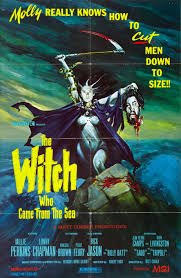
Millie Perkins stars as Molly "The Mermaid," a single barmaid at a seaside dive on the beach of Santa Monica, "The Boathouse," owned and operated by the pleasantly grizzled Long John (Lonny Chapman). She's not just great babysitter to her two adoring nephews, beloved of clientele and employees, but she has the ability to 'get' good-looking men as if fishing them out of the television. Aside from headaches as her brain struggles to keep the lid on her buried incest childhood by cloaking it in all sorts of nautical imagery and oceanic sound effects, she's perfect. Maybe she's mad as a hatter, and has a weird thing for good-looking men on TV, as if they can see her from the screen, and are propositioning her. Maybe she keeps talking about her lost-at-sea captain father as some kind of omnipotent hero despite her more grounded sister who assures her kids he was a monster. But she's not 'victim' crazy, not a cringing trauma victim or a twitchy mess. She's crazy in a way that encompass sanity within itself. When a bubbly blonde actress (Roberta Collins) at the bar bemoans not being liberated, which is now a requirement for TV she glances over at Molly in her patchwork denim and declares she could be in commercials: "You look liberated." The older barmaid Doris (Peggy Furey) adds that "Molly is a saint, a goddamned American saint." Later when her nervous welfare-collecting sister Cathy (Vanessa Brown) shows up to try and convince them of the truth, "you think she's just about perfect," she says to Long John. "Yeah," he snaps back, "why not?"

We agree, thanks to Millie Perkins' dynamic, confident, warm portrayal we love her as much as the staff and her nephews do. Anything she does is all right with us. She's a goddamned American saint.


That's what makes it so tragic. Molly is a liberated saint, yes, but she has no grasp on reality, and it's not the social world's fault, it's the fault of the family dynamic that would let her vile father rule the roost in such a horrifying way (we never see if she has a mother). It's a mix of latent, incest trauma-induced schizophrenia, wherein she sees people on TV talking to her, and her childhood is--understandably--warped and blurred in a salty sea spray of nautical mythology, punctuated by deeply unsettling visions. She has a habit of being drawn to people on it or connected with television, only to then kill them or is she merely fantasizing. She presumes the latter but lately, who knows. If she hears someone is dead she announces she won't believe "if it's true or not until it's on television." As if TV isn't lying to her constantly, the men on it leering out at her, calling her forward. Her dichotomy seems to be a relaxed ease in the anonymous oceanic of the bar, and the bed of salty pirate Long John, a grizzled old reprobate who accepts Molly as she is, no strings. ("Molly is the captain of her own ship.") The bed seems to be in the bar itself, and as such it becomes a very weird uniquely 70s cool spot, with panelling and aquariums and mermaid and nautical bric-a-brac, including those painted mirrored wall tiles that are often associated with orange shag and faux rock walls.

"Her father was a god; they cut off his balls and threw them into the sea."

The ocean plays a huge part, though the film never gets out on a boat, we see the ocean outside the window, and hear it deep in the sound mix, the town where they live seems largely deserted, so shops like Jack Dracula's tattoo parlor loom with an almost Lemora-style surrealism. The flashbacks are all given a surreal, sometimes darkly comic, patina, with comically distorted or ocean sound effects as if her brain is working overtime to contextualize the most primal and odious of endured horrors in terms of oceanic myth. The sea itself becomes her father, a timeless chthonic wellspring, an ultimate signifier connecting this film to everything from Treasure Island (hence the name Long John) to Moby Dick (the local tattoo artist's long tattooed face evokes Queequeg). The soundtrack is a brilliant melange of background sound (the ocean's waves are never out of earshot) and ironic electronic counterpoint: when the melody of a sea shanty she's half-singing while going in the bathroom, the two football players tied up, is suddenly picked up and finished by the ominous soundtrack as she comes back with a razor, its the kind of darkly comic interjection that would make John Williams probably shit himself with fear ("do you shave with straight razors, or is this all going to be agonizingly slow?"). When Molly learns of Venus, born in the sea, according to one of her pursuing men, ex-movie star Billy Batt (Rick Jason - above) she says, with child-like sincerity, "You're lying to me." It's a brilliant line, she could be kidding in a cocktail party way, or it could be an indication her concepts of reality, myth and TV are hopelessly blurred together. And in fact, it's both and why not? This is the age of liberation and free-thinking - where the structure of reality is far looser than it used to be. A latent schizophrenic barmaid isn't even judged for her violent bedroom actions, but loved and accepted by those around her, neither in spite of or because of her castrative tendencies.


And as in any ocean, there are storms: when all other boundaries fail her, her oceanic visions become terrifying pictures of being tied to the mast of a free-floating raft, surrounded by dismembered male bodies, as if remembering some primal prehistoric siren past (only without a hypnotist Chester Morris pulling the strings). The split between her castrating angel of death, turned on by sadism and dismemberment, both as projection revenge against her father and tricks maybe taught by him (we never really know - or hear his voice), and her sweet aunt / fun carefree cool barmaid type is as vivid as the difference between TV and reality. "Let's get lost at sea, Molly m'lass" is what we learn her father used to say, "and we got lost at sea so many... many times." The ocean surge mirroring the rise and fall of the bedsprings - its base horror itself part Greek myth (Elektra) and part Sumerian or druid sacrificial cult, the young boy castrated and his loins thrown into the sea to ensure a good harvest of fish (or wheat if on the fields).

Long John seems somehow to be spared, to share a bed. Maybe due to his easygoing attitude, age, that he's not on TV, and his ability to be contextualized into her nautical miasma (he's a "pirate"). He certainly never reigns in her sexual adventurousness or belittles or infantilizes her. He says he's too old and experienced to get jealous, he says, and we believe him. But you know he loves her, and is willing to take her at face value, as much as he can. He's no fool though, and when he asks her when she lost her virginity and she can't remember that far back, starts stalling and getting a headache he realizes immediately and to some horror the truth; the script and film don't need to underline the moment. He gets it, and his whole demeanor changes, and so we get it too, without ever needing it heard aloud. It's a brilliantly modulated bit of acting by them both. These are smart, interesting people, with unique bonds.


THE MYSTIC ORACLE:

One thing that most horror movies, or any movies, lack is the presence of TVs. They're hard to film due to streaking, so often they're just left off, but it really spells the difference between a believable reality and this kind of utopia where people just sit around in empty kitchens waiting for their cue. Here, though we can clearly see the TV image is superimposed to avoid telltale streaking, that actually works to give the images an extra eerie frisson.  TV is a constant extrasensory, imposed presence: in her childhood memories a very creepy black-and-white clown makes all sorts of weird swimming gestures towards her, beckoning to her/us in a way that's genuinely unsettling. Watching, I had the distinct feeling some terrifying being from my own childhood dreams had found me and was beckoning me from across time and media. Other genius moments tap into LSD experiences (every hippy's schizophrenic sampler), as figures talking to the camera on TV seem to be addressing us/Molly directly. No sooner has she seduced Alexander McPeak (Stafford Morgan) after seeing him in a shaving commercial ("Don't bruise the lady,") she's receiving bizarre directives directly from his TV commercials, telling her where and how to take that razor across his jugular vein.
"He's stark naked! Everywhere... looking at me!"
It's a weird trick to pull off - Molly is a tragic figure who we don't have to 'protect' or 'fix'.  There's no evil or malice in anything she does. ("Does it help that I didn't hate any of them?" she eventually says, "except that first little bastard," she notes. "His mother sang on television," thus spelling out why perhaps he was doomed, "and he sang with her!") And that's why for me, the film really takes off, with a script that looks at the whole mythopoetic televisual-schizophrenic pie, from the raw ingredients to the final delicious slice, ocean-to-table, as it were. Rising from ocean depths to behold the facile screen and its leering Apollonian males, and find those titans in need of gelding by a dark agent of the chthonic. It's a perfect role for the right actress, and Millie Perkins is just that actress. Maybe she had a hand in creating it (she was married to screenwriter Thom, and played the senator's daughter in his AIP hit Wild in the Streets). Between her turn as Anne Frank (in 1959's Diary of Ann Frank) and as the 'woman' in Monte Hellman's The Shooting (1966), we know she's very comfortable playing strong women who are quite comfortable in situations that might make ordinary female characters cringe like crushed flowers. Molly the Mermaid is not a wuss, or one of those rote timid types that become punching bags for every bully and sadist in a 20 mile radius before finally getting down to revenging. She behaves in a way that is indicative of the kind of liberated female vibe of the decade the film is from. Though she's clearly "a mess," she's falling apart from a place of strength so beyond most modern female characters that even a mess she's more together than they are. With her voice given a druggy surreal echo or pitch-shifted to a just slightly low-enough to be eerie (not enough to be goofy or obvious), she becomes the deranged siren, as if stirred from the primordial past).

Trying to find out how this amazing film could be made, could emerge so fully formed from the frothy foam of independent horror cinema, we need to look at the credits, for both Thom and director Climber have unique outlooks on feminine strength indicated by their other films. Thom's body of work shows a latent queer eye for strong young beautiful men, fully-formed (non-objectified) females, and his films often feature a strong, domineering mother figure (as in his scripts for New World: Bloody Mama and Wild in the StreetsAngel Angel Down We Go) He's the exploitation market's Tennessee Williams, tapping into the same vein of Apollonian beauty reaching like Icarus, for the sun, swallowed up by the maternal chthonic of the devouring mother. In fact, Witch's conspicuous absence of a human mother figure allows for the sea itself (ever-present, either in the sound mix or the frame) to step into the role (and nobody does it better), its warm, forgiving maternal tide like a ceaseless flow of half-dissolved titan testes, and scuttling crustacean claws (by Gillette). Keenly aware of its archetypal resonance (yet avoiding literality), The Witch who Came from the Sea would make a great mythopoetic subtextual gender/death-swapped  double bill with Suddenly Last Summer, with Molly's sister as the Mercedes McCambridge (there's even a bit of the same speaking pattern), Long John the equivalent to Liz Taylor, and Molly herself as the dead Sebastian and hid cannibal bird beach boys, soft-swirled into one many-armed/headed deity. 

Promise me you'll think about it? Constantly?


Director Matt Climber is the other major "ally" that helps make Witch so redolent, as his love of strong female characters very much in evidence. Basically the real-life inspiration for Marc Maron's character in GLOW (there's even a passing resemblance between GLOW star Alison Brie and Perkins), between that and his 1983 Conan-ish film Hundra, about a wandering blonde Amazon warrior who teaches an oppressed group of women how to rise up and smite their bullying men, it's clear Climber's got a unique appreciation for very strong, assertive, capable women. He also loves Molly as much as Thom, Perkins, and the actors and their characters in the film do.  I love her too. I love this film.

I love the weird, uncommented on details I haven't even mentioned: the way Molly and Long John sleep downstairs in the bar, that it converts to a bedroom, one with a cigarette machine by the stairs (who doesn't want a cigarette machine in their bedroom?). We never quite figure out how that works, if the bed pulls down or something, but it doesn't matter. I love the way all the scenes have that strange 70s mirror tiling and gorgeous deep wood decor, as if they're all the same place. Things that bear examination aren't addressed, but that's to its credit. Not since Antonioni's Red Desert (1964) have commercial and private space been so subtly blurred. I love the way Climber uses the cinematic time image as a reflection of Molly's dysfunction (just a single cut could bridge years, hours or seconds, how she can seemingly commit murders in the space between taking a drink and putting the glass down). I love the seamless way she goes from being playfully sexual to totally deranged, and the subtle pitch-shifts in her voice as her inner siren emerges, voice getting low and draggy like a riptide. It's all so very fierce. I've already visited its shores three times since that fateful post-Climax night! Won't you sail away on it too? It's on Prime so there's no excuse to shun it. Not anymore. It may not put you in that tropical island mood but it will give you that old-time religion.... older than Aphrodite, older than Innana, Ishtar, Asherah and Astarte! Old enough to sail the sea without a rudder, knowing your raft is safe--at last-- in your mother's foamy talons... Adieu, Belladonna, the Lady of the Rocks. Good night. At the count of three... a wake.
Friday, September 02, 2016

10 Reasons: THE CAR (1977)


Nobody said living in a post-JAWS monster landscape was going to be a busket of clacks and thistles, because--no matter how far above sea level you may park your groovy one-hearse town--the scythe, she a-come a swipin'. This is the high-octane truth learned by one unlucky black customized Lincoln when it innocently incurs the ire of a small posse fronted by one wife-beating demolitions expert (E.G. Marshall), a Burt Reynolds imitation motorcycle cop (James Brolin), a relapsing alcoholic deputy, and a cadre of various out-of-order western bit characters in THE CAR (1977). But hell, before it's dispatched to that great infernal pit-stop down below,  this one-of-a-kind low ridin' custom Lincoln learns a valuable lesson and wreaks some unleaded vengeance upon several no-good hippies, a few cops, and even an innocent lovely brunette, in the process giving literality to phrases like 'drive through' and 'dust-devil'.

The ne plus ultra of land-based Jaws rips, the CAR rocks so hard it rattles like a spray paint can in an echo chamber. You can imagine the Universal Studios bigwigs, intrigued by all the money earned by JAWS, and THE OMEN, the nationwide yen for the occult and Detroit muscle cars, watching the script for a demonic souped-up black town car terrorizing a small desert town all but write itself. As if they needed proof, SMOKEY AND THE BANDIT came wizzin' by two weeks after THE CAR. 

Alas, it passed right on by with nary a victory honk. And so THE CAR was razzed off the road and left to its wild red yonders, leaving us kids to wonder if those red yonders weren't really right behind us, ready to flash their brights in the dead-of-night highway half-asleep moment. We kids loved it! I remember staring at the novel at Woolworth's, fascinated, imagination revving up. 

Well, in them days, the sorrows of small box office returns were the joys of prime time TV. I remember  my parents, me and brother watching it on its happy Friday Night Movie premiere, happy as clams, mom making popcorn and pouring ice-cold coke, my dad all whiskey sour-cheery and sharp-witted, my little brother and I flanking him, lobbing witticisms like blind shells at the screen (and if we actually made dad laugh it was like scoring a major victory). THE CAR was the kind of movie you could follow real fine even drunk or sugar and salt-addled. Good times. This blog's roots lie in night like that one. It maybe explains maybe why I hate Mystery Science Theater (it tries to steal my dad's affection) and why now, thanks to DVD, THE CAR glows in mine eyes like Rosebud roasting on an open fire in a KRAMPUS snow globe full of (blank).

Yeah I been watching a lot of MATCH GAME 78 on Buzzr.... for the same reason I love this film. Wanna make somethin' of it?

Blank: it's not just a space to be filled, it's a goal in itself.


Revisiting it for this post I noticed that, even now, I like THE CAR better than a lot of more than some of the more highly praised post-Jaws monster genre creations. I like it better even than Joe Dante's PIRANHA. 

And I love PIRANHA. 


1. Car Design

The problem inherent in just transposing the 'rogue shark besieges small tourist town' blueprint onto the Great American Western highway is that there's very few places for a car to hide where we won't see it coming. (It can't exactly leap up from under the asphalt.) At night the thing can turn off its headlights, and then snap on the brights at the right psychological moment. During the day it's hidden only by its blurring speed and the occasional tunnels or brush. Ingeniously--rather than trick the car out with air brushed horns and fangs (the way, say, Rob Zombie would)--THE CAR's designers bring Lewtonesque shadows to its outer chassis. Painted a dull matte grey-black, it looks like a miniature even though it's life size; the big grinning grille / front fender / headlights alternate looking vaguely like bull horns, teeth, or --to my crazy eyes--the glowering lamps of the mollusk in THE MONSTER THAT CHALLENGED THE WORLD (1959- below-left), which featured a similar bucolic western America setting facing an existential but localized threat.

Recently I took a frame-by-frame look at a few dark splotches in Val Lewton's 1942 CAT PEOPLE to try and figure out, at long last, what's going on in the shadows of the famous pool scene. You know it: Irina walks into the corner while her rival treads water in the middle of the pool--and then the shadow of a black cat emerges. When she crouches down into the darkness, now that it's all in HD, we see something is forming in between the shadow of Irina, the shadow of the corner of the pool, and the shadow of a cat, but it's just an indistinguishable animated ink blob; it's that rare kind of subliminal animation actually blocks imagery out rather than fleshes it in. It's just a half second or so of inked out darkness - blacker than the black shadows of a dark corner of an unlit pool room, but the effect is uncanny. Paul Schrader didn't get that concept for the remake, so had to use the whole make-up latex blood and placenta schtick, to far less effect.

CAR director Elliot Silverstein knows the reason JAWS worked such a number upon our popular imagination in the summers of 75-6 was the opaqueness of the water...As kids playing in the surf we were always weirded out by the fact that we couldn't see our feet (it wouldn't work near as well in the clear turquoise water of the Caribbean) so we could be about to stand on a crab pincer or get stung by a jellyfish or step on a gross slimy patch of seaweed. This experience makes deep impressions on the unconscious mind, i.e. the dark Lewtonian shadow. What we can't see right below us is simultaneously terrifying and intriguing. Similarly, the interior of the devil car is the mystery; we can't see who's driving, if anyone, nor can we totally know for sure why the car is even there (some Native American return of an ancient evil spirit idea is batted around) and that's part of its effectiveness. I'd have preferred we didn't get even the small interior view of the empty driver's seat (I have a feeling it was insisted on by the producer), but then again not showing anything carries its own penalty too. It makes literal-minded people ornery. Films like Blair Witch Project and Duel go out on a limb, knowing the ambiguity is either going to hit--and make a classic--or piss people off. 

2. UTAH!

Silverstein's original conception of the film was more Lewtonesque - with the idea that the car would be zipping around at high speed with its headlights off in the dead of night, flashing on its brights right before running someone down or totaling their car (ala Stuntman Mike). BUT hey, there's a few moments of that, to some fine effect, so don't worry. And THEN, in the daytime, we see Utah's gorgeous national parks with all the canyons and Mars-looking red rock piles and glory therein. Thanks to recent DVD and Blu-ray remastering it's now no longer just a "fun" film but a breathtaking lure to anyone who's become sick to death of big city life and longed to escape to where everyone knows your name and the closest thing to evil is EG Marshall.

Escape, the lure, the road west... Gerald Hirschfeld's camera never gets too over-the-top with art, just delivers the vistas. Hell, it's not rocket science.

The climax with its early dawn thing; the sun just coming up from between the far off mountains-- that's hard to get just right when capturing all the Utah scenery - but Hirschfeld does it. And the final shot with the smoke and the sun coming up like a big round eye of God... man, that's just totally the shit.

3.  Leonard Rosenman's para-diegetic score 

America was used to talking cars and intelligent VW Bugs thanks to TV comedy shows like HERBIE and MY MOTHER, THE CAR, but the way this devil car communicates is solely through engine revving and a horn from hell, a rising and falling  death rattle blast that Roseman's hip-but-never-ostentatious score gamely enfolds in the fabric of his score. He also great use of the desert wind whistling through idle band instruments as elementary school marching band parade practice temporarily halts out on a lonely track field, and the way that cacophonous sound gradually shifts into a lower octave as "the Car" rolls into view. The mounting engine drone, the cacophony of the instruments, the roaring wind, the children's panic, all fuse into the score. Great churning bassoons and oboes tap their way through Grieg's Mountain King's hallways and ye olde funeral dirge "Die Irae" (later heard in Wendy Carlos' Shining) and the long scary drones of octave drooping thunder; the piercing top note sustains and clanging cymbals merge flawlessly with hell's own car horn as it revs up for the kill and exults in triumph, Rosenman is clearly trying something new and cool, merging diegetic/ambient and score together in a way that has our ears always sifting around through the melody, in search of that telltale horn...

4. Kathleen Lloyd as Lauren

You can call the film derivative if you want--another JAWS-DUEL-EXORCIST hybrid ripoff--but there's no cash-centric mayor ranting about starting a panic and scaring off tourists ("so some car ran over a few hippies? Don't make a big thing about it and scare away the tourists?"); no defrocked alcoholic priest working as an auto mechanic who alone can stop it ("Someone's gonna have to climb inside that car and hang a cross around the rearview mirror, and I reckon it's gonna have to be me."), not even obsessive Ahab-like FBI agent with a tire tread scar across his face from when he was run over by the same vehicle in Alamogordo last month ("I'll get that car if it's the last thing I do!") etc. What the film does have, however, in spades, is a long, "boss" (1) ) scene wherein sheriff James Brolin's girlfriend, elementary school teacher Lauren, taunts the car from the dubious safety of the church graveyard to try and protect her terrified class. It's a real stunner of a scene and Lloyd brilliantly acts a full range of emotions, moving very palpably from terrified, to mad, working herself up to sneering provocations, and even branch-throwing, trying to goad whomever's driving to come out and show himself.  Her eyes getting dark and shark-like, glistening from fear-adrenalin but voice cracking from the dust stirred up by the furiously revving car, Lloyd gets the shake in her voice exactly right. She's ageless in this moment - with her big head and short sleeves she could be a fifth grader herself, or my fifth grade teacher from the same approx. time, Miss Zackon.


Her big moment here is so unusually human! It's the first time we've really cared or rooted for someone so much cooler and complex than we originally thought --and it's a girl! In JAWS, we like Mrs. Brody but she doesn't get much to do, shark-wise, and even in THE BIRDS (1963), Melanie and Annie merely help the children run to safety. But Lauren not only helps the children run to safety she gets out and, so to speak, throws rocks at the crows.

She's also a great example of what I call the 70s hot shiksa movement as that decade saw a whole slew of cool complex Jewish or Italian-American girlfriends. They're now much harder to find due to Hollywood's red head obsession. Lloyd was also the romantic interest with Jack Nicholson in THE MISSOURI BREAKS - and was brilliant there, too. Here she sounds exactly like you'd expect a schoolteacher to sound: playful but grounded, fun but no pushover; her slightly plain-spoken voice hinting she talks to kids a lot (so has to be loud) but never talks down to them. Maybe she sounds a little infantile herself at times herself, but countermands it with a maternal toughness that lets you know you better do as she says or or she'll flatten you cold with a few measured words or grab your nuts (below camera) --while she rocks a Cagney impression, no less!

Her last scene has a hushed Val Lewton kind of magic. It's night after the incident at the church; she's being dropped off by the Navajo deputy Feeling the wind beginning to stir, recognizing it as the same unearthly wind from the attack, she runs up to call Wade. It's all very hushed and eerie, indicating the direction Silverstein originally wanted to go --that sense of enveloping darkness, the shot where the headlights start out super small down the road -- the kind of single static camera shot both Tourneur and Hitchcock alike would have been proud of. 

5. BOSS STUNTS

Right off the bat there's a totally impressive stunt --a cyclist falling off this super high-up suspension bridge over a river, flailing limbs so you know it's not a dummy. It's the kind of thing CGI would handle now, but this is stuntman territory, out in Native American preservations and uninhabited swaths of Utah, away from prying Highway Safety eyes. So when we see a tiny flash of light off in the distance at the parade ground we know what's coming, we don't need cutaways to insert dodgy overlays. When cowboys fall off their horses while distracting the car away from running children, they really do fall right by speeding tires. The car really does smash right through that house.


There is one scene though that's dodgy: where the car pulls hard turn speeding at the two cops cars in a game of chicken, then starts rolling over on itself, rolls over the passing cars and smashes in the roofs killing everyone - say what you want (we never see the car land)--and it sure is ridiculous, but we also see the cap really flip over... and all the quick cut shots of blood and fire are awesome if nothing else.

6.  Faithfulness to the Satanic Western Genre (70s)

This was the era of cowboy character donning pentagram covered black robes and sacrificing folks like William Shatner (DEVIL'S RAIN) or Warren Oates (RIDE WITH THE DEVIL), or transmigrating into random kids (BROTHERHOOD OF SATAN). These films realized--as only Jack Arnold had before (in TARANTULA and It CAME FROM OUTER SPACE)--that the strange alien landscape of the American Southwest had a disturbing, eerie, almost Satanic, majesty. Native American shamanic curses and otherworldly savvy suffused the mise-en-scene. 

The closest thing to a religious resource in THE CAR are Navajo legends. There are no Catholics priest Baptists, not even Mormons. There's an old church/ graveyard but it's long empty There is a quote from Anton La Vey in the beginning and a cross on the alcoholic deputy's neck--but why not? He's probably in AA - which equals spirituality without religion. 

This town itself, with its rugged western faces and wide-eyed children (cool kids, cute but not sweet or saintly), is almost like the 70s itself, needing to let go of all its dysfunction or embrace them. There's ultimately no explanation why that weird car is showing up at all, let alone why here, of all places. There is no 'gotcha' moment, or man vs. machine John Henry moral. The car is there because it's a gorgeous stunning vista-ridden area - and most of us who've been in that part of the country have only driven through on their way to the coast, going out of our way to get super high and drive through Utah's alien landscape, listening to Pink Floyd's "Meddle" album and going, "wow, man." In other words, the car is us, the drivers passing through to California or New York. We're the ones running over pedestrians and going "Oops, just keep going."

After all, if the devil was to drive through any part of the country, wouldn't it be here? The rocky canyons and otherworldly terrain could have been allowed to manifest as demonic if given the right atonal avant-garde drone and deep focus landscape at dawn shots (like 2001 or the beginning of THERE WILL BE BLOOD). We don't get them, but they tried and it's almost there, and the rocks are still weird enough.

(For a satiric look at how mainstream pagan/devil-worshipping was in the UK in the 70s- be sure and check out Scarfolk)


7. Cool (70s) Kids

Real life sisters Kyle and Kim Richards (they'd grow up to be real-life aunts of Paris Hilton) are the daughters of sheriff Brolin, and you know I hate kids on principle except in the 70s (I was the same age when THE CAR came out as they are here). It was the last decade in which kids ran wild all over the neighborhood from the age of five onward. We grew up wild and free and these two kids are great examples of why that was a good policy. Smart, cool, they have a good playful rapport with Brolin. Together they have that kind of lion with his cubs quality that, say, Brody and his brood had in JAWS. He drives them both to school on the back of his motorcycle! He makes them wear helmets but he doesn't wear one himself. In other words, he's one of those great 70s dads I'm always writing about, the ones able to inspire love and independence without micro-managing, hovering, fretting, or sacrificing their own happiness and freedom on the altar of their children's "safety."

8. Believably out-of-their-depth local cops:

The local cops mean well, and try hard, but they're not prepared for an indestructible devil car. Things get fouled up with their communication and their lack of experience is a real hindrance. They've barely had to draw their guns in the line of duty before, and now this? 

Though strictly small town, these are not bad guys (as they'd be in FIRST BLOOD) or buffoons (SMOKEY AND THE BANDIT). For Luke (Ronny Cox), celebrating his two-year sober anniversary, the unreality of it all is just too good a reason to relapse. Hell, I'd do the same, even though his spacey state of shock results in the attack on the parade grounds (he forgets to cancel it).

I like that, after their roadblocks fail, these cops just frankly don't know what to do, and for once it's not frustrating as they're not deposited as heroes held back from performance by some greedy mayor in a tacky sport coat --they're just plain outgunned by Satan's engine. In fact, they're a bit like the police in TWIN PEAKS if agent Cooper wasn't there --they even have a tall Native American tracker type (Eddie Little Sky), mainly so an old medicine woman from his tribe can bear witness to the running over of the local old NYC character actor on the force, Chief Everett (John Marley), and inform him the car has strange magic.


Everett's actually a pretty cool older character. "Are you gonna stand there philosophizing or are you gonna buy me a drink? You're not smart enough to do both," he says. "You know what your father once said to me," he tells Wade as they stroll across the street to the town's one bar (never seen in interior), then he forgets, "ah I was gonna make it up anyhow."  And he gets pretty furious with the local wife beater, ever-trying to convince the wife to press charges. "Be anything you want, just don't be a bully!"

Was there ever a more succinct encapsulation of 70s philosophy?

It's not Everett's death however, but Lauren's--inevitably the reprisal for her taunting--that makes it feel personal and the surviving fuzz are finally fully rallied and we're rooting for them all the way. There's a great long single static shot, no music or dialogue, of the cops sitting around Lauren's wrecked living room in a state of angry fugue shock and rage. No words, no real movement, no music--the moment is allowed to land. Then, back at the sheriff office they grab the demolition man wife beater out of the jail (EG Marshall) and Brolin just says "you." Marshall smiles an evil but reassuring grin - he'll at last get to use his violence for the good of the group. It's a galvanizing moment--and all the more potent for being done without meddling emotional telegraph scoring.


 9. Better at being a Stephen King adaption than most Stephen King adaptions

Like so many good horror novels, especially King's, we get a weird vignette of each recognizably small town American victim before they're slaughtered, and we either mourn or cheer their demises. We do wish there was more time with cute girlfriend and less of the abusive demolitions expert husband down the road--but each have an important part in the Americana tapestry. When the alcoholic deputy reacts to the weirdness of the car invasion by sneaking a fifth of whiskey out of his trunk on the day of his two-year sober anniversary, the event is given the proper shadowy ominousness--the sort King, a recovering alcoholic himself, would definitely add if this was one of his books--instead of being made light of or indirectly encouraged (welcome back!) or judged as mere character weakness (can't you just drink a beer and stop like everyone else?). All in all, rather than just painting the roadkill residents in dumb broad get-it-over-with strokes, the mood and low key vibe of the thing is really honed in on. These are people we know from our own lives, or would like to, and quickly come to care about, not generic lazily-written 'types.'

Everyone involved in the cast is smart enough to know we in the audience are going to find the premise of devil car absurd, so they wisely play it dead straight. As a result, it's fine fun and lacks the endless train of shitters and bullies that, to my mind, marred CHRISTINE --both the book and the film--in mean-spirited overkill and too many on-the-nose rock songs ("Bad to the Bone" ugh). THE CAR doesn't deign to mess in such overly-paddled waters. Like the recent Netflix hit, STRANGER THINGS, THE CAR explores the good parts of King horror novel style without the cliches and ugly American small town swath-cataloguing and cheap way to get our blood up as readers.


10. Brolin Brolin Brolin

My dad considered James Brolin the worst actor in the history of the world. That's etched in my mind (PS- dad's worst actress: Ali McGraw). Well, James fathered one of my favorite actors of our day, Josh Brolin, so he's all right with me. And you see the resemblance right off, and it makes James' films bolder and more resonant in hindsight. Both of them Brolins them look like they belong in the American Southwest (in films like this and NO COUNTRY FOR OLD MEN. They have a smattering of the noble savage about their features--like Jame's grandpa could have been the son of the Native American princess and Dewey Martin in THE BIG SKY. As with Burt Reynolds and Kris Kristofferson, that droplet of Native American ancestry in their DNA helps them look as rugged and grounded as the great American Southwest itself. Their voice just clinches it. These are men who didn't have to learn to ride a horse or shoot a gun for their first western. 


As for his character, Wade "Parent," (how associative!), we don't often see such a mix of well-meaning lummox and laconic rebel in horror movie fathers anymore. Today they are either perfect dads, seeping intelligence warmth and compassion like puss from glowing sores, or tortured-by-the-killer-who-got-away divorcee cops always late to their children's custody hearing--the haggard ex-wife glowering at him as he stumbles into the courtroom, spilling lame excuses. Today, too, child actor babyface stunted growth prettiness and 'good' masculinity have become intertwined to the point even country stars have to be clean shaven burly but baby-faced Christians rather than hairy good old boys full of swamp-bred sass, nicotine deep vocals, a moonshine twinkle in their blue eyes, and a 'stache big as all outdoors. 

But Brolin's Wade is one of the great 70s dads, fulfilling the linkage to his son Josh's portrayal of a great 70s dad, in PLANET TERROR.  Just taking his two little girls to their elementary school on the back of his motorcycle should give you some kind of a clue. This is not a man who's going to turn this devil car case over to the Feds or State Patrol--though he knows deep down he probably should. He probably doesn't even have the FBI's phone numbers. But he's certainly got the 'stache, and the moxy, and a dim cognizance of his own limitations coupled to the courage to sally forth anyway is what makes a man a man's man.

If that's the trade-off--"competence and dull safety-first responsible clean-shaven rules-follower" instead of 'mustache ridin' badasses who need to fall apart before they can be re-glued'-well then... at least we got the movies to remember the real men by. Isn't that why we're all here, to make sure we remember the things we left behind when we were booted from our comfy local highway drag strip to make way for the god-damned highway with its speed limit and tolls?


And remember: in the 70s no one used seat-belts, even in the front. EVER! Dig.

It's a slippery slope, all that life-saving is murder on our Social Security and pension funds. Honey don't think about it. Just press play and drive fast, furious, and over and over... the hippie... one more time.

NOTES:
"Boss" was the adjective we kids of the 70s used a lot, i.e. "Boss iron-on, Cheryl! Where'd ya get it?"

Saturday, August 23, 2014

Shat on the Altar: HORROR AT 37,000 FEET, THE DEVIL'S RAIN


William Shatner, the Hawksian organizer of men in a far-flung future without currency. Shatner, determined player of crisis-bound priests, rock-like teachers, a race-baiting hate monger, an Esperanto-speaking Christian soul so pure he converts a succubus, and an Arizona sheriff named 'Dances with Tarantulas.' Shat, so so.. many things, all of them great, some of them even pretty good, but most so very strange that, if you look deep (and it's always worth looking deep with old Shat), you might find a whole other Shat self waiting below the gum line to spit forth a torrent of surprise micro-thesping! 

For your consideration: two films from the early 70s occult revival in which you will see him drink from a flask and scoff at God while on a flight frozen-in-mid air (at 37,000 feet!); and bare his chest and risk his family to hold onto a stolen devil book one minute but then drop his protective amulet the next. What a man is Shat! Courageous, callous, stubborn, fearful, pompous and pugnacious, he's a relic from when scientists and captains had resonant voices and one could be impulsive and brutish yet catlike and dancer nimble. The Neil Diamond of science fiction icons, Shatner is his name. And in the late 60s-early 70s, we kids couldn't have been happier about it - Bop Bop! 


I know there are those hardcore Trekkies annoyed by Shatner's macho fey arrogance as Kirk; using his cast mates hatred of his prima donna behavior on set as evidence, they disimiss him as a hammy egotist. They seem to prefer the dry, safe, nostril-breathing baldness of Patrick Stewart. I am not one of them, I am not even a Trekkie, but I do enjoy the first three seasons, the Kirk era. Shatner elevates the project to greatness. Stewart, as an actor, can be fun when snogging with Steve Railsback in Lifeforce or snogging with Wolverine in X2, but Stewart is too sane as Picard, too much Polonius and not enough Hamlet. Shatner's Kirk is a live wire. 

Maybe my loyalty to Kirk is because of watching Trek reruns every evening, as a small child in the early 70s.  To me, because of this familial connection, Shatner can do no wrong. He was to the TV as Neil DIamond was to my mom's album collection--a fact, a staple, a comfortable but sturdy foundation on which to grow one's taste and eventual collection. So it is with every generation perhaps. For mine, Shat's blowhard egotism is part of the charm. Kirk is always just a bit hammier than called for, his expressive resonant voice... his... unique... pauses...followedby... rapidcascades.... ofwords, have brought decades of amusement to a beleaguered nation. (See: Sex, Drugs, and Quantum Existentialism). And even when starring in dopey films like the two I shall discuss here, or artsy experiments like Incubus, Shat goes for broke, every time. Terrible or triumphant, he never phones in a syllable. Lugging Shakespeare-style oratory into the rarefied sphere of cowboys-vs.-Satanists, or fighting against ancient druid altars in the sky, he gives 100%, no matter how half-assed the vehicle.

So how half-assed does it get? Let's see!

HORROR AT 37,000 FEET
1973 - TVM / CBS
**1/2
In order to earn the primetime slot, a 70s TV movie had to explore at least three pop cultural themes. In Horror at 37,000 Feet, we get: 1) the curse attached to an ancient artifact (ala King Tut); 2) social commentary (i.e. the Salem witch trials); 3) the ensemble cast disaster movie, i.e. Airport. Swirl 'em all together and serve!

The ensemble cast was a huge staple of 70s TV, providing welcome work for familiar-faced old movie and TV actors, nearly-ran and upcoming starlets, and granite-jawed authority figures like Christopher Plummer or David Jansen or Chuck Conners. Since they'd meet as strangers coming together for the first and last time for a voyage, we got their full character trait dossier in a few friendly exchanges between passangers.
Many of them will get picked off and those who make it will end up bonded heroes (see also: Day of the Animals).

The vehicle this time is a jumbo jet luxury cargo-passenger "airplane" hauling a massively heavy Celtic altar exhumed from its sacred grove in Ireland, and but a small scattering of passengers. They make the weird blonde lady put her dog in the cargo hold. And the downstairs storage freezes --the dog is frozen solid! (Why did we need to go through that, so the studio could show off its frozen dog prop? It's upsetting!) And then, the plane become suspended at 37,000 feet, trapped in a crossfire of wind tunnels, providing an ingenious explanation of why the plane interiors never once give the impression of movement, or engine roar, or the inside of the plane being anything but a breakaway set. Luckily the stewardesses all wear hot white go-go boots. Shat, playing a bitter, soused ex-priest who lost his faith (zzz) rocks some writerly glasses while sewing, and sports a toupee far more natural than usual. These little things help and the film needs all it can get. I love Shatner unconditionally but man, is he terrible in this. Richard Burton might have got away with it, maybe it was written with him in mind. But it's painful to buy our Kirk as a misanthropic drunk bitterly ranting about "homo-sapien" as a bunch of savages and noting, prissily: "I didn't lose my faith - it lost me." He doesn't sound drunk, profound, or pleasant to be around. His bitter laughs sound forced and bitchy. He doesn't want to be in this film and is taking it out on us. Has he ever even had a drink or seen a drunk person? 

I ain't complaining about how bad it is, though. I love a kind of zero point surreal experience where some smoke wafting up from a hole in the carpet and the occasional Val Lewtonian shadow substitutes for any kind of monster or concrete threat (which is great, since the whole point of the 'mounting menace' is to keep you glued through the commercials, worried you might miss the monster). The strange fascination with sub-zero temperatures on a plane (just touching the door makes pilot Chuck Connors' whole arm go numb) goes well with the array of locked-in ensemble types waiting for their chance at a terse "Why doesn't somebody do something??!" line. Playing like the unrehearsed table read of an off-off-Broadway one-act drama, directed by someone who has never been on a real plane, there's a sense of disaster always about to happen, as if a dozen actor tantrums are edited out between each line. And what kind of stewardess would confiscate a first-class passenger's flask, and not bring him a sip of champagne? That's taking it too far! 

Shatner is just one of many characters though - no one person really stars. There  Chuck Connors as the square-jawed pilot; Shatner the boozy priest who lost his faith; Lynn Loring his Mia Farrow-ish wife; Russell "The Professor-and" Johnson; Paul Winfield as the nattily-dressed physician whose dogmatic rationalism will soon be put to the test; Buddy Ebsen a cranky millionaire always ready with a homespun witticism; and--providing the bulk of the supernatural exposition--the baby-voiced Mrs. Pinder (Tammy Grimes). A wild-eyed pagan with straight dirty blonde hair and aversion to fire, she knows all about the stone's colorful human sacrifice-enriched past and makes the most out of every evil syllable of dialogue. Her dog, named Damien, stored below by the altar is clearly given no ketamine, the swines.

The only real sore spot is Will Hutchins as a spaghetti western B-cowboy with a terrible towhead mop top wig and rodeo shirt and a habit of shouting all his lines. Yeesh Watching the pathetic way he hits on one of the lady passengers is the most terrifying thing in the movie. Thank 'god' for Mrs. Pinder and her crazy eyes and straight dirt blonde hair, Connors and his  granite jaw of Connors, and of course, the Shat and his faux-drunk sneering at his fellow passenger's atheist-in-a-foxhole panic. Determined to be utterly worthless, he snaps to life when the other passengers contemplate child sacrifice. As Mrs. Pinder says, it just pisses the evil one off by trying to trick him (they try to switch the girl with her doll first). What the altar and its attached warlock wants the blood of one of its ancestors, the psychic girl (Jane Merrow) whose rich architect husband (Roy Thinnes) brought the altar as a souvenir from her ancestral home, against her wishes. The very fact a cargo plane has such a big cabin, and is flying passengers as well as a 11,000 pound altar seems very odd. Does this kind of flight even exist? Seems like that altar should be shipped by a freighter. But hey, it saves on passenger manifests (i.e. no extras needed) and allows more room for the camera and later, the possible child sacrifice fire in the now frigid cargo hold. Will the terrified passengers commit the ultimate transgression or be turned into green puddles before the dawn can come up in time to save them? But first a word from Alpo.


Horror at 37,000 Feet moves pretty fast without the commercials, and fans of Italian horror can luxuriate in the colorful red lights of the cockpit and everyone can appreciate the wild-eyed hysteria with which Loring rises to the occasion, furiously cutting off Jane Merrow's hair to wrap in the child's doll and wrapping it up in her clothes. "And some of your fingernails," she raves, as if possessed. When that doesn't work, it's time to actually sacrifice the child! Great hammy stuff with Shatner wobbling around and all the actors wondering what do in this under-rehearsed closed-in space to 'portray' their types without any directorial input. Shatner out matches Buddy Ebsen in the finger bending department. "Here, take another pain killer,' says the co-pilot to Connors, "no pint in saving them." Shatner realizes he can terrify Mrs. Pinder by waving his Zippo lighter in her face. "Fire... To burn.... witches!" Yikes! He's  not very PC --he even sneers at people who "believe jimson weed will make them immortal!" Dude, take it from an old jimson weed-head, no one thinks that. But Shat should know, having counseled the first and only 'mixed bag' drug addict that same year in Go Ask Alice.


Those of us who were around in the 70s and remember seeing this with the family are far less likely to wince over all this stupidity. We might care though, that the film can no longer hide its poverty in an analog cathode ray blur, or hide its lack of logical sense via the amnesia of regular commercial breaks. For those of us who were kids at the time (I was seven), Horror is a fond touchstone for those days when everyone watched the same shows (there were only three channels and no VHS and families only had one TV) and it gave the all something to laugh about together. For us this is as precious a memento as a family album. Maybe more so.  For us, though the clarity doesn't do the film any favors, the DVD is a must. If only Satan's School for Girls or Death at Love House would one day get the same respectful remastering treatment they too deserve1. May Cheesy Flix die a thousand deaths fo blurring Kate Jackson worse than a bad reception! Still, better than nothing.

 Though I hear 'nothing' is getting better all the time.
-----------

THE DEVIL'S RAIN
1975 - dir. Robert Fuest
**1/2
I've seen hellfire and I've seen face-melting rain/ I've seen green puddles with air bubbling up through them / and it wasn't impressive, even via nostalgia's glowing tolerance. But if you were a kid in the 70s, The Devil's Rain falls into the unholy and powerful relic category of stuff unseen yet dreamt of. Its TV spots were an inescapable part of local prime time TV in 1975, when I was eight and very impressionable and into monsters and devils. I still remember the weird the melting faces, Borgnine with goat horns, and the robes - both kind of a turn on and scary at the same time. I also remember I had a bizarre childhood dream I was part of the coven, melting under the rain, and even now a lingering prepubescent jouissance echo hits me imagining it. Those of us on the playground heard from our older siblings Devil's Rain was lousy, but my dream was amazing, and if I wasn't so savvy about Satanic cinema even at eight years-old, and it was the 80s instead of the 70s, and a careerist child psychologist heard me describe my dream, he'd probably think I was abducted by Satanists and arrest my parents and teachers. But in the 70s it was anybody's game, a whole Middle America demographic had gone to the devil with touchy feely sharing: cocktails, bridge, Jaycees, smoking on planes, turtleneck and medallion conclaves of wife-swappers, communes and encounter groups; there were all-night block parties leading into softball breakfast picnics of still-drunk adults and kids high on their very first sunrise and sleep deprivation. It was grand indeed, total freedom, and even the devils were cool. And church was just an excuse to act rambunctious.

That sub-sexual supernatural power of not being able to see a film like Devil's Rain as a kid is of course a substantial amount of the appeal for me and my Generation X comrades, the last group who experienced the high of unavailability, of R-rated movies being forever out of reach (once they left the theaters) and so projected upon with our most lurid imagination. Just seeing the TV commercial for an R-rated horror movie was enough to give us sexy nightmares and make the world seem full of strange telekinetic magic and unimaginable 'adult' terror. Our constant imagining created a parallel subconscious repository so powerful it later spilled over into our adult reality, dragging us by our budding sexual drives towards a dreaded obsession that finally led to the 'satanic panic' witch hunts of the 1980s and the rise of nervous overprotective brand parenting we're still hurting our children and ourselves with today.

Turns out, in real life, seeing it now on DVD as an adult, I realize the film is too strange, too 'off' and too slow to be scary or sexy, but it is creepy, kinda. The daytime Satanic ceremonies in the Arizona desert, the boarded up church in the middle of a nowhere ghost town, the upside down pentagram stained glass window, the ultimate futile weakness of Shatner's moxy in the face of Borgnine's mojo, the weird Psycho-style mid-film protagonist shift, it all generates a collective creepiness. as does the idea of looking for your parents and finding they've become life-size animated black-eyed wax effigies urging you to bring them 'the book'.


Earnest Borgnine is an odd choice for the head Satanist, but Shatner is great as the cowboy whose parents are sucked into the coven, which has taken over the whole ghost town. Meanwhile Joan Prather is psychic for no good reason except to allow her to 'see' the flashback to colonial times by looking into cult member John Travolta's dead black eyes, and to provide an interesting scene where she performs an EKG for a crowd of psychology students while Dr. Eddie Albert explains that ESP is very real and he's in the process of discovering what brainwave controls it. Tom Skerritt is her husband and eventually wrests the lead away from Shatner like Sylvia Miles from Janet Leigh.  

Any film that gives Hieronymus Bosch and Anton LaVey screen credit deserves some halting respect but I love lots of other things about this screwy picture, from the ESP angle right down to the way Scientology and plastic surgery are precognitively critiqued by the sight of a ceremonial robe-clad very young John Travolta's face melting in the rain. My only complaint is the unnecessary, depressing final 'twist' so I try to remember to stop watching beforehand, like somewhere during the last 20 minutes which is all just rain and melting. I still like it better than Fuest's higher praised work, like Dr. Phibes. Mighty Shat makes shit shows like this soar, son! Drink to that... or be damned like a black Cadillac chasing James Brolin through the dusty desert... with no driver!! Now that's a movie, even if it ain't got no Shat screaming on its altar.
Related Posts Plugin for WordPress, Blogger...