
"When life itself seems lunatic, who knows where madness lies? Perhaps to be too practical is madness. To surrender dreams—this may be madness. To seek treasure where there is only trash. Too much sanity may be madness. And maddest of all, to see life as it is and not as it should be." –Don QuixoteWhen true doomsday comes, perhaps the manic depressives and bi-polars amongst us will at last have an opportunity to shine in calm perfection while walking through slow motion rain. That seems to be the message of Lars Von Trier's latest, MELANCHOLIA (2011). Until then, alas, the ordinary madness of our civilization and all its unconscious munching, adherence to unexamined cultural mores, and slow death momentum, will have to be endured. Lars, I feel ya. But Jeeze. There are pills for that now!
MELANCHOLIA makes me nervous because I don't want to lose one of the best auteurs of our post-art house age and the film has the earmarks of a cinematic suicide note, a message from someone planning to be dead by the time you read it. His whole post-Dogme 95 life is flashing before our eyes and on some level he's reached the frontier from which no traveler returns. In order to keep going into the wilderness, for Lars is an explorer first and foremost, the film ceases to rim a frontier, but rather settles in and lets the frontier fall right upon it. It's a film about endurance, and the inability of some to handle normalcy vs. others to handle apocalypses. And Lars' star Kirsten Dunst, no longer the vampire child of Lestat, or the willowy cheerleader, has never seemed more Nordic. It's as if she's spent her life scowling through meaningless sex and animal fat-enriched meals solely to get to this part, solely to face this one vanishing point.

For in MELANCHOLIA, Von Trier dives headfirst into the same abyss that Terence Malick only wades up to his knees for THE TREE OF LIFE. There is no real comparison between the two other than their release dates, and ponderous linking of 2001-style classical music-scored outer space vistas. It's fun to compare them anyway: MELANCHOLIA, the tale of a woman's post-wedding depression coming to life in the form of a world-destroying planet, is the suicide note before to TREE OF LIFE's faded funeral notice after. TREE mourns my soon-deceased father but MELANCHOLIA mourns for me, and the son of my unborn son, and the ground beneath our unborn feet.

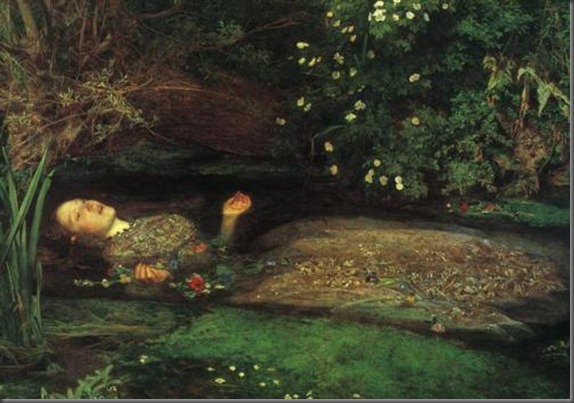
My girl and I saw the film this past Saturday night at the charmingly dilapidated Brooklyn Heights Cinema with its blaring, distorted speakers rumbling the seats with Wagner's aria to Tristan und Isolde as Kristen Dunst and company writhed in Bill Viola-style (see above) slowness. It was so loud I had to cover my ears. But rather than be the one to complain to the ticket taker, I tried my best to accept it. And then suddenly the music stopped. I missed it.
The 1st chapter of Lars' film is a long and expensive wedding for our melancholy heroine Justine (Dunst) over the course of which she flits with ecstasy before dissolving into a deep depression, winding up in the bathtub upstairs, refusing to come out. The sight of a distant star unnerves her. Soon she's telling off her boss (Stellan Skarsgard), losing her groom John (Alexander Skarsgard, insufferable as ever), sleeping with a kid on the 18th green, pissing off her sister Claire (Charlotte Gainsbourg) and her sister's rich husband John (Kiefer Sutherland), infuriating the wedding planner (a great Udo Kier) and drawing gasps from everyone but her loving drunk of a father (John Hurt) and psychotic mother (Charlotte Rampling), who makes the toast "I think marriage is a crock of shit."
Handheld Dogme verite style used to film weddings by now almost quaint: Demme's RACHEL GETTING MARRIED, Vinterberg's THE CELEBRATION, Baumbach's MARGOT AT THE WEDDING, have already been there. But unlike those affairs, LVT's is a picture of a cold planet bathed in warmth but unable to feel warm, and if you can survive the whiplash handheld camera nausea in these scenes, you can move on to the next course. The bride, however, won't be there as she's upstairs, nearly catatonic with ennui.

After some portions of the reception are over, Justine ducks into the library and changes the open art books on display from abstract geometrical shapes (put there no doubt by John as they reflect his dull patriarchal-modernist tastes) to archaic pictures of female suffering and/or death and peasant post-wedding debauchery. There's: "Land of Cockaine" and "Hunters in the Snow" by Bruegel; "Ophelia" by J.W. Waterhouse; and "After the Hunt" by Bogarde. As in DOGVILLE and ANTICHRIST, this book swap seems a full rejection of the flat, dull left-brained scientific rationalism championed by an insufferable materialist know-it-all in favor of a return to the mythic unconscious where every day is your last so you better get connected back to your Jungian roots, and hammered, before the whole tree of life goes up in flames.

John rejects such Dionysian nonsense outright, but his own left-brained thinking falls apart at every turn. Unable to to deal with the loss of his empirical toe-hold, deluding and denuding-- as DaFoe did in ANTICHRIST--via smug dismissal of Gainsbourg's intellectually eroticized 'feminine hysteria,' and the neglect of their co-owned horses. Dunst's depression is never fully explained so we naturally look for clues and there are plenty if you hate the fact that all that rich razzle dazzle, the 'very expensive' fairy tale wedding is the closest the dead patriarch of order and logic dares come in the direction of ritual, of 'myth' (outside of forbidden Masonic rites, etc). In going for high class in a materialist bourgeois competitive manner, this stuffy wedding becomes a control freak's dream and an awake aesthete's overload nightmare, where the more money spent the less fun it's possible to have. It's Bruegel land of plenty fairy tale overrun with linear edicts.
Cockaigne is a medieval mythical land of plenty, an imaginary place of extreme luxury and ease where physical comforts and pleasures are always immediately at hand and where the harshness of medieval peasant life does not exist. Specifically, in poems like The Land of Cockaigne, Cockaigne is a land of contraries, where all the restrictions of society are defied (abbots beaten by their monks), sexual liberty is open (nuns flipped over to show their bottoms), and food is plentiful... Writing about Cockaigne was a commonplace of Goliard verse. It represented both wish fulfillment and resentment at the strictures of asceticism and dearth (Wiki)
Pieter Bruegel the Elder's "Luilekkerland" ("The Land of Cockaigne"), 1567. Oil on panel.

 |
| Justine prefers dearth |
While we struggle to not get nauseous from whiplash shaky-cam, the heavy breathing Dogme sound keeps the wedding unbearably intimate: we hear every cut of the meat and every clang of cutlery on the china plates; every breath and wheeze from the gathered throng is amplified like we're tripping our faces off and boiling over in claustrophobic anxiety; trapped in this crowded dining room with all these acting actors talking over each other all at once like real people do in groups, it's as if the secret joy of the movies--avoiding having to talk to people and act civil--is corrupted, the meat and small talk tumbling out of the screen like the guts out of a rotten pumpkin.

At first we don't know why Justine is losing her grip, but we feel it's something to do with the oppressive worry of her sister ("Don't ruin this!") her brother-in-law John ("this cost a fortune") and the insane ravings of her mom. The wedding is a public de-pantsing of artistic success, wherein the best riches and opulence can be is thrown up as buffer against the onslaught of Lars'/Justine's depression, and it all crumbles like fairy dust.
It is only in Justine's subsequent sad melt-down and later ecstasy over the approaching doomsday that she blossoms. The planet is her true groom and its destruction her true union.
Seeing how each person in their group prepares for the end, I was reminded of my own strange exaltation on the day of 9/11, the acrid smell of the burning buildings in my nose as I went racing up deserted 2nd Avenue at midnight, brain thrilling that it might the world might end any moment. Any building might blow up at any time! I was alive for the first time in years, I was FREE of all my conceptions of self and the world around me. New York City was a ghost town at that hour. Not a car or soul on the street but me. Yet, I managed to grab the only train running, a single C-train that suddenly arrived at Brooklyn Heights as I went racing down the stairs, and to find one cab when I got off at 78th street (?) and me and the the cab driver were like the post-apocalypse, like ESCAPE FROM NEW YORK, map of the bridge! Hey! Hey! HEY!
I knew my exaltation was not 'proper' but also, later, learned I was not alone in feeling it, especially at the uptown AA meetings I attended in the weeks that followed. We had a lot of firemen and cops up there at those meetings and we felt their pain and grief at losing--roughly--half their number in a single day, but we, the non-responder/survivors, were strangely calm, more serene than we'd been in some time. We went to the movies never sure if the city would be there when we got out, thus comedies took on special import (ROCK STAR, ZOOLANDER, coming to mind).
In this apocalyptic moment, we AA people were at peace. Our constant existential dread, so useless in normal life, was suddenly the norm. Now that the world was blind, our impoverished vision made us royalty.

What’s madness but nobility of soul
At odds with circumstance? The day’s on fire!
I know the purity of pure despair,
My shadow pinned against a sweating wall.
That place among the rocks—is it a cave,
Or winding path? The edge is what I have.
At odds with circumstance? The day’s on fire!
I know the purity of pure despair,
My shadow pinned against a sweating wall.
That place among the rocks—is it a cave,
Or winding path? The edge is what I have.
–Theodore Roethke, “In a Dark Time”

John however, will have no such apocalyptic acceptance, and in the period after the wedding he belittles and dominates Claire in a vain effort to allay her anxiety about the approaching planet. In his bland pretense he resembles past Von Trier male characters of past films like Dogville and Antichrist, authority figure wannabes who do their best to dominate the women in the room but come off sad and impotent, wanting in the shadow of some dead patriarchal ideal that dominates both genders.
In TREE OF LIFE we saw the dawn of the earth, and the first vague gestures of compassion, leading up to some beach-side dream jazz heaven cast party. That's the kind of soiree Claire wants to have as the planet looms, a Cockaigne-style acceptance of the end through drink and song and togetherness. From her new husband's picture of an apple orchard he's bought for her, to 'rest' in, to the pebbles in the jar Udo Kier wants everyone to guess the number of--everything but the strange request to 'build caves' from the son, to return to Werner Herzog's CAVES OF FORGOTTEN DREAMS, perhaps, and to the mythic inner reality of Jungian archetypes of which we are the shadows on the Platonic walls-- is, in Justine's eyes, contemptible.


Von Trier shows that all the money in the bourgeois world of wealth and rationalism won't allay or abet this impending cloud, only Justine's resolutely transcendental delusion is some kind of salvation. Hers is the peace of the twisted. She is a herald, one of the women and men who have writhed backwards through time due to years of enduring the stale, hollow pleasures of Cockaigne. Like Jack in the 1920s New Years eve picture at the end of THE SHINING, Justine moves backwards into the representations of the past until she's as indestructible as the planet Melancholia itself. I hope Lars doesn't mean to follow her quite yet, though at this point he's running out of language, image, and time. Every new film shows a little less sand in the hourglass and MELANCHOLIA shows the hourglass itself breaking into slow motion splinters. Soon he will have nothing left but sand, unless...
May I suggest an Effexor + Wellbutrin + Neurontin cocktail, sir? It works wonders! Cockaigne is for suckers, as Bruegel and Lacan well knew. When life gives you only lemon orchards as far as the eye can see, no amount of lemonade-making can allay the soul-curling sourness. One must burn and run, even if there's nowhere to go but deeper into the ash crevasse.


POST-SCRIPT (12/7/12): As Justine gets out of the limo to head into the reception, she spots the incoming planet--still just a dot in the sky but she recognizes it--and five days after seeing the film it dawned on me that even so far away she recognizes it as our onrushing doom and her deliverance. So fuck it, she tells off her boss and dumps her groom. But isn't that what depression is all about? She doesn't bother to share her realization though, knowing perhaps that in the house of a coddling smugly bourgeois materialist like John it's useless to bring it up. Considering this, the film suddenly comes into sharper focus for me, so thought I'd add it!
Special Thanks to Jennifer Boyer,