
THE BLACK CAT
1941 - Universal **1/2
It's confusingly titled since the Ulmer 1934 is the Black Cat as far as every horror fan in the world is concerned, but this name-only version has charms of its own, hampered (unless you've a benign tolerance for idiots) by insurance salesman Broderick Crawford's spazz and bluster and the endless tut-tutting of Hugh Herbert. The climax exemplifies Griffith's dictum re: you don't crosscut from the heroine about to be grilled in a cat crematorium, Perils of Pauline-style, to old Hugh Herbert fiddling around with old lamps and screwdrivers laughing to himself like a simpleton, since it creates a feeling of rage rather than suspense in the viewer (his exact words, I swear!) Another rule: never turn your back on someone after you've accused them of murder, especially when you're alone with them inside a secret, soundproof chamber. Luckily there's the triple threat treat of Basil Rathbone (as a greedy heir), Bela Lugosi (as an enigmatic groundskeeper), and Gayle Sondergaard (as a suspicious housekeeper); and dialogue so rattattat one gets the whiff of amphetamines in the air. However, unlike Howard Hawk's ingenious use of overlapping dialogue, here they wait for the other person to finish their lines (if you'll forgive the expression) so there's a weird disconnect, as it takes longer to go a shorter distance even while moving twice as fast. As a result, more stuff happens in the first half hour of this film than in six ordinary old dark house films, yet it never really goes... anywhere... at all... 'til the fiery furnace finish.

In addition to Basil Rathbone ("who does he think he is," quips the Brod, Sherlock Holmes?") there's a young, surly Alan Ladd in his film debut (would that Veronica Lake was around to chill him). And while Brod's schtick grows wearisome fast, there's some satisfaction to be had when he jumps off a second floor balcony and lands face down in the mud in a single wacky take. After flying through the air and tackling an empty suit of armor or the wrong guy over and over though, you'd think he might hesitate the smallest bit with his wild accusations the next time a single whiff of red herring catches his dopey blue-collar nose. Nope. Still, like that Ritz Brothers' Gorilla movie, if your mood is undiscriminating enough, there are worse variations on the theme, and it certainly ladles on the atmosphere. This Cat has even more secret passages and panels than most; the cat sculpture and its surrounding marble mausoleum are gorgeous; and there's two deaths by hanging (they weave around the censors by showing dangling legs reflected in the mirror).

Gale Sondergaard is good as always as the sinister catkeeper (the old rich dead lady wants to keep her house a cat sanctuary after she dies) but poor Bela--though featured prominently in the credits--is literally stuck out in the cold as the shaggy groundskeeper. Clearly they wanted his name on the marquee but didn't want to deal with him at all, except maybe through a second unit. Was the morphine or just his infamous Hungarian temperament that reduced him to these wasted household servant parts at Universal all through the 40s? While we're on the subject, I would like to see one movie, just one, where Bela has a girlfriend. Why couldn't he be married to Sondergaard or something? Actually there is one film where a girl likes Bela, Monogram's BLACK DRAGONS. (Rattle metal thunder sheet and flicker the lights)

HORROR ISLAND
1941 - Universal - *1/2
There are a lot of things wrong from the start with Horror Island but none more so than the three lead males: squeaky clean Dick Foran in a Popeye-style sailor man suit as a dope struggling to pay off his boat; Fuzzy Knight, making Andy Devine seem like like Errol Flynn as his cornpone first mate; and Leo Carrillo, shameless hamming it up as a Spanish pirate, replete with earring. They're seeking some buried pirate gold on a remote island, but need money for the expedition so they market it as an adventure expedition. Signing up is wiseacre heiress Peggy Moran, her drowsy playboy companion, Thurston Coldwater (Lewis Howard), and some other tourists. After some on-deck skullduggery they land on a rocky coasted island and an old mansion and then commences the ghostly howls, and the dusty suits of armor that m-m-m-move by themselves. Simmer for 30 more minutes of tepid candle-lit corridor creeping and you got yourself a bland comedy-mystery cliche stew. Worse even, a lot of the spook happenings turn out to be fake. A sinister shadow in a slouch hat tries to add to the studio enforced and censor-scrubbed 'fun' but whether he succeeds probably depends on what age you were when you first saw this.

People who caught on TV in their youth do love it. It even has a chapter in the Guilty Pleasures (Vol. 1 - Midnight Marquee) which I think is out of print so you'll have to take my word for it (I can't find my copy or I'd quote it. For you, it should be enough to know that it's there, in the book, and that some writer likes it. I will say this: if you just relax into the film and take it as a bunch of vaguely connected shots of young men and women in dreary wartime fashions and pasteurized pirate costumes skeedaddling in and out of secret panels and conking each other on the back of the head, maybe you can muddle through.
There is one bright spot: Moran's effete rich pal, Thurston, played with great ennui by Howard, who lounges around and makes droll wry comments like an anesthetized Waldo Lydecker. He can do wonders with a line like "Listen, my impetuous young friend," and he even has the last joke. Why didn't he star?!?!
PHANTOM OF CRESTWOOD
1932 - RKO ****
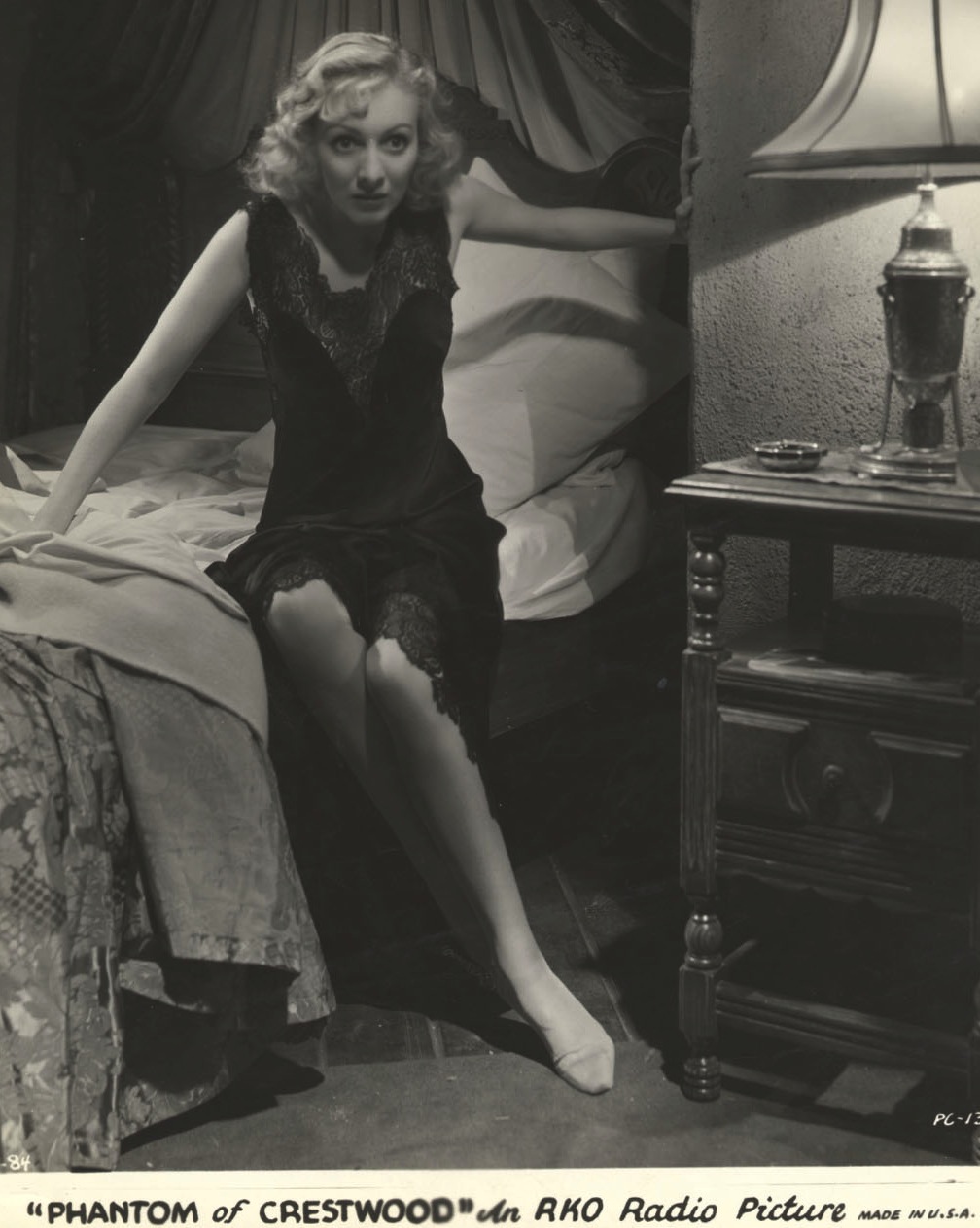
It's got everything I love: it occurs over one afternoon and night, ends at dawn, it's got fog, a washed-out road, a wind-blown house, murder suspects, death masks, and two of my favorite actresses: Anita Louise (Titania in the 1935 Reinhardt Midsummer Night's Dream) and Karen Morley (Poppy in Scarface). The latter delivers a scene-swipingly slithery performance as wry gold digger 'party girl' Jenny Wren, who's decided to retire and intends blackmailing all her rich ex-lovers in one fell swoop, gathering them for a party at a remote Southern California mansion at midnight, along with their wives, if any. The scandal! If this got out I'd be ruined (x3). Jenny's retirement is prompted--we learn via then-groundbreaking whirlwind flashbacks--bysome naive rich baby-faced college boy's leaping off cliff to his death after she dumps him (papa cut him off because he wants to marry her). Then his ghostly face appears on the balcony, and then she's dead, too, from a thrown dart (?). Ricardo Cortez and his group of gangsters arrive, initially to steal some of Jenny's incriminating love letters, but when they see the corpse, decide to hold the whole party hostage, and need quick solve the murder before the landslide is cleared and cops arrive.

Yet another great instance of pre-code casting genius: Hilda Vaughn is Morely's awesome deadpan maid, a kind almost a Leporello-level co-conspirator and/or sewing circle "companion: rather than a mere servant. And if the lesbian currents don't run deep enough for you, there's the butch old aunt played by Pauline Frederick who--like Mercedes McCambridge in Giant--is fond of using horse breeding terminology when scrutinizing potential in-laws (i.e. Anita's innocent sister home from college). They're all great but it's really Morley's show - though she's in the role of the rotten blackmailer everyone wants to kill, she's so honest about her machinations, so amused at the way her suckers fear scandal, yet so winning in her "chalk it up to experience, youngster" worldliness, we want to write her incriminating love letters ourselves.
The ending, on a foggy cliff with a single engine police plane coming in overhead and the two guys walking off into the fog, foreshadows Casablanca!! The only difference, the plane is going the opposite direction! The End! The photography is shadowy and intoxicating almost to Von Sternbergian levels, but with all its (in this case, Spanish-style) old dark house accoutrements -- secret passages, clues, washed-out bridge keeping the cops away, complex motives and sophisticated pre-code banter, it doesn't even need to look good to be great.
The ending, on a foggy cliff with a single engine police plane coming in overhead and the two guys walking off into the fog, foreshadows Casablanca!! The only difference, the plane is going the opposite direction! The End! The photography is shadowy and intoxicating almost to Von Sternbergian levels, but with all its (in this case, Spanish-style) old dark house accoutrements -- secret passages, clues, washed-out bridge keeping the cops away, complex motives and sophisticated pre-code banter, it doesn't even need to look good to be great.

THE ROGUE'S TAVERN
(1936) Dir. Bob Hill / Puritan Pictures - **
Detective Wallace Ford wants to marry Babara Pepper (a former department store detective)--and quickly-- so they head to a remote lodge the next state over (where its presumably easier to wed impulsively), there to meet a preacher at a tavern for a quickie service. But man, did Ford ever pick the wrong place! They haven't any vacancies. And the justice hasn't shown up. A gaggle of suspicious types mill in the lobby, the wind howls softly outside in the night, and then a dog (Silver Wolf) bares his fangs on cue at certain windows and soon, sans preacher, they're all locked in by a mysterious killer. Suspects include a cabal of diamond smugglers, an old coot in a wheelchair and a sexy, strange fortune teller lady (the colossal Joan Woodbury) with a habit of staring straight into the camera during moody close-ups! And Silver Wolf! I've seen this movie a dozen times and fallen asleep every time, but there are worse films to doze off to than this one--the photography, framing, performances, and foggy, dog-howl atmosphere (we hear people scream alongside growls in another room and people run in just in time to see Silver Wolf jump through a broken window and the victim fall down dead) lifts it two steps above the average comparable Monogram picture--and long as you wake up in time to marvel at the sustained crazy killer monologue finale. Seriously, you'll love who the killer turns out to be - it becomes almost a giallo.

Please note also the big fireplace in the lobby / lounge / tavern, which apparently was a mainstay of RKO-Pathe soundstage, chosen 2-1 by fly-by-nite indie outfits like our 'Mercury Pictures.' When at RKO-Pathe, make sure to build your set around the big fireplace, if it's available (too big to move off the soundstage). You won't regret it. "Have you got a fireplace?" asks Wallace Ford. "Have we got a fireplace!"

Unfortunately, when the fireplace is the film's best artistic asset, it's gonna be a long night. Splotchy sound (sometimes there's none at all, when something like music, or wind noise, or even footsteps, would be nice; other spots people are talking but there ain't no sound to that either). Pepper's character has that post-code nag problem where instead of just telling Ford what she's seen out the window, i.e. fangs, murders, she hems and haws and stammers like Lou Costello while Ford (a detective in his day job) is busy cross-examining the rogues, and he's reluctant to listen to her, thinking she's just making some excuse to monopolize his time or make some dumb faux-Ann Sheridan wisecrack. One longs for the relative tactlessness of Jimmy Chan! Luckily the jewel thieves get some good knowing lines ("the preacher must be busy with something awfully important," notes one of them), the mystery keeps moving forward, and all three of the women in the cast are all fully-formed characters (for all my grousing, Pepper is a pretty on-key sleuth, silently trailing after suspects, searching everyone's room, etc.) The DVD version on Alpha and is pretty blurred (the Prime print is better). But I don't think clarity would help. The fog of booze, on the other hand, just might.

1935 - Mascot Pictures - **1/2
A dark and stormy night, a crotchety old man (Charley Grapewin) gathers his greedy heirs and promises them each a million dollars, but then some blonde shows up claiming to be his long lost granddaughter, so he changes his mind and leaves it all to her. If you want your granddaughter to survive the night!! Secret panels, passages. grisly masks, and a house full of strange blow guns and other indigenous tribal weaponry... you get the picture.
ONE DARK NIGHT is a little more lively and ape-free than most old dark house pics, but finds itse;f saddled with the inescapable Wallace Ford. He plays a Vaudeville magician named 'the Great Lavalle,' whose car conveniently breaks down near the old mansion during the storm. His assistant (Mary Carlisle) just so happens to be the real granddaughter heiress. The old man believes her because she refuses to have anything to do with him or his filthy money. Meanwhile there are poison darts, Hindi sculptures, and a line-up of suspects who all must sooner or later tangle with the usual carload of clueless, gun-jumping cops. Rafaela Ottiano (the human trafficker in SHE DONE HIM WRONG) is the maid; Arthur Hohl and Hedda Hopper (you heard me) are suspects. Ford has no interest in Carlisle except as a pal and assistant, which is unusual, so she upgrades to Regis Toomey, despite the fact he may be the killer.
FRIGHTENED has been a fall-asleep C-level favorite of mine for years in a more truncated version than the somewhat blurry Alpha DVD (I had taped it in the early 80s off the old PBS show Matinee at the Bijou). I even used footage from it in my cynically unclaimed 2009 smashed hit, CURSE OF THE MALE GAZE. What better way, perhaps, to close this capsule collection than to present it now?
See Old Dark Capsules 1 here (with OLD DARK HOUSE, CAT AND THE CANARY, THE GHOUL, THE MONSTER WALKS, THE GHOUL)


 informs this essay and comes highly recommended.