HELL'S ANGELS
1930 - dir. Howard Hughes (w/ James Whale, Edmund Goulding - uncredited)
***1/2
Hughes' infamously expensive Hemingway-wannabe saga of WWI pilots and the woman holds up today as fresher and more cutting edge than say, Scorsese's
The Aviator. Its only drawback is the ill-conceived casting of the Yank brothers who come to Oxford for the learnin' and stay to become pilots during the Great War: Monte (Ben Lyon) is the cowardly, jaded womanizer; Roy (James Hall--a bloated mix of Richard Barthelmess and Bob Newhart) is brave but a chump who idolizes women to the extent of idiocy. He expects nymphomaniac Jean Harlow (in the role that made her an instant iconic sex symbol) to live up to his goofy moralistic ideals
because she kissed him
once! If you're a pretty girl who gets around (if you know what I mean), you've probably had more than one dude like Roy moping you, leaving emails or messages constantly, getting ever more sullen as to why you haven't called him back. "Never love a woman," Monte tries to tell Roy, "just make love to her."
It's a great line, but the question is, who was the girl, Howard, who left you with such a high opinion of women? She must have been quite a gal...
While unconvincing as a ladykiller, at least Lyon does a decent job with his scenes of his being seduced against his very weak will by Harlow who--with her thick, jet-black eyebrows giving her platinum wave just the right level of dirty contrast to her platinum wave--almost steals the movie from the spectacular aerial combat. It's for her and the fighting we're here, not the dimwit brothers, so every scene of these two sibling muttonheads engaged in their worldly nonsense seems worthless unless Harlow is there, coming between them.


The thing about Hughes is: he at least walks it likes he talks it; there's a cool sense of uninhibited sexual congress with Harlow, as expressed keenly in one of the best all-time 'fade-outs' in the pre-code era. It's a scene of her and Monte making out on a couch, crossed over to a scene of naive brother Roy sulking back at the bunks (having been blown off by her on his imagined date); when we get back to the couch at Harlow's pad, the vibe has shifted from simmering hot to ice cold. Monte's ashen mood and Harlow's nonplussed attitude ("It seems colder in here now," she says, "doesn't it?") indicates they had sex on the couch during the fade-out and (my guess) it wasn't very satisfying. Monte now hates himself, and--in grand womanizer misogynist fashion--thinks she's a slut for putting out. He lacks the self-awareness to realize his post-orgasm depression is not her fault, but his, and nature's. Yo Monte! Every
true playa knows not to get all pissy and moralistic with the girl you were busting moves on 'before' shit got real, even if now all you can think about is getting home before your wife (or idiot brother) finds out.
I admit I've never been a huge fan of Harlow's work in later movies, where she often seems a bit shrill and broad, especially playing alleged society dames. But the Harlow on display here is like a whole different person than the one shortly to rule over at MGM. She's not a baby-talking brawler lounging around eating bonbons and babbling to her maid or shoving around Wallace Beery; she's an educated, upscale nymphomaniac, whose love of sex is like a fierce elemental magic. She's thinner too, and younger than she'd look in just another year or so, and you can feel the hair on her arms tingling with a every carnal inhale. She's like a living electric sheet of fire. She's not perfect, just dazzling.
 |
| (Compare to how kind of busted she looks just a year later in Public Enemy, below). |
Second big bang for the buck here the aerial combat; all the sounds of all the guns and the humming of the biplane engines as they go buzzing about is of course post-synced (Hughes took so long filming
Hell's Angels it was started in the silent era) and the engine buzz is strangely soothing; also, having an aviator doing the filming and choreography definitely hels; we get a clear picture of where all the planes are in relation to each other, the ground, and the cloud layers; and most of the dialogue is in German in these scenes, so the inter-titles make a weird kind of sense, especially in a very long and riveting scene involving a German zeppelin attempting to drop bombs on Piccadilly Circus on a cloudy London night. The trick for zeppelins (this being the era before both radar and twin engine planes) was staying high above the clouds up where the air is too thin for single engine biplanes. With no bombsights invented yet (and no black-outs), they lower the bombardier down through the clouds on a cable; and for some unexplained noble reason, the bombardier steers the bombs into the water, knowing full well the British planes will strafe him anyway. The mix of luck, patience, not freaking out or choking on the trigger, and just how damn slow those planes were compared to today, all come roaring to life. Hughes went all out for this stuff, especially with hand-painted color tints.

And as the German who first duels with Monte (before the war) and then later questions the boys after they're shot down behind enemy lines, Lucien Prival is a delight. A leaner, feral version of Erich Von Stroheim, he steals the final (alas, landlocked) chapter of the film. Don't forget the Germans weren't yet Nazis and it's clear Hughes doesn't see them as faceless ogres; there was still a lot of chivalrous, sporting blood between Huns and Brits, especially with the upper crust aviators. They'd all been drinking, playing and dueling together at each other's colleges scant years before. Of all the male characters in this filthy war, it's actually Prival who seems worth the couch of Harlow.
But man, those chumps from Oxford...
GOODBYE AGAIN
1933 - dir. Michael Curtiz
***
Warren William is at his most frivolous in this Warner Brothers comedy, maybe even too much so, and I say this as a die-hard William fan. I even like
Satan Met a Lady, that original
Maltese Falcon adaptation where he hams it up so much he seems merrily cockeyed, a bit blitzed, not quite blotto or stinko, but buzzing. Here, as a bestselling romantic novel writer, he's even buzzier, but he has a weird cool chemistry with Joan Blondell as his (what else?) fitfully bemused secretary so we know we're safely ensconced in primo WB pre-code territory, in short, the wolf is in his tailored forest. Adding to the value: Helen Chandler is the unwelcome sister-in-law of his latest on-tour groupie/conquest (Genevieve Tobin), showing up to make sure she comes home, for the sanctity of marriage and reputationzzzz. In reality, Chandler was a notorious alcoholic who burnt herself up in a fire shortly hereafter, a fitting if tragic fate for a girl half in half out of this world (as in 1931's
The Last Flight and Dracula). Wallace Ford--bespectacled!-- is cast against type as Chandler's litigious husband and fellow moral task force self-appointer. Dragging Tobin's estranged but relatively cool husband (Hugh Herbert) in tow, they set about following William from Cleveland to Albany on the sleeper train, hoping to nab him in the act. And there's a great scene where their presence in the next car all but forces William to sleep with Tobin, waiting in his sleeper in a sexy negligee. Pre-code gold! It all ends in William's Albany boudoir where he jumps around on the bed and generally carries on while Blondell is gradually revealed to be far more than a secretary but hitherto 'open-minded' to his dalliances with ladies such as Tobin - usually, but because Tobin's married and he's lying to her about it, she gets pissed. Is he gonna do the right thing? Are we kids or what?
That's about it --not much to write home about though the actors sure strive for a farcical peak. It doesn't come, that peak, but William is on camera every minute, almost, so it's tough to care about anything else, even though we realize that he needs more menace to be really riveting. Here he's coasting on his wolfish charm like he knows we'll love him no matter what. We will. Gotta love a confident man.
 HE WAS HER MAN
1934 - dir. Lloyd Bacon
**1/2
Jimmy Cagney and Joan Blondell play two small time grifters in this half-good WB drama. Hustling and flowing from the Turkish baths of NYC to the running afoul of mobsters in Chicago to hiding out on the shores of Marina Del Rey, seeking safe harbor in a small Portuguese immigrant fishing community, the kind of Podunk town that showgirls and good-hearted Steinbeckian whores go for their second chances, turning respectable to marry some terminally decent, slow-witted townie (see also:
Tiger Shark, Anna Christie, The Wedding Night, The Purchase Price, The Wind, to name merely a few) whose lunkheadedness is almost like one last dig at the sanctity of, as Blondell's heart-of-gold whore puts it, "good honest decent hardworking people, which you wouldn't know anything about, Dick Jordan!"
Believe it or not, the big surprise here is Victor Jory as the chump. With his deep voice, looming height, the stoic poise of a stock company Sitting Bull, and gravitas that belies his then-lean years, he might have a bizarre accent and mangled fisherman syntax, and Cagney might talk faster and hustle more but Jory's tortoise wins the race, legitimately, and we don't roll our eyes. While such a result certainly pleased the censors (then looming ever closer), the film's subtext never sides with the forces of small town decency: the sanctity of marriage may prevail, but as Cagney walks off into the sunset, arm-in-arm with his killers, it's him we want to follow, even if that means going straight off a cliff.
1933 dir. Michael Curtiz
***1/2
Robust Raoul Walsh direction makes this turn-of-the-century New York City Darryl F. Zanuck opus
the Gangs of New York to beat, with all the downtown warring fire brigades, Tammany Hall corruption, nickel beer, sawdust floozies singing from laughing laps, tear-stained blubbering pathos, callous racism, and freewheeling stunts the era can offer, and of it rendered in a mise-en-scène so vivid you can smell the cigars, cheap beer, and coal fires.
Wallace Beery stars as Chuck, the--what else?--big shot of the Bowery; Jackie Cooper is his adopted son, a racist orphan who likes throwing rocks through "chink's winders" (we're invited to nervously laugh as the brigades slug it out during a laundry fire, leaving the Chinese stuck on the fourth floor, burning alive); Fay Wray is the good girl who ends up keeping house for the pair of them, much to Jackie's initial resentment; George Raft is Chuck's rival, an up-and-coming sharpie with a saloon and fire brigade of his own. Chuck don't like that much, and he's so tough he saps a broad just because she drunkenly crashes into his table, as illustration to Cooper that women are "only after yer spondoolicks." Cooper's hip to that, doesn't like girls, and instead goes in for trading cigarette cards "from guinea kids." Yeesh! Cooper's presence on the scene is somewhat superfluous, it seems thanks to the popularity of THE CHAMP, he's become affixed to Beery like some kind of blubbering lamprey.

The problem with the whole motivation of Leo DiCaprio in the very similar GANGS OF NEW YORK was his swearing revenge on a man who his father lost a fight to
fairly. There's no treachery involved, no injustice. (No sense in tracking down the enemy soldier who killed your father in WW2, after all - it's not personal, Sonny). It shows the extreme cluelessness that can result when a genius like Scorsese's every dumb idea is never doubted as genius. Well, alas, even
The Bowery feels the need to fall back on a similar hackneyed arc of its day, for as popular as vengeance for dead family members is today, in the 30s it was the 'love triangle', usually a woman choosing between a young man with no dough and an older successful but unsavory character. Thus, here a triangel coheres from the crowded streets betwixt Wray, the jealous brute Beery and George Raft as his slick rival--
yawn. A better plot thread has Raft jumping off the Brooklyn bridge on a wager for Chuck's saloon; he makes it but almost used a dummy in his place, so reversals of fortune are always happening on the Bowery, including an appearance of vile liquor-bashing Carrie Nation and her armada of shrewish wives. Living examples of the evils of sobriety, for a country finally free of the evils of prohibition (it was repealed in 1933 - the same year of THE BOWERY's release), the drunkenness flying in the face of their dour battle-axe waving scans a genuinely patriotic.
ARSENE LUPIN
1931 - *** - dir. Jack Conway
Karen Morley is at her warmest and most mature in this pre-code MGM caper: The romance between her and master thief John Barrymore starts with his discovering her naked in his bed during a party (he insists on being in the room while she dresses - with the lights off - and it's pretty sexy... for he is no gentleman!). And since this is Paris, he doesn't have to go to the gallows to spare her from having to confess she spent the night with him when a crime is announced the next morning. He doesn't believe her story about being an exiled Russian countess, but he still likes her. So do we. Theirs is a relationship of mature equals and that's a rarity even in pre-code, or screwball for that matter. I'm not a huge fan of John's brother Lionel, who here plays the head of the French Secret Service, sworn to bag Lupin before he retires. As always, Lionel is as fussy and mannered, and dawdling as John is sweeping and debonair, but the pair have a more interesting rapport here than in all their other films together. Enticing dabs of old dark house mystery atmosphere help it stay fun, with great Cedric Gibbons art direction prodding the events ever forward.

Even if, by the end, not too much is really at stake (the French and Italians love their master thief narratives more than Americans, who don't always see the point) and it all kind of resembles the later THOMAS CROWN AFFAIR (i.e. no deaths), right down the daylight hour museum theft, so what? Lipin was here first. And despite its rough treatment, the Mona Lisa is none the worse for wear having been ripped off it's canvas stretcher, rolled up and concealed inside an umbrella jacket. In fact, the only real crime here is Karen Morley's not being in more films or better known. Appearing only sporadically after she left MGM (due to disputes over her private life, and later the blacklist) we have but a handful of films with which to treasure her mature sexual openness and the way she more than made up for actorly limitations with unusual line readings, effortless charm and an icy laugh. So there's this film,
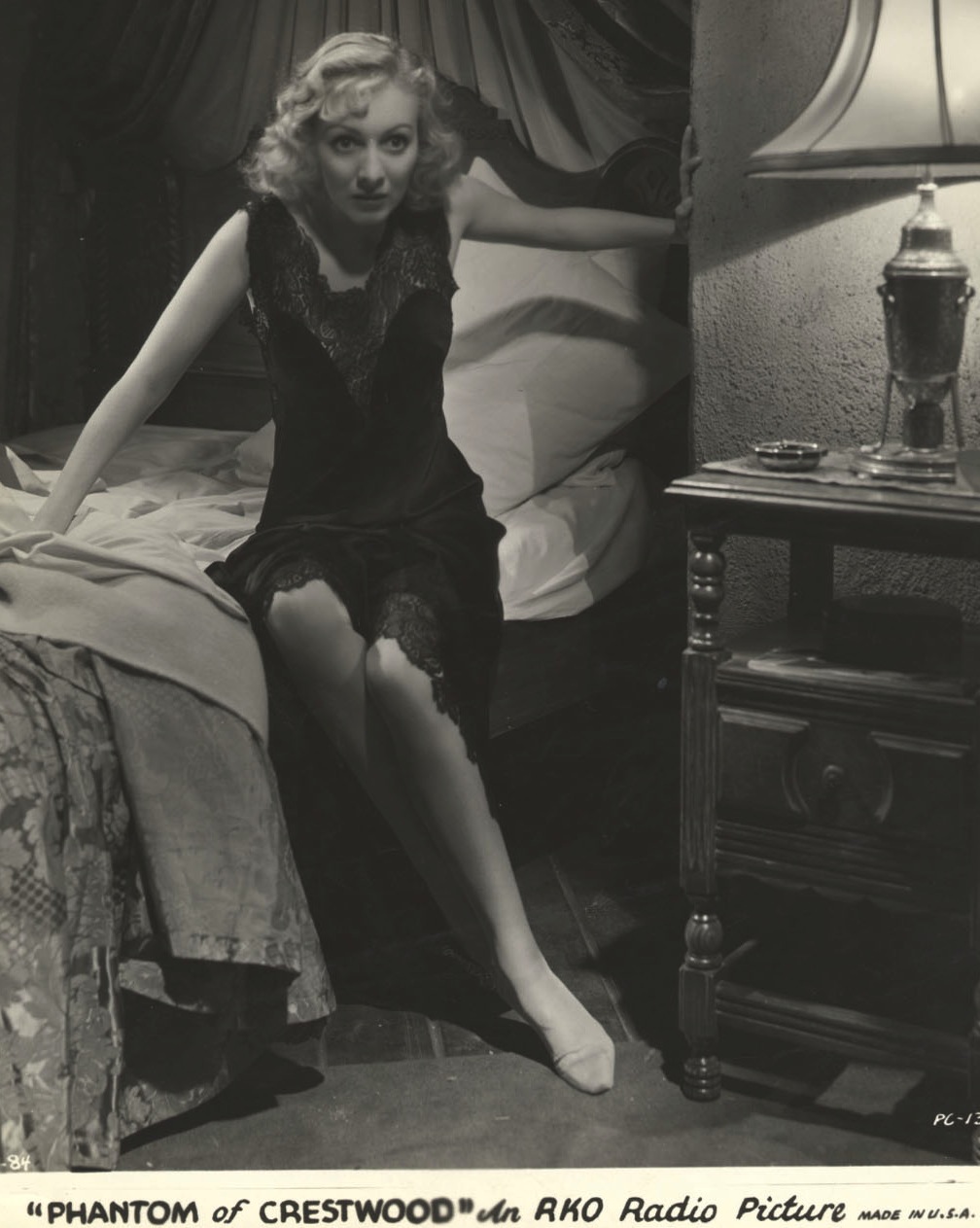
PHANTOM OF CRESTWOOD, SCARFACE, MASK OF FU MANCHU, DINNER AT EIGHT and, well, they'd all be worthwhile anyway, but with her... they're all sublime. She's got such mature allure in LUPIN she melted the keys in my pocket. We wouldn't see sexual confidence like hers again until... well, Renee Russo in the THOMAS CROWN remake. Like the Mona Lisa, cherish her always.