
Mobsters and LSD: don't doubt that they mix! But forget about Scorsese's mobsters for a minute--they're the cocaine generation, disco and cloth napkins--and instead let's sink down into Coppola's deep dark studies and smoky dens full of fissured old faces half lost in shadow, aka the1970s. I'm talking about the LSD generation's addled children, all tentacled with wild murk. I'm talking about Godfather Part 2 (1974). As Chico Marx would say, Ahsta mana gatsa - Aye shalom!
 |
| He's got Giuliani's Smile |
The key figure in it all for lysergic resonance is not, as one might suspect, Michael (Al Pacino) or Vito Corleone (Robert De Niro), but the original padrone, Don Fanucci (Gastone Moschin). A monstrous, sinister yet vaguely comical representation of the old country, Fanucci extorts local Italian businesses as an alleged finger of the shadowy organization known as the Black Hand. In the TruTV.com Crime Library, Anthony Bruno lays it all out:
At the turn of the 20th century in America, Italian immigrant extortionists used the mysterious name, the Black Hand, to scare their targets into paying their demands, lest they incur the wrath of some vast underground society. In fact, these Black Handers were freelancers with no affiliation to any criminal organization. Nevertheless, the innocent Italian immigrants they targeted believed that a Black Hand organization existed and knew very well that these extortionists generally followed through on their threats when they didn't get what they wanted. (more here)For frightened immigrants with no grasp of English, a figure like Fanucci could easily step in as an arbiter of the law, a go-between. What Vito Corleone did that made him such a powerful figure (as we see over the course of his part in the film) was to destroy the ties and traps that still snared lesser men, like the guy who introduced him to crime in the first place, Clemenza. Perhaps unwilling or unable to play the assassin as needed, even crooks pay their tribute to Don Fanucci and his mysterious old world crime ring, without even giving it a second thought. It's the willingness and the ability to kill without getting caught that puts Vito into the position of being Clemenza's boss in the years to come. Note too the complete lack of a police presence in the entirety of both films, except for the corrupt police chief Michael shoots in the first film.
Similarly, the protagonists of 1970s young turk movies (like Coppola's) operated outside the illusion of government. The anti-establishment attempts of Easy Rider (1969) were the only law or 'rightness' in that film. Captain America and Billy maybe never made it to Florida, but Friedkin, Scorsese, and Coppola did. They pulled back the curtain, took one look at old Frank Morgan as Oz, and popped a cap in his cheek (and a tab on their tongues). They busted free. And until they fell down, bloated on their own evil budgets (and coke), operating out there, in the jungles, going insane like Coppola's Kurtz (or Friedkin in the rainforest making Sorcerer; Cimino making Heaven's Gate out west), man did they soar.
The realization that one's own fears, one's fight-or-flight need to feel like someone out there is in charge, that reality means something concrete, makes one a slave, and the guts to just cast off the chains and leave the parade, to realize no one's coming to chase you, that's the big LSD awakening. It not only gives you the awareness of that terrifying 'no one is in charge / reality is an illusion' truth, it gives you the guts to handle embodying its lessons, to follow the Fanucci in your life, and pop a few in his brain and heart -- symbolically of course.
At the same time, you realize you are the Fanucci. You feel every bullet.


Watching this scene on my analog blurry (and cropped) VHS dupe, the bullet holes Vito makes in Fanucci's head and white vest in the infamous vestibule scene seem absurdly tiny for his massive bulk. When shot, he whirls around like a puppet whose master has tangled his strings; his mouth all a- grimace, a bit like Monotsatos, the evil servant of Sarastro, in Mozart's The Magic Flute. And like Monostatos, from a mythic archetypal vantage, Fanucci too is an 'evil servant' - he's chosen personal gain over altruism and what's worse, he thinks that all he wants is a little love, a little respect, just enough to whet his beak.
In the muddy 90s, this section of the film always seemed to be popping up late at night when I was reeling from the effects of some mind-bending substance (I think it came on after 'Psych-Out' on my VHS), and Fanucci's face looked on my blurry VHS like a grotesque theater clown, His last gasps, a mix of profound awareness, surprise and seeming attempts to react in a heroic manner, are all undone by his rapid loss of blood and bodily functioning. He tries to snarl and chokes on it. He realizes, it seems, in a split second, he's going to die before he even gets to spit out a single syllable of some defiant curse at his killer. At the same time, seeing this while in the post-peak period of an LSD trip, thrust outside the reach of the linear space-time guardrails, we too are unable to give full expression to the intense sensory input one is experiencing in the dark auburn Gordon Willis lighting of the hallway that is the late night of our lives. We all have our Fanucci moment: the death of a loved one, a brutal break-up, a car accident, or taking a whole tab when you should have taken a half, the question is, what do we do with it? Do we cower, or do we stand up and dissolve into the ether like a man, a blood-soaked, pain-wracked but still standing mobster? It doesn't matter to the world, but it matters to us -well not even us, and that's what's so freeing, so terrifying, yet so comical.
It's interesting also to note how Fanucci's death scene mirrors the opening of this particular Vito period segment: it begins at the theater, with the poor Italian immigrant opera singer threatening to kill himself (above) because he just learned his mama is dead back in Naples. In the scene immediately following, Fanucci steps backstage and threatens Vito's skittish paisan's alleged girlfriend for her papa's box office money. Meanwhile the character onstage in the play has lost his mama, but what's really got him down is the realization his tie to 'home' in Italy no longer exists, Mama Mia! We never see the mother die - it is only a letter, a signifier of something he'd otherwise not know about, just as the idea of 'the Black Hand' doesn't really exist beyond the imagery conjured up by Fanucci. Note that this scene may have been based on a real life case involving Caruso:
It wasn't uncommon for a child to be kidnapped and a severed finger delivered back to the parents to convince them to pay the ransom. In 1905 a Brooklyn butcher was gunned down in his shop for ignoring an extortionist's demand for $1,000. The famous opera tenor Enrico Caruso paid a demand for $2,000 when he received a threatening letter signed with a black-ink palm print.
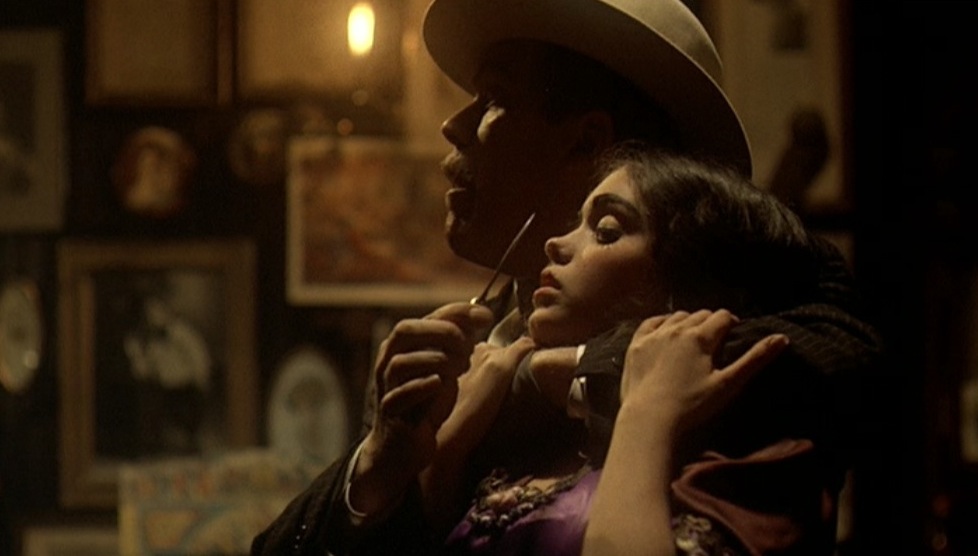
There's the Black Hand cultivating wives' tales with their propensity for violence and then there's that old wives' tale of the LSD user eating a live cat for the 'experience,' a fable I'm not sure I believe so much as remember from my halcyon days. Not that I did, but while you're peaking even a stalk of celery can seem like you're eating a live cat. You can hear the screaming in the crunch, feel the claws in the severed tendrils of the inner stalk. The piece in your hand is like Rhode Island being unmoored from the North American continent, like Jupiter adrift in space; every gesture leaving trails that make it seem like you're wielding a dozen arms, like Vishnu on a bender. In the amber dimness of the apartment doorway where Fanucci is gunned down, a similar collapse of time and space occurs, making my many views of it under the influence in past decades no mere accident. What collapses is not just a man, but the distance between the busy throngs of Manhattan and the Catholic ceremony going on outside in the street. The old world theater, with its constant shuffling of crowds in and out during performances, collapses into itself like a dwarf star, shrunk away into nothing but a few red holes in a white suit. Every time Fanucci dies in that streaky VHS dupe, even if I'm not having a bad trip on too much acid, I still feel the bullets; I burst out laughing from my chest at his grotesque expression, at the bewilderment and anger pulsing out of his face and mine, the realization in the second before he dies that he'll never get to make his last macho boast, his last beak-whet, his last salut.


Thus the Fanucci murder sequence is the LSD breakthrough moment, the hinge on which turns the wheel that cuts off the head of the imprisoned delegates of the old world, the quintessence of what I like to call "The Dissolving Father" of 1970s cinema.
The concept of the dissolving father is best elaborated in two stages: before and after. The before is the Mad Men era of JFK, the authority figure the father who enjoys the finer things --smoking, women, and martinis-- but who is also a family man at a time when that meant being a provider to a housewife and children, and maid, and maybe gardener. He must be a benevolent and canny ruler who can mix business with pleasure while asserting his dominance without tapping his manly reserves. His womanizing is part of his charm and so he is always partly exposed to judgment, but society hasn't caught up with him yet. He is silver fox-stage Cary Grant or Gary Cooper, mixing drinks in their state of the art Manhattan bachelor pads (the wives are up in Westchester) for girls young enough to be their granddaughters.

The after, the historical finish of the dissolve, occurs in the 1980s, with all such behavior in our leaders thought of as suspect and the attention turned to an endangered child--poor Vito alone on the boat to America--vulnerable to predators because both his parents work or are dead and so en absentia, the grotesque 'anal father' of Freud and Lacan returns from the shadows, a patched-up Fanucci unaware he's about to get re-punctured by his hockey mask-wearing bastard (or Cimmerian barbarian) 'other' son, the lost prodigal who's been in gladiator school. The only survivor of this 1980s purging is the 'final dad' - he mirrors the slasher movie 'final girl' in his sexless androgyny. To survive he makes his voice high and effeminate when he talks to his kids, deferring power to the mom in all things, a meek co-breadwinner terrified of being rejected by his offspring to the point they have no other choice.
The dissolving father is the tragic figure of the 1970s, his once inarguable power now slipped away. The institutions he used to signify are now little more than meaningless totems. Of course this is supposed to happen anyway if you are to fully mature and able to become the father, recognizing it's not a trap or a duty but a symbol, something you represent in the lives of others but don't actually have to 'perform.' In LSD parlance, you become 'experienced' and hip to the whole cosmic flim-flam. It's as if there are two--you and your dad-- in a sealed room, and then just one. But like Poe's William Wilson, or, say, Scanners, it's not like you are still there, and yet neither did you leave. So just how did you absorb the other person? What was the alchemical formula that dissolved you both, did you get absorbed into the 'Father' or did the father get absorbed into you? When you put a murderous old world Italian crime boss and an innocent (as far as killing) but canny new world upstart into a vestibule, and only one emerges, didn't both really die? Or didn't you realize, until this very day, it was Barzini all along?


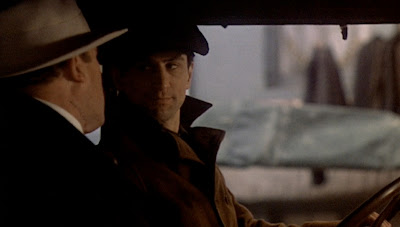
Historically, the father dissolved as a result of changing dynamics in the workplace and at home. As the suburbs became more and more isolated, the nuclear family was more and more cut off from older generations. The outer world grew colder and more hostile. With the arrival of cable TV and VCRs, the family's lack of direct participation in each others' lives reached new heights. Since both mother and father now have to both work all day, the children grow up watching TV, and if the father comes home at all, the best he can do in the way of demonstrative mastery is change the channel from cartoons to the news - an effective display in the 1970s when there was only one television in the house - but by the 1980s we all had at least two, so we kids just trucked it upstairs, fatherly bonding averted. Though it is certainly accidental, this loss is mirrored brilliantly in the arc of the Godfather films. The cleansing fire grows out of control and at the end leaves only dead trees. Fanucci is the old world father, makes a grandly conspicuous show of his connection to the people; he waves and nods to the crowd as if everyone is listening to him, even though we never see a single person do so, he is the anal father of Lacan, the devouring primordial father killed by the sons for his hogging all the women, enjoying conspicuously, Above him stalks Vito along the empty rooftop, alone, the grim chimneys and windows like fortress battlements or tombstones, a place no one has bothered to 'fix up' to look-a nice, a place without symbols and ceremony, where all traces of pleasure and decadence, anything to cloud a man's judgment and purpose, have been excised. The Corleone family will always be on the DL, restrained. We never see Vito laugh or crack more than half a smile.

To bring it back to The Magic Flute, the murder of Fanucci is akin to the passage of the lovers through the test of Sarastro: the journey through the underworld with the writhing figures menacing from all sides, but are they even really there? Close your eyes and no monster can scare nor vixen lure you. Vito realizes the same thing, that Fanucci's threats just the phantoms of the underworld, all he has to do is be secretive, remove himself from the public eye, and kill the dragon and then he inherits the burden of authority. He becomes the shadow Fanucci, no one can kill him in a vestibule since he lays so low, so discreetly. He has been given the secret, which is of course that there is no secret. There is no special power that comes with the job of 'Ultimate Signififer', only the belief held by others that there is such a power there, behind the visible. Vito's offering of the self as representative of order, as someone who is not afraid to stand in front of the chaotic void, pull back the curtain, and take over the wizarding. Rather than a big scary projection, it's his surface humility --his steely reserve and secretive 'normal guy' nature -that instill confidence there is a deep power structure below his feet--even the witch pays him, or her monkeys might suddenly go on strike, or wake up with her shattered crystal ball under her sheets. Best to not find out whether that would really happen.
Only you, the new void stander, knows the truth: old Oz has actually been dead for years, and you're the one who shot him! You see the blood on your hands, or at any rate, in your hands, swimming through the blue veins, ever ready to come out and turn red in the grimy air of Emerald City. The darkness always is waiting to engulf you, always just a broken bulb and napkin-wrapped pistol away. But the others, the small fry, your familia, they see only your iron skin. This gives them the assurance they need to go on --it's worth any amount of secret violence to prevent your loved ones from knowing what you know, the full measure of your/the world's horror, is it not?


LSD reveals all these things, because it draws back every curtain and if you cling to outmoded morals and fear, pay Fanucci or get all paranoid about the passing cops, you're headed for a bummer trip, little better than the kid who's afraid to cross the street against the traffic light even though there's no car for miles, or refuses to jump off the cliff when all his friends below are splashing away without him, citing the lack of a lifeguard. Authority is a placebo, as all the LSD kids know this, and so does Hyman Roth. Michael, we're bigger than US Steel. You'd never guess Roth was rich the way he lives, or that he hates the Corleones by the way he acts. There's no need to be mean or a braggart when you're fully awake, by which I mean ever-aware of your own mortality, and that of others. There's so much blood out there, all just waiting to be let. That it stays where it is, most of the time, is a miracle. To paraphrase Joni Mitchell, if you manage to know what you got before it's gone, you realize you may have to steal everyone else's just to keep yours from being stolen away. What you got is a parking lot over paradise, but the question is, who gets the contract for the concrete pouring??

Fanucci is the old world type of deep oak patriarch, the one called 'the terrible father,' the odious ruler who makes a spectacle of his own enjoyment, who insists on being seen enjoying. Witness his conspicuousness at the Sen Gennaro festival at the puppet show when he makes a joke about it being "too violent" for him, and turns around expecting the whole crowd to meet his gaze and break out in approving laughter. When they don't there's a flicker of shame that passes over his face, before he blocks it away with a smirk and moves on. This grandstanding exposes Fanucci as an easy target for a man as streamlined and rid of all personal pleasures as Vito, who has developed the mix of exterior compassion and the canny ability to use the granting of favors as a kind of paperless, untraceable, untaxable currency, and who has mastered the ability to repress anger and then kill in cold blood. This is the 'gift' of bravery, and it's what any successful space cowboy also has, for he must keep a straight face when, for example, his walls are crawling with mutant tentacled wallpaper pattern demons and has to walk past oblivious parents in order to get to the sanctuary of his bedroom, and they're bound to come in and pester him with banalities and he knows one wrong word and he'll be laughing hysterically on the floor while they phone the rehab.


LSD reveals all these things, because it draws back every curtain and if you cling to outmoded morals and fear, pay Fanucci or get all paranoid about the passing cops, you're headed for a bummer trip, little better than the kid who's afraid to cross the street against the traffic light even though there's no car for miles, or refuses to jump off the cliff when all his friends below are splashing away without him, citing the lack of a lifeguard. Authority is a placebo, as all the LSD kids know this, and so does Hyman Roth. Michael, we're bigger than US Steel. You'd never guess Roth was rich the way he lives, or that he hates the Corleones by the way he acts. There's no need to be mean or a braggart when you're fully awake, by which I mean ever-aware of your own mortality, and that of others. There's so much blood out there, all just waiting to be let. That it stays where it is, most of the time, is a miracle. To paraphrase Joni Mitchell, if you manage to know what you got before it's gone, you realize you may have to steal everyone else's just to keep yours from being stolen away. What you got is a parking lot over paradise, but the question is, who gets the contract for the concrete pouring??


 |
| The look of a cobra, couched |
CODA: What takes the old world's place? We never really know until it's too late, and Vito's son has distilled and distorted the teachings of his father into remorseless sociopathy, all the familial sense of togetherness totally severed, by Roth's machinations and his own poor choice in a wife (Diane Keaton, ever thinking she can snap Michael out of his 'Sicilian thing' with a New England schoolmarm scolding), the spaces of Las Vegas and Tahoe relative to the crowded earthy space of NYC and NJ. It's a mark of the jet age that families no longer live together in their old neighborhood, but spread out to new horizons and eventually reunite only at Christmas. The values of the Vito age aren't tangible, apparent, easy to bottle can can, and so dismissed. Thus our sense of family, happiness, and wholeness, paradoxically shrinks, dissolves and dissipates, the more our new world expands, solidifies and devours. The ultimate signifier. disappears with only a few shots from a flaming napkin. But the red dots on the blotter that set you free, and threw back the curtain on the bullet-riddled corpse of your paternal Other, are now wearing off. You're coming down, down... and somewhere, up the street, some angry youth is making his way towards you, stalking you like a panther from the high ground rooftops. When you see him--that murdering little snot-- admiring his dilated pupils in the mirror, all young and stupid, don't snort in derision. He's about to pull back your wizard curtain and blat blat blat. So get out the gift bag, pass him his diploma, and then die... die like a real-a Fanucci!


