
Showing posts sorted by date for query duke of burgundy. Sort by relevance Show all posts

Thursday, September 07, 2023

Sex Negative: Lucio Fulci's THE DEVIL'S HONEY (1986)

 "Sex is nostalgia for when you used to want it... Sex is nostalgia for sex." - Andy Warhol 

“The male has to will his sexual authority before the woman, who is a shadow of his mother and of all women. Failure and humiliation constantly wait in the wings. No woman has to prove herself a woman in the grim way a man has to prove himself a man. He must perform, or the show does not go on. Social convention is irrelevant. A flop is a flop.”  -- Camille Paglia, Sexual Personae

"War does something to a man, (it) takes away the gloss." - (film-within-film dialogue overheard while a sadistic sax player shocks his girlfriend by getting fellatio from his fey music producer in a Venice Cinema)- The Devil's Honey 

Can only an emotion as strong as grief wake you up to the emptiness of a love based on debasement and humiliation---even if that sex is super hot (and takes away your usual baseline suicidal ideation), in the way only sex with a crazy sadistic-abusive super freak can be?  Lucio Fulci knows. And he's using a distributor's brief to deliver another 9 1/2 Weeks (a big-ass hit in Europe) to answer the kind of tough questions9 1/2 director Adrian Lyne would pee himself in fear if you ever asked him. In short, if 9 1/2 Weeks is a naughty couples-only dip into Sandal's 'bondage night' (safe word posted on the wall in case you forget), Fulci's The Devil's Honey is a hard pistol butt thwacked in your face, followed by a little waterboarding in the romantic beach side surf. And not a lifeguard or a safe word for 5 kilometers in any direction. 

Don't say 'it's just sex' like you'd say "it's just leprosy.' Sex is serious. 

Our sex drive, it seems is itself a crazy sadistic-abusive super freak, demanding ever greater risks of safety, self-esteem and sanity just to get the same old rocks off. Safe words kill the fantasy as sure as condoms kill our 'sweet sensations.' With the intrusion of 'sanity', it's just play-acting.  like sooner or later an opiate addict needs too much for his body to handle, stranding him on the shrinking sandbar between the overdose abyss and the encroaching tide of withdrawal, so too the sex addict thrill seeker has to resort to Hellraiser- style "Jesus Wept"-style agonies for the same old kicks. Our common sense kicking and scream to be let off the ride, even as our subconscious paralyzes us with aroused excitement with every clank up the ramp. The alternative in each case is the hell of boredom, of safe healthy relationships and responsible bed times, wherein every life-affirming smile of your boring ass spouse, their big box of prophylactics and safe word rolodex ever at the ready, makes me want to rip your own genitals out and nail them to the front door.  

But wait, is that danger seeker even really us, or have we been taken advantage of by some sadistic lover who allies with our unconscious sex/death drive against our ego's judgement? On some level we know a lot of this abuse is all being done to please us. We forget how quickly our comfort zones shrink to noose size if left unassailed. And so we learn to hitch ourselves to loose canons, only to then complain when they roll all over our decks, crashing into mizzenmasts and crushing our toes? 

In other words, is it still rape if you call them for another date the next night? That question has been legally answered since the 80s, thank god, but there's a whole other line of moral questioning, posed only in brave films like Bitter Tears of Petra von Kant, Duke of Burgundy, Belle du Jour and The Devil is a Woman -- films which carry a lot of Criterion cred, that go all the way around to the back door of the same thorny issue, and are all considered art. But add a Lucio Fulci film like The Devil's Honey to their midst and those film snobs start sneakin' away, quietly striking your name from their bourgeois opening invite lists. AND I'M FINE WITH THAT! You can take those lists and stick 'em in your undiscovered country. 


Yes Honey, like much of Fulci's work, is too tawdry to the bourgeois types to give the same leeway they give to Bunuel or Fassbinder. And yes, it's a film where a saxophone solo is blown between a sexually supercharged girl's naked thighs in a red sound booth while his producer and engineer are out having lunch. And yes it's guilty of things that were having a last gasp back in the mid-80s, when every European filmmaker was chasing the elusive butterfly of 60 Shades of Grey, 9 1/2 Week$ but it's Fulci, not some perfume ad-music video hack. His genius stretches deep no matter what the assignment. He started out in dated sex comedies of the sort America has been largely spared (it has plenty of its own). And I think after cranking them out for the first Promise them Fatal Attraction, give them Guantanomo Beach. 

If Bunuel or Von Sternberg were around today, would they know what to do without the heavy breathing hypocrisy of the censors lending their every cryptic gesture a portent at once sophomoric and heroic? When forced to bury sex under mountains of respectability, that you get sex through somehow anyway is heroic, the way drinking during prohibition was considered patriotic by many of the writing class ('hic') I have the same problem now with marijuana, when you could go to jail for having a single joint, being part of the in-crowd carried outlaw cachet. Now, you're just another consumer, so who cares? A Fulci special isn't going to shock with sex when sex isn't shocking. He's too 'gone' for that- he'd rather bypass sex altogether, to get at the ugly truths not of love but of 'what it takes to keep your partner's interest, and your own' - the sex drive is, as Camille Paglia point out, very un-PC. Nature observes no moral code aside from might makes right, it's the whole reptilian cortex kind of shit, domination and sublimation. The only way out is through awareness, real Lacanian confrontation with the hideous staring eye at the center of horror of raw, undiluted existence, where Kali rips heads off of soldiers with one set of arms, and screaming babies out of bloody wombs with the others. So. much screaming and yelling - the only way to drown it out is to scream yourself. Fucli says, hey - go ahead. 

Because you see, gore and eyeball mutilation are the specialty of la Casa Fulci. Sex is something for Jess Franco or Jean Rollin, or even Joe D'Amato. Fulci wants no part of it. You can call some of his films misogynist, but he never fetshizes female suffering or the female body (beautiful faces and hair, yes, shapely figures, no) he presumes instead upon a Carol Clover kind of "Her Body Himself" projection.  There's no objectification of the female form with Fulci since in nightmare logic there can. be no 'satisfaction' or cuddling. Lust is a prison where the only release from your cell is enough gratification to stop the biological belittling for a little while, it buys you some time, like a $10 tray that at least takes your gorilla jones away, to paraphrase Girl Scout Heroin Gil Scott-Heron It's sex as a hungry ghost pining for the time before it mattered. 

For Fulci it's all just a dead end to the path of the 'stare' - not the 'gaze' but the 'stare' back at the gazer. Someone like De Palma emulates Hitchcock but Fulci 'one ups' that kind of scopophilia by emulating Dali instead - i.e. going right for the eye. Like Oedipus, Fulci knows that that the smallest of return stares can snowball into the murder of children (Don't Torture the Duckling) or lesbian neighbors (Lizard in a Woman's Skin). So the safe move for all humanity is if we just gouge those offenders out right now. Ah, but what movie do you see when that cloud editor's knife ravages your one good moon like a Melies rocket? You already know the answer. 

Fulci makes movies for the post-envisioned, forging a detour through the dream pineal pipeline, the dreamer's magic box, wherein we can behold our own blindness with rueful amusement, fully aware of the paradox but just not giving a shit. 

WITHOUT CENSORSHIP, SMUT IS NOT SEXY.  

For someone like Hitchcock, the handcuffs and short leash of censorship and his own Catholic guilt, keep him 'peeping' through keyholes to the end. For him and his disciples, Catholic repression is the ultimate aphrodesiac.  Hitch could funnel acres of sex into a single drag on a cigarette. With Fulci, the funnel spills out on the ground, the soggy cigarette explodes and the smoker vomiting ever last acre of sex back up and all over the floor. For Fulci, if a naked woman is presented for our gaze it's scary because she's looking back at us--to use Rear Window parlance, it's as if "Ms. Torso" suddenly whirls around and stares back up through Scotty's zoom lens in a way that would make Lars Thorwald pee his big boy pants. 


THE DEVIL'S HONEY
(1986) Dir. Lucio Fulci
"There isn't any reason, and I wouldn't want you to go around thinking that there was." - Ned Beaumont to the DA, The Glass Key (Dashiell Hammett)

In the sordid psycho-sexual chamber piece that is The Devil's Honey, the two male characters in the film straddle the disinterested whore of time, as if two aspects of the same man - one the tired, middle-aged male surgeon (Brett Halsey) with the stricken look of men my age when we finally see what lies at the bottom of the hill we're finally over (and we realize the car we're locked in has no brakes, or reverse, or door, or seatbelt, or steering wheel), and the younger, sadistic adrenaline junky colossus of the lite jazz saxophone scene who flies into a rage if his girlfriend ever wants to cuddle. In other words, he's on the upside of the hill, where the top is all he can see. He considers himself immortal, a god. Sex has made him into an ogre, the sadist, but is he like that because he 'gets' his girlfriend, knows how she sexually responds to being a 'piece of meat' to him?  

On the other side there's no doubt the burnt-out (Fulci-stand in?) surgeon played almost too well by Halsey, is trying to treat his hooker like a piece of meat (1t) , or at any rate she treats him like a temporary annoyance that's over before she can figure out if she even likes it, peeling her still-warm chewing gum off the mirror on her way out - no sense wasting it, and he treats her roughly the way a crippled kitten might play at being a lion for a few seconds before shrinking back into a world of consumptive coughing. His wife meanwhile longs for some sexual contact, wishing he'd man up. She's forced to say embarrassing things like: "Treat me like a whore," and, after she leaves him: "There's no use coming back unless you take me to bed," He'd rather mope, and never thinks to take his phone off the hook long enough to get her where she needs to be. 

Though he's extra stricken by her departure, he's stricken like Florence Pugh's boyfriend in Midsommar, cowed by some ego ideal he feels he needs to embody even while every fibre of his being is struggling to rid himself of her.  After she leaves and Halsey's eyes say it all - he'd rather be abducted and brutalized by an unhinged hottie than deal with Corinne Clery and her big haunted pleading eyes. Needless to say, he never goes home after this, 

Fans of YOR! (and who isn't?) know exactly how this feels; Clery does the insecure possessive clinging GF almost too well. She's got all the goods in all the right areas, but there's something about her that makes you want to chew off your own arm rather than wake her up and there's no clear reason why other than her neediness. Halsey is maybe a little too adept at seeming world weary and flaccid to the point we viewers long for his delivery from feeling obligated to feel bad about her wanting out.  Nothing is more tiresome in a movie than a character halfheartedly trying to stop a girl from leaving him that you feel deep down he wants her gone too, but can't admit it, because he's told himself he's not that kind of a guy. We saw this most recently in Midsommar, but it goes back to the start of Antonioni's L'Eclisse (1961) where we watch the morning after some apparent all-night breakup, as some lame dude lopes miserably after Monica Vitti, until we finally rejoice when she closes the gate on him.  Antonioni knows we hate this guy on principle, just like we hate the guy in Midsommar, that he drags us through it all anyway shows us that, like Fucli, he's a sadist in ways not quite associated with pain or mastery. 

Above all he plays against expectations, and every camera move or line is 'off' in a telling way. There's the absurd idea that there could ever be a lite-jazz sax player with a groupie (in the US especially). Eve  shot of Jessica walking outside, mourning him by wearing his sweater, seems unreal. A long tracking shot as she glides down a line of white fencing on her way to the doctor's car, in the rain, is given a surreal gleam, as we seem to be gliding along after her. And when she pulls out a knife to threaten our abducted doctor - the music doesn't get predictably ominous but surges into big guitar stings and jangly 80s air rock.

The Opposites Subtract Effect

It would be nice if we saw any change in Halsey's tired demeanor after this drastic turn of events. But aside from the dog scaring him so much he pees his pants, or when he watches her smash up his car with a hatchet, there's not much he offers in the way of reaction-- his eyes have that stricken sad guy look, the kind of mid-age crisis where you're over and start going down the hill - and see the spikes at the end, and there's no brakes or steering wheel, no way to unfasten your safety belt. All you can do is stare in that stricken way - and let it come. 

I tell you what though, Blanca Marsillach is rather amazing as Jessica. Singing and laughing to herself, eyes wide, staring - staring at him saying "Why did you let him die?" over and over, smiling gleefully - laughing ("so the great surgeon has peed in his pants."), Marsillach, you're one for the ages!!

"I can look straight into your eyes," she says 

As she walks around the beach house, moments from her past with Johnny seem to be happening at the same time. He seems always around the corner, coming down the stairs or out from the beach; the only difference is in lighting filters. When he says "You know I always come back," we wonder if he's a ghost, until he says "I can't live without you." Dude, I wouldn't worry.

Unless we've seen some Argento movies we may find it strange she's made so violent by the death of the man who treated he so meanly. But we who've seen The Stendahl Syndrome, Bird with the Crystal Plumage, etc., we know better. We also may know if we found ourselves adopting some of our ex-lover's habits after we separate from them, drinking their brand of whiskey, etc. We unconsciously move our habits around to accommodate for the sudden absence. Here it's forcing the doctor to eat dog food. Forcing him to operate on a doll she got from Johnny that he later broke in a violent rage. ("I love you I love you. Can't you say anything else?" he shouts, as if her string is broken). Eventually her memories stray from the house into Venice, made Don't Look Now uncanny, with Fulci once again making things super weird without half trying, through the simplest of close-ups - such as the sudden appearance of a smiling Nicky.  

I won't spoil the end. But of course they are in a Venice cinema, with a movie in English playing (we never see it only hear its stilted "WW1 vet coming home to find wife with another man' kind of British drawing room drama. 

As someone who's suffered from depression all my life, in one way or another, and had a lot of bad psychedelic trips as well as good ones, I can vouch that nothing snaps you out of a funk and into the moment like pain and fear. Thus masochism is often a remedy for depression, and the pain of one thing can be transmuted to ease the pain of the other, a kind of focusing/exorcism. And no pain is worse than severe depression --cutting, etc. is a relief. And if all it takes to forget your marital and malpractice troubles is to suffer a massive head wound, or wake up in some strange house with a naked psycho hottie named Jessica giving you the full Guantanamo, then hey where do I sign? 

And if you're Jessica, suffering to the point of madness because your now dead thrill-seeking dom boyfriend kept you constantly in that state of the "now" through abuse alternating with love and affection (like how Fulci treats the viewer), how natural it would be to spread the love/anti-love by subjecting the doctor--whose depression indirectly killed the man who was killing her depression (because the doctor was failing to cure his wife's depression he couldn't concentrate)--to an even more violent and domineering extended session of abuse. 

Is this Fulci's way of looking for some kind oar artistic underpinning to his life's work, as if his art itself is waking up to the abusivness of its 'total' self? A kind of apology by way of Italian art as espoused by Camille Paglia.

By the end, the meat treating will be almost completely purged from both grieving objectified girlfriend (sifting through her memories of his behavior and gradually realizing which came first, the chicken d'Sade or l'ouvo de Masoch) and the ennui-crippled midlife crisis special called Halsey-- whose wife shouted she'd rather he let his patient die in the OR than miss date night (in the end he does both)--will find himself still caught in his premature ejaculation problem (never mentioned but c'mon- you can count the amount of thrusts he gets --pants still on--with one hand, so to speak --at his age there's no excuse for that) but maybe at last - he'll have some idea how to enjoy sex without all the sub/dom booolshit..

THE FEMALE GAZE WRIT LARGE

That's really the point though of Fulci's feminine orgasm, perhaps and a sick kind of capstone. The outrage, the onus is on the woman and the complex web of her attraction and repulsion to the constant forcing of anal sex, thrusting at her from behind while she fumes and fusses as if always ready to try and surrender ("no, please, it hurts!") but determined to resist and fume. The idea of whether a masochistic part of her responds - they really need a safe word, but what are you going to do?-- feeds into the eroticism is, in Fulci's clever handling, always open to interpretation (does even he know?) Either way you can tell this lite jazz colossus doesn't really give a shit about her orgasms. He can't afford to, if he's to keep 'em coming. What a delicate dance, if that's what it is. 

And maybe it is, since the moment he's not pushing or pulling, she sulks. She sulks if he abuses her and she sulks if he doesn't.  She's sulking even on the ferris wheel. When he tries to be nice she pouts and fumes, angry that she had to leave him even just so he could finish recording his album, so desperate for him she hurls herself against the soundproof glass of the recording studio as if his horn's magnetic pull overpowers her, crotch first. And yet, if he does anything to please her, she'll lose all interest, like the secretary in Fassbinder's Bitter Tears of Petra von Kant. Without the cycle of anger/abuse/make-up sex (and as Camille Paglia always points out, that's why abused women often stay -- after he's all contrite and sweet later one, the make-up sex-- sharpened by all that fear and dopamine)-is almost worth it (ala the "Stella! Stella!" sequence in Streetcar).

By the end, the cycle of abuse will be almost completely purged from both grieving objectified girlfriend (sifting through her memories of his behavior and gradually realizing which came first, the chicken al l'abuse or l'ouvo de Masoch) and Halsey's ennui-crippled midlife crisis special. As if any doubt is still in your mind, when his needy wife shouted she'd rather he let his patient die in the OR than him miss date night (in the end he does both) she loses all sympathy (get that lady a pool so she can have a pool boy, bro). Free of both of their misguided guilt (Halsey's real guilt comes from refusing to admit every fibre of his being is screaming to escape Clery's claws; and Johnny's girl's guilt over accidentally killing her animus projection before any closure can be attained), maybe they stay together out of a kind of shared post-traumatic paralysis. Maybe they've burned out each other's mopes, both realized they don't even really want the heavy trip of their previous love's insecure brutality. If abuse overrides depression, then maybe exhausted release of past self-perceptions overrides the need for any kind of resistance to the initial depression in the first place. Few negative emotions live for long when you no longer fight them. 

And yet, our poor doctor will still find himself still caught in his premature ejaculation problem (it's never mentioned but c'mon) and at his age there's no excuse for that. Physician, heal thyself (you know what I mean).


Tuesday, October 01, 2019

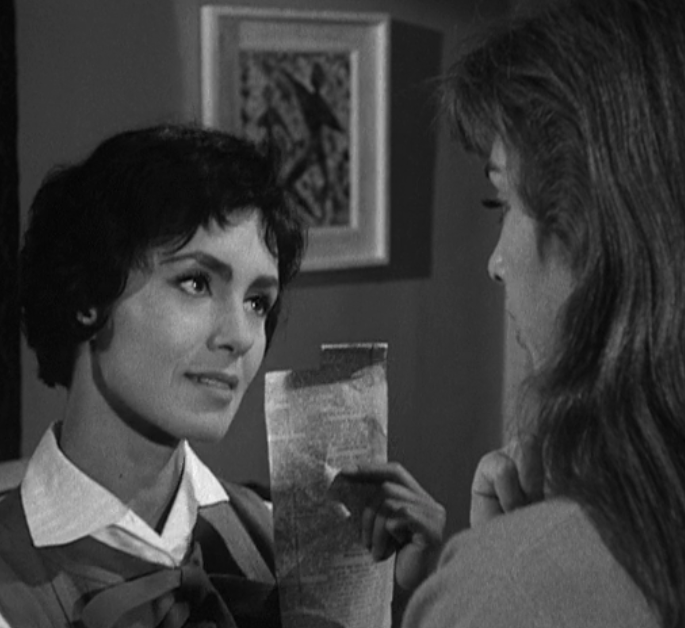
Crazy, Cool Sue Cabot: SORORITY GIRL (1957), MACHINE-GUN KELLY (1958)


Raise the roof! Because under it Shout Factory TV via Prime have dislodged some of the long buried Corman gems from the late-50s beatnik Corman AIP days, including three of his very best: THE UNDEAD (1957), SORORITY GIRL (1957) and MACHINE GUN KELLY (1958). Long unseen by anyone not expressly looking for them (they've never been on DVD) the sudden availability of these three gems, ready to stream and looking great, should be great news to weird movie fans like myself. The dialogue and plots are go-for-broke inspired (Undead being a crazy riff on Bergman's Seventh Seal crossed with a Bridey Murphy hypnotist angle that prefigures The Terminator) and Corman's cadre of genius hipster actors are all here: Barboura Morris, Dick Miller, Richard Devon, and --of course--the divine Susan Cabot. She's not in The Undead but she leads the pack in Girl and Gun, wherein though she's the bad guy in both we root for her straight down the line. Cabot plays Corman's characters with such modulated catlike finesse, we don't blame him for letting her take oer the picture, even if it means stealing the show from Charles Bronson. 


I kept trying to get really good screenshots for this post but it's hard to nail down Cabot's expressive features in a single shot, as she has a way of running through an array of moods and sly glances while doing a kind of restless movement thing with her head bending low and snaking sidewise towards her prey. Both playful and a little macabre, consider, for example, when someone threatens to rat her out to the dean in Sorority Girl: Cabot's face first displays a brief animal rage as she knocks the rat out, to determination while rummaging through the rat's things while she's unconscious, to triumph when she finds some incriminating evidence that will hold the rat's tongue in a blackmail quid pro quo, to playful cool once she has the rat under her control. What matters isn't the evidence she finds, or the absurd idea someone could get kicked out of school for spanking a pledge--it's the irresistible way Cabot has with controlling a scene, with goading the other characters into pushing back, then taking their slaps or incriminations with a cat who swallowed the canary smile. It's theatrical, but it's a special kind of movie-style theatricality that scriptwriters and directors and actors can't often predict, but love when it happens as suddenly their lines take wing. Sue Cabot soars with Corman's dialogue; she susses out all the fissures and peaks and moments the writer maybe didn't even know were there because they couldn't get high enough. 

She got a contract with Universal earlier in the decade but they didn't know what they had, so they loaded her into the background of a bunch of forgettable westerns. She went back to NYC to act on the stage and then Corman came. He recognized a tough confidence in her, she was tough enough to be sensitive and open, that kind of courageous raw nerve that lets her saunter up to a cop and make small talk while her man's robbing the bank next door, if you know what I mean. He put her in the lead, Sorority Girl, then she stayed with him to make six films within a three year period of 1957-59: Sorority GirlViking Women and the Sea Serpent, Carnival Rock, War of the Satellites, Machine Gun Kelly and The Wasp Woman.  She could be the girlfriend of a tough guy like Charles Bronson and not even gripe or sob if he socked her for taunting him and teasing him in front of the other guys, and she could be manipulative sadistic sorority girl determined to abuse her hazing privileges. And she could win our admiration almost in spite of ourselves, every time.

SORORITY GIRL
(1957) Dr. Roger Corman
***/  Amazon/Shout Image - A

From the title, we kind of expect a bunch of malt hops and mixers, with Tab Hunter giving our heroine a pledge pin and maybe getting her pregnant the night Chubby Checker or Bill Haley come to town to play at the big beachside fraternity party. Thankfully, it's not that. And we can tell just from the mysterious animated collage credits: a surrealist figure stands, alienated from the bunch, reacting with a cat o'nine tails to those who'd ignore her, becoming a kind of surrogate harpy. It's haunting and totally unique, seriously, there is no comparison to other films. No Tab Hunter tonight. What Freud fan Corman is bringing us under that innocuous title is a strangely sexy psychodrama about a disturbed young woman named Sabra (Cabot), from an affluent but loveless home, who struggles against a deep Sadean impulse to hurt and destroy. Clearly she should see a shrink, but we must remember that back then shrinks were considered a shameful secret. If it got out you'd been to one it could ruin your reputation (a stigma that persisted through into the 70s), and chances are the analyst would be some smug male who'd decree you had 'lady part issues' and needed to get married or, on the other side, have electroshock treatment and be committed. I mention this to temper the scenes of her begging for help from her distant loveless mom, to the point we shout at the screen: see a shrink and get some anti-depressants! But antidepressants are still decades away.

Pity them, the fucked-up children in a time before Prozac.

She tries, in all the wrong ways to connect. I can certainly relate, and maybe you can to, to not realizing that your mistreatment of the one person who does want to hang out with you, just because they're a stupid loser, is the reason you are shunned by everyone else. With her schemes and bizarre psychosexual sadism Sabra prefigures Tippi Hedren in Marnie and Sara Michelle Gellar in Cruel Intentions. And during a surprise visit home to beg for help and/or affection from mom, we don't need our Penguin Freud to see where Sabra gets her inability to tolerate or express affection. It might be obvious, but it's still relentless and true, to the bone.

Thanks to the insights of her voiceover and that heartbreaking visit home, we have endless sympathy for Sabra, which makes her odious behavior all the harder to accept or understand. What sets all this above the average 'co-ed' movie (even above Corman's later nurse pics for New World) is the sober intellect and overall supportiveness of the student body amongst each other. The fear of public gossip---this being the age of strict codes of conduct, where getting pregnant can mean disgrace, when abortions are illegal-- is just a few rings more moderate than Peyton Place, making blackmail and other nefarious evils all too easy.

One of Corman's ingenious tricks is to plant his films with a very strong and entertaining centerpiece scene (i.e. the fight over the fur in St. Valentine's Day Massacre). Usually this scene has only has a moderate amount to do with the rest of the film but it packs in sex and tough, awesome talk, as if Russ Meyer took over for a middle reel. Here, it's an extended scene that goes from Sabra trying to steal her roommate Rita's (Barboura Morris') man (Dick Miller, modulating his /beat swagger to seem like a gadfly about town) downstairs in the drawing room of the sorority house while the other sisters are at a pledge party, to trying to help dowdy pledge Tina (Barbara Cowan) lose a few pounds by forcing her to do some crunches / sit-ups, to eventually becoming so incensed by Tina's defeatist childish attitude, Sabra reaches for the sorority pledge paddle. Suddenly the flow stops cold. You can almost hear the blood rushing in their ears.

 What follows is a very erotically charged sorority paddling, ingeniously edited to focus on Cabot's face, lost in a haze of suppressed lesbian (?) and Sadean desire, worthy of Petra von Kant, especially considering Tina's complicity. She meekly submits, lying face down on the ottoman as if enraptured and trying not to blow the mood. There's clearly some darkly erotic Freudian/repressed sapphic undertones as she submits. A kind of sub/dom unspoken sublimated lesbian moment that, again, is unique to the drive-in, but after all, why we're here.


Corman films this paddling from two angles-- behind Cabot and looking down to the side at the submissive pledge and then an reverse, looking up at Cabot's face, which seems to be hiding an unholy mix of sadistic lesbian relish, all done very subtly (there's no moaning or screaming in pleasure or pain). The quiet sobbing of the pledge afterwards sounds more ashamed of some secret masochistic enjoyment than of trauma. In this repressed world, paddling is about the only means of sexual contact these two maybe gay women are allowed, and even then, it's warped by social repression (cruelty is less abject that lesbianism); neither one has a boyfriend or seems interested in such things (unless, for Sabra, any man is only valuable as a tool of power over other girls). They are their only human companions, two outsiders bound in a coded sapphic master-slave relationship neither one quite understands (this being America and not Germany).

Later, on the beach, they are still sitting together. Tina is doing sit-ups and even dryly noting she's gotten tougher. She's used the incident in a productive manner. It's toughened her up.

Perhaps Cabot drew from experience, having grown up in a series of 13 foster homes in Boston before getting married at 17 in order to escape the havoc. We can feel in her eyes: the round-and-round mix of need/desire for acceptance and companionship ever at odds with a total contempt for weakness and loathing for any kind of physical affection.  When Sabra goes home, hoping in vain to get some sympathy from her socialite mother (Fay Baker), only to find mom would never let her daughter's nervous breakdown and craving for love and connection interfere with her plans for cocktails with the neighbors. It's a devastating, stand-alone scene that tells us everything we need to know and instills the utmost sympathy for this "evil" sorority sister. Cabot brings such raw hurt and psychological complexity to the scene it's simply astonishing for a 1957 drive-in picture. 

In addition to Barbara Mouris, we get Dick Miller as a bar-owning man about campus who rejects Sabra's advances so she blackmails a pregnant waitress (June Kenney) into blackmailing him, even though they both know he's not the one who got her pregnant. The music is by Ronald Stein; Monroe Askins' photography brings an airy depth to the sorority house's close quarters, and a misty mountain marvelousness to the climactic beach scene. The print on Shout TV/via Prime, is ungodly great. And so welcome. Barely clocking in at over an hour, there's not an ounce of fat on this strange cinematic event, which had a male military school version with even more kinky sadism and blackmail, the same year, The Strange One, starring the comparable Ben Gazzara. If you saw them both as a double feature you'd never send your child to school again! 

 MACHINE-GUN KELLY
(1958) Dir. Roger Corman
*** 1/2 / Amazon Stream image - A

Though Charles Bronson gets the title billing, Corman lets Susan Cabot be the real show, the real leader of Kelly's gang, and Cabot has a field day! Her character, Florence "Flo" Becker, is based loosely (one presumes) on the real-life Kelly's wife Kathryn: the brains of the organization and apparently the one who styled her husband's public image, even convincing him to adopt a machine gun as a talisman. Why isn't she the title character? Because she was too smart even for that. Instead, well, Cabot's Flo gets as many--if not more lines--as Bronson's Kelly, who suffers from a major yellow streak. She's way more courageous, witty, and pro-active than everyone else in the film. She keeps reminding Bronson he's her "little baby," and her "gun arm," and she chose him because he was so weak and pliable! She tells him that in front of the other members of the gang, including the Morey Amsterdam as a dime-dropping fink mad at Kelly for ripping his arm off via cougar!

Bronson plays Kelly with a kind of functional sadism atop the fear and, surprise, and a streak of niceness as well as cowardice. It's a full 3D performance with Bronson even playing paddy cake with their kidnap victim and thrashing Richard Devon when tries to rape the kid's nanny (Barbara Mouris).

Some elements of the true story have been shifted around (here Kelly and co. kidnap a rich guy's child -- in real life they kidnapped the rich guy himself) and it's a bit rough on our modern sensibility to see cougars and other beasts in tiny cages but Corman films it all with a punchy urgency so there's no time for feeling glum. This is no plodding origin story. This is just a few crazy heists, and then the cops get 'em, the end. Bang! Credits! Corman has no time for tedious art or Big Statements, and in the process of stripping things down he's way more insightful and illuminating than most of the overblown prestige gangster pics.

To get back to Cabot's Flo, what lets the audience know she's the real leader of the gang is the way only she seems totally at ease with danger. And she's always dressed to the nines, sauntering in and out of the hideout, trailing her fur stoles, while the men all have to lay super low, bickering and playing cards behind closed curtains. As luxuriant and catlike as one could ask for in a super moll, she's the one casing out banks, drawing out maps, and flirting with the guards. Kelly is prone to freezing and running away when confronted with any memento mori (a coffin, skull paperweight, or obituary column), so he needs constant propping up his ego, flirting with his outlaw cronies (none of them have molls) to make him jealous. After he blows a big heist (a coffin passes by in front of him on the way to the bank) the couple hide out at a small brotherl run by her Mom (Connie Gilchrist), almost as cool as Flo herself. Unfazed by Kelly's tough guy veneer, realizing he's no good and telling him so. We see where Flo gets her her scathing wit and her lack of fear when it comes to antagonizing tough-talking, hard-hitting men.


Cabot relishes her character, investing so much playful nuance and force it's amazing. Part of it, I imagine, is her theatrical background: the ability to play extended single takes covering a lot of different emotional moments, and she does it daringly well. Unlike most 'moll' characters in crime movies, her Flo enjoys the life of crime. She's a long way from being just Warner Bros-style trophy wife, sulking around on the couch, eating bon-bons, whining about how much she misses nightclubs, irritating a pacing James Cagney .Corman and Cabot's Flo is the one going out and doing all the work. And when push come to shove she's the one ready to go down swinging.

Gerald Fried whips up some really peppy rich jazz for the score, a million miles from the phoned in Dixieland ragtime generic nonsense usually played in the 70s during their 20s-30s nostalgia kick. I mean, man, this stuff rips, I found myself unable to stop snapping my fingers and at one point was lifted out of my recliner as if on the wings of Gene Krupa. And Corman makes sure it's all edited tight as bank heists and the elaborate getaways come off like clockwork tied to the precision jump-back crackerjack flap the pack rack rhythm of the band. Fried had just done the score for Kubrick's The Killing a couple years earlier and the buzz was still generating. It's 61 years later and he's still working! Every day is Fried day!


Alas, aside from this small period of working with Corman (six films in three years: 1957-59), Cabot never really made the lasting mark she should and could have. She went back to NYC and Boston after The Wasp Woman to do mostly theater, and then there's her tragic death at the hands of her deranged son (1).

As for that, well, I don't like to dwell in my favorite stars' murky home lives, lest some detail or other ruin their viability as a screen for some archetypal projection of my own. Cabot is just such a screen, that mix of anima, trickster, cougar and devouring mom I have deep in the collective cinema unconscious. She could embody all these archetypes and more, in a single scene, perfectly modulated, all with a catty class and oomph that reminds us strong cool women come in all decades, shapes, and sizes. That a short brunette with shark eyes, clunky shoes, and a weird smile can wow us to core--even in a B-list gangster movie, or a sorority sister psychodrama meant to fill in a B-slot at a drive-in--proves greatness always eventually finds its way to the light... no matter what happens offscreen. Thanks Shout Factory! We got our Cabot back.


NOTES:
1. See Tom Weaver's piece "The Life and Tragic Death of Susan Cabot" for the full sad tale
2. And to prove the powerful effect of this kind of strange, deeply Freudian scene, Corman recreated it 13 years later in Bloody Mama this time in a holding cell between Bruce Dern and Robert Walden with a wet towel instead of a paddle, and the desire/fear-paralyzed Walden gently singing a religious spiritual as the 'whacks' come down.  In getting at the deep Freudian root, in these two scenes Corman creates moments we find confusing in their eroticism. We're hypnotized and dimly--on a subconscious, precambrian level--even turned on, albeit in the way we may have been as a child imagining such punishments inflicted on others. So often in film these kinds of incidents are filmed all wrong. An auteur like Bunuel or Von Sternberg focuses more on the psychological sort of masochism, and some, like Alain Robbe-Grillet, get too hung up on the bondage gear and class. In these two examples, Corman somehow manages to stage the abuse in a way that captures all the Freudian intensity without ever tumbling into the void of either Shades of Grey softcore tackiness or Girl with a Dragon Tattoo misogynistic trauma. See: Taming the Tittering Tourists: 50 Shades of Grey for the one type (tacky), Butterfly Moanin' - Duke of Burgundy and Fairie Bower Cinema (inert) for the other.

Wednesday, September 18, 2019

Til Human Voices Wake Us: THE BERMUDA DEPTHS (1978)


Hurricane Dorian spiraled over the Bahamas over this past Labor Day as I watched the ABC Friday Night Movie THE BERMUDA DEPTHS (from 1978) via Warner Archive DVD-R. Crystal blue skies, clear crystal white beaches, clear turquoise water, coral reef footage humming with moody folk love song theme, beautiful young lovers dripping with salt water, mostly tranquilized sea levels and oceanic temperatures, and giant (and I mean giant) turtle occasionally rising like Moby Dick x Gamera to bump his head on an unconvincing helicopter in the name of Triangle-style Satanic vengeance. After it, before it, during it, I was regularly checking in with the wide-eyed barometrically-hip denizens of 'Weather Underground' on The Weather Channel, to see where Dorian was projected to go next, and gawking at the crazy footage of in-progress devastation. Bahamas in tatters! Will... Bermuda be next?

Here's what you got to know about the Depths... once upon a time, circa 1977-79, the whole nation was "that way" about the Bermuda Triangle. From children upwards, all of America and maybe the world were thinking about that triangle and what might strange star portal, gate or devil might be hoovering up half the ships and planes that dared traverse it. The popular Leonard Nimoy-narrated docu-series In Search of....kicked off the craze with a triangle episode in 1977, Suddenly the book rack at the grocery store was flooded with books about it--including pictures!--the movie marquees flowed with documentaries and fictionalizations. "The Bermuda Triangle"... even today the name carries a sexy sea spray currency, like some cult around a strange expensive boutique water that promotes male potency. But all through those last years of the 70s, it was inescapable. 

Flick the channel ahead now to 2019: meteorologists stand before giant maps, caressing the predicted motion lines of swirling energy, pressure, precipitation like zephyrs in the sparkler air. Electric with apocalyptic anticipation, repeating themselves and their predictions, chanting national scientific barometric readings like druidic incantations and the unholy name -- Dorian... Dorian... Dorian, we worship thee. A thousand Moby Dicks worth of water and air swirl towards the TWC Atlanta headquarters, all so they might stand out in the wind and rain and be lashed while trying to talk to the camera. And all so we--at home--might feel extra dry and cozy. 


When I saw The Bermuda Depths over Labor Day, Dorian was circling around the Bahamas, twirling and whirling as if to bring the island chain to some monstrous extinction level vaginal vortex orgasm, a Cenobite maenad rending. The linked necklace of basic comforts that chokes us in the trap of civilized leisure snaps under Dorian's fury. Dorian leaves drowning souls clamoring at the ark's moss-slick sides. Those who drown don't die for long --but grow Satanic tails and squiggle towards a giant moon/egg/eye in the center of the center of the rift. 

The weather people scuttle over to B-roll of Floridians buying bottled water by the Price Club forklift. 

I hit play on the DVD player at the commercial, back ... to The Bermuda Depths and to.... her. 

Note similarity in outline of the rock to his hatted head as he sleeps,
Jenny emerging from his pineal gland, or where land meets ocean;
maybe the most beautiful photographic image in the history of Jungian archetypal symbolism?
(female/dream/ocean vs. conscious/man/sky.
Jennie Haniver (Connie Sellecca) appears at first like a distant black flame, framed in the picture window of a rocky outcrop (above): walking closer through the eye of the island where Michael Pitt-lipped wanderer Magnus (Leigh McCloskey) naps. She brings her own theme song--the indelible guitar of Vivaldi's "Concerto in D major for Lute and Strings RV:93 Largo"--and gazes down at him with loving eyes. A stirring flashback of their time as children on that same beach, raising a giant sea turtle together, even carving a heart with their initials on its shell, comes hazily out before us. She eventually left, without a word, swimming off on the turtle's back as Magnus slept upon the shore. He almost drowned trying to swim after her. And then, the night, after Magnus is in bed, his marine biologist dad decided to conduct some ominous experiment in a grotto under their beach cliffside house. Something to do with a giant unseen monster! It knocks half the house's foundations on on top of him while Magnus frets upstairs in his childhood bed. So many questions, but save them. It's all in the past, and that's why we're here, and maybe there is a connection and maybe there isn't. First, we got commercials coming.

The music is gorgeous; there are no clumsy voiceovers; no words spoken--nor read at all--anywhere in the first 12 minutes of the film. There is only Vivaldi, and that achingly lyrical folksy theme song (a signature of production team Rankin/Bass)... already burrowing into our souls and leaving us with a plaintive spiritual ache for our own lost ocean animas.. Jenny....

Have I only imagined her?
I still the feel the warmth from kissing her
I'll spend my whole life missing her 
Jenny....
Jenny...

Magnus, now grown, is back in Bermuda. He and Jenny meet again, along the day-for-night shores. We're as obsessed with her flawless raven-haired beauty as he is. She's so ethereal, desirable, anima-like, it's hard not to swoon. But he's only back in Bermuda to do a stint on a marine research vessel helmed by Burl Ives, with Carl Weathers, whose beautiful black muscles glisten in the blazing blue sun as he shirtlessly pilots their vessel out to sea. A marine biologist collaborator with his Magnus' late father's, Ives is researching gigantism in ancient triangle species, i.e. a turtle the size of a football field! But, is this the animal familiar of Jenny, the turtle they raised as children, or is it maybe a guise of the devil, her master, dictating her relentless lure of smitten sailors to the briny depths... of the Bermuda Triangle. Watch out, Magnus! She's a siren. Luckily you have Weathers to cockblock you at every turn.

Ives' wide-eyed black housekeeper (Ruth Attaway) tells Magnus that when Jennie Haniver was alive-- a century ago--she was so vain and beautiful that all the men on the island were in love with her. When her ship was caught in a storm and about to go down in the middle of you know where, she made a deal with "the other god, the one who swims below" to stay beautiful and young forever in exchange for an eternity of 'service' to the leviathan. She lives, notes the housekeeper, "out there" in "what you folks call... the Triangle."  Magnus refuses to believe his Jennie could be a ghost until she reminisces about when her father used to host 'quadrilles.' She invites him to dance to her ever-present Vivaldi soundtrack.... but is it the same giant turtle she swam away on that crushed his dad and house? Let it go, Magnus! And hold on tight!

ABC Friday Night TV movies like Depths made deep and lasting impressions on children like myself (I was 12), who had no voice in the prime time choices. Lucky for me my dad loved this kind of shit (unless football was on). We all loved In Search Of..., so a movie this weird and wondrous couldn't be missed. Somehow, though, it was. I have no memory of it. What else would we have been watching?

After its initial premiere, this weird intensely haunting film lay dormant for decades, gradually considered to be a folk myth told of in reverent hushed tones by the few kids who saw it. But decades later, through the giant claw machine of the Warner Archive, it is dredged from the depths, and it is a treasure. Though it's is a TV movie, its filmed on location and Bermuda has never seemed so beautiful. Jerry Sopanen's brilliant cinematography plus a perfect color restoration results in a blue sky, clear water, white sand, tanned limb clarity that leaves a hole in the heart, evoking among other things, Dali's magical paintings of Costa Brava. 

A kind of oceanic ghost story, Bermuda Depths sails the same currents as Night Tide and even the doomed romance between Bonehead and Lorelei in Beach Blanket Bingo. Maybe it's because I'm a Pisces, but I'm even haunted by Rankin's theme song. I was dissatisfied with the end but, after I switched back to the Weather Channel watched the twirling storm still just hovering over the Bahamas, I couldn't stop thinking about it, and her--Jennie-- with her raven hair, perfect olive tan, waterproof no-smudge eyeliner and the ability to reflect light from her eyes so they glow like a a pair of lighthouses beckoning before an otherwise jet black curtain


ARGH - SPOILERS BELOW! 

It's not an easy role to pull off well, as one needs to be--in a sense--a blank screen, to nudge the viewer's anima into using the coiled energy of the far-off hurricane to fire up its projector and feel once more that sense of hopeless longing that comes from one of Ego and Psyche's all-too-rare reunion. How could I blame the film for being true to the anima's nature, i.e., for all too quickly shutting the projector off again, before we can ever get quite enough? Carl Weathers busting in on us like a big black alarm clock like some resistant superego, we can only pine for her to come again the next time we dream.

And this is--alas--the anima relationship at its purest. The anima appears to us only that her absence may be all the more keenly felt. She does read our letters but doesn't answer. In a way, she even helps us write them - for our (male) ego is a projection of her unconscious as well.

It doesn't matter anymore. I am glad I bought this on DVD, and that the image is so gorgeously clear I can count the ocean's beaded rivulets down Connie Sellecca's luxuriant gamin limbs. I applaud the way the giant turtle is used so sparingly - appearing mainly at the climax, and fading away with an unforgettable dive into the depths and all the ensuing tarot-card ready references that connect The Bermuda Depths with the arcane language of the collective unconscious.

My early childhood anima - the mermaid girl from the old Marine Boy 
anime, from I was around 3-4. I was so
enthralled I think I cried when the show stopped airing. I still
remember her vividly, though not her name.

Though this dream girl aspect ("have I only imagined her?") often irritates me in other films, it works here as there's plenty of evidence she's more than just a male fantasy or a psychotic hallucination. The men who don't believe she's real are--after all--a pair of normal guys on a tiny dinghy who actually believe they'll be able to catch and reel in a turtle the size of a Victorian mansion all by themselves, in a tiny little research vessel not even half its size --and that's way weirder. And besides, Jennie is real to Magnus, and to us, watching. We never see him talking to the air, for example. Though she's never seen by anyone else (except Weathers--at the very end--and then we don't see the version of Jennie he sees, the image that causes him to buckle over in horror, but it's clearly not Connie Sellecca). 

Besides, if the Jennie the Mermaid element of the film was all done as some kind of Harvey-Walter Mitty style fantasy, we wouldn't even be having this conversation. Instead, by reveling nothing whatsoever the Depths delivers the full mythic power of an actual dream, the kind spend the rest of our lives trying to get back to... or forget about. The Bermuda Depths is one of the few films to ever tap fully into the true power of anima projection. The filmmakers know that if there was some big twist at the end, i.e. a mad scientist is behind it all and/or it's a scam and the scammer would have got away with it if not for those rascally kids, or if the film relied on any rational or even metaphysical 'explanation' for the mysteries, it would undo the spell. But the way it's all filmed, the way the story goes down, it never loses its Jungian "on-the-one" beat, where the film itself is a dream from which there is no waking, only a renouncement of one layer of the dream, which may or may not be a transition to adulthood, for another.

The problem is--as besets all young boys once they reach the end of elementary school--Magnus can't get a moment to woo his lady love because of his girlfriend-less rowdy buddies, his shipmates, ie. the Apollonian 'group' of men that lie in dialectic opposition to the male conscious/female unconscious Dionysian pair-bond. Even to a secret, gorgeous grotto Eric (Weathers) knows where to find him. Luckily, in all that time he's been away, no one has touched the wreckage of his family home, nor found the hidden grotto--but again, this all fits the Jungian model.

Why did he not hide from Carl? We did he heed that manly call, that friendly but nonetheless cockblocking Captain Bligh all-hands? He's Fletcher Christian pulled from his languid island hammock with comely Mauatua for another endless slog across the seas. Without a second thought, presuming she'll be waiting when and where he deigns to look for her, Magnus leaves his ghostly love to go fishing with Eric and Dr. Poulis (Ives), as they set about trying to catch a creature so massive that there is no boat big enough to do anything on but drown should they be unlucky enough to hook into it.

Earning his masters in marine biology while spending the summer with Poulis, Weathers' Eric mispronounces "coelacanth" but is otherwise letter perfect as the kind of guy whose energy is like a magnet for lost boys. After pointing out he and his father used to laugh when Magnus as a boy playing on the beach with his "imaginary" girlfriend, he then shrugs it off with a swig of beer, telling his young charge "you're all right, you're home." This brusque fraternal protectiveness is something Magnus is clearly drawn to (or he wouldn't be on the boat at all) and needs on some basic level. And we need it too! So does Weathers! He's clearly having a great time in Bermuda; he improvs freely, cracks open beers that you know are real beers, and struts around loving the sun just as the sun loves illuminating every striation of his rippling shoulder muscles. If Jennie is the anima, then Weathers is the Wild Man, as Ives is the sage. All three offer elements Magnus needs to incorporate in his psyche, but they are not necessarily in harmony. The Wild Man archetype and the Anima, especially, seldom even acknowledge each other, trying to dissuade the hero from hanging out with his other "imaginary" friend.

It doesn't make any sense--that Poulis and Eric would dismiss Jennie but think they can catch a deep sea leviathan with a tug boat and a little net--but that's part of the film's dreamy unease. Even in the safe normal reality championed by Eric and Poulis, things don't add up. Their quest exists as a kind of perennial cockblock. Any young man in the throes of a sexual (but ultimately "dry") dream knows that torturous frustration. Our anima will always be ours, only ours, forever.... but first --before she surrenders herself -- you have to just go do one little thing. The boys are calling you back from the siren's rocky ledge, just as she called you away from their slippery gangplank. Their calling back and forth ensures you are never really with either. "Wait here and I'll be back," you tell her. But of course she's never there if you do return. Either that or you never make it back. Not for years. 

But what does time matter for the unconscious? Time and space are illusions. In reality, there is only waves.

 Magnus, though, too, is an archetype. He's not just some dweeb as so many lesser movies of this sort are saddled with (the sort played by Matthew Broderick or Tom Hanks). He is the Parsifal (and McCloskey does a great job with this vague role); Burl Ives is once again the Fisher King (see #12 of CinemArchetype 24) and there's also Weather moving from Wild Man to the hanged man (literally, in a tarot sense, as man is dragged to the depths by his foot - those are pearls that were his eyes, etc.) - all on the one side; and the alluring anima, her monstrous familiar (in a Gamera-logical sense) and even a wild/wise woman (Attaway's amazing one scene as the black housekeeper / conjure woman / folksy exposition provider) on the other.

It breaks my heart but is because Magnus does leave Bermuda that this becomes myth. If he didn't, he'd be snared in the faerie bower of Eros (1). Aphrodite's scallop shell would close down on the he and Jennie like a submersible honeymoon coffin.  The dreaming ego always goes off with the guys when he can, otherwise there is no myth, only an enchanted knight slowly dying of hunger under the poppy trees, ministered to by a dozen doting fairies til he withers down to a junky skeleton. ++

Some call him Kurma

----

BACK, STORY!

The production team behind the Depths are Rankin-Bass, names familiar to kids all over the 70s for the puppet-animated catchy tune-spattered Xmas specials we all saw every December, and still do, like Rudolph and The Year without a Santa Claus; and the first two animated catchy tune-spattered Tolkien specials - The Hobbit and Return of the King. They clearly knew a few things about how to tap into the deep strain of Jungian archetypal myth that can structure kids' psyches as they merge into the adult lane. Here they're working with same Japanese crew and director: Tsugunobo Kotani, with whom they'd teamed up with for the more-conventional The Last Dinosaur from the year before. But while that movie stayed a 'boy's life' Hemingway meets Edgar Rice Burroughs dissertation on machismo, The Bermuda Depths is infinitely more even-handed and light in its touch. Trying to talk about its brilliance is, as Tyrone Power says in Nightmare Alley, "like trying to put the ocean into bottles."  Like the waves going in and out on those beautiful white sand Bermuda beaches -- it captures that all things are fleeting.  At best, consciousness is just a skittish series of opportunities to practice the fine art of letting go, for one must let go, of everything, in the end - and the end is soon. It's been real, but now the sea nymph must return to the depths, lest she melt into a skull ala Sandra Knight in THE TERROR (1963) and the Vivaldi concerto end, replaced by... Diamanda Galas...


BACK TO THE STORM

Enter 3 meteorologists, tracing their batons back and forth around the barometric reading map like junkies combing the carpet after the last grain is licked off the table, or conjure wives summoning demons from the depths of their cooking pots, roiling like coiling clouds over the Bahamas. Gesturing at the mimetic map as if to move the vortex through their swirling mimetic hand magic.

So as the swirling moves across time, space, and the spinning planet surface, is Bermuda's cosmic bill paid or will the hammer come down? No amount of blowing or fanning will change that spiral's mind. 

Up at Niagara, the Native American art museum is shaped like a turtle... It's been vacant for 22 years. I was there in 1989 with my girlfriend when it was open and full of Iroquois turtle imagery. The turtle carrying the world on its back, the incessant Falls, the force from which it gains its mighty roar...... my girl, her raven hair and crystal blue eyes... the turtle with the world on its... 

Am I still there? Am I ghost wandering that stricken empty shell? My ex had crystal Bermuda water blue eyes and raven black hair, pale skin and a lovely lips. But though she was everything I dreamt of, the roar of my band, of whiskey, and of inertia, all came first- no amount of hating myself could prevent it. 

Wait right here, I'd say....  I have a turtle to catch. It took me 20 years to get over her loss, yet I was so glad to be free of her (more of that in My Long Day's Journey into NIGHT OF THE IGUANA

Life was always going to be fleeting. We signed the waiver before we sailed. We're bound to remember we are all just waves that crash on the shore and leave only children, maybe, and photos of ourselves,  and mentions on the web that are only really 'there' if someone reads them. 
see: Godasiyo, the Woman Chief

The Bermuda Depths' theme song knows that horror, yet is sweet as any Rankin/Bass folksy theme. It might be friendly but it knows the power music had in the age of holding tape recorders up to TV speakers. It knows how we were once so anxious to capture any fleeting images of our beloved we would take photos of the TV, to somehow 'own' a reflection, knowing how futile that is. The sadness in the song "only imagined her" knows the almost religious importance we placed on things like 8x10 glossies, trading cards of our favorite movies, bands, and shows, of decals and buttons, of pictures cut out of magazines, traded like furs and guns. 

Now, in this internet age, the anima is harder to find for being so available. We are flooded with potential anima screens now, like the parade of hurricanes rolling out from Africa and around the and up the Florida coast before peeling out east  towards Bermuda or Nova Scotia. The Weather Channel crew traces their path on the empty blue  screen, commenting and gesturing, but there is no making the 'sea wife' come, only letting her go... when she's ready... Until then, she just sits there off the coast, in the deep, twirling in place, grinding the Bahamas down to a treelss, roofless nub. 

 It's only in her absence that she stays forever. That's the anima. 22 years later and the Niagara Great Turtle museum still stands, empty in shell but present in corner real estate. If you see her, say hello, but do not linger, lest your consciousness dissolve in the brine, its husk bobbing up and down in the waves, as she makes way for the next drowning man. 

But isn't that you, too? 

I still the feel the warmth from kissing her
I'll spend my whole life missing her 
Jennie...


NOTES:

Relevant Archetypes:


(Note: the key to this power is the image - Keep the old tactile 'real' photos of her on the beach or in front of the Falls from when you were young. Never look up her virtual pixel image on Facebook decades later, she will not look the same. No empty turtle shell still immortal just absent this time -your anima will shriek as if you caught it in the morning bathroom before it put its 'face' on. The true Jennie Hanniver at last.. Now your old photos just seem 'dead' - the anima has gone from this screen forever. That's Hollywood, and it's your problem. You looked back. And now your gaze itself is salt. 
Related Posts Plugin for WordPress, Blogger...