Wednesday, January 10, 2007

Xena and Gabrielle: The Post-Modern Love Story of Our Age


I've been watching the final season of Xena on DVD. By this time the girls were so out of the closet that they were doing everything but kissing or declaring themselves sexual partners. You would have to be the most conservative southerner in the world to not read the writing on the wall. What makes this weird in/out thing so enjoyable is how it solves the dilemma faced by most TV shows that linger over their romantic leads "will they or wont they" status, as in Cheers, X-files, etc. where you have a male and female lead pair bond who you keep waiting to fall in love and into bed. Of course, once the lovers do fall into bed and start kissing on the show, it's repulsive and time for it to end.

This is the nature of our position as infantile viewers that we are grossed out by seeing our onscreen lovers kiss unless it's the end of the film, or disaster and separation is looming right afterwards. With Xena and Gabrielle the lesbian love pair bond is actually strengthened by the lack of exposure. In maintaining their privacy, the girls maintain our interest.

It also forces them to continually find excuses to give each other mouth to mouth resuscitation and employ other nifty gimmicks. A particular favorite is what I call the reverse-double-entendre, wherein declarations of earthly love are then reversed and put in a vague fog so that what you thought they just said and was a moment ago completely and unmistakably a lesbian declaration is now again, obfusciated. In a way it recalls, for me at least, the thrill of realizing your parents are talking about sexual matters in a way you barely comprehend, as they code everything above your ears while you are, say, in the 5th grade. It's a level of adulthood that contrasts wondrously with the less mature elements of the show to create entertainment for the "person who is, in themselves, all ages."

Check my in-depth analysis of Xena Season 3 on popmatters here

Friday, November 10, 2006

Be Fearless: Brick and the Kingpin


The high school nerd gets his just due in this hardboiled noir set in some chillingly remote California suburb. Branden (Joseph Gordon-Levitt) is a loner with glasses who eats lunch by himself near the dumpsters behind the high school. He used to be more social, but druggie Laura (Nora Zehetner) broke his heart. His lonesome blues are over when note in his locker leads him to a remote pay phone where his Laura soon calls, raving about “the pin’s brick” and asking for Branden's help. The only other guy with glasses and a modicum of intelligence in the school is Brain (Matt O'Leary) who lends his aid. Branden runs up the social ladder in search of his girlfriend’s assailants, finding drugs, decadence and deceit all the way. That’s all fine and good in an update on various themes from Raymond Chandler and Dashiell Hammett (drug wars with the detective hero pretending to be on both sides; a femme fatale; an uneasy truce with the fall-guy seeking police; expendable patsies, POV beatings, etc.)

In addition to the cleverness of transporting this noir scenario to a high school setting, the choice to play Branden as utterly fearless is utterly awesome. The closest thing to him in film of recent memory is probably Billy, the kid from American Beauty who deals Kevin Spacey his government-grade pot. To overcome fear at that age is no easy feat, but Brandon takes endless beatings, picking fights with hulking football players and drug thugs and winning every time. When his glasses are punched off his face, he merely pulls out a case with another pair, the way Clint Eastwood might pull out a cheroot in a Sergio Leone western.

Along with the amazing, clever dialogue and the great use of geometric composition to establish a sense of suburban desolation at every turn, this is easily the best neo-noir since The Last Seduction and an important step forward in showing young male viewers a protagonist other than the simple minded hunk bore who gets the girl or the coded gay best friend hysteric in the chick flick; the sneering pretty boy; the geeky obese avenger; and so on. Enacted by Gordon-Levitt, Brandon is an inspiring character who should motivate a generation of men and teens to stand up and take their punches like a man, then throw back with everything they have, all in the name of love... baby. Lukas Haas also scores as the drug kingpin. They have some great Sergio Leone-style staring contests.

Friday, September 15, 2006

Lolita Nation


Since the advent of AMERICAN BEAUTY and that Pepsi commercial with Britney Spears (where you see even former presidential nominee Bob Dole drooling over her), we've been collectively in a spiral of youth worship. Men are encouraged to have mid-life crises, get that jet ski, quit their jobs and back out of their marriages (to shrill hellish Annette Benning-style wives) and go after the 18-23 year old of their dreams. Some of us have gone and done this, some of us have regretted it, some have married them and had a second batch of kids, THEN lived to regret it. Some just keep it a fantasy... and get unreasonably hostile towards girls that attract them in that way (and then the girl has to report them) and so it goes.

But WHO grows out of it? Who transcends it? Was it always this way? What happened?

In my estimation, it all began with the death of John Lennon in December of 1980. Before that, America was a place with a lot more touching: parents and babysitters of both genders touched children, played with them, rolling around on the floor, tickling and sitting on laps, and so forth. Then Lennon got shot and the peaceful concept of "love" as a force that transcended sex and politics, love as a unity of all people of all ages and races rather than of sex partners and sex partners only, was put on the shelf.

Then came this scare in the early 1980s of children being molested at day care centers. Suddenly every kid was having recovered memories of being molested at their day care center. From then on, the panic over improper touching of children completely overrode the fact that children need to be touched, not sexually but like monkey-grooming style. Now sex seems to be the only way these lost girls can get their father back, symbolically speaking. Here in our fatherless society, these lost girls wear all this Bob Dole-approved sexy stuff in order to snare the attention of the older man, which they then spurn, because they don't really want the sex, so much as the love and attention, masked in the idea of the power of the tease. They oscillate, like a dangling carrot before the horny horse, trying to lure it into some kind of paternal/older brother surrogate forward movement without getting bitten in half.

Older Male educators or others who work with young women on a regular basis sometimes unconsciously learn to parlay this need into a tool for getting the young women to do their homework or get into AA. It's only when the man is going through a midlife crisis, is sexually frustrated and constantly fighting with a belittling foreign wife, etc., that this otherwise positive father/older brother surrogate situation can run afoul of the law, or common decency.

This is brilliantly represented in the film, "Blue Car," for example, where a fatherless young girl befriends her English professor, who mistakes her need for a strong paternal force as a romantic crush which he is only to happy to equivocate having a tragic home life that's rendered his concept of family to shards of meaningless disconnect. The film is devastatingly honest and highly recommended.

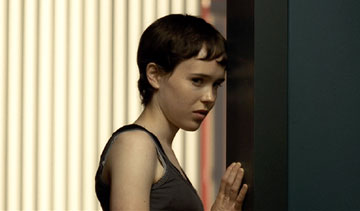
A less honest film is "Hard Candy" wherein a little Red Riding Hood style disem-baller played by the able Ellen Page is forced to spout reams of unrealistic dialogue with this bland pedophile played by a bland actor's workshop type. The worst aspect of it: she doesn't actually cut off his balls, after all this build up, as if to actually do so would be going too far. Fuck that! Castrate the prick!!

Instead, the movie itself is castrated, hesitating at the moment of truth in grand punter fashion. Patriarchy's castration anxiety strikes again! Fuck that.

So now, everything is filtered through the sex looking glass in a way it hasn't been since the great Anita Hill PC-putsch of 1990-1992... Now it's all somewhow OK that immature men run out on their daughters to be free of family responsibility, only fall in love with a fatherless teenager in a musical chairs of pseudo-incest..

But is sex the ultimate goal, or merely the healing "touch" of another human, the same kind of touch each would have gotten in the 1970s in an EST-style encounter group, all without having to feel guilty? Am I just imagining the greater liberty of that decade? I was only a child, age 3-13, but I molested three babysitters, only one was male. I remember clearly: I started all of it. I was no victim. Very little of it would have been considered indecent at the time, but now -- they'd be in jail and/or I'd be in therapy, encouraged to see those experiences as violation rather than exploration. Not that I'm not. And not that this is meant to demote the other version - if I was a cute girl instead, who knows what legit traumas I may have endured in those same situations? I just mean, well... what the fuck do I mean? That it's a big chthonic mess?

What kind of goal is sex, ultimately, anyway? The media uses it to sell soap, for God's sakes... but everyone whose had a post-orgasmic depression knows that ultimately it's a genetic con job. Don't fall for it! Be nice! Auto-castrate yourself and be free forever!

Saturday, September 02, 2006

Notes on Charlie's Angels


The man of masculinity has only a handful of choices as he ages -- the burly Kris Kristofferson on the farm route, the handsome dad who drives the babysitter home route, the wise old sage who coughs route and the fun fat guy who drinks route.

Bosley is great as this last one; he's been brain damaged by his connection to the lovely girls of the show. Their hormones have wreaked a genuine winged and whip-weilding fury onto his lowly testes. He has found his god too, and serves the mighty Charlie. Castrated and thrust into service of the invisible other, Bosley is the white version of all those wiley chauffers Mantan Moreland played in the 1940s, always doing what needs be done but making it look like an accident.

The mighty Charlie is an ingenious concept, for as long as he isn't seen, he's immortal and all male viewers like him. He's not competition for the angels attention because he's "far away" and surrounded by (always less attractive) bitches of his own.

Like the Wizard of Oz, Charlie also teaches us that the UNSEEN subject is the one with power. In this way CHARLIE is a WIZARD OF OZ with the luxury of not being uncovered by that infernal dog, Toto. The angels need no Toto. And it is important that he stay invisible to them as well, even though they tease about it and try to see him all the time. His visibility is their desire, the way Smith's breasts are to the viewer, things we are safe in longing for due to their remoteness. (If they did actually see Charlie, they'd inevitably feel some measure of disappointment, while if they never see him he stays eternally beautiful).

What we in our priest-spooked ignorance fail to realize when we try to overthrow these hidden rulers is that we LIKE the unseen ruler. The seen ruler is evil and odious because inevitably some aspect of him will remind us of ourselves, or our odious younger brothers, or oppressive fathers. Once Charlie is seen he becomes that smug artist in Hitchcock's The TROUBLE WITH HARRY now grown old and possibly paunched -- and certainly debauched. The good father is the unseen Charlie; the anal father is the visible Charlie. Thus, one must always keep they Charlie hidden, lest you give the game away.

This is also akin to a person not being able to stand the suspense of a novel and so cheating and reading the last chapters first. What the writer knows is that the ending is almost always a sad one, because it shuts us out of the future. The story continues in a direction we cannot know. If the book ends tragically we feel better in the long term to be in our own reality, while a happy reality's happiness is correspondingly short-lived. The ending is always a Medusa grimace, and the narrative apparatus once more turns to stone.

If we do not seek to look at Charlie we always dwell in smoggy but babe-filled Los Angeles, protected from on high by the mighty Aaron Spelling. If we look upon Charlie, he shall be as one who has jumped a mighty shark.

If we seek to gaze at Charlie we are dislodged from paradise. We snap from the narrative and behold our mate on the couch, sleepy and real, and the aches in our legs and our noses. We need to get back right quick, but all we can think of is how saggy were His eyelids, how white was His thinning hair, how skull-like and frail his human, failing smile.

Related Posts Plugin for WordPress, Blogger...