Friday, October 21, 2011

Angels of Death: 10 Favorites


I love chicks that are truly crazy, not the faux bad-assedness of poseurs like Winona Ryder in Heathers (who express remorse for their murders as if mom and censor are waiting just off camera) but those who are truly liberated, in a way that terrifies even the bourgeois tenured profs who presume themselves beyond knee-jerk anti-feminist patriarchal reactions. It's payback time for the Inquisition with these devilish damsels on the screen.

People come to horror movies to see their deepest, unresolved, pre-empathic infantile anger expressed and cathartically exorcised. Bela Lugosi embodied this rage for my generation, the egomaniacal genius who scorned society and its unconscious banality appeared to us through the fuzzy UHF signal like an alien ruler. We rooted for him even unto the closing credit flames. In his honor I praise the chthonic bitchez in these films, for they stomp all over 'safe' characterizations and trust the audience not to start killing everyone the moment the film's over. They use their claws.

I only wish I could mention the great female killers from certain gialli, but that would be giving away the plots and I would never....

Yoko Mimimada
HOUSE
1977
I need to see this film about a dozen more times before I'll be able to write about it, but whatever... it's paisley psychedelic strangeness with incessant, nerve-grating piano melody stopping and starting until it becomes torture. Minimada plays demonic doppelganger auntie to a gaggle of schoolgirls who are all devoured by her deadly... house. She's old and in a wheelchair but as the girls are consumed she becomes younger and more empowered until in a final showdown she's a picture perfect soap commercial model. This film may be too out there even for an 'enhanced' audience, but is the kind of thing you can freak out people of all ages with.

If you need to come down afterwards, try AUDITION!

Sue Lyon
MURDER IN A BLUE WORLD 
1973
Three things I'm crazy for: nurses, Sue Lyon, and mercy killing; all three are wrapped up in this piece where Lyon is a homicidal nurse who kills patients so they don't have to spend their lives crippled, old, or boring. Meanwhile a bunch of douchebags with tacky helmets, whips, and dune buggys pull some of the old surprise party ultra-violence on random families who are usually watching Clockwork Orange-related programming. You get the impression this Spanish director Eloy de la Iglesia really loves his Kubrick (Sue was, of course, Stanley's LOLITA). She's aged well and if doing cheap Italian horror movies to pay the bills was a common thing for American actresses of the era, she's younger than most all of them, and still hot, especially in white, and red.

The incredible Kimberly Lindbergs champions the film over at TCM's Movie Morlocks thus:
...by making Sue Lyon his muse, Eloy de la Iglesia hijacks Kubrick’s LOLITA and leaves the audience questioning their voyeuristic relationship with the cinema and its effect on our own sexual impulses. Eloy de la Iglesia‘s Lolita isn’t a fictional ideal of feminine beauty or a hapless victim of the male ego and Sue Lyon seems to get a kick out of exploiting her character. By the end of MURDER IN A BLUE WORLD it becomes apparent that Stanley Kubrick’s films have been thoroughly deconstructed and put back together in such an unusual way that Sue Lyon is able to completely redefine her celebrated ’60s role.

Priscilla Lawson
FLASH GORDON
1936
People remember the monsters and Flash's wrestling tights from the brilliant original 1936 serial but not everyone remembers that at the core of all the derring-do was a hot love quadrangle: Ming's kinky daughter, Princess Aura, lusts uninhibitedly after the earth man, who stays true to Dale (Jean Rogers), the long-suffering earth woman who is desired by Ming (and Prince Baron longs for Aura). Dale is often thrown into very revealing gowns and pawed by hawk men and the a crab-clawed dragon monster while Aura arches her wicked eyebrows and pulls strings behind her father's throne like the Fah Lo Suee of Mongo. It was Princess Aura I had the hots for as a kid and Lawson is pretty solid and awfully kinky. I guess it was okay as far as the code was concerned to lust uninhibitedly in a 1930s serial if you never get your man.  If you can see the whole serial, see it. If you can't, see the edited together feature SPACE SOLDIERS. Either way, keep your eye on Priscilla at all times.

Allison Hayes
ZOMBIES OF MORA TAU 
1958
The best parts of this film are not even the hilarious underwater fights (slow motion with a bubble machine and blurry filter to hide the fact they're all shot on dry land under normal gravitational circumstance) but the scenes with Allison Hayes as the bitchy trophy wife of the rich fat cat big game gold hunt gambler Carl Denham x Capt. Kidd whatever come to these voodoo islands to dive for gold. In case you forgot, Hayes is the 50 FOOT WOMAN and a honey for the ages, always looking like she just slithered off the cover of a 1930s pulp magazine. And she turns into a zombie, in this film, and the idiot non-zombie people just won't even... well, let me turn you over to Day of the Woman's Britney-Jade Colangelo, who notes that Hayes, sports quite possibly the GREATEST bra that man has ever known. The hottest moment is when Hayes talks her fatcat boyfriend into insisting the handsome skipper (Gregg Palmer) kiss her! Right in front of him! Fatcat even has to insist!! G'head on Miss Allison! When she gets all zombiefied the film reaches it's big golden stretch (the lighting is almost Lewton-eque as she moves through the dark with her knife, above) but there's never a dull momnt along the way; see it back to back with Ed Wood's NIGHT OF THE GHOULS for yet another army of middle-aged-elderly extras marching through tight spaces as zombie avengers, but no one can compare with Hayes. 

Beatrice Dalle
TROUBLE EVERY DAY
2001
"TROUBLE fulfills the promise of CAT PEOPLE, which told of a race of humans who would turn into black leopards after making love and could turn human again only after taking a life. However in Paul Schrader's 1982 version these killings were kind of tepid, with the panther striking while the victim is lolling around in a post-coitus haze. None of that waiting around for Denis! The way Dalle continues to obliviously whisper and coo in her now dead lovers' ears for example, links to her a real cat, toying with her prey long after its dead. Such scenes are few and far between (a similar one was apparently edited from later cuts of LAST HOUSE ON THE LEFT), they make producers uncomfortable because they threaten the safety of their model of the cinemagoer as one already dead and presumed therefore impervious to attack, as if the image and the eye are tectonic plates and the idea of cinema is to promise contact yet prevent any actual buckling. Dalle's sexuality buckles it and triggers a simulacratic melt-down; the covetous eye is torn out in a fit of enjoyment that transcends all textual boundaries. "(cont. reading here)

 Mariclare Costello
LET'S SCARE JESSICA TO DEATH
1971
It's tough being a paranoid schizophrenic when everyone really is out to get you. This is what Jessica learns when she and her husband and some meathead move to an island off New England to get away from the big Apple's 70s crime. They find a squatter named Emily (Costello) living in their big manse, and are about to kick her out, but she's kind of cute and Meathead takes a shine to her. Jessica is just pumped that she didn't hallucinate Emily -- she really is there! And she plays the lute. And her picture is in an old frame in the attic dated in the 1800s. Uh oh... There's a really terrifying scene where Emily makes a pass at Jessica, and then kind of --- well, it's freaky, quiet, fucked up beyond rational thought, and awesome.

All the Ladies on the Isle
THE WICKER MAN 
2007
"Many critics label LaBute a misogynist but his remake of WICKER MAN allows him to portray plenty of very powerful, frightening, intelligent women going up against a coarse, unconscious, ineffectual male cop and that's the opposite of what a misogynist would do. A truly liberated, sexually aggressive, snarling female is one of the most terrifying creatures ever conceived of by - and I hesitate to say God because God is suddenly not even a "He" when they're around, and everything gets dark and scary and one's balls shrink and release hormones of queasy dread that hit us like an extra dose of gravity. And without the people of Summers' Isle kowtowing to his manly whims, Nic Cage's "A Child is Missing, damn you!" righteousness is revealed as the macho bullying it's always has been.  Cage here is like the sister's boorish boyfriend in REPULSION or the sleazy neighbor in CARNIVAL OF SOULS, only here he's outnumbered and roaring like an old pervert crushed to death under the headlights of a Russ Meyer supervixen. (Where the Wild Wicker Lieutenants Are, 1/7/10)

 Ruth Gordon
ROSEMARY'S BABY
1968
What Polanski dredges out of Ruth Gordon’s clown-cake make-upped old lady smile is an evil against which there is no rational defense if you've been socially conditioned --as a woman in the 20th century--to be nice and decent to friendly elderly neighbors. Since Minnie Castavet is old and perky and adorable there is no defense against her prying, manipulating, and ensnaring because according to the social doctrine old ladies must be obeyed while women Rosemary's age are treated like children too incompetent to know what's best for their own wombs.

Marki Bey
SUGAR HILL

1974
"It's great to be rooting for a murderous voodoo priestess and not have to worry she's going to develop a conscience or let love weaken her resolve for deadly reprisal-making via a series of comic book-style death traps involving zombie massages ("Treat me easy, easy,"), a severed chicken foot that hops around on a string (a peak AIP moment), voodoo dolls ("When the doll is enflamed you will pick up the knife and use it on yourself!"), leg cramps, and hungry pigs ("Hope they like white trash!"). When the 'good' guys are the zombies, the bad guys don't have a chance in hell... and I'm in psychotronic heaven. (9/9/10)

 Lesley Tapin
LEMORA: A CHILD'S TALE OF THE SUPERNATURAL
1973
Sweet Lila Lee (Cheryl "Rainbeaux" Smith) escapes her creepy preacher foster parent and catches a midnight bus to Spookville in this low budget and all the more eerie for it thriller. If you ever used to catch those bizarre, faded color, cheap puppet and bad dubbing-infused German and Swedish 'kid's film' K. Gordon Murray imported on TV or in the local matinees in the 60s-70s then the threadbare theatricality of LEMORA will be like remembering a childhood nightmare. There's some vague lesbian resonance between the evil Lemora and Rainbeux as Lemora introduces her to a lot of weird perverse blood-drinking style shit, and I cannot reveal the awesome ending!

 For another great women in horror top ten, check out this from last February's Women in Horror Month.

Tuesday, October 18, 2011

Halloween Essential: THE BOOGIE MAN WILL GET YOU (1942)


Straight horror was considered ill-timed during the war, but horror comedy was OK - get 'em laughing at the boogie man and the eggshells don't crunch quite so loud underfoot on the way home. If only an attempt by Columbia to mimic Arsenic and Old Lace, then a Broadway hit, THE BOOGIE MAN WILL GET YOU would be pedestrian fluff--and most critics dismiss it as just that---if the script didn't rock in a way so deadpan it take many viewings to truly savor. That means that you must come to terms with the shrill hamming of Larry Parks and "Miss Jeff" Donnell in the Brad and Janet roles. It's worth any effort to get both Boris Karloff and Peter Lorre, bouncing off each other with perfect comedic timing. Clearly, we're meant to share their bemused disdain for Bill, the high-strung little pisher of a romantic lead (Parks). He's shipping out to war but first has to square up with flighty ex-wife, Winnie (Donnell) who just bought the crumbling old inn where mortgage-strapped Karloff is brewing atomic supermen in the basement and two old character actors round things out as the resident 'cook' and 'pigkeeper.'

Ever-angered at his own co-dependent need to save her (he thinks she's gullible), Parks' is like a high strung little wire--one of those shrimpy 4F guys Hollywood had to use to patch the holes left by all the A-1 recruits and draftees. It's clear Winnie does need saving (heavy clocks and sideboards nearly fall on her quite often) but she doesn't think so and regards Bill as a tiresome nuisance, though he eventually proves his worth. Visitors to the inn include two doubtful state troopers, a crazy 'human bomb' escaped Italian POW, and the always delightful Max Rosenblum as a powder puff salesman ("like what ya dab on ya kissa"). Lorre is the town magistrate, sheriff, and the notary public who arranges the deed to be signed over and eventually joins Karloff in his superman brewing (the failures are stored in a cold morgue room off to the side. Parks and Winnie set about the renovations, and hunting for possible shadiness and it's all so good, so right, you get the vibe you might remember from when dad's away for the weekend on business and mom lets you stay up extra late and makes popcorn.


If you've seen ARSENIC, the film version made two years after BOOGIE MAN, you know that Parks' equivalent would Cary Grant's Mortimer Brewster. Grant uses the same high voiced morality and exasperated protectiveness as an excuse for avoiding sex. Recall how Grant keeps his bride waiting at the cab while he tries to quickly send his homicidal aunts off to "Happydale," like they are the ones who need it. Parks at least seems to want to have sex at some point, and is willing to do the Bed, Bath, and Beyond route if that's what it takes to get there. Winnie has his number ("Bill," she asks romantically, "don't you ever get tired of yourself?") and it's all understandable because men were hard to find on the home front back in 1942. They better look 4F if not in uniform, and not get too lucky with all the single girls drifting around in zombie fugue states between the sexy bookstore girl in The Big Sleep and the tranced-out Monogram brides of Bela Lugosi in The Corpse Vanishes and Voodoo Man. 

The catch is that, just like we root for Grant's crazy aunts in Old Lace, we root for Karloff and Lorre here way more than Parks. First the "gruesome twosome" spar with each other, old neighborhood enemies (Lorre owns the mortgage) but they then form a bond with Lorre helping Karloff turn passing salesmen into electro-powered supermen: "He will destroy Berlin! He will throttle Tokyo!" Meanwhile, the ghost of Unkus ("The last of the Mohicans!") keeps emitting unearthly yowls in the day-for-night exteriors, and a portly 'balletmaster' snoops around the grounds and deflecting knife attacks from the crazy old lady housekeeper with his whalebone corset.

The dialogue is deliciously archaic throughout, as if a drunken Vincent Price was mocking passages in some old Victorian novel. Someone had a good time writing this, and the actors ride that spirit. Lorre gets a great glint of mischief in his eyes and Karloff riffs on all his past and future mad scientist-cum-daffy but lovable old duffer roles.


There's lots of great little bits I love and can quote by heart: Lorre's kitten, which he carries in his coat ("she has an amazing affinity for crime and corruption!") and his easygoing way with handling all the magistrate duties required in this strange 'historic' town is consistent with the Norman Rockwell divided by Chas Adams political allegory of the moment, reflecting the way social order and governmental fixedness dissolve on the home front when the bulk of the brains and brawn are occupied elsewhere. Authority and energy streamline themselves, for survival's sake; capitalist money-grubbing is put on hold in favor of a kind of can-do socialism America shuns both before and after emergencies. At such times as war, petty tyrants can grab the throne and force true noblemen to turn outlaw and rob the rich and give to the poor in Sherwood. Or in this case, to help the war effort by taking 4F door-to-door salesmen and turning them into super soldiers!

Karloff and Lorre bring out the best in each other. One of the big tragedies of cinema is that Karloff wasn't released from his Broadway contract to do Capra's film version, though the rest of the cast all got to (west, that is). Karloff instead made this film, almost as consolation, once the show was over, and Raymond Massey stepped already into his shoes on ARSENIC, making all the jokes about "he he looks just like Karloff!" completely confusing -not that he did that bad a job, it's just that Karloff would have nailed it and no one would ever accuse anyone of looking 'just like Massey.' Not just for that reason but I prefer BOOGIE to the film version of ARSENIC. There's a lot less repetition and whinnying sexual anxiety and a lot more Lorre and Karloff. That means, in other words, more Halloween perfection, despite its relative sunniness (Capra got to use real night, and you can feel the difference). Put it on a double bill with Roger Corman's THE RAVEN and your Halloween shall be neither Karloff and Lorre-less no mit aus heiterkeit!

Tuesday, October 11, 2011

SHINING Examples: Pupils in the Bathroom Mirror


Caught THE SHINING (1980) for the 18th or 10th or 100th time Tuesday (!) and noticed new things (!) as always--the vast disconnect between the members of the Torrance family; how badly each is trapped in their own unconscious minds' grips; how the Overlook's trans-dimensional gravity widens the space between them into uncrossable gulfs. I also realized how a post-structuralist malaise hangs over the Overlook, making even normal job interview blather cryptic and enriched with mantra-like repetitions which I have to assume are a meant as vain buffer against the madness of irrational experience. Of the entire cast, only Shelly Duvall's perky mom uses words in a direct, emotional manner, and everyone but Danny thinks she's a rube because of it. I also gleaned new insight into cabin fever and the archetypal meaning of the bathroom. So come with me, neighbor, I don't want to be alone. Trying to retrace steps is as dangerous as going forward.

Cabin Fever is something we know very little about since scientific inquiries into its nature are difficult. The presence of the scientific observer alone is enough to stop it from manifesting. Checking on an isolated subject's door with a questionaire in hand can either snap the subject out of it, or put the knocker at serious risk. This is because the condition infers a complete collapse of the social sphere. Without anyone to bring the subject back to a consensual reality, the sufferer can't tell the real from his imagination. The visitor can be misinterpreted as any kind of demons our unconscious can dredge up. Because the space of the hotel is so vast the Torrance family each falls into a separate madness. With no direct link to the social order present to keep them anchored--whether to each other, the social order or linear time/space--they dissolve into the archetypal time warp created by their own unconscious minds; like an iPod that must erase its current contents to connect with a new hard drive (they're not called 'torrents' for nothing!) Danny is erased from his body altogether, to be replaced by his talking finger, Tony. Jack--in his writerly determination to not be 'a dull boy'--is compelled to literally sever his family ties so he can escape into the past. Shelly's inability to get a 'normal' response from either of the Torrance males drives her into hysterics, and when even her ability to check in with the Rangers station for a dose of consensual social reality sanity is cut off, there's no new hard drive waiting to fill her memory. For whatever reason, her social connection won't erase, leaving her alone to witness the full horror of the Overlook.

Consider their example in light of the quintessential cabin fever victims: the Donner party (mentioned by Jack during the family's car ride) who spent months starving and shivering in clumsy brush sheds, buried under mountains of snow, weakened by frostbite and starvation, with only some human remains for food. Several of them lost any semblance of 'sanity' simply because the situation itself was without any 'anchor' of space/time and social strata. In such a situation, sanity becomes a burden, an anachronism. We can read the accounts of the survivors, but it was not a time wherein people waxed on about their mental states, unless they were novelists or well educated. 

In a way the relationship between Bowman and HAL in 2001 is reflected in THE SHINING, with its random markers "Tuesday" and "8:00 AM" indicating the complete breakdown and meaninglessness of time. There are no weekends in space, or at the Overlook, no intruding signifiers of social order for your madness to wriggle against. No alarm clocks. No recourse, except to kill any person whose reality might contradict your own.

Post-Structuralism - The second thing that stuck out this -nth viewing of THE SHINING was the constant repetition of 'tour guide' language: Jack and hotel staff (and later rangers via short wave radio) hide behind repetitive phrases ("sure looks like a lot of snow, over") and Jack especially clings to this repetition in his avoidance of any real commitment to his writing - his mantra of All Work and No Play make jack a dull boy functions as the endgame of a long string of repetitions heard throughout the film. Avoiding any genuine emotional connection to his family, Jack 'hides' in language, depending on his post-structuralist 'wit' for melting away the terror of any unsignified remainder that may come his way. But eventually, these mantras all fall by the wayside; they are feeble tools compared to the vast arsenal of symbolic language employed by the unconscious.


Note that the ghost bartender Lloyd (right) appears at Jack's big moment of crisis - when Shelly Duvall accuses him of hurting his son and Jack goes a little mad in outrage. Here he's wasted five months not having a single drink, out of some dorky fatherly guilt, and all for nothing as he's accused of hurting Danny anyway. His language finally breaks up a bit from the mantras and he mutters he'd sell his soul for a drink. There Lloyd is, without a word. Salvation and destruction all tied up in a single bargain. His statement "I would sell my soul for a drink," is perhaps the only 'true' thing he says, and as such constitutes a deal-done in the saying; the devil springs right up with full bottle service. Jack's eyes widen and bug out as he talks with Lloyd and the other ghosts, but he never dares ask anything like "are you real?" for that would risk sounding as square as his wife.

The Bathroom - Ground zero when it comes to realizing the drugs are kicking in. Check your dilated pupils in the mirror; freak out when you close the medicine cabinet and see a figure standing behind you, or a different background than the one you came in with; the toilet looms alien with its gaping porcelain maw of porcelain and swirling reflective light-off-the-small-square-tiles serpent scale vortices. This is the place of hair combing and judgment and bereavement, vows made to never drink tequila after wine, and last looks before you return to the merciless world of co-ed living. It is the place where coke moves from the tip of someone's car key into your nose, or you sneak cigarettes, or find the gun taped to the back of the old-fashioned toilet. We all surely know the 'boost' we may get when we break from our navigation of precarious social situations and retreat to the mirror of the bathroom to check our hair and psych ourselves for, and recover from, the million and one pressures, anxieties, and rewards, of social interaction. Here we are able to reconstitute our ego, a little mini-resurrection. The bathroom is where we go to delude and denude. We are allowed 'privacy' there, so can be naked without shame. And, as the hotel Overlook is so immensely private, the bathrooms in the film (there are two) are therefore double private, the haunted bath nook in room 237 is even a room within a room within a room, so triple private--so private that there is no difference between its reality and the realm of pure unconscious, and the tub is in a nook at the infinite point, for yet another layer--the mirror in the mirror room at the end of time in 2001. Time and language drift away in the solace of the gleaming fixtures and tiles, which correspond perfectly with our visualizations of the the drainage portal that lurks at the bottom of our souls, between our own unconscious and that of the universal collective, which is always waiting to back up the pipes and flood the room.

From top: Psycho, 2001, The Holy Mountain, Twin Peaks: Fire Walk With Me
Which came first, after all, the way bathroom tiles glisten in the light when you're tripping at 3:30 AM, or the reflection of your mind's eye temple and its sparking lights, each as large as the eye can wish to make out through the constantly rearranging serpentine points of definition? Small wonder that the bathroom is where all the scary business goes down in THE SHINING. For most Kubrick films, it is always, as it were, the same bathroom; the bathroom behind your eyes, or its eyes.  The black of your pupils in the mirror is the black of the 2001 obelisk and the blackness of the sink's drain, or Janet Leigh's dead eyes. It is the bathroom at the end of 2001 where Bowman hides from his older self; it's where Pyle shoots the sarge and himself in FULL METAL JACKET; it's where we see Nicole Kidman on the toilet while Tom adores his reflection in EYES WIDE SHUT. The colors in the Kubrick bathroom are always melting, the tiles always glistening like the skin of a giant slumbering serpent from the warped perspective of a fish-eye lens.


I've always felt if therapy wants to be truly effective it should take place in the bathroom. The room wherein the dancing dwarf speaks backwards in David Lynch's Twin Peaks is 'kind' of like this bathroom, a little less functional--like the outer lounge antechamber in swanky hotel ballroom bathrooms where you adjust your bow-tie at weddings and the dancing dwarf brushes your shoes and has a basket for tips and speaks in some indecipherable language. The beginning of Jodorowsky's THE HOLY MOUNTAIN takes place in a similar kind of bathroom/ tiled space, as the shaman shaves the heads of two women acolytes. This latter example evinces a superb understanding of the fantasmatic - with the hair shaving representing a complete identity melt (see also Kubrick's opening haircut sequence in FULL METAL JACKET) as an essential rite of passage when undertaking the trek to total self actualization and surrender.

In a Jungian analysis Jack's room 237 bathroom scene is something straight out of Hansel and Gretel - with the bathroom as the gingerbread house. Jack is a nervous but horny Hansel, the initial stern leggy sexiness of the female apparition is his candy. The breadcrumb trail in this case is the maze-like paths of the carpet and hallways that seem to pull him, like a magnet in slow dream time motion, towards the the woman, who is old witch and leggy candy rolled into a one-two switch. In Jung's lexicon, this old witch is the undernourished and most cranky shadow/anima, the 'wrathful deity' in the first bardo, the flip side of the peaceful deity / sexy young woman. Jack should have read the Tibetan Book of the Dead.

To get back to cabin fever, anyone who's been to the psychedelic mountain will surely have some chills of recognition in 237, for the room itself has cabin fever-- everything is slowed like clockwork and, without a 'majority' rule of perception to block the infinite with their tunnel vision reality, it's as if the Overlook is a galaxy and 237 bathroom is a black hole, through which one is drained into the pipes of Aboriginal 'dream-time.' One moves through the pipe and comes out of Marian Crane's open dilated pupil in PSYCHO, or out of the pistol barrel fired into the camera of Mick Jagger's brain at the end of PERFORMANCE. This small black hole slows down the world around it in an inescapable clockwork pentameter; hypnotic in its steady unwavering mechanical rhythm; it is the earth, the sun, and the wheels within wheels revolving in 2001's spaceships or Ezekiel's wheels in the sky. The drones on the soundtrack work to achieve this revolving sense of hypnosis, as does the slow, dreamlike movement of the camera and actors, the repetition of certain words over and over as a tool of hypnosis - "gimme the bat!" for example, becomes a mantra, as does 'redrum' and 'my responsibilities' and "Danny! Danny boy!"


Post-Post Structuralism - In my past viewings I've found her unbearable, but I came to respect and like Shelly Duvall's character this time around. After all, she does knock her husband out with a bat and then lock him in the pantry. She defends herself with a knife and eventually triumphs over him in every respect. She fucking kicks his ass! Her kid may be a nutcase and her husband a smartass but Shelly manages to keep some kind of grip on things even as she herself begins to see the apparitions. I was particularly aware of the wincing of the men over her gushing naivete during their initial tour, and it's that which clued me into the post-structuralist aspect: "This may be the biggest, most beautiful place I've ever been in!" she beams. The men wince at her guilelessness.  Jack would never admit the Overlook was the biggest place he'd ever seen, lest he look like a rube whose never left Denver--and in part that's why he got the job. But its Shelly's kind of uncomplicated normality that survives cabin fever, not Jack's cynical melting clock-style evasiveness.


You see, you see Jack plays the game wherein all language is double filtered, repeated and used as a distancing tool, a way of negotiating one's way through matters too vast and complex to adequately sum up. For those who operate in this 'adult code' any gushing or exclamatory phrase pollutes the bond that acknowledges the power of the unspoken and is therefore evidence of immaturity --the domain of the squares, i.e. the wives who don't get invited out to drinks or the kid who knows you're tripping at the art opening and has to tell everyone so you can't 'pass' for sane as you would like. "You know he's tripping, right?" - "Shut up Max, I don't want them to know," -- "why, are you ashamed?" But tripping you can't even process the word ashamed, it's only that your enhanced depth perception has now been pinned down to a mere drug signifier to which most people have only one response, to rapidly move their hands back and forth on either side of your head and say "you're going down a tunnel whoosh whooosh!"

For speech to be 'successful' as indicative of one's adult insider status -- too cool to care, as it were-- said speech must circumvent and sidestep and 'double-time' its actual meaning, and protect the sublime in fields of repetition and banality. (Max should have said "Did you know he's not tripping? Isn't that wild!") The words Ullman speaks to Jack during the interview, for example, he's clearly spoken before, but he trots them out like a favorite old horse around a familiar well-worn track. The past murders are mentioned with the 'customary' tact and Jack reacts in just the way one would ideally react, without real thought or emotional surplus. Compare his reactions to someone who attempts to be 'earnest' when faced with a similar situation, and you know I'm thinking here of the meetings between Barton Fink and Lipnick (read my thing on that thing here)


This strategy is also what enables Jack later to talk with Lloyd and later the bathroom attendant, Grady. Jack confronts these speechful specters with, if anything, a greater connection and directness than he has with his own family but basically the connection is the same in that it is deliberately clouded by 'hip' language. Ghost bartenders are much more sympathetic than hysterical wives or disturbed sons, at least in Jack's eyes. Effortlessly moving into a racist, classicist mode of thinking, Jack becomes the gentleman who is served, i.e. the upper class, of which until now he--like us--has obviously regarded with anxiety, since (unless we're part of this 'old money' class) most of us never 'see' this reality in our normal life, yet feel we deserve to live in it. When we're suddenly presented with the opportunity we balk. We want to go home and change, to buy a new dress, we start to panic. But in his delusional state Jack feels more than ready and clearly views his wife and son as the disposable dregs of his present, like Shelly Winters in A PLACE IN THE SUN, the sort of albatross of a broad who can't let a minute go by at Disneyland without having to say "isn't this fun, honey?" or "are you having a good time?," laboring under the idea that language will somehow encompass and exceed the event, will adequately mirror the vastness of direct experience. But Jack knows that by saying it she in effect robs it of the qualities she ascribes to it. Moms do this all the time, don't they? Honey? Don't they? Honey?


The only way saying something is great without making it less great is if the great thing has moved safely into the past - which is part of why the bourgeoisie prefers their artists long dead before they honor them. The artist was great but can never be great in that moment. (Jack is finally happy when he is 'already dead' and appears bottom center in the 1921 photo (above) his arms contorted like a Satanic puppet.

Jack triumphs because he never weakens in his mastery of repetition in language, he's like a horror icon version of Warhol. In repetition only does language prove an equal to direct experience, and only repetition can actually 'enhance' direct experience by hypnotizing the conscious mind into a state of strictly observational stasis. Approached via mantra, by removing one's focus from the realm of the symbolic, by repeating a single word over and over until it loses all meaning, the obscene dimensions of the real are suddenly exposed. Say it enough times in a row and even the word 'beauty' becomes a hideous, trumpet-like mass of snouts and tentacles. Better just wait in the bathroom until these tentacled noises have passed into rusty memory and silence removes your last few senses like barnacles and all tomorrow's parties are safely receded in the tide.

Wednesday, October 05, 2011

Unironic Ventriloquist Radio: YOU CAN'T CHEAT AN HONEST MAN

"They say any idiot can write a book, if that's true I'm their boy."

Call me strange but I've always been a little bothered by concert 'films' -- the idea that the sight of a guy straining at his guitar is of some intrinsic aesthetic relevance to the experience of the music. Maybe I've been to too many Grateful Dead shows while hallucinating but I find the sight of people playing guitars to be fairly obscene. It's dirty, all those phallic necks and jerking strum movements. Sometimes seeing the musician is off-putting to your musical enjoyment, the way going to a reading by your favorite author can ruin his work for you (never meet your heroes). What is the correlation, for example, between watching a Jheri-curled ebony gremlin blowing into a shiny brass cornucopia and the the primordial jazz of Miles Davis in his late 60s-70s electric period? Better the music be seen as the earth's crust cooling and buckling at the dawn of time. What has a bunch of balding white guys in tuxedos with horsehair saws to the music of Mozart? Better an interwoven laser show. How does a fat dude with crazy gray hair wanking a long hunk of shiny purple wood correlate to the spacey noodling of Jerry Garcia, rather than... what... a zonked hippie chick sitting in a puddle behind the stage tracing patterns in the air like her fingertips are invisible sparklers? In the age of mp3s you can love a band and have no idea what they look like, and it's much better that way. I never want to go 'see' my favorite authors read, lest I be turned off by their voices or appearance and lose all love their work - imagine their real voice in my head as I read instead of the hazy matrix of inner voices I ascribe. I get around this by blotting out the author photos on books I own. You won't find a one. I even have doubts about showing my own on this blog and elsewhere, but I try to get around it by wearing dark glasses, beards, and deadpan expressions.

On another note: thanks to the anonymity of the web, mixed media collages that used to qualify for stuffy grants from arts foundations and take years to finish are now set up in seconds by freshmen college kids on their laptops who may have no idea how meta and post-modern they are by watching TRANSFORMERS on mute with a Mash-up remix of Pat Boone and Beyonce playing on their iTunes as a substitute soundtrack, all totally without any idea they can try to connect the interwoven symbolic meanings of it all and discover the joys of post-modernism for a media studies thesis. Meanwhile there are music documentaries or biopics out there that don't even have the rights to the music of their subject and so use muzak that sounds 'roughly' like the band. Authorship as a commodity thus shifts and feints and ducks back through an endless maze of duplication, collage, licensing, advertising 'rips' and adaptation. And you have pop stars now who make their songs on thin square pads and their concert performances consist of them sitting onstage with their little box, and pressing play, and then bravely extending their right hand across the bar for their cash while bewildered kids, too hip to complain, dance uncertainly. Maybe Andy Kaufman would love it... for awhile.  I'm Emperor's New Clothes about it.

Because it's all been done already.

No hay banda!
Artists have continually worked to negate each other, to make their own brand obsolete, and various forms of expression that take lifetimes to learn now become mastered, outdated and forgotten within months thanks to overexposure. We must remember that in 1929 a similar thing to our current 'collapse of the performative sphere' happened when the icons of the silent film era went stepping nervously into sound, unsure how the public would react to their ungainly, sadly human voices--their fans had seen and loved them or so long, god forbid their voice didn't match their expectations - they were ruined overnight if their accents were incoherent or their man's manliness undone by an effeminate whinny. We know about all that from SINGING IN THE RAIN, the fall of Gilbert Roland, "Garbo Speaks!' and Club Silencio in MULHOLLAND DR. (above) but what about the reverse? What about beloved radio comedians moving hesitantly into motion pictures. People seeing them for the first time after imagining faces to their voices the way they'd imagined voices in 1929? What about... ventriloquists on the radio?


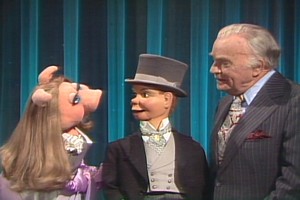
In the golden age of radio the 1930s-40s (before TV took over) everyone in America knew the voices of comedians like Fred Allen, Jack Benny, Edgar Bergen and Charlie McCarthy. The best material resulted from pretend feuds between them, which provided lots of insult gag opportunities. There was the original east-west rivalry in NYC-based Fred Allen vs. LA-based Jack Benny and one between Charlie McCarthy and W.C. Fields. The latter was more complicated as Fields didn't have his own show, was an established film star, and Charlie was, well, a hunk of wood with a shy not especially charismatic Swede attached. If aliens one day pick up our radio signals in space, some of the first things they hear won't be SETI, but these old radio shows still flying out into space bouncing around in the void, and they'll probably scratch their heads, especially over Edgar and Charlie. A ventriloquist on the radio? What were those Hu-Mans thinking?

 
I got into old radio shows as a kid in the 70s after hearing THE SHADOW Sunday nights on PBS's radio station, which I received on my little clock radio. This was the closest thing, aside from an actual film projector, one could get in the 70s to a VCR. Being able to listen to creepy shows like Inner Sanctum and The Shadow in my bedroom, all the lights off, put the hook in me, and the comedy was reassuring, especially if you were an avid watcher of Bugs Bunny cartoons, then in constant afternoon rotation, as guest voices from those shows constantly showed up, betraying their origins (i.e Foghorn Leghorn based on Senator Claghorn in Allen's Alley; the dopey buzzard based on Mortimer Snerd; Mel Blanc a regular on the Jack Benny show, etc). Still seeing Allen, Gildersleeve and Edgar Bergen and Fibber McGee all for the first time in this one old movie gave me the creeps. It took a long time to forget about that unpleasant frisson and just enjoy as I had enjoyed in my innocence...

The Siamese twin Hilton Sisters in Freaks (1933)
Edgar Bergen and two animate objects
Bergen and McCarthy especially were quite jarring on film, which is strange since the whole reason a ventriloquist act should work is our tendency towards anthropomorphism, the way our minds see a human shape, moving its mouth, and hear a voice, so we link them together. It's unconscious, beyond our control, hence the uncanny frisson; but on radio it's much easier to imagine Charlie McCarthy as a separate entity, existing in a fantasmatic rather than uncanny dimension. In their elder statesman days on the Muppet Show Bergen and his wood fit right in, but muppets are different than human actors or ventriloquist dummies, more colorful and with some level of expression gained through the full range of fingers along the wide felt mouth--and with no handler visible--but Charlie's mouth is kind of robotic, his dead eyes stare right through you and that jaw moves up and down but that's it-- and Edgar is always literally an arms length away. For some reason I still find Charlie terrifying in 'person' and Edgar kind of anemic and 'half' there. The whole issue of the ebony demon with his silver cornucopia comes roaring back when you have close-ups of old wooden Charlie McCarthy, his mouth moving up and down like a macabre robot, his dead eyes refusing all attempts to project emotion. When handler Edgar tries to get it on with a girl and, while explaining to her how ventriloquism works, his dummy keeps talking, sabotaging any attempt at cool, it makes him seem quite dysfunctional, like he's got a kind of projected Tourette syndrome. It's FREAKS-ish, i.e. the scene with the Siamese twins and the frisson-laden idea of loving one 'half' of a whole while the other half hangs around, vibing or cockblocking depending on whether the subject is split or not. Edgar is incomplete on his own, he is not a 'puppet proper.' His persona is diluted and partially externalized into a soft-voiced half-man. If you have  to have a talking piece of wood, saying "why don't you kiss her and get it over with?" before your first meeting is halfway through, you are officially a creep.


My first viewings of Bergen's big starring feature debut with WC Fields, YOU CAN'T CHEAT AN HONEST MAN (1938) were from an old afternoon UHF TV show, sped up and edited for time (and racism) as they used to do in those days. It was great on a fuzzy small TV screen, the uncanny valley was less uncanny, and I saw it dozens of times and became quite familiar with its comedic rhythms. Years later now, on DVD, the film is stretched back to normal running time, so it seems to move super slow, with dead air moments. Now the picture is super clear and scenes I've never seen have been restored, and now McCarthy's uncanny automaton qualities are much too pronounced to ignore. His close-ups seem like some home movie some devout pagan idol worshiper would make for Andy Warhol... if Warhol was into puppetry.

Fields' scenes were often shot by Eddie Cline, separately from Charlie's, helping the timeless-strange aspect along as Cline had a much better knack for ramshackle comedy than the film's official director George Marshall. Also helping is Field's obvious alcoholism: he staggers through the film in a zig-zag, avoiding the major 'marks' the way his character avoids the process server, preferring to run through his litany of old circus impresario gags from THE OLD FASHIONED WAY, SALLY OF THE SAWDUST, and so on, rather than engaging directly with the material before him.


It's a smart movie because, as a narrative, YOU CAN'T CHEAT AN HONEST MAN is pure hokum, old hat even in the silent age. And as a romance, it lives and dies in the soft dulcet 'real' voice of Charlie McCarthy's handler, Edgar Bergen, and some anonymous wartime heroine, playing Fields' daughter, bravely trying to seem not creeped out by the fact her love interest can't let go of his wooden 'buddy' even to hold her hand, yet he wants to marry her although he only met her a few hours earlier. Ick. Luckily the scenes with Larson E. Whipsnade doing his timeless but 'off' carny acts (subbing for the bearded lady sharpshooter, etc) are hilarious, like a jazz solo springing off the crusty familiarity of the tune (like Coltrane riffing on "My Favorite Things") and the weirdness of the overall film pays off in a skewed three-prong textual dissolve:


'Textual' Prong #1 - Meta - CHEAT is a relic of a bygone age and I love it largely for my own memories of what was going on in my life (the first warm glow of drink, that golden nectar) when I first taped it, a day I stayed home sick to edit out the commercials and then felt guilty all day as my mom stink-eyed me from the kitchen. I've seen it dozens of times. Dozens. That guilty depressed feeling staying home was almost totally wiped out by years of drinking to it late in the AM, but now that I'm sober that stain remains, and now that it's on DVD and I'm on meds, I get all the various stages of 'me' viewing its earlier 'home-edited' edition as well as this new one. The film's hokey datedness encourages such long term relationships - each new viewing holds surprises.


Prong 2 - Sub - The Brechtian-reflexive schtick with the creepy dual come-on of Bergen and McCarthy to Vicky. Charlie's telling Edgar to tell Vicky he loves her and wants to marry her before he has even kissed her (he can't kiss her because Charlie would be stricken mute, or else Vicky would hear Charlie in her molars). And Fields lamenting when a native steals the cork out of his lunch or daring you to guess whether his lines are intentionally or unintentionally fumbled or written that way.

Prong 3 - Inter - The nostalgia of the early Americana circus film was once a huge part of any sawdust-covered five cent cinema's rotation, especially in the silent era: there was always a sad clown played by Lon Chaney or Wallace Ford, who loves the acrobat but she's under the thumb of the abusive strong man; there was also the rich kid scheduled to marry a stuffy heiress but loves the waif; a poor kid romance 'meller' of the "I'll pay the rent!" variety that careened around the country in Fields' heyday: it's this corny schtick that Fields grew up watching and acting in (he was a long time circus juggler) which he is here lampooning.

In other words Fields is parodying genres of film that most of us have never seen nor would we want to. Most of them are deservedly long gone. HONEST MAN is a 'parody' of the sawdust-soaked cliches of Fields' youth, the innocent abroad with his hankerin' for the city (as Fields lambasts in FATAL GLASS OF BEER), the rich but loveless family of snobs Fields' daughter is willing to marry into if it means getting the circus out of debt: it is not just a parody of turn-of-the-century wealthy snobbery, but of Hollywood's past depictions of same, including Fields starring silent vehicles like SALLY OF THE SAWDUST.


Small wonder then, that Edgar's competition for Field's daughter's hand is the aptly named Roger Belgoode III. The scenes of class clashes and chaste romance were mockable cliches even in the 1930s, and this third prong represents that intertextual nostalgia the film carries for the lost era of full-length bathing suits, opium pipes, theater organs, and flagpole sitters. Back in 1938, this cornball stuff was their That 70s Show. 


CHEAT also grows less stilted once Fields sends Bergen and Charlie adrift in a hot air balloon and they discover Mortimer Snerd has been sleeping in the basket. For some reason, Snerd eases the creepy affect from all the McCarthy close-ups. Watching a puppet open and close its mouth while Edgar talks to himself, phrasing the set ups to his jokes in such archaic language they could only hold punchlines on the other end ("Is you mother living yet?" - "No, not yet") is less creepy for some reason once there are two puppets interacting with Edgar. It helps too that there are no other people around, especially not a girl. It helps too that Snerd is supposed to be dead-eyed and moronic. It's because he's an idiot that this hood-eyed hunk of wood is more relatable than the shark-eyed Charlie.


This was Edgar's feature film debut and he seems nervous and shy. Talking in an effeminate little whisper he's too dependent on his dummy to become a 'leading man' who can believably engage in romantic relations. He would make more films and get a better sense of a separate identity, but here he seems naught but a shadow. Expecting a girl to give up a cozy rich scenario to save her dad's circus in order to fall in love with this split subject wreck is so unreasonable it's kind of insulting.

And yet, the interesting thing about Bergen here is the example of just how fucked a ventriloquist who gets successful is: Bergen/Charlie must now and forever stay split. Bergen's real daughter Candice may know the separate Edgar, her father, without the dummies, but do we? Does Vicky? Bergen's 'own' voice has grown soft and delicate in relation to Charlie's far wider range, the way a couple overcompensates for each other's perceived faults; his eyes stay half-focused on his wooden 'other' as if in a trance. This is his Faustian bargain for success - "he" has become his "other's" puppet. The literal half-man --when he speaks as himself his voice is lowered and soft and girly, as if he has nowhere to throw it because no one will have it. He says his lines nervously, ashamed of his lips moving. This is all done no doubt so Charlie and Mortimer seem louder, but instead their combined split subject performing carries a cold dead air -- not helped by the fact that no one in the circus audiences ever laughs at or enjoys their show. I mean how hard would it have been to add some laughter from the crowd rather than letting the poor chump twist in the wind?

No wonder then that Bergen is such a perfect foil for Fields... on the radio. Similarly mired in a defective ego ideal --the liquored-up charlatan, Fields can duel Charlie with pithy one-liners and simultaneously neither actor need even be 'present' -- Fields stays in his cups and Bergen in his dolls - what their duels have, then, is something beyond acting, a multiplication of interlocked archetype slitters right up there with eerie totem pole sacrifices we see in films like THE WICKER MAN or England's Guy Fawkes effigies.

Fields in one of his many ingenious disguises
 The ultimate difference between Fields and Bergen (now that I'm sober this seems especially glaring) is that while they both effectively hide in plain sight through deceptive means, one is multiplied and the other divided: Bergen's deception is 'thrown' (external); Fields' is 'drunk' (internal), Fields slowly vanishes down a beer tap drain while Edgar multiplies like a hydra until he's neither here nor there, but solely in the interaction between here and there. The romance between Edgar and Vicky is therefore as creepy as incest, since it automatically infers a menage a trois with an inanimate object and ensures you can only marry half a person - and kissing them for any length of time essentially strangles their Siamese other. 

The main love relationship Fields has in his films by contrast is always a chaste paternal one, with a daughter or niece since he is in effect already happily married to gin which doesn't talk but rather is consumed utterly, so Fields in a sense is always in the process of sneaking away in plain sight, drinking his 'other' back into the void, and then being drunk in turn; he mutters to himself under his breath like the very air around him is his dummy, and everything he does or said he had done or said before ("Dragging my canoe behind me!") in his other films is done and said again. As all drunks repeat their stories and sentiments endlessly, so too does Fields repeat his stories and bits from film to film to his straight men, be they A-list stars, poker tables, cigar store Indians, hick extras, or oblivious family members absorbed in their own petty breakfast gossip. So in a sense Fields has an open dialogue not with an external totem of himself as Edgar does, but with a ghost, a half Fields referencing a 1/4 Fields, and so on... until he's so infinitesimally small he becomes bigger than all creation... 
Related Posts Plugin for WordPress, Blogger...